


ISO 6508-3:2015
(Main)Metallic materials — Rockwell hardness test — Part 3: Calibration of reference blocks
Metallic materials — Rockwell hardness test — Part 3: Calibration of reference blocks
ISO 6508-3:2015 specifies a method for the calibration of reference blocks to be used for the indirect and daily verification of Rockwell hardness testing machines, as specified in ISO 6508‑2:2015. Attention is drawn to the fact that the use of hard metal for ball indenters is considered to be the standard type of Rockwell indenter ball. Steel indenter balls can be used only when complying with ISO 6508‑1:2015, Annex A.
Matériaux métalliques — Essai de dureté Rockwell — Partie 3: Étalonnage des blocs de référence
L'ISO 6508-3:2015 spécifie une méthode pour l'étalonnage des blocs de référence à utiliser pour la vérification indirecte et la vérification quotidienne des machines d'essai de dureté Rockwell, comme spécifié dans l'ISO 6508‑2:2015. L'attention est attirée sur le fait que l'utilisation de métaux durs pour les pénétrateurs à billes est considérée être le type courant de bille de pénétrateur Rockwell. Des billes de pénétrateur en acier peuvent continuer d'être utilisées seulement en conformité avec l'Annexe A de l'ISO 6508‑1:2015.
General Information
- Status
- Withdrawn
- Publication Date
- 24-Feb-2015
- Technical Committee
- ISO/TC 164/SC 3 - Hardness testing
- Drafting Committee
- ISO/TC 164/SC 3 - Hardness testing
- Current Stage
- 9599 - Withdrawal of International Standard
- Start Date
- 13-Dec-2023
- Completion Date
- 12-Feb-2026
Relations
- Effective Date
- 12-Feb-2026
- Consolidated By
ISO 8028:2017 - Rubber and/or plastics hoses and hose assemblies for airless paint spraying — Specification - Effective Date
- 06-Jun-2022
- Effective Date
- 06-Jun-2022
- Effective Date
- 30-Apr-2011



Get Certified
Connect with accredited certification bodies for this standard

Element Materials Technology
Materials testing and product certification.

Inštitut za kovinske materiale in tehnologije
Institute of Metals and Technology. Materials testing, metallurgical analysis, NDT.
Sponsored listings
Frequently Asked Questions
ISO 6508-3:2015 is a standard published by the International Organization for Standardization (ISO). Its full title is "Metallic materials — Rockwell hardness test — Part 3: Calibration of reference blocks". This standard covers: ISO 6508-3:2015 specifies a method for the calibration of reference blocks to be used for the indirect and daily verification of Rockwell hardness testing machines, as specified in ISO 6508‑2:2015. Attention is drawn to the fact that the use of hard metal for ball indenters is considered to be the standard type of Rockwell indenter ball. Steel indenter balls can be used only when complying with ISO 6508‑1:2015, Annex A.
ISO 6508-3:2015 specifies a method for the calibration of reference blocks to be used for the indirect and daily verification of Rockwell hardness testing machines, as specified in ISO 6508‑2:2015. Attention is drawn to the fact that the use of hard metal for ball indenters is considered to be the standard type of Rockwell indenter ball. Steel indenter balls can be used only when complying with ISO 6508‑1:2015, Annex A.
ISO 6508-3:2015 is classified under the following ICS (International Classification for Standards) categories: 77.040.10 - Mechanical testing of metals. The ICS classification helps identify the subject area and facilitates finding related standards.
ISO 6508-3:2015 has the following relationships with other standards: It is inter standard links to EN ISO 6508-3:2015, ISO 8028:2017, ISO 6508-3:2023, ISO 6508-3:2005. Understanding these relationships helps ensure you are using the most current and applicable version of the standard.
ISO 6508-3:2015 is available in PDF format for immediate download after purchase. The document can be added to your cart and obtained through the secure checkout process. Digital delivery ensures instant access to the complete standard document.
Standards Content (Sample)
INTERNATIONAL ISO
STANDARD 6508-3
Third edition
2015-03-01
Metallic materials — Rockwell
hardness test —
Part 3:
Calibration of reference blocks
Matériaux métalliques — Essai de dureté Rockwell —
Partie 3: Étalonnage des blocs de référence
Reference number
©
ISO 2015
© ISO 2015
All rights reserved. Unless otherwise specified, no part of this publication may be reproduced or utilized otherwise in any form
or by any means, electronic or mechanical, including photocopying, or posting on the internet or an intranet, without prior
written permission. Permission can be requested from either ISO at the address below or ISO’s member body in the country of
the requester.
ISO copyright office
Case postale 56 • CH-1211 Geneva 20
Tel. + 41 22 749 01 11
Fax + 41 22 749 09 47
E-mail copyright@iso.org
Web www.iso.org
Published in Switzerland
ii © ISO 2015 – All rights reserved
Contents Page
Foreword .iv
1 Scope . 1
2 Normative references . 1
3 Manufacture of reference blocks . 1
4 Calibration machine and calibration indenter . 2
4.1 General . 2
4.2 Calibration machine . 2
4.3 Calibration diamond indenter . 2
4.4 Calibration ball indenter . 4
5 Calibration procedure . 4
6 Number of indentations . 5
7 Uniformity of hardness . 5
8 Marking . 6
9 Calibration certificate . 7
10 Validity . 7
Annex A (normative) Uniformity of reference blocks . 8
Annex B (informative) Uncertainty of the mean hardness value of hardness-reference blocks .10
Annex C (normative) Requirements for reference diamond indenters .16
Bibliography .17
Foreword
ISO (the International Organization for Standardization) is a worldwide federation of national standards
bodies (ISO member bodies). The work of preparing International Standards is normally carried out
through ISO technical committees. Each member body interested in a subject for which a technical
committee has been established has the right to be represented on that committee. International
organizations, governmental and non-governmental, in liaison with ISO, also take part in the work.
ISO collaborates closely with the International Electrotechnical Commission (IEC) on all matters of
electrotechnical standardization.
The procedures used to develop this document and those intended for its further maintenance are
described in the ISO/IEC Directives, Part 1. In particular the different approval criteria needed for the
different types of ISO documents should be noted. This document was drafted in accordance with the
editorial rules of the ISO/IEC Directives, Part 2 (see www.iso.org/directives).
Attention is drawn to the possibility that some of the elements of this document may be the subject of
patent rights. ISO shall not be held responsible for identifying any or all such patent rights. Details of any
patent rights identified during the development of the document will be in the Introduction and/or on
the ISO list of patent declarations received (see www.iso.org/patents).
Any trade name used in this document is information given for the convenience of users and does not
constitute an endorsement.
For an explanation on the meaning of ISO specific terms and expressions related to conformity
assessment, as well as information about ISO’s adherence to the WTO principles in the Technical Barriers
to Trade (TBT) see the following URL: Foreword - Supplementary information
The committee responsible for this document is ISO/TC 164, Mechanical testing of metals, Subcommittee
SC 3, Hardness testing.
This third edition cancels and replaces the second edition (ISO 6508-3:2005), which has been
technically revised.
ISO 6508 consists of the following parts, under the general title Metallic materials — Rockwell hardness test:
— Part 1: Test method
— Part 2: Verification and calibration of testing machines and indenters
— Part 3: Calibration of reference blocks
iv © ISO 2015 – All rights reserved
INTERNATIONAL STANDARD ISO 6508-3:2015(E)
Metallic materials — Rockwell hardness test —
Part 3:
Calibration of reference blocks
1 Scope
This part of ISO 6508 specifies a method for the calibration of reference blocks to be used for the indirect
and daily verification of Rockwell hardness testing machines, as specified in ISO 6508-2:2015.
Attention is drawn to the fact that the use of hard metal for ball indenters is considered to be the
standard type of Rockwell indenter ball. Steel indenter balls can be used only when complying with
ISO 6508-1:2015, Annex A.
2 Normative references
The following documents, in whole or in part, are normatively referenced in this document and are
indispensable for its application. For dated references, only the edition cited applies. For undated
references, the latest edition of the referenced document (including any amendments) applies.
ISO 376, Metallic materials — Calibration of force-proving instruments used for the verification of uniaxial
testing machines
ISO 6508-1:2015, Metallic materials — Rockwell hardness test — Part 1: Test method
ISO 6508-2:2015, Metallic materials — Rockwell hardness test — Part 2: Verification and calibration of
testing machines and indenters
3 Manufacture of reference blocks
3.1 The block shall be specially manufactured for use as a hardness-reference block.
NOTE Attention is drawn to the need to use a manufacturing process, which will give the necessary
homogeneity, stability of structure, and uniformity of surface hardness.
3.2 Each hardness reference block shall be of a thickness not less than 6 mm. To minimize the effect of
hardness change with increasing number of indents, thicker blocks should be used.
3.3 The reference blocks shall be free of magnetism. It is recommended that the manufacturer ensure
that the blocks, if made of steel, have been demagnetized at the end of the manufacturing process (before
calibration).
3.4 The deviation from surface flatness of the top and bottom surfaces shall be ≤0,01 mm. The bottom
of the blocks shall not be convex. The deviation from parallelism of the top and bottom surfaces shall
be ≤0,02 mm per 50 mm.
3.5 The test surface and lower surface shall be free from damage, such as notches, scratches, oxide
layers, etc., which can interfere with the measurement of the indentations. The surface roughness, Ra,
shall not exceed 0,000 3 mm for the test surface and 0,000 8 mm for the bottom surface. Sampling length
is l = 0,8 mm (see ISO 4287:1997, 3.1.9).
3.6 To verify that no material is subsequently removed from the reference block, the thickness at the
time of calibration shall be marked on it, to the nearest 0,1 mm, or an identifying mark shall be made on
the test surface [see 8.1 e)].
4 Calibration machine and calibration indenter
4.1 General
4.1.1 Calibrations and verifications of Rockwell calibration machines and calibration indenters shall be
carried out at a temperature of (23 ± 5) °C.
4.1.2 The instruments used for calibration shall be traceable to national standards.
4.2 Calibration machine
4.2.1 In addition to fulfilling the general conditions specified in ISO 6508-2:2015, Clause 3, the
calibration machine shall also meet the requirements given in 4.2.2, 4.2.3, 4.2.4, 4.2.5, and 4.2.6.
4.2.2 The machine shall be directly verified in intervals not exceeding 12 months. Direct verification
involves calibration and verification of the following:
a) test force;
b) measuring system;
c) testing cycle; if this is not possible, at least the force versus time behaviour.
4.2.3 The test force shall be measured by means of an elastic proving device (according to ISO 376) class
0,5 or better and calibrated for reversibility, or by another method having the same or better accuracy.
Evidence should be available to demonstrate that the output of the force-proving device does not vary
by more than 0,1 % in a period of 1 s to 30 s, following a stepped change in force.
4.2.4 Each test force shall be measured and shall agree with the nominal preliminary test force, F , to
within ±0,2 % and the nominal total test force, F, to within ±0,1 %.
4.2.5 The measuring system shall have a resolution of ±0,000 1 mm and a maximum expanded
uncertainty of 0,000 2 mm, when calculated with a confidence level of 95 % over its working range.
4.2.6 The testing cycle shall be timed with an uncertainty less than ±0,5 s and shall conform to the
testing cycle of Clause 5.
4.3 Calibration diamond indenter
4.3.1 The geometric shape and performance of calibration diamond indenters shall be calibrated as
defined below. Direct verification of the geometric shape shall be made before first use and at a frequency
of no greater than five years. Verification of the indenter performance, as specified in 4.3.3, shall be made
before first use and at a frequency of no greater than 12 months.
4.3.2 The diamond indenter shall be measured on at least eight unique axial section planes equidistant
from each other (e.g. the eight cross-sections will be spaced approximately 22,5° apart at 0°, 22,5°, 45°,
67,5°, 90°, 112,5°, 135°, 157,5°), and shall meet the following requirements:
2 © ISO 2015 – All rights reserved
a) The cone angle shall be measured adjacent to the blend. The diamond cone shall have a mean included
angle of (120 ± 0,1)°. In each measured axial section, the included angle shall be (120 ± 0,17)°.
b) The mean deviation from straightness of the generatrix of the diamond cone adjacent to the blend
shall not exceed 0,000 5 mm over a minimum length of 0,4 mm. In each measured section, the
deviation shall not exceed 0,000 7 mm.
c) The radius of the spherical tip of the diamond shall be measured adjacent to the blend. The tip shall
have a mean radius of (0,200 ± 0,005) mm. In each measured section, the radius shall be within
(0,200 ± 0,007) mm and local deviations from a true radius shall not exceed 0,002 mm.
NOTE The tip of the diamond indenter is usually not truly spherical, but often varies in radius across
its surface. Depending on the crystallographic orientation of the diamond stone with respect to the indenter
axis, diamond tends to preferentially polish away more easily or with more difficulty at the tip, producing an
increasingly flat or sharp surface in the central indenter axis region. The sphericity of the diamond tip can be
better evaluated by measuring multiple measurement windows of varying width. The measurement window
would be bounded by widths measured along a line normal to the indenter axis. For example, the following
window sizes can be evaluated:
— between ±80 µm from the indenter axis;
— between ±60 µm from the indenter axis;
— between ±40 µm from the indenter axis.
d) The surfaces of the cone and the spherical tip shall blend in a smooth tangential manner. The
location where the spherical tip and the cone of the diamond blend together will vary depending on
the values of the tip radius and cone angle. Ideally for a perfect indenter geometry, the blend point
is located at 100 µm from the indenter axis measured along a line normal to the indenter axis. To
avoid including the blend area in the measurement of the tip radius and cone angle, the portion of
the diamond surface between 90 µm and 110 µm should be ignored.
e) The inclination of the axis of the diamond cone to the axis of the indenter holder (normal to the
seating surface) shall be within 0,3°.
4.3.3 Calibration diamond indenters shall be performance verified by performing comparison tests with
reference diamond indenter(s) that meet the requirements of Annex C. Calibration diamond indenters
can be verified for use on either regular or superficial Rockwell diamond scales or both. The test blocks
used for the comparison testing shall meet the requirements of Clause 3 and be calibrated at the hardness
levels given in Table 1, Table 2, Table 3, or Table 4, depending on the scales for which the indenter is
verified. The testing shall be carried out in accordance with ISO 6508-1:2015.
NOTE The alternate hardness levels given in Table 2 are provided to accommodate indenters calibrated to other
International Standards. It is believed that calibrations conducted to Table 1 or Table 2 will yield equivalent results.
For each block, the mean hardness value of three indentations made using the calibration diamond
indenter to be verified shall not differ from the mean hardness value of three indentations obtained
with a reference diamond indenter by more than ±0,4 Rockwell units. The indentations made with the
calibration diamond indenter to be verified and with the reference diamond indenter should be adjacent.
Table 1 — Hardness levels for indenters to be used for calibrating Rockwell regular and
superficial scale test blocks (A, C, D, and N)
Scale Nominal hardness Ranges
HRC 23 20 to 26
HRC 55 52 to 58
HR45N 43 40 to 46
HR15N 91 88 to 94
Table 2 — Alternate hardness levels for indenters to be used for calibrating Rockwell regular
and superficial scale test blocks (A, C, D, and N)
Scale Nominal hardness Ranges
HRC 25 22 to 28
HRC 63 60 to 65
HR30N 64 60 to 69
HR15N 91 88 to 94
Table 3 — Hardness levels for indenters to be used for calibrating Rockwell regular scale test
blocks only (A, C, and D)
Scale Nominal hardness Ranges
HRC 25 22 to 28
HRC 45 42 to 50
HRC 63 60 to 65
HRA 81 78 to 84
Table 4 — Hardness levels for indenters to be used for calibrating Rockwell superficial scale
test blocks only (N)
Scale Nominal hardness Ranges
HR15N 91 88 to 94
HR30N 64 60 to 69
HR30N 46 42 to 50
HR45N 25 22 to 29
4.4 Calibration ball indenter
4.4.1 The calibration tungsten carbide composite ball shall be replaced at a frequency no greater
than 12 months.
4.4.2 Calibration tungsten carbide composite balls shall meet the requirements of ISO 6508-2:2015,
with the exception of the following tolerances for the ball diameter:
— ±0,002 mm for the ball of diameter 1,587 5 mm;
— ±0,003 mm for the ball of diameter 3,175 mm.
5 Calibration procedure
5.1 The reference blocks shall be calibrated in a calibration machine as described in Clause 4, at a
temperature of (23 ± 5) °C, using the general procedure described in ISO 6508-1:2015.
During calibration, the thermal drift should not exceed 1 °C.
5.2 The velocity of the indenter, when it comes into contact with the surface, shall not exceed 1 mm/s.
The velocity of the indenter, when it comes into contact with the surface, should not exceed 0,3 mm/s
for undamped systems.
4 © ISO 2015 – All rights reserved
5.3 Bring the indenter into contact with the test surface and apply the preliminary test force, F , without
shock or vibration and without oscillation or overload of the test force. The application time, T , of the
a
preliminary test force, F , shall not exceed 2 s.
The duration, T , of the preliminary test force, F , shall be equal to (3 ± 1) s, as shown in Formula (1):
p 0
TT=+23T =±1 s (1)
()
pa pm
where
T is the preliminar
...
INTERNATIONAL ISO
STANDARD 6508-3
Troisième edition
2015-03-01
Matériaux métalliques — Essai de
dureté Rockwell —
Partie 3:
Étalonnage des blocs de référence
Metallic materials — Rockwell hardness test —
Part 3: Calibration of reference blocks
Reference number
©
ISO 2015
© ISO 2015
All rights reserved. Unless otherwise specified, no part of this publication may be reproduced or utilized otherwise in any form
or by any means, electronic or mechanical, including photocopying, or posting on the internet or an intranet, without prior
written permission. Permission can be requested from either ISO at the address below or ISO’s member body in the country of
the requester.
ISO copyright office
Case postale 56 • CH-1211 Geneva 20
Tel. + 41 22 749 01 11
Fax + 41 22 749 09 47
E-mail copyright@iso.org
Web www.iso.org
Published in Switzerland
ii © ISO 2015 – All rights reserved
Contents Page
Avant-propos .iv
1 Domaine d’application . 1
2 Références normatives . 1
3 Fabrication des blocs de référence . 1
4 Machine d’étalonnage et pénétrateur d’étalonnage. 2
4.1 Généralités . 2
4.2 Machine d’étalonnage . 2
4.3 Pénétrateur diamant pour étalonnage . 2
4.4 Pénétrateur à bille pour étalonnage . 4
5 Mode opératoire d’étalonnage . 5
6 Nombre d’empreintes . 5
7 Uniformité de la dureté . 6
8 Marquage . 7
9 Certificat d’étalonnage . 7
10 Validité . 8
Annexe A (normative) Uniformité des blocs de référence . 9
Annexe B (informative) Incertitude de la valeur de dureté moyenne des blocs de référence
de dureté .11
Annexe C (normative) Prescriptions relatives aux pénétrateurs diamant de référence .17
Bibliographie .18
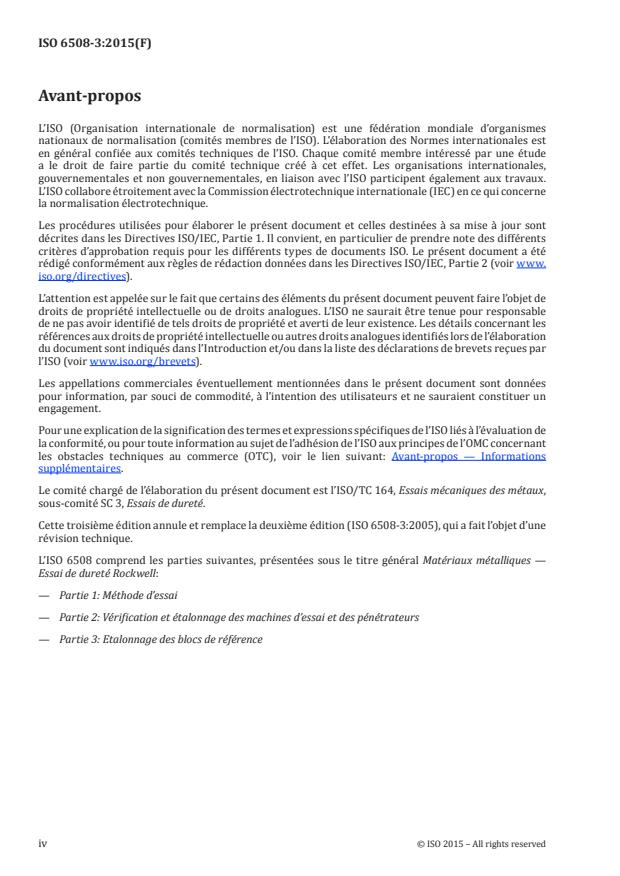
Avant-propos
L’ISO (Organisation internationale de normalisation) est une fédération mondiale d’organismes
nationaux de normalisation (comités membres de l’ISO). L’élaboration des Normes internationales est
en général confiée aux comités techniques de l’ISO. Chaque comité membre intéressé par une étude
a le droit de faire partie du comité technique créé à cet effet. Les organisations internationales,
gouvernementales et non gouvernementales, en liaison avec l’ISO participent également aux travaux.
L’ISO collabore étroitement avec la Commission électrotechnique internationale (IEC) en ce qui concerne
la normalisation électrotechnique.
Les procédures utilisées pour élaborer le présent document et celles destinées à sa mise à jour sont
décrites dans les Directives ISO/IEC, Partie 1. Il convient, en particulier de prendre note des différents
critères d’approbation requis pour les différents types de documents ISO. Le présent document a été
rédigé conformément aux règles de rédaction données dans les Directives ISO/IEC, Partie 2 (voir www.
iso.org/directives).
L’attention est appelée sur le fait que certains des éléments du présent document peuvent faire l’objet de
droits de propriété intellectuelle ou de droits analogues. L’ISO ne saurait être tenue pour responsable
de ne pas avoir identifié de tels droits de propriété et averti de leur existence. Les détails concernant les
références aux droits de propriété intellectuelle ou autres droits analogues identifiés lors de l’élaboration
du document sont indiqués dans l’Introduction et/ou dans la liste des déclarations de brevets reçues par
l’ISO (voir www.iso.org/brevets).
Les appellations commerciales éventuellement mentionnées dans le présent document sont données
pour information, par souci de commodité, à l’intention des utilisateurs et ne sauraient constituer un
engagement.
Pour une explication de la signification des termes et expressions spécifiques de l’ISO liés à l’évaluation de
la conformité, ou pour toute information au sujet de l’adhésion de l’ISO aux principes de l’OMC concernant
les obstacles techniques au commerce (OTC), voir le lien suivant: Avant-propos — Informations
supplémentaires.
Le comité chargé de l’élaboration du présent document est l’ISO/TC 164, Essais mécaniques des métaux,
sous-comité SC 3, Essais de dureté.
Cette troisième édition annule et remplace la deuxième édition (ISO 6508-3:2005), qui a fait l’objet d’une
révision technique.
L’ISO 6508 comprend les parties suivantes, présentées sous le titre général Matériaux métalliques —
Essai de dureté Rockwell:
— Partie 1: Méthode d’essai
— Partie 2: Vérification et étalonnage des machines d’essai et des pénétrateurs
— Partie 3: Etalonnage des blocs de référence
iv © ISO 2015 – All rights reserved
INTERNATIONAL STANDARD ISO 6508-3:2015(F)
Matériaux métalliques — Essai de dureté Rockwell —
Partie 3:
Étalonnage des blocs de référence
1 Domaine d’application
La présente partie de l’ISO 6508 spécifie une méthode pour l’étalonnage des blocs de référence à utiliser
pour la vérification indirecte et la vérification quotidienne des machines d’essai de dureté Rockwell,
comme spécifié dans l’ISO 6508-2:2015.
L’attention est attirée sur le fait que l’utilisation de métaux durs pour les pénétrateurs à billes est
considérée être le type courant de bille de pénétrateur Rockwell. Des billes de pénétrateur en acier
peuvent continuer d’être utilisées seulement en conformité avec l’Annexe A de l’ISO 6508-1:2015.
2 Références normatives
Les documents suivants, en tout ou partie, sont référencés de façon normative dans le présent document
et sont indispensables à son application. Pour les références datées, seule l’édition citée s’applique.
Pour les références non datées, la dernière édition du document de référence s’applique (y compris les
éventuels amendements).
ISO 376, Matériaux métalliques — Étalonnage des instruments de mesure de force utilisés pour la vérification
des machines d’essais uniaxiaux
ISO 6508-1:2015, Matériaux métalliques — Essai de dureté Rockwell — Partie 1: Méthode d’essai
ISO 6508-2:2015, Matériaux métalliques — Essai de dureté Rockwell — Partie 2: Vérification et étalonnage
des machines d’essai et des pénétrateurs
3 Fabrication des blocs de référence
3.1 Le bloc doit être spécialement fabriqué pour utilisation comme bloc de référence de dureté.
NOTE L’attention est attirée sur la nécessité d’utiliser un procédé de fabrication qui assurera l’homogénéité,
la stabilité de la structure et l’uniformité de la dureté de surface nécessaires.
3.2 Chaque bloc de référence de dureté doit avoir une épaisseur au moins égale à 6 mm. Pour minimiser
l’effet de changement de dureté avec un nombre croissant d’empreintes, il convient d’utiliser des blocs
plus épais.
3.3 Les blocs de référence ne doivent pas être aimantés. II est recommandé que le fabricant s’assure que
les blocs, s’ils sont en acier, ont été désaimantés à la fin du processus de fabrication (avant étalonnage).
3.4 L’écart de planéité de surface entre les surfaces supérieure et inférieure doit être ≤ 0,01 mm.
Le dessous des blocs ne doit pas être convexe. L‘écart de parallélisme entre les surfaces supérieure et
inférieure doit être ≤ 0,02 mm sur 50 mm.
3.5 La surface d’essai et la surface inférieure doivent être exemptes de tout endommagement tel
qu’entailles, rayures, couches d’oxyde, etc. pouvant interférer avec le mesurage des empreintes. La
rugosité de surface, R , ne doit pas dépasser 0,000 3 mm pour la surface d’essai et 0,000 8 mm pour la
a
face inférieure. La longueur d’échantillonnage est l = 0,8 mm (voir ISO 4287:1997, 3.1.9).
3.6 Afin de vérifier qu’il n’a pas été enlevé ultérieurement de matière sur le bloc de référence, l’épaisseur
au moment de l’étalonnage, arrondie à 0,1 mm près, doit être marquée sur celui-ci ou une marque
d’identification doit être apposée sur la surface d’essai [voir 8.1 e)].
4 Machine d’étalonnage et pénétrateur d’étalonnage
4.1 Généralités
4.1.1 Les étalonnages et les vérifications des machines d’étalonnage et des pénétrateurs d’étalonnage
Rockwell doivent être réalisés à une température de (23 ± 5) °C.
4.1.2 Les instruments utilisés pour l’étalonnage doivent pouvoir être raccordés aux étalons nationaux.
4.2 Machine d’étalonnage
4.2.1 Outre le respect des prescriptions générales spécifiées à l’Article 3 de l’ISO 6508-2:2015, la
machine d’étalonnage doit également satisfaire aux prescriptions données aux 4.2.2, 4.2.3, 4.2.4, 4.2.5 et
4.2.6.
4.2.2 La machine doit faire l’objet d’une vérification directe à intervalles ne dépassant pas 12 mois. La
vérification directe comporte l’étalonnage et la vérification des éléments suivants:
a) force d’essai;
b) système de mesure;
c) cycle d’essai; si cela n’est pas possible, au moins le comportement force en fonction du temps.
4.2.3 La force d’essai doit être mesurée au moyen d’un instrument élastique de mesure de force
(conforme à l’ISO 376), de classe 0,5 ou meilleure et étalonné pour la réversibilité ou par une autre
méthode ayant la même exactitude ou une exactitude meilleure.
4.2.4 Chaque force d’essai doit être mesurée et doit être en accord avec la force d’essai préliminaire
nominale, F , à ± 0,2 % près, et la force d’essai totale nominale, F, à ± 0,1 % près.
4.2.5 Le système de mesure doit avoir une résolution de ± 0,000 1 mm et une incertitude étendue
maximale de 0,000 2 mm, lorsqu’elle est calculée avec un niveau de confiance de 95 %, sur son intervalle
de travail.
4.2.6 Le cycle d’essai doit être fixé avec une incertitude inférieure à ± 0,5 s et doit être conforme au
cycle d’essai de l’Article 5.
4.3 Pénétrateur diamant pour étalonnage
4.3.1 La forme géométrique et les performances des pénétrateurs diamant pour étalonnage doivent être
étalonnées comme défini ci-après. La vérification directe de la forme géométrique doit être réalisée avant
la première utilisation et à une fréquence non supérieure à cinq ans. La vérification des performances du
pénétrateur, telle que spécifiée au 4.3.3, doit être réalisée avant la première utilisation et à une fréquence
non supérieure à 12 mois.
2 © ISO 2015 – All rights reserved
4.3.2 Le pénétrateur diamant doit être mesuré dans au moins huit sections planes axiales individuelles,
équidistantes les unes des autres (par exemple, les huit sections transversales seront espacées
approximativement de 22,5° à 0°, 22,5°, 45°, 67,5°, 90°, 112,5°, 135°, 157,5°), et doivent satisfaire aux
prescriptions suivantes:
a) L’angle du cône doit être mesuré de manière adjacente au raccordement. Le cône en diamant doit
présenter un angle moyen au sommet de (120 ± 0,1)°. Dans chaque section axiale de mesure, l’angle
au sommet doit être (120 ± 0,17)°.
b) L’écart moyen de rectitude de la génératrice du cône en diamant, dans la zone adjacente au
raccordement, ne doit pas dépasser 0,000 5 mm sur une longueur minimale de 0,4 mm. Dans chaque
section de mesure, l’écart ne doit pas dépasser 0,000 7 mm.
c) Le rayon de la pointe sphérique du diamant doit être mesuré de manière adjacente au raccordement.
La pointe doit présenter un rayon moyen de (0,200 ± 0,005) mm. Dans chaque section de mesure, le
rayon doit se situer dans l’intervalle (0,2 ± 0,007) mm et des écarts locaux ne doivent pas dépasser
0,002 mm.
NOTE La pointe du pénétrateur en diamant n’est, communément, pas vraiment sphérique, mais son
rayon varie souvent sur sa surface. En fonction de l’orientation cristallographique de la pierre de diamant par
rapport à l’axe du pénétrateur, le diamant a tendance à se polir de manière préférentielle vers l’extérieur, de
façon plus aisée ou avec plus de difficulté au niveau de la pointe, produisant une surface plane ou pointue qui
s’accroît dans la région de l’axe central du pénétrateur. La sphéricité de la pointe en diamant peut être mieux
évaluée en procédant aux mesures dans des fenêtres de mesurage multiples de largeur variable. La fenêtre de
mesurage serait reliée aux largeurs mesurées le long d’une ligne perpendiculaire à l’axe du pénétrateur. Par
exemple, les dimensions suivantes de fenêtre peuvent être évaluées:
— à ± 80 µm de l’axe du pénétrateur;
— à ± 60 µm de l’axe du pénétrateur;
— à ± 40 µm de l’axe du pénétrateur.
d) Les surfaces du cône et la pointe sphérique doivent se raccorder de manière tangentielle et régulière.
L’emplacement où la pointe sphérique et le cône de diamant se raccordent, variera en fonction des
valeurs du rayon de la pointe et de l’angle du cône. Idéalement pour une géométrie parfaite de
pénétrateur, le point de raccordement est situé à 100 µm de l’axe du pénétrateur, mesuré le long
d’une ligne perpendiculaire à l’axe du pénétrateur. Pour éviter d’inclure la zone de raccordement
dans le mesurage du rayon de la pointe et de l’angle du cône, il convient d’ignorer la partie de la
surface du diamant comprise entre 90 µm et 110 µm.
e) L’inclinaison de l’a xe du cône du diamant par rappor t à l’a xe du por te-pénét rateur ( per pendic ulairement
à la surface d’appui) doit être d’au plus 0,3°.
4.3.3 Les performances des pénétrateurs diamant pour étalonnage doivent être vérifiées en réalisant des
essais de comparaison avec un(des) pénétrateur(s) diamant de référence qui satisfont aux prescriptions
de l’Annexe C. Les pénétrateurs diamant pour étalonnage peuvent être vérifiés pour une utilisation pour
des échelles diamant Rockwell normale ou superficielle ou les deux. Les blocs d’essai utilisés pour les
essais de comparaison doivent satisfaire les prescriptions de l’Article 3 et être étalonnés aux niveaux de
dureté donnés dans le Tableau 1, le Tableau 2, le Tableau 3 ou le Tableau 4, en fonction des échelles pour
lesquelles le pénétrateur est vérifié. Les essais doivent être réalisés conformément à l’ISO 6508-1:2015.
NOTE Les niveaux de dureté alternatifs donnés dans le Tableau 2 sont donnés pour s’adapter à des pénétrateurs
étalonnés selon d’autres Normes internationales. On pense que des étalonnages réalisés conformément au Tableau
1 ou au Tableau 2 conduiront à des résultats équivalents.
Pour chaque bloc, la valeur moyenne de dureté des trois empreintes réalisées au moyen du pénétrateur
diamant pour étalonnage à vérifier ne doit pas différer de la valeur moyenne de dureté de trois empreintes
obtenue avec un pénétrateur diamant de référence de plus de ± 0,4 unité Rockwell. Il convient que les
empreintes réalisées avec le pénétrateur diamant pour étalonnage à vérifier et pénétrateur diamant de
référence soient adjacentes.
Tableau 1 — Niveaux de dureté pour des pénétrateurs à utiliser pour étalonner des blocs d’essai
pour échelles Rockwell normale et superficielle (A, C, D et N)
Dureté nomi-
Echelle Intervalles
nale
HRC 23 20 à 26
HRC 55 52 à 58
HR45N 43 40 à 46
HR15N 91 88 à 94
Tableau 2 — Niveaux de dureté alternatifs pour des pénétrateurs à utiliser pour étalonner des
blocs d’essai pour échelles Rockwell normale et superficielle (A, C, D et N)
Dureté nomi-
Echelle Intervalles
nale
HRC 25 22 à 28
HRC 63 60 à 65
HR30N 64 60 à 69
HR15N 91 88 à 94
Tableau 3 — Niveaux de dureté pour des pénétrateurs à utiliser pour étalonner des blocs d’essai
pour échelles Rockwell normale seulement (A, C et D)
Dureté nomi-
Echelle Intervalles
nale
HRC 25 22 à 28
HRC 45 42 à 50
HRC 63 60 à 65
HRA 81 78 à 84
Tableau 4 — Niveaux de dureté pour des pénétrateurs à utiliser pour étalonner des blocs d’essai
pour échelles Rockwell superficielle seulement (N)
Dureté nomi-
Echelle Intervalles
nale
HR15N 91 88 à 94
HR30N 64 60 à 69
HR30N 46 42 à 50
HR45N 25 22 à 29
4.4 Pénétrateur à bille pour étalonnage
4.4.1 La bille en composite de carbure de tungstène pour étalonnage doit être remplacée à une
fréquence ne dépassant pas 12 mois.
4.4.2 Les billes en composite de carbure de tungstène pour étalonnage doivent satisfaire aux
prescriptions de l’ISO 6508-2:2015, avec l’exception des tolérances suivantes pour le diamètre de la bille:
— ± 0,002 mm pour la bille de diamètre 1,587 5 mm;
— ± 0,003 mm pour la bille de diamètre 3,175 mm.
4 © ISO 2015 – All rights reserved
5 Mode opératoire d’étalonnage
5.1 Les blocs de référence doivent être étalonnés sur une machine d’étalonnage comme décrit dans
l’Article 4, à une température de (23 ± 5) °C, en suivant le mode opératoire général décrit dans l’ISO 6508-
1:2015.
Durant l’étalonnage, il convient que la température ne varie pas plus de 1 °C.
5.2 La vitesse du pénétrateur ne doit pas dépasser 1 mm/s lorsqu’il entre en contact avec la surface.
Il convient que la vitesse du pénétrateur ne dépasse 0,3 mm/s pour des systèmes non amortis lorsqu’il
entre en contact avec la surface.
5.4 Placer le pénétrateur au contact de la surface d’essai et appliquer la force d’essai prélimina
...
Questions, Comments and Discussion
Ask us and Technical Secretary will try to provide an answer. You can facilitate discussion about the standard in here.
Loading comments...