

ISO 5993:1979
(Main)Sodium hydroxide for industrial use — Determination of mercury content — Flameless atomic absorption spectrometric method
General Information
- Abstract
Covers a method applicable to liquid or solid products having mercury contents greater than 0,02 mg/kg. The principle of determination is based on oxidation of the mercury contained in a test portion to mercury(II) ions by potassium permanganate in the presence of sulphuric acid, reduction of the excess oxidant by hydroxylammonium chloride, reduction of the mercury(II) ions to mercury by tin(II) chloride, entrainment of the mercury in air or nitrogen, passage of the gaseous mixture through a measuring cell, and measurement of the absorption at a wavelength of 253,7 nm.
- Status
- Published
- Publication Date
- 31-Aug-1979
- Technical Committee
- ISO/TC 47 - Chemistry
- Drafting Committee
- ISO/TC 47 - Chemistry
- Current Stage
- 9093 - International Standard confirmed
- Start Date
- 20-Oct-2023
- Completion Date
- 29-Aug-2026
Buy Documents
ISO 5993:1979 - Sodium hydroxide for industrial use — Determination of mercury content — Flameless atomic absorption spectrometric method Released:9/1/1979
ISO 5993:1979 - Hydroxyde de sodium a usage industriel — Dosage du mercure — Méthode par spectrométrie d'absorption atomique sans flamme
Overview
ISO 5993:1979 specifies a flameless atomic absorption spectrometric method for the determination of mercury content in sodium hydroxide for industrial use. The procedure is applicable to liquid or solid sodium hydroxide products with mercury levels greater than 0.02 mg/kg. The standard covers sample preparation, required reagents and apparatus, the chemical conversion steps, spectrometric measurement at 253.7 nm, and reporting.
Key topics and technical requirements
- Principle: Oxidize mercury to Hg(II) with potassium permanganate in sulphuric acid; quench excess oxidant with hydroxylammonium chloride; reduce Hg(II) to elemental mercury with tin(II) chloride; entrain mercury vapour in air or nitrogen and measure absorption in an atomic absorption spectrometer (flameless) at 253.7 nm.
- Scope limit: Method applies to samples with mercury content > 0.02 mg/kg.
- Sampling: Follow ISO 3195 for sampling of sodium hydroxide; immediate oxidation of test portions is emphasized to avoid mercury loss by evaporation or adsorption.
- Reagents: Includes potassium permanganate, sulphuric acid, hydroxylammonium chloride, tin(II) chloride, iodine absorber solution, and calibrated mercury standard solutions. Use analytical-grade, low-mercury reagents and ultrapure water.
- Apparatus: Flameless atomic absorption spectrometer (mercury vapor lamp or low-pressure mercury lamp), measuring cell (1 cm or 10 cm), gas washing bottles, absorber containing iodine solution, nitrogen supply, flowmeter and pressure regulator. Closed- or open-circuit systems are described.
- Calibration and measurements: Prepare calibration graphs for 0–1 µg and 0–10 µg mercury ranges using standard matching solutions; perform blank tests and recovery (standard addition) checks to identify interferences.
- Safety and waste: Exhaust gases must pass through an iodine absorber; collect mercury-containing waste and remove mercury per guidance (see ISO 5790).
Applications and users
- Quality control laboratories in chemical manufacturing (producers of industrial sodium hydroxide).
- Analytical and environmental testing labs responsible for trace mercury analysis in alkali products.
- Regulatory and compliance teams monitoring mercury contamination in industrial chemicals.
- Laboratories choosing a sensitive atomic absorption spectroscopy approach for total mercury determination where the detection range fits the standard’s scope.
Related standards
- ISO 5992 - Dithizone photometric method for mercury in sodium hydroxide (alternative method).
- ISO 3195 - Sampling of sodium hydroxide for industrial use.
- ISO 5790 - Guidance on removing mercury from waste and related determinations.
- Annex references: multiple ISO methods for sodium hydroxide quality parameters (see ISO 979, ISO 980, ISO 981, etc.).
Keywords: ISO 5993:1979, sodium hydroxide, mercury determination, flameless atomic absorption spectrometric method, atomic absorption spectroscopy, mercury content, sample preparation, ISO standard.
Relations
- Effective Date
- 25-Aug-2026
- Effective Date
- 25-Aug-2026
- Effective Date
- 25-Aug-2026
- Effective Date
- 25-Aug-2026
- Effective Date
- 25-Aug-2026
- Effective Date
- 25-Aug-2026
- Effective Date
- 25-Aug-2026
- Effective Date
- 25-Aug-2026
- Effective Date
- 25-Aug-2026
- Effective Date
- 25-Aug-2026
- Effective Date
- 25-Aug-2026
- Effective Date
- 25-Aug-2026
- Effective Date
- 25-Aug-2026
- Effective Date
- 25-Aug-2026
- Effective Date
- 25-Aug-2026
Buy Documents
ISO 5993:1979 - Sodium hydroxide for industrial use — Determination of mercury content — Flameless atomic absorption spectrometric method Released:9/1/1979
ISO 5993:1979 - Hydroxyde de sodium a usage industriel — Dosage du mercure — Méthode par spectrométrie d'absorption atomique sans flamme
Get Certified
Connect with accredited certification bodies for this standard

ECOCERT
Organic and sustainability certification.

Eurofins Food Testing Global
Global leader in food, environment, and pharmaceutical product testing.

Intertek Bangladesh
Intertek certification and testing services in Bangladesh.
Sponsored listings
Frequently Asked Questions
ISO 5993:1979 is a standard published by the International Organization for Standardization (ISO). Its full title is "Sodium hydroxide for industrial use — Determination of mercury content — Flameless atomic absorption spectrometric method". This standard covers: Covers a method applicable to liquid or solid products having mercury contents greater than 0,02 mg/kg. The principle of determination is based on oxidation of the mercury contained in a test portion to mercury(II) ions by potassium permanganate in the presence of sulphuric acid, reduction of the excess oxidant by hydroxylammonium chloride, reduction of the mercury(II) ions to mercury by tin(II) chloride, entrainment of the mercury in air or nitrogen, passage of the gaseous mixture through a measuring cell, and measurement of the absorption at a wavelength of 253,7 nm.
Covers a method applicable to liquid or solid products having mercury contents greater than 0,02 mg/kg. The principle of determination is based on oxidation of the mercury contained in a test portion to mercury(II) ions by potassium permanganate in the presence of sulphuric acid, reduction of the excess oxidant by hydroxylammonium chloride, reduction of the mercury(II) ions to mercury by tin(II) chloride, entrainment of the mercury in air or nitrogen, passage of the gaseous mixture through a measuring cell, and measurement of the absorption at a wavelength of 253,7 nm.
ISO 5993:1979 is classified under the following ICS (International Classification for Standards) categories: 71.060.40 - Bases. The ICS classification helps identify the subject area and facilitates finding related standards.
ISO 5993:1979 has the following relationships with other standards: It is inter standard links to EN 12120:2012, EN 12386:2012, EN 12175:2013, EN 12174:2022, EN 12175:2006, EN 12124:2012, EN 12175:2022, EN 12120:2022, EN 12174:2013, EN 12125:2022, EN 12121:2012, EN 12123:2022, EN 12121:2022, EN 12124:2022, EN 12122:2005. Understanding these relationships helps ensure you are using the most current and applicable version of the standard.
ISO 5993:1979 is available in PDF format for immediate download after purchase. The document can be added to your cart and obtained through the secure checkout process. Digital delivery ensures instant access to the complete standard document.
Standards Content (Sample)
International Standard
INTERNATIONAL ORGANIZATION FOR STANDARDIZATION@MEIKKCIYHAPO~HAR OPrAHM3AUMR fl0 CTAH,QAPTbI3A~MM~ORGANISATlON INTERNATIONALE DE NORMALISATION
Sodium hydroxide for industrial use - Determination of
mercury content - Flameless atomic absorption
spectrometric method
Hydroxyde de sodium G wage industriel - Dosage du mercure - IWthode par spectrometrie d’absorp tion atomique sans
flamme
First edition - 1979-09-01
UDC 661.322.1 : 543.422 : 546.49 Ref. ISO 5993-1979 (E)
Gi
Descriptors : Sodium hydroxide, Chemical analysis, determination of content, mercury, atomic absorption
spectrophotometric analysis,
spectroscopic analysis.
Price based on 6 pages
Foreword
ISO (the International Organization for Standardization) is a worldwide federation of
national Standards institutes (ISO member bedies). The work of developing Interna-
tional Standards is carried out through ISO technical committees. Every member body
interested in a subject for which a technical committee has been set up has the right to
be represented on that committee. International organizations, governmental and non-
governmental, in liaison with ISO, also take part in the work.
Draft International Standards adopted by the technical committees are circulated to
the member bodies for approval before their acceptance as International Standards by
the ISO Council.
International Standard ISO 5993 was developed by Technical Committee ISO/TC 47,
Chemistry, and was circulated to the member bodies in September 1977.
lt has been approved by the member bodies of the following countries :
Australia Hungary Philippines
Austria India Poland
Belgium Israel Romania
Bulgaria Italy South Africa, Rep. of
Chile
Kenya Switzerland
Czechoslovakia Korea, Rep. of Turkey
Egypt, Arab Rep. of Mexico United Kingdom
France Netherlands
USSR
Germany, F. R. New Zealand Y ugoslavia
No member body expressed disapproval of the document.
This International Standard has also been approved by the International Union of Pure
and Applied Chemistry (IUPAC).
International Organkation for Standardkation, 1979
Printed in Switzerland
INTERNATIONAL STANDARD
ISO 5993-1979 (E)
Sodium hydroxide for industrial use - Determination of
Flameless atomic absorption spectro-
mercury content -
metric method
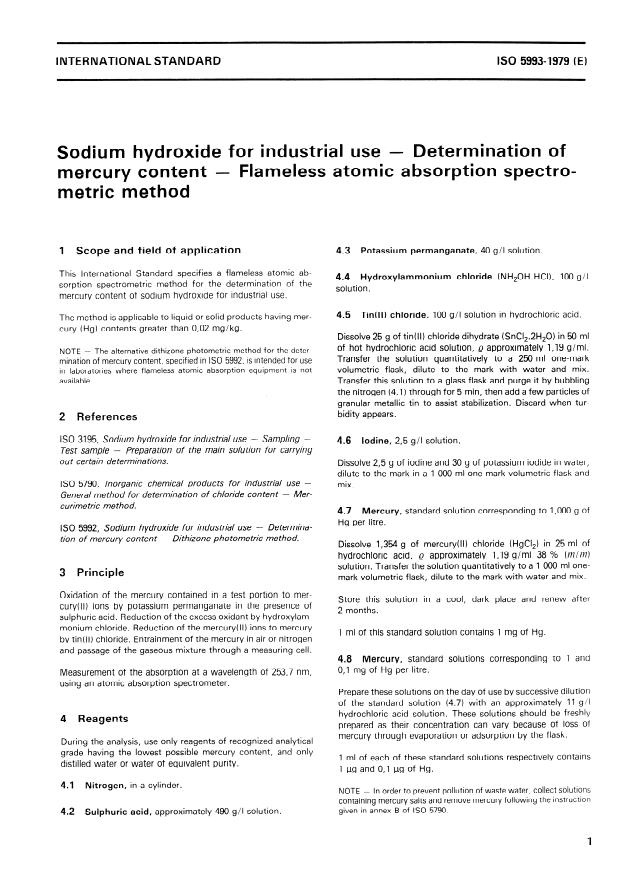
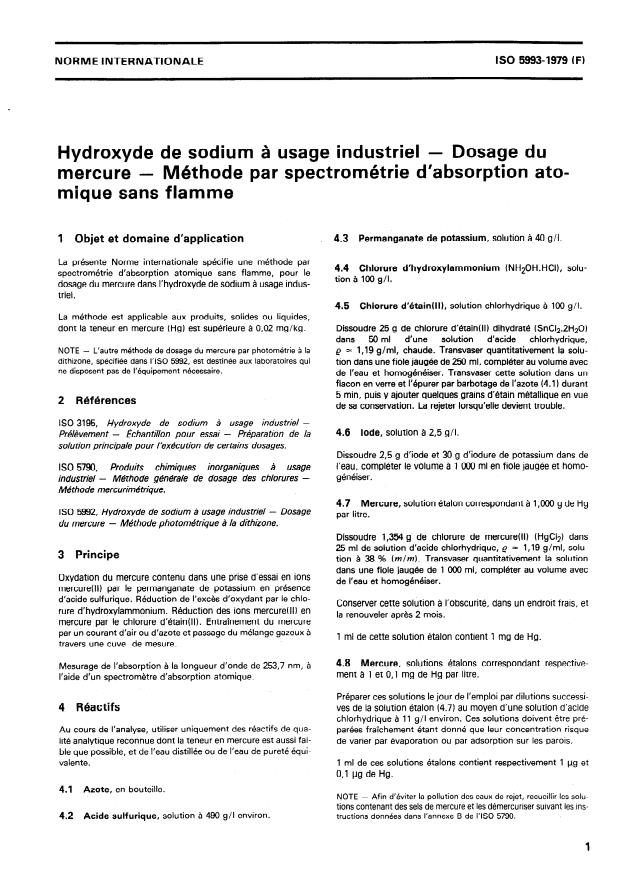
1 Scope and field of application 4.3 Potassium permanganate, 40 g/l Solution.
This International Standard specifies a flameless atomic ab-
4.4 Hydroxylammonium chloride (NHzOH.HCI), 100 g/l
sorption spectrometric method for the determination of the
Solution.
mercury content of sodium hydroxide for industrial use.
4.5 Tin(ll) chloride, 100 g/l Solution in hydrochloric acid.
The method is applicable to liquid or solid products having mer-
cury (Hg) contents greater than 0,02 mg/kg.
Dissolve 25 g of tin( II) chloride dihydrate ( SnC12.2H20) in 50 ml
of hot hydrochioric acid Solution, Q approximately 1,19 g/ml.
NOTE - The alternative dithizone photometric method for the deter-
Transfer the Solution quantitatively to a 250 ml one-mark
mination of mercury content, specified in ISO 5992, is intended for use
in laboratories where flameless atomic absorption equipment is not volumetric flask, dilute to the mark with water and mix.
availa ble. Transfer this Solution to a glass flask and purge it by bubbling
the nitrogen (4.1) through for 5 min, then add a few particles of
granular metallic tin to assist stabilization. Discard when tur-
bidity appears.
2 References
ISO 3195, Sodium hydroxide for industrial use - Sampling -
4.6 lodine, 2,5 g/l Solution.
Test Sample - Reparation of the main Solution for carrying
out certain de termina tions.
Dissolve 2,5 g of iodine and 30 g of potassium iodide in water,
dilute to the mark in a 1 000 ml one-mark volumetric flask and
ISO 5790, lnorganic Chemical products for industrial use -
mrx.
General method for determination of chloride content - Mer-
curime tric me thod.
4.7 Mercury, Standard Solution corresponding to 1,000 g of
Hg per litre.
ISO 5992, Sodium h ydroxide for industrial use - Determina-
tion of mercury content - Dithizone photometric method.
Dissolve 1,354 g of mercury(ll) chloride (HgCI,) in 25 ml of
hydrochloric acid, Q approximately 1,19 g/ml 38 % (ml~)
Solution. Transfer the Solution quantitatively to a 1 000 ml one-
3 Principle
mark volumetric flask, dilute to the mark with water and mix.
Oxidation of the mercury contained in a test Portion to mer-
Store this solution in a cool, dark place and renew after
cury(ll) ions by potassium permanganate in the presence of
2 months.
sulphuric acid. Reduction of the excess oxidant by hydroxylam-
monium chloride. Reduction of the mercury(ll) ions to mercury
1 ml of this Standard Solution contains 1 mg of Hg.
by tin(ll) chloride. Entrainment of the mercury in air or nitrogen
and passage of the gaseous mixture through a measuring cell.
4.8 Mercury, Standard solutions corresponding to 1 and
0,l mg of Hg per litre.
Measurement of the absorption at a wavelength of 253,7 nm,
using an atomic absorption spectrometer.
Prepare these solutions on the day of use by successive dilution
of the Standard Solution (4.7) with an approximately 11 g/l
hydrochloric acid Solution. These solutions should be freshly
4 Reagents
prepared as their concentration tan vary because of IOSS of
mercury through evaporation or adsorption by the flask.
During the analysis, use only reagents of recognized analytical
grade having the lowest possible mercury content, and only
1 ml of each of these Standard solutions respectively contains
distilled water or water of equivalent purity.
1 pg and 0,l pg of Hg.
4.1 Nitrogen, in a cylinder.
NOTE - In Order to prevent pollution of waste water, collect solutions
containing mercury salts and remove mercury following the instruction
given in annex B of ISO 5790.
4.2 Sulphuric acid, approximately 490 g/l Solution.
ISO 5993-1979 (El
5.8 Pressure regulator.
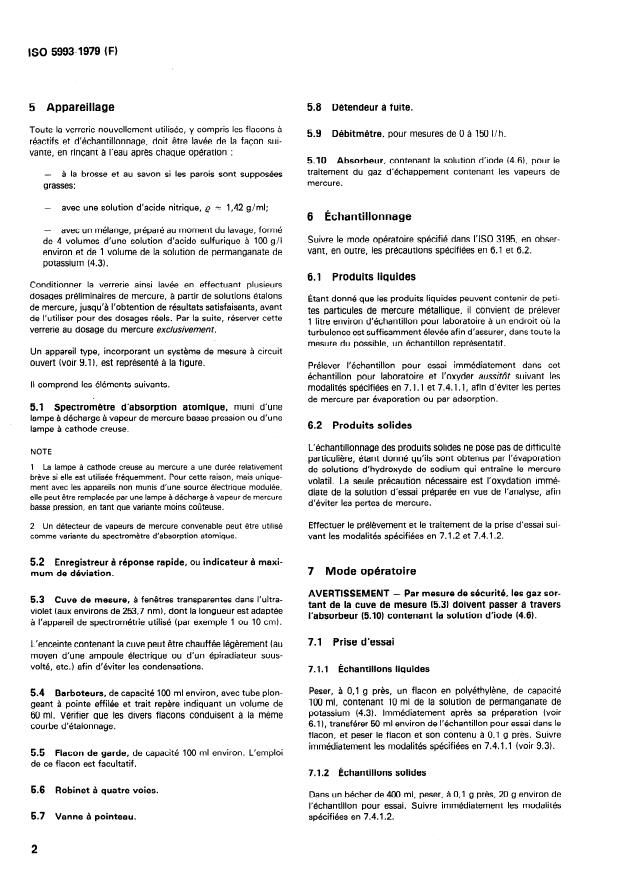
5 Apparatus
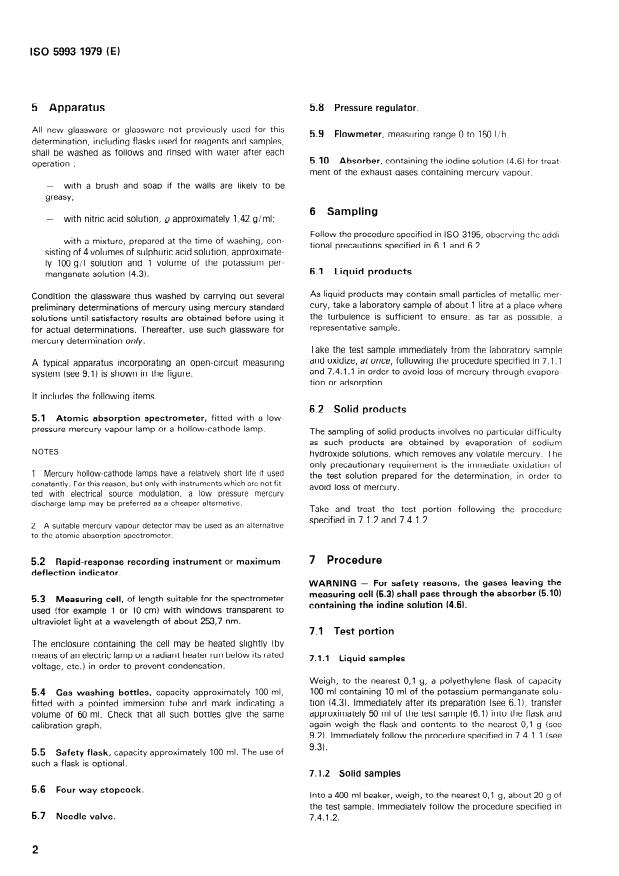
All new glassware or glassware not previously used for this
5.9 Flowmeter, measuring range 0 to 150 I/ h.
determination, including flasks used for reagents and samples,
shall be washed as follows and rinsed with water after each
5.10 Absorber, containing the iodine solution (4.6) for treat-
Operation :
ment
of the exhau st gases containing mercury vapour.
-
if the
wit h a brush and soap Walls are likely to be
greasy;
6 Sampling
-
with nitric acid Solution, Q approximately 1,42 g/ml;
Follow the procedure specified in ISO 3195, observing the addi-
-
with a mixture, prepared at the time of washing, con
tional precautions specified in 6.1 and 6.2.
sisting of 4 volumes of sulphuric acid Solution, approximate
ly 100 g/l Solution and 1 volume of the potassium per
6.1 Liquid products
manganate Solution (4.3).
As liquid products may contain small particles of metallic mer-
Condition the glassware thus washed by carrying out several
cury, take a laboratory Sample of about 1 litre at a place where
preliminary determinations of mercury using mercury Standard
the turbulente is sufficient to ensure, as far as possible, a
solutions until satisfactory results are obtained before using it
representative Sample.
for actual determinations. Thereafter, use such glassware for
mercury determination on/y.
Take the test Sample immediately from the laboratory Sample
and oxidize, at once, following the procedure specified in 7.1.1
tus incorporating an op en-circuit measuring
A typical appara
and 7.4.1.1 in Order to avoid loss of mercury through evapora-
System (see 9.1) is shown in the figure.
tion or adsorption.
lt includes the following items.
6.2 Solid products
fitted with a low-
5.1 Atomic ab sorption spectrometer
pressure mercury vapour Ia mp or a hollow cathod e lamp.
The sampling of solid products involves no particular difficulty
as such products are obtained by evaporation of sodium
NOTES
hydroxide solutions, which removes any volatile mercury. The
only precautionary requirement is the immediate Oxidation of
1 Mercury hollow-cathode lamps have a relatively short life if used
the test Solution prepared for the determination, in Order to
constantly. For this reason, but only with instruments which are notfit-
avoid loss of mercury.
ted with electrical Source modulation, a low pressure mercury
discharge lamp may be preferred as a eheaper alternative.
Take and treat the test Portion following the procedure
specified in 7.1.2 and 7.4.1.2.
2 A suitable mercury vapour detector may be used as an alternative
to the atomic absorption spectrometer.
7 Procedure
5.2 Rapid-response recording instrument or maximum-
deflection indicator.
WARNING - For safety reasons, the gases leawing the
measuring cell (5.3) shall pass through the absorber (5.10)
5.3 Measuring cell, of length suitable for the spectrometer
containing the iodine Solution (4.6).
used (for example 1 or 10 cm) with windows transparent to
ultraviolet light at a wavelength of about 253,7 nm.
7.1 Test Portion
The enclosure containing the cell may be heated slightly (by
means of an electric lamp or a radiant heater run below its rated
7.1.1 Liquid samples
voltage, etc.) in Order to prevent condensation.
Weigh, to the nearest 0,l g, a polyethylene flask of capacity
100 ml containing 10 ml of the potassium permanganate solu-
5.4 Gas washing bottles, capacity approximately 100 ml,
tion (4.3). Immediately after its preparation (see 6.1), transfer
fitted with a pointed immersion tube and mark indicating a
volume sf 60 ml. Check that all such bottles give the same approximately 50 ml of the test Sample (6.1) into the flask and
again weigh the flask and contents to the nearest 0,I g (see
calibration graph.
9.2). Immediately follow the procedure specified in 7.4.1.1 (sec
9.3).
5.5 Safety flask, capacity approximately 100 ml. The use of
such a flask is optional.
7.1.2 Solid samples
5.6 Four-way stopcock.
Into a 400 ml beaker, weigh, to the nearest 0,I g, about 20 g of
the test Sample. Immediately foll
...
Norme internationale
INTERNATIONAL ORGANIZATION FOR STANDARDIZATIONWlE~YHAPO~HAfl OPI-AHM3ALlMfl ll0 CTAHAAPTM3AL(MM@ORGANISATION INTERNATIONALE DE NORMALISATION
Hydroxyde de sodium à usage industriel - Dosage du
mercure - Méthode par spectrométrie d’absorption
atomique sans flamme
Flameless a tomic absorption spec trome trie me thod
Sodium hydroxide for industrial use - Determination of mercury content -
Première édition - 1979-09-01
CDU 661322.1 : 543.422 : 546.49 Réf. no : ISO 5993-1979 (F)
G:
Descripteurs : hydroxyde de sodium, analyse chimique, dosage, mercure, méthode spectrophotométrique, méthode spectroscopique
d’absorption atomique
Prix basé sur 6 pages
Avant-propos
L’ISO (Organisation internationale de normalisation) est une fédération mondiale
d’organismes nationaux de normalisation (comités membres de I’ISO). L’élaboration
des Normes internationales est confiée aux comités techniques de I’ISO. Chaque
comité membre intéressé par une étude a le droit de faire partie du comité technique
correspondant. Les organisations internationales, gouvernementales et non gouverne-
mentales, en liaison avec I’ISO, participent également aux travaux.
Les projets de Normes internationales adoptés par les comités techniques sont soumis
aux comités membres pour approbation, avant leur acceptation comme Normes inter-
nationales par le Conseil de I’ISO.
La Norme internationale ISO 5993 a été élaborée par le comité technique ISO/TC 47,
Chimie, et a été soumise aux comités membres en septembre 1977.
Les comités membres des pays suivants l’ont approuvée :
Afrique du Sud, Rép. d’ France Philippines
Allemagne, R. F. Hongrie Pologne
Australie Inde Roumanie
Autriche Israël Royaume-Uni
Belgique Italie Suisse
Bulgarie Kenya Tchécoslovaquie
Chili Mexique Turquie
Corée, Rép. de Nouvelle-Zélande
URSS
Égypte, Rép. arabe d’ Pays-Bas Yougoslavie
Aucun comité membre ne l’a désapprouvée.
Cette Norme internationale a également été approuvée par l’Union internationale de
chimie pure et appliquée (UICPA).
@ Organisation internationale de normalisation, 1979 0
Imprimé en Suisse
ISO 59934979 (F)
NORME INTERNATIONALE
Hydroxyde de sodium à usage industriel - Dosage du
mercure - Méthode par spectrométrie d’absorption ato-
mique sans flamme
4.3 Permanganate de potassium, solution à 40 g/l.
1 Objet et domaine d’application
La présente Norme internationale spécifie une méthode par
4.4 Chlorure d’hydroxylammonium (NHzOH.HCI), solu-
spectrométrie d’absorption atomique sans flamme, pour le
tion à 100 g/l.
dosage du mercure dans l’hydroxyde de sodium à usage indus-
triel.
4.5 Chlorure d’étainHI), solution chlorhydrique à 100 g/l
La méthode est applicable aux produits, solides ou liquides,
dont la teneur en mercure (Hg) est supérieure à 0,02 mg/kg, Dissoudre 25 g de chlorure d’étain(ll) dihydraté (SnC12.2H20)
solution
dans 50 ml d’une d’acide chlorhydrique,
- L’autre méthode de dosage du mercure par photométrie à la = 1,19 g/ml, chaude. Transvaser quantitativement la solu-
NOTE
e
dithizone, spécifiée dans I’ISO 5992, est destinée aux laboratoires qui
tion dans une fiole jaugée de 250 ml, compléter au volume avec
ne disposent pas de l’équipement nécessaire.
de l’eau et homogénéiser. Transvaser cette solution dans un
flacon en verre et l’épurer par barbotage de l’azote (4.1) durant
5 min, puis y ajouter quelques grains d’etain métallique en vue
2 Références
de sa conservation. La rejeter lorsqu’elle devient trouble.
ISO 3195, Hydroxyde de sodium à usage industriel -
4.6 Iode, solution à 2,5 g/l.
khantillon pour essai - Préparation de la
Prélèvement -
solution principale pour l’exécution de certains dosages.
Dissoudre 2,5 g d’iode et 30 g d’iodure de potassium dans de
l’eau, compléter le volume à 1 000 ml en fiole jaugée et homo-
ISO 5799, Produits chimiques inorganiques a usage
généiser .
indus trie1 - Methode genérale de dosage des chlorures -
Methode mercurimétrique.
4.7 Mercure, solution étalon correspondant à 1,000 g de Hg
ISO 5992, Hydroxyde de sodium à usage industriel - Dosage
par litre.
- Methode photométrique a la dithizone.
du mercure
Dissoudre 1,354 g de chlorure de mercure (HgCl2) dans
25 ml de solution d’acide chlorhydrique, Q = 1,19 g/ml, solu-
3 Principe
tion à 38 % (mlm). Transvaser quantitativement la solution
dans une fiole jaugée de 1 000 ml, compléter au volume avec
Oxydation du mercure contenu dans une prise d’essai en ions
de l’eau et homogénéiser.
mercure par le permanganate de potassium en présence
d’acide sulfurique. Réduction de l’excès d’oxydant par le chlo-
Conserver cette solution à l’obscurité, dans un endroit frais, et
rure d’hydroxyl’ammonium. Réduction des ions mercure( II) en
la renouveler après 2 mois.
mercure par le chlorure d’étain(ll). Entraînement du mercure
par un courant d’air ou d’azote et passage du mélange gazeux à
1 ml de cette solution étalon contient 1 mg de Hg.
travers une cuve de mesure.
4.8 Mercure, solutions étalons correspondant respective-
Mesurage de l’absorption à la longueur d’onde de 253,7 nm, à
ment à 1 et 0,l mg de Hg par litre.
l’aide d’un spectromètre d’absorption atomique.
Préparer ces solutions le jour de l’emploi par dilutions successi-
4 Réactifs ves de la solution étalon (4.7) au moyen d’une solution d’acide
chlorhydrique à 11 g/l environ. Ces solutions doivent être pré-
parées fraîchement étant donné que leur concentration risque
Au cours de l’analyse, utiliser uniquement des réactifs de qua-
lité analytique reconnue dont la teneur en mercure est aussi fai- de varier par évaporation ou par adsorption sur les parois.
ble que possible, et de l’eau distillée ou de l’eau de pureté équi-
valente. 1 ml de ces solutions étalons contient respectivement 1 pg et
0,l pg de Hg.
4.1 Azote, en bouteille.
- Afin d’éviter la pollution des eaux de rejet, recueillir les solu-
NOTE
tions contenant des sels de mercure et les démercuriser suivant les ins-
tructions données dans l’annexe B de I’ISO 5790.
4.2 Acide sulfurique, solution à 490 g/l environ.
SO 59934979 (FI
5.8 Détendeur à fuite,
5 Appareillage
Toute la verrerie nouvellement utilisée, y compris les flacons à
5.9 Débitmètre, pour mesures de 0 à 150 I/h.
réactifs et d’échantillonnaqe, doit être lavée de la facon sui-
- .
vante, en rincant à l’eau après chaque opération :
5.10 Absorbeur, contenant la solution d’iode (4.6), pour le
traitement du gaz d’échappement contenant les vapeurs de
-
à la brosse et au savon si les parois sont supposées
mercure.
grasses;
-
avec une solution d’acide nitrique, Q = 1,42 g/ml;
6 Échantillonnage
-
avec un mélange, préparé au moment du lavage, formé
Suivre le mode opératoire spécifié dans I’ISO 3195, en obser-
de 4 volumes d’une solution d’acide sulfurique à 100 g/l
vant, en outre, les précautions spécifiées en 6.1 et 6.2.
environ et de 1 volume de la solution de permanganate de
potassium (4.3).
6.1 Produits liquides
Conditionner la verrerie ainsi lavée en effectuant plusieurs
dosages préliminaires de mercure, à partir de solutions étalons
Étant donné que les produits liquides peuvent contenir de peti-
de mercure, jusqu’à l’obtention de résultats satisfaisants, avant
tes particules de mercure métallique, il convient de prélever
de l’utiliser pour des dosages réels. Par la suite, réserver cette
1 litre environ d’échantillon pour laboratoire à un endroit où la
verrerie au dosage du mercure exclusivement.
turbulence est suffisamment élevée afin d’assurer, dans toute la
mesure du possible, un échantillon représentatif.
Un appareil type, incorporant un système de mesure à circuit
ouvert (voir 9.11, est représenté à la figure.
Prélever l’échantillon pour essai immédiatement dans cet
échantillon pour laboratoire et l’oxyder aussitôt suivant les
II comprend les éléments suivants.
modalités spécifiées en 7.1.1 et 7.4.1 .l, afin d’éviter les pertes
de mercure par évaporation ou par adsorption.
5.1 Spectromètre d’absorption atomique, muni d’une
lampe à décharge à vapeur de mercure basse pression ou d’une
6.2 Produits solides
lampe à cathode creuse.
L’échantillonnage des produits solides ne pose pas de difficulté
NOTE
particulière, étant donné qu’ils sont obtenus par l’évaporation
1 La lampe à cathode creuse au mercure a une durée relativement
de solutions d’hydroxyde de sodium qui entraîne le mercure
brève si elle est utilisée fréquemment. Pour cette raison, mais unique-
volatil. La seule précaution nécessaire est l’oxydation immé-
ment avec les appareils non munis d’une source électrique modulée,
diate de la solution d’essai préparée en vue de t’analyse, afin
elle peut être remplacée par une lampe à décharge à vapeur de mercure
d’éviter les pertes de mercure.
basse pression, en tant que variante moins coûteuse.
2 Un détecteur de vapeurs de mercure convenable peut être utilisé Effectuer le prélèvement et le traitement de la prise d’essai sui-
comme variante du spectromètre d’absorption atomique. vant les modalités spécifiées en 7.1.2 et 7.4.1.2.
5.2 Enregistreur à réponse rapide, ou indicateur à maxi-
7 Mode opératoire
mum de déviation.
AVERTISSEMENT - Par mesure de sécurité, les gaz sor-
5.3 Cuve de mesure, à fenêtres transparentes dans l’ultra-
tant de la cuve de mesure (5.3) doivent passer à travers
violet (aux environs de 253,7 nm), dont la longueur est adaptée
l’absorbeur (5.10) contenant la solution d’iode (4.6).
à l’appareil de spectrométrie utilisé (par exemple 1 ou 10 cm).
7.1 Prise d’essai
L’enceinte contenant la cuve peut être chauffée légèrement (au
moyen d’une ampoule électrique ou d’un épiradiateur sous-
volté, etc.) afin d’éviter les condensations.
7.1.1 Échantillons liquides
Peser, à 0,l g près, un flacon en polyéthylène, de capacité
5.4 Barboteurs, de capacité 100 ml environ, avec tube plon-
100 ml, contenant 10 ml de la solution de permanganate de
geant à pointe effilée et trait repère indiquant un volume de
potassium (4.3). Immédiatement après sa préparation (voir
60 ml. Vérifier que les divers flacons conduisent à la même
6.1), transférer 50 ml environ de l’échantillon pour essai dans le
courbe d’étalonnage.
flacon. et oeser le flacon et son contenu à 0.1 cl près. Suivre
immédiatement les modalités spécifiées en 7.4.111’ (voir 9.3).
5.5 Flacon de garde, de capacité 100 ml environ. L’emploi
de ce flacon est facultatif.
7.1.2 Échantillons solides
5.6 Robinet à quatre voies.
Dans un bécher de 400 ml, peser, à 0,l g près, 20 g environ de
l’échantillon pour essai. Suivre immédiatement les modalités
5.7 Vanne à pointeau. spécifiées en 7.4.1.2.
ISO 59934979 (FI
7.2 Essai à blanc tion témoin. Ajouter 2,0 ml de la solution de chlorure d’étain(II)
(4.5), fermer aussitôt le barbot
...