

ISO 10896-6:2015
(Main)Rough-terrain trucks — Safety requirements and verification — Part 6: Tilting operator's cabs
General Information
- Abstract
ISO 10896-6:2015 specifies safety requirements and means of verification for tilting operator's cabs of trucks covered by ISO 10896‑1 and ISO 10896‑2, where the seat index point (SIP) height is lifted not more than 400 mm when the cab is fully tilted. ISO 10896-6:2015 only deals with significant hazards, hazardous situations or hazardous events relevant to the tilting cab affixed to trucks.
- Status
- Published
- Publication Date
- 07-Dec-2015
- Technical Committee
- ISO/TC 110/SC 4 - Rough-terrain trucks
- Drafting Committee
- ISO/TC 110/SC 4/WG 1 - Safety
- Current Stage
- 9093 - International Standard confirmed
- Start Date
- 03-Oct-2022
- Completion Date
- 29-Aug-2026
Buy Documents
ISO 10896-6:2015 - Rough-terrain trucks -- Safety requirements and verification
ISO 10896-6:2015 - Rough-terrain trucks — Safety requirements and verification — Part 6: Tilting operator's cabs/8/2015
Overview
ISO 10896-6:2015 specifies safety requirements and verification methods for tilting operator’s cabs fitted to rough‑terrain trucks (as covered by ISO 10896‑1 and ISO 10896‑2). The standard applies where the seat index point (SIP) is raised by no more than 400 mm when the cab is fully tilted. It addresses significant hazards specifically related to the tilting cab and sets performance, testing and information-for-use requirements to reduce crushing, stability and impact risks.
Key topics and requirements
- Scope limit: SIP lift ≤ 400 mm for the fully tilted cab.
- Tilting geometry and motion:
- Recommended maximum tilt angle: 20° from horizontal.
- Maximum tilting speed: 5°/s under normal working conditions.
- Controls and operation:
- Tilting control must be clearly marked, separated, protected, and of hold-to-run type to prevent inadvertent activation.
- Provisions to prevent truck travel when the cab is not in its defined travel position.
- Stability and testing:
- Stability verification per ISO 22915-14 or ISO 22915-24 (tests performed with cab in the most unfavourable tilted positions; tests T2 and T4 excluded).
- Structural protection:
- ROPS: must comply with ISO 3471 with modifications - treat the cab as an independent ROPS; apply vertical load tests in all planes; some ISO 3471 clauses are excluded.
- FOPS: comply with ISO 3449; tests carried out with cab in lower and maximum tilt positions.
- Maintenance and safety:
- Mechanical support device required for maintenance when the cab is tilted; device must withstand twice the mass (×g) of the tilting cab.
- Hazardous area between frame and cab base must be marked with warning signs.
- Verification methods: measurement, visual examination and the specific tests referenced for ROPS/FOPS.
- Information for use: operator manual must cover travel position, emergency procedures and use of the mechanical support device.
Applications and users
ISO 10896-6:2015 is intended for:
- Rough‑terrain truck manufacturers designing tilting cabs and control systems.
- Safety engineers and compliance teams conducting risk assessment and type testing.
- Regulators and market surveillance verifying conformity to safety requirements.
- Maintenance providers and fleet operators implementing safe maintenance and operating procedures. Practical uses include design validation, stability testing, operator manual content, and specifying safety devices (locks, supports, interlocks) for tilting cabs.
Related standards
- ISO 10896-1, ISO 10896-2 (rough‑terrain truck general requirements)
- ISO 12100 (machine safety - risk assessment)
- ISO 3449 (FOPS) and ISO 3471 (ROPS)
- ISO 22915‑14 / ISO 22915‑24 (stability verification)
- ISO 5053 (terminology) and ISO 5353 (SIP definition)
- ISO 20297-1 (lorry‑mounted trucks - related requirements)
Keywords: ISO 10896-6:2015, tilting operator’s cabs, rough-terrain trucks, safety requirements, verification, ROPS, FOPS, seat index point (SIP), stability testing.
Relations
- Effective Date
- 11-Dec-2021
Buy Documents
ISO 10896-6:2015 - Rough-terrain trucks -- Safety requirements and verification
ISO 10896-6:2015 - Rough-terrain trucks — Safety requirements and verification — Part 6: Tilting operator's cabs/8/2015
Frequently Asked Questions
ISO 10896-6:2015 is a standard published by the International Organization for Standardization (ISO). Its full title is "Rough-terrain trucks — Safety requirements and verification — Part 6: Tilting operator's cabs". This standard covers: ISO 10896-6:2015 specifies safety requirements and means of verification for tilting operator's cabs of trucks covered by ISO 10896‑1 and ISO 10896‑2, where the seat index point (SIP) height is lifted not more than 400 mm when the cab is fully tilted. ISO 10896-6:2015 only deals with significant hazards, hazardous situations or hazardous events relevant to the tilting cab affixed to trucks.
ISO 10896-6:2015 specifies safety requirements and means of verification for tilting operator's cabs of trucks covered by ISO 10896‑1 and ISO 10896‑2, where the seat index point (SIP) height is lifted not more than 400 mm when the cab is fully tilted. ISO 10896-6:2015 only deals with significant hazards, hazardous situations or hazardous events relevant to the tilting cab affixed to trucks.
ISO 10896-6:2015 is classified under the following ICS (International Classification for Standards) categories: 53.060 - Industrial trucks. The ICS classification helps identify the subject area and facilitates finding related standards.
ISO 10896-6:2015 has the following relationships with other standards: It is inter standard links to ISO 10896-6:2015/Amd 1:2019. Understanding these relationships helps ensure you are using the most current and applicable version of the standard.
ISO 10896-6:2015 is available in PDF format for immediate download after purchase. The document can be added to your cart and obtained through the secure checkout process. Digital delivery ensures instant access to the complete standard document.
Standards Content (Sample)
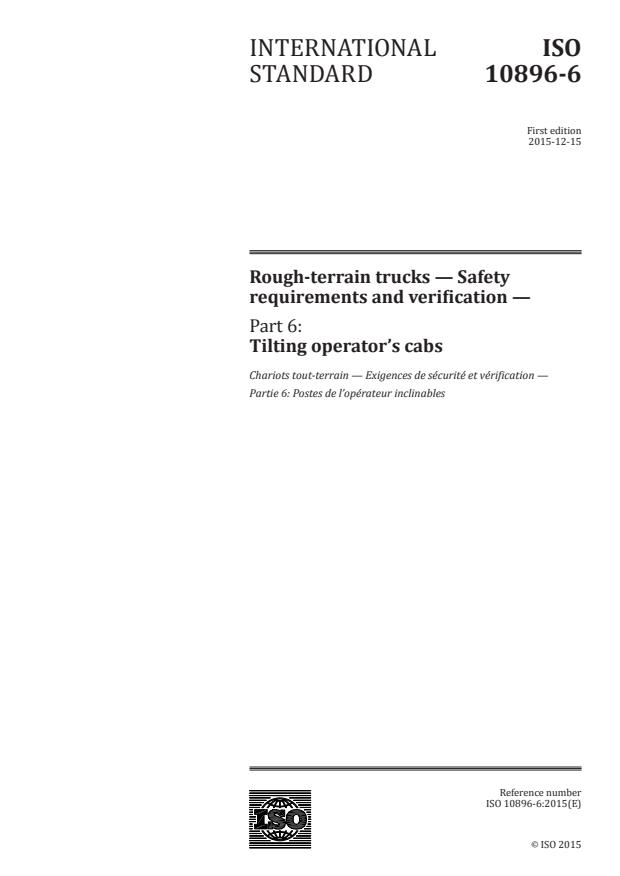
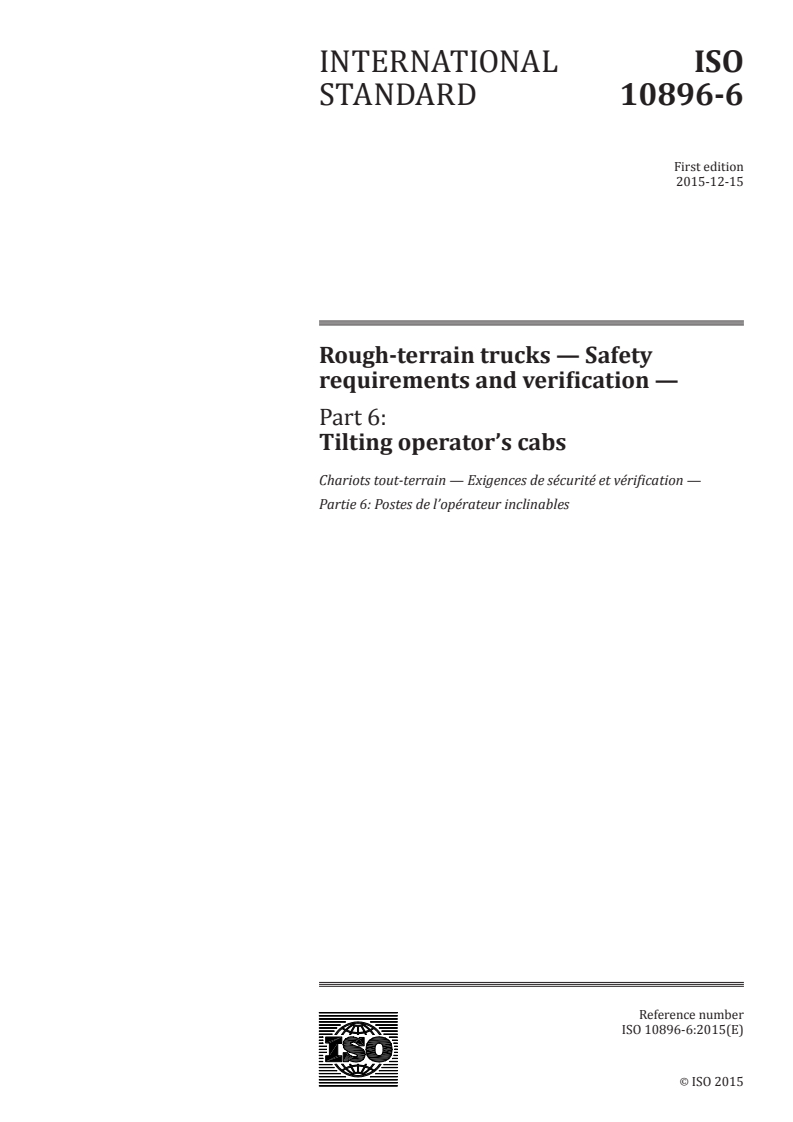
INTERNATIONAL ISO
STANDARD 10896-6
First edition
2015-12-15
Rough-terrain trucks — Safety
requirements and verification —
Part 6:
Tilting operator’s cabs
Chariots tout-terrain — Exigences de sécurité et vérification —
Partie 6: Postes de l’opérateur inclinables
Reference number
©
ISO 2015
© ISO 2015, Published in Switzerland
All rights reserved. Unless otherwise specified, no part of this publication may be reproduced or utilized otherwise in any form
or by any means, electronic or mechanical, including photocopying, or posting on the internet or an intranet, without prior
written permission. Permission can be requested from either ISO at the address below or ISO’s member body in the country of
the requester.
ISO copyright office
Ch. de Blandonnet 8 • CP 401
CH-1214 Vernier, Geneva, Switzerland
Tel. +41 22 749 01 11
Fax +41 22 749 09 47
copyright@iso.org
www.iso.org
ii © ISO 2015 – All rights reserved
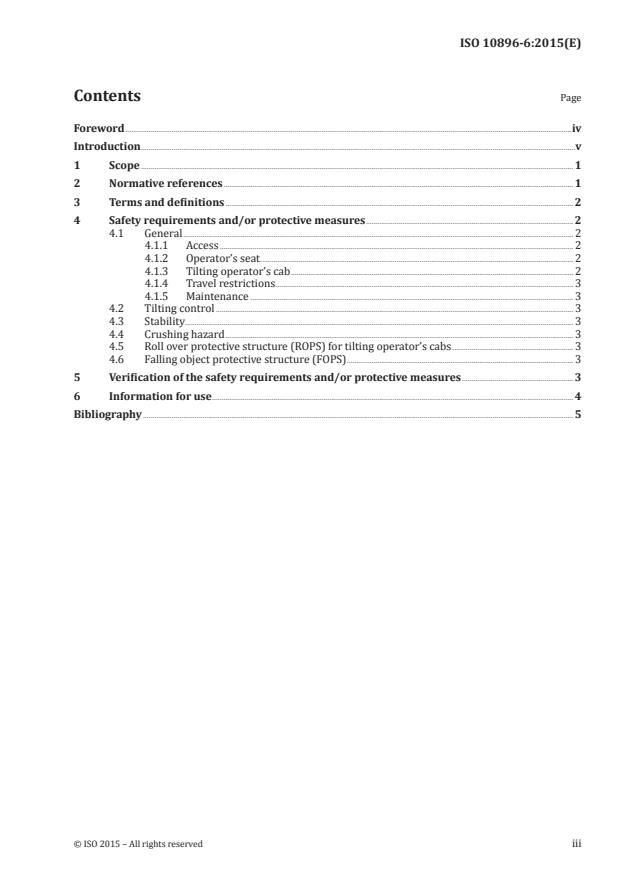
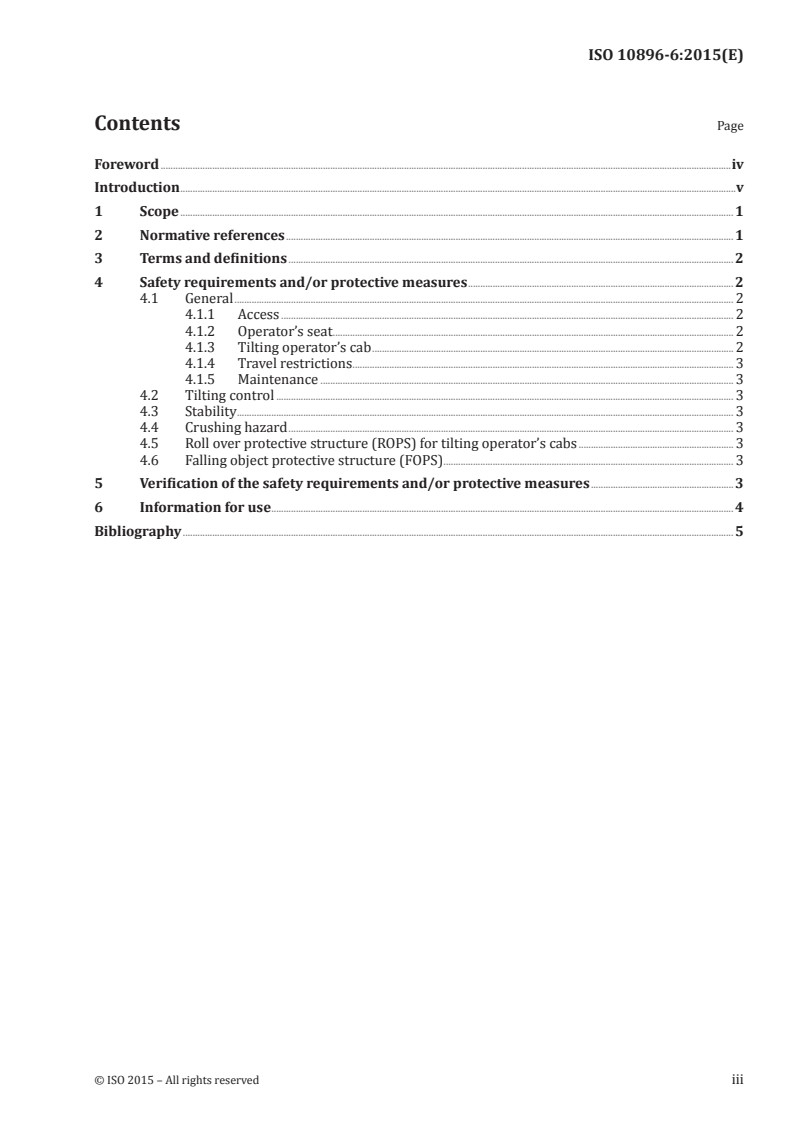
Contents Page
Foreword .iv
Introduction .v
1 Scope . 1
2 Normative references . 1
3 Terms and definitions . 2
4 Safety requirements and/or protective measures . 2
4.1 General . 2
4.1.1 Access . 2
4.1.2 Operator’s seat . 2
4.1.3 Tilting operator’s cab . 2
4.1.4 Travel restrictions . 3
4.1.5 Maintenance . 3
4.2 Tilting control . 3
4.3 Stability . 3
4.4 Crushing hazard . 3
4.5 Roll over protective structure (ROPS) for tilting operator’s cabs . 3
4.6 Falling object protective structure (FOPS) . 3
5 Verification of the safety requirements and/or protective measures .3
6 Information for use . 4
Bibliography . 5
Foreword
ISO (the International Organization for Standardization) is a worldwide federation of national standards
bodies (ISO member bodies). The work of preparing International Standards is normally carried out
through ISO technical committees. Each member body interested in a subject for which a technical
committee has been established has the right to be represented on that committee. International
organizations, governmental and non-governmental, in liaison with ISO, also take part in the work.
ISO collaborates closely with the International Electrotechnical Commission (IEC) on all matters of
electrotechnical standardization.
The procedures used to develop this document and those intended for its further maintenance are
described in the ISO/IEC Directives, Part 1. In particular the different approval criteria needed for the
different types of ISO documents should be noted. This document was drafted in accordance with the
editorial rules of the ISO/IEC Directives, Part 2 (see www.iso.org/directives).
Attention is drawn to the possibility that some of the elements of this document may be the subject of
patent rights. ISO shall not be held responsible for identifying any or all such patent rights. Details of
any patent rights identified during the development of the document will be in the Introduction and/or
on the ISO list of patent declarations received (see www.iso.org/patents).
Any trade name used in this document is information given for the convenience of users and does not
constitute an endorsement.
For an explanation on the meaning of ISO specific terms and expressions related to conformity
assessment, as well as information about ISO’s adherence to the WTO principles in the Technical
Barriers to Trade (TBT) see the following URL: Foreword - Supplementary information
The committee responsible for this document is ISO/TC 110, Industrial trucks, Subcommittee SC 4,
Rough-terrain trucks.
ISO 10896 consists of the following parts, under the general title Rough-terrain trucks — Safety
requirements and verification:
— Part 1: Variable-reach trucks
— Part 2: Slewing trucks
— Part 4: Additional requirements for variable reach trucks handling freely suspended loads
— Part 5: Interface between rough-terrain truck and integrated personnel work platform
— Part 6: Tilting operator’s cabs
— Part 7: Longitudinal load moment systems
Safety requirements and verification for lorry-mounted trucks are dealt with by ISO 20297-1.
iv © ISO 2015 – All rights reserved
Introduction
This part of ISO 10896 is one of a set of standards produced by ISO/TC 110/SC 4 as part of its program
of work regarding standardization of terminology, general safety, performance and user requirements
for rough-terrain trucks (hereafter also referred to as trucks).
This part of ISO 10896 is a type-C standard as stated in ISO 12100.
This part of ISO 10896
...
INTERNATIONAL ISO
STANDARD 10896-6
First edition
2015-12-15
Rough-terrain trucks — Safety
requirements and verification —
Part 6:
Tilting operator’s cabs
Chariots tout-terrain — Exigences de sécurité et vérification —
Partie 6: Postes de l’opérateur inclinables
Reference number
©
ISO 2015
© ISO 2015, Published in Switzerland
All rights reserved. Unless otherwise specified, no part of this publication may be reproduced or utilized otherwise in any form
or by any means, electronic or mechanical, including photocopying, or posting on the internet or an intranet, without prior
written permission. Permission can be requested from either ISO at the address below or ISO’s member body in the country of
the requester.
ISO copyright office
Ch. de Blandonnet 8 • CP 401
CH-1214 Vernier, Geneva, Switzerland
Tel. +41 22 749 01 11
Fax +41 22 749 09 47
copyright@iso.org
www.iso.org
ii © ISO 2015 – All rights reserved
Contents Page
Foreword .iv
Introduction .v
1 Scope . 1
2 Normative references . 1
3 Terms and definitions . 2
4 Safety requirements and/or protective measures . 2
4.1 General . 2
4.1.1 Access . 2
4.1.2 Operator’s seat . 2
4.1.3 Tilting operator’s cab . 2
4.1.4 Travel restrictions . 3
4.1.5 Maintenance . 3
4.2 Tilting control . 3
4.3 Stability . 3
4.4 Crushing hazard . 3
4.5 Roll over protective structure (ROPS) for tilting operator’s cabs . 3
4.6 Falling object protective structure (FOPS) . 3
5 Verification of the safety requirements and/or protective measures .3
6 Information for use . 4
Bibliography . 5
Foreword
ISO (the International Organization for Standardization) is a worldwide federation of national standards
bodies (ISO member bodies). The work of preparing International Standards is normally carried out
through ISO technical committees. Each member body interested in a subject for which a technical
committee has been established has the right to be represented on that committee. International
organizations, governmental and non-governmental, in liaison with ISO, also take part in the work.
ISO collaborates closely with the International Electrotechnical Commission (IEC) on all matters of
electrotechnical standardization.
The procedures used to develop this document and those intended for its further maintenance are
described in the ISO/IEC Directives, Part 1. In particular the different approval criteria needed for the
different types of ISO documents should be noted. This document was drafted in accordance with the
editorial rules of the ISO/IEC Directives, Part 2 (see www.iso.org/directives).
Attention is drawn to the possibility that some of the elements of this document may be the subject of
patent rights. ISO shall not be held responsible for identifying any or all such patent rights. Details of
any patent rights identified during the development of the document will be in the Introduction and/or
on the ISO list of patent declarations received (see www.iso.org/patents).
Any trade name used in this document is information given for the convenience of users and does not
constitute an endorsement.
For an explanation on the meaning of ISO specific terms and expressions related to conformity
assessment, as well as information about ISO’s adherence to the WTO principles in the Technical
Barriers to Trade (TBT) see the following URL: Foreword - Supplementary information
The committee responsible for this document is ISO/TC 110, Industrial trucks, Subcommittee SC 4,
Rough-terrain trucks.
ISO 10896 consists of the following parts, under the general title Rough-terrain trucks — Safety
requirements and verification:
— Part 1: Variable-reach trucks
— Part 2: Slewing trucks
— Part 4: Additional requirements for variable reach trucks handling freely suspended loads
— Part 5: Interface between rough-terrain truck and integrated personnel work platform
— Part 6: Tilting operator’s cabs
— Part 7: Longitudinal load moment systems
Safety requirements and verification for lorry-mounted trucks are dealt with by ISO 20297-1.
iv © ISO 2015 – All rights reserved
Introduction
This part of ISO 10896 is one of a set of standards produced by ISO/TC 110/SC 4 as part of its program
of work regarding standardization of terminology, general safety, performance and user requirements
for rough-terrain trucks (hereafter also referred to as trucks).
This part of ISO 10896 is a type-C standard as stated in ISO 12100.
This part of ISO 10896
...