


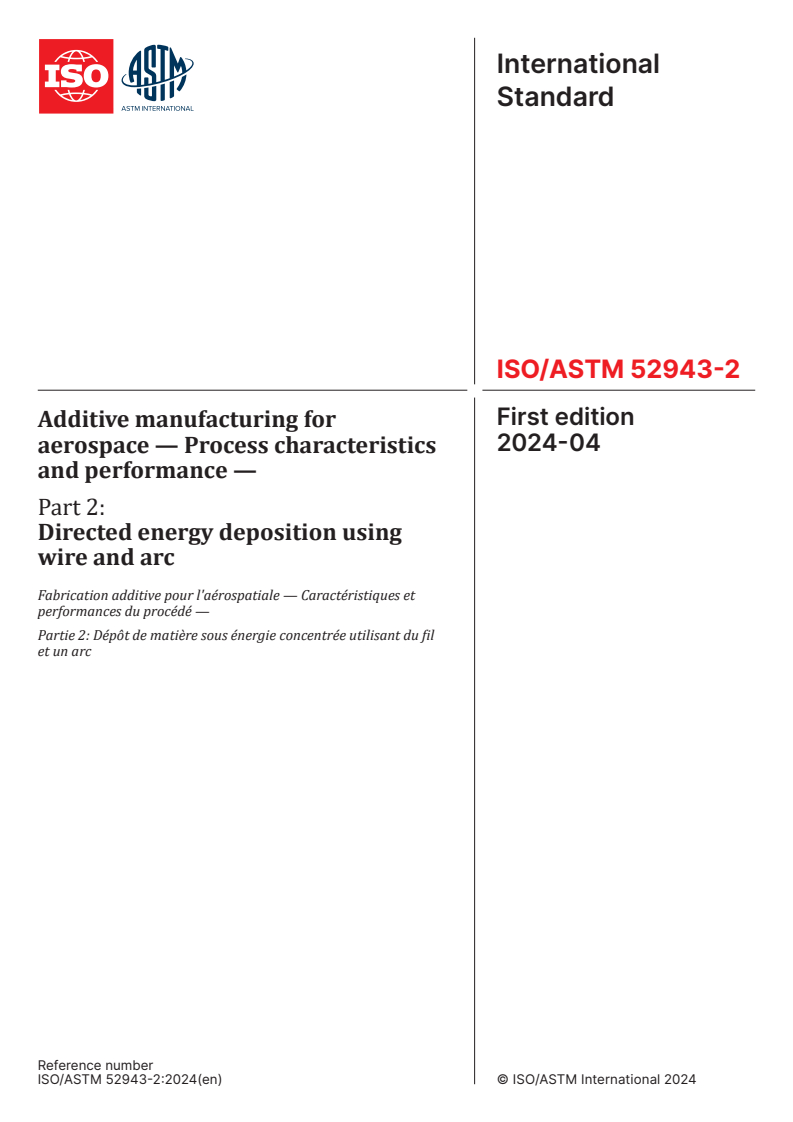
ISO/ASTM 52943-2:2024
(Main)Additive manufacturing for aerospace — Process characteristics and performance — Part 2: Directed energy deposition using wire and arc
Additive manufacturing for aerospace — Process characteristics and performance — Part 2: Directed energy deposition using wire and arc
This document specifies requirements for the additive manufacturing of metallic parts with directed energy deposition (DED) in the aerospace industry. Within the application scope of this document, wire is used as feedstock, and arc processes (gas-shielded metal arc processes (MIG/MAG/GMAW), tungsten inert gas processes (TIG/GTAW), plasma arc processes (PAW)) are used as the main energy source. This document is to be used in conjunction with the engineering documents, if required by the engineering authority. This document does not address health and safety issues.
Fabrication additive pour l'aérospatiale — Caractéristiques et performances du procédé — Partie 2: Dépôt de matière sous énergie concentrée utilisant du fil et un arc
Le présent document spécifie les exigences relatives à la fabrication additive de pièces métalliques par dépôt de matière sous énergie concentrée (DED) dirigée dans l’industrie aérospatiale. Dans le domaine d’application du présent document, le fil est utilisé comme matière première et les procédés à l’arc (procédé à l’arc avec électrode fusible sous protection gazeuse MIG/MAG/GMAW), procédés à l’arc sous protection de gaz inerte avec électrode de tungstène (TIG/GTAW), procédés par arc plasma (PAW)) sont utilisés comme principale source d’énergie. Le présent document est à utiliser en conjonction avec les documents techniques, si exigé par le responsable des études techniques. Le présent document ne traite pas les questions de sécurité et de santé.
General Information
- Status
- Published
- Publication Date
- 15-Apr-2024
- Technical Committee
- ISO/TC 261 - Additive manufacturing
- Drafting Committee
- ISO/TC 261/JWG 10 - Joint ISO/TC 261 - ISO/TC 44/SC 14 WG: Additive manufacturing in aerospace applications
- Parallel Committee
- ISO/TC 44/SC 14 - Welding and brazing in aerospace
- Current Stage
- 6060 - International Standard published
- Start Date
- 16-Apr-2024
- Due Date
- 06-Aug-2024
- Completion Date
- 16-Apr-2024
Relations
- Effective Date
- 12-Feb-2026
Overview
ISO/ASTM 52943-2:2024 - "Additive manufacturing for aerospace - Process characteristics and performance - Part 2: Directed energy deposition using wire and arc" defines requirements for producing metallic aerospace parts using directed energy deposition (DED) where wire feedstock and arc energy sources are used. The standard covers process, machine and operator qualification, feedstock and substrate requirements, procedure qualification (pAPS/APS), process monitoring, documentation and traceability. It is intended to be used with applicable engineering documents and does not address health and safety.
Keywords: ISO/ASTM 52943-2:2024, directed energy deposition, DED-Arc, wire and arc, additive manufacturing for aerospace.
Key topics and technical requirements
- Feedstock requirements: specifies properties to record (wire diameter, chemical composition, surface condition, storage and traceability such as heat lot/batch).
- Operator qualification: requires certification per ISO/ASTM 52926-5 with practical and theoretical exams; suggested re-examination interval is every 2 years unless otherwise approved by engineering authority.
- Machine qualification & requalification: each DED machine must be qualified across its working range (calibration, verification, deposition tests, maintenance plan); requalification is required after significant changes, repairs or relocation.
- Process and procedure qualification: use of preliminary additive procedure specification (pAPS) and qualified additive procedure specification (APS) to ensure repeatability and control of key process variables (KPVs).
- Build platform/substrate: material, geometry and surface cleanliness requirements to avoid build defects.
- Environment & process control: facility and process environment controls, enclosures and gas supply considerations for arc processes (MIG/MAG/GMAW, TIG/GTAW, PAW).
- Documentation & traceability: engineering and production documents, build records, process monitoring data and delivery documentation for acceptance testing and certification.
- Process monitoring and product acceptance testing: monitoring, acceptance tests and record keeping to support part quality and airworthiness.
Practical applications
- Qualification and production of structural and non-structural metallic parts for aerospace using wire-and-arc DED.
- Establishing manufacturing plans, quality systems and traceability for suppliers producing AM aerospace components.
- Auditing and certifying DED systems, operator competency, machine performance and procedure repeatability.
Who should use this standard
- Aerospace OEMs and tier suppliers
- Additive manufacturing process engineers and QA personnel
- Welding and AM coordinators, certification bodies
- Machine builders, wire feedstock suppliers and maintenance teams
- Engineering authorities responsible for part airworthiness
Related standards
- ISO/ASTM 52900 (AM fundamentals & vocabulary)
- ISO/ASTM 52926-5 (operator qualification for DED-Arc)
- ISO 14175 (welding gases), ISO 544, ISO 15792, ISO 14344 (feedstock/consumables)
- SAE AMS 7005, ISO 17662, SAE AMS 7032, ISO 15614 series (procedure and qualification guidance)
This standard helps organizations implement controlled, repeatable DED wire-and-arc processes to meet aerospace performance and traceability expectations.
ISO/ASTM 52943-2:2024 - Additive manufacturing for aerospace — Process characteristics and performance — Part 2: Directed energy deposition using wire and arc Released:16. 04. 2024
ISO/ASTM 52943-2:2024 - Fabrication additive pour l'aérospatiale — Caractéristiques et performances du procédé — Partie 2: Dépôt de matiere sous énergie concentrée utilisant du fil et un arc Released:16. 04. 2024
Get Certified
Connect with accredited certification bodies for this standard

National Aerospace and Defense Contractors Accreditation Program (NADCAP)
Global cooperative program for special process quality in aerospace.
CARES (UK Certification Authority for Reinforcing Steels)
UK certification for reinforcing steels and construction.
DVS-ZERT GmbH
German welding certification society.
Sponsored listings
Frequently Asked Questions
ISO/ASTM 52943-2:2024 is a standard published by the International Organization for Standardization (ISO). Its full title is "Additive manufacturing for aerospace — Process characteristics and performance — Part 2: Directed energy deposition using wire and arc". This standard covers: This document specifies requirements for the additive manufacturing of metallic parts with directed energy deposition (DED) in the aerospace industry. Within the application scope of this document, wire is used as feedstock, and arc processes (gas-shielded metal arc processes (MIG/MAG/GMAW), tungsten inert gas processes (TIG/GTAW), plasma arc processes (PAW)) are used as the main energy source. This document is to be used in conjunction with the engineering documents, if required by the engineering authority. This document does not address health and safety issues.
This document specifies requirements for the additive manufacturing of metallic parts with directed energy deposition (DED) in the aerospace industry. Within the application scope of this document, wire is used as feedstock, and arc processes (gas-shielded metal arc processes (MIG/MAG/GMAW), tungsten inert gas processes (TIG/GTAW), plasma arc processes (PAW)) are used as the main energy source. This document is to be used in conjunction with the engineering documents, if required by the engineering authority. This document does not address health and safety issues.
ISO/ASTM 52943-2:2024 is classified under the following ICS (International Classification for Standards) categories: 25.030 - Additive manufacturing. The ICS classification helps identify the subject area and facilitates finding related standards.
ISO/ASTM 52943-2:2024 has the following relationships with other standards: It is inter standard links to EN ISO/ASTM 52943-2:2024. Understanding these relationships helps ensure you are using the most current and applicable version of the standard.
ISO/ASTM 52943-2:2024 is available in PDF format for immediate download after purchase. The document can be added to your cart and obtained through the secure checkout process. Digital delivery ensures instant access to the complete standard document.
Standards Content (Sample)
International
Standard
ISO/ASTM 52943-2
First edition
Additive manufacturing for
2024-04
aerospace — Process characteristics
and performance —
Part 2:
Directed energy deposition using
wire and arc
Fabrication additive pour l'aérospatiale — Caractéristiques et
performances du procédé —
Partie 2: Dépôt de matière sous énergie concentrée utilisant du fil
et un arc
Reference number
© ISO/ASTM International 2024
All rights reserved. Unless otherwise specified, or required in the context of its implementation, no part of this publication may
be reproduced or utilized otherwise in any form or by any means, electronic or mechanical, including photocopying, or posting on
the internet or an intranet, without prior written permission. Permission can be requested from either ISO at the address below
or ISO’s member body in the country of the requester. In the United States, such requests should be sent to ASTM International.
ISO copyright office ASTM International
CP 401 • Ch. de Blandonnet 8 100 Barr Harbor Drive, PO Box C700
CH-1214 Vernier, Geneva West Conshohocken, PA 19428-2959, USA
Phone: +41 22 749 01 11 Phone: +610 832 9634
Fax: +610 832 9635
Email: copyright@iso.org Email: khooper@astm.org
Website: www.iso.org Website: www.astm.org
Published in Switzerland
© ISO/ASTM International 2024 – All rights reserved
ii
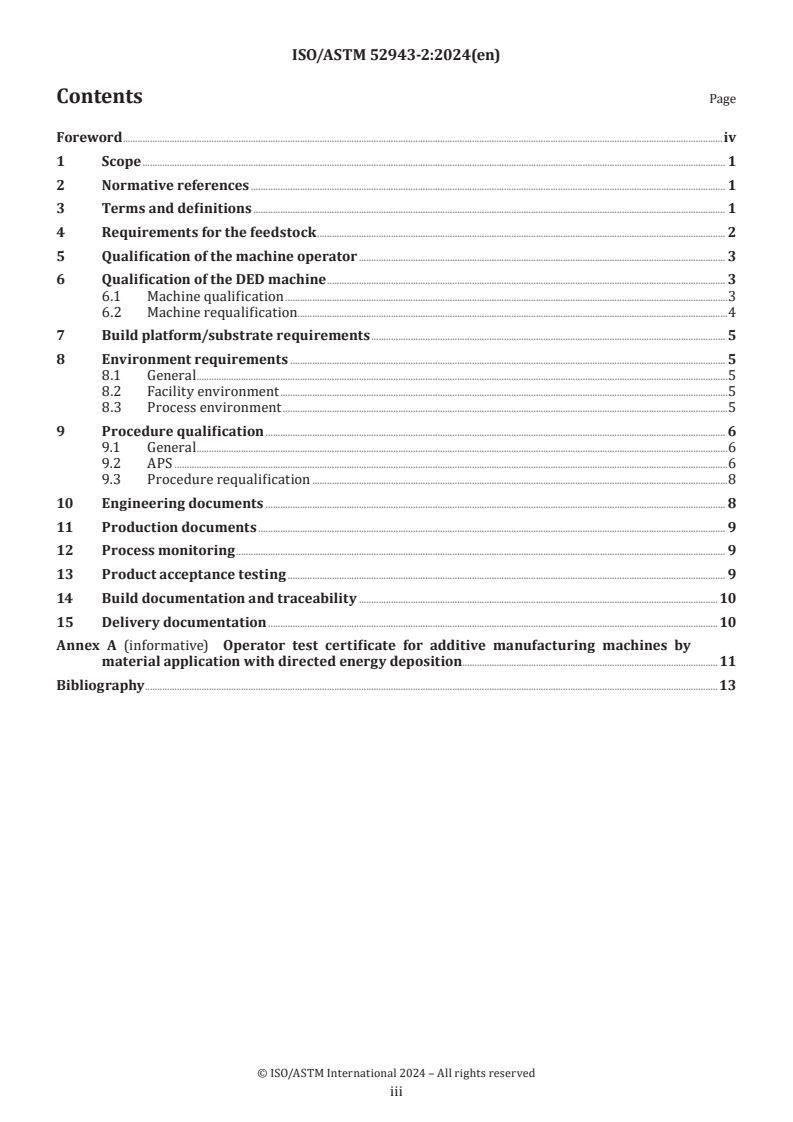
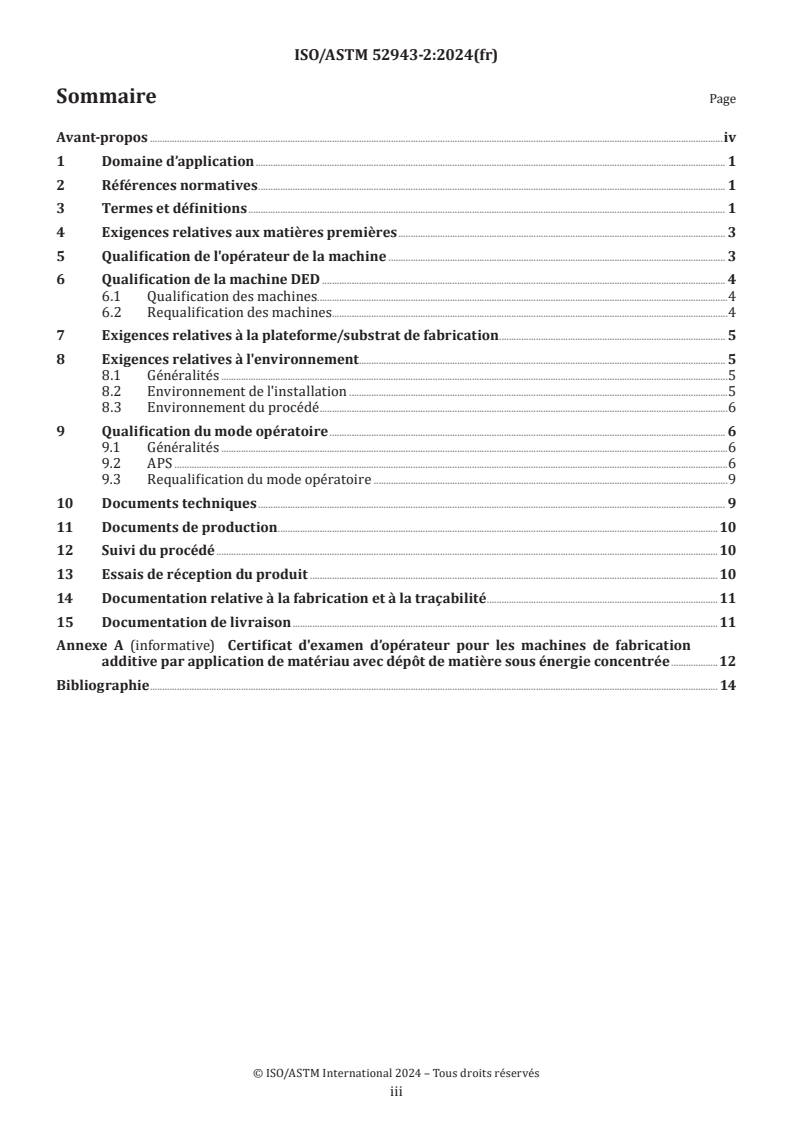
Contents Page
Foreword .iv
1 Scope . 1
2 Normative references . 1
3 Terms and definitions . 1
4 Requirements for the feedstock . 2
5 Qualification of the machine operator . 3
6 Qualification of the DED machine . 3
6.1 Machine qualification .3
6.2 Machine requalification . .4
7 Build platform/substrate requirements . 5
8 Environment requirements . 5
8.1 General .5
8.2 Facility environment .5
8.3 Process environment .5
9 Procedure qualification . 6
9.1 General .6
9.2 APS .6
9.3 Procedure requalification .8
10 Engineering documents . 8
11 Production documents . 9
12 Process monitoring . 9
13 Product acceptance testing . 9
14 Build documentation and traceability .10
15 Delivery documentation .10
Annex A (informative) Operator test certificate for additive manufacturing machines by
material application with directed energy deposition .11
Bibliography .13
© ISO/ASTM International 2024 – All rights reserved
iii
Foreword
ISO (the International Organization for Standardization) is a worldwide federation of national standards
bodies (ISO member bodies). The work of preparing International Standards is normally carried out through
ISO technical committees. Each member body interested in a subject for which a technical committee
has been established has the right to be represented on that committee. International organizations,
governmental and non-governmental, in liaison with ISO, also take part in the work. ISO collaborates closely
with the International Electrotechnical Commission (IEC) on all matters of electrotechnical standardization.
The procedures used to develop this document and those intended for its further maintenance are described
in the ISO/IEC Directives, Part 1. In particular, the different approval criteria needed for the different types
of ISO document should be noted. This document was drafted in accordance with the editorial rules of the
ISO/IEC Directives, Part 2 (see www.iso.org/directives).
ISO draws attention to the possibility that the implementation of this document may involve the use of (a)
patent(s). ISO takes no position concerning the evidence, validity or applicability of any claimed patent
rights in respect thereof. As of the date of publication of this document, ISO had not received notice of (a)
patent(s) which may be required to implement this document. However, implementers are cautioned that
this may not represent the latest information, which may be obtained from the patent database available at
www.iso.org/patents. ISO shall not be held responsible for identifying any or all such patent rights.
Any trade name used in this document is information given for the convenience of users and does not
constitute an endorsement.
For an explanation of the voluntary nature of standards, the meaning of ISO specific terms and expressions
related to conformity assessment, as well as information about ISO's adherence to the World Trade
Organization (WTO) principles in the Technical Barriers to Trade (TBT), see www.iso.org/iso/foreword.html.
This document was prepared by Technical Committee ISO/TC 261, Additive manufacturing, in cooperation
with ASTM Committee F42, Additive Manufacturing Technologies, on the basis of a partnership agreement
between ISO and ASTM International with the aim to create a common set of ISO/ASTM standards on
additive manufacturing, and in collaboration with the European Committee for Standardization (CEN)
Technical Committee CEN/TC 438, Additive manufacturing, in accordance with the Agreement on technical
cooperation between ISO and CEN (Vienna Agreement).
Any feedback or questions on this document should be directed to the user’s national standards body. A
complete listing of these bodies can be found at www.iso.org/members.html.
© ISO/ASTM International 2024 – All rights reserved
iv
International Standard ISO/ASTM 52943-2:2024(en)
Additive manufacturing for aerospace — Process
characteristics and performance —
Part 2:
Directed energy deposition using wire and arc
1 Scope
This document specifies requirements for the additive manufacturing of metallic parts with directed energy
deposition (DED) in the aerospace industry.
Within the application scope of this document, wire is used as feedstock, and arc processes (gas-shielded
metal arc processes (MIG/MAG/GMAW), tungsten inert gas processes (TIG/GTAW), plasma arc processes
(PAW)) are used as the main energy source.
This document is to be used in conjunction with the engineering documents, if required by the engineering
authority.
This document does not address health and safety issues.
2 Normative references
The following documents are referred to in the text in such a way that some or all of their content constitutes
requirements of this document. For dated references, only the edition cited applies. For undated references,
the latest edition of the referenced document (including any amendments) applies.
ISO 14175, Welding consumables — Gases and gas mixtures for fusion welding and allied processes
ISO/ASTM 52900, Additive manufacturing — General principles — Fundamentals and vocabulary
ISO/ASTM 52926-5, Additive manufacturing of metals — Qualification principles — Part 5: Qualification of
operators for DED-Arc
3 Terms and definitions
For the purposes of this document, the terms and definitions given in ISO/ASTM 52900 and the following apply.
ISO and IEC maintain terminology databases for use in standardization at the following addresses:
— ISO Online browsing platform: available at https:// www .iso .org/ obp
— IEC Electropedia: available at https:// www .electropedia .org/
3.1
preliminary additive procedure specification
pAPS
document containing the required variables of the additive manufacturing process which has to be qualified
Note 1 to entry: The pAPS contains process specific parameters and will form a section of the manufacturing plan.
© ISO/ASTM International 2024 – All rights reserved
3.2
additive procedure specification
APS
document that has been qualified and provides the required variables of the additive manufacturing process
to ensure repeatability during production
Note 1 to entry: The APS contains process specific parameters and will form a section of the manufacturing plan.
Note 2 to entry: Further information on the qualification of processes can be found in the ISO 15614 series.
3.3
key process variable
KPV
aspects of the manufacturing process that may impact the capability to meet the specified requirements
that include physical, chemical, metallurgical, mechanical and dimensional properties
[SOURCE: SAE AMS 7005:2019-01-31, 8.2.1]
3.4
engineering authority
organization that has the responsibility for the structural integrity or maintenance of airworthiness of the
hardware and compliance with all relevant documents
[SOURCE: ISO 24394:2023, 3.8, modified — "design" was removed from the term and Notes to entry have
been deleted.]
3.5
build platform
base which provides a surface upon which the building of the part/s, is started and supported throughout
the build process
[SOURCE: ISO/ASTM 52900:2021, 3.3.5]
3.6
substrate
base metal utilized to initiate the deposition of material that can remain a portion of the preform
[SOURCE: SAE AMS 7005:2019-01-31, 8.2.1, modified — “may” has been replaced with “can”. Note 1 to
entry added]
Note 1 to entry: A substrate can be integral to the final part whereas a build platform will be removed from the final part.
3.7
point of use
location where the process is performed e.g. gas nozzle or torch, trailing nozzle, gas chamber (if used)
4 Requirements for the feedstock
The properties of the feedstock to be used shall be specified. In order to guarantee a constant delivery
quality ISO 544, ISO 15792 (all parts) and ISO 14344 can be used. Typical properties include:
— feedstock diameter;
— chemical composition;
— surface condition;
— storage conditions;
— traceability (e.g. heat lot, batch).
© ISO/ASTM International 2024 – All rights reserved
5 Qualification of the machine operator
The qualification of the machine operator shall be carried out in accordance to ISO/ASTM 52926-5 and the
examination shall be taken every 2 years to ensure certification to the process. Alternative qualification of
machine operator may be carried out, if approved by the engineering authority. Example of such are included
in SAE AMS 7005:2019, 4.8 and Appendix C and ISO 24394 but with adaptations to the specific DED process
and type of DED machine user interface.
NOTE DED processes within the scope of this document share many of the key characteristics with established
welding processes such as MIG/MAG (GMAW), TIG (GTAW) and plasma (PAW) as well as mixed variants. The user
interface is standardized or manufacturer-specific.
Practical and theoretical examinations are required. For the practical examination. the machine operator
sets up the machine for the process and prepares it for the product to be manufactured. This is done on the
basis of an APS and a prepared product-specific programme as well as internal specifications.
Machine set-up can include the following:
— wire change;
— change of protective gas supply;
— replacement of wearing parts;
— cleaning of the machine;
— loading the production programme;
— inspection of the overall condition of the machine;
— maintenance.
The content of the theoretical examination shall be adapted to the DED process and the DED machine type
of user interface. Testing and evaluation are the responsibility of the welding or additive manufacturing
coordinator, examiner or examining body and shall be documented. For the theoretical examination, the
guidelines for the theoretical part of the examination from ISO 24394 can be applied, if applicable. A company
defined training program per SAE AMS 7005:2019, Clause C.2 may be used if approved by the engineering
authority.
In the practical part of the test, the machine operator shall prove the ability to operate the DED machine
according to an existing APS. Defined test pieces or production parts can be used for practical testing.
An example for a certificate for a machine operator test can be found in Annex A.
6 Qualification of the DED machine
6.1 Machine qualification
Each individual DED machine shall be qualified by a qualification test programme within its working range,
(see ISO 17662 or SAE AMS 7032 for information) as specified by the machine user and approved by the
engineering authority.
The machine qualification test programme shall include the main activities of calibration/verification,
deposition of test specimens and established maintenance plan.
Within the scope of this document, a DED machine can consist of the following components. Depending on
the type of machine, the following can be verified, if applicable:
— power source (see IEC 60974-14);
— moving axes (see ISO 14744-4, ISO 14744-5 and ISO 15616-2 for general guidance, although the application
is formally limited to beam welding, or for industrial robots see ISO 9283);
© ISO/ASTM International 2024 – All rights reserved
— wire feed rate according to the wire diameter and the wire feedstock;
— wire straightening;
— wire alignment to melt pool feed point;
— machine environment;
— enclosure of the machine or the work area, if needed;
— machine controller;
— control systems (e.g. temperature, weld pool size, process height);
— process gases;
— hot wire system;
— heat treatment system for substrate/build platform (if applicable);
— appropriate build of test samples to evaluate the machine functionality;
— machine and auxiliary equipment software version(s);
— maintenance plan and maintenance schedule is up to date;
— calibration plan and calibration schedule is up to date;
— safety features for proper operation;
— floor layout for proper spacing to other equipment and room to perform maintenance.
The results of the qualification testing shall be documented.
6.2 Machine requalification
Relevant qualification testing shall be repeated for the following cases:
— operational conditions have changed substantially;
— modification of the machine which can impact key process variables (KPVs);
— process deterioration;
— repair or replacement of key parts;
— relocation of the machine.
To ensure that when there is deterioration of the DED process as identified by a decrease in the equipment
performance or quality of the parts, there shall be a documented procedure that controls how this is tracked
and resolved.
Key parts of the machine include, but are not limited to
— power source,
— type of torch,
— motion control system, and
— hot wire system.
© ISO/ASTM International 2024 – All rights reserved
7 Build platform/substrate requirements
The build platform is subject to the following requirements:
— the appropriate platform/substrate material shall be specified;
— it shall be defined geometrically and positioned such that the substrate should not pose a collision hazard
during the build that prevents the required geometry being deposited;
— the surface shall be free of grease or other impurities which have a negative influence on the DED process
and product quality;
— the required clamping forc
...
Norme
internationale
ISO/ASTM 52943-2
Première édition
Fabrication additive pour
2024-04
l'aérospatiale — Caractéristiques et
performances du procédé —
Partie 2:
Dépôt de matière sous énergie
concentrée utilisant du fil et un arc
Additive manufacturing for aerospace — Process characteristics
and performance —
Part 2: Directed energy deposition using wire and arc
Numéro de référence
DOCUMENT PROTÉGÉ PAR COPYRIGHT
© ISO/ASTM International 2024
Tous droits réservés. Sauf prescription différente ou nécessité dans le contexte de sa mise en œuvre, aucune partie de cette
publication ne peut être reproduite ni utilisée sous quelque forme que ce soit et par aucun procédé, électronique ou mécanique,
y compris la photocopie, ou la diffusion sur l’internet ou un intranet, sans autorisation écrite soit de l’ISO à l’adresse ci-après,
soit d’un organisme membre de l’ISO dans le pays du demandeur. Aux États-Unis, les demandes doivent être adressées à ASTM
International.
ISO copyright office ASTM International
Case postale 401 • Ch. de Blandonnet 8 100 Barr Harbor Drive, PO Box C700
CH-1214 Vernier, Genève West Conshohocken, PA 19428-2959, USA
Tél.: +41 22 749 01 11 Tél.: +610 832 9634
Fax: +610 832 9635
E-mail: copyright@iso.org E-mail: khooper@astm.org
Web: www.iso.org Web: www.astm.org
Publié en Suisse
© ISO/ASTM International 2024 – Tous droits réservés
ii
Sommaire Page
Avant-propos .iv
1 Domaine d’application . 1
2 Références normatives . 1
3 Termes et définitions . 1
4 Exigences relatives aux matières premières . 3
5 Qualification de l'opérateur de la machine . 3
6 Qualification de la machine DED . 4
6.1 Qualification des machines.4
6.2 Requalification des machines.4
7 Exigences relatives à la plateforme/substrat de fabrication . 5
8 Exigences relatives à l'environnement . 5
8.1 Généralités .5
8.2 Environnement de l'installation .5
8.3 Environnement du procédé .6
9 Qualification du mode opératoire . 6
9.1 Généralités .6
9.2 APS .6
9.3 Requalification du mode opératoire .9
10 Documents techniques . 9
11 Documents de production . .10
12 Suivi du procédé .10
13 Essais de réception du produit . 10
14 Documentation relative à la fabrication et à la traçabilité .11
15 Documentation de livraison .11
Annexe A (informative) Certificat d'examen d’opérateur pour les machines de fabrication
additive par application de matériau avec dépôt de matière sous énergie concentrée .12
Bibliographie . 14
© ISO/ASTM International 2024 – Tous droits réservés
iii
Avant-propos
L'ISO (Organisation internationale de normalisation) est une fédération mondiale d'organismes nationaux
de normalisation (comités membres de l'ISO). L'élaboration des Normes internationales est en général
confiée aux comités techniques de l'ISO. Chaque comité membre intéressé par une étude a le droit de faire
partie du comité technique créé à cet effet. Les organisations internationales, gouvernementales et non
gouvernementales, en liaison avec l'ISO participent également aux travaux. L'ISO collabore étroitement avec
la Commission électrotechnique internationale (IEC) en ce qui concerne la normalisation électrotechnique.
Les procédures utilisées pour élaborer le présent document et celles destinées à sa mise à jour sont
décrites dans les Directives ISO/IEC, Partie 1. Il convient, en particulier, de prendre note des différents
critères d'approbation requis pour les différents types de documents ISO. Le présent document a
été rédigé conformément aux règles de rédaction données dans les Directives ISO/IEC, Partie 2 (voir
www.iso.org/directives).
L’ISO attire l’attention sur le fait que la mise en application du présent document peut entraîner l’utilisation
d’un ou de plusieurs brevets. L’ISO ne prend pas position quant à la preuve, à la validité et à l’applicabilité de
tout droit de propriété revendiqué à cet égard. À la date de publication du présent document, l’ISO n'avait pas
reçu notification qu’un ou plusieurs brevets pouvaient être nécessaires à sa mise en application. Toutefois,
il y a lieu d’avertir les responsables de la mise en application du présent document que des informations
plus récentes sont susceptibles de figurer dans la base de données de brevets, disponible à l'adresse
www.iso.org/brevets. L’ISO ne saurait être tenue pour responsable de ne pas avoir identifié tout ou partie de
tels droits de propriété.
Les appellations commerciales éventuellement mentionnées dans le présent document sont données pour
information, par souci de commodité, à l’intention des utilisateurs et ne sauraient constituer un engagement.
Pour une explication de la nature volontaire des normes, la signification des termes et expressions
spécifiques de l'ISO liés à l'évaluation de la conformité, ou pour toute information au sujet de l'adhésion de
l'ISO aux principes de l’Organisation mondiale du commerce (OMC) concernant les obstacles techniques au
commerce (OTC), voir www.iso.org/avant-propos.
Le présent document a été élaboré par le comité technique ISO/TC 261, Fabrication additive, en coopération
avec l’ASTM Comité F42, Technologies de fabrication additive, dans le cadre d’un accord de partenariat
entre l’ISO et ASTM International dans le but de créer un ensemble commun de normes ISO/ASTM sur la
fabrication additive, ainsi qu'en collaboration avec le comité technique CEN/TC 438, Fabrication additive, du
Comité européen de normalisation (CEN) conformément à l'Accord de coopération technique entre l'ISO et le
CEN (Accord de Vienne).
Il convient que l’utilisateur adresse tout retour d’information ou toute question concernant le présent
document à l’organisme national de normalisation de son pays. Une liste exhaustive desdits organismes se
trouve à l’adresse www.iso.org/fr/members.html.
© ISO/ASTM International 2024 – Tous droits réservés
iv
Norme internationale ISO/ASTM 52943-2:2024(fr)
Fabrication additive pour l'aérospatiale — Caractéristiques et
performances du procédé —
Partie 2:
Dépôt de matière sous énergie concentrée utilisant du fil
et un arc
1 Domaine d’application
Le présent document spécifie les exigences relatives à la fabrication additive de pièces métalliques par dépôt
de matière sous énergie concentrée (DED) dirigée dans l’industrie aérospatiale.
Dans le domaine d’application du présent document, le fil est utilisé comme matière première et les procédés
à l’arc (procédé à l’arc avec électrode fusible sous protection gazeuse MIG/MAG/GMAW), procédés à l’arc
sous protection de gaz inerte avec électrode de tungstène (TIG/GTAW), procédés par arc plasma (PAW))
sont utilisés comme principale source d’énergie.
Le présent document est à utiliser en conjonction avec les documents techniques, si exigé par le responsable
des études techniques.
Le présent document ne traite pas les questions de sécurité et de santé.
2 Références normatives
Les documents suivants sont cités dans le texte de sorte qu’ils constituent, pour tout ou partie de leur
contenu, des exigences du présent document. Pour les références datées, seule l’édition citée s’applique. Pour
les références non datées, la dernière édition du document de référence s’applique (y compris les éventuels
amendements).
ISO 14175, Produits consommables pour le soudage — Gaz et mélanges gazeux pour le soudage par fusion et les
techniques connexes
ISO/ASTM 52900, Fabrication additive — Principes généraux — Fondamentaux et vocabulaire
ISO/ASTM 52926-5, Fabrication additive des métaux — Principes de qualification — Partie 5: Qualification des
opérateurs pour DED-Arc
3 Termes et définitions
Pour l’application du présent document, les termes et définitions donnés dans l’ISO/ASTM 52900 ainsi que
les suivants s’appliquent.
L’ISO et l’IEC tiennent à jour des bases de données terminologiques destinées à être utilisées en normalisation,
consultables aux adresses suivantes:
— ISO Online browsing platform: disponible à l’adresse https:// www .iso .org/ obp
— IEC Electropedia: disponible à l’adresse https:// www .electropedia .org/
© ISO/ASTM International 2024 – Tous droits réservés
3.1
spécification préliminaire du mode opératoire additif
pAPS pour preliminary additive procedure specification
document contenant les variables requises du procédé de fabrication additive qui nécessite d’être qualifié
Note 1 à l'article: Le pAPS contient des paramètres spécifiques au procédé et représentera une section du plan de
fabrication.
3.2
spécification du mode opératoire additif
APS pour additive procedure specification
document qui a été qualifié et qui fournit les variables requises du procédé de fabrication additive pour
assurer la répétabilité pendant la production
Note 1 à l'article: L’APS contient des paramètres spécifiques au procédé et représentera une section du plan de
fabrication.
Note 2 à l'article: De plus amples informations sur la qualification des procédés se trouvent dans la série ISO 15614.
3.3
variable clé du procédé
KPV
aspects du procédé de fabrication qui peuvent avoir un impact sur la capacité à satisfaire aux exigences
spécifiées qui incluent les propriétés physiques, chimiques, métallurgiques, mécaniques et dimensionnelles
[SOURCE: SAE AMS 7005:2019-01-31, 8.2.1]
3.4
responsable des études techniques
organisme qui a la responsabilité de l'intégrité structurale ou du maintien de la navigabilité du matériel et
de la conformité à tous les documents applicables
[SOURCE: ISO 24394:2023, 3.8, modifiée — «design» a été retiré du terme et les Notes à l’article ont été
supprimées.]
3.5
plateforme de fabrication
base qui offre une surface sur laquelle la fabrication de la ou des pièce(s) est lancée et supportée tout au long
du procédé de fabrication
[SOURCE: ISO/ASTM 52900:2021, 3.3.5]
3.6
substrat
métal de base utilisé pour initier le dépôt de matériau qui peut rester une portion de la préforme
[SOURCE: SAE AMS 7005:2019-01-31, 8.2.1, modifiée – «may» a été remplacé par «can» en anglais. Note 1 à
l’article ajoutée]
Note 1 à l'article: Un substrat peut faire partie intégrante de la pièce finale tandis qu’une plateforme de fabrication
sera retirée de la pièce finale.
3.7
point d’exploitation
emplacement où le procédé est réalisé, par exemple, torche ou buse à gaz, buse de protection, chambre à gaz
(si utilisée)
© ISO/ASTM International 2024 – Tous droits réservés
4 Exigences relatives aux matières premières
Les propriétés de la matière première à utiliser doivent être spécifiées. Afin de garantir une qualité de
livraison constante, l'ISO 544, l'ISO 15792 (toutes les parties) et l'ISO 14344 peuvent être utilisées. Les
propriétés typiques comprennent:
— le diamètre de la matière première;
— la composition chimique;
— l’état de surface;
— les conditions de stockage;
— la traçabilité (par exemple, lot unique de coulée, lot).
5 Qualification de l'opérateur de la machine
La qualification de l'opérateur de la machine doit être effectuée conformément à l’ISO/ASTM 52926-5 et
l’examen doit être passé tous les 2 ans afin d’assurer la certification au procédé. Une autre qualification de
l'opérateur de la machine peut être effectuée, si elle est approuvée par le responsable des études techniques.
De tels exemples sont inclus dans la SAE AMS 7005:2019, 4.8 et l'Annexe C, ainsi que l’ISO 24394 mais avec
des adaptations au procédé DED spécifique et au type d'interface utilisateur de la machine DED.
NOTE Les procédés DED entrant dans le domaine d'application du présent document partagent un grand nombre
de caractéristiques essentielles avec les procédés de soudage établis tels que MIG/MAG (GMAW), TIG (GTAW) et
plasma (PAW) ainsi que les variantes mixtes. L'interface utilisateur est normalisée ou spécifique au fabricant.
Des examens pratiques et théoriques sont requis. Pour l’examen pratique, l'opérateur de machine configure
la machine pour le procédé et la prépare pour le produit à fabriquer. Cela se fait sur la base d'une APS et d'un
programme spécifique au produit préparé, ainsi que de spécifications internes.
La configuration de la machine peut comprendre ce qui suit:
— le changement de fil;
— le changement de l'alimentation en gaz protecteur;
— le remplacement des pièces d'usure;
— le nettoyage de la machine;
— le chargement du programme de production;
— l’inspection de l’état général de la machine;
— la maintenance.
Le contenu de l'examen théorique doit être adapté au procédé DED et au type d'interface utilisateur de la
machine DED. Les essais et l'évaluation relèvent de la responsabilité du coordonnateur en soudage ou en
fabrication additive, de l'examinateur ou de l'organisme d'examen et doivent être documentés. Pour l'examen
théorique, les lignes directrices pour la partie théorique de l'examen de l’ISO 24394 peuvent être appliquées,
le cas échéant. Un programme de formation défini par l'entreprise conformément à la SAE AMS 7005:2019,
Article C.2, peut être utilisé s'il est approuvé par le responsable des études techniques.
Dans la partie pratique de l'examen, l'opérateur de la machine doit prouver sa capacité à faire fonctionner la
machine DED conformément à une APS existante. Des pièces d'examen définies ou des pièces de production
peuvent être utilisées pour les examens pratiques.
Un exemple de certificat pour l’examen d'un opérateur de machine se trouve dans l'Annexe A.
© ISO/ASTM International 2024 – Tous droits réservés
6 Qualification de la machine DED
6.1 Qualification des machines
Chaque machine DED individuelle doit être qualifiée par un programme d'examens de qualification dans sa
plage de travail (voir l’ISO 17662 ou SAE AMS 7032 pour information), tel que spécifié par l'utilisateur de la
machine et approuvé par le responsable des études techniques.
Le programme d'examen de qualification de la machine doit inclure les principales activités d'étalonnage/
vérification, le dépôt d'éprouvettes d'essai et le plan de maintenance établi.
Dans le domaine d’application du présent document, une machine DED peut être constituée des éléments
suivants. Selon le type de machine, les éléments suivants peuvent être vérifiés, le cas échéant:
— la source d'alimentation (voir IEC 60974-14);
— les axes mobiles (voir l'ISO 14744-4, l'ISO 14744-5 et l'ISO 15616-2 pour des lignes directrices générales,
bien que l'application soit formellement limitée au soudage par faisceau, ou pour les robots industriels,
voir ISO 9283);
— la vitesse de dévidage du fil selon le diamètre du fil et de la matière première;
— le dressage du fil;
— l’alignement du fil au point d'alimentation du bain de fusion;
— l’environnement de la machine;
— l'enceinte de la machine ou de la zone de travail, si nécessaire;
— la commande de la machine;
— les systèmes de commande (par exemple, la température, la taille du bain de fusion, la hauteur de
procédure);
— les gaz de procédé;
— le système à fil chaud;
— le système de traitement thermique pour le substrat/la plateforme de fabrication (le cas échéant);
— la fabrication appropriée d'échantillons d’essai pour évaluer la fonctionnalité de la machine;
— version(s) du logiciel de la machine et des équipements auxiliaires;
— le plan de maintenance et le calendrier de maintenance sont à jour;
— le plan d'étalonnage et le calendrier d'étalonnage sont à jour;
— les dispositifs de sécurité pour le bon fonctionnement;
— l’arrangement du sol pour assurer un espacement adéquat avec les autres équipements et l’espace
nécessaire pour effectuer la maintenance.
Les résultats des examens de qualification doivent être documentés.
6.2 Requalification des machines
Les examens de qualification pertinents doivent être répétés dans les cas suivants:
— les conditions de fonctionnement ont considérablement changé;
— les modifications de la machine pouvant impacter les variables clés du procédé (KPVs);
© ISO/ASTM International 2024 – Tous droits réservés
— la détérioration du procédé;
— la réparation ou le remplacement des pièces essentielles;
— le déplacement de la machine.
Pour s’assurer qu’en cas de détérioration du procédé DED tel qu’identifié par une baisse de performance de
l'équipement ou de la qualité des pièces, il doit y avoir un mode opératoire documenté qui contrôle le suivi et
la résolution.
Les parties principales de la machine sont, entre autres, les suivants
— la source d’alimentation,
— le type de torche,
— le système de commande de mouvement, et
— le système à fil chaud.
7 Exigences relatives à la plateforme/substrat de fabrication
La plateforme de fabrication est soumise aux exigences suivantes:
— le matériau de plateforme/substrat approprié doit être spécifié;
— elle doit être définie géométriquement et il convient qu'elle soit positionnée de manière à ce que le
substrat ne constitue pas un risque de collision pendant la fabrication qui empêcherait le dépôt de la
géométrie exigée;
— la surface doit être exempte de graisse ou d'autres impuretés ayant une influence négative sur le procédé
DED et la qualité du produit;
— l’effort de serrage et les positions exigées sont définis.
Les exigences énumérées ici s'appliquent également aux additions de fils et d'arcs aux pièces existantes.
8 Exigences relatives à l'environnement
8.1 Généralités
Une installation et un plan de contrôle de l'environnement du procédé doivent être établis avant la
production. Les matériaux ayant une haute affinité pour l'absorption des gaz atmosphériques doivent être
protégés pendant le procédé par l'utilisation de gaz inertes conformément à l’ISO 14175. À cette fin, des
équipements auxiliaires (par exemple, des buses de trainée ou des chambres à gaz de protection) peuvent
être utilisés.
8.2 Environnement de l'installation
Ce qui suit doit être abordé dans le plan de contrôle de l'environnement de l'installation:
— la manutention et le stockage de la matière première;
— la manutention et le stockage de la plateforme de fabrication;
— les gaz de procédé (par exemple
...
Questions, Comments and Discussion
Ask us and Technical Secretary will try to provide an answer. You can facilitate discussion about the standard in here.
Loading comments...