

ISO/IEC 20248:2022/Amd 1:2024
(Amendment)Information technology — Automatic identification and data capture techniques — Digital signature data structure schema — Amendment 1: Domain authority identifier (DAID) specification for the GS1 legal entity identifier and encoding clarifications
General Information
- Abstract
- Status
- Published
- Publication Date
- 08-Oct-2024
- Technical Committee
- ISO/IEC JTC 1/SC 31 - Automatic identification and data capture techniques
- Current Stage
- 6060 - International Standard published
- Start Date
- 09-Oct-2024
- Due Date
- 02-Jun-2026
- Completion Date
- 09-Oct-2024
Buy Documents

ISO/IEC 20248:2022/Amd 1:2024 - Information technology — Automatic identification and data capture techniques — Digital signature data structure schema — Amendment 1: Domain authority identifier (DAID) specification for the GS1 legal entity identifier and encoding clarifications Released:10/9/2024
Overview
ISO/IEC 20248:2022/Amd 1:2024 is an important amendment to the international standard for information technology related to automatic identification and data capture techniques. This update focuses on enhancing the digital signature data structure schema by specifying the Domain Authority Identifier (DAID) for the GS1 legal entity identifier and providing essential encoding clarifications. Developed collaboratively by ISO and IEC committees, this amendment ensures consistency, security, and interoperability in digital signature applications involving GS1 identifiers, which are widely used in global supply chain and business management.
Key Topics
Domain Authority Identifier (DAID) Specification
The amendment introduces a clear specification for the DAID format associated with the GS1 legal entity, leveraging the GS1 Party Global Location Number (PGLN) as the unique GS1 identifier for legal entities. The DAID is structured as "GS1 ", enhancing uniformity in entity identification within digital signatures.Encoding Enhancements
Significant encoding clarifications are provided:- DAID encoding uses a type identifier of 0xFE, with the 13-digit PGLN encoded as a 44-bit binary number.
- Data encoding formats are specified precisely, with distinctions among HexString and Base64String for different binary values to avoid ambiguity in digital signature data interpretation.
Language Tag Construction
The language tags for signature data follow IETF RFC 5646 standards, requiring compulsory language subtags with optional additional sub-tags. This ensures metadata in digital signatures are consistent and internationally understandable.Example Implementation Adjustments
The amendment refines example digital signature implementations, offering updated signature data and encoding examples to guide developers in practical application of the standard, including integration with cryptographic libraries like MIRACL Core.
Applications
Supply Chain and Logistics
Organizations utilizing GS1 identifiers benefit from improved digital signature practices. This enables secure, authenticated transfer of information tied to legal entities involved in global trade and logistics networks.Legal and Regulatory Compliance
Incorporating standardized DAID specifications supports compliance with international regulations requiring verifiable digital signatures linked to recognized legal entities, enhancing trust in digital documents and transactions.Information Systems Integration
Developers and system architects can leverage clarified encoding rules for improved interoperability between automatic identification and data capture systems, ensuring robust validation of digital signatures across platforms.Digital Authentication
Enhanced domain authority specification facilitates stronger identity assertions in electronic environments, supporting identity management and fraud prevention in e-commerce, government, and institutional frameworks.
Related Standards
ISO/IEC 20248:2022
The parent standard defining the digital signature data structure schema for automatic identification and data capture techniques, providing the foundational framework for secure signed data.GS1 General Specifications Standard
Governs the structure and use of GS1 identifiers like the Party Global Location Number (PGLN), essential for implementing the DAID as specified in this amendment.IETF RFC 5646
Defines tags for identifying languages in digital data, referenced here for constructing compliant language subtags in digital signatures.ISO/IEC Directives, Part 1 and Part 2
Outline the procedures and editorial rules for developing and maintaining ISO and IEC standards, ensuring consistency and quality in international standardization.
Keywords: ISO/IEC 20248 amendment, digital signature data structure, Domain Authority Identifier, GS1 legal entity identifier, PGLN, automatic identification, data capture techniques, encoding clarifications, digital authentication, international standards, digital signature interoperability, GS1 identifiers, IETF RFC 5646 language tag, MIRACL Core library.
Relations
- Effective Date
- 03-Jun-2023
Buy Documents
ISO/IEC 20248:2022/Amd 1:2024 - Information technology — Automatic identification and data capture techniques — Digital signature data structure schema — Amendment 1: Domain authority identifier (DAID) specification for the GS1 legal entity identifier and encoding clarifications Released:10/9/2024
Get Certified
Connect with accredited certification bodies for this standard

BSI Group
BSI (British Standards Institution) is the business standards company that helps organizations make excellence a habit.

NYCE
Mexican standards and certification body.
Sponsored listings
Frequently Asked Questions
ISO/IEC 20248:2022/Amd 1:2024 is a standard published by the International Organization for Standardization (ISO). Its full title is "Information technology — Automatic identification and data capture techniques — Digital signature data structure schema — Amendment 1: Domain authority identifier (DAID) specification for the GS1 legal entity identifier and encoding clarifications". This standard covers: Information technology — Automatic identification and data capture techniques — Digital signature data structure schema — Amendment 1: Domain authority identifier (DAID) specification for the GS1 legal entity identifier and encoding clarifications
Information technology — Automatic identification and data capture techniques — Digital signature data structure schema — Amendment 1: Domain authority identifier (DAID) specification for the GS1 legal entity identifier and encoding clarifications
ISO/IEC 20248:2022/Amd 1:2024 is classified under the following ICS (International Classification for Standards) categories: 35.040.50 - Automatic identification and data capture techniques. The ICS classification helps identify the subject area and facilitates finding related standards.
ISO/IEC 20248:2022/Amd 1:2024 has the following relationships with other standards: It is inter standard links to ISO/IEC 20248:2022. Understanding these relationships helps ensure you are using the most current and applicable version of the standard.
ISO/IEC 20248:2022/Amd 1:2024 is available in PDF format for immediate download after purchase. The document can be added to your cart and obtained through the secure checkout process. Digital delivery ensures instant access to the complete standard document.
Standards Content (Sample)
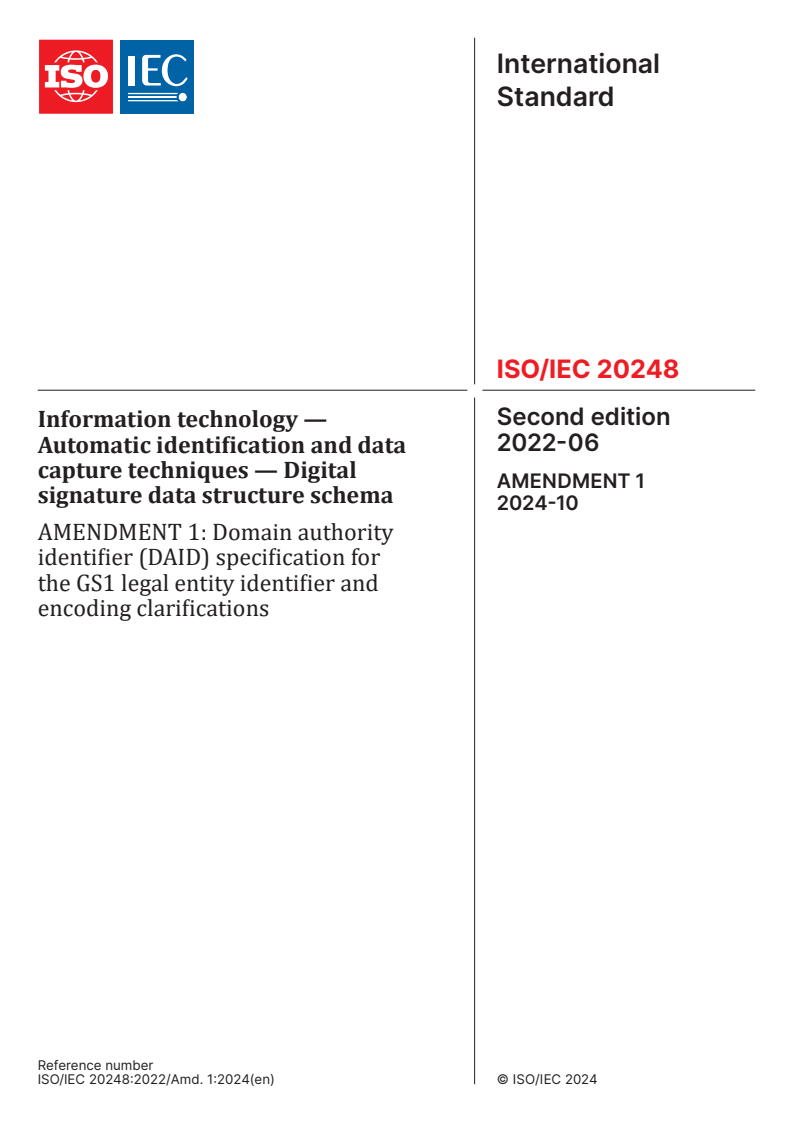
International
Standard
ISO/IEC 20248
Second edition
Information technology —
2022-06
Automatic identification and data
capture techniques — Digital
AMENDMENT 1
signature data structure schema
2024-10
AMENDMENT 1: Domain authority
identifier (DAID) specification for
the GS1 legal entity identifier and
encoding clarifications
Reference number
ISO/IEC 20248:2022/Amd. 1:2024(en) © ISO/IEC 2024
ISO/IEC 20248:2022/Amd. 1:2024(en)
© ISO/IEC 2024
All rights reserved. Unless otherwise specified, or required in the context of its implementation, no part of this publication may
be reproduced or utilized otherwise in any form or by any means, electronic or mechanical, including photocopying, or posting on
the internet or an intranet, without prior written permission. Permission can be requested from either ISO at the address below
or ISO’s member body in the country of the requester.
ISO copyright office
CP 401 • Ch. de Blandonnet 8
CH-1214 Vernier, Geneva
Phone: +41 22 749 01 11
Email: copyright@iso.org
Website: www.iso.org
Published in Switzerland
© ISO/IEC 2024 – All rights reserved
ii
ISO/IEC 20248:2022/Amd. 1:2024(en)
Foreword
ISO (the International Organization for Standardization) and IEC (the International Electrotechnical
Commission) form the specialized system for worldwide standardization. National bodies that are
members of ISO or IEC participate in the development of International Standards through technical
committees established by the respective organization to deal with particular fields of technical activity.
ISO and IEC technical committees collaborate in fields of mutual interest. Other international organizations,
governmental and non-governmental, in liaison with ISO and IEC, also take part in the work.
The procedures used to develop this document and those intended for its further maintenance are described
in the ISO/IEC Directives, Part 1. In particular, the different approval criteria needed for the different types
of document should be noted. This document was drafted in accordance with the editorial rules of the ISO/
IEC Directives, Part 2 (see www.iso.org/directives or www.iec.ch/members_experts/refdocs).
ISO and IEC draw attention to the possibility that the implementation of this document may involve the
use of (a) patent(s). ISO and IEC take no position concerning the evidence, validity or applicability of any
claimed patent rights in respect thereof. As of the date of publication of this document, ISO and IEC had not
received notice of (a) patent(s) which may be required to implement this document. However, implementers
are cautioned that this may not represent the latest information, which may be obtained from the patent
database available at www.iso.org/patents and https://patents.iec.ch. ISO and IEC shall not be held
responsible for identifying any or all such patent rights.
Any trade name used in this document is information given for the convenience of users and does not
constitute an endorsement.
For an explanation of the voluntary nature of standards, the meaning of ISO specific terms and expressions
related to conformity assessment, as well as information about ISO's adherence to the World Trade
Organization (WTO) principles in the Technical Barriers to Trade (TBT) see www.iso.org/iso/foreword.html.
In the IEC, see www.iec.ch/understanding-standards.
This document was prepared by Joint Technical Committee ISO/IEC JTC 1, Information technology,
Subcommittee SC 31, Automatic identification and data capture techniques.
Any feedback or questions on this document should be directed to the user’s national standards
body. A complete listing of these bodies can be found at www.iso.org/members.html and
www.iec.ch/national-committees.
Clause 2, Normative references
Add the reference:
© ISO/IEC 2024 –
...