

ISO/IEC 20248:2022
(Main)Information technology — Automatic identification and data capture techniques — Digital signature data structure schema
General Information
- Abstract
This document is an ISO/IEC 9594‑8 [public key infrastructure (PKI) digital signatures and certificates] application specification for automated identification services. It specifies a method whereby data stored within a barcode and/or RFID tag are structured, encoded and digitally signed. ISO/IEC 9594‑8 is used to provide a standard method for key and data description management and distribution. The data capacity and/or data transfer capacity of automated identification data carriers are restricted. This restricts the normal use of a digital signature as specified in ISO/IEC 9594‑8 within automated identification services. The purpose of this document is to provide an open and interoperable method, between automated identification services and data carriers, to read data, verify data originality and data integrity in an offline use case. This document specifies — the meta data structure, the DigSig, which contains the digital signature and encoded structured data, — the public key certificate parameter and extension use, the DigSig certificate, which contains the certified associated public key, the structured data description, the read methods, and private containers, — the method to specify, read, describe, sign, verify, encode, and decode the structured data, the DigSig Data Description, — the DigSig EncoderGenerator which generates the relevant asymmetric key pairs, keeps the private key secret, and generates the DigSigs, and — the DigSig DecoderVerifier which, by using to the DigSig certificate, reads the DigSig from the set of data carriers, verifies the DigSig and extracts the structured data from the DigSig. This document does not specify — cryptographic methods, or — key management methods.
- Status
- Published
- Publication Date
- 09-Jun-2022
- Technical Committee
- ISO/IEC JTC 1/SC 31 - Automatic identification and data capture techniques
- Drafting Committee
- ISO/IEC JTC 1/SC 31/WG 2 - Data and structure
- Current Stage
- 6060 - International Standard published
- Start Date
- 10-Jun-2022
- Due Date
- 16-Jun-2022
- Completion Date
- 10-Jun-2022



Overview
ISO/IEC 20248:2022 specifies a standardized digital signature data structure schema (commonly called a DigSig) for automatic identification and data capture (AIDC) technologies such as barcodes and RFID tags. Designed as an application specification of ISO/IEC 9594‑8 (PKI digital signatures and certificates), the standard enables compact, interoperable packaging of structured data and a digital signature so that data can be read and verified offline from constrained data carriers.
Key goals:
- Enable reading, authenticity verification and integrity checks of encoded AIDC data in offline use cases
- Provide an open, interoperable method for structuring, encoding and signing AIDC payloads
- Accommodate limited data capacity and transfer rates typical of barcodes and RFID
Key topics and technical requirements
- DigSig structure: a meta-data envelope which contains the encoded structured data and the digital signature.
- DigSig certificate: an application of PKI certificate parameters and extensions to carry the certified public key used to verify DigSigs.
- DigSig Data Description (DDD): defines how structured data fields are specified, encoded, displayed and parsed for signing/verification.
- EncoderGenerator and DecoderVerifier: device/process roles - EncoderGenerator creates asymmetric key pairs, keeps private keys secret, and generates DigSigs; DecoderVerifier uses DigSig certificates to read and verify DigSigs and extract structured data.
- Read methods, private containers, envelope formats, and presentation: covers pragmatic encoding constructs (e.g., “snips”, DDDdata, SigData, DDDdataDisplay) and directives for constrained carriers.
- Conformance, test methods and error codes: conformance claims, test specifications and standardized error reporting are included.
- Important exclusions: the standard does not prescribe specific cryptographic algorithms or key management methods.
Practical applications and intended users
ISO/IEC 20248 is valuable for:
- Supply chain and logistics providers who need tamper-evident barcodes/RFID with offline authenticity checks
- Manufacturers and developers of AIDC readers, mobile verification apps and IoT devices
- Certificate authorities and system integrators implementing DigSig certificate processes
- Healthcare, government credentials, product authentication, anti-counterfeiting and document security use cases requiring compact signed payloads
Benefits include increased data integrity, offline verification capability, and cross-vendor interoperability for constrained AIDC media.
Related standards
- ISO/IEC 9594‑8 - PKI digital signatures and certificates (application base)
- ISO/IEC 15434, ISO/IEC 18000‑63, and GS1 EPC Gen2 - referenced in annexes for example message and RFID usages
- Other ISO AIDC standards for field encoding and carrier specifications
Keywords: ISO/IEC 20248, DigSig, digital signature, barcode, RFID, AIDC, PKI, offline verification, DigSig Data Description, EncoderGenerator, DecoderVerifier.
Relations
- Effective Date
- 03-Jun-2023
- Effective Date
- 10-Jul-2021
Get Certified
Connect with accredited certification bodies for this standard

BSI Group
BSI (British Standards Institution) is the business standards company that helps organizations make excellence a habit.

NYCE
Mexican standards and certification body.
Sponsored listings
Frequently Asked Questions
ISO/IEC 20248:2022 is a standard published by the International Organization for Standardization (ISO). Its full title is "Information technology — Automatic identification and data capture techniques — Digital signature data structure schema". This standard covers: This document is an ISO/IEC 9594‑8 [public key infrastructure (PKI) digital signatures and certificates] application specification for automated identification services. It specifies a method whereby data stored within a barcode and/or RFID tag are structured, encoded and digitally signed. ISO/IEC 9594‑8 is used to provide a standard method for key and data description management and distribution. The data capacity and/or data transfer capacity of automated identification data carriers are restricted. This restricts the normal use of a digital signature as specified in ISO/IEC 9594‑8 within automated identification services. The purpose of this document is to provide an open and interoperable method, between automated identification services and data carriers, to read data, verify data originality and data integrity in an offline use case. This document specifies — the meta data structure, the DigSig, which contains the digital signature and encoded structured data, — the public key certificate parameter and extension use, the DigSig certificate, which contains the certified associated public key, the structured data description, the read methods, and private containers, — the method to specify, read, describe, sign, verify, encode, and decode the structured data, the DigSig Data Description, — the DigSig EncoderGenerator which generates the relevant asymmetric key pairs, keeps the private key secret, and generates the DigSigs, and — the DigSig DecoderVerifier which, by using to the DigSig certificate, reads the DigSig from the set of data carriers, verifies the DigSig and extracts the structured data from the DigSig. This document does not specify — cryptographic methods, or — key management methods.
This document is an ISO/IEC 9594‑8 [public key infrastructure (PKI) digital signatures and certificates] application specification for automated identification services. It specifies a method whereby data stored within a barcode and/or RFID tag are structured, encoded and digitally signed. ISO/IEC 9594‑8 is used to provide a standard method for key and data description management and distribution. The data capacity and/or data transfer capacity of automated identification data carriers are restricted. This restricts the normal use of a digital signature as specified in ISO/IEC 9594‑8 within automated identification services. The purpose of this document is to provide an open and interoperable method, between automated identification services and data carriers, to read data, verify data originality and data integrity in an offline use case. This document specifies — the meta data structure, the DigSig, which contains the digital signature and encoded structured data, — the public key certificate parameter and extension use, the DigSig certificate, which contains the certified associated public key, the structured data description, the read methods, and private containers, — the method to specify, read, describe, sign, verify, encode, and decode the structured data, the DigSig Data Description, — the DigSig EncoderGenerator which generates the relevant asymmetric key pairs, keeps the private key secret, and generates the DigSigs, and — the DigSig DecoderVerifier which, by using to the DigSig certificate, reads the DigSig from the set of data carriers, verifies the DigSig and extracts the structured data from the DigSig. This document does not specify — cryptographic methods, or — key management methods.
ISO/IEC 20248:2022 is classified under the following ICS (International Classification for Standards) categories: 35.040.50 - Automatic identification and data capture techniques. The ICS classification helps identify the subject area and facilitates finding related standards.
ISO/IEC 20248:2022 has the following relationships with other standards: It is inter standard links to ISO/IEC 20248:2022/Amd 1:2024, ISO/IEC 20248:2018. Understanding these relationships helps ensure you are using the most current and applicable version of the standard.
ISO/IEC 20248:2022 is available in PDF format for immediate download after purchase. The document can be added to your cart and obtained through the secure checkout process. Digital delivery ensures instant access to the complete standard document.
Standards Content (Sample)
INTERNATIONAL ISO/IEC
STANDARD 20248
Second edition
2022-06
Information technology — Automatic
identification and data capture
techniques — Digital signature data
structure schema
Technologies de l'information — Techniques d'identification
automatique et de capture de données — Schéma de structure de
données de signature numérique
Reference number
© ISO/IEC 2022
© ISO/IEC 2022
All rights reserved. Unless otherwise specified, or required in the context of its implementation, no part of this publication may
be reproduced or utilized otherwise in any form or by any means, electronic or mechanical, including photocopying, or posting on
the internet or an intranet, without prior written permission. Permission can be requested from either ISO at the address below
or ISO’s member body in the country of the requester.
ISO copyright office
CP 401 • Ch. de Blandonnet 8
CH-1214 Vernier, Geneva
Phone: +41 22 749 01 11
Email: copyright@iso.org
Website: www.iso.org
Published in Switzerland
ii
© ISO/IEC 2022 – All rights reserved
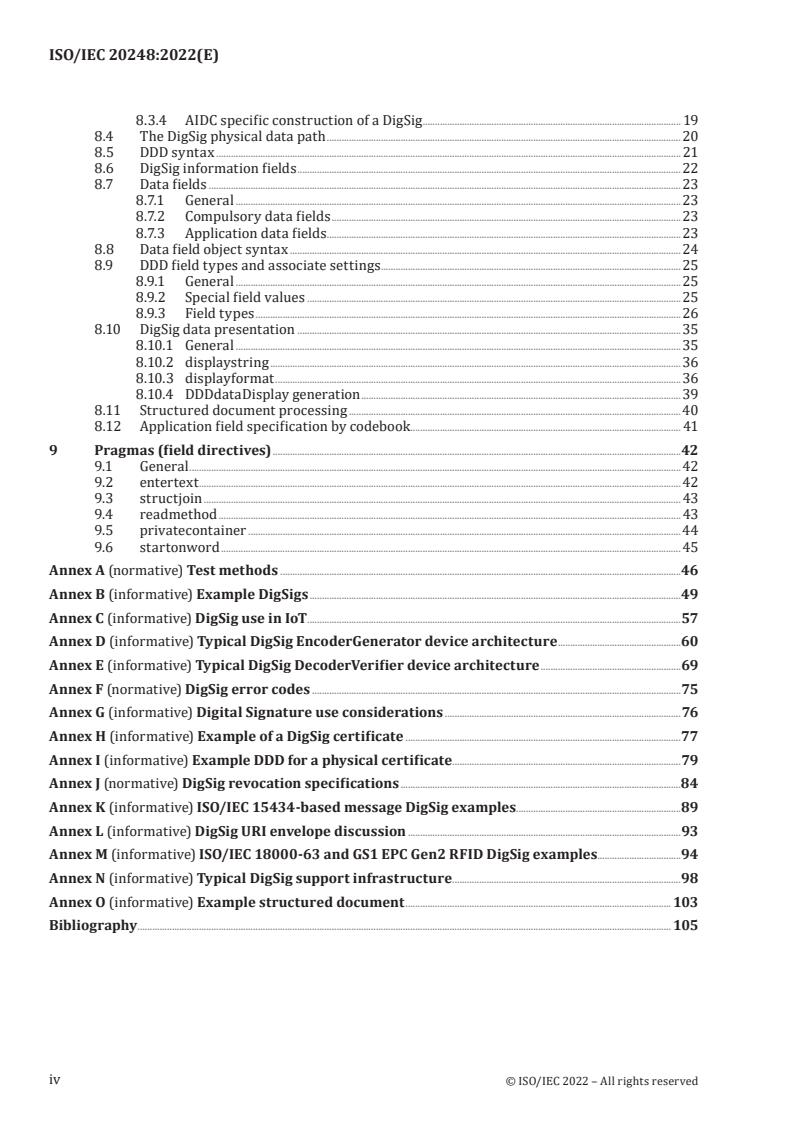
Contents Page
Foreword .v
Introduction .vii
1 Scope . 1
2 Normative references . 1
3 Terms and definitions . 2
4 Field and data definitions, abbreviated terms, symbols, and binary data .4
4.1 Field and data definitions . 4
4.2 Abbreviated terms . 4
4.3 Symbols . 5
4.4 Binary data . 5
5 Conformance . 5
5.1 Specification version . 5
5.2 Claiming conformance . 6
5.3 Test authority . 6
5.4 Test specification . 6
6 DigSig use architecture . 6
6.1 General . 6
6.2 DigSig identification and ownership . 7
6.3 DigSig certificate process. 8
6.4 DigSig generation process . 9
6.5 DigSig verification process . 9
6.6 Error codes . . 10
7 DigSig certificate .10
7.1 General . 10
7.2 ISO/IEC 20248 Object Identifier . 10
7.3 DigSig certificate parameter use . 10
7.4 DigSig cryptography . 11
7.4.1 General . 11
7.4.2 Digital signatures . 11
7.4.3 Private containers . 11
7.5 DigSig Domain Authority identifier (DAID) . 11
7.5.1 Binary encoding . 11
7.5.2 Referenced DAID .13
7.5.3 GS1 Company Prefix (GCP) . 13
7.6 DigSig certificate identifier (CID) . 13
7.7 DigSig validity . 13
7.8 DigSig certificate management . 14
7.9 DigSig revocation . . 14
7.10 Online verification . 15
8 DigSig Data Description (DDD) .15
8.1 General . 15
8.2 DDD derived data structures . 16
8.2.1 General . 16
8.2.2 DDDdata . 16
8.2.3 SigData . 17
8.2.4 DDDdataTagged . 17
8.2.5 DDDdataDisplay . 18
8.3 DigSig format . 18
8.3.1 General . 18
8.3.2 Snips . 18
8.3.3 Envelope format . 19
iii
© ISO/IEC 2022 – All rights reserved
8.3.4 AIDC specific construction of a DigSig . 19
8.4 The DigSig physical data path . 20
8.5 DDD syntax . 21
8.6 DigSig information fields . 22
8.7 Data fields . 23
8.7.1 General .23
8.7.2 Compulsory data fields .23
8.7.3 Application data fields .23
8.8 Data field object syntax . 24
8.9 DDD field types and associate settings . 25
8.9.1 General . 25
8.9.2 Special field values .25
8.9.3 Field types .26
8.10 DigSig data presentation . 35
8.10.1 General . 35
8.10.2 displaystring . 36
8.10.3 displayformat .36
8.10.4 DDDdataDisplay generation . 39
8.11 Structured document processing .40
8.12 Application field specification by codebook . 41
9 Pragmas (field directives) .42
9.1 General . 42
9.2 entertext . 42
9.3 structjoin . 43
9.4 readmethod . 43
9.5 privatecontainer .44
9.6 startonword . 45
Annex A (normative) Test methods .46
Annex B (informative) Example DigSigs .49
Annex C (informative) DigSig use in IoT .57
Annex D (informative) Typical DigSig EncoderGenerator device architecture .60
Annex E (informative) Typical DigSig DecoderVerifier device architecture .69
Annex F (normative) DigSig error codes .75
Annex G (informative) Digital Signature use considerations .76
Annex H (informative) Example of a DigSig certificate .77
Annex I (informative) Example DDD for a physical certificate .79
Annex J (normative) DigSig revocation specifications .84
Annex K (informative) ISO/IEC 15434-based message DigSig examples .89
Annex L (informative) DigSig URI envelope discussion .93
Annex M (informative) ISO/IEC 18000-63 and GS1 EPC Gen2 RFID DigSig examples.94
Annex N (informative) Typical DigSig support infrastructure .98
Annex O (informative) Example structured document . 103
Bibliography . 105
iv
© ISO/IEC 2022 – All rights reserved
Foreword
ISO (the International Organization for Standardization) and IEC (the International Electrotechnical
Commission) form the specialized system for worldwide standardization. National bodies that are
members of ISO or IEC participate in the development of International Standards through technical
committees established by the respective organization to deal with particular fields of technical
activity. ISO and IEC technical committees collaborate in fields of mutual interest. Other international
organizations, governmental and non-governmental, in liaison with ISO and IEC, also take part in the
work.
The procedures used to develop this document and those intended for its further maintenance
are described in the ISO/IEC Directives, Part 1. In particular, the different approval criteria
needed for the different types of documents should be noted. This document was drafted in
accordance with the editorial rules of the ISO/IEC Directives, Part 2 (see www.iso.org/directives or
www.iec.ch/members_experts/refdocs).
Attention is drawn to the possibility that some of the elements of this document may be the subject
of patent rights. ISO and IEC shall not be held responsible for identifying any or all such patent
rights. Details of any patent rights identified during the development of the document will be in the
Introduction and/or on the ISO list of patent declarations received (see www.iso.org/patents) or the IEC
list of patent declarations received (see https://patents.iec.ch).
Any trade name used in this document is information given for the convenience of users and does not
constitute an endorsement.
For an explanation of the voluntary nature of standards, the meaning of ISO specific terms and
expressions related to conformity assessment, as well as information about ISO's adherence to the
World Trade Organization (WTO) principles in the Technical Barriers to Trade (TBT) see
This document was prepared by joint Technical Committee ISO/IEC JTC 1, Information technology,
Subcommittee SC 31, Automatic identification and data capture techniques.
This second edition cancels and replaces the first edition (ISO/IEC 20248:2018), which has been
technically revised.
The main changes are as follows:
— The relationship between the Domain Authority (data owner) and the Domain Authority ID (DAID)
is clarified to be one-to-many. The DAID has been extended to cater for the GS1 Company Prefix
longer than 10 digits (see 7.5.3), and a method to use the primary data carrier DAID, if present (see
7.5.2).
— The data types and specifications have been updated for easier implementation and completeness,
especially to support the practice of using the data type specifications to achieve optimized schema-
based data encoding. A codebook method forms part of this update.
— The date field type has been found to be limiting. A new human readable isodate has been specified
to replace date (see 8.9.3.7).
— The format of binary data is explicitly defined to be HexString or Base64String ensuring
interoperability and ease of use.
— The bstring DDDdata has been limited to HexString since Base64 decoding can be done in more
than one way which may cause a valid DigSig to be rejected.
— The digsigenv type has been changed from bstring to string with a range of Base64String, which
is technically the same, but explicit and clear.
— The cidsniptext pragma (field directive) has been removed since it is not practical, not used, and
redundant. It is also difficult and convoluted to use and implement.
v
© ISO/IEC 2022 – All rights reserved
— ISO/IEC 9899, Information technology — Programming languages — C has been removed as a
normative reference. Common current coding language methods replaced the C methods.
— Example cryptography methods are provided in B.4.
— Example interfaces to potential code blocks are provided in D.3.3 and E.3.3.
— Revocation has been harmonized with conventional best practices. The CID requirement to be 0 and
1 has been removed (see Annex J).
— An example implementation architecture description has been added as Annex N.
— The structured document function (see 8.11) has been enhanced to support multiple languages. An
example structured document is discussed as Annex O.
Any feedback or questions on this document should be directed to the user’s national standards
body. A complete listing of these bodies can be found at www.iso.org/members.html and
www.iec.ch/national-committees.
vi
© ISO/IEC 2022 – All rights reserved
Introduction
This document specifies a data structure framework and data specification method for domain-
authority-specified, schema-based item identification data. A domain authority is typically a brand
owner, a data authority, or a data owner.
ISO/IEC 21778 (JSON) is used as the data message format for both the schema and the data, ensuring
interoperability with modern Internet systems and services. The data message encapsulates both data
syntax and semantics, providing meaning to the data message.
The data source, data schema and data are both offline and online verifiable using ISO/IEC 9594-8 (public
key infrastructure (PKI) digital signatures and certificates), with its implementation environment. The
data message format allows for the verification of the data message anywhere within the data-stack.
Data capacity and/or data transfer capacity of automated identification data carriers (barcode
labels and RFID tags) are limited. This restricts the normal use of a digital signature, as specified
in ISO/IEC 9594-8, within automated identification services. This limitation is overcome by the
methods specified in this document, which recognizes the three classes of item; data carrier data
(any combination of barcodes and RFID tags), generic data which applies to a group of items, and item
specific data which may be static for that item, or volatile. Only item specific data are carried by the tag.
Generic data are carried by the digital certificate associated with the tag. This method allows additional
(comprehensive) data about a group of items to be readable and verifiable.
Adding additional data, especially authenticity data, to tags are often challenging for existing systems
resulting in high costs and system/services unavailability. This document provides a method whereby
data may be added with limited impact to incumbent systems, facilitating an interoperable add-on
rather than a system redesign.
This document specifies an effective and interoperable method to specify, read, decode, and verify
data stored in automated identification, independent from real-time remote control. Meta parameters
included in a digital certificate are used to achieve:
— offline integrity verification of the data source and data originality,
— a verifiable data structure description to enable interoperability of deployment, domain authority
and automated identification data carriers,
— a verifiable data encoding method to achieve compact data to be stored in data constrained
automated identification data carriers (the JSON data format is used for both input and output of
the encoder and decoder),
— a verifiable automated identification data carrier read method description, allowing for the data of
a read event to be distributed over more than one carrier of the same and of different technologies,
and
— a verifiable method to support key management of cryptographically-enabled automatic
identification data carriers.
A successful verification of the DigSig signifies:
— the data was not tampered with;
— the source of the data is as indicated on the DigSig certificate used to verify the DigSig with;
— if a secured unique identifier of the data carrier is included in the signature of the DigSig stored on
data carrier, then the DigSig stored on the data carrier can be considered unique and original.
The choice of cryptography method should be considered carefully. It is advised that only internationally
recognized or standardized methods, e.g. FIPS PUB 186-4 and IEEE P1363, be used.
vii
© ISO/IEC 2022 – All rights reserved
This document should be used in conjunction with standard risk assessments of the use-case and
environment.
NOTE Many applications rely on a secure non-transferable unique data carrier identifier to tag an item
uniquely. ISO/IEC 29167 gives more information on such functionality for RFID tags. This specification provides
a mechanism to ensure the integrity and authenticity of the data carrier data and an irrefutable link of the
data carrier data with the unique data carrier identifier. As such, alterations or insertion of false data into data
carriers are detectable. It also provides a means to detect tampered data carrier data stored and communicated
within systems. It does not provide any means to defend against replay attacks. As a counter the data carrier
reader can use this specification to sign the read data, effectively providing integrity and authenticity to the
read-transaction. A third party can then verify that the read-transaction happened at a given place and time, as
well as verify the data read from the carrier. Likewise, the signed data carrier data can contain data describing
unique features and security marks of the item establishing a verifiable link between the data carrier data and
the physical item.
viii
© ISO/IEC 2022 – All rights reserved
INTERNATIONAL STANDARD ISO/IEC 20248:2022(E)
Information technology — Automatic identification and
data capture techniques — Digital signature data structure
schema
1 Scope
This document is an ISO/IEC 9594-8 [public key infrastructure (PKI) digital signatures and certificates]
application specification for automated identification services. It specifies a method whereby data
stored within a barcode and/or RFID tag are structured, encoded and digitally signed. ISO/IEC 9594-8
is used to provide a standard method for key and data description management and distribution. The
data capacity and/or data transfer capacity of automated identification data carriers are restricted.
This restricts the normal use of a digital signature as specified in ISO/IEC 9594-8 within automated
identification services.
The purpose of this document is to provide an open and interoperable method, between automated
identification services and data carriers, to read data, verify data originality and data integrity in an
offline use case.
This document specifies
— the meta data structure, the DigSig, which contains the digital signature and encoded structured
data,
— the public key certificate parameter and extension use, the DigSig certificate, which contains the
certified associated public key, the structured data description, the read methods, and private
containers,
— the method to specify, read, describe, sign, verify, encode, and decode the structured data, the DigSig
Data Description,
— the DigSig EncoderGenerator which generates the relevant asymmetric key pairs, keeps the private
key secret, and generates the DigSigs, and
— the DigSig DecoderVerifier which, by using to the DigSig certificate, reads the DigSig from the set of
data carriers, verifies the DigSig and extracts the structured data from the DigSig.
This document does not specify
— cryptographic methods, or
— key management methods.
2 Normative references
The following documents are referred to in the text in such a way that some or all their content
constitutes requirements of this document. For dated references, only the edition cited applies. For
undated references, the latest edition of the referenced document (including any amendments) applies.
ISO 8601 (all parts), Data elements and interchange formats — Information interchange — Representation
of dates and times
1)
ISO/IEC 8824-1 , Information technology — Abstract Syntax Notation One (ASN.1): Specification of basic
notation — Part 1
1) ITU-T X.680 is equivalent to ISO/IEC 8824-1.
© ISO/IEC 2022 – All rights reserved
2)
ISO/IEC 9594-1 , Information technology — Open Systems Interconnection — The Directory — Part 1:
Overview of concepts, models and services
3)
ISO/IEC 9594-8 , Information technology — Open Systems Interconnection —The Directory — Part 8:
Public-key and attribute certificate frameworks
ISO/IEC/IEEE 9945, Information technology — Portable Operating System Interface (POSIX®) Base
Specifications, Issue 7
ISO/IEC 19762, Information technology — Automatic identification and data capture (AIDC) techniques —
Harmonized vocabulary
IETF RFC 3986, Uniform Resource Identifier (URI): Generic Syntax
4)
IETF RFC 5646 , Tags for Identifying Languages
3 Terms and definitions
For the purposes of this document, the terms and definitions given in ISO/IEC 19762 and the following
apply.
ISO and IEC maintain terminology databases for use in standardization at the following addresses:
— ISO Online browsing platform: available at https:// www .iso .org/ obp
— IEC Electropedia: available at https:// www .electropedia .org/
3.1
authenticity
quality or condition of being authentic, trustworthy, or genuine
3.2
base64url
Base64 encoding with the URL and Filename Safe Alphabet
Note 1 to entry: See IETF RFC 4648.
3.3
CIDSnip
continuous binary sequence starting with the DAID and CID encoded field values
Note 1 to entry: See 8.3.2.
3.4
DataSnip
continuous binary or text sequence of encoded field values
Note 1 to entry: See 8.3.2.
3.5
digital certificate
certificate
data construct that contains the public key, integrity parameters and use parameters of the DigSig
Note 1 to entry: The data construct shall be as specified in ISO/IEC 9594-8.
2) ITU X.500 is equivalent to ISO/IEC 9594-1, and is the commonly used reference for standard and terminology.
3) ITU X.509 is equivalent to ISO/IEC 9594-8, and is the commonly used reference for standard and terminology.
4) IEFT RFC 5646 is the reference specification of the IETF BCP 47.
© ISO/IEC 2022 – All rights reserved
3.6
digital signature
signature
result of an asymmetric encryption method on a data construct
Note 1 to entry: The asymmetric encryption method and data construct shall be as specified in ISO/IEC 9594-8.
Note 2 to entry: In typical legal terminology, this term is the equivalent of an advanced electronic signature.
3.7
DigSig
data construct assembled according to this document which contains verifiable information obtained
from one or more AIDC
3.8
DigSig envelope
envelope
data construct assembled according to this document by the EncoderGenerator
3.9
Domain Authority
entity, operating as a trusted third party, responsible for the digital signature integrity of a jurisdiction
3.10
integrity
reliability of data that are as they were created according to the required verification parameters
3.11
jurisdiction
independent domain of control in terms of the business or legal (or both) scope of the parties concerned
Note 1 to entry: Examples are independent countries, separate ministries or departments of a government, or
independent companies each with their own legal or business (or both) framework.
3.12
nibble
four-bit aggregation
3.13
pragma
field directive
Note 1 to entry: See Clause 9.
3.14
Private key
key that is kept in secret and is used to generate a digital signature by encrypting data that will be
verified by its associated public key
3.15
Public key
key that is publicly available and is used to verify data that were encrypted by its associated private key
3.16
Snip
continuous binary or text sequence
Note 1 to entry: See 8.3.2.
© ISO/IEC 2022 – All rights reserved
3.17
UTF-8
8 bit variable-width encoding as specified by ISO/IEC 10646 of the Unicode Graphic code points
Note 1 to entry: See ISO/IEC 10646.
3.18
WORD
media physical memory grouping of bits
4 Field and data definitions, abbreviated terms, symbols, and binary data
4.1 Field and data definitions
Field and data objects are defined in Clause 8 and 8.10.3.
4.2 Abbreviated terms
AFI Application Family Identifier
AIDC Automatic Identification data capture
BRE Basic Regular Expression
CA Certification Authority
CID DigSig certificate ID
DA Domain Authority
DAID Domain Authority identifier
DDD DigSig Data Description
DI Data Identifier (see ISO/IEC 15434)
DigSig IA DigSig Issuing Authority
ERE Extended Regular Expressions
ID Identification number
IoT Internet of Things
JSON Data description construct (see ISO/IEC 21778)
MSB Most significant bit
OID Object identifier as specified in ISO/IEC 8824-1
PKI Public key infrastructure
RFID Radio-frequency identification
UID Unique ID
URI Uniform Resource Identifier
UTC Coordinated Universal Time
© ISO/IEC 2022 – All rights reserved
X.509 ISO/IEC 9594-8
4.3 Symbols
‖ concatenate or join
… repeat the previous, as required, or fill in, as required
{…} parameters that form one structure/grouping, a JSON object
[x] x is optional, or a JSON array
x is compulsory
x |= y y is a description of x
x ⇐ y x takes the value of y
# x x is a comment until the end of the line
F(x,y) the function F that takes as input two parameters, x and y, to produce an output
:XXXX:.XX depicts a hexadecimal string with "0" to "9" and "A" to "F" with 4-character groupings
0xX… depicts a hexadecimal value with X with "0" to "9" and "A" to "F"
XXX "XXX" is binary with X a "0" or a "1"
4.4 Binary data
Binary data shall be represented by a JSON string with one of the following two formats:
— HexString: The character 0 to 9 and A to F shall be used to represent binary values 0000 to 1111 .
2 2
A HexString is a continuum of 4-bit nibbles presented as uppercase hex grouped with 4 characters
preceded by a colon (":"). Zero-bit padding shall be used to reach a 4-bit boundary.
EXAMPLE 1 ":0123:4567:89AB:CDEF:0123:4567:89AB:C" and ":92"
— Base64String: IETF RFC 4648 base64url with padding shall be used except when Base64String is
used as an input value for bstring where multiples of 6 bits are represented each with a base64url
character.
EXAMPLE 2 "VGhlIHF1aWNrIGJzyQMjezuZcA=="
Binary data shall be represented in network byte order (big-endian on bytes).
Applications shall auto distinguish between HexString and Base64String by using the leading colon
(":") character in the JSON string.
5 Conformance
5.1 Specification version
The specification version is used by data structures defined in this document. Other systems use the
specification version to identify the data structures of this document and to determine the version of
the specification.
The specification version shall be set as follows:
© ISO/IEC 2022 – All rights reserved
specificationversionvalue ⇐ "ISO/IEC 20248:yyyy" with "yyyy" the year of the publication
supported by the implementation.
5.2 Claiming conformance
To claim conformance, a service shall comply with the requirements of this document.
5.3 Test authority
The tests shall be performed by a software test authority using a norm application or by code inspection.
The norm application used in this test shall be independent from the person who requests the test.
5.4 Test specification
The test specification specifies the conformance test methods for this document.
The test methods in Annex A shall be used.
The test specification is independent of
— cryptography conformance and performance; and
— AIDC data carrier conformance and performance.
The following components shall be tested:
— DigSig certificate format.
— DigSig data.
— DigSig DecoderVerifier.
— DigSig EncoderGenerator.
6 DigSig use architecture
6.1 General
This document specifies a DigSig EncoderGenerator and a DigSig DecoderVerifier system component.
The DigSig EncoderGenerator is typically an application dedicated implementation and the DigSig
DecoderVerifier an application independent implementation.
A DigSig is a structured set of AIDC data. A DigSig may be stored over more than one AIDC device of
different types. A DigSig is cryptographically verifiable. The DigSig data structure definition, read
methods and cryptographic functions (DigSigs Data Description - DDD) are specified by a Domain
Authority (DA) and published in a DigSig certificate (a version 3 X.509 digital certificate). The DigSig
certificate is cryptographically verifiable as certified by an X.509 Certification Authority. Each DigSig
certificate has a unique identifier (see 7.6) called the certificate Identifier (CID). The {DAID, CID}
is unique and contained in every DigSig as the first data of the DigSig. A reader of a DigSig uses the
{DAID, CID} of the specific DigSig to reference the relevant DigSig certificate, from which the reader
acquires the read methods, data structure specification and cryptographic functions to read the full
DigSig, decode the DigSig and verify the DigSig. See Annex B for example DigSigs and Annex I for the
DigSig data structures of an example DigSig.
The DigSig EncoderGenerator is used to generate a DigSig, on request from a data carrier programming
application. The DigSig EncoderGenerator does not include the method to create or program a data
carrier. See Annex D for a typical DigSig EncoderGenerator use architecture.
© ISO/IEC 2022 – All rights reserved
The DigSig DecoderVerifier is used by a local application to instruct a data carrier reader/interrogator
how to read the DigSig from a set of data carriers and other sources to decode and verify the data. See
Annex E typical DigSig DecoderVerifier use architecture.
Figure 1 — DigSig use architecture
The general method and properties of this document are illustrated in Figure 1.
a) Domain Authority A (DA-A) provides DigSig issuing services for Jurisdiction A. Similarly, Domain
Authority B (DA-B) provides DigSig issuing services for Jurisdiction B. “Issuing” entails the
validation of the data for a DigSig, the validation of the DigSig requestor's credentials, and the
generation of the DigSig. The DigSig requestor may be a human and/or an application.
b) The DigSig certificates issued by DA-A, each containing a DigSig Data Description (DDD) as
applicable to Jurisdiction A applications/services, are certified by the Certification Authority α (CA-
α) for a specific signing and certificate validity period in accordance with a Certification Practice
Statement as specified in X.509. Similarly, Certification Authority β certifies DigSig certificates
issued by DA-B. Certification Authorities α and β may be the same entity.
c) The DigSig certificates are published in a manner to allow systems S1 , S2 , S1 , S2 … to acquire
A A B B
them in advance or on demand. The DigSig certificates are used by the systems to read, decode,
and verify DigSigs generated and stored on data carriers by the Domain Authorities, e.g. Data X is
used by DA-A to generate a DigSig N X as specified by a DigSig certificate N. The systems of both
A
jurisdictions use the DigSig certificates to read, decode, verify, and use the data without the need to
connect to any other system.
Annex C provides more information on DigSig use in IoT. AIDC data fulfil an important role in IoT by
providing physical objects with a digital identity and optional attributes.
Annex G provides more information on digital signature use in general.
6.2 DigSig identification and ownership
The Domain Authority (DA) shall be the owner of the DigSig certificate which specifies the DigSig data
structure schema (the DDD). The DA shall be the issuer of the DigSigs, directly or by proxy, specified by
the associated DigSig certificate.
© ISO/IEC 2022 – All rights reserved
The Domain Authority shall be identified by its URI called the DA URI (see 7.3). The DA URI shall be
verified by the X.509 Certificate Authority when issuing the DigSig certificate.
The DigSig ownership shall be identified by the tuple {Domain Authority URI (dauri), Domain Authority
identifier (DAID, see 7.5), DigSig certificate identifier (CID, see 7.6)} as certified by the DigSig certificate
to be valid at the time of the issuance of the certificate. This validity should be valid when a DigSig is
issued.
A Domain Authority may be related to more than one DAID. A DAID shall only be related to one Domain
Authority at a given time.
NOTE A DAID is typically assigned to a company or an operating entity of a company. These entities can be
traded, terminated, suspended, and resurrected as part of normal business operations.
6.3 DigSig certificate process
Figure 2 describes the process that shall be followed to issue a DigSig certificate in accordance with
X.509.
Figure 2 — DigSig certificate process
Figure 3 illustrates how data structure changes can be achieved seamlessly by allowing DigSig
certificates — and therefore the data structure validity — to overlap.
© ISO/IEC 2022 – All rights reserved
IS
...