

ISO/IEC 9796-3:2006
(Main)Information technology — Security techniques — Digital signature schemes giving message recovery — Part 3: Discrete logarithm based mechanisms
General Information
- Abstract
A digital signature in electronic exchange of information provides the same kind of facilities that are expected from a handwritten signature in paper-based mail. Hence it is applicable to providing entity authentication, data origin authentication, non-repudiation, and integrity of data. ISO/IEC 9796-3:2006 specifies digital signature mechanisms giving partial or total message recovery aiming at reducing storage and transmission overhead. ISO/IEC 9796-3:2006 specifies mechanisms based on the discrete logarithm problem of a finite field or an elliptic curve over a finite field. ISO/IEC 9796-3:2006 defines types of redundancy: natural redundancy, added redundancy, or both. ISO/IEC 9796-3:2006 gives the general model for digital signatures giving partial or total message recovery aiming at reducing storage and transmission overhead. ISO/IEC 9796-3:2006 specifies six digital signature schemes giving data recovery: NR, ECNR, ECMR, ECAO, ECPV, and ECKNR. NR is defined on a prime field; ECNR, ECMR, ECAO, ECPV, and ECKNR are defined on an elliptic curve over a finite field.
- Status
- Published
- Publication Date
- 11-Sep-2006
- Drafting Committee
- ISO/IEC JTC 1/SC 27/WG 2 - Cryptography and security mechanisms
- Current Stage
- 9093 - International Standard confirmed
- Start Date
- 03-May-2024
- Completion Date
- 29-Aug-2026

Overview
ISO/IEC 9796-3:2006 defines digital signature schemes giving message recovery based on the discrete logarithm problem. The standard specifies randomized signature mechanisms that enable partial or total message recovery from the signature itself, reducing storage and transmission overhead compared with signature-with-appendix approaches. Schemes are defined on a prime field or on elliptic curves over finite fields, and support services such as entity authentication, data origin authentication, non‑repudiation, and integrity.
Key topics and requirements
- Scope: Digital signatures that allow recovery of all or part of the signed message to save bandwidth and storage.
- Mechanisms: Six discrete-logarithm‑based schemes are specified: NR (Nyberg–Rueppel), ECNR, ECMR, ECAO, ECPV, and ECKNR. NR uses a prime field; the others are elliptic‑curve based.
- Core processes: formal models for parameter generation, user key generation, signature generation, and signature verification are defined.
- Redundancy models: support for natural redundancy, added redundancy, or a combination to enable reliable message recovery and integrity checking.
- Hash and mask binding: specification of how signature mechanisms bind to hash functions and allowable mask generation (key‑derivation) functions (e.g., MGF variants).
- Data and conversion functions: conversions between bit/ octet strings, finite‑field elements and elliptic‑curve points, plus an ASN.1 module for representation and interchange.
- Security properties: requirements that signatures resist forgery, key recovery, and second‑preimage issues under standard cryptographic assumptions.
- Implementation guidance: informative annexes with mathematical conventions, conversion and mask functions, example data construction, numeric examples, and a summary of mechanism properties.
- Patents: the standard notes claimed patent interests for NR, ECMR and ECAO; implementers should review patent/licensing terms.
Applications and who should use it
ISO/IEC 9796-3 is useful for:
- Cryptographic library developers implementing digital-signature APIs that support message recovery.
- Security architects designing low-bandwidth or constrained systems (smart cards, IoT, embedded devices) where reducing message transmission or storage matters.
- Electronic document and secure email systems that need non‑repudiation while optimizing payload size.
- Standards and compliance teams assessing interoperable signature formats for protocols using elliptic‑curve or discrete‑logarithm cryptography.
Practical application areas include secure firmware signing, e‑transaction receipts, constrained-network communications, and smart‑card authentication systems.
Related standards
- ISO/IEC 9796‑2 - integer factorization based mechanisms (complementary family)
- ISO/IEC 15946‑1 - elliptic curve cryptography background and techniques
- ISO/IEC 10118 - hash function standards
- ISO/IEC 14888 - signature framework and terminology
Keywords: ISO/IEC 9796-3, digital signature schemes, message recovery, elliptic curve, discrete logarithm, NR, ECNR, ECMR, ECAO, ECPV, ECKNR, non-repudiation, entity authentication.
Relations
- Effective Date
- 09-Feb-2026
- Effective Date
- 09-Feb-2026
- Effective Date
- 15-Apr-2008
Get Certified
Connect with accredited certification bodies for this standard

BSI Group
BSI (British Standards Institution) is the business standards company that helps organizations make excellence a habit.

Bureau Veritas
Bureau Veritas is a world leader in laboratory testing, inspection and certification services.

DNV
DNV is an independent assurance and risk management provider.
Sponsored listings
Frequently Asked Questions
ISO/IEC 9796-3:2006 is a standard published by the International Organization for Standardization (ISO). Its full title is "Information technology — Security techniques — Digital signature schemes giving message recovery — Part 3: Discrete logarithm based mechanisms". This standard covers: A digital signature in electronic exchange of information provides the same kind of facilities that are expected from a handwritten signature in paper-based mail. Hence it is applicable to providing entity authentication, data origin authentication, non-repudiation, and integrity of data. ISO/IEC 9796-3:2006 specifies digital signature mechanisms giving partial or total message recovery aiming at reducing storage and transmission overhead. ISO/IEC 9796-3:2006 specifies mechanisms based on the discrete logarithm problem of a finite field or an elliptic curve over a finite field. ISO/IEC 9796-3:2006 defines types of redundancy: natural redundancy, added redundancy, or both. ISO/IEC 9796-3:2006 gives the general model for digital signatures giving partial or total message recovery aiming at reducing storage and transmission overhead. ISO/IEC 9796-3:2006 specifies six digital signature schemes giving data recovery: NR, ECNR, ECMR, ECAO, ECPV, and ECKNR. NR is defined on a prime field; ECNR, ECMR, ECAO, ECPV, and ECKNR are defined on an elliptic curve over a finite field.
A digital signature in electronic exchange of information provides the same kind of facilities that are expected from a handwritten signature in paper-based mail. Hence it is applicable to providing entity authentication, data origin authentication, non-repudiation, and integrity of data. ISO/IEC 9796-3:2006 specifies digital signature mechanisms giving partial or total message recovery aiming at reducing storage and transmission overhead. ISO/IEC 9796-3:2006 specifies mechanisms based on the discrete logarithm problem of a finite field or an elliptic curve over a finite field. ISO/IEC 9796-3:2006 defines types of redundancy: natural redundancy, added redundancy, or both. ISO/IEC 9796-3:2006 gives the general model for digital signatures giving partial or total message recovery aiming at reducing storage and transmission overhead. ISO/IEC 9796-3:2006 specifies six digital signature schemes giving data recovery: NR, ECNR, ECMR, ECAO, ECPV, and ECKNR. NR is defined on a prime field; ECNR, ECMR, ECAO, ECPV, and ECKNR are defined on an elliptic curve over a finite field.
ISO/IEC 9796-3:2006 is classified under the following ICS (International Classification for Standards) categories: 35.030 - IT Security; 35.040 - Information coding. The ICS classification helps identify the subject area and facilitates finding related standards.
ISO/IEC 9796-3:2006 has the following relationships with other standards: It is inter standard links to EN 419212-1:2014, EN 419212-2:2014, ISO/IEC 9796-3:2000. Understanding these relationships helps ensure you are using the most current and applicable version of the standard.
ISO/IEC 9796-3:2006 is available in PDF format for immediate download after purchase. The document can be added to your cart and obtained through the secure checkout process. Digital delivery ensures instant access to the complete standard document.
Standards Content (Sample)
INTERNATIONAL ISO/IEC
STANDARD 9796-3
Second edition
2006-09-15
Corrected version
2013-09-15
Information technology — Security
techniques — Digital signature schemes
giving message recovery —
Part 3:
Discrete logarithm based mechanisms
Technologies de l'information — Techniques des sécurité — Schémas
de signature numérique rétablissant le message —
Partie 3: Mécanismes basés sur les logarithmes discrets
Reference number
©
ISO/IEC 2006
PDF disclaimer
This PDF file may contain embedded typefaces. In accordance with Adobe's licensing policy, this file may be printed or viewed but
shall not be edited unless the typefaces which are embedded are licensed to and installed on the computer performing the editing. In
downloading this file, parties accept therein the responsibility of not infringing Adobe's licensing policy. The ISO Central Secretariat
accepts no liability in this area.
Adobe is a trademark of Adobe Systems Incorporated.
Details of the software products used to create this PDF file can be found in the General Info relative to the file; the PDF-creation
parameters were optimized for printing. Every care has been taken to ensure that the file is suitable for use by ISO member bodies. In
the unlikely event that a problem relating to it is found, please inform the Central Secretariat at the address given below.
© ISO/IEC 2006
All rights reserved. Unless otherwise specified, no part of this publication may be reproduced or utilized in any form or by any means,
electronic or mechanical, including photocopying and microfilm, without permission in writing from either ISO at the address below or
ISO's member body in the country of the requester.
ISO copyright office
Case postale 56 CH-1211 Geneva 20
Tel. + 41 22 749 01 11
Fax + 41 22 749 09 47
E-mail copyright@iso.org
Web www.iso.org
Published in Switzerland
ii © ISO/IEC 2006 – All rights reserved
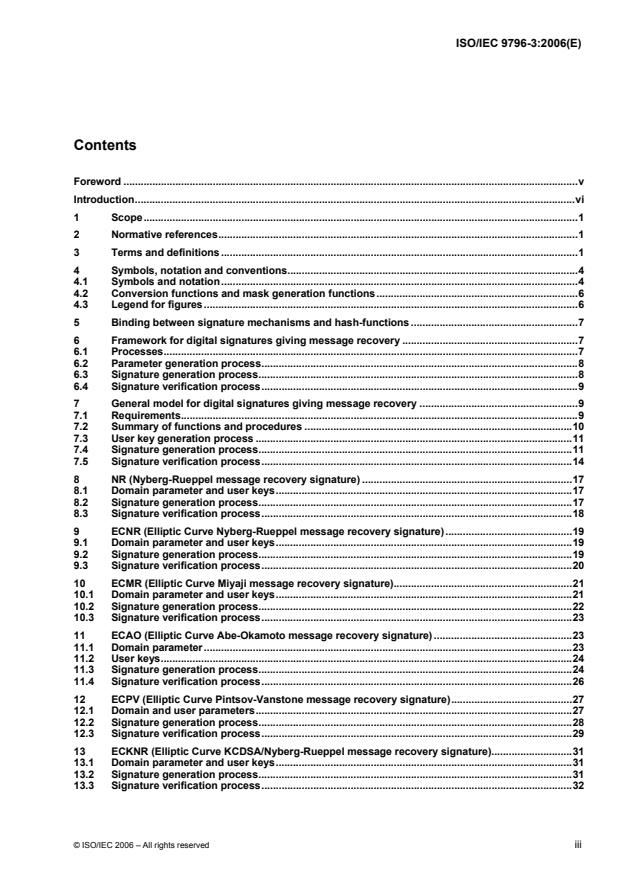
Contents
Foreword . v
Introduction . vi
1 Scope . 1
2 Normative references . 1
3 Terms and definitions . 1
4 Symbols, notation and conventions . 4
4.1 Symbols and notation . 4
4.2 Conversion functions and mask generation functions . 6
4.3 Legend for figures . 6
5 Binding between signature mechanisms and hash-functions . 7
6 Framework for digital signatures giving message recovery . 7
6.1 Processes . 7
6.2 Parameter generation process . 8
6.3 Signature generation process . 8
6.4 Signature verification process . 9
7 General model for digital signatures giving message recovery . 9
7.1 Requirements . 9
7.2 Summary of functions and procedures . 10
7.3 User key generation process . 11
7.4 Signature generation process . 11
7.5 Signature verification process . 14
8 NR (Nyberg-Rueppel message recovery signature) . 17
8.1 Domain parameter and user keys . 17
8.2 Signature generation process . 17
8.3 Signature verification process . 18
9 ECNR (Elliptic Curve Nyberg-Rueppel message recovery signature) . 19
9.1 Domain parameter and user keys . 19
9.2 Signature generation process . 19
9.3 Signature verification process . 20
10 ECMR (Elliptic Curve Miyaji message recovery signature). 21
10.1 Domain parameter and user keys . 21
10.2 Signature generation process . 22
10.3 Signature verification process . 23
11 ECAO (Elliptic Curve Abe-Okamoto message recovery signature) . 23
11.1 Domain parameter . 23
11.2 User keys . 24
11.3 Signature generation process . 24
11.4 Signature verification process . 26
12 ECPV (Elliptic Curve Pintsov-Vanstone message recovery signature) . 27
12.1 Domain and user parameters . 27
12.2 Signature generation process . 28
12.3 Signature verification process . 29
13 ECKNR (Elliptic Curve KCDSA/Nyberg-Rueppel message recovery signature). 31
13.1 Domain parameter and user keys . 31
13.2 Signature generation process . 31
13.3 Signature verification process . 32
© ISO/IEC 2006 – All rights reserved iii
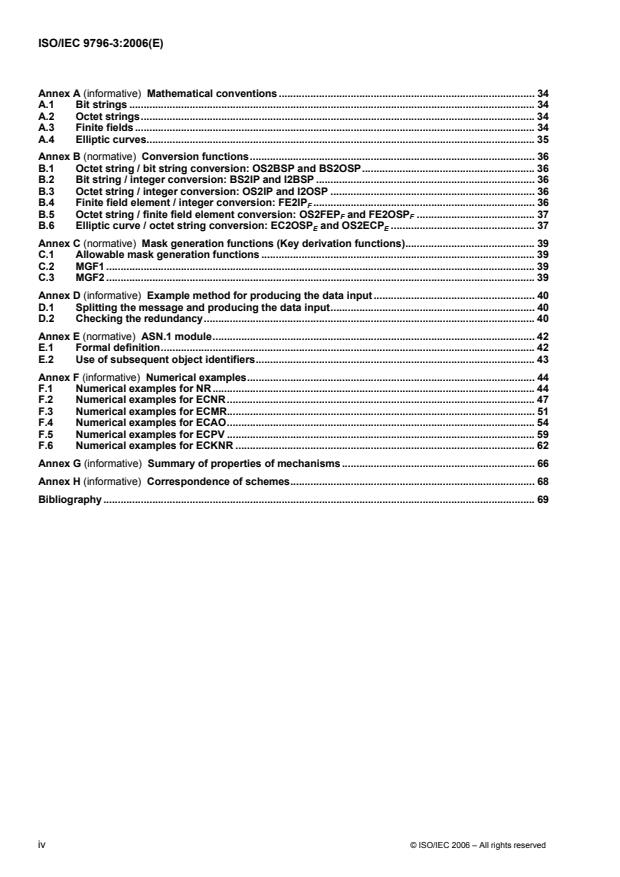
Annex A (informative) Mathematical conventions . 34
A.1 Bit strings . 34
A.2 Octet strings . 34
A.3 Finite fields . 34
A.4 Elliptic curves . 35
Annex B (normative) Conversion functions . 36
B.1 Octet string / bit string conversion: OS2BSP and BS2OSP . 36
B.2 Bit string / integer conversion: BS2IP and I2BSP . 36
B.3 Octet string / integer conversion: OS2IP and I2OSP . 36
B.4 Finite field element / integer conversion: FE2IP . 36
F
B.5 Octet string / finite field element conversion: OS2FEP and FE2OSP . 37
F F
B.6 Elliptic curve / octet string conversion: EC2OSP and OS2ECP . 37
E E
Annex C (normative) Mask generation functions (Key derivation functions) . 39
C.1 Allowable mask generation functions . 39
C.2 MGF1 . 39
C.3 MGF2 . 39
Annex D (informative) Example method for producing the data input . 40
D.1 Splitting the message and producing the data input . 40
D.2 Checking the redundancy . 40
Annex E (normative) ASN.1 module . 42
E.1 Formal definition . 42
E.2 Use of subsequent object identifiers . 43
Annex F (informative) Numerical examples . 44
F.1 Numerical examples for NR . 44
F.2 Numerical examples for ECNR . 47
F.3 Numerical examples for ECMR . 51
F.4 Numerical examples for ECAO . 54
F.5 Numerical examples for ECPV . 59
F.6 Numerical examples for ECKNR . 62
Annex G (informative) Summary of properties of mechanisms . 66
Annex H (informative) Correspondence of schemes . 68
Bibliography . 69
iv © ISO/IEC 2006 – All rights reserved
Foreword
ISO (the International Organization for Standardization) and IEC (the International Electrotechnical
Commission) form the specialized system for worldwide standardization. National bodies that are members of
ISO or IEC participate in the development of International Standards through technical committees
established by the respective organization to deal with particular fields of technical activity. ISO and IEC
technical committees collaborate in fields of mutual interest. Other international organizations, governmental
and non-governmental, in liaison with ISO and IEC, also take part in the work. In the field of information
technology, ISO and IEC have established a joint technical committee, ISO/IEC JTC 1.
International Standards are drafted in accordance with the rules given in the ISO/IEC Directives, Part 2.
The main task of the joint technical committee is to prepare International Standards. Draft International
Standards adopted by the joint technical committee are circulated to national bodies for voting. Publication as
an International Standard requires approval by at least 75 % of the national bodies casting a vote.
ISO/IEC 9796-3 was prepared by Joint Technical Committee ISO/IEC /JTC 1, Information technology,
Subcommittee SC 27, IT Security techniques.
This second edition cancels and replaces the first edition (ISO/IEC 9796-3:2000), which has been technically
revised. New mechanisms and object identifiers have been specified.
ISO/IEC 9796 consists of the following parts, under the general title Information technology ― Security
techniques ― Digital signature schemes giving message recovery:
Part 2: Integer factorization based mechanisms
Part 3: Discrete logarithm based mechanisms
This corrected version of ISO/IEC 9796-3:2006 incorporates the following corrections:
The year of publication has been removed from references to ISO/IEC 15946-1.
The last paragraph of 6.2.1 has been modified and ISO/IEC 15946-5 has been added to Clause 2.
© ISO/IEC 2006 – All rights reserved v
Introduction
Digital signature mechanisms can be used to provide services such as entity authentication, data origin
authentication, non-repudiation, and integrity of data.
A digital signature mechanism satisfies the following requirements:
given only the public verification key and not the private signature key, it is computationally infeasible to
produce a valid signature for any given message;
the signatures produced by a signer can neither be used for producing a valid signature for any new
message nor for recovering the signature key;
it is computationally infeasible, even for the signer, to find two different messages with the same
signature.
Most digital signature mechanisms are based on asymmetric cryptographic techniques and involve three basic
operations:
a process for generating pairs of keys, where each pair consists of a private signature key and the
corresponding public verification key;
a process using the private signature key, called the signature generation process;
a process using the public verification key, called the signature verification process.
There are two types of digital signature mechanisms:
when, for each given private signature key, the signatures produced for the same message are the same,
the mechanism is said to be non-randomized (or deterministic) [see ISO/IEC 14888-1];
when, for a given message and a given private signature key, each application of the signature process
produces a different signature, the mechanism is said to be randomized.
This part of ISO/IEC 9796 specifies randomized mechanisms.
Digital signature schemes can also be divided into the following two categories:
when the whole message has to be stored and/or transmitted along with the signature, the mechanism is
named a signature mechanism with appendix [see ISO/IEC 14888];
when the whole message or a part of it is recovered from the signature, the mechanism is named a
signature mechanism giving message recovery.
If the message is short enough, then the entire message can be included in the signature, and recovered from
the signature in the signature verification process. Otherwise, a part of the message can be included in the
signature and the rest of it is stored and/or transmitted along with the signature. The mechanisms specified in
ISO/IEC 9796 give either total or partial recovery, aiming at reducing storage and transmission overhead.
This part of ISO/IEC 9796 includes six mechanisms, one of which was in ISO/IEC 9796-3:2000 and five of
which are in ISO/IEC 15946-4:2004. The mechanisms specified in this part of ISO/IEC 9796 use a hash-
function to hash the entire message. ISO/IEC 10118 specifies hash-functions. Some of the mechanisms
specified in this part of ISO/IEC 9796 use a group on an elliptic curve over finite field. ISO/IEC 15946-1
describes the mathematical background and general techniques necessary for implementing cryptosystems
based on elliptic curves defined over finite fields.
vi © ISO/IEC 2006 – All rights reserved
The International Organization for Standardization (ISO) and International Electrotechnical Commission (IEC)
draw attention to the fact that it is claimed that compliance with this document may involve the use of patents
concerning the mechanisms NR, ECMR and ECAO given in Clause 8, 10 and 11, respectively.
Area Patent no. Issue date Inventors
NR [see Clause 8] US 5 600 725, 1997-02-04 K. Nyberg and R. A. Rueppel
EP 0 639 907
ECMR [see Clause 10] JP H09-160492 A. Miyaji
(patent application)
ECAO [see Clause 11] JP 3 434 251 2003-08-04 M. Abe and T. Okamoto
ISO and IEC take no position concerning the evidence, validity and scope of these patent rights.
The holders of these patent rights have assured the ISO and IEC that they are willing to negotiate licences
under reasonable and non-discriminatory terms and conditions with applicants throughout the world. In this
respect, the statement of the holders of these patent rights are registered with ISO and IEC. Information may
be obtained from the following companies.
Patent no. Name of holder of patent right Contact address
US 5 600 725, Certicom Corp. 5520 Explorer Drive, 4th Floor, Mississauga,
EP 0 639 907 Ontario, Canada L4W 5L1
th
JP H09-160492 Matsushita Electric Industrial Co., Ltd. Matsushita IMP Building 19 Floor, 1-3-7,
Siromi, Chuo-ku, Osaka 540-6319, Japan
JP 3 434 251 NTT Intellectual Property Center 9-11 Midori-Cho 3-chome, Musashino-shi,
Tokyo 180-8585, Japan
Attention is drawn to the possibility that some of the elements of this document may be the subject of patent
rights other than those identified above. ISO and IEC shall not be held responsible for identifying any or all
such patent rights.
NOTE 1 Computational feasibility depends on the specific security requirements and environment.
NOTE 2 Any signature mechanism giving message recovery — for example, the mechanisms specified in this part of
ISO/IEC 9796 — can be converted for provision of digital signatures with appendix. In this case, the signature is produced
by application of the signature mechanism to a hash-token of the message.
© ISO/IEC 2006 – All rights reserved vii
INTERNATIONAL STANDARD ISO/IEC 9796-3:2006(E)
Information technology ― Security techniques —
Digital signature schemes giving message recovery —
Part 3:
Discrete logarithm based mechanisms
1 Scope
This part of ISO/IEC 9796 specifies six digital signature schemes giving message recovery. The security of
these schemes is based on the difficulty of the discrete logarithm problem, which is defined on a finite field or
an elliptic curve over a finite field.
This part of ISO/IEC 9796 also defines an optional control field in the hash-token, which can provide added
security to the signature.
This part of ISO/IEC 9796 specifies randomized mechanisms.
The mechanisms specified in this part of ISO/IEC 9796 give either total or partial message recovery.
NOTE For discrete logarithm based digital signature schemes with appendix, see ISO/IEC 14888-3.
2 Normative references
The following referenced documents are indispensable for the application of this document. For dated
references, only the edition cited applies. For undated references, the latest edition of the referenced
document (including any amendments) applies.
ISO/IEC 10118 (all parts), Information technology — Security techniques — Hash-functions
ISO/IEC 15946-1, Information technology — Security techniques — Cryptographic techniques based on
elliptic curves — Part 1: General
ISO/IEC 15946-5, Information technology — Security techniques — Cryptographic techniques based on
elliptic curves — Part 5: Elliptic curve generation
3 Terms and definitions
For the purposes of this document, the following terms and definitions apply.
3.1
data input
octet string which depends on the entire message or a portion of the message and which forms a part of the
input to the signature generation process
3.2
domain parameter
data item which is common to and known by or accessible to all entities within the domain
[ISO/IEC 14888-1:1998]
© ISO/IEC 2006 – All rights reserved 1
NOTE The set of domain parameters may contain data items such as hash-function identifier, length of the hash-
token, maximum length of the recoverable part of the message, finite field parameters, elliptic curve parameters, or other
parameters specifying the security policy in the domain.
3.3
elliptic curve
set of points P = (x, y), where x and y are elements of an explicitly given finite field, that satisfy a cubic equation
without any singular point, together with the “point at infinity” denoted by O
[ISO/IEC 15946-1:2002]
NOTE For a mathematical definition of an elliptic curve over an explicitly given finite field, see Clause A.4.
3.4
explicitly given finite field
set of all e-tuples over [0, p – 1], where p is prime and e ≥ 1, along with a “multiplication table”
NOTE 1 For a mathematical definition of an explicitly given finite field, see Clause A.3.
NOTE 2 For more detailed information on finite fields, see ISO/IEC 15946-1.
3.5
hash-code
string of octets which is the output of a hash-function
NOTE Adapted from ISO/IEC 10118-1:2000.
3.6
hash-function
function which maps strings of octets to fixed-length strings of octets, satisfying the following two properties:
for a given output, it is computationally infeasible to find an input which maps to this output;
for a given input, it is computationally infeasible to find a second input which maps to the same output.
NOTE 1 Adapted from ISO/IEC 10118-1:2000.
NOTE 2 Computational feasibility depends on the specific security requirements and environment.
NOTE 3 For the purposes of this part of ISO/IEC 9796, the allowable hash-functions are those described in
ISO/IEC 10118-2 and ISO/IEC 10118-3, with the following proviso:
The hash-functions described in ISO/IEC 10118 map bit strings to bit strings, whereas in this part of ISO/IEC 9796,
they map octet strings to octet strings. Therefore, a hash-function in ISO/IEC 10118-2 or ISO/IEC 10118-3 is allowed
in this part of ISO/IEC 9796 only if the length in bits of the output is a multiple of 8, in which case the mapping
between octet strings and bit strings is affected by the functions OS2BSP and BS2OSP.
3.7
hash-token
concatenation of a hash-code and an optional control field which can be used to identify the hash-function and
the padding method
[ISO/IEC 14888-1:1998]
NOTE The control field with the hash-function identifier is mandatory unless the hash-function is uniquely determined
by the signature mechanism or by the domain parameters.
3.8
message
string of octets of any length
3.9
parameter generation process
process which gives as its output domain parameter and user keys
2 © ISO/IEC 2006 – All rights reserved
3.10
pre-signature
octet string computed in the signature generation process which is a function of the randomizer but which is
independent of the message
NOTE Adapted from ISO/IEC 14888-1:1998.
3.11
private signature key
data item specific to an entity and usable only by this entity in the signature generation process
3.12
public verification key
data item which is mathematically related to a private signature key and is known by or accessible to all
entities and which is used by the verifier in the signature verification process
3.13
randomized
dependent on a randomizer
[ISO/IEC 14888-1]
3.14
randomizer
secret integer produced by the signing entity in the pre-signature production process, and not predictable by
other entities
NOTE Adapted from ISO/IEC 14888-1:1998.
3.15
signature
pair of an octet string and an integer for providing authentication, generated in the signature generation
process
NOTE Adapted from ISO/IEC 14888-1:1998.
3.16
signature generation process
process which takes as inputs the message, the signature key and the domain parameters, and which gives
as output the signature
NOTE Adapted from the definition of signature process in ISO/IEC 14888-1:1998.
3.17
signature verification process
process, which takes as its input the signed message, the verification key and the domain parameters, and
which gives as its output the recovered message if valid
NOTE Adapted from the definition of verification process in ISO/IEC 14888-1:2008.
3.18
signed message
set of data items consisting of the signature, the part of the message which cannot be recovered from the
signature, and an optional text field
[ISO/IEC 14888-1:1998]
3.19
user keys
data item of a set of private signature key and public verification key
© ISO/IEC 2006 – All rights reserved 3
4 Symbols, notation and conventions
4.1 Symbols and notation
For the purposes of this document, the following symbols and notation apply.
A entity, usually signer
B entity, usually verifier
d
data input (octet string)
d′
recovered data input (octet string)
E
elliptic curve over explicitly given finite field
F
explicitly given finite field
G
generator of underlying group (finite field element / elliptic curve point)
h
(truncated) hash-token (octet string)
h′ recovered (truncated) hash-token (octet string)
h″ recomputed (truncated) hash-token (octet string)
Hash, Hash , Hash hash-function
1 2
k randomizer (integer)
KDF key derivation function (synonym for MGF)
L length in octets of non-recoverable part (integer)
clr
L length in octets of data input (integer)
dat
L length in octets of explicitly given finite field F (non-negative integer)
F
L (maximum) length in octets of recoverable part (integer)
rec
L length in octets of (added) redundancy (integer)
red
L(x) length in octets of integer x or octet string x (non-negative integer)
L length in octets of output of hash-function Hash (non-negative integer)
Hash
M message (octet string)
M non-recoverable part of message (octet string)
clr
M recoverable part of message (octet string)
rec
M′ recovered message (octet string)
M′ received non-recoverable part of message (octet string)
clr
M′ recovered part of message (octet string)
rec
MGF
mask generation function
n order of group generated by G (prime number)
4 © ISO/IEC 2006 – All rights reserved
O point at infinity of elliptic curve
p prime number
P element dependent on the chosen key generation scheme, that is P = G for
for Key Generation Scheme II [see
Key Generation Scheme I and P = Y
A
Clause 7.3]
Π pre-signature (octet string)
Π′
recovered pre-signature (octet string)
q prime power
Q element dependent on the chosen key generation scheme, that is Q = Y for
A
Key Generation Scheme I and Q = G for Key Generation Scheme II [see
Clause 7.3]
r first part of signature (octet string)
r′ first part of recovered signature (octet string)
s second part of signature (integer)
s′ second part of recovered signature (integer)
x private signature key of entity A
A
Y public verification key of entity A
A
* set of finite bit strings
{0, 1}
* set of finite octet strings
{0, 1}
ℓ
{0, 1} set of bit strings of length ℓ, where ℓ is a non-negative integer
8ℓ
{0, 1} set of octet strings of length ℓ, where ℓ is a non-negative integer
[a, b] set of integers x satisfying a≤ x≤ b, where a and b are integers
| x | length of bit string x
| X | cardinality of set X
ℓ
[x] leftmost ℓ-bits of octet string x, appending zeros to the right when 8ℓ > L(x )
[x] rightmost ℓ-bits of octet string x, appending zeros to the left when 8ℓ > L(x )
ℓ
x mod n
r [0, n − 1] such that (x − r) is divisible by n, where x is an integer
bitwise exclusive-OR operation of bit strings x and y
x y
x || y concatenation of bit strings x and y
Cartesian product of sets X and Y
X Y
© ISO/IEC 2006 – All rights reserved 5
4.2 Conversion functions and mask generation functions
For the purposes of this document, the following conversion functions and mask generation functions are
used.
BS2IP bit-string-to-integer primitive [see Clause B.2]
BS2OSP bit-string-to-octet-string primitive [see Clause B.1]
EC2OSP elliptic-curve-to-octet-string primitive [see Clause B.6]
FE2IP finite-field-element-to-integer primitive [see Clause B.4]
FE2OSP finite-field-element-to-octet-string primitive [see Clause B.5]
I2BSP integer-to-bit-string primitive [see Clause B.2]
I2OSP integer-to-octet-string primitive [see Clause B.3]
MGF1 mask generation function 1 [see Clause C.2]
MGF2 mask generation function 2 [see Clause C.3]
OS2BSP octet-string-to-bit-string primitive [see Clause B.1]
OS2ECP octet-string-to-elliptic-curve primitive [see Clause B.6]
OS2FEP octet-string-to-finite-field-element primitive [see Clause B.5]
OS2IP octet-string-to-integer primitive [see Clause B.3]
4.3 Legend for figures
The following legend is used for the figures in Clause 7 depicting the signature generation and verification
processes for digital signatures giving message recovery.
STEP OF THE step of the process
PROCESS
mandatory data flow
optional data flow
6 © ISO/IEC 2006 – All rights reserved
5 Binding between signature mechanisms and hash-functions
Use of the signature schemes specified in this part of ISO/IEC 9796 requires the selection of a hash-function
Hash. ISO/IEC 10118 specifies hash-functions. There shall be a binding between the signature mechanism
and the hash-function in use. Without such a binding, an adversary might claim the use of a weak hash-
function (and not the actual one) and thereby forge a signature.
The user of a digital signature mechanism should conduct a risk assessment considering the costs and
benefits of the various alternative means of accomplishing the required binding. This assessment should
include an assessment of the cost associated with the possibility of a bogus signature being produced.
NOTE 1 One of the security requirements for the hash-function Hash used in this part of ISO/IEC 9796 is so-called
“collision-resistance.”
NOTE 2 There are various ways to accomplish this binding. The following options are listed in order of increasing risk:
a) Require a particular hash-function when using a particular signature mechanism. The verification process shall
exclusively use that particular hash-function. ISO/IEC 14888-3 gives an example of this option where the DSA
mechanism requires the use of Dedicated Hash-function 3 (otherwise known as SHA-1) from ISO/IEC 10118-3;
b) Allow a set of hash-functions and explicitly indicate the hash-function in use in the certificate domain parameters.
Inside the certificate domain, the verification process shall exclusively use the hash-function indicated in the
certificate. Outside the certificate domain, there is a risk arising from certification authorities (CAs) that may not
adhere to the user’s policy. If, for example, an external CA creates a certificate permitting other hash-functions, then
signature forgery problems may arise. In such a case a misled verifier may be in dispute with the CA that produced
the other certificate; and
c) Allow a set of hash-functions and indicate the hash-function in use by some other method, e.g., an indication in the
message or a bilateral agreement. The verification process shall exclusively use the hash-function indicated by the
other method. However, there is a risk that an adversary may forge a signature using another hash-function.
NOTE 3 The “other method” referred to in paragraph c) immediately above could be in the form of a hash-function
identifier included in the octet string representative d. If the hash-function identifier is included in d in this way then an
attacker cannot fraudulently reuse an existing signature with the same octet string d and a different d , even when the
1 2
verifier could be persuaded to accept signatures created using a hash-function sufficiently weak that pre-images can be
found. However, in this latter case and using the weak hash-function, an attacker can still find a new signature with a
“random” d .
NOTE 4 The attack mentioned in Note 3 that yields a new signature with a “random” d can be prevented by requiring
the presence of a specific structure in d . For instance, one may impose a length limit on d that is sufficiently less than the
1 1
capacity of the signature scheme. For some digital signature schemes, a length limit on d may also prevent an attacker
from reusing existing signatures even if no hash-function identifier is included in the message representative, provided that
the mask generation function MGF is based on the hash-function. This holds under the reasonable assumption that the
weak hash-function involved is a “general purpose” hash-function, not one designed solely for the purpose of forging a
signature.
6 Framework for digital signatures giving message recovery
6.1 Processes
Clauses 6.2 through 6.4 contain a high-level description of a general model for the six signature schemes
specified in this part of ISO/IEC 9796. A detailed description of the general model is provided in Clause 7.
A digital signature scheme specified in this part of ISO/IEC 9796 is defined by the specification of the following
processes:
parameter generation process;
signature generation process;
signature verification process.
© ISO/IEC 2006 – All rights reserved 7
6.2 Parameter generation process
6.2.1 Domain parameters
The parameters can be divided into domain parameters and user keys. The domain parameters consist of
parameters to define a finite group, such as a multiplicative group of a finite field or an additive group on an
elliptic curve over a finite field, and other public information which is common to and known by or accessible to
all entities within the domain. As well as the domain parameters specific to the cryptographic scheme in use,
the following parameters must be specified:
an identifier for the digital signature scheme used;
the type of redundancy;
(optional) a hash function Hash;
the user key generation procedures.
For the implementation techniques and the mathematical background for an additive group on an elliptic curve
over a finite field, ISO/IEC 15946-1 shall be referred. For the methods to construct an elliptic curve over a
finite field, ISO/IEC 15946-5 shall be referred.
6.2.2 User keys
Each entity has its own public and private keys. The user keys of entity A consist of the following:
the private signature key x ;
A
the public verification key Y ;
A
(optional) other information, which is specific to the entity A, for the use in the signature generation and/or
verification process.
NOTE 1 User keys are valid only within the context of a specified set of domain parameters.
NOTE 2 The signature verifier may require assurance that the domain parameters and public verification key are valid,
otherwise there is no assurance of meeting the intended security even if the signature verifies. The signer may also
require assurance that the domain parameters and public verification key are valid, otherwise an adversary may be able to
generate signatures that verify.
6.3 Signature generation process
The following data items are required for the signature generation process:
the domain parameters;
the signer A’s private signature key x ;
A
a message M.
For all the schemes specified in this part of ISO/IEC 9796, the signature generation process consists of the
following procedures:
a) splitting the message;
b) (optional) computation of redundancy, or computation of the message digest;
8 © ISO/IEC 2006 – All rights reserved
c) computations in a finite group, which is either the multiplicative group of a finite field or the additive group
on an elliptic curve over a finite field;
d) computations modulo the group order of the base element G;
e) formatting the signed message.
The output of the signature generation process is a pair (r, s) that constitutes A’s digital signature of the
message M.
6.4 Signature verification process
The following data items are required for the signature verification process:
the domain parameters;
the signer A’s public verification key Y ;
A
the non-recoverable part of the message M′ (if any);
clr
the received signature for M, represented as an octet string r′ and an integer s′.
For all the schemes the signature verification process consists of some or all of the following procedures:
a) signature size verification;
b) computations in a finite group, which is either the multiplicative group of a finite field or the additive group
on an elliptic curve over a finite field;
c) computations modulo the group order of the base element G;
d) recovering the data input or the message;
e) signature checking.
If all procedures are passed successfully, the signature is accepted by the verifier; otherwise it is rejected.
7 General model for digital signatures giving message recovery
7.1 Requirements
7.1.1 Domain parameters
Users who wish to employ one of the digital signature mechanisms specified in this part of ISO/IEC 9796 shall
select the following domain parameters of the digital signature scheme:
a) an explicitly given finite field F, or an elliptic curve E over an explicitly given finite field F;
b) an element G in F or E of prime order n.
Agreement on these choices amongst the users is essential for the purpose of the operation of the digital
signature mechanism giving message recovery.
NOTE 1 The size of n affects the level of security offered by the scheme and shall be chosen to meet the defined
security objectives.
© ISO/IEC 2006 – All rights reserved 9
NOTE 2 The two possible groups with which this scheme may be used are normally written using multiplicative
notation (for the multiplicative group of the finite field) and additive notation (for the group of points on an elliptic curve). In
Clause 7, the multiplicative notation is used, in order to simplify the presentation.
NOTE 3 For the definition of an explicitly given finite field, see Clause A.3.
NOTE 4 For the definition of an elliptic curve over an explicitly given finite field, see Clause A.4.
NOTE 5 For efficient implementations and cryptographic techniques related to the groups on elliptic curves, see
ISO/IEC 15946-1.
7.1.2 Type of redundancy
Users shall select the type of redundancy, which shall be
natural redundancy,
added redundancy, or
both.
Agreement on the type of redundancy amongst the users is essential for the purpose of the operation of the
digital signature mechanism giving message recovery.
If users use added redundancy, the length in octets of added redundancy, L , shall be fixed. A message with
red
added redundancy may be constructed by the hash token of the message or of the recoverable message.
If users use natural redundancy alone, then L is set equal to 0. A message with natural redundancy means
red
that the message includes redundancy naturally, such as the use of ASCII characters, or that the redundancy
of the message is verifiable implicitly in some applications.
The natural or added redundancy may be anything agreed upon as long as it can be checked by the
communicating parties. Total redundancy, which consists of natural redundancy and added redundancy, shall
be greater than some minimum value specified by the application. In general natural redundancy alone shall
only be used for total message recovery.
NOTE The value of the parameter L also affects the security level of the signatures giving message recovery.
red
7.2 Summary of functions and procedures
The signature schemes specified in this part of ISO/IEC 9796 give message recovery. More precisely, some
of the data which is input to the signature generation function is recovered from the signature as part of the
signature verification procedure.
The signature scheme consists of the following functions and procedures:
user key generation process;
signature generation process;
signature verification process.
10 © ISO/IEC 2006 – All rights reserved
7.3 User key generation process
One of the following two methods shall be used to compute the key pair consisting of the public verification
and the private signature key (the signing entity shall keep the private signature key secret):
a) Key generation I
Given a valid set of domain parameters, a private signature key and corresponding public verification key
may be generated as follows:
1) Select a random or pseudorandom integer x in the set [1, n – 1]. The integer x must be protected
A A
from unauthorised disclosure and be unpredictable;
x
A
2) Compute the element Y = G ;
A
3) The key pair is (Y , x ), where Y will be used as public verification key, and x is the private
A A A A
signature key.
To allow an unified representation of the algorithms, put P = G and Q = Y .
A
b) Key generation II
Given a valid set of domain parameters, a private signature key and corresponding public verification key
may be generated as follows:
1) Select a random or pseudorandom integer e in the set [1, n – 1] and compute an integer x in the
A
interval [1, n – 1] with the property x e = 1 mod n. The integer x must be protected from
A A
unauthorised disclosure and be unpredictable;
e
2) Compute the element Y = G , and then erase the integer e in a secure ma
...