

ISO 141:1976
(Main)Textile machinery and accessories — Pirn winders and cross winders — Definition of left and right sides
General Information
- Abstract
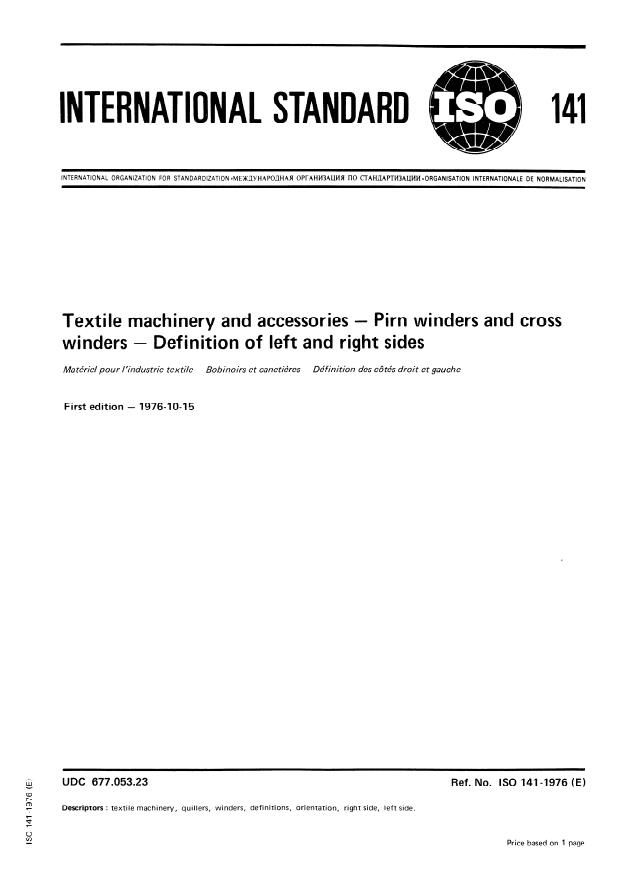
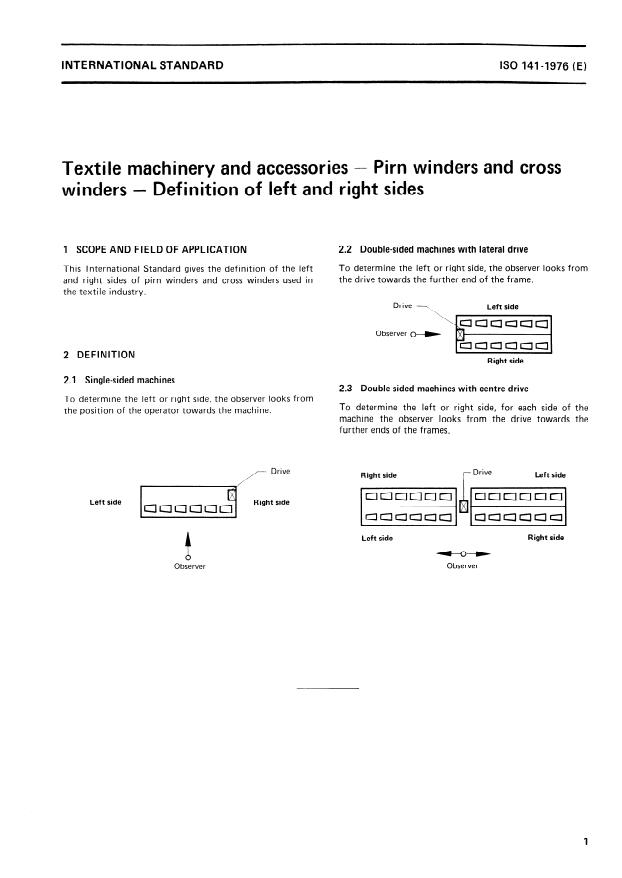
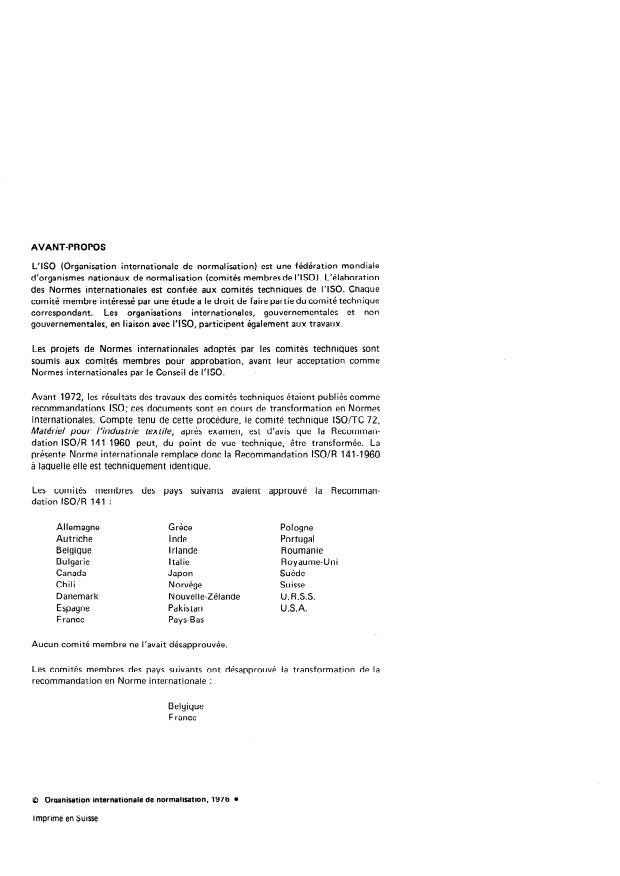
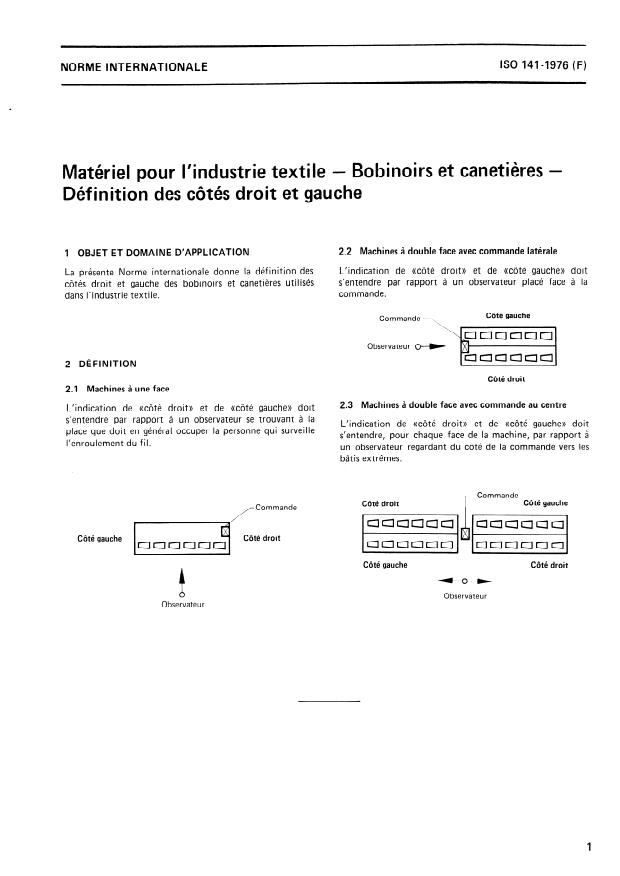
Defines left and right sides of single-sided machines, double-sided machines with lateral driving unit and double-sided machines with centre driving unit.
- Status
- Published
- Publication Date
- 30-Jun-1976
- Current Stage
- 9093 - International Standard confirmed
- Start Date
- 13-Dec-2023
- Completion Date
- 29-Aug-2026
Buy Documents

ISO 141:1976 - Textile machinery and accessories — Pirn winders and cross winders — Definition of left and right sides Released:7/1/1976
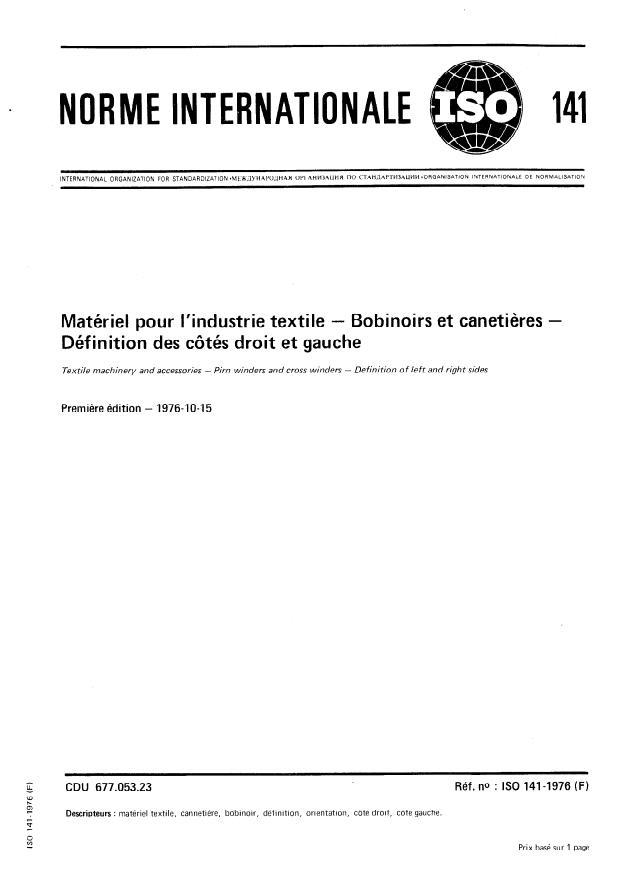

ISO 141:1976 - Matériel pour l'industrie textile — Bobinoirs et canetieres — Définition des côtés droit et gauche Released:7/1/1976

ISO 141:1976 - Matériel pour l'industrie textile — Bobinoirs et canetieres — Définition des côtés droit et gauche Released:7/1/1976
Overview
ISO 141:1976 - Textile machinery and accessories - Pirn winders and cross winders - Definition of left and right sides establishes a uniform convention for identifying the left and right sides of pirn winders and cross winders used in the textile industry. First published in 1976 by ISO Technical Committee ISO/TC 72, the standard replaces the earlier Recommendation R 141-1960 and provides a simple rule-set to remove ambiguity in machine orientation, documentation and communication.
Key topics
- Scope: Applies to pirn winders and cross winders and covers:
- single-sided machines
- double-sided machines with a lateral driving unit
- double-sided machines with a centre driving unit
- Definition rules:
- Single-sided machines: the observer determines left/right by looking from the position of the operator towards the machine.
- Double-sided machines with lateral drive: the observer determines left/right by looking from the drive towards the further end of the frame.
- Double-sided machines with centre drive: for each side, the observer looks from the drive towards the further ends of the frames to determine left and right.
- Illustrative diagrams: The standard includes schematic views showing drive locations, observer positions and resulting left/right designations (useful for technical drawings and assembly instructions).
Applications
ISO 141 is practical for any activity that requires unambiguous orientation of winding machinery:
- Machine manufacturers and designers - to produce consistent engineering drawings, assembly and installation manuals for pirn winders and cross winders.
- Maintenance and service teams - to clearly identify service points, spare parts locations and safety procedures by side.
- Procurement and quality departments - to specify orientation-dependent features in purchase orders and acceptance testing.
- Installation and factory layout planners - to align machine interfaces, operator stations and drive systems correctly on the shop floor.
- Standards writers and technical documenters - to adopt a consistent reference when specifying left/right in manuals and specifications.
Benefits
- Eliminates ambiguity in orientation-related instructions
- Improves safety and reduces errors during installation and maintenance
- Facilitates international communication and interoperability across suppliers and users of textile machinery
Related standards
- Issued by ISO/TC 72 (Textile machinery and accessories); ISO 141 replaces Recommendation R 141-1960.
- Refer to other ISO textile machinery standards for complementary rules on terminology, safety and machine testing.
Keywords: ISO 141, textile machinery, pirn winders, cross winders, left side, right side, machine orientation, winding machinery standard.
Buy Documents
ISO 141:1976 - Textile machinery and accessories — Pirn winders and cross winders — Definition of left and right sides Released:7/1/1976
ISO 141:1976 - Matériel pour l'industrie textile — Bobinoirs et canetieres — Définition des côtés droit et gauche Released:7/1/1976
ISO 141:1976 - Matériel pour l'industrie textile — Bobinoirs et canetieres — Définition des côtés droit et gauche Released:7/1/1976
Get Certified
Connect with accredited certification bodies for this standard

Control Union Certifications
Global certification for agriculture and sustainability.

Hohenstein Institut
Textile testing and certification.

Bureau Veritas Bangladesh
Bureau Veritas certification services in Bangladesh.
Sponsored listings
Frequently Asked Questions
ISO 141:1976 is a standard published by the International Organization for Standardization (ISO). Its full title is "Textile machinery and accessories — Pirn winders and cross winders — Definition of left and right sides". This standard covers: Defines left and right sides of single-sided machines, double-sided machines with lateral driving unit and double-sided machines with centre driving unit.
Defines left and right sides of single-sided machines, double-sided machines with lateral driving unit and double-sided machines with centre driving unit.
ISO 141:1976 is classified under the following ICS (International Classification for Standards) categories: 59.120.20 - Winding machines and equipment. The ICS classification helps identify the subject area and facilitates finding related standards.
ISO 141:1976 is available in PDF format for immediate download after purchase. The document can be added to your cart and obtained through the secure checkout process. Digital delivery ensures instant access to the complete standard document.
Standards Content (Sample)
INTERNATIONAL STANDARD
INTERNATIONAL ORGANIZATION FOR STANDARCIZATION l MEXKL1YHAPOLIHA54 OPI-AHM3AUMJl no CTAHLIAPTM3AUMM~ORGANISATION INTERNATIONALE DE NORMALISATION
Textile machinery and accessories - Pirn winders and Cross
winders - Definition of left and right sides
Definition des c0 t& droit et gauehe
Matkriel pour INindustrie textile - Bobinoirs et canetikes -
First edition - 1976-10-15
UDC 677.053.23 Ref. No. ISO 141-1976 (E)
Descriptors : textile machinery, quillers, winders, definitions, orientation, right side, left side.
Price based on 1 page
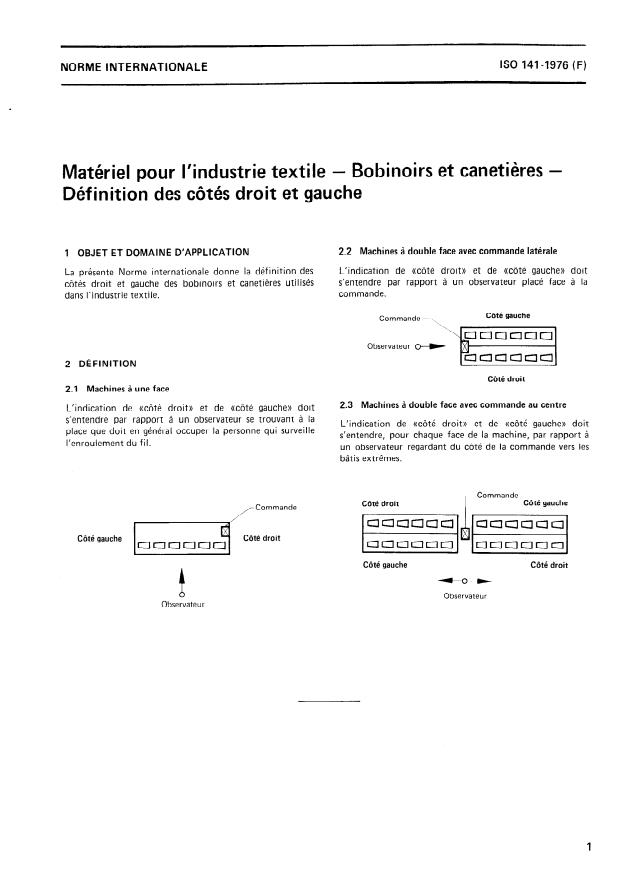
FOREWORD
ISO (the I nternationai Organization for Standardization) is a worldwide federation
of national Standards institutes (ISO member bodies). The work of developing
International Standards is carried out through ISO technical committees. Every
member body interested in a subject for which a technical committee has been set
up has the right to be represented on that committee. International organizations,
governmental and non-governmental, in liaison with ISO, also take part in the work.
Draft International Standards adopted by the technical committees are circulated
to the member bodies for approval before their acceptance as International
Standards by the ISO Council.
Prior to 1972, the results of the work of the technical committees were published
as ISO Recommendations; these documents are in the process of being transformed
into International Standards. As part of this process, Technical Committee
ISOITC 72, Textile machinery and accessories, has reviewed ISO Recommen-
dation R 141-1960 and found it technically suitable for transformation.
International Standard ISO 141 Recommen-
therefore replaces ISO
dation R 141-1960, to which i
...
INTERNATIONALE
ORME
INTERNATIONAL ORGANIZATION FOR STANDARDIZATION .MEX~YHAPOAHAII OPT‘AHI43ALlMJl l-l0 CTAHLZAPTM3AUMM -ORGANISATION INTERNATIONALE DE NORMALISATION
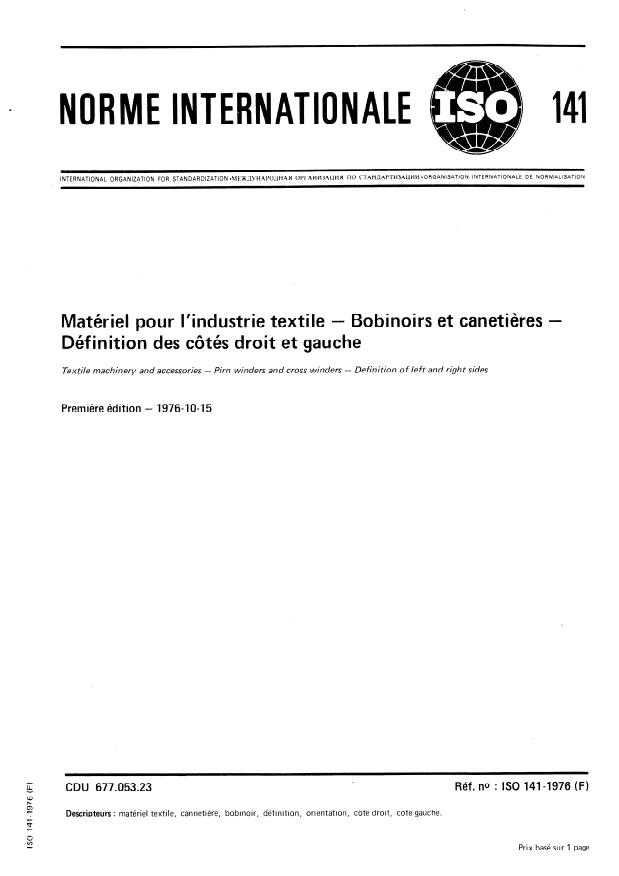
Matériel pour l’industrie textile - Bobinoirs et canetières -
Définition des côtés droit et gauche
Textile machinery and accessories - Pirn winders and cross winders - Definition of left and right sides
Première édition - 1976-l O-l 5
.
Réf. no : ISO 141-1976 (F)
CDU 677.053.23
: matériel textile, cannetière, bobinoir, définition, orientation, côté droit, côté gauche.
Descripteurs
Prix basé sur 1 page
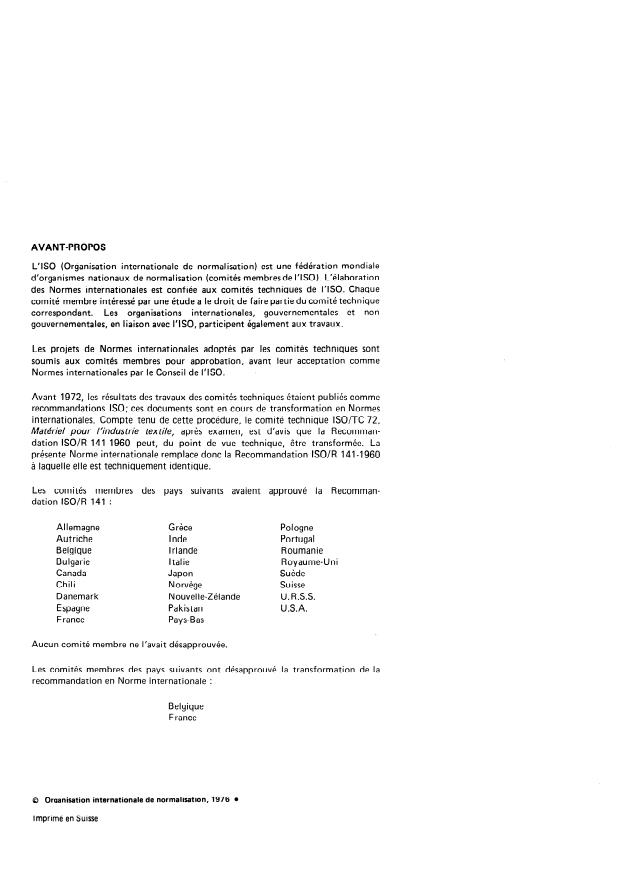
AVANT-PROPOS
L’ISO (Organisation internationale de normalisation) est une fédération mondiale
d’organismes nationaux de normalisation (comités membres de I’ISO). L’élaboration
des Normes internationales est confiée aux comités techniques de I’ISO. Chaque
comité membre intéressé par une étude a le droit de faire partie du comité technique
correspondant. Les organisations internationales, gouvernementales et non
gouvernementales, en liaison avec I’ISO, participent également aux travaux.
Les projets de Normes internationales adoptés par les comités techniques sont
soumis aux comités membres pour approbation, avant leur acceptation comme
Normes internationales par le Conseil de I’ISO.
Avant 1972, les résultats des travaux des comités techniques étaient publiés comme
recommandations ISO; ces documents sont en cours de transformation en Normes
internationales. Compte tenu de cette procédure, le comité technique ISO/TC 72,
Matériel pour l’industrie textile, après examen, est d’avis que la Recomman-
dation ISO/R 141-1960 peut, du point de vue technique, être transformée. La
présente Norme internationale remplace donc la Recommandation ISO/R 141-l 960
à laquelle elle est techniquement identique.
Les comités membres des pays sui
...
INTERNATIONALE
ORME
INTERNATIONAL ORGANIZATION FOR STANDARDIZATION .MEX~YHAPOAHAII OPT‘AHI43ALlMJl l-l0 CTAHLZAPTM3AUMM -ORGANISATION INTERNATIONALE DE NORMALISATION
Matériel pour l’industrie textile - Bobinoirs et canetières -
Définition des côtés droit et gauche
Textile machinery and accessories - Pirn winders and cross winders - Definition of left and right sides
Première édition - 1976-l O-l 5
.
Réf. no : ISO 141-1976 (F)
CDU 677.053.23
: matériel textile, cannetière, bobinoir, définition, orientation, côté droit, côté gauche.
Descripteurs
Prix basé sur 1 page
AVANT-PROPOS
L’ISO (Organisation internationale de normalisation) est une fédération mondiale
d’organismes nationaux de normalisation (comités membres de I’ISO). L’élaboration
des Normes internationales est confiée aux comités techniques de I’ISO. Chaque
comité membre intéressé par une étude a le droit de faire partie du comité technique
correspondant. Les organisations internationales, gouvernementales et non
gouvernementales, en liaison avec I’ISO, participent également aux travaux.
Les projets de Normes internationales adoptés par les comités techniques sont
soumis aux comités membres pour approbation, avant leur acceptation comme
Normes internationales par le Conseil de I’ISO.
Avant 1972, les résultats des travaux des comités techniques étaient publiés comme
recommandations ISO; ces documents sont en cours de transformation en Normes
internationales. Compte tenu de cette procédure, le comité technique ISO/TC 72,
Matériel pour l’industrie textile, après examen, est d’avis que la Recomman-
dation ISO/R 141-1960 peut, du point de vue technique, être transformée. La
présente Norme internationale remplace donc la Recommandation ISO/R 141-l 960
à laquelle elle est techniquement identique.
Les comités membres des pays sui
...