

ISO 3857-2:1977
(Main)Compressors, pneumatic tools and machines — Vocabulary — Part 2: Compressors
General Information
- Abstract
Establishes terms and definitions in English and French relating to compressors, comprises: general, temperatures, flow rates, pressures, powers, specific energy requirement, efficiencies and related information.
- Status
- Published
- Publication Date
- 31-May-1977
- Technical Committee
- ISO/TC 118/SC 6 - Air compressors and compressed air systems
- Drafting Committee
- ISO/TC 118/SC 6 - Air compressors and compressed air systems
- Current Stage
- 9093 - International Standard confirmed
- Start Date
- 16-Nov-2021
- Completion Date
- 29-Aug-2026



Overview
ISO 3857-2:1977 - Compressors, pneumatic tools and machines - Vocabulary - Part 2: Compressors is an international vocabulary standard that defines terms and bilingual (English/French) definitions specifically for compressors. Published by ISO/TC 118 in 1977 as Part II of the ISO 3857 series, this standard establishes consistent terminology covering basic compressor concepts, measurement points, and parameters used across design, testing and procurement.
Key topics
The standard focuses on vocabulary and definitions rather than prescriptive performance limits. Major technical topics and defined terms include:
- General compressor terms: swept volume, displacement (volume rate), clearance (clearance volume), relative clearance volume, volume factor.
- Measurement points: standard inlet point and standard discharge point; standard inlet and discharge conditions.
- Temperatures: inlet temperature, discharge temperature (total temperatures at standard points).
- Flow rates: actual volume rate of flow, standard (reference) volume rate of flow.
- Pressures and ratios: inlet pressure, discharge pressure, total pressure ratio, stage and overall stage pressure ratios.
- Dynamic-compressor characteristics: tip Mach number, pressure coefficient (stage and overall).
- Powers and thermodynamic references: theoretical required power (isentropic, isothermal, polytropic reference processes), indicated power, internal power.
- Compression process definitions: ideal multi‑stage compression and reference thermodynamic processes (isothermal, isentropic, polytropic).
These entries are supplied in both English and French, ensuring consistent multilingual use.
Applications
ISO 3857-2:1977 is a foundation document used to:
- Standardize terminology in technical specifications, test reports and certification documents for compressors and pneumatic machinery.
- Support engineers and designers when documenting compressor performance (flow rates, pressures, temperatures, efficiencies).
- Help testing laboratories and acceptance testing to reference clearly defined measurement points and conditions.
- Assist manufacturers and procurement professionals in drafting unambiguous product data sheets and contracts.
- Provide translators, technical writers and standards developers with authoritative bilingual terms for documentation and regulatory use.
Keywords: ISO 3857-2:1977, compressor vocabulary, compressor terminology, swept volume, clearance volume, inlet/discharge conditions, pressure ratio, indicated power, polytropic/isotropic processes.
Related standards
- ISO 3857-1 - Part 1: Basic concepts, symbols and units (companion document covering symbols and units).
- ISO 3857-3 - Part 3: Pneumatic tools and machines (covers other pneumatic equipment; noted as in preparation in the original document).
- Work developed by ISO/TC 118 (Compressors, pneumatic tools and machines).
Use ISO 3857-2:1977 when consistent, internationally accepted compressor terminology is required in design, testing, procurement and documentation.
Relations
- Referred By
EN 1012-1:2010 - Compressors and vacuum pumps - Safety requirements - Part 1: Air compressors - Effective Date
- 25-Aug-2026
- Referred By
EN 1012-3:2013 - Compressors and vacuum pumps - Safety requirements - Part 3: Process compressors - Effective Date
- 01-Apr-2026
Get Certified
Connect with accredited certification bodies for this standard

Institut za varilstvo d.o.o. (Welding Institute)
Slovenia's leading welding institute since 1952. ISO 3834, EN 1090, pressure equipment certification, NDT personnel, welder qualification. Only IIW Au
Sponsored listings
Frequently Asked Questions
ISO 3857-2:1977 is a standard published by the International Organization for Standardization (ISO). Its full title is "Compressors, pneumatic tools and machines — Vocabulary — Part 2: Compressors". This standard covers: Establishes terms and definitions in English and French relating to compressors, comprises: general, temperatures, flow rates, pressures, powers, specific energy requirement, efficiencies and related information.
Establishes terms and definitions in English and French relating to compressors, comprises: general, temperatures, flow rates, pressures, powers, specific energy requirement, efficiencies and related information.
ISO 3857-2:1977 is classified under the following ICS (International Classification for Standards) categories: 01.040.23 - Fluid systems and components for general use (Vocabularies); 23.140 - Compressors and pneumatic machines. The ICS classification helps identify the subject area and facilitates finding related standards.
ISO 3857-2:1977 has the following relationships with other standards: It is inter standard links to EN 1012-1:2010, EN 1012-3:2013. Understanding these relationships helps ensure you are using the most current and applicable version of the standard.
ISO 3857-2:1977 is available in PDF format for immediate download after purchase. The document can be added to your cart and obtained through the secure checkout process. Digital delivery ensures instant access to the complete standard document.
Standards Content (Sample)
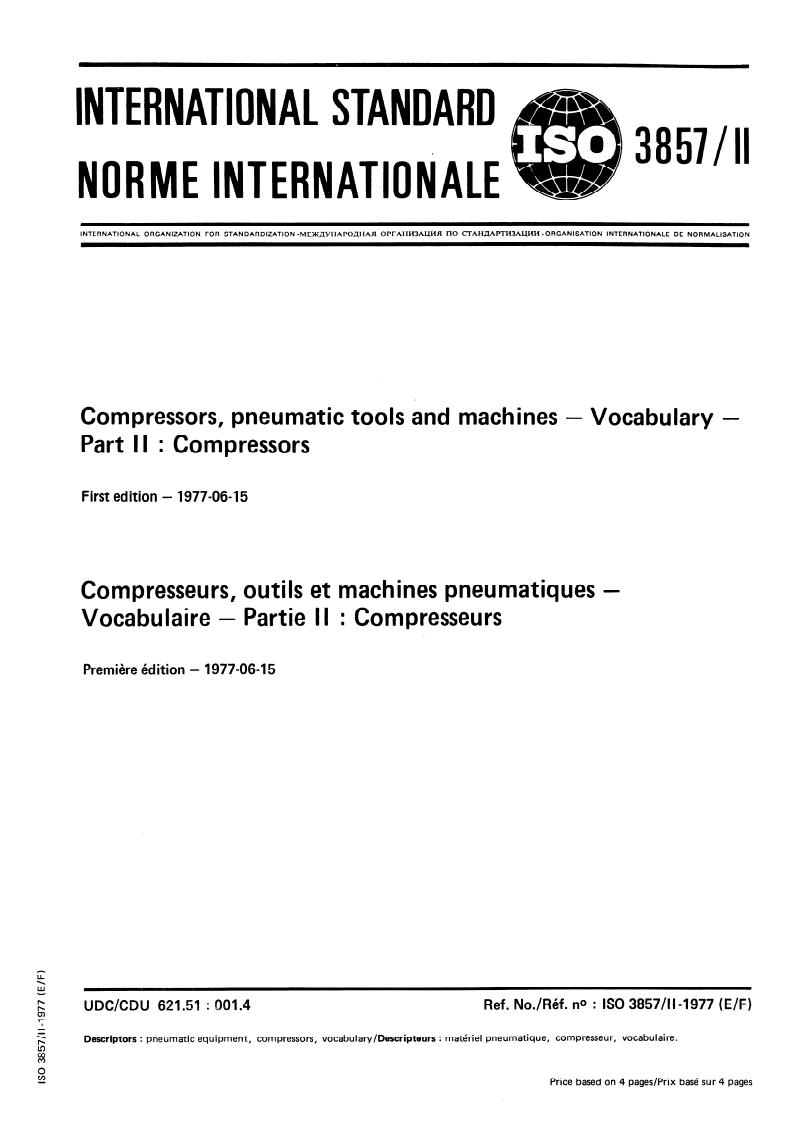
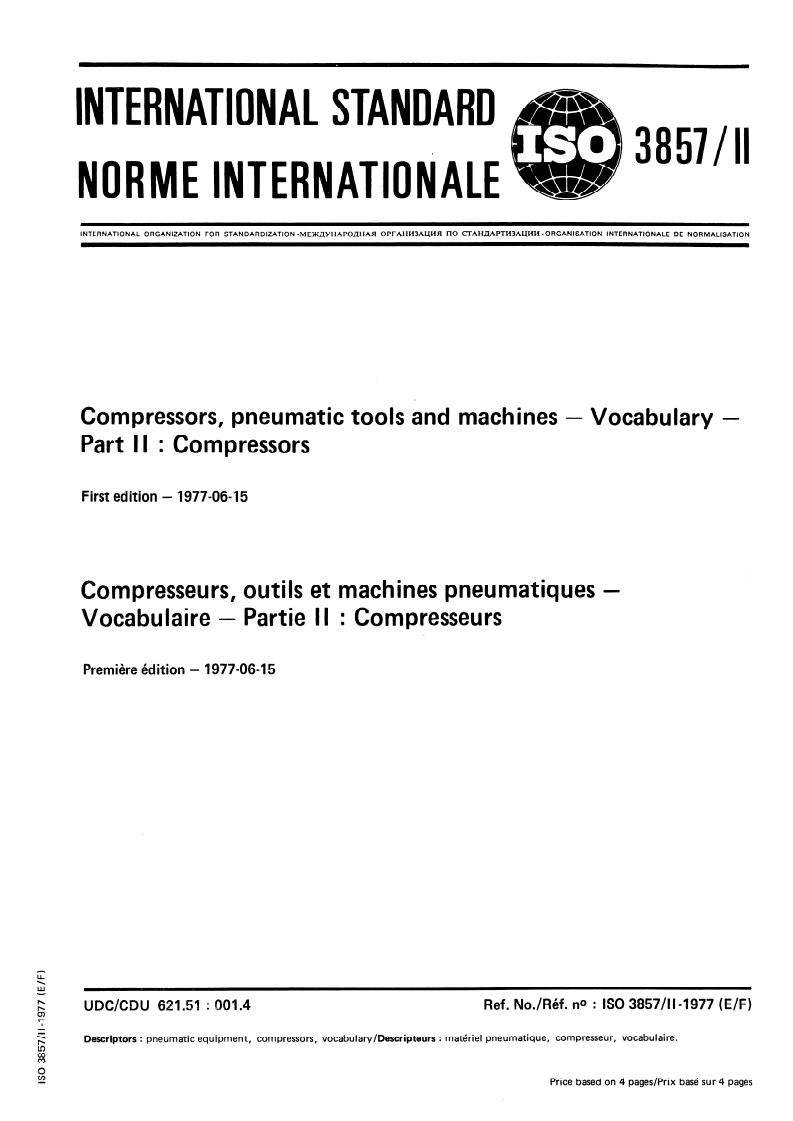
INTERNATIONAL STANDARD
NORME INTERNAT~lOliALE
INTERNATIONAL ORGANIZATION FOR STANDARDIZATION l MEXflYHAPOflHAR OPl-AHW3ALUiS l-IO CTAHAAPTM3ALWf~ORGANlSATION INTERNATIONALE DE NORMALISATION
Compressors, pneumatic tools and machines - Vocabulary -
Part II 3 Compressors
First edition - 1977-06-15
Compresseurs, outils et machines pneumatiques -
Vocabulaire - Partie ll : Compresseurs
Premiere Edition - 1977-06-15
Ref. No./Rhf. no : ISO 3857/11-1977 (E/F)
UDC/CDU 621.51 : 001.4
mathiel pneumatique, compresseur, vocabulaire.
Descriptors : pneumatic equipment, compressors, vocabuIary/Descripteurs :
Price based on 4 pages/Prix bas6 sur 4 pages
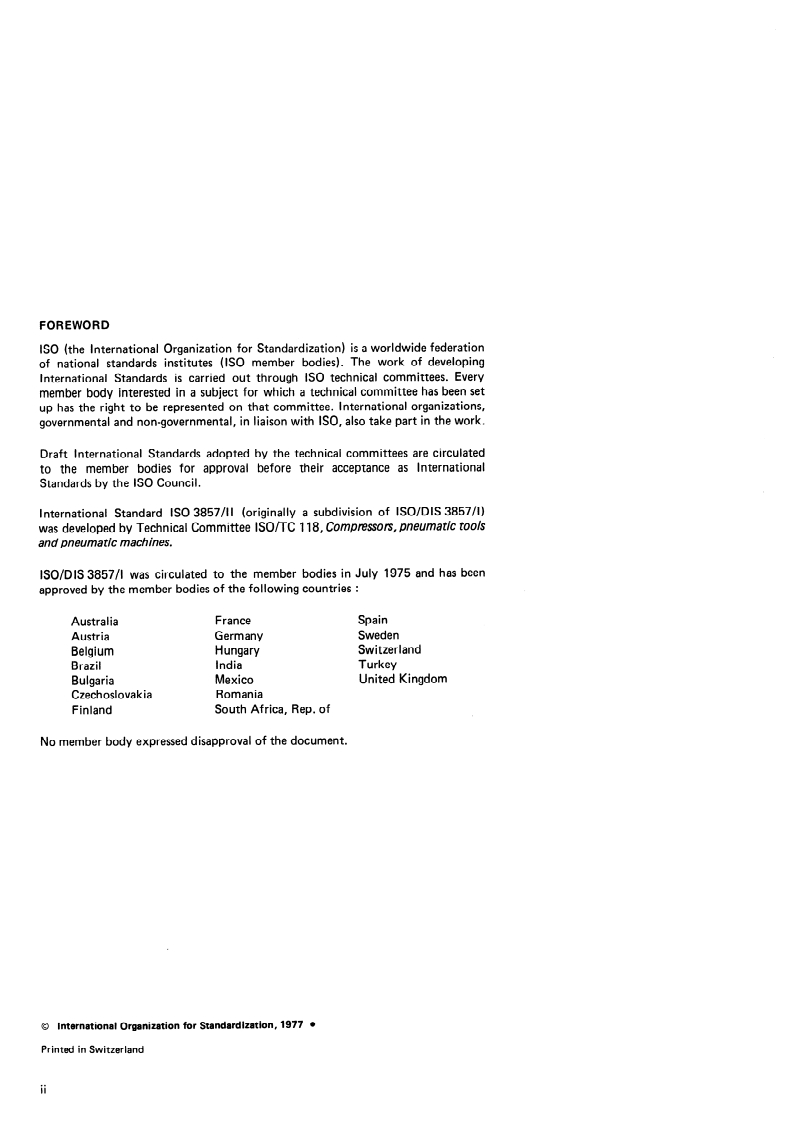
FOREWORD
ISO (the International Organization for Standardization) is a worldwide federation
of national Standards institutes (ISO member bodies). The work of developing
International Standards is carried out through ISO technical committees. Every
member body interested in a subject for which a technical committee has been set
up has the right to be represented on that committee. International organizations,
governmental and non-governmental, in liaison with ISO, also take part in the work.
Draft International Standards adopted by the technical committees are circulated
to the member bodies for approval before their acceptance as International
Standards by the ISO Council.
International Standard ISO 3857/ll (originally a subdivision of lSO/DIS 3857h)
was developed by Technical Committee ISO/TC 118, Compressors, pneumatic tools
and pneumatic machines.
ISO/DIS 3857h was circulated to the member bodies in July 1975 and has been
approved by the member bodies of the following countries :
Australia France Spain
Austria Germany Sweden
Belgium Hungary Switzerland
Brazil India Turkey
Bulgaria Mexico United Kingdom
Czechoslovakia Romania
Finland South Africa, Rep. of
No member body expressed disapproval of the document.
0 International Organization for Standardization, 1977 l
Printed in Switzerland
ii
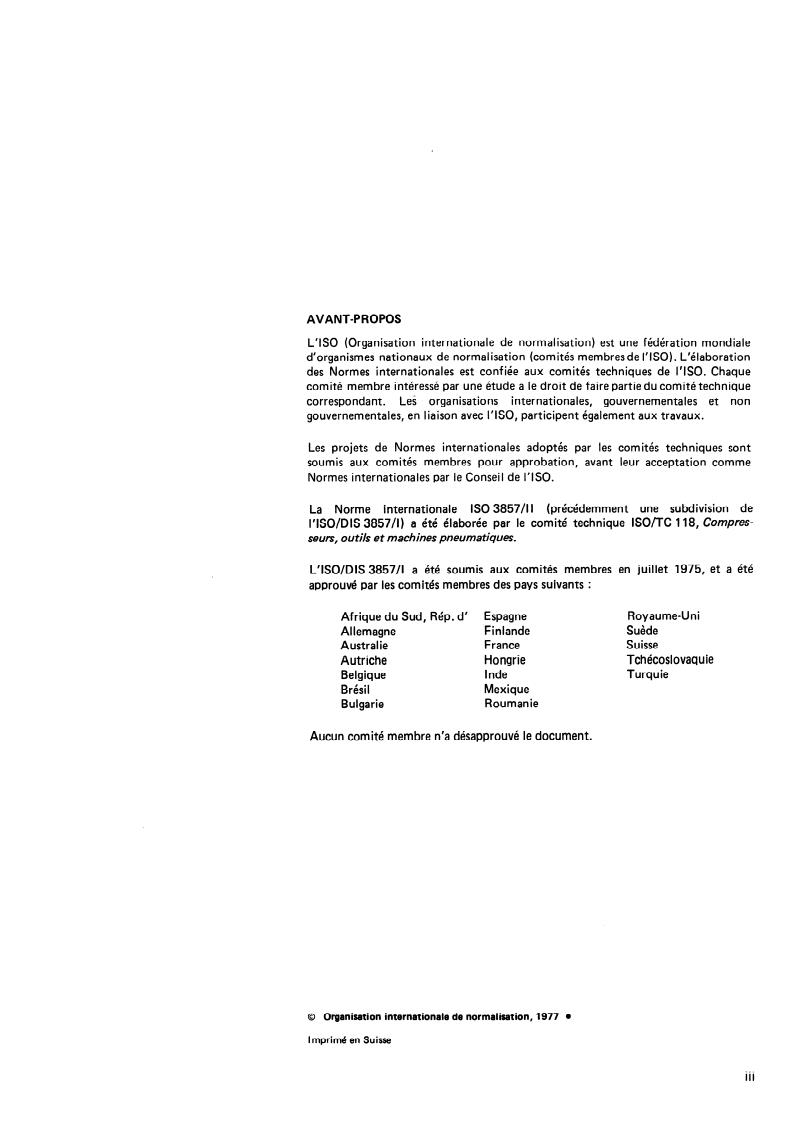
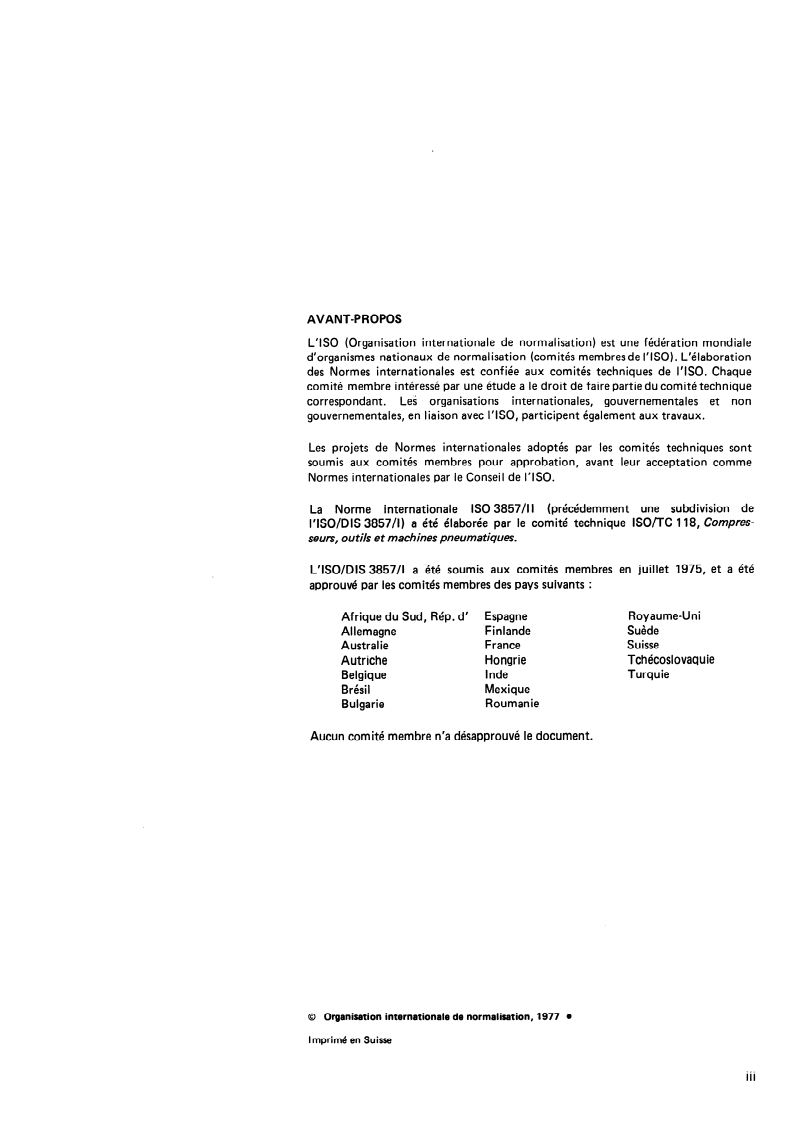
AVANT-PROPOS
L’ISO (Organisation internationale de normalisation) est une federation mondiale
d’organismes nationaux de normalisation (comites membres de I’ISO). L’elaboration
des Normes internationales est confiee aux comites techniques de I’ISO. Chaque
comite membre interesse par une etude a Ie droit de faire Partie du comite technique
correspondant. Les organisations internationales, gouvernementales et non
gouvernementales, en liaison avec I’ISO, participent egalement aux travaux.
Les projets de Normes internationales adoptes par les comites techniques sont
soumis aux comites membres pour approbation, avant leur acceptation comme
Normes internationales par Ie Conseil de I’ISO.
La Norme internationale ISO 3857/l I (precedemment une subdivision de
I’ISO/DIS 3857/1) a et6 elaboree par Ie comite technique ISO/TC 118, Compres-
seurs, outils et machines pneumatiques.
L’ISO/DIS 3857/l a et6 soumis aux comites membres en juillet 1975, et a et6
approuve par les comites membres des pays suivants :
Afrique du Sud, Rep. d’ Espagne Royaume-Uni
Allemagne Finlande Suede
Australie France Suisse
Autriche Hongrie Tchecoslovaquie
Belgique Inde Turquie
Bresil Mexique
Bulgarie Roumanie
Aucun comite membre n’a desapprouve Ie document.
0 Organisation internationale de normalisation, 1977 l
Imprimd en Suisse
This page intentionally left blank
-
INTERNATIONAL STANDARD
ISO 3857h 1-1977 (E/F)
NORME INTERNATIONALE
Compresseurs, outils et machines
Compressors, pneumatic tools and
pneumatiques - Vocabulaire -
machines - Vocabulary -
Partie II : Compresseurs
Part ll : Compressors
SCOPE AND FIELD OF APPLICATION OBJET ET DOMAINE D’APPLICATION
La presente Norme internationale constitue Ia deuxieme
This International Standard constitutes the second part
Partie d’un vocabulaire relatif aux compresseurs, outils et
of a vocabulary relating to compressors, pneumatic tools
machines pneumatiques. Elle traite des compresseurs. La
and machines. lt deals with compressors. Part I deals with
Partie I traite des notions fondamentales, des Symboles et
basic concepts, Symbols and units. Part Illi) deals with
unites, tandis que Ia Partie I I I l) traite des outils et machines
pneumatic tools and machines.
pneumatiques.
1 GENkRALITkS
1 GENERAL
1.1 swept volume for a displacement compressor : The 1 .l volume engendrh (cylindrhe) dlun compresseur
volumktrique : Volume engendre par Ie (ou les) element(s)
volume swept in one revolution by the compressing
element(s) of the compressor first Stage. comprimant(s) du Premier etage du compresseur au cours
d’une revolution.
1.2 displacement for a displacement compressor : The 1.2 dhbit engendre d’un compresseur volumhtrique :
Volume engendre par Ie (ou les) element(s) comprimant(s)
volume swept by the compressing element(s) of the
du Premier etage du compresseur par unite de temps.
compressor first Stage per unit of time.
1.3 espace mort : Volume interieur de Ia chambre de
1.3 clearance volume : The volume inside a compression
space, which contains gas trapped at the end of the compression qui retient du gaz enferme 5 Ia fin du cycle de
compression.
compression cycle.
1.4 espace mort relatif : Rapport de I’espace mort de
1.4 relative clearance volume : The ratio of clearance
I’etage considere au volume engendre par I’element
volume of the Stage under consideration to the swept
comprimant de cet etage.
volume of the compressing element of this Stage.
1.5 volume factor : A dimensionless number obtained 1.5 coefficient de volume : Nombre sans dimension
by the division of the inlet volume rate of flow of one Stage obtenu en divisant Ie debit-volume aspire d’un etage par Ia
by the peripheral Speed of the impeller and by the reference vitesse peripherique de Ia roue 5 aubes de cet etage et par
cross-section. une section de reference.
Dans Ie cas des compresseurs axiaux, on adopte, comme
In the case of axial flow compressors, the Chosen reference
section de reference, Ia surface annulaire formee par Ie
Cross-section is the annular Cross-section formed by the
outside diameter and the hub diameter of the impeller diametre exterieur et par Ie diametre du moyeu de Ia roue 5
under consideration. aubes consideree.
1.6 Point normal d’aspiration : Point d’aspiration
1.6 Standard inlet Point : The inlet Point considered
considere comme representatif des conditions d’aspiration
representative for each compressor. This Point varies with
de chaque compresseur. Ce Point varie avec Ie modele du
compressor design and type of installation. (Refer to the
test Standard concerning each particular compresseur et Ie type de I’installation. (Se referer a Ia
acceptance
norme d’essai de reception relative au type du compresseur
compressor type.)
concerne.)
1) En preparation.
1) In preparation.
ISO 3857/1 I-l977 (E/F)
1.7 Standard discharge Point l The discharge Point
1.7 Point normal de refoulement : Point de refoulement
considered representative for each compressor. This Point considere comme representatif des conditions de
varies with compressor design and type of installation. refoulement de chaque compresseur. Ce Point varie avec Ie
(Refer to the acceptance test Standard concerning each modele du compresseur et Ie type de I’installation. (Se
particular compressor type.) referer 5 Ia norme d’essai de reception relative au type du
compresseur concerne.)
Standard inlet condition : The condition of the 1.8 conditions normales d’aspiration : Conditions du gaz
1.8
the Standard inlet Point of the compressor. aspire au Point n ormal d’a spiration du compresseur.
aspi red gas at
1.9 Standard discharge condition : The condition of the 1.9 conditions normales de refoulement : Conditions du
compressed gas at the Standard discharge Point of the gaz comprime, au Point normal de refoulement du
compresseur.
compressor.
The ratio of the circumferential 1.10 nombre de Mach de rotation ; Rapport de Ia vitesse
1.10 tip Mach number :
or peripheral velocity of a compressor impeller to the peripherique d’une roue de turbocompresseur 5 Ia vitesse du
velocity of Sound in the fluid at the temperature and inlet son dans Ie fluide a Ia temperature et a Ia Pression
pressure under consideration. d’aspiration considerees.
2 TEMPERATURES 2 TEMPERATURES
...
INTERNATIONAL STANDARD
NORME INTERNAT~lOliALE
INTERNATIONAL ORGANIZATION FOR STANDARDIZATION l MEXflYHAPOflHAR OPl-AHW3ALUiS l-IO CTAHAAPTM3ALWf~ORGANlSATION INTERNATIONALE DE NORMALISATION
Compressors, pneumatic tools and machines - Vocabulary -
Part II 3 Compressors
First edition - 1977-06-15
Compresseurs, outils et machines pneumatiques -
Vocabulaire - Partie ll : Compresseurs
Premiere Edition - 1977-06-15
Ref. No./Rhf. no : ISO 3857/11-1977 (E/F)
UDC/CDU 621.51 : 001.4
mathiel pneumatique, compresseur, vocabulaire.
Descriptors : pneumatic equipment, compressors, vocabuIary/Descripteurs :
Price based on 4 pages/Prix bas6 sur 4 pages
FOREWORD
ISO (the International Organization for Standardization) is a worldwide federation
of national Standards institutes (ISO member bodies). The work of developing
International Standards is carried out through ISO technical committees. Every
member body interested in a subject for which a technical committee has been set
up has the right to be represented on that committee. International organizations,
governmental and non-governmental, in liaison with ISO, also take part in the work.
Draft International Standards adopted by the technical committees are circulated
to the member bodies for approval before their acceptance as International
Standards by the ISO Council.
International Standard ISO 3857/ll (originally a subdivision of lSO/DIS 3857h)
was developed by Technical Committee ISO/TC 118, Compressors, pneumatic tools
and pneumatic machines.
ISO/DIS 3857h was circulated to the member bodies in July 1975 and has been
approved by the member bodies of the following countries :
Australia France Spain
Austria Germany Sweden
Belgium Hungary Switzerland
Brazil India Turkey
Bulgaria Mexico United Kingdom
Czechoslovakia Romania
Finland South Africa, Rep. of
No member body expressed disapproval of the document.
0 International Organization for Standardization, 1977 l
Printed in Switzerland
ii
AVANT-PROPOS
L’ISO (Organisation internationale de normalisation) est une federation mondiale
d’organismes nationaux de normalisation (comites membres de I’ISO). L’elaboration
des Normes internationales est confiee aux comites techniques de I’ISO. Chaque
comite membre interesse par une etude a Ie droit de faire Partie du comite technique
correspondant. Les organisations internationales, gouvernementales et non
gouvernementales, en liaison avec I’ISO, participent egalement aux travaux.
Les projets de Normes internationales adoptes par les comites techniques sont
soumis aux comites membres pour approbation, avant leur acceptation comme
Normes internationales par Ie Conseil de I’ISO.
La Norme internationale ISO 3857/l I (precedemment une subdivision de
I’ISO/DIS 3857/1) a et6 elaboree par Ie comite technique ISO/TC 118, Compres-
seurs, outils et machines pneumatiques.
L’ISO/DIS 3857/l a et6 soumis aux comites membres en juillet 1975, et a et6
approuve par les comites membres des pays suivants :
Afrique du Sud, Rep. d’ Espagne Royaume-Uni
Allemagne Finlande Suede
Australie France Suisse
Autriche Hongrie Tchecoslovaquie
Belgique Inde Turquie
Bresil Mexique
Bulgarie Roumanie
Aucun comite membre n’a desapprouve Ie document.
0 Organisation internationale de normalisation, 1977 l
Imprimd en Suisse
This page intentionally left blank
-
INTERNATIONAL STANDARD
ISO 3857h 1-1977 (E/F)
NORME INTERNATIONALE
Compresseurs, outils et machines
Compressors, pneumatic tools and
pneumatiques - Vocabulaire -
machines - Vocabulary -
Partie II : Compresseurs
Part ll : Compressors
SCOPE AND FIELD OF APPLICATION OBJET ET DOMAINE D’APPLICATION
La presente Norme internationale constitue Ia deuxieme
This International Standard constitutes the second part
Partie d’un vocabulaire relatif aux compresseurs, outils et
of a vocabulary relating to compressors, pneumatic tools
machines pneumatiques. Elle traite des compresseurs. La
and machines. lt deals with compressors. Part I deals with
Partie I traite des notions fondamentales, des Symboles et
basic concepts, Symbols and units. Part Illi) deals with
unites, tandis que Ia Partie I I I l) traite des outils et machines
pneumatic tools and machines.
pneumatiques.
1 GENkRALITkS
1 GENERAL
1.1 swept volume for a displacement compressor : The 1 .l volume engendrh (cylindrhe) dlun compresseur
volumktrique : Volume engendre par Ie (ou les) element(s)
volume swept in one revolution by the compressing
element(s) of the compressor first Stage. comprimant(s) du Premier etage du compresseur au cours
d’une revolution.
1.2 displacement for a displacement compressor : The 1.2 dhbit engendre d’un compresseur volumhtrique :
Volume engendre par Ie (ou les) element(s) comprimant(s)
volume swept by the compressing element(s) of the
du Premier etage du compresseur par unite de temps.
compressor first Stage per unit of time.
1.3 espace mort : Volume interieur de Ia chambre de
1.3 clearance volume : The volume inside a compression
space, which contains gas trapped at the end of the compression qui retient du gaz enferme 5 Ia fin du cycle de
compression.
compression cycle.
1.4 espace mort relatif : Rapport de I’espace mort de
1.4 relative clearance volume : The ratio of clearance
I’etage considere au volume engendre par I’element
volume of the Stage under consideration to the swept
comprimant de cet etage.
volume of the compressing element of this Stage.
1.5 volume factor : A dimensionless number obtained 1.5 coefficient de volume : Nombre sans dimension
by the division of the inlet volume rate of flow of one Stage obtenu en divisant Ie debit-volume aspire d’un etage par Ia
by the peripheral Speed of the impeller and by the reference vitesse peripherique de Ia roue 5 aubes de cet etage et par
cross-section. une section de reference.
Dans Ie cas des compresseurs axiaux, on adopte, comme
In the case of axial flow compressors, the Chosen reference
section de reference, Ia surface annulaire formee par Ie
Cross-section is the annular Cross-section formed by the
outside diameter and the hub diameter of the impeller diametre exterieur et par Ie diametre du moyeu de Ia roue 5
under consideration. aubes consideree.
1.6 Point normal d’aspiration : Point d’aspiration
1.6 Standard inlet Point : The inlet Point considered
considere comme representatif des conditions d’aspiration
representative for each compressor. This Point varies with
de chaque compresseur. Ce Point varie avec Ie modele du
compressor design and type of installation. (Refer to the
test Standard concerning each particular compresseur et Ie type de I’installation. (Se referer a Ia
acceptance
norme d’essai de reception relative au type du compresseur
compressor type.)
concerne.)
1) En preparation.
1) In preparation.
ISO 3857/1 I-l977 (E/F)
1.7 Standard discharge Point l The discharge Point
1.7 Point normal de refoulement : Point de refoulement
considered representative for each compressor. This Point considere comme representatif des conditions de
varies with compressor design and type of installation. refoulement de chaque compresseur. Ce Point varie avec Ie
(Refer to the acceptance test Standard concerning each modele du compresseur et Ie type de I’installation. (Se
particular compressor type.) referer 5 Ia norme d’essai de reception relative au type du
compresseur concerne.)
Standard inlet condition : The condition of the 1.8 conditions normales d’aspiration : Conditions du gaz
1.8
the Standard inlet Point of the compressor. aspire au Point n ormal d’a spiration du compresseur.
aspi red gas at
1.9 Standard discharge condition : The condition of the 1.9 conditions normales de refoulement : Conditions du
compressed gas at the Standard discharge Point of the gaz comprime, au Point normal de refoulement du
compresseur.
compressor.
The ratio of the circumferential 1.10 nombre de Mach de rotation ; Rapport de Ia vitesse
1.10 tip Mach number :
or peripheral velocity of a compressor impeller to the peripherique d’une roue de turbocompresseur 5 Ia vitesse du
velocity of Sound in the fluid at the temperature and inlet son dans Ie fluide a Ia temperature et a Ia Pression
pressure under consideration. d’aspiration considerees.
2 TEMPERATURES 2 TEMPERATURES
...