

ISO 8458-1:2026
(Main)Steel wire for mechanical springs — Part 1: General requirements
General Information
- Abstract
This document specifies general requirements for steel spring wire of round cross-section, suitable for the manufacture of mechanical springs.
- Status
- Published
- Publication Date
- 22-Jan-2026
- Technical Committee
- ISO/TC 17/SC 17 - Steel wire rod and wire products
- Drafting Committee
- ISO/TC 17/SC 17 - Steel wire rod and wire products
- Current Stage
- 6060 - International Standard published
- Start Date
- 23-Jan-2026
- Due Date
- 23-Dec-2026
- Completion Date
- 23-Jan-2026
Overview
ISO 8458-1:2026 sets forth the general requirements for steel wire of round cross-section intended for the manufacture of mechanical springs. Published by the International Organization for Standardization (ISO), this standard forms the foundation for defining mechanical properties, dimensional tolerances, quality, and testing methods for steel spring wire. It is applicable to both static and dynamic duty springs across a wide range of industries.
The standard is integral to spring manufacturing, ensuring consistency, reliability, and safety in the performance of mechanical springs. It specifies the essential factors purchasers and manufacturers must address, making it a critical resource for quality assurance in the production of steel spring wire.
Key Topics
- Scope and Applicability: Defines the types of steel wire covered, focusing on round cross-section wire suitable for mechanical springs.
- Dimensional Tolerances: Clearly outlines permissible diameter deviations and ovality for both coiled and cut-length wires, supporting precise manufacturing.
- Surface Quality: Sets expectations for surface condition, minimizing flaws that could impair spring performance.
- Testing and Inspection: Details required tests such as tensile, wrapping, coiling, torsion, and bend tests, along with methods for chemical analysis and surface quality assessments.
- Purchaser Information: Specifies what details must be provided in orders, such as quantity, wire grade, diameter, delivery form, and inspection requirements.
- Marking and Traceability: Stipulates information to be marked on packaging for clear identification, aiding in traceability and compliance.
Applications
Steel wire manufactured according to ISO 8458-1:2026 is used in a diverse array of mechanical spring applications, including:
- Automotive Springs: Suspension, clutch, and valve springs.
- Industrial Equipment: Springs in machinery, tools, and construction equipment.
- Consumer Goods: Springs in appliances, electronics, and furniture.
- Aerospace and Defense: Where reliability, consistency, and quality are paramount.
Manufacturers and quality assurance professionals rely on this standard to:
- Guarantee the mechanical properties required for high-performance springs.
- Ensure reliable spring functionality under static and dynamic loads.
- Facilitate clear communication between purchasers and suppliers.
- Reduce the risk of material defects and improve product longevity.
Related Standards
ISO 8458-1:2026 aligns closely with other international standards for steel wire and mechanical springs, including:
- ISO 8458-2: Patented cold-drawn non-alloy steel wire for mechanical springs.
- ISO 8458-3: Oil-hardened and tempered steel wire for mechanical springs.
- ISO 377: Location and preparation of samples and test pieces for mechanical testing.
- ISO 404: General technical delivery requirements for steel products.
- ISO 3887: Determination of the depth of decarburization in steels.
- ISO 6892-1: Tensile testing methods for metallic materials.
- ISO 7438: Bend test for metallic materials.
- ISO 7800 and ISO 7802: Torsion and wrapping tests for metallic wire.
- ISO 10474: Inspection documents for steel and steel products.
These related standards collectively support comprehensive quality assurance and product consistency throughout the steel wire supply chain.
Adhering to ISO 8458-1:2026 ensures steel spring wire meets the rigorous requirements of modern mechanical spring applications, supporting safe, high-quality, and efficient manufacturing processes worldwide.
Relations
- Effective Date
- 28-Jun-2025
Get Certified
Connect with accredited certification bodies for this standard

Element Materials Technology
Materials testing and product certification.

Inštitut za kovinske materiale in tehnologije
Institute of Metals and Technology. Materials testing, metallurgical analysis, NDT.
Sponsored listings
Frequently Asked Questions
ISO 8458-1:2026 is a standard published by the International Organization for Standardization (ISO). Its full title is "Steel wire for mechanical springs — Part 1: General requirements". This standard covers: This document specifies general requirements for steel spring wire of round cross-section, suitable for the manufacture of mechanical springs.
This document specifies general requirements for steel spring wire of round cross-section, suitable for the manufacture of mechanical springs.
ISO 8458-1:2026 is classified under the following ICS (International Classification for Standards) categories: 77.140.25 - Spring steels. The ICS classification helps identify the subject area and facilitates finding related standards.
ISO 8458-1:2026 has the following relationships with other standards: It is inter standard links to ISO 8458-1:2002. Understanding these relationships helps ensure you are using the most current and applicable version of the standard.
ISO 8458-1:2026 is available in PDF format for immediate download after purchase. The document can be added to your cart and obtained through the secure checkout process. Digital delivery ensures instant access to the complete standard document.
Standards Content (Sample)
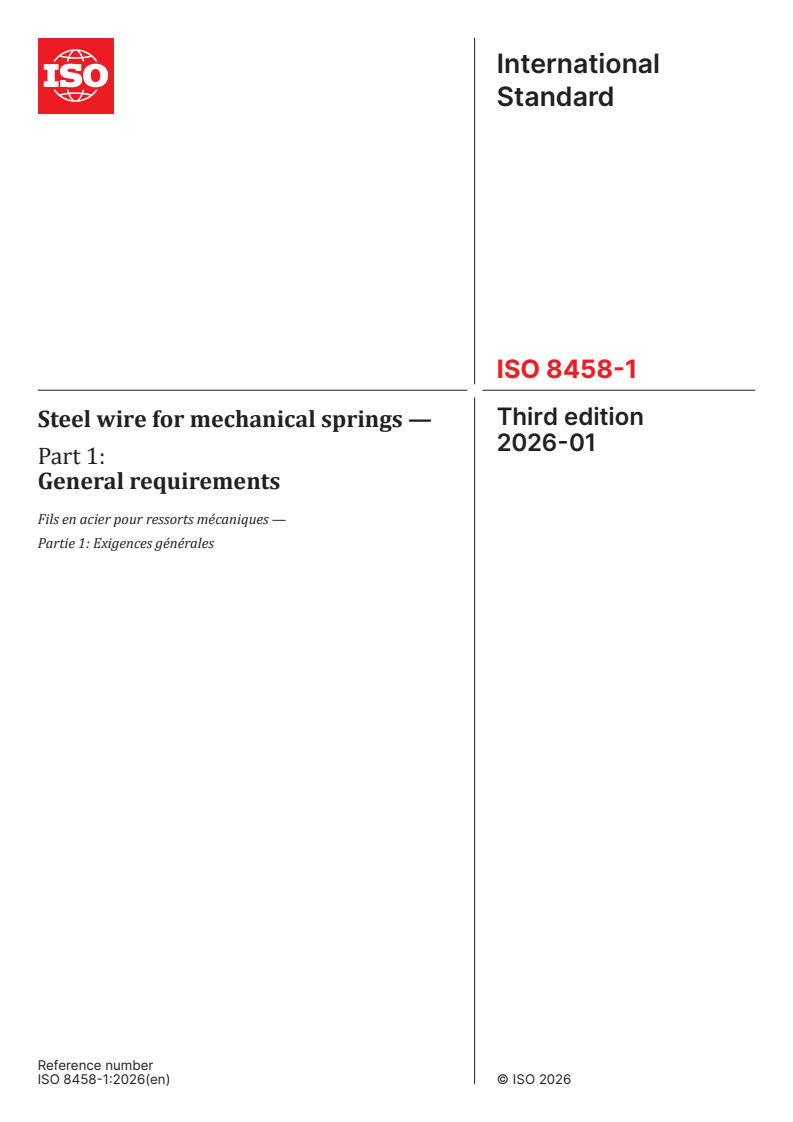
International
Standard
ISO 8458-1
Third edition
Steel wire for mechanical springs —
2026-01
Part 1:
General requirements
Fils en acier pour ressorts mécaniques —
Partie 1: Exigences générales
Reference number
© ISO 2026
All rights reserved. Unless otherwise specified, or required in the context of its implementation, no part of this publication may
be reproduced or utilized otherwise in any form or by any means, electronic or mechanical, including photocopying, or posting on
the internet or an intranet, without prior written permission. Permission can be requested from either ISO at the address below
or ISO’s member body in the country of the requester.
ISO copyright office
CP 401 • Ch. de Blandonnet 8
CH-1214 Vernier, Geneva
Phone: +41 22 749 01 11
Email: copyright@iso.org
Website: www.iso.org
Published in Switzerland
ii
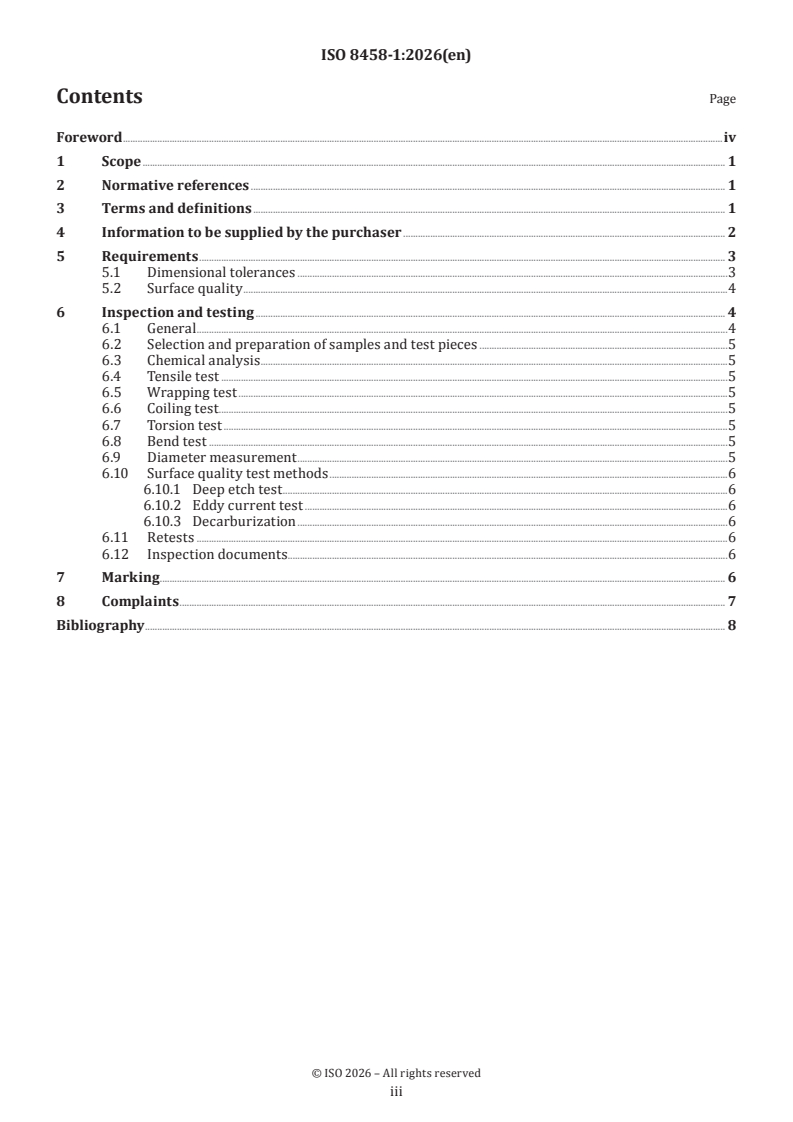
Contents Page
Foreword .iv
1 Scope . 1
2 Normative references . 1
3 Terms and definitions . 1
4 Information to be supplied by the purchaser . 2
5 Requirements . 3
5.1 Dimensional tolerances .3
5.2 Surface quality .4
6 Inspection and testing . 4
6.1 General .4
6.2 Selection and preparation of samples and test pieces .5
6.3 Chemical analysis .5
6.4 Tensile test .5
6.5 Wrapping test .5
6.6 Coiling test .5
6.7 Torsion test .5
6.8 Bend test .5
6.9 Diameter measurement .5
6.10 Surface quality test methods .6
6.10.1 Deep etch test .6
6.10.2 Eddy current test .6
6.10.3 Decarburization .6
6.11 Retests .6
6.12 Inspection documents.6
7 Marking . . 6
8 Complaints . 7
Bibliography . 8
iii
Foreword
ISO (the International Organization for Standardization) is a worldwide federation of national standards
bodies (ISO member bodies). The work of preparing International Standards is normally carried out through
ISO technical committees. Each member body interested in a subject for which a technical committee
has been established has the right to be represented on that committee. International organizations,
governmental and non-governmental, in liaison with ISO, also take part in the work. ISO collaborates closely
with the International Electrotechnical Commission (IEC) on all matters of electrotechnical standardization.
The procedures used to develop this document and those intended for its further maintenance are described
in the ISO/IEC Directives, Part 1. In particular, the different approval criteria needed for the different types
of ISO document should be noted. This document was drafted in accordance with the editorial rules of the
ISO/IEC Directives, Part 2 (see www.iso.org/directives).
ISO draws attention to the possibility that the implementation of this document may involve the use of (a)
patent(s). ISO takes no position concerning the evidence, validity or applicability of any claimed patent
rights in respect thereof. As of the date of publication of this document, ISO had not received notice of (a)
patent(s) which may be required to implement this document. However, implementers are cautioned that
this may not represent the latest information, which may be obtained from the patent database available at
www.iso.org/patents. ISO shall not be held responsible for identifying any or all such patent rights.
Any trade name used in this document is information given for the convenience of users and does not
constitute an endorsement.
For an explanation of the voluntary nature of standards, the meaning of ISO specific terms and expressions
related to conformity assessment, as well as information about ISO's adherence to the World Trade
Organization (WTO) principles in the Technical Barriers to Trade (TBT), see www.iso.org/iso/foreword.html.
This document was prepared by Technical Committee ISO/TC 17, Steel, Subcommittee SC 17, Steel wire rod
and wire products.
This third edition cancels and replaces the second edition (ISO 8458-1:2002), of which it constitutes a minor
revision.
The changes are as follows:
— the normative references have been updated;
— the structure of the document has been updated in accordance with the latest ISO/IEC Directives, Part 2.
A list of all parts in the ISO 8458 series can be found on the ISO website.
Any feedback or questions on this document should be directed to the user’s national standards body. A
complete listing of these bodies can be found at www.iso.org/members.html.
iv
International Standard ISO 8458-1:2026(en)
Steel wire for mechanical springs —
Part 1:
General requirements
1 Scope
This document specifies general requirements for steel spring wire of round cross-section, suitable for the
manufacture of mechanical springs.
2 Normative references
The following documents are referred to in the text in such a way that some or all of their content constitutes
requirements of this document. For dated references, only the edition cited applies. For undated references,
the latest edition of the referenced document (including any amendments) applies.
ISO 377, Steel and steel products — Location and preparation of samples and test pieces for mechanical testing
ISO 404, Steel and steel products — General technical delivery requirements
ISO 3887, Steels — Determination of the depth of decarburization
ISO 6892-1, Metallic materials — Tensile testing — Part 1: Method of test at room temperature
ISO 7438, Metallic materials — Bend test
ISO 7800, Metallic materials — Wire — Simp
...