

ISO 187:2022
(Main)Paper, board and pulps — Standard atmosphere for conditioning and testing and procedure for monitoring the atmosphere and conditioning of samples
General Information
- Abstract
This document specifies the standard atmospheres for conditioning and testing pulp, paper and board, the conditioning procedure and the procedures for measuring the temperature and relative humidity.
- Status
- Published
- Publication Date
- 17-Oct-2022
- Technical Committee
- ISO/TC 6/SC 2 - Test methods and quality specifications for paper and board
- Drafting Committee
- ISO/TC 6/SC 2/WG 46 - Standard atmosphere
- Current Stage
- 6060 - International Standard published
- Start Date
- 18-Oct-2022
- Due Date
- 21-Nov-2022
- Completion Date
- 18-Oct-2022
Buy Documents
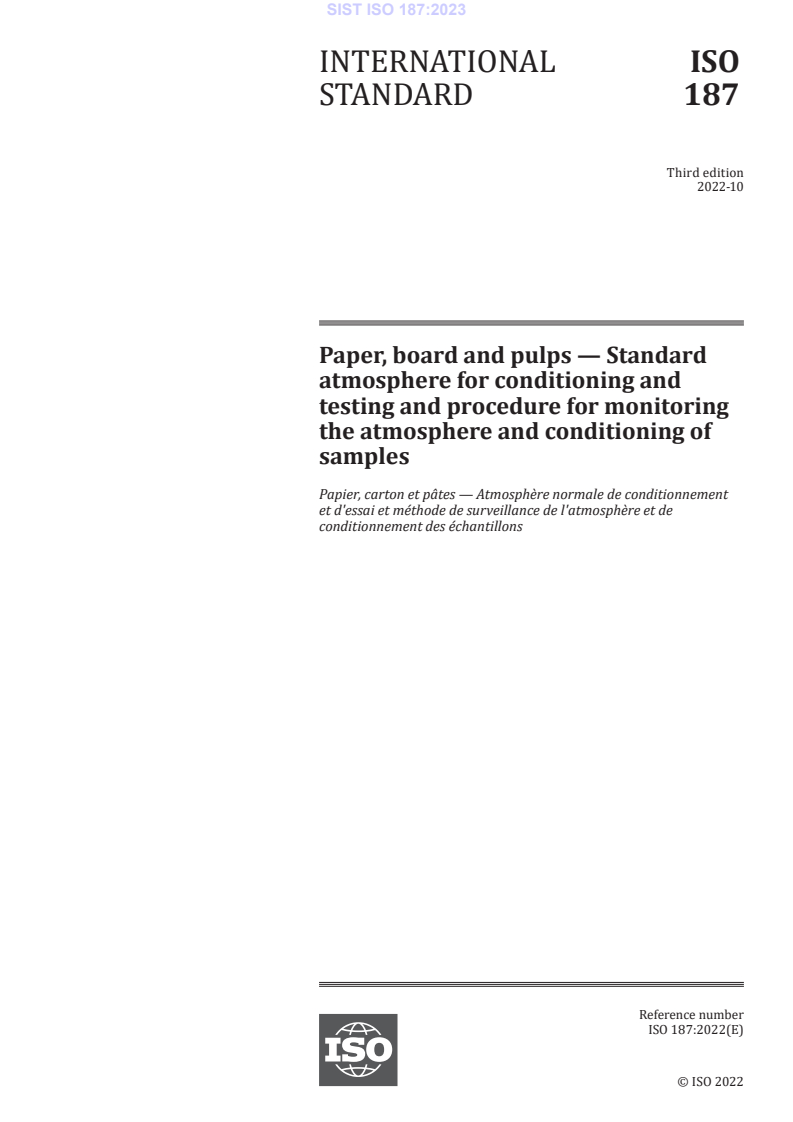



ISO 187:2022 - Paper, board and pulps — Standard atmosphere for conditioning and testing and procedure for monitoring the atmosphere and conditioning of samples Released:18. 10. 2022


ISO 187:2022 - Paper, board and pulps — Standard atmosphere for conditioning and testing and procedure for monitoring the atmosphere and conditioning of samples Released:18. 10. 2022
Overview
ISO 187:2022 - "Paper, board and pulps - Standard atmosphere for conditioning and testing and procedure for monitoring the atmosphere and conditioning of samples" - defines the standard atmosphere, conditioning procedure, and measurement requirements to establish reproducible moisture-equilibrium for pulp, paper and board. The third edition (2022) updates conditioning definitions, measurement procedures (Annex A) and guidance on temperature/relative-humidity interdependence (Annex B).
Key topics and technical requirements
- Standard atmosphere: primary test atmosphere is (23 ± 1) °C and (50 ± 2) % RH. In tropical zones, (27 ± 1) °C and (65 ± 2) % RH is permitted.
- Equilibrium definition: conditioning is achieved when two consecutive weighings at least 1 hour apart differ by ≤ 0.25 % of the specimen mass.
- Preconditioning: when hysteresis can affect results, precondition samples 24 h at 10–35 % RH and ≤ 40 °C (ensure preconditioning RH < conditioning RH). Laboratory sheets made by ISO 5269 methods shall not be preconditioned.
- Conditioning practice: allow free air access to all specimen surfaces; typical conditioning times: ~4 h for paper (longer for higher grammage; boards or special materials may need 48 h+). Minimize handling and avoid touching or breathing on test areas.
- Measurement and monitoring (Annex A): use a thermo‑hygrometer with 0.1 °C temperature resolution and ±2 % RH RH resolution (or equivalent apparatus). Record data every 2 minutes, compute 10‑minute averages and use the 10‑minute averages as test results.
- Control considerations (Annex B): temperature and RH are interdependent - small temperature changes alter RH (table provides change in RH per 0.5 °C). Maintain even air circulation and appropriate control capacity; avoid internal heat/moisture sources.
- Failure and reporting: excursions that could change moisture content require reconditioning; samples exposed to RH > 75 % must be discarded. Test reports must reference ISO 187:2022 and include atmosphere used, conditioning time, preconditioning status, deviations and test date.
Applications and who uses it
- Quality control and R&D laboratories in pulp, paper and packaging industries needing reproducible test conditions.
- Test labs performing physical, optical or mechanical property tests where moisture content affects outcomes.
- Manufacturers of conditioning and climate-control equipment, and standards developers calibrating test rooms and instrumentation.
- Procurement and compliance teams requiring consistent sampling and reporting practices.
Related standards
- ISO 5269-1 and ISO 5269-3 (laboratory sheet preparation) - referenced for laboratory sheet handling and exclusions.
- Historical reference: replaces ISO 187:1990.
Keywords: ISO 187:2022, standard atmosphere, paper conditioning, relative humidity, temperature control, conditioning procedure, thermo-hygrometer, pulp paper board testing.
Relations
- Referred By
EN ISO 6599-1:2026 - Packaging - Conditioning for testing - Part 1: Paper sacks (ISO 6599-1:2026) - Effective Date
- 26-Aug-2026
- Effective Date
- 25-Aug-2026
- Effective Date
- 25-Aug-2026
- Effective Date
- 25-Aug-2026
- Effective Date
- 25-Aug-2026
- Effective Date
- 25-Aug-2026
- Effective Date
- 25-Aug-2026
- Referred By
EN ISO 3035:2025 - Corrugated fibreboard - Determination of flat crush resistance (ISO 3035:2025) - Effective Date
- 25-Aug-2026
- Effective Date
- 25-Feb-2026
- Effective Date
- 12-Feb-2026
- Effective Date
- 06-Jun-2022
- Consolidated By
ISO/FDIS 17228 - Leather — Tests for colour fastness — Change in colour with accelerated ageing - Effective Date
- 20-Jul-2024
- Effective Date
- 23-Apr-2020
Buy Documents
ISO 187:2022 - Paper, board and pulps — Standard atmosphere for conditioning and testing and procedure for monitoring the atmosphere and conditioning of samples Released:18. 10. 2022
ISO 187:2022 - Paper, board and pulps — Standard atmosphere for conditioning and testing and procedure for monitoring the atmosphere and conditioning of samples Released:18. 10. 2022
Get Certified
Connect with accredited certification bodies for this standard

Control Union Certifications
Global certification for agriculture and sustainability.

Gozdarski inštitut Slovenije
Slovenian Forestry Institute. Forest management certification support, timber testing.
Sponsored listings
Frequently Asked Questions
ISO 187:2022 is a standard published by the International Organization for Standardization (ISO). Its full title is "Paper, board and pulps — Standard atmosphere for conditioning and testing and procedure for monitoring the atmosphere and conditioning of samples". This standard covers: This document specifies the standard atmospheres for conditioning and testing pulp, paper and board, the conditioning procedure and the procedures for measuring the temperature and relative humidity.
This document specifies the standard atmospheres for conditioning and testing pulp, paper and board, the conditioning procedure and the procedures for measuring the temperature and relative humidity.
ISO 187:2022 is classified under the following ICS (International Classification for Standards) categories: 85.040 - Pulps; 85.060 - Paper and board. The ICS classification helps identify the subject area and facilitates finding related standards.
ISO 187:2022 has the following relationships with other standards: It is inter standard links to EN ISO 6599-1:2026, EN ISO 535:2023, EN ISO 12625-15:2022, EN ISO 12625-16:2024, EN ISO 3037:2022, EN ISO 12625-5:2024, EN ISO 12625-12:2023, EN ISO 3035:2025, EN ISO 9706:2025, EN ISO 187:2022, ISO/TS 8100-3:2019, ISO/FDIS 17228, ISO 187:1990. Understanding these relationships helps ensure you are using the most current and applicable version of the standard.
ISO 187:2022 is available in PDF format for immediate download after purchase. The document can be added to your cart and obtained through the secure checkout process. Digital delivery ensures instant access to the complete standard document.
Standards Content (Sample)
SLOVENSKI STANDARD
01-julij-2023
Papir, karton, lepenka in vlaknine - Standardna atmosfera za kondicioniranje in
preskušanje ter postopek za nadzor atmosfere in kondicioniranje vzorcev
Paper, board and pulps — Standard atmosphere for conditioning and testing and
procedure for monitoring the atmosphere and conditioning of samples
Papier, carton et pâtes — Atmosphère normale de conditionnement et d'essai et
méthode de surveillance de l'atmosphère et de conditionnement des échantillons
Ta slovenski standard je istoveten z: ISO 187:2022
ICS:
85.040 Vlaknine Pulps
85.060 Papir, karton in lepenka Paper and board
2003-01.Slovenski inštitut za standardizacijo. Razmnoževanje celote ali delov tega standarda ni dovoljeno.
INTERNATIONAL ISO
STANDARD 187
Third edition
2022-10
Paper, board and pulps — Standard
atmosphere for conditioning and
testing and procedure for monitoring
the atmosphere and conditioning of
samples
Papier, carton et pâtes — Atmosphère normale de conditionnement
et d'essai et méthode de surveillance de l'atmosphère et de
conditionnement des échantillons
Reference number
© ISO 2022
All rights reserved. Unless otherwise specified, or required in the context of its implementation, no part of this publication may
be reproduced or utilized otherwise in any form or by any means, electronic or mechanical, including photocopying, or posting on
the internet or an intranet, without prior written permission. Permission can be requested from either ISO at the address below
or ISO’s member body in the country of the requester.
ISO copyright office
CP 401 • Ch. de Blandonnet 8
CH-1214 Vernier, Geneva
Phone: +41 22 749 01 11
Email: copyright@iso.org
Website: www.iso.org
Published in Switzerland
ii
Contents Page
Foreword .iv
Introduction .v
1 Scope . 1
2 Normative references . 1
3 Terms and definitions . 1
4 Principle . 1
5 Standard atmosphere . 1
6 Conditioning procedure . 2
6.1 Preconditioning of the sample . 2
6.2 Conditioning. 2
6.3 Testing . 2
7 Test report . 2
Annex A (normative) Measurement of temperature and relative humidity .3
Annex B (informative) Interdependence of temperature and relative humidity .4
Bibliography . 7
iii
Foreword
ISO (the International Organization for Standardization) is a worldwide federation of national standards
bodies (ISO member bodies). The work of preparing International Standards is normally carried out
through ISO technical committees. Each member body interested in a subject for which a technical
committee has been established has the right to be represented on that committee. International
organizations, governmental and non-governmental, in liaison with ISO, also take part in the work.
ISO collaborates closely with the International Electrotechnical Commission (IEC) on all matters of
electrotechnical standardization.
The procedures used to develop this document and those intended for its further maintenance are
described in the ISO/IEC Directives, Part 1. In particular, the different approval criteria needed for the
different types of ISO documents should be noted. This document was drafted in accordance with the
editorial rules of the ISO/IEC Directives, Part 2 (see www.iso.org/directives).
Attention is drawn to the possibility that some of the elements of this document may be the subject of
patent rights. ISO shall not be held responsible for identifying any or all such patent rights. Details of
any patent rights identified during the development of the document will be in the Introduction and/or
on the ISO list of patent declarations received (see www.iso.org/patents).
Any trade name used in this document is information given for the convenience of users and does not
constitute an endorsement.
For an explanation of the voluntary nature of standards, the meaning of ISO specific terms and
expressions related to conformity assessment, as well as information about ISO's adherence to
the World Trade Organization (WTO) principles in the Technical Barriers to Trade (TBT), see
www.iso.org/iso/foreword.html.
This document was prepared by Technical Committee ISO/TC 6, Paper, board and pulps, Subcommittee
SC 2, Test methods and quality specifications for paper and board, in collaboration with the European
Committee for Standardization (CEN) Technical Committee CEN/TC 172, Pulp, paper and board, in
accordance with the Agreement on technical cooperation between ISO and CEN (Vienna Agreement).
This third edition cancels and replaces the second edition (ISO 187:1990), which has been technically
revised.
The main changes are as follows:
— introduction has been revised;
— normative references have been removed;
— definition of conditioning has been revised;
— content has been added to Clause 5 and Clause 6;
— Annex A has been simplified.
Any feedback or questions on this document should be directed to the user’s national standards body. A
complete listing of these bodies can be found at www.iso.org/members.html.
iv
Introduction
The physical properties of paper are affected by its moisture content which, in turn, is dependent on the
relative humidity (RH) of the surrounding atmosphere and its history. In order that tests can be made
on paper in a defined physical state, it is brought into equilibrium in an atmosphere of standardized
temperature and relative humidity.
The moisture content of a given paper in equilibrium with a given atmosphere varies according to
whether the equilibrium is reached by sorption or by desorption of moisture and how far the moisture
content is from its equilibrium value. This hysteresis influences those physical properties that change
with moisture content. Preconditioning paper from low relative humidity and then bringing it into the
standard atmosphere will avoid most of the hysteresis effect. Typically, the variation in the moisture
content of a given sample is less than 0,15 % when the sample is later conditioned to 50 % RH and 23 °C.
Unless otherwise specified, the equilibrium condition should be attained from a low relative humidity.
For a number of years, three standard test atmospheres have been in common use:
20 °C/65 % RH;
23 °C/50 % RH;
27 °C/65 % RH.
Since 1993, the atmosphere of 23 °C /50 % RH has been considered the ISO standard test atmosphere for
testing of pulp, paper, and board. However, this atmosphere can be difficult to attain in some countries
located in tropical zones, and in such countries the 27 °C /65 % RH atmosphere is permitted.
v
INTERNATIONAL STANDARD ISO 187:2022(E)
Paper, board and pulps — Standard atmosphere for
conditioning and testing and procedure for monitoring the
atmosphere and conditioning of samples
1 Scope
This document specifies the standard atmospheres for conditioning and testing pulp, paper and board,
the conditioning procedure and the procedures for measuring the temperature and relative humidity.
2 Normative references
There are no normative references in this document.
3 Terms and definitions
For the purposes of this document, the following terms and definitions apply.
ISO and IEC maintain terminology databases for use in standardization at the following addresses:
— ISO Online browsing platform: available at https:// www .iso .org/ obp
— IEC Electropedia: available at https:// www .electropedia .org/
3.1
relative humidity
RH
ratio, expressed as a percentage, of the actual water vapour content of the air to the water vapour
content of air saturated with water vapour at the same temperature and pressure
3.2
conditioning
process of establishing a reproducible moisture content equilibrium of a sample in an atmosphere of
specified temperature and relative humidity
Note 1 to entry: This equilibrium is considered to be attained when the results of two consecutive weighings of
the sample, carried out at an interval of time of not less than 1 h, do not differ by more than 0,25 %.
4 Principle
Exposure of a sample to a specific conditioning atmosphere in such a manner that a reproducible state
of moisture content equilibrium is reached.
5 Standard atmosphere
The standard atmosphere for testing pulp, paper and board shall be (23 ± 1) °C and (50 ± 2) % RH. In
tropical countries, an atmosphere of (27 ± 1) °C and (65 ± 2) % RH can be used.
A test atmosphere shall be deemed to be within the requirements of this document if all
...
INTERNATIONAL ISO
STANDARD 187
Third edition
2022-10
Paper, board and pulps — Standard
atmosphere for conditioning and
testing and procedure for monitoring
the atmosphere and conditioning of
samples
Papier, carton et pâtes — Atmosphère normale de conditionnement
et d'essai et méthode de surveillance de l'atmosphère et de
conditionnement des échantillons
Reference number
© ISO 2022
All rights reserved. Unless otherwise specified, or required in the context of its implementation, no part of this publication may
be reproduced or utilized otherwise in any form or by any means, electronic or mechanical, including photocopying, or posting on
the internet or an intranet, without prior written permission. Permission can be requested from either ISO at the address below
or ISO’s member body in the country of the requester.
ISO copyright office
CP 401 • Ch. de Blandonnet 8
CH-1214 Vernier, Geneva
Phone: +41 22 749 01 11
Email: copyright@iso.org
Website: www.iso.org
Published in Switzerland
ii
Contents Page
Foreword .iv
Introduction .v
1 Scope . 1
2 Normative references . 1
3 Terms and definitions . 1
4 Principle . 1
5 Standard atmosphere . 1
6 Conditioning procedure . 2
6.1 Preconditioning of the sample . 2
6.2 Conditioning. 2
6.3 Testing . 2
7 Test report . 2
Annex A (normative) Measurement of temperature and relative humidity .3
Annex B (informative) Interdependence of temperature and relative humidity .4
Bibliography . 7
iii
Foreword
ISO (the International Organization for Standardization) is a worldwide federation of national standards
bodies (ISO member bodies). The work of preparing International Standards is normally carried out
through ISO technical committees. Each member body interested in a subject for which a technical
committee has been established has the right to be represented on that committee. International
organizations, governmental and non-governmental, in liaison with ISO, also take part in the work.
ISO collaborates closely with the International Electrotechnical Commission (IEC) on all matters of
electrotechnical standardization.
The procedures used to develop this document and those intended for its further maintenance are
described in the ISO/IEC Directives, Part 1. In particular, the different approval criteria needed for the
different types of ISO documents should be noted. This document was drafted in accordance with the
editorial rules of the ISO/IEC Directives, Part 2 (see www.iso.org/directives).
Attention is drawn to the possibility that some of the elements of this document may be the subject of
patent rights. ISO shall not be held responsible for identifying any or all such patent rights. Details of
any patent rights identified during the development of the document will be in the Introduction and/or
on the ISO list of patent declarations received (see www.iso.org/patents).
Any trade name used in this document is information given for the convenience of users and does not
constitute an endorsement.
For an explanation of the voluntary nature of standards, the meaning of ISO specific terms and
expressions related to conformity assessment, as well as information about ISO's adherence to
the World Trade Organization (WTO) principles in the Technical Barriers to Trade (TBT), see
www.iso.org/iso/foreword.html.
This document was prepared by Technical Committee ISO/TC 6, Paper, board and pulps, Subcommittee
SC 2, Test methods and quality specifications for paper and board, in collaboration with the European
Committee for Standardization (CEN) Technical Committee CEN/TC 172, Pulp, paper and board, in
accordance with the Agreement on technical cooperation between ISO and CEN (Vienna Agreement).
This third edition cancels and replaces the second edition (ISO 187:1990), which has been technically
revised.
The main changes are as follows:
— introduction has been revised;
— normative references have been removed;
— definition of conditioning has been revised;
— content has been added to Clause 5 and Clause 6;
— Annex A has been simplified.
Any feedback or questions on this document should be directed to the user’s national standards body. A
complete listing of these bodies can be found at www.iso.org/members.html.
iv
Introduction
The physical properties of paper are affected by its moisture content which, in turn, is dependent on the
relative humidity (RH) of the surrounding atmosphere and its history. In order that tests can be made
on paper in a defined physical state, it is brought into equilibrium in an atmosphere of standardized
temperature and relative humidity.
The moisture content of a given paper in equilibrium with a given atmosphere varies according to
whether the equilibrium is reached by sorption or by desorption of moisture and how far the moisture
content is from its equilibrium value. This hysteresis influences those physical properties that change
with moisture content. Preconditioning paper from low relative humidity and then bringing it into the
standard atmosphere will avoid most of the hysteresis effect. Typically, the variation in the moisture
content of a given sample is less than 0,15 % when the sample is later conditioned to 50 % RH and 23 °C.
Unless otherwise specified, the equilibrium condition should be attained from a low relative humidity.
For a number of years, three standard test atmospheres have been in common use:
20 °C/65 % RH;
23 °C/50 % RH;
27 °C/65 % RH.
Since 1993, the atmosphere of 23 °C /50 % RH has been considered the ISO standard test atmosphere for
testing of pulp, paper, and board. However, this atmosphere can be difficult to attain in some countries
located in tropical zones, and in such countries the 27 °C /65 % RH atmosphere is permitted.
v
INTERNATIONAL STANDARD ISO 187:2022(E)
Paper, board and pulps — Standard atmosphere for
conditioning and testing and procedure for monitoring the
atmosphere and conditioning of samples
1 Scope
This document specifies the standard atmospheres for conditioning and testing pulp, paper and board,
the conditioning procedure and the procedures for measuring the temperature and relative humidity.
2 Normative references
There are no normative references in this document.
3 Terms and definitions
For the purposes of this document, the following terms and definitions apply.
ISO and IEC maintain terminology databases for use in standardization at the following addresses:
— ISO Online browsing platform: available at https:// www .iso .org/ obp
— IEC Electropedia: available at https:// www .electropedia .org/
3.1
relative humidity
RH
ratio, expressed as a percentage, of the actual water vapour content of the air to the water vapour
content of air saturated with water vapour at the same temperature and pressure
3.2
conditioning
process of establishing a reproducible moisture content equilibrium of a sample in an atmosphere of
specified temperature and relative humidity
Note 1 to entry: This equilibrium is considered to be attained when the results of two consecutive weighings of
the sample, carried out at an interval of time of not less than 1 h, do not differ by more than 0,25 %.
4 Principle
Exposure of a sample to a specific conditioning atmosphere in such a manner that a reproducible state
of moisture content equilibrium is reached.
5 Standard atmosphere
The standard atmosphere for testing pulp, paper and board shall be (23 ± 1) °C and (50 ± 2) % RH. In
tropical countries, an atmosphere of (27 ± 1) °C and (65 ± 2) % RH can be used.
A test atmosphere shall be deemed to be within the requirements of this document if all the test results
determined as described in Annex A are within the prescribed limits.
Even short-term excursions of temperature or humidity beyond these limits, to the extent that the
equilibrium moisture content of the sample will be affected, are not permitted. Whenever the test
atmosphere is known to have been outside the limits and if there is any chance that the moisture
content of samples has been changed by such excursions, all samples sha
...
NORME ISO
INTERNATIONALE 187
Troisième édition
2022-10
Papier, carton et pâtes — Atmosphère
normale de conditionnement et
d'essai et méthode de surveillance de
l'atmosphère et de conditionnement
des échantillons
Paper, board and pulps — Standard atmosphere for conditioning
and testing and procedure for monitoring the atmosphere and
conditioning of samples
Numéro de référence
DOCUMENT PROTÉGÉ PAR COPYRIGHT
© ISO 2022
Tous droits réservés. Sauf prescription différente ou nécessité dans le contexte de sa mise en œuvre, aucune partie de cette
publication ne peut être reproduite ni utilisée sous quelque forme que ce soit et par aucun procédé, électronique ou mécanique,
y compris la photocopie, ou la diffusion sur l’internet ou sur un intranet, sans autorisation écrite préalable. Une autorisation peut
être demandée à l’ISO à l’adresse ci-après ou au comité membre de l’ISO dans le pays du demandeur.
ISO copyright office
Case postale 401 • Ch. de Blandonnet 8
CH-1214 Vernier, Genève
Tél.: +41 22 749 01 11
E-mail: copyright@iso.org
Web: www.iso.org
Publié en Suisse
ii
Sommaire Page
Avant-propos .iv
Introduction .v
1 Domaine d’application . 1
2 Références normatives .1
3 Termes et définitions . 1
4 Principe. 1
5 Atmosphère normale .1
6 Conditionnement .2
6.1 Préconditionnement des échantillons . 2
6.2 Conditionnement . 2
6.3 Essais . 2
7 Rapport d’essai . 2
Annexe A (normative) Mesurage de la température et de l’humidité relative .4
Annexe B (informative) Interdépendance de la température et de l’humidité relative .5
Bibliographie . 8
iii
Avant-propos
L'ISO (Organisation internationale de normalisation) est une fédération mondiale d'organismes
nationaux de normalisation (comités membres de l'ISO). L'élaboration des Normes internationales est
en général confiée aux comités techniques de l'ISO. Chaque comité membre intéressé par une étude
a le droit de faire partie du comité technique créé à cet effet. Les organisations internationales,
gouvernementales et non gouvernementales, en liaison avec l'ISO participent également aux travaux.
L'ISO collabore étroitement avec la Commission électrotechnique internationale (IEC) en ce qui
concerne la normalisation électrotechnique.
Les procédures utilisées pour élaborer le présent document et celles destinées à sa mise à jour sont
décrites dans les Directives ISO/IEC, Partie 1. Il convient, en particulier, de prendre note des différents
critères d'approbation requis pour les différents types de documents ISO. Le présent document
a été rédigé conformément aux règles de rédaction données dans les Directives ISO/IEC, Partie 2
(voir www.iso.org/directives).
L'attention est appelée sur le fait que certains des éléments du présent document peuvent faire l'objet de
droits de propriété intellectuelle ou de droits analogues. L’ISO ne saurait être tenue pour responsable
de ne pas avoir identifié de tels droits de propriété. Les détails concernant les références aux droits
de propriété intellectuelle ou autres droits analogues identifiés lors de l'élaboration du document
sont indiqués dans l'Introduction et/ou dans la liste des déclarations de brevets reçues par l'ISO (voir
www.iso.org/brevets).
Les appellations commerciales éventuellement mentionnées dans le présent document sont données
pour information, par souci de commodité, à l'intention des utilisateurs et ne sauraient constituer un
engagement.
Pour une explication de la nature volontaire des normes, la signification des termes et expressions
spécifiques de l'ISO liés à l'évaluation de la conformité, ou pour toute information au sujet de l'adhésion
de l'ISO aux principes de l’Organisation mondiale du commerce (OMC) concernant les obstacles
techniques au commerce (OTC), voir:.www.iso.org/iso/fr/avant-propos
Le présent document a été élaboré par le comité technique ISO/TC 6, Papiers, cartons et pâtes,
SC 2, Méthodes d’essais et spécifications de qualité des papiers et cartons, en collaboration avec le
comité technique CEN/TC 172, Pâtes, papier et carton, du Comité européen de normalisation (CEN),
conformément à l'Accord de coopération technique entre l'ISO et le CEN (Accord de Vienne).
Cette troisième édition annule et remplace la deuxième édition (ISO 187:1990) qui a fait l’objet d’une
révision technique.
Les principales modifications sont les suivantes :
— l’introduction a été modifiée ;
— les références normatives ont été supprimées ;
— la définition du terme conditionnement a été modifiée ;
— des dispositions ont été ajoutées dans l’Article 5 et l’Article 6 ;
— l’Annexe A a été simplifiée.
Il convient que l’utilisateur adresse tout retour d’information ou toute question concernant le présent
document à l’organisme national de normalisation de son pays. Une liste exhaustive desdits organismes
se trouve à l’adresse http://www.iso.org/fr/members.html.
iv
Introduction
Les propriétés physiques du papier varient avec sa teneur en humidité, qui dépend elle-même de
l’humidité relative (HR) de l’atmosphère ambiante et de son historique. Pour qu’un papier se trouvant
dans un état physique donné puisse être soumis à des essais, il doit être amené à l’équilibre dans une
atmosphère de température et d’humidité relative normalisées.
La teneur en humidité d’un papier donné, à l’équilibre dans une atmosphère donnée, varie selon que cet
équilibre a été atteint par sorption ou par désorption de l’humidité et selon l’écart entre la teneur en
humidité et sa valeur d’équilibre. Cette hystérésis influe sur les propriétés physiques qui varient selon
la teneur en humidité. Le papier est d’abord soumis à une faible humidité relative ensuite portée à la
valeur des conditions de l’atmosphère normale, ce qui permet d’éviter la plupart des effets d’hystérésis.
Généralement, la variation de la teneur en humidité d’un échantillon donné est inférieure à 0,15 % lors
du conditionnement ultérieur de ce dernier à 50 % HR et 23 °C. Sauf spécification contraire, il convient
d’atteindre l’état d’équilibre à partir d’une faible humidité relative.
Depuis de nombreuses années, trois atmosphères normales d’essai sont couramment utilisées :
20 °C/65 % HR ;
23 °C/50 % HR ;
27 °C/65 % HR.
Depuis 1993, l’atmosphère 23 °C/50 % HR est considérée comme l’atmosphère normale d’essai ISO pour
les essais relatifs aux pâtes, papiers et cartons. Cette atmosphère étant toutefois difficile à établir dans
certains pays tropicaux, l’utilisation de l’atmosphère 27 °C/65 % HR y est admise.
v
NORME INTERNATIONALE ISO 187:2022(F)
Papier, carton et pâtes — Atmosphère normale de
conditionnement et d'essai et méthode de surveillance de
l'atmosphère et de conditionnement des échantillons
1 Domaine d’application
Le présent document spécifie les atmosphères normales de conditionnement et d’essai des pâtes,
papiers et cartons, le mode opératoire de conditionnement ainsi que les modes opératoires de mesure
de la température et de l’humidité relative.
2 Références normatives
Le présent document ne contient aucune référence normative.
3 Termes et définitions
Pour les besoins du présent document, les termes et définitions suivants s'appliquent.
L'ISO et l'IEC tiennent à jour des bases de données terminologiques destinées à être utilisées en
normalisation, consultables aux adresses suivantes :
— ISO Online browsing platform : disponible à l'adresse https:// www .iso .org/ obp
— IEC Electropedia : disponible à l'adresse https:// www .electropedia .org/
3.1
humidité relative
HR
rapport, exprimé en pourcentage, de la teneur effective de l’air en vapeur d’eau à la teneur de l’air en
vapeur d’eau à saturation, dans les mêmes conditions de température et de pression
3.2
conditionnement
processus d’établissement d’un équilibre d’humidité reproductible pour un échantillon placé dans une
atmosphère de température et d’humidité relative spécifiées
Note 1 à l'article: L’équilibre est considéré comme atteint lorsque l’écart entre les résultats de deux pesées
consécutives de l’échantillon, effectuées à au moins 1 h d’intervalle, n’est pas supérieur à 0,25 %.
4 Principe
Il s’agit d’exposer un échantillon à une atmosphère de conditionnement spécifique, de manière à
atteindre un état d’équilibre reproductible de la teneur en humidité.
5 Atmosphère normale
L’atmosphère normale d’essai des pâtes, papiers et cartons doit être de (23 ± 1) °C et de (50 ± 2) % HR.
Dans les pays tropicaux, il est possible d’utiliser une atmosphère de (27 ± 1) °C et de (65 ± 2) % HR.
Une atmosphère d’essai doit être jugée comme respectant les exigences du présent document si tous les
résultats d’essai obtenus de la manière décrite à l’Annexe A se situent dans les limites fixées.
Aucun dépassement, même de courte durée, de ces limites de température et d’humidité au point
d’affecter la teneur en humidité à l’équilibre des échantillons n’est admis. S'il est avéré que l'atmosphère
d'essai a dépassé les limites et que la teneur en humidité des feuilles s'en est trouvée modifiée, l'ensemble
des feuilles doit être reconditionné en répétant le mode opératoire de l’Article 6 avant que des essais
ultérieurs puissent être réalisés. Si les échantillons ont été soumis à une humidité relative supérieure à
75 %, ils doivent être rejetés car des contraintes résiduelles dues au séchage dans l’échantillon peuvent
avoir été supprimées, entraînant ainsi une modification permanente de leurs propriétés.
Pour les feuilles de laboratoire préparées conformément à l’ISO 5269-1 ou à l’ISO 5269-3 au moyen de
la formette conventionnelle, s’il est constaté ou soupçonné une baisse de l’humidité relative en deçà de
la limite inférieure, susceptible d’avoir réduit leur teneur en humidité, ces feuilles doivent être rejetées
et de nouveaux échantillons doivent être préparés. Si cela n’est pas possible et que ces échantillons sont
soumis à essai, ce fait doit être consigné.
6 Conditionnement
6.1 Préconditionnement
...