


ISO 2435:1973
(Main)Nitrogen for use in aircraft
Nitrogen for use in aircraft
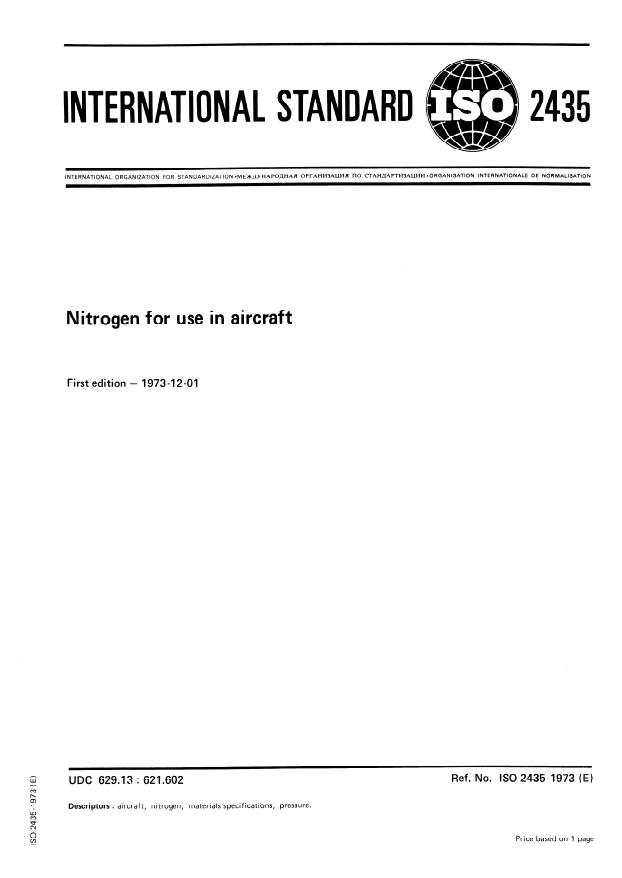
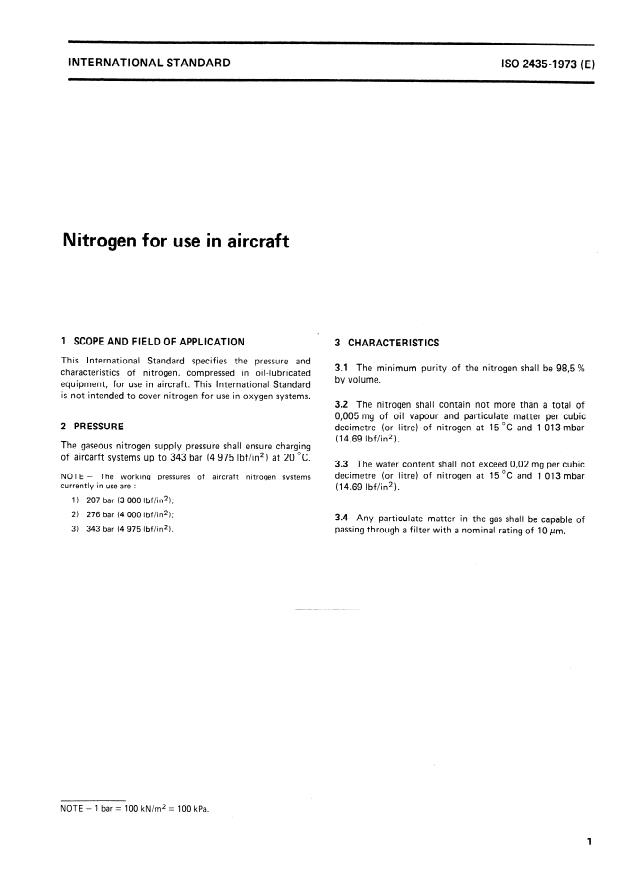
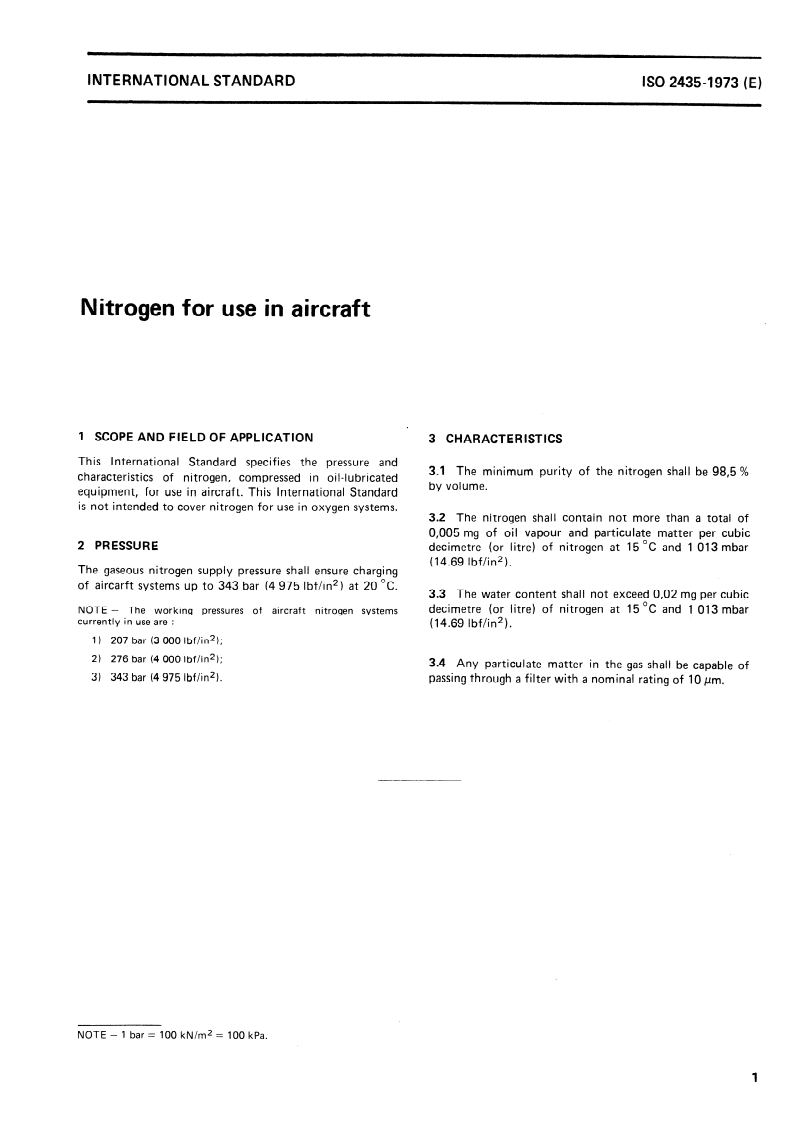
Gives the pressure and characteristics of nitrogen, compressed in oil-lubricated equipment. Is not intended to cover nitrogen für use in oxygen systems. The gaseous nitrogen supply pressure shall ensure charging of aircraft systems up to 343 bar at 20 °C. The minimum purity shall be 98,5 % by volume. It shall contain not more than a total of O,OO5 mg of oil vapour and particulate matter per cubic decimetre of nitrogen at 15 °C and 1 013 mbar.
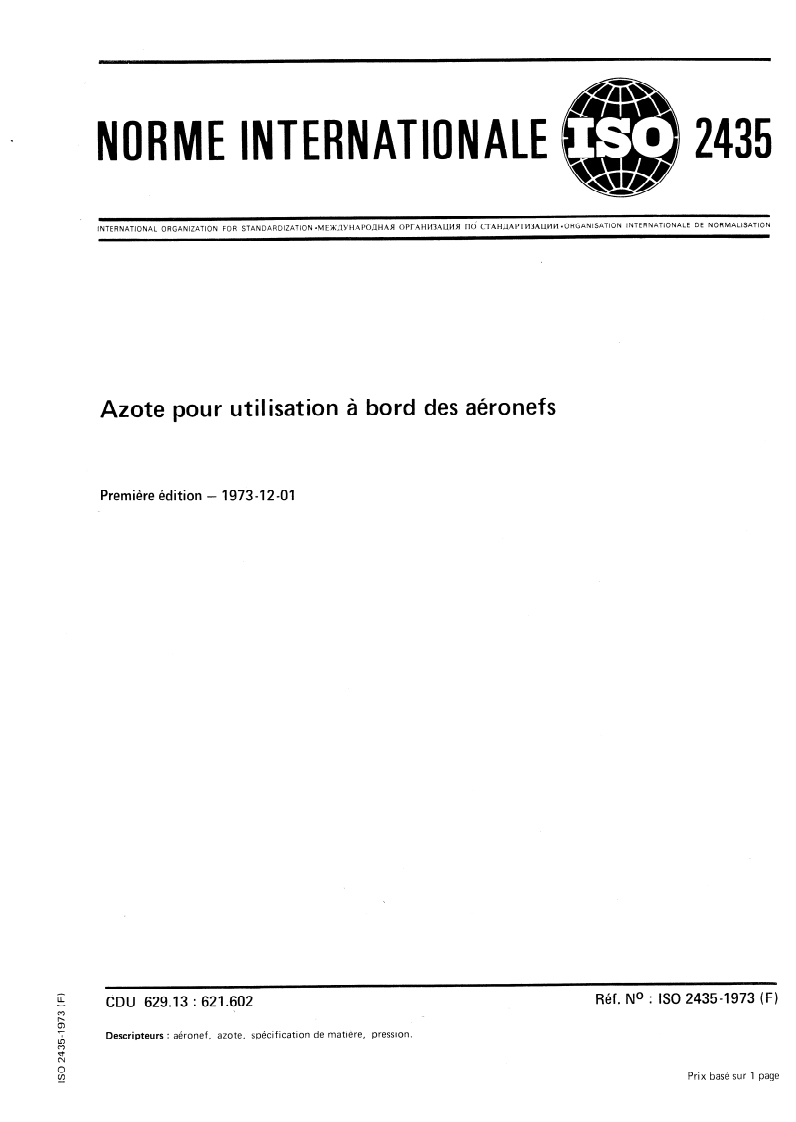
Azote pour utilisation à bord des aéronefs
General Information
- Status
- Published
- Publication Date
- 30-Nov-1973
- Technical Committee
- ISO/TC 20/SC 10 - Aerospace fluid systems and components
- Drafting Committee
- ISO/TC 20/SC 10/WG 8 - Hydraulic fluids and fluid contamination control
- Current Stage
- 9060 - Close of review
- Completion Date
- 04-Jun-2031
Overview
ISO 2435:1973 - "Nitrogen for use in aircraft" defines the required characteristics and supply pressure of gaseous nitrogen used for servicing aircraft systems. This international standard applies to nitrogen compressed in oil-lubricated equipment and is not intended for nitrogen used in aircraft oxygen systems. Use this standard to ensure safe, compatible, and contaminant-controlled nitrogen supply for high‑pressure aircraft applications.
Key topics and technical requirements
The standard sets clear, practical limits on gas quality and supply capability:
- Supply pressure: Must enable charging of aircraft systems up to 343 bar (4 975 lbf/in²) at 20 °C. (Typical working pressures cited: 207, 276, and 343 bar.)
- Purity: Minimum 98.5% by volume nitrogen.
- Oil vapour and particulate contamination: Maximum 0.005 mg total (oil vapour + particulate matter) per cubic decimetre (litre) of nitrogen at 15 °C and 1013 mbar.
- Water content: Not to exceed 0.02 mg per cubic decimetre (litre) at 15 °C and 1013 mbar.
- Particulate size: Any particulate matter must be able to pass through a 10 µm nominal filter.
These requirements focus on contamination control (oil, particulates, moisture) and adequate charging pressure for hydraulic, pneumatic, and other pressurized aircraft systems.
Applications
ISO 2435 is used wherever clean, high‑pressure nitrogen is required for aircraft maintenance and ground support:
- Filling and charging aircraft pneumatic and hydraulic systems
- Pre-flight servicing of landing gear, actuators, and emergency systems that use nitrogen
- Specification input for ground support equipment (GSE) and nitrogen supply stations
- Procurement and quality verification by airlines, MROs (maintenance, repair, overhaul), and ground handling providers
Who should use this standard
- Aircraft maintenance engineers and technicians
- Ground support equipment manufacturers and service providers
- Industrial gas suppliers and cylinder refill stations supplying aviation nitrogen
- Aviation safety and quality assurance teams specifying acceptance criteria
Related standards
ISO 2435 addresses aircraft nitrogen only; nitrogen for oxygen systems and other respiratory/gas-specific standards are handled separately. For integrated procurement and compliance, consult applicable standards for compressed gases, breathing/oxygen systems, and GSE safety in your jurisdiction.
Keywords: ISO 2435, nitrogen for aircraft, aircraft nitrogen standard, nitrogen purity, aircraft charging pressure, nitrogen contamination limits, ground support equipment.
Buy Documents


ISO 2435:1973 - Nitrogen for use in aircraft/1/1973
ISO 2435:1973 - Azote pour utilisation a bord des aéronefs
ISO 2435:1973 - Azote pour utilisation a bord des aéronefs
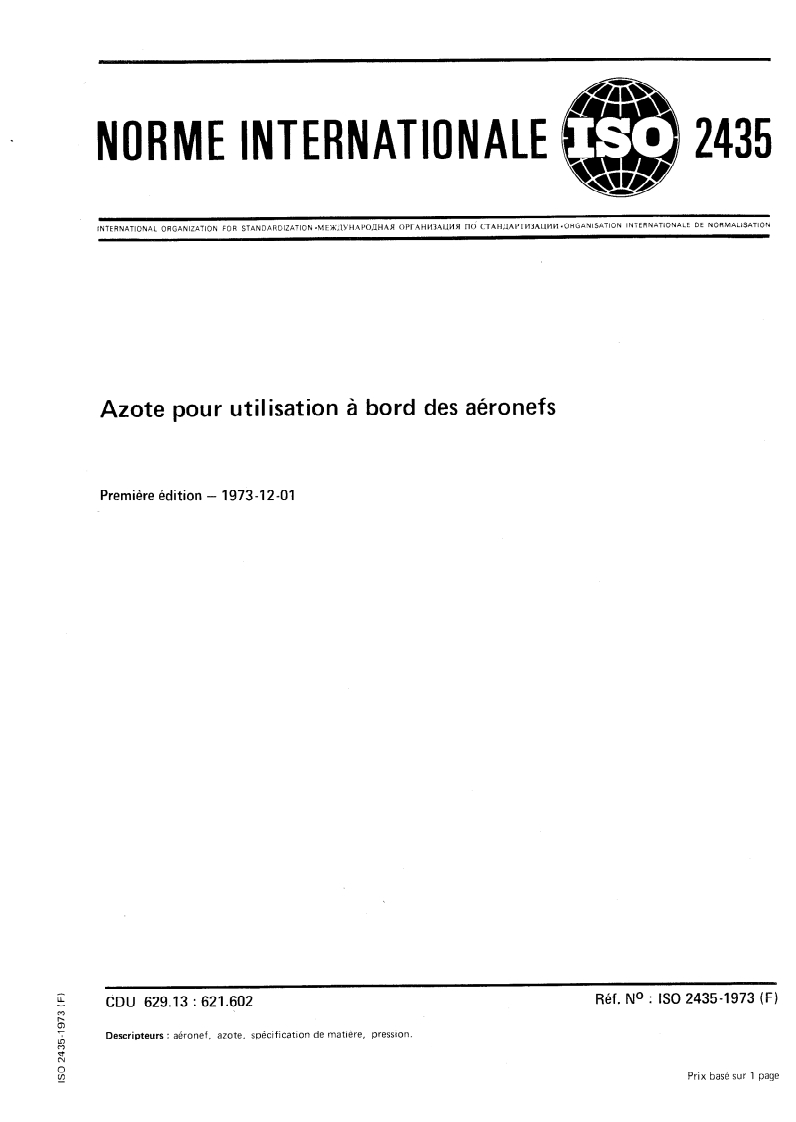
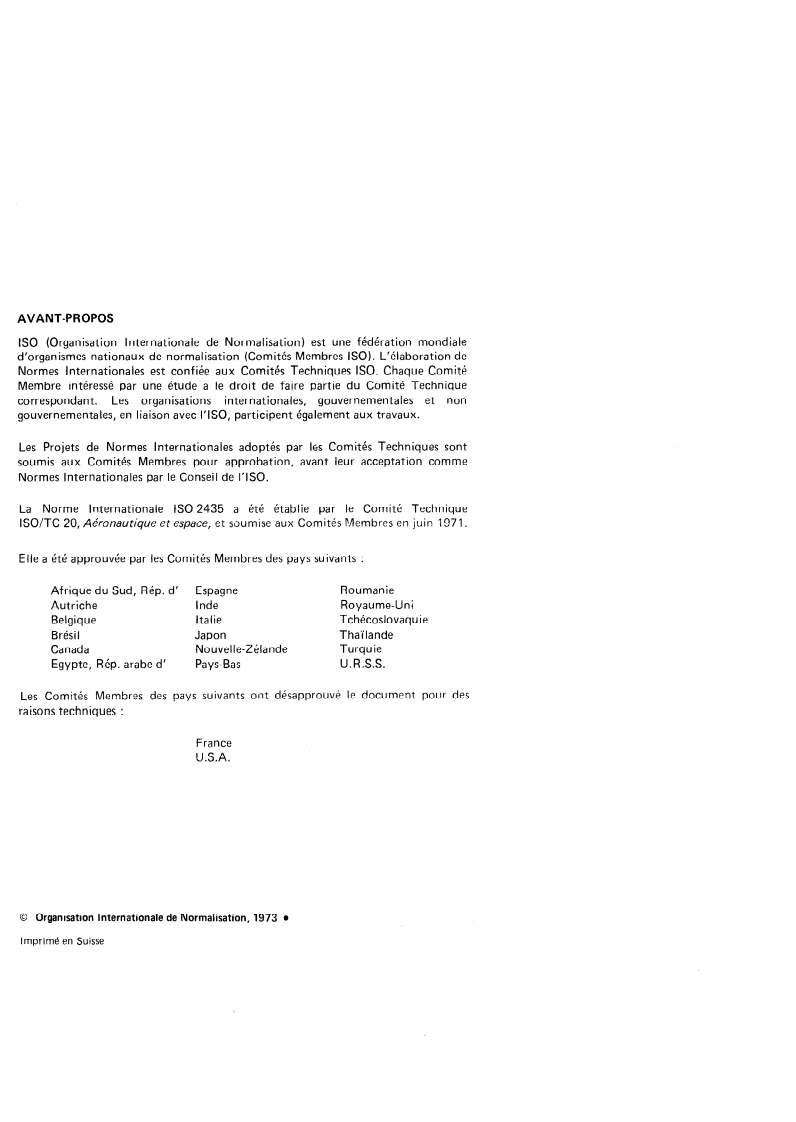
ISO 2435:1973 - Azote pour utilisation à bord des aéronefs/1/1973
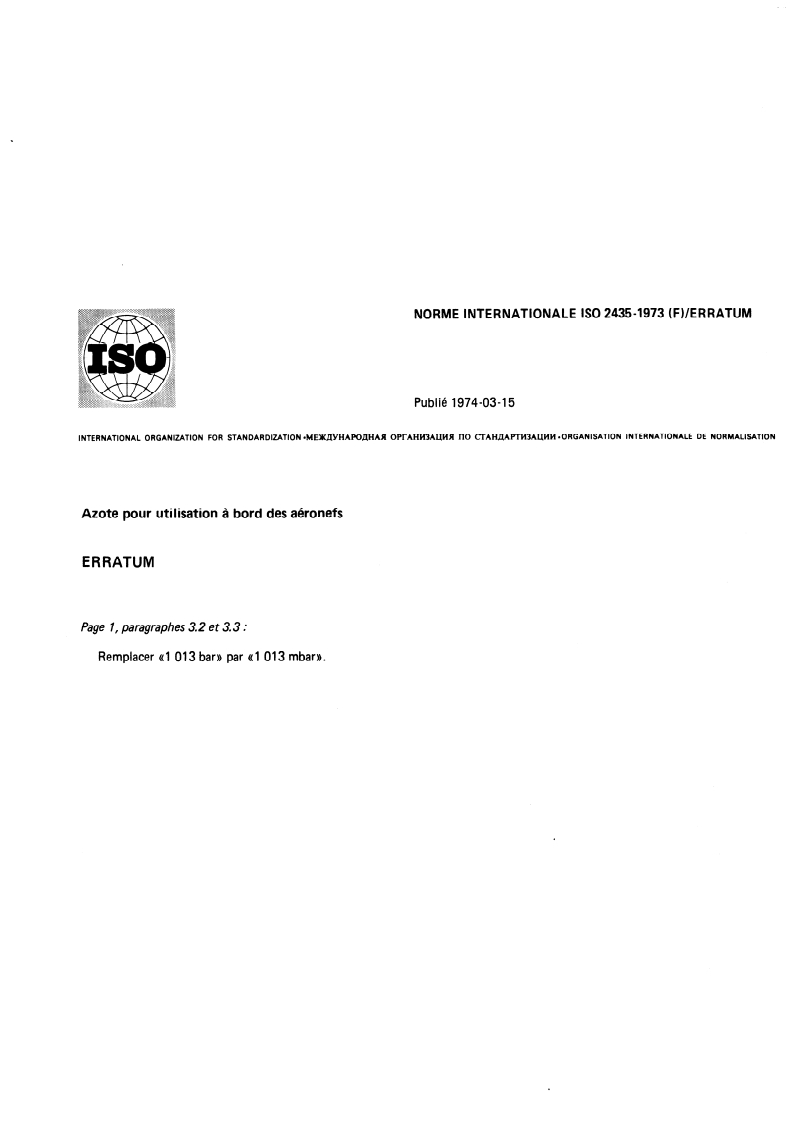
ISO 2435:1973 - Azote pour utilisation à bord des aéronefs/1/1973
Get Certified
Connect with accredited certification bodies for this standard

DEKRA North America
DEKRA certification services in North America.

Eagle Registrations Inc.
American certification body for aerospace and defense.

Element Materials Technology
Materials testing and product certification.
Sponsored listings
Frequently Asked Questions
ISO 2435:1973 is a standard published by the International Organization for Standardization (ISO). Its full title is "Nitrogen for use in aircraft". This standard covers: Gives the pressure and characteristics of nitrogen, compressed in oil-lubricated equipment. Is not intended to cover nitrogen für use in oxygen systems. The gaseous nitrogen supply pressure shall ensure charging of aircraft systems up to 343 bar at 20 °C. The minimum purity shall be 98,5 % by volume. It shall contain not more than a total of O,OO5 mg of oil vapour and particulate matter per cubic decimetre of nitrogen at 15 °C and 1 013 mbar.
Gives the pressure and characteristics of nitrogen, compressed in oil-lubricated equipment. Is not intended to cover nitrogen für use in oxygen systems. The gaseous nitrogen supply pressure shall ensure charging of aircraft systems up to 343 bar at 20 °C. The minimum purity shall be 98,5 % by volume. It shall contain not more than a total of O,OO5 mg of oil vapour and particulate matter per cubic decimetre of nitrogen at 15 °C and 1 013 mbar.
ISO 2435:1973 is classified under the following ICS (International Classification for Standards) categories: 49.100 - Ground service and maintenance equipment. The ICS classification helps identify the subject area and facilitates finding related standards.
ISO 2435:1973 is available in PDF format for immediate download after purchase. The document can be added to your cart and obtained through the secure checkout process. Digital delivery ensures instant access to the complete standard document.
Standards Content (Sample)
-~~
INTERNATIONAL STANDARD
INTERNATIONAL ORGANIZATION FOR STANDARDIZATION aMEX)IlYHAPOAHAII OPTAHM3AUMX n0 CTAHAAPTM3AWM l ORGANIZATION INTERNATIONALE DE NORMALISATION
Nitrogen for use in aircraft
First edition - 1973-12-01
~-
UDC 629.13 : 621.602 Ref. No. IS0 2435-‘l973 (E)
Descriptors : aircraft, nitrogen, materials specifications, pressure.
Price based on ‘I page
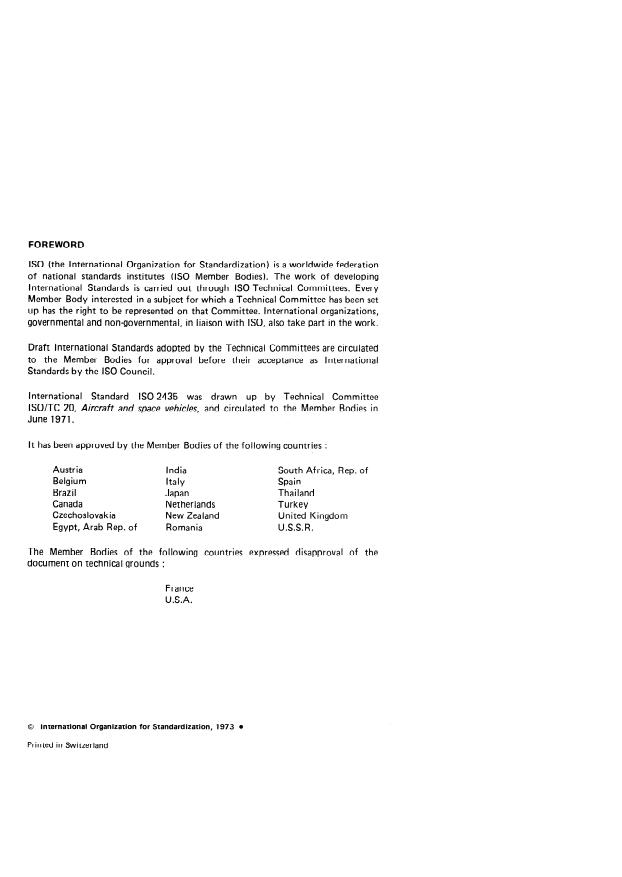
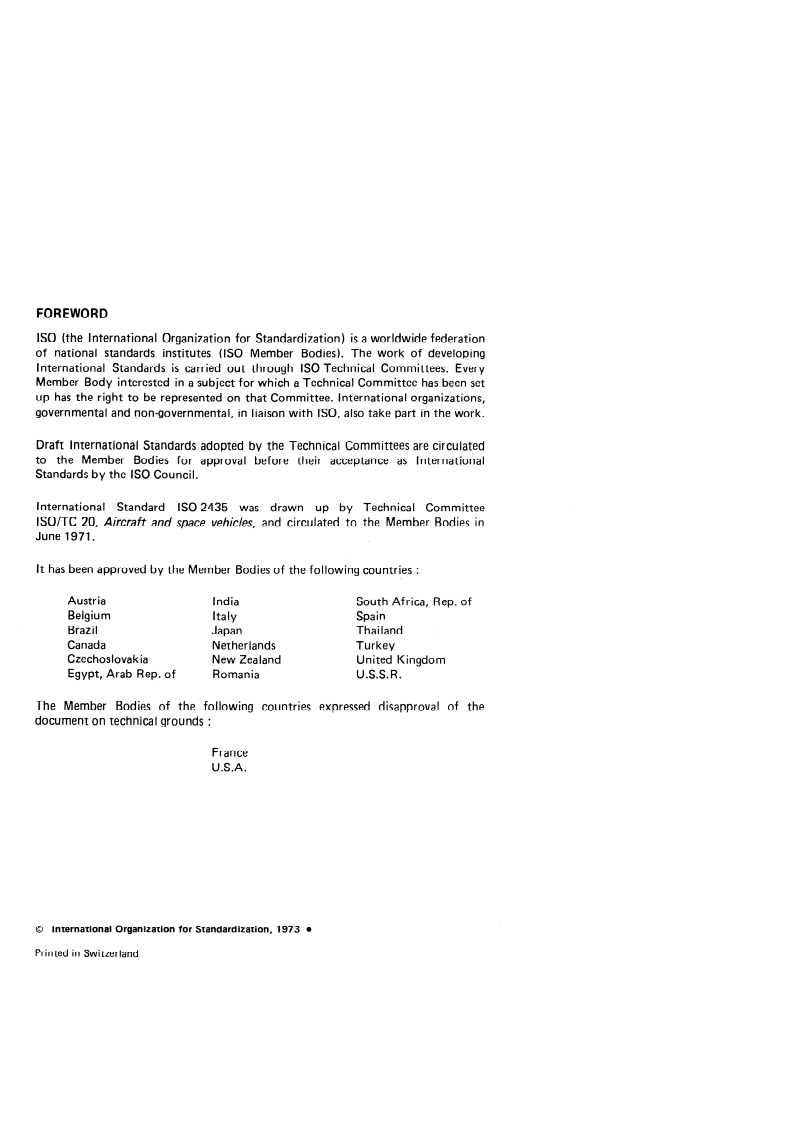
IS0 (the International Organization for Standardization) is a worldwide federation
of national standards institutes (IS0 Member Bodies). The work of developing
International Standards is carried out through IS0 Technical Committees. Every
Member Body interested in a subject for which a Technical Committee has been set
up has the right to be represented on that Committee. International organizations,
governmental and non-governmental, in liaison with ISO, also take part in the work.
Draft International Standards adopted by the Technical Committees are circulated
to the Member Bodies for approval before their acceptance as International
Standards by the IS0 Council.
International Standard IS0 2435 was drawn up by Technical Committee
ISO/TC 20, Aircraft and space vehicles, and circulated to the Member Bodies in
June 1971.
It has been approved by the Member Bodies of the following countries :
Austria India South Africa, Rep. of
Belgium Spain
Italy
Thai land
Brazil Japan
Canada Netherlands Turkey
Czechoslovakia New Zealand United Kingdom
Egypt, Arab Rep. of Romania U.S.S.R.
disapproval of the
The Member Bodies of t
...
-~~
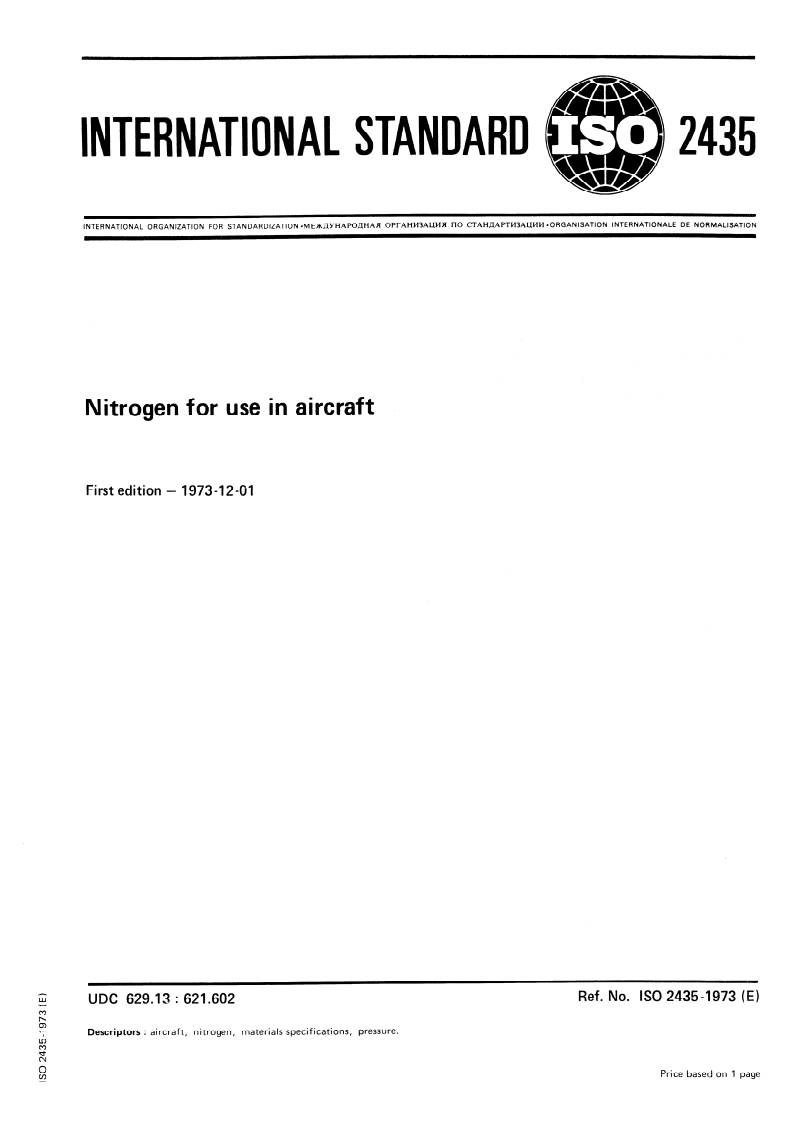
INTERNATIONAL STANDARD
INTERNATIONAL ORGANIZATION FOR STANDARDIZATION aMEX)IlYHAPOAHAII OPTAHM3AUMX n0 CTAHAAPTM3AWM l ORGANIZATION INTERNATIONALE DE NORMALISATION
Nitrogen for use in aircraft
First edition - 1973-12-01
~-
UDC 629.13 : 621.602 Ref. No. IS0 2435-‘l973 (E)
Descriptors : aircraft, nitrogen, materials specifications, pressure.
Price based on ‘I page
IS0 (the International Organization for Standardization) is a worldwide federation
of national standards institutes (IS0 Member Bodies). The work of developing
International Standards is carried out through IS0 Technical Committees. Every
Member Body interested in a subject for which a Technical Committee has been set
up has the right to be represented on that Committee. International organizations,
governmental and non-governmental, in liaison with ISO, also take part in the work.
Draft International Standards adopted by the Technical Committees are circulated
to the Member Bodies for approval before their acceptance as International
Standards by the IS0 Council.
International Standard IS0 2435 was drawn up by Technical Committee
ISO/TC 20, Aircraft and space vehicles, and circulated to the Member Bodies in
June 1971.
It has been approved by the Member Bodies of the following countries :
Austria India South Africa, Rep. of
Belgium Spain
Italy
Thai land
Brazil Japan
Canada Netherlands Turkey
Czechoslovakia New Zealand United Kingdom
Egypt, Arab Rep. of Romania U.S.S.R.
disapproval of the
The Member Bodies of t
...
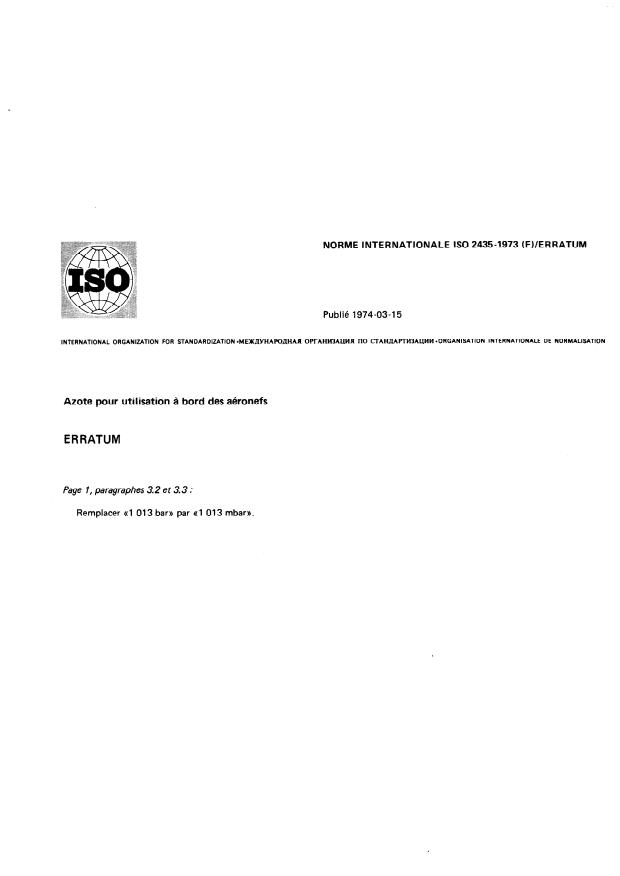
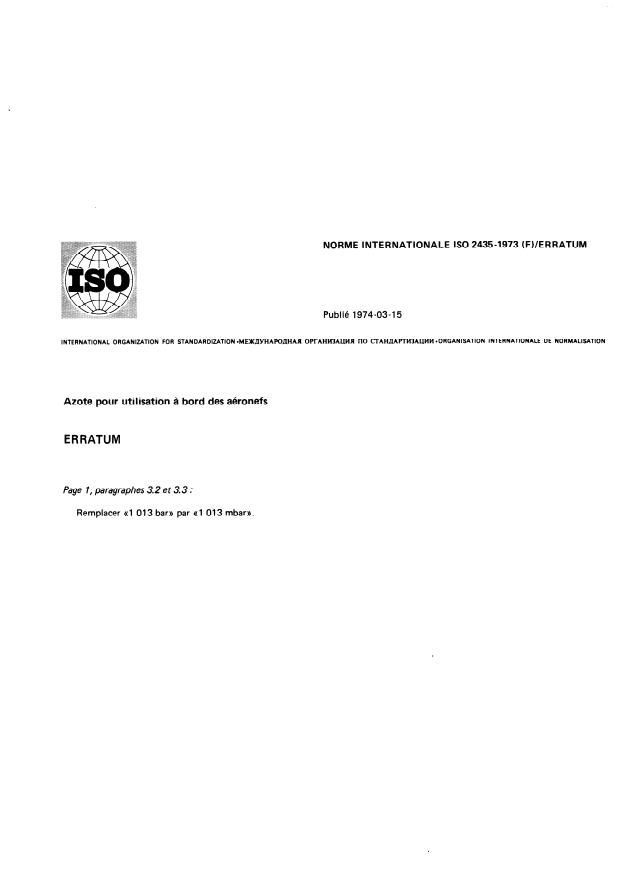
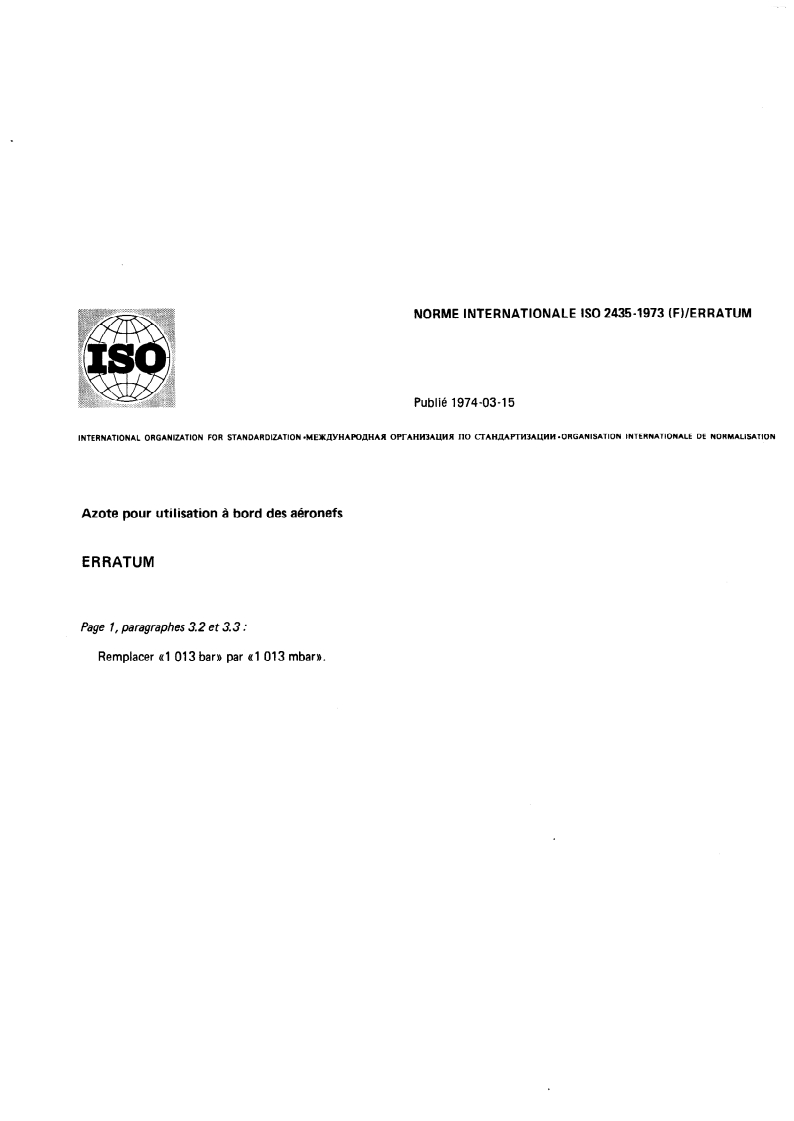
NORME INTERNATIONALE ISO 2435-1973 (F)/ERRATUM
Publié 1974-03-l 5
INTERNATIONAL ORGANIZATION FOR STANDARDIZATION l ElK~i’HAPOflHAI( OPI-AHH3AUH/I Il0 CTAH~APTM3ALWd .ORGANISATION INTERNATIONALE DE NORMALISATION
Azote pour utilisation à bord des aéronefs
ERRATUM
Page 1, paragraphes 3.2 et 3.3 :
Remplacer ~1 013 bar)) par ((1 013 mbaw.
Page blanche
/
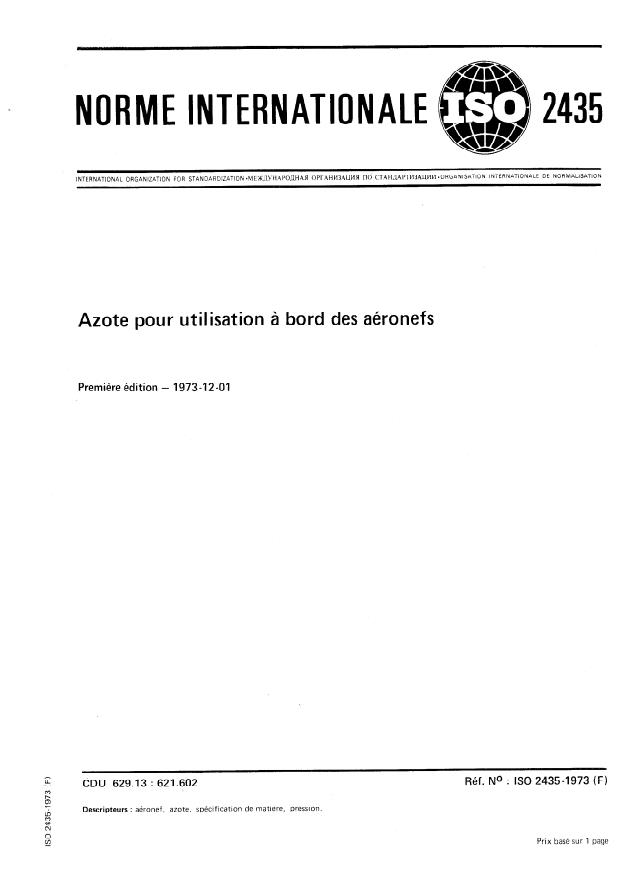
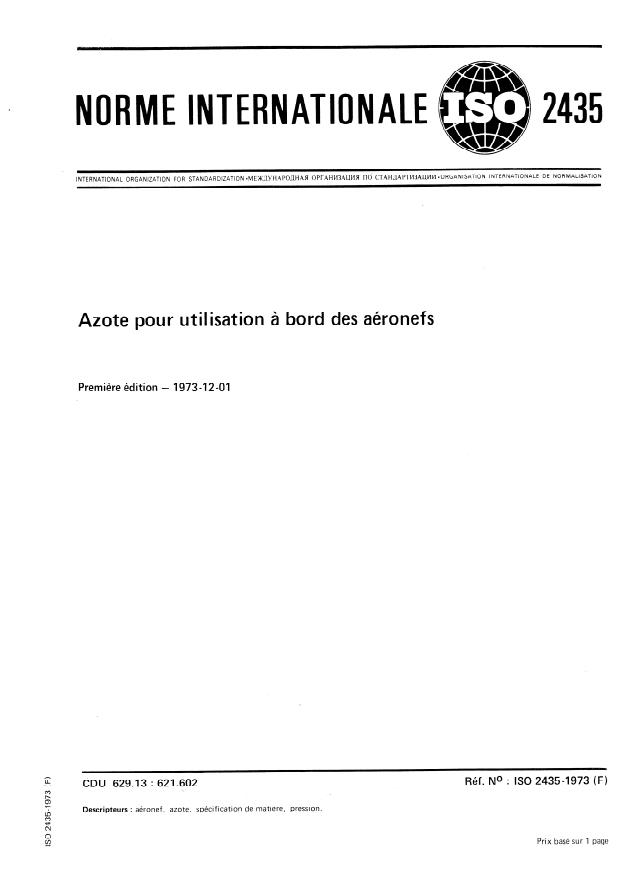
NORME INTERNATIONALE
INTERNATIONAL ORGANlZATlON FOR STANDARDIZATION l MEX~YHAPO~HAR ()PI-AHM3AUMR I-lb CTAH~APTM3A~MM~ORGANISATION INTERNATIONALE DE NORMALISATION
Azote pour utilisation à bord des aéronefs
Première édition - 1973-I 2 -01
~~~
c
Réf. No : ISO 2435-1973 (F)
Y CDU 629.13 : 621.602
Descripteurs : aéronef, azote, spécification de matière, pression.
Prix basé sur 1 page
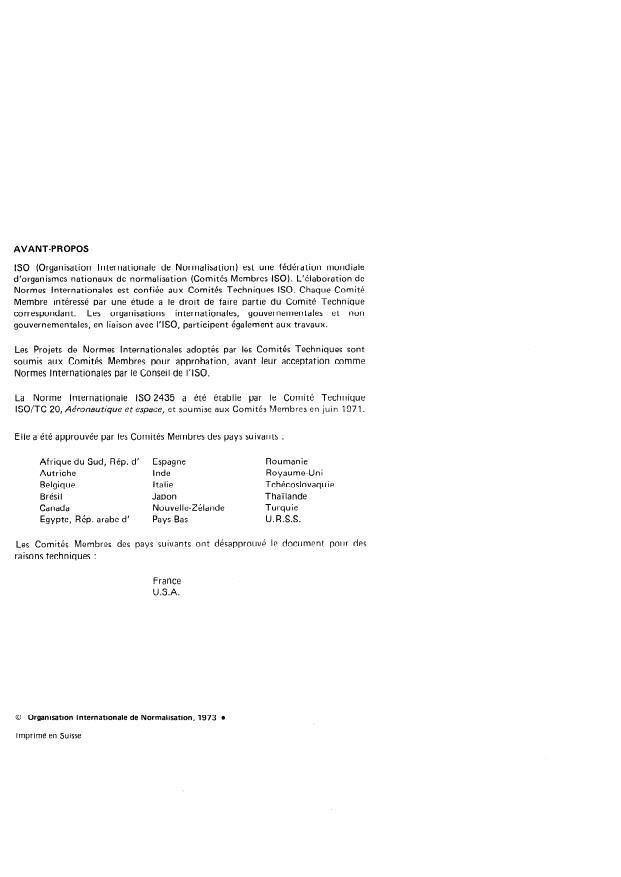
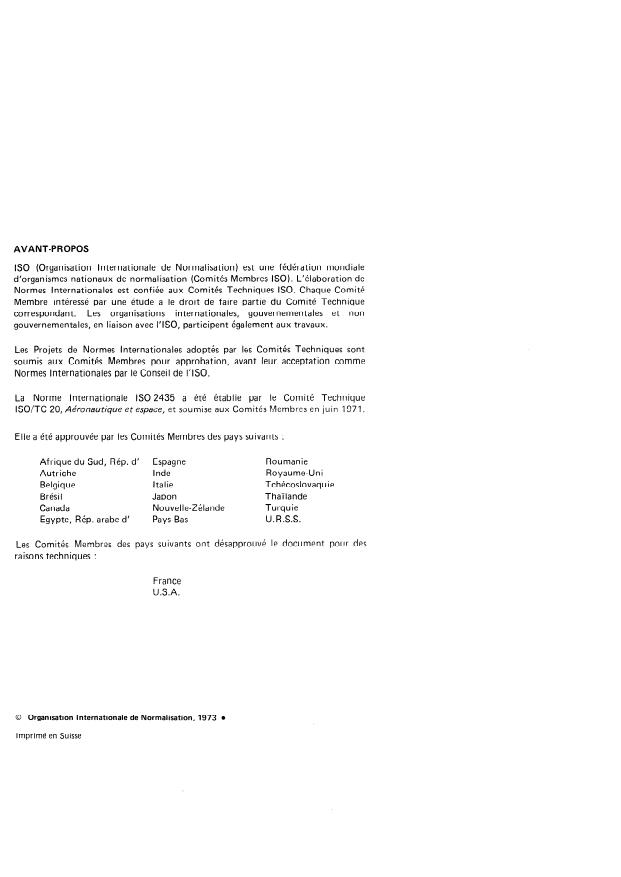
AVANT-PROPOS
ISO (Organisation Internationale de Normalisation) est une fédération mondiale
d’organismes nationaux de normalisation (Comités Membres ISO). L’élaboration de
Normes Internationales est confiée aux Comités Techniques ISO. Chaque Comité
Membre intéressé par une étude a le droit de faire partie du Comité Technique
correspondant. Les organisations internationales, gouvernementales et non
gouvernementales, en liaison avec I’ISO, participent également aux travaux.
Les Projets de Normes Internationales adoptés par les Comités Techniques sont
soumis aux Comités Membres pour approbation, avant leur acceptation comme
Normes Internationales par le Conseil de I’ISO.
La Norme Internationale ISO 2435 a été établie par le Comité Technique
ISO/TC 20, Aéronautique et espace, e”c soumise aux Comités Membres en juin 1971.
Elle a été approuvée par les Comités Membres des pays suivants
...
NORME INTERNATIONALE ISO 2435-1973 (F)/ERRATUM
Publié 1974-03-l 5
INTERNATIONAL ORGANIZATION FOR STANDARDIZATION l ElK~i’HAPOflHAI( OPI-AHH3AUH/I Il0 CTAH~APTM3ALWd .ORGANISATION INTERNATIONALE DE NORMALISATION
Azote pour utilisation à bord des aéronefs
ERRATUM
Page 1, paragraphes 3.2 et 3.3 :
Remplacer ~1 013 bar)) par ((1 013 mbaw.
Page blanche
/
NORME INTERNATIONALE
INTERNATIONAL ORGANlZATlON FOR STANDARDIZATION l MEX~YHAPO~HAR ()PI-AHM3AUMR I-lb CTAH~APTM3A~MM~ORGANISATION INTERNATIONALE DE NORMALISATION
Azote pour utilisation à bord des aéronefs
Première édition - 1973-I 2 -01
~~~
c
Réf. No : ISO 2435-1973 (F)
Y CDU 629.13 : 621.602
Descripteurs : aéronef, azote, spécification de matière, pression.
Prix basé sur 1 page
AVANT-PROPOS
ISO (Organisation Internationale de Normalisation) est une fédération mondiale
d’organismes nationaux de normalisation (Comités Membres ISO). L’élaboration de
Normes Internationales est confiée aux Comités Techniques ISO. Chaque Comité
Membre intéressé par une étude a le droit de faire partie du Comité Technique
correspondant. Les organisations internationales, gouvernementales et non
gouvernementales, en liaison avec I’ISO, participent également aux travaux.
Les Projets de Normes Internationales adoptés par les Comités Techniques sont
soumis aux Comités Membres pour approbation, avant leur acceptation comme
Normes Internationales par le Conseil de I’ISO.
La Norme Internationale ISO 2435 a été établie par le Comité Technique
ISO/TC 20, Aéronautique et espace, e”c soumise aux Comités Membres en juin 1971.
Elle a été approuvée par les Comités Membres des pays suivants
...
NORME INTERNATIONALE ISO 2435-1973 (F)/ERRATUM
Publié 1974-03-l 5
INTERNATIONAL ORGANIZATION FOR STANDARDIZATION l ElK~i’HAPOflHAI( OPI-AHH3AUH/I Il0 CTAH~APTM3ALWd .ORGANISATION INTERNATIONALE DE NORMALISATION
Azote pour utilisation à bord des aéronefs
ERRATUM
Page 1, paragraphes 3.2 et 3.3 :
Remplacer ~1 013 bar)) par ((1 013 mbaw.
Page blanche
/
NORME INTERNATIONALE
INTERNATIONAL ORGANlZATlON FOR STANDARDIZATION l MEX~YHAPO~HAR ()PI-AHM3AUMR I-lb CTAH~APTM3A~MM~ORGANISATION INTERNATIONALE DE NORMALISATION
Azote pour utilisation à bord des aéronefs
Première édition - 1973-I 2 -01
~~~
c
Réf. No : ISO 2435-1973 (F)
Y CDU 629.13 : 621.602
Descripteurs : aéronef, azote, spécification de matière, pression.
Prix basé sur 1 page
AVANT-PROPOS
ISO (Organisation Internationale de Normalisation) est une fédération mondiale
d’organismes nationaux de normalisation (Comités Membres ISO). L’élaboration de
Normes Internationales est confiée aux Comités Techniques ISO. Chaque Comité
Membre intéressé par une étude a le droit de faire partie du Comité Technique
correspondant. Les organisations internationales, gouvernementales et non
gouvernementales, en liaison avec I’ISO, participent également aux travaux.
Les Projets de Normes Internationales adoptés par les Comités Techniques sont
soumis aux Comités Membres pour approbation, avant leur acceptation comme
Normes Internationales par le Conseil de I’ISO.
La Norme Internationale ISO 2435 a été établie par le Comité Technique
ISO/TC 20, Aéronautique et espace, e”c soumise aux Comités Membres en juin 1971.
Elle a été approuvée par les Comités Membres des pays suivants
...
NORME INTERNATIONALE ISO 2435-1973 (F)/ERRATUM
Publié 1974-03-l 5
INTERNATIONAL ORGANIZATION FOR STANDARDIZATION l ElK~i’HAPOflHAI( OPI-AHH3AUH/I Il0 CTAH~APTM3ALWd .ORGANISATION INTERNATIONALE DE NORMALISATION
Azote pour utilisation à bord des aéronefs
ERRATUM
Page 1, paragraphes 3.2 et 3.3 :
Remplacer ~1 013 bar)) par ((1 013 mbaw.
Page blanche
/
NORME INTERNATIONALE
INTERNATIONAL ORGANlZATlON FOR STANDARDIZATION l MEX~YHAPO~HAR ()PI-AHM3AUMR I-lb CTAH~APTM3A~MM~ORGANISATION INTERNATIONALE DE NORMALISATION
Azote pour utilisation à bord des aéronefs
Première édition - 1973-I 2 -01
~~~
c
Réf. No : ISO 2435-1973 (F)
Y CDU 629.13 : 621.602
Descripteurs : aéronef, azote, spécification de matière, pression.
Prix basé sur 1 page
AVANT-PROPOS
ISO (Organisation Internationale de Normalisation) est une fédération mondiale
d’organismes nationaux de normalisation (Comités Membres ISO). L’élaboration de
Normes Internationales est confiée aux Comités Techniques ISO. Chaque Comité
Membre intéressé par une étude a le droit de faire partie du Comité Technique
correspondant. Les organisations internationales, gouvernementales et non
gouvernementales, en liaison avec I’ISO, participent également aux travaux.
Les Projets de Normes Internationales adoptés par les Comités Techniques sont
soumis aux Comités Membres pour approbation, avant leur acceptation comme
Normes Internationales par le Conseil de I’ISO.
La Norme Internationale ISO 2435 a été établie par le Comité Technique
ISO/TC 20, Aéronautique et espace, e”c soumise aux Comités Membres en juin 1971.
Elle a été approuvée par les Comités Membres des pays suivants
...
Questions, Comments and Discussion
Ask us and Technical Secretary will try to provide an answer. You can facilitate discussion about the standard in here.
Loading comments...