


ISO 30002:2010
(Main)Ships and marine technology — Ship recycling management systems — Guidelines for selection of ship recyclers (and pro forma contract)
Ships and marine technology — Ship recycling management systems — Guidelines for selection of ship recyclers (and pro forma contract)
ISO 30002:2010 provides guidance to shipowners in the selection of a ship recycling facility. In order to ensure as far as possible that vessels are recycled in a safe and environmentally sound manner, shipowners need to consider to which ship recycling facilities they wish to sell their ships, and it is therefore important that ship recycling facilities provide certain objective information to assist in this selection process. Ship recycling facilities that are unwilling to provide this information on request by the shipowner cannot be objectively assessed. Since the shipowner might not be able to verify the information given, it is the sole responsibility of the ship recycling facilities to ensure that such information is correct. However, it is important that shipowners be critical in their consideration of any such information, and aware that some facilities might publish obviously false information or give contradictory data that make it apparent that the information supplied does not reflect reality. In such cases the facilities cannot be objectively assessed. It applies to the process of selecting a ship recycling facility and the use of a pro forma contract. It does not consider other aspects of ship recycling which are covered by other standards of the ISO 30000 series. ISO 30002:2010 is applicable to shipowners who wish to select a ship recycling facility in order to carry out safe and environmentally sound ship recycling, to demonstrate conformity with the ISO 30000 series, and to assure themselves that the ship recycling facility chosen is in conformity with the ISO 30000 series. ISO 30002:2010 does not limit shipowners to selling to or recycling at facilities that have ISO 30000 certification.
Navires et technologie maritime — Systèmes de management de recyclage pour navires — Lignes directrices pour la sélection des recycleurs pour navires (et modèle de contrat)
General Information
- Status
- Withdrawn
- Publication Date
- 11-Apr-2010
- Withdrawal Date
- 11-Apr-2010
- Technical Committee
- ISO/TC 8 - Ships and marine technology
- Drafting Committee
- ISO/TC 8 - Ships and marine technology
- Current Stage
- 9599 - Withdrawal of International Standard
- Start Date
- 14-Jun-2012
- Completion Date
- 12-Feb-2026
Relations
- Effective Date
- 24-Dec-2011
- Effective Date
- 23-May-2009

Get Certified
Connect with accredited certification bodies for this standard

DNV
DNV is an independent assurance and risk management provider.

Lloyd's Register
Lloyd's Register is a global professional services organisation specialising in engineering and technology.

ABS Quality Evaluations Inc.
American Bureau of Shipping quality certification.
Sponsored listings
Frequently Asked Questions
ISO 30002:2010 is a standard published by the International Organization for Standardization (ISO). Its full title is "Ships and marine technology — Ship recycling management systems — Guidelines for selection of ship recyclers (and pro forma contract)". This standard covers: ISO 30002:2010 provides guidance to shipowners in the selection of a ship recycling facility. In order to ensure as far as possible that vessels are recycled in a safe and environmentally sound manner, shipowners need to consider to which ship recycling facilities they wish to sell their ships, and it is therefore important that ship recycling facilities provide certain objective information to assist in this selection process. Ship recycling facilities that are unwilling to provide this information on request by the shipowner cannot be objectively assessed. Since the shipowner might not be able to verify the information given, it is the sole responsibility of the ship recycling facilities to ensure that such information is correct. However, it is important that shipowners be critical in their consideration of any such information, and aware that some facilities might publish obviously false information or give contradictory data that make it apparent that the information supplied does not reflect reality. In such cases the facilities cannot be objectively assessed. It applies to the process of selecting a ship recycling facility and the use of a pro forma contract. It does not consider other aspects of ship recycling which are covered by other standards of the ISO 30000 series. ISO 30002:2010 is applicable to shipowners who wish to select a ship recycling facility in order to carry out safe and environmentally sound ship recycling, to demonstrate conformity with the ISO 30000 series, and to assure themselves that the ship recycling facility chosen is in conformity with the ISO 30000 series. ISO 30002:2010 does not limit shipowners to selling to or recycling at facilities that have ISO 30000 certification.
ISO 30002:2010 provides guidance to shipowners in the selection of a ship recycling facility. In order to ensure as far as possible that vessels are recycled in a safe and environmentally sound manner, shipowners need to consider to which ship recycling facilities they wish to sell their ships, and it is therefore important that ship recycling facilities provide certain objective information to assist in this selection process. Ship recycling facilities that are unwilling to provide this information on request by the shipowner cannot be objectively assessed. Since the shipowner might not be able to verify the information given, it is the sole responsibility of the ship recycling facilities to ensure that such information is correct. However, it is important that shipowners be critical in their consideration of any such information, and aware that some facilities might publish obviously false information or give contradictory data that make it apparent that the information supplied does not reflect reality. In such cases the facilities cannot be objectively assessed. It applies to the process of selecting a ship recycling facility and the use of a pro forma contract. It does not consider other aspects of ship recycling which are covered by other standards of the ISO 30000 series. ISO 30002:2010 is applicable to shipowners who wish to select a ship recycling facility in order to carry out safe and environmentally sound ship recycling, to demonstrate conformity with the ISO 30000 series, and to assure themselves that the ship recycling facility chosen is in conformity with the ISO 30000 series. ISO 30002:2010 does not limit shipowners to selling to or recycling at facilities that have ISO 30000 certification.
ISO 30002:2010 is classified under the following ICS (International Classification for Standards) categories: 47.020.01 - General standards related to shipbuilding and marine structures. The ICS classification helps identify the subject area and facilitates finding related standards.
ISO 30002:2010 has the following relationships with other standards: It is inter standard links to ISO 30002:2012, ISO/PAS 30002:2009. Understanding these relationships helps ensure you are using the most current and applicable version of the standard.
ISO 30002:2010 is available in PDF format for immediate download after purchase. The document can be added to your cart and obtained through the secure checkout process. Digital delivery ensures instant access to the complete standard document.
Standards Content (Sample)
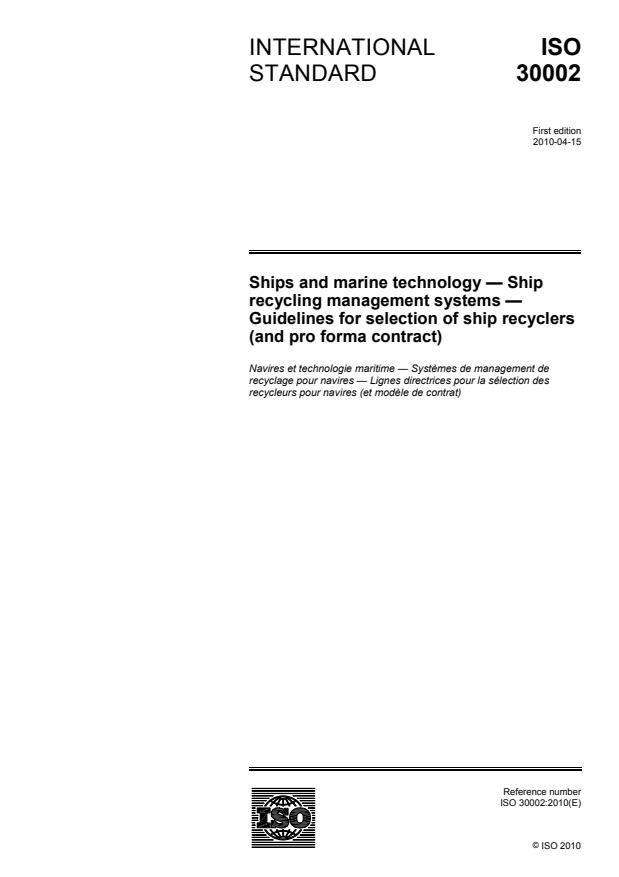
INTERNATIONAL ISO
STANDARD 30002
First edition
2010-04-15
Ships and marine technology — Ship
recycling management systems —
Guidelines for selection of ship recyclers
(and pro forma contract)
Navires et technologie maritime — Systèmes de management de
recyclage pour navires — Lignes directrices pour la sélection des
recycleurs pour navires (et modèle de contrat)
Reference number
©
ISO 2010
PDF disclaimer
This PDF file may contain embedded typefaces. In accordance with Adobe's licensing policy, this file may be printed or viewed but
shall not be edited unless the typefaces which are embedded are licensed to and installed on the computer performing the editing. In
downloading this file, parties accept therein the responsibility of not infringing Adobe's licensing policy. The ISO Central Secretariat
accepts no liability in this area.
Adobe is a trademark of Adobe Systems Incorporated.
Details of the software products used to create this PDF file can be found in the General Info relative to the file; the PDF-creation
parameters were optimized for printing. Every care has been taken to ensure that the file is suitable for use by ISO member bodies. In
the unlikely event that a problem relating to it is found, please inform the Central Secretariat at the address given below.
© ISO 2010
All rights reserved. Unless otherwise specified, no part of this publication may be reproduced or utilized in any form or by any means,
electronic or mechanical, including photocopying and microfilm, without permission in writing from either ISO at the address below or
ISO's member body in the country of the requester.
ISO copyright office
Case postale 56 • CH-1211 Geneva 20
Tel. + 41 22 749 01 11
Fax + 41 22 749 09 47
E-mail copyright@iso.org
Web www.iso.org
Published in Switzerland
ii © ISO 2010 – All rights reserved
Foreword
ISO (the International Organization for Standardization) is a worldwide federation of national standards bodies
(ISO member bodies). The work of preparing International Standards is normally carried out through ISO
technical committees. Each member body interested in a subject for which a technical committee has been
established has the right to be represented on that committee. International organizations, governmental and
non-governmental, in liaison with ISO, also take part in the work. ISO collaborates closely with the
International Electrotechnical Commission (IEC) on all matters of electrotechnical standardization.
International Standards are drafted in accordance with the rules given in the ISO/IEC Directives, Part 2.
The main task of technical committees is to prepare International Standards. Draft International Standards
adopted by the technical committees are circulated to the member bodies for voting. Publication as an
International Standard requires approval by at least 75 % of the member bodies casting a vote.
Attention is drawn to the possibility that some of the elements of this document may be the subject of patent
rights. ISO shall not be held responsible for identifying any or all such patent rights.
ISO 30002 was prepared by Technical Committee ISO/TC 8, Ships and marine technology.
This first edition cancels and replaces ISO/PAS 30002:2009, which has been technically revised.
INTERNATIONAL STANDARD ISO 30002:2010(E)
Ships and marine technology — Ship recycling management
systems — Guidelines for selection of ship recyclers (and pro
forma contract)
1 Scope
This International Standard provides guidance to shipowners in the selection of a ship recycling facility.
In order to ensure as far as possible that vessels are recycled in a safe and environmentally sound manner,
shipowners need to consider to which ship recycling facilities they wish to sell their ships, and it is therefore
important that ship recycling facilities provide certain objective information to assist in this selection process.
Ship recycling facilities that are unwilling to provide this information on request by the shipowner cannot
be objectively assessed.
Since the shipowner might not be able to verify the information given, it is the sole responsibility of the ship
recycling facilities to ensure that such information is correct. However, it is important that shipowners be
critical in their consideration of any such information, and aware that some facilities might publish obviously
false information or give contradictory data that make it apparent that the information supplied does not reflect
reality. In such cases the facilities cannot be objectively assessed.
It applies to the process of selecting a ship recycling facility and the use of a pro forma contract. It does not
consider other aspects of ship recycling which are covered by other standards of the ISO 30000 series.
This International Standard is applicable to shipowners who wish
a) to select a ship recycling facility in order to carry out safe and environmentally sound ship recycling,
b) to demonstrate conformity with the ISO 30000 series, and
c) to assure themselves that the ship recycling facility chosen is in conformity with the ISO 30000 series.
This International Standard does not limit shipowners to selling to or recycling at facilities that have ISO 30000
certification.
2 Normative references
No normative references are cited. This clause is included to enable numeric consistency and comparison
with similar ISO standards.
3 Terms and definitions
For the purposes of this document, the following terms and definitions apply.
3.1
hazard (hazardous material)
source, situation (or item, element, substance) with a potential for harm in terms of human injury or ill health,
both short and long term, damage to property, damage to the environment, or a combination of these
3.2
IMO Convention
document produced by the International Maritime Organization titled “IMO Convention for the safe and
environmentally sound recycling of ships”
NOTE Considered valid when available and approved by the IMO (but not necessarily entered into force).
3.3
letter of compliance
non-convention certificate
statement of compliance
document issued by a “Recognized Organization (RO)” or classification society confirming compliance with a
convention although the relevant authority is not a party to the convention
3.4
safety
arrangements, conditions and working environment such that all conditions and factors that affect the well-
being of employees, temporary workers, contractor personnel, managers, visitors and any other person in the
workplace or its surroundings are in accordance with required domestic and International Standards for
occupation
...
Questions, Comments and Discussion
Ask us and Technical Secretary will try to provide an answer. You can facilitate discussion about the standard in here.
Loading comments...