


ISO 20341:2003
(Main)Surface chemical analysis — Secondary-ion mass spectrometry — Method for estimating depth resolution parameters with multiple delta-layer reference materials
Surface chemical analysis — Secondary-ion mass spectrometry — Method for estimating depth resolution parameters with multiple delta-layer reference materials
ISO 20341:2003 specifies procedures for estimating three depth resolution parameters, viz the leading-edge decay length, the trailing-edge decay length and the Gaussian broadening, in SIMS depth profiling using multiple delta-layer reference materials. It is not applicable to delta-layers where the chemical and physical state of the near-surface region, modified by the incident primary ions, is not in the steady state.
Analyse chimique des surfaces — Spectrométrie de masse des ions secondaires — Méthode d'estimation des paramètres de résolution en profondeur à l'aide de matériaux de référence multicouches minces
General Information
- Status
- Published
- Publication Date
- 23-Jul-2003
- Technical Committee
- ISO/TC 201/SC 6 - Secondary ion mass spectrometry
- Drafting Committee
- ISO/TC 201/SC 6 - Secondary ion mass spectrometry
- Current Stage
- 9093 - International Standard confirmed
- Start Date
- 15-Jul-2025
- Completion Date
- 12-Feb-2026
Overview
ISO 20341:2003 specifies a standardized method for estimating depth resolution parameters in Secondary‑Ion Mass Spectrometry (SIMS) depth profiling using multiple delta‑layer reference materials. The standard defines procedures to quantify the three component parameters that describe a SIMS depth profile: the leading‑edge decay length, the trailing‑edge decay length, and the Gaussian broadening. It is intended for situations where the near‑surface region is in a steady state under primary‑ion bombardment and therefore does not apply to non‑steady‑state delta layers.
Key topics and requirements
- Depth resolution parameters: Procedures for estimating
- Leading‑edge decay length (λL)
- Trailing‑edge decay length (λT)
- Gaussian broadening (σ)
- Reference materials: Requirements for multiple delta‑layer samples:
- Matrix must remain constant during sputtering (constant matrix signals).
- Flat, parallel delta layers and surface to avoid profile distortion.
- Delta‑layer thickness much less than primary‑ion projected range.
- Layer spacing such that valley intensity < 1% of peak.
- Characterisation of layer thickness, position and interface roughness by cross‑section TEM, grazing incidence X‑ray reflectivity, MEIS, or equivalent.
- Measurement procedures:
- Instrument setup per manufacturer/local procedures (ion species, energy, current, polarity, scan uniformity).
- Acquire profiles with >10 data points in the top 20% of peak intensity and record down to <1% of maximum.
- Subtract constant background if >1% of peak before fitting; convert sputter time to depth.
- Full estimation: use non‑linear curve fitting of a convolution model (see Equation (4) in the standard) to extract λL, λT and σ.
- Simpler options (Annex A): one‑ or two‑parameter estimates using semi‑log slopes of intensity vs. depth (require linear span of at least a factor 10 in intensity).
- Reporting: Test report must identify specimen, instrument, analysis conditions, reference material, method used (Equation (4) or Annex A), measured parameters for each layer, depths, and any deviations or unusual features.
Applications and users
ISO 20341:2003 is directly applicable to laboratories and professionals performing SIMS depth profiling, including:
- Surface analysis and materials characterization labs
- Semiconductor and thin‑film process development teams
- Quality control laboratories using delta‑layer reference materials
- Instrument manufacturers and calibration services
- Academic researchers studying interfaces, diffusion, ion‑beam mixing or sputter‑induced effects
This standard helps ensure reproducible, comparable measurements of SIMS depth resolution for device interfaces, dopant profiling, multilayer films and other nanoscale depth analyses.
Related standards and references
- Normative reference: ISO 18115:2001 (Surface chemical analysis - Vocabulary)
- Supporting literature cited in the standard: Dowsett et al. (1994) and Moon et al. (2000) for derivation and example fits.
Get Certified
Connect with accredited certification bodies for this standard

ECOCERT
Organic and sustainability certification.

Eurofins Food Testing Global
Global leader in food, environment, and pharmaceutical product testing.

Intertek Bangladesh
Intertek certification and testing services in Bangladesh.
Sponsored listings
Frequently Asked Questions
ISO 20341:2003 is a standard published by the International Organization for Standardization (ISO). Its full title is "Surface chemical analysis — Secondary-ion mass spectrometry — Method for estimating depth resolution parameters with multiple delta-layer reference materials". This standard covers: ISO 20341:2003 specifies procedures for estimating three depth resolution parameters, viz the leading-edge decay length, the trailing-edge decay length and the Gaussian broadening, in SIMS depth profiling using multiple delta-layer reference materials. It is not applicable to delta-layers where the chemical and physical state of the near-surface region, modified by the incident primary ions, is not in the steady state.
ISO 20341:2003 specifies procedures for estimating three depth resolution parameters, viz the leading-edge decay length, the trailing-edge decay length and the Gaussian broadening, in SIMS depth profiling using multiple delta-layer reference materials. It is not applicable to delta-layers where the chemical and physical state of the near-surface region, modified by the incident primary ions, is not in the steady state.
ISO 20341:2003 is classified under the following ICS (International Classification for Standards) categories: 71.040.40 - Chemical analysis. The ICS classification helps identify the subject area and facilitates finding related standards.
ISO 20341:2003 is available in PDF format for immediate download after purchase. The document can be added to your cart and obtained through the secure checkout process. Digital delivery ensures instant access to the complete standard document.
Standards Content (Sample)
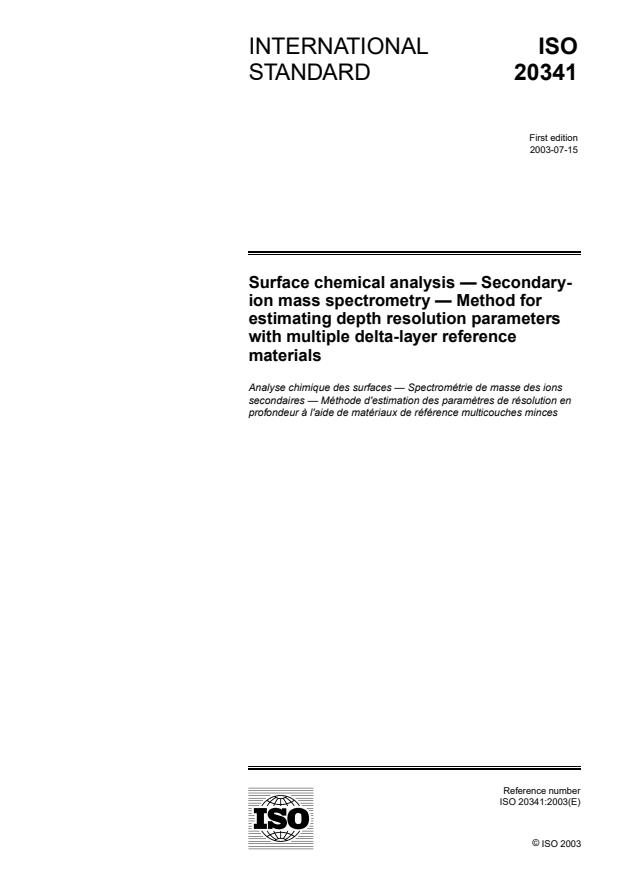
INTERNATIONAL ISO
STANDARD 20341
First edition
2003-07-15
Surface chemical analysis — Secondary-
ion mass spectrometry — Method for
estimating depth resolution parameters
with multiple delta-layer reference
materials
Analyse chimique des surfaces — Spectrométrie de masse des ions
secondaires — Méthode d'estimation des paramètres de résolution en
profondeur à l'aide de matériaux de référence multicouches minces
Reference number
©
ISO 2003
PDF disclaimer
This PDF file may contain embedded typefaces. In accordance with Adobe's licensing policy, this file may be printed or viewed but shall
not be edited unless the typefaces which are embedded are licensed to and installed on the computer performing the editing. In
downloading this file, parties accept therein the responsibility of not infringing Adobe's licensing policy. The ISO Central Secretariat
accepts no liability in this area.
Adobe is a trademark of Adobe Systems Incorporated.
Details of the software products used to create this PDF file can be found in the General Info relative to the file; the PDF-creation
parameters were optimized for printing. Every care has been taken to ensure that the file is suitable for use by ISO member bodies. In the
unlikely event that a problem relating to it is found, please inform the Central Secretariat at the address given below.
All rights reserved. Unless otherwise specified, no part of this publication may be reproduced or utilized in any form or by any means,
electronic or mechanical, including photocopying and microfilm, without permission in writing from either ISO at the address below or
ISO's member body in the country of the requester.
ISO copyright office
Case postale 56 CH-1211 Geneva 20
Tel. + 41 22 749 01 11
Fax + 41 22 749 09 47
E-mail copyright@iso.org
Web www.iso.org
Published in Switzerland
©
ii ISO 2003 – All rights reserved
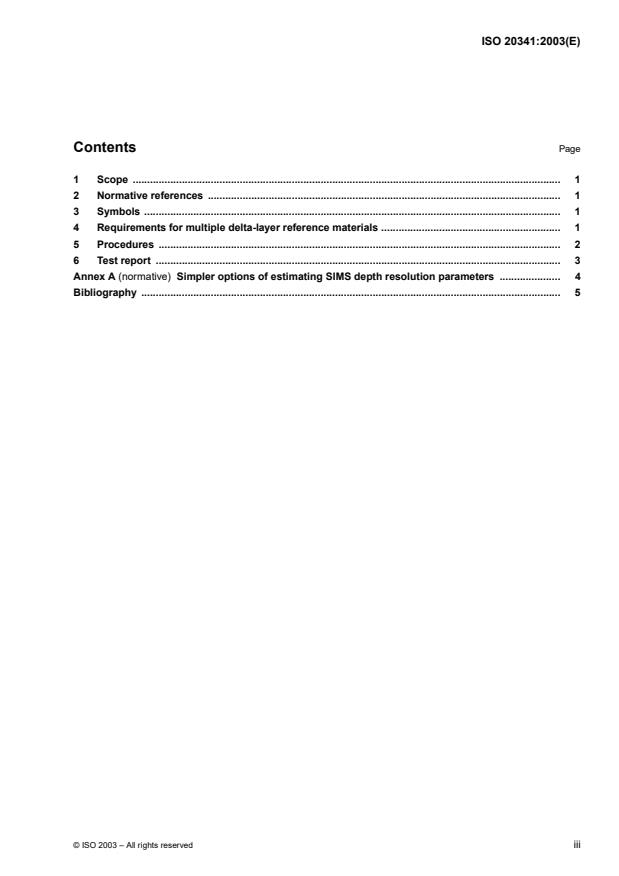
Contents Page
1 Scope . 1
2 Normative references . 1
3 Symbols . 1
4 Requirements for multiple delta-layer reference materials . 1
5 Procedures . 2
6 Test report . 3
Annex A (normative) Simpler options of estimating SIMS depth resolution parameters . 4
Bibliography . 5
©
ISO 2003 – All rights reserved iii
Foreword
ISO (the International Organization for Standardization) is a worldwide federation of national standards bodies
(ISO member bodies). The work of preparing International Standards is normally carried out through ISO
technical committees. Each member body interested in a subject for which a technical committee has been
established has the right to be represented on that committee. International organizations, governmental and
non-governmental, in liaison with ISO, also take part in the work. ISO collaborates closely with the International
Electrotechnical Commission (IEC) on all matters of electrotechnical standardization.
International Standards are drafted in accordance with the rules given in the ISO/IEC Directives, Part 2.
The main task of technical committees is to prepare International Standards. Draft International Standards
adopted by the technical committees are circulated to the member bodies for voting. Publication as an
International Standard requires approval by at least 75 % of the member bodies casting a vote.
Attention is drawn to the possibility that some of the elements of this document may be the subject of patent
rights. ISO shall not be held responsible for identifying any or all such patent rights.
ISO 20341 was prepared by Technical Committee ISO/TC 201, Surface chemical analysis, Subcommittee
SC 6, Secondary ion mass spectrometry.
©
iv ISO 2003 – All rights reserved
Introduction
Depth resolution is one of the important parameters in SIMS depth profiling. However, sputter depth profiles in
SIMS analysis are affected by many factors which may include ion-beam-induced mixing and segregation,
charge-driven diffusion, matrix effects, crater shape, surface microtopography, etc. To obtain the best depth
resolution, the deterioration of the depth resolution due to these factors should be understood and minimized.
The best depth resolution generally requires special conditions of analysis which may include an ultra-low
primary-ion beam energy, glancing incidence angle, specimen rotation, specimen cooling to cryogenic
temperature, etc., all of which cannot be easily adopted for daily SIMS analysis. In addition to this, the
optimization of the analysis parameters may be quite different for each specimen. Moreover, different aspects of
the depth resolution are also affected by instrumental factors such as the crater shape, ion beam homogeneity,
removal of the crater edge effect, mass interference, memory effect, residual gas effect, etc.
Therefore, it is not straightforward to estimate the depth resolution under given daily SIMS analysis conditions.
In this International Standard, the three essential component parameters of the depth resolution, the leading-
edge decay length, the trailing-edge decay length and the Gaussian broadening, are described and procedures
are provided for the measurement of each parameter. The depth resolution parameters under daily SIMS
analysis conditions can be estimated using multiple delta-layer reference materials.
©
ISO 2003 – All rights reserved v
.
vi
INTERNATIONAL STANDARD ISO 20341:2003(E)
Surface chemical analysis — Secondary-ion mass
spectrometry — Method for estimating depth resolution
parameters with multiple delta-layer reference materials
1Scope
1.1 This International Standard specifies procedures for estimating three depth resolution parameters, viz the
leading-edge decay length, the trailing-edge decay length and the Gaussian broadening, in SIMS depth profiling
using multiple delta-layer reference materials.
1.2 This International Standard is not applicable to delta-layers where the chemical and physical state of the
near-surface region, modified by the incident primary ions, is not in the steady state.
2 Normative references
The following referenced documents are indispensable for the application of this document. For dated
references, only the edition cited applies. For undated references, the latest edition of the referenced document
(including any amendments) applies.
ISO 18115:2001
...
Questions, Comments and Discussion
Ask us and Technical Secretary will try to provide an answer. You can facilitate discussion about the standard in here.
Loading comments...