


ISO/IEC TR 13335-5:2001
(Main)Information technology — Guidelines for the management of IT Security — Part 5: Management guidance on network security
Information technology — Guidelines for the management of IT Security — Part 5: Management guidance on network security
Technologies de l'information — Lignes directrices pour la gestion de sécurité IT — Partie 5: Guide pour la gestion de sécurité du réseau
General Information
- Status
- Withdrawn
- Publication Date
- 24-Oct-2001
- Withdrawal Date
- 24-Oct-2001
- Drafting Committee
- ISO/IEC JTC 1/SC 27/WG 1 - Information security management systems
- Current Stage
- 9599 - Withdrawal of International Standard
- Start Date
- 19-Aug-2008
- Completion Date
- 12-Feb-2026
Relations
- Effective Date
- 28-Aug-2008
Get Certified
Connect with accredited certification bodies for this standard

BSI Group
BSI (British Standards Institution) is the business standards company that helps organizations make excellence a habit.

Bureau Veritas
Bureau Veritas is a world leader in laboratory testing, inspection and certification services.

DNV
DNV is an independent assurance and risk management provider.
Sponsored listings
Frequently Asked Questions
ISO/IEC TR 13335-5:2001 is a technical report published by the International Organization for Standardization (ISO). Its full title is "Information technology — Guidelines for the management of IT Security — Part 5: Management guidance on network security". This standard covers: Information technology — Guidelines for the management of IT Security — Part 5: Management guidance on network security
Information technology — Guidelines for the management of IT Security — Part 5: Management guidance on network security
ISO/IEC TR 13335-5:2001 is classified under the following ICS (International Classification for Standards) categories: 03.100.70 - Management systems; 35.030 - IT Security; 35.040 - Information coding. The ICS classification helps identify the subject area and facilitates finding related standards.
ISO/IEC TR 13335-5:2001 has the following relationships with other standards: It is inter standard links to ISO/IEC 18028-1:2006. Understanding these relationships helps ensure you are using the most current and applicable version of the standard.
ISO/IEC TR 13335-5:2001 is available in PDF format for immediate download after purchase. The document can be added to your cart and obtained through the secure checkout process. Digital delivery ensures instant access to the complete standard document.
Standards Content (Sample)
TECHNICAL ISO/IEC
REPORT TR
13335-5
First edition
2001-11-01
Information technology — Guidelines for
the management of IT Security —
Part 5:
Management guidance on network security
Technologies de l'information — Lignes directrices pour la gestion de
sécurité IT —
Partie 5: Guide pour la gestion de sécurité du réseau
Reference number
©
ISO/IEC 2001
PDF disclaimer
This PDF file may contain embedded typefaces. In accordance with Adobe's licensing policy, this file may be printed or viewed but shall not
be edited unless the typefaces which are embedded are licensed to and installed on the computer performing the editing. In downloading this
file, parties accept therein the responsibility of not infringing Adobe's licensing policy. The ISO Central Secretariat accepts no liability in this
area.
Adobe is a trademark of Adobe Systems Incorporated.
Details of the software products used to create this PDF file can be found in the General Info relative to the file; the PDF-creation parameters
were optimized for printing. Every care has been taken to ensure that the file is suitable for use by ISO member bodies. In the unlikely event
that a problem relating to it is found, please inform the Central Secretariat at the address given below.
© ISO/IEC 2001
All rights reserved. Unless otherwise specified, no part of this publication may be reproduced or utilized in any form or by any means, electronic
or mechanical, including photocopying and microfilm, without permission in writing from either ISO at the address below or ISO's member body
in the country of the requester.
ISO copyright office
Case postale 56 • CH-1211 Geneva 20
Tel. + 41 22 749 01 11
Fax + 41 22 749 09 47
E-mail copyright@iso.ch
Web www.iso.ch
Printed in Switzerland
ii © ISO/IEC 2001 – All rights reserved
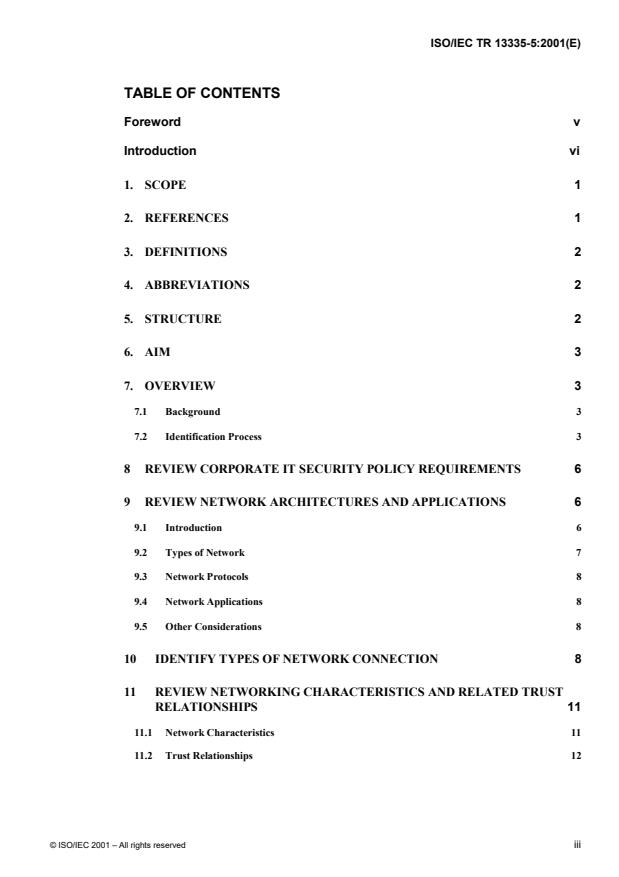
TABLE OF CONTENTS
Foreword v
Introduction vi
1. SCOPE 1
2. REFERENCES 1
3. DEFINITIONS 2
4. ABBREVIATIONS 2
5. STRUCTURE 2
6. AIM 3
7. OVERVIEW 3
7.1 Background 3
7.2 Identification Process 3
8 REVIEW CORPORATE IT SECURITY POLICY REQUIREMENTS 6
9 REVIEW NETWORK ARCHITECTURES AND APPLICATIONS 6
9.1 Introduction 6
9.2 Types of Network 7
9.3 Network Protocols 8
9.4 Network Applications 8
9.5 Other Considerations 8
10 IDENTIFY TYPES OF NETWORK CONNECTION 8
11 REVIEW NETWORKING CHARACTERISTICS AND RELATED TRUST
RELATIONSHIPS 11
11.1 Network Characteristics 11
11.2 Trust Relationships 12
© ISO/IEC 2001 – All rights reserved iii
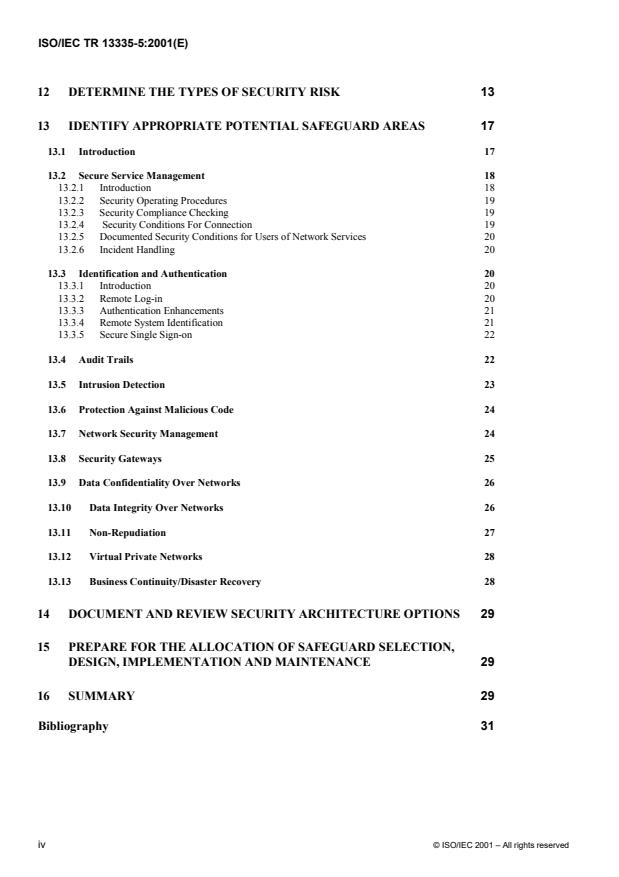
12 DETERMINE THE TYPES OF SECURITY RISK 13
13 IDENTIFY APPROPRIATE POTENTIAL SAFEGUARD AREAS 17
13.1 Introduction 17
13.2 Secure Service Management 18
13.2.1 Introduction 18
13.2.2 Security Operating Procedures 19
13.2.3 Security Compliance Checking 19
13.2.4 Security Conditions For Connection 19
13.2.5 Documented Security Conditions for Users of Network Services 20
13.2.6 Incident Handling 20
13.3 Identification and Authentication 20
13.3.1 Introduction 20
13.3.2 Remote Log-in 20
13.3.3 Authentication Enhancements 21
13.3.4 Remote System Identification 21
13.3.5 Secure Single Sign-on 22
13.4 Audit Trails 22
13.5 Intrusion Detection 23
13.6 Protection Against Malicious Code 24
13.7 Network Security Management 24
13.8 Security Gateways 25
13.9 Data Confidentiality Over Networks 26
13.10 Data Integrity Over Networks 26
13.11 Non-Repudiation 27
13.12 Virtual Private Networks 28
13.13 Business Continuity/Disaster Recovery 28
14 DOCUMENT AND REVIEW SECURITY ARCHITECTURE OPTIONS 29
15 PREPARE FOR THE ALLOCATION OF SAFEGUARD SELECTION,
DESIGN, IMPLEMENTATION AND MAINTENANCE 29
16 SUMMARY 29
Bibliography 31
iv © ISO/IEC 2001 – All rights reserved
Foreword
ISO (the International Organization for Standardization) and IEC (the International Electrotechnical Commission)
form the specialized system for worldwide standardization. National bodies that are members of ISO or IEC
participate in the development of International Standards through technical committees established by the
respective organization to deal with particular fields of technical activity. ISO and IEC technical committees
collaborate in fields of mutual interest. Other international organizations, governmental and non-governmental, in
liaison with ISO and IEC, also take part in the work. In the field of information technology, ISO and IEC have
established a joint technical committee, ISO/IEC JTC 1.
International Standards are drafted in accordance with the rules given in the ISO/IEC Directives, Part 3.
The main task of the joint technical committee is to prepare International Standards. Draft International Standards
adopted by the joint technical committee are circulated to national bodies for voting. Publication as an International
Standard requires approval by at least 75 % of the national bodies casting a vote.
In exceptional circumstances, the joint technical committee may propose the publication of a Technical Report of
one of the following types:
— type 1, when the required support cannot be obtained for the publication of an International Standard, despite
repeated efforts;
— type 2, when the subject is still under technical development or where for any other reason there is the future
but not immediate possibility of an agreement on an International Standard;
— type 3, when the joint technical committee has collected data of a different kind from that which is normally
published as an International Standard (“state of the art”, for example).
Technical Reports of types 1 and 2 are subject to review within three years of publication, to decide whether they
can be transformed into International Standards. Technical Reports of type 3 do not necessarily have to be
reviewed until the data they provide are considered to be no longer valid or useful.
Attention is drawn to the possibility that some of the elements of this part of ISO/IEC TR 13335 may be the subject
of patent rights. ISO and IEC shall not be held responsible for identifying any or all such patent rights.
ISO/IEC TR 13335-5, which is a Technical Report of type 3, was prepared by Joint Technical Committee
ISO/IEC JTC 1, Information technology, Subcommittee SC 27, IT Security techniques.
ISO/IEC TR 13335 consists of the following parts, under the general title Information technology — Guidelines for
the management of IT Security:
Part 1: Concepts and models for IT Security
Part 2: Managing and planning IT Security
Part 3: Techniques for the management of IT Security
Part 4: Selection of safeguards
Part 5: Management guidance on network security
© ISO/IEC 2001 – All rights reserved v
Introduction
The purpose of this Technical Report (ISO/IEC TR 13335) is to provide guidance, not
solutions, on management aspects of IT security. Those individuals within an organization
that are responsible for IT security should be able to adapt the material in this report to
meet their specific needs. The main objectives of this Technical Report are:
• to define and describe the concepts associated with the management of IT security,
• to identify the relationships between the management of IT security and management
of IT in general,
• to present several models which can be used to explain IT security, and
• to provide general guidance on the management of IT security.
ISO/IEC TR 13335 is organized into five parts. Part 1 provides an overview of the
fundamental concepts and models used to describe the management of IT security. This
material is suitable for managers responsible for IT security and for those who are
responsible for an organization's overall security programme.
Part 2 describes management and planning aspects. It is relevant to managers with
responsibilities relating to an organization’s IT systems. They may be:
• IT managers who are responsible for overseeing the design, implementation, testing,
procurement, or operation of IT systems, or
• managers who are responsible for activities that make substantial use of IT systems.
Part 3 describes security techniques relevant to those involved with management activities
during a project life cycle, such as planning, designing, implementing, testing, acquisition
or operations.
Part 4 provides guidance for the selection of safeguards, and how this can be supported by
the use of baseline models and controls. It also describes how this complements the
security techniques described in Part 3, and how additional assessment methods can be
used for the selection of safeguards.
Part 5 provides guidance with respect to networks and communications to those
responsible for the management of IT security. This guidance supports the identification
and analysis of the communications related factors that should be taken into account to
establish network security requirements. It also contains a brief introduction to the possible
safeguard areas.
vi © ISO/IEC 2001 – All rights reserved
TECHNICAL REPORT ISO/IEC TR 13335-5:2001(E)
Information technology — Guidelines for the management of IT
Security —
Part 5:
Management guidance on network security
1. Scope
ISO/IEC TR 13335-5 provides guidance with respect to networks and communications to
those responsible for the management of IT security. This guidance supports the
identification and analysis of the communications related factors that should be taken into
account to establish network security requirements.
This part of ISO/IEC TR 13335 builds upon Part 4 of this Technical Report by providing
an introduction on how to identify appropriate safeguard areas with respect to security
associated with connections to communications networks.
It is not within the scope of this TR to provide advice on the detailed design and
implementation aspects of the technical safeguard areas. That advice will be dealt with in
future ISO documents.
2. References
ISO/IEC TR 13335-1:1996, Information technology — Guidelines for the management
of IT Security — Part 1: Concepts and models for IT Security
ISO/IEC TR 13335-2:1997, Information technology — Guidelines for the management
of IT Security — Part 2: Managing and planning IT Security
ISO/IEC TR 13335-3:1998, Information technology — Guidelines for the management
of IT Security — Part 3: Techniques for the management of IT Security
ISO/IEC TR 13335-4:2000, Information technology — Guidelines for the management
of IT Security — Part 4: Selection of safeguards
1)
ISO/IEC TR 14516:— , Information technology — Guidelines on the use and
management of Trusted Third Party (TTP) services
ISO/IEC 13888 (all parts), Information technology — Security techniques — Non-
repudiation
1)
ISO/IEC 15947:— , Information technology — Security techniques — IT intrusion
detection framework
ISO/IEC 7498-1:1994, Information technology — Open Systems Interconnection —
Basic Reference Model: The Basic Model
ISO 7498-2:1989, Information processing systems — Open Systems Interconnection —
Basic Reference Model — Part 2: Security Architecture
__________________
1) To be published.
© ISO/IEC 2001 – All rights reserved 1
ISO/IEC 7498-3:1997, Information technology — Open Systems Interconnection —
Basic Reference Model: Naming and addressing
ISO/IEC 7498-4:1989, Information processing systems — Open Systems
Interconnection — Basic Reference Model — Part 4: Management framework
(Other relevant, non ISO/IEC, references are given in the Bibliography.)
3. Definitions
For the purposes of this part of ISO/IEC TR 13335, the definitions given in Part 1 of
ISO/IEC TR 13335 apply: accountability, asset, authenticity, availability, baseline
controls, confidentiality, data integrity, impact, integrity, IT security, IT security policy,
non-repudiation, reliability, risk, risk analysis, risk management, safeguard, threat,
vulnerability.
4. Abbreviations
EDI - Electronic Data Interchange
IP - Internet Protocol
IT - Information Technology
PC - Personal Computer
PIN - Personal Identification Number
SecOPs - Security Operating Procedures
TR - Technical Report
5. Structure
The approach taken in TR 13335-5 is to first summarize the overall process for
identification and analysis of the communications related factors that should be taken into
account to establish network security requirements, and then provide an indication of the
potential safeguard areas (in doing so indicating where relevant content of other parts of
TR 13335 may be used).
This document describes three simple criteria to aid those persons responsible for IT
security to identify potential safeguard areas. These criteria identify (1) the different types
of network connections, (2) the different networking characteristics and related trust
relationships, and (3) the potential types of security risk associated with network
connections (and the use of services provided via those connections). The results of
combining these criteria are then utilised to indicate potential safeguard areas.
Subsequently, a brief introductory description is provided of the potential safeguard areas,
with indications to sources of more detail.
2 © ISO/IEC 2001 – All rights reserved
6. Aim
The aim of this document is to provide guidance for the identification and analysis of the
communications related factors that should be taken into account to establish network
security requirements, and to provide an indication of the potential safeguard areas.
7. Overview
7.1 Background
Government and commercial organizations rely heavily on the use of information to
conduct their business activities. Loss of confidentiality, integrity, availability, non-
repudiation, accountability, authenticity and reliability of information and services can
have an adverse impact on an organization’s business operations. Consequently, there is a
critical need to protect information and to manage the security of IT systems within
organizations.
This critical need to protect information is particularly important in today's environment
because many organizations’ IT systems are connected by networks. These network
connections can be within the organization, between different organizations, and
sometimes between the organization and the general public. Both governmental and
commercial organizations conduct business globally. Therefore they depend on all kinds
of communication from computerized to other ‘classical’ means. Their network needs
have to be fulfilled, with network security playing an increasing significant role.
Clause 7.2 summarises the recommended process for the identification and analysis of the
communications related factors that should be taken into account to establish network
security requirements, and the provision of an indication of the potential safeguard areas.
Subsequent clauses then provide further detail of this process.
7.2 Identification Process
When considering network connections, all those persons in the organization who have
responsibilities associated with the connections should be clear about the business
requirements and benefits. In addition, they and all other users of the connections should
be aware of the security risks to, and related safeguard areas for, such network
connections. The business requirements and benefits are likely to influence many
decisions and actions taken in the process of considering network connections, identifying
potential safeguard areas, and then eventually selecting, designing, implementing and
maintaining security safeguards. Thus, these business requirements and benefits need to
be kept in mind throughout the process. In order to identify the appropriate network
related security requirements and safeguard areas, the following tasks will need to be
completed:
© ISO/IEC 2001 – All rights reserved 3
• review the general security requirements for network connections as set out in the
organization’s corporate IT security policy (see clause 8),
• review the network architectures and applications that relate to the network
connections, to provide the necessary background to conduct subsequent tasks (see
clause 9),
• identify the type or types of network connection that should be considered (see
clause 10),
• review the characteristics of the networking proposed (aided as necessary by the
information available on network and application architectures), and the associated
trust relationships (see clause 11),
• determine the related types of security risk, where possible with the help of risk
analysis and management review results - including consideration of the value to
business operations of the information to be transferred via the connections, and any
other information potentially accessible in an unauthorized way through these
connections (see clause 12),
• identify the references to the potential safeguard areas that may be appropriate, on
the basis of the type(s) of network connection, the networking characteristics and
associated trust relationships, and the types of security risk, determined (see clause
13),
• document and review security architecture options (see clause 14),
• prepare to allocate tasks for the detailed safeguard selection, design,
implementation and maintenance, using the identified references to potential
safeguard areas and the agreed security architecture (see clause 15).
It should be noted that general advice on the identification of safeguards is contained in
Part 4 of TR 13335. This Part (5) of TR 13335 complements Part 4 and provides an
introduction on how to identify appropriate safeguard areas with respect to security
associated with connections to communications networks.
Figure 1 below explains the overall process of identification and analysis of the
communications related factors that should be taken into account to establish network
security requirements, and the provision of indications of potential safeguard areas. Each
step of the process is described in further detail in the clauses following the figure.
4 © ISO/IEC 2001 – All rights reserved
Review Corporate
IT Security Policy
(Clause 8)
Review Network
Architectures
and Applications
(Clause 9)
Identify Type(s) of
Network Connection
(Clause 10)
Review Networking
Characteristics &
Trust Relationships
(Clause 11)
Review Security Risk
Analysis and
Determine Types of
Management Results
Security Risk
(GMITS Parts 3 and 4,
(Clause 12)
& Clause 12)
Identify Appropriate
Potential Safeguard
Areas
(Clause 13)
Document & Review
Security Architecture
Options
(Clause 14)
Prepare for Allocation
of Safeguard
Selection, Design, etc.
(Clause 15)
Figure 1: Process for the Identification and Analysis of Communications Related
Factors Leading to the Establishment of Network Security Requirements
It should be noted that, in Figure 1, the solid lines represent the main path of the process,
and the dotted line where the types of security risk may be determined with the aid of
results from a security risk analysis and management review.
In addition to the main path of the process, in certain steps there will be a need to re-visit
the results of earlier steps to ensure consistency, in particular the steps ”Review Corporate
IT Security Policy” and ”Review Network Architectures and Applications”. For example,
• after types of security risk have been determined there may be a need to review
corporate IT security policy because something has arisen that is in fact not
covered at that policy level,
• in identifying potential safeguard areas, the corporate IT security policy should be
taken into account, because it may, for example, specify that a particular safeguard
has to be implemented across the organization regardless of the risks,
• in reviewing security architecture options, to ensure compatibility there will be a
need to consider the network architectures and applications.
© ISO/IEC 2001 – All rights reserved 5
8 Review Corporate IT Security Policy Requirements
The organization’s corporate IT security policy may include statements on the need for
confidentiality, integrity, availability, non-repudiation, accountability, authenticity and
reliability, as well as views on types of threat, and safeguard requirements, that relate
directly to network connections.
For ex ample, such a policy could state that:
• availability of certain types of information or services is a major concern,
• no connections via dial-up lines are permitted,
• all connections to the Internet must be made through a security gateway,
• a particular type of security gateway must be used,
• no payment instruction is valid without a digital signature.
Such statements, views and requirements, being applicable organization-wide, must be
accounted for in the determination of the types of security risk (see clause 12 below) and
the identification of potential safeguard areas for network connections (see clause 13
below). If there are any such security requirements then these can be documented in the
draft list of potential safeguard areas, and as necessary reflected in security architecture
options. Guidance on the positioning of a corporate IT security policy document within
an organization’s approach to IT security, and on its content and relationships with other
security documentation, is provided in Parts 2 and 3 of TR 13335.
9 Review Network Architectures and Applications
9.1 Introduction
Later steps in the process of moving towards the confirmation of potential safeguard
areas, i.e. identification of the:
• type(s) of network connection that will be used,
• networking characteristics and associated trust relationships involved,
• types of security risk,
and indeed the development of the list of potential safeguard areas (and later the related
designs for securing a particular connection), should always be done in the context of the
network architecture and applications that already exist or are planned.
6 © ISO/IEC 2001 – All rights reserved
Thus detail should be obtained of the relevant network architecture and applications, and
reviewed, to provide the necessary understanding and context for the process steps that
follow.
By clarifying these aspects at the earliest possible stage, the process of identifying the
relevant security requirement identification criteria, identifying potential safeguard areas,
and refining the security architecture, will become more efficient and will eventually
result in a more workable security solution (see clauses 9.2 to 9.5 below).
At the same time, consideration of network and application architectural aspects at an
early stage allows time for those architectures to be reviewed and possibly revised if an
acceptable security solution cannot be realistically achieved within the current
architecture.
The different areas that need to be considered under network architectures and
applications include:
• types of network,
• network protocols,
• network applications.
Some of the issues for review for each of these areas are discussed in clauses 9.2 to 9.4
below. Other considerations are introduced in clause 9.5.
(General guidance on network and application architectures can be found in ISO/IEC 7498.)
9.2 Types of Network
Depending on the area they cover, networks can be categorized as:
• Local Area Networks (LAN), which are used to interconnect systems locally,
• Metropolitan Area Networks (MAN), which are used to interconnect systems in a
metropolitan range,
• Wide Area Networks (WAN), which are used to interconnect systems in wider
areas than MANs, up to a world wide coverage.
© ISO/IEC 2001 – All rights reserved 7
9.3 Network Protocols
Different protocols have different security characteristics and need to be afforded special
consideration. For example:
• shared media protocols are mainly used in LANs (and sometimes in MANs) and
provide mechanisms to regulate the use of shared media among the systems
connected. As a shared media is used, all information on the network is physically
accessible by all connected systems,
• routing protocols are used to define the route through the different nodes on which
information travels within MANs and WANs. Information is physically accessible
for all systems along the route, and routing may be changed, either accidentally or
intentionally.
The protocols may be used on different network topologies, for example bus, ring and
star, whether implemented through wireless or non-wireless technologies, which may
have further impact on security.
9.4 Network Applications
The type of applications used over a network need to be considered in the context of
security. Types can include:
• terminal emulation based applications,
• store and forward or spooler based applications,
• client server applications.
9.5 Other Considerations
When reviewing the network architecture and applications, consideration should also be
given to existing network connections within, to or from the organization, and to the
network to which the connection is proposed. The organization’s existing connections
may restrict or prevent new connections, e.g. because of agreements or contracts. The
existence of other connections to or from the network to which the connection is required
could introduce additional vulnerabilities and thus higher risks, possibly warranting
stronger and/or additional safeguards.
10 Identify Types of Network Connection
There are many generic types of network connection that an organization may wish to
utilise. Some of these types of connection can be made through private networks (to
which access is restricted to a known community), and some could be made through
8 © ISO/IEC 2001 – All rights reserved
public networks (to which access is potentially available to any organization or person).
Further, these types of network connection could be used for a variety of services, e.g.
electronic mail or Electronic Data Interchange (EDI), and could involve use of Internet,
Intranet or Extranet facilities, each with differing security considerations. Each of the
types of connection may have different vulnerabilities and thus associated security risks,
and consequently eventually require a different set of safeguards.
Table 1 below shows one way of categorizing the generic types of network connection
that may be required to conduct business, with a descriptive example shown for each
type.
Taking due account of relevant network architectures and applications (see clause 9
above), one or more of the types shown in Table 1 should be selected as appropriate to the
network connection(s) being considered.
It should be noted that the generic types of network connection described in this
document are organized and categorized from a business perspective rather than a
technical one. This means that two different types of network connection may sometimes
be implemented by similar technical means, and that in some cases the safeguards may be
similar, but there are other cases where they will be different.
Table 1: Types of Network Connection
Clause Type of Network Connection Descriptive Example
Connection within a single controlled Interconnection between different parts of the
10.1
location of an organization. same organization within the same controlled
location, i.e. a single controlled building or site.
10.2 Connection between different Interconnection between regional offices (and/or
geographically disparate parts of the regional offices with a headquarters site) within a
same organization. single organization across a wide area network. In
this type of network connection, most if not all
users are able to access the IT systems available
via the network, but not all users within the
organization would have authorisation for access
to all applications or information (i.e. each user’s
access would only be in accordance with
privileges granted).
One type of access from another part of the
organization could be for remote maintenance
purposes. There might be more access privileges
assigned to this type of user and connection.
© ISO/IEC 2001 – All rights reserved 9
Clause Type of Network Connection Descriptive Example
10.3 Connections between an organization Use of mobile data terminals by employees (e.g. a
site and personnel working in locations salesperson verifying stock availability from a
away from the organization. customer site) or the establishment of remote links
to an organization’s computing systems by
employees working from home or other remote
sites not linked via a network maintained by the
organization. In this type of network connection,
the user is authorized as a system user on his local
system.
10.4 Connections between different Interconnection between two or more
organizations within a closed organizations where there is a business need to
community, e.g. because of contractual facilitate inter-organizational electronic
or other legally binding situations, or of transactions (e.g. electronic funds transfer in the
similar business interests, e.g. banking banking industry). This type of network
or insurance. connection is similar to 10.2 above, except that
the sites being interconnected belong to two or
more organizations, and the connection is not
intended to provide access to the full range of
applications utilized by each of the participating
organizations.
10.5 Connections with other organizations. There could be access to remote databases held by
other organizations (e.g. through service
providers). In this type of network connection, all
users, including those of the connecting
organization, are individually pre-authorized by
the external organization whose information is
being accessed. However, although all users are
pre-authorized, there may be no screening of
potential users other than in relation to their
ability to pay for the services being offered.
There could also be access to applications on the
organization’s systems that store or process the
organizational information that may be provided
to users from external organizations. In this
circumstance, the external users would be known
and authorized.
One type of access from another organization
could be for remote maintenance purposes. There
might be more access privileges assigned to this
type of user and connection.
10 © ISO/IEC 2001 – All rights reserved
Clause Type of Network Connection Descriptive Example
10.6 Connections with the general public Access could be initiated by the organization’s
domain. users to public access databases, Web sites, and/or
electronic mail facilities (e.g. via the Internet),
where the access is initiated for purposes such as
the retrieval of information or the sending of
information from/to persons and/or sites which
have not been specifically pre-authorized by the
organization. In this type of connection, the
organization’s users may be utilising this facility
for organizational (possibly even private)
purposes; however, the organization may have
little, if any, control over the information being
transmitted.
Access could be initiated by external users to the
organization’s facilities (e.g. via the Internet). In
this type of network connection, access by the
individual external users has not been specifically
pre-authorized by the organization.
11 Review Networking Characteristics and Related Trust
Relationships
11.1 Network Characteristics
The characteristics of the existing or proposed network should be reviewed. It is
particularly important to identify whether the network is:
• a public network - a network accessible by anyone, or
• a private network - a network consisting of owned or leased lines, therefore
considered to be more secure than a public network.
It is also important to know the type of data transported by the network, for example:
• a data network - a network transferring primarily data and making use of data
protocols,
• a voice network - a network intended for telephone but also usable for data, or
• a network encompassing both data and voice.
Other information, such as whether the network is a packet or switched network, is also
germane.
© ISO/IEC 2001 – All rights reserved 11
Further, it should also be established whether a connection is permanent, or established at
need.
11.2 Trust Relationships
Once the characteristics of the existing or proposed networking have been identified, and
at minimum it has been established if the network is public or private (see clause 11.1
above), then the related trust relationships should be identified.
Firstly, the applicable trust environment(s) associated with the network connection(s)
should be identified using the simple matrix shown at Table 2 below.
Table 2: Description of Trust Environments
Trust Description
Environment
Low Network with an unknown community of users.
Medium Network with a known community of users and within a closed
business community (of more than one organization).
High Network with a known community of users and solely within the
organization.
Secondly, the relevant trust environment(s) (from Low, Medium and High) should be
related to the applicable network characteristic (public or private) and the type(s) of
network connection involved (from clauses 10.1 to 10.6), to establish the trust
relationships. This can be accomplished using the matrix shown in Table 3 below.
Table 3: Identification of Trust Relationships
TRUST ENVIRONMENTS
LOW MEDIUM HIGH
10.6 10.4 10.2
PUBLIC
TYPES OF
10.5 10.3
NETWORK
CONNECTION
(See Clause 10)
10.4 10.4 10.1
PRIVATE
10.5 10.5 10.2
10.3
From Table 3 the reference category for each relevant trust relationship can be
determined. All of the possible categories are described in Table 4 below.
12 © ISO/IEC 2001 – All rights reserved
Table 4: Trust Relationship References
Trust Relationship Category Description
LOW/PUBLIC Low trust, and use of a public network.
MEDIUM/PUBLIC Medium trust, and use of a public network.
HIGH/PUBLIC High trust, and use of a public network.
LOW/PRIVATE Low trust, and use of a private network.
MEDIUM/PRIVATE Medium trust, and use of a private network.
HIGH/PRIVATE High trust, and use of a private network.
These references will be used in clause 12 to confirm the types of security risk and
identify potential safeguard areas.
This task can be aided as necessary by the information available on network architectures
and applications (see clause 9).
12 Determine the Types of Security Risk
As reflected earlier, the majority of organizations today are dependent on the use of IT
systems and networks to support their business operations. Further, in many cases there is
a definite business requirement for the use of network connections between the IT
systems at each organization’s location, and to other locations both within and outside the
organization. When a connection is made to another network, considerable care should be
taken to ensure that the connecting organization is not exposed to additional risks. These
risks could, for example, result from the connection itself or from network connections at
the other end.
Whilst network connections are important for business reasons, it has to be recognized
that the use of these connections could yield additional security risks - some possibly
related to ensuring adherence to relevant legislation and regulation. The types of risk
reflected in this clause relate to concerns about unauthorized access to information,
unauthorized sending of information, the introduction of malicious code, denial of receipt
or origin, and denial of service connection. Thus the types of security risk that an
organization might face relate to loss of:
• confidentiality of information,
© ISO/IEC 2001 – All rights reserved 13
• integrity of information,
• availability of information and service,
• non-repudiation of commitments,
• accountability of transactions,
• authenticity of information,
• reliability of information.
Not all of the possible types of security risk will apply to every location, or to every
organization. However, the relevant types of security risk need to be identified so that
potential safeguards areas can be identified (and eventually safeguards selected, designed,
implemented and maintained).
Information should be gathered on the implications to business operations related to the
types of security risk referred to above (desirably from the results of a security risk
analysis and management review ), with due consideration of the sensitivity or value of
information involved (expressed as potential adverse business impacts) and related
potential threats and vulnerabilities. Related to this, if there is likely to be more than a
minor adverse impact on the business operations of the organization, then reference
should be made to the matrix in Table 5 below.
It is emphasized that in completing this task, use should be made of the results from
security risk analysis and management review(s) conducted with regard to the network
connection(s). These results will enable a focus, to whatever level of detail the review(s)
have been conducted, on the potential adverse business impacts associated with the types
of security risk listed above, as well as the threat types, vulnerabilities and hence risks of
concern.
The relevant trust relationship references determined from using clause 11 above should
be identified along the top of the matrix in Table 5, and the impacts of concern on the left
hand side of the matrix. The references at the pertinent intersections should then be noted
– these are the references to the potential safeguard areas that are introduced in clause 13
below.
Guidance on security risk analysis and management approaches is provided in Parts 3
and 4 of TR 13335.
14 © ISO/IEC 2001 – All rights reserved
Table 5: Types of Security Risk and References to Potential Safeguard Areas
Types of Risk Trust Relationship References
LOW/ MEDIUM/ HIGH/ LOW/ MEDIUM/ HIGH/
PUBLIC PUBLIC PUBLIC PRIVATE PRIVATE PRIVATE
13.2.2 13.2.2 13.2.2 13.2.2 13.2.2 13.2.2
Loss of Confidentiality
13.2.3 13.2.3 13.2.3 13.2.3 13.2.3 13.2.3
13.2.6 13.2.4 13.2.5 13.2.4 13.2.4 13.2.5
13.4 13.2.6 13.2.6 13.2.6 13.2.6 13.2.6
13.5 13.3.2 13.3.2 13.3.2 13.3.2 13.3.2
13.7 13.3.3 13.3.3 13.3.4 13.3.3 13.3.5
13.8 13.3.4 13.3.4 13.4 13.3.4 13.4
13.9 13.4 13.3.5 13.5 13.4 13.7
13.12 13.5 13.4 13.7 13.7 13.9
13.7 13.5 13.8 13.8
13.8 13.7 13.9 13.9
13.9 13.8 13.12 13.12
13.12 13.9
13.12
13.2.2 13.2.2 13.2.2 13.2.2 13.2.2 13.2.2
Loss of Integrity
13.2.3 13.2.3 13.2.3 13.2.3 13.2.3 13.2.3
13.2.6 13.2.4 13.2.5 13.2.4 13.2.4 13.2.5
13.4 13.2.6 13.2.6 13.2.6 13.2.6 13.2.6
13.5 13.3.2 13.3.2 13.3.2 13.3.2 13.3.2
13.6 13.3.3 13.3.3 13.3.4 13.3.3 13.3.5
13.7 13.3.4 13.3.4 13.4 13.3.4 13.4
13.8 13.4 13.3.5 13.5 13.4 13.6
13.10 13.5 13.4 13.6 13.6 13.7
13.12 13.6 13.5 13.7 13.7 13.10
13.7 13.6 13.8 13.8
13.8 13.7 13.10 13.10
13.10 13.8 13.12 13.12
13.12 13.10
13.12
13.2.2 13.2.2 13.2.2 13.2.2 13.2.2 13.2.2
Loss of Availability
13.2.3 13.2.3 13.2.3 13.2.3 13.2.3 13.2.3
13.2.6 13.2.4 13.2.5 13.2.4 13.2.4 13.2.5
13.4 13.2.6 13.2.6 13.2.6 13.2.6 13.2.6
13.5 13.3.2 13.3.2 13.3.2 13.3.2 13.3.2
13.6 13.3.3 13.3.3 13.3.4 13.3.4 13.3.5
13.7 13.3.4 13.3.4 13.4 13.4 13.4
13.8 13.4 13.3.5 13.5 13.6 13.6
13.13 13.5 13.4 13.6 13.7 13.7
13.6 13.5 13.7 13.8 13.12
13.7 13.6 13.8 13.12 13.13
13.8 13.7 13.12 13.13
13.13 13.8 13.13
13.13
© ISO/IEC 2001 – All rights reserved 15
Types of Risk Trust Relationship References
LOW/ MEDIUM/ HIGH/ LOW/ MEDIUM/ HIGH/
PUBLIC PUBLIC PUBLIC PRIVATE PRIVATE PRIVATE
13.2.2 13.2.2 13.2.2 13.2.2 13.2.2 13.2.2
Loss of Non-
13.2.3 13.2.3 13.2.3 13.2.3 13.2.3 13.2.3
Repudiation
13.2.6 13.2.4 13.2.5 13.2.4 13.2.4 13.2.5
13.4 13.2.6 13.2.6 13.2.6 13.2.6 13.2.6
13.5 13.3.2 13.3.2 13.3.2 13.3.2 13.3.2
13.7 13.3.3 13.3.3 13.3.4 13.3.4 13.3.3
13.11 13.3.4 13.3.4 13.4 13.4 13.3.4
13.13 13.4 13.3.5 13.5 13.7 13.3.5
13.5 13.4 13.7 13.11 13.4
13.7 13.5 13.11 13.13 13.7
13.11 13.7 13.13 13.13
13.13 13.13
13.2.2 13.2.2 13.2.2 13.2.2 13.2.2 13.2.2
Loss of Accountability
13.2.6 13.2.6 13.2.6 13.2.3 13.2.3 13.2.3
13.2.4 13.2.4 13.3.3 13.2.4 13.2.4 13.2.4
13.6 13.3.4 13.3.4 13.2.5 13.2.5 13.2.5
13.7 13.4 13.4 13.2.6 13.2.6 13.2.6
13.8 13.6 13.6 13.3.3 13.3.3 13.3.3
13.12 13.7 13.7 13.3.4 13.4 13.3.4
13.8 13.8 13.4 13.6 13.4
13.12 13.12 13.6 13.7 13.7
13.7 13.12
13.8
13.12
13.2.2 13.2.2 13.2.2 13.2.2 13.2.2 13.2.2
Loss of Authenticity
13.2.6 13.2.6 13.2.6 13.2.3 13.2.3 13.2.3
13.2.4 13.2.4 13.3.2 13.2.4 13.2.4 13.2.5
13.3.3 13.3.3 13.3.3 13.2.5 13.2.5 13.2.6
13.5 13.3.4 13.3.4 13.2.6 13.2.6 13.3.2
13.6 13.4 13.4 13.4 13.3.2 13.3.4
13.8 13.5 13.5 13.5 13.4 13.4
13.10 13.6 13.6 13.6 13.5 13.5
13.12 13.8 13.7 13.8 13.6 13.6
13.10 13.8 13.10 13.10 13.7
13.12 13.10 13.12 13.12 13.10
13.12
16 © ISO/IEC 2001 – All rights reserved
Types of Risk Trust Relationship References
LOW/ MEDIUM/ HIGH/ LOW/ MEDIUM/ HIGH/
PUBLIC PUBLIC PUBLIC PRIVATE PRIVATE PRIVATE
13.2.2 13.2.2 13.2.2 13.2.2 13.2.2 13.2.2
Loss of Reliability
13.2.6 13.2.6 13.2.6 13.2.3 13.2.3 13.2.3
13.2.4 13.2.4 13.3.2 13.2.4 13.2.4 13.2.5
13.3.3 13.3.3 13.3.3 13.2.5 13.2.5 13.2.6
13.5 13.4 13.3.4 13.2.6 13.2.6 13.3.2
13.6 13.5 13.4 13.4 13.3.2 13.3.4
13.8 13.6 13.5 13.5 13.5 13.5
13.12 13.7 13.6 13.6 13.6 13.6
13.13 13.8 13.7 13.8 13.7 13.7
13.12 13.8 13.12 13.12 13.12
13.13 13.12 13.13 13.13 13.13
13.13
It should be noted that the table appears to indicate that the more a user is trusted, the
more safeguards are necessary. There are two reasons for this.
Firstly, there are a number of safeguards described in Part 4 of TR 13335 (and thus not
repeated in this TR) that would be selected to protect the host IT facilities, including for
identification and authentication, and logical access control. The configuration of the
permissions (privileges) in the lower trust situations needs to ensure that access is only
provided to resources that are consistent with the trust model and needs of the intended
access. In low trust situations the strength of identification and authentication, and logical
access control, safeguards (as described in Part 4 of TR 13335), needs to be higher than in
high trust situations. If this cannot be assured, then relevant additional safeguards would
need to be implemented.
Secondly, trusted users are usually given access to more important/critical information
and/or functionality. This can mean a need for additional safeguards, as a reflection of the
value of the resources accessed and not on the trust in the users.
13 Identify Appropriate Potential Safeguard Areas
13.1 Introduction
On the basis of the references identified from using clause 12, the potential safeguard
areas should now be identifiable from clause 13. Clauses 13.2 to 13.13 introduce potential
safeguard areas that should be selected as appropriate after use of clause 12 above. It
should be noted that a particular security solution may in fact enco
...
Questions, Comments and Discussion
Ask us and Technical Secretary will try to provide an answer. You can facilitate discussion about the standard in here.
Loading comments...