


ISO/IEC 20000-2:2005
(Main)Information technology — Service management — Part 2: Code of practice
Information technology — Service management — Part 2: Code of practice
ISO/IEC 20000-2:2005 represents an industry consensus on guidance to auditors and offers assistance to service providers planning service improvements or to be audited against ISO/IEC 20000-1. ISO/IEC 20000-2:2005 is based on BS 15000-2, which has been superseded. Organizations require increasingly advanced facilities (at minimum cost) to meet their business needs. With the increasing dependencies in support services and the diverse range of technologies available, service providers can struggle to maintain high levels of customer service. Working reactively, they spend too little time planning, training, reviewing, investigating, and working with customers. The result is a failure to adopt structured, proactive working practices. Those same service providers are being asked for improved quality, lower costs, greater flexibility, and faster response to customers. In contrast, effective service management delivers high levels of customer service and customer satisfaction. It also recognizes that services and service management are essential to helping organizations generate revenue and be cost-effective. The ISO/IEC 20000 series enables service providers to understand how to enhance the quality of service delivered to their customers, both internal and external. The ISO/IEC 20000 series draws a distinction between the best practices of processes, which are independent of organizational form or size and organizational names and structures. The ISO/IEC 20000 series applies to both large and small service providers, and the requirements for best practice service management processes are independent of the service provider's organizational form. These service management processes deliver the best possible service to meet a customer's business needs within agreed resource levels, i.e. service that is professional, cost-effective and with risks which are understood and managed. The variety of terms used for the same process, and between processes and functional groups (and job titles) can make the subject of service management confusing to the new manager. Understanding the terminology is a tangible and significant benefit from ISO/IEC 20000.
Technologies de l'information — Gestion des services — Partie 2: Code de pratique
General Information
- Status
- Withdrawn
- Publication Date
- 13-Dec-2005
- Withdrawal Date
- 13-Dec-2005
- Technical Committee
- ISO/IEC JTC 1/SC 7 - Software and systems engineering
- Drafting Committee
- ISO/IEC JTC 1/SC 7 - Software and systems engineering
- Current Stage
- 9599 - Withdrawal of International Standard
- Start Date
- 14-Feb-2012
- Completion Date
- 12-Feb-2026
Relations
- Effective Date
- 20-Jun-2008

Get Certified
Connect with accredited certification bodies for this standard

BSI Group
BSI (British Standards Institution) is the business standards company that helps organizations make excellence a habit.

Great Wall Tianjin Quality Assurance Center
Established 1993, first batch to receive national accreditation with IAF recognition.
Hong Kong Quality Assurance Agency (HKQAA)
Hong Kong's leading certification body.
Sponsored listings
Frequently Asked Questions
ISO/IEC 20000-2:2005 is a standard published by the International Organization for Standardization (ISO). Its full title is "Information technology — Service management — Part 2: Code of practice". This standard covers: ISO/IEC 20000-2:2005 represents an industry consensus on guidance to auditors and offers assistance to service providers planning service improvements or to be audited against ISO/IEC 20000-1. ISO/IEC 20000-2:2005 is based on BS 15000-2, which has been superseded. Organizations require increasingly advanced facilities (at minimum cost) to meet their business needs. With the increasing dependencies in support services and the diverse range of technologies available, service providers can struggle to maintain high levels of customer service. Working reactively, they spend too little time planning, training, reviewing, investigating, and working with customers. The result is a failure to adopt structured, proactive working practices. Those same service providers are being asked for improved quality, lower costs, greater flexibility, and faster response to customers. In contrast, effective service management delivers high levels of customer service and customer satisfaction. It also recognizes that services and service management are essential to helping organizations generate revenue and be cost-effective. The ISO/IEC 20000 series enables service providers to understand how to enhance the quality of service delivered to their customers, both internal and external. The ISO/IEC 20000 series draws a distinction between the best practices of processes, which are independent of organizational form or size and organizational names and structures. The ISO/IEC 20000 series applies to both large and small service providers, and the requirements for best practice service management processes are independent of the service provider's organizational form. These service management processes deliver the best possible service to meet a customer's business needs within agreed resource levels, i.e. service that is professional, cost-effective and with risks which are understood and managed. The variety of terms used for the same process, and between processes and functional groups (and job titles) can make the subject of service management confusing to the new manager. Understanding the terminology is a tangible and significant benefit from ISO/IEC 20000.
ISO/IEC 20000-2:2005 represents an industry consensus on guidance to auditors and offers assistance to service providers planning service improvements or to be audited against ISO/IEC 20000-1. ISO/IEC 20000-2:2005 is based on BS 15000-2, which has been superseded. Organizations require increasingly advanced facilities (at minimum cost) to meet their business needs. With the increasing dependencies in support services and the diverse range of technologies available, service providers can struggle to maintain high levels of customer service. Working reactively, they spend too little time planning, training, reviewing, investigating, and working with customers. The result is a failure to adopt structured, proactive working practices. Those same service providers are being asked for improved quality, lower costs, greater flexibility, and faster response to customers. In contrast, effective service management delivers high levels of customer service and customer satisfaction. It also recognizes that services and service management are essential to helping organizations generate revenue and be cost-effective. The ISO/IEC 20000 series enables service providers to understand how to enhance the quality of service delivered to their customers, both internal and external. The ISO/IEC 20000 series draws a distinction between the best practices of processes, which are independent of organizational form or size and organizational names and structures. The ISO/IEC 20000 series applies to both large and small service providers, and the requirements for best practice service management processes are independent of the service provider's organizational form. These service management processes deliver the best possible service to meet a customer's business needs within agreed resource levels, i.e. service that is professional, cost-effective and with risks which are understood and managed. The variety of terms used for the same process, and between processes and functional groups (and job titles) can make the subject of service management confusing to the new manager. Understanding the terminology is a tangible and significant benefit from ISO/IEC 20000.
ISO/IEC 20000-2:2005 is classified under the following ICS (International Classification for Standards) categories: 03.080.99 - Other services; 35.020 - Information technology (IT) in general. The ICS classification helps identify the subject area and facilitates finding related standards.
ISO/IEC 20000-2:2005 has the following relationships with other standards: It is inter standard links to ISO/IEC 20000-2:2012. Understanding these relationships helps ensure you are using the most current and applicable version of the standard.
ISO/IEC 20000-2:2005 is available in PDF format for immediate download after purchase. The document can be added to your cart and obtained through the secure checkout process. Digital delivery ensures instant access to the complete standard document.
Standards Content (Sample)
INTERNATIONAL ISO/IEC
STANDARD 20000-2
First edition
2005-12-15
Information technology — Service
management —
Part 2:
Code of practice
Technologies de l'information — Gestion de services —
Partie 2: Code de bonne pratique
Reference number
©
ISO/IEC 2005
PDF disclaimer
This PDF file may contain embedded typefaces. In accordance with Adobe's licensing policy, this file may be printed or viewed but
shall not be edited unless the typefaces which are embedded are licensed to and installed on the computer performing the editing. In
downloading this file, parties accept therein the responsibility of not infringing Adobe's licensing policy. The ISO Central Secretariat
accepts no liability in this area.
Adobe is a trademark of Adobe Systems Incorporated.
Details of the software products used to create this PDF file can be found in the General Info relative to the file; the PDF-creation
parameters were optimized for printing. Every care has been taken to ensure that the file is suitable for use by ISO member bodies. In
the unlikely event that a problem relating to it is found, please inform the Central Secretariat at the address given below.
© ISO/IEC 2005
All rights reserved. Unless otherwise specified, no part of this publication may be reproduced or utilized in any form or by any means,
electronic or mechanical, including photocopying and microfilm, without permission in writing from either ISO at the address below or
ISO's member body in the country of the requester.
ISO copyright office
Case postale 56 • CH-1211 Geneva 20
Tel. + 41 22 749 01 11
Fax + 41 22 749 09 47
E-mail copyright@iso.org
Web www.iso.org
Published in Switzerland
ii © ISO/IEC 2005 – All rights reserved
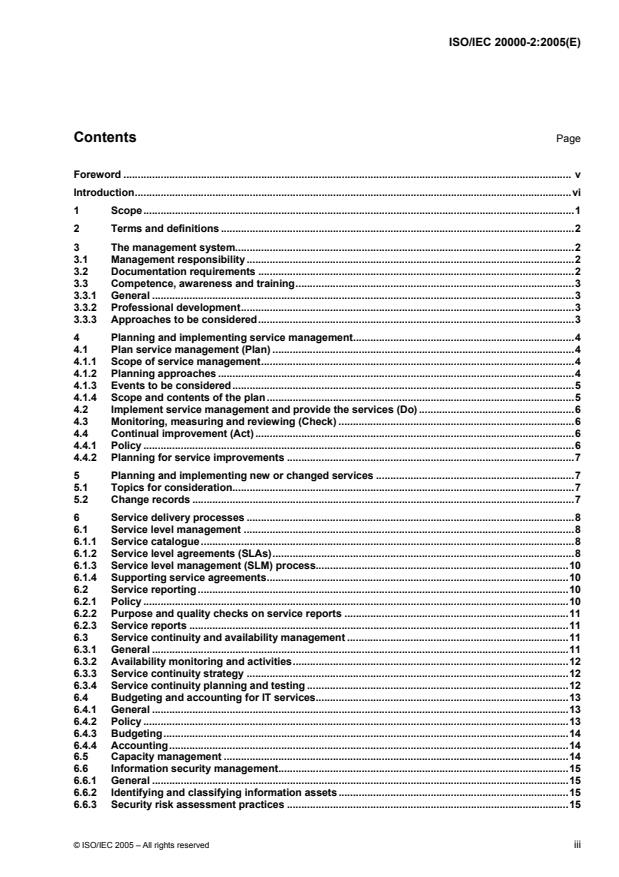
Contents Page
Foreword . v
Introduction.vi
1 Scope.1
2 Terms and definitions .2
3 The management system.2
3.1 Management responsibility .2
3.2 Documentation requirements .2
3.3 Competence, awareness and training.3
3.3.1 General .3
3.3.2 Professional development.3
3.3.3 Approaches to be considered.3
4 Planning and implementing service management.4
4.1 Plan service management (Plan) .4
4.1.1 Scope of service management.4
4.1.2 Planning approaches .4
4.1.3 Events to be considered.5
4.1.4 Scope and contents of the plan .5
4.2 Implement service management and provide the services (Do) .6
4.3 Monitoring, measuring and reviewing (Check) .6
4.4 Continual improvement (Act) .6
4.4.1 Policy.6
4.4.2 Planning for service improvements .7
5 Planning and implementing new or changed services .7
5.1.1 Topics for consideration.7
5.2.2 Change records .7
6 Service delivery processes .8
6.1 Service level management .8
6.1.1 Service catalogue.8
6.1.2 Service level agreements (SLAs).8
6.1.3 Service level management (SLM) process.10
6.1.4 Supporting service agreements.10
6.2 Service reporting.10
6.2.1 Policy.10
6.2.2 Purpose and quality checks on service reports .11
6.2.3 Service reports .11
6.3 Service continuity and availability management .11
6.3.1 General .11
6.3.2 Availability monitoring and activities.12
6.3.3 Service continuity strategy .12
6.3.4 Service continuity planning and testing .12
6.4 Budgeting and accounting for IT services.13
6.4.1 General .13
6.4.2 Policy.13
6.4.3 Budgeting.14
6.4.4 Accounting.14
6.5 Capacity management .14
6.6 Information security management.15
6.6.1 General .15
6.6.2 Identifying and classifying information assets .15
6.6.3 Security risk assessment practices .15
© ISO/IEC 2005 – All rights reserved iii
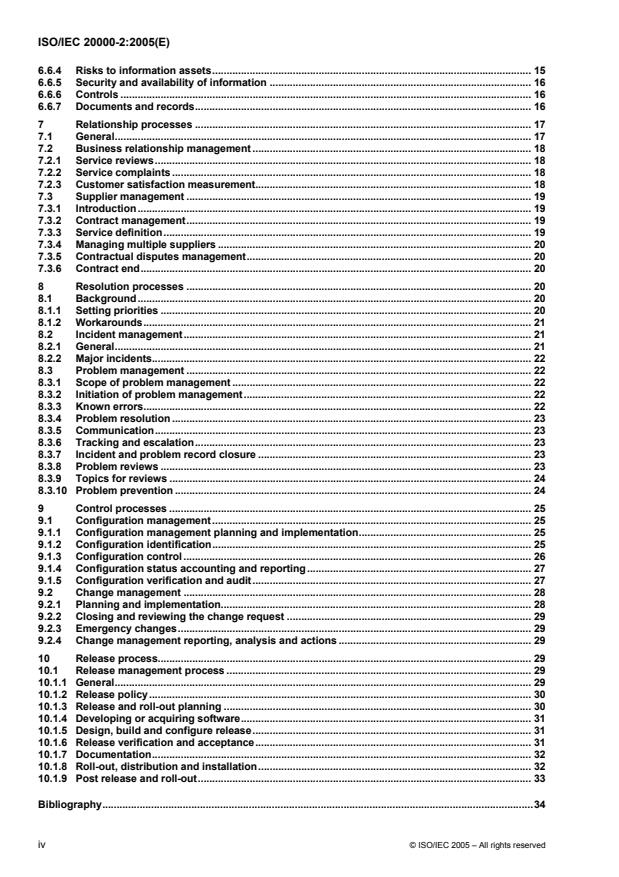
6.6.4 Risks to information assets. 15
6.6.5 Security and availability of information . 16
6.6.6 Controls . 16
6.6.7 Documents and records. 16
7 Relationship processes . 17
7.1 General. 17
7.2 Business relationship management . 18
7.2.1 Service reviews. 18
7.2.2 Service complaints . 18
7.2.3 Customer satisfaction measurement. 18
7.3 Supplier management . 19
7.3.1 Introduction. 19
7.3.2 Contract management. 19
7.3.3 Service definition. 19
7.3.4 Managing multiple suppliers . 20
7.3.5 Contractual disputes management. 20
7.3.6 Contract end. 20
8 Resolution processes . 20
8.1 Background. 20
8.1.1 Setting priorities . 20
8.1.2 Workarounds. 21
8.2 Incident management. 21
8.2.1 General. 21
8.2.2 Major incidents. 22
8.3 Problem management . 22
8.3.1 Scope of problem management . 22
8.3.2 Initiation of problem management. 22
8.3.3 Known errors. 22
8.3.4 Problem resolution . 23
8.3.5 Communication. 23
8.3.6 Tracking and escalation. 23
8.3.7 Incident and problem record closure . 23
8.3.8 Problem reviews . 23
8.3.9 Topics for reviews . 24
8.3.10 Problem prevention . 24
9 Control processes . 25
9.1 Configuration management. 25
9.1.1 Configuration management planning and implementation. 25
9.1.2 Configuration identification. 25
9.1.3 Configuration control . 26
9.1.4 Configuration status accounting and reporting. 27
9.1.5 Configuration verification and audit. 27
9.2 Change management . 28
9.2.1 Planning and implementation. 28
9.2.2 Closing and reviewing the change request . 29
9.2.3 Emergency changes. 29
9.2.4 Change management reporting, analysis and actions . 29
10 Release process. 29
10.1 Release management process . 29
10.1.1 General. 29
10.1.2 Release policy. 30
10.1.3 Release and roll-out planning . 30
10.1.4 Developing or acquiring software. 31
10.1.5 Design, build and configure release. 31
10.1.6 Release verification and acceptance. 31
10.1.7 Documentation. 32
10.1.8 Roll-out, distribution and installation. 32
10.1.9 Post release and roll-out. 33
Bibliography.34
iv © ISO/IEC 2005 – All rights reserved
Foreword
ISO (the International Organization for Standardization) and IEC (the International Electrotechnical
Commission) form the specialized system for worldwide standardization. National bodies that are members of
ISO or IEC participate in the development of International Standards through technical committees
established by the respective organization to deal with particular fields of technical activity. ISO and IEC
technical committees collaborate in fields of mutual interest. Other international organizations, governmental
and non-governmental, in liaison with ISO and IEC, also take part in the work. In the field of information
technology, ISO and IEC have established a joint technical committee, ISO/IEC JTC 1.
International Standards are drafted in accordance with the rules given in the ISO/IEC Directives, Part 2.
The main task of the joint technical committee is to prepare International Standards. Draft International
Standards adopted by the joint technical committee are circulated to national bodies for voting. Publication as
an International Standard requires approval by at least 75 % of the national bodies casting a vote.
Attention is drawn to the possibility that some of the elements of this document may be the subject of patent
rights. ISO and IEC shall not be held responsible for identifying any or all such patent rights.
ISO/IEC 20000-2 was prepared by BSI (as BS 15000-2) and was adopted, under a special “fast-track
procedure”, by Joint Technical Committee ISO/IEC JTC 1, Information technology, in parallel with its approval
by national bodies of ISO and IEC.
ISO/IEC 20000 consists of the following parts, under the general title Information technology — Service
management:
⎯ Part 1: Specification
⎯ Part 2: Code of practice
© ISO/IEC 2005 – All rights reserved v
Introduction
As a code of practice, this part of ISO/IEC 20000 takes the form of guidance and recommendations. It should
not be quoted as if it were a specification and particular care should be taken to ensure that claims of
compliance are not misleading.
This part of ISO/IEC 20000 should be used in conjunction with ISO/IEC 20000-1, the specification associated
with this code of practice.
It is assumed that the execution of the provisions of this part of ISO/IEC 20000 is entrusted to appropriately
qualified and competent people. An International Standard does not purport to include all necessary provisions
of a contract. Users of International Standards are responsible for their correct application.
Compliance with an International Standard does not of itself confer immunity from legal obligations
This part of ISO/IEC 20000 describes the best practices for service management processes within the scope
of ISO/IEC 20000-1.
Service delivery grows in importance, as customers require increasingly advanced facilities (at minimum cost)
to meet their business needs. It also recognizes that services and service management are essential to
helping organizations generate revenue and be cost-effective.
ISO/IEC 20000-1 is a specification for service management and should be read in conjunction with this
part of ISO/IEC 20000.
The ISO/IEC 20000 series enables service providers to understand how to enhance the quality of service
delivered to their customers, both internal and external.
With the increasing dependencies in support services and the diverse range of technologies available, service
providers can struggle to maintain high levels of customer service. Working reactively, they spend too little
time planning, training, reviewing, investigating, and working with customers. The result is a failure to adopt
structured, proactive working practices.
Those same service providers are being asked for improved quality, lower costs, greater flexibility, and faster
response to customers. Effective service management delivers high levels of customer service and customer
satisfaction.
The ISO/IEC 20000 series draws a distinction between the best practices of processes, which are
independent of organizational form or size and organizational names and structures. The ISO/IEC 20000
series applies to both large and small service providers, and the requirements for best practice service
management processes do not change according to the organizational form which provides the management
framework within which processes are followed.
vi © ISO/IEC 2005 – All rights reserved
INTERNATIONAL STANDARD ISO/IEC 20000-2:2005(E)
Information technology — Service management —
Part 2:
Code of practice
1 Scope
This part of ISO/IEC 20000 represents an industry consensus on quality standards for IT service management
processes. These service management processes deliver the best possible service to meet a customer’s
business needs within agreed resource levels, i.e. service that is professional, cost-effective and with risks
which are understood and managed.
The variety of terms used for the same process, and between processes and functional groups (and job titles)
can make the subject of service management confusing to the new manager. Failure to understand the
terminology can be a barrier to establishing effective processes. Understanding the terminology is a tangible
and significant benefit from ISO/IEC 20000. This part of ISO/IEC 20000 recommends that service providers
should adopt common terminology and a more consistent approach to service management. It gives a
common basis for improvements in services. It also provides a framework for use by suppliers of service
management tools.
As a process based standard this code of practice is not intended for product assessment. However,
organizations developing service management tools, products and systems may use both the specification
and the code of practice to help them develop tools, products and systems that support best practice service
management.
This part of ISO/IEC 20000 provides guidance to auditors and offers assistance to service providers planning
service improvements or to be audited against ISO/IEC 20000-1.
ISO/IEC 20000-1 specifies a number of related service management processes as shown in Figure 1.
Figure 1 – Service management processes
© ISO/IEC 2005 – All rights reserved 1
2 Terms and definitions
For the purposes of this document, the terms and definitions given in ISO/IEC 20000-1 apply.
3 The management system
Objective: To provide a management system, including policies and a framework to enable the effective
management and implementation of all IT services.
3.1 Management responsibility
The role of management in ensuring best practice processes are adopted and sustained is fundamental for
any service provider to meet the requirements of ISO/IEC 20000-1.
To ensure commitment an owner at senior level should be identified as being responsible for service
management plans. This senior responsible owner should be accountable for the overall delivery of the
service management plan.
The senior responsible owner’s role should encompass resourcing for any continual or project based service
improvement activities.
The senior responsible owner should be supported by a decision-taking group with sufficient authority to
define policy and to enforce its decisions.
3.2 Documentation requirements
The senior responsible owner should ensure that evidence is available for an audit of service management
policies, plans and procedures, and any activities related to these.
Much of the evidence of service management planning and operations should exist in the form of documents,
which may be any type, form or medium suitable for their purpose.
The following documents are normally considered suitable as evidence of service management planning.
a) policies and plans;
b) service documentation;
c) procedures;
d) processes;
e) process control records.
There should be a process for the creation and management of documents to help ensure that the
characteristics described are met.
Documentation should be protected from damage due, for example, to poor environmental conditions and
computer disasters.
2 © ISO/IEC 2005 – All rights reserved
3.3 Competence, awareness and training
3.3.1 General
Personnel performing work within service management should be competent on the basis of appropriate
education, training, skills, and experience.
The service provider should:
a) determine the necessary competence for each role in service management;
b) ensure that personnel are aware of the relevance and importance of their activities within the wider
business context and how they contribute to the achievement of quality objectives;
c) maintain appropriate records of education, training, skills and experience;
d) provide training or take other action to satisfy these needs;
e) evaluate the effectiveness of the actions taken.
3.3.2 Professional development
The service provider should develop and enhance the professional competence of their workforce. Among the
measures taken to achieve this, the service provider should address the following:
a) recruitment: with the objective of checking the validity of job applicants’ details (including their
professional qualifications) and identifying applicants’ strengths, weaknesses and potential capabilities,
against a job description/profile, service management targets and overall service quality objectives;
b) planning: with the objective of staffing of new or expanded services (also contracting services), using
new technology, assigning service management staff to development project teams, succession planning
and filling other gaps due to anticipated staff turnover;
c) training and development: with the objective of identifying training and development requirements as a
training and development plan and providing for timely and effective delivery.
Staff should be trained in the relevant aspects of service management (e.g. via training courses, self study,
mentoring and on the job training) and their team-working and leadership skills should be developed. A
chronological training record should be maintained for each individual, together with descriptions of the
training provided.
3.3.3 Approaches to be considered
In order to achieve teams of staff with appropriate levels of competence the service provider should decide
on the optimum mix of short term and permanent recruits. The service provider should also decide on the
optimum mix of new staff with the skills required and re-training of existing staff.
NOTE The optimum balance of short term and permanent recruits is particularly important when the service provider is
planning how to provide a service during and after major changes to the number and skills of the support staff.
Factors that should be considered when establishing the most suitable combination of approaches include:
a) short or long term nature of new or changed competencies;
b) rate of change in the skills and competencies;
c) expected peaks and troughs in the workload and skills mix required, based on service management and
service improvement planning;
© ISO/IEC 2005 – All rights reserved 3
d) availability of suitably competent staff;
e) staff turnover rates;
f) training plans.
For all staff, the service provider should review each individual’s performance at least annually and take
appropriate action.
4 Planning and implementing service management
4.1 Plan service management (Plan)
Objective: To plan the implementation and delivery of service management.
4.1.1 Scope of service management
The scope of service management should be defined as part of the service management plan.
For example, it may be defined by
a) organization;
b) location;
c) service.
Management should define the scope as part of their management responsibilities (and as part of the service
management plan). The scope should then be checked for suitability under ISO/IEC 20000-1.
NOTE Planning for operational changes is described in 9.2.
4.1.2 Planning approaches
Multiple service management plans may be used in place of one large plan or programme. Where this is the
case the underlying service management processes should be consistent with each other. It should also be
possible to demonstrate how each planning requirement is managed by linking it to the corresponding roles,
responsibilities and procedures.
Service management planning should form part of the process for translating customers’ requirements and
senior management intentions into services, and for providing a route map for directing progress.
A service management plan should encompass:
a) implementation of service management (or part of service management);
b) delivery of service management processes;
c) changes to service management processes;
d) improvements to service management processes;
e) new services (to the extent that they affect processes within the agreed scope of service management).
4 © ISO/IEC 2005 – All rights reserved
4.1.3 Events to be considered
The service management plan should cater for service management process and service changes triggered
by events such as:
a) service improvement;
b) service changes;
c) infrastructure standardization;
d) changes to legislation;
e) regulatory changes, e.g. local tax rate changes;
f) deregulation or regulation of industries;
g) mergers and acquisitions.
4.1.4 Scope and contents of the plan
A service management plan should define:
a) the scope of the service provider’s service management;
b) the objectives and requirements that are to be achieved by service management;
c) the resources, facilities and budgets necessary to achieve the defined objectives;
d) the framework of management roles and responsibilities, including the senior responsible owner, process
owners and management of suppliers;
e) the interfaces between service management processes and the manner in which the activities and/or
processes are to be co-ordinated;
f) the approach to be taken in identifying, assessing and managing issues and risks to the achievement of
the defined objectives;
g) a resource schedule expressed in terms of the dates on which funds, skills, and resources should be
available;
h) the approach to changing the plan and the service defined by the plan;
i) how the service provider will demonstrate continuing quality control (e.g. interim audits);
j) the processes that are to be executed;
k) tools as appropriate to support the processes.
© ISO/IEC 2005 – All rights reserved 5
4.2 Implement service management and provide the services (Do)
Objective: To implement the service management objectives and plan.
Attainment of best practice service management processes capable of meeting the requirements of
ISO/IEC 20000 will not be achieved if the original services do not meet the requirements outlined for the
implementation in ISO/IEC 20000-1.
Once implemented the service and service management processes should be maintained.
Reviews should take place in accordance with 4.3.
NOTE The person that is appropriate for the planning and initial implementation may not be suitable for the ongoing
operation.
4.3 Monitoring, measuring and reviewing (Check)
Objective: To monitor, measure and review that the service management objectives and plan are being
achieved.
The service provider should plan and implement the monitoring, measurement, analysis and review of the
service, the service management processes and associated systems. Items that should be monitored,
measured, and reviewed include:
a) achievement against defined service targets;
b) customer satisfaction;
c) resource utilisation;
d) trends;
e) major non-conformities.
The results of the analysis should provide input to a plan for improving the service.
As well as service management activities on measurement and analysis senior management may need to
make use of internal audits and other checks. When deciding the frequency of such internal audits and checks,
the degree of risk involved in a process, its frequency of operation and its past history of problems are among
the factors that should be taken into account. Internal audits and checks should be planned, carried out
competently and recorded.
4.4 Continual improvement (Act)
Objective: To improve the effectiveness and efficiency of service delivery and management.
4.4.1 Policy
Service providers should recognize that there is always the potential to make delivery of services more
effective and efficient. There should be a published policy on service quality and improvement.
All those involved in service management and service improvement should be aware of the service quality
policy and their personal contribution to the achievement of the objectives laid out within this policy.
In particular all the service provider’s staff involved in service management should have a detailed
understanding of the implications of this on service management processes.
6 © ISO/IEC 2005 – All rights reserved
There should be effective liaison within the service provider’s own management structure, customers and the
service provider’s suppliers on matters affecting service quality and customer requirements.
4.4.2 Planning for service improvements
Service providers should adopt a methodical and coordinated approach to service improvement to meet the
requirements of the policy, from their own and from their customer’s perspective.
Before implementing a plan for improving the service, service quality and levels should be recorded as a
baseline against which the actual improvements can be compared. The actual improvement should be
compared to the predicted improvement to assess the effectiveness of the change.
NOTE 1 Service improvement requirements can come from all processes.
Service providers should encourage their staff and customers to suggest ways of improving services.
NOTE 2 This may be done using suggestion schemes, quality circles, user groups and liaison meetings.
Service improvement targets should be measurable, linked to business objectives and documented in a plan.
Service improvement should be actively managed and progress should be monitored against formally agreed
objectives.
5 Planning and implementing new or changed services
Objective: To ensure that new services and changes to services will be deliverable and manageable at the
agreed cost and service quality.
5.1 Topics for consideration
Planning for new or changed services should include reviewing:
a) budgets;
b) staff resources;
c) existing service levels,
d) SLAs and other targets or service commitments;
e) existing service management processes, procedures and documentation;
f) the scope of service management, including the implementation of service management processes
previously excluded from the scope.
5.2 Change records
All service changes should be reflected in Change Management records.
This includes plans for:
a) staff recruitment/retraining;
b) relocation;
c) user training;
© ISO/IEC 2005 – All rights reserved 7
d) communications about the changes;
e) changes to the nature of the technology supported;
f) formal closure of services.
6 Service delivery processes
6.1 Service level management
Objective: To define, agree, record, and manage levels of service.
6.1.1 Service catalogue
A service catalogue should define all services. It can be referenced from the SLA and should be used to hold
material considered volatile for the SLA itself.
The service catalogue should be maintained and kept up-to-date.
NOTE The service catalogue can include generic information such as:
a) the name of the service;
b) targets, e.g. time to respond or install a printer, time to re-instate a service after a major failure;
c) contact points;
d) service hours and exceptions;
e) security arrangements.
The service catalogue is a key document for setting customer expectation and should be easily accessible
and widely available to both customers and support staff.
6.1.2 Service level agreements (SLAs)
A service should be formally documented in a service level agreement (SLA). The SLA should be formally
authorized by senior customer and service provider representatives. The SLA should be subject to change
management, as is the service that it describes.
The customer’s business needs and budget should be the defining force for the content, structure and targets
of the SLA. The targets, against which the delivered service should be measured, should be defined from a
customer perspective.
The SLAs should include only an appropriate subset of the targets to focus attention on the most important
aspects of the service.
NOTE 1 Too many targets can create confusion and lead to excessive overheads.
8 © ISO/IEC 2005 – All rights reserved
The minimum content that should be in an SLA or that can be directly referenced from an SLA is:
a) brief service description;
b) validity period and/or SLA change control mechanism;
c) authorization details;
d) brief description of communications, including reporting;
e) contact details of people authorized to act in emergencies, to participate in incidents and problem
correction, recovery or workaround;
f) service hours, e.g. 09:00 h to 17:00 h, date exceptions (e.g. weekends, public holidays), critical business
periods and out of hours cover;
g) scheduled and agreed interruptions, including notice to be given, number per period;
h) customer responsibilities, e.g. security;
i) service provider liability and obligations e.g. security;
j) impact and priority guidelines;
k) escalation and notification process;
l) complaints procedure;
m) service targets;
n) workload limits (upper and lower), e.g. the ability of the service to support the agreed number of
users/volume of work, system throughput;
o) high level financial management details, e.g. charge codes etc;
p) action to be taken in the event of a service interruption;
q) housekeeping procedures;
r) glossary of terms;
s) supporting and related services;
t) any exceptions to the terms given in the SLA.
NOTE 2 Volatile information, or information common to many SLAs (such as contact details) can be referenced from the
SLA without impacting the quality of SLM processes as long as the referenced documents are also under the control of the
change management process.
NOTE 3 Continuity plan and details of accounting & budgeting are normally referenced from the SLA.
NOTE 4 A glossary of terms is normally held in one place and is common to all documents, including the service
catalogue.
© ISO/IEC 2005 – All rights reserved 9
6.1.3 Service level management (SLM) process
Major business changes, due, for example, to growth, business reorganizations and mergers, and changing
customer requirements, can require service levels to be adjusted, redefined or even temporarily suspended.
The SLM process should be flexible to accommodate these changes. The SLM process should ensure that
the service provider remains focused on the customer throughout the planning, implementation, and ongoing
management of service delivery.
The service provider should be given adequate information to enable them to understand their customer’s
business drivers and requirements.
The SLM process should manage and coordinate contributors of the service levels, to include:
a) agreement of the service requirements and expected service workload characteristics;
b) agreement of service targets;
c) measurement and reporting of the service levels achieved, workloads and an explanation if the agreed
targets are not met (see 6.2);
d) initiation of corrective action;
e) input to a plan for improving the service.
The process should encourage both the service provider and the customer to develop a proactive attitude
ensuring that they have joint responsibility for the service.
Customer satisfaction is an important part of service level management but it should be recognized as being a
subjective measurement, whereas service targets within an SLA should be objective measurements. The SLM
process should work closely with the business relationship and supplier management processes.
6.1.4 Supporting service agreements
The supporting services on which the delivered service depends should be documented and agreed with each
supplier. This includes internal groups providing part of the service provider’s service.
6.2 Service reporting
Objective: To produce agreed timely, reliable, accurate reports for informed decision making and effective
communication.
NOTE The success of all service management processes is dependent on the use of the information provided in service
reports.
6.2.1 Policy
The requirements for service reporting should be agreed and recorded for customers and internal
management.
Service monitoring and reporting encompasses all measurable aspects of the service, providing both current
and historical analysis.
Where there are multiple suppliers, lead suppliers and sub-contracted suppliers the reports should reflect the
relationships between suppliers. For example, a lead supplier should report on the whole of the service they
provide, including any services by sub-contracted suppliers that they manage as part of the customer’s service.
10 © ISO/IEC 2005 – All rights reserved
6.2.2 Purpose and quality checks on service reports
Service reports should be timely, clear, reliable, and concise.
They should be appropriate to the recipient’s needs
...
МЕЖДУНАРОДНЫЙ ISO/IEC
СТАНДАРТ 20000-2
Первое издание
2005-12-15
Информационные технологии.
Менеджмент услуг.
Часть 2.
Свод установленных правил
Information technology — Service management —
Part 2: Code of practice
Ответственность за подготовку русской версии несёт GOST R
(Российская Федерация) в соответствии со статьёй 18.1 Устава ISO
Ссылочный номер
©
ISO/IEC 2005
Отказ от ответственности при работе в PDF
Настоящий файл PDF может содержать интегрированные шрифты. В соответствии с условиями лицензирования, принятыми
фирмой Adobe, этот файл можно распечатать или смотреть на экране, но его нельзя изменить, пока не будет получена
лицензия на интегрированные шрифты и они не будут установлены на компьютере, на котором ведется редактирование. В
случае загрузки настоящего файла заинтересованные стороны принимают на себя ответственность за соблюдение
лицензионных условий фирмы Adobe. Центральный секретариат ISO не несет никакой ответственности в этом отношении.
Adobe - торговый знак фирмы Adobe Systems Incorporated.
Подробности, относящиеся к программным продуктам, использованные для создания настоящего файла PDF, можно найти в
рубрике General Info файла; параметры создания PDF были оптимизированы для печати. Были приняты во внимание все
меры предосторожности с тем, чтобы обеспечить пригодность настоящего файла для использования комитетами-членами
ISO. В редких случаях возникновения проблемы, связанной со сказанным выше, просьба проинформировать Центральный
секретариат по адресу, приведенному ниже.
ДОКУМЕНТ ЗАЩИЩЕН АВТОРСКИМ ПРАВОМ
© ISO/IEC 2005
Все права сохраняются. Если не указано иное, никакую часть настоящей публикации нельзя копировать или использовать в
какой-либо форме или каким-либо электронным или механическим способом, включая фотокопии и микрофильмы, без
предварительного письменного согласия ISO, которое должно быть получено после запроса о разрешении, направленного по
адресу, приведенному ниже, или в комитет-член ISO в стране запрашивающей стороны.
ISO copyright office
Case postale 56 • CH-1211 Geneva 20
Tel. + 41 22 749 01 11
Fax + 41 22 749 09 47
E-mail copyright@iso.org
Web www.iso.org
Опубликовано в Швейцарии
ii © ISO/IEC 2005 – Все права сохраняются
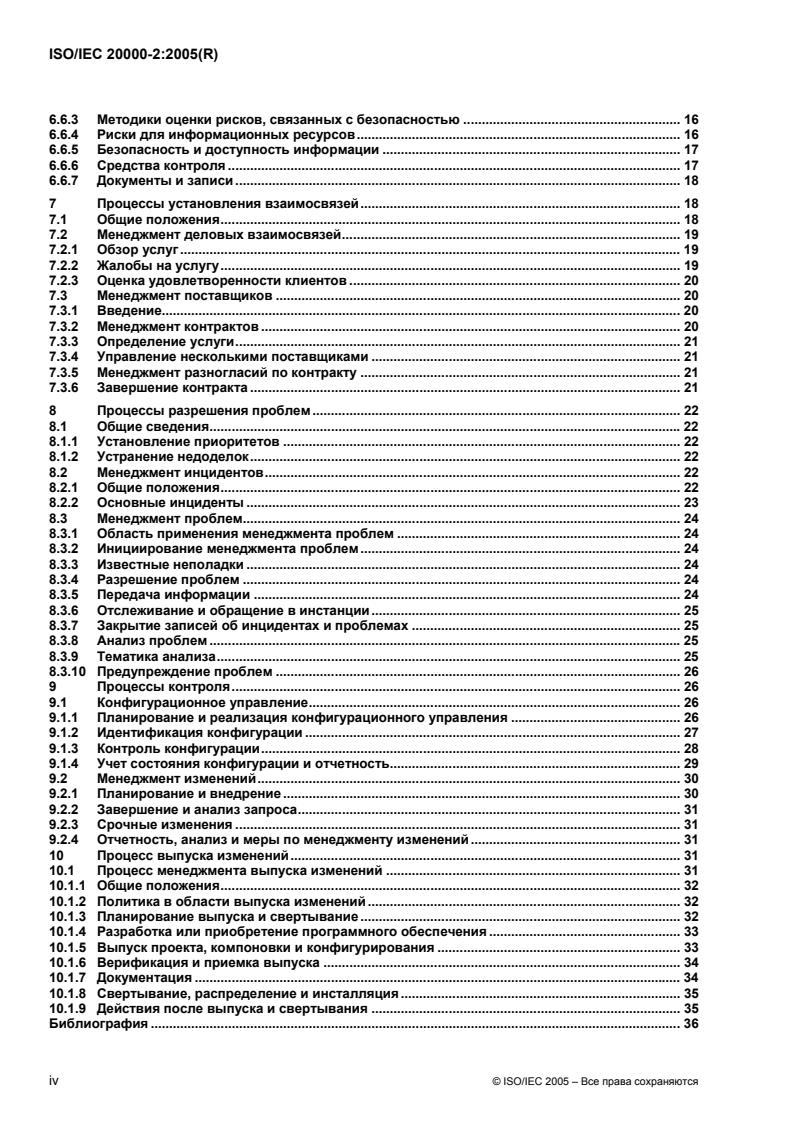
Содержание Страница
Предисловие .v
Введение .vi
1 Область применения .1
2 Термины и определения .2
3 Система менеджмента .2
3.1 Ответственность руководства.2
3.2 Требования к документации.2
3.3 Компетентность, информированность и подготовка персонала .3
3.3.1 Общие положения .3
3.3.2 Профессиональное развитие .3
З.З.З Рассматриваемые подходы .4
4 Планирование и совершенствование менеджмента услуг .4
4.1 Планирование процесса менеджмента услуг (План).4
4.1.1 Область применения менеджмента услуг .4
4.1.2 Подходы к планированию .5
4.1.3 Рассматриваемые события.5
4.1.4 Область применения и содержание плана.5
4.2 Реализация менеджмента услуг и их предоставление (Исполнение).6
4.3 Непрерывный контроль, измерение и проверка (Проверка).6
4.4 Непрерывное совершенствование (Действие) .7
4.4.1 Политика.7
4.4.2 Планирование усовершенствования услуг.7
5 Планирование и реализация новых или измененных услуг .8
5.1 Темы для обсуждения .8
5.2 Записи об изменениях.8
6 Процессы предоставления услуг.8
6.1 Управление уровнем услуг.8
6.1.1 Каталог предоставляемых услуг.8
6.1.2 Соглашения об уровне услуг (SLAs).9
6.1.3 Процесс менеджмента уровня услуг (SLM) .10
6.1.4 Соглашения о дополнительных услугах .11
6.2 Отчетность по услугам.11
6.2.1 Политика.11
6.2.2 Цель и проверки качества отчетов об услуге.11
6.2.3 Отчеты об услугах.12
6.3 Менеджмент непрерывности и доступности услуги .12
6.3.1 Общие положения .12
6.3.2 Непрерывный контроль доступности и предпринимаемые для этого меры,.12
6.3.3 Стратегия непрерывности услуг .13
6.3.4 Планирование и проверка непрерывности услуг.13
6.4 Составление бюджета и бухгалтерский учет услуг IT.14
6.4.1 Общие положения .14
6.4.2 Политика.14
6.4.3 Составление бюджета .15
6.4.4 Бухгалтерский учет .15
6.5 Менеджмент мощностей.15
6.6 Менеджмент системы обеспечения информационной безопасности.16
6.6.1 Общие положения .16
6.6.2 Идентификация и классификация информационных ресурсов.16
© ISO/IEC 2005 – Все права сохраняются iii
6.6.3 Методики оценки рисков, связанных с безопасностью . 16
6.6.4 Риски для информационных ресурсов. 16
6.6.5 Безопасность и доступность информации . 17
6.6.6 Средства контроля . 17
6.6.7 Документы и записи . 18
7 Процессы установления взаимосвязей. 18
7.1 Общие положения. 18
7.2 Менеджмент деловых взаимосвязей. 19
7.2.1 Обзор услуг. 19
7.2.2 Жалобы на услугу. 19
7.2.3 Оценка удовлетворенности клиентов . 20
7.3 Менеджмент поставщиков . 20
7.3.1 Введение. 20
7.3.2 Менеджмент контрактов . 20
7.3.3 Определение услуги. 21
7.3.4 Управление несколькими поставщиками . 21
7.3.5 Менеджмент разногласий по контракту . 21
7.3.6 Завершение контракта . 21
8 Процессы разрешения проблем . 22
8.1 Общие сведения.22
8.1.1 Установление приоритетов . 22
8.1.2 Устранение недоделок. 22
8.2 Менеджмент инцидентов. 22
8.2.1 Общие положения. 22
8.2.2 Основные инциденты . 23
8.3 Менеджмент проблем. 24
8.3.1 Область применения менеджмента проблем . 24
8.3.2 Инициирование менеджмента проблем. 24
8.3.3 Известные неполадки . 24
8.3.4 Разрешение проблем . 24
8.3.5 Передача информации . 24
8.3.6 Отслеживание и обращение в инстанции. 25
8.3.7 Закрытие записей об инцидентах и проблемах . 25
8.3.8 Анализ проблем .25
8.3.9 Тематика анализа. 25
8.3.10 Предупреждение проблем . 26
9 Процессы контроля. 26
9.1 Конфигурационное управление. 26
9.1.1 Планирование и реализация конфигурационного управления . 26
9.1.2 Идентификация конфигурации . 27
9.1.3 Контроль конфигурации. 28
9.1.4 Учет состояния конфигурации и отчетность. 29
9.2 Менеджмент изменений. 30
9.2.1 Планирование и внедрение . 30
9.2.2 Завершение и анализ запроса. 31
9.2.3 Срочные изменения . 31
9.2.4 Отчетность, анализ и меры по менеджменту изменений. 31
10 Процесс выпуска изменений. 31
10.1 Процесс менеджмента выпуска изменений . 31
10.1.1 Общие положения. 32
10.1.2 Политика в области выпуска изменений. 32
10.1.3 Планирование выпуска и свертывание . 32
10.1.4 Разработка или приобретение программного обеспечения . 33
10.1.5 Выпуск проекта, компоновки и конфигурирования . 33
10.1.6 Верификация и приемка выпуска . 34
10.1.7 Документация . 34
10.1.8 Свертывание, распределение и инсталляция . 35
10.1.9 Действия после выпуска и свертывания . 35
Библиография . 36
iv © ISO/IEC 2005 – Все права сохраняются
Предисловие
Международная организация по стандартизации (ISO) и Международная электротехническая комиссия
(IEC) создали специализированную систему всемирной стандартизации. Национальные органы,
являющиеся комитетами-членами ISO или IEC, участвуют в разработке международных стандартов
через технические комитеты, учрежденные соответствующими организациями для того, чтобы
заниматься отдельными областями технической деятельности. Технические комитеты ISO и IEC
сотрудничают между собой в областях, представляющих взаимный интерес. К участию в этой работе
привлекаются и другие правительственные и неправительственные международные организации,
сотрудничающие с ISO и IEC. В области информационных технологий ISO и IEC учредили Совместный
технический комитет ISO/IEC JТC1.
Международные стандарты разрабатываются в соответствии с правилами, приведенными в
Директивах ISO/IEC, Часть 2.
Основная задача совместного технического комитета состоит в подготовке международных
стандартов. Проекты международных стандартов, одобренные совместным Техническим комитетом,
рассылаются комитетам-членам ISO и IEC для голосования. Публикация проектов в качестве
международных стандартов требует утверждения не менее чем 75 % национальных органов,
принимающих участие в голосовании.
Следует обратить внимание на то, что некоторые элементы настоящего международного стандарта
могут быть объектом патентных прав. ISO и IEC не должны нести ответственность за идентификацию
какого-либо одного или всех таких патентных прав.
ISO/IEC 20000-2 был разработан BSI (как BS 15000-2) и принят с использованием “ускоренной”
процедуры совместным техническим комитетом JТC1, Информационные технологии, одновременно с
утверждением его национальными органами.
ISO/IEC 20000 состоит из следующих частей, объединенных общим названием Информационные
технологии. Менеджмент услуг:
— Часть 1. Технические требования
— Часть 2. Свод установленных правил
© ISO/IEC 2005 – Все права сохраняются v
Введение
В качестве свода правил, эта часть стандарта ISO/IEC 20000 принимает форму руководства и
рекомендаций. Ее не следует цитировать в качестве технических требований, и особое внимание
следует уделить тому, чтобы заявления о соответствии не вводили в заблуждение.
Эту часть стандарта ISO/IEC 20000 следует использовать вместе со стандартом ISO/IEC 20000-1,
содержащим технические требования, связанные с установленными правилами.
Предполагается, что выполнение положений этой части поручено персоналу соответствующей
квалификации и компетентности. Международный стандарт не претендует на полноту включения в
него всех необходимых контрактных требований, поэтому пользователи этого стандарта несут
ответственность за их правильное применение.
Соответствие с международным стандартом само по себе не освобождает от каких-либо юридических
обязательств.
Здесь описаны наилучшие правила для выполнения процессов менеджмента услуг, охваченных
областью применения ISO/IEC 20000-1.
Предоставление услуг становится все более важным для клиентов, поскольку им требуются все более
растущие возможности (при минимальных затратах) для удовлетворения своих деловых потребностей.
Признано также, что услуги и их менеджмент существенны для содействия организациям получать
доход и быть экономически эффективными.
ISO/IEC 20000-1-1 содержит технические требования к менеджменту услуг и его следует читать вместе
этой частью ISO/IEC 20000.
Серия стандартов ISO/IEC 20000 помогает провайдерам услуг понять, как повысить качество услуг,
поставляемых клиентам как внутренним, так и внешним.
При увеличении количества зависимых от поддерживающих услуг экономических и социальных
областей и разнообразии существующих технологий провайдеры услуг могут прилагать все усилия,
чтобы поддерживать высокие уровни услуг для своих клиентов. Работая только в ответ на запросы,
они тратят слишком мало времени на планирование, подготовку, анализ, изучение, а также работу с
клиентами. В результате им не удается принять структурированные активные правила работы.
Провайдеры одних и тех же услуг получают просьбы об улучшении качества, более низкой стоимости
услуг, большей гибкости и убыстрении их предоставления. Эффективный менеджмент обеспечивает
более высокий уровень услуг клиентам и удовлетворенности клиентов.
Серия стандартов ISO/IEC 20000 выбирает наилучшие правила для процессов, которые не зависят от
формы и величины организации и организационных наименований и структур. Она применима к
крупным и мелким провайдерам услуг, а требования к процессам менеджмента услуг, выполненным в
соответствии с наилучшими правилами, не изменяются в зависимости от формы организации, что
обеспечивает структуру менеджмента, в рамках которой выполняются процессы.
vi © ISO/IEC 2005 – Все права сохраняются
МЕЖДУНАРОДНЫЙ СТАНДАРТ ISO/IEC 20000-2:2005(R)
Информационные технологии. Менеджмент услуг.
Часть 2.
Свод установленных правил
1 Область применения
Данная часть стандарта ISO/IEC 20000 представляет собой согласованный с отраслями
промышленности документ, касающийся качества процессов менеджмента услуг IT. Эти процессы
предоставляют наилучшую из всех возможных услугу, удовлетворяющую потребности бизнеса в
пределах согласованных ресурсов, т. е. услугу профессиональную, экономически эффективную и с
рисками, которые изучены и управляемы.
Разнообразие терминов, используемых для одного и того же процесса и связи между процессами и
функциональными группами (и наименованиями работ), может запутать неопытного менеджера
относительно предмета менеджмента услуг. Недопонимание терминологии может стать препятствием
для разработки эффективных процессов. Понимание же терминологии приносит ощутимую и
существенную пользу от применения серии стандартов IEC/ISO 20000. Эта ее часть рекомендует
провайдерам услуг принять общую терминологию и использовать единообразный подход к
менеджменту услуг. Это создает общую основу для их усовершенствования, а также обеспечивает
структуру для использования средств менеджмента услуг поставщиками.
Как стандарт на процесс, этот свод установленных правил, не предназначен для оценки продуктов,
однако организации, разрабатывающие средства, продукты и системы менеджмента услуг, могут
использовать как технические требования, так и свод установленных правил в помощь своим
разработкам средств, продуктов и систем, поддерживающих менеджмент услуг, предоставленных в
соответствии с наилучшими установленными правилами.
В данной части стандарта ISO/IEC 20000 содержится руководство для аудиторов и предлагается
помощь провайдерам услуг, планирующим их усовершенствование или подлежащим аудиту по
ISO/IEC 20000-1.
ISO/IEC 20000-1 определяет ряд связанных между собой процессов менеджмента услуг, как
показано на Рисунке 1.
© ISO/IEC 2005 – Все права сохраняются 1
Рисунок 1 — Процессы менеджмента услуг
2 Термины и определения
В рамках данного документа применяются термины и определения, приведенные в стандарте
ISO/IEC 20000-1.
3 Система менеджмента
Цель: Обеспечение системы менеджмента, включая принципы и структуру, способствующие
эффективному менеджменту и внедрению всех услуг IT.
3.1 Ответственность руководства
Роль руководства в обеспечении принятия и поддерживания наилучших установленных правил
является основополагающей для любого провайдера, который выполняет требования стандарта
ISO/IEC 20000-1.
Для обеспечения выполнения обязательств, следует идентифицировать собственника на высшем
уровне в качестве ответственного за плана менеджмента услуг лица. Этому основному ответственному
за эти плана собственнику следует отчитываться за выполнение программ.
В обязанности основного ответственного за предоставление услуг собственника следует включить
комплектование персонала для всей постоянной или основанной на отдельных проектах деятельности
по усовершенствованию услуг.
Работа ответственного за предоставление услуг собственника должна поддерживаться группой
принятия решений, обладающей достаточными полномочиями для определения политики и
реализацию принятых решений.
3.2 Требования к документации
Основному ответственному за предоставление услуг собственнику следует обеспечить наличие
доказательств, для аудита принципов, программ и процедур менеджмента услуг, а также любой
деятельности, связанной с ними.
2 © ISO/IEC 2005 – Все права сохраняются
Большую часть доказательств планирования и операций менеджмента услуг должна быть
документирована в любой форме и на любом носителе, пригодном для документирования.
Обычно для получения доказательств планирования менеджмента услуг считается приемлемым
предоставление документов, касающихся:
а) принципов менеджмента и программ;
в) служебной документации;
с) процедур;
d) процессов;
е) записей по управлению производственными процессами.
Следует разработать процесс создания и менеджмента документации, чтобы обеспечить соответствие
установленным требованиям.
Документацию следует защитить от повреждений вследствие, например, неблагоприятных условий
окружающей среды и выходом из строя компьютера.
3.3 Компетентность, информированность и подготовка персонала
3.3.1 Общие положения
Персоналу, выполняющему работу в рамках плана менеджмента услуг, следует обладать
компетентностью, основанной на соответствующем образовании, подготовке, навыках и опыте.
Провайдер услуг должен:
а) определять необходимую для каждой функции менеджмента услуг компетентность персонала;
b) обеспечивать информированность своих сотрудников о значимости и важности их деятельности в
более широком деловом контексте и о том вкладе, который они вносят в достижение
поставленных целей качества;
с) вести соответствующие записи об образовании, подготовке, навыках и опыте персонала;
d) обеспечивать подготовку или предпринимать другие меры для удовлетворения этих потребностей;
е) оценивать эффективность предпринятых мер.
3.3.2 Профессиональное развитие
Провайдеру услуг следует развивать и повышать уровень профессиональной компетентности своих
сотрудников. Среди мер, предпринимаемых для этого, провайдеру услуг следует осуществлять:
а) комплектование персонала: с целью проверки достоверности предоставляемых претендентами
на занимаемую должность сведений (включая сведения об их профессиональной квалификации) и
определения достоинств претендентов, их недостатков и потенциальных возможностей, в
зависимости от должностной инструкции/профиля предлагаемых работ, задач менеджмента услуг и
общих целей повышения качества услуг;
b) планирование: с целью привлечения персонала к новым или расширяемым услугам (а также к
законтрактованным услугам) с использованием новых информационных технологий закреплять
© ISO/IEC 2005 – Все права сохраняются 3
штат, отвечающий за менеджмент услуг, за коллективами разработчиков проектов, планировать
текучесть кадров и заполнение вакансий, которые могут возникать за счет их текучести;
с) подготовку и повышение профессионального уровня: с целью определения требований к
подготовке и развитию в виде соответствующего плана и обеспечения своевременного и
эффективного их предоставления.
Штат сотрудников должен быть подготовлен для работы в определенных сферах менеджмента услуг
(например, путем обучения на курсах, самообразования, наставничества или обучения на рабочем
месте). Следует развивать в сотрудниках навыки работы в команде и лидерства. Записи об обучении
отдельных сотрудников, ведущиеся в хронологическом порядке, должны сохраняться вместе с
описанием проведенного обучения.
З.З.З Рассматриваемые подходы
Для того чтобы сотрудники достиг приемлемого уровня компетентности, провайдеру услуг следует
принять решение относительно краткосрочного и долговременного комплектования штатов. Ему также
следует принять решение относительно оптимального сочетания новых сотрудников, обладающих
требуемыми навыками, и старых сотрудников, прошедших переподготовку.
ПРИМЕЧАНИЕ Оптимальный баланс персонала при краткосрочном и долговременном комплектовании штата
особенно важен при планировании провайдером услуг кардинальных изменений численности и навыков
вспомогательного персонала.
Факторы, которые следует принять во внимание для установления оптимального баланса персонала,
включают в себя:
a) краткосрочный или долговременный характер новой или измененной компетентности персонала;
b) скорость изменения навыков и компетентности;
с) ожидаемые взлеты и падения рабочей нагрузки и требуемой при этом профессиональной структуры
занятости на основе менеджмента услуг и планирования их усовершенствования;
d) наличие персонала с требуемым уровнем компетентности;
е) скорость перемещения персонала;
f) плана подготовки персонала.
Провайдер услуг должен по крайней мере ежегодно анализировать показатели деятельности каждого
сотрудника своего штата и принимать соответствующие меры.
4 Планирование и совершенствование менеджмента услуг
4.1 Планирование процесса менеджмента услуг (План)
Цель: Планирование менеджмента реализации и предоставления услуг.
4.1.1 Область применения менеджмента услуг
Область применения менеджмента услуг следует определять как часть плана.
Например, область применения может быть определена
а) организацией;
4 © ISO/IEC 2005 – Все права сохраняются
b) местоположением;
с) услугой.
Руководству следует определять область применения как часть своих обязанностей (и как часть
плана менеджмента услуг). Затем область применения следует проверить на предмет соответствия по
стандарту ISO/IEC 20000-1.
ПРИМЕЧАНИЕ Планирование функциональных изменений описано в 9.2.
4.1.2 Подходы к планированию
Вместо одного общего плана или плана можно использовать несколько отдельных программ
менеджмента услуг. В этом случае основные процессы менеджмента услуг следует увязать между
собой. Следует также предусмотреть возможность демонстрации того, как каждое запланированное
требование управляется путем его привязки к соответствующим функциям, ответственностям и
процедурам.
Планированию менеджмента услуг следует быть частью процесса преобразования требований
клиента и намерений высшего руководства услуги, а также обеспечения направления развития
процесса.
В план менеджмента услуг следует включить:
а) внедрение менеджмента услуг (или его части);
b) предоставление процессов менеджмента услуг;
с) изменения в процессах менеджмента услуг;
d) усовершенствование процессов менеджмента услуг;
е) новые услуги (в той степени, в какой они затрагивают процессы в пределах согласованной области
применения менеджмента услуг).
4.1.3 Рассматриваемые события
В плане менеджмента услуг следует учесть как сам процесс менеджмента услуг, так и изменения
услуг, вызываемые такими событиями, как:
а) усовершенствование услуг;
b) изменения услуг;
с) стандартизация инфраструктуры;
d) изменениями в законодательстве;
е) изменения нормативной базы, например, местных налоговых ставок;
f) прекращение регулирования или введение регулирования в отрасли промышленности;
g) слияния компаний и их приобретения.
4.1.4 Область применения и содержание плана
В план менеджмента услуг следует определять:
© ISO/IEC 2005 – Все права сохраняются 5
а) область применения менеджмента услуг у их провайдера;
b) требования и цели, которых необходимо достичь в области менеджмента услуг;
с) ресурсы, средства и бюджеты, необходимые для достижения поставленных целей;
d) структуру функций и обязанностей руководства, включая обязанности основного отвечающего за
предоставление услуг собственника, собственника процесса и руководства поставщика;
е) взаимодействие между процессами менеджмента услуг и способ координации работ и/или
процессов;
f) принятый подход к идентификации, оценке и управлению проблемами и рисками для достижения
намеченных целей;
g) календарное планирование ресурсов по датам, к которым следует обеспечить фонды, навыки и
ресурсы;
h) подход к изменению плана и услуг, определенных в этом плане;
i) способ, которым провайдер услуг должен продемонстрировать непрерывный контроль качества
(например, с помощью промежуточных аудитов);
j) процессы, которые должны быть выполнены;
k) средства, подходящие для поддержания процессов.
4.2 Реализация менеджмента услуг и их предоставление (Исполнение)
Цель: Выполнение задач и плана менеджмента услуг
Реализация процессов менеджмента услуг с использованием наилучших установленных правил,
способных удовлетворять требованиям ISO/IEC 20000, не будет достигнута, если исходные услуги не
отвечают требованиям к реализации в ISO/IEC 20000-1.
Сразу же после внедрения услуга и процессы менеджмента услуг следует поддерживать.
Анализ внедрения следует выполнять в соответствии с 4.3.
ПРИМЕЧАНИЕ Лицо, которое подходит для планирования и начального внедрения, может оказаться
неподходящим для выполнения текущих работ.
4.3 Непрерывный контроль, измерение и проверка (Проверка)
Цель: Непрерывный контроль, измерение и проверку выполнения задач и плана.
Провайдер услуг должен планировать и осуществлять непрерывный контроль, измерение, анализ и
проверку услуги, процессы менеджмента услуг и связанных с ними систем. Элементы, подлежащие
непрерывному контролю и измерению, должны включать в себя:
а) достижение целей в сравнении с заданными показателями;
b) удовлетворенность клиента;
с) использование ресурсов;
d) тенденции;
6 © ISO/IEC 2005 – Все права сохраняются
е) основные несоответствия требованиям.
Результаты анализа должны следует считать входной информацией для плана усовершенствования
услуг.
Помимо деятельности по измерению и анализу в области менеджмента услуг, высшему руководству
может понадобиться использование внутреннего аудита и другие видов проверки. При решении
вопроса о периодичности этих внутренних аудитов и проверок необходимо принимать во внимание
такие факторы, как степень риска, связанного с данным процессом, его частота и предыстория ранее
возникавших проблем. Внутренние аудиты и проверки следует планировать, компетентным образом
выполнять и записывать.
4.4 Непрерывное совершенствование (Действие)
Цель: Повышение эффективности и результативности предоставления и менеджмента услуг.
4.4.1 Политика
Провайдерам услуг следует признать, всегда можно сделать предоставление услуг более
эффективным и результативным. Следует разработать и опубликовать политику в области качества и
усовершенствования услуг.
Всех, кто занимается менеджментом услуг и их усовершенствованием, следует информировать о
политике в области качества услуг и об их персональном вкладе в достижение целей, установленных
ею.
В частности, всему персоналу провайдера, занятому менеджментом услуг, следует иметь четкое
понимание воздействия менеджмента на его процессы.
В собственной структуре менеджмента услуг у провайдера услуг следует предусмотреть установление
эффективной связи клиентов и поставщиков провайдера по вопросам, затрагивающим качество услуг
и требования клиентов.
4.4.2 Планирование усовершенствования услуг
Провайдерам услуг следует принять методический и скоординированный подход к
усовершенствованию услуг, отвечающий требованиям политики, исходя из перспектив для провайдера
и клиентов.
Перед реализацией плана усовершенствования услуг необходимо зарегистрировать исходный
уровень, с которым можно будет сравнивать реальные достижения, которые, в свою очередь, следует
сравнивать с прогнозом, чтобы оценить эффективность внесенных изменений.
ПРИМЕЧАНИЕ 1 Требования к усовершенствованию услуг могут вытекать из всех процессов.
Провайдерам услуг следует стимулировать своих сотрудников и клиентов к выработке предложений по
усовершенствованию услуг.
ПРИМЕЧАНИЕ 2 Это можно сделать используя планы предложений, создание кружков качества, групп
пользователей и проведения совещаний.
Цели усовершенствования услуг должны быть измеряемы, связаны с задачами бизнеса и
документированы в плане.
Усовершенствованием услуг следует активно управлять, а его прогресс непрерывно контролировать и
сверять с официально утвержденными целями.
© ISO/IEC 2005 – Все права сохраняются 7
5 Планирование и реализация новых или измененных услуг
Цель: Обеспечение возможности предоставления и управляемости новых и измененных услуги при
утвержденных затратах и качестве услуг.
5.1 Темы для обсуждения
При планировании новых или изменении существующих услуг следует предусмотреть анализ:
а) бюджетов;
b) людских ресурсов;
с) существующих уровней услуг,
d) SLAs и других целевых показателей или обязательств по услугам;
е) существующих процессов, процедур и документации менеджмента услуг;
f) области применения менеджмента услуг, включая реализацию процессов, ранее исключенных из
области применения.
5.2 Записи об изменениях
Все изменения услуг должны отражаться в записях об изменениях.
Они должны содержать планы, касающиеся:
а) комплектования/переквалификации персонала;
b) перераспределения персонала;
с) обучения пользователей;
d) предоставления информации об изменениях;
е) изменений характера поддерживаемых технологий
f) официального прекращения предоставления услуг.
6 Процессы предоставления услуг
6.1 Управление уровнем услуг
Цель: Определение, согласование, регистрация и управление уровнем предоставления услуг.
6.1.1 Каталог предоставляемых услуг
В каталоге предоставляемых услуг должны указываться все услуги. На него можно ссылаться в SLAs и
использовать его для материала, считающегося непостоянным для самих SLAs.
Каталог следует поддерживать в актуальном состоянии.
ПРИМЕЧАНИЕ Каталог услуг может включать общую информацию, такую как:
а) название услуги;
8 © ISO/IEC 2005 – Все права сохраняются
b) целевые показатели, например, срок реагирования на запрос или установки принтера, срок восстановления
услуги после серьезной неисправности;
с) контактные данные;
d) часы предоставления услуги и перерывы;
е) меры по обеспечению безопасности.
Каталог услуг - это ключевой документ для определения ожиданий клиента, поэтому он должен быть
легко доступным и широко распространяемым как среди клиентов, так и среди вспомогательного
персонала.
6.1.2 Соглашения об уровне услуг (SLAs)
Услугу следует официально регистрировать в соглашении об уровне услуг (SLA). Ответственному
клиенту и представителю провайдера услуг следует официально утвердить SLA. Оно может стать
объектом менеджмента изменений, как и услуга, описанная в нем.
При составлении текста этого соглашения, определении его структуры и постановке задач
определяющими следует руководствоваться потребностями бизнеса клиента и бюджетом. Целевые
показатели, по которым предоставленную услугу следует измерять, определяются исходя из
перспективы клиента.
В SLA следует включать только соответствующую подгруппу целевых показателей для концентрации
внимания на наиболее важных аспектах услуги.
ПРИМЕЧАНИЕ 1 Слишком большое число целевых показателей может создать путаницу и привести к
чрезмерным накладным расходам.
Минимальная информации в SLA или информация, на которую можно дать в нем прямую ссылку,
следующая:
а) краткое описание услуги;
b) срок действия и/или механизм контроля за внесением изменений в SLA;
с) подробное описание полномочий;
d) краткое описание связей, включая отчетность;
е) контактная информация о лицах, уполномоченных работать в непредвиденных случаях,
участвовать в разрешении инцидентов и проблем, восстановлении, а также максимальном
устранении недоделок;
f) часы предоставления услуги, например, с 09:00 до 17:00, даты перерывов (например, выходные
дни государственные праздники), критические ситуации в бизнесе и сверхурочные;
g) плановые и согласованные перерывы, включая уведомления, их число за данный период;
h) ответственность клиента, например, за безопасность;
i) ответственность провайдера услуг и его обязательства (например, относительно мер
безопасности);
j) руководящие указания, касающиеся воздействия и приоритета;
© ISO/IEC 2005 – Все права сохраняются 9
k) процесс обращения в вышестоящие инстанции и рассылки уведомлений;
l) процедура обжалования;
m) целевые показатели для услуг;
n) пределы рабочей нагрузки (верхний и нижний), например способность услуги поддерживать
согласованное число пользователей/объемов работ, пропускная способность системы;
o) подробности управления финансами высокого уровня, например, коды цен и т. д;
p) меры, которые должны предприниматься в случае прерывания услуг;
q) управляющие процедуры;
r) глоссарий терминов;
s) вспомогательные и связанные услуги;
t) любые исключения, относящиеся к условиям, приведенным в SLAs.
ПРИМЕЧАНИЕ 2 На переменную информацию или информацию, общую для многих SLAs (типа контактных
данных), можно дать в них ссылку без влияния на качество процессов управления уровнем услуг (SLM) при
условии, что ссылочные документы также находятся под управлением процесса менеджмента изменений.
ПРИМЕЧАНИЕ 3 Ссылки на план обеспечения непрерывности, подробности бухучета и составления бюджета
обычно даются в SLAs.
ПРИМЕЧАНИЕ 4 Глоссарий терминов обычно приводится в одном месте документа и является общим для всех
документов, включая каталог услуг.
6.1.3 Процесс менеджмента уровня услуг (SLM)
Основные изменения в бизнесе, вызванные, например, ростом деловой активности, реорганизацией и
слиянием компаний, а также изменяющимися требованиями клиента, могут потребовать корректировки
уровня услуг, пересмотра и даже временной приостановки их предоставления. Процесс SLM должен
быть гибким, чтобы вобрать в себя эти изменения. Процесс SLM должен обеспечивать непрерывный
учет интересов клиента со стороны провайдера услуг при планировании, внедрении и текущем
менеджменте предоставления услуг.
Провайдер услуг должен получать информацию, достаточную для понимания им движущих мотивов
бизнеса и требований клиента.
SLM процесс должен управлять и координировать компоненты уровней услуг, включая:
а) соглашение относительно требований к услугам и ожидаемых характеристик рабочей нагрузки;
b) соглашение относительно целевых показателей услуг;
с) результаты измерений и сообщение о достигнутых уровнях, рабочих нагрузках и объяснение
причин неудачи, если согласованные целевые показатели не были достигнуты (см. 6.2);
d) инициирование корректирующих мер;
е) входную информацию для плана усовершенствования услуг.
Данный процесс должен способствовать разработке провайдером услуг и клиентом активного подхода
10 © ISO/IEC 2005 – Все права сохраняются
обеспечивающего их со
...
Questions, Comments and Discussion
Ask us and Technical Secretary will try to provide an answer. You can facilitate discussion about the standard in here.
Loading comments...