

ISO 16145-4:2013
(Main)Ships and marine technology — Protective coatings and inspection method — Part 4: Automated measuring method for the total amount of water-soluble salts
General Information
- Abstract
ISO 16145-4:2013 describes the characteristics of an automated measuring method by using a conductivity meter for the assessment of the total surface density of various water-soluble salts on steel surfaces prior to coating applications for dedicated sea water ballast tanks, void spaces of bulk carriers and oil tankers, and cargo oil tanks of crude tankers in compliance with PSPC stipulated by IMO Res.MSC.215(82), IMO Res.MSC.244(83), and IMO Res.MSC.288(87). This method describes a procedure for rapid evaluation of the surface of steel for the presence of ionic contamination by determining the total concentration of water-soluble ionic contaminants by means of a conductivity test.
- Status
- Published
- Publication Date
- 14-Jan-2013
- Technical Committee
- ISO/TC 8/SC 8 - Ship design
- Drafting Committee
- ISO/TC 8/SC 8 - Ship design
- Current Stage
- 9093 - International Standard confirmed
- Start Date
- 06-Dec-2023
- Completion Date
- 29-Aug-2026
Overview
ISO 16145-4:2013 is an international standard developed by the International Organization for Standardization (ISO) addressing the automated measurement method for assessing total water-soluble salts on steel surfaces prior to the application of protective coatings. Part of the ISO 16145 series on ships and marine technology, this standard is intended for new building stages and supports compliance with the Performance Standard for Protective Coatings (PSPC) as stipulated by the International Maritime Organization (IMO) resolutions, including Res.MSC.215(82), Res.MSC.244(83), and Res.MSC.288(87).
The standard provides clear technical requirements and guidance for rapid, accurate, and automated measurement, using a conductivity meter, to ensure steel surfaces are adequately cleaned of ionic contaminants-such as chlorides and sulfates-before coating applications in critical marine environments.
Key Topics
Purpose and Scope
ISO 16145-4:2013 covers automated methods to measure the overall surface density of water-soluble salts on steel, critical for maintaining the integrity of protective coatings in ballast tanks, void spaces, and cargo oil tanks.Measurement Principle
The method uses a specially designed detector and a conductivity meter. Salts are dissolved from a steel surface using water and the conductivity of the extract is measured, indicating the presence and quantity of ionic contaminants.Instrumentation and Requirements
- Use of standardized solutions for calibration and verification
- Detectors with defined areas, electrodes, and temperature sensors
- Conductivity meters with specific measurement ranges, accuracy, and calibration intervals
- Use of high-purity water (at least ISO 3696 grade 3) for extraction and instrument cleaning
Procedures
- Blank tests for instrument baseline
- Consistent extraction techniques as per manufacturer instructions
- Cleaning protocols between measurements
- Direct-reading instruments or calculations based on conductivity differences
Result Expression
Results are displayed in units such as mS/m, μS/cm, mg/m², or μg/cm², enabling clear assessment of the total amount of water-soluble salts.
Applications
ISO 16145-4:2013 serves multiple practical roles within the marine industry:
- Shipyards and Shipbuilders: Ensures steel surfaces meet PSPC requirements, leading to extended coating life and reduced maintenance costs for seawater ballast tanks, bulk carrier void spaces, and oil tankers.
- Coating Manufacturers and Applicators: Enables verification of surface preparation, ensuring optimal coating performance and reduced risk of premature coating failures.
- Coating Inspectors: Provides a repeatable and standardized method for evaluating surface cleanliness, supporting compliance audits and quality assurance.
- Regulatory Compliance: Fulfills mandatory requirements under various IMO performance standards, contributing to vessel safety and environmental protection.
- Alternatives to Manual Methods: Offers rapid, automated measurement as an alternative to manual Bresle method and is recognized as equivalent to ISO 8502-9 under certain conditions.
Related Standards
Users of ISO 16145-4:2013 may also reference the following standards for related procedures and guidance:
- ISO 8502-9:1998: Field method for the conductometric determination of water-soluble salts
- ISO 3696: Water for analytical laboratory use - Specification and test methods
- NACE SP0508:2010: Methods of Validating Equivalence to ISO 8502-9 on Measurement of the Levels of Soluble Salts
- ISO 8502-6: Extraction of soluble contaminants for analysis - The Bresle method
- Other Parts of the ISO 16145 Series: Covering specific requirements for dedicated seawater ballast tanks (Part 1), void spaces (Part 2), cargo oil tanks (Part 3), and assessment of damaged coatings (Part 5, under development)
By integrating ISO 16145-4:2013, organizations can ensure that vessel coatings are applied to surfaces of verified cleanliness, ultimately improving corrosion resistance, coating longevity, and regulatory compliance in demanding marine environments.
Get Certified
Connect with accredited certification bodies for this standard

DNV
DNV is an independent assurance and risk management provider.

Lloyd's Register
Lloyd's Register is a global professional services organisation specialising in engineering and technology.

FSC International
Forest Stewardship Council certification.
Sponsored listings
Frequently Asked Questions
ISO 16145-4:2013 is a standard published by the International Organization for Standardization (ISO). Its full title is "Ships and marine technology — Protective coatings and inspection method — Part 4: Automated measuring method for the total amount of water-soluble salts". This standard covers: ISO 16145-4:2013 describes the characteristics of an automated measuring method by using a conductivity meter for the assessment of the total surface density of various water-soluble salts on steel surfaces prior to coating applications for dedicated sea water ballast tanks, void spaces of bulk carriers and oil tankers, and cargo oil tanks of crude tankers in compliance with PSPC stipulated by IMO Res.MSC.215(82), IMO Res.MSC.244(83), and IMO Res.MSC.288(87). This method describes a procedure for rapid evaluation of the surface of steel for the presence of ionic contamination by determining the total concentration of water-soluble ionic contaminants by means of a conductivity test.
ISO 16145-4:2013 describes the characteristics of an automated measuring method by using a conductivity meter for the assessment of the total surface density of various water-soluble salts on steel surfaces prior to coating applications for dedicated sea water ballast tanks, void spaces of bulk carriers and oil tankers, and cargo oil tanks of crude tankers in compliance with PSPC stipulated by IMO Res.MSC.215(82), IMO Res.MSC.244(83), and IMO Res.MSC.288(87). This method describes a procedure for rapid evaluation of the surface of steel for the presence of ionic contamination by determining the total concentration of water-soluble ionic contaminants by means of a conductivity test.
ISO 16145-4:2013 is classified under the following ICS (International Classification for Standards) categories: 47.020.99 - Other standards related to shipbuilding and marine structures. The ICS classification helps identify the subject area and facilitates finding related standards.
ISO 16145-4:2013 is available in PDF format for immediate download after purchase. The document can be added to your cart and obtained through the secure checkout process. Digital delivery ensures instant access to the complete standard document.
Standards Content (Sample)
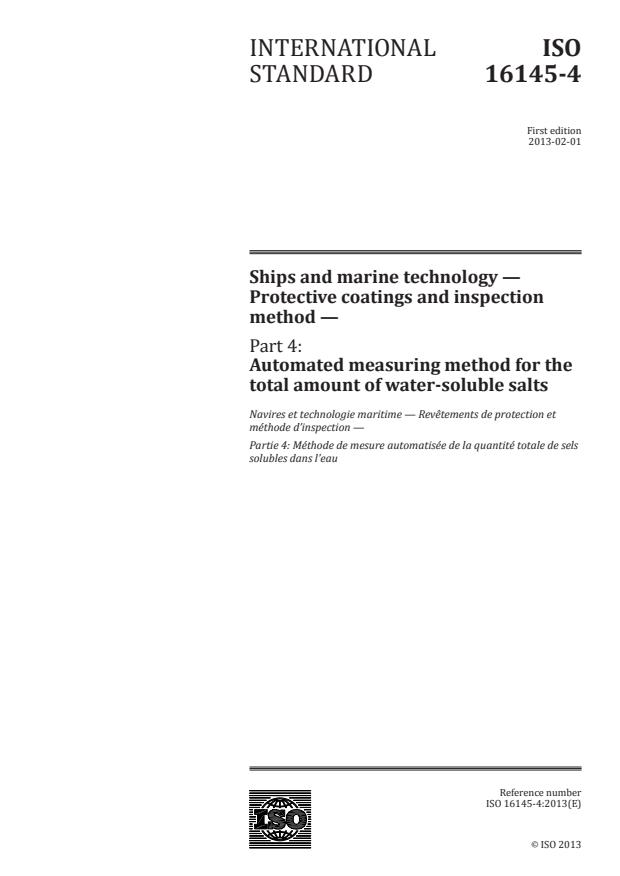
INTERNATIONAL ISO
STANDARD 16145-4
First edition
2013-02-01
Ships and marine technology —
Protective coatings and inspection
method —
Part 4:
Automated measuring method for the
total amount of water-soluble salts
Navires et technologie maritime — Revêtements de protection et
méthode d’inspection —
Partie 4: Méthode de mesure automatisée de la quantité totale de sels
solubles dans l’eau
Reference number
©
ISO 2013
© ISO 2013
All rights reserved. Unless otherwise specified, no part of this publication may be reproduced or utilized in any form or by any
means, electronic or mechanical, including photocopying and microfilm, without permission in writing from either ISO at the
address below or ISO’s member body in the country of the requester.
ISO copyright office
Case postale 56 • CH-1211 Geneva 20
Tel. + 41 22 749 01 11
Fax + 41 22 749 09 47
E-mail copyright@iso.org
Web www.iso.org
Published in Switzerland
ii © ISO 2013 – All rights reserved
Contents Page
Foreword .iv
Introduction .v
1 Scope . 1
2 Normative references . 1
3 Terms and definitions . 1
4 Principle of measurement . 2
5 General requirements . 2
5.1 Standard solutions . 2
5.2 Composition of detector . 2
5.3 Conductivity meter . 2
5.4 Water . 2
6 Measurement procedure . 2
6.1 General . 2
6.2 Blank test . 3
6.3 General requirements of extraction of salts from the steel surface . 3
6.4 Conductivity measurement . 3
6.5 Cleaning of the detector . 3
7 Expression of results . 3
7.1 Measurement with direct reading from instrument . 3
7.2 Calculation results . . 3
Bibliography . 5
Foreword
ISO (the International Organization for Standardization) is a worldwide federation of national standards
bodies (ISO member bodies). The work of preparing International Standards is normally carried out
through ISO technical committees. Each member body interested in a subject for which a technical
committee has been established has the right to be represented on that committee. International
organizations, governmental and non-governmental, in liaison with ISO, also take part in the work.
ISO collaborates closely with the International Electrotechnical Commission (IEC) on all matters of
electrotechnical standardization.
International Standards are drafted in accordance with the rules given in the ISO/IEC Directives, Part 2.
The main task of technical committees is to prepare International Standards. Draft International
Standards adopted by the technical committees are circulated to the member bodies for voting.
Publication as an International Standard requires approval by at least 75 % of the member bodies
casting a vote.
Attention is drawn to the possibility that some of the elements of this document may be the subject of
patent rights. ISO shall not be held responsible for identifying any or all such patent rights.
ISO 16145-4 was prepared by Technical Committee ISO/TC 8, Ships and marine technology, Subcommittee
SC 8, Ship design.
ISO 16145 consists of the following parts, under the general title Ships and marine technology — Protective
coatings and inspection method:
— Part 1: Dedicated sea water ballast tanks
— Part 2: Void spaces of bulk carriers and oil tankers
— Part 3: Cargo oil tanks of crude oil tankers
— Part 4: Automated measuring method for the total amount of water-soluble salts
The following part is under preparation:
— Part 5: Assessment and calculating method for damaged coating areas of ballast tanks
iv © ISO 2013 – All rights reserved
Introduction
The ISO 16145 series addresses qualified coating and inspection works in accordance with the
requirement of IMO PSPC.
Technical Committee ISO/TC 8, Ships and marine technology, SC 8, Ship design, has decided to standardize
a coating and inspection method for the IMO PSPC series.
Coating quality itself depends largely on the surface preparation and coating application. Therefore,
the right application of surface preparation and coating in accordance with the coating manufacturer’s
recommendations, including inspections at each step, are of vital importance.
This part of ISO 16145 is intended to serve as a standard for ship owners, shipyards, coating manufacturers,
coating inspectors and coating applicators in applying IMO PSPC in the new building stage.
...