

ISO 10110-9:2016
(Main)Optics and photonics — Preparation of drawings for optical elements and systems — Part 9: Surface treatment and coating
General Information
- Abstract
ISO 10110-9:2016 specifies the presentation of design and functional requirements for optical elements and systems in technical drawings used for manufacturing and inspection. It specifies rules for indicating the treatments and coatings applied to optical surfaces for functional and/or protective purposes.
- Status
- Published
- Publication Date
- 06-Jul-2016
- Technical Committee
- ISO/TC 172/SC 1 - Fundamental standards
- Current Stage
- 9092 - International Standard to be revised
- Start Date
- 11-Dec-2025
- Completion Date
- 29-Aug-2026
Buy Documents
ISO 10110-9:2016 - Optics and photonics -- Preparation of drawings for optical elements and systems
ISO 10110-9:2016 - Optics and photonics — Preparation of drawings for optical elements and systems — Part 9: Surface treatment and coating/7/2016
ISO 10110-9:2016 - Optique et photonique -- Indications sur les dessins pour éléments et systèmes optiques
ISO 10110-9:2016 - Optique et photonique — Indications sur les dessins pour éléments et systèmes optiques — Partie 9: Traitement de surface et revêtement/7/2016
Overview
ISO 10110-9:2016 - part of the ISO 10110 series for optics and photonics - defines how to indicate surface treatments and optical coatings on technical drawings used for manufacturing and inspection. The standard specifies presentation rules for functional coatings (antireflective, reflective, filtering, polarizing, etc.) and protective surface treatments, how to reference coating specifications, and how coating-related dimensions and imperfections should be represented.
Key topics and requirements
- Scope and intent: Indications apply to the finished product unless the drawing explicitly states otherwise (dimensions refer to part after coating).
- Presentation formats:
- Preferred: tabular field in the drawing (per ISO 10110-1) for functional coating data.
- Alternative: drawing field box or a separate coating specification document for complex requirements.
- Symbols and notation:
- Use the spectral function symbols τ(λ) (spectral transmittance), ρ(λ) (spectral reflectance) and α(λ) (spectral absorptance). Where confusion may occur, T(λ), R(λ), A(λ) are permitted.
- Wavelengths must be given in nanometres (nm).
- Functional coatings are indicated with a designated coating symbol (per ISO 9211‑1) with a leader line to a specification box.
- Protective treatments are shown by a thick “chain” line (line type 04.2, ISO 128‑24) adjacent to the surface, linked to a box with the treatment description.
- Surface-area and tolerance: Coating extent normally covers the optically effective surface; toleranced dimensions should be provided when necessary or when different zones on a single surface require different coatings.
- Imperfections and acceptability: Coating imperfection acceptance is specified via ISO 10110‑7 with defect definitions from ISO 9211‑1.
- Examples and templates: Annexes A–D include lists of functional coating types, tabular examples, and sample coating specification documents.
Applications and users
ISO 10110‑9 is used by:
- Optical designers and systems engineers for unambiguous coating requirements.
- Mechanical and optical drafters preparing manufacturing drawings.
- Coating engineers and vendors who produce and test thin-film optical coatings.
- Quality, inspection and procurement teams verifying incoming parts and supplier deliverables. Practical uses include specifying AR coatings for lenses, reflective coatings for mirrors, dichroics, filters, protective paints/platings for rear mirrors, and creating referenced coating spec documents for complex multilayer stacks.
Related standards
- ISO 10110‑1 (general drawing presentation)
- ISO 9211‑1 / ISO 9211‑2 (optical coating definitions and optical properties)
- ISO 128‑24 (drawing line types)
- ISO 10110‑7 (coating imperfection tolerances)
- ISO 9211 parts on durability and test methods for coatings
Keywords: ISO 10110-9, optical coatings, surface treatment, technical drawings, coating specification, functional coatings, protective treatments, spectral transmittance, optics and photonics.
Relations
- Effective Date
- 16-Feb-2013
Buy Documents
ISO 10110-9:2016 - Optics and photonics -- Preparation of drawings for optical elements and systems
ISO 10110-9:2016 - Optics and photonics — Preparation of drawings for optical elements and systems — Part 9: Surface treatment and coating/7/2016
ISO 10110-9:2016 - Optique et photonique -- Indications sur les dessins pour éléments et systèmes optiques
ISO 10110-9:2016 - Optique et photonique — Indications sur les dessins pour éléments et systèmes optiques — Partie 9: Traitement de surface et revêtement/7/2016
Frequently Asked Questions
ISO 10110-9:2016 is a standard published by the International Organization for Standardization (ISO). Its full title is "Optics and photonics — Preparation of drawings for optical elements and systems — Part 9: Surface treatment and coating". This standard covers: ISO 10110-9:2016 specifies the presentation of design and functional requirements for optical elements and systems in technical drawings used for manufacturing and inspection. It specifies rules for indicating the treatments and coatings applied to optical surfaces for functional and/or protective purposes.
ISO 10110-9:2016 specifies the presentation of design and functional requirements for optical elements and systems in technical drawings used for manufacturing and inspection. It specifies rules for indicating the treatments and coatings applied to optical surfaces for functional and/or protective purposes.
ISO 10110-9:2016 is classified under the following ICS (International Classification for Standards) categories: 01.100.20 - Mechanical engineering drawings; 37.020 - Optical equipment. The ICS classification helps identify the subject area and facilitates finding related standards.
ISO 10110-9:2016 has the following relationships with other standards: It is inter standard links to ISO 10110-9:1996. Understanding these relationships helps ensure you are using the most current and applicable version of the standard.
ISO 10110-9:2016 is available in PDF format for immediate download after purchase. The document can be added to your cart and obtained through the secure checkout process. Digital delivery ensures instant access to the complete standard document.
Standards Content (Sample)
INTERNATIONAL ISO
STANDARD 10110-9
Second edition
2016-07-15
Optics and photonics — Preparation
of drawings for optical elements and
systems —
Part 9:
Surface treatment and coating
Optique et photonique — Indications sur les dessins pour éléments et
systèmes optiques —
Partie 9: Traitement de surface et revêtement
Reference number
©
ISO 2016
© ISO 2016, Published in Switzerland
All rights reserved. Unless otherwise specified, no part of this publication may be reproduced or utilized otherwise in any form
or by any means, electronic or mechanical, including photocopying, or posting on the internet or an intranet, without prior
written permission. Permission can be requested from either ISO at the address below or ISO’s member body in the country of
the requester.
ISO copyright office
Ch. de Blandonnet 8 • CP 401
CH-1214 Vernier, Geneva, Switzerland
Tel. +41 22 749 01 11
Fax +41 22 749 09 47
copyright@iso.org
www.iso.org
ii © ISO 2016 – All rights reserved
Contents Page
Foreword .iv
1 Scope . 1
2 Normative references . 1
3 Terms and definitions . 1
4 General . 1
5 Indications in drawings . 2
5.1 General . 2
5.2 Indication of functional coatings . 2
5.3 Indication of protective treatments . 3
6 Imperfections of functional coatings. 3
7 Examples . 3
Annex A (informative) Functional coatings (from ISO 9211-1:2010) . 5
Annex B (informative) Example for an optical drawing using the indication of functional
coatings in tabular form . 6
Annex C (informative) Example for a coating specification document . 7
Annex D (informative) Example of a functional coating indication showing two different
coatings on the same surface . 8
Bibliography . 9
Foreword
ISO (the International Organization for Standardization) is a worldwide federation of national standards
bodies (ISO member bodies). The work of preparing International Standards is normally carried out
through ISO technical committees. Each member body interested in a subject for which a technical
committee has been established has the right to be represented on that committee. International
organizations, governmental and non-governmental, in liaison with ISO, also take part in the work.
ISO collaborates closely with the International Electrotechnical Commission (IEC) on all matters of
electrotechnical standardization.
The procedures used to develop this document and those intended for its further maintenance are
described in the ISO/IEC Directives, Part 1. In particular the different approval criteria needed for the
different types of ISO documents should be noted. This document was drafted in accordance with the
editorial rules of the ISO/IEC Directives, Part 2 (see www.iso.org/directives).
Attention is drawn to the possibility that some of the elements of this document may be the subject of
patent rights. ISO shall not be held responsible for identifying any or all such patent rights. Details of
any patent rights identified during the development of the document will be in the Introduction and/or
on the ISO list of patent declarations received (see www.iso.org/patents).
Any trade name used in this document is information given for the convenience of users and does not
constitute an endorsement.
For an explanation on the meaning of ISO specific terms and expressions related to conformity
assessment, as well as information about ISO’s adherence to the WTO principles in the Technical
Barriers to Trade (TBT) see the following URL: Foreword - Supplementary information
The committee responsible for this document is ISO/TC 172, Optics and photonics, Subcommittee SC 1,
Fundamental standards.
This second edition cancels and replaces the first edition (ISO 10110-9:1996), which has been
technically revised with the following changes:
a) the referencing of optical coating standards ISO 9211-1 and ISO 9211-2;
b) the description of functional coatings in tabular form as described in ISO 10110-1;
c) a complete revision of all drawings;
d) the addition of Annexes A to D which show examples for optical drawings and coating specification
documents.
ISO 10110 consists of the following parts, under the general title Optics and photonics — Preparation of
drawings for optical elements and systems:
— Part 1: General
— Part 2: Material imperfections — Stress birefringence
— Part 3: Material imperfections — Bubbles and inclusions
— Part 4: Material imperfections — lnhomogeneity and striae
— Part 5: Surface form tolerances
— Part 6: Centring tolerances
— Part 7: Surface imperfection tolerances
— Part 8: Surface texture; roughness and waviness
— Part 9: Surface treatment and coating
iv © ISO 2016 – All rights reserved
— Part 10: Table representing data of optical elements and cemented assemblies
— Part 11: Non-toleranced data
— Part 12: Aspheric surfaces
— Part 14: Wavefront deformation tolerance
— Part 17: Laser irradiation damage threshold
— Part 19: General description of surfaces and components
INTERNATIONAL STANDARD ISO 10110-9:2016(E)
Optics and photonics — Preparation of drawings for
optical elements and systems —
Part 9:
Surface treatment and coating
1 Scope
ISO 10110 specifies the presentation of design and functional requirements for optical elements and
systems in technical drawings used for manufacturing and inspection.
This part of ISO 10110 specifies rules for indicating the treatments and coatings applied to optical
surfaces for functional and/or protective purposes.
2 Normative references
The following documents, in whole or in part, are normatively referenced in this document and are
indispensable for its application. For dated references, only the edition cited applies. For undated
references, the latest edition of the referenced document (including any amendments) applies.
ISO 128-24, Technical drawings — General principles of presentation — Part 24: Lines on mechanical
engineering drawings
ISO 9211-1:2010, Optics and photonics — Optical coatings — Part 1: Definitions
ISO 9211-2, Optics and photonics — Optical coatings — Part 2: Optical properties
3 Terms and definitions
For the purposes of this document, the terms and definitions given in ISO 9211-1 and the following apply.
3.1
functional coating
thin film deposited to affect surface refle
...
INTERNATIONAL ISO
STANDARD 10110-9
Second edition
2016-07-15
Optics and photonics — Preparation
of drawings for optical elements and
systems —
Part 9:
Surface treatment and coating
Optique et photonique — Indications sur les dessins pour éléments et
systèmes optiques —
Partie 9: Traitement de surface et revêtement
Reference number
©
ISO 2016
© ISO 2016, Published in Switzerland
All rights reserved. Unless otherwise specified, no part of this publication may be reproduced or utilized otherwise in any form
or by any means, electronic or mechanical, including photocopying, or posting on the internet or an intranet, without prior
written permission. Permission can be requested from either ISO at the address below or ISO’s member body in the country of
the requester.
ISO copyright office
Ch. de Blandonnet 8 • CP 401
CH-1214 Vernier, Geneva, Switzerland
Tel. +41 22 749 01 11
Fax +41 22 749 09 47
copyright@iso.org
www.iso.org
ii © ISO 2016 – All rights reserved
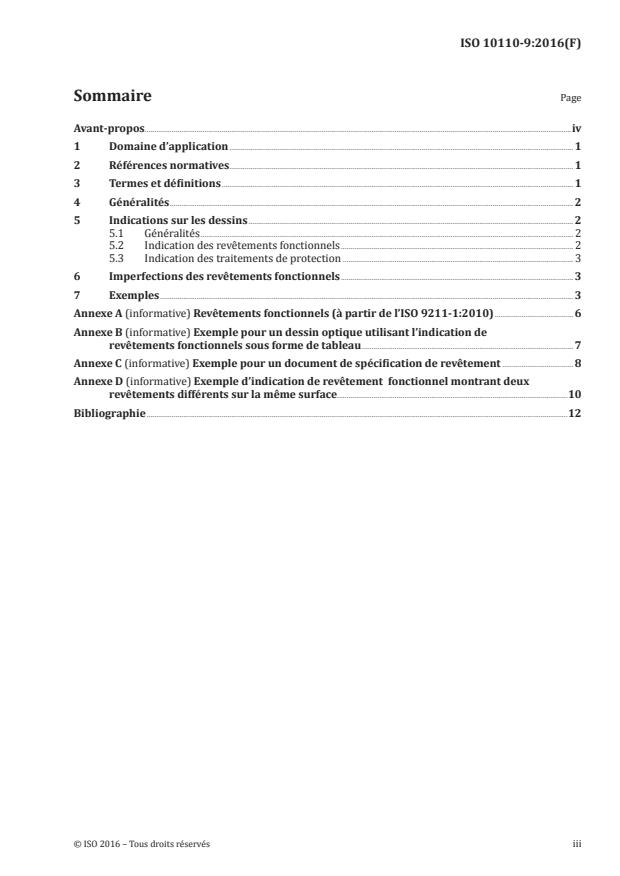
Contents Page
Foreword .iv
1 Scope . 1
2 Normative references . 1
3 Terms and definitions . 1
4 General . 1
5 Indications in drawings . 2
5.1 General . 2
5.2 Indication of functional coatings . 2
5.3 Indication of protective treatments . 3
6 Imperfections of functional coatings. 3
7 Examples . 3
Annex A (informative) Functional coatings (from ISO 9211-1:2010) . 5
Annex B (informative) Example for an optical drawing using the indication of functional
coatings in tabular form . 6
Annex C (informative) Example for a coating specification document . 7
Annex D (informative) Example of a functional coating indication showing two different
coatings on the same surface . 8
Bibliography . 9
Foreword
ISO (the International Organization for Standardization) is a worldwide federation of national standards
bodies (ISO member bodies). The work of preparing International Standards is normally carried out
through ISO technical committees. Each member body interested in a subject for which a technical
committee has been established has the right to be represented on that committee. International
organizations, governmental and non-governmental, in liaison with ISO, also take part in the work.
ISO collaborates closely with the International Electrotechnical Commission (IEC) on all matters of
electrotechnical standardization.
The procedures used to develop this document and those intended for its further maintenance are
described in the ISO/IEC Directives, Part 1. In particular the different approval criteria needed for the
different types of ISO documents should be noted. This document was drafted in accordance with the
editorial rules of the ISO/IEC Directives, Part 2 (see www.iso.org/directives).
Attention is drawn to the possibility that some of the elements of this document may be the subject of
patent rights. ISO shall not be held responsible for identifying any or all such patent rights. Details of
any patent rights identified during the development of the document will be in the Introduction and/or
on the ISO list of patent declarations received (see www.iso.org/patents).
Any trade name used in this document is information given for the convenience of users and does not
constitute an endorsement.
For an explanation on the meaning of ISO specific terms and expressions related to conformity
assessment, as well as information about ISO’s adherence to the WTO principles in the Technical
Barriers to Trade (TBT) see the following URL: Foreword - Supplementary information
The committee responsible for this document is ISO/TC 172, Optics and photonics, Subcommittee SC 1,
Fundamental standards.
This second edition cancels and replaces the first edition (ISO 10110-9:1996), which has been
technically revised with the following changes:
a) the referencing of optical coating standards ISO 9211-1 and ISO 9211-2;
b) the description of functional coatings in tabular form as described in ISO 10110-1;
c) a complete revision of all drawings;
d) the addition of Annexes A to D which show examples for optical drawings and coating specification
documents.
ISO 10110 consists of the following parts, under the general title Optics and photonics — Preparation of
drawings for optical elements and systems:
— Part 1: General
— Part 2: Material imperfections — Stress birefringence
— Part 3: Material imperfections — Bubbles and inclusions
— Part 4: Material imperfections — lnhomogeneity and striae
— Part 5: Surface form tolerances
— Part 6: Centring tolerances
— Part 7: Surface imperfection tolerances
— Part 8: Surface texture; roughness and waviness
— Part 9: Surface treatment and coating
iv © ISO 2016 – All rights reserved
— Part 10: Table representing data of optical elements and cemented assemblies
— Part 11: Non-toleranced data
— Part 12: Aspheric surfaces
— Part 14: Wavefront deformation tolerance
— Part 17: Laser irradiation damage threshold
— Part 19: General description of surfaces and components
INTERNATIONAL STANDARD ISO 10110-9:2016(E)
Optics and photonics — Preparation of drawings for
optical elements and systems —
Part 9:
Surface treatment and coating
1 Scope
ISO 10110 specifies the presentation of design and functional requirements for optical elements and
systems in technical drawings used for manufacturing and inspection.
This part of ISO 10110 specifies rules for indicating the treatments and coatings applied to optical
surfaces for functional and/or protective purposes.
2 Normative references
The following documents, in whole or in part, are normatively referenced in this document and are
indispensable for its application. For dated references, only the edition cited applies. For undated
references, the latest edition of the referenced document (including any amendments) applies.
ISO 128-24, Technical drawings — General principles of presentation — Part 24: Lines on mechanical
engineering drawings
ISO 9211-1:2010, Optics and photonics — Optical coatings — Part 1: Definitions
ISO 9211-2, Optics and photonics — Optical coatings — Part 2: Optical properties
3 Terms and definitions
For the purposes of this document, the terms and definitions given in ISO 9211-1 and the following apply.
3.1
functional coating
thin film deposited to affect surface refle
...
NORME ISO
INTERNATIONALE 10110-9
Deuxième édition
2016-07-15
Optique et photonique — Indications
sur les dessins pour éléments et
systèmes optiques —
Partie 9:
Traitement de surface et revêtement
Optics and photonics — Preparation of drawings for optical elements
and systems —
Part 9: Surface treatment and coating
Numéro de référence
©
ISO 2016
DOCUMENT PROTÉGÉ PAR COPYRIGHT
© ISO 2016, Publié en Suisse
Droits de reproduction réservés. Sauf indication contraire, aucune partie de cette publication ne peut être reproduite ni utilisée
sous quelque forme que ce soit et par aucun procédé, électronique ou mécanique, y compris la photocopie, l’affichage sur
l’internet ou sur un Intranet, sans autorisation écrite préalable. Les demandes d’autorisation peuvent être adressées à l’ISO à
l’adresse ci-après ou au comité membre de l’ISO dans le pays du demandeur.
ISO copyright office
Ch. de Blandonnet 8 • CP 401
CH-1214 Vernier, Geneva, Switzerland
Tel. +41 22 749 01 11
Fax +41 22 749 09 47
copyright@iso.org
www.iso.org
ii © ISO 2016 – Tous droits réservés
Sommaire Page
Avant-propos .iv
1 Domaine d’application . 1
2 Références normatives . 1
3 Termes et définitions . 1
4 Généralités . 2
5 Indications sur les dessins . 2
5.1 Généralités . 2
5.2 Indication des revêtements fonctionnels . 2
5.3 Indication des traitements de protection . 3
6 Imperfections des revêtements fonctionnels . 3
7 Exemples . 3
Annexe A (informative) Revêtements fonctionnels (à partir de l’ISO 9211-1:2010) .6
Annexe B (informative) Exemple pour un dessin optique utilisant l’indication de
revêtements fonctionnels sous forme de tableau . 7
Annexe C (informative) Exemple pour un document de spécification de revêtement .8
Annexe D (informative) Exemple d’indication de revêtement fonctionnel montrant deux
revêtements différents sur la même surface.10
Bibliographie .12
Avant-propos
L’ISO (Organisation internationale de normalisation) est une fédération mondiale d’organismes
nationaux de normalisation (comités membres de l’ISO). L’élaboration des Normes internationales est
en général confiée aux comités techniques de l’ISO. Chaque comité membre intéressé par une étude
a le droit de faire partie du comité technique créé à cet effet. Les organisations internationales,
gouvernementales et non gouvernementales, en liaison avec l’ISO participent également aux travaux.
L’ISO collabore étroitement avec la Commission électrotechnique internationale (IEC) en ce qui
concerne la normalisation électrotechnique.
Les procédures utilisées pour élaborer le présent document et celles destinées à sa mise à jour sont
décrites dans les Directives ISO/IEC, Partie 1. Il convient, en particulier de prendre note des différents
critères d’approbation requis pour les différents types de documents ISO. Le présent document a été
rédigé conformément aux règles de rédaction données dans les Directives ISO/IEC, Partie 2 (voir www.
iso.org/directives).
L’attention est appelée sur le fait que certains des éléments du présent document peuvent faire l’objet de
droits de propriété intellectuelle ou de droits analogues. L’ISO ne saurait être tenue pour responsable
de ne pas avoir identifié de tels droits de propriété et averti de leur existence. Les détails concernant
les références aux droits de propriété intellectuelle ou autres droits analogues identifiés lors de
l’élaboration du document sont indiqués dans l’Introduction et/ou dans la liste des déclarations de
brevets reçues par l’ISO (voir www.iso.org/brevets).
Les appellations commerciales éventuellement mentionnées dans le présent document sont données
pour information, par souci de commodité, à l’intention des utilisateurs et ne sauraient constituer un
engagement.
Pour une explication de la signification des termes et expressions spécifiques de l’ISO liés à
l’évaluation de la conformité, ou pour toute information au sujet de l’adhésion de l’ISO aux principes
de l’OMC concernant les obstacles techniques au commerce (OTC), voir le lien suivant: Avant-propos —
Informations supplémentaires.
Le comité technique responsable de l’élaboration du présent document est l’ISO/TC 172, Optique et
photonique, Sous-Comité SC 1, Normes fondamentales.
Cette deuxième édition annule et remplace la première édition (ISO 10110-9:1996), qui a fait l’objet
d’une révision technique avec les changements suivants:
a) le référencement aux normes de traitement optique ISO 9211-1 et ISO 9211-2;
b) la description de revêtements fonctionnels sous forme de tableau comme décrit dans l’ISO 10110-1;
c) une révision complète de tous les dessins;
d) l’ajout des Annexes A à D qui montrent des exemples pour les dessins optiques et les documents de
spécification de revêtement.
L’ISO 10110 comprend les parties suivantes, présentées sous le titre général Optique et photonique —
Indications sur les dessins pour éléments et systèmes optiques:
— Partie 1: Généralités
— Partie 2: Imperfections des matériaux — Biréfringence sous contrainte
— Partie 3: Imperfections des matériaux — Bulles et inclusions
— Partie 4: Imperfections des matériaux — Hétérogénéités et stries
— Partie 5: Tolérances de forme de surface
— Partie 6: Tolérances de centrage
iv © ISO 2016 – Tous droits réservés
— Partie 7: Tolérances d’imperfection de surface
— Partie 8: État de surface; rugosité et ondulation
— Partie 9: Traitement de surface et revêtement
— Partie 10: Tableau représentant les données d’éléments optiques et d’assemblages collés
— Partie 11: Données non tolérancées
— Partie 12: Surfaces asphériques
— Partie 14: Tolérance de déformation du front d’onde
— Partie 17: Seuil de dommage au rayonnement laser
— Partie 19: Description générale des surfaces et des composants
NORME INTERNATIONALE ISO 10110-9:2016(F)
Optique et photonique — Indications sur les dessins pour
éléments et systèmes optiques —
Partie 9:
Traitement de surface et revêtement
1 Domaine d’application
L’ISO 10110 spécifie la représentation des exigences de conception et des exigences fonctionnelles des
éléments et systèmes optiques, sur les dessins techniques utilisés pour la fabrication et le contrôle.
La présente partie de l’ISO 10110 prescrit les règles pour l’indication des traitements et revêtements
appliqués aux surfaces optiques dans un but fonctionnel et/ou de protection.
2 Références normatives
Les documents suivants, en totalité ou en partie, sont référencés de manière normative dans le présent
document et sont indispensables pour son application. Pour les références datées, seule l’édition citée
s’applique. Pour les références non datées, la dernière édition du document de référence s’applique (y
compris les éventuels amendements).
ISO 128-24, Dessins techniques — Principes généraux de représentation — Partie 24: Traits utilisés pour
les dessins industriels
ISO 9211-1:2010, Optique et photonique — Traitements optiques — Partie 1: Définitions
ISO 9211-2, Optique et photonique — Traitements optiques — Partie 2: Propriétés optiques
3 Termes et définitions
Pour les besoins du présent document, les termes et définitions donnés dans l’ISO 9211-1 et les suivants
s’appliquent.
3.1
revêtement fonctionnel
couche mince déposée en vue d’affecter le facteur de réflexion de la surface, pour diviser les zones
spectrales de longueur d’onde et/ou produire une certaine polarisation ou d’autres propriétés
particulières
Note 1 à l’article: Il existe une grande variété de revêtements fonctionnels, par exemple, revêtement de réflexion,
anti-reflets, de longueur d’onde sélective, conductrice ou de protection. Les différents types de revêtements
fonctionnels sont listés dans l’ISO 9211-1:2010, Tableau A.1 (voir l’Annexe A).
3.2
traitement de surface de protection
protection par peinture ou plaquage appliquée sur les surfaces optiques, en particulier les surfaces
arrière des miroirs, pour empêcher les dommages dus à la manipulation, aux effets de l’environnement
et autres causes
Note 1 à l’article: Les surfaces peuvent également être peintes ou couvertes sur certaines zones pour limiter leurs
ouvertures optiques utiles et pour contrôler la lumière parasite.
4 Généralités
L’ISO 10110-1 stipule que toutes les indications s’appliquent fondamentalement au produit fini. En
conséquence, les dimensions données sur les dessins, qui mentionnent les traitements de surface ou
revêtements, se réfèrent aux dimensions après application des traitements ou revêtements (voir la
Figure 1). Cependant, dans certains cas, les dimensions d’une pièce avant application des traitements
de surface peuvent être importantes. Dans ce cas, il doit être explicitement indiqué sur le dessin que ces
dimensions concernent la pièce non traitée.
5 Indications sur les dessins
5.1 Généralités
La forme de la spécification pour les revêtements est définie dans l’ISO 9211-2.
Lorsque les exigences de performance du revêtement sont complexes, elles sont décrites dans des
documents de spécification distincts, qui doivent être référencés sur les dessins. Si la spécification est
simple,
...
NORME ISO
INTERNATIONALE 10110-9
Deuxième édition
2016-07-15
Optique et photonique — Indications
sur les dessins pour éléments et
systèmes optiques —
Partie 9:
Traitement de surface et revêtement
Optics and photonics — Preparation of drawings for optical elements
and systems —
Part 9: Surface treatment and coating
Numéro de référence
©
ISO 2016
DOCUMENT PROTÉGÉ PAR COPYRIGHT
© ISO 2016, Publié en Suisse
Droits de reproduction réservés. Sauf indication contraire, aucune partie de cette publication ne peut être reproduite ni utilisée
sous quelque forme que ce soit et par aucun procédé, électronique ou mécanique, y compris la photocopie, l’affichage sur
l’internet ou sur un Intranet, sans autorisation écrite préalable. Les demandes d’autorisation peuvent être adressées à l’ISO à
l’adresse ci-après ou au comité membre de l’ISO dans le pays du demandeur.
ISO copyright office
Ch. de Blandonnet 8 • CP 401
CH-1214 Vernier, Geneva, Switzerland
Tel. +41 22 749 01 11
Fax +41 22 749 09 47
copyright@iso.org
www.iso.org
ii © ISO 2016 – Tous droits réservés
Sommaire Page
Avant-propos .iv
1 Domaine d’application . 1
2 Références normatives . 1
3 Termes et définitions . 1
4 Généralités . 2
5 Indications sur les dessins . 2
5.1 Généralités . 2
5.2 Indication des revêtements fonctionnels . 2
5.3 Indication des traitements de protection . 3
6 Imperfections des revêtements fonctionnels . 3
7 Exemples . 3
Annexe A (informative) Revêtements fonctionnels (à partir de l’ISO 9211-1:2010) .6
Annexe B (informative) Exemple pour un dessin optique utilisant l’indication de
revêtements fonctionnels sous forme de tableau . 7
Annexe C (informative) Exemple pour un document de spécification de revêtement .8
Annexe D (informative) Exemple d’indication de revêtement fonctionnel montrant deux
revêtements différents sur la même surface.10
Bibliographie .12
Avant-propos
L’ISO (Organisation internationale de normalisation) est une fédération mondiale d’organismes
nationaux de normalisation (comités membres de l’ISO). L’élaboration des Normes internationales est
en général confiée aux comités techniques de l’ISO. Chaque comité membre intéressé par une étude
a le droit de faire partie du comité technique créé à cet effet. Les organisations internationales,
gouvernementales et non gouvernementales, en liaison avec l’ISO participent également aux travaux.
L’ISO collabore étroitement avec la Commission électrotechnique internationale (IEC) en ce qui
concerne la normalisation électrotechnique.
Les procédures utilisées pour élaborer le présent document et celles destinées à sa mise à jour sont
décrites dans les Directives ISO/IEC, Partie 1. Il convient, en particulier de prendre note des différents
critères d’approbation requis pour les différents types de documents ISO. Le présent document a été
rédigé conformément aux règles de rédaction données dans les Directives ISO/IEC, Partie 2 (voir www.
iso.org/directives).
L’attention est appelée sur le fait que certains des éléments du présent document peuvent faire l’objet de
droits de propriété intellectuelle ou de droits analogues. L’ISO ne saurait être tenue pour responsable
de ne pas avoir identifié de tels droits de propriété et averti de leur existence. Les détails concernant
les références aux droits de propriété intellectuelle ou autres droits analogues identifiés lors de
l’élaboration du document sont indiqués dans l’Introduction et/ou dans la liste des déclarations de
brevets reçues par l’ISO (voir www.iso.org/brevets).
Les appellations commerciales éventuellement mentionnées dans le présent document sont données
pour information, par souci de commodité, à l’intention des utilisateurs et ne sauraient constituer un
engagement.
Pour une explication de la signification des termes et expressions spécifiques de l’ISO liés à
l’évaluation de la conformité, ou pour toute information au sujet de l’adhésion de l’ISO aux principes
de l’OMC concernant les obstacles techniques au commerce (OTC), voir le lien suivant: Avant-propos —
Informations supplémentaires.
Le comité technique responsable de l’élaboration du présent document est l’ISO/TC 172, Optique et
photonique, Sous-Comité SC 1, Normes fondamentales.
Cette deuxième édition annule et remplace la première édition (ISO 10110-9:1996), qui a fait l’objet
d’une révision technique avec les changements suivants:
a) le référencement aux normes de traitement optique ISO 9211-1 et ISO 9211-2;
b) la description de revêtements fonctionnels sous forme de tableau comme décrit dans l’ISO 10110-1;
c) une révision complète de tous les dessins;
d) l’ajout des Annexes A à D qui montrent des exemples pour les dessins optiques et les documents de
spécification de revêtement.
L’ISO 10110 comprend les parties suivantes, présentées sous le titre général Optique et photonique —
Indications sur les dessins pour éléments et systèmes optiques:
— Partie 1: Généralités
— Partie 2: Imperfections des matériaux — Biréfringence sous contrainte
— Partie 3: Imperfections des matériaux — Bulles et inclusions
— Partie 4: Imperfections des matériaux — Hétérogénéités et stries
— Partie 5: Tolérances de forme de surface
— Partie 6: Tolérances de centrage
iv © ISO 2016 – Tous droits réservés
— Partie 7: Tolérances d’imperfection de surface
— Partie 8: État de surface; rugosité et ondulation
— Partie 9: Traitement de surface et revêtement
— Partie 10: Tableau représentant les données d’éléments optiques et d’assemblages collés
— Partie 11: Données non tolérancées
— Partie 12: Surfaces asphériques
— Partie 14: Tolérance de déformation du front d’onde
— Partie 17: Seuil de dommage au rayonnement laser
— Partie 19: Description générale des surfaces et des composants
NORME INTERNATIONALE ISO 10110-9:2016(F)
Optique et photonique — Indications sur les dessins pour
éléments et systèmes optiques —
Partie 9:
Traitement de surface et revêtement
1 Domaine d’application
L’ISO 10110 spécifie la représentation des exigences de conception et des exigences fonctionnelles des
éléments et systèmes optiques, sur les dessins techniques utilisés pour la fabrication et le contrôle.
La présente partie de l’ISO 10110 prescrit les règles pour l’indication des traitements et revêtements
appliqués aux surfaces optiques dans un but fonctionnel et/ou de protection.
2 Références normatives
Les documents suivants, en totalité ou en partie, sont référencés de manière normative dans le présent
document et sont indispensables pour son application. Pour les références datées, seule l’édition citée
s’applique. Pour les références non datées, la dernière édition du document de référence s’applique (y
compris les éventuels amendements).
ISO 128-24, Dessins techniques — Principes généraux de représentation — Partie 24: Traits utilisés pour
les dessins industriels
ISO 9211-1:2010, Optique et photonique — Traitements optiques — Partie 1: Définitions
ISO 9211-2, Optique et photonique — Traitements optiques — Partie 2: Propriétés optiques
3 Termes et définitions
Pour les besoins du présent document, les termes et définitions donnés dans l’ISO 9211-1 et les suivants
s’appliquent.
3.1
revêtement fonctionnel
couche mince déposée en vue d’affecter le facteur de réflexion de la surface, pour diviser les zones
spectrales de longueur d’onde et/ou produire une certaine polarisation ou d’autres propriétés
particulières
Note 1 à l’article: Il existe une grande variété de revêtements fonctionnels, par exemple, revêtement de réflexion,
anti-reflets, de longueur d’onde sélective, conductrice ou de protection. Les différents types de revêtements
fonctionnels sont listés dans l’ISO 9211-1:2010, Tableau A.1 (voir l’Annexe A).
3.2
traitement de surface de protection
protection par peinture ou plaquage appliquée sur les surfaces optiques, en particulier les surfaces
arrière des miroirs, pour empêcher les dommages dus à la manipulation, aux effets de l’environnement
et autres causes
Note 1 à l’article: Les surfaces peuvent également être peintes ou couvertes sur certaines zones pour limiter leurs
ouvertures optiques utiles et pour contrôler la lumière parasite.
4 Généralités
L’ISO 10110-1 stipule que toutes les indications s’appliquent fondamentalement au produit fini. En
conséquence, les dimensions données sur les dessins, qui mentionnent les traitements de surface ou
revêtements, se réfèrent aux dimensions après application des traitements ou revêtements (voir la
Figure 1). Cependant, dans certains cas, les dimensions d’une pièce avant application des traitements
de surface peuvent être importantes. Dans ce cas, il doit être explicitement indiqué sur le dessin que ces
dimensions concernent la pièce non traitée.
5 Indications sur les dessins
5.1 Généralités
La forme de la spécification pour les revêtements est définie dans l’ISO 9211-2.
Lorsque les exigences de performance du revêtement sont complexes, elles sont décrites dans des
documents de spécification distincts, qui doivent être référencés sur les dessins. Si la spécification est
simple,
...