


ISO 16400-4:2026
(Main)Automation systems and integration — Equipment behaviour catalogues for virtual production system — Part 4: Application methods
General Information
- Abstract
This document specifies requirements, a framework, a general specification procedure, a guide for elaboration, and categorization of application methods of an equipment behaviour catalogue (EBC) in smart manufacturing.
- Status
- Published
- Publication Date
- 08-Sep-2026
- Current Stage
- 6060 - International Standard published
- Start Date
- 09-Sep-2026
- Due Date
- 12-Jun-2026
- Completion Date
- 09-Sep-2026


Overview
ISO 16400-4:2026 is an international standard developed by the International Organization for Standardization (ISO) focusing on automation systems and integration in smart manufacturing settings. This fourth part of the ISO 16400 series specifies the requirements, frameworks, and categorization of application methods for Equipment Behaviour Catalogues (EBCs) used in virtual production systems. EBCs serve as structured collections of information that detail the behavioral characteristics of equipment, providing a standardized approach for system developers and manufacturers to integrate and simulate equipment behaviors within smart manufacturing environments. The document offers guidance on elaborating, embedding, and interfacing EBCs to facilitate seamless integration with manufacturing applications.
Key Topics
Requirements for Application Methods:
Defines how EBC elements should be described, utilized, and interact with application elements. Calls for clear interfaces and outlines relationships and integration to meet smart manufacturing needs.Framework of Application Methods:
Introduces a conceptual information model for integrating EBCs with manufacturing applications. Specifies the connection, initiation of interaction, mode of interaction, direction of information flow, and lifecycle stage as key aspects for integration.Specification Procedure:
Recommends a general procedure for determining application methods, including:- Establishing objectives and scope
- Defining interactions and involved aspects
- Identifying relevant elements from both EBCs and applications
- Specifying detailed interactions
Categorization of Application Methods:
Outlines three main categories to characterize integration:- Elaboration: Extending EBC behaviour by referencing or embedding application-specific resources.
- Embedment: Structurally including EBC elements within application models.
- Service Interface: Providing defined interfaces for applications to dynamically exchange data with EBCs.
Use of Common Ontology:
Encourages employing a shared ontology for consistent information exchange and semantic interoperability, facilitating better integration and flexible adaptation throughout the equipment and application lifecycles.
Applications
The standardized application methods for Equipment Behaviour Catalogues in ISO 16400-4:2026 are highly beneficial for various smart manufacturing scenarios, including:
Virtual Production Systems:
EBCs enable detailed simulation and verification of manufacturing processes by representing equipment behaviour digitally. This supports predictive maintenance, process optimization, and real-time monitoring.System Design and Engineering:
Designers and engineers can leverage EBCs to capture equipment properties and behaviors, improving collaboration, reducing integration errors, and accelerating the development of interconnected systems.Manufacturing Operations:
Applications can dynamically access and embed EBC information to enhance operational efficiency, resilience, and adaptability in production lines.Digital Twins and Smart Factory Integration:
EBCs are foundational for building digital twins-virtual representations of physical assets-enabling more precise lifecycle management, performance analysis, and sustainable manufacturing practices.Cross-Domain Collaboration:
Standardized EBCs support interoperability across engineering, production, quality assurance, and other enterprise domains, streamlining information flow and decision-making in complex manufacturing ecosystems.
Related Standards
Organizations implementing ISO 16400-4:2026 should be aware of and may benefit from integrating the following standards:
- ISO 16400-1:2020:
Overview of Equipment Behaviour Catalogues for virtual production systems. - ISO 16400-2:
Further requirements and structure for EBCs. - ISO 16400-3:
Executable models for equipment instance modeling. - IEС 63319 / IEC 63339:
Reference models and aspect frameworks for smart manufacturing. - IEC 62832 (Digital Factory):
Standards for digital representation of manufacturing assets. - ISO 16100-1:
Terms and definitions relating to manufacturing applications. - Other related digital twin and asset administration standards:
e.g., IEC 63278-1, IEC 63278-2.
By applying ISO 16400-4:2026, manufacturers and system integrators ensure consistent application of EBCs, improved interoperability, and more resilient and intelligent automation systems, supporting the evolution toward fully integrated smart factories and digital manufacturing.
Get Certified
Connect with accredited certification bodies for this standard

BSI Group
BSI (British Standards Institution) is the business standards company that helps organizations make excellence a habit.

National Aerospace and Defense Contractors Accreditation Program (NADCAP)
Global cooperative program for special process quality in aerospace.
CARES (UK Certification Authority for Reinforcing Steels)
UK certification for reinforcing steels and construction.
Sponsored listings
Frequently Asked Questions
ISO 16400-4:2026 is a standard published by the International Organization for Standardization (ISO). Its full title is "Automation systems and integration — Equipment behaviour catalogues for virtual production system — Part 4: Application methods". This standard covers: This document specifies requirements, a framework, a general specification procedure, a guide for elaboration, and categorization of application methods of an equipment behaviour catalogue (EBC) in smart manufacturing.
This document specifies requirements, a framework, a general specification procedure, a guide for elaboration, and categorization of application methods of an equipment behaviour catalogue (EBC) in smart manufacturing.
ISO 16400-4:2026 is classified under the following ICS (International Classification for Standards) categories: 25.040.01 - Industrial automation systems in general; 35.240.50 - IT applications in industry. The ICS classification helps identify the subject area and facilitates finding related standards.
ISO 16400-4:2026 is available in PDF format for immediate download after purchase. The document can be added to your cart and obtained through the secure checkout process. Digital delivery ensures instant access to the complete standard document.
Standards Content (Sample)
International
Standard
ISO 16400-4
First edition
Automation systems and
2026-09
integration — Equipment behaviour
catalogues for virtual production
system —
Part 4:
Application methods
Systèmes d'automatisation et intégration — Catalogues de
comportement des équipements pour système de production
virtuelle —
Partie 4: Méthodes d’application
Reference number
© ISO 2026
All rights reserved. Unless otherwise specified, or required in the context of its implementation, no part of this publication may
be reproduced or utilized otherwise in any form or by any means, electronic or mechanical, including photocopying, or posting on
the internet or an intranet, without prior written permission. Permission can be requested from either ISO at the address below
or ISO’s member body in the country of the requester.
ISO copyright office
CP 401 • Ch. de Blandonnet 8
CH-1214 Vernier, Geneva
Phone: +41 22 749 01 11
Email: copyright@iso.org
Website: www.iso.org
Published in Switzerland
ii
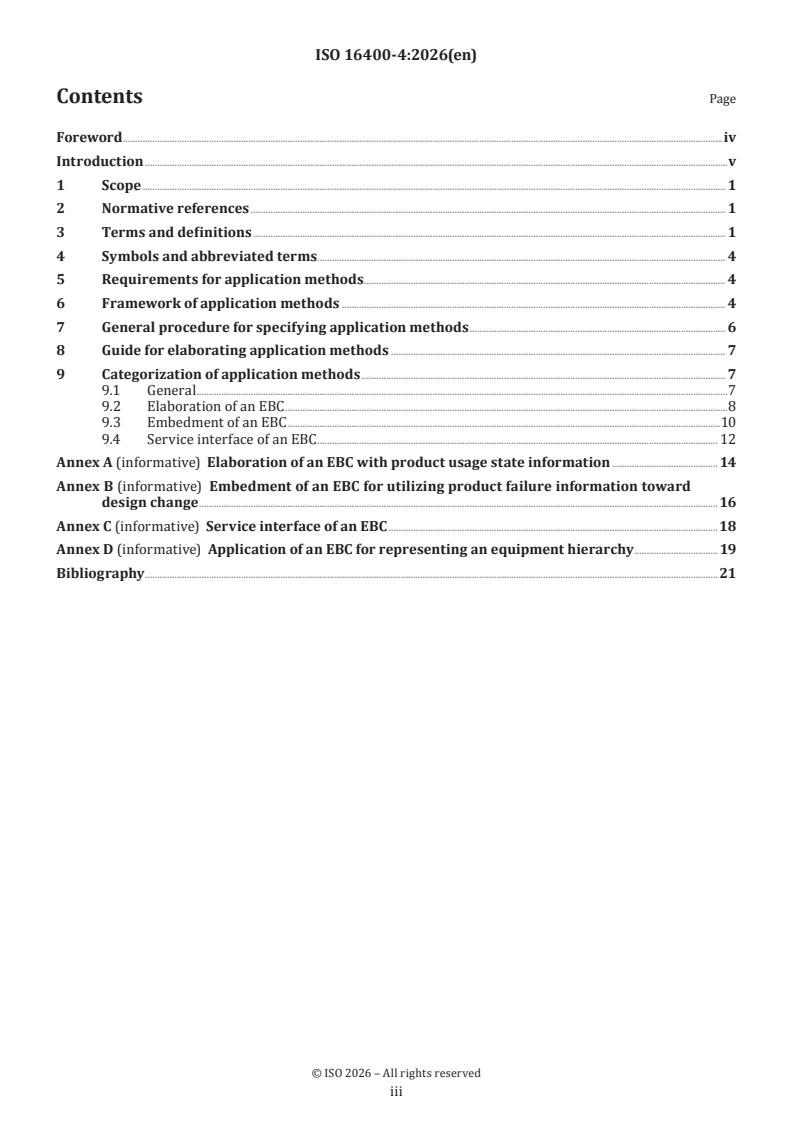
Contents Page
Foreword .iv
Introduction .v
1 Scope . 1
2 Normative references . 1
3 Terms and definitions . 1
4 Symbols and abbreviated terms. 4
5 Requirements for application methods . . 4
6 Framework of application methods . 4
7 General procedure for specifying application methods . 6
8 Guide for elaborating application methods . 7
9 Categorization of application methods . 7
9.1 General .7
9.2 Elaboration of an EBC .8
9.3 Embedment of an EBC .10
9.4 Service interface of an EBC . 12
Annex A (informative) Elaboration of an EBC with product usage state information . 14
Annex B (informative) Embedment of an EBC for utilizing product failure information toward
design change .16
Annex C (informative) Service interface of an EBC .18
Annex D (informative) Application of an EBC for representing an equipment hierarchy . 19
Bibliography .21
iii
Foreword
ISO (the International Organization for Standardization) is a worldwide federation of national standards
bodies (ISO member bodies). The work of preparing International Standards is normally carried out through
ISO technical committees. Each member body interested in a subject for which a technical committee
has been established has the right to be represented on that committee. International organizations,
governmental and non-governmental, in liaison with ISO, also take part in the work. ISO collaborates closely
with the International Electrotechnical Commission (IEC) on all matters of electrotechnical standardization.
The procedures used to develop this document and those intended for its further maintenance are described
in the ISO/IEC Directives, Part 1. In particular, the different approval criteria needed for the different types
of ISO document should be noted. This document was drafted in accordance with the editorial rules of the
ISO/IEC Directives, Part 2 (see www.iso.org/directives).
ISO draws attention to the possibility that the implementation of this document may involve the use of (a)
patent(s). ISO takes no position concerning the evidence, validity or applicability of any claimed patent
rights in respect thereof. As of the date of publication of this document, ISO had not received notice of (a)
patent(s) which may be required to implement this document. However, implementers are cautioned that
this may not represent the latest information, which may be obtained from the patent database available at
www.iso.org/patents. ISO shall not be held responsible for identifying any or all such patent rights.
Any trade name used in this document is information given for the convenience of users and does not
constitute an endorsement.
For an explanation of the voluntary nature of standards, the meaning of ISO specific terms and expressions
related to conformity assessment, as well as information about ISO's adherence to the World Trade
Organization (WTO) principles in the Technical Barriers to Trade (TBT), see www.iso.org/iso/foreword.html.
This document was prepared by Technical Committee ISO/TC 184, Automation systems and integration,
Subcommittee SC 5, Interoperability, integration, and architectures for enterprise systems and automation
applications.
A list of all parts in the ISO 16400 series can be found on the ISO website.
Any feedback or questions on this document should be directed to the user’s national standards body. A
complete listing of these bodies can be found at www.iso.org/members.html.
iv
Introduction
The ISO 16400 series introduces the concept of an equipment behaviour catalogue (EBC), addresses the
requirements of an EBC, and provides requirements and recommendations to generate an executable model
representing the dynamic behaviour of a nominal or a physical instance of an equipment. An equipment
instance model is implemented, such as a software agent. Such an executable model plays a vital role when
configuring virtual production systems used for simulation and verification of a future process as well as
monitoring of a current process. Therefore, EBCs will constitute an important part in the development of
smart manufacturing.
An EBC enables an efficient and standardized way for a provider of equipment to communicate its dynamic
behaviour.
In this document, application methods of an EBC are introduced, and requirements of application methods
are described. Application methods of an EBC are defined as methods to integrate elements of an EBC in
smart manufacturing applications in a way that is adapted to the smart manufacturing requirements.
This document specifies application methods of an EBC by the usage viewpoints of an EBC with stakeholders
including system developers and users, in relation with the usage viewpoints of application systems.
There are several ways to integrate EBCs to smart manufacturing applications according to objectives and
scopes of smart manufacturing.
According to the objectives and scopes of smart manufacturing, a level of granularity of integration or types
of integration of EBCs can be different. The integration can be achieved via clearly defined interfaces of EBCs
to applications. It can be achieved by embedding EBC elements in applications. The other type of integration
is to include application behaviour resources into EBCs.
For clarifying the different kinds of application methods of an EBC to manufacturing resources and
applications, this document specifies a categorization scheme of EBC application methods based on
integration modes between EBCs and manufacturing applications. The categorization scheme helps to
clarify differences of various application methods and corresponding use cases of EBCs, and to guide the
integration of EBCs in appropriate manner.
This document outlines general requirements, a conceptual application framework, a guide for elaborating
application methods, and a categorization of EBC integration methods.
v
International Standard ISO 16400-4:2026(en)
Automation systems and integration — Equipment behaviour
catalogues for virtual production system —
Part 4:
Application methods
1 Scope
This document specifies requirements, a framework, a general specification procedure, a guide for
elaboration, and categorization of application methods of an equipment behaviour catalogue (EBC) in smart
manufacturing.
2 Normative references
The following documents are referred to in the text in such a way that some or all of their content constitutes
requirements of this document. For dated references, only the edition cited applies. For undated references,
the latest edition of the referenced document (including any amendments) applies.
ISO 16400-1:2020, Automation systems and integration — Equipment behaviour catalogues for virtual
production system — Part 1: Overview
3 Terms and definitions
For the purposes of this document, the following terms and definitions apply.
ISO and IEC maintain terminology databases for use in standardization at the following addresses:
— ISO Online browsing platform: available at https:// www .iso .org/ obp
— IEC Electropedia: available at https:// www .electropedia .org/
3.1
application element
component of an information model defining the information requirements in an application method,
including application objects, attributes and properties
3.2
aspect
labelled designation for a collection of concepts in a particular context
EXAMPLE Functional, structural, information, security, availability, customer.
Note 1 to entry: An aspect is often expressed as a view across one or more model for a manufacturing system.
Note 2 to entry: Elements of an aspect can have functional, non-functional or other kinds of descriptors.
Note 3 to entry: The identification of an aspect is often the result of prior knowledge, experience and practice in the
domain to which the aspect applies.
[SOURCE: IEC 63339:2024, 3.1.1]
3.3
aspect collection
one or more than one aspect (3.2) grouped into a labelled collection.
Note 1 to entry: An aspect collection is most meaningful when a relationship among the meanings of the various
aspects in the collection exists and is articulated for reference. Aspect collections provide the basis for representation
of the smart manufacturing domain for a particular purpose.
[SOURCE: IEC 63339:2024, D.2.3.2.12]
3.4
behaviour
way in which an element acts and reacts in contexts of realizing its external interaction
[SOURCE: ISO 14258:1998, 2.2.2, modified — “how” has been replaced with “way in which”, and “in contexts
of realizing its external interaction” has been added at the end of the original definition.]
3.5
elaboration
semantic or functional extension of an equipment behaviour catalogue (3.8) by referencing or embedding
external resources in order to represent application-specific behaviours (3.4)
3.6
embedment
integration of equipment behaviour catalogue elements (3.9) into application elements (3.1), where the
equipment behaviour catalogue's (3.8) data and interfaces are structurally included as part of the application
model
3.7
equipment
physical assets of an enterprise involved in manufacturing
Note 1 to entry: Equipment can be a listing of sites, areas, production units, production lines, work cells, process cells
or units.
Note 2 to entry: Equipment can be made up of other equipment. For example, a production line can be made up of work
cells.
3.8
equipment behaviour catalogue
EBC
group of one equipment behaviour catalogue template (3.11) and its equipment behaviour catalogue items
[SOURCE: ISO 16400-1:2020, 3.1]
3.9
EBC element
equipment behaviour catalogue element
behaviour (3.4), property, or external interaction defining the information requirements for equipment (3.7)
in its interactions
EXAMPLE Constituent components of an equipment behaviour catalogue template in ISO 16400-1:2020, Figure 2.
3.10
EBC template
schema representing a model for each equipment (3.7) type including behaviour (3.4)
[SOURCE: ISO 16400-1:2020, 3.2]
3.11
equipment instance model
executable model corresponding to a specification of an equipment behaviour catalogue item
[SOURCE: ISO 16400-3:2024, 3.2]
3.12
manufacturing application
group of activities (a process or part thereof), within a manufacturing domain of an enterprise, cooperating
to realize a definite objective or role
[SOURCE: ISO 16100-1:2009, 3.13]
3.13
ontology
explicit and consensual specification of concepts of an application domain independent of any use of these
concepts
[SOURCE: ISO 13584-511:2006, 3.1.20, modified — Note 1 to entry has been deleted.]
3.14
product structure
structure providing a functional classification of all items, parts, components, sub-assemblies and assemblies
of a product
[SOURCE: ISO 18828-2:2016, 3.1.9, modified — Note 1 to entry has been deleted.]
3.15
service interface
way in which other elements can interact and exchange information with a service as the outcome of a
request in the definition of a service
Note 1 to entry: This interface enables an application to exchange behaviour information with an equipment behaviour
catalogue (3.8) through bidirectional request–response, without exposing its internal structure.
[SOURCE: ISO/IEC TR 30102:2012, 2.1.33, modified — Note 1 to entry has been added.]
3.16
smart manufacturing
manufacturing that improves its performance aspects (3.2) with integrated and intelligent use of processes
and resources in cyber, physical and human spheres to create and deliver products and services, which also
collaborates with other domains within enterprises’ value chains
Note 1 to entry: Performance aspects include agility, efficiency, safety, security, sustainability or any other
performance indicators identified by the enterprise.
Note 2 to entry: In addition to manufacturing, other enterprise domains can include engineering, logistics, marketing,
procurement, sales or any other domains identified by the enterprise.
[SOURCE: ISO/TR 22100-4:2018, 3.16]
3.17
viewpoint
identification of one or more kind of model useful for addressing a collection of related stakeholder concerns
[SOURCE: ISO 15704:2019, 3.24, modified — Note 1 to entry and Note 2 to entry have been deleted.]
4 Symbols and abbreviated terms
AAS asset administration shell
DF digital factory
EBC equipment behaviour catalogue
EoL end of life
ML machine leaning
UML unified modelling language
5 Requirements for application methods
Application methods of an EBC are defined as methods to integrate elements of EBCs in smart manufacturing
applications in a way that is adapted to the smart manufacturing requirements described in IEC/TR 63319.
[1]
This document specifies the application methods of an EBC from the perspective of its use by stakeholders
[19]
including system developers and users, in relation to the usage viewpoints of application systems.
Application methods of an EBC shall satisfy the following requirements:
a) EBC elements and their relationships to application elements shall be described.
b) EBC elements required by a given application shall be utilized through defined interfaces.
c) Interaction functions shall be triggered by either an EBC or a given application, and executed.
Specific requirements with respect to the framework of application methods are described in Clause 6.
6 Framework of application methods
Figure 1 shows a framework of application methods of an EBC in the form of classes and relations of an
information model. Application methods shall specify how to integrate EBC elements and application
elements to effectively utilize the EBC in manufacturing applications. Integration means to connect
necessary EBC elements and application elements to achieve the specific functions of the application, the
EBC, or both.
Key
class
relation
Figure 1 — Framework of application methods of an EBC
EBC elements are described as elements of the conceptual structure of an EBC template in ISO 16400-1 and
ISO 16400-2. EBC elements include behaviour, property, or external interaction defining the information
requirements for equipment in its interactions. The list of EBC elements is not exhaustive, and other elements
[5]
such as a machine learning (ML) model specified in ISO 16400-6 can be added as required.
In case of manufacturing systems, applications include application elements such as product planning,
product design, production planning, production operation and product usage. According to the application
requirements, these application elements are further elaborated to their sub-elements. Sub-elements of
[6]
appropriate level of details are used for integration with EBC elements. ISO 16400-5:2026, Annex A shows
an example of application elements in the case of production systems engineering and manufacturing
operation.
Application methods can be characterized by various types of aspect collections of integration according to
the requirements of the applications. Types of aspect collections of integration include, but are not limited
to, the following:
a) connection among elements;
Relationships between EBC elements and application elements are generally many to many.
EXAMPLE 1 One EBC element which represents an external functionality of an EBC is connected to several
application elements.
EXAMPLE 2 Several EBC elements which represent internal EBC information are connected to one associated
application element.
NOTE 1 An external functionality of an EBC means a behaviour of corresponding equipment.
b) initiation of interaction;
Interactions can be triggered from EBC elements, application elements, or both.
EXAMPLE 3 An application element accesses several EBC elements to receive information about behaviour.
EXAMPLE 4 An EBC element accesses application elements to receive information for specifying behaviour.
c) mode of interaction;
Some interactions only happen at the specific situations such as initial setting or end of operations, and
the static information is exchanged. Some interactions are continuously activated during interaction
operations, and the dynamically varying information is exchanged.
d) direction of information flow;
Information can flow between EBC elements and application elements in one or both directions.
e) life cycle stage.
Interactions can happen in various life cycle stages of applications, including planning, design, execution,
maintenance and modifications.
Each of the above five types of aspect collections is independent and consistent with the others. Additional
types of aspect collections of integration can be introduced according to the contents of applications. The
criteria of independence and consistency shall be observed.
NOTE 2 An aspect collection is a collection of aspects for concepts by a given model in a particular context. For
example, an aspect collection a) is described based on a model of a network connection. Respective models for aspect
collections a) to e) are different and independent. Aspect collections can be used as dimensions to categorize objects
in concern.
There are several ways to integrate EBCs to smart manufacturing applications and resources according
to objectives and scopes of smart manufacturing. Figure 1 is a general view and is elaborated into several
categories in Clause 9.
A categorization scheme helps to clarify the differences and similarities of various application methods and
corresponding use cases of EBCs, and to guide the integration of EBCs in appropriate ways. For clarifying
the different kinds of application methods of an EBC to manufacturing applications, Clause 9 specifies
a categorization scheme of EBC application methods based on the two types of aspect collections of
integration: a) connection among elements and b) initiation of interaction. According to the applications,
other types of aspect collections, such as c), d) or e), can be used for categorization.
7 General procedure for specifying application methods
In general, an application method can be specified by a procedure with following steps:
1. Specify an objective and a scope of an application method.
2. Specify interactions between an application and an EBC.
3. Identify aspects of interactions between an application and an EBC.
4. Identify relevant application elements and EBC elements related to aspects of interactions.
5. Specify interactions in detail among application elements and EBC elements.
According to the specific categories in 9.2 to 9.4, items in the steps of the above procedure are elaborated,
including an objective and a scope, interactions, aspects of interactions, application elements and EBC
elements. Those items are respectively described in 9.2 to 9.4.
8 Guide for elaborating application methods
The framework of application methods described in Clause 6 is generic, and details are decided for
elaborating application methods. This clause provides guidance for elaborating application methods.
For confirming that the requirements for application methods are met, it is recommended to describe
application methods in a transparent manner based on the framework of application methods between EBCs
and applications by using a common ontology.
Common ontology should be used for describing different application methods in order to achieve common
understanding and information transformation across different methods.
The following criteria should be considered for the feasibility of application methods.
a) Information of an EBC can satisfy requirements for application methods.
An EBC should be provided in a form which can be utilized by application methods.
b) Common understanding of information between an EBC and applications can be established.
c) An EBC can be replaced, if necessary, according to application requirements.
Application methods should be described to allow replacement of an EBC with the equivalent
functionality.
d) Specification of an application method is maintained to cope with possible changes of usage conditions
and environment through the life cycle of applications.
9 Categorization
...