


ISO 19318:2004
(Main)Surface chemical analysis — X-ray photoelectron spectroscopy — Reporting of methods used for charge control and charge correction
Surface chemical analysis — X-ray photoelectron spectroscopy — Reporting of methods used for charge control and charge correction
ISO 19318:2004 specifies the minimum amount of information describing the methods of charge control and charge correction in measurements of core-level binding energies for insulating specimens by X-ray photoelectron spectroscopy that shall be reported with the analytical results. Information is also provided on methods that have been found useful for charge control and for charge correction in the measurement of binding energies.
Analyse chimique des surfaces — Spectroscopie de photoélectrons — Indication des méthodes mises en oeuvre pour le contrôle et la correction de la charge
General Information
- Status
- Withdrawn
- Publication Date
- 04-May-2004
- Withdrawal Date
- 04-May-2004
- Technical Committee
- ISO/TC 201/SC 7 - Electron spectroscopies
- Drafting Committee
- ISO/TC 201/SC 7 - Electron spectroscopies
- Parallel Committee
- ISO/TC 201/SC 7 - Electron spectroscopies
- Current Stage
- 9599 - Withdrawal of International Standard
- Start Date
- 04-Jun-2021
- Completion Date
- 12-Feb-2026
Relations
- Effective Date
- 12-Oct-2020
Get Certified
Connect with accredited certification bodies for this standard

ECOCERT
Organic and sustainability certification.

Eurofins Food Testing Global
Global leader in food, environment, and pharmaceutical product testing.

Intertek Bangladesh
Intertek certification and testing services in Bangladesh.
Sponsored listings
Frequently Asked Questions
ISO 19318:2004 is a standard published by the International Organization for Standardization (ISO). Its full title is "Surface chemical analysis — X-ray photoelectron spectroscopy — Reporting of methods used for charge control and charge correction". This standard covers: ISO 19318:2004 specifies the minimum amount of information describing the methods of charge control and charge correction in measurements of core-level binding energies for insulating specimens by X-ray photoelectron spectroscopy that shall be reported with the analytical results. Information is also provided on methods that have been found useful for charge control and for charge correction in the measurement of binding energies.
ISO 19318:2004 specifies the minimum amount of information describing the methods of charge control and charge correction in measurements of core-level binding energies for insulating specimens by X-ray photoelectron spectroscopy that shall be reported with the analytical results. Information is also provided on methods that have been found useful for charge control and for charge correction in the measurement of binding energies.
ISO 19318:2004 is classified under the following ICS (International Classification for Standards) categories: 71.040.40 - Chemical analysis. The ICS classification helps identify the subject area and facilitates finding related standards.
ISO 19318:2004 has the following relationships with other standards: It is inter standard links to ISO 19318:2021. Understanding these relationships helps ensure you are using the most current and applicable version of the standard.
ISO 19318:2004 is available in PDF format for immediate download after purchase. The document can be added to your cart and obtained through the secure checkout process. Digital delivery ensures instant access to the complete standard document.
Standards Content (Sample)
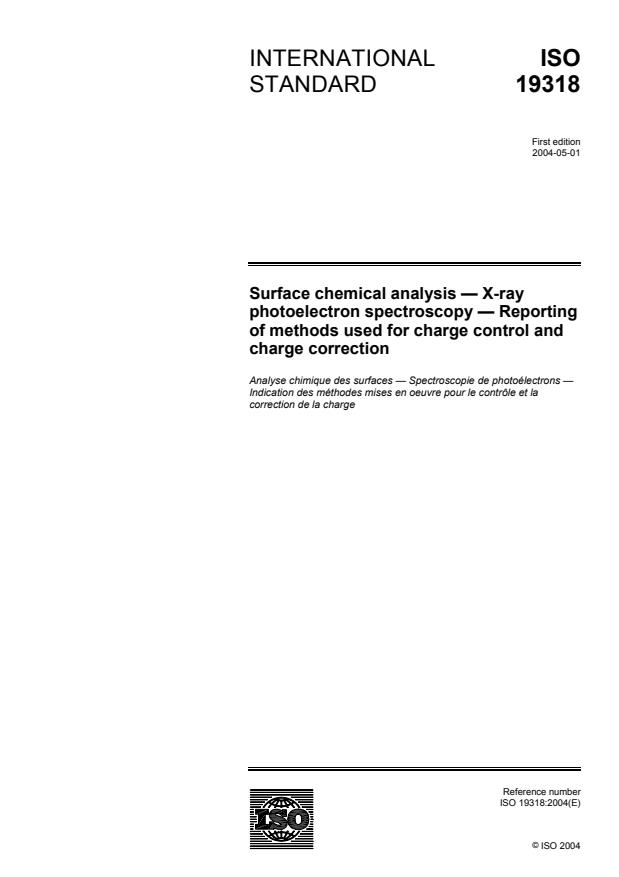
INTERNATIONAL ISO
STANDARD 19318
First edition
2004-05-01
Surface chemical analysis — X-ray
photoelectron spectroscopy — Reporting
of methods used for charge control and
charge correction
Analyse chimique des surfaces — Spectroscopie de photoélectrons —
Indication des méthodes mises en oeuvre pour le contrôle et la
correction de la charge
Reference number
©
ISO 2004
PDF disclaimer
This PDF file may contain embedded typefaces. In accordance with Adobe's licensing policy, this file may be printed or viewed but
shall not be edited unless the typefaces which are embedded are licensed to and installed on the computer performing the editing. In
downloading this file, parties accept therein the responsibility of not infringing Adobe's licensing policy. The ISO Central Secretariat
accepts no liability in this area.
Adobe is a trademark of Adobe Systems Incorporated.
Details of the software products used to create this PDF file can be found in the General Info relative to the file; the PDF-creation
parameters were optimized for printing. Every care has been taken to ensure that the file is suitable for use by ISO member bodies. In
the unlikely event that a problem relating to it is found, please inform the Central Secretariat at the address given below.
© ISO 2004
All rights reserved. Unless otherwise specified, no part of this publication may be reproduced or utilized in any form or by any means,
electronic or mechanical, including photocopying and microfilm, without permission in writing from either ISO at the address below or
ISO's member body in the country of the requester.
ISO copyright office
Case postale 56 • CH-1211 Geneva 20
Tel. + 41 22 749 01 11
Fax + 41 22 749 09 47
E-mail copyright@iso.org
Web www.iso.org
Published in Switzerland
ii © ISO 2004 – All rights reserved
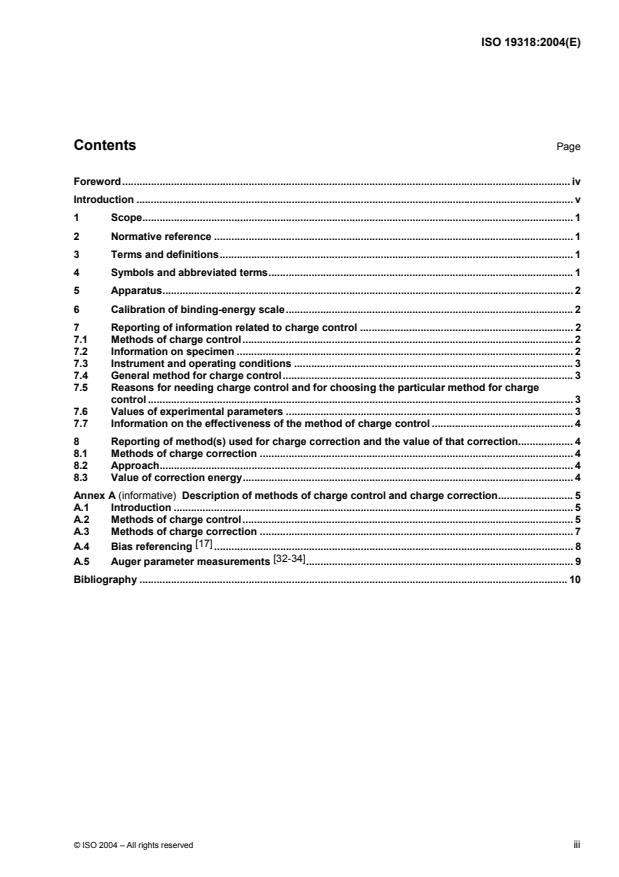
Contents Page
Foreword. iv
Introduction . v
1 Scope. 1
2 Normative reference. 1
3 Terms and definitions. 1
4 Symbols and abbreviated terms. 1
5 Apparatus. 2
6 Calibration of binding-energy scale. 2
7 Reporting of information related to charge control . 2
7.1 Methods of charge control. 2
7.2 Information on specimen . 2
7.3 Instrument and operating conditions . 3
7.4 General method for charge control. 3
7.5 Reasons for needing charge control and for choosing the particular method for charge
control . 3
7.6 Values of experimental parameters . 3
7.7 Information on the effectiveness of the method of charge control . 4
8 Reporting of method(s) used for charge correction and the value of that correction. 4
8.1 Methods of charge correction . 4
8.2 Approach. 4
8.3 Value of correction energy. 4
Annex A (informative) Description of methods of charge control and charge correction. 5
A.1 Introduction. 5
A.2 Methods of charge control. 5
A.3 Methods of charge correction . 7
[17]
A.4 Bias referencing . 8
[32-34]
A.5 Auger parameter measurements . 9
Bibliography . 10
Foreword
ISO (the International Organization for Standardization) is a worldwide federation of national standards bodies
(ISO member bodies). The work of preparing International Standards is normally carried out through ISO
technical committees. Each member body interested in a subject for which a technical committee has been
established has the right to be represented on that committee. International organizations, governmental and
non-governmental, in liaison with ISO, also take part in the work. ISO collaborates closely with the
International Electrotechnical Commission (IEC) on all matters of electrotechnical standardization.
International Standards are drafted in accordance with the rules given in the ISO/IEC Directives, Part 2.
The main task of technical committees is to prepare International Standards. Draft International Standards
adopted by the technical committees are circulated to the member bodies for voting. Publication as an
International Standard requires approval by at least 75 % of the member bodies casting a vote.
Attention is drawn to the possibility that some of the elements of this document may be the subject of patent
rights. ISO shall not be held responsible for identifying any or all such patent rights.
ISO 19318 was prepared by Technical Committee ISO/TC 201, Surface chemical analysis, Subcommittee
SC 5, Auger electron spectroscopy.
iv © ISO 2004 – All rights reserved
Introduction
X-ray photoelectron spectroscopy (XPS) is widely used for characterization of surfaces of materials. Elements
in the test specimen (with the exception of hydrogen and helium) are identified from comparisons of the
binding energies of their core levels, determined from measured photoelectron spectra, with tabulations of
these binding energies for the various elements. Information on the chemical state of the detected elements
can frequently be obtained from small variations (typically between 0,1 eV and 10 eV) of the core-level binding
energies from the corresponding values for the pure elements. Reliable determination of chemical shifts often
requires that the binding-energy scale of the XPS instrument be calibrated with an uncertainty that could be as
small as 0,1 eV.
The surface potential of an insulating specimen will generally change during an XPS measurement due to
surface charging, and it is then difficult to determine binding energies with the accuracy needed for elemental
identification or chemical-state determination. There are two steps in dealing with this problem. First,
experimental steps can be taken to minimize the amount of surface charging (charge-control methods).
Second, corrections for the effects of surface charging can be made after acquisition of the XPS data (charge-
correction methods). Although the buildup of surface charge can complicate analysis in some circumstances,
it can be creatively used as a tool to gain information about a specimen.
The amount of induced charge near the surface, its distribution across the specimen surface, and its
dependence on experimental conditions are determined by many factors including those associated with the
[1, 2]
specimen and characteristics of the spectrometer. Charge buildup is a well-studied three-dimensional
phenomenon that occurs along the specimen surface and into the material. Charge buildup may also occur at
phase boundaries or interface regions within the depth of the specimen that is irradiated by X-rays. Some
specimens undergo time-dependent changes in the level of charging because of chemical changes or
volatilization induced by photoelectrons and secondary electrons, X-rays, or heating. Such specimens may
never achieve steady-state potentials.
There is, at present, no universally applicable method or set of methods for charge control or for charge
[3, 4]
correction . This International Standard specifies the information that shall be provided to document the
method of charge control during data acquisition and/or the method of charge correction during data analysis.
Information is given in Annex A on common methods for charge control and charge correction that can be
useful for many applications. The particular charge-control method that may be chosen in practice depends on
the type of specimen (e.g., powder, thin film or thick specimen), the nature of the instrumentation, the size of
the specimen, and the extent to which the specimen surface might be modified by a particular procedure.
This International Standard is expected to have two main areas of application. First, it identifies information on
methods of charge control and/or charge correction to be included in reports of XPS measurements (e.g., from
an analyst to a customer or in publications) in order to evaluate, assess and reproduce data on insulating
materials and to ensure that measurements on similar materials can be meaningfully compared. Second,
adherence to this International Standard will enable published binding energies to be used with confidence by
other analysts and will lead to the inclusion of more reliable data in XPS databases.
INTERNATIONAL STANDARD ISO 19318:2004(E)
Surface chemical analysis — X-ray photoelectron
spectroscopy — Reporting of methods used for charge control
and charge correction
1 Scope
This International Standard specifies the minimum amount of information describing the methods of charge
control and charge correction in measurements of core-level binding energies for insulating specimens by
X-ray photoelectron spectroscopy that shall be reported with the analytical results. Information is also provided
on methods that have been found useful for charge control and for charge correction in the measurement of
binding energies.
2 Normative reference
The following referenced documents are indispensable for the application of this document. For dated
references, only the edition cited applies. For undated references, the latest edition of the referenced
document (including any amendments) applies.
ISO 18115, Surface chemical analysis — Vocabulary
3 Terms and definitions
For the purposes of this document, the terms and definitions given in ISO 18115 apply.
4 Symbols and abbreviated terms
BE Binding energy, in eV
BE Corrected binding energy, in eV
corr
BE Measured binding energy, in eV
meas
BE Reference binding energy, in eV
ref
FWHM Full width at half maximum amplitude of a peak in the photoelectron spectrum above the
background,
in eV
XPS X-ray photoelectron spectroscopy
∆ Correction energy, to be added to measured binding energies for charge correction, in eV
corr
5 Apparatus
5.1 One or more of the charge-control techniques mentioned in Clause A.2 may be employed in most XPS
spectrometers. The XPS instrument shall be operated in accordance with the manufacturer’s or other
documented procedures.
5.2 Some of the techniques outlined in Clause A.2 require special apparatus, such as an electron flood gun
or a source for evaporative deposition of gold.
[5]
5.3 Certain specimen-mounting procedures, such as mounting the specimen under a fine metal mesh ,
can enhance electrical contact of the specimen with the specimen holder, or reduce the amount of surface
charge buildup. This and other methods of specimen mounting to reduce static charge are described in detail
[6, 7]
in ASTM E 1078 and ASTM E 1829 .
6 Calibration of binding-energy scale
[8]
The binding-energy scale of the X-ray photoelectron spectrometer shall be calibrated using ISO 15472 or
another documented method before application of this International Standard.
7 Reporting of information related to charge control
7.1 Methods of charge control
Many of the methods commonly used to control the surface potential and to minimize surface charging are
summarized in Clause A.2. Information on the following critical specimen and experimental conditions shall be
reported for individual specimens or collections of similar specimens.
7.2 Information on specimen
7.2.1 Specimen form
The form of the specimen shall be reported. The physical nature, source, preparation method and specimen
[2]
structure can influence charging behaviour .
EXAMPLE 1 Powder
EXAMPLE 2 Thin film spin-cast on silicon
EXAMPLE 3 Macroscopic mineral specimen
7.2.2 Specimen dimensions
The size and shape of a specimen can have a significant effect on the extent of specimen charging. The
shape of the specimen shall be reported together with approximate values of the dimensions of the specimen
or of any relevant specimen features (e.g., particle diameters).
7.2.3 Specimen-mounting methods
[1, 2]
Specimen mounting and contact with the specimen holder can significantly impact charging . The method
by which a specimen is mounted, including information about special methods used to increase conductivity or
isolate a specimen from ground, shall be reported.
EXAMPLE 1 Powder specimen pressed into foil, which was attached to specimen holder by tape
EXAMPLE 2 1 ml of contaminated liquid deposited on a silicon substrate and dried prior to analysis
2 © ISO 2004 – All rights reserved
EXAMPLE 3 Specimen held to holder using conductive adhesive tape of a specified type
EXAMPLE 4 Corroded specimen held on specimen holder by metal screw
7.2.4 Specimen treatment prior to or during analysis
The specimen treatment prior to or during analysis includes any physical or chemical treatment that can affect
charging of the specimen during XPS measurements.
NOTE Such treatment of the specimen may modify the surface composition as well as the electrical conductivity, and
hence charging, of the surface region.
7.3 Instrument and operating conditions
The instrument operating conditions include details of the particular XPS instrument, the nature of the X-ray
source, the approximate size of the X-ray beam on the specimen surface, the analyser pass energy, a
measure of energy resolution such as the FWHM of the silver 3d photoelectron line for the selected
5/2
operating conditions, the angle between the specimen normal and the X-ray source, and the use or not of a
magnetic lens.
7.4 General method for charge control
The particular instrumental component(s) used for charge control shall be identified.
EXAMPLE 1 Electron flood gun
EXAMPLE 2 Electron flood gun in combination with an ion gun
EXAMPLE 3 Specimen heating
EXAMPLE 4 Irradiation with ultraviolet light
If the components used are not standard for the XPS instrument, information shall be provided on the
manufacturer or on the relevant design characteristics.
7.5 Reasons for needing charge control and for choosing the particular method for charge
control
The reasons for needing charge control and for choosing a particular method shall be reported.
EXAMPLE 1 As supplied to us, the portion of the specimen of interest was isolated from ground. We supplied flood
gun electrons for charge compensation using the standard flood gun for this instrument.
EXAMPLE 2 Experience with similar specimens indicated that differential charging was likely. To obtain good spectra,
we totally isolated these specimens from ground. The application of the combined fluxes of a low-energy electron flood
gun and a low-energy ion flux produced well resolved peaks.
EXAMPLE 3 Initial spectra without any charge control showed peak shifting and broadening. Placing a grounded fine
grid above the specimen solved these problems without leading to a significant signal due to the grid material. This
method is easy to apply, and is used routinely in our measurements with similar specimens.
7.6 Values of experimental parameters
Values of parameters used to control charge, such as flood gun settings, shall be reported.
EXAMPLE For the flood gun, the cathode voltage was − 5 V (with respect to instrumental ground), the emission
current was 20 mA, and the gun cathode was 5 cm from the specimen.
7.7 Information on the effectiveness of the method of charge control
The adequacy of the charge-control methods for the type of analysis being conducted shall be established.
FWHMs and the binding energies (BE ) of peaks in the measured spectra, after charging effects have
meas
been minimized, but before any charge correction has been made, provide one useful method for determining
adequacy of the charge-control method. To document the effectiveness of the procedure(s) used to produce
appropriate BE and FWHM measurements, it may useful to have as a comparison a measurement of the
FWHM of at least one photoelectron peak of similar chemistry in another specimen that is known to be
conductive or for which the method of charge control is believed to be effective.
EXAMPLE The FWHM of the oxidized Si 2p photoline was reduced from 2,4 eV to 1,6 eV by application of flood gun.
The 1,6 eV width is consistent with measurements made on a thin SiO layer on Si.
The ability to control charge compensation over a wide energy range might be documented by measuring the
energy separation between different photopeaks from the same element. The adequacy of such a
measurement assumes that there are no complications due to chemical state changes with depth or the
presence of second phases.
NOTE It is recommended that specimens be examined for the presence or absence of specimen damage and that
the results be recorded.
8 Reporting of method(s) used for charge correction and the value of that
correction
8.1 Methods of charge correction
Many of the methods commonly used for charge correction are summarized in Clause A.3. The following
critical specimen and experimental parameters shall be reported:
8.2 Approach
The general method for correcting measured binding energies (peak positions) for charging effects shall be
specified in sufficient detail so that the method can be reproduced and the effectiveness judged.
8.3 Value of correction energy
Information shall be given on the magnitude of the correction energy (∆ ) for each spectrum and how this
corr
correction energy was determined. The corrected binding energies and values of the reference energies shall
be reported.
The correction energy ∆ is determined by taking the difference between the measured binding energy of a
corr
reference line (BE ) and the accepted or reference value for this binding energy (BE ) using the following
meas ref
relation:
∆ = BE − BE (1)
corr ref meas
The corrected binding energy for another photoelectron peak in the same spectrum (BE ) can then be found
corr
from the sum of the measured binding energy for that peak (BE ) and the correction energy:
meas
BE = BE + ∆ (2)
corr meas corr
NOTE Equations (1) and (2) apply only when charge compensation has adequately removed differential charging
effects.
4 © ISO 2004 – All rights reserved
Annex A
(informative)
Description of methods of charge control and charge correction
A.1 Introduction
The methods described here involve charge control (the effort to control the buildup of charge at a surface or
to minimize its effect) as described in Clause A.2, charge correction (the effort to determine a reliable binding
energy despite buildup of charge) as described in Clause A.3, or some combination of the two as described in
Clause A.4. For charge control, peak shape is one of the most important parameters to consider in assessing
the effectiveness of a method. Correcting a measured peak-energy position (i.e., binding energy) is
accomplished separately using an appropriate charge-correction technique. When both a photoelectron line
and a major Auger peak from the same element can be observed, the Auger parameter or the modified Auger
parameter, described in Clause A.5, can be used to provide chemical-state information without the need to
resort to charge corrections. Although the buildup of charge during XPS is often an unwanted complication, it
can also be used to obtain important information about a specimen as noted in A.2.5.2 and A.2.5.3.
The amount and distribution of surface and near-surface charge for a specific experimental system are
determined by many factors, including specimen composition, homogeneity, magnitude of bulk and surface
conductivities, photoionization cross-section, surface topography, spatial distribution of the exciting X-rays,
and availability of neutralizing electrons. Charge buildup occurs along the specimen surface and into the
[1, 2]
material . The presence of particles on or different phases in the specimen surface may result in an
uneven distribution of charge across the surface, a phenomenon known as differential charging. Charge
buildup may also occur at phase boundaries or interface regions within the specimen that is irradiated by
X-rays. Some specimens undergo time-dependent changes in the amount of charging because of chemical
and physical changes induced by electrons, X
...
Questions, Comments and Discussion
Ask us and Technical Secretary will try to provide an answer. You can facilitate discussion about the standard in here.
Loading comments...