


ISO 13659
(Main)Chain of custody - Book and claim - Requirements and guidelines
Chain of custody - Book and claim - Requirements and guidelines
Chaîne de contrôle — Réservation et réclamation — Exigences et lignes directrices
General Information
- Status
- Not Published
- Technical Committee
- ISO/TC 308 - Chain of custody
- Drafting Committee
- ISO/TC 308 - Chain of custody
- Current Stage
- 6000 - International Standard under publication
- Start Date
- 06-Nov-2025
- Completion Date
- 13-Dec-2025
Overview
ISO/FDIS 13659:2025 - "Chain of custody - Book and claim - Requirements and guidelines" provides a standardized method for applying the book and claim chain of custody model. Published as a Final Draft International Standard (FDIS) by ISO/TC 308 (Secretariat: NEN), the document sets out requirements and guidance for using administrative records (Transferrable Instruments with Entitlement to Claim - TIECs) to represent specified characteristics of materials or products independent of the physical product flow. This model is particularly relevant where physical segregation is impractical (for example, electricity grids or shared gas pipelines). Voting on the FDIS runs from 2025-09-10 to 2025-11-05.
Key topics and requirements
- Definition and terminology: Clear terms for administrative documents, administrative record flow, attribution, TIECs and related concepts (aligned with ISO 22095).
- Differentiation from mass balance: Guidance on how book and claim differs from mass-balance and other chain-of-custody models.
- System boundaries: Rules for defining geographic and temporal system boundaries for issuing and attributing TIECs.
- TIEC characteristics and handling: Requirements for issuance, storage, ownership transfer, retirement, expiry and attributes recorded on TIECs.
- Timeframe rules: Time periods between production, TIEC issuance, retirement and expiry; evaluation periods for claims.
- Data, conversion and residual mix: Requirements for data capture, use of conversion factors and documenting any residual mixes.
- Transparency and recordkeeping: Record retention, avoiding double counting, auditability and communication standards for claims.
- Interoperability: Guidance for interactions and interoperability between book and claim systems to support consistent claims and market operations.
Applications and who should use it
ISO 13659 is applicable across sectors where separated physical tracking is difficult and a market-based administrative approach is needed. Typical users include:
- Sustainability and procurement teams wanting credible claims for use/consumption of attributes (e.g., renewable energy)
- Energy registries and certificate platforms that issue, trade or retire TIECs or equivalent instruments
- Auditors and assurance providers assessing book and claim systems and claims
- Policy makers and regulators designing frameworks for market-based attribute claims and import reporting
- Manufacturers and supply chain managers seeking transparent attribution of specified characteristics across complex supply chains
- Companies reporting greenhouse gas or renewable energy attributes under corporate reporting frameworks
Related standards
- ISO 22095:2020 - Chain of custody: general terminology and models (normative reference). ISO 13659 builds on ISO 22095 by providing detailed requirements and guidelines specifically for the book and claim model.
Keywords: ISO 13659, book and claim, chain of custody, TIEC, transferable instruments, supply chain transparency, greenhouse gas reporting, renewable energy certificates, chain of custody standard.
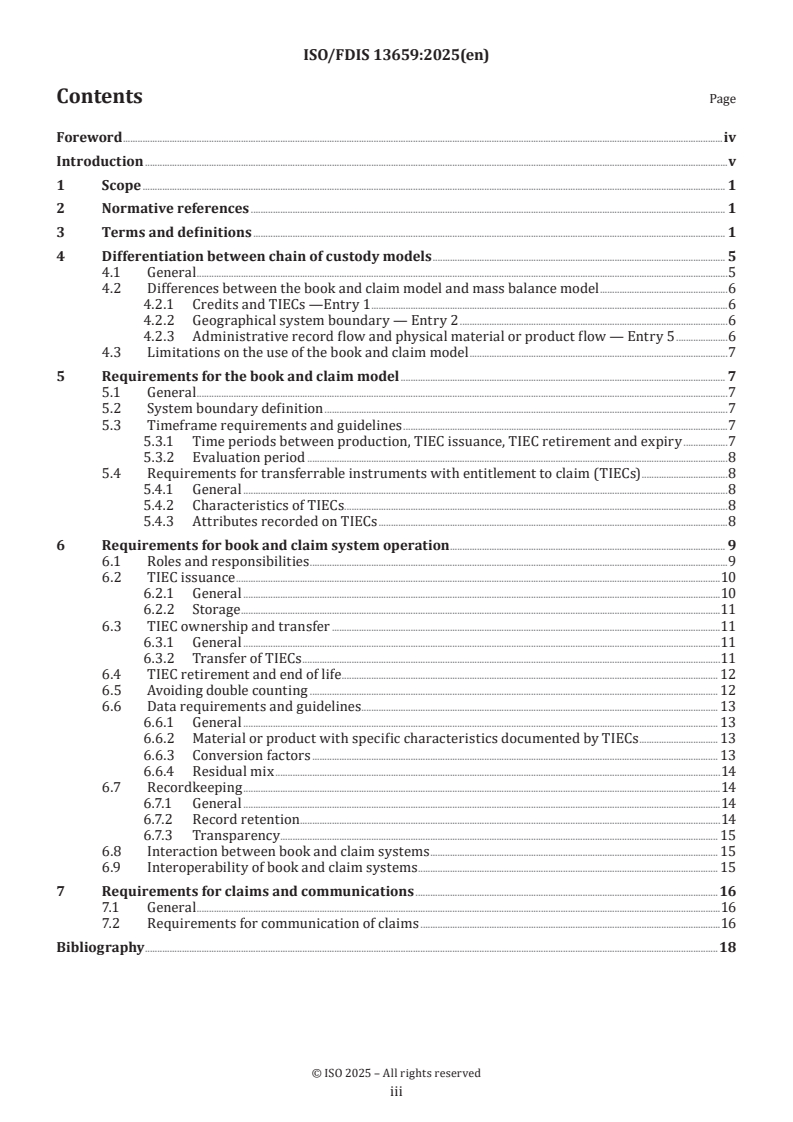
ISO/FDIS 13659 - Chain of custody — Book and claim — Requirements and guidelines Released:27. 08. 2025
REDLINE ISO/FDIS 13659 - Chain of custody — Book and claim — Requirements and guidelines Released:27. 08. 2025
Frequently Asked Questions
ISO 13659 is a draft published by the International Organization for Standardization (ISO). Its full title is "Chain of custody - Book and claim - Requirements and guidelines". This standard covers: Chain of custody - Book and claim - Requirements and guidelines
Chain of custody - Book and claim - Requirements and guidelines
ISO 13659 is classified under the following ICS (International Classification for Standards) categories: 03.100.01 - Company organization and management in general. The ICS classification helps identify the subject area and facilitates finding related standards.
You can purchase ISO 13659 directly from iTeh Standards. The document is available in PDF format and is delivered instantly after payment. Add the standard to your cart and complete the secure checkout process. iTeh Standards is an authorized distributor of ISO standards.
Standards Content (Sample)
FINAL DRAFT
International
Standard
ISO/FDIS 13659
ISO/TC 308
Chain of custody — Book and claim
Secretariat: NEN
— Requirements and guidelines
Voting begins on:
2025-09-10
Voting terminates on:
2025-11-05
RECIPIENTS OF THIS DRAFT ARE INVITED TO SUBMIT,
WITH THEIR COMMENTS, NOTIFICATION OF ANY
RELEVANT PATENT RIGHTS OF WHICH THEY ARE AWARE
AND TO PROVIDE SUPPOR TING DOCUMENTATION.
IN ADDITION TO THEIR EVALUATION AS
BEING ACCEPTABLE FOR INDUSTRIAL, TECHNO
LOGICAL, COMMERCIAL AND USER PURPOSES, DRAFT
INTERNATIONAL STANDARDS MAY ON OCCASION HAVE
TO BE CONSIDERED IN THE LIGHT OF THEIR POTENTIAL
TO BECOME STAN DARDS TO WHICH REFERENCE MAY BE
MADE IN NATIONAL REGULATIONS.
Reference number
ISO/FDIS 13659:2025(en) © ISO 2025
FINAL DRAFT
ISO/FDIS 13659:2025(en)
International
Standard
ISO/FDIS 13659
ISO/TC 308
Chain of custody — Book and claim
Secretariat: NEN
— Requirements and guidelines
Voting begins on:
Voting terminates on:
RECIPIENTS OF THIS DRAFT ARE INVITED TO SUBMIT,
WITH THEIR COMMENTS, NOTIFICATION OF ANY
RELEVANT PATENT RIGHTS OF WHICH THEY ARE AWARE
AND TO PROVIDE SUPPOR TING DOCUMENTATION.
© ISO 2025
IN ADDITION TO THEIR EVALUATION AS
All rights reserved. Unless otherwise specified, or required in the context of its implementation, no part of this publication may
BEING ACCEPTABLE FOR INDUSTRIAL, TECHNO
LOGICAL, COMMERCIAL AND USER PURPOSES, DRAFT
be reproduced or utilized otherwise in any form or by any means, electronic or mechanical, including photocopying, or posting on
INTERNATIONAL STANDARDS MAY ON OCCASION HAVE
the internet or an intranet, without prior written permission. Permission can be requested from either ISO at the address below
TO BE CONSIDERED IN THE LIGHT OF THEIR POTENTIAL
or ISO’s member body in the country of the requester.
TO BECOME STAN DARDS TO WHICH REFERENCE MAY BE
MADE IN NATIONAL REGULATIONS.
ISO copyright office
CP 401 • Ch. de Blandonnet 8
CH-1214 Vernier, Geneva
Phone: +41 22 749 01 11
Email: copyright@iso.org
Website: www.iso.org
Published in Switzerland Reference number
ISO/FDIS 13659:2025(en) © ISO 2025
ii
ISO/FDIS 13659:2025(en)
Contents Page
Foreword .iv
Introduction .v
1 Scope . 1
2 Normative references . 1
3 Terms and definitions . 1
4 Differentiation between chain of custody models . 5
4.1 General .5
4.2 Differences between the book and claim model and mass balance model .6
4.2.1 Credits and TIECs —Entry 1 .6
4.2.2 Geographical system boundary — Entry 2 .6
4.2.3 Administrative record flow and physical material or product flow — Entry 5 .6
4.3 Limitations on the use of the book and claim model .7
5 Requirements for the book and claim model . 7
5.1 General .7
5.2 System boundary definition .7
5.3 Timeframe requirements and guidelines .7
5.3.1 Time periods between production, TIEC issuance, TIEC retirement and expiry .7
5.3.2 Evaluation period .8
5.4 Requirements for transferrable instruments with entitlement to claim (TIECs) .8
5.4.1 General .8
5.4.2 Characteristics of TIECs.8
5.4.3 Attributes recorded on TIECs .8
6 Requirements for book and claim system operation . 9
6.1 Roles and responsibilities .9
6.2 TIEC issuance .10
6.2.1 General .10
6.2.2 Storage .11
6.3 TIEC ownership and transfer .11
6.3.1 General .11
6.3.2 Transfer of TIECs .11
6.4 TIEC retirement and end of life . 12
6.5 Avoiding double counting . 12
6.6 Data requirements and guidelines. 13
6.6.1 General . 13
6.6.2 Material or product with specific characteristics documented by TIECs . 13
6.6.3 Conversion factors . 13
6.6.4 Residual mix .14
6.7 Recordkeeping .14
6.7.1 General .14
6.7.2 Record retention . .14
6.7.3 Transparency . . . 15
6.8 Interaction between book and claim systems . 15
6.9 Interoperability of book and claim systems . 15
7 Requirements for claims and communications .16
7.1 General .16
7.2 Requirements for communication of claims .16
Bibliography .18
iii
ISO/FDIS 13659:2025(en)
Foreword
ISO (the International Organization for Standardization) is a worldwide federation of national standards
bodies (ISO member bodies). The work of preparing International Standards is normally carried out through
ISO technical committees. Each member body interested in a subject for which a technical committee
has been established has the right to be represented on that committee. International organizations,
governmental and non-governmental, in liaison with ISO, also take part in the work. ISO collaborates closely
with the International Electrotechnical Commission (IEC) on all matters of electrotechnical standardization.
The procedures used to develop this document and those intended for its further maintenance are described
in the ISO/IEC Directives, Part 1. In particular, the different approval criteria needed for the different types
of ISO document should be noted. This document was drafted in accordance with the editorial rules of the
ISO/IEC Directives, Part 2 (see www.iso.org/directives).
ISO draws attention to the possibility that the implementation of this document may involve the use of (a)
patent(s). ISO takes no position concerning the evidence, validity or applicability of any claimed patent
rights in respect thereof. As of the date of publication of this document, ISO had not received notice of (a)
patent(s) which may be required to implement this document. However, implementers are cautioned that
this may not represent the latest information, which may be obtained from the patent database available at
www.iso.org/patents. ISO shall not be held responsible for identifying any or all such patent rights.
Any trade name used in this document is information given for the convenience of users and does not
constitute an endorsement.
For an explanation of the voluntary nature of standards, the meaning of ISO specific terms and expressions
related to conformity assessment, as well as information about ISO's adherence to the World Trade
Organization (WTO) principles in the Technical Barriers to Trade (TBT), see www.iso.org/iso/foreword.html.
This document was prepared by Technical Committee ISO/TC 308, Chain of custody.
Any feedback or questions on this document should be directed to the user’s national standards body. A
complete listing of these bodies can be found at www.iso.org/members.html.
iv
ISO/FDIS 13659:2025(en)
Introduction
Book and claim is a chain of custody model in which the flow of administrative records representing
specified characteristics is not necessarily connected to the flow of physical material or product through
the supply chain. Transferrable instruments with entitlement to claim (TIECs) are administrative records
issued in a book and claim system to represent and track the ownership of specified characteristics, separate
from the associated material or product. TIECs can be retired to support owners’ claims of consumption or
use of specified characteristics. The book and claim model is often suitable where material or product with
specified characteristics cannot, or only with difficulty, be kept physically separate from material or product
without specified characteristics, such as renewable power in an electricity grid which also has power from
non-renewable sources, or multiple sources of renewable and non-renewable natural gas feeding into a
common pipeline network.
There is a market need for book and claim. Book and claim can be useful to help organizations participate
in, and support, the utilization of more sustainable solutions, even when those solutions are not part
of the organization’s own direct operations. For example, book and claim can be used to help incentivize
investment in activities that reduce greenhouse gas emissions in a defined system that includes multiple
companies, industries and regions, by conveying a unique right to claim the associated reduced emissions
characteristics. Book and claim is used under the market-based approach for imported electricity in
corporate greenhouse gas reporting.
The purpose of this document is to serve a wide range of sectors. This document provides a common method
to apply the book and claim model and aims to enhance transparency throughout the value chain that
utilizes this model. The common methodology and enhanced transparency ensure that any claims supported
by book and claim can be clearly understood by all value chain actors and the consumer. The credibility of a
particular book and claim application can be enhanced by the methods of verification of claims.
ISO 22095 lays out general guidance on the application of the chain of custody models: identity preserved,
segregated, controlled blending, mass balance, and book and claim. This document provides additional
requirements and guidelines for book and claim.
v
FINAL DRAFT International Standard ISO/FDIS 13659:2025(en)
Chain of custody — Book and claim — Requirements and
guidelines
1 Scope
This document provides requirements and guidelines for the application of the book and claim chain of
custody model. It is applicable to any flow of materials or products or processes within a system, including
how to attribute specified characteristics to flows of such processes.
This document provides requirements and guidelines for the following matters, amongst others:
— general requirements for the book and claim chain of custody model;
— differentiations from mass balance;
— system boundaries including geography and time;
— attribution of material flows in and out;
— conversion factors;
— transparency, communication and claims.
2 Normative references
The following documents are referred to in the text in such a way that some or all of their content constitutes
requirements of this document. For dated references, only the edition cited applies. For undated references,
the latest edition of the referenced document (including any amendments) applies.
ISO 22095:2020, Chain of custody — General terminology and models
3 Terms and definitions
For the purposes of this document, the terms and definitions given in ISO 22095 and the following apply.
ISO and IEC maintain terminological databases for use in standardization at the following addresses:
— ISO Online browsing platform: available at https:// www .iso .org/ obp
— IEC Electropedia: available at https:// www .electropedia .org/
3.1
administrative document
documentation that uniquely identifies the entitlement to claim the ownership of the specified characteristics
of materials or products (3.18) at the respective point in the chain of custody
3.2
administrative record
documentation or guarantee that warrants unique ownership of the entitlement to claim the consumption
or use of specified characteristics at a point in the chain of custody
Note 1 to entry: “Specified characteristics” is defined in ISO 22095:2020, 3.2.5 and “chain of custody”
is defined in ISO 22095:2020, 3.1.1.
ISO/FDIS 13659:2025(en)
3.3
administrative record flow
movement or transfer of unique ownership of the entitlement to claim consumption or use of specified
characteristics within the chain of custody
3.4
associated information
information related to the material or product (3.18), such as description, quality, assurance, or life cycle
related data
3.5
attribution
assignment of credits (3.9) (credit method) or specified characteristics (rolling average method) to outputs
(3.15) or part of the outputs
3.6
book and claim model
chain of custody model in which the administrative recordflow (3.3) is not necessarily connected
to the physical flow of material or product (3.18) throughout the supply chain
Note 1 to entry: This chain of custody model is also referred to as “certificate trading” or “credit trading”.
Note 2 to entry: Within a book and claim system, a transferable instrument with entitlement to claim (TIEC) represents
the right to claim specified characteristics, which can be bought, sold, transferred between organizations (3.14) or
retained on behalf of other organizations. The term “certificates” is used in ISO 22095, whereas the term 'TIEC” is
used here for consistency. TIEC is defined in 3.22.
[SOURCE: ISO 22095:2020, 3.3.5, modified — In Note 1 to entry the wording has been modified, Note 2 to
entry has been added.]
3.7
claim
declared information regarding the specified characteristics of a material or product (3.18)
Note 1 to entry: Information can be any message or representation, including text, pictorial, graphic or symbolic
representation in any form in the context of a commercial communication.
Note 2 to entry: A claim can be made using various means or channels, for example on the product or physically
attached to the product, or physical or virtual information about the product.
Note 3 to entry: In the context of book and claim model (3.6), claims can also be used to inform stakeholders regarding
organizational commitments or impacts.
[SOURCE: ISO 22095:2020, 3.5.10, modified — Notes 1, 2 and 3 to entry have been added.]
3.8
conversion factor
ratio which is used to determine the quantity of output (3.15) or part of the output with specified
characteristics that can be obtained from the quantity of the input (3.11) with specified characteristics,
taking into account any losses
3.9
credit
representation of the quantity of units (3.23) available for attribution with entitlement to claim the
ownership of specified characteristics
3.10
evaluation period
time frame when the performance of the chain of custody system is monitored, measured, analysed
and evaluated, by conducting audits to assess the performance of the chain of custody system procedures
and the conformance with all applicable requirements
ISO/FDIS 13659:2025(en)
3.11
input
material or product (3.18) that enters a chain of custody system boundary
Note 1 to entry: Input can be used at any stage of the supply chain.
Note 2 to entry: Input can also include reused and recycled materials or products.
Note 3 to entry: Input can have associated information (3.4), such as specified characteristics.
3.12
mass balance model
chain of custody model in which materials or products (3.18) with a set of specified characteristics are mixed
or co-processed according to defined criteria with materials or products without that set of characteristics
Note 1 to entry: The proportion of the input (3.11) with specified characteristics might only match the initial
proportions on average and will typically vary across different outputs (3.15).
Note 2 to entry: The mass balance model establishes the relation between inputs and outputs with specified
characteristics and the distribution of those inputs and outputs via attribution (3.5).
Note 3 to entry: For the mass balance model, two implementation methods are specified: rolling average percentage
method and credit method.
Note 4 to entry: In the mass balance model, the specified characteristics cannot be transferred between different
organizations (3.14) independent of physical materials or products.
[SOURCE: ISO 22095:2020, 3.3.4, modified — Note 2 to entry has been modified; Notes 3 and 4 to entry have
been added.]
3.13
measurement body
person or organization (3.14) responsible for collecting and determining measured data relating to inputs
(3.11), outputs (3.15), material, product (3.18) or specified characteristics
Note 1 to entry: A measurement body can be an organization or part of an organization.
3.14
organization
entity or group of people and facilities with an arrangement of responsibilities, authorities and relationships
and identifiable objectives
Note 1 to entry: An organization can encompass multiple (production/geographical) sites.
Note 2 to entry: Organization includes a corporate group defined as a number of consolidated legal entities guided by
a parent company.
[9]
[SOURCE: ISO 26000:2010 , 2.12, modified — Note 2 to entry has been added.]
3.15
output
material or product (3.18) that leaves a chain of custody system boundary
Note 1 to entry: Output can be created at any stage of the supply chain.
Note 2 to entry: Output might include other products resulting from production processes.
Note 3 to entry: Product covers material or energy products.
ISO/FDIS 13659:2025(en)
3.16
party responsible for recordkeeping
recordkeeper
organization that administers and operates the data management system used to track TIECs (3.22),
including issuance, transfer of ownership, expiry, conversion, withdrawal and retirement
Note 1 to entry: A book and claim system may be implemented by multiple parties responsible for recordkeeping
provided measures exist to prevent TIECs representing the same specified characteristics of a given quantity of material,
product (3.18) or property from being transferrable in more than one recordkeeping platform at the same time.
Note 2 to entry: The party responsible for recordkeeping is sometimes known as an ownership registrar.
3.17
primary data
quantified value of a unit (3.23) process or an activity obtained from a direct measurement or a calculation
based on direct measurements at the original source
[4]
[SOURCE: ISO 14050:2020 , 3.6.34]
3.18
product
any good or service
3.19
requirements setter
person, organization (3.14), regulator or independent third party program operator that specifies
requirements for a particular chain of custody
Note 1 to entry: Organizations active in the chain of custody can also act as the requirements setter.
Note 2 to entry: The book and claim system is defined by the requirements setter.
[SOURCE: ISO 22095:2020, 3.4.3, modified — Notes 1 and 2 to entry have been added.]
3.20
residual mix
specified characteristics of material or product, within the boundary of a book and claim system, for which
TIECs (3.22) have not been issued or retired and are not allocated within any reliable tracking system
Note 1 to entry: Calculating the residual mix prevents double counting by enabling more accurate tracking of specified
characteristics.
3.21
similar in nature
material, products (3.18), or concepts that share common characteristics e.g. functionalities, qualities,
composition or attributes, making them alike in fundamental aspects
3.22
transferrable instrument with entitlement to claim
TIEC
administrative record (3.2) that is issued, tracked, retired or retained within a book and claim system,
the ownership of which confers the unique right to claim consumption or use of specified characteristics
Note 1 to entry: Prior to retirement, TIECs can be bought, sold, transferred between organizations (3.14), or retained
on behalf of other organizations.
Note 2 to entry: In some book and claim systems, certificate is used as a synonym for TIEC.
3.23
unit
standard quantity of specified characteristics, by which other quantities can be expressed
ISO/FDIS 13659:2025(en)
3.24
verification
confirmation of a claim (3.7), through the provision of objective evidence that specified requirements
have been fulfilled
Note 1 to entry: Verification is considered to be a process for evaluating a claim based on historical data and information
to determine whether the claim is materially correct and conforms with the specific requirements.
Note 2 to entry: Verification is applied to claims regarding events that have already occurred or results that have
already been obtained (confirmation of truthfulness).
[5]
[SOURCE: ISO/IEC 17029:2019 , 3.3, modified — Note 3 has been modified.]
3.25
verification body
organization (3.14) that performs verification (3.24)
Note 1 to entry: A verification body can be an organization, or part of an organization.
Note 2 to entry: A verification body can be first, second or third party.
[5]
[SOURCE: ISO/IEC 17029:2019 , 3.5]
4 Differentiation between chain of custody models
4.1 General
The book and claim model ensures that for each claim of consumption or use of specified characteristics,
the material or product associated with those specified characteristics has been produced and the right
to claim the specified characteristics has been uniquely conveyed to the claimant. The right to claim the
consumption or use of specified characteristics belongs exclusively to the owner of the TIEC issued for that
specific unit of material or product in the book and claim model.
When applying the book and claim model, TIECs are issued to track specified characteristics throughout
the chain of custody.
Transfer of ownership of the right to claim specified characteristics is accomplished through transfer
of ownership of TIECs, and does not require movement of physical material or product between organizations
active in the chain of custody. TIECs may be transferred between organizations within the book and claim
system either together with, or separate from, physical material or product.
This means that TIECs representing specified characteristics are decoupled from the associated material or
product when entering the book and claim system.
Use of the book and claim model enables claims, which are different than claims made using other chain of
custody models including the mass balance model.
“Attribution of material flows in and out” is not applicable to the book and claim model.
This clause provides a description of the differences between the book and claim and mass balance models. It
is intended to help the users of this document to determine either which chain of custody model is adequate
for their system, or whether they selected the appropriate model for their system.
Item and market-based expectations are defined in ISO 22095:2020, 4.3.
Market-based expectations are satisfied under the controlled blending, mass balance and book and claim models.
Item-based expectations are satisfied only by the controlled blending model.
Table 1 provides a technical description of key differences between chain of custody models.
ISO/FDIS 13659:2025(en)
Table 1 — Technical description of key differences between chain of custody models
Comparison content Model
Entry
Question Mass balance model Book and claim model
1 Is there a TIEC or credit system in place? Rolling average percentage: No Yes
Credit method: Yes
2 What are the applicable geographical Process, site, Physical region, delineated
system boundaries? multiple sites, or transporta- network, or market
tion process
3 Are item-based expectations satisfied? No No
4 Are the inputs with specified character- No No
istics physically present in the output or
parts of the output with specified charac-
teristics at all times?
5 Can TIECs or credits be transferred No Yes
between organizations separately from
physical material or product?
6 Is physical separation of material or prod- No No
uct required to ensure the specified
characteristics are physically present in
the output?
7 Is it required that the specified character- No No
istics be present in the output in a known
proportion?
4.2 Differences between the book and claim model and mass balance model
4.2.1 Credits and TIECs —Entry 1
In the book and claim model, specified characteristics are represented by TIECs. TIECs may be transferred
between organizations separately from physical material or product (see 6.3).
For the credit method of the mass balance model, specified characteristics are represented as credits in
the system boundary. Specified characteristics may not be transferred between organizations separately
from physical material or product. Credits may only be transferred within the mass balance model system
boundary with physical material or product, except when the conditions of site-to-site credit transfer (see
ISO 13662:2025, 6.2.3.2) are met.
Credits are not used in the rolling average percentage method of the mass balance model.
4.2.2 Geographical system boundary — Entry 2
Geographical system boundaries for the book and claim model are defined as a physical region, delineated
network, or market.
Geographical system boundaries for the mass balance model are defined as a process, site, multiple sites
or transportation process.
4.2.3 Administrative record flow and physical material or product flow — Entry 5
In the book and claim model, TIECs are administrative records issued to represent specified characteristics
which may be decoupled from the physical flow of material or product, and sold or transferred between
organizations separately. However, at some point prior to TIEC issuance, there is a connection between the
physical material or product and the specified characteristics represented by the TIEC.
In the mass balance model, the administrative document is connected to the physical flow of material or
product when the custody of this material or product is transferred from one organization to another
through the supply chain.
ISO/FDIS 13659:2025(en)
4.3 Limitations on the use of the book and claim model
According to ISO 22095:2020, B.4, the book and claim model is not suitable for some applications, such as the
traceability of safety characteristics of food items or pharmaceutical items.
5 Requirements for the book and claim model
5.1 General
The general requirements for organizations active in a chain of custody, as documented in ISO 22095:2020,
Clause 6, shall be followed. This document contains additional requirements and guidance for the book and
claim model.
Book and claim systems facilitate credible issuance, transfer, and retirement of TIECs representing specified
characteristics of material or product within a defined system boundary. In these systems, TIECs may be
transacted separately from physical material or product.
TIECs may be issued as unique administrative records to facilitate transfer of the ownership of the right to
claim consumption or use of the specified characteristics represented by the TIEC upon retirement, which
can be used to support external claims.
5.2 System boundary definition
The system boundary of the book and claim system shall be defined by a physical region or otherwise
delineated network or market. The system boundary definition shall include the following aspects,
as determined by the requirements setter, or another actor in the chain of custody:
— the geographic boundary within which TIECs are valid;
— the nature of material or product with specified characteristics that are eligible to generate TIECs in the
system, including any geographical or temporal limitations; and
— the material, product, services, or other claims to which TIECs and the specified characteristics they
represent can be applied, based on TIEC retirement from the book and claim system. This may also
include geographical limitations, or other sector- or product-specific legal or regulatory requirements.
EXAMPLE The system boundary can relate to the geographical area from which production is eligible for issuance
of TIECs and into which claims are allowed for consumption or use of corresponding specified characteristics.
5.3 Timeframe requirements and guidelines
5.3.1 Time periods between production, TIEC issuance, TIEC retirement and expiry
The maximum allowable period of time between physical production of material or product with specified
characteristics, and the issuance of TIECs, shall be defined, justified and documented by the requirements
setter. This time period shall be appropriate for the process or industry of interest, and should be as short as
possible.
The maximum allowable period of time between the physical production of material or product with specified
characteristics and the retirement of TIECs, or between the issuance of TIECs and the retirement of TIECs,
shall be defined, justified and documented by the requirements setter. This time period shall be appropriate
for the process or industry of interest.
In accordance with ISO 22095:2020, 5.5, TIECs shall expire after a defined period of time, which shall be
defined by the requirements setter. After expiry, TIECs shall not be transferred or retired. Claims shall not
be made based on TIECs that have expired.
ISO/FDIS 13659:2025(en)
5.3.2 Evaluation period
The evaluation period is the frequency at which TIECs and the book and claim system shall be evaluated.
In line with the requirements of ISO 22095:2020, 6.5, the evaluation period shall be defined, justified and
documented by the requirements setter, and reported by the organization active in the chain of custody.
The evaluation period is often one year, but can be defined otherwise to be appropriate for the process or
industry of interest.
NOTE 1 The requirements setter can define the evaluation period for an organization wishing to conform
to its requirements.
NOTE 2 Evaluation period is synonymous with ‘verification period’ in many systems.
Conversion factor calculations shall be reviewed each evaluation period.
Evaluation of the system shall meet the requirements described in ISO 22095:2020, 6.5.
5.4 Requirements for transferrable instruments with entitlement to claim (TIECs)
5.4.1 General
The requirements setter shall define the specified characteristics that are represented by TIECs in the book
and claim system, and that can be passed down the value chain.
Within a book and claim system, the party responsible for recordkeeping, value chain actors, and any
other relevant system participants, shall ensure that only one TIEC is issued for the identified specified
characteristic, or set of characteristics, of a given quantity of material or product. When issuing TIECs, the
party responsible for recordkeeping shall assign and maintain a unique identifier for each TIEC throughout
its life cycle.
5.4.2 Characteristics of TIECs
TIECs shall have each of the following characteristics:
— Real: A TIEC shall represent one or the aggregation of multiple real, material aspects or specified
characteristics;
— Measurable: Each TIEC shall be equivalent to a unit, or batch of units, that can be quantified in an
accounting system;
— Unique: No more than one TIEC shall be issued, representing specified characteristics of a given quantity
of material or product, for the same purpose or to enable the same claim. However, multiple TIECs can be
issued, representing the specified characteristics of a given quantity of material or product, if the TIECs
enable unique claims by organizations performing different roles in the same value chain.
— Immutable: Specified characteristics represented by a TIEC in the book and claim system shall not change
to represent new specified characteristics once a TIEC is issued;
— Irreversible: Specified characteristics that are represented by the TIEC are durable and lasting.
5.4.3 Attributes recorded on TIECs
The party responsible for recordkeeping shall record on each issued TIEC either the quantity of material
or product with specified characteristics that is represented, or use the standardized unit of measurement
defined by the requirements setter.
TIECs shall document the specified characteristic, or set of aggregated specified characteristics, that they
represent, as well as temporal and geographical information, such as:
a) date or time period during which the associated material or product with specified characteristics was
produced, placed on the market, or made available for transfer;
ISO/FDIS 13659:2025(en)
b) site or facility, including accurate location, where the material or product with specified characteristics
was produced, placed on the market, or made available for transfer; and
c) date and time of TIEC issuance by the party responsible for recordkeeping.
6 Requirements for book and claim system operation
6.1 Roles and responsibilities
The roles of the value chain actors in the book and claim system, as shown in Figure 1, shall be clearly
identifiable.
The role of the producer or supplier is to generate, place on the market, or make available for transfer,
material or product with specified characteristics, and to apply to the party responsible for recordkeeping
for TIEC issuance. Once issued, TIEC ownership can be transferred between organizations.
The party responsible for recordkeeping in the book and claim system shall be responsible for:
— evaluation of applications for issuance, transfer of ownership between organizations, and retirement
of TIECs;
— execution of issuance, transfer of ownership and retirement of TIECs;
— recordkeeping and documentation of all transactions, including issuance, transfer of ownership, and
retirement of a TIEC, as well as all other relevant records associated with a TIEC and the specified
characteristics it represents.
At any moment in time, there shall be only one identified party responsible for recordkeeping with the ability
to transfer the ownership of a TIEC representing the same specified characteristics of a given quantity of
material or product. In order to enhance the integrity of book and claim systems, any party responsible for
recordkeeping shall either be:
— independent from the value chain of the material, product, specified characteristics, or TIECs in question; or
— independently verified on a regular basis by a verification body or bodies.
Independence may be demonstrated by the verification body ensuring that:
— none of its employees are full-time or part-time employees of the body which is verified;
— none of its employees has been part of the project team of the body which is verified; and
— none of its employees has vested financial, political or other interests in the outcome of verification.
TIECs can be transferred in the book and claim system and may be retired by application to the party
responsible for recordkeeping. TIEC retirement enables TIEC users to make verifiable claims related to the
specified characteristics that they represent.
Intermediate TIEC owners can take ownership of a TIEC on a book and claim system without being
a producer or supplier, or user of the specified characteristics represented by the TIEC. Intermediate owners
do not play a role in all book and claim systems.
ISO/FDIS 13659:2025(en)
Figure 1 — Life cycle of a transferrable instrument with entitlement to claim (TIEC) and the roles of
value chain actors within a generalized book and claim system
All actors in the book and claim system shall ensure that there is no erroneous double counting of specified
characteristics (see 6.5).
6.2 TIEC issuance
6.2.1 General
In order to issue TIECs in the book and claim system, the party responsible for recordkeeping can work with
producers, suppliers, measurement bodies or verification bodies, in order to determine eligibility of material
or product with specified characteristics for TIEC issuance.
A TIEC may be issued following a request by a producer or supplier of material or product with specified
characteristics, or following a request by the party responsible for recordkeeping itself when the producer
or supplier is not an active participant in the system, and after the material or product is produced or
released from a storage system (see 6.2.2). This issuance request shall be based on measured or modelled
data provided by a measurement body. The measurement body shall be independent from the party entitled
to receive TIECs, or the reported measured or modelled data shall be independently verified on a regular
basis. The measured or modelled data, and independent verification, relates to both the quantity of TIECs
to be issued and the associated specified characteristics. In general, no more than one TIEC shall be issued,
representing specified characteristics of a given quantity of material or product, for the same purpose or to
enable the same claim.
However, in exceptional cases multiple TIECs can be issued, representing the specified characteristics of
a given quantity of material or product, if the TIECs enable unique claims by organizations performing
different roles in the same value chain.
EXAMPLE A simplified logistics value chain includes ‘carriers’ that provide transport services, and ‘shippers’
that purchase services from carriers to transport their goods. ‘Carriers’ and ‘shippers’ perform clearly defined and
differentiated roles in the same value chain. In this case, a single intervention to reduce the greenhouse gas (GHG)
emissions of transport activity is used to issue two TIECs representing the same specified characteristics. Each
individual TIEC enables the organization that owns it to make a unique claim. One TIEC enables only ‘carriers’ to claim
reduced GHG emissions of providing transport services; the other
...
Formatted: Left
Style Definition
ISO/DISFDIS 13659:2025(en)
...
Formatted: Font: 14 pt, English (United Kingdom)
ISO/TC 308
Formatted: zzCover large
Secretariat: NEN
Formatted: Left: 1.5 cm, Right: 1.5 cm, Section start:
New page, Header distance from edge: 1.27 cm, Footer
Date: 2024-12-06 distance from edge: 1.27 cm
Formatted
...
Formatted: English (United Kingdom)
Formatted: Cover Title_A1
Chain of custody — Book and claim — Requirements and guidelines
FDIS stage
Formatted: Left
ISO/WDFDIS 13659:20232025(en)
Formatted: Font: Bold
Formatted: HeaderCentered, Line spacing: single
Formatted: Font: Bold
Formatted: Font: Bold
All rights reserved. Unless otherwise specified, or required in the context of its implementation, no part of this publication Formatted: Default Paragraph Font
may be reproduced or utilized otherwise in any form or by any means, electronic or mechanical, including photocopying,
Formatted: Default Paragraph Font
or posting on the internet or an intranet, without prior written permission. Permission can be requested from either ISO
Formatted: Indent: Left: 0 cm, Right: 0 cm, Space
at the address below or ISO’s member body in the country of the requester.
Before: 0 pt, No page break before, Adjust space
between Latin and Asian text, Adjust space between
ISO copyright office
Asian text and numbers
CP 401 • Ch. de Blandonnet 8
CH-1214 Vernier, Geneva
Phone: + 41 22 749 01 11
Formatted: French (Switzerland)
Formatted: French (Switzerland)
Fax: +41 22 749 09 47
Email: copyright@iso.org
E-mail: copyright@iso.org
Website: www.iso.orgwww.iso.org
Formatted: French (Switzerland)
Formatted: zzCopyright address, Indent: Left: 0 cm,
Published in Switzerland
First line: 0 cm, Right: 0 cm, Adjust space between Latin
and Asian text, Adjust space between Asian text and
numbers
Formatted: French (Switzerland)
Formatted: English (United Kingdom)
Formatted: FooterPageRomanNumber, Line spacing:
single
Formatted: Font: 11 pt
ii © ISO 2023 2025 – All rights reserved
ii
ISO/DISFDIS 13659:2025(en)
Formatted: Font: 11 pt, Bold
Formatted: HeaderCentered, Left
Formatted: Font: 11 pt, Bold
Contents
Formatted: Font: Bold
Formatted: Adjust space between Latin and Asian text,
Foreword . v
Adjust space between Asian text and numbers
Introduction . vi
1 Scope . 1
2 Normative references . 1
3 Terms and definitions . 1
4 Differentiation between chain of custody models . 5
5 Requirements for the book and claim model . 7
6 Requirements for book and claim system operation . 10
7 Requirements for claims and communications . 17
Bibliography . 20
Foreword . iv
Introduction . v
1 Scope . 7
2 Normative references . 7
3 Terms and definitions . 7
4 Description of the book and claim chain of custody model . 11
4.1 General . 11
4.2 Description of the book and claim model . 12
4.3 Differences between the book and claim and the mass balance models . 12
4.4 Limitations on the use of the book and claim model . 13
5 Requirements for book and claim system definition . 14
5.1 General . 14
5.2 System boundary definition . 14
5.3 Timeframe requirements and guidelines . 14
5.4 Requirements for Transferrable Instruments with Entitlement to Claim (TIECs) . 15
6 Requirements for book and claim system operation . 16
6.1 Roles and responsibilities . 16
6.2 TIEC issuance . 20
6.3 TIEC ownership and transfer . 20
6.4 TIEC retirement and end of life . 21
6.5 Avoiding double counting . 22
6.6 Data requirements and guidelines . 23
Formatted: Font: 10 pt
6.7 Recordkeeping . 24
Formatted: FooterCentered, Left, Space Before: 0 pt,
6.8 Storage . 24
Tab stops: Not at 17.2 cm
6.9 Interaction between book and claim systems . 25
Formatted: Font: 11 pt
6.10 Interoperability of book and claim systems . 25
Formatted: FooterPageRomanNumber, Left, Space
7 Requirements for claims and communications . 26
After: 0 pt, Tab stops: Not at 17.2 cm
iii
ISO/WDFDIS 13659:20232025(en)
Formatted: Font: Bold
Formatted: Font: Bold
Formatted: HeaderCentered, Line spacing: single
7.1 General . 26
Formatted: Font: Bold
7.2 Transparency . 26
7.3 Requirements for claims . 26
Bibliography . 28
Formatted: FooterPageRomanNumber, Line spacing:
single
Formatted: Font: 11 pt
iv © ISO 2023 2025 – All rights reserved
iv
ISO/DISFDIS 13659:2025(en)
Formatted: Font: 11 pt, Bold
Formatted: HeaderCentered, Left
Formatted: Font: 11 pt, Bold
Foreword
Formatted: Font: Bold
ISO (the International Organization for Standardization) is a worldwide federation of national standards Formatted: Adjust space between Latin and Asian text,
Adjust space between Asian text and numbers
bodies (ISO member bodies). The work of preparing International Standards is normally carried out through
ISO technical committees. Each member body interested in a subject for which a technical committee has been
established has the right to be represented on that committee. International organizations, governmental and
non-governmental, in liaison with ISO, also take part in the work. ISO collaborates closely with the
International Electrotechnical Commission (IEC) on all matters of electrotechnical standardization.
The procedures used to develop this document and those intended for its further maintenance are described
in the ISO/IEC Directives, Part 1. In particular, the different approval criteria needed for the different types
of ISO documentsdocument should be noted. This document was drafted in accordance with the editorial rules
of the ISO/IEC Directives, Part 2 (see www.iso.org/directiveswww.iso.org/directives).
Attention is drawnISO draws attention to the possibility that some of the elementsimplementation of this
document may beinvolve the subjectuse of (a) patent rights.(s). ISO takes no position concerning the evidence,
validity or applicability of any claimed patent rights in respect thereof. As of the date of publication of this
document, ISO had not received notice of (a) patent(s) which may be required to implement this document.
However, implementers are cautioned that this may not represent the latest information, which may be
obtained from the patent database available at www.iso.org/patents. ISO shall not be held responsible for
identifying any or all such patent rights. Details of any patent rights identified during the development of the
document will be in the Introduction and/or on the ISO list of patent declarations received (see
www.iso.org/patents).
Any trade name used in this document is information given for the convenience of users and does not
constitute an endorsement.
For an explanation of the voluntary nature of standards, the meaning of ISO specific terms and expressions
related to conformity assessment, as well as information about ISO's adherence to the World Trade
Organization (WTO) principles in the Technical Barriers to Trade (TBT), see www.iso.org/iso/foreword.html
www.iso.org/iso/foreword.html.
This document was prepared by Technical Committee ISO/TC 308, Chain of custody.
Any feedback or questions on this document should be directed to the user’s national standards body.
A complete listing of these bodies can be found at www.iso.org/members.htmlwww.iso.org/members.html.
Formatted: Font: 10 pt
Formatted: FooterCentered, Left, Space Before: 0 pt,
Tab stops: Not at 17.2 cm
Formatted: Font: 11 pt
Formatted: FooterPageRomanNumber, Left, Space
After: 0 pt, Tab stops: Not at 17.2 cm
v
ISO/WDFDIS 13659:20232025(en)
Formatted: Font: Bold
Formatted: Font: Bold
Formatted: HeaderCentered, Line spacing: single
Introduction
Formatted: Font: Bold
Book and claim is a chain of custody model in which the flow of administrative records representing specified
characteristics is not necessarily connected to the flow of physical material or product through the supply
chain. Transferrable instruments with entitlement to claim (TIECs) are administrative records issued in a
book and claim system to represent and track the ownership of specified characteristics, separate from the
associated material or product. TIECs can be retired to support owners’ claims of consumption or use of
specified characteristics. The book and claim model is often suitable where material or product with specified
characteristics cannot, or only with difficulty, be kept physically separate from material or product without
specified characteristics, such as renewable power in an electricity grid which also has power from non-
renewable sources, or multiple sources of renewable and non-renewable natural gas feeding into a common
pipeline network.
There is a market need for book and claim. Book and claim can be useful to help organizations participate in,
and support, the utilization of more sustainable solutions, even when those solutions are not part of the
organization’s own direct operations. For example, book and claim can be used to help incentivize investment
in activities that reduce greenhouse gas emissions in a defined system that includes multiple companies,
industries and regions, by conveying a unique right to claim the associated reduced emissions characteristics.
Book and claim is used under the market-based approach for imported electricity in corporate greenhouse
gas reporting.
The purpose of this document is to serve a wide range of sectors. This document provides a common method
to apply the book and claim model and aims to enhance transparency throughout the value chain that utilizes
this model. The common methodology and enhanced transparency ensure that any claims supported by book
and claim can be clearly understood by all value chain actors and the consumer. The credibility of a particular
book and claim application can be enhanced by the methods of verification of claims.
ISO 22095 lays out general guidance on the application of the chain of custody models: identity preserved,
Formatted: Default Paragraph Font
segregated, controlled blending, mass balance, and book and claim. This document provides additional
Formatted: Default Paragraph Font
requirements and guidelines for book and claim.
Formatted: FooterPageRomanNumber, Line spacing:
single
Formatted: Font: 11 pt
vi © ISO 2023 2025 – All rights reserved
vi
DRAFT International Standard ISO/DIS 13659:2025(en)
Formatted: Left
Formatted: Font: Bold
Chain of custody — Book and claim — Requirements and guidelines
Formatted: Main Title 1, Space After: 0 pt, Adjust space
between Latin and Asian text, Adjust space between
1 Scope
Asian text and numbers
This document provides requirements and guidelines for the application of the book and claim
Formatted: Font: Bold
chain of custody model. It is applicable to any flow of materials or products or processes within a system,
Formatted: Adjust space between Latin and Asian text,
including how to attribute specified characteristics to flows of such processes.
Adjust space between Asian text and numbers
This document provides requirements and guidelines for the following matters, amongst others:
— — general requirements for the book and claim chain of custody model;
Formatted: Adjust space between Latin and Asian text,
Adjust space between Asian text and numbers, Tab
— — differentiations from mass balance; stops: Not at 0.7 cm + 1.4 cm + 2.1 cm + 2.8 cm +
3.5 cm + 4.2 cm + 4.9 cm + 5.6 cm + 6.3 cm + 7 cm
— — system boundaries including geography and time;
— — attribution of material flows in and out;
— — conversion factors;
— — transparency, communication and claims.
2 Normative references
Formatted: Adjust space between Latin and Asian text,
Adjust space between Asian text and numbers
The following documents are referred to in the text in such a way that some or all of their content constitutes
requirements of this document. For dated references, only the edition cited applies. For undated references,
Formatted: Default Paragraph Font
the latest edition of the referenced document (including any amendments) applies.
Formatted: Adjust space between Latin and Asian text,
Adjust space between Asian text and numbers, Tab
ISO 22095:2020, Chain of custody — General terminology and models
stops: Not at 0.7 cm + 1.4 cm + 2.1 cm + 2.8 cm +
3.5 cm + 4.2 cm + 4.9 cm + 5.6 cm + 6.3 cm + 7 cm
3 Terms and definitions
Formatted: Default Paragraph Font
For the purposes of this document, the terms and definitions given in ISO 22095 and the following apply.
Formatted: Default Paragraph Font
Formatted: Default Paragraph Font, Font: Italic
ISO and IEC maintain terminological databases for use in standardization at the following addresses:
Formatted: Adjust space between Latin and Asian text,
Adjust space between Asian text and numbers
— — ISO Online browsing platform: available at https://www.iso.org/obphttps://www.iso.org/obp
Formatted: Default Paragraph Font
— — IEC Electropedia: available at https://www.electropedia.org/https://www.electropedia.org/
Formatted: Default Paragraph Font
3.1 3.1
Formatted: Adjust space between Latin and Asian text,
administrative document Adjust space between Asian text and numbers, Tab
stops: Not at 0.7 cm + 1.4 cm + 2.1 cm + 2.8 cm +
documentation that uniquely identifies the entitlement to claim the ownership of the specified characteristics
3.5 cm + 4.2 cm + 4.9 cm + 5.6 cm + 6.3 cm + 7 cm
of materials or products (3.18)(3.18) at the respective point in the chain of custody
Formatted: TermNum2, Adjust space between Latin and
3.2 3.2
Asian text, Adjust space between Asian text and
administrative record
numbers
documentation or guarantee that warrants unique ownership of the entitlement to claim the consumption or
Formatted: Footer, Left, Space After: 0 pt, Line spacing:
use of specified characteristics at a point in the chain of custody
single, Tab stops: Not at 17.2 cm
Formatted: Font: 11 pt
ISO/FDIS 13659:2025(en)
Formatted: HeaderCentered
Formatted: Font: Bold
Note 1 to entry: “Specified characteristics” is defined in ISO 22095:2020, 3.2.5 and “chain of custody” is defined in ISO
Formatted: Default Paragraph Font
22095:2020, 3.1.1.
Formatted: Adjust space between Latin and Asian text,
Adjust space between Asian text and numbers, Tab
3.3 3.3
stops: Not at 0.7 cm + 1.4 cm + 2.1 cm + 2.8 cm +
administrative record flow
3.5 cm + 4.2 cm + 4.9 cm + 5.6 cm + 6.3 cm + 7 cm
movement or transfer of unique ownership of the entitlement to claim consumption or use of specified
Formatted: Default Paragraph Font
characteristics within the chain of custody
Formatted: Default Paragraph Font
3.4 3.4
Formatted: Default Paragraph Font
associated information
information related to the material or product (3.18),(3.18), such as description, quality, assurance, or life Formatted: Default Paragraph Font
cycle related data
Formatted: Default Paragraph Font
Formatted: Default Paragraph Font
3.5 3.5
attribution
Formatted: Default Paragraph Font
assignment of credits (3.9)(3.9) (credit method) or specified characteristics (rolling average method) to
Formatted: TermNum2, Adjust space between Latin and
outputs (3.15)(3.15) or part of the outputs
Asian text, Adjust space between Asian text and
numbers
3.6 3.6
Formatted: TermNum2
book and claim model
chain of custody model in which the administrative record flow (3.3)recordflow (3.3) is not necessarily
Formatted: Adjust space between Latin and Asian text,
connected to the physical flow of material or product (3.18)(3.18) throughout the supply chain
Adjust space between Asian text and numbers
Note 1 to entry: This chain of custody model is also referred to as "“certificate trading” or "“credit trading”.
Formatted: Adjust space between Latin and Asian text,
Adjust space between Asian text and numbers, Tab
Note 2 to entry: Within a book and claim system, a transferable instrument with entitlement to claim (TIEC) represents
stops: Not at 0.7 cm + 1.4 cm + 2.1 cm + 2.8 cm +
the right to claim specified characteristics, which can be bought, sold, transferred between organizations (3.14)(3.14) or
3.5 cm + 4.2 cm + 4.9 cm + 5.6 cm + 6.3 cm + 7 cm
retained on behalf of other organizations. The term “certificates” is used in ISO 22095, whereas the term 'TIEC” is used
Formatted: Default Paragraph Font
here for consistency. TIEC is defined in 3.22.3.22.
Formatted: Default Paragraph Font
[SOURCE: ISO 22095:2020, 3.3.5, modified — In Note 1 to entry the wording has been modified, Note 2 to
Formatted: Adjust space between Latin and Asian text,
entry has been added.]
Adjust space between Asian text and numbers
Formatted: Default Paragraph Font
3.7 3.7
claim
Formatted: Default Paragraph Font
declared information regarding the specified characteristics of a material or product (3.18)(3.18)
Formatted: Default Paragraph Font
Note 1 to entry: Information can be any message or representation, including text, pictorial, graphic or symbolic
Formatted: Default Paragraph Font
representation in any form in the context of a commercial communication.
Formatted: Adjust space between Latin and Asian text,
Adjust space between Asian text and numbers, Tab
Note 2 to entry: A claim can be made using various means or channels, for example on the product or physically attached
stops: Not at 0.7 cm + 1.4 cm + 2.1 cm + 2.8 cm +
to the product, or physical or virtual information about the product.
3.5 cm + 4.2 cm + 4.9 cm + 5.6 cm + 6.3 cm + 7 cm
Note 3 to entry: In the context of book and claim model (3.6),(3.6), claims can also be used to inform stakeholders
regarding organizational commitments or impacts.
[SOURCE: ISO 22095:2020, 3.5.10, modified — Notes 1, 2 and 3 to entry have been added.]
Formatted: Adjust space between Latin and Asian text,
Adjust space between Asian text and numbers
3.8 3.8
Formatted: Default Paragraph Font
conversion factor
Formatted: Default Paragraph Font
ratio which is used to determine the quantity of output (3.15)(3.15) or part of the output with specified
characteristics that can be obtained from the quantity of the input (3.11)(3.11) with specified characteristics,
Formatted: Default Paragraph Font
taking into account any losses
Formatted: Default Paragraph Font
Formatted: Font: 11 pt
Formatted: FooterPageNumber, Space Before: 0 pt,
Line spacing: single
2 © ISO 2023 2025 – All rights reserved
ISO/DISFDIS 13659:2025(en)
Formatted: Font: 11 pt
Formatted: HeaderCentered, Left, Space After: 0 pt,
Line spacing: single, Tab stops: Not at 0.71 cm
3.9 3.9
Formatted: Font: 11 pt
credit
representation of the quantity of units (3.23)(3.23) available for attribution with entitlement to claim the
ownership of specified characteristics
3.10 3.10
evaluation period
time frame when the performance of the chain of custody system is monitored, measured, analysed
and evaluated, by conducting audits to assess the performance of the chain of custody system procedures and
the conformance with all applicable requirements
3.11 3.11
input
material or product (3.18)(3.18) that enters a chain of custody system boundary
Formatted: Font: Italic
Note 1 to entry: Input can be used at any stage of the supply chain.
Formatted: Adjust space between Latin and Asian text,
Adjust space between Asian text and numbers, Tab
Note 2 to entry: Input can also include reused and recycled materials or products.
stops: Not at 0.7 cm + 1.4 cm + 2.1 cm + 2.8 cm +
3.5 cm + 4.2 cm + 4.9 cm + 5.6 cm + 6.3 cm + 7 cm
Note 3 to entry: Input can have associated information (3.4),(3.4), such as specified characteristics.
3.12 3.12
Formatted: TermNum2, Adjust space between Latin and
mass balance model
Asian text, Adjust space between Asian text and
chain of custody model in which materials or products (3.18)(3.18) with a set of specified characteristics are numbers
mixed or co-processed according to defined criteria with materials or products without that set of
characteristics
Note 1 to entry: The proportion of the input (3.11)(3.11) with specified characteristics might only match the initial
Formatted: Adjust space between Latin and Asian text,
proportions on average and will typically vary across different outputs (3.15).(3.15).
Adjust space between Asian text and numbers, Tab
stops: Not at 0.7 cm + 1.4 cm + 2.1 cm + 2.8 cm +
Note 2 to entry: The mass balance model establishes the relation between inputs and outputs with specified
3.5 cm + 4.2 cm + 4.9 cm + 5.6 cm + 6.3 cm + 7 cm
characteristics and the distribution of those inputs and outputs via attribution (3.5).(3.5).
Formatted: Note, Adjust space between Latin and Asian
Note 3 to entry: For the mass balance model, two implementation methods are specified: rolling average percentage
text, Adjust space between Asian text and numbers
method and credit method.
Formatted: Default Paragraph Font
Note 4 to entry: In the mass balance model, the specified characteristics cannot be transferred between different
Formatted: Default Paragraph Font
organizations (3.14)(3.14) independent of physical materials or products.
Formatted: Default Paragraph Font
[SOURCE: ISO 22095:2020, 3.3.4, modified — Note 2 to entry has been modified,; Notes 3 and 4 to entry have
Formatted: Default Paragraph Font
been added.]
Formatted: Adjust space between Latin and Asian text,
Adjust space between Asian text and numbers, Tab
3.13 3.13
stops: Not at 0.7 cm + 1.4 cm + 2.1 cm + 2.8 cm +
measurement body
3.5 cm + 4.2 cm + 4.9 cm + 5.6 cm + 6.3 cm + 7 cm
person or organization (3.14)(3.14) responsible for collecting and determining measured data relating to
Formatted: TermNum2, Adjust space between Latin and
inputs (3.11),(3.11), outputs (3.15),(3.15), material, product (3.18)(3.18) or specified characteristics
Asian text, Adjust space between Asian text and
numbers
Note 1 to entry: A measurement body can be an organization or part of an organization.
Formatted: Adjust space between Latin and Asian text,
3.14 3.14
Adjust space between Asian text and numbers, Tab
organization
stops: Not at 0.7 cm + 1.4 cm + 2.1 cm + 2.8 cm +
entity or group of people and facilities with an arrangement of responsibilities, authorities and relationships
3.5 cm + 4.2 cm + 4.9 cm + 5.6 cm + 6.3 cm + 7 cm
and identifiable objectives
Formatted: Font: 10 pt
Formatted: FooterCentered, Left, Space Before: 0 pt,
Note 1 to entry: An organization can encompass multiple (production/geographical) sites.
Line spacing: single, Tab stops: Not at 17.2 cm
Formatted: Font: 11 pt
ISO/FDIS 13659:2025(en)
Formatted: HeaderCentered
Formatted: Font: Bold
Note 2 to entry: Organization includes a corporate group defined as a number of consolidated legal entities guided by a
parent company.
[9][ ]
[SOURCE: ISO 26000:2010, 0 , 2.12, modified — Note 2 to entry has been added.]
Formatted: Adjust space between Latin and Asian text,
Adjust space between Asian text and numbers
3.15 3.15
Formatted: Default Paragraph Font
output
Formatted: Default Paragraph Font
material or product (3.18)(3.18) that leaves a chain of custody system boundary
Formatted: Default Paragraph Font
Note 1 to entry: Output can be created at any stage of the supply chain.
Formatted: Default Paragraph Font
Note 2 to entry: Output might include other products resulting from production processes.
Formatted: Adjust space between Latin and Asian text,
Adjust space between Asian text and numbers, Tab
Note 3 to entry: Product covers material or energy products.
stops: Not at 0.7 cm + 1.4 cm + 2.1 cm + 2.8 cm +
3.5 cm + 4.2 cm + 4.9 cm + 5.6 cm + 6.3 cm + 7 cm
3.16 3.16
Formatted: TermNum2, Adjust space between Latin and
party responsible for recordkeeping
Asian text, Adjust space between Asian text and
recordkeeper
numbers
organization that administers and operates the data management system used to track TIECs (3.22),(3.22),
including issuance, transfer of ownership, expiry, conversion, withdrawal, and retirement
Note 1 to entry: A book and claim system may be implemented by multiple parties responsible for recordkeeping
Formatted: Adjust space between Latin and Asian text,
provided measures exist to prevent TIECs representing the same specified characteristics of a given quantity of material,
Adjust space between Asian text and numbers, Tab
product (3.18)(3.18) or property from being transferrable in more than one recordkeeping platform at the same time.
stops: Not at 0.7 cm + 1.4 cm + 2.1 cm + 2.8 cm +
3.5 cm + 4.2 cm + 4.9 cm + 5.6 cm + 6.3 cm + 7 cm
Note 2 to entry: The party responsible for recordkeeping is sometimes known as an ownership registrar.
3.17 3.17
Formatted: TermNum2, Adjust space between Latin and
primary data
Asian text, Adjust space between Asian text and
quantified value of a unit (3.23)(3.23) process or an activity obtained from a direct measurement numbers
or a calculation based on direct measurements at the original source
[4][ ]
[SOURCE: ISO 14050:2020, 0 , 3.6.34]
Formatted: Default Paragraph Font
Formatted: Default Paragraph Font
3.18 3.18
Formatted: Default Paragraph Font
product
any good or service
Formatted: Default Paragraph Font
3.19 3.19
requirements setter
person, organization (3.14),(3.14), regulator or independent third party program operator that specifies
requirements for a particular chain of custody
Formatted: Adjust space between Latin and Asian text,
Adjust space between Asian text and numbers, Tab
Note 1 to entry: Organizations active in the chain of custody can also act as the requirements setter.
stops: Not at 0.7 cm + 1.4 cm + 2.1 cm + 2.8 cm +
3.5 cm + 4.2 cm + 4.9 cm + 5.6 cm + 6.3 cm + 7 cm
Note 2 to entry: The book and claim system is defined by the requirements setter.
Formatted: Adjust space between Latin and Asian text,
[SOURCE: ISO 22095:2020, 3.4.3, modified — Notes 1 and 2 to entry have been added.] Adjust space between Asian text and numbers
Formatted: Default Paragraph Font
3.20 3.20
Formatted: Default Paragraph Font
residual mix
specified characteristics of material or product, within the boundary of a book and claim system, for which
Formatted: Default Paragraph Font
TIECs (3.22)(3.22) have not been issued or retired and are not allocated within any reliable tracking system
Formatted: Default Paragraph Font
Formatted: Font: 11 pt
Note 1 to entry: Calculating the residual mix prevents double counting by enabling more accurate tracking of specified
characteristics.
Formatted: FooterPageNumber, Space Before: 0 pt,
Line spacing: single
4 © ISO 2023 2025 – All rights reserved
ISO/DISFDIS 13659:2025(en)
Formatted: HeaderCentered, Left, Space After: 0 pt,
Line spacing: single, Tab stops: Not at 0.71 cm
Formatted: Font: 11 pt
3.21 3.21
Formatted: Font: 11 pt
similar in nature
material, products (3.18),(3.18), or concepts that share common characteristics e.g. functionalities, qualities,
Formatted: Adjust space between Latin and Asian text,
composition or attributes, making them alike in fundamental aspects Adjust space between Asian text and numbers
3.22 3.22
Formatted: TermNum2
transferrable instrument with entitlement to claim
Formatted: Adjust space between Latin and Asian text,
TIEC
Adjust space between Asian text and numbers
administrative record (3.2)(3.2) that is issued, tracked, retired or retained within a book and claim system,
the ownership of which confers the unique right to claim consumption or use of specified characteristics
Note 1 to entry: Prior to retirement, TIECs can be bought, sold, transferred between organizations (3.14),(3.14), or
Formatted: Adjust space between Latin and Asian text,
retained on behalf of other organizations.
Adjust space between Asian text and numbers, Tab
stops: Not at 0.7 cm + 1.4 cm + 2.1 cm + 2.8 cm +
Note 2 to entry: In some book and claim systems, certificate is used as a synonym for TIEC.
3.5 cm + 4.2 cm + 4.9 cm + 5.6 cm + 6.3 cm + 7 cm
3.23 3.23
Formatted: TermNum2, Adjust space between Latin and
unit
Asian text, Adjust space between Asian text and
standard quantity of specified characteristics, by which other quantities can be expressed
numbers
3.24 3.24
verification
Formatted: Adjust space between Latin and Asian text,
confirmation of a claim (3.7),(3.7), through the provision of objective evidence that specified requirements
Adjust space between Asian text and numbers, Tab
have been fulfilled
stops: Not at 0.7 cm + 1.4 cm + 2.1 cm + 2.8 cm +
3.5 cm + 4.2 cm + 4.9 cm + 5.6 cm + 6.3 cm + 7 cm
Note 1 to entry: Verification is considered to be a process for evaluating a claim based on historical data and information
to determine whether the claim is materially correct and conforms with the specific requirements.
Formatted: Adjust space between Latin and Asian text,
Adjust space between Asian text and numbers
Note 2 to entry: Verification is applied to claims regarding events that have already occurred or results that have already
Formatted: Default Paragraph Font
been obtained (confirmation of truthfulness).
Formatted: Default Paragraph Font
[5]
Note 3 to entry: Conformity assessment can be done in application of a relevant ISO document, such as ISO 17029 or
Formatted: Default Paragraph Font
[7]
ISO 17065 .
Formatted: Default Paragraph Font
[5][ ]
[SOURCE: ISO/IEC 17029:2019, 0 , 3.3, modified — Note 3 has been modified.]
Formatted: Adjust space between Latin and Asian text,
Adjust space between Asian text and numbers, Tab
3.25 3.25
stops: Not at 0.7 cm + 1.4 cm + 2.1 cm + 2.8 cm +
verification body
3.5 cm + 4.2 cm + 4.9 cm + 5.6 cm + 6.3 cm + 7 cm
organization (3.14)(3.14) that performs verification (3.24)(3.24)
Formatted: Adjust space between Latin and Asian text,
Adjust space between Asian text and numbers
Note 1 to entry: A verification body can be an organization, or part of an organization.
Formatted: Default Paragraph Font
Note 2 to entry: A verification body can be first, second or third party.
Formatted: Default Paragraph Font
[5][ ]
[SOURCE: ISO/IEC 17029:2019, 0 , 3.5]
Formatted: Default Paragraph Font
Formatted: Default Paragraph Font
4 Differentiation between chain of custody models
Formatted: Adjust space between Latin and Asian text,
Adjust space between Asian text and numbers, Tab
4.1 General
stops: Not at 0.71 cm
The book and claim model ensures that for each claim of consumption or use of specified characteristics, the Formatted: Adjust space between Latin and Asian text,
Adjust space between Asian text and numbers
material or product associated with those specified characteristics has been produced and the right to claim
the specified characteristics has been uniquely conveyed to the claimant. The right to claim the consumption
Formatted: Font: 10 pt
or use of specified characteristics belongs exclusively to the owner of the TIEC issued for that specific unit of
Formatted: FooterCentered, Left, Space Before: 0 pt,
material or product in the book and claim model.
Line spacing: single, Tab stops: Not at 17.2 cm
Formatted: Font: 11 pt
Formatted
...
Formatted
...
ISO/FDIS 13659:2025(en)
Formatted
...
Formatted
...
Formatted
...
When applying the book and claim model, TIECs are issued to track specified characteristics throughout
the chain of custody. Formatted
...
Formatted
...
Transfer of ownership of the right to claim specified characteristics is accomplished through transfer
Formatted
...
of ownership of TIECs, and does not require movement of physical material or product between organizations
active in the chain of custody. TIECs may be transferred between organizations within the book and claim
Formatted
...
system either together with, or separate from, physical material or product.
Formatted
...
Formatted
This means that TIECs representing specified characteristics are decoupled from the associated material or
...
product when entering the book and claim system.
Formatted
...
Formatted
...
Use of the book and claim model enables claims, which are different than claims made using other chain of
custody models including the mass balance model. Formatted
...
Formatted
...
“Attribution of material flows in and out” is not applicable to the book and claim model.
Formatted
...
This clause provides a description of the differences between the book and claim and mass balance models. It
Formatted
...
is intended to help the users of this document to determine either which chain of custody model is adequate
Formatted
...
for their system, or whether they selected the appropriate model for their system.
Formatted
...
Item and market-based expectations are defined in ISO 22095:2020, 4.3.
Formatted
...
Formatted
...
Market-based expectations are satisfied under the controlled blending, mass balance and book and claim
models.
Formatted
...
Formatted
...
Item-based expectations are satisfied only by the controlled blending model.
Formatted
...
Table 1Table 1 provides a technical description of key differences between chain of custody models.
Formatted
...
Formatted
...
Table 1 — Technical description of key differences between chain of custody models
Formatted
...
Comparison content Model
Formatted
Entry
...
Question Mass balance model Book and claim model
Formatted
...
1 Is there a TIEC or credit system in place? Rolling average percentage: Yes
Formatted
...
No
Formatted
...
Credit method: Yes
Formatted
...
2 What are the applicable geographical Process, site, Physical region, delineated
system boundaries? multiple sites, network, or market
Formatted
...
or transportation process
Formatted
...
3 Are item-based expectations satisfied? No No
Formatted
...
4 Are the inputs with specified No No
Formatted
...
characteristics physically present in the
output or parts of the output with Formatted
...
specified characteristics at all times?
Formatted
...
5 Can TIECs or credits be transferred No Yes
Formatted
...
between organizations separately from
Formatted
physical material or product? .
Formatted
...
6 Is physical separation of material No No
or product required to ensure
Formatted
...
the specified characteristics are
Formatted
...
physically present in the output?
Formatted
...
Formatted
...
Formatted
...
6 © ISO 2023 2025 – All rights reserved
Formatted
...
Formatted
...
Formatted
...
Formatted
...
Formatted
...
Formatted
...
ISO/DISFDIS 13659:2025(en)
Formatted: Font: 11 pt
Formatted: HeaderCentered, Left, Space After: 0 pt,
Line spacing: single, Tab stops: Not at 0.71 cm
Comparison content Model
Formatted: Font: 11 pt
Entry
Question Mass balance model Book and claim model
Formatted: Font: Not Bold, English (United Kingdom)
7 Is it required that the specified No No Formatted: Font: Not Bold, English (United Kingdom)
characteristics be present in the output
Formatted: Font: Not Bold, English (United Kingdom)
in a known proportion?
Formatted: Adjust space between Latin and Asian text,
Adjust space between Asian text and numbers
4.2 Differences between the book and claim model and mass balance model
Formatted: Adjust space between Latin and Asian text,
4.2.1 Credits and TIECs —Entry 1 Adjust space between Asian text and numbers
Formatted: Font: Not Bold, English (United Kingdom)
In the book and claim model, specified characteristics are represented by TIECs. TIECs may be transferred
Formatted: Font: Not Bold, English (United Kingdom)
between organizations separately from physical material or product (see 6.3).6.3).
Formatted: Font: Not Bold, English (United Kingdom)
For the credit method of the mass balance model, specified characteristics are represented as credits in the
Formatted: English (United Kingdom)
system boundary. Specified characteristics may not be transferred between organizations separately from
Formatted: Adjust space between Latin and Asian text,
physical material or product. Credits may only be transferred within the mass balance model system boundary
Adjust space between Asian text and numbers
with physical material or product, except when the conditions of site-to-site credit transfer (see
ISO 13662:2025, 6.2.3.2) are met.
Formatted: English (United Kingdom)
Formatted: English (United Kingdom)
Credits are not used in the rolling average percentage method of the mass balance model.
Formatted: Left, Adjust space between Latin and Asian
4.2.2 Geographical system boundary — Entry 2 text, Adjust space between Asian text and numbers
Formatted: English (United Kingdom)
Geographical system boundaries for the book and claim model are defined as a physical region, delineated
Formatted: Space Before: 12 pt, Adjust space between
network, or market.
Latin and Asian text, Adjust space between Asian text
and numbers, Tab stops: Not at 0.71 cm
Geographical system boundaries for the mass balance model are defined as a process, site, multiple sites
or transportation process.
Formatted: Adjust space between Latin and Asian text,
Adjust space between Asian text and numbers, Tab
4.2.3 Administrative record flow and physical material or product flow — Entry 5
stops: Not at 0.71 cm + 0.99 cm + 1.27 cm
Formatted: Adjust space between Latin and Asian text,
In the book and claim model, TIECs are administrative records issued to represent specified characteristics
Adjust space between Asian text and numbers
which may be decoupled from the physical flow of material or product, and sold or transferred between
Formatted
...
organizations separately. However, at some point prior to TIEC issuance, there is a connection between the
physical material or product and the specified characteristics represented by the TIEC.
Formatted
...
Formatted
...
In the mass balance model, the administrative document is connected to the physical flow of material or
Formatted
product when the custody of this material or product is transferred from one organization to another through .
the supply chain.
4.3 Limitations on the use of the book and claim model
Formatted
...
According to ISO 22095:2020, B.4, the book and claim model is not suitable for some applications, such as the
Formatted: English (United Kingdom)
traceability of safety characteristics of food items or pharmaceutical items.
Formatted
...
5 Requirements for the book and claim model
Formatted
...
5.1 General
Formatted: Font color: Auto
Formatted
...
The general requirements for organizations active in a chain of custody, as documented in ISO 22095:2020,
Formatted: Font color: Auto
Clause 6, shall be followed. This document contains additional requirements and guidance for the book and
claim model.
Formatted: Font: 10 pt
Formatted
...
Formatted: Font: 11 pt
ISO/FDIS 13659:2025(en)
Formatted: HeaderCentered
Formatted: Font: Bold
Book and claim systems facilitate credible issuance, transfer, and retirement of TIECs representing specified
Formatted: Font color: Auto
characteristics of material or product within a defined system boundary. In these systems, TIECs may be
transacted separately from physical material or product.
TIECs may be issued as unique administrative records to facilitate transfer of the ownership of the right to
claim consumptio
...
Questions, Comments and Discussion
Ask us and Technical Secretary will try to provide an answer. You can facilitate discussion about the standard in here.
Loading comments...