

ISO/TS 44007:2025
(Main)Collaborative business relationship management — Guidance for ecosystem collaborations
General Information
- Abstract
This document gives guidance for ecosystem participants on implementing the 12 principles of collaborative business relationships outlined in ISO/TR 44000 to enhance their collaborative capabilities. This document is applicable to all ecosystem configurations, orchestrators and members regardless of function, location, operating environment, industry sector, cultural context, social capital or organizational objectives.
- Status
- Published
- Publication Date
- 24-Aug-2025
- Technical Committee
- ISO/TC 286 - Collaborative business relationship management
- Drafting Committee
- ISO/TC 286 - Collaborative business relationship management
- Current Stage
- 6060 - International Standard published
- Start Date
- 25-Aug-2025
- Due Date
- 13-Aug-2025
- Completion Date
- 25-Aug-2025


Overview
ISO/TS 44007:2025 - Collaborative business relationship management: Guidance for ecosystem collaborations provides practical guidance for implementing the 12 collaborative business relationship principles from ISO/TR 44000 in multilateral ecosystems. Applicable to all ecosystem configurations, this technical specification helps orchestrators, members, platform owners and senior executives apply lightweight, scalable approaches to manage multilateral relationships across industries, cultures and operating environments.
Key topics and requirements
The document focuses on applying the 12 principles to ecosystem settings and includes informative annexes on competencies and maturity. Major technical topics include:
- Relationship management - establishing a documented, scalable framework for member selection, segmentation, coverage (high-touch to automated), and relationship lifecycle oversight.
- Visions and values - aligning members around a shared mission to guide behaviour and decisions.
- Business objectives - linking ecosystem activities to joint value propositions and measurable goals.
- Collaborative leadership - adopting influence-based leadership, consensus building and mutual gain.
- Governance and processes - defining governance models suitable for small or large ecosystems, including orchestrator roles and platform-based automation.
- Collaborative competence and behaviour - defining skills, roles and behaviours needed for effective multilateral collaboration (see Annex A).
- Trust and commitment to mutual benefit - mechanisms to foster trust, transparency and equitable value distribution.
- Value creation - methods to enable continuous, multilateral value generation and distribution.
- Information and knowledge sharing - guidance on openness, data sharing and platform enablement.
- Risk management - identifying and mitigating interdependent ecosystem risks.
- Relationship measurement and optimization - KPIs, performance tracking and continuous improvement.
- Exit strategy - planning for member transitions and ecosystem change.
- Annex B - ecosystem maturity matrix for assessing collaborative capability.
Note: ISO/TS 44007 is guidance (no normative references) and complements existing collaborative management standards.
Applications and who should use it
This technical specification is intended for:
- Ecosystem orchestrators designing governance, rules and platform architectures.
- Member organizations seeking to evaluate and improve collaborative capabilities.
- Senior executives (SERs) accountable for oversight, resources and strategic alignment.
- Program and relationship managers implementing onboarding, performance and risk processes.
- Consultants and integrators advising on ecosystem strategy, digital platforms and maturity assessment.
Practical benefits include reduced complexity in multilateral governance, accelerated innovation, improved resilience and clearer pathways for scalable value creation.
Related standards
- ISO/TR 44000 - Describes the 12 principles of collaborative business relationships (basis for this TS).
- ISO 44001 - Requirements for collaborative business relationship management systems; use together for a requirements-to-guidance approach.
Keywords: ISO/TS 44007:2025, ecosystem collaborations, collaborative business relationship management, ecosystem orchestrator, governance, value creation, collaborative leadership, ISO/TR 44000, ISO 44001.
Get Certified
Connect with accredited certification bodies for this standard

BSI Group
BSI (British Standards Institution) is the business standards company that helps organizations make excellence a habit.

Bureau Veritas
Bureau Veritas is a world leader in laboratory testing, inspection and certification services.

DNV
DNV is an independent assurance and risk management provider.
Sponsored listings
Frequently Asked Questions
ISO/TS 44007:2025 is a technical specification published by the International Organization for Standardization (ISO). Its full title is "Collaborative business relationship management — Guidance for ecosystem collaborations". This standard covers: This document gives guidance for ecosystem participants on implementing the 12 principles of collaborative business relationships outlined in ISO/TR 44000 to enhance their collaborative capabilities. This document is applicable to all ecosystem configurations, orchestrators and members regardless of function, location, operating environment, industry sector, cultural context, social capital or organizational objectives.
This document gives guidance for ecosystem participants on implementing the 12 principles of collaborative business relationships outlined in ISO/TR 44000 to enhance their collaborative capabilities. This document is applicable to all ecosystem configurations, orchestrators and members regardless of function, location, operating environment, industry sector, cultural context, social capital or organizational objectives.
ISO/TS 44007:2025 is classified under the following ICS (International Classification for Standards) categories: 03.100.01 - Company organization and management in general; 03.100.70 - Management systems. The ICS classification helps identify the subject area and facilitates finding related standards.
ISO/TS 44007:2025 is available in PDF format for immediate download after purchase. The document can be added to your cart and obtained through the secure checkout process. Digital delivery ensures instant access to the complete standard document.
Standards Content (Sample)
Technical
Specification
ISO/TS 44007
First edition
Collaborative business relationship
2025-08
management — Guidance for
ecosystem collaborations
Relation d'affaires collaborative — Recommandations pour le
ecosystem collaboratif
Reference number
© ISO 2025
All rights reserved. Unless otherwise specified, or required in the context of its implementation, no part of this publication may
be reproduced or utilized otherwise in any form or by any means, electronic or mechanical, including photocopying, or posting on
the internet or an intranet, without prior written permission. Permission can be requested from either ISO at the address below
or ISO’s member body in the country of the requester.
ISO copyright office
CP 401 • Ch. de Blandonnet 8
CH-1214 Vernier, Geneva
Phone: +41 22 749 01 11
Email: copyright@iso.org
Website: www.iso.org
Published in Switzerland
ii
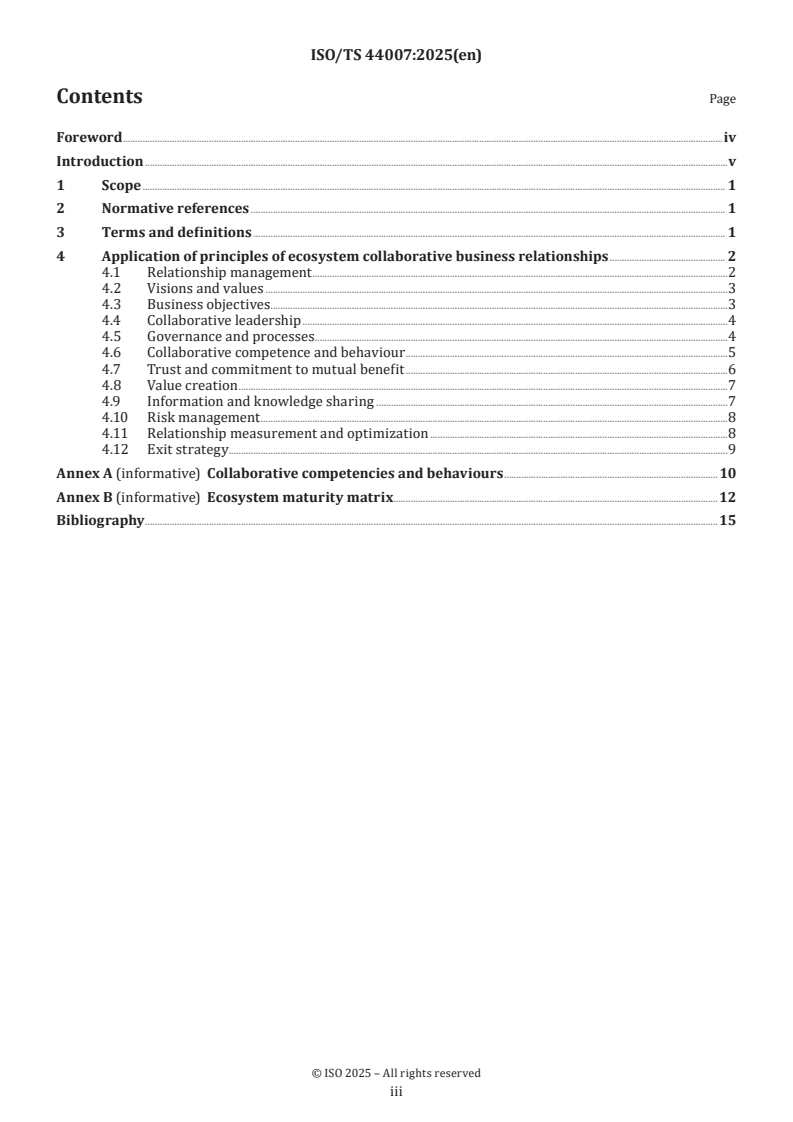
Contents Page
Foreword .iv
Introduction .v
1 Scope . 1
2 Normative references . 1
3 Terms and definitions . 1
4 Application of principles of ecosystem collaborative business relationships . 2
4.1 Relationship management .2
4.2 Visions and values .3
4.3 Business objectives . .3
4.4 Collaborative leadership .4
4.5 Governance and processes .4
4.6 Collaborative competence and behaviour .5
4.7 Trust and commitment to mutual benefit .6
4.8 Value creation .7
4.9 Information and knowledge sharing .7
4.10 Risk management .8
4.11 Relationship measurement and optimization .8
4.12 Exit strategy.9
Annex A (informative) Collaborative competencies and behaviours .10
Annex B (informative) Ecosystem maturity matrix .12
Bibliography .15
iii
Foreword
ISO (the International Organization for Standardization) is a worldwide federation of national standards
bodies (ISO member bodies). The work of preparing International Standards is normally carried out through
ISO technical committees. Each member body interested in a subject for which a technical committee
has been established has the right to be represented on that committee. International organizations,
governmental and non-governmental, in liaison with ISO, also take part in the work. ISO collaborates closely
with the International Electrotechnical Commission (IEC) on all matters of electrotechnical standardization.
The procedures used to develop this document and those intended for its further maintenance are described
in the ISO/IEC Directives, Part 1. In particular, the different approval criteria needed for the different types
of ISO document should be noted. This document was drafted in accordance with the editorial rules of the
ISO/IEC Directives, Part 2 (see www.iso.org/directives).
ISO draws attention to the possibility that the implementation of this document may involve the use of (a)
patent(s). ISO takes no position concerning the evidence, validity or applicability of any claimed patent
rights in respect thereof. As of the date of publication of this document, ISO had not received notice of (a)
patent(s) which may be required to implement this document. However, implementers are cautioned that
this may not represent the latest information, which may be obtained from the patent database available at
www.iso.org/patents. ISO shall not be held responsible for identifying any or all such patent rights.
Any trade name used in this document is information given for the convenience of users and does not
constitute an endorsement.
For an explanation of the voluntary nature of standards, the meaning of ISO specific terms and expressions
related to conformity assessment, as well as information about ISO’s adherence to the World Trade
Organization (WTO) principles in the Technical Barriers to Trade (TBT), see www.iso.org/iso/foreword.html.
This document was prepared by Technical Committee ISO/TC 286, Collaborative business relationship
management.
Any feedback or questions on this document should be directed to the user’s national standards body. A
complete listing of these bodies can be found at www.iso.org/members.html.
iv
Introduction
Ecosystems are becoming a predominant business model in which businesses, governmental bodies
and other organizations interoperate and collaborate. Notable strategy advisories project that between
USD 60 trillion to USD 100 trillion of economic value can be generated from ecosystems, constituting a third
of the global economy.
One reason behind the rise of ecosystems is that they are exponential value generators. While both
bilateral alliances and ecosystems have the capacity to continuously generate new output, ecosystems,
being multilateral, facilitate ongoing value creation by enabling connections among a diverse range of
organizations. Other sources of value include reduced costs, increased market share, enhanced competitive
advantage and resiliency through business disruptions.
However, a different approach and different mindset is required to manage these multidimensional,
multilateral business relationships. While collaborative management processes remain relevant, it is
necessary to rethink how to apply them.
For example, in the case of a multi-party ecosystem of nine partners, a nine-way governance model that
adopts traditional collaborative working practices would be neither efficient nor agile and cannot scale.
Instead, a set of adaptive and simple (or “light-weight”) principles that enable creative interactions, guide
behaviour and are scalable can be codified to support an ecosystem’s ongoing value creation and value
distribution. Principles are more adaptable to harnessing the network effect of the creative capability within
an ecosystem community of diverse organizations.
By adopting common frameworks, ecosystem members can reduce the time and complexity of figuring
out the collaborative processes. Through adoption of these principles, individual members can assess and
address their capability to collaborate effectively and ensure that the right processes, leadership and mindset
are in place to enable success. Adhering to ecosystem collaboration principles enables ecosystem members
to focus more on value-creating activities, thus increasing productivity and accelerating innovation.
There are various configurations of ecosystems, and they differ in scale. The application of collaboration
principles adapts according to the ecosystem’s scale and configuration. For example, in a small ecosystem of
half a dozen partners, members can manage the added complexity of having six different voices and interests.
This is possible, but far from easy, and will break down as more partners are added. As an ecosystem grows,
a more self-sustaining and principles-driven approach is necessary for effective ecosystem governance and
development. Collaboration principles do not replace having sound practices and policies, but they do enable
lighter-weight and more programmatic approaches.
Large-scale ecosystems can be comprised of dozens or even thousands of partner members. In these
configurations, there is typically a single orchestrator or a small number of partners who form the
orchestration core. Other ecosystem partners have much less influence and participate through self-
alignment to the rules and guidance set by the orchestrators.
Partner ecosystems also have a life cycle, over which time members can join and leave and experience stages
similar to that of other collaborative business relationships: strategic, engagement and management.
This document is based on the 12 principles of collaborative business relationships given in ISO/TR 44000:
— relationship management (see 4.1);
— visions and values (see 4.2);
— business objectives (see 4.3);
— collaborative leadership (see 4.4);
— governance and processes (see 4.5);
— collaborative competence and behaviour (see 4.6);
— trust and commitment to mutual benefit (see 4.7);
v
— value creation (see 4.8);
— information and knowledge sharing (see 4.9);
— risk management (see 4.10);
— relationship measurement and optimization (see 4.11);
— exit strategy (see 4.12).
ISO/TR 44000 describes each principle, explains why it is important to the organization and provides
examples of the benefits gained from applying it.
To maximize their benefit, they should be addressed collectively, and not in isolation or in any particular
sequence.
The requirements for achieving a collaborative ecosystem are contained in ISO 44001 which generally
addresses collaborations of all sizes, types and configurations.
This document provides insight into how collaborative working principles can be applied to manage
multilateral ecosystems for organizations of all sizes and their stakeholders. It endeavours to address
the unique challenges in implementing collaborative relationships in multi-partner configurations. It is a
standalone document but can also be used with reference to ISO/TR 44000 or ISO 44001.
vi
Technical Specification ISO/TS 44007:2025(en)
Collaborative business relationship management — Guidance
for ecosystem collaborations
1 Scope
This document gives guidance for ecosystem participants on implementing the 12 principles of collaborative
business relationships outlined in ISO/TR 44000 to enhance their collaborative capabilities.
This document is applicable to all ecosystem configurations, orchestrators and members regardless of
function, location, operating environment, industry sector, cultural context, social capital or organizational
objectives.
2 Normative references
There are no normative references in this document.
3 Terms and definitions
For the purposes of this document, the following terms and definitions apply.
ISO and IEC maintain terminology databases for use in standardization at the following addresses:
— ISO Online browsing platform: available at https:// www .iso .org/ obp
— IEC Electropedia: available at https:// www .electropedia .org/
3.1
ecosystem
collaborative community of autonomous, diverse organizations with varying degrees of multilateral
complementary relationships that contribute to a joint value proposition
3.2
collaboration
act of working together jointly with autonomous, diverse organizations, in a formalized or informal way, to
contribute to a joint value proposition
3.3
collaborative leadership
management style that embraces collaborative behaviours such as leading through influence, consensus
building and seeking mutual gain
Note 1 to entry: See Annex A.
3.4
orchestrator
entity that facilitates and coordinates interactive value co-creation within an ecosystem (3.1) and may be the
initiator of the ecosystem
3.5
member
individual organization that participates in the ecosystem community
3.6
senior executive responsible
SER
high level executive person who has overall responsibility of oversight management and resource allocation
for the ecosystem community
4 Application of principles of ecosystem collaborative business relationships
4.1 Relationship management
Relationship management is the framework to manage and sustain collaborative relationships and
underpins their success. This does not have to be a complex process but should be easily understood across
all ecosystem members.
Collaborative relationships based solely on personal relationships are vulnerable, as personnel can change
over time. Moreover, in large-scale ecosystems, maintaining personal relationships between each member
is impossible. A documented relationship management approach ensures consistency and a common
understanding in how collaborations are formed between the members and orchestrators, and among
members themselves.
While it is possible for an ecosystem to exist without a designated orchestrator, one or a core of entities
should serve as the ecosystem orchestrator.
The ecosystem orchestrators are responsible for setting the initial framework for relationship management
even as it is likely to evolve through the contributions of members over time. The orchestrators should have
clarity in the mission, vision and values of the ecosystem, and identify who the stakeholders are and their
expectations and requirements. They should be cognizant of the external and internal environment in which
stakeholders collectively seek to achieve their objectives.
The following considerations apply:
— Ecosystems are comprised of diverse members with varying areas of expertise, commercial interests
and business models. To refine collaborative requirements within an ecosystem, it is useful to segment
and categorize members by:
— clarifying member types and roles within the ecosystem;
— determining how each member type’s activities align with and contribute to the overall business
objectives of the ecosystem;
— defining the value each member type seeks in participating in the ecosystem;
— identifying key requirements for success as they apply to each segment.
— Member selection may take several forms depending upon the purpose and scale of the ecosystem, as
follows:
— Orchestrators may adopt a portfolio approach in recruiting and admitting new members to fulfil
their strategic objectives. Ecosystem members may be carefully curated by the orchestrators for
specific business opportunities, and proactively evaluated across several criteria based on strategic
fit, capacity to deliver or collaborative capability.
— Large-scale ecosystems which rely on self-alignment may adopt a programmatic approach where
qualification criteria are openly published, and ecosystem members demonstrate that they comply
with the criteria to be accepted into the ecosystem.
— Relationship coverage is the means and methods through which member interactions are managed
within the ecosystem and may vary depending upon their level of activity and engagement. Coverage can
reflect high-touch human relationships between members, or it can be highly automated. The coverage
model should acknowledge members’ roles, contributions and value expectations for various customers,
industries and projects, as follows:
— Strategic members may have teams assigned to manage the collaboration and achieve mutual
objectives.
— Less strategic members may have assigned but not exclusive relationship managers to manage their
collaborations.
— Some ecosystem members may self-align to the documented policies and processes of the ecosystem
without a designated relationship manager. These relationships may in fact be highly automated
through a digital platform.
— Large-scale ecosystems are typically highly automated and dependent upon platform technologies. These
platforms manage many aspects of the relationship such as governance, performance tracking, access
to information, communications channels, business planning and risk management. These functions
complement the human interactions of assigned relationship managers.
— Some large-scale ecosystems are digital platform-based ecosystems where the platform owner designs
the platform’s architecture, sets the rules of engagement and establishes the governance approach for
orchestrating value creation. Digital technologies enable automation and connectivity.
4.2 Visions and values
Strong collaborations require a unified and shared vision that serves as the North Star, guiding them towards
achieving common goals and enhancing value creation. This alignment is key for ecosystem sustainability,
which ecosystem orchestrators are wise to keep at the forefront of their strategy. Orchestrators lack
hierarchical authority, and thus ecosystems are not managed by traditional practices of command and
control or by standardized organizational processes. Rather, each member seeks value in the relationship
and will align to the vision only when they recognize the benefits of member participation.
The degree of alignment on vision and values will provide a strong indicator for stakeholder behaviour and
decision-making that transcend metrics, governance and management oversight. The result streamlines
operations, and enables faster achievement of goals and higher performance.
The following considerations apply:
— Alignment is not a one-time exercise done at the beginning of a collaboration. Ecosystems will have
many participating members and so frequent communication and reinforcement of the shared vision
and values will be important to maintain alignment.
— Business conditions evolve, company strategies shift, and fortunes change. These factors can cause the
ecosystem’s North Star to shift and require adjustments to remain viable. It is wise to frequently do a
navigation check to ensure continued alignment to a common vision or whether a re-evaluation and
adjustment is in order.
— Shared vision and values do not mean identical perspectives, but there should be a degree of mutuality
and synergy to maintain aligned self-interest in achieving business objectives.
4.3 Business objectives
Orchestrators typically define the ecosystem’s business objectives, and members may only contribute to
those objectives if their individual organization’s business objectives are suitably aligned and synergistic.
Ultimately, business objective alignment is determined by how organizations generate revenue, and how
they fulfil their mission and serve their stakeholders.
Business objectives may include customer requirements, customer retention, revenue growth, market reach,
resource enhancement, increased levels of engagement, access to new markets, risk mitigation and more.
Thus, it is important to understand the drivers for a collaborative, ecosystem approach.
As with vision and values, alignment does not mean identical perspectives. The extent to which individual
members can achieve their respective business objectives by aligning to those of the ecosystem’s will
encourage collaboration and engagement. This is especially relevant when individual business objectives
cannot be achieved independently.
As more organizations adopt ecosystem business models, the ecosystem becomes the competitive footprint
in the economy and the value proposition becomes that of the collective value of the ecosystem’s participating
members.
The following considerations apply:
— Orchestrators should be mindful of the individual member’s business and economic models. The
segmentation practice, suggested in the relationship management plan, should aid in understanding
the member’s business models and how they will seek to optimize their business outcomes and goals
through ecosystem engagement.
— Each participating member may create a strategy and business case that rationalizes the objectives they
seek to achieve and the benefits they seek to gain through engagement in the ecosystem.
— Orchestrators should monitor and ensure, to the extent possible, that each participant's objectives are
being achieved and that continued alignment will support the right behaviours and engagement at both
organizational and individual levels to sustain mutual benefit.
— In large-scale ecosystems, individual members can assess achievement of their business objectives by
evaluating whether continued participation in the ecosystem is beneficial.
4.4 Collaborative leadership
Senior leadership responsibility and operational leadership accountability are crucial to underpinning a
successful ecosystem approach.
In a collaborative ecosystem, traditional command-and-control leadership models are inappropriate since
value is created by multiple organizations with their own hierarchies. Collaborative leaders embrace
influence models, consensus-building, leading by example and forging alignment to a shared vision. Senior
management support and guidance is a crucial success factor since it creates an environment where people
can work in a collaborative style.
The following considerations apply:
— Within orchestrating organizations, appointing an appropriate senior executive responsible (SER) for the
ecosystem ensures high-level support in terms of oversight management and resource allocation. Their
visible participation provides both focus and confidence for those directly involved in any collaboration,
which in turn fosters the appropriate behaviours at all levels.
— Members should have a similar level of engagement through their senior management. This level
of engagement signals that the collaboration represents a strategic commitment for the member
organization.
4.5 Governance and processes
Collaborations require governance processes that reflect how partners mutually agree to work together,
allocate resources to the collaboration and hold each other accountable for their commitments, with the
ultimate purpose of achieving results. This process can be structured through governance committees
and contract terms, but partnerships based on trust and alignment of vision and values are more agile and
responsive in fast-moving business climates. This is particularly true in ecosystems, where much of the
governance is dependent upon alignment of self-interests to a shared vision.
Typically, ecosystem orchestrators define the governance model through a set of policies that provide
guardrails for expected behaviour within the ecosystem. Members agree to abide by these guidelines as a
condition of membership.
The following considerations apply:
— Factors that help shape the rules or guardrails on ecosystem governance include:
— entry criteria for official participation;
— performance requirements;
— review cadence;
— decision-making and escalation process;
— customer assurance measures (such as training requirements or certifications) to promo
...