

ISO 8466-1:2021
(Main)Water quality — Calibration and evaluation of analytical methods — Part 1: Linear calibration function
General Information
- Abstract
This document specifies various calibration strategies for physicochemical and chemical analytical methods and specifies the calculation of analytical results. It defines the general context for linear calibration so that individual standards dealing with analytical methods for the examination of water quality can make reference to it.
- Status
- Published
- Publication Date
- 16-Nov-2021
- Technical Committee
- ISO/TC 147/SC 2 - Physical, chemical and biochemical methods
- Drafting Committee
- ISO/TC 147/SC 2/WG 48 - QA/QC (Quality assurance/Quality control)
- Current Stage
- 9092 - International Standard to be revised
- Start Date
- 25-Sep-2026
- Completion Date
- 26-Sep-2026
Buy Documents




ISO 8466-1:2021 - Water quality -- Calibration and evaluation of analytical methods


ISO 8466-1:2021 - Water quality — Calibration and evaluation of analytical methods — Part 1: Linear calibration function/17/2021


ISO 8466-1:2026 - BARVE
Overview
ISO 8466-1:2021 - Water quality - Calibration and evaluation of analytical methods - Part 1: Linear calibration function provides the general framework for establishing and using linear calibration in physicochemical and chemical methods for water analysis. The standard defines how to determine the linear working range, select calibration strategies, calculate analytical results and verify calibration validity so that individual water‑quality method standards can reference a consistent approach.
Key topics and technical requirements
- Determination of the linear working range: guidance on preliminary choice and estimation of the linear range (visual x/y plots, point‑to‑point slope analysis) so the selected range is appropriate for linear regression.
- Calibration strategies: multiple approaches including one‑point and two‑point calibration, external and internal standard calibration, calibration of the total procedure, and standard addition. Each strategy covers establishing the calibration function and calculating results.
- Recovery and internal standard handling: procedures for determining recovery rates of analytes or internal standards and incorporating them into result calculations.
- Calculation of calibration functions: methods for computing linear calibration functions and practical considerations for measurement results.
- Validation and control: strategies for testing calibration validity such as control solutions/samples and testing the slope of the calibration line.
- Informative and normative annexes: statistical guidance (Mandel goodness‑of‑fit, standard deviation and confidence intervals), examples of linearity testing, empirical curvature tests, and weighted regression (weighting 1/x).
Practical applications and users
ISO 8466-1:2021 is intended for routine analytical practice in water‑quality laboratories and for standards authors. Typical users include:
- Environmental and drinking‑water testing laboratories establishing routine calibrations
- Method developers writing or validating analytical procedures
- Accreditation bodies and quality managers defining calibration policies
- Instrument manufacturers and service organizations documenting calibration requirements
- Regulators and environmental agencies requiring standardized result calculation and traceability
Practical benefits:
- Harmonizes how linear calibration is implemented and reported across water‑quality methods
- Supports robust quantification by defining working ranges and when different calibration strategies are appropriate
- Facilitates consistent handling of recovery, internal standards and result computation
Related standards
- ISO 8466 series (other parts cover additional calibration topics)
- ISO 11352 (alternative approaches for estimating measurement uncertainty referenced in the introduction)
Keywords: ISO 8466-1:2021, water quality, linear calibration function, calibration strategies, linearity testing, analytical methods, calibration range, standard addition, external/internal standard.
Relations
- Effective Date
- 25-Aug-2026
- Effective Date
- 25-Aug-2026
- Effective Date
- 25-Aug-2026
- Effective Date
- 25-Aug-2026
- Effective Date
- 25-Aug-2026
- Effective Date
- 25-Aug-2026
- Effective Date
- 25-Aug-2026
- Effective Date
- 25-Aug-2026
- Effective Date
- 01-Jul-2026
- Effective Date
- 10-Jun-2026
- Effective Date
- 20-May-2026
- Effective Date
- 06-May-2026
- Effective Date
- 29-Apr-2026
- Effective Date
- 29-Apr-2026
- Effective Date
- 13-Feb-2026
Buy Documents
ISO 8466-1:2021 - Water quality -- Calibration and evaluation of analytical methods
ISO 8466-1:2021 - Water quality — Calibration and evaluation of analytical methods — Part 1: Linear calibration function/17/2021
ISO 8466-1:2026 - BARVE
Get Certified
Connect with accredited certification bodies for this standard

CIS Institut d.o.o.
Personal Protective Equipment (PPE) certification body. Notified Body NB-2890 for EU Regulation 2016/425 PPE.

Kiwa BDA Testing
Building and construction product certification.
Kmetijski inštitut Slovenije
Agricultural Institute of Slovenia. Soil testing, plant health, agricultural product analysis.
Sponsored listings
Frequently Asked Questions
ISO 8466-1:2021 is a standard published by the International Organization for Standardization (ISO). Its full title is "Water quality — Calibration and evaluation of analytical methods — Part 1: Linear calibration function". This standard covers: This document specifies various calibration strategies for physicochemical and chemical analytical methods and specifies the calculation of analytical results. It defines the general context for linear calibration so that individual standards dealing with analytical methods for the examination of water quality can make reference to it.
This document specifies various calibration strategies for physicochemical and chemical analytical methods and specifies the calculation of analytical results. It defines the general context for linear calibration so that individual standards dealing with analytical methods for the examination of water quality can make reference to it.
ISO 8466-1:2021 is classified under the following ICS (International Classification for Standards) categories: 13.060.01 - Water quality in general. The ICS classification helps identify the subject area and facilitates finding related standards.
ISO 8466-1:2021 has the following relationships with other standards: It is inter standard links to EN 17503:2022, EN ISO 17294-2:2023, EN 17892:2024, EN ISO 18475:2025, EN ISO 20596-2:2022, EN ISO 20236:2024, EN ISO 15923-1:2024, EN ISO 10304-4:2022, EN ISO 13646:2025, EN ISO 15192:2025, EN ISO 18127:2026, EN ISO 18724:2025, EN ISO 23697-2:2025, EN ISO 23697-1:2025, EN ISO 23696-2:2025. Understanding these relationships helps ensure you are using the most current and applicable version of the standard.
ISO 8466-1:2021 is available in PDF format for immediate download after purchase. The document can be added to your cart and obtained through the secure checkout process. Digital delivery ensures instant access to the complete standard document.
Standards Content (Sample)
INTERNATIONAL ISO
STANDARD 8466-1
Second edition
2021-11
Water quality — Calibration and
evaluation of analytical methods —
Part 1:
Linear calibration function
Qualité de l'eau — Étalonnage et évaluation des méthodes
d'analyse —
Partie 1: Fonction linéaire d'étalonnage
Reference number
© ISO 2021
All rights reserved. Unless otherwise specified, or required in the context of its implementation, no part of this publication may
be reproduced or utilized otherwise in any form or by any means, electronic or mechanical, including photocopying, or posting on
the internet or an intranet, without prior written permission. Permission can be requested from either ISO at the address below
or ISO’s member body in the country of the requester.
ISO copyright office
CP 401 • Ch. de Blandonnet 8
CH-1214 Vernier, Geneva
Phone: +41 22 749 01 11
Email: copyright@iso.org
Website: www.iso.org
Published in Switzerland
ii
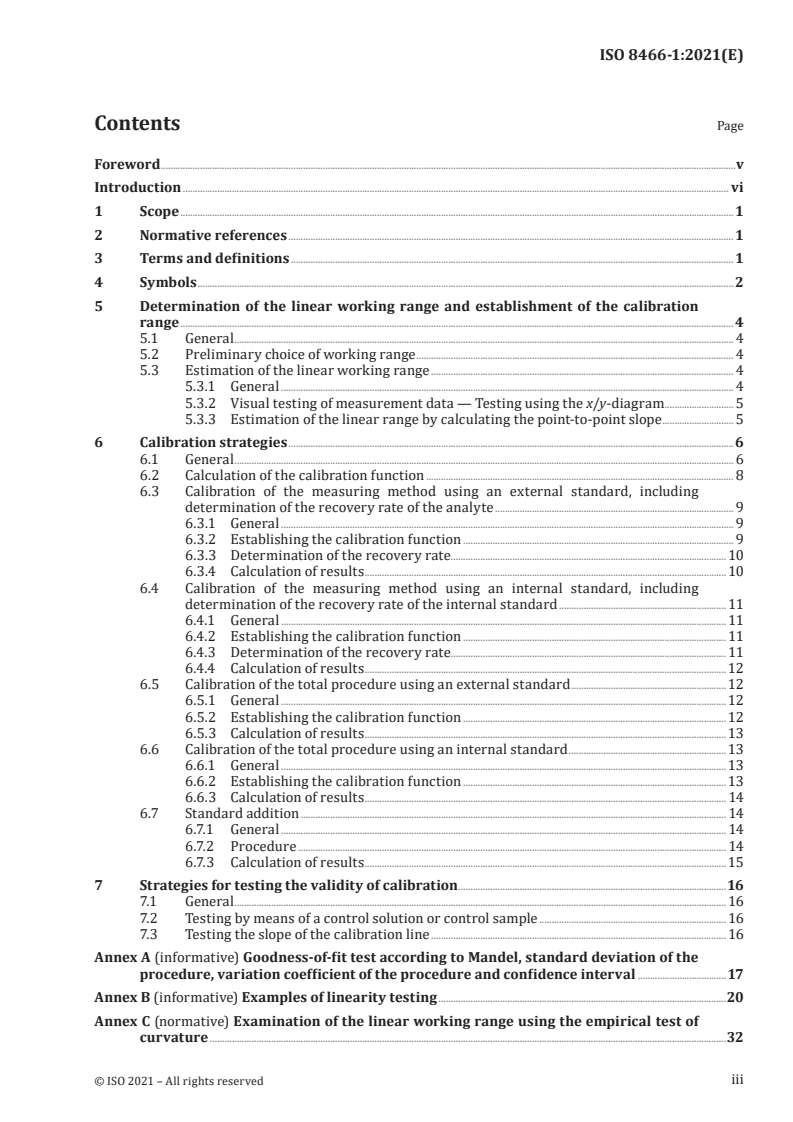
Contents Page
Foreword .v
Introduction . vi
1 Scope . 1
2 Normative references . 1
3 Terms and definitions . 1
4 Symbols . 2
5 Determination of the linear working range and establishment of the calibration
range . 4
5.1 General . 4
5.2 Preliminary choice of working range . 4
5.3 Estimation of the linear working range . 4
5.3.1 General . 4
5.3.2 Visual testing of measurement data — Testing using the x/y-diagram. 5
5.3.3 Estimation of the linear range by calculating the point-to-point slope . 5
6 Calibration strategies .6
6.1 General . 6
6.2 Calculation of the calibration function . 8
6.3 Calibration of the measuring method using an external standard, including
determination of the recovery rate of the analyte . 9
6.3.1 General . 9
6.3.2 Establishing the calibration function . 9
6.3.3 Determination of the recovery rate . 10
6.3.4 Calculation of results . 10
6.4 Calibration of the measuring method using an internal standard, including
determination of the recovery rate of the internal standard . 11
6.4.1 General . 11
6.4.2 Establishing the calibration function . 11
6.4.3 Determination of the recovery rate . 11
6.4.4 Calculation of results .12
6.5 Calibration of the total procedure using an external standard .12
6.5.1 General .12
6.5.2 Establishing the calibration function .12
6.5.3 Calculation of results .13
6.6 Calibration of the total procedure using an internal standard .13
6.6.1 General .13
6.6.2 Establishing the calibration function . 13
6.6.3 Calculation of results . 14
6.7 Standard addition . 14
6.7.1 General . 14
6.7.2 Procedure . 14
6.7.3 Calculation of results .15
7 Strategies for testing the validity of calibration .16
7.1 General . 16
7.2 Testing by means of a control solution or control sample . 16
7.3 Testing the slope of the calibration line . 16
Annex A (informative) Goodness-of-fit test according to Mandel, standard deviation of the
procedure, variation coefficient of the procedure and confidence interval .17
Annex B (informative) Examples of linearity testing .20
Annex C (normative) Examination of the linear working range using the empirical test of
curvature .32
iii
Annex D (informative) Weighted regression — Weighting 1/x .39
Bibliography .41
iv
Foreword
ISO (the International Organization for Standardization) is a worldwide federation of national standards
bodies (ISO member bodies). The work of preparing International Standards is normally carried out
through ISO technical committees. Each member body interested in a subject for which a technical
committee has been established has the right to be represented on that committee. International
organizations, governmental and non-governmental, in liaison with ISO, also take part in the work.
ISO collaborates closely with the International Electrotechnical Commission (IEC) on all matters of
electrotechnical standardization.
The procedures used to develop this document and those intended for its further maintenance are
described in the ISO/IEC Directives, Part 1. In particular, the different approval criteria needed for the
different types of ISO documents should be noted. This document was drafted in accordance with the
editorial rules of the ISO/IEC Directives, Part 2 (see www.iso.org/directives).
Attention is drawn to the possibility that some of the elements of this document may be the subject of
patent rights. ISO shall not be held responsible for identifying any or all such patent rights. Details of
any patent rights identified during the development of the document will be in the Introduction and/or
on the ISO list of patent declarations received (see www.iso.org/patents).
Any trade name used in this document is information given for the convenience of users and does not
constitute an endorsement.
For an explanation of the voluntary nature of standards, the meaning of ISO specific terms and
expressions related to conformity assessment, as well as information about ISO's adherence to
the World Trade Organization (WTO) principles in the Technical Barriers to Trade (TBT), see
www.iso.org/iso/foreword.html.
This document was prepared by Technical Committee ISO/TC 147, Water quality, Subcommittee SC 2,
Physical, chemical and biochemical methods.
This second edition cancels and replaces the first edition (ISO 8466-1:1990), which has been technically
revised.
The main changes compared to the previous edition are as follows:
— the title has been modified;
— the scope of the document is the calibration for routine analysis;
— calculation of performance characteristics has been moved to the informative Annex A;
— the calibration range has been extended to several decade orders of magnitudes;
— the verification of the homogeneity of variances has been deleted;
— the linearity test has been modified;
— various calibration strategies have been described;
— the document has been editorially revised.
A list of all parts in the ISO 8466 series can be found on the ISO website.
Any feedback or questions on this document should be directed to the user’s national standards body. A
complete listing of these bodies can be found at www.iso.org/members.html.
v
Introduction
Calibration is a prerequisite for the quantification of analytes by means of physicochemical and
chemical methods. In most cases, simple linear regression is applied because many measuring methods
show a linear relationship between the indicated value and the sample content.
Since the publication of ISO 8466-1 in 1990, a huge progress has been made in the field of instrumental
analysis, a consequence of which is that various calibration strategies have been developed in order to
make best use of the equipment. The calibration range of many analytical methods was constrained to
a maximum of one order of magnitude by the theoretical statistical requirement to only apply simple
linear regression if homogeneity of variances exists across the selected working range. Due to the
estimation of measurement uncertainty by calculation of the confidence interval in ISO 8466-1:1990, it
had been necessary to conform to the required homogeneity of variances. Meanwhile, other methods for
the estimation of measurement uncertainty that are independent of calibration have been established
(e.g. ISO 11352).
Calibration is always done in two steps. The first step comprises the determination of the linear
range, the second step is the calculation of the calibration function. The calibration strategies that are
described in this document enable the analyst to individually define the calibration effort according
to specified requirements. The method that is described in ISO 8466-1:1990 remains part of the
informative annex since it can still be useful for specific purposes (e.g. method validation).
vi
INTERNATIONAL STANDARD ISO 8466-1:2021(E)
Water quality — Calibration and evaluation of analytical
methods —
Part 1:
Linear calibration function
1 Scope
This document specifies various calibration strategies for physicochemical and chemical analytical
methods and specifies the calculation of analytical results.
It defines the general context for linear calibration so that individual standards dealing with analytical
methods for the examination of water quality can make reference to it.
2 Normative references
There are no normative references in this document.
3 Terms and definitions
For the purposes of this document, the following terms and definitions apply.
ISO and IEC maintain terminological databases for use in standardization at the following addresses:
— ISO Online browsing platform: available at https:// www .iso .org/ obp
— IEC Electropedia: available at https:// www .electropedia .org/
3.1
working range
interval, determined by calibration, between the highest and the lowest content, where the lowest
possible limit of the working range is the limit of quantification of the analytical method
3.2
one-point calibration
calibration between the origin and the indicated value corresponding to the content in the calibration
sample (3.8)
3.3
two-point calibration
calibration using two calibration samples (3.8) with different contents at the upper and at the lower
working range limit
3.4
indicated value
y
quantity value provided by a measuring instrument or a measuring system
[7]
Note 1 to entry: In accordance with definition 4.1 “indication” of ISO/IEC Guide 99 .
3.5
content
general term for the quantitative expression of the concentration or fraction of a substance in or of a
substance mixture
Note 1 to entry: For example, it is the generic term for mass concentration, molar concentration, mass fraction.
3.6
total procedure
analytical method comprising all steps from sample pre-treatment to the report of results
3.7
calibration solution
standard solution without a matrix
3.8
calibration sample
standard solution with a matrix
3.9
measurement procedure
comprises all details of a measurement including all calculations for obtaining the measurement result
3.10
responsivity
R
input–output gain of a detector system, i.e. indicated value divided by the corresponding content in the
calibration sample (3.8)
Note 1 to entry: For a system that responds linearly to its input, there is a unique responsivity. For nonlinear
systems, the responsivity is the local slope.
4 Symbols
A recovery rate for the sample
s
A recovery rate of the internal standard
Is
a intercept of the calibration line or the regression line for standard addition
b slope of the calibration line or the regression line for standard addition or the coefficient of
the linear term of the second-order calibration function
b point-to-point slope i
i
b median of the slopes b
m i
c regression coefficient of the quadratic term of the second-order calibration function
F factor (taking into account sample preparation, e.g. enrichment factor)
f conversion factor (e.g. 100 for expression in %)
f or f degree of freedom
1 2
i index of the calibration solutions (1, 2, …, N)
m number of replicate measurements per spiking level for standard addition
N number of calibration solutions
n number of spiking levels for the method of standard addition (including unspiked sample)
P confidence level
R responsivity
R responsivity threshold
R responsivity median
m
V volume of the spiking solution i
ssi
V volume of the measurement solution
M
V volume of the sample
s
V volume of the sub-samples
su
x analyte content
x
mean value of the contents x
i
x analyte content in the calibration solution
e
x analyte content in the spiked calibration sample
eg
x analyte content in the sample after calibration of the total procedure
g
x content of the internal standard I in the calibration solution
Ie
x content of the internal standard I in the calibration sample
Ieg
x content of the internal standard I in the sample
Ig
x measured content of the internal standard I in the measurement solution
IM
x analyte content in the calibration solution i
i
x analyte content in the measurement solution
M
x analyte content in the original sample
o
x analyte content in the sample
s
x content of the spiked sample
sp
x content of the spiking solution
ss
x spiked content in the sample
z
x spiked content in the sub-samples i
zi
y indicated value
y
mean value of the indicated values y
i
y indicated value for external calibration
e
y indicated value for external calibration of the total procedure
eg
y indicated value of the analyte in the sample
g
y indicated value of the internal standard I for calibration of the measuring method
Ie
y indicated value of the internal standard I for calibration of the total procedure
Ieg
y indicated value of the internal standard I in the sample
Ig
y indicated value of the calibration solution i or indicated value of the sub-sample i for standard
i
addition
y indicated value of the (unspiked) sample
s
Δb
difference between the slope b and the median of the slopes b
im−
i m
5 Determination of the linear working range and establishment of the
calibration range
5.1 General
Linearity of the analytical measuring method is tested within the practice-oriented working range in
accordance with the following pattern:
a) First step: Establishment of the preliminary working range.
Prepare and analyse calibration solutions (with or without internal standards, analyte-dependent
but matrix-independent) over one or more orders of magnitude.
b) Second step: Test linearity and establishment of the linear working range.
Calculate the linear calibration function.
5.2 Preliminary choice of working range
Each calibration starts with the selection of a preliminary working range. This is subject to:
— the objective with respect to the practical application;
— the technically feasible possibilities;
— the linearity of the functional relationship between the indicated values and the contents.
The working range should largely cover a wide application range for the purpose in hand.
The available measuring instruments often allow the choice of a wide linear working range (sometimes
over several orders of magnitude). On the other hand, it is required that the indicated values obtained
near the lower limit of the working range can be at least distinguished from the indicated values of the
procedure blank. A lower limit of the working range is only reasonable if it is greater than or equal to
the limit of quantification of this method. Moreover, dilution and concentration steps are required to be
feasible and accurate.
5.3 Estimation of the linear working range
5.3.1 General
For testing the linearity of a working range covering one or more orders of magnitude, the following
procedure which is based on the first-order calibration function has proved to be effective.
Prepare a minimum of five calibration solutions with different contents (x) and determine the
i
corresponding indicated values (y ). Subsequently, plot both the measuring points and the point-to-
i
point slopes in a diagram and visually estimate the linear working range (see 5.3.2).
Here, the contents may be equidistant or be based on geometric series (e.g. 1; 2; 4; 8; …) or, when testing
linear working ranges that are expected to be large, such as for ICP-MS, be based on the power of ten.
Multiple measurements increase the reliability of the statement.
For many measuring methods showing a linear behaviour over two to five orders of magnitude, a series
of contents (x ) in the form of … 0,1; 0,2; 0,5; 1; 2; 5; 10; 20; 50; 100; … is suitable.
i
NOTE 1 For the recommended series of contents, the measuring points for the contents are nearly equidistant
on a logarithmic scale. Instead of a series of contents of e.g. [… 0,2; 2; 20; …], the series of contents of [… 0,25; 2,5;
25; …] can also be applied.
NOTE 2 Multiple calibration solutions increase the reliability more than multiple determination.
5.3.2 Visual testing of measurement data — Testing using the x/y-diagram
The measuring points are plotted in a content/indicated value-diagram and the developing of the
measuring points is visually assessed.
NOTE 1 When using a spreadsheet programme, the additional presentation of a linear regression function
and a comparing second-order regression function (stating the correlation coefficient or the coefficient of
determination) can be helpful.
NOTE 2 Analysis of residuals using a preliminary linear regression can give additional information.
5.3.3 Estimation of the linear range by calculating the point-to-point slope
For estimation of the linear working range calculate section-wise the slope b from the data sets of each
i
two consecutive measuring points.
In case of a linear calibration function, a constant slope can be expected. Since there might be a non-
linear sub-section, the median of the slope values should be used instead of the arithmetic mean value.
In case of a linear working range, the section-wise calculated slopes should scatter around the median.
A non-linear range at the beginning or at the end will be recognised by systematically increasing or
decreasing deviations from the median of the slopes b .
m
For evaluation, plot the differences (Δb = b − b ) between the slopes b and the median of the slopes
i−m i m i
b in a diagram.
m
If the procedure is linear across the selected working range, the differences will be normally distributed
around zero (vary unsystematically around zero). Emerging trends indicate a non-linear relationship
between content and indicated value.
If, in addition, a tolerance range with limiting lines above and below the zero-line is entered, then the
working range that is accepted to be linear can be easily estimated. The tolerance range is defined in
accordance with the accuracy requirements for analysis. The linear working range ends (or starts) at
the measuring point (characterized as continuous index) that is just located within the accepted scatter
around the zero-line or from which a systematic trend is recognized.
Annex B describes this procedure and gives examples.
NOTE 1 The tolerance range can affect measurement uncertainty.
NOTE 2 Especially in the case of measuring points not being equidistantly distributed, single points can
visually lead to a false estimation of linearity. The limit of the linear working range can be specified more
precisely by adding further measuring points.
As an alternative to the estimation of the linear range by determining the point-to-point slope, Annex C
describes the testing of the linear working range by means of the empirical test of curvature. Both
methods lead to the same result.
NOTE 3 An Excel spreadsheet for the testing of the linear working range can be downloaded from the website
[10]
of the Water Chemistry Society . It includes several sample data sets.
6 Calibration strategies
6.1 General
The calibration function that has been determined for a substance is only valid for the covered working
range. Moreover, it depends on the operating condition of the measuring instrument and shall be tested
within each series of measurements (see Clause 7). The calibration function is valid as long as the
requirements for the measurement uncertainty are fulfilled.
The measurement uncertainty of analytical results comprises contributions from random and
systematic deviations. The determination of the measurement uncertainty using quality assurance
data is described in ISO 11352. Calibration itself contributes to the random and systematic deviations
depending on the number of calibration levels applied and the number of parallel determinations, or to
what extent a correction of matrix-related systematic deviations is done during calibration. Therefore,
more or less complex calibration strategies can be selected according to the required measurement
uncertainty for analysis. In this context, this document does not clearly specify the number of calibration
levels, the number of standard additions or the number of parallel determinations.
For establishing the calibration functions, five modes of operation are described:
a) calibration of the measuring method using an external standard;
b) calibration of the measuring method using an internal standard;
c) calibration of the total procedure using an external standard;
d) calibration of the total procedure using an internal standard;
e) calibration according to the method of standard addition.
The following options for working ranges and for the number of calibration levels can be applied:
— for one-point calibration, selection of a content level at the upper working range limit. Blanks shall
be negligible (below the limit of detection);
— if blanks are not negligible or are varying, measurement of at least one more content level near the
lower working range limit and exclusion of the origin for the calculation of the calibration function;
— for multi-point calibration, distribution of content levels across the calibration range;
— for one-point and two-point calibration, a minimum of three measurements for each content level.
The lowest content level of the calibration range shall be greater than or equal to the limit of
quantification. The determination of the limit detection and of the limit of quantification is carried out
in accordance with documented procedures, for example according to ISO/TS 13530.
Table 1 summarizes the basic conditions and application ranges of various calibration strategies.
For large working ranges, some software packages offer the possibility of weighting by means of
1/x in order to improve trueness in the lower part of the working range, if necessary. This weighting
procedure is presented in Annex D, including formulae for calculation.
Table 1 — Summary of various calibration strategies
Calibration method Subclause Characteristics/basic conditions Preferred application
range
a) calibration of 6.3 — matrix-free calibration solution; Analytical methods for which
the measuring it is known due to experience
— abscissa: content values;
method using from the standardization
an external process or intralaboratory
— ordinate: indicated values;
standard, validation that the recov-
including ery rate is predominantly
— regardless of the sample matrix,
determination of constant.
the content value of the sample is
the recovery rate
determined from the indicated value
of the analyte
of the sample and the calibration
function;
— matrix effects or process-related
effects are corrected by the recovery
rate of spiked real or synthetic
samples, if necessary
b) calibration of 6.4 — matrix-free calibration solution with Analytical methods for which
the measuring internal standard; the matrices influence the
method using measurement results during
— abscissa: ratio of the analyte content
an internal preparation of different sam-
in the calibration solution to the
standard, ples to an extent that is not
content of the internal standard in the
including negligible and not predicta-
calibration solution;
determination of ble
the recovery rate
— ordinate: ratio of the corresponding
of the internal
indicated value of the standard
standard
substance to the indicated value of
the internal standard;
— the content value of the sample is
determined from the ratio of the
indicated values of the analyte
and the internal standard and the
calibration function;
— matrix effects are corrected by
addition of the internal standard
to the sample prior to sample
preparation
c) calibration of the 6.5 — synthetic samples or analyte-free real Analytical methods for which
total procedure samples are spiked with an analyte it is known due to experience
using an external in order to prepare calibration from the standardization
standard samples and are subjected to the total process or intralaboratory
procedure; validation that matrix-relat-
ed interferences are present
— abscissa: content values;
which, however, have a sim-
ilar impact on the indicated
— ordinate: indicated values;
values regarding amount and
direction.
— regardless of the sample matrix,
the content value of the sample is
determined from the indicated value
of the sample and the calibration
function;
— the matrix effect is corrected by the
recovery rate of spiked samples
Table 1 (continued)
Calibration method Subclause Characteristics/basic conditions Preferred application
range
d) calibration of the 6.6 — for the preparation of calibration Analytical methods for which
total procedure samples, synthetic or analyte-free the matrices influence the
using an internal real samples are spiked with an measurement results during
standard analyte and with an internal standard preparation of different sam-
and finally subjected to the total ples to an extent that is not
procedure; negligible and not predicta-
ble.
— abscissa: ratio of the analyte content
Analytical methods for which
in the calibration sample to the
the analyte is converted
content of the internal standard in the
during sample preparation
calibration sample;
to a different form that is
not available as a standard
— ordinate: ratio of the corresponding
substance.
indicated value of the standard
substance to the indicated value of
the internal standard;
— matrix effects will be corrected due to
the addition of the internal standard
to the sample prior to sample
preparation
e) calibration 6.7 — the sample itself is used for the Analytical methods for which
according to preparation of the calibration samples it is known that each matrix
the method of by spiking it with an analyte; significantly affects the
standard addition indicated value in a non-pre-
— abscissa: spiked contents;
dictable manner.
— ordinate: corresponding indicated
values;
— the content value of the sample is
determined by dividing the indicated
value of the unspiked sample by the
slope of the calibration function
6.2 Calculation of the calibration function
Based on the data sets of calibration values (x and y ), the coefficients a and b of the calibration line,
i i
which describes the linear relationship between the content x as an independent variable and the
indicated value y as a dependent variable, are calculated in accordance with the rules of simple linear
regression.
For the calculation of the simple linear regression, the uncertainty values of the contents are neglected.
The calibration function only results from those data which are based on a working range that has
been determined from the standard contents (x to x ), i.e. no blank is subtracted from the individual
1 N
indicated values.
The calibration function hence is as given in Formula (1):
ya=+bx⋅ (1)
where
y is the indicated value;
a is the intercept of the calibration line;
b is the slope of the calibration line;
x is the analyte content.
The coefficients of the calibration function are the results from Formulae (2), (3) and (4):
Slope of the calibration function is given as Formula (2):
N
()xx− ⋅−()yy
∑ ii
i=1
b= (2)
N
xx−
()
i
∑
i=1
where
x is the analyte content of the calibration solution i;
i
x
is the mean value of the contents x ;
i
y is the indicated value of the calibration solution i;
i
y
is the mean value of the indicated values y .
i
Ordinate intercept is given as Formula (3):
ay=−bx⋅ (3)
This results in the general evaluation function which shall be adapted in accordance with the calibration
strategies, if necessary, is given as Formula (4):
ya−
()
x = (4)
b
6.3 Calibration of the measuring method using an external standard, including
determination of the recovery rate of the analyte
6.3.1 General
This type of calibration only concerns the measuring method, i.e. no steps of sample preparation such
as extraction or digestion are carried out but only matrix-free standards (e.g. in pure solvent or high-
purity water) are analysed. The influence due to the steps of sample preparation and of the matrix on
the analytical result is taken into account by a separate determination of the recovery rate.
6.3.2 Establishing the calibration function
— For establishing the calibration function, measure the calibration solutions.
— Represent the calibration function graphically. Therefore, plot the indicated values y as the ordinate
e
values and the corresponding contents x as the abscissa values.
e
— Determine the line of best fit by linear regression using the value pairs y and x in accordance with
e e
Formula (5):
yb=⋅xa+ (5)
ee
where
y is the indicated value of the external calibration;
e
x is the analyte content of the calibration solution.
e
6.3.3 Determination of the recovery rate
For the determination of the recovery rate, spike real samples with the analytes, e.g. by adding
calibration solutions, and analyse these spiked samples and the original samples by the total procedure.
Spiking shall be such that the analyte contents in the spiked sample are at the upper working range
limit.
The volume of the spike should be negligible compared to the volume of the sample, e.g. <1 %.
Determine the analyte contents of the spiked sample and of the original sample in accordance with
Formula (6).
ya−
x = ⋅F (6)
b
where F is the factor (taking into account sample preparation, e.g. enrichment factor).
Calculate the recovery rate in accordance with Formula (7).
xx−
sp O
A = ⋅ f (7)
s
x
z
where
A is the recovery rate for the sample;
s
x is the content of the spiked sample;
sp
x is the content of the original sample;
o
x is the spiked content in the sample;
z
f is the conversion factor (e.g. 100 for expression in %).
If varying matrix effects exist with proportional systematic impacts, a correction by the sample-specific
recovery rate (see Table 1 in 6.1), or the use of internal standards (6.6), or calibration according to the
method of standard addition (6.7) is required.
NOTE Information on matrix effects can be obtained from recovery experiments.
6.3.4 Calculation of results
— Calculate the analyte content of the sample in accordance with Formula (8):
ya− F
x = ⋅⋅ f (8)
s
b A
s
where x is the analyte content of the sample.
s
6.4 Calibration of the measuring method using an internal standard, including
determination of the recovery rate of the internal standard
6.4.1 General
By using internal standards in the calibration solutions and samples, the variations of the measuring
system are compensated and the recovery rates, including matrix effects, are determined and taken
into account over the total analytical process.
The calibration solutions and each analytical sample are spiked with the same amount of the internal
standard. The volume of the spike should be negligible compared to the volume of the sample, for
example <1 %. The internal standard shall not be present in the samples to be examined. The internal
standard and the substance to be determined should have a similar recovery rate and should show
a similar behaviour during sample preparation and measurement. Depending on the spectrum of the
analytes and the measuring method, it can be necessary to use several internal standards.
For the organic trace analysis, appropriate internal standards are, for example, homologous substances,
and, especially for mass-spectrometric methods, the same analytes but composed of different isotopes,
e.g. deuterated or C labelled compounds. Analytes, for which no isotope-labelled compounds are
available, may be analysed using other internal standards if it has been ascertained and documented
that the recovery rate of the analyte, which has been determined by spiking, is in the same range for the
examined sample types as the recovery rate of the selected internal standard.
6.4.2 Establishing the calibration function
Analyse the calibration solutions containing all substances to be determined and the internal standards;
the contents of the internal standards shall be identical in all calibration solutions.
For the graphic representation of the calibration function, plot the ratios of the indicated values y /y
e Ie
as the ordinate values and the corresponding ratios of the contents x /x as the abscissa values.
e Ie
Determine the line of best fit from the value pairs y /y and x /x by linear regression in accordance
e Ie e Ie
with Formula (9).
y x
e e
=⋅b +a (9)
y x
Ie Ie
where
y is the indicated value of the internal standard;
Ie
x is the content of the internal standard in the calibration solution.
Ie
6.4.3 Determination of the recovery rate
For the determination of the recovery rate, spike synthetic or real samples with the internal standard
and analyse the spiked sample via the total procedure.
Spiking shall be such that the theoretical content in the measurement solution equals the content of the
internal standard in the calibration solution.
Calculate the recovery rate of the internal standard A in accordance with Formula (10):
Is
x
IM
A = f (10)
Is
x
Ie
where
x is the measured content of the internal standard I in the measurement solution;
IM
f is the conversion factor (100 for expression in %).
NOTE x is calculated by external calibration. This is usually a one-point calibration.
IM
6.4.4 Calculation of results
Calculate the analyte content of the measurement solution in accordance with Formula (11):
y
e
−a
y
Ie
x = ⋅x (11)
M Ie
b
where x is the analyte content of the measurement solution.
M
Calculate the analyte content x in the water sample in accordance with Formula (12):
s
x V
Ie M
xx=⋅ (12)
sM
x V
IM s
where
x see Formula (11);
M
V is the volume of the measurement solution;
M
V is the volume of the sample.
s
6.5 Calibration of the total procedure using an external standard
6.5.1 General
This type of calibration concerns the total analytical procedure, including all steps of sample
[5]
preparation. For calibration, synthetic samples or representative analyte-free real samples are
prepared by spiking them with analytes.
Calibration via the total procedure is necessary if the analyte is converted into another form during
sample preparation, which is not available as a standard substance, e.g. by derivatization.
NOTE 1 The transferability onto real samples can be estimated by the indication of the application ranges in
the subject-specific standards. They indicate details on possible problems or interferences.
Further matrix effects can be identified from real samples through the determination of the recovery
rate.
If varying matrix effects exist with proportional systematic impacts, a correction by the sample-specific
recovery rate (see Table 1 in 6.1), or the use of internal standards (6.6), or calibration according to the
method of standard addition (6.7) is required.
NOTE 2 Information on matrix effects can be obtained from recovery experiments.
6.5.2 Establishing the calibration function
For establishing the calibration function, prepare and analyse the calibration samples in the same
manner as real samples.
Represent the calibration function graphically. Therefore, plot the indicated values y as the ordinate
eg
values and the corresponding contents x in the spiked calibration samples as the abscissa values.
eg
Determine the line of best fit by linear regression using the value pairs y and x :
eg eg
yb=⋅xa+ (13)
eg eg
where
y is the indicated value (dependent variable) for the external calibration of the total procedure;
eg
x is the analyte content (independent variable) of the spiked calibration sample.
eg
6.5.3 Calculation of results
Calculate the content x in the sample in accordance with Formula (14):
g
ya−
()
g
x = (14)
g
b
where
x is the analyte content of the sample;
g
y is the indicated value of the analyte in the sample (prepared according to the same procedure
g
as for calibration).
6.6 Calibration of the total procedure using an internal standard
6.6.1 General
This type of calibration concerns the total analytical procedure and corresponds to the method
[5]
described in 6.4, except with the calibration sample being a synthetic sample or an analyte-free real
matrix. When adding an internal standard, the effects caused by the matrix and by sample preparation
(e.g. incomplete digestion or extraction losses by clean-up) can be corrected.
Calibration of the total procedure is necessary if the analyte is converted to another form during sample
preparation, which is not available as a standard substance, e.g. by derivatization.
The calibration samples and
...
INTERNATIONAL ISO
STANDARD 8466-1
Second edition
2021-11
Water quality — Calibration and
evaluation of analytical methods —
Part 1:
Linear calibration function
Qualité de l'eau — Étalonnage et évaluation des méthodes
d'analyse —
Partie 1: Fonction linéaire d'étalonnage
Reference number
© ISO 2021
All rights reserved. Unless otherwise specified, or required in the context of its implementation, no part of this publication may
be reproduced or utilized otherwise in any form or by any means, electronic or mechanical, including photocopying, or posting on
the internet or an intranet, without prior written permission. Permission can be requested from either ISO at the address below
or ISO’s member body in the country of the requester.
ISO copyright office
CP 401 • Ch. de Blandonnet 8
CH-1214 Vernier, Geneva
Phone: +41 22 749 01 11
Email: copyright@iso.org
Website: www.iso.org
Published in Switzerland
ii
Contents Page
Foreword .v
Introduction . vi
1 Scope . 1
2 Normative references . 1
3 Terms and definitions . 1
4 Symbols . 2
5 Determination of the linear working range and establishment of the calibration
range . 4
5.1 General . 4
5.2 Preliminary choice of working range . 4
5.3 Estimation of the linear working range . 4
5.3.1 General . 4
5.3.2 Visual testing of measurement data — Testing using the x/y-diagram. 5
5.3.3 Estimation of the linear range by calculating the point-to-point slope . 5
6 Calibration strategies .6
6.1 General . 6
6.2 Calculation of the calibration function . 8
6.3 Calibration of the measuring method using an external standard, including
determination of the recovery rate of the analyte . 9
6.3.1 General . 9
6.3.2 Establishing the calibration function . 9
6.3.3 Determination of the recovery rate . 10
6.3.4 Calculation of results . 10
6.4 Calibration of the measuring method using an internal standard, including
determination of the recovery rate of the internal standard . 11
6.4.1 General . 11
6.4.2 Establishing the calibration function . 11
6.4.3 Determination of the recovery rate . 11
6.4.4 Calculation of results .12
6.5 Calibration of the total procedure using an external standard .12
6.5.1 General .12
6.5.2 Establishing the calibration function .12
6.5.3 Calculation of results .13
6.6 Calibration of the total procedure using an internal standard .13
6.6.1 General .13
6.6.2 Establishing the calibration function . 13
6.6.3 Calculation of results . 14
6.7 Standard addition . 14
6.7.1 General . 14
6.7.2 Procedure . 14
6.7.3 Calculation of results .15
7 Strategies for testing the validity of calibration .16
7.1 General . 16
7.2 Testing by means of a control solution or control sample . 16
7.3 Testing the slope of the calibration line . 16
Annex A (informative) Goodness-of-fit test according to Mandel, standard deviation of the
procedure, variation coefficient of the procedure and confidence interval .17
Annex B (informative) Examples of linearity testing .20
Annex C (normative) Examination of the linear working range using the empirical test of
curvature .32
iii
Annex D (informative) Weighted regression — Weighting 1/x .39
Bibliography .41
iv
Foreword
ISO (the International Organization for Standardization) is a worldwide federation of national standards
bodies (ISO member bodies). The work of preparing International Standards is normally carried out
through ISO technical committees. Each member body interested in a subject for which a technical
committee has been established has the right to be represented on that committee. International
organizations, governmental and non-governmental, in liaison with ISO, also take part in the work.
ISO collaborates closely with the International Electrotechnical Commission (IEC) on all matters of
electrotechnical standardization.
The procedures used to develop this document and those intended for its further maintenance are
described in the ISO/IEC Directives, Part 1. In particular, the different approval criteria needed for the
different types of ISO documents should be noted. This document was drafted in accordance with the
editorial rules of the ISO/IEC Directives, Part 2 (see www.iso.org/directives).
Attention is drawn to the possibility that some of the elements of this document may be the subject of
patent rights. ISO shall not be held responsible for identifying any or all such patent rights. Details of
any patent rights identified during the development of the document will be in the Introduction and/or
on the ISO list of patent declarations received (see www.iso.org/patents).
Any trade name used in this document is information given for the convenience of users and does not
constitute an endorsement.
For an explanation of the voluntary nature of standards, the meaning of ISO specific terms and
expressions related to conformity assessment, as well as information about ISO's adherence to
the World Trade Organization (WTO) principles in the Technical Barriers to Trade (TBT), see
www.iso.org/iso/foreword.html.
This document was prepared by Technical Committee ISO/TC 147, Water quality, Subcommittee SC 2,
Physical, chemical and biochemical methods.
This second edition cancels and replaces the first edition (ISO 8466-1:1990), which has been technically
revised.
The main changes compared to the previous edition are as follows:
— the title has been modified;
— the scope of the document is the calibration for routine analysis;
— calculation of performance characteristics has been moved to the informative Annex A;
— the calibration range has been extended to several decade orders of magnitudes;
— the verification of the homogeneity of variances has been deleted;
— the linearity test has been modified;
— various calibration strategies have been described;
— the document has been editorially revised.
A list of all parts in the ISO 8466 series can be found on the ISO website.
Any feedback or questions on this document should be directed to the user’s national standards body. A
complete listing of these bodies can be found at www.iso.org/members.html.
v
Introduction
Calibration is a prerequisite for the quantification of analytes by means of physicochemical and
chemical methods. In most cases, simple linear regression is applied because many measuring methods
show a linear relationship between the indicated value and the sample content.
Since the publication of ISO 8466-1 in 1990, a huge progress has been made in the field of instrumental
analysis, a consequence of which is that various calibration strategies have been developed in order to
make best use of the equipment. The calibration range of many analytical methods was constrained to
a maximum of one order of magnitude by the theoretical statistical requirement to only apply simple
linear regression if homogeneity of variances exists across the selected working range. Due to the
estimation of measurement uncertainty by calculation of the confidence interval in ISO 8466-1:1990, it
had been necessary to conform to the required homogeneity of variances. Meanwhile, other methods for
the estimation of measurement uncertainty that are independent of calibration have been established
(e.g. ISO 11352).
Calibration is always done in two steps. The first step comprises the determination of the linear
range, the second step is the calculation of the calibration function. The calibration strategies that are
described in this document enable the analyst to individually define the calibration effort according
to specified requirements. The method that is described in ISO 8466-1:1990 remains part of the
informative annex since it can still be useful for specific purposes (e.g. method validation).
vi
INTERNATIONAL STANDARD ISO 8466-1:2021(E)
Water quality — Calibration and evaluation of analytical
methods —
Part 1:
Linear calibration function
1 Scope
This document specifies various calibration strategies for physicochemical and chemical analytical
methods and specifies the calculation of analytical results.
It defines the general context for linear calibration so that individual standards dealing with analytical
methods for the examination of water quality can make reference to it.
2 Normative references
There are no normative references in this document.
3 Terms and definitions
For the purposes of this document, the following terms and definitions apply.
ISO and IEC maintain terminological databases for use in standardization at the following addresses:
— ISO Online browsing platform: available at https:// www .iso .org/ obp
— IEC Electropedia: available at https:// www .electropedia .org/
3.1
working range
interval, determined by calibration, between the highest and the lowest content, where the lowest
possible limit of the working range is the limit of quantification of the analytical method
3.2
one-point calibration
calibration between the origin and the indicated value corresponding to the content in the calibration
sample (3.8)
3.3
two-point calibration
calibration using two calibration samples (3.8) with different contents at the upper and at the lower
working range limit
3.4
indicated value
y
quantity value provided by a measuring instrument or a measuring system
[7]
Note 1 to entry: In accordance with definition 4.1 “indication” of ISO/IEC Guide 99 .
3.5
content
general term for the quantitative expression of the concentration or fraction of a substance in or of a
substance mixture
Note 1 to entry: For example, it is the generic term for mass concentration, molar concentration, mass fraction.
3.6
total procedure
analytical method comprising all steps from sample pre-treatment to the report of results
3.7
calibration solution
standard solution without a matrix
3.8
calibration sample
standard solution with a matrix
3.9
measurement procedure
comprises all details of a measurement including all calculations for obtaining the measurement result
3.10
responsivity
R
input–output gain of a detector system, i.e. indicated value divided by the corresponding content in the
calibration sample (3.8)
Note 1 to entry: For a system that responds linearly to its input, there is a unique responsivity. For nonlinear
systems, the responsivity is the local slope.
4 Symbols
A recovery rate for the sample
s
A recovery rate of the internal standard
Is
a intercept of the calibration line or the regression line for standard addition
b slope of the calibration line or the regression line for standard addition or the coefficient of
the linear term of the second-order calibration function
b point-to-point slope i
i
b median of the slopes b
m i
c regression coefficient of the quadratic term of the second-order calibration function
F factor (taking into account sample preparation, e.g. enrichment factor)
f conversion factor (e.g. 100 for expression in %)
f or f degree of freedom
1 2
i index of the calibration solutions (1, 2, …, N)
m number of replicate measurements per spiking level for standard addition
N number of calibration solutions
n number of spiking levels for the method of standard addition (including unspiked sample)
P confidence level
R responsivity
R responsivity threshold
R responsivity median
m
V volume of the spiking solution i
ssi
V volume of the measurement solution
M
V volume of the sample
s
V volume of the sub-samples
su
x analyte content
x
mean value of the contents x
i
x analyte content in the calibration solution
e
x analyte content in the spiked calibration sample
eg
x analyte content in the sample after calibration of the total procedure
g
x content of the internal standard I in the calibration solution
Ie
x content of the internal standard I in the calibration sample
Ieg
x content of the internal standard I in the sample
Ig
x measured content of the internal standard I in the measurement solution
IM
x analyte content in the calibration solution i
i
x analyte content in the measurement solution
M
x analyte content in the original sample
o
x analyte content in the sample
s
x content of the spiked sample
sp
x content of the spiking solution
ss
x spiked content in the sample
z
x spiked content in the sub-samples i
zi
y indicated value
y
mean value of the indicated values y
i
y indicated value for external calibration
e
y indicated value for external calibration of the total procedure
eg
y indicated value of the analyte in the sample
g
y indicated value of the internal standard I for calibration of the measuring method
Ie
y indicated value of the internal standard I for calibration of the total procedure
Ieg
y indicated value of the internal standard I in the sample
Ig
y indicated value of the calibration solution i or indicated value of the sub-sample i for standard
i
addition
y indicated value of the (unspiked) sample
s
Δb
difference between the slope b and the median of the slopes b
im−
i m
5 Determination of the linear working range and establishment of the
calibration range
5.1 General
Linearity of the analytical measuring method is tested within the practice-oriented working range in
accordance with the following pattern:
a) First step: Establishment of the preliminary working range.
Prepare and analyse calibration solutions (with or without internal standards, analyte-dependent
but matrix-independent) over one or more orders of magnitude.
b) Second step: Test linearity and establishment of the linear working range.
Calculate the linear calibration function.
5.2 Preliminary choice of working range
Each calibration starts with the selection of a preliminary working range. This is subject to:
— the objective with respect to the practical application;
— the technically feasible possibilities;
— the linearity of the functional relationship between the indicated values and the contents.
The working range should largely cover a wide application range for the purpose in hand.
The available measuring instruments often allow the choice of a wide linear working range (sometimes
over several orders of magnitude). On the other hand, it is required that the indicated values obtained
near the lower limit of the working range can be at least distinguished from the indicated values of the
procedure blank. A lower limit of the working range is only reasonable if it is greater than or equal to
the limit of quantification of this method. Moreover, dilution and concentration steps are required to be
feasible and accurate.
5.3 Estimation of the linear working range
5.3.1 General
For testing the linearity of a working range covering one or more orders of magnitude, the following
procedure which is based on the first-order calibration function has proved to be effective.
Prepare a minimum of five calibration solutions with different contents (x) and determine the
i
corresponding indicated values (y ). Subsequently, plot both the measuring points and the point-to-
i
point slopes in a diagram and visually estimate the linear working range (see 5.3.2).
Here, the contents may be equidistant or be based on geometric series (e.g. 1; 2; 4; 8; …) or, when testing
linear working ranges that are expected to be large, such as for ICP-MS, be based on the power of ten.
Multiple measurements increase the reliability of the statement.
For many measuring methods showing a linear behaviour over two to five orders of magnitude, a series
of contents (x ) in the form of … 0,1; 0,2; 0,5; 1; 2; 5; 10; 20; 50; 100; … is suitable.
i
NOTE 1 For the recommended series of contents, the measuring points for the contents are nearly equidistant
on a logarithmic scale. Instead of a series of contents of e.g. [… 0,2; 2; 20; …], the series of contents of [… 0,25; 2,5;
25; …] can also be applied.
NOTE 2 Multiple calibration solutions increase the reliability more than multiple determination.
5.3.2 Visual testing of measurement data — Testing using the x/y-diagram
The measuring points are plotted in a content/indicated value-diagram and the developing of the
measuring points is visually assessed.
NOTE 1 When using a spreadsheet programme, the additional presentation of a linear regression function
and a comparing second-order regression function (stating the correlation coefficient or the coefficient of
determination) can be helpful.
NOTE 2 Analysis of residuals using a preliminary linear regression can give additional information.
5.3.3 Estimation of the linear range by calculating the point-to-point slope
For estimation of the linear working range calculate section-wise the slope b from the data sets of each
i
two consecutive measuring points.
In case of a linear calibration function, a constant slope can be expected. Since there might be a non-
linear sub-section, the median of the slope values should be used instead of the arithmetic mean value.
In case of a linear working range, the section-wise calculated slopes should scatter around the median.
A non-linear range at the beginning or at the end will be recognised by systematically increasing or
decreasing deviations from the median of the slopes b .
m
For evaluation, plot the differences (Δb = b − b ) between the slopes b and the median of the slopes
i−m i m i
b in a diagram.
m
If the procedure is linear across the selected working range, the differences will be normally distributed
around zero (vary unsystematically around zero). Emerging trends indicate a non-linear relationship
between content and indicated value.
If, in addition, a tolerance range with limiting lines above and below the zero-line is entered, then the
working range that is accepted to be linear can be easily estimated. The tolerance range is defined in
accordance with the accuracy requirements for analysis. The linear working range ends (or starts) at
the measuring point (characterized as continuous index) that is just located within the accepted scatter
around the zero-line or from which a systematic trend is recognized.
Annex B describes this procedure and gives examples.
NOTE 1 The tolerance range can affect measurement uncertainty.
NOTE 2 Especially in the case of measuring points not being equidistantly distributed, single points can
visually lead to a false estimation of linearity. The limit of the linear working range can be specified more
precisely by adding further measuring points.
As an alternative to the estimation of the linear range by determining the point-to-point slope, Annex C
describes the testing of the linear working range by means of the empirical test of curvature. Both
methods lead to the same result.
NOTE 3 An Excel spreadsheet for the testing of the linear working range can be downloaded from the website
[10]
of the Water Chemistry Society . It includes several sample data sets.
6 Calibration strategies
6.1 General
The calibration function that has been determined for a substance is only valid for the covered working
range. Moreover, it depends on the operating condition of the measuring instrument and shall be tested
within each series of measurements (see Clause 7). The calibration function is valid as long as the
requirements for the measurement uncertainty are fulfilled.
The measurement uncertainty of analytical results comprises contributions from random and
systematic deviations. The determination of the measurement uncertainty using quality assurance
data is described in ISO 11352. Calibration itself contributes to the random and systematic deviations
depending on the number of calibration levels applied and the number of parallel determinations, or to
what extent a correction of matrix-related systematic deviations is done during calibration. Therefore,
more or less complex calibration strategies can be selected according to the required measurement
uncertainty for analysis. In this context, this document does not clearly specify the number of calibration
levels, the number of standard additions or the number of parallel determinations.
For establishing the calibration functions, five modes of operation are described:
a) calibration of the measuring method using an external standard;
b) calibration of the measuring method using an internal standard;
c) calibration of the total procedure using an external standard;
d) calibration of the total procedure using an internal standard;
e) calibration according to the method of standard addition.
The following options for working ranges and for the number of calibration levels can be applied:
— for one-point calibration, selection of a content level at the upper working range limit. Blanks shall
be negligible (below the limit of detection);
— if blanks are not negligible or are varying, measurement of at least one more content level near the
lower working range limit and exclusion of the origin for the calculation of the calibration function;
— for multi-point calibration, distribution of content levels across the calibration range;
— for one-point and two-point calibration, a minimum of three measurements for each content level.
The lowest content level of the calibration range shall be greater than or equal to the limit of
quantification. The determination of the limit detection and of the limit of quantification is carried out
in accordance with documented procedures, for example according to ISO/TS 13530.
Table 1 summarizes the basic conditions and application ranges of various calibration strategies.
For large working ranges, some software packages offer the possibility of weighting by means of
1/x in order to improve trueness in the lower part of the working range, if necessary. This weighting
procedure is presented in Annex D, including formulae for calculation.
Table 1 — Summary of various calibration strategies
Calibration method Subclause Characteristics/basic conditions Preferred application
range
a) calibration of 6.3 — matrix-free calibration solution; Analytical methods for which
the measuring it is known due to experience
— abscissa: content values;
method using from the standardization
an external process or intralaboratory
— ordinate: indicated values;
standard, validation that the recov-
including ery rate is predominantly
— regardless of the sample matrix,
determination of constant.
the content value of the sample is
the recovery rate
determined from the indicated value
of the analyte
of the sample and the calibration
function;
— matrix effects or process-related
effects are corrected by the recovery
rate of spiked real or synthetic
samples, if necessary
b) calibration of 6.4 — matrix-free calibration solution with Analytical methods for which
the measuring internal standard; the matrices influence the
method using measurement results during
— abscissa: ratio of the analyte content
an internal preparation of different sam-
in the calibration solution to the
standard, ples to an extent that is not
content of the internal standard in the
including negligible and not predicta-
calibration solution;
determination of ble
the recovery rate
— ordinate: ratio of the corresponding
of the internal
indicated value of the standard
standard
substance to the indicated value of
the internal standard;
— the content value of the sample is
determined from the ratio of the
indicated values of the analyte
and the internal standard and the
calibration function;
— matrix effects are corrected by
addition of the internal standard
to the sample prior to sample
preparation
c) calibration of the 6.5 — synthetic samples or analyte-free real Analytical methods for which
total procedure samples are spiked with an analyte it is known due to experience
using an external in order to prepare calibration from the standardization
standard samples and are subjected to the total process or intralaboratory
procedure; validation that matrix-relat-
ed interferences are present
— abscissa: content values;
which, however, have a sim-
ilar impact on the indicated
— ordinate: indicated values;
values regarding amount and
direction.
— regardless of the sample matrix,
the content value of the sample is
determined from the indicated value
of the sample and the calibration
function;
— the matrix effect is corrected by the
recovery rate of spiked samples
Table 1 (continued)
Calibration method Subclause Characteristics/basic conditions Preferred application
range
d) calibration of the 6.6 — for the preparation of calibration Analytical methods for which
total procedure samples, synthetic or analyte-free the matrices influence the
using an internal real samples are spiked with an measurement results during
standard analyte and with an internal standard preparation of different sam-
and finally subjected to the total ples to an extent that is not
procedure; negligible and not predicta-
ble.
— abscissa: ratio of the analyte content
Analytical methods for which
in the calibration sample to the
the analyte is converted
content of the internal standard in the
during sample preparation
calibration sample;
to a different form that is
not available as a standard
— ordinate: ratio of the corresponding
substance.
indicated value of the standard
substance to the indicated value of
the internal standard;
— matrix effects will be corrected due to
the addition of the internal standard
to the sample prior to sample
preparation
e) calibration 6.7 — the sample itself is used for the Analytical methods for which
according to preparation of the calibration samples it is known that each matrix
the method of by spiking it with an analyte; significantly affects the
standard addition indicated value in a non-pre-
— abscissa: spiked contents;
dictable manner.
— ordinate: corresponding indicated
values;
— the content value of the sample is
determined by dividing the indicated
value of the unspiked sample by the
slope of the calibration function
6.2 Calculation of the calibration function
Based on the data sets of calibration values (x and y ), the coefficients a and b of the calibration line,
i i
which describes the linear relationship between the content x as an independent variable and the
indicated value y as a dependent variable, are calculated in accordance with the rules of simple linear
regression.
For the calculation of the simple linear regression, the uncertainty values of the contents are neglected.
The calibration function only results from those data which are based on a working range that has
been determined from the standard contents (x to x ), i.e. no blank is subtracted from the individual
1 N
indicated values.
The calibration function hence is as given in Formula (1):
ya=+bx⋅ (1)
where
y is the indicated value;
a is the intercept of the calibration line;
b is the slope of the calibration line;
x is the analyte content.
The coefficients of the calibration function are the results from Formulae (2), (3) and (4):
Slope of the calibration function is given as Formula (2):
N
()xx− ⋅−()yy
∑ ii
i=1
b= (2)
N
xx−
()
i
∑
i=1
where
x is the analyte content of the calibration solution i;
i
x
is the mean value of the contents x ;
i
y is the indicated value of the calibration solution i;
i
y
is the mean value of the indicated values y .
i
Ordinate intercept is given as Formula (3):
ay=−bx⋅ (3)
This results in the general evaluation function which shall be adapted in accordance with the calibration
strategies, if necessary, is given as Formula (4):
ya−
()
x = (4)
b
6.3 Calibration of the measuring method using an external standard, including
determination of the recovery rate of the analyte
6.3.1 General
This type of calibration only concerns the measuring method, i.e. no steps of sample preparation such
as extraction or digestion are carried out but only matrix-free standards (e.g. in pure solvent or high-
purity water) are analysed. The influence due to the steps of sample preparation and of the matrix on
the analytical result is taken into account by a separate determination of the recovery rate.
6.3.2 Establishing the calibration function
— For establishing the calibration function, measure the calibration solutions.
— Represent the calibration function graphically. Therefore, plot the indicated values y as the ordinate
e
values and the corresponding contents x as the abscissa values.
e
— Determine the line of best fit by linear regression using the value pairs y and x in accordance with
e e
Formula (5):
yb=⋅xa+ (5)
ee
where
y is the indicated value of the external calibration;
e
x is the analyte content of the calibration solution.
e
6.3.3 Determination of the recovery rate
For the determination of the recovery rate, spike real samples with the analytes, e.g. by adding
calibration solutions, and analyse these spiked samples and the original samples by the total procedure.
Spiking shall be such that the analyte contents in the spiked sample are at the upper working range
limit.
The volume of the spike should be negligible compared to the volume of the sample, e.g. <1 %.
Determine the analyte contents of the spiked sample and of the original sample in accordance with
Formula (6).
ya−
x = ⋅F (6)
b
where F is the factor (taking into account sample preparation, e.g. enrichment factor).
Calculate the recovery rate in accordance with Formula (7).
xx−
sp O
A = ⋅ f (7)
s
x
z
where
A is the recovery rate for the sample;
s
x is the content of the spiked sample;
sp
x is the content of the original sample;
o
x is the spiked content in the sample;
z
f is the conversion factor (e.g. 100 for expression in %).
If varying matrix effects exist with proportional systematic impacts, a correction by the sample-specific
recovery rate (see Table 1 in 6.1), or the use of internal standards (6.6), or calibration according to the
method of standard addition (6.7) is required.
NOTE Information on matrix effects can be obtained from recovery experiments.
6.3.4 Calculation of results
— Calculate the analyte content of the sample in accordance with Formula (8):
ya− F
x = ⋅⋅ f (8)
s
b A
s
where x is the analyte content of the sample.
s
6.4 Calibration of the measuring method using an internal standard, including
determination of the recovery rate of the internal standard
6.4.1 General
By using internal standards in the calibration solutions and samples, the variations of the measuring
system are compensated and the recovery rates, including matrix effects, are determined and taken
into account over the total analytical process.
The calibration solutions and each analytical sample are spiked with the same amount of the internal
standard. The volume of the spike should be negligible compared to the volume of the sample, for
example <1 %. The internal standard shall not be present in the samples to be examined. The internal
standard and the substance to be determined should have a similar recovery rate and should show
a similar behaviour during sample preparation and measurement. Depending on the spectrum of the
analytes and the measuring method, it can be necessary to use several internal standards.
For the organic trace analysis, appropriate internal standards are, for example, homologous substances,
and, especially for mass-spectrometric methods, the same analytes but composed of different isotopes,
e.g. deuterated or C labelled compounds. Analytes, for which no isotope-labelled compounds are
available, may be analysed using other internal standards if it has been ascertained and documented
that the recovery rate of the analyte, which has been determined by spiking, is in the same range for the
examined sample types as the recovery rate of the selected internal standard.
6.4.2 Establishing the calibration function
Analyse the calibration solutions containing all substances to be determined and the internal standards;
the contents of the internal standards shall be identical in all calibration solutions.
For the graphic representation of the calibration function, plot the ratios of the indicated values y /y
e Ie
as the ordinate values and the corresponding ratios of the contents x /x as the abscissa values.
e Ie
Determine the line of best fit from the value pairs y /y and x /x by linear regression in accordance
e Ie e Ie
with Formula (9).
y x
e e
=⋅b +a (9)
y x
Ie Ie
where
y is the indicated value of the internal standard;
Ie
x is the content of the internal standard in the calibration solution.
Ie
6.4.3 Determination of the recovery rate
For the determination of the recovery rate, spike synthetic or real samples with the internal standard
and analyse the spiked sample via the total procedure.
Spiking shall be such that the theoretical content in the measurement solution equals the content of the
internal standard in the calibration solution.
Calculate the recovery rate of the internal standard A in accordance with Formula (10):
Is
x
IM
A = f (10)
Is
x
Ie
where
x is the measured content of the internal standard I in the measurement solution;
IM
f is the conversion factor (100 for expression in %).
NOTE x is calculated by external calibration. This is usually a one-point calibration.
IM
6.4.4 Calculation of results
Calculate the analyte content of the measurement solution in accordance with Formula (11):
y
e
−a
y
Ie
x = ⋅x (11)
M Ie
b
where x is the analyte content of the measurement solution.
M
Calculate the analyte content x in the water sample in accordance with Formula (12):
s
x V
Ie M
xx=⋅ (12)
sM
x V
IM s
where
x see Formula (11);
M
V is the volume of the measurement solution;
M
V is the volume of the sample.
s
6.5 Calibration of the total procedure using an external standard
6.5.1 General
This type of calibration concerns the total analytical procedure, including all steps of sample
[5]
preparation. For calibration, synthetic samples or representative analyte-free real samples are
prepared by spiking them with analytes.
Calibration via the total procedure is necessary if the analyte is converted into another form during
sample preparation, which is not available as a standard substance, e.g. by derivatization.
NOTE 1 The transferability onto real samples can be estimated by the indication of the application ranges in
the subject-specific standards. They indicate details on possible problems or interferences.
Further matrix effects can be identified from real samples through the determination of the recovery
rate.
If varying matrix effects exist with proportional systematic impacts, a correction by the sample-specific
recovery rate (see Table 1 in 6.1), or the use of internal standards (6.6), or calibration according to the
method of standard addition (6.7) is required.
NOTE 2 Information on matrix effects can be obtained from recovery experiments.
6.5.2 Establishing the calibration function
For establishing the calibration function, prepare and analyse the calibration samples in the same
manner as real samples.
Represent the calibration function graphically. Therefore, plot the indicated values y as the ordinate
eg
values and the corresponding contents x in the spiked calibration samples as the abscissa values.
eg
Determine the line of best fit by linear regression using the value pairs y and x :
eg eg
yb=⋅xa+ (13)
eg eg
where
y is the indicated value (dependent variable) for the external calibration of the total procedure;
eg
x is the analyte content (independent variable) of the spiked calibration sample.
eg
6.5.3 Calculation of results
Calculate the content x in the sample in accordance with Formula (14):
g
ya−
()
g
x = (14)
g
b
where
x is the analyte content of the sample;
g
y is the indicated value of the analyte in the sample (prepared according to the same procedure
g
as for calibration).
6.6 Calibration of the total procedure using an internal standard
6.6.1 General
This type of calibration concerns the total analytical procedure and corresponds to the method
[5]
described in 6.4, except with the calibration sample being a synthetic sample or an analyte-free real
matrix. When adding an internal standard, the effects caused by the matrix and by sample preparation
(e.g. incomplete digestion or extraction losses by clean-up) can be corrected.
Calibration of the total procedure is necessary if the analyte is converted to another form during sample
preparation, which is not available as a standard substance, e.g. by derivatization.
The calibration samples and
...
SLOVENSKI STANDARD
01-september-2026
Kakovost vode - Umerjanje in vrednotenje analiznih metod - 1. del: Linearna
umeritvena funkcija
Water quality - Calibration and evaluation of analytical methods - Part 1: Linear
calibration function
Qualité de l'eau - Étalonnage et évaluation des méthodes d'analyse - Partie 1: Fonction
linéaire d'étalonnage
Ta slovenski standard je istoveten z: ISO 8466-1:2021
ICS:
13.060.01 Kakovost vode na splošno Water quality in general
2003-01.Slovenski inštitut za standardizacijo. Razmnoževanje celote ali delov tega standarda ni dovoljeno.
INTERNATIONAL ISO
STANDARD 8466-1
Second edition
2021-11
Water quality — Calibration and
evaluation of analytical methods —
Part 1:
Linear calibration function
Qualité de l'eau — Étalonnage et évaluation des méthodes
d'analyse —
Partie 1: Fonction linéaire d'étalonnage
Reference number
© ISO 2021
All rights reserved. Unless otherwise specified, or required in the context of its implementation, no part of this publication may
be reproduced or utilized otherwise in any form or by any means, electronic or mechanical, including photocopying, or posting on
the internet or an intranet, without prior written permission. Permission can be requested from either ISO at the address below
or ISO’s member body in the country of the requester.
ISO copyright office
CP 401 • Ch. de Blandonnet 8
CH-1214 Vernier, Geneva
Phone: +41 22 749 01 11
Email: copyright@iso.org
Website: www.iso.org
Published in Switzerland
ii
Contents Page
Foreword .v
Introduction . vi
1 Scope . 1
2 Normative references . 1
3 Terms and definitions . 1
4 Symbols . 2
5 Determination of the linear working range and establishment of the calibration
range . 4
5.1 General . 4
5.2 Preliminary choice of working range . 4
5.3 Estimation of the linear working range . 4
5.3.1 General . 4
5.3.2 Visual testing of measurement data — Testing using the x/y-diagram. 5
5.3.3 Estimation of the linear range by calculating the point-to-point slope . 5
6 Calibration strategies .6
6.1 General . 6
6.2 Calculation of the calibration function . 8
6.3 Calibration of the measuring method using an external standard, including
determination of the recovery rate of the analyte . 9
6.3.1 General . 9
6.3.2 Establishing the calibration function . 9
6.3.3 Determination of the recovery rate . 10
6.3.4 Calculation of results . 10
6.4 Calibration of the measuring method using an internal standard, including
determination of the recovery rate of the internal standard . 11
6.4.1 General . 11
6.4.2 Establishing the calibration function . 11
6.4.3 Determination of the recovery rate . 11
6.4.4 Calculation of results .12
6.5 Calibration of the total procedure using an external standard .12
6.5.1 General .12
6.5.2 Establishing the calibration function .12
6.5.3 Calculation of results .13
6.6 Calibration of the total procedure using an internal standard .13
6.6.1 General .13
6.6.2 Establishing the calibration function . 13
6.6.3 Calculation of results . 14
6.7 Standard addition . 14
6.7.1 General . 14
6.7.2 Procedure . 14
6.7.3 Calculation of results .15
7 Strategies for testing the validity of calibration .16
7.1 General . 16
7.2 Testing by means of a control solution or control sample . 16
7.3 Testing the slope of the calibration line . 16
Annex A (informative) Goodness-of-fit test according to Mandel, standard deviation of the
procedure, variation coefficient of the procedure and confidence interval .17
Annex B (informative) Examples of linearity testing .20
Annex C (normative) Examination of the linear working range using the empirical test of
curvature .32
iii
Annex D (informative) Weighted regression — Weighting 1/x .39
Bibliography .41
iv
Foreword
ISO (the International Organization for Standardization) is a worldwide federation of national standards
bodies (ISO member bodies). The work of preparing International Standards is normally carried out
through ISO technical committees. Each member body interested in a subject for which a technical
committee has been established has the right to be represented on that committee. International
organizations, governmental and non-governmental, in liaison with ISO, also take part in the work.
ISO collaborates closely with the International Electrotechnical Commission (IEC) on all matters of
electrotechnical standardization.
The procedures used to develop this document and those intended for its further maintenance are
described in the ISO/IEC Directives, Part 1. In particular, the different approval criteria needed for the
different types of ISO documents should be noted. This document was drafted in accordance with the
editorial rules of the ISO/IEC Directives, Part 2 (see www.iso.org/directives).
Attention is drawn to the possibility that some of the elements of this document may be the subject of
patent rights. ISO shall not be held responsible for identifying any or all such patent rights. Details of
any patent rights identified during the development of the document will be in the Introduction and/or
on the ISO list of patent declarations received (see www.iso.org/patents).
Any trade name used in this document is information given for the convenience of users and does not
constitute an endorsement.
For an explanation of the voluntary nature of standards, the meaning of ISO specific terms and
expressions related to conformity assessment, as well as information about ISO's adherence to
the World Trade Organization (WTO) principles in the Technical Barriers to Trade (TBT), see
www.iso.org/iso/foreword.html.
This document was prepared by Technical Committee ISO/TC 147, Water quality, Subcommittee SC 2,
Physical, chemical and biochemical methods.
This second edition cancels and replaces the first edition (ISO 8466-1:1990), which has been technically
revised.
The main changes compared to the previous edition are as follows:
— the title has been modified;
— the scope of the document is the calibration for routine analysis;
— calculation of performance characteristics has been moved to the informative Annex A;
— the calibration range has been extended to several decade orders of magnitudes;
— the verification of the homogeneity of variances has been deleted;
— the linearity test has been modified;
— various calibration strategies have been described;
— the document has been editorially revised.
A list of all parts in the ISO 8466 series can be found on the ISO website.
Any feedback or questions on this document should be directed to the user’s national standards body. A
complete listing of these bodies can be found at www.iso.org/members.html.
v
Introduction
Calibration is a prerequisite for the quantification of analytes by means of physicochemical and
chemical methods. In most cases, simple linear regression is applied because many measuring methods
show a linear relationship between the indicated value and the sample content.
Since the publication of ISO 8466-1 in 1990, a huge progress has been made in the field of instrumental
analysis, a consequence of which is that various calibration strategies have been developed in order to
make best use of the equipment. The calibration range of many analytical methods was constrained to
a maximum of one order of magnitude by the theoretical statistical requirement to only apply simple
linear regression if homogeneity of variances exists across the selected working range. Due to the
estimation of measurement uncertainty by calculation of the confidence interval in ISO 8466-1:1990, it
had been necessary to conform to the required homogeneity of variances. Meanwhile, other methods for
the estimation of measurement uncertainty that are independent of calibration have been established
(e.g. ISO 11352).
Calibration is always done in two steps. The first step comprises the determination of the linear
range, the second step is the calculation of the calibration function. The calibration strategies that are
described in this document enable the analyst to individually define the calibration effort according
to specified requirements. The method that is described in ISO 8466-1:1990 remains part of the
informative annex since it can still be useful for specific purposes (e.g. method validation).
vi
INTERNATIONAL STANDARD ISO 8466-1:2021(E)
Water quality — Calibration and evaluation of analytical
methods —
Part 1:
Linear calibration function
1 Scope
This document specifies various calibration strategies for physicochemical and chemical analytical
methods and specifies the calculation of analytical results.
It defines the general context for linear calibration so that individual standards dealing with analytical
methods for the examination of water quality can make reference to it.
2 Normative references
There are no normative references in this document.
3 Terms and definitions
For the purposes of this document, the following terms and definitions apply.
ISO and IEC maintain terminological databases for use in standardization at the following addresses:
— ISO Online browsing platform: available at https:// www .iso .org/ obp
— IEC Electropedia: available at https:// www .electropedia .org/
3.1
working range
interval, determined by calibration, between the highest and the lowest content, where the lowest
possible limit of the working range is the limit of quantification of the analytical method
3.2
one-point calibration
calibration between the origin and the indicated value corresponding to the content in the calibration
sample (3.8)
3.3
two-point calibration
calibration using two calibration samples (3.8) with different contents at the upper and at the lower
working range limit
3.4
indicated value
y
quantity value provided by a measuring instrument or a measuring system
[7]
Note 1 to entry: In accordance with definition 4.1 “indication” of ISO/IEC Guide 99 .
3.5
content
general term for the quantitative expression of the concentration or fraction of a substance in or of a
substance mixture
Note 1 to entry: For example, it is the generic term for mass concentration, molar concentration, mass fraction.
3.6
total procedure
analytical method comprising all steps from sample pre-treatment to the report of results
3.7
calibration solution
standard solution without a matrix
3.8
calibration sample
standard solution with a matrix
3.9
measurement procedure
comprises all details of a measurement including all calculations for obtaining the measurement result
3.10
responsivity
R
input–output gain of a detector system, i.e. indicated value divided by the corresponding content in the
calibration sample (3.8)
Note 1 to entry: For a system that responds linearly to its input, there is a unique responsivity. For nonlinear
systems, the responsivity is the local slope.
4 Symbols
A recovery rate for the sample
s
A recovery rate of the internal standard
Is
a intercept of the calibration line or the regression line for standard addition
b slope of the calibration line or the regression line for standard addition or the coefficient of
the linear term of the second-order calibration function
b point-to-point slope i
i
b median of the slopes b
m i
c regression coefficient of the quadratic term of the second-order calibration function
F factor (taking into account sample preparation, e.g. enrichment factor)
f conversion factor (e.g. 100 for expression in %)
f or f degree of freedom
1 2
i index of the calibration solutions (1, 2, …, N)
m number of replicate measurements per spiking level for standard addition
N number of calibration solutions
n number of spiking levels for the method of standard addition (including unspiked sample)
P confidence level
R responsivity
R responsivity threshold
R responsivity median
m
V volume of the spiking solution i
ssi
V volume of the measurement solution
M
V volume of the sample
s
V volume of the sub-samples
su
x analyte content
x
mean value of the contents x
i
x analyte content in the calibration solution
e
x analyte content in the spiked calibration sample
eg
x analyte content in the sample after calibration of the total procedure
g
x content of the internal standard I in the calibration solution
Ie
x content of the internal standard I in the calibration sample
Ieg
x content of the internal standard I in the sample
Ig
x measured content of the internal standard I in the measurement solution
IM
x analyte content in the calibration solution i
i
x analyte content in the measurement solution
M
x analyte content in the original sample
o
x analyte content in the sample
s
x content of the spiked sample
sp
x content of the spiking solution
ss
x spiked content in the sample
z
x spiked content in the sub-samples i
zi
y indicated value
y
mean value of the indicated values y
i
y indicated value for external calibration
e
y indicated value for external calibration of the total procedure
eg
y indicated value of the analyte in the sample
g
y indicated value of the internal standard I for calibration of the measuring method
Ie
y indicated value of the internal standard I for calibration of the total procedure
Ieg
y indicated value of the internal standard I in the sample
Ig
y indicated value of the calibration solution i or indicated value of the sub-sample i for standard
i
addition
y indicated value of the (unspiked) sample
s
Δb
difference between the slope b and the median of the slopes b
im−
i m
5 Determination of the linear working range and establishment of the
calibration range
5.1 General
Linearity of the analytical measuring method is tested within the practice-oriented working range in
accordance with the following pattern:
a) First step: Establishment of the preliminary working range.
Prepare and analyse calibration solutions (with or without internal standards, analyte-dependent
but matrix-independent) over one or more orders of magnitude.
b) Second step: Test linearity and establishment of the linear working range.
Calculate the linear calibration function.
5.2 Preliminary choice of working range
Each calibration starts with the selection of a preliminary working range. This is subject to:
— the objective with respect to the practical application;
— the technically feasible possibilities;
— the linearity of the functional relationship between the indicated values and the contents.
The working range should largely cover a wide application range for the purpose in hand.
The available measuring instruments often allow the choice of a wide linear working range (sometimes
over several orders of magnitude). On the other hand, it is required that the indicated values obtained
near the lower limit of the working range can be at least distinguished from the indicated values of the
procedure blank. A lower limit of the working range is only reasonable if it is greater than or equal to
the limit of quantification of this method. Moreover, dilution and concentration steps are required to be
feasible and accurate.
5.3 Estimation of the linear working range
5.3.1 General
For testing the linearity of a working range covering one or more orders of magnitude, the following
procedure which is based on the first-order calibration function has proved to be effective.
Prepare a minimum of five calibration solutions with different contents (x) and determine the
i
corresponding indicated values (y ). Subsequently, plot both the measuring points and the point-to-
i
point slopes in a diagram and visually estimate the linear working range (see 5.3.2).
Here, the contents may be equidistant or be based on geometric series (e.g. 1; 2; 4; 8; …) or, when testing
linear working ranges that are expected to be large, such as for ICP-MS, be based on the power of ten.
Multiple measurements increase the reliability of the statement.
For many measuring methods showing a linear behaviour over two to five orders of magnitude, a series
of contents (x ) in the form of … 0,1; 0,2; 0,5; 1; 2; 5; 10; 20; 50; 100; … is suitable.
i
NOTE 1 For the recommended series of contents, the measuring points for the contents are nearly equidistant
on a logarithmic scale. Instead of a series of contents of e.g. [… 0,2; 2; 20; …], the series of contents of [… 0,25; 2,5;
25; …] can also be applied.
NOTE 2 Multiple calibration solutions increase the reliability more than multiple determination.
5.3.2 Visual testing of measurement data — Testing using the x/y-diagram
The measuring points are plotted in a content/indicated value-diagram and the developing of the
measuring points is visually assessed.
NOTE 1 When using a spreadsheet programme, the additional presentation of a linear regression function
and a comparing second-order regression function (stating the correlation coefficient or the coefficient of
determination) can be helpful.
NOTE 2 Analysis of residuals using a preliminary linear regression can give additional information.
5.3.3 Estimation of the linear range by calculating the point-to-point slope
For estimation of the linear working range calculate section-wise the slope b from the data sets of each
i
two consecutive measuring points.
In case of a linear calibration function, a constant slope can be expected. Since there might be a non-
linear sub-section, the median of the slope values should be used instead of the arithmetic mean value.
In case of a linear working range, the section-wise calculated slopes should scatter around the median.
A non-linear range at the beginning or at the end will be recognised by systematically increasing or
decreasing deviations from the median of the slopes b .
m
For evaluation, plot the differences (Δb = b − b ) between the slopes b and the median of the slopes
i−m i m i
b in a diagram.
m
If the procedure is linear across the selected working range, the differences will be normally distributed
around zero (vary unsystematically around zero). Emerging trends indicate a non-linear relationship
between content and indicated value.
If, in addition, a tolerance range with limiting lines above and below the zero-line is entered, then the
working range that is accepted to be linear can be easily estimated. The tolerance range is defined in
accordance with the accuracy requirements for analysis. The linear working range ends (or starts) at
the measuring point (characterized as continuous index) that is just located within the accepted scatter
around the zero-line or from which a systematic trend is recognized.
Annex B describes this procedure and gives examples.
NOTE 1 The tolerance range can affect measurement uncertainty.
NOTE 2 Especially in the case of measuring points not being equidistantly distributed, single points can
visually lead to a false estimation of linearity. The limit of the linear working range can be specified more
precisely by adding further measuring points.
As an alternative to the estimation of the linear range by determining the point-to-point slope, Annex C
describes the testing of the linear working range by means of the empirical test of curvature. Both
methods lead to the same result.
NOTE 3 An Excel spreadsheet for the testing of the linear working range can be downloaded from the website
[10]
of the Water Chemistry Society . It includes several sample data sets.
6 Calibration strategies
6.1 General
The calibration function that has been determined for a substance is only valid for the covered working
range. Moreover, it depends on the operating condition of the measuring instrument and shall be tested
within each series of measurements (see Clause 7). The calibration function is valid as long as the
requirements for the measurement uncertainty are fulfilled.
The measurement uncertainty of analytical results comprises contributions from random and
systematic deviations. The determination of the measurement uncertainty using quality assurance
data is described in ISO 11352. Calibration itself contributes to the random and systematic deviations
depending on the number of calibration levels applied and the number of parallel determinations, or to
what extent a correction of matrix-related systematic deviations is done during calibration. Therefore,
more or less complex calibration strategies can be selected according to the required measurement
uncertainty for analysis. In this context, this document does not clearly specify the number of calibration
levels, the number of standard additions or the number of parallel determinations.
For establishing the calibration functions, five modes of operation are described:
a) calibration of the measuring method using an external standard;
b) calibration of the measuring method using an internal standard;
c) calibration of the total procedure using an external standard;
d) calibration of the total procedure using an internal standard;
e) calibration according to the method of standard addition.
The following options for working ranges and for the number of calibration levels can be applied:
— for one-point calibration, selection of a content level at the upper working range limit. Blanks shall
be negligible (below the limit of detection);
— if blanks are not negligible or are varying, measurement of at least one more content level near the
lower working range limit and exclusion of the origin for the calculation of the calibration function;
— for multi-point calibration, distribution of content levels across the calibration range;
— for one-point and two-point calibration, a minimum of three measurements for each content level.
The lowest content level of the calibration range shall be greater than or equal to the limit of
quantification. The determination of the limit detection and of the limit of quantification is carried out
in accordance with documented procedures, for example according to ISO/TS 13530.
Table 1 summarizes the basic conditions and application ranges of various calibration strategies.
For large working ranges, some software packages offer the possibility of weighting by means of
1/x in order to improve trueness in the lower part of the working range, if necessary. This weighting
procedure is presented in Annex D, including formulae for calculation.
Table 1 — Summary of various calibration strategies
Calibration method Subclause Characteristics/basic conditions Preferred application
range
a) calibration of 6.3 — matrix-free calibration solution; Analytical methods for which
the measuring it is known due to experience
— abscissa: content values;
method using from the standardization
an external process or intralaboratory
— ordinate: indicated values;
standard, validation that the recov-
including ery rate is predominantly
— regardless of the sample matrix,
determination of constant.
the content value of the sample is
the recovery rate
determined from the indicated value
of the analyte
of the sample and the calibration
function;
— matrix effects or process-related
effects are corrected by the recovery
rate of spiked real or synthetic
samples, if necessary
b) calibration of 6.4 — matrix-free calibration solution with Analytical methods for which
the measuring internal standard; the matrices influence the
method using measurement results during
— abscissa: ratio of the analyte content
an internal preparation of different sam-
in the calibration solution to the
standard, ples to an extent that is not
content of the internal standard in the
including negligible and not predicta-
calibration solution;
determination of ble
the recovery rate
— ordinate: ratio of the corresponding
of the internal
indicated value of the standard
standard
substance to the indicated value of
the internal standard;
— the content value of the sample is
determined from the ratio of the
indicated values of the analyte
and the internal standard and the
calibration function;
— matrix effects are corrected by
addition of the internal standard
to the sample prior to sample
preparation
c) calibration of the 6.5 — synthetic samples or analyte-free real Analytical methods for which
total procedure samples are spiked with an analyte it is known due to experience
using an external in order to prepare calibration from the standardization
standard samples and are subjected to the total process or intralaboratory
procedure; validation that matrix-relat-
ed interferences are present
— abscissa: content values;
which, however, have a sim-
ilar impact on the indicated
— ordinate: indicated values;
values regarding amount and
direction.
— regardless of the sample matrix,
the content value of the sample is
determined from the indicated value
of the sample and the calibration
function;
— the matrix effect is corrected by the
recovery rate of spiked samples
Table 1 (continued)
Calibration method Subclause Characteristics/basic conditions Preferred application
range
d) calibration of the 6.6 — for the preparation of calibration Analytical methods for which
total procedure samples, synthetic or analyte-free the matrices influence the
using an internal real samples are spiked with an measurement results during
standard analyte and with an internal standard preparation of different sam-
and finally subjected to the total ples to an extent that is not
procedure; negligible and not predicta-
ble.
— abscissa: ratio of the analyte content
Analytical methods for which
in the calibration sample to the
the analyte is converted
content of the internal standard in the
during sample preparation
calibration sample;
to a different form that is
not available as a standard
— ordinate: ratio of the corresponding
substance.
indicated value of the standard
substance to the indicated value of
the internal standard;
— matrix effects will be corrected due to
the addition of the internal standard
to the sample prior to sample
preparation
e) calibration 6.7 — the sample itself is used for the Analytical methods for which
according to preparation of the calibration samples it is known that each matrix
the method of by spiking it with an analyte; significantly affects the
standard addition indicated value in a non-pre-
— abscissa: spiked contents;
dictable manner.
— ordinate: corresponding indicated
values;
— the content value of the sample is
determined by dividing the indicated
value of the unspiked sample by the
slope of the calibration function
6.2 Calculation of the calibration function
Based on the data sets of calibration values (x and y ), the coefficients a and b of the calibration line,
i i
which describes the linear relationship between the content x as an independent variable and the
indicated value y as a dependent variable, are calculated in accordance with the rules of simple linear
regression.
For the calculation of the simple linear regression, the uncertainty values of the contents are neglected.
The calibration function only results from those data which are based on a working range that has
been determined from the standard contents (x to x ), i.e. no blank is subtracted from the individual
1 N
indicated values.
The calibration function hence is as given in Formula (1):
ya=+bx⋅ (1)
where
y is the indicated value;
a is the intercept of the calibration line;
b is the slope of the calibration line;
x is the analyte content.
The coefficients of the calibration function are the results from Formulae (2), (3) and (4):
Slope of the calibration function is given as Formula (2):
N
()xx− ⋅−()yy
∑ ii
i=1
b= (2)
N
xx−
()
i
∑
i=1
where
x is the analyte content of the calibration solution i;
i
x
is the mean value of the contents x ;
i
y is the indicated value of the calibration solution i;
i
y
is the mean value of the indicated values y .
i
Ordinate intercept is given as Formula (3):
ay=−bx⋅ (3)
This results in the general evaluation function which shall be adapted in accordance with the calibration
strategies, if necessary, is given as Formula (4):
ya−
()
x = (4)
b
6.3 Calibration of the measuring method using an external standard, including
determination of the recovery rate of the analyte
6.3.1 General
This type of calibration only concerns the measuring method, i.e. no steps of sample preparation such
as extraction or digestion are carried out but only matrix-free standards (e.g. in pure solvent or high-
purity water) are analysed. The influence due to the steps of sample preparation and of the matrix on
the analytical result is taken into account by a separate determination of the recovery rate.
6.3.2 Establishing the calibration function
— For establishing the calibration function, measure the calibration solutions.
— Represent the calibration function graphically. Therefore, plot the indicated values y as the ordinate
e
values and the corresponding contents x as the abscissa values.
e
— Determine the line of best fit by linear regression using the value pairs y and x in accordance with
e e
Formula (5):
yb=⋅xa+ (5)
ee
where
y is the indicated value of the external calibration;
e
x is the analyte content of the calibration solution.
e
6.3.3 Determination of the recovery rate
For the determination of the recovery rate, spike real samples with the analytes, e.g. by adding
calibration solutions, and analyse these spiked samples and the original samples by the total procedure.
Spiking shall be such that the analyte contents in the spiked sample are at the upper working range
limit.
The volume of the spike should be negligible compared to the volume of the sample, e.g. <1 %.
Determine the analyte contents of the spiked sample and of the original sample in accordance with
Formula (6).
ya−
x = ⋅F (6)
b
where F is the factor (taking into account sample preparation, e.g. enrichment factor).
Calculate the recovery rate in accordance with Formula (7).
xx−
sp O
A = ⋅ f (7)
s
x
z
where
A is the recovery rate for the sample;
s
x is the content of the spiked sample;
sp
x is the content of the original sample;
o
x is the spiked content in the sample;
z
f is the conversion factor (e.g. 100 for expression in %).
If varying matrix effects exist with proportional systematic impacts, a correction by the sample-specific
recovery rate (see Table 1 in 6.1), or the use of internal standards (6.6), or calibration according to the
method of standard addition (6.7) is required.
NOTE Information on matrix effects can be obtained from recovery experiments.
6.3.4 Calculation of results
— Calculate the analyte content of the sample in accordance with Formula (8):
ya− F
x = ⋅⋅ f (8)
s
b A
s
where x is the analyte content of the sample.
s
6.4 Calibration of the measuring method using an internal standard, including
determination of the recovery rate of the internal standard
6.4.1 General
By using internal standards in the calibration solutions and samples, the variations of the measuring
system are compensated and the recovery rates, including matrix effects, are determined and taken
into account over the total analytical process.
The calibration solutions and each analytical sample are spiked with the same amount of the internal
standard. The volume of the spike should be negligible compared to the volume of the sample, for
example <1 %. The internal standard shall not be present in the samples to be examined. The internal
standard and the substance to be determined should have a similar recovery rate and should show
a similar behaviour during sample preparation and measurement. Depending on the spectrum of the
analytes and the measuring method, it can be necessary to use several internal standards.
For the organic trace analysis, appropriate internal standards are, for example, homologous substances,
and, especially for mass-spectrometric methods, the same analytes but composed of different isotopes,
e.g. deuterated or C labelled compounds. Analytes, for which no isotope-labelled compounds are
available, may be analysed using other internal standards if it has been ascertained and documented
that the recovery rate of the analyte, which has been determined by spiking, is in the same range for the
examined sample types as the recovery rate of the selected internal standard.
6.4.2 Establishing the calibration function
Analyse the calibration solutions containing all substances to be determined and the internal standards;
the contents of the internal standards shall be identical in all calibration solutions.
For the graphic representation of the calibration function, plot the ratios of the indicated values y /y
e Ie
as the ordinate values and the corresponding ratios of the contents x /x as the abscissa values.
e Ie
Determine the line of best fit from the value pairs y /y and x /x by linear regression in accordance
e Ie e Ie
with Formula (9).
y x
e e
=⋅b +a (9)
y x
Ie Ie
where
y is the indicated value of the internal standard;
Ie
x is the content of the internal standard in the calibration solution.
Ie
6.4.3 Determination of the recovery rate
For the determination of the recovery rate, spike synthetic or real samples with the internal standard
and analyse the spiked sample via the total procedure.
Spiking shall be such that the theoretical content in the measurement solution equals the content of the
internal standard in the calibration solution.
Calculate the recovery rate of the internal standard A in accordance with Formula (10):
Is
x
IM
A = f (10)
Is
x
Ie
where
x is the measured content of the internal standard I in the measurement solution;
IM
f is the conversion factor (100 for expression in %).
NOTE x is calculated by external calibration. This is usually a one-point calibration.
IM
6.4.4 Calculation of results
Calculate the analyte content of the measurement solution in accordance with Formula (11):
y
e
−a
y
Ie
x = ⋅x (11)
M Ie
b
where x is the analyte content of the measurement solution.
M
Calculate the analyte content x in the water sample in accordance with Formula (12):
s
x V
Ie M
xx=⋅ (12)
sM
x V
IM s
where
x see Formula (11);
M
V is the volume of the measurement solution;
M
V is the volume of the sample.
s
6.5 Calibration of the total procedure using an external standard
6.5.1 General
This type of calibration concerns the total analytical procedure, including all steps of sample
[5]
preparation. For calibration, synthetic samples or representative analyte-free real samples are
prepared by spiking them with analytes.
Calibration via the total procedure is necessary if the analyte is converted into another form during
sample preparation, which is not available as a standard substance, e.g. by derivatization.
NOTE 1 The transferability onto real samples can be estimated by the indication of the application ranges in
the subject-specific standards. They indicate details on possible problems or interferences.
Further matrix effects can be identified from real samples through the determination of the recovery
rate.
If varying matrix effects exist with proportional systematic impacts, a correction by the sample-specific
recovery rate (see Table 1 in 6.1), or the use of internal standards (6.6), or calibration according to the
method of standard addition (6.7) is required.
NOTE 2 Information on matrix effects can be obtained from recovery experiments.
6.5.2 Establishing the calibration function
For establishing the calibration function, prepare and analyse the calibration samples in the same
manner as real samples.
Represent the calibration function graphically. Therefore, plot the indicated values y as the ordinate
eg
values and the corresponding contents x in the spiked calibration samples as the abscissa values.
eg
Determine the line of best fit by linear regression using the value pairs y and x :
eg eg
yb=
...