

ISO 11733:2004
(Main)Water quality — Determination of the elimination and biodegradability of organic compounds in an aqueous medium — Activated sludge simulation test
General Information
- Abstract
ISO 11733:2004 specifies a method for the determination of the elimination and the biodegradability of organic compounds by aerobic micro-organisms. The conditions described simulate a wastewater treatment plant. Two test systems can be used: activated sludge plants or porous pots. The tests can optionally be performed under conditions of nitrification and denitrification and coupling of the units. The method applies to organic compounds which, under the conditions of the test, are soluble in tap water at the test concentration and not expected to be transformed to insoluble metabolites if biodegradation, in addition to elimination, is determined; poorly water-soluble, but which are satisfactorily dispersible in water and allow detection with suitable analytical means (e.g. organic carbon measurements); non-volatile, or which have a negligible vapour pressure under the test conditions; not inhibitory to the test micro-organisms at the concentration chosen for the test. Compounds inhibitory at concentrations used in this test may be tested at concentrations less than their EC20 value, followed by higher practical concentrations after a period of acclimatization. The method can also be used to measure the biodegradation and elimination of dissolved organic compounds in waste water (also called "test compound" in the method).
- Status
- Published
- Publication Date
- 26-Jul-2004
- Technical Committee
- ISO/TC 147/SC 5 - Biological methods
- Drafting Committee
- ISO/TC 147/SC 5 - Biological methods
- Current Stage
- 9093 - International Standard confirmed
- Start Date
- 18-Jun-2024
- Completion Date
- 29-Aug-2026
Buy Documents
ISO 11733:2004 - Water quality — Determination of the elimination and biodegradability of organic compounds in an aqueous medium — Activated sludge simulation test Released:7/27/2004
ISO 11733:2004 - Qualité de l'eau — Détermination de l'élimination et de la biodégradabilité des composés organiques en milieu aqueux — Essai de simulation des boues activées Released:7/27/2004
Overview
ISO 11733:2004 - "Water quality - Determination of the elimination and biodegradability of organic compounds in an aqueous medium - Activated sludge simulation test" specifies a laboratory method to evaluate the elimination and biodegradability of organic compounds by aerobic microorganisms under conditions that simulate a wastewater treatment plant. The method uses parallel continuously operated test systems (activated sludge plants or porous pots) to quantify removal and, where possible, primary or ultimate biodegradation of soluble or suitably dispersible, non‑volatile, non‑inhibitory test compounds.
Key topics and requirements
- Test principle: Continuous-flow activated‑sludge simulation with a treated influent containing an organic medium plus the test compound in one unit and a control unit without the test compound. Effluent samples are analyzed to determine elimination.
- Analytical endpoints: DOC (dissolved organic carbon) or COD (chemical oxygen demand) are used to calculate degree of elimination; substance‑specific analysis can assess primary biodegradation.
- Test conditions:
- Typical mean hydraulic retention time (HRT): about 6 h.
- Typical sludge retention time (SRT): 6–10 days (sludge age).
- Temperature control usually 20–25 °C (diffuse light or dark enclosure).
- Influent DOC for test compound commonly targeted between 10–20 mg/L when added to organic medium.
- Applicability: Suitable for compounds that are water‑soluble at test concentration or satisfactorily dispersible, non‑volatile under test conditions, and not inhibitory to test microorganisms at the chosen concentration. Inhibitory compounds may be tested at lower concentrations or after acclimatization.
- Optional modes: Tests can be modified for nitrification/denitrification and for coupling of units (see annexes in the standard).
- Safety note: Activated sludge and sewage can contain pathogenic organisms; toxic test compounds require careful handling.
Applications and who uses it
- Environmental and analytical laboratories assessing biodegradability and removal efficiency of chemicals in simulated wastewater treatment.
- Wastewater engineers and treatment plant designers evaluating fate of organic micropollutants under activated‑sludge conditions.
- Chemical manufacturers and environmental compliance teams generating data for regulatory submissions and risk assessment.
- Researchers studying adaptation, pre‑exposure, and biodegradation kinetics in treatment systems.
Related standards
- ISO/TR 15462 - Selection of tests for biodegradability
- ISO 5667‑16 - Guidance on biotesting of samples
- ISO 10634 - Preparation of poorly water‑soluble compounds for biodegradability testing
Keywords: ISO 11733:2004, activated sludge simulation test, biodegradability, elimination, DOC, COD, wastewater treatment simulation, nitrification, denitrification, HRT, SRT.
Relations
- Effective Date
- 03-Jun-2026
- Effective Date
- 12-Feb-2026
- Effective Date
- 06-Jun-2022
- Effective Date
- 15-Apr-2008
Buy Documents
ISO 11733:2004 - Water quality — Determination of the elimination and biodegradability of organic compounds in an aqueous medium — Activated sludge simulation test Released:7/27/2004
ISO 11733:2004 - Qualité de l'eau — Détermination de l'élimination et de la biodégradabilité des composés organiques en milieu aqueux — Essai de simulation des boues activées Released:7/27/2004
Get Certified
Connect with accredited certification bodies for this standard

CIS Institut d.o.o.
Personal Protective Equipment (PPE) certification body. Notified Body NB-2890 for EU Regulation 2016/425 PPE.

Kiwa BDA Testing
Building and construction product certification.
Kmetijski inštitut Slovenije
Agricultural Institute of Slovenia. Soil testing, plant health, agricultural product analysis.
Sponsored listings
Frequently Asked Questions
ISO 11733:2004 is a standard published by the International Organization for Standardization (ISO). Its full title is "Water quality — Determination of the elimination and biodegradability of organic compounds in an aqueous medium — Activated sludge simulation test". This standard covers: ISO 11733:2004 specifies a method for the determination of the elimination and the biodegradability of organic compounds by aerobic micro-organisms. The conditions described simulate a wastewater treatment plant. Two test systems can be used: activated sludge plants or porous pots. The tests can optionally be performed under conditions of nitrification and denitrification and coupling of the units. The method applies to organic compounds which, under the conditions of the test, are soluble in tap water at the test concentration and not expected to be transformed to insoluble metabolites if biodegradation, in addition to elimination, is determined; poorly water-soluble, but which are satisfactorily dispersible in water and allow detection with suitable analytical means (e.g. organic carbon measurements); non-volatile, or which have a negligible vapour pressure under the test conditions; not inhibitory to the test micro-organisms at the concentration chosen for the test. Compounds inhibitory at concentrations used in this test may be tested at concentrations less than their EC20 value, followed by higher practical concentrations after a period of acclimatization. The method can also be used to measure the biodegradation and elimination of dissolved organic compounds in waste water (also called "test compound" in the method).
ISO 11733:2004 specifies a method for the determination of the elimination and the biodegradability of organic compounds by aerobic micro-organisms. The conditions described simulate a wastewater treatment plant. Two test systems can be used: activated sludge plants or porous pots. The tests can optionally be performed under conditions of nitrification and denitrification and coupling of the units. The method applies to organic compounds which, under the conditions of the test, are soluble in tap water at the test concentration and not expected to be transformed to insoluble metabolites if biodegradation, in addition to elimination, is determined; poorly water-soluble, but which are satisfactorily dispersible in water and allow detection with suitable analytical means (e.g. organic carbon measurements); non-volatile, or which have a negligible vapour pressure under the test conditions; not inhibitory to the test micro-organisms at the concentration chosen for the test. Compounds inhibitory at concentrations used in this test may be tested at concentrations less than their EC20 value, followed by higher practical concentrations after a period of acclimatization. The method can also be used to measure the biodegradation and elimination of dissolved organic compounds in waste water (also called "test compound" in the method).
ISO 11733:2004 is classified under the following ICS (International Classification for Standards) categories: 13.060.70 - Examination of biological properties of water. The ICS classification helps identify the subject area and facilitates finding related standards.
ISO 11733:2004 has the following relationships with other standards: It is inter standard links to EN ISO 9509:2006, EN ISO 11733:2004, ISO 5122:1979, ISO 11733:1995. Understanding these relationships helps ensure you are using the most current and applicable version of the standard.
ISO 11733:2004 is available in PDF format for immediate download after purchase. The document can be added to your cart and obtained through the secure checkout process. Digital delivery ensures instant access to the complete standard document.
Standards Content (Sample)
INTERNATIONAL ISO
STANDARD 11733
Second edition
2004-08-01
Water quality — Determination of the
elimination and biodegradability of
organic compounds in an aqueous
medium — Activated sludge simulation
test
Qualité de l'eau — Détermination de l'élimination et de la
biodégradabilité des composés organiques en milieu aqueux — Essai
de simulation des boues activées
Reference number
©
ISO 2004
PDF disclaimer
This PDF file may contain embedded typefaces. In accordance with Adobe's licensing policy, this file may be printed or viewed but
shall not be edited unless the typefaces which are embedded are licensed to and installed on the computer performing the editing. In
downloading this file, parties accept therein the responsibility of not infringing Adobe's licensing policy. The ISO Central Secretariat
accepts no liability in this area.
Adobe is a trademark of Adobe Systems Incorporated.
Details of the software products used to create this PDF file can be found in the General Info relative to the file; the PDF-creation
parameters were optimized for printing. Every care has been taken to ensure that the file is suitable for use by ISO member bodies. In
the unlikely event that a problem relating to it is found, please inform the Central Secretariat at the address given below.
© ISO 2004
All rights reserved. Unless otherwise specified, no part of this publication may be reproduced or utilized in any form or by any means,
electronic or mechanical, including photocopying and microfilm, without permission in writing from either ISO at the address below or
ISO's member body in the country of the requester.
ISO copyright office
Case postale 56 • CH-1211 Geneva 20
Tel. + 41 22 749 01 11
Fax + 41 22 749 09 47
E-mail copyright@iso.org
Web www.iso.org
Published in Switzerland
ii © ISO 2004 – All rights reserved
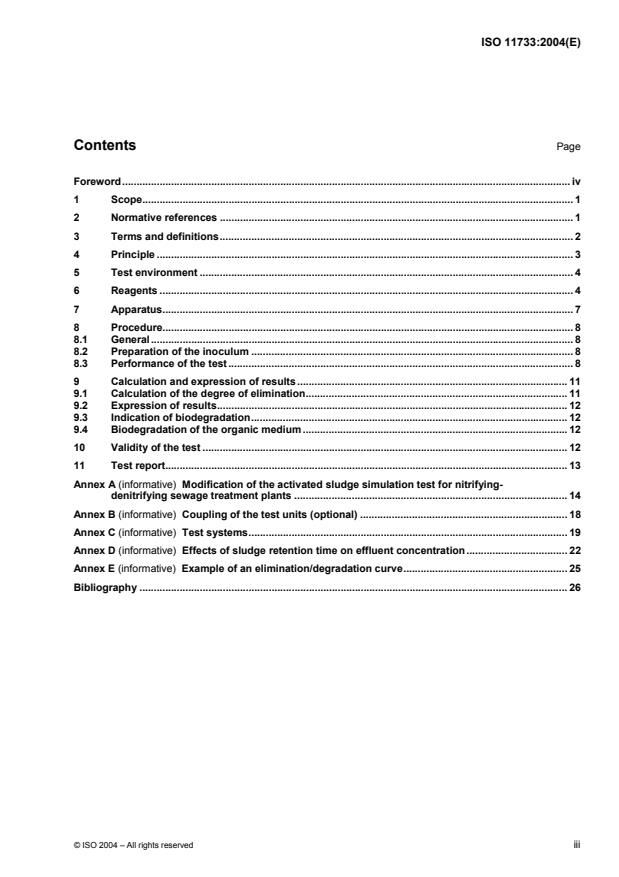
Contents Page
Foreword. iv
1 Scope. 1
2 Normative references . 1
3 Terms and definitions. 2
4 Principle . 3
5 Test environment . 4
6 Reagents . 4
7 Apparatus. 7
8 Procedure. 8
8.1 General. 8
8.2 Preparation of the inoculum . 8
8.3 Performance of the test. 8
9 Calculation and expression of results . 11
9.1 Calculation of the degree of elimination. 11
9.2 Expression of results. 12
9.3 Indication of biodegradation. 12
9.4 Biodegradation of the organic medium .12
10 Validity of the test . 12
11 Test report. 13
Annex A (informative) Modification of the activated sludge simulation test for nitrifying-
denitrifying sewage treatment plants . 14
Annex B (informative) Coupling of the test units (optional) . 18
Annex C (informative) Test systems. 19
Annex D (informative) Effects of sludge retention time on effluent concentration. 22
Annex E (informative) Example of an elimination/degradation curve. 25
Bibliography . 26
Foreword
ISO (the International Organization for Standardization) is a worldwide federation of national standards bodies
(ISO member bodies). The work of preparing International Standards is normally carried out through ISO
technical committees. Each member body interested in a subject for which a technical committee has been
established has the right to be represented on that committee. International organizations, governmental and
non-governmental, in liaison with ISO, also take part in the work. ISO collaborates closely with the
International Electrotechnical Commission (IEC) on all matters of electrotechnical standardization.
International Standards are drafted in accordance with the rules given in the ISO/IEC Directives, Part 2.
The main task of technical committees is to prepare International Standards. Draft International Standards
adopted by the technical committees are circulated to the member bodies for voting. Publication as an
International Standard requires approval by at least 75 % of the member bodies casting a vote.
Attention is drawn to the possibility that some of the elements of this document may be the subject of patent
rights. ISO shall not be held responsible for identifying any or all such patent rights.
ISO 11733 was prepared by Technical Committee ISO/TC 147, Water quality, Subcommittee SC 5, Biological
methods.
This second edition cancels and replaces the first edition (ISO 11733:1995), which has been technically
revised.
iv © ISO 2004 – All rights reserved
INTERNATIONAL STANDARD ISO 11733:2004(E)
Water quality — Determination of the elimination and
biodegradability of organic compounds in an aqueous
medium — Activated sludge simulation test
WARNING AND SAFETY PRECAUTIONS — Activated sludge and sewage contain potentially
pathogenic organisms, therefore appropriate precautions should be taken when handling them. Toxic
test compounds and those whose properties are unknown should be handled with care.
1 Scope
This International Standard specifies a method for the determination of the elimination and the
biodegradability of organic compounds by aerobic micro-organisms. The conditions described simulate a
waste-water treatment plant. Two test systems can be used: activated sludge plants or porous pots. The tests
can optionally be performed under conditions of nitrification and denitrification (Annex A) and coupling of the
units (Annex B).
The method applies to organic compounds which, under the conditions of the test, are
a) soluble in tap water at the test concentration and not expected to be transformed to insoluble metabolites
if biodegradation, in addition to elimination, is determined;
b) poorly water-soluble, but which are satisfactorily dispersible in water and allow detection with suitable
analytical means (e.g. organic carbon measurements);
c) non-volatile, or which have a negligible vapour pressure under the test conditions;
d) not inhibitory to the test micro-organisms at the concentration chosen for the test. Inhibitory effects can be
[15] [27]
determined by using a suitable test method (e.g. ISO 8192 or ISO 15522 ). Compounds inhibitory at
concentrations used in this test may be tested at concentrations less than their EC value, followed by
higher practical concentrations after a period of acclimatization.
The method can also be used to measure the biodegradation and elimination of dissolved organic compounds
in waste water (also called “test compound” in the method).
If more or different information is required to predict the behaviour of test compounds or waste water in a
treatment plant, other degradation tests may be performed. For appropriate use of this method and for
alternative biodegradation methods, see ISO/TR 15462 and for general information on biotesting, see
ISO 5667-16.
2 Normative references
The following referenced documents are indispensable for the application of this document. For dated
references, only the edition cited applies. For undated references, the latest edition of the referenced
document (including any amendments) applies.
ISO 5667-16, Water quality — Sampling — Part 16: Guidance on biotesting of samples
ISO 10634, Water quality — Guidance for the preparation and treatment of poorly water-soluble organic
compounds for the subsequent evaluation of their biodegradability in an aqueous medium
ISO/TR 15462, Water quality — Selection of tests for biodegradability
3 Terms and definitions
For the purposes of this document, the following terms and definitions apply.
3.1
accelerating removal phase
〈activated sludge simulation test〉 time from the end of the lag phase until the plateau phase is reached, during
which the biodegradation of a compound or organic matter increases
NOTE Accelerating removal phase is expressed in days.
3.2
activated sludge
biomass and inert matter produced in the aerobic treatment of wastewater by the growth of bacteria and other
micro-organisms in the presence of dissolved oxygen
3.3
chemical oxygen demand
COD
mass concentration of oxygen equivalent to the amount of a specified oxidant consumed by a chemical
compound or organic matter when a water sample is treated with that oxidant under defined conditions
NOTE COD is expressed, in this case, as milligrams of oxygen consumed per milligram or per gram of test
compound
3.4
concentration of suspended solids of an activated sludge
amount of solids obtained by filtration or centrifugation at known conditions of a known volume of activated
sludge and drying at about 105 °C to constant weight
3.5
degree of elimination
biodegradation
〈activated sludge simulation test〉 mean eliminated (biodegraded) amount of a chemical compound or organic
matter, calculated from the measured concentrations in the inlet and the outlet of the system
NOTE The degree of elimination (biodegradation) is determined when no further elimination can be measured and is
expressed as a percentage.
3.6
denitrification
reduction of nitrate and nitrite to the end product nitrogen (in the form of the gas) by the action of bacteria
3.7
dissolved organic carbon
DOC
part of the organic carbon in a sample of water which cannot be removed by specified phase separation
NOTE Phase separation may be obtained, for example, by centrifugation of the water sample at 40 000 m/s for
15 min or by membrane-filtration using membranes with a pore size of 0,45 µm.
3.8
lag phase
〈activated sludge simulation test〉 time from the start of a test until a significant elimination (biodegradation) of
a compound or organic matter can be measured (the beginning of the accelerated removal phase)
NOTE The lag phase is expressed in days.
2 © ISO 2004 – All rights reserved
3.9
nitrification
oxidation of ammonium salts by bacteria where usually the intermediate product is nitrite and the end product
nitrate
3.10
plateau phase
〈activated sludge simulation test〉 time from the end of the accelerating removal phase until the end of a test in
which the biodegradation of a compound or organic matter is in a steady state
NOTE The plateau phase is expressed in days.
3.11
pre-exposure
pre-incubation of an inoculum in the presence of the test compound or organic matter, with the aim of
enhancing the ability of this inoculum to biodegrade the test compound by adaptation and/or selection of the
micro-organisms
3.12
pre-conditioning
pre-incubation of an inoculum under the conditions of the subsequent test in the absence of the test
compound and other organic matter, with the aim of improving the performance of the test by acclimatization
of the micro-organisms to the test conditions
3.13
primary biodegradation
structural change (transformation) of a chemical compound by micro-organisms resulting in the loss of a
specific property
3.14
total organic carbon
TOC
all the carbon present in organic matter which is dissolved and suspended in the water
3.15
ultimate aerobic biodegradation
breakdown of a chemical compound or organic matter by micro-organisms in the presence of oxygen to
carbon dioxide, water and mineral salts of any other elements present (mineralization) and the production of
new biomass
4 Principle
This method is designed to determine the elimination and, if possible, the primary or ultimate biodegradation
of water-soluble organic compounds from water by aerobic micro-organisms in a continuously operating test
system simulating the activated-sludge process. An easily biodegradable organic medium and the organic test
compound are the sources of carbon and energy for the micro-organisms.
Two test units (activated sludge plants or porous pots) are run in parallel under identical conditions, normally
with a mean hydraulic retention time, HRT, of 6 h (8.3.1) and a mean sludge retention time, SRT (sludge age),
of 6 d to 10 d (8.3.3).
NOTE 1 HTR is the mean period of retention of waste water in the aeration vessel. It is calculated by dividing the
volume of sludge, expressed in litres, by the rate of flow of waste water, expressed in litres per day.
NOTE 2 SRT is the mean period of retention of activated sludge in the aeration vessel. It is calculated by dividing the
volume or weight of sludge in the aeration vessel by the volume or weight of sludge discarded per day. If a period of
8 days is chosen, remove 1/8 of the volume of the activated sludge of the aeration vessel each working day and discard it.
The test compound is added together with the organic medium, usually at a concentration equivalent to a
DOC between 10 mg/l and 20 mg/l, to the influent of only one of the test units. The second unit is used as
control unit to determine the degree of biodegradation of the organic medium when the analysis is based on
DOC or COD.
Samples of the effluents taken at regular intervals are analyzed for DOC or COD. The difference between
values in the effluent of the test and the control unit compared with the influent concentration of the test
compound is used to determine the degree of elimination of the test compound. Depending on the elimination
characteristics and other available information, e.g. from other tests, ultimate biodegradability can be stated.
If required, the primary biodegradation of the test compound can be determined by substance-specific
analysis. Optionally, the units may be operated under denitrifying conditions (see Annex A) or be coupled (see
Annex B).
5 Test environment
The test shall take place in diffused light or in the dark, in an enclosure which is free from vapours toxic to
micro-organisms and at a controlled temperature in the range of 20 °C to 25 °C. For special purposes, it is
permissible to use a test temperature in another range.
6 Reagents
Use only reagents of recognized analytical grade, unless otherwise specified.
6.1 Tap water, containing less than 3 mg/l DOC.
6.2 Deionized water, containing less than 1 mg/l DOC.
6.3 Organic media.
6.3.1 General.
Synthetic sewage, domestic sewage or a mixture of both are permissible as an organic medium. Measure the
[16] [14]
DOC (e.g. ISO 8245 ) or COD (e.g. ISO 6060 ) concentration in each new batch of organic medium and
determine the alkalinity, if required and not already known.
[29]
Experience has shown that the so-called OECD medium (6.3.2) might not be suitable in some cases.
Therefore, two more synthetic media which have successfully been tested in laboratories are described in this
International Standard. Domestic sewage (6.3.5) may also be used. Its use is recommended, as a continuous
inoculation takes place and a vastly greater number of nutrients is available to improve the biodegradation
potential of the test.
6.3.2 Synthetic sewage 1 (OECD medium), which gives a mean DOC concentration of about 100 mg/l
and a COD of about 300 mg/l in the influent.
It is composed of the following:
peptone 160 mg
meat extract 110 mg
urea 30 mg
anhydrous potassium monohydrogenphosphate (K HPO) 28 mg
2 4
sodium chloride (NaCl) 7 mg
4 © ISO 2004 – All rights reserved
.
calcium chloride dihydrate (CaCl 2HO) 4 mg
2 2
.
magnesium sulfate heptahydrate (MgSO 7HO) 2 mg
4 2
tap water (6.1) 1 l
6.3.3 Synthetic sewage 2, which gives a mean DOC concentration of about 150 mg/l and a COD of about
400 mg/l in the influent.
It is composed of the following:
peptone 192 mg
meat extract 138 mg
glucose monohydrate 19 mg
ammonium chloride (NHCl) 23 mg
anhydrous potassium dihydrogenphosphate (KH PO) 16 mg
2 4
.
disodium hydrogenphosphate dihydrate (Na HPO 2HO) 32 mg
2 4 2
sodium hydrogen carbonate (NaHCO) 294 mg
sodium chloride (NaCl) 60 mg
.
iron(III) chloride hexahydrate (FeCl 6HO) 40 mg
tap water (6.1) 1 l
It is strongly recommended to add the iron chloride solution separately and directly to the aeration vessel to
prevent precipitation, especially if a concentrated solution is sterilized (8.3.1). For example, if a stock solution
of 45 g/l iron(III) chloride hexahydrate is prepared, 5 ml should be added daily to the aeration vessel.
6.3.4 Synthetic sewage 3, which gives a mean DOC concentration of about 180 mg/l and a COD of about
470 mg/l in the influent.
The composition is specially balanced for nutrient-removal systems as described in Annex A, but it is equally
usable in the standard test system. It is composed of the following (for more information, see References [4]
and [5]):
peptone 15 mg
meat extract 15 mg
potato starch 50 mg
milk powder 120 mg
glycerol 40 mg
sodium acetate 120 mg
urea 75 mg
uric acid 9 mg
ammonium chloride (NHCl) 11 mg
.
magnesium hydrogen phosphate trihydrate (MgHPO 3HO) 25 mg
4 2
.
tripotassiumphosphate trihydrate (K PO 3HO) 20 mg
3 4 2
diatomaceous earth 10 mg
lyophilised, powdered activated sludge 50 mg;
natural (diet) fibres 80 mg
linear alkylbenzene sulfonate (LAS) 10 mg
alcohol ethoxylate C to C EO5 or any other easily biodegradable surfactant 10 mg
12 14
ethylene diamine tetraacetic acid tetra sodium salt (Na-EDTA) 0,29 mg
trace elements:
CaCl 5 mg
NaHCO 25 mg
.
FeSO 7HO 10 mg
4 2
.
CuCl 2HO 0,48 mg
2 2
.
CoCl 6HO 0,05 mg
2 2
ZnCl 0,18 mg
.
MnSO HO 0,1 mg
4 2
K MoO 0,020 mg
2 4
.
Cr(NO ) 9HO 0,68 mg
3 3 2
.
NiSO 6HO 0,3 mg
4 2
Tap water 1 l
NOTE This medium contains surfactants and therefore might not be suitable for the determination of the
biodegradability of surface-active agents.
6.3.5 Domestic sewage, fresh, settled, largely free from coarse particles and, if necessary, neutralized to
(pH 7 ± 0,5).
Preferably use sewage (8.2) from the same plant as the sludge inoculum. Sewage can be stored for several
days at about 4 °C if it has been proven that the DOC or COD does not significantly decrease during storage
(for example, by less than about 20 % compared to the initial concentration). In order to limit disturbances to
the activated sludge system, adjust each new batch to an appropriate constant value of, for example, 100 mg/l
DOC or 300 mg/l COD by dilution with tap water.
6.3.6 Modified organic medium, a dilution of an organic medium (6.3.2 to 6.3.5) with tap water.
EXAMPLE If synthetic sewage 1 (6.3.2) is diluted 1:1, a DOC concentration in the influent of about 50 mg/l is
obtained.
6 © ISO 2004 – All rights reserved
Domestic sewage of low acidity or alkalinity or synthetic sewage prepared from tap water of low acidity or
alkalinity can require the addition of a suitable buffer to improve the biological processes, especially
nitrification. A pH of about 7,5 ± 0,5 in the aeration vessel during the test may be achieved, for example, by
adding a buffer solution of 1 500 mg/l potassium dihydrogen phosphate (KH PO ) to the synthetic sewage 1
2 4
(6.3.2). When and how much buffer is added shall usually be decided on an individual basis, depending on the
acidity or alkalinity of the organic medium and the pH values measured in the aeration vessel.
6.4 Test compound stock solution, a solution of a suitable concentration, e.g. 5 g/l, of the test compound
in tap water (6.1) or deionized water (6.2).
Check that diluting this solution with tap water to give the required test concentration does not produce a
precipitate.
Determine the DOC and TOC of the stock solution. If the difference between the DOC and TOC is < 20 %,
DOC can be used as analytical parameter. If the difference between the DOC and TOC is > 20 %, check that
the test compound is completely water-soluble at the desired test concentration (8.3.2). It is recommended to
repeat at least the DOC measurement for each new batch of the stock solution to ensure its correct
preparation. Compare the DOC of the stock solution with the theoretical value to ascertain whether the
analytical recovery is good enough (normally > 90 % can be expected). Ensure, especially for dispersions,
whether or not the DOC can be used as an analytical parameter. For dispersions, centrifugation of the
samples is required. If primary biodegradation shall be determined, check the test-compound concentration of
the stock solution measured by specific analysis with the theoretical value.
[23]
Determine the pH of the stock solution . Extreme pH values indicate that the test compound may have an
influence on the pH of the activated sludge in the test system. In this case, neutralize the stock solution to get
a pH value of, preferably, (7 ± 0,5) with small amounts of inorganic acid or base, but avoid precipitation of the
test compound. In the event of precipitate formation, use another pH range which yields no precipitate.
7 Apparatus
7.1 Test system, consisting, for one test compound, of a test unit and a control unit.
The test unit shall be either an activated-sludge plant (a so-called Husmann apparatus) or a porous pot (see
Annex C). In both cases, storage vessels sufficiently large for the influent and the effluent are needed, as well
as pumps to dose the influent. One control unit can be used for several test units. In the case of coupling (see
Annex B), use one control unit for each test unit.
Each activated-sludge plant consists of an aeration vessel with a capacity of about 3 l for activated sludge and
a separator (secondary clarifier) which holds about 1,5 l. Vessels of different size are permissible if they are
operated with comparable hydraulic loads. If it is not possible to keep the test temperature in the test room in
the desired range, use, for example, water-jacketed vessels with water at a controlled temperature. Use a
dosing pump or a suitable air-lift pump to recycle the activated sludge from the separator to the aeration
vessel, either continuously or intermittently. The use of a dosing pump allows the recycling of settled sludge to
the sewage influent and then back to the aeration vessel, so that the settled sludge does not become
anaerobic. The design of the air-lift pump alone does not allow this.
The porous-pot system consists of an inner, porous cylinder with a conical bottom suspended in a slightly
larger vessel of the same shape, but made of impervious material. Separation of the sludge from the treated
organic medium is made by differential passage through the porous wall. The effluent collects in the annular
space from where it overflows into the collecting vessel. No settlement occurs and hence there is neither
sludge return nor formation of anoxic zones. The whole system may be mounted in a thermostatically
controlled room or water-bath. Porous pots can sometimes block and overflow in the initial stages of the test.
In such a case, replace the blocked pot with a clean pot to which the sludge from the blocked pot has been
added. Clean blocked pots by soaking them in dilute sodium hypochlorite solution, then in water, followed by
thorough rinsing with water.
NOTE As material for the cylinder, porous polyethylene with a maximum pore size of 90 µm and a thickness of 2 mm
can be used.
For aeration of the sludge in the aeration vessels of both systems, suitable techniques, e.g. sintered cubes
(diffuser stones) and compressed air, are required. The air shall be cleaned, if necessary, by passing through
a suitable filter and washed. Sufficient air shall pass through the system to maintain aerobic conditions and
the sludge flocs in suspension at all times during the test.
Neither test system fully mimics full-scale activated sludge plants, but both systems have shown their
suitability for laboratory experiments for many years.
7.2 Analytical equipment, use laboratory carbon analyzer to determine DOC and TOC (see e.g.
[16] [14]
ISO 8245 or equipment for COD determination (see e.g. ISO 6060 and, if necessary, suitable
[2], [17], [18]
equipment for substance-specific analyses or surfactants . Equipment to determine suspended
[25] [23] [13]
solids , pH , oxygen concentration in water , temperature, if required acidity and alkalinity and, if
[24] [22]
nitrification and denitrification are being investigated, ammonium , nitrite and nitrate .
7.3 Filtration apparatus or centrifuge.
7.3.1 Device for filtration, with membrane filters of suitable porosity (nominal pore size of 0,45 µm) which
adsorb organic compounds and release organic carbon to an insignificant degree.
If filters are used which release organic carbon, wash them carefully with hot water to remove leachable
organic carbon. Be aware that filters treated in this way might be very fragile, therefore centrifugation is
generally recommended.
7.3.2 Centrifuge, suitable for operating at 40 000 m/s .
8 Procedure
8.1 General
The procedure is described for the activated sludge plants (Husmann apparatus). It shall be adapted for the
porous-pot system.
8.2 Preparation of the inoculum
Inoculate the test system at the beginning of the test with either activated sludge or an inoculum containing a
low concentration of micro-organisms. Keep the inoculum aerated at room temperature until it is used and use
it within 24 h.
In the first case, take a sample of activated sludge from the aeration vessel of an efficiently operated biological
waste-water treatment plant (e.g. from the exit end of a plug-flow type) or from a laboratory treatment plant
which receives predominantly domestic sewage.
Determine the concentration of suspended solids. If necessary, concentrate the sludge by settling so that the
volume added to the test system is minimal. Ensure that the starting concentration in the aeration vessel is
about 2,5 g/l dry matter.
In the second case, use 2 ml/l to 10 ml/l of effluent from a domestic biological waste water treatment plant as
an inoculum. The activated sludge develops and grows in the test system. To get as many different species of
bacteria as possible, it might be helpful to combine inocula from various sources. When a smaller inoculum is
used, it usually take longer to achieve sufficient sludge concentrations.
8.3 Performance of the test
8.3.1 Dosage of organic medium
Assemble the test systems (7.1) in a controlled-temperature room (Clause 5) or use water-jacketted test units.
8 © ISO 2004 – All rights reserved
Prepare a sufficient amount of the desired organic medium (6.3). Initially fill the aeration vessel and the
separator with organic medium and add the inoculum (8.2). Start aeration such that the sludge is kept in
suspension and aerobic; begin dosing the influent and recycling the settled sludge.
Dose the organic medium out of storage vessels into the aeration vessels of the test and blank units. To get
the normal hydraulic retention time (see note 1, Clause 4) of 6 h in the aeration vessel, pump the organic
medium at 0,5 l/h into the aeration vessel, preferably at appropriate intervals (see note in 8.3.3) to improve the
settleability of the sludge. Measure the amount of organic medium dosed into the units carefully.
If the organic medium is kept for longer than one day, cooling at about 4 °C is necessary to prevent microbial
growth and biodegradation outside of the test units.
If synthetic sewage is used, it is possible to add the concentrated stock solution of synthetic sewage (e.g. 10-
fold strength) and the corresponding amount of tap water separately to get the desired DOC concentration or
COD value in the influent. Store the stock solution at about 4 °C in a refrigerator and use directly or use a
sterilized solution.
If domestic sewage is used, install a pipe, e.g. a ring pipeline, and continuously pump settled (or decanted)
sewage in a closed loop. Discharge waste water from this pipeline into a storage vessel at such an overflow
rate that fresh waste water is always available and that the concentration of dissolved oxygen does not fall
below about 4 mg/l.
8.3.2 Dosage of test compound
Add appropriate amounts of the stock solution of the test compound (6.4) to the storage vessel of the influent
or dose it directly into the aeration vessel continuously or discontinuously with a separate pump. The normal
mean test concentration in the influent should be such that the DOC lies between 10 mg/l and 20 mg/l, with an
upper concentration of no more than 50 mg/l. If the water-solubility of the test compound is low or if toxic
effects are likely to occur, reduce the test concentration, but to not less than 5 mg/l DOC for analytical reasons.
Lower test concentrations may be used if the primary biodegradation is determined using specific analysis.
Check that there is no precipitation when the stock solution is added to the tap water. A dispersed, poorly
water-soluble test compound may be added using special dosing techniques. For more information, see
ISO 10634.
Add the test compound from the beginning of the test or add it only after a stabilization period in which the
DOC has been largely (about 80 %) removed from the organic medium. It is important to check that all units
are working equally efficiently. If they are not, it usually helps to mix the individual sludges and to re-distribute
equal volumes to the individual units. Direct progressive addition of the test compound from the beginning has
the advantage that the activated sludge is better able to adapt to the test compound.
Determine the volume in the storage vessel at regular intervals or measure the flow rate to determine exactly
how much test compound has been dosed to the test system.
8.3.3 Handling of activated sludge
The concentration of solids in activated sludge normally stabilizes during the test, independent of the inoculum
used, in the range of 1 g/l to 3 g/l, depending on the quality and concentration of the organic medium, the
operating conditions, the nature of the micro-organisms present and the influence of the test compound.
[25]
Either determine the suspended solids (e.g. ISO 11923 ) in the aeration vessel at least weekly and discard
the surplus sludge to maintain the concentration at 1 g/l to 3 g/l or, preferably, control the mean sludge
retention time, SRT (sludge age), at a constant value in the range of 6 d to 10 d. The SRT can be controlled
by removing a certain volume each day or by means of an automatic intermittently working pump; see also
Annex D.
NOTE For the volume removal, if a period of 8 days is chosen, remove 1/8 of the volume of the activated sludge of
the aeration vessel each working day and discard it; see also note 2, Clause 4.
Maintaining a nearly constant concentration of suspended solids does not maintain a constant sludge
retention time, which essentially determines the degree of biodegradation and hence the concentration of the
test compound in the effluent. Because the concentration of suspended solids in a sludge is not an
independent variable, the higher values (e.g. > 3 g/l) are not reached if influents of low concentrations are
treated. Conversely, high removal of DOC is not obtained when low concentrations of suspended solids are
maintained with influents of high DOC concentrations.
At least daily throughout the test, remove any sludge adhering to the walls of the aeration vessel and the
separator so that it is re-suspended. Check and clean regularly all tubes to prevent the growth of biofilm. If a
distinct sludge age is required, remove sludge from the aeration vessel at least once a day. Recycle the
settled sludge from the separator to the aeration vessel, preferably by intermittent pumping.
NOTE In the (Husmann) activated-sludge plants (7.1), poor settlement and loss of sludge might occur. This may be
rectified by a number of actions which can be performed in parallel in test and control units:
Add appropriate amounts of fresh sludge at regular intervals (e.g. weekly).
Dose the organic medium at intervals (e.g. for 3 min to 10 min every hour) into the aeration vessel.
Pump sludge intermittently (e.g. for 5 min every 2,5 h to recycle 1 l/h to 1,5 l/h) from the separator to the aeration
vessel.
Replace the air lift by a peristaltic pump and use a sludge re-circulation flow which approximately equals the influent
flow.
Pass air in short bursts (e.g. for 10 s every hour) through the settled sludge in the separator.
Use a non-toxic anti-foaming agent, e.g. silicone oil, at a minimal concentration to prevent loss by foaming.
Add, in an appropriate way, a suitable flocculant, e.g. about 2 ml of an iron(III) chloride solution (50 g/l FeCl ), per
unit; ensure in advance that no reaction or precipitation of the test compound occurs.
8.3.4 Sampling and analyses
[13]
At regular intervals, measure the dissolved oxygen concentration (e.g. ISO 5814 ), the temperature and the
[23]
pH (e.g. ISO 10523 ) of the activated sludge in the aeration vessels. Ensure that sufficient oxygen (> 2 mg/l)
is always available and that the temperature is kept in the desired range (normally 20 °C to 25 °C). Keep the
pH in a range of (7,5 ± 0,5) by dosing small amounts of inorganic base or acid into the aeration vessel or into
the influent, or by increasing the buffer capacity of the organic medium (6.3). The frequency of measuring
depends on the parameter to be measured and the stability of the system and can vary from daily to weekly
measurements.
[16] [14]
For ultimate biodegradation, measure the DOC (e.g. ISO 8245 ) or COD (e.g. ISO 6060 ) in the influent to
and the effluent from the test and the control units. For primary biodegradation, measure the test compound
concentration by substance-specific analyses in the influent to and the effluent from the test unit. The
relatively small difference between two relatively large DOC concentrations or COD in the organic medium
and that spiked with test compound can lead to variable data. Therefore, alternatively, estimate these
parameters from the concentration of the stock solution of the test compound (6.4), the organic medium (6.3)
and the volumes dosed into the test and control units.
To reduce the number of samples and the variability of the data of the influent, it is recommended to measure
the COD and the concentrations of DOC or the test compound in each new batch of the stock solution and
organic medium and to calculate the concentration in the influent from these values instead of measuring it
directly in the influent.
For measurements in the effluent, take suitable samples (e.g. 24-h composites) from the collected effluent and
filter (7.3.1) them or centrifuge (7.3.2) them at about 40 000 m/s for about 15 min. Centrifuging is preferred,
especially if filtering is difficult. Determine DOC or COD at least in duplicate to measure the ultimate
biodegradation and, if desired, the primary biodegradability by an analysis specific for the test compound.
The use of COD as summary parameter might give rise to analytical problems at low values. It is therefore
recommended only if a sufficiently high (about 30 mg/l COD) test concentration is used.
10 © ISO 2004 – All rights reserved
In the case of adsorbing test compounds, it is recommended to measure the amount of adsorbed substance
on the sludge using an analytical technique specific for the test substance. The adsorption potential of
[28]
compounds on sludge can also be determined by a special adsorption test (e.g. ISO 18749 ).
The frequency of sampling depends on the expected duration of the test. A recommended frequency is three
samples per week. Once the units are operating efficiently, allow from one week to a maximum of six weeks
after the test compound has been introduced for adaptation to reach a steady state. Then, obtain at least
15 valid values in the plateau phase for the evaluation of the test result. The test may be finished when a
sufficient reduction (e.g. > 90 %) has been reached and 15 values are available. The normal test duration is
not more than 12 weeks after addition of the test compound.
All analyses should be performed as soon as possible. If analyses are postponed, store the samples at about
4 °C in the dark in full, tightly stoppered bottles. If samples are stored for more than 48 h, preserve them by
deep-freezing, acidification (e.g. the addition of 10 ml/l of a 400-g/l sulfuric acid solution) or by the addition of a
suitable toxic substance [e.g. 20 ml/l of a 10-g/l solution of mercury(II) chloride]. Ensure in advance that the
preservation technique does not influence the concentrations of the test compound in the samples.
9 Calculation and expression of results
9.1 Calculation of the degree of elimination
To determine the percentage elimination of the test compound (on the basis of DOC or COD measurements),
use Equation (1).
VV−−()V
i,0 e,ttc,
F=×100 (1)
t
V
i,0
where
F is the degree of elimination, expressed in percent, of the test compound (on the basis of the DOC
t
or COD measurement) at time, t;
V is the DOC concentration or COD value, both expressed in milligrams per litre, in the influent due
i,0
to the test compound, preferably estimated from the stock solution;
V is the measured DOC concentration or COD value, both expressed in milligrams per litre, in the
e,t
test effluent at time, t;
V is the measured DOC concentration or COD value, both expressed in milligram per litre, in the
c,e
control effluent at time, t.
The degree of elimination of the organic medium in the control unit (on the basis of the DOC or COD
measurement) is helpful information to assess the biodegradation activity of the activated sludge during the
test. Calculate the degree of elimination as specified in Equation (2).
VV−
c,i c,t
F=×100 (2)
m,t
V
c,i
where
F is the degree of elimination, expressed in percent, of the organic medium in the control unit, (on
m,t
the basis of the DOC or COD measurement) at time, t;
V is the DOC concentration or COD value, both expressed in milligram per litre, of organic medium
c,i
of the control influent.
To determine the removal of the test compound measured with specific analytical methods, use Equation (3).
VV−
S,i S,e
F=×100 (3)
S,t
V
S,i
where
F is the degree of elimination, expressed in percent, of the test compound at time, t;
S,t
V is the measured or estimated concentration, expressed in milligram per litre, of the test compound
S,i
in the influent;
V is the measured concentration, expressed in milligram per litre, of the test compound in the test
S,e
effluent at time, t.
9.2 Expression of results
Plot the percentage of elimination F and, if available, F , versus time (for example, see Annex E). From this
t S,t
elimination curve of the test compound, the following information can be determined and used to identify a
biodegradation curve.
If a high DOC elimination is observed from the beginning of the test, the test compound is probably eliminated
by adsorption onto the activated sludge. It is possible to prove this with an adsorption test with activated
[28]
sludge (see ISO 18749 ), preferably by determining the adsorbed test compound with specific analyses.
Calculate the mean from the elimination values of the plateau phase. The duration of the plateau phase
should be at least three weeks and have about 15 measured valid values.
Rounded to the nearest whole percent (1 %), the mean is the level of elimination of test compound. Calculate
the 95 % confidence interval of the mean value.
9.3 Indication of biodegradation
If the test substance does not adsorb significantly onto activated sludge and the elimination curve has the
typical sigmoidal shape of a biodegradation curve with lag, accelerated removal and plateau phases, assign
the measured elimination of the test compound to biodegradation. If a high initial adsorption has taken place,
the simulation test cannot differentiate between biological and abiotic elimination processes. In such a case
and in other cases where there is any doubt on biodegradation (e.g. if stripping takes place), analyse
adsorbed test compounds or perform additional biodegradation tests based on parameters clearly indicating
[19]
biological processes, such as a respirometric test (e.g. ISO 9408 ) or a test with a measurement of the
[20] [26]
carbon dioxide production (e.g. ISO 9439 or ISO 14593 ). In such a case, it is recommended to use the
pre-exposed inoculum from the simulation test.
9.4 Biodegradation of the organic medium
Plot the curve of the percentage of biodegradation of the organic medium in the control unit, F , (on the
m,t
basis of the DOC or COD measurement) versus time and proceed in the same way as for the test compound.
10 Validity of the test
Information on the normal biodegradation behaviour of the inoculum is achieved by determining the degree of
biodegradation of the organic medium of the control unit. Consider the test to be valid if the degree of DOC or
COD degradation in the control un
...
NORME ISO
INTERNATIONALE 11733
Deuxième édition
2004-08-01
Qualité de l'eau — Détermination de
l'élimination et de la biodégradabilité des
composés organiques en milieu
aqueux — Essai de simulation des boues
activées
Water quality — Determination of the elimination and biodegradability of
organic compounds in an aqueous medium — Activated sludge
simulation test
Numéro de référence
©
ISO 2004
PDF – Exonération de responsabilité
Le présent fichier PDF peut contenir des polices de caractères intégrées. Conformément aux conditions de licence d'Adobe, ce fichier
peut être imprimé ou visualisé, mais ne doit pas être modifié à moins que l'ordinateur employé à cet effet ne bénéficie d'une licence
autorisant l'utilisation de ces polices et que celles-ci y soient installées. Lors du téléchargement de ce fichier, les parties concernées
acceptent de fait la responsabilité de ne pas enfreindre les conditions de licence d'Adobe. Le Secrétariat central de l'ISO décline toute
responsabilité en la matière.
Adobe est une marque déposée d'Adobe Systems Incorporated.
Les détails relatifs aux produits logiciels utilisés pour la création du présent fichier PDF sont disponibles dans la rubrique General Info
du fichier; les paramètres de création PDF ont été optimisés pour l'impression. Toutes les mesures ont été prises pour garantir
l'exploitation de ce fichier par les comités membres de l'ISO. Dans le cas peu probable où surviendrait un problème d'utilisation,
veuillez en informer le Secrétariat central à l'adresse donnée ci-dessous.
© ISO 2004
Droits de reproduction réservés. Sauf prescription différente, aucune partie de cette publication ne peut être reproduite ni utilisée sous
quelque forme que ce soit et par aucun procédé, électronique ou mécanique, y compris la photocopie et les microfilms, sans l'accord écrit
de l'ISO à l'adresse ci-après ou du comité membre de l'ISO dans le pays du demandeur.
ISO copyright office
Case postale 56 • CH-1211 Geneva 20
Tel. + 41 22 749 01 11
Fax. + 41 22 749 09 47
E-mail copyright@iso.org
Web www.iso.org
Publié en Suisse
ii © ISO 2004 – Tous droits réservés
Sommaire Page
Avant-propos. iv
1 Domaine d'application. 1
2 Références normatives. 1
3 Termes et définitions . 2
4 Principe . 3
5 Environnement d'essai. 4
6 Réactifs . 4
7 Appareillage. 7
8 Mode opératoire . 8
8.1 Généralités. 8
8.2 Préparation de l'inoculum . 9
8.3 Réalisation de l'essai. 9
9 Calcul et expression des résultats. 12
9.1 Calcul du taux d'élimination . 12
9.2 Expression des résultats. 13
9.3 Indication de la biodégradation. 13
9.4 Biodégradation du milieu organique . 13
10 Validité de l'essai . 13
11 Rapport d'essai . 14
Annexe A (informative) Modification de l'essai de simulation des boues activées pour les unités
de traitement des eaux résiduaires par nitrification-dénitrification . 15
Annexe B (informative) Couplage des unités d'essai (facultatif). 19
Annexe C (informative) Systèmes d'essai. 20
Annexe D (informative) Effets du temps de rétention des boues sur la concentration de l'effluent. 23
Annexe E (informative) Exemple d'une courbe d'élimination/dégradation . 27
Bibliographie . 28
Avant-propos
L'ISO (Organisation internationale de normalisation) est une fédération mondiale d'organismes nationaux de
normalisation (comités membres de l'ISO). L'élaboration des Normes internationales est en général confiée
aux comités techniques de l'ISO. Chaque comité membre intéressé par une étude a le droit de faire partie du
comité technique créé à cet effet. Les organisations internationales, gouvernementales et non
gouvernementales, en liaison avec l'ISO participent également aux travaux. L'ISO collabore étroitement avec
la Commission électrotechnique internationale (CEI) en ce qui concerne la normalisation électrotechnique.
Les Normes internationales sont rédigées conformément aux règles données dans les Directives ISO/CEI,
Partie 2.
La tâche principale des comités techniques est d'élaborer les Normes internationales. Les projets de Normes
internationales adoptés par les comités techniques sont soumis aux comités membres pour vote. Leur
publication comme Normes internationales requiert l'approbation de 75 % au moins des comités membres
votants.
L'attention est appelée sur le fait que certains des éléments du présent document peuvent faire l'objet de
droits de propriété intellectuelle ou de droits analogues. L'ISO ne saurait être tenue pour responsable de ne
pas avoir identifié de tels droits de propriété et averti de leur existence.
L'ISO 11733 a été élaborée par le comité technique ISO/TC 147, Qualité de l'eau, sous-comité SC 5,
Méthodes biologiques.
Cette deuxième édition annule et remplace la première édition (ISO 11733:1995) qui a fait l'objet d'une
révision technique.
iv © ISO 2004 – Tous droits réservés
NORME INTERNATIONALE ISO 11733:2004(F)
Qualité de l'eau — Détermination de l'élimination et de la
biodégradabilité des composés organiques en milieu aqueux —
Essai de simulation des boues activées
AVERTISSEMENT ET PRECAUTIONS DE SÉCURITÉ — Les boues activées et les eaux usées
contiennent des organismes potentiellement pathogènes. Il convient donc de les manipuler avec les
précautions appropriées, tout comme les composés à expérimenter toxiques ou dont les propriétés
ne sont pas connues.
1 Domaine d'application
La présente Norme internationale spécifie une méthode pour la détermination de l'élimination et de la
biodégradabilité des composés organiques sous l'action de micro-organismes aérobies. Les conditions
décrites simulent une installation de traitement des eaux usées. Deux systèmes d'essai peuvent être utilisés:
les unités de traitement utilisant des boues activées ou les dispositifs à cylindres poreux. Les essais peuvent,
de façon facultative, être réalisés dans des conditions de nitrification et de dénitrification (Annexe A), et dans
des conditions de couplage des unités d'essai (Annexe B).
La méthode s'applique aux composés organiques qui, dans les conditions d'essai, sont
a) solubles dans l'eau à la concentration d'essai choisie et non susceptibles d'être transformés en
métabolites insolubles, s'il faut déterminer la biodégradation en supplément de l'élimination;
b) faiblement solubles, mais aisément dispersables dans l'eau et pouvant être détectés par des moyens
d'analyse appropriés (par exemple mesurages du carbone organique);
c) non volatils ou ayant une tension de vapeur négligeable dans les conditions de l'essai;
d) sans effets inhibiteurs vis-à-vis des micro-organismes à expérimenter à la concentration choisie pour
l'essai. Les effets inhibiteurs peuvent être déterminés par une méthode d'essai appropriée (par exemple
[15] [27]
l'ISO 8192 ou l'ISO 15522 ). Des composés à effets inhibiteurs aux concentrations utilisées pour cet
essai peuvent être testés à des concentrations inférieures à la valeur de leur CE , puis à des
concentrations pratiques supérieures après une période d'acclimatation.
La méthode peut également être utilisée pour mesurer la biodégradation et l'élimination des composés
organiques dissous dans les eaux usées (également appelés «composés à expérimenter» dans la méthode).
Si des informations supplémentaires sont requises pour prévoir le comportement des composés à
expérimenter ou des eaux usées dans une unité de traitement, il est possible de réaliser d'autres essais de
dégradation. Pour une utilisation appropriée de cette méthode et pour la mise en œuvre d'autres méthodes de
biodégradation, voir l'ISO/TR 15462 et pour des informations générales sur les essais biologiques, voir
l'ISO 5667-16.
2 Références normatives
Les documents de référence suivants sont indispensables pour l'application du présent document. Pour les
références datées, seule l'édition citée s'applique. Pour les références non datées, la dernière édition du
document de référence s'applique (y compris les éventuels amendements).
ISO 5667-16, Qualité de l'eau — Échantillonnage — Partie 16: Lignes directrices pour les essais biologiques
des échantillons
ISO 10634, Qualité de l'eau — Lignes directrices pour la préparation et le traitement des composés
organiques peu solubles dans l'eau en vue de l'évaluation de leur biodégradabilité en milieu aqueux
ISO/TR 15462, Qualité de l'eau — Sélection d'essais de biodégradabilité
3 Termes et définitions
Pour les besoins du présent document, les termes et définitions suivants s'appliquent.
3.1
phase d'élimination accélérée
〈essai de simulation des boues activées〉 temps écoulé depuis la fin de la phase de latence jusqu'à ce que la
phase de plateau soit atteinte; période pendant laquelle la biodégradation d'un composé ou de la matière
organique augmente
NOTE La phase d'élimination accélérée est exprimée en jours.
3.2
boue activée
biomasse et matière inerte produites lors du traitement aérobie des eaux usées par la croissance des
bactéries et d'autres micro-organismes en présence d'oxygène dissous
3.3
demande chimique en oxygène
DCO
concentration massique d'oxygène, équivalente à la quantité d'un oxydant précis, consommé par un composé
chimique ou par la matière organique lorsqu'un échantillon d'eau est traité avec cet oxydant dans les
conditions définies
NOTE La DCO est exprimée, dans ce cas, en milligrammes d'oxygène consommé par milligramme ou par gramme
de composé à expérimenter.
3.4
concentration en matières en suspension d'une boue activée
quantité de matières obtenues par filtration ou centrifugation d'un volume connu de boue activée dans des
conditions définies, et dessiccation à environ 105 °C jusqu'à masse constante
3.5
taux d'élimination
biodégradation
〈essai de simulation des boues activées〉 quantité moyenne éliminée (biodégradée) d'un composé chimique
ou de la matière organique, calculée à partir des concentrations mesurées à l'entrée et à la sortie du système
NOTE Le taux d'élimination (biodégradation) est déterminé lorsque aucune autre élimination ne peut être mesurée et
est exprimé en pourcentage.
3.6
dénitrification
réduction des nitrates et des nitrites en azote (sous forme de gaz) sous l'action de bactéries
3.7
carbone organique dissous
COD
fraction du carbone organique d'un échantillon d'eau ne pouvant être éliminée par une séparation de phase
spécifiée
NOTE La séparation de phase peut être obtenue, par exemple, par centrifugation de l'échantillon d'eau à
40 000 m/s pendant 15 min, ou par filtration sur membrane à l'aide de membranes dont le diamètre des pores est de
0,45 µm.
2 © ISO 2004 – Tous droits réservés
3.8
phase de latence
〈essai de simulation des boues activées〉 temps écoulé depuis le début d'un essai jusqu'à ce qu'une
élimination significative (biodégradation) d'un composé ou de la matière organique puisse être mesurée
(début de la phase d'élimination accélérée)
NOTE La phase de latence est exprimée en jours.
3.9
nitrification
oxydation des sels d'ammonium par des bactéries, au cours de laquelle le produit intermédiaire est
généralement un nitrite et le produit final un nitrate
3.10
phase de plateau
〈essai de simulation des boues activées〉 temps écoulé depuis la fin de la phase d'élimination accélérée
jusqu'à la fin d'un essai; période pendant laquelle la biodégradation d'un composé ou de la matière organique
est à l'état d'équilibre
NOTE La phase de plateau est exprimée en jours.
3.11
pré-exposition
pré-incubation d'un inoculum en présence du composé ou de la matière organique à expérimenter, destinée à
accroître l'aptitude de cet inoculum à biodégrader le composé à expérimenter par adaptation et/ou sélection
de micro-organismes
3.12
pré-conditionnement
pré-incubation d'un inoculum dans les conditions de l'essai en l'absence du composé ou de la matière
organique à expérimenter, destinée à améliorer les performances de l'essai par acclimatation des micro-
organismes aux conditions d'essai
3.13
biodégradation primaire
changement structurel (transformation) d'un composé chimique sous l'action de micro-organismes, conduisant
à la perte d'une propriété spécifique
3.14
carbone organique total
COT
totalité du carbone présent dans la matière organique, qui est dissous et en suspension dans l'eau
3.15
biodégradation aérobie ultime
décomposition d'un composé chimique ou de la matière organique sous l'action de micro-organismes, en
présence d'oxygène, en dioxyde de carbone, eau, sels minéraux de tout autre élément présent
(minéralisation) et production d'une nouvelle biomasse
4 Principe
La présente méthode est conçue pour déterminer l'élimination de composés organiques solubles dans l'eau et,
si possible, la biodégradation primaire ou ultime de ces composés sous l'action de micro-organismes aérobies
dans un système d'essai fonctionnant en continu et simulant le procédé d'une unité de boues activées. Un
milieu organique aisément biodégradable et le composé organique à expérimenter constituent la source de
carbone et d'énergie pour les micro-organismes.
Deux unités d'essais (unité de traitement utilisant des boues activées ou dispositifs utilisant des cylindres
poreux) sont mises en fonctionnement en parallèle dans des conditions identiques avec un temps de rétention
hydraulique (TRH) moyen de 6 h (8.3.1) et un temps moyen de rétention de la boue (TRB) (âge de la boue)
de 6 jours à 10 jours (8.3.3).
NOTE 1 Le TRH est le temps de rétention de l'eau usée dans le récipient d'aération. Il est calculé en divisant le volume
de boue, exprimé en litres, par le taux d'écoulement de l'eau usée, exprimé en litres par jour.
NOTE 2 Le TRB est le temps moyen de rétention de la boue activée dans le récipient d'aération. Il est calculé en
divisant le volume ou la masse de boue dans le récipient d'aération par le volume ou la masse de boue prélevé(e) par jour.
Si l'on choisit une période de huit jours, retirer 1/8 du volume de boue activée du récipient d'aération chaque jour ouvrable
et l'éliminer.
Le composé à expérimenter est ajouté, ensemble avec le milieu organique, à une concentration comprise en
général entre 10 mg/l et 20 mg/l de COD, à l'affluent de seulement l'une des unités d'essai. La seconde unité
sert d'unité témoin pour déterminer le taux de biodégradation du milieu organique lorsque le COD ou la DCO
sont utilisés pour les analyses.
Le COD ou la DCO est mesuré(e) dans des échantillons prélevés régulièrement dans les effluents.
L'élimination du composé à expérimenter est déterminée en évaluant la différence entre les valeurs de la
DCO ou les concentrations en COD dans l'effluent de l'unité d'essai et de l'unité témoin, comparées à la
concentration en composé à expérimenter de l'affluent. La biodégradabilité ultime peut être établie à partir des
caractéristiques de l'élimination et d'autres informations disponibles.
Si nécessaire, la biodégradation primaire du composé à expérimenter peut être déterminée par une analyse
spécifique de la substance. Les unités peuvent également être utilisées dans des conditions de dénitrification
(voir l'Annexe A) ou être couplées (voir l'Annexe B).
5 Environnement d'essai
L'essai doit être réalisé sous lumière diffuse ou à l'obscurité, dans une enceinte exempte de vapeurs toxiques
vis-à-vis des micro-organismes et maintenue à une température comprise entre 20 °C et 25 °C. Pour des
applications spécifiques, il est permis d'utiliser une température d'essai située dans une gamme différente.
6 Réactifs
Sauf indications contraires, utiliser uniquement des réactifs de qualité analytique reconnue
6.1 Eau du robinet, contenant moins de 3 mg/l de COD.
6.2 Eau déionisée, contenant moins de 1 mg/l de COD.
6.3 Milieu organique.
6.3.1 Généralités.
Il est permis d'utiliser comme milieu organique des eaux usées synthétiques ou domestiques, ou un mélange
[16]
des deux. Mesurer la concentration en COD (par exemple l'ISO 8245 ) ou la valeur de la DCO (par exemple
[14]
l'ISO 6060 ) de chaque nouvelle préparation de milieu organique et déterminer l'alcalinité si elle n'est pas
déjà connue.
[29]
L'expérience a montré que le milieu OCDE (6.3.2) peut s'avérer inapproprié dans certains cas. C'est
pourquoi deux autres milieux synthétiques ayant été soumis à essai avec succès en laboratoire sont décrits
dans la présente Norme internationale. Des eaux usées domestiques (6.3.5) peuvent également être utilisées.
Étant donné que dans ce cas une inoculation continue a lieu, leur utilisation est recommandée, afin que la
grande quantité de matières nutritives présente améliore le potentiel de biodégradation au cours de l'essai.
4 © ISO 2004 – Tous droits réservés
6.3.2 Eaux usées synthétiques 1 (milieu OCDE), qui donne une concentration moyenne en COD dans
l'affluent d'environ 100 mg/l ou une DCO dans l'affluent d'environ 300 mg/l.
Cette eau usée synthétique est composée de ce qui suit:
peptone 160 mg
extrait de viande 110 mg
urée 30 mg
monohydrogénophosphate de potassium anhydre (K HPO) 28 mg
2 4
chlorure de sodium (NaCl) 7 mg
chlorure de calcium dihydraté (CaCl ,2HO) 4 mg
2 2
sulfate de magnésium heptahydraté (MgSO ,7HO) 2 mg
4 2
eau du robinet (6.1) 1 l
6.3.3 Eaux usées synthétiques 2, qui donne une concentration moyenne en COD dans l'affluent d'environ
150 mg/l ou une DCO dans l'affluent d'environ 400 mg/l.
Cette eau usée synthétique est composée de ce qui suit:
peptone 192 mg
extrait de viande 138 mg
glucose monohydraté 19 mg
chlorure d'ammonium (NHCl) 23 mg
dihydrogénophosphate de potassium anhydre (KH PO) 16 mg
2 4
hydrogénophosphate de disodium dihydraté (Na HPO ,2HO) 32 mg
2 4 2
hydrogénocarbonate de sodium (NaHCO) 294 mg
chlorure de sodium (NaCl) 60 mg
chlorure de fer(III) hexahydraté (FeCl ,6HO) 40 mg
3 2
eau du robinet (6.1) 1 l
Il est fortement recommandé d'ajouter la solution de chlorure ferrique séparément et directement dans le
récipient d'aération afin d'empêcher la précipitation, en particulier si une solution concentrée est stérilisée
(8.3.1). Par exemple, si une solution mère de 45 g/l de chlorure de fer (III) hexahydraté est préparée, il
convient d'ajouter 5 ml chaque jour dans le récipient d'aération.
6.3.4 Eaux usées synthétiques 3, qui donne une concentration moyenne en COD dans l'affluent d'environ
180 mg/l ou une DCO dans l'affluent d'environ 470 mg/l.
La composition est particulièrement équilibrée pour les systèmes d'élimination de substances nutritives tels
que décrits dans l'Annexe A, mais elle est également utilisable dans le système d'essai standard.
Cette eau usée synthétique est composée de ce qui suit (pour plus d'informations, voir les Références [4]
et [5]).
peptone 15 mg
extrait de viande 15 mg
fécule de pomme de terre 50 mg
lait en poudre 120 mg
glycérol 40 mg
acétate de sodium 120 mg
urée 75 mg
acide urique 9 mg
chlorure d'ammonium (NHCl) 11 mg
hydrogénophosphate de magnésium trihydraté (MgHPO ,3HO) 25 mg
4 2
phosphate tripotassique trihydraté (K PO ,3HO) 20 mg
3 4 2
diatomite 10 mg
boue activée réduite en poudre et lyophilisée 50 mg
fibres naturelles (alimentaires) 80 mg
sulfonate d'alkylbenzène linéaire (LAS) 10 mg
alcool éthoxylé C -C EO5 ou tout autre produit tensio-actif aisément biodégradable 10 mg
12 14
sel tétrasodique d'acide éthylène-diamino-tétracétique (Na-EDTA) 0,29 mg
éléments traces
CaCl 5 mg
NaHCO 25 mg
FeSO ,7HO 10 mg
4 2
CuCl ,2HO 0,48 mg
2 2
CoCl ,6HO 0,05 mg
2 2
ZnCl 0,18 mg
MnSO ,HO 0,1 mg
4 2
K MoO 0,020 mg
2 4
Cr(NO ) ,9HO 0,68 mg
3 3 2
NiSO ,6HO 0,3 mg
4 2
eau du robinet 1 l
NOTE Le milieu contient des produits tensio-actifs et peut donc être inadapté à la détermination de la
biodégradabilité des agents de surface actifs.
6.3.5 Eaux usées domestiques, fraîches, décantées, exemptes de particules grossières et si nécessaire
neutralisées (pH 7 ± 0,5).
6 © ISO 2004 – Tous droits réservés
Utiliser de préférence des eaux usées (8.2) provenant de la même unité de traitement que l'inoculum de la
boue. Les eaux usées peuvent être conservées pendant plusieurs jours à environ 4 °C, s'il a été prouvé que
le COD ou la DCO ne diminuent pas de façon significative pendant la conservation (par exemple, moins de
20 % environ de réduction par rapport à la concentration initiale). Afin de limiter les perturbations au sein du
système, ajuster la concentration en COD ou la DCO de chaque nouvelle préparation sur une valeur
constante appropriée, par exemple 100 mg/l pour le COD ou 300 mg/l pour la DCO en diluant avec de l'eau
du robinet.
6.3.6 Milieu organique modifié, une dilution d'un milieu organique (6.3.2 à 6.3.5) avec de l'eau du robinet.
NOTE Si, par exemple, des eaux usées synthétiques 1 (6.3.2) sont diluées dans un rapport de 1:1, on obtient une
concentration en COD dans l'affluent d'environ 50 mg/l.
Les eaux usées domestiques de faible acidité ou de faible alcalinité, ou les eaux usées synthétiques
préparées à partir d'eau du robinet de faible acidité ou de faible alcalinité, peuvent nécessiter l'ajout d'un
tampon approprié afin d'améliorer les processus biologiques, en particulier la nitrification. Un pH d'environ
7,5 ± 0,5 dans le récipient d'aération pendant l'essai peut être obtenu, par exemple en ajoutant dans les eaux
usées synthétiques 1 (6.3.2) une solution tampon de 1 500 mg/l de dihydrogénophosphate de potassium
(KH PO ). La quantité de tampon à ajouter et le moment de l'ajout doivent être décidés au cas par cas, en
2 4
fonction de l'acidité et de l'alcalinité du milieu organique et des valeurs de pH mesurées dans le récipient
d'aération.
6.4 Solution mère du composé à expérimenter, de concentration appropriée, par exemple 5 g/l du
composé à expérimenter dans de l'eau du robinet (6.1) ou de l'eau déionisée (6.2).
Vérifier que la dilution de cette concentration avec l'eau du robinet pour obtenir la concentration d'essai voulue
ne produit pas de précipité.
Déterminer le COD et le COT de la solution mère. Si la différence entre le COD et le COT est inférieure à
20 %, le COD peut être utilisé comme paramètre d'analyse. Si la différence entre le COD et le COT est
supérieure à 20 %, vérifier que le composé à expérimenter est totalement soluble dans l'eau à la
concentration d'essai voulue (8.3.2). Il est recommandé de répéter au moins le mesurage du COD pour
chaque nouvelle préparation de la solution mère. Comparer le COD de la solution mère avec la valeur
théorique pour s'assurer que le rendement analytique est suffisant (généralement un rendement analytique
supérieur à 90 % est obtenu). Vérifier, notamment dans le cas de dispersions, si l'on peut ou non utiliser le
COD comme paramètre d'analyse. Dans le cas de dispersions, il est nécessaire de centrifuger les
échantillons. Si la biodégradation primaire doit être déterminée, vérifier la concentration du composé à
expérimenter de la solution mère, mesurée par analyse spécifique avec la valeur théorique.
[23]
Déterminer le pH de la solution mère . Des valeurs extrêmes de pH indiquent que le composé à
expérimenter peut avoir une influence sur le pH de la boue activée dans le système d'essai. Dans ce cas,
neutraliser la solution mère avec de petites quantités d'acide ou de base inorganiques, en évitant la
précipitation du composé à expérimenter, jusqu'à obtention d'un pH de 7 ± 0,5. S'il y a formation d'un précipité,
utiliser une autre gamme de pH qui n'en produit aucun.
7 Appareillage
7.1 Système d'essai, constitué d'une unité d'essai et d'une unité témoin pour un composé à expérimenter.
L'unité d'essai doit être soit une unité de traitement utilisant des boues activées (unité appelée appareil de
Husmann), soit un dispositif à cylindre poreux (voir l'Annexe C). Dans les deux cas, des récipients de
stockage d'une taille suffisante pour l'affluent et l'effluent, ainsi que des pompes pour injecter l'affluent, sont
nécessaires. Une unité témoin peut être utilisée pour plusieurs unités d'essai. En cas de couplage des unités
(voir l'Annexe B), utiliser une unité témoin pour chaque unité d'essai.
Chaque unité de traitement utilisant des boues activées est constituée d'un récipient d'aération d'une capacité
d'environ 3 l de boues activées et d'un décanteur (clarificateur secondaire) d'une capacité d'environ 1,5 l. Il est
permis d'utiliser des récipients de tailles différentes s'ils fonctionnent avec des charges hydrauliques
comparables. S'il s'avère impossible de maintenir dans l'enceinte d'essai la température dans la gamme
souhaitée, utiliser, par exemple, des récipients à double paroi dans lesquelles circule de l'eau à température
contrôlée. Pour recycler la boue activée du séparateur au récipient d'aération, utiliser de façon continue ou
intermittente une pompe doseuse ou une pompe à air comprimé appropriée. L'utilisation d'une pompe
doseuse permet de recycler la boue vers les eaux usées, puis vers le récipient d'aération, de manière à ce
que la boue décantée ne devienne pas anaérobie. En revanche, la conception avec une pompe à air
comprimé ne permet pas cela.
Le dispositif à cylindre poreux est constitué d'un cylindre intérieur poreux à fond conique suspendu dans un
récipient légèrement plus grand de même forme, mais constitué d'un matériau étanche. La séparation de la
boue du milieu organique traité s'effectue par passage différentiel à travers la paroi poreuse.
L'effluent s'accumule dans l'espace annulaire à partir duquel il déborde dans le récipient collecteur. Aucune
décantation ne se produisant, il n'y a donc pas de retour de boue et pas de zones anoxiques. L'ensemble du
système peut être monté dans une enceinte thermostatée ou un bain-marie. Les dispositifs à cylindres poreux
peuvent parfois se boucher et donc provoquer un débordement dans les phases initiales de l'essai. Dans ce
cas, remplacer le récipient bouché par un récipient propre dans lequel on transvase la boue du récipient
bouché. Nettoyer les récipients bouchés en les trempant dans une solution d'hypochlorite de sodium diluée
puis dans l'eau. Rincer ensuite abondamment à l'eau.
NOTE Le matériau utilisé pour le cylindre poreux peut être du polyéthylène poreux présentant une taille maximale de
pores de 90 µm et une épaisseur de 2 mm.
Il est nécessaire d'utiliser des techniques appropriées pour l'aération de la boue dans les récipients d'aération
des deux systèmes, par exemple des diffuseurs de forme cubique et de l'air comprimé. Si nécessaire, l'air doit
être purifié par passage à travers un filtre approprié et lavage. Une quantité suffisante d'air doit passer à
travers le système pour maintenir, pendant toute la durée de l'essai, des conditions aérobies et les flocs de
boue en suspension.
Aucun des systèmes d'essai ne reproduit complètement les unités de traitement utilisant des boues activées
grandeur nature mais les deux systèmes ont montré leur aptitude aux expériences en laboratoire depuis
plusieurs années.
7.2 Équipement analytique, comprenant un analyseur de carbone de laboratoire pour déterminer le COD
[16]
et le COT (par exemple l'ISO 8245 ) ou un appareillage pour la détermination de la DCO (par exemple
[14]
l'ISO 6060 ). Si nécessaire, des appareillages appropriés pour des analyses spécifiques à la substance et
[2] [17] [18] [25]
au surfactant et des appareillages permettant la détermination des matières en suspension , du
[23] [13]
pH , de la concentration en oxygène dans l'eau , de la température, de l'acidité et de l'alcalinité, si
nécessaire. Si l'essai doit être réalisé dans des conditions nitrifiantes et dénitrifiantes, des appareillages
[24] [22]
permettant de déterminer l'ammonium , les nitrites et les nitrates sont nécessaires.
7.3 Appareillage de filtration/centrifugation.
7.3.1 Dispositif de filtration, utilisant des membranes filtrantes de porosité appropriée (ouverture
nominale de 0,45 µm de diamètre), dans lequel l'adsorption des composés organiques ou le relargage du
carbone organique sont réduits au minimum.
S'il y a relargage de carbone organique avec les filtres utilisés, les laver soigneusement à l'eau chaude afin
d'éliminer le carbone organique relargable. Il faut savoir que les filtres traités de cette manière peuvent être
très fragiles et que la centrifugation est donc recommandée.
7.3.2 Centrifugeuse, pouvant fonctionner à 40 000 m/s .
8 Mode opératoire
8.1 Généralités
Le mode opératoire est décrit pour les unités de traitement des boues activées (appareil de Husmann). Il doit
être adapté pour le dispositif à cylindre poreux.
8 © ISO 2004 – Tous droits réservés
8.2 Préparation de l'inoculum
Ensemencer, dès le début de l'essai, le système d'essai avec soit de la boue activée, soit un inoculum
faiblement concentré en micro-organismes. Maintenir l'inoculum aéré à température ambiante jusqu'à
utilisation, qui doit intervenir dans les 24 h.
Dans le premier cas, prélever un échantillon de boues activées dans le récipient d'aération d'une installation
de traitement biologique des eaux usées en fonctionnement (par exemple en sortie d'un système traditionnel)
ou dans une installation de traitement de laboratoire recevant essentiellement des eaux usées d'origine
domestique.
Déterminer la concentration en matières en suspension. Si nécessaire, concentrer la boue par décantation de
sorte que le volume ajouté au système d'essai soit minimal. Veiller à ce que la concentration de départ dans
le récipient d'aération soit d'environ 2,5 g/l de matière sèche.
Dans le second cas, utiliser comme inoculum 2 ml/l à 10 ml/l d'effluent provenant d'une installation de
traitement biologique des eaux usées domestiques. La boue activée va se développer dans le système
d'essai. Pour obtenir autant d'espèces de bactéries différentes que possible, il peut être utile de combiner des
inocula d'origines différentes. Quand un inoculum plus petit est utilisé, les concentrations suffisantes de boues
sont plus longues à obtenir.
8.3 Réalisation de l'essai
8.3.1 Introduction du milieu organique
Assembler les systèmes d'essai (7.1) dans une enceinte où la température est contrôlée (Article 5) ou utiliser
des unités d'essai à double paroi dans lesquelles circule de l'eau à température contrôlée.
Préparer une quantité suffisante du milieu organique désiré (6.3). Remplir d'abord le récipient d'aération et le
séparateur avec le milieu organique puis ajouter l'inoculum (8.2). Démarrer l'aération pour que la boue reste
en suspension dans des conditions aérobies, puis commencer à doser l'affluent et à recycler la boue
décantée.
Prélever le milieu organique dans les récipients de stockage et le transvaser dans les récipients d'aération
des unités d'essai et témoin. Afin d'obtenir le temps de rétention hydraulique (voir note 1, Article 4) normal de
6 h dans le récipient d'aération, pomper le milieu organique à raison de 0,5 l/h dans le récipient d'aération, de
préférence à des intervalles appropriés (voir la note en 8.3.3) afin d'améliorer l'aptitude à la décantation de la
boue. Mesurer précisément la quantité de milieu organique injecté dans les unités.
Si le milieu organique est gardé pendant plus d'une journée, il est nécessaire de le conserver à une
température de 4 °C, afin d'empêcher tout phénomène de croissance microbienne ou de biodégradation hors
des unités d'essai.
Si des eaux usées synthétiques sont utilisées, il est possible d'ajouter la solution mère concentrée d'eaux
usées synthétiques (par exemple 10 fois la concentration indiquée) et la quantité correspondante d'eau du
robinet séparément afin d'obtenir la concentration en COD ou la valeur de la DCO souhaitée dans l'affluent.
Conserver la solution mère au réfrigérateur à environ 4 °C et l'utiliser directement, ou utiliser une solution
stérilisée.
Si des eaux usées domestiques sont utilisées, installer une conduite, par exemple une canalisation circulaire,
et pomper en continu des eaux usées décantées en circuit fermé. Décharger de l'eau usée de cette
canalisation dans un récipient de stockage doté d'un trop-plein, de façon à ce que de l'eau usée fraîche soit
toujours disponible et que la concentration en oxygène dissous ne tombe pas au-dessous de 4 mg/l.
8.3.2 Introduction du composé à expérimenter
Ajouter des quantités appropriées de la solution mère du composé à expérimenter (6.4) dans le récipient de
stockage de l'affluent ou le doser directement dans le récipient d'aération, en continu ou en discontinu, à l'aide
d'une pompe séparée. Il convient que la concentration d'essai moyenne normale dans l'affluent soit telle que
le COD soit compris entre 10 mg/l et 20 mg/l, la concentration la plus élevée ne dépassant pas 50 mg/l. Si la
solubilité dans l'eau du composé à expérimenter est faible ou si des effets toxiques sont susceptibles de se
produire, réduire la concentration d'essai, sans atteindre des valeurs en deçà de 5 mg/l de COD pour des
raisons analytiques. Des concentrations d'essai inférieures peuvent être utilisées si la biodégradation primaire
est déterminée à l'aide d'une analyse spécifique. Vérifier qu'il n'y a pas formation de précipité lorsque la
solution mère est ajoutée à l'eau du robinet. Un composé à expérimenter dispersé dans l'eau, faiblement
soluble, peut être ajouté par des techniques d'introduction spécifiques. Pour plus d'informations, voir
l'ISO 10634.
Ajouter le composé à expérimenter dès le début de l'essai ou seulement après une période de stabilisation
pendant laquelle le COD a été largement élimimé (80 % environ) du milieu organique. Il est important de
vérifier que toutes les unités fonctionnent avec la même efficacité. Si tel n'est pas le cas, il est généralement
conseillé de mélanger les boues individuelles et de redistribuer des volumes équivalents dans les unités
individuelles. L'ajout direct progressif du composé à expérimenter dès le début de l'essai présente l'avantage
d'améliorer l'aptitude de la boue activée à s'adapter au composé à expérimenter.
Afin de connaître avec précision la quantité du composé à expérimenter ajoutée au système d'essai,
déterminer à intervalles réguliers le volume dans le récipient de stockage ou mesurer le débit.
8.3.3 Manipulation des boues activées
La concentration en matières solides dans la boue activée se stabilise normalement pendant l'essai, quel que
soit l'inoculum utilisé, dans la gamme de 1 g/l à 3 g/l, en fonction de la qualité et de la concentration du milieu
organique, des conditions d'utilisation, de la nature des micro-organismes présents et de l'influence du
composé à expérimenter.
[25]
Déterminer les matières en suspension (par exemple l'ISO 11923 ) dans le récipient d'aération au moins
chaque semaine et rejeter la boue en surplus afin de maintenir la concentration entre 1 g/l et 3 g/l ou bien, de
préférence, veiller à ce que le temps de rétention de la boue (TRB) (âge de la boue) soit maintenu de façon
constante à une valeur comprise entre 6 jours et 10 jours. Le TRB peut être contrôlé en prélevant
quotidiennement un certain volume ou au moyen d'une pompe automatique fonctionnant de façon
intermittente (voir aussi l'Annexe D).
NOTE Prélévement du volume: si on choisit par exemple une période de huit jours, prélever chaque jour ouvrable
e
1/8 du volume de boues activées contenu dans le récipient d'aération et l'éliminer; voir aussi note 2, Article 4.
Le fait de maintenir quasiment constante la concentration en matières en suspension ne permet pas de
maintenir constant le temps de rétention de la boue, qui détermine essentiellement le degré de biodégradation
et, donc, la concentration en composé à expérimenter dans l'effluent. Parce que la concentration de la boue
en matières solides en suspension n'est pas une variable indépendante, les valeurs plus élevées (par
exemple > 3 g/l) ne sont pas obtenues si l'on traite des affluents de faibles concentrations. Inversement, on
n'obtient pas de grosse réduction en COD quand de faibles concentrations de matières solides en suspension
sont maintenues dans des affluents à haute concentration de COD.
Pendant toute la durée de l'essai, prélever au minimum chaque jour la boue adhérant aux parois du récipient
d'aération et du séparateur et la remettre en suspension. Vérifier et nettoyer régulièrement tous les tuyaux
pour éviter qu'un film biologique ne se développe. S'il est nécessaire d'avoir un âge précis pour la boue,
prélever de la boue dans le récipient d'aération au minimum chaque jour. Recycler la boue décantée du
séparateur vers le récipient d'aération, de préférence par pompage intermittent.
NOTE Dans les unités de traitement de boues activées (appareil de Husmann) (7.1), une mauvaise décantation ou
des pertes de boue peuvent se produire. Ceci peut être corrigé par des actions qui peuvent être menées en parallèle dans
les unités d'essai et dans les unités témoins:
ajouter des quantités appropriées de boue fraîche ou de floculant à intervalles réguliers (une fois par semaine par
exemple);
10 © ISO 2004 – Tous droits réservés
introduire régulièrement le milieu organique dans le récipient d'aération (par exemple 3 min à 10 min toutes les
heures);
prélever de temps en temps à l'aide d'une pompe de la boue dans le séparateur et la faire passer dans le récipient
d'aération (par exemple 5 min toutes les 2,5 h afin de recycler de 1 l/h à 1,5 l/h);
remplacer l'air soulevé par une pompe péristaltique et utiliser un flux de recirculation de boue équivalent à celui de
l'affluent;
faire passer de l'air par à-coups dans la boue contenue dans le séparateur (par exemple 10 s toutes les heures);
utiliser un agent antimousse non toxique à la concentration minimale pour empêcher des pertes par moussage (par
exemple de l'huile de silicone);
ajouter un floculant approprié, par exemple environ 2 ml par récipient d'une solution de chlorure de fer(III) (50 g/l de
FeCl ); s'assurer qu'il ne se produit aucune réaction ou précipitation du composé à expérimenter.
8.3.4 Échantillonnage et analyses
[13]
À intervalles réguliers, mesurer la concentration en oxygène dissous (par exemple l'ISO 5814 ), la
[23]
température et le pH (par exemple l'ISO 10523 ) des boues activées dans les récipients d'aération. Veiller à
ce que l'oxygène disponible soit toujours en quantité suffisante (> 2 mg/l) et que la température soit toujours
dans la gamme voulue (normalement entre 20 °C et 25 °C). Maintenir également le pH à 7,5 ± 0,5 en ajoutant
dans le récipient d'aération ou dans l'affluent de petites quantités de base ou d'acide inorganiques, ou en
augmentant le pouvoir tampon du milieu organique (6.3). La fréquence des mesurages dépend des
paramètres à mesurer et de la stabilité du système, et peut être quotidienne ou hebdomadaire.
[16]
Pour évaluer la biodégradation ultime, mesurer le COD (par exemple l'ISO 8245 ) ou la DCO (par exemple
[14]
l'ISO 6060 ) dans l'affluent et dans l'effluent des unités d'essai et des unités témoins. Mesurer, pour la
biodégradation primaire, la concentration en composé à expérimenter par des analyses spécifiques de la
substance dans l'affluent et dans l'effluent provenant de l'unité d'essai. La différence relativement faible entre
deux concentrations relativement élevées de COD ou de DCO dans le milieu organique par rapport à celle
obtenue avec le composé à expérimenter peut conduire à l'obtention de données variables. Pour cette raison,
comme alternative, il faut estimer ces paramètres à partir de la concentration de la solution mère en composé
à expérimenter (6.4), du milieu organique (6.3) et des volumes introduits dans les unités d'essai et témoins.
Pour limiter la quantité d'échantillons et la variabilité des données de concentration de l'affluent, il est
recommandé de mesurer la COD, et la concentration en DCO ou en composé à expérimenter dans chaque
nouvelle préparation de la solution mère et du milieu organique, et de calculer à partir de ces valeurs la
concentration dans l'affluent, au lieu de la mesurer directement dans l'affluent.
Pour les mesurages dans l'effluent, prélever, dans l'effluent collecté, des échantillons appropriés (composites
sur 24 h par exemple), les filtrer (7.3.1) ou les centrifuger (7.3.2) à environ 40 000 m/s pendant environ
15 min. Il est préférable de les centrifuger, en particulier si la filtration est difficile. Déterminer le COD et la
DCO au moins en double pour mesurer la biodégradation ultime et, si nécessaire, la biodégradabilité primaire
par une analyse spécifique au composé à expérimenter.
Le choix de la DCO comme paramètre global peut causer des problèmes d'analyse à de faibles valeurs et
n'est donc recommandé que si la concentration d'essai utilisée est suffisamment élevée (environ 30 mg/l de
DCO).
En présence de composés à expérimenter adsorbants, il est
...