


ISO 22111:2019
(Main)Bases for design of structures - General requirements
Bases for design of structures - General requirements
This document provides the requirements for structural design and procedures following a semi-probabilistic approach that conform to the general principles for structural reliability as stipulated by ISO 2394. The scope of requirements and procedures are accordingly limited to the design of structures for which sufficient knowledge and experience are commonly available on design and construction practice to ensure that target levels of reliability account for the nature and consequences of structural failure. Situations outside these limitations are covered by ISO 2394. The methods that are included in this document are the semi-probabilistic limit states approaches that are proven to achieve sufficient and consistent levels of structural reliability. This document relies on standardized procedures for the characterization of the load bearing performance of the structures within its scope. Sufficient information is needed on uncertainties of design variables and models to be able to derive semi-probabilistic design measures for verification of structural reliability within the scope of this and the related design standards.
Bases du calcul des constructions — Exigences générales
General Information
- Status
- Published
- Publication Date
- 05-Sep-2019
- Technical Committee
- ISO/TC 98/SC 2 - Reliability of structures
- Drafting Committee
- ISO/TC 98/SC 2 - Reliability of structures
- Current Stage
- 9560 - Close of voting
- Start Date
- 06-Aug-2025
- Completion Date
- 05-Aug-2025
Relations
- Effective Date
- 04-Nov-2015
Overview - ISO 22111:2019 (Bases for design of structures)
ISO 22111:2019 establishes general requirements for structural design using a semi‑probabilistic limit states approach to achieve consistent structural reliability. It defines the framework for deriving design values and verification procedures where sufficient knowledge and experience of design and construction exist. The standard is aligned with the general principles in ISO 2394 and is intended to help standards bodies, code writers and designers set target levels of reliability and quantitative design parameters for common structural types.
Key topics and technical requirements
- Semi‑probabilistic limit states approach - verification methods proven to deliver consistent reliability.
- Scope limitations - applies only where adequate information exists on design practice, materials and uncertainties; more complex or less understood cases are addressed by ISO 2394.
- Definitions, symbols and terminology - standardized terms for actions, resistances, limit states and reliability classes.
- Fundamental performance requirements - design situations, limit states (ultimate and serviceability), and verification principles.
- Actions and action combinations - classification and design values for permanent, variable and accidental actions; rules for combining effects.
- Resistance - treatment of material properties, geometrical data, characteristic and design values of resistance.
- Analysis and testing - recommended analysis procedures and test considerations for demonstrating performance.
- Demonstrating conformance - procedures to verify ultimate limit states, serviceability, robustness (including collapse scenarios) and durability.
- Guidance annexes - informative annexes on adoption, formats for presenting design values, target reliability practice and an illustrative design procedure.
Applications and users
Who uses ISO 22111:2019:
- Standards organizations and code committees - to set national or regional target reliability levels and design parameters.
- Structural engineers and designers - for design verification using semi‑probabilistic limit state methods.
- Regulators and authorities - to express mandatory requirements in an internationally consistent format.
- Academics and researchers - for teaching and development of harmonized reliability-based design methods.
- Testing laboratories - for defining test-based resistance and validation procedures.
Practical uses:
- Harmonizing building, bridge and industrial-structure design rules.
- Establishing design value formats for actions and resistances.
- Integrating robustness and durability checks into design verification.
- Facilitating international adoption of consistent structural reliability practices.
Related standards
- ISO 2394 - General principles for structural reliability (reference standard that complements ISO 22111:2019).
- ISO 22111 is intended to be used together with material- and action-specific standards referenced within it when deriving design inputs.
Keywords: ISO 22111:2019, bases for design of structures, structural reliability, semi-probabilistic, limit states, design verification, ISO 2394.

Frequently Asked Questions
ISO 22111:2019 is a standard published by the International Organization for Standardization (ISO). Its full title is "Bases for design of structures - General requirements". This standard covers: This document provides the requirements for structural design and procedures following a semi-probabilistic approach that conform to the general principles for structural reliability as stipulated by ISO 2394. The scope of requirements and procedures are accordingly limited to the design of structures for which sufficient knowledge and experience are commonly available on design and construction practice to ensure that target levels of reliability account for the nature and consequences of structural failure. Situations outside these limitations are covered by ISO 2394. The methods that are included in this document are the semi-probabilistic limit states approaches that are proven to achieve sufficient and consistent levels of structural reliability. This document relies on standardized procedures for the characterization of the load bearing performance of the structures within its scope. Sufficient information is needed on uncertainties of design variables and models to be able to derive semi-probabilistic design measures for verification of structural reliability within the scope of this and the related design standards.
This document provides the requirements for structural design and procedures following a semi-probabilistic approach that conform to the general principles for structural reliability as stipulated by ISO 2394. The scope of requirements and procedures are accordingly limited to the design of structures for which sufficient knowledge and experience are commonly available on design and construction practice to ensure that target levels of reliability account for the nature and consequences of structural failure. Situations outside these limitations are covered by ISO 2394. The methods that are included in this document are the semi-probabilistic limit states approaches that are proven to achieve sufficient and consistent levels of structural reliability. This document relies on standardized procedures for the characterization of the load bearing performance of the structures within its scope. Sufficient information is needed on uncertainties of design variables and models to be able to derive semi-probabilistic design measures for verification of structural reliability within the scope of this and the related design standards.
ISO 22111:2019 is classified under the following ICS (International Classification for Standards) categories: 91.080.01 - Structures of buildings in general. The ICS classification helps identify the subject area and facilitates finding related standards.
ISO 22111:2019 has the following relationships with other standards: It is inter standard links to ISO 22111:2007. Understanding these relationships helps ensure you are using the most current and applicable version of the standard.
ISO 22111:2019 is available in PDF format for immediate download after purchase. The document can be added to your cart and obtained through the secure checkout process. Digital delivery ensures instant access to the complete standard document.
Standards Content (Sample)
INTERNATIONAL ISO
STANDARD 22111
Second edition
2019-09
Bases for design of structures —
General requirements
Bases du calcul des constructions — Exigences générales
Reference number
©
ISO 2019
© ISO 2019
All rights reserved. Unless otherwise specified, or required in the context of its implementation, no part of this publication may
be reproduced or utilized otherwise in any form or by any means, electronic or mechanical, including photocopying, or posting
on the internet or an intranet, without prior written permission. Permission can be requested from either ISO at the address
below or ISO’s member body in the country of the requester.
ISO copyright office
CP 401 • Ch. de Blandonnet 8
CH-1214 Vernier, Geneva
Phone: +41 22 749 01 11
Fax: +41 22 749 09 47
Email: copyright@iso.org
Website: www.iso.org
Published in Switzerland
ii © ISO 2019 – All rights reserved
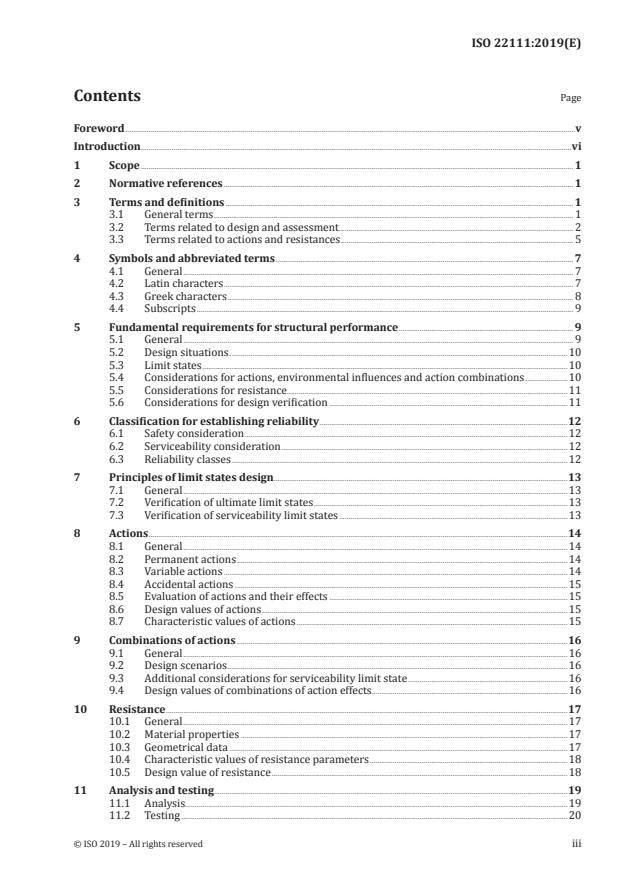
Contents Page
Foreword .v
Introduction .vi
1 Scope . 1
2 Normative references . 1
3 Terms and definitions . 1
3.1 General terms . 1
3.2 Terms related to design and assessment . . 2
3.3 Terms related to actions and resistances . 5
4 Symbols and abbreviated terms . 7
4.1 General . 7
4.2 Latin characters . 7
4.3 Greek characters . 8
4.4 Subscripts . 9
5 Fundamental requirements for structural performance . 9
5.1 General . 9
5.2 Design situations .10
5.3 Limit states .10
5.4 Considerations for actions, environmental influences and action combinations .10
5.5 Considerations for resistance .11
5.6 Considerations for design verification .11
6 Classification for establishing reliability .12
6.1 Safety consideration .12
6.2 Serviceability consideration .12
6.3 Reliability classes .12
7 Principles of limit states design.13
7.1 General .13
7.2 Verification of ultimate limit states .13
7.3 Verification of serviceability limit states .13
8 Actions .14
8.1 General .14
8.2 Permanent actions .14
8.3 Variable actions .14
8.4 Accidental actions .15
8.5 Evaluation of actions and their effects .15
8.6 Design values of actions .15
8.7 Characteristic values of actions .15
9 Combinations of actions .16
9.1 General .16
9.2 Design scenarios .16
9.3 Additional considerations for serviceability limit state .16
9.4 Design values of combinations of action effects.16
10 Resistance .17
10.1 General .17
10.2 Material properties .17
10.3 Geometrical data .17
10.4 Characteristic values of resistance parameters .18
10.5 Design value of resistance .18
11 Analysis and testing .19
11.1 Analysis.19
11.2 Testing .20
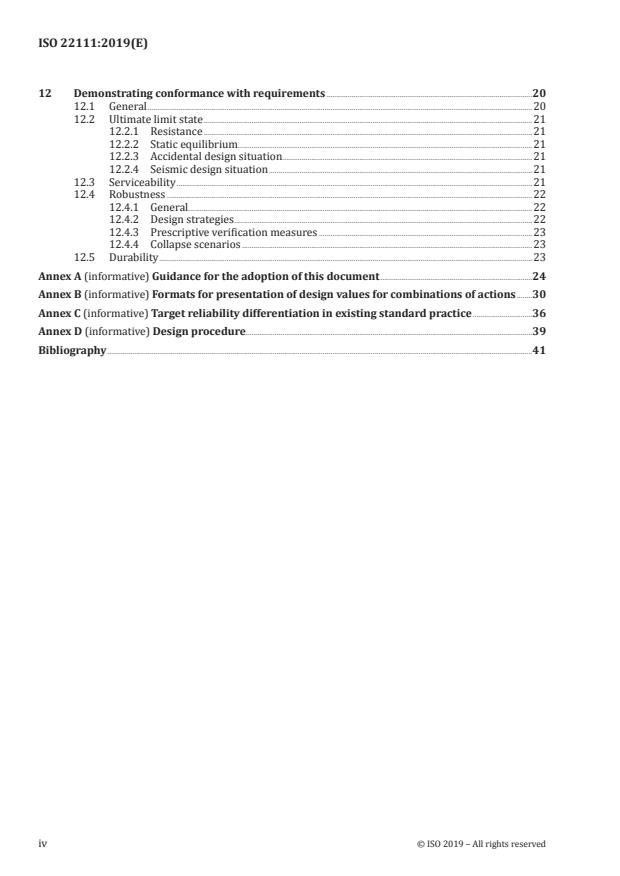
12 Demonstrating conformance with requirements .20
12.1 General .20
12.2 Ultimate limit state .21
12.2.1 Resistance .21
12.2.2 Static equilibrium .21
12.2.3 Accidental design situation .21
12.2.4 Seismic design situation .21
12.3 Serviceability .21
12.4 Robustness .22
12.4.1 General.22
12.4.2 Design strategies .22
12.4.3 Prescriptive verification measures .23
12.4.4 Collapse scenarios .23
12.5 Durability .23
Annex A (informative) Guidance for the adoption of this document .24
Annex B (informative) Formats for presentation of design values for combinations of actions .30
Annex C (informative) Target reliability differentiation in existing standard practice .36
Annex D (informative) Design procedure .39
Bibliography .41
iv © ISO 2019 – All rights reserved
Foreword
ISO (the International Organization for Standardization) is a worldwide federation of national standards
bodies (ISO member bodies). The work of preparing International Standards is normally carried out
through ISO technical committees. Each member body interested in a subject for which a technical
committee has been established has the right to be represented on that committee. International
organizations, governmental and non-governmental, in liaison with ISO, also take part in the work.
ISO collaborates closely with the International Electrotechnical Commission (IEC) on all matters of
electrotechnical standardization.
The procedures used to develop this document and those intended for its further maintenance are
described in the ISO/IEC Directives, Part 1. In particular, the different approval criteria needed for the
different types of ISO documents should be noted. This document was drafted in accordance with the
editorial rules of the ISO/IEC Directives, Part 2 (see www .iso .org/directives).
Attention is drawn to the possibility that some of the elements of this document may be the subject of
patent rights. ISO shall not be held responsible for identifying any or all such patent rights. Details of
any patent rights identified during the development of the document will be in the Introduction and/or
on the ISO list of patent declarations received (see www .iso .org/patents).
Any trade name used in this document is information given for the convenience of users and does not
constitute an endorsement.
For an explanation of the voluntary nature of standards, the meaning of ISO specific terms and
expressions related to conformity assessment, as well as information about ISO's adherence to the
World Trade Organization (WTO) principles in the Technical Barriers to Trade (TBT), see www .iso
.org/iso/foreword .html.
This document was prepared by Technical Committee ISO/TC 98, Bases for design of structures,
Subcommittee SC 2, Reliability of structures.
This second edition cancels and replaces the first edition (ISO 22111:2007), which has been technically
revised. The main change compared to the previous edition is as follows:
— the document has been made consistent with the latest edition of ISO 2394 (ISO 2394:2015).
Any feedback or questions on this document should be directed to the user’s national standards body. A
complete listing of these bodies can be found at www .iso .org/members .html.
Introduction
This document incorporates the general principles of structural design as set out in ISO 2394. The
general requirements relevant to the design of structures given here are expressed according to the
semi-probabilistic approach as presented in ISO 2394. The general requirements are based on the
premise that sufficient information is available on all aspects that are needed to set target levels of
reliability and for uncertainty representation to be categorized and standardized, to ensure realization
of such reliability through a semi-probabilistic approach. Procedures for deriving semi-probabilistic
requirements and design methods from risk and reliability approaches are provided in ISO 2394.
The general requirements for actions on structures and the material independent resistance of the
structures provided in this document are expressed on the basis of related standards for all actions and
structural materials relevant to the scope of application.
The main duties for standards organisations in adopting this document are:
— to set target levels of reliability;
— to provide a suitable format and a set of quantitative design parameters;
— to establish the relevant standards from which input values for actions and resistance are to be
obtained.
International Standards on actions are referenced here in lieu of standards within the jurisdiction of
the adopting group.
As this document is an International Standard, its scope represents general consensus for standardized
procedures for the semi-probabilistic design verification requirements of structural reliability.
Thus, this document is intended to promote harmonization of structural design practice. Additional
requirements and procedures need to be added to provide for specific types of structures, conditions or
design practice.
This document has the following aims:
— to facilitate international practice in structural design by expressing the general requirements for
the basis for the design of structures;
— to obtain international standardization of the process for setting up rules for structural design,
while allowing each economy to specify its own levels of structural performance, in accordance
with its own needs;
— to provide a means of promoting commonality, interchangeability, consistency and comparability
of structural standards developed by different economies, such that regulators, standards writers,
designers and academics could then adopt such standards with confidence in their international
acceptance;
— to encourage regulatory authorities in each country to describe their mandatory requirements in
an internationally agreed format;
— to facilitate future coordination between the various specialist subcommittees and working groups
for ISO structural standards;
— to create transparency in the process of comparison of national standards for structural design.
Annex A to Annex D provide additional guidance on the adoption of this document and its adaptation to
suit the conditions and requirements of the relevant standardization organisation.
vi © ISO 2019 – All rights reserved
INTERNATIONAL STANDARD ISO 22111:2019(E)
Bases for design of structures — General requirements
1 Scope
This document provides the requirements for structural design and procedures following a semi-
probabilistic approach that conform to the general principles for structural reliability as stipulated by
ISO 2394. The scope of requirements and procedures are accordingly limited to the design of structures
for which sufficient knowledge and experience are commonly available on design and construction
practice to ensure that target levels of reliability account for the nature and consequences of structural
failure. Situations outside these limitations are covered by ISO 2394.
The methods that are included in this document are the semi-probabilistic limit states approaches that
are proven to achieve sufficient and consistent levels of structural reliability.
This document relies on standardized procedures for the characterization of the load bearing
performance of the structures within its scope. Sufficient information is needed on uncertainties of
design variables and models to be able to derive semi-probabilistic design measures for verification of
structural reliability within the scope of this and the related design standards.
2 Normative references
The following documents are referred to in the text in such a way that some or all of their content
constitutes requirements of this document. For dated references, only the edition cited applies. For
undated references, the latest edition of the referenced document (including any amendments) applies.
ISO 13823, General principles on the design of structures for durability
3 Terms and definitions
For the purposes of this document, the following terms and definitions apply.
ISO and IEC maintain terminological databases for use in standardization at the following addresses:
— ISO Online browsing platform: available at https: //www .iso .org/obp
— IEC Electropedia: available at http: //www .electropedia .org/
3.1 General terms
3.1.1
structure
organized combination of connected parts including geotechnical structures designed to provide
resistance (3.3.14) and rigidity against various actions (3.3.1)
[SOURCE: ISO 2394:2015, 2.1.1]
3.1.2
structural performance
qualitative or quantitative representation of the behaviour of a structure (3.1.1) (e.g. load bearing
capacity, stiffness, etc.) related to its safety and serviceability (3.1.6), durability and robustness (3.1.7)
3.1.3
reliability
ability of a structure (3.1.1) or structural member to fulfil the specified requirements, during the service
life, for which it has been designed
Note 1 to entry: Reliability is often expressed in terms of probability.
Note 2 to entry: Reliability covers safety, serviceability, and durability of a structure.
[SOURCE: ISO 2394:2015, 2.1.8]
3.1.4
reliability index
β
−1 −1
substitute for the failure (3.2.7) probability p by β = −Φ (p ) where Φ is the inverse standardized
f f
normal distribution
[SOURCE: ISO 2394:2015, 2.2.22]
3.1.5
structural safety
ability (of a structure (3.1.1) or structural member) to avoid exceedance of ultimate limit states (3.2.14),
including the effects of specified accidental phenomena, with a specified level of reliability (3.1.3),
during a specified period of time
[SOURCE: ISO 2394:2015, 2.1.9]
3.1.6
serviceability
ability of a structure (3.1.1) or structural member to perform adequately for normal use under all
expected actions (3.3.1)
[SOURCE: ISO 2394:2015, 2.1.32]
3.1.7
robustness
damage insensitivity or ability of a structure (3.1.1) to withstand adverse and unforeseen events
(like fire, explosion, impact) or consequences of human errors without being damaged to an extent
disproportionate to the original cause
[SOURCE: ISO 2394:2015, 2.1.46, modified — “ability of a structure…” is modified to “damage
insensitivity or ability of a structure …”.]
3.2 Terms related to design and assessment
3.2.1
design situations
sets of physical conditions representing a certain time interval for which it shall be demonstrated that
relevant limit states (3.2.12) are not exceeded
[SOURCE: ISO 2394:2015, 2.2.1]
3.2.2
persistent design situation
normal condition of use for the structure (3.1.1)
[SOURCE: ISO 2394:2015, 2.2.2]
2 © ISO 2019 – All rights reserved
3.2.3
transient design situation
provisional condition of use or exposure for the structure (3.1.1), for example, during its construction or
repair, representing a time period much shorter than the design service life (3.2.10)
[SOURCE: ISO 2394:2015, 2.2.3, modified — “… design working life…” is modified to “… design service
life …”.]
3.2.4
accidental design situation
design situation (3.2.1) involving possible exceptional conditions for the structure (3.1.1) in use or
exposure, including flooding, fire, explosion, impact, mal-operation of systems, or local failure (3.2.7)
[SOURCE: ISO 2394:2015, 2.2.4]
3.2.5
seismic design situation
design situation (3.2.1) involving the exceptional conditions when the structure (3.1.1) is subject to
seismic event
[SOURCE: ISO 2394:2015, 2.2.5]
3.2.6
basic variable
variable representing physical quantities which characterize actions (3.3.1) and environmental
influences, material and soil properties, and geometrical quantities
[SOURCE: ISO 2394:2015, 2.2.15]
3.2.7
failure
loss of load-bearing capacity or inadequate serviceability (3.1.6) of a structure (3.1.1) or structural
member, or rupture or excessive deformation of the ground, in which the strengths of soil or rock are
significant in providing resistance (3.3.14 )
[SOURCE: ISO 2394:2015, 2.2.6, modified — “insufficient load-bearing capacity…” is modified to “loss of
load-bearing capacity…”.]
3.2.8
consequence class
categorization of the consequences of structural failure (3.2.7) used to distinguish between structures
(3.1.1 ), components, and limit states (3.2.12)
[SOURCE: ISO 2394:2015, 2.1.34, modified — the phrase “used to distinguish between structures,
components, and limit states” is newly added.]
3.2.9
reliability class
specific target reliability (3.2.16) against failure (3.2.7), based upon consequence classes (3.2.8) for
structures (3.1.1), structural members and limit states (3.2.12)
3.2.10
design service life
assumed period for which a structure (3.1.1) or a structural member is to be used for its intended
purpose with anticipated maintenance, but without substantial repair being necessary
[SOURCE: ISO 2394:2015, 2.2.16]
3.2.11
reference period
period of time used as a basis for assessing the design value of variable and/or accidental actions (3.3.5)
[SOURCE: ISO 2394:2015, 2.2.31]
3.2.12
limit state
state beyond which a structure (3.1.1) no longer satisfies the design criteria
[SOURCE: ISO 2394:2015, 2.2.7]
3.2.13
serviceability limit state
limit state (3.2.12) concerning the criteria governing the functionalities related to normal use
[SOURCE: ISO 2394:2015, 2.2.10]
3.2.14
ultimate limit state
limit state (3.2.12) concerning the maximum load-bearing capacity
[SOURCE: ISO 2394:2015, 2.2.8]
3.2.15
irreversible limit states
limit states (3.2.12) which will remain permanently exceeded when the actions (3.3.1) which caused the
exceedance are no longer present
Note 1 to entry: Conversely, reversible limit states are defined as limit states which will not be exceeded when
the actions which caused the exceedance are no longer present.
[SOURCE: ISO 2394:2015, 2.2.11, modified — a note to entry has been added.]
3.2.16
target reliability
target reliability index
reliability (3.1.3) (index) corresponding to acceptable safety or serviceability (3.1.6) for a given reference
period (3.2.11), which can coincide with the design service life (3.2.10)
[SOURCE: ISO 2394:2015, 2.2.23, modified — “for a given reference period, which can coincide with the
design service life” is newly added.]
3.2.17
semi-probabilistic method
verification method in which allowances made for the uncertainties and variability are assigned to
the basic variables (3.2.6) by means of representative values, partial factors and, if relevant, additive
quantities
Note 1 to entry: Factors may be related to individual random variables or global variables and may be stated as
unitary or partial factors; representative values may be related to service life, the nature of the limit state or
action, or to the target reliability.
4 © ISO 2019 – All rights reserved
3.3 Terms related to actions and resistances
3.3.1
action
assembly of concentrated or distributed forces acting on a structure (3.1.1) (direct actions),
displacements or thermal effects imposed to the structure, or constrained in it; or environmental
influences that can cause changes with time in the material properties or in the dimensions of a
structure
[SOURCE: ISO 2394:2015, 2.3.1, modified — “… that may cause change …” is modified to “… that can
cause change …”.]
3.3.2
effect of action
action effect
result of actions (3.3.1) on a structural member (e.g. internal force, moment, stress, strain) or on the
whole structure (3.1.1) (e.g. deflection, rotation)
[SOURCE: ISO 2394:2015, 2.3.12]
3.3.3
permanent action
action (3.3.1) which is likely to act continuously throughout the design service life (3.2.10) and for which
variations in magnitude with time are small compared with the mean value
[SOURCE: ISO 2394:2015, 2.3.3, modified — “… design working life…” is modified to “… design service
life …”.]
3.3.4
variable action
action (3.3.1) which is likely to act during a given design service life (3.2.10) and for which the variation
in magnitude with time is neither negligible nor monotonic
[SOURCE: ISO 2394:2015, 2.3.4, modified — “… design working life…” is modified to “… design service
life …”.]
3.3.5
accidental action
action (3.3.1) which is unlikely to occur with a significant value during the design service life (3.2.10) of
the structure (3.1.1)
[SOURCE: ISO 2394:2015, 2.3.5, modified — “… design working life…” is modified to “… design service
life …”.]
3.3.6
individual action
single action
action (3.3.1) which can be assumed to be independent in time and space of any other actions on the
structure (3.1.1)
[SOURCE: ISO 2394:2015, 2.3.2]
3.3.7
frequent value
value of action (3.3.1) determined in such a way that either the total time, within a chosen period,
during which it is exceeded is only a given small part of the chosen period of time or the frequency of its
exceedance is limited to a given value
Note 1 to entry: This "frequent value" may be expressed as the characteristic value reduced by a factor Ψ .
[SOURCE: ISO 2394:2015, 2.3.23, modified — “value determined in such a way…” is modified to “value
of action determined in such a way …”.]
3.3.8
load case
compatible load arrangement, set of deformations, and imperfections considered for a particular
verification of the specific limit state (3.2.12)
[SOURCE: ISO 2394:2015, 2.3.25]
3.3.9
characteristic value
value of a basic variable (3.2.6) specified preferably on statistical bases, so it can be considered to have
a prescribed probability of not being exceeded
Note 1 to entry: For variable actions, the characteristic value corresponds to either of the following:
— an upper value with an intended probability of not being exceeded or a lower value with an intended
probability of being achieved, during some specific reference period;
— a nominal value, which may be specified in cases where a statistical distribution is not known.
[SOURCE: ISO 2394:2015, 2.2.30]
3.3.10
representative value
characteristic value (3.3.9), nominal value, combination value (3.3.13 ), frequent value (3.3.7), or quasi-
permanent value (3.3.11) of an action (3.3.1)
[SOURCE: ISO 2394:2015, 2.3.20, modified — the definition has been reworded so that it can replace the
term in context.]
3.3.11
quasi-permanent value
value of action (3.3.1) determined in such a way that the total time, within a chosen period, during
which it is exceeded is of the magnitude half the period
Note 1 to entry: This "quasi-permanent value" may be expressed as the characteristic value reduced by a factor Ψ .
[SOURCE: ISO 2394:2015, 2.3.24, modified — “value determined in such a way…” is modified to “value
of action determined in such a way …”.]
3.3.12
load combination
design value of the different actions (3.3.1) considered simultaneously in the verification of the reliability
(3.1.3) of a structure (3.1.1) for a specific limit state (3.2.12)
[SOURCE: ISO 2394:2015, 2.3.26]
3.3.13
combination value
value of action (3.3.1) determined in such a way that the probability of action effect caused by several
combination values being exceeded is approximately the same as the probability of the design value
being exceeded by a single action (3.3.6)
Note 1 to entry: The "combination value" may be expressed as the characteristic value reduced by a factor Ψ .
[SOURCE: ISO 2394:2015, 2.3.21, modified — “value determined in such a way…” is modified to “value of
action determined in such a way …”.]
6 © ISO 2019 – All rights reserved
3.3.14
resistance
ability of structure (3.1.1) (or a part of it) to withstand actions (3.3.1) without failure (3.2.7)
[SOURCE: ISO 2394:2015, 2.1.27]
3.3.15
characteristic value of a material property
priori specified fractile of the statistical distribution of the material property in the relevant supply
4 Symbols and abbreviated terms
4.1 General
The following symbols are used in this document. All symbols are based on ISO 2394, whilst ISO 3898
defines standard notations for structural design.
4.2 Latin characters
A accidental action
a geometrical quantity
a vector containing the design values of the geometry
d
C design value of the permissible serviceability constraint
d
E function determining the effect of actions
E design value of the effect of actions
d
E design value of destabilizing actions
d,dst
E design value of stabilizing actions
d,stb
f characteristic value of material property
k
G permanent action
G characteristic value of the i-th permanent action G ,
k,i i
G design value of i-th permanent action as factored characteristic value
d,i
G design value of the i-th permanent action corresponding to annual probability
r,i
of exceedance of 1/r
Q variable action
Q characteristic values of leading variable action Q
k,j j
Q (i≠j) characteristic values of the i-th accompanying variable action, Q (i≠j)
k,i i
Q design value of variable actions as factored characteristic values
d,j
Q i-th variable action with r -year return period value, which corresponds to
r,i i
the value with 1/r annual probability of exceedance
i
R resistance
R design value of the resistance
d
R characteristic value of the resistance
k
R specified resistance
n
X basic variable at characteristic value (action, material property, geometric dimension)
k
V coefficient of variability of basic variable
4.3 Greek characters
α standardized sensitivity factor for actions (E) or resistance (R)
i
β reliability index
β reliability index for reference period of n year
n
γ partial factor
γ load factors for accompanying variable load
ci
γ partial (or load) factor for permanent action G ,
G,i i
γ load factors for leading variable load
j
γ partial factor for variable action Q ; the value for γ is dependent on whether the variable
Q,j j Q,j
action is leading or accompanying
γ partial factors for material properties [used in the partial factor (γ ) method
m m
(for example, EN 1990)]
γ generalized partial factors for resistance properties taking account of material, model, and
M
geometric uncertainties
γ partial factor for model uncertainties of action effects
S
γ partial factor for model uncertainties of resistance (partial factor for resistance)
R
µ mean value (of basic variable)
σ standard deviation (of basic variable)
σ , σ standard deviation of action effects and resistance, respectively
E R
Φ(.) cumulative normal distribution function
ϕ resistance (capacity) factor (used for example, in the LRFD format)
Ψ factor for determining combination values of actions
Ψ factor for determining frequent values of actions
Ψ factor for determining quasi-permanent values of actions
8 © ISO 2019 – All rights reserved
4.4 Subscripts
d design value
E action effect
i number denoting basic variable (accompanying action)
j number denoting basic variable (leading action)
k characteristic value
n reference period (y) for specifying target reliability
R resistance
5 Fundamental requirements for structural performance
5.1 General
A structure shall, with appropriate degree of risk and reliability, fulfil the following performance
requirements:
— function adequately under all expected actions throughout its service life, providing service and
functionality;
— provide reliable safety against extreme and/or frequently repeated and permanent actions, as well as
environmental exposures occurring during its construction, anticipated use, and decommissioning;
— provide assurance that degradation of resistance over the service life does not reduce the reliability
for safety or functionality below the acceptable targets;
— provide reliability with respect to damage and its consequences;
— provide sufficient robustness so as not to suffer severe damage or cascading failure by extraordinary
and possibly unforeseen events like natural hazards, accidents, or human errors.
Target performance levels shall be based on the risk-based approach. The appropriate degree of
reliability shall be judged with due regard to the possible consequences of failure, the associated
expense, and the level of efforts and procedures necessary to reduce the risk of failure and damage.
When the consequences of failure and damage are well understood and within normal ranges,
reliability-based assessment can be applied to derive target reliabilities.
Design shall account for performance throughout the life cycle of the structure. The assessment of other
phases in the life of the structure shall be based on directly related information, such as considering
construction, operation, inspection, maintenance, decommissioning, life cycle management and the
assessment of existing structures (see ISO 13822).
For the semi-probabilistic approach, uncertainties shall be categorized and standardized, to be
represented through design values and characteristic values together with specified design equations,
load cases, and action combination factors. The characteristic values shall, when relevant, account for
available information relating, for example, to loads and material properties.
The validity of all assumptions underlying decisions concerning structures, e.g. the relevance of and
the uncertainty associated with available knowledge and information, the intended use, the service life,
as well as the environmental and operational loads, should be controlled, ensured and documented.
Alternatively, it should be ensured that the performance of the structures is still adequate despite
possible violations of or deviations from assumptions. Quality management plays a central role for the
performance of structures and shall be completely integrated in the decision-making processes related
to design and assessment of structures.
The expression of the principles of reliability for structures in standardized requirements is given
below. Procedures based on the requirements are provided in subsequent clauses.
5.2 Design situations
The reliability requirement shall be verified for all relevant design situations related to the structural
design. The design situations shall be sufficiently severe and varied so as to encompass all conditions
that can reasonably be foreseen to occur during the construction and use of the structure. This typically
refers to loading conditions subject to normal operation, extreme environmental loads, and accidental
loads during the different phases of the life of the structure.
Safety shall be provided through adequate resistance to common actions and accidental events, and
through robustness against unforeseeable events and/or events not considered. Design procedures are
different for these three classes. Failure after an extended time due to degradation of resistance, or lack
of durability, is a safety consideration.
Serviceability shall be provided by designing to limit response of the structure to common actions.
Specific design situations, or combinations of various actions that affect the structure, shall be
considered as specified in subsequent clauses.
5.3 Limit states
Evaluation of the performance of a structure in design shall be accomplished by comparing the response
of the structure to various combinations of actions to limit states where the response changes from
acceptable to unacceptable.
Ultimate limit states account for structural safety. It shall account for modes of failure that involve a
loss of resistance through fracture, crushing, buckling, or yielding of a member or connection within
a structure, loss of equilibrium of the structure or part of it considered as a rigid body, instability of
the structure or part of it, and sudden change of the assumed structural system to a new system. Some
modes of failure for ultimate limit states are defined in terms of collapse of the entire structure, or a
substantial part of it. The exceedance of an ultimate limit state shall be considered as irreversible and
the first time that this occurs causes failure. The ultimate limit state resulting from a single extreme
action event or from a deterioration process over time followed by a (less) extreme action event shall be
considered.
Serviceability limit states account for loss of intended functionality related to normal use. The
following undesirable serviceability limit states (non-exhaustive) shall be accounted for: unacceptable
deformations which affect the efficient use or appearance of structural or non-structural elements
or the functioning of equipment, excessive vibrations which cause discomfort to people or affect
non-structural elements or the functioning of equipment, local damage affecting the appearance, the
efficacy, or functional reliability of the structure, and local damage (including cracking) which can
reduce the durability of the structure or make the structure unsafe for use. In the cases of permanent
local damage or permanent unacceptable deformations, the exceedance of a serviceability limit state
shall be considered as irreversible and the first time that this occurs causes failure. Reversible limit
states shall be considered as failure at the first time of exceedance, when the duration of exceedance or
number of occurrences is unacceptable, or combinations of these criteria.
NOTE In practice, many serviceability requirements are a matter of agreement between owner and designer.
For example, a structure in which the use of an electron microscope is planned will have more stringent vibration
limits than a structure not housing such sensitive equipment.
5.4 Considerations for actions, environmental influences and action combinations
All physical conditions likely to affect the performance of the structure shall be considered. Actions can
be of natural or human origin. Models shall describe the temporal, spatial and directional properties of
the action across the structure. Environmental influences that can cause changes with time in material
properties or structural dimensions should be treated similarly.
10 © ISO 2019 – All rights reserved
Actions shall be classified in a manner that reflects the main characteristics related to structural
reliability. Representative values of actions shall be specified at characteristic or equivalent levels as
basis for design. Reliabi
...
Questions, Comments and Discussion
Ask us and Technical Secretary will try to provide an answer. You can facilitate discussion about the standard in here.
Loading comments...