


ISO 7195:2005
(Main)Nuclear energy — Packaging of uranium hexafluoride (UF6) for transport
Nuclear energy — Packaging of uranium hexafluoride (UF6) for transport
ISO 7195:2005 specifies requirements for packaging of uranium hexafluoride (UF6) for transport. It applies to packages designed to contain uranium hexafluoride in quantities of 0,1 kg or more; design, manufacture, inspection and testing of new cylinders and protective packagings; maintenance, repair, inspection and testing of cylinders and protective packagings; and in-service inspection and testing requirements for cylinders and protective packagings.
Énergie nucléaire — Emballage de l'hexafluorure d'uranium (UF6) en vue de son transport
L'ISO 7195:2005 spécifie les exigences qui s'appliquent à l'emballage de l'hexafluorure d'uranium (UF6) en vue de son transport. Elle s'applique aux colis conçus pour contenir 0,1 kg d'hexafluorure d'uranium ou plus, à la conception, à la fabrication, au contrôle et à l'essai des cylindres et systèmes de protection neufs, à l'entretien, à la réparation, au contrôle et à l'essai des cylindres et des systèmes de protection, et au contrôle en service et aux exigences d'essai pour les cylindres et les systèmes de protection.
General Information
- Status
- Withdrawn
- Publication Date
- 05-Sep-2005
- Withdrawal Date
- 05-Sep-2005
- Technical Committee
- ISO/TC 85/SC 5 - Nuclear installations, processes and technologies
- Drafting Committee
- ISO/TC 85/SC 5/WG 4 - Transportation of radioactive material
- Current Stage
- 9599 - Withdrawal of International Standard
- Start Date
- 20-Nov-2020
- Completion Date
- 12-Feb-2026
Relations
- Consolidated By
ISO 80369-1:2010 - Small-bore connectors for liquids and gases in healthcare applications — Part 1: General requirements - Effective Date
- 06-Jun-2022
- Effective Date
- 23-Apr-2020
- Effective Date
- 15-Apr-2008
ISO 7195:2005 - Nuclear energy -- Packaging of uranium hexafluoride (UF6) for transport
ISO 7195:2005 - Énergie nucléaire -- Emballage de l'hexafluorure d'uranium (UF6) en vue de son transport
Get Certified
Connect with accredited certification bodies for this standard

DNV
DNV is an independent assurance and risk management provider.

Lloyd's Register
Lloyd's Register is a global professional services organisation specialising in engineering and technology.
DNV Energy Systems
Energy and renewable energy certification.
Sponsored listings
Frequently Asked Questions
ISO 7195:2005 is a standard published by the International Organization for Standardization (ISO). Its full title is "Nuclear energy — Packaging of uranium hexafluoride (UF6) for transport". This standard covers: ISO 7195:2005 specifies requirements for packaging of uranium hexafluoride (UF6) for transport. It applies to packages designed to contain uranium hexafluoride in quantities of 0,1 kg or more; design, manufacture, inspection and testing of new cylinders and protective packagings; maintenance, repair, inspection and testing of cylinders and protective packagings; and in-service inspection and testing requirements for cylinders and protective packagings.
ISO 7195:2005 specifies requirements for packaging of uranium hexafluoride (UF6) for transport. It applies to packages designed to contain uranium hexafluoride in quantities of 0,1 kg or more; design, manufacture, inspection and testing of new cylinders and protective packagings; maintenance, repair, inspection and testing of cylinders and protective packagings; and in-service inspection and testing requirements for cylinders and protective packagings.
ISO 7195:2005 is classified under the following ICS (International Classification for Standards) categories: 27.120.30 - Fissile materials and nuclear fuel technology. The ICS classification helps identify the subject area and facilitates finding related standards.
ISO 7195:2005 has the following relationships with other standards: It is inter standard links to ISO 80369-1:2010, ISO 7195:2020, ISO 7195:1993. Understanding these relationships helps ensure you are using the most current and applicable version of the standard.
ISO 7195:2005 is available in PDF format for immediate download after purchase. The document can be added to your cart and obtained through the secure checkout process. Digital delivery ensures instant access to the complete standard document.
Standards Content (Sample)
INTERNATIONAL ISO
STANDARD 7195
Second edition
2005-09-01
Nuclear energy — Packaging of uranium
hexafluoride (UF ) for transport
Énergie nucléaire — Emballage de l'hexafluorure d'uranium (UF ) en
vue de son transport
Reference number
©
ISO 2005
PDF disclaimer
This PDF file may contain embedded typefaces. In accordance with Adobe's licensing policy, this file may be printed or viewed but
shall not be edited unless the typefaces which are embedded are licensed to and installed on the computer performing the editing. In
downloading this file, parties accept therein the responsibility of not infringing Adobe's licensing policy. The ISO Central Secretariat
accepts no liability in this area.
Adobe is a trademark of Adobe Systems Incorporated.
Details of the software products used to create this PDF file can be found in the General Info relative to the file; the PDF-creation
parameters were optimized for printing. Every care has been taken to ensure that the file is suitable for use by ISO member bodies. In
the unlikely event that a problem relating to it is found, please inform the Central Secretariat at the address given below.
© ISO 2005
All rights reserved. Unless otherwise specified, no part of this publication may be reproduced or utilized in any form or by any means,
electronic or mechanical, including photocopying and microfilm, without permission in writing from either ISO at the address below or
ISO's member body in the country of the requester.
ISO copyright office
Case postale 56 • CH-1211 Geneva 20
Tel. + 41 22 749 01 11
Fax + 41 22 749 09 47
E-mail copyright@iso.org
Web www.iso.org
Published in Switzerland
ii © ISO 2005 – All rights reserved
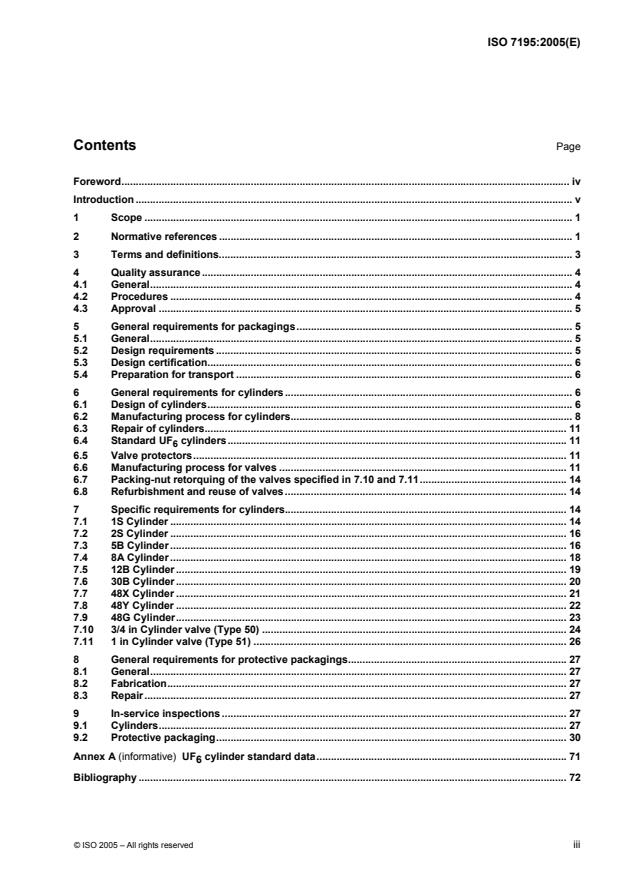
Contents Page
Foreword. iv
Introduction . v
1 Scope . 1
2 Normative references . 1
3 Terms and definitions. 3
4 Quality assurance. 4
4.1 General. 4
4.2 Procedures . 4
4.3 Approval . 5
5 General requirements for packagings. 5
5.1 General. 5
5.2 Design requirements . 5
5.3 Design certification. 6
5.4 Preparation for transport . 6
6 General requirements for cylinders. 6
6.1 Design of cylinders. 6
6.2 Manufacturing process for cylinders. 8
6.3 Repair of cylinders. 11
6.4 Standard UF cylinders.11
6.5 Valve protectors. 11
6.6 Manufacturing process for valves . 11
6.7 Packing-nut retorquing of the valves specified in 7.10 and 7.11. 14
6.8 Refurbishment and reuse of valves. 14
7 Specific requirements for cylinders. 14
7.1 1S Cylinder . 14
7.2 2S Cylinder . 16
7.3 5B Cylinder . 16
7.4 8A Cylinder . 18
7.5 12B Cylinder . 19
7.6 30B Cylinder . 20
7.7 48X Cylinder . 21
7.8 48Y Cylinder . 22
7.9 48G Cylinder. 23
7.10 3/4 in Cylinder valve (Type 50) . 24
7.11 1 in Cylinder valve (Type 51) . 26
8 General requirements for protective packagings. 27
8.1 General. 27
8.2 Fabrication. 27
8.3 Repair. 27
9 In-service inspections . 27
9.1 Cylinders. 27
9.2 Protective packaging. 30
Annex A (informative) UF cylinder standard data. 71
Bibliography . 72
Foreword
ISO (the International Organization for Standardization) is a worldwide federation of national standards bodies
(ISO member bodies). The work of preparing International Standards is normally carried out through ISO
technical committees. Each member body interested in a subject for which a technical committee has been
established has the right to be represented on that committee. International organizations, governmental and
non-governmental, in liaison with ISO, also take part in the work. ISO collaborates closely with the
International Electrotechnical Commission (IEC) on all matters of electrotechnical standardization.
International Standards are drafted in accordance with the rules given in the ISO/IEC Directives, Part 2.
The main task of technical committees is to prepare International Standards. Draft International Standards
adopted by the technical committees are circulated to the member bodies for voting. Publication as an
International Standard requires approval by at least 75 % of the member bodies casting a vote.
Attention is drawn to the possibility that some of the elements of this document may be the subject of patent
rights. ISO shall not be held responsible for identifying any or all such patent rights.
ISO 7195 was prepared by Technical Committee ISO/TC 85, Nuclear energy, Subcommittee SC 5, Nuclear
fuel technology.
This second edition cancels and replaces the first edition (ISO 7195:1993), which has been technically revised.
iv © ISO 2005 – All rights reserved
Introduction
The packaging of uranium hexafluoride (UF ) for transport is an essential operation in the nuclear industry.
The United States Standard ANSI N14.1 (first issued in 1971) has been used internationally as an accepted
procedure for packaging UF , and the standard cylinders and protective packages included in ANSI N14.1
have been used widely as accepted designs for international transport of UF . However, in some cases minor
adaptations of the American standard were required to meet local conditions in a particular country. For
example, equivalent materials may have been used instead of the materials specified. Moreover, the
certification of cylinders as pressure vessels can have required equivalent authorization procedures
appropriate in the countries concerned, rather than the US certification procedure specified.
This International Standard has been developed from and is based on ANSI N14.1, but with incorporation of,
and allowance for, other equivalent technical solutions and national authorization and certification procedures.
IAEA recommendations relevant to UF have also been taken into consideration. ISO 7195 was first issued in
1993 and the revision process started in 1998.
This International Standard specifies the internationally accepted guidelines and procedures for packaging of
UF for transport. It does not relieve the consignor from compliance with the relevant transport regulations for
dangerous goods of each of the countries through or into which the material is transported.
This International Standard is consistent with, but does not replace, the recommendations of the International
Atomic Energy Agency contained in IAEA Safety Standards Series No. TS-R-1:1996 (as revised 2003).
Quoting from the Introduction to these Regulations,
“The objective of these Regulations is to protect persons, property and the environment from the effects of
radiation during the transport of radioactive material. Protection is achieved by requiring containment of the
radioactive contents, control of external radiation levels, prevention of criticality and prevention of damage
caused by heat. These requirements are satisfied firstly by applying a graded approach to contents limits for
packages and conveyances and to performance standards applied to package designs depending upon the
hazard of the radioactive contents. Secondly, they are satisfied by imposing requirements on the design and
operation of packages and on the maintenance of packagings, including a consideration of the nature of the
radioactive contents. Finally, they are satisfied by requiring administrative controls including, where
appropriate, approval by competent authorities.”
In addition, due to the chemical risks associated with UF , there are special requirements for packages
containing this material.
It should be noted that the IAEA Regulations form the essential basis of regulations for international transport
(Agreement for the safe transport of dangerous goods by rail, RID; European agreement for the safe transport
of dangerous goods by road, ADR; International maritime dangerous code, IMDG; and Technical instructions
for the safe transport of dangerous goods by air issued by the International Civil Aviation Organization, ICAO)
that accordingly form the basis for national regulations. There are nevertheless minor differences in practice in
the various countries. However, these minor differences are not considered significant in relation to this
International Standard and do not affect the guidelines stated. Individual countries may issue national
standards for packaging of UF for transport, for which this International Standard can form the basis. This
International Standard does not take precedence over applicable governmental regulations.
This International Standard presents information on UF cylinders, valves, protective packages and shipping.
However, it should be emphasized that this information has been derived from widespread practical
applications and is therefore the result of international experience. As this experience grows, improved
designs of cylinders and valves may come forward. Improvements shall be subject to approval by competent
authorities. Authorized improvements may be considered for incorporation in this International Standard on
the occasion of future revisions. Annex A of this International Standard is provided for information.
Throughout this International Standard and in conformity with standard ISO practice, SI metric units are used
in preference to imperial units (which are given in parenthesis for information). However, if the original type
identification of a cylinder is based on its size, the imperial units are maintained (e.g. 48” cylinder, 48Y, 30B,
etc.). If a common, commercially available component uses features that are defined in an appropriate non-SI
metric-based Standard document, only the relevant base units are quoted.
vi © ISO 2005 – All rights reserved
INTERNATIONAL STANDARD ISO 7195:2005(E)
Nuclear energy — Packaging of uranium hexafluoride (UF )
for transport
1 Scope
This International Standard specifies requirements for packaging of uranium hexafluoride (UF ) for transport.
It applies to
packages designed to contain uranium hexafluoride in quantities of 0,1 kg or more,
design, manufacture, inspection and testing of new cylinders and protective packagings,
maintenance, repair, inspection and testing of cylinders and protective packagings,
in-service inspection and testing requirements for cylinders and protective packagings.
2 Normative references
The following referenced documents are indispensable for the application of this document. For dated
references, only the edition cited applies. For undated references, the latest edition of the referenced
document (including any amendments) applies.
ISO 263, ISO inch screw threads — General plan and selection for screws, bolts and nuts — Diameter range
0.06 to 6 in
ISO 898-1:1999, Mechanical properties of fasteners made of carbon steel and alloy steel — Part 1: Bolts,
screws and studs
ISO 9453, Soft solder alloys — Chemical compositions and forms
ISO 12807, Safe transport of radioactive materials — Leakage testing on packages
IAEA Safety Standards Series No. TS-R-1, Regulations for the Safe Transport of Radioactive Materials, 1996
Edition (as revised 2003)
ANSI/ASME B1.1:2003, Unified Inch Screw Threads, UN and UNR Thread Form
ANSI/ASME B1.20.1:1983 (R2001), Pipe Threads, General Purpose, inch
ANSI/ASME B16.11:2001, Forged Steel Fittings, Socket-Welding and Threaded
ANSI/AWS A5.8/A5.8M:2004, Specification for Filler Metals for Brazing and Braze Welding
ANSI/AWS A5.14/A5.14M:1997, Specification for Nickel and Nickel Alloy Bare Wire Electrodes and Rods
ANSI/A5.18:1993, Specification for Nickel and Nickel Alloy Bare Wire Electrodes and Rods
ANSI/CGA V-1:2003, Compressed Gas Cylinder Valve Outlet and Inlet Connections
EN 10025:1990, Hot rolled products of non-alloy structural steels — Technical delivery conditions
EN 10025:1990/A1:1993, Amendment 1
EN 10028-3:2003 Flat products made of steels for pressure purposes — Part 3: Weldable fine grain steels,
normalized
EN 10088-2:1995, Stainless steels — Part 2: Technical delivery conditions for sheet/plate and strip for general
purposes
ASTM A20/A20M-B:2004a, Standard Specification for General Requirements for Steel Plates for Pressure
Vessels
ASTM A36/A36M:2004, Standard Specification for Carbon Structural Steel
ASTM A53/A53M:2004a, Standard Specification for Pipe, Steel, Black and Hot-Dipped, Zinc-Coated, Welded
and Seamless
ASTM A105/A105M:2003, Standard Specification for Carbon Steel Forgings for Piping Applications
ASTM A106/A106M:2004b, Standard Specification for Seamless Carbon Steel Pipe for High-Temperature
Service
ASTM A108:2003, Standard Specification for Steel Bar, Carbon and Alloy, Cold-Finished
ASTM A131/A131M:2004ae1, Standard Specification for Structural Steel for Ships
ASTM A240/A240M:2004, Standard Specification for Chromium and Chromium-Nickel Stainless Steel Plate,
Sheet, and Strip for Pressure Vessels and for General Applications
ASTM A285/A285M:2003, Standard Specification for Pressure Vessel Plates, Carbon Steel, Low- and
Intermediate-Tensile Strength
ASTM A516/A516M:2004, Standard Specification for Pressure Vessel Plates, Carbon Steel, for Moderate-
and Lower-Temperature Service
ASTM A575/A575M:1996 (2002), Standard Specification for Steel Bars, Carbon, Merchant Quality, M-Grades
ASTM B16/B16M:2000, Standard Specification for Free-Cutting Brass Rod, Bar and Shapes for Use in Screw
Machines
ASTM B32:2004, Standard Specification for Solder Metal
ASTM B127:1998, Standard Specification for Nickel-Copper Alloy Plate, Sheet, and Strip
ASTM B150:1998, Standard Specification for Aluminum Bronze Rod, Bar, and Shapes
ASTM B160:1999, Standard Specification for Nickel Rod and Bar
ASTM B161:2003, Standard Specification for Nickel Seamless Pipe and Tube
ASTM B162:1999, Standard Specification for Nickel Plate, Sheet, and Strip
ASTM B164:2003, Standard Specification for Nickel-Copper Alloy Rod, Bar, and Wire
ASTM B165:1993 (2003)e1, Standard Specification for Nickel-Copper Alloy Seamless Pipe and Tube
ASTM B366:2004, Standard Specification for Factory-Made Wrought Nickel and Nickel Alloy Fittings
2 © ISO 2005 – All rights reserved
3 Terms and definitions
For the purposes of this document, the terms and definitions given in the IAEA Safety Standards Series
No. TS-R-1:1996 (as revised 2003), Section II, and the following apply.
NOTE 1 Throughout this International Standard, the word shall denotes a requirement; the word should denotes a
recommendation; the word may denotes a permission, neither a requirement nor a recommendation.
NOTE 2 Units are those of the International System, with other units shown in brackets for information.
3.1
clean cylinder
new cylinder that has been cleaned to remove oil and other manufacturing debris, or a cylinder that, after
contact with UF , has been decontaminated to remove residual quantities of uranium and other contaminants
3.2
effective threads
threads that are capable of providing reasonable engagement in mating threads; the first effective thread at a
runout begins one thread length below the runout scratch
3.3
empty cylinder
cylinder containing a heel in quantities equal to or less than those specified in Table 1
Table 1 — Maximum mass and enrichment limits of heel for empty cylinders
Cylinder type Maximum heel Maximum
mass enrichment
kg (lb) g U/100 g U
5B 0,045 (0,1) 100
8A 0,227 (0,5) 12,5
12B 0,454 (1,0) 5,0
30B 11,4 (25,0) 5,0
48X 22,7 (50,0) 4,5
48Y 22,7 (50,0) 4,5
48G 22,7 (50,0) 1,0
3.4
heel
residual amount of UF and non-volatile reaction products of uranium, uranium daughters and (if the cylinder
has contained irradiated uranium) fission products and transuranic elements
3.5
maximum allowable working pressure
MAWP
maximum value of cylinder design gauge pressure (rounded up to two significant figures) at the maximum
value of cylinder design temperature
3.6
minimum design metal temperature
MDMT
minimum value of design metal temperature at the maximum value of cylinder design pressure to meet ASME
Code requirements
3.7
protective packaging
outer packaging or device used to provide additional protection to a cylinder during transport
3.8
qualified inspector
pressure-vessel inspector who has a demonstrated level of expertise relevant to the task being undertaken
and designated or otherwise recognized as such for any purpose in connection with satisfying the national
pressure-vessel code requirements
3.9
tare
as-built cylinder mass without valve protector with an internal air or nitrogen total pressure of 34,5 kPa
(5 lbf/in )
NOTE The tare, colloquially designated tare weight, is denominated in kilograms (pounds).
4 Quality assurance
4.1 General
Quality assurance programmes [see IAEA TS-R-1:1996 (as revised 2003), paragraph 310] shall be
established for the design, manufacture, testing, documentation, use, maintenance and inspection of UF
packagings and for transport and in-transit storage operations to ensure conformity to the regulations and/or
particular provisions of the competent national authorities. Where the term “quality assurance programme” is
used in this International Standard it can be related or equated to a “Quality management system/programme”
as recommended by ISO 9000. If competent authority approval for design or shipment is required, this will
take into account and be contingent upon the adequacy of the quality assurance programme. Certification that
the design specifications have been fully implemented shall be available to the competent authority. The
manufacturer, owner, consignor, consignee or shipper of any package design shall be prepared to provide
facilities for competent authority inspection of the packaging during construction and use and to demonstrate
to any cognizant competent authority
that the construction methods and materials used for the construction of the packaging conform to the
approved design specifications, and
that all packagings built to an approved design are periodically inspected, and as necessary, repaired and
maintained in good condition so that they conform to all relevant requirements and specifications, even
after repeated use.
[3]
NOTE The IAEA safety standard series TS-G-1.1:1996 , Appendix IV, provides advice on acceptable ways of
achieving and demonstrating compliance with the quality assurance criteria from package fabrication to transport usage.
4.2 Procedures
The manufacturer or repairer of packaging shall establish and maintain written quality control procedures for
materials and components procurement, manufacture, repair, cleaning, inspection and testing to ensure that
the finished product conforms to this International Standard. The quality assurance programme shall be
acceptable to the competent authority (but prior approval is not necessarily a requirement of the competent
authority), and shall be provided to the customer or buyer and should conform to recognized standards such
as ISO 9001.
The procedures may consist of, or be based upon, the manufacturer’s written specifications for similar work or
should be developed in accordance with specifications for cylinder manufacture.
4 © ISO 2005 – All rights reserved
4.3 Approval
The manufacturer, repairer or servicing agent shall, prior to the manufacturing, repairing or servicing process,
submit for purchaser approval, copies of all relevant proposed procedures. Any proposed changes to such
procedures shall be agreed and approved in writing by the purchaser before being introduced during
manufacture, repair or servicing.
The manufacturer, repairer or servicing agent shall notify the purchaser in advance of the start of the
manufacturing, repair or servicing process to allow the purchaser or the purchaser’s representative to witness
initial production, repair or any other agreed aspect of the subject process. The purchaser or the purchaser’s
representative shall be granted access to the manufacturing, repair or servicing facilities at any reasonable
time to verify that all purchasing requirements, including applicable approved procedures, are being
implemented.
Appropriate records, within the applicable quality assurance programme, shall be established and maintained
by the manufacturer, repairer, servicing agent or purchaser to confirm compliance with all applicable
purchasing requirements and the requirements of this International Standard.
5 General requirements for packagings
5.1 General
Cylinders (see Clauses 6 and 7) and protective packagings (see Clause 8) individually and in combination are
examples of packaging and they shall therefore conform to this clause.
UF shall be packaged for transport in cylinders meeting the manufacture, inspection, testing, certification and
service requirements of this International Standard and may be shipped in protective packagings meeting the
requirements of IAEA TS-R-1.
5.2 Design requirements
Packages shall be designed in accordance with the requirements of this International Standard and so that
normal hazards of handling do not damage the package and reduce the effectiveness of containment.
Package and packaging designs shall conform to IAEA TS-R-1:1996 (as revised 2003), paragraph 629.
Competent authority approval shall be obtained prior to shipment as required in IAEA TS-R-1:1996 (as revised
2003), paragraph 802.
Tie-down arrangements shall be designed, as a minimum, to withstand the stresses due to accelerations or
decelerations which occur during normal transport (see Table 2). Additionally, package acceleration factors to
be applied shall be determined by reference to national and international transport modal standards and
regulations. Tie-down design shall use the worst-case scenario, recognizing, as appropriate, the potential for
ambiguity of designation of longitudinal and lateral directions.
Table 2 — Minimum acceleration/deceleration values for tie-down arrangements
Minimum acceleration/deceleration values to be withstood
by tie-down arrangements
Mode of transport
m/s
Longitudinal Lateral Vertical
Road 20 10 ± 10
Rail 20 10 ± 10
Water 20 10 ± 20
Air 30 15 ± 30
Standard acceleration due to gravity ≈ 10 m/s .
5.3 Design certification
Competent authority approval shall be obtained for packages designed to contain 0,1 kg or more of UF [see
IAEA TS-R-1:1996 (as revised 2003), paragraph 802 (a) (iii)]. Approved packages shall be marked with the
identification mark assigned by the competent authority and indicated on the approval certificate [see
IAEA TS-R-1:1996 (as revised 2003), paragraph 538 (a)].
5.4 Preparation for transport
5.4.1 Physical conditions
UF shall be shipped only in the solid state and when the vapour pressure within the cylinder is below
atmospheric [see IAEA TS-R-1:1996 (as revised 2003), paragraph 419].
5.4.2 Security seal
Packaging shall be shipped with a feature (a tamper-indicating device), such as a seal, that is not readily
breakable and that, while intact, shall be evidence that the packaging has not been opened.
6 General requirements for cylinders
6.1 Design of cylinders
6.1.1 General
Cylinders shall be designed and fabricated in accordance with a pressure vessel code, of which Section VIII of
ANSI/ASME Boiler and Pressure Vessel Code is an example, that is acceptable to the competent authority.
Stiffening rings should be relieved to bridge the shell longitudinal weld and minimize the influence of the heat-
affected zones.
Lifting lugs shall be designed, using an appropriate safety factor, to allow the gross mass of the cylinder to be
lifted and restrained during transport (see 5.2) using two diagonally opposed cylinder lifting lugs loaded
perpendicular to their lifting/tie-down plane. Cylinders fitted with lifting lugs and containing more than heel
quantity of material shall be handled using a four-point attachment. Additional holes or slots may be provided
in lifting lugs, e.g. for tie-down, and shall be designed such that the fitness for purpose of the lifting lug is not
impaired.
Additional holes in skirts are permitted and shall be designed such that the fitness for purpose of the package
is not impaired.
Unless otherwise specified, threads identified in this International Standard shall conform to ISO 263.
Cylinders shall be marked as specified in Clause 7.
In all cases, for transport approval, compliance with the requirements of IAEA TS-R-1:1996 (as revised 2003),
paragraphs 629 to 632, as applicable, is mandatory.
6.1.2 Maximum allowable working pressure
The pressure-containing portion of the cylinder shall be designed to withstand the pressure rating specified in
Clause 7 for the type of cylinder. The design shall provide a strength margin of at least 10 % between the
maximum stress reached when the cylinder is hydrostatically tested at the test pressure specified in 6.2.4.1
and the yield point (or 0,2 % proof stress) of the material used.
During normal operating conditions, the maximum value of the design gauge pressure shall not be exceeded,
account being taken of the effects of impurities on the total gas pressure.
6 © ISO 2005 – All rights reserved
6.1.3 Leak-tightness
If valves or pipe plugs are used in addition to those shown on cylinder drawings, they shall be manufactured,
prepared, inspected, installed and tested in accordance with the requirements of this International Standard.
Cylinders, valves and pipe plugs shall be leak-tight in accordance with the standard indicated, as
−4 3
demonstrated with equipment able to detect a standardized leak rate of 1 × 10 Pa⋅m /s. Detection of leaks
shall be made using a suitable test and shall include fittings, connections, valve seat and packing. No
detectable leakage shall be permitted. Leakage requirements stated in IAEA TS-R-1 relating to the
radioactive-material package category shall also apply.
6.1.4 Maximum allowable temperature range
The pressure-containing portion of the cylinder, its valve and pipe plug shall be able to withstand the service
temperature range as specified in Clause 7.
6.1.5 Materials
Materials for cylinder pressure envelopes shall comply with the pressure vessel code and, together with
valves and pipe plugs, shall be compatible with UF and shall have chemical and metallurgical properties as
specified in Clauses 6 and 7.
6.1.6 Maximum transport fill
Maximum transport-fill limits (see Table 3 for values for existing cylinders) shall conform to IAEA TS-R-1:1996
(as revised 2003), paragraph 419, and be based on liquid UF density at 121 °C (250 °F), 3 257 kg/m
(203,3 lb/ft ), minimum cylinder volume and a minimum UF purity of 99,5 %.
Allowable fill limits for cylinders containing tails with a minimum UF purity of 99,5 % may be higher than the
limit shown in Table 3 but shall not result in a free-volume safety margin of less than 5 % of the actual certified
volume when the cylinder is at the higher design temperature value. More restrictive allowable fill limits shall
be adopted if additional impurities are present.
Cylinders shall not be heated above the design temperature value for the cylinder.
Table 3 — Standard data for UF cylinders
Cylinder type Minimum wall Minimum Maximum Maximum
thickness volume enrichment transport fill
3 3 235
mm (in) m (ft ) g U/100 g U kg (lb)
−4 −3
1S 1,59 (1/16) 1,50 × 10 (5,30 × 10) 100 0,45 (1,0)
−4 −2
2S 1,59 (1/16) 7,21 × 10 (2,55 × 10) 100 2,2 (4,9)
−3
5B 3,18 (1/8) 8,04 × 10 (0,284) 100 24,9 (54,9)
8A 3,18 (1/8) 0,037 4 (1,32) 12,5 115 (255)
12B 4,76 (3/16) 0,067 4 (2,38) 5,0 208 (460)
a
30B 7,94 (5/16) 0,736 (26,0) 5,0 2 277 (5 020)
a
48X 12,7 (1/2) 3,084 (108,9) 4,5 9 539 (21 030)
a
48Y 12,7 (1/2) 4,041 (142,7) 4,5 12 501 (27 560)
48G 6,35 (1/4) 3,936 (139,0) 1,0 12 174 (26 840)
a
These enrichment percentages require moderation control equivalent to a minimum UF purity of 99,5 %. Without moderation
235 235
control, the maximum permissible enrichment in U shall be 1 g U/100 g U.
6.2 Manufacturing process for cylinders
6.2.1 Process
6.2.1.1 General
The manufacturing process for cylinders shall conform to this International Standard and the pressure vessel
code requirements as agreed with the cylinder purchaser’s competent authority and shall conform to the
applicable drawings and specifications. Approval shall be obtained from a qualified inspector.
Couplings, after having cooled from being welded into the pressure envelope and before the valve or pipe
plug is inserted, may have a 1 in 11 1/2 NGT or 1 1/2 in 11 1/2 NGT tap, as appropriate, used, if necessary, to
lightly chase the threads. Thread forms shall conform to ANSI/CGA V-1. Conformity to specification of the
thread and coupling shall be confirmed in accordance with the agreed quality control plan.
6.2.1.2 Welding/brazing
Surfaces to be welded or brazed shall be free from foreign matter (oil, grease, rust, etc.). Interior surfaces of
the cylinder shall be inspected and cleaned before closure is effected.
UF cylinder welds and brazes shall be designed such that they conform to the requirements of the pressure
vessel code or other code agreed with the competent authority and be formed in accordance with procedures
given in the code(s) agreed with the competent authority. Welds detailed in Figures 1, 5 to 8 and 10 to 14 may
be taken as typical. All welds shall be full penetration welds unless otherwise specified. Circumferential
cylinder seams should be welded without backing rings. Optionally, circumferential cylinder seams may be
welded with backing rings, as shown in Figure 1. Welders and brazers shall be qualified to each specific
procedure used in cylinder fabrication. Each weld procedure shall be qualified with impact testing. This testing
shall be as specified by the pressure vessel code utilized for the material being welded. Procedures and
qualifications shall be documented as required by the specified codes.
6.2.1.3 Inspection of welds/brazes
All welds and brazes shall be visually inspected for proper fitting of the joints, full compliance with the
previously qualified procedure and absence of imperfections and defects in the finished joints as specified by
the pressure vessel code requirements. As a minimum, each cylinder shall be radiographed in accordance
with code requirements and shall be spot radiographed at the junction of the longitudinal seam and the
circumferential head weld in accordance with code acceptance criteria. Stiffening ring butt welds shall be
examined to ensure full weld penetration. The qualified inspector shall examine radiographs.
6.2.2 Cylinder capacity and tare
The manufacturer shall determine the cylinder capacity by completely filling it with water. The mass and
temperature of water shall be recorded and shall be accurate to ± 0,1 %. The water capacity, in kilograms
(pounds) at 15,6 °C (60 °F), shall be determined and shall be not less than the specified minimum for the
cylinder design (see Table 3 or cylinder design parameters).
On completion of the manufacturing process, painting and evacuation of the cylinder, the tare weight, in
kilograms (pounds) at the specified internal pressure, shall be determined. The cylinder mass and internal
pressure shall be recorded and shall be accurate to ± 0,1 %. The valve protector, if provided, shall not be
included in the tare weight.
6.2.3 Cleaning
6.2.3.1 Interior of the cylinders
After hydrostatic testing, the inside of the cylinder shall be inspected and thoroughly cleaned of grease, oil,
scale, slag, oxides, dirt, moisture and other foreign matter. The surfaces shall be clean, dry and free of
contamination. The cleaning method shall be agreed with the purchaser.
8 © ISO 2005 – All rights reserved
NOTE The cleanliness of UF cylinders is important since UF reacts vigorously with some impurities left from the
6 6
manufacturing process, particularly hydrocarbon oils.
The cleaning process should involve degreasing with an alkali cleaning solution at between 80 °C and 90 °C
(176 °F and 194 °F) followed by a thorough washing with water within the same temperature range. The
cylinder should then be blown dry with filtered, oil-free, dry air with a dew-point of − 40 °C (− 40 °F). Drying
should be continued until air exhausting from the cylinder has a dew-point of − 35 °C (− 30 °F) or lower.
Other methods of cleaning and drying that achieve the same result may be applied.
6.2.3.2 Exterior of cylinders
The outer surface of the cylinder shall be easily decontaminable. After cleaning the inside of the cylinder and
completion of testing, the exterior surface of the cylinder shall be blasted to remove rust, scale, dirt and other
foreign matter. Where a protective coating system is to be applied, the cylinder shall be blasted to the
protective coating system manufacturer’s requirements. A protective coating that should be suitable for
service conditions should be applied to the outside of the cylinder and shall be applied in accordance with the
coating manufacturer’s instructions.
6.2.3.3 Valves
Valves that are procured, cleaned, lubricated and assembled in sealed packages using quality control
practices conforming to Clause 4 may be installed in cylinders as received. Otherwise, prior to installation into
the cylinder, the valve shall be disassembled and cleaned to remove all traces of machining lubricants, metal
chips, oxide film and other foreign substances in accordance with 6.2.3.1.
Prior to re-use, valves that have been removed from cylinders shall be refurbished in accordance with a
quality control plan conforming to the requirements of the competent authority and to the drawings and
specification of this International Standard.
6.2.4 Testing
6.2.4.1 Hydrostatic testing of cylinders
Cylinders shall be hydrostatically tested. No leakage shall be permitted. The test pressure shall be twice the
maximum admissible working pressure, (gauge pressure). The MAWP shall be rounded up to two significant
figures. Prior to inspection of the cylinder for leaks, the pressure shall be lowered to 1,5 times the MAWP or to
a gauge pressure of 1,38 MPa (200 lbf/in gauge), whichever is the higher. Defects shall be repaired in
accordance with the appropriate manufacturing and welding standards within the quality control procedure
and as permitted in the relevant code. After being repaired, the cylinder shall then be subjected to a retest in
accordance with the original requirements. Packages for transport shall conform to IAEA TS-R-1:1996 (as
revised 2003), paragraph 630 (a).
6.2.4.2 Valve and pipe-plug leak test
After installation of the pipe plug and cleaning and installation of the valve, a test air pressure of 690 kPa
gauge (100 lbf/in gauge) shall be applied and the fittings, connections and valve seat and packing tested for
leaks. Leak detection shall be as specified in 6.1.3. Defects shall be repaired in accordance with the
appropriate standards within the quality control procedure and as permitted in this International Standard.
After being repaired, the cylinder shall then be subjected to a retest to the original requirements.
Alternative test of equivalent sensitivity as described in ISO 12807 or other standard as authorized by the
competent authority may be applied.
6.2.5 Certification
The manufacturer shall certify in writing to the purchaser that cylinders conform to the fabrication, test and
cleanliness requirements of this International Standard. The manufacturer shall also provide the following:
a) “as-built” drawings and design calculations;
b) a certified copy of certificates for the materials used in cylinder fabrication and related reports identified
against cylinder serial number as follows:
copies of radiographs properly identified against location information;
test certificates for chemical analysis and physical tests for each heat of material used in cylinder
manufacture;
copy of completed route sheet certified by a competent official of the manufacturer;
test certificate for the valve and pipe-plug leak test if the manufacturer has fitted the valve or pipe
plug;
certificate relating to the inspection of welds, brazes and cleaning;
certificate of the initial test for the cylinder;
certificate relating to the water capacity of the cylinder.
The manufacturer shall provide evidence that the full weld strength of the stiffening-ring butt welds has been
developed (see 6.2.1.3).
Copies of the manufacturer’s data report, drawings and certifications shall be retained throughout ownership
of the cylinder and for a period following its decommissioning and disposal as required by the cylinder owner’s
competent authority. Documents shall be transferred with the cylinder upon change of ownership.
6.2.6 Cylinder nameplates
Cylinder nameplates referenced in 7.3.4, 7.4.4, 7.5.4, 7.6.4, 7.7.4, 7.8.4 and 7.9.4 should conform in size and
general layout to Figure 2 and shall be marked, as a minimum, with the following information:
identity of the specification and revision (ISO 7195:2005) to which the cylinder conforms;
pressure vessel code stamps as appropriate;
maximum allowable working pressure (MAWP);
minimum design metal temperature (MDMT);
minimum design transport temperature;
model type number;
manufacturer’s name;
purchaser’s name
purchaser’s cylinder serial number;
water capacity at 15,6 °C;
maximum fill mass of pure UF , in accordance with Table 3;
month and year of manufacture;
tare weight;
date (month and year) of last periodic inspection;
periodically re-established tare weight (provide four pairs of blank spaces for these periodic data).
10 © ISO 2005 – All rights reserved
The nameplate may be punched with cylinder-specific data in characters that shall be sized in accordance
with 7.3.4 or 7.7.4 as specificed and be marked with headings and descriptive text in characters at least 4 mm
(5/32 in) high [Figure 2 (a)] or at least 6 mm (1/4 in) high [Figure 2 (b)].
NOTE The requirements of this clause do not remove the requirement for c
...
NORME ISO
INTERNATIONALE 7195
Deuxième édition
2005-09-01
Énergie nucléaire — Emballage de
l'hexafluorure d'uranium (UF ) en vue de
son transport
Nuclear energy — Packaging of uranium hexafluoride (UF ) for
transport
Numéro de référence
©
ISO 2005
PDF – Exonération de responsabilité
Le présent fichier PDF peut contenir des polices de caractères intégrées. Conformément aux conditions de licence d'Adobe, ce fichier
peut être imprimé ou visualisé, mais ne doit pas être modifié à moins que l'ordinateur employé à cet effet ne bénéficie d'une licence
autorisant l'utilisation de ces polices et que celles-ci y soient installées. Lors du téléchargement de ce fichier, les parties concernées
acceptent de fait la responsabilité de ne pas enfreindre les conditions de licence d'Adobe. Le Secrétariat central de l'ISO décline toute
responsabilité en la matière.
Adobe est une marque déposée d'Adobe Systems Incorporated.
Les détails relatifs aux produits logiciels utilisés pour la création du présent fichier PDF sont disponibles dans la rubrique General Info
du fichier; les paramètres de création PDF ont été optimisés pour l'impression. Toutes les mesures ont été prises pour garantir
l'exploitation de ce fichier par les comités membres de l'ISO. Dans le cas peu probable où surviendrait un problème d'utilisation,
veuillez en informer le Secrétariat central à l'adresse donnée ci-dessous.
© ISO 2005
Droits de reproduction réservés. Sauf prescription différente, aucune partie de cette publication ne peut être reproduite ni utilisée sous
quelque forme que ce soit et par aucun procédé, électronique ou mécanique, y compris la photocopie et les microfilms, sans l'accord écrit
de l'ISO à l'adresse ci-après ou du comité membre de l'ISO dans le pays du demandeur.
ISO copyright office
Case postale 56 • CH-1211 Geneva 20
Tel. + 41 22 749 01 11
Fax. + 41 22 749 09 47
E-mail copyright@iso.org
Web www.iso.org
Publié en Suisse
ii © ISO 2005 – Tous droits réservés
Sommaire Page
Avant-propos. iv
Introduction . v
1 Domaine d'application. 1
2 Références normatives . 1
3 Termes et définitions. 3
4 Assurance de la qualité. 4
4.1 Généralités . 4
4.2 Procédures . 4
4.3 Approbation. 5
5 Exigences générales pour les emballages . 5
5.1 Généralités . 5
5.2 Exigences de conception. 5
5.3 Agrément du modèle . 6
5.4 Préparation en vue du transport . 6
6 Exigences générales pour les cylindres . 6
6.1 Conception des cylindres . 6
6.2 Fabrication des cylindres . 8
6.3 Réparation des cylindres . 12
6.4 Cylindres standard pour l'UF . 12
6.5 Capot de protection des vannes . 12
6.6 Fabrication des vannes. 12
6.7 Resserrage de l'écrou de presse-étoupe des vannes définies en 7.10 et 7.11 . 15
6.8 Remise en état et réutilisation des vannes .15
7 Exigences spécifiques pour les cylindres . 16
7.1 Cylindre 1S . 16
7.2 Cylindre 2S . 17
7.3 Cylindre 5B . 18
7.4 Cylindre 8A. 19
7.5 Cylindre 12B . 20
7.6 Cylindre 30B . 21
7.7 Cylindre 48X . 23
7.8 Cylindre 48Y . 24
7.9 Cylindre 48G. 25
7.10 Vanne 3/4 in (Type 50) . 26
7.11 Vanne 1 in (Type 51) . 27
8 Exigences générales pour le système de protection. 28
8.1 Généralités . 28
8.2 Fabrication. 29
8.3 Réparation . 29
9 Contrôles en cours de service . 29
9.1 Cylindres. 29
9.2 Système de protection . 32
Annexe A (informative) Données types relatives aux cylindres d'UF . 73
Bibliographie . 74
Avant-propos
L'ISO (Organisation internationale de normalisation) est une fédération mondiale d'organismes nationaux de
normalisation (comités membres de l'ISO). L'élaboration des Normes internationales est en général confiée
aux comités techniques de l'ISO. Chaque comité membre intéressé par une étude a le droit de faire partie du
comité technique créé à cet effet. Les organisations internationales, gouvernementales et non
gouvernementales, en liaison avec l'ISO participent également aux travaux. L'ISO collabore étroitement avec
la Commission électrotechnique internationale (CEI) en ce qui concerne la normalisation électrotechnique.
Les Normes internationales sont rédigées conformément aux règles données dans les Directives ISO/CEI,
Partie 2.
La tâche principale des comités techniques est d'élaborer les Normes internationales. Les projets de Normes
internationales adoptés par les comités techniques sont soumis aux comités membres pour vote. Leur
publication comme Normes internationales requiert l'approbation de 75 % au moins des comités membres
votants.
L'attention est appelée sur le fait que certains des éléments du présent document peuvent faire l'objet de
droits de propriété intellectuelle ou de droits analogues. L'ISO ne saurait être tenue pour responsable de ne
pas avoir identifié de tels droits de propriété et averti de leur existence.
L'ISO 7195 a été élaborée par le comité technique ISO/TC 85, Énergie nucléaire, sous-comité SC 5,
Technologie du combustible nucléaire.
Cette deuxième édition annule et remplace la première édition (ISO 7195:1993), qui a fait l'objet d'une
révision technique.
iv © ISO 2005 – Tous droits réservés
Introduction
Le conditionnement pour le transport de l'hexafluorure d'uranium (UF ) est une opération essentielle dans
ère
l'industrie nucléaire. La Norme américaine ANSI N14.1 (1 publication en 1971) a été utilisée sur le plan
international comme définissant une méthode acceptable pour l'emballage de l'UF , et les cylindres standard
ainsi que les coques de protection décrits dans l'ANSI N14.1 ont été largement employés et acceptés pour le
transport international de l'UF . Dans certains cas, toutefois, des aménagements mineurs ont été apportés à
l'ANSI N14.1 pour répondre aux conditions locales existant dans certains pays. Par exemple, on a pu utiliser
des matériaux équivalents à la place des matériaux spécifiés. De plus, la certification des cylindres comme
appareil à pression a pu faire l'objet de procédures propres aux pays concernés et différentes de la procédure
de certification spécifiée aux États-Unis.
La présente Norme internationale a été établie à partir de l'ANSI N14.1, mais contient aussi d'autres solutions
techniques équivalentes et d'autres procédures nationales de certification et de réception. Elle tient également
compte des recommandations de l'AIEA relatives à l'UF . La présente Norme internationale a été publiée pour
la première fois en 1993, et le processus de révision a commencé en 1998.
La présente Norme internationale fixe les directives et méthodes acceptées sur le plan international en ce qui
concerne l'emballage pour le transport de l'UF . Elle tient compte du fait que l'expéditeur n'est pas dispensé
de se conformer aux règlements nationaux appropriés relatifs au transport des marchandises dangereuses,
en vigueur dans chacun des pays sur les territoires desquels les marchandises doivent être transportées.
La présente Norme internationale est en accord avec, mais ne remplace pas, les recommandations de
l'Agence Internationale pour l'Énergie Atomique contenues dans la Collection normes de sûreté de l'AIEA
N° TS-R-1:1996 (tel que modifié 2003). En introduction de ces règles, il est précisé que:
«Le présent Règlement a pour objectif de protéger les personnes, les biens et l'environnement contre les
effets des rayonnements pendant le transport de matières radioactives. Cette protection est assurée par le
confinement du contenu radioactif, la maîtrise de l'intensité de rayonnement externe, la prévention de la
criticité, la prévention des dommages causés par la chaleur. Il est satisfait à ces exigences: premièrement, en
modulant les limites de contenu pour les colis et les moyens de transport ainsi que les normes de
performance appliquées aux modèles de colis suivant le risque que présente le contenu radioactif;
deuxièmement, en imposant des prescriptions pour la conception et l'exploitation des colis et pour l'entretien
des emballages, en tenant compte de la nature du contenu radioactif; enfin en prescrivant des contrôles
administratifs, y compris, le cas échéant, une approbation par les autorités compétentes.»
En outre, en raison des risques chimiques liés à l'UF , des exigences spécifiques s'appliquent aux
emballages contenant cette matière.
Il convient de noter que le règlement de l'AIEA forme la base essentielle des règlements portant sur les
transports internationaux (Règlement concernant le transport international ferroviaire des marchandises
dangereuses, RID; Accord européen relatif au transport international des marchandises dangereuses par
route, ADR; Code maritime international des marchandises dangereuses, Code IMDG; Instructions
techniques pour la sécurité du transport aérien des marchandises dangereuses de l'Organisation de l'Aviation
Civile Internationale, OACI), qui sont le fondement des règlements nationaux. En pratique, il subsiste
néanmoins quelques différences minimes dans les règlements adoptés par les différents pays. Celles-ci ne
sont cependant pas tenues pour significatives en regard de la présente Norme internationale et n'affectent
pas les directives fixées. Chaque pays peut publier des normes nationales pour l'emballage de l'UF en vue
de son transport, et dont la présente Norme internationale peut former la base. La présente Norme
internationale n'a pas la primauté sur les règlements gouvernementaux applicables.
La présente Norme internationale contient des informations sur les cylindres, les vannes, les systèmes de
protection et le transport de l'UF . Il convient cependant de noter que ces informations s'appuient sur des
pratiques répandues et sont donc le résultat de l'expérience internationale. Au fur et à mesure que celle-ci
augmente, la conception des cylindres et des vannes est susceptible de connaître des améliorations qui
doivent être soumises aux autorités compétentes pour approbation et pourront être intégrées dans la présente
Norme internationale à l'occasion de futures révisions. L'Annexe A de la présente Norme internationale est
donnée pour information.
Tout au long de la présente Norme internationale et en conformité avec la pratique habituelle de l'ISO, les
unités métriques SI sont préférées aux unités impériales (qui sont données entre parenthèses pour
information). Cependant, si l'appellation d'origine d'un type de cylindre est liée à sa taille, les unités impériales
sont conservées (exemple: cylindre 48'', 48Y, 30B, etc.). Lorsqu'un composant courant, disponible dans le
commerce, dispose de caractéristiques définies dans un document normatif utilisant des unités non-SI, seules
les unités d'origine sont signalées.
vi © ISO 2005 – Tous droits réservés
NORME INTERNATIONALE ISO 7195:2005(F)
Énergie nucléaire — Emballage de l'hexafluorure d'uranium
(UF ) en vue de son transport
1 Domaine d'application
La présente Norme internationale spécifie les exigences qui s'appliquent à l'emballage de l'hexafluorure
d'uranium (UF ) en vue de son transport.
Elle s'applique
aux colis conçus pour contenir 0,1 kg d'hexafluorure d'uranium ou plus,
à la conception, à la fabrication, au contrôle et à l'essai des cylindres et systèmes de protection neufs,
à l'entretien, à la réparation, au contrôle et à l'essai des cylindres et des systèmes de protection, et
au contrôle en service et aux exigences d'essai pour les cylindres et les systèmes de protection.
2 Références normatives
Les documents de référence suivants sont indispensables pour l'application du présent document. Pour les
références datées, seule l'édition citée s'applique. Pour les références non datées, la dernière édition du
document de référence s'applique (y compris les éventuels amendements).
ISO 263, Filetages ISO en inches — Vue d'ensemble et sélection pour boulonnerie — Diamètres de 0,06
à 6 inch
ISO 898-1:1999, Caractéristiques mécaniques des éléments de fixation en acier au carbone et en acier
allié — Partie 1: Vis et goujons
ISO 9453, Alliages de brasage tendre — Composition chimique et formes
ISO 12807, Sûreté des transports de matières radioactives — Contrôle de l'étanchéité des colis
AIEA, Collection normes de sûreté N° TS-R-1, Règlement de transport des matières radioactives, édition de
1996 (telle que révisée 2003)
ANSI/ASME B1:2003, Unified Inch Screw Threads, UN and UNR Thead Form
ANSI/ASME B1.20.1:1983 (R2001), Pipe Threads, General Purpose, inch
ANSI/ASME B16.11:2001, Forged Steel Fittings, Socket-Welding and Threaded
ANSI/AWS A5.8/A5.8M:2004, Specification for Filler Metals for Brazing and Braze Welding
ANSI/AWS A5.14/A5.14M:1997, Specification for Nickel and Nickel Alloy Bare Wire Electrodes and Rods
ANSI A5.18:1993, Specification for Nickel and Nickel Alloy Bare Wire Electrodes and Rods
ANSI/CGA V-1:2003, Compressed Gas Cylinder Valve Outlet and Inlet Connections
EN 10025:1990, Hot rolled products of non-alloy structural steels — Technical delivery conditions
EN 10025:1990/A1:1993, Amendement 1
EN 10028-3:2003, Produits plats en aciers pour appareils à pression — Partie 3: Aciers soudables à grains
fins, normalisés
EN 10088-2:1995, Aciers inoxydables — Partie 2: Conditions techniques de livraison des tôles et bandes pour
usage general
ASTM A20/A20M-B:2004a, Standard Specification for General Requirements for Steel Plates for Pressure
Vessels
ASTM A36/A36M:2004, Standard Specification for Carbon Structural Steel
ASTM A53/A53M:2004a, Standard Specification for Pipe, Steel, Black and Hot-Dipped, Zinc-Coated, Welded
and Seamless
ASTM A105/A105M:2003, Standard Specification for Carbon Steel Forgings for Piping Applications
ASTM A 106/A106M:2004b, Standard Specification for Seamless Carbon Steel Pipe for High-Temperature
Service
ASTM A108:2003, Standard Specification for Steel Bar, Carbon and Alloy, Cold-Finished
ASTM A131/A131M:2004ae1, Standard Specification for Structural Steel for Ships
ASTM A240/A240M:2004ae1, Standard Specification for Chromium and Chromium-Nickel Stainless Steel
Plate, Sheet, and Strip for Pressure Vessels and for General Applications
ASTM A285/A285M:2003, Standard Specification for Pressure Vessel Plates, Carbon Steel, Low- and
Intermediate-Tensile Strength
ASTM A516/A516M:2004, Standard Specification for Pressure Vessel Plates, Carbon Steel, for Moderate-
and Lower-Temperature Service
ASTM A575/A575M:1996 (2002), Standard Specification for Steel Bars, Carbon, Merchant Quality, M-Grades
ASTM B16/B16M:2000, Standard Specification for Free-Cutting Brass Rod, Bar and Shapes for Use in Screw
Machines
ASTM B32:2003, Standard Specification for Solder Metal
ASTM B127:1998, Standard Specification for Nickel-Copper Alloy Plate, Sheet, and Strip
ASTM B150:1998, Standard Specification for Aluminum Bronze Rod, Bar, and Shapes
ASTM B160:1999, Standard Specification for Nickel Rod and Bar
ASTM B161:2003, Standard Specification for Nickel Seamless Pipe and Tube
ASTM B162:1999, Standard Specification for Nickel Plate, Sheet, and Strip
ASTM B164:2003, Standard Specification for Nickel-Copper Alloy Rod, Bar, and Wire
ASTM B165:1993 (2003)e1, Standard Specification for Nickel-Copper Alloy Seamless Pipe and Tube
ASTM B366:2004, Standard Specification for Factory-Made Wrought Nickel and Nickel Alloy Fittings
2 © ISO 2005 – Tous droits réservés
3 Termes et définitions
Pour les besoins du présent document, les termes et définitions donnés dans l'AIEA, Collection normes de
sûreté, N° TS-R-1:1996 (telle que révisée 2003), Section II, ainsi que les suivants s'appliquent.
NOTE 1 Tout au long de la présente Norme internationale, le verbe devoir indique une exigence; l'expression convenir
de indique une recommandation; le verbe pouvoir indique une autorisation, mais jamais une exigence ou une
recommandation.
NOTE 2 Les unités sont celles du Système International; les autres unités sont données entre parenthèses pour
information.
3.1
cylindre propre
cylindre neuf dont on a enlevé par nettoyage les huiles et autres impuretés provenant du processus de
fabrication, ou cylindre qui, après avoir été mis en contact avec l'UF , a été décontaminé pour éliminer les
quantités résiduelles d'uranium et d'autres produits contaminants
3.2
filets utiles
filets capables de s'engager raisonnablement dans les filets conjugués; le premier filet utile au niveau de
l'amorce commence une longueur filetée sous la rayure d'amorce
3.3
cylindre vide
cylindre contenant des résidus en quantité égale ou inférieure à celle spécifiée dans le Tableau 1
Tableau 1 — Masse maximale et limites d'enrichissement des «pieds de cuve» pour les cylindres
vides
Masse maximale de
Enrichissement maximal
«pieds de cuve»
Modèle de cylindre
kg (lb)
g de U/100 g de U
5B 0,045 (0,1) 100
8A 0,227 (0,5) 12,5
12B 0,454 (1,0) 5,0
30B 11,4 (25,0) 5,0
48X 22,7 (50,0) 4,5
48Y 22,7 (50,0) 4,5
48G 22,7 (50,0) 1,0
3.4
«pied de cuve»
quantité résiduelle d'UF , produits de réaction non volatils de l'uranium, isotopes issus de la décroissance de
l'uranium, et (si le cylindre a contenu de l'uranium irradié) produits de fission et éléments transuraniens
3.5
pression de service maximale admissible
MAWP
valeur maximale de la pression (relative) de calcul du cylindre (arrondie supérieurement à deux chiffres
significatifs) à la température maximale de calcul de cylindre
3.6
température de calcul minimale du métal
MDMT
valeur minimale de la température de calcul du métal à la valeur maximale de la pression de calcul du cylindre
pour respecter les exigences du code ASME
3.7
système de protection
emballage ou dispositif externe apportant une protection aux cylindres pendant le transport
3.8
inspecteur agréé
inspecteur pour les appareils à pression, qui a apporté la preuve de son expertise dans le domaine de la
mission qui lui a été confiée, et désigné ou reconnu comme tel pour toutes les tâches qui concernent le
respect des exigences des règlements nationaux applicables aux appareils à pression
3.9
tare
masse d'un cylindre, tel que fabriqué, sans capot de protection de la vanne, avec une pression intérieure
totale d'air ou d'azote de 34,5 kPa (5 lbf/in )
NOTE La tare, familièrement désignée masse de la tare, est exprimée en kilogrammes (pounds).
4 Assurance de la qualité
4.1 Généralités
Des programmes d'assurance de la qualité (voir l'AIEA TS-R-1:1996 (telle que révisée 2003) Paragraphe 310)
doivent être établis pour la conception, la fabrication, les épreuves, l'établissement des documents, l'utilisation,
l'entretien et l'inspection des emballages d'UF et pour les opérations de transport et d'entreposage en transit,
pour en garantir la conformité aux règlements et/ou aux dispositions particulières des autorités compétentes
nationales. Quand le terme assurance de la qualité est utilisé dans ce document, il peut être apparenté ou
être considéré comme l'équivalent d'un «Système/programme de management de la qualité» ainsi que
recommandé par l'ISO 9000. Lorsque l'agrément du modèle de colis ou l'approbation de l'expédition, par
l'autorité compétente, est requise, l'agrément ne sera délivré que si les programmes d'assurance de la qualité
proposés sont jugés satisfaisants. Une attestation indiquant que les spécifications du modèle ont été
pleinement respectées doit être tenue à la disposition de l'autorité compétente. Le fabricant, le maître
d'ouvrage, l'expéditeur, le destinataire ou le transporteur d'un modèle de colis doit être prêt à fournir à
l'autorité compétente les moyens de faire des inspections pendant la fabrication des emballages et leur
utilisation, et à leur prouver
que les méthodes de fabrication des emballages et les matériaux utilisés sont conformes aux
spécifications du modèle agréé, et
que tous les emballages réalisés conformément à ces mêmes spécifications sont inspectés
périodiquement et, le cas échéant, réparés et maintenus en bon état de sorte qu'ils continuent à satisfaire
à toutes les prescriptions et spécifications pertinentes, même après usage répété.
[3]
NOTE La norme de sûreté de l'1 N° TS-G-1.1:1996 , Annexe IV, fournit des recommandations sur les moyens
admissibles de satisfaire aux critères d'assurance de la qualité et d'en démontrer la conformité depuis la fabrication des
emballages jusqu'à leur utilisation en transport.
4.2 Procédures
Le constructeur ou le réparateur d'emballages doit établir et appliquer des procédures écrites pour
l'approvisionnement des matières de base et des composants, la fabrication, la réparation, le nettoyage, le
contrôle et les essais, afin que le produit fini soit conforme à la présente Norme internationale. Le programme
d'assurance de la qualité doit être acceptable par l'autorité compétente (sans que son acceptation préalable
4 © ISO 2005 – Tous droits réservés
soit nécessairement requise par l'autorité compétente), et doit être communiqué au client ou à l'acheteur. En
outre, il convient qu'il satisfasse à des normes reconnues telles que l'ISO 9001.
Les procédures peuvent consister en, ou être fondées sur, des spécifications écrites du constructeur pour un
travail similaire, ou il conviendrait qu'elles soient élaborées pour répondre à des spécifications pour la
fabrication des cylindres.
4.3 Approbation
Avant de commencer la fabrication, la réparation ou la maintenance, le constructeur, le réparateur ou le
prestataire chargé de la maintenance doit soumettre à l'acheteur, pour approbation, les copies de toutes les
procédures qu'il propose. Pendant la fabrication, la réparation ou la maintenance, toute proposition de
modification de telles procédures doit être acceptée et approuvée par écrit par l'acheteur avant sa mise en
application.
Le constructeur, le réparateur ou le prestataire chargé de la maintenance doit aviser par avance l'acheteur du
début de la fabrication, de la réparation ou de la maintenance afin que l'acheteur ou un représentant de
l'acheteur puisse assister à la mise en route de la fabrication, de la réparation ou de la maintenance.
L'acheteur, ou son mandataire, doit avoir accès aux installations de fabrication, de réparation ou de
maintenance pendant les heures normales, pour s'assurer que toutes les exigences de l'acheteur, y compris
les procédures applicables approuvées, sont appliquées.
Des enregistrements appropriés, dans le cadre du programme d'assurance de la qualité applicable, doivent
être établis et tenus à jour par le constructeur, le réparateur ou le prestataire chargé de la maintenance, pour
assurer la conformité à toutes les exigences de l'acheteur et aux exigences de la présente Norme
internationale.
5 Exigences générales pour les emballages
5.1 Généralités
Les cylindres (voir Articles 6 et 7) et les systèmes de protection (voir Article 8), considérés individuellement ou
ensemble, sont des exemples d'emballage et doivent donc satisfaire au présent article.
L'UF doit être emballé en vue de son transport dans des cylindres répondant aux exigences de fabrication,
de contrôle, d'essai, de certification et de service de la présente Norme internationale et peut être transporté
dans des systèmes de protection conformes aux exigences de l'AIEA TS-R-1.
5.2 Exigences de conception
L'emballage doit être conçu en conformité avec les exigences de la présente Norme internationale, de sorte
que les risques habituels liés aux opérations de manutention ne puissent ni l'endommager ni nuire à
l'efficacité du confinement. Les modèles d'emballage et de colis doivent être conformes à l'AIEA TS-R-1:1996
(telle que révisée 2003), Paragraphe 629. Il est nécessaire que l'agrément de l'autorité compétente soit
obtenu avant le transport, dans les conditions de l'AIEA TS-R-1:1996 (telle que révisée 2003), Paragraphe
802.
Les emballages doivent être arrimés de façon à pouvoir résister aux contraintes dues aux accélérations et
décélérations se manifestant pendant le transport (voir Tableau 2). De plus, les facteurs d'accélération à
appliquer doivent être déterminés en prenant en compte également les normes et règlements nationaux et
internationaux relatifs aux différents modes de transport. Les dispositifs d'arrimage doivent envisager le cas le
plus défavorable, en tenant compte, le cas échéant, de l'ambiguïté éventuelle liée à la détermination des
directions longitudinales et latérales.
Tableau 2 — Valeurs minimales d'accélération/décélération pour l'arrimage des emballages
Valeurs minimales d'accélération/ décélération qui doivent être
supportées par les dispositifs d'immobilisation des emballages
Mode de transport
m/s
Longitudinalement Latéralement Verticalement
Route 20 10 ± 10
Rail 20 10 ± 10
Eau 20 10 ± 20
Air 30 15 ± 30
Accélération standard due à la gravité ≈ 10 m/s .
5.3 Agrément du modèle
L'agrément de l'autorité compétente est requis pour les colis conçus pour contenir au moins 0,1 kg d'UF [voir
l'AIEA TS-R-1:1996 (telle que révisée 2003), Paragraphe 802 (a) (iii)]. Les emballages agréés doivent porter
la cote attribuée par l'autorité compétente et indiquée sur le certificat d'agrément [voir l'AIEA TS-R-1:1996
(telle que révisée 2003), Paragraphe 538 (a)].
5.4 Préparation en vue du transport
5.4.1 État physique
Le transport de l'UF ne doit avoir lieu que si celui-ci est à l'état solide et que la pression de vapeur à
l'intérieur du cylindre est inférieure à la pression atmosphérique (voir l'AIEA TS-R-1:1996 (telle que révisée
2003), Paragraphe 419).
5.4.2 Scellé de sécurité
Les emballages destinés à être transportés doivent être équipés d'un dispositif de sécurité tel qu'un scellé
d'intégrité, qui ne puisse se briser facilement et qui, s'il est intact, prouve que le colis n'a pas été ouvert.
6 Exigences générales pour les cylindres
6.1 Conception des cylindres
6.1.1 Généralités
Les cylindres doivent être conçus et fabriqués conformément à un code concernant les appareils à pression,
dont la Section VIII du code de l'ANSI/ASME (Boiler and pressure vessel code) constitue un exemple, qui doit
être reconnu par l'autorité compétente.
Il convient de pratiquer un dégagement dans les raidisseurs de manière à ce qu'ils ne chevauchent pas la
soudure longitudinale de la virole et à réduire au minimum l'influence des zones affectées thermiquement.
Les pattes de levage doivent être conçues en tenant compte d'un facteur de sécurité approprié pour permettre
de soulever et d'immobiliser la masse brute du cylindre pendant le transport (voir 5.2), à l'aide de deux pattes
de levage diamétralement opposées et chargées perpendiculairement au plan de levage/arrimage. Les
cylindres équipés de pattes de levage et contenant des quantités supérieures aux «pieds de cuve» doivent
être manutentionnés par quatre points. Des trous ou des fentes supplémentaires peuvent être réalisés dans
les pattes de levage, par exemple pour l'arrimage, qui doivent alors être conçus de manière à ne pas réduire
l'aptitude à l'emploi des pattes de levage.
6 © ISO 2005 – Tous droits réservés
Il est admis de réaliser des trous supplémentaires dans les jupes, qui doivent alors être conçus de manière à
ne pas réduire l'aptitude à l'emploi des emballages.
Sauf spécification contraire, les filetages mentionnés dans la présente Norme internationale doivent être
conformes à l'ISO 263.
Les cylindres doivent être marqués tel que spécifié à l'Article 7.
Dans tous les cas, la conformité aux exigences de l'AIEA TS-R-1:1996 (telle que révisée 2003),
Paragraphes 629 à 632, dans la mesure où ils sont applicables, est obligatoire pour obtenir l'agrément du
modèle de colis vis-à-vis de la réglementation des transports.
6.1.2 Pression de service maximale admissible
Les parties sous pression du cylindre doivent être conçues pour résister à la pression nominale spécifiée à
l'Article 7 pour le type de cylindre concerné. La conception doit offrir une marge de résistance d'au moins
10 % entre la contrainte maximale atteinte lors de l'épreuve hydraulique du cylindre à la pression d'essai
spécifiée en 6.2.4.1 et la limite d'élasticité (à 0,2 %) du matériau utilisé.
Pour les conditions de fonctionnement normal, la valeur maximale de la pression de calcul du cylindre ne doit
pas être dépassée, en tenant compte des effets produits par les impuretés sur la pression totale du gaz.
6.1.3 Étanchéité
En cas d'utilisation de vannes ou de bouchons autres que ceux figurant sur les plans des cylindres, ces
vannes ou bouchons doivent être fabriqués, préparés, contrôlés, installés et soumis à essai conformément
aux exigences de la présente Norme internationale.
L'étanchéité des cylindres, des vannes et des bouchons doit être conforme au niveau réputé obtenu quand on
−4 3
utilise un matériel permettant de déceler un taux de fuite normalisé de 1 × 10 Pa·m /s. Il est nécessaire de
procéder à un essai d'étanchéité approprié, qui doit comprendre les raccords, le siège de la vanne et la
garniture. Aucune fuite détectable n'est admise. Les exigences mentionnées dans l'AIEA TS-R-1 relatives au
confinement de la matière dans le type de colis concerné doivent également être respectées.
6.1.4 Plage de températures maximales admissibles
Les parties sous pression du cylindre, sa vanne et son bouchon doivent être conçus pour résister à la plage
de températures de service tel que spécifié à l'Article 7.
6.1.5 Matériaux
Les matériaux composant les parties sous pression des cylindres doivent être conformes au code concernant
les appareils à pression. Comme les vannes et les bouchons, ils doivent également être compatibles avec
l'UF et disposer des propriétés chimiques et métallurgiques spécifiées aux Articles 6 et 7.
6.1.6 Remplissage maximal en vue du transport
Les limites de remplissage maximal pour le transport (voir le Tableau 3 pour les valeurs relatives aux
cylindres existants) doivent être conformes à l'AIEA TS-R-1:1996 (telle que révisée 2003), Paragraphe 419 et
3 3
sont fondées sur la masse volumique de l'UF liquide à 121 °C (250 °F), 3 257 kg/m (203,3 lb/ft ), le volume
minimal du cylindre et une pureté minimale de l'UF de 99,5 %.
Les limites de remplissage admissibles pour les cylindres contenant des produits avec une pureté minimale
de l'UF de 99,5 % peuvent être supérieures à la limite spécifiée dans le Tableau 3 mais ne doivent pas
donner lieu à une marge de sécurité en volume libre inférieure à 5 % du volume réel certifié lorsque le cylindre
est à la température de calcul maximale. Des limites de remplissage admissibles plus restrictives doivent être
adoptées en cas de présence d'impuretés supplémentaires.
La température de chauffe des cylindres ne doit pas être supérieure à la température de calcul du cylindre.
Tableau 3 — Données relatives aux cylindres standard pour l'UF
Remplissage
Épaisseur minimale Enrichissement
Volume minimal maximal en vue du
des parois maximal
Modèle de cylindre
transport
3 3 235
mm (in) m (ft) g de U/100 g de U kg (lb)
−4 −3
1S 1,59 (1/16) 1,50 × 10 (5,30 × 10) 100 0,45 (1,0)
−4 −2
2S 1,59 (1/16) 7,21 × 10 (2,55 × 10) 100 2,2 (4,9)
−3
5B 3,18 (1/8) 8,04 × 10 (0,284) 100 24,9 (54,9)
8A 3,18 (1/8) 0,037 4 (1,32) 12,5 115 (255)
12B 4,76 (3/16) 0,067 4 (2,38) 5,0 208 (460)
a
30B 7,94 (5/16) 0,736 (26,0) 5,0 2 277 (5 020)
a
48X 12,7 (1/2) 3,084 (108,9) 4,5 9 539 (21 030)
a
48Y 12,7 (1/2) 4,041 (142,7) 4,5 12 501 (27 560)
48G 6,35 (1/4) 3,936 (139,0) 1,0 12 174 (26 840)
a
Ces pourcentages d'enrichissement nécessitent un contrôle de la modération à un niveau équivalent au moins à celui de l'UF
ayant une pureté de 99,5 %. Sans contrôle de la modération, l'enrichissement maximal admissible en U doit être de 1 g de
U/100 g de U.
6.2 Fabrication des cylindres
6.2.1 Processus
6.2.1.1 Généralités
La fabrication des cylindres doit être conforme à la présente Norme internationale et aux exigences du code
concernant les appareils à pression tel que convenu avec l'autorité compétente de l'acheteur du cylindre, et
satisfaire aux spécifications et plans correspondants. L'approbation doit être obtenue auprès d'un inspecteur
agréé.
Les bossages soudés, après refroidissement dans la virole et avant insertion de la vanne ou du bouchon,
peuvent être équipés d'un trou taraudé de 1 in 11 1/2 NGT ou 1 1/2 in 11 1/2 NGT, qui peut servir, si
nécessaire, à repasser légèrement le filetage. Les formes de filetage doivent être conformes à
l'ANSI/CGA V-1. La conformité du filetage et des bossages aux spécifications doit être confirmée
conformément au programme de contrôle de la qualité.
6.2.1.2 Soudage/brasage
Les surfaces à souder ou à braser doivent être exemptes d'impuretés (huile, graisse, rouille, etc.). Avant les
soudures de fermeture, les surfaces intérieures du cylindre doivent être examinées et nettoyées.
Les soudures et brasures sur les cylindres d'UF doivent être conçues en conformité avec les exigences du
code concernant les appareils à pression ou d'un autre code convenu avec l'autorité compétente et être
effectuées conformément aux modes opératoires spécifiés dans ces mêmes codes. Les soudures
représentées à la Figure 1 et dans la série de Figures 5 à 8 et 10 à 14 peuvent être considérées comme
représentatives. Sauf spécification contraire, toutes les soudures doivent être à pleine pénétration. Il convient
de réaliser les cordons de soudure circonférentiels sans contre-plaque annulaire. De manière facultative, les
cordons de soudure circonférentiels peuvent être réalisés avec contre-plaque annulaire, tel qu'illustré à la
Figure 1. Les soudeurs et les braseurs doivent être qualifiés pour chaque mode opératoire spécifique utilisé
dans la fabrication de cylindres. Chaque mode opératoire de soudage doit inclure la qualification au test de
résilience. Ce test doit être conforme à celui prescrit pour le matériau à souder par le code pour appareil à
8 © ISO 2005 – Tous droits réservés
pression utilisé. Les modes opératoires et les qualifications doivent être documentés comme indiqué dans les
codes spécifiés.
6.2.1.3 Contrôle des soudures/brasures
Toutes les soudures et brasures doivent être examinées visuellement pour vérifier la bonne exécution du joint
soudé, la conformité complète avec le mode opératoire précédemment qualifié ainsi que l'absence
d'imperfections et de défauts dans les soudures terminées, tel que prescrit par le code concernant les
appareils à pression. Au minimum, chaque cylindre doit être radiographié selon les exigences du code, et être
radiographié ponctuellement au croisement du cordon longitudinal et de la soudure circonférentielle des fonds,
les critères du code doivent être respectés. Les soudures bout à bout des raidisseurs doivent être examinées
afin de s'assurer que les soudures sont effectivement à pleine pénétration. Les radiographies doivent être
examinées par l'inspecteur agréé.
6.2.2 Capacité et tare du cylindre
Le constructeur doit déterminer la capacité du cylindre en le remplissant complètement d'eau. La masse et la
température de l'eau contenue dans le cylindre doivent être notées et l'exactitude de mesure doit être de
± 0,1 %. La capacité en eau, en kilogrammes (pounds) à 15,6 °C (60 °F), doit être déterminée et ne doit pas
être inférieure à la valeur minimale spécifiée dans la conception du cylindre (voir Tableau 3 ou les paramètres
de conception du cylindre).
Après la fabrication, la peinture et la vidange complète du cylindre, la masse de la tare de chaque cylindre doit
être déterminée en kilogrammes (pounds) à la pression interne spécifiée. La masse du cylindre et la pression
intérieure doivent être notées et l'exactitude de mesure doit être de ± 0,1 %. Si la vanne est équipée d'un
capot de protection, celui-ci ne doit pas être inclus dans la masse de la tare.
6.2.3 Nettoyage
6.2.3.1 Intérieur des cylindres
Après les épreuves hydrauliques, l'intérieur du cylindre doit être contrôlé et soigneusement nettoyé pour
éliminer les graisses, les huiles, la calamine, les résidus de laitier, les oxydes, les saletés, l'humidité et les
autres impuretés. La surface doit être propre, sèche et exempte de toute contamination. La méthode de
nettoyage doit être acceptée par l'acheteur.
NOTE La propreté des cylindres d'UF est très importante du fait que l'UF réagit violemment en présence de
6 6
certaines impuretés provenant des procédés de fabrication, et particulièrement en présence d'huiles à base
d'hydrocarbures.
Il convient que le procédé de nettoyage comporte un dégraissage dans une solution alcaline à une
température comprise entre 80 °C et 90 °C (176 °F à 194 °F), suivi d'un rinçage soigné à l'eau à la même
température. Il convient ensuite de sécher le cylindre à l'air comprimé sec et filtré, sans huile, ayant un point
de rosée de − 40 °C (− 40 °F). Il convient de poursuivre le séchage jusqu'à ce que l'air sortant du cylindre ait
un point de rosée égal ou inférieur à − 35 °C (− 30 °F).
Il est admis d'utiliser d'autres méthodes de nettoyage et de séchage de qualité équivalente.
6.2.3.2 Extérieur des cylindres
La surface extérieure du cylindre doit être facilement décontaminable. À la fin du nettoyage intérieur et des
essais, la surface extérieure du cylindre doit être nettoyée par grenaillage, afin d'éliminer la rouille, la
calamine, les saletés et autres impuretés. Les surfaces où un revêtement protecteur doit être appliqué doivent
être nettoyées par grenaillage en respectant les exigences du fournisseur du revêtement. Il convient
d'appliquer un revêtement protecteur, qui soit adapté aux conditions de service, sur la surface extérieure du
cylindre et il doit être appliqué conformément aux consignes du fournisseur du revêtement.
6.2.3.3 Vannes
Les vannes qui sont fournies déjà nettoyées, graissées et montées dans des emballages étanches répondant
aux procédures de contrôle de la qualité décrites à l'Article 4 peuvent être directement installées sur les
cylindres. Dans le cas contraire, les vannes doivent être démontées et nettoyées avant leur installation,
conformément à 6.2.3.1, afin d'éliminer toute trace de lubrifiant d'usinage, de copeaux de métal, de couches
d'oxyde et autres impuretés.
Avant leur réutilisation, les vannes qui ont été démontées doivent être remises en état conformément à un
plan de contrôle de la qualité répondant aux exige
...
Questions, Comments and Discussion
Ask us and Technical Secretary will try to provide an answer. You can facilitate discussion about the standard in here.
Loading comments...