


ISO 14019-1
(Main)Sustainability information - Part 1: General principles and requirements for validation and verification
Sustainability information - Part 1: General principles and requirements for validation and verification
This document specifies general principles and requirements for the validation and verification process of sustainability information, including reporting on environmental, social, governance (ESG) and other sustainability aspects. It provides general principles and requirements for determining the categorization of quantitative and qualitative information. These principles and requirements contribute to the set of rules and procedures that are provided in validation/verification programmes. This document can also be used as the basis for validation and verification activities that support other conformity assessment schemes. NOTE: This document can be applied by validation and verification bodies according to ISO/IEC 17029. It can contribute to schemes operated by inspection bodies according to ISO/IEC 17020 or certification bodies according to ISO/IEC 17065.
Informations en matière de durabilité — Partie 1: Principes généraux et exigences pour leur validation et leur vérification
General Information
- Status
- Not Published
- Current Stage
- 6000 - International Standard under publication
- Start Date
- 31-Oct-2025
- Completion Date
- 17-Jan-2026
Relations
- Effective Date
- 03-Feb-2024
Overview
ISO 14019-1 - Sustainability information: Part 1 - sets general principles and requirements for validation and verification of sustainability information, including environmental, social and governance (ESG) disclosures. The document defines how validation/verification bodies assess declared sustainability information against specified requirements and criteria, and describes expected deliverables such as assurance opinions or alternative non‑assurance reports. (Document status: Final Draft International Standard, ISO/FDIS 14019-1:2025.)
Key topics and technical requirements
ISO 14019-1 covers the following core topics and requirements:
- Principles for the validation/verification process: evidence‑based approach, sampling, consistency, documentation, impartiality, competence, confidentiality, integrity, fair presentation, due professional care and professional judgement.
- Declared sustainability information: guidance on categorizing and treating quantitative vs qualitative information and the distinction between data and information.
- Assurance deliverables: formats and content of assurance opinions and alternative deliverables (e.g., reports of factual findings / agreed‑upon procedures (AUP), findings reports, evidence reports).
- Validation/verification programmes: requirements for programme design, specified criteria, rules and procedures, scope description, and competence requirements for executing engagements.
- Validation and verification processes: stepwise activities that validation/verification bodies should follow during engagements.
- Informative annexes on terminology, intended users, sample deliverables, use of marks, AUP report examples and evaluation of information from artificial intelligence systems.
Practical applications
ISO 14019-1 is designed to enable consistent, credible validation and verification of sustainability disclosures so they can be relied upon for:
- Corporate sustainability reporting and ESG disclosures
- Regulatory and mandatory sustainability reporting schemes
- Investor due diligence, procurement decisions and supply‑chain verification
- Voluntary assurance programmes, sectoral schemes and internal management reporting
- Capacity building and reporting support for SMEs and upstream/downstream value‑chain actors
Validated or verified sustainability information increases stakeholder confidence in data accuracy, comparability and fair presentation, supporting decision making for investors, customers, regulators and civil society.
Who should use this standard
- Validation/verification bodies and their clients
- Programme owners and standard developers
- Accreditation bodies and conformity assessment bodies
- Certification and inspection bodies (can be applied in the context of ISO/IEC 17029, and support schemes under ISO/IEC 17020 or ISO/IEC 17065)
- Intended users of verified sustainability information (investors, supply‑chain partners, NGOs, consumers, regulators)
Related standards (select)
- ISO/IEC 17029 (conformity assessment - general principles for validation/verification)
- ISO/IEC 17020, ISO/IEC 17065 (relevant to inspection and certification bodies)
- Other parts of the ISO 14019 series and sector‑specific reporting standards
Keywords: ISO 14019-1, sustainability information, validation and verification, ESG, assurance opinion, ISO/IEC 17029, sustainability reporting, conformity assessment.
ISO/FDIS 14019-1 - Sustainability information — Part 1: General principles and requirements for validation and verification Released:21. 08. 2025
REDLINE ISO/FDIS 14019-1 - Sustainability information — Part 1: General principles and requirements for validation and verification Released:21. 08. 2025
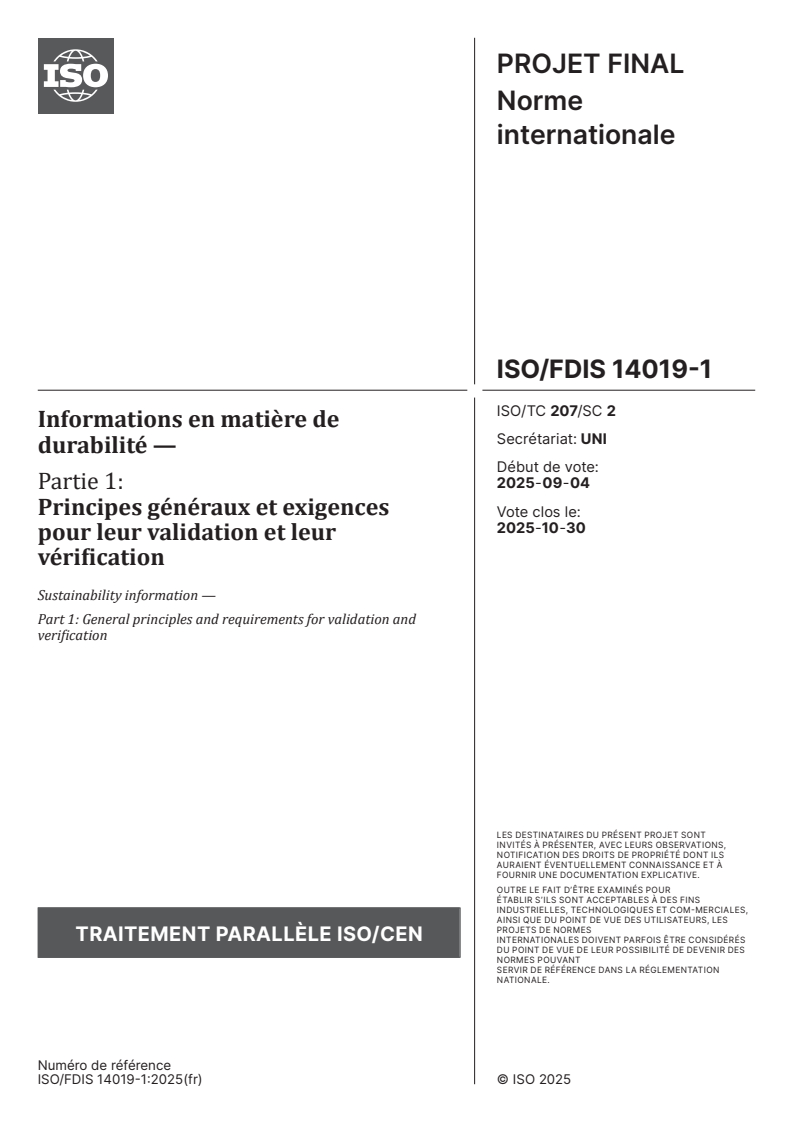
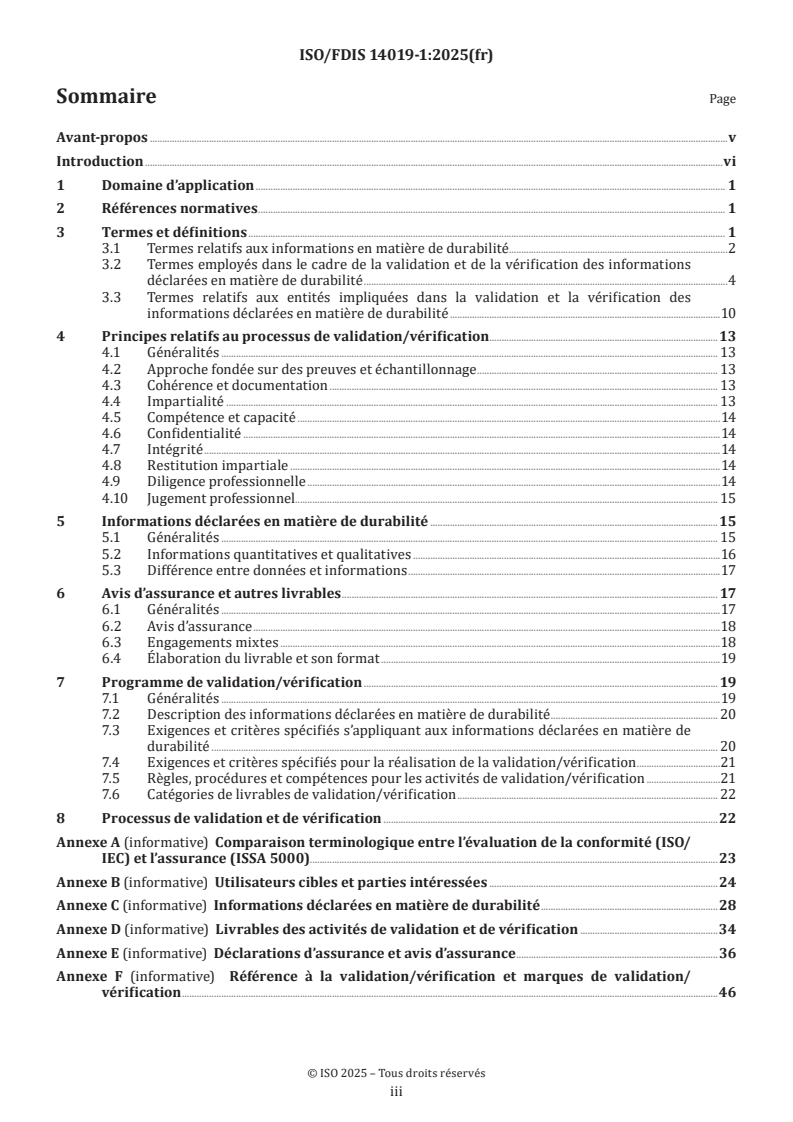
ISO/FDIS 14019-1 - Informations en matière de durabilité — Partie 1: Principes généraux et exigences pour leur validation et leur vérification Released:9/26/2025
Frequently Asked Questions
ISO 14019-1 is a draft published by the International Organization for Standardization (ISO). Its full title is "Sustainability information - Part 1: General principles and requirements for validation and verification". This standard covers: This document specifies general principles and requirements for the validation and verification process of sustainability information, including reporting on environmental, social, governance (ESG) and other sustainability aspects. It provides general principles and requirements for determining the categorization of quantitative and qualitative information. These principles and requirements contribute to the set of rules and procedures that are provided in validation/verification programmes. This document can also be used as the basis for validation and verification activities that support other conformity assessment schemes. NOTE: This document can be applied by validation and verification bodies according to ISO/IEC 17029. It can contribute to schemes operated by inspection bodies according to ISO/IEC 17020 or certification bodies according to ISO/IEC 17065.
This document specifies general principles and requirements for the validation and verification process of sustainability information, including reporting on environmental, social, governance (ESG) and other sustainability aspects. It provides general principles and requirements for determining the categorization of quantitative and qualitative information. These principles and requirements contribute to the set of rules and procedures that are provided in validation/verification programmes. This document can also be used as the basis for validation and verification activities that support other conformity assessment schemes. NOTE: This document can be applied by validation and verification bodies according to ISO/IEC 17029. It can contribute to schemes operated by inspection bodies according to ISO/IEC 17020 or certification bodies according to ISO/IEC 17065.
ISO 14019-1 is classified under the following ICS (International Classification for Standards) categories: 03.120.20 - Product and company certification. Conformity assessment; 13.020.20 - Environmental economics. Sustainability. The ICS classification helps identify the subject area and facilitates finding related standards.
ISO 14019-1 has the following relationships with other standards: It is inter standard links to ISO 18778:2022. Understanding these relationships helps ensure you are using the most current and applicable version of the standard.
ISO 14019-1 is available in PDF format for immediate download after purchase. The document can be added to your cart and obtained through the secure checkout process. Digital delivery ensures instant access to the complete standard document.
Standards Content (Sample)
FINAL DRAFT
International
Standard
ISO/FDIS 14019-1
ISO/TC 207/SC 2
Sustainability information —
Secretariat: UNI
Part 1:
Voting begins on:
2025-09-04
General principles and
requirements for validation and
Voting terminates on:
2025-10-30
verification
Informations en matière de durabilité —
Partie 1: Principes généraux et exigences pour leur validation et
leur vérification
RECIPIENTS OF THIS DRAFT ARE INVITED TO SUBMIT,
WITH THEIR COMMENTS, NOTIFICATION OF ANY
RELEVANT PATENT RIGHTS OF WHICH THEY ARE AWARE
AND TO PROVIDE SUPPOR TING DOCUMENTATION.
IN ADDITION TO THEIR EVALUATION AS
BEING ACCEPTABLE FOR INDUSTRIAL, TECHNO-
ISO/CEN PARALLEL PROCESSING LOGICAL, COMMERCIAL AND USER PURPOSES, DRAFT
INTERNATIONAL STANDARDS MAY ON OCCASION HAVE
TO BE CONSIDERED IN THE LIGHT OF THEIR POTENTIAL
TO BECOME STAN DARDS TO WHICH REFERENCE MAY BE
MADE IN NATIONAL REGULATIONS.
Reference number
ISO/FDIS 14019-1:2025(en) © ISO 2025
FINAL DRAFT
ISO/FDIS 14019-1:2025(en)
International
Standard
ISO/FDIS 14019-1
ISO/TC 207/SC 2
Sustainability information —
Secretariat: UNI
Part 1:
Voting begins on:
General principles and
requirements for validation and
Voting terminates on:
verification
Informations en matière de durabilité —
Partie 1: Principes généraux et exigences pour leur validation et
leur vérification
RECIPIENTS OF THIS DRAFT ARE INVITED TO SUBMIT,
WITH THEIR COMMENTS, NOTIFICATION OF ANY
RELEVANT PATENT RIGHTS OF WHICH THEY ARE AWARE
AND TO PROVIDE SUPPOR TING DOCUMENTATION.
© ISO 2025
IN ADDITION TO THEIR EVALUATION AS
All rights reserved. Unless otherwise specified, or required in the context of its implementation, no part of this publication may
BEING ACCEPTABLE FOR INDUSTRIAL, TECHNO-
ISO/CEN PARALLEL PROCESSING
LOGICAL, COMMERCIAL AND USER PURPOSES, DRAFT
be reproduced or utilized otherwise in any form or by any means, electronic or mechanical, including photocopying, or posting on
INTERNATIONAL STANDARDS MAY ON OCCASION HAVE
the internet or an intranet, without prior written permission. Permission can be requested from either ISO at the address below
TO BE CONSIDERED IN THE LIGHT OF THEIR POTENTIAL
or ISO’s member body in the country of the requester.
TO BECOME STAN DARDS TO WHICH REFERENCE MAY BE
MADE IN NATIONAL REGULATIONS.
ISO copyright office
CP 401 • Ch. de Blandonnet 8
CH-1214 Vernier, Geneva
Phone: +41 22 749 01 11
Email: copyright@iso.org
Website: www.iso.org
Published in Switzerland Reference number
ISO/FDIS 14019-1:2025(en) © ISO 2025
ii
ISO/FDIS 14019-1:2025(en)
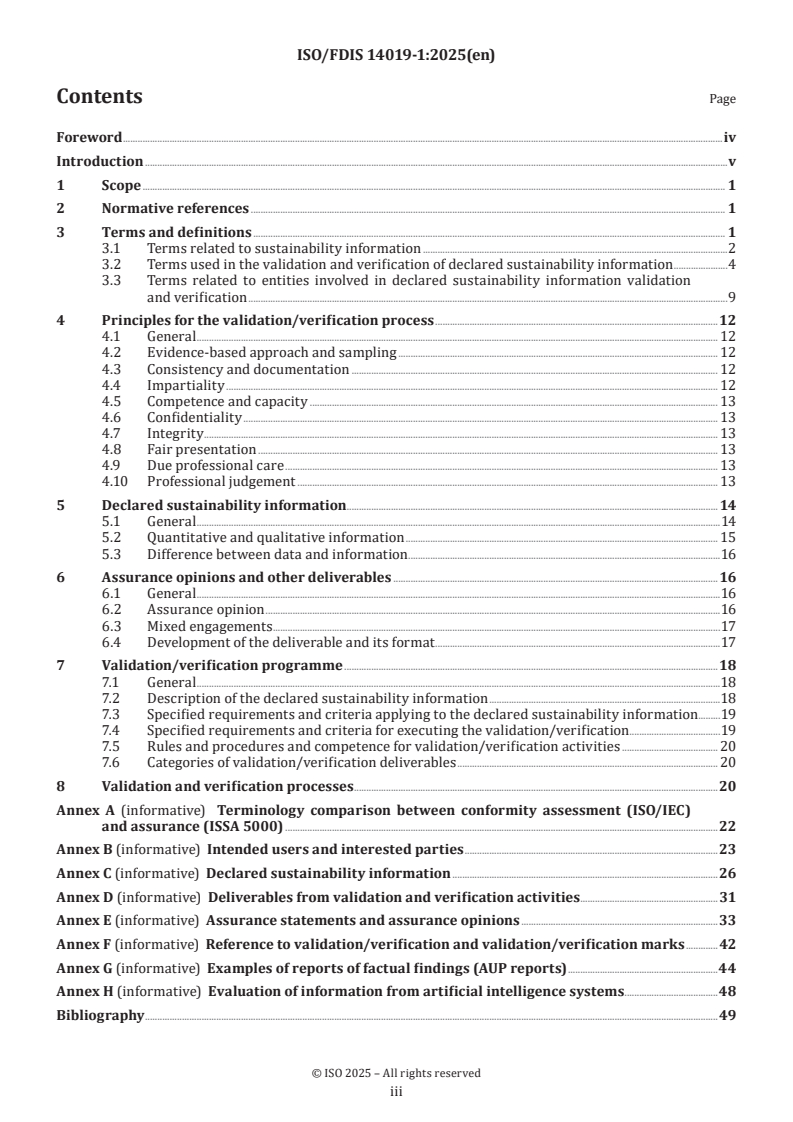
Contents Page
Foreword .iv
Introduction .v
1 Scope . 1
2 Normative references . 1
3 Terms and definitions . 1
3.1 Terms related to sustainability information .2
3.2 Terms used in the validation and verification of declared sustainability information .4
3.3 Terms related to entities involved in declared sustainability information validation
and verification .9
4 Principles for the validation/verification process .12
4.1 General . 12
4.2 Evidence-based approach and sampling . 12
4.3 Consistency and documentation . 12
4.4 Impartiality . 12
4.5 Competence and capacity . 13
4.6 Confidentiality . 13
4.7 Integrity . 13
4.8 Fair presentation . 13
4.9 Due professional care . 13
4.10 Professional judgement . 13
5 Declared sustainability information. 14
5.1 General .14
5.2 Quantitative and qualitative information . 15
5.3 Difference between data and information .16
6 Assurance opinions and other deliverables .16
6.1 General .16
6.2 Assurance opinion .16
6.3 Mixed engagements . .17
6.4 Development of the deliverable and its format .17
7 Validation/verification programme .18
7.1 General .18
7.2 Description of the declared sustainability information .18
7.3 Specified requirements and criteria applying to the declared sustainability information.19
7.4 Specified requirements and criteria for executing the validation/verification .19
7.5 Rules and procedures and competence for validation/verification activities . 20
7.6 Categories of validation/verification deliverables . 20
8 Validation and verification processes .20
Annex A (informative) Terminology comparison between conformity assessment (ISO/IEC)
and assurance (ISSA 5000) .22
Annex B (informative) Intended users and interested parties .23
Annex C (informative) Declared sustainability information .26
Annex D (informative) Deliverables from validation and verification activities .31
Annex E (informative) Assurance statements and assurance opinions .33
Annex F (informative) Reference to validation/verification and validation/verification marks .42
Annex G (informative) Examples of reports of factual findings (AUP reports) .44
Annex H (informative) Evaluation of information from artificial intelligence systems .48
Bibliography .49
iii
ISO/FDIS 14019-1:2025(en)
Foreword
ISO (the International Organization for Standardization) is a worldwide federation of national standards
bodies (ISO member bodies). The work of preparing International Standards is normally carried out through
ISO technical committees. Each member body interested in a subject for which a technical committee
has been established has the right to be represented on that committee. International organizations,
governmental and non-governmental, in liaison with ISO, also take part in the work. ISO collaborates closely
with the International Electrotechnical Commission (IEC) on all matters of electrotechnical standardization.
The procedures used to develop this document and those intended for its further maintenance are described
in the ISO/IEC Directives, Part 1. In particular, the different approval criteria needed for the different types
of ISO document should be noted. This document was drafted in accordance with the editorial rules of the
ISO/IEC Directives, Part 2 (see www.iso.org/directives).
ISO draws attention to the possibility that the implementation of this document may involve the use of (a)
patent(s). ISO takes no position concerning the evidence, validity or applicability of any claimed patent
rights in respect thereof. As of the date of publication of this document, ISO had not received notice of (a)
patent(s) which may be required to implement this document. However, implementers are cautioned that
this may not represent the latest information, which may be obtained from the patent database available at
www.iso.org/patents. ISO shall not be held responsible for identifying any or all such patent rights.
Any trade name used in this document is information given for the convenience of users and does not
constitute an endorsement.
For an explanation of the voluntary nature of standards, the meaning of ISO specific terms and expressions
related to conformity assessment, as well as information about ISO’s adherence to the World Trade
Organization (WTO) principles in the Technical Barriers to Trade (TBT), see www.iso.org/iso/foreword.html.
This document was prepared by Technical Committee ISO/TC 207, Environmental management, Subcommittee
SC 2, Environmental auditing and related practices, in collaboration with the European Committee for
Standardization (CEN) Technical Committee CEN/CLC/JTC 1, Criteria for conformity assessment bodies, in
accordance with the Agreement on technical cooperation between ISO and CEN (Vienna Agreement), and in
collaboration with ISO/CASCO, Committee on conformity assessment.
A list of all parts in the ISO 14019 series can be found on the ISO website.
Any feedback or questions on this document should be directed to the user’s national standards body. A
complete listing of these bodies can be found at www.iso.org/members.html.
iv
ISO/FDIS 14019-1:2025(en)
Introduction
0.1 With increasing public demand and advancing legal provisions (regulatory and contractual) for
declarations, disclosures and reporting of sustainability information, there is a significant market need for
the validation, verification and assurance of this information.
0.2 Standards are needed for both:
a) identifying metrics and indicators, monitoring, compiling, reporting, declaring and disclosing
information about sustainability matters (including environmental, social and governance (ESG)
matters);
b) harmonized approaches to validation/verification and assurance of that information.
Validated and verified sustainability information can be used for decision-making, including investment
decisions, procurement decisions, or individual choices during consumer purchasing, the use of services and
decisions on where to work.
0.3 In this document, the sustainability information that is declared by a responsible party is the object of
the validation/verification. Validation/verification bodies assess the declared sustainability information for
its conformity with, and fulfilment of, specified requirements and criteria.
0.4 Specified requirements and criteria are set by a validation/verification programme, which can be a
mandatory regulatory reporting programme, or a voluntary programme for a specific sector or sustainability
matter. The result of a completed validation/verification can be the provision of an assurance opinion which
attests that:
a) the specified requirements and criteria have been fulfilled;
b) the reasonableness of the assumptions, limitations and methods that support declared sustainability
information about a future outcome has been validated;
c) the material correctness and fair representation of historical data and information has been verified.
NOTE The primary outcome of validation/verification activities in accordance with the ISO 14019 series is an
assurance opinion. In addition, the ISO 14019 series allows for alternative non-assurance outcomes or deliverables.
The deliverable chosen for each specific validation/verification activity (i.e. an assurance opinion or a non-assurance
deliverable) is specified in the relevant validation/verification programme and confirmed between the validation/
verification body and its client in a specific engagement agreement. Non-assurance deliverables include reports of
factual findings based on agreed-upon procedures (AUP) reports, findings reports and evidence reports. These non-
assurance deliverables can be appropriate for situations where an assurance opinion is not required (e.g. in voluntary
or internal reporting, reporting from organizations upstream or downstream in the value chain, for small and
medium-sized enterprises (SMEs), in situations where capacity building is being undertaken, when the expense of an
assurance opinion is prohibitive (see Annex D for more information).
0.5 The overall aim of validation/verification is to give confidence to intended users that the declared
sustainability information is fairly stated, can be used for the defined purpose and fulfils specified
requirements and criteria. This confidence is provided through an impartial validation/verification process
undertaken by a competent validator/verifier.
0.6 Parties that have an interest in validation/verification include, but are not limited to:
a) clients of validation/verification bodies;
b) validation/verification programme owners and other developers of standards;
c) regulatory authorities;
d) intended users of validated/verified declared sustainability information (e.g. investors, supply chain
partners, industry bodies, non-governmental organizations (NGOs), consumers) and other interested
parties;
e) accreditation bodies.
v
ISO/FDIS 14019-1:2025(en)
0.7 Frameworks, principles and processes guiding validation/verification methodologies should be
compatible with the globally accepted quality infrastructure (standardization, conformity assessment by
validation/verification, peer assessment, accreditation). Furthermore, developing these methodologies as
International Standards allows all interested parties, especially those with already implemented structures
and existing instruments, to participate.
0.8 Standards for the declaration and reporting of sustainability information already existing or under
development relate, for instance, to organizations (e.g. listed companies or suppliers) that are increasingly
required to report specific ESG or sustainability matters under voluntary or mandatory arrangements (e.g.
as a pre-requisite to supply chain or market access, precondition for tenders and government procurement,
as part of securities exchange or regulatory annual reporting).
0.9 Within the existing legal framework of many countries and regions, the global system of conformity
assessment and its recognition (e.g. through multilateral arrangements between accreditation bodies), tools
for reliable assessment and confirmation of declared information (claims, reports, etc.) currently exist.
0.10 Parties interested in qualitatively trustworthy and quantitatively comparable information will benefit
from standardized validation/verification processes performed by legal entities that fulfil the requirements
of ISO/IEC 17029.
0.11 While both validation and verification result in a confirmation of declared information, they differ
significantly in their execution. Assessing historic data with respect to truthful and correct statements
in a verification requires different methodological approaches than determining whether declarations on
an intended purpose or future effect are reasonable and plausible in a validation. Therefore, this series
1)
includes separate documents for the validation process (see ISO 14019-3 ) and the verification process (see
ISO 14019-2).
0.12 As for the type of information to be validated or verified, a distinction can be made according to the
sustainability matter (e.g. environmental, social, governance). However, taking the perspective of describing
methodologies, the distinction according to the nature of the assessed information, being quantitative or
qualitative, appears more rational. Hence, this latter approach has been taken in this document.
0.13 The ISO 14019 series provides a consistent overview of the entire validation/verification of
sustainability information, and gives general and specific requirements for validation/verification processes.
0.14 In summary, the ISO 14019 series comprises the following parts:
— ISO 14019-1 (this document) contains terminology, principles and general requirements applicable to
both validation and verification;
— ISO 14019-2 contains specific principles and requirements for verification processes;
1)
— ISO 14019-3 contains specific principles and requirements for validation processes;
— ISO 14019-4 contains specific principles and requirements for validation/verification bodies and their
personnel, the validators and verifiers, in addition to the generic requirements of ISO/IEC 17029.
1) Planned.
vi
FINAL DRAFT International Standard ISO/FDIS 14019-1:2025(en)
Sustainability information —
Part 1:
General principles and requirements for validation and
verification
1 Scope
This document specifies general principles and requirements for the validation/verification of declared
sustainability information, including reporting on environmental, social, governance and other sustainability
matters.
This document is applicable to quantitative and qualitative information.
NOTE These principles and requirements complement the set of rules and procedures that are provided in
validation/verification programmes.
This document is also applicable as the basis for validation/verification activities that support other
conformity assessment schemes.
This document is applicable to validation/verification bodies operating in accordance with ISO/IEC 17029.
2 Normative references
The following documents are referred to in the text in such a way that some or all of their content constitutes
requirements of this document. For dated references, only the edition cited applies. For undated references,
the latest edition of the referenced document (including any amendments) applies.
ISO 14019-4:—, Sustainability information — Part 4: Principles and requirements for bodies validating and
verifying sustainability information
ISO/IEC 17029, Conformity assessment — General principles and requirements for validation and verification bodies
3 Terms and definitions
For the purposes of this document, the following terms and definitions apply.
ISO and IEC maintain terminology databases for use in standardization at the following addresses:
— ISO Online browsing platform: available at https:// www .iso .org/ obp
— IEC Electropedia: available at https:// www .electropedia .org/
[68]
NOTE Annex A provides a comparison table between ISO/IEC and ISSA 5000 terminology.
ISO/FDIS 14019-1:2025(en)
3.1 Terms related to sustainability information
3.1.1
sustainability
state of the global system in which the needs of the present are met without compromising the ability of
future generations to meet their own needs
Note 1 to entry: Sustainability is the goal of sustainable development.
Note 2 to entry: Sustainability can include environmental, social, economic, governance and other aspects.
[SOURCE: ISO Guide 82:2019, 3.1, modified — “environmental, social and economic aspects” deleted in the
definition. Note 1 to entry deleted. New Note 2 to entry added.]
3.1.2
sustainability matter
underlying subject matter
attribute that can influence sustainability (3.1.1), including an organization’s (3.3.10) governance, objectives,
goals, plans, processes and performance
Note 1 to entry: Attributes can relate to activities, products (3.2.4), services, value chains (3.2.5), natural and economic
systems.
Note 2 to entry: Sustainability matters can relate to forecasting based on assumptions, limitations and methods
aiming to predict the future that support declared sustainability information (3.1.4).
Note 3 to entry: Identification of sustainability matters can be undertaken from various viewpoints, including from the
viewpoint of intended users (3.3.4), interested parties (3.3.5) and those that can be affected by the decisions of others
in relation to sustainability. It can also be possible to take a viewpoint from a non-human perspective such as another
species or ecosystem, or a natural system at local, regional or global scales (e.g. nitrogen, carbon or water cycle).
Note 4 to entry: Sustainability matters can be a description of a classification of underlying sustainability attributes
and can be an aggregation of those attributes.
Note 5 to entry: Sustainability matters can relate to an organization’s (3.3.10) influence as well as influence on an
organization.
Note 6 to entry: Sustainability matters include attributes related to impacts (3.1.7), dependencies and performance.
Note 7 to entry: Often sustainability matters will be interdependent and have complex cause and effect relationships
and feedback loops.
3.1.3
sustainability information
subject matter information
information about sustainability matters (3.1.2)
Note 1 to entry: Sustainability information can result from measuring or evaluating sustainability matters against
specified requirements (3.2.3) and criteria (3.2.2).
Note 2 to entry: Sustainability information is grounded in systems thinking and includes consideration of the
interaction and interdependence between different sustainability matters.
Note 3 to entry: Sustainability information can be numerical, verbal, written, recorded, visual, virtual, etc.
Note 4 to entry: Validation/verification programmes (3.2.1) can use alternative terms to categorize sustainability
information, such as “issues”, “factors”, etc.
ISO/FDIS 14019-1:2025(en)
3.1.4
declared sustainability information
sustainability information (3.1.3) that is declared by a responsible party (3.3.3)
Note 1 to entry: The responsible party determines the relevance of what it chooses to declare based on consideration
of its intended users (3.3.4) and their needs for information to make decisions for a purpose (see Annex B for more
information on intended users).
Note 2 to entry: The term “declared sustainability information” in the ISO 14019 series is used in place of the term
“claim” in ISO/IEC 17029.
Note 3 to entry: Declared sustainability information can represent a situation at a point in time or can cover a period
of time (see Annex C for more information on declared sustainability information).
Note 4 to entry: Declared sustainability information can represent past results, current state or predicted future
outcomes.
Note 5 to entry: Declared sustainability information that represents a current state is clearly identifiable and capable
of consistent evaluation or measurement against specified requirements (3.2.3) and criteria (3.2.2).
Note 6 to entry: Declared sustainability information that represents predicted future outcomes is clearly identifiable
and capable of consistent evaluation of the assumptions, limitations and methods against specified requirements and
criteria.
Note 7 to entry: Declared sustainability information can be provided in the form of a report, a claim, statement,
disclosure, declaration, project plan, consolidated data or performance indicator. It can be provided in any format (e.g.
written, oral, recording, video, website or a combination thereof).
Note 8 to entry: Declared sustainability information can include information about more than one sustainability matter
(3.1.2) (e.g. an environmental, social and governance (ESG) declaration or a natural capital report).
Note 9 to entry: Declared sustainability information can include both current state and predicted outcome of future
activities.
3.1.5
disclosed sustainability information
sustainability information (3.1.3) that is made available to parties external to the responsible party (3.3.3)
Note 1 to entry: Examples of parties external to the responsible party to which sustainability information is disclosed
can be an intended user (3.3.4), a current or potential investor or lender, a supplier, a customer, a regulator, the public
or any other organization (3.3.10) or person.
Note 2 to entry: Disclosed sustainability information can be, in full or in part, declared sustainability information
(3.1.4). See Clause C.7 for more information on disclosed sustainability information.
3.1.6
relevance determination process
process to identify reporting elements
materiality process
process used by the responsible party (3.3.3) to determine what sustainability information (3.1.3) is to be
included in the declared sustainability information (3.1.4) to meet the needs of identified intended users
(3.3.4) to make decisions for their stated purpose
3.1.7
impact
positive or negative change in an outcome as a result of an organization’s (3.3.10) decisions or execution, and
the consequences of those decisions
Note 1 to entry: The change in an outcome can be positive or negative depending on its relation to a threshold.
Note 2 to entry: There can be interim points between actions and their resulting impacts where measurement can
support management towards achieving organizational purpose.
Note 3 to entry: Impact can be determined based on current outcome or predicted future outcome.
ISO/FDIS 14019-1:2025(en)
[SOURCE: ISO 37005:2024, 3.9, modified — “outcome as a result of an organization’s decisions or execution,”
replaced “organizational outcome because of a governing body’s decision, execution” in the definition. Notes
1 and 4 to entry deleted. New Note 3 to entry added.]
3.2 Terms used in the validation and verification of declared sustainability information
3.2.1
validation/verification programme
set of rules and procedures that describes declared sustainability information (3.1.4), identifies the specified
requirements (3.2.3) and criteria (3.2.2), and provides the methodology for performing validation (3.2.6)/
verification (3.2.7)
Note 1 to entry: Programmes can be operated at international, regional, national, sub-national, sector-specific or
organizational levels.
Note 2 to entry: A programme can also be called a “scheme”.
Note 3 to entry: A programme can include a combination of validation and verification activities, and result in mixed
engagements (3.2.34) (see 6.3 for more information on mixed engagements).
Note 4 to entry: A programme can be a set of activities specified by a validation body (3.3.6)/verification body (3.3.7)
in agreement with their client (3.3.1) or refer to a formal programme document which has a set of rules with varying
degrees of specification and complexity.
Note 5 to entry: Programmes can be voluntary or mandatory in the case of regulation or contractual requirements.
[SOURCE: ISO/IEC 17000:2020, 4.9, modified — “validation/verification programme” replaced “conformity
assessment scheme” as the term. Admitted term deleted. “declared sustainability information” replaced
“objects of conformity assessment”, “and criteria” added and “validation/verification” replaced “conformity
assessment” in the definition. Notes to entry replaced.]
3.2.2
criteria
policy, procedure or requirement used as a reference against which declared sustainability information (3.1.4)
is validated or verified
Note 1 to entry: Criteria can be established by governments, regulators, programmes, voluntary reporting initiatives,
standards, codes of practice or internal procedures.
Note 2 to entry: The phrase “specified requirements and criteria” is used in place of the phrase “specified requirements”
used in ISO/IEC 17029.
Note 3 to entry: An example of criteria can be the benchmark to measure or evaluate the sustainability matter (3.1.2).
[SOURCE: ISO 14064-3:2019, 3.6.10, modified — “declared sustainability information is validated or verified”
replaced “GHG statement is compared”. Notes to entry added.]
3.2.3
specified requirement
need or expectation that is stated
Note 1 to entry: Specified requirements can be stated in normative documents such as regulations, standards and
technical specifications.
Note 2 to entry: Specified requirements can be detailed or general.
Note 3 to entry: The phrase “specified requirements and criteria” is used in place of the phrase “specified requirements”
used in ISO/IEC 17029.
[SOURCE: ISO/IEC 17000:2020, 5.1, modified — Note 3 to entry added.]
ISO/FDIS 14019-1:2025(en)
3.2.4
product
any goods or service
Note 1 to entry: The definition of product can refer to the process of producing the goods or service.
[SOURCE: ISO 14050:2020, 3.5.12, modified — Note 1 to entry added.]
3.2.5
value chain
sequence of activities, or parties, that create or receive value through the provision of a product (3.2.4)
Note 1 to entry: In this document, “value chain” is regarded as a broader concept than “supply chain” (persons or
organizations (3.3.10) that perform a sequence of activities to produce and deliver a product). The supply chain is a part
of the value chain, but the value chain can also include other persons or organizations upstream and downstream from
the supply chain and not directly involved in the supply chain. All the persons or organizations in the value chain are all
or part of the interested parties (3.3.5) and interested parties can be persons or organizations outside the value chain.
[SOURCE: ISO 14050:2020, 3.5.28, modified — “entire” deleted and commas added in the definition. Note 1
to entry added.]
3.2.6
validation
process for evaluating the reasonableness of the assumptions, limitations and methods that support declared
sustainability information (3.1.4) about the outcome of future activities
Note 1 to entry: The term “declared sustainability information” in the ISO 14019 series is synonymous with the term
“claim” in ISO/IEC 17029.
[SOURCE: ISO 14065:2020, 3.3.16, modified — Preferred term deleted. “declared sustainability information”
replaced “an environmental information statement”. Note 1 to entry replaced.]
3.2.7
verification
process for evaluating declared sustainability information (3.1.4) of a historical nature to determine if the
declared sustainability information is materially correct and conforms to specified requirements (3.2.3) and
criteria (3.2.2)
Note 1 to entry: The term “declared sustainability information” in the ISO 14019 series is synonymous with the term
“claim” in ISO/IEC 17029.
Note 2 to entry: Evaluation activities performed that do not provide assurance (3.2.23) are called agreed-upon
procedures (3.2.25).
[SOURCE: ISO 14065:2020, 3.3.15, modified — Preferred term deleted. “declared sustainability information”
replaced “an environmental information statement” in the definition. Note 1 to entry replaced. Note 2 to
entry added.]
3.2.8
level of assurance
degree of confidence in the declared sustainability information (3.1.4)
Note 1 to entry: The levels of assurance and the conditions to achieve them can be specified in the programme (e.g.
reasonable, limited).
[SOURCE: ISO/IEC 17029:2019, 3.15, modified — “declared sustainability information” replaced “claim” in
the definition. “specified” replaced “defined” and “absolute” deleted in Note 1 to entry.]
3.2.9
material
significant to intended users (3.3.4)
[SOURCE: ISO/IEC 17029:2019, 3.16, modified — Notes 1 and 2 to entry deleted.]
ISO/FDIS 14019-1:2025(en)
3.2.10
materiality
concept that misstatements (3.2.11), individually or aggregated, can influence the reliability of the declared
sustainability information (3.1.4) and hence decisions made by the intended user (3.3.4)
Note 1 to entry: Materiality can be qualitative or quantitative.
[SOURCE: ISO 14065:2020, 3.3.19, modified — “misstatements, individually or aggregated” replaced
“individual misstatements or the aggregation of misstatements” and “reliability of the declared sustainability
information and hence decisions made by the intended user” replaced “intended users’ decisions” in the
definition. Note 1 to entry added.]
3.2.11
misstatement
error, omission, misreporting or misrepresentation in declared sustainability information (3.1.4)
Note 1 to entry: Misstatement can be qualitative or quantitative.
Note 2 to entry: Misstatements are not limited to numerical errors but include errors in presentation, declared
sustainability information, sustainability matters (3.1.2) or assumptions as well as the potential for statements to
mislead the intended user (3.3.4).
Note 3 to entry: Misstatement can be unintentional or intentional, including fraud.
[SOURCE: ISO 14065:2020, 3.3.21, modified — “declared sustainability information” replaced “environmental
information statement”. Notes 2 and 3 to entry added.]
3.2.12
material misstatement
individual misstatement (3.2.11) or the aggregate of actual misstatements in declared sustainability
information (3.1.4) that can affect the decisions of the intended users (3.3.4) for their stated purpose
[SOURCE: ISO 14065:2020, 3.2.22, modified — “declared sustainability information” replaced “environmental
information statement” and “for their stated purpose” added.]
3.2.13
engagement risk
risk that an assurance opinion (3.2.24) results in an inappropriate conclusion when the declared sustainability
information (3.1.4) is materially misstated
3.2.14
sampling risk
risk that a validator’s (3.3.8)/verifier’s (3.3.9) conclusion based on a sample can be different from the
conclusion if the entire population were subjected to the same validation/verification procedure
3.2.15
information risk
likelihood of a material misstatement (3.2.12) materializing and its consequences
[SOURCE: ISO 28004-1:2007, 3.1, modified — “information” added before “risk” in the term. “material
misstatement” replaced “security threat” in the definition.]
3.2.16
risk assessment
overall process for risk identification, risk analysis, risk evaluation and risk mitigation
[SOURCE: ISO 31073:2022, 3.3.8, modified — “and risk mitigation” added.]
3.2.17
scope limitation
specific situation in which part of a validation (3.2.6)/verification (3.2.7) cannot be performed as intended
Note 1 to entry: Conclusions, including the assurance opinion (3.2.24) provided, can be affected by these limitations.
ISO/FDIS 14019-1:2025(en)
Note 2 to entry: Scope limitations can be due to various factors, such as limited access to information, time constraints,
inadequate resources or restrictions imposed by the client (3.3.1) or responsible party (3.3.3).
Note 3 to entry: Scope limitations can prevent the validator (3.3.8)/verifier (3.3.9) from obtaining complete and
unrestricted access to all relevant information or conducting a thorough examination of certain areas or activities.
3.2.18
inherent limitation
constraint or uncertainty present in any validation (3.2.6)/verification (3.2.7)
Note 1 to entry: Inherent limitations can arise due to factors beyond the control of the validator (3.3.8)/verifier (3.3.9)
and are integral to the nature of the validation/verification activities. Examples include the reliability of information,
the possibility of fraud or error, the effectiveness of internal controls or the future-oriented nature of validation
activities.
Note 2 to entry: Even with a well-planned and executed validation/verification process, there is always a residual risk
that some material misstatements (3.2.12) or issues can go undetected.
3.2.19
strategic analysis
documented process to comprehend the context for validation/verification activities
Note 1 to entry: The process includes researching, gathering and analysing information in relation to a responsible
party (3.3.3), its business environment and its declared sustainability information (3.1.4).
3.2.20
scope of validation/verification
identification of:
— the declared sustainability information (3.1.4) to be the object of validation (3.2.6) or verification (3.2.7),
including the boundaries of the declared sustainability information;
— the applicable validation/verification programme (3.2.1);
— the specified requirements (3.2.3) and criteria (3.2.2) to which the declared sustainability information is
validated/verified
[SOURCE: ISO/IEC 17029:2019, 3.11, modified — “declared sustainability information” replaced “claim”
twice and “specified requirements and criteria” replaced “standards and other normative documents,
including their date of publication,”.]
3.2.21
evidence report
issue of results from evidence-gathering activities
Note 1 to entry: An evidence report includes the evidence gathered. It does not include the outcome of any review or
any decision as to whether specified requirements (3.2.3) and criteria (3.2.2) have been fulfilled, and thus does not
provide an assurance opinion (3.2.24).
3.2.22
findings report
issue of review results from a review of evidence gathering
Note 1 to entry: A findings report includes consideration of whether the evidence-gathering activities have been
suitable, adequate and effective, and whether they have resulted in conclusive evidence with regard to the fulfilment of
specified requirements (3.2.3) and criteria (3.2.2). It does not include any decision as to whether specified requirements
and criteria have been fulfilled, and thus does not provide an assurance opinion (3.2.24).
3.2.23
assurance
confidence that can be placed on declared sustainability information (3.1.4) as a result of validation (3.2.6) or
verification (3.2.7)
ISO/FDIS 14019-1:2025(en)
3.2.24
assurance opinion
declaration by a validation body (3.3.6)/verification body (3.3.7) on assurance (3.2.23) in accordance with an
engagement agreement
Note 1 to entry: Assurance opinions can be referred to using specific programme terminology.
Note 2 to entry: The assurance opinion reflects only the situation at the point in time it is issued.
Note 3 to entry: The assurance opinion for a verification (3.2.7) can be confirming or not confirming the information
declared by the responsible party (3.3.3), with or without comments, according to the programme requirements.
Note 4 to entry: The assurance opinion for validation (3.2.6) can be confirming or not confirming the assumptions/
methodologies used to develop the projected future information that is declared by the responsible party, with or
without comments, according to the programme requirements.
Note 5 to entry: The assurance opinion is included in the assurance statement (3.2.25).
3.2.25
assurance statement
assurance information and the assurance opinion (3.2.24)
3.2.26
agreed-upon procedures
AUP
engagement agreement that results in a report on validation or verification activities and does not provide
an assurance opinion (3.2.24)
[SOURCE: ISO 14064-3:2019, 3.6.4, modified — A revised definition replaced “engagement that reports on
the results of verification activities and does not provide an opinion”.]
3.2.27
agreed-upon procedures report
AUP report
report of factual findings
documented output of AUP (3.2.26)
3.2.28
nonconformity
non-fulfilment of a requirement
Note 1 to entry: Some programmes can require that nonconformities raised against legal requirements related to the
programme are raised as non-compliances.
Note 2 to entry: This document uses “specified requirements and criteria” for the word “requirement” referred to in
this definition.
[SOURCE: ISO 14050:2020, 3.1.17, modified — Notes 1 and 2 to entry added.]
3.2.29
professional scepticism
attitude that includes a questioning mind and a critical assessment of evidence
[SOURCE: ISO 14066:2023, 3.1.1]
3.2.30
impartiality
...
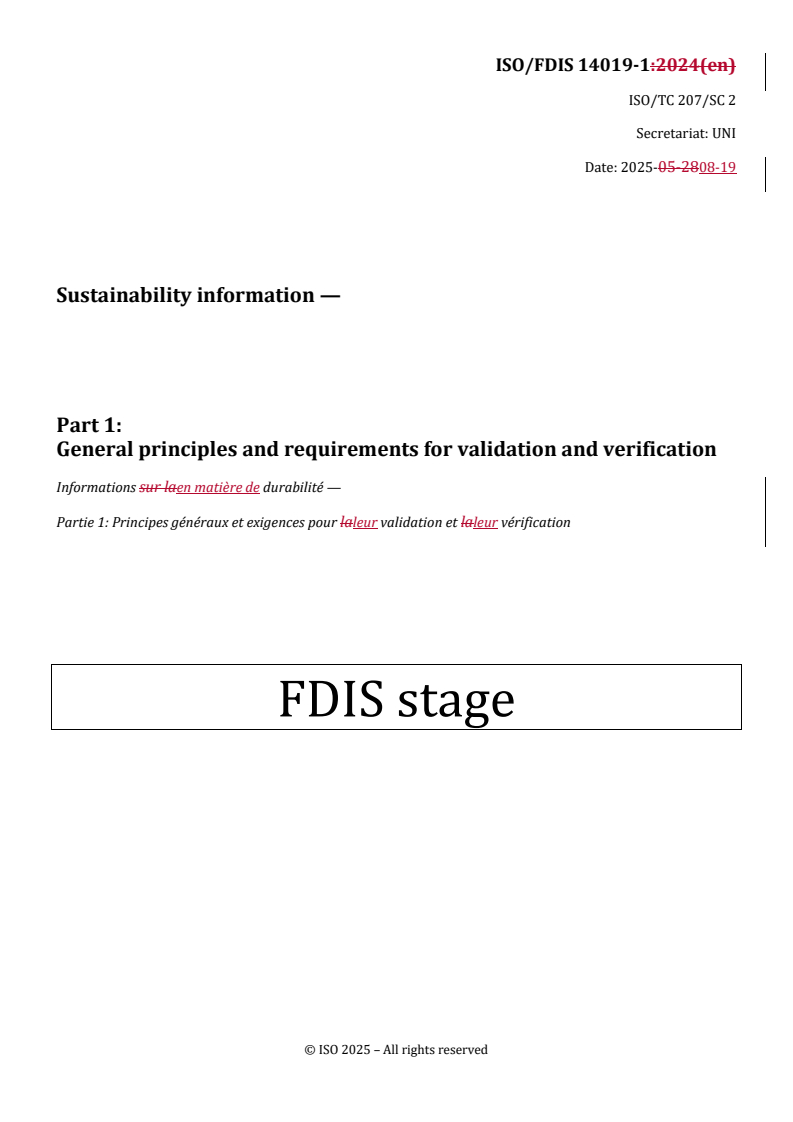
ISO/FDIS 14019-1:2024(en)
ISO/TC 207/SC 2
Secretariat: UNI
Date: 2025-05-2808-19
Sustainability information —
Part 1:
General principles and requirements for validation and verification
Informations sur laen matière de durabilité —
Partie 1: Principes généraux et exigences pour laleur validation et laleur vérification
FDIS stage
ISO/FDIS 14019-1:2025(en)
All rights reserved. Unless otherwise specified, or required in the context of its implementation, no part of this publication
may be reproduced or utilized otherwise in any form or by any means, electronic or mechanical, including photocopying,
or posting on the internet or an intranet, without prior written permission. Permission can be requested from either ISO
at the address below or ISO’s member body in the country of the requester.
ISO copyright office
CP 401 • Ch. de Blandonnet 8
CH-1214 Vernier, Geneva
Phone: + 41 22 749 01 11
E-mail: copyright@iso.org
Website: www.iso.org
Published in Switzerland
ii
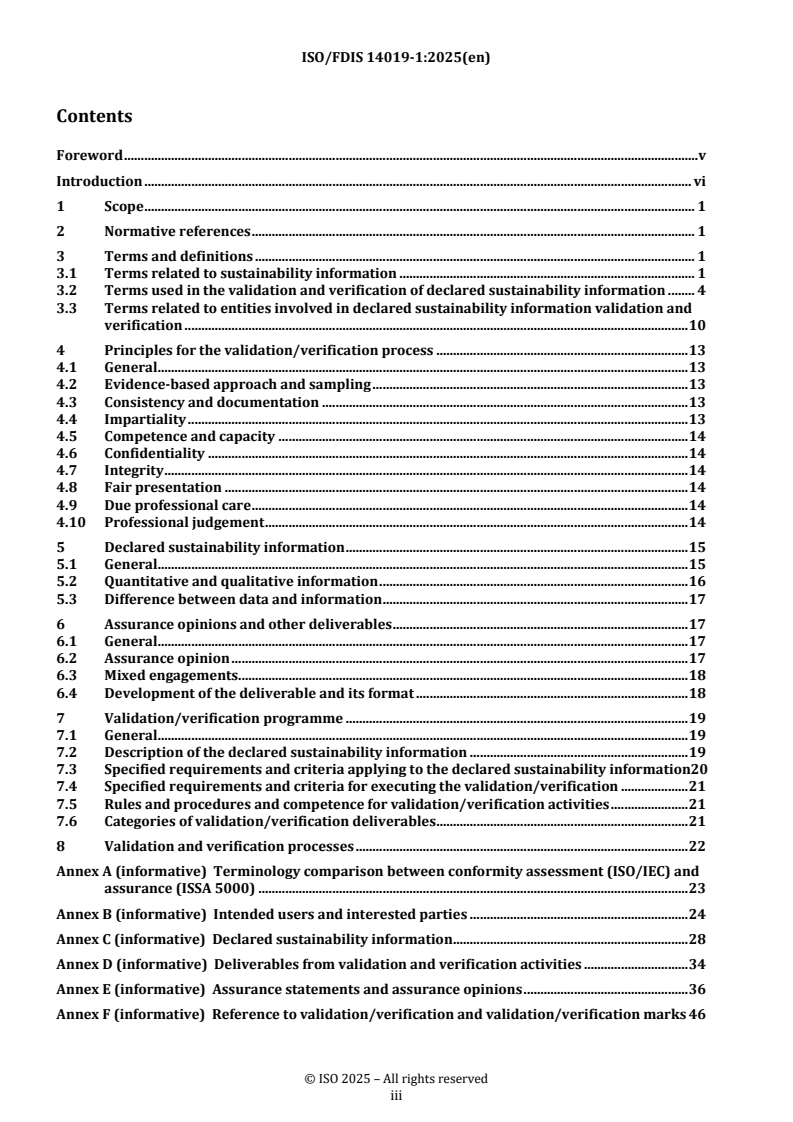
ISO/FDIS 14019-1:2025(en)
Contents
Foreword . v
Introduction . vi
1 Scope . 1
2 Normative references . 1
3 Terms and definitions . 1
3.1 Terms related to sustainability information . 1
3.2 Terms used in the validation and verification of declared sustainability information . 4
3.3 Terms related to entities involved in declared sustainability information validation and
verification . 10
4 Principles for the validation/verification process . 13
4.1 General . 13
4.2 Evidence-based approach and sampling . 13
4.3 Consistency and documentation . 13
4.4 Impartiality . 13
4.5 Competence and capacity . 14
4.6 Confidentiality . 14
4.7 Integrity . 14
4.8 Fair presentation . 14
4.9 Due professional care . 14
4.10 Professional judgement . 14
5 Declared sustainability information . 15
5.1 General . 15
5.2 Quantitative and qualitative information . 16
5.3 Difference between data and information . 17
6 Assurance opinions and other deliverables . 17
6.1 General . 17
6.2 Assurance opinion . 17
6.3 Mixed engagements. 18
6.4 Development of the deliverable and its format . 18
7 Validation/verification programme . 19
7.1 General . 19
7.2 Description of the declared sustainability information . 19
7.3 Specified requirements and criteria applying to the declared sustainability information20
7.4 Specified requirements and criteria for executing the validation/verification . 21
7.5 Rules and procedures and competence for validation/verification activities . 21
7.6 Categories of validation/verification deliverables . 21
8 Validation and verification processes . 22
Annex A (informative) Terminology comparison between conformity assessment (ISO/IEC) and
assurance (ISSA 5000) . 23
Annex B (informative) Intended users and interested parties . 24
Annex C (informative) Declared sustainability information . 28
Annex D (informative) Deliverables from validation and verification activities . 34
Annex E (informative) Assurance statements and assurance opinions . 36
Annex F (informative) Reference to validation/verification and validation/verification marks 46
iii
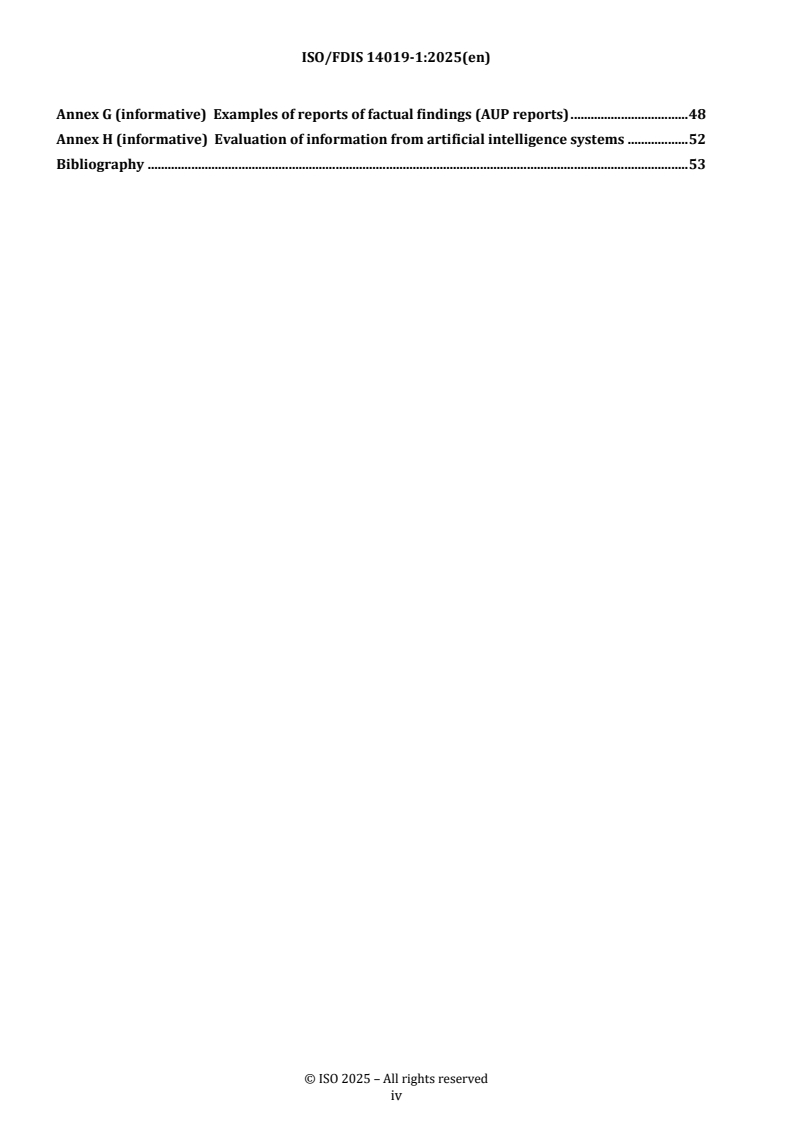
ISO/FDIS 14019-1:2025(en)
Annex G (informative) Examples of reports of factual findings (AUP reports) . 48
Annex H (informative) Evaluation of information from artificial intelligence systems . 52
Bibliography . 53
iv
ISO/FDIS 14019-1:2025(en)
Foreword
ISO (the International Organization for Standardization) is a worldwide federation of national standards
bodies (ISO member bodies). The work of preparing International Standards is normally carried out through
ISO technical committees. Each member body interested in a subject for which a technical committee has been
established has the right to be represented on that committee. International organizations, governmental and
non-governmental, in liaison with ISO, also take part in the work. ISO collaborates closely with the
International Electrotechnical Commission (IEC) on all matters of electrotechnical standardization.
The procedures used to develop this document and those intended for its further maintenance are described
in the ISO/IEC Directives, Part 1. In particular, the different approval criteria needed for the different types of
ISO document should be noted. This document was drafted in accordance with the editorial rules of the
ISO/IEC Directives, Part 2 (see www.iso.org/directives).
ISO draws attention to the possibility that the implementation of this document may involve the use of (a)
patent(s). ISO takes no position concerning the evidence, validity or applicability of any claimed patent rights
in respect thereof. As of the date of publication of this document, ISO had not received notice of (a) patent(s)
which may be required to implement this document. However, implementers are cautioned that this may not
represent the latest information, which may be obtained from the patent database available at
www.iso.org/patents. ISO shall not be held responsible for identifying any or all such patent rights.
Any trade name used in this document is information given for the convenience of users and does not
constitute an endorsement.
For an explanation of the voluntary nature of standards, the meaning of ISO specific terms and expressions
related to conformity assessment, as well as information about ISO’s adherence to the World Trade
Organization (WTO) principles in the Technical Barriers to Trade (TBT), see www.iso.org/iso/foreword.html.
This document was prepared by Technical Committee ISO/TC 207, Environmental management,
Subcommittee SC 2, Environmental auditing and related practices, in collaboration with the European
Committee for Standardization (CEN) Technical Committee CEN/CLC/JTC 1, Criteria for conformity assessment
bodies, in accordance with the Agreement on technical cooperation between ISO and CEN (Vienna Agreement),
and in collaboration with ISO/CASCO, Committee on conformity assessment.
A list of all parts in the ISO 14019 series can be found on the ISO website.
Any feedback or questions on this document should be directed to the user’s national standards body. A
complete listing of these bodies can be found at www.iso.org/members.html.
v
ISO/FDIS 14019-1:2025(en)
Introduction
0.1 With increasing public demand and advancing legal provisions (regulatory and contractual) for
declarations, disclosures and reporting of sustainability information, there is a significant market need for the
validation, verification and assurance of this information.
0.2 Standards are needed for both:
a) identifying metrics and indicators, monitoring, compiling, reporting, declaring and disclosing information
about sustainability matters (including environmental, social and governance (ESG) matters);
b) harmonized approaches to validation/verification and assurance of that information.
Validated and verified sustainability information can be used for decision-making, including investment
decisions, procurement decisions, or individual choices during consumer purchasing, the use of services and
decisions on where to work.
0.3 In this document, the sustainability information that is declared by a responsible party is the object of
the validation or /verification. Validation and /verification bodies assess the declared sustainability
information for its conformity with, and fulfilment of, ‘specified requirements and criteria’criteria.
0.4 Specified requirements and criteria are set by a validation/verification programme, which can be a
mandatory regulatory reporting programme, or a voluntary programme for a specific sector or sustainability
matter. The result of a completed validation/verification can be the provision of an assurance opinion which
attests that:
a) the specified requirements and criteria have been fulfilled;
b) the reasonableness of the assumptions, limitations and methods that support declared sustainability
information about a future outcome has been validated;
c) the material correctness and fair representation of historical data and information has been verified.
NOTE The primary outcome of validation/verification activities in accordance with the ISO 14019 series is an
assurance opinion. In addition, the ISO 14019 series allows for alternative non-assurance outcomes or deliverables. The
deliverable chosen for each specific validation/verification activity (i.e. an assurance opinion or a non-assurance
deliverable) is specified in the relevant validation/verification programme and confirmed between the
validation/verification body and its client in a specific engagement agreement. Non-assurance deliverables include
reports of factual findings based on agreed-upon procedures (AUP) reports, findings reports and evidence reports. These
non-assurance deliverables can be appropriate for situations where an assurance opinion is not required (e.g. in
voluntary or internal reporting, reporting from organizations upstream or downstream in the value chain, for small and
medium-sized enterprises (SMEs), in situations where capacity building is being undertaken, when the expense of an
assurance opinion is prohibitive (see Annex D for more information).
0.5 The overall aim of validation/verification is to give confidence to intended users that the declared
sustainability information is fairly stated, can be used for the defined purpose and fulfils specified
requirements and criteria. This confidence is provided through an impartial validation/verification process
undertaken by a competent validator/verifier.
0.6 Parties that have an interest in validation/verification include, but are not limited to:
a) clients of validation/verification bodies;
b) validation/verification programme owners and other developers of standards;
c) regulatory authorities;
vi
ISO/FDIS 14019-1:2025(en)
d) intended users of validated/verified declared sustainability information (e.g. investors, supply chain
partners, industry bodies, non-governmental organizations (NGOs), consumers) and other interested
parties;
e) accreditation bodies.
0.7 Frameworks, principles and processes guiding validation/verification methodologies should be
compatible with the globally accepted quality infrastructure (standardization, conformity assessment by
validation/verification, peer assessment, accreditation). Furthermore, developing these methodologies as
International Standards allows all interested parties, especially those with already implemented structures
and existing instruments, to participate.
0.8 Standards for the declaration and reporting of sustainability information already existing or under
development relate, for instance, to organizations (e.g. listed companies or suppliers) that are increasingly
required to report specific ESG or sustainability matters under voluntary or mandatory arrangements (e.g. as
a pre-requisite to supply chain or market access, precondition for tenders and government procurement, as
part of securities exchange or regulatory annual reporting).
0.9 Within the existing legal framework of many countries and regions, the global system of conformity
assessment and its recognition (e.g. through multilateral arrangements between accreditation bodies), tools
for reliable assessment and confirmation of declared information (claims, reports, etc.) currently exist.
0.10 Parties interested in qualitatively trustworthy and quantitatively comparable information will benefit
from standardized validation/verification processes performed by legal entities that fulfil the requirements
of ISO/IEC 17029.
0.11 While both validation and verification result in a confirmation of declared information, they differ
significantly in their execution. Assessing historic data with respect to truthful and correct statements in a
verification requires different methodological approaches than determining whether declarations on an
intended purpose or future effect are reasonable and plausible in a validation. Therefore, this series includes
1)
separate documents for the validation process (see ISO 14019-3) ) and the verification process (see ISO
14019-2).
0.12 As for the type of information to be validated or verified, a distinction can be made according to the
sustainability matter (e.g. environmental, social, governance). However, taking the perspective of describing
methodologies, the distinction according to the nature of the assessed information, being quantitative or
qualitative, appears more rational. Hence, this latter approach has been taken in this document.
0.13 The ISO 14019 series provides a consistent overview of the entire validation/verification of
sustainability information, and gives general and specific requirements for validation/verification processes.
0.14 In summary, the ISO 14019 series comprises the following parts:
— ISO 14019-1 (this document) contains terminology, principles and general requirements applicable to
both validation and verification;
— ISO 14019-2 contains specific principles and requirements for verification processes;
1 1)
— ISO 14019-3 3 contains specific principles and requirements for validation processes;.;
— ISO 14019-4 contains specific principles and requirements for validation/verification bodies and their
personnel, the validators and verifiers, in addition to the generic requirements of ISO/IEC 17029.
1)
Planned.
Under development.
vii
Sustainability information —
Part 1:
General principles and requirements for validation and verification
1 Scope
This document specifies general principles and requirements for the validation/verification of declared
sustainability information, including reporting on environmental, social, governance and other sustainability
matters.
This document is applicable to quantitative and qualitative information.
NOTE These principles and requirements complement the set of rules and procedures that are provided in
validation/verification programmes.
This document is also applicable as the basis for validation/verification activities that support other
conformity assessment schemes.
NOTE This document is applicable to validation/verification bodies operating in accordance with
ISO/IEC 17029.
2 Normative references
The following documents are referred to in the text in such a way that some or all of their content constitutes
requirements of this document. For dated references, only the edition cited applies. For undated references,
the latest edition of the referenced document (including any amendments) applies.
ISO 14019-4:—, Sustainability information — Part 4: Principles and requirements for bodies validating and
verifying sustainability information
ISO/IEC 17029, Conformity assessment — General principles and requirements for validation and verification
bodies
3 Terms and definitions
For the purposes of this document, the following terms and definitions apply.
ISO and IEC maintain terminology databases for use in standardization at the following addresses:
— ISO Online browsing platform: available at https://www.iso.org/obp
— IEC Electropedia: available at https://www.electropedia.org/
[68[11]]
NOTE Annex A provides a comparison table between ISO/IEC and ISSA 5000 terminology.
3.1 Terms related to sustainability information
3.1.1
sustainability
state of the global system in which the needs of the present are met without compromising the ability of future
generations to meet their own needs
Note 1 to entry: Sustainability is the goal of sustainable development.
ISO/FDIS 14019-1:2025(en)
Note 2 to entry: Sustainability can include environmental, social, economic, governance and other aspects.
[SOURCE: ISO Guide 82:2019, 3.1, modified — “environmental, social and economic aspects” deleted in the
definition. Note 1 to entry deleted. Note 2 to entry renumbered, and a newNew Note 2 to entry added.]
3.1.2
sustainability matter
underlying subject matter
attribute that can influence sustainability (3.1.1), including an organization’s (3.3.10(3.2.10)) governance,
objectives, goals, plans, processes and performance
Note 1 to entry: Attributes can relate to activities, products (3.2.4(3.3.4),), services, value chains (3.2.5(3.3.5),), natural
and economic systems.
Note 2 to entry: Sustainability matters can relate to forecasting based on assumptions, limitations and methods aiming
to predict the future that support declared sustainability information (3.1.4.).
Note 3 to entry: Identification of sustainability matters can be undertaken from various viewpoints, including from the
viewpoint of intended users (3.3.4(3.2.4),), interested parties (3.3.5(3.2.5)) and those that can be affected by the decisions
of others in relation to sustainability. It can also be possible to take a viewpoint from a non-human perspective such as
another species or ecosystem, or a natural system at local, regional or global scales (e.g. nitrogen, carbon or water cycle).
Note 4 to entry: Sustainability matters can be a description of a classification of underlying sustainability attributes and
can be an aggregation of those attributes.
Note 5 to entry: Sustainability matters can relate to an organization’s (3.3.10(3.2.10)) influence as well as influence on
an organization.
Note 6 to entry: Sustainability matters include attributes related to impacts (3.1.7,), dependencies and performance.
Note 7 to entry: Often sustainability matters will be interdependent and have complex cause and effect relationships and
feedback loops.
3.1.3
sustainability information
subject matter information
information about sustainability matters (3.1.2)
Note 1 to entry: Sustainability information can result from measuring or evaluating sustainability matters against
specified requirements (3.2.3) and criteria (3.2.2(3.3.3) and criteria (3.3.2). Sustainability information is also referred to
as “subject matter information”.).
Note 2 to entry: Sustainability information is grounded in systems thinking and includes consideration of the interaction
and interdependence between different sustainability matters.
Note 3 to entry: Sustainability information can be numerical, verbal, written, recorded, visual, virtual, etc.
Note 4 to entry: Validation/verification programmes (3.2.1(3.3.1)) can use alternative terms to categorize sustainability
information, such as “issues”, “factors”, etc.
3.1.4
declared sustainability information
sustainability information (3.1.3) that is declared by a responsible party (3.3.3(3.2.3))
Note 1 to entry: The responsible party determines the relevance of what it chooses to declare based on consideration of
its intended users (3.3.4(3.2.4)) and their needs for information to make decisions for a purpose (see Annex B for more
information on intended users).
ISO/FDIS 14019-1:2025(en)
Note 2 to entry: The term “declared sustainability information” in the ISO 14019 series is used in place of the term “claim”
in ISO/IEC 17029.
Note 3 to entry: Declared sustainability information can represent a situation at a point in time or can cover a period of
time (see Annex C for more information on declared sustainability information).
Note 4 to entry: Declared sustainability information can represent past results, current state or predicted future
outcomes.
Note 5 to entry: Declared sustainability information that represents a current state is clearly identifiable and capable of
consistent evaluation or measurement against specified requirements (3.2.3(3.3.3)) and criteria (3.2.2(3.3.2).).
Note 6 to entry: Declared sustainability information that represents predicted future outcomes is clearly identifiable and
capable of consistent evaluation of the assumptions, limitations and methods against specified requirements and criteria.
Note 7 to entry: Declared sustainability information can be provided in the form of a report, a claim, statement,
disclosure, declaration, project plan, consolidated data or performance indicator. It can be provided in any format (e.g.
written, oral, recording, video, website or a combination thereof).
Note 8 to entry: Declared sustainability information can include information about more than one sustainability matter
(3.1.2) (e.g. an environmental, social and governance (ESG) declaration or a natural capital report).
Note 9 to entry : : Declared sustainability information can include both current state and predicted outcome of future
activities.
3.1.5
disclosed sustainability information
sustainability information (3.1.3) that is made available to parties external to the responsible party
(3.3.3(3.2.3))
Note 1 to entry: Examples of parties external to the responsible party to which sustainability information is disclosed can
be an intended user (3.3.4(3.2.4),), a current or potential investor or lender, a supplier, a customer, a regulator, the public
or any other organization (3.3.10(3.2.10)) or person.
Note 2 to entry: Disclosed sustainability information can be, in full or in part, declared sustainability information (3.1.4).
See Clause C.7Annex C.7 for more information on disclosed sustainability information.
3.1.6
relevance determination process
process to identify reporting elements
materiality process
process used by the responsible party (3.3.3(3.2.3)) to determine what sustainability information (3.1.3) is to
be included in the declared sustainability information (3.1.4) to meet the needs of identified intended users
(3.3.4(3.2.4)) to make decisions for their stated purpose
Note 1 to entry: The relevance determination process can also be referred to as “the process to identify reporting
elements”, “materiality process”, amongst other terms.
3.1.93.1.7
impact
positive or negative change in an outcome as a result of an organization’s (3.3.10(3.2.10)) decisions or
execution, and the consequences of those decisions
Note 1 to entry: The change in an outcome can be positive or negative depending on its relation to a threshold.
Note 2 to entry: There can be interim points between actions and their resulting impacts where measurement can
support management towards achieving organizational purpose.
ISO/FDIS 14019-1:2025(en)
Note 3 to entry: Impact can be determined based on current outcome or predicted future outcome.
[SOURCE: ISO 37005:2024, 3.9, modified — “outcome as a result of an organization’s decisions or execution,”
replaced “organizational outcome because of a governing body’s decision, execution” in the definition.
NoteNotes 1 and 4 to entry deleted and replaced by new note. New Note 3 to entry added.]
3.2 Terms used in the validation and verification of declared sustainability information
3.2.1
validation/verification programme
set of rules and procedures that describes declared sustainability information (3.1.4), identifies the specified
requirements (3.2.3) and criteria (3.2.2), and provides the methodology for performing validation
(3.2.6)/verification (3.2.7)
Note 1 to entry: Programmes can be operated at international, regional, national, sub-national, sector-specific or
organizational levels.
Note 2 to entry: A programme can also be called a “scheme”.
Note 3 to entry: A programme can include a combination of validation and verification activities, and result in mixed
engagements (3.2.34) (see 6.3 for more information on mixed engagements).
Note 4 to entry: A programme can be a set of activities specified by a validation body (3.3.6(3.2.6)/)/verification body
(3.3.7(3.2.7)) in agreement with their client (3.3.1) or refer to a formal programme document which has a set of rules
with varying degrees of specification and complexity.
Note 5 to entry: Programmes can be voluntary or mandatory in the case of regulation or contractual requirements.
[SOURCE: ISO/IEC 17000:2020, 4.9, modified — “validation/verification programme” replaced “conformity
assessment scheme” as the term. Admitted term deleted. “declared sustainability information“” replaced
“objects of conformity assessment”, “and criteria” added and “validation/verification” replaced “conformity
assessment”.” in the definition. Notes to entry replaced.]
3.2.2
criteria
policy, procedure or requirement used as a reference against which declared sustainability information (3.1.4)
is validated or verified
Note 1 to entry: Criteria can be established by governments, regulators, programmes, voluntary reporting initiatives,
standards, codes of practice or internal procedures.
Note 2 to entry: The phrase “specified requirements and criteria” is used in place of the phrase “specified requirements”
used in ISO/IEC 17029.
Note 3 to entry: An example of criteria can be the benchmark to measure or evaluate the sustainability matter (3.1.2. ).
[SOURCE: ISO 14064-3:2019, 3.6.10, modified — “GHG statement is compared” has replaced “declared
sustainability information is validated or verified”.” replaced “GHG statement is compared”. Notes 1 and 2 to
entry added.]
3.2.3
specified requirement
need or expectation that is stated
Note 1 to entry: Specified requirements can be stated in normative documents such as regulations, standards and
technical specifications.
ISO/FDIS 14019-1:2025(en)
Note 2 to entry: Specified requirements can be detailed or general.
Note 3 to entry: The phrase “specified requirements and criteria” is used in place of the phrase “specified requirements”
used in ISO/IEC 17029.
[SOURCE: ISO/IEC 17000:2020, 5.1, modified — Note 3 to entry added.]
3.2.4
product
any goods or service
Note 1 to entry: The definition of product can refer to the process of producing the goods or service.
[SOURCE: ISO 14050:2020, 3.5.12, modified — Note 1 to entry added.]
3.2.5
value chain
sequence of activities, or parties, that create or receive value through the provision of a product (3.2.4)
Note 1 to entry: In this document, “value chain” is regarded as a broader concept than “supply chain” (persons or
organizations (3.3.10) that perform a sequence of activities to produce and deliver a product). The supply chain is a part
of the value chain, but the value chain can also include other persons or organizations upstream and downstream from
the supply chain and not directly involved in the supply chain. All the persons or organizations in the value chain are all
or part of the interested parties (3.3.5) and interested parties can be persons or organizations outside the value chain.
[SOURCE: ISO 14050:2020, 3.5.28, modified — “entire” deleted and commas added in the definition. Note 1 to
entry added.]
3.2.6
validation
process for evaluating the reasonableness of the assumptions, limitations and methods that support declared
sustainability information (3.1.4) about the outcome of future activities
Note 1 to entry: The term “declared sustainability information” in the ISO 14019 series is synonymous with the term
“claim” in ISO/IEC 17029.
[SOURCE: ISO 14065:2020, 3.3.16, modified — Preferred term deleted. “declared sustainability information”
replaced “an environmental information statement”. Note 1 to entry replaced.]
3.2.7
verification
process for evaluating declared sustainability information (3.1.4) of a historical nature to determine if the
declared sustainability information is materially correct and conforms to specified requirements (3.2.3) and
criteria (3.2.2)
Note 1 to entry: The term “declared sustainability information” in the ISO 14019 series is synonymous with the term
“claim” in ISO/IEC 17029.
Note 2 to entry: Evaluation activities performed that do not provide assurance (3.2.23) are called agreed-upon procedures
(3.2.25).
[SOURCE: ISO 14065:2020, 3.3.15, modified — Preferred term deleted. “declared sustainability information”
replaced “an environmental information statement”.” in the definition. Note 1 to entry replaced. Note 2 to
entry added.]
ISO/FDIS 14019-1:2025(en)
3.2.8
level of assurance
degree of confidence in the declared sustainability information (3.1.4)
Note 1 to entry: The levels of assurance and the conditions to achieve them can be specified in the programme (e.g.
reasonable, limited).
[SOURCE: ISO/IEC 17029:2019, 3.15, modified — “declared sustainability information” replaced “claim”.” in
the definition. “specified” replaced “defined” and “absolute” deleted in Note 1 to entry.]
3.2.9
material
significant to intended users (3.3.4)
[SOURCE: ISO/IEC 17029:2019, 3.16, modified — Notes 1 and 2 to entry deleted.]
3.2.10
materiality
concept that misstatements (3.2.11), individually or aggregated, can influence the reliability of the declared
sustainability information (3.1.4) and hence decisions made by the intended user (3.3.4)
Note 1 to entry: Materiality can be qualitative or quantitative.
[SOURCE: ISO 14065:2020, 3.3.19, modified — “misstatements, individually or aggregated” replaced
“individual misstatements or the aggregation of misstatements” and “reliability of the declared sustainability
information and hence decisions made by the intended user” replaced “intended users’ decisions” in the
definition. Note 1 to entry added.]
3.2.11
misstatement
error, omission, misreporting or misrepresentation in declared sustainability information (3.1.4)
Note 1 to entry: Misstatement can be qualitative or quantitative.
Note 2 to entry: Misstatements are not limited to numerical errors but include errors in presentation, declared
sustainability information, sustainability matters (3.1.2) or assumptions as well as the potential for statements to mislead
the intended user (3.3.4).
Note 3 to entry: Misstatement can be unintentional or intentional, including fraud.
[SOURCE: ISO 14065:2020, 3.3.21, modified — “declared sustainability information” replaced “environmental
information statement”. Notes 2 and 3 to entry added.]
3.2.12
material misstatement
individual misstatement (3.2.11) or the aggregate of actual misstatements in declared sustainability
information (3.1.4) that can affect the decisions of the intended users (3.3.4) for their stated purpose
[SOURCE: ISO 14065:2020, 3.2.22, modified — “declared sustainability information” replaced “environmental
information statement” and “for their stated purpose” added.]
3.2.13
engagement risk
risk that an assurance opinion (3.2.24) results in an inappropriate conclusion when the declared sustainability
information (3.1.4) is materially misstated
ISO/FDIS 14019-1:2025(en)
3.2.14
sampling risk
risk that a validator’s (3.3.8)/verifier’s (3.3.9) conclusion based on a sample can be different from the
conclusion if the entire population were subjected to the same validation/verification procedure
3.2.15
information risk
likelihood of a material misstatement (3.2.12) materializing and its consequences
[SOURCE: ISO 28004-1:2007, 3.1, modified — “information” added before “risk” in the term. “material
misstatement” replaced “security threat” in the definition.]
3.2.16
risk assessment
overall process for risk identification, risk analysis, risk evaluation and risk mitigation
[SOURCE: ISO 31073:2022, 3.3.8, modified — “and risk mitigation” added.]
3.2.17
scope limitation
specific situation in which part of a validation (3.2.6)/verification (3.2.7) cannot be performed as intended
Note 1 to entry: Conclusions, including the assurance opinion (3.2.24) provided, can be affected by these limitations.
Note 2 to entry: Scope limitations can be due to various factors, such as limited access to information, time constraints,
inadequate resources or restrictions imposed by the client (3.3.1) or responsible party (3.3.3).
Note 3 to entry: Scope limitations can prevent the validator (3.3.8)/verifier (3.3.9) from obtaining complete and
unrestricted access to all relevant information or conducting a thorough examination of certain areas or activities.
3.2.18
inherent limitation
constraint or uncertainty present in any validation (3.2.6)/verification (3.2.7)
Note 1 to entry: Inherent limitations can arise due to factors beyond the control of the validator (3.3.8)/verifier (3.3.9)
and are integral to the nature of the validation/verification activities. Examples include the reliability of information, the
possibility of fraud or error, the effectiveness of internal controls or the future-oriented nature of validation activities.
Note 2 to entry: Even with a well-planned and executed validation/verification process, there is always a residual risk
that some material misstatements (3.2.12) or issues can go undetected.
3.2.19
strategic analysis
documented process to comprehend the context for validation/verification activities
Note 1 to entry: The process includes researching, gathering and analysing information in relation to a responsible party
(3.3.3), its business environment and its declared sustainability information (3.1.4).
3.2.20
scope of validation/verification
identification of:
— the declared sustainability information (3.1.4) to be the object of validation (3.2.6) or verification (3.2.7),
including the boundaries of the declared sustainability information;
— the applicable validation/verification programme (3.2.1);
ISO/FDIS 14019-1:2025(en)
— the specified requirements (3.2.3) and criteria (3.2.2) to which the declared sustainability information is
validated/verified
[SOURCE: ISO/IEC 17029:2019, 3.11, modified — “declared sustainability information” replaced “claim” twice
and “specified requirements and criteria” replaced “standards and other normative documents, including
their date of publication,”.]
3.2.21
evidence report
issue of results from evidence-gathering activities
Note 1 to entry: An evidence report includes the evidence gathered. It does not include the outcome of any review or any
decision as to whether specified requirements (3.2.3) and criteria (3.2.2) have been fulfilled, and thus does not provide an
assurance opinion (3.2.24).
3.2.22
findings report
issue of review results from a review of evidence gathering
Note 1 to entry: A findings report includes consideration of whether the evidence-gathering activities have been suitable,
adequate and effective, and whether they have resulted in conclusive evidence with regard to the fulfilment of specified
requirements (3.2.3) and criteria (3.2.2). It does not include any decision as to whether specified requirements and
criteria have been fulfilled, and thus does not provide an assurance opinion (3.2.24).
3.2.23
assurance
confidence that can be placed on declared sustainability information (3.1.4(3.1.4)) as a result of validation
(3.2.6) or verification (3.2.7)
3.2.24
assurance opinion
declaration by a validation body (3.3.6)/verification body (3.3.7) on assurance (see 3.2.23) in accordance with
an engagement agreement
Note 1 to entry: Assurance opinions can be referred to using specific programme terminology.
Note 2 to entry: The assurance opinion reflects only the situation at the point in time it is issued.
Note 3 to entry: The assurance opinion for a verification (3.2.7) can be confirming or not confirming the information
declared by the responsible party (3.3.3), with or without comments, according to the programme requirements.
Note 4 to entry: The assurance opinion for validation (3.2.6) can be confirming or not confirming the
assumptions/methodologies used to develop the projected future information that is declared by the responsible party,
with or without comments, according to the programme requirements.
Note 5 to entry: The assurance opinion is included in the assurance statement (3.2.25.).
3.2.25
assurance statement
assurance information and the assurance opinion (3.2.24)
3.2.26
agreed-upon procedures
AUP
engagement agreement that results in a report on validation or verification activities and does not provide an
assurance opinion (3.2.24)
ISO/FDIS 14019-1:2025(en)
[SOURCE: ISO 14064-3:2019, 3.6.4, modified — A revised definition replaced “engagement that reports on the
results of verification activities and does not provide an opinion”.]
3.2.27
agreed-upon procedures report
AUP report
report of factual findings
documented output of AUP (3.2.26)
3.2.28
nonconformity
non-fulfilment of a requirement
Note 1 to entry: Some programmes can require that nonconformities raised against legal requirements related to the
programme are raised as noncompliancesnon-compliances.
Note 2 to entry: This document uses “specified requirements and criteria” for the word “requirement” referred to in this
definition.
[SOURCE: ISO 14050:2020, 3.1.1.17, modified — NoteNotes 1 and 2 to entry has be added.]
3.2.29
professional scepticism
attitude that includes a questioning mind and a critical assessment of evidence
[SOURCE: ISO 14066:2023, 3.1.1]
3.2.30
impartiality
objectivity with regard to the outcome of a validation/verification activity
Note 1 to entry: Objectivity can be understood as freedom from bias or freedom from conflicts of interest.
Note 2 to entry: Other terms that are useful in conveying the element of impartiality include “independence”, “freedom
from conflicts of interest”, “freedom from bias”, “lack of prejudice”, “neutrality”, “fairness”, “open-mindedness”, “even-
handedness”, “detachment” and “balance”.
[SOURCE: ISO/IEC 17000:2020, 5.3, modified — “validation/verification” replaced “conformity assessment”
in the definition. Note 2 to entry added.]
3.2.31
consultancy
provision of specific expertise on the matter that supports the preparation of the declared sustainability
information (3.1.4)
Note 1 to entry: Arranging training and participating as a trainer is not considered consultancy, provided that, where the
course relates to validation (3.2.6)/verification (3.2.7) or the declared sustainability information being validated or
verified, it is confined to the provision of generic information, i.e. the trainer should not provide client-specific advice or
solutions.
3.2.32
appeal
request by the responsible party (3.3.3) or client (3.3.1) to the validation body (3.3.6/)/verification body (3.3.7)
for reconsideration of a decision it has made with respect to the issuance of an assurance opinion (3.2.24)
[SOURCE: ISO/IEC 17000:2020, 8.6, modified — The words “responsible party or client to the
validation/verification body” replaced “person or organization that provides, or that is, the object of
ISO/FDIS 14019-1:2025(en)
conformity assessment” have been replaced by “responsible party or client”, the words “ to a conformity
assessment body or an accreditation body” have been replaced byand “the validation/verification body”, the
words “relating to that object” have been replaced by “with respect to the issuance of an assurance opinion”
replaced “that object”.]
3.2.33
complaint
expression of dissatisfaction, other than appeal, by any person or organization (3.3.10) to
...
PROJET FINAL
Norme
internationale
ISO/FDIS 14019-1
ISO/TC 207/SC 2
Informations en matière de
Secrétariat: UNI
durabilité —
Début de vote:
2025-09-04
Partie 1:
Principes généraux et exigences
Vote clos le:
2025-10-30
pour leur validation et leur
vérification
Sustainability information —
Part 1: General principles and requirements for validation and
verification
LES DESTINATAIRES DU PRÉSENT PROJET SONT
INVITÉS À PRÉSENTER, AVEC LEURS OBSERVATIONS,
NOTIFICATION DES DROITS DE PROPRIÉTÉ DONT ILS
AURAIENT ÉVENTUELLEMENT CONNAISSANCE ET À
FOURNIR UNE DOCUMENTATION EXPLICATIVE.
OUTRE LE FAIT D’ÊTRE EXAMINÉS POUR
ÉTABLIR S’ILS SONT ACCEPTABLES À DES FINS
INDUSTRIELLES, TECHNOLOGIQUES ET COM-MERCIALES,
AINSI QUE DU POINT DE VUE DES UTILISATEURS, LES
PROJETS DE NORMES
TRAITEMENT PARALLÈLE ISO/CEN
INTERNATIONALES DOIVENT PARFOIS ÊTRE CONSIDÉRÉS
DU POINT DE VUE DE LEUR POSSI BILITÉ DE DEVENIR DES
NORMES POUVANT
SERVIR DE RÉFÉRENCE DANS LA RÉGLEMENTATION
NATIONALE.
Numéro de référence
ISO/FDIS 14019-1:2025(fr) © ISO 2025
PROJET FINAL
ISO/FDIS 14019-1:2025(fr)
Norme
internationale
ISO/FDIS 14019-1
ISO/TC 207/SC 2
Informations en matière de
Secrétariat: UNI
durabilité —
Début de vote:
Partie 1: 2025-09-04
Principes généraux et exigences
Vote clos le:
2025-10-30
pour leur validation et leur
vérification
Sustainability information —
Part 1: General principles and requirements for validation and
verification
LES DESTINATAIRES DU PRÉSENT PROJET SONT
INVITÉS À PRÉSENTER, AVEC LEURS OBSERVATIONS,
NOTIFICATION DES DROITS DE PROPRIÉTÉ DONT ILS
AURAIENT ÉVENTUELLEMENT CONNAISSANCE ET À
FOURNIR UNE DOCUMENTATION EXPLICATIVE.
DOCUMENT PROTÉGÉ PAR COPYRIGHT
OUTRE LE FAIT D’ÊTRE EXAMINÉS POUR
ÉTABLIR S’ILS SONT ACCEPTABLES À DES FINS
© ISO 2025 INDUSTRIELLES, TECHNOLOGIQUES ET COM-MERCIALES,
AINSI QUE DU POINT DE VUE DES UTILISATEURS, LES
Tous droits réservés. Sauf prescription différente ou nécessité dans le contexte de sa mise en œuvre, aucune partie de cette
PROJETS DE NORMES
TRAITEMENT PARALLÈLE ISO/CEN
INTERNATIONALES DOIVENT PARFOIS ÊTRE CONSIDÉRÉS
publication ne peut être reproduite ni utilisée sous quelque forme que ce soit et par aucun procédé, électronique ou mécanique,
DU POINT DE VUE DE LEUR POSSI BILITÉ DE DEVENIR DES
y compris la photocopie, ou la diffusion sur l’internet ou sur un intranet, sans autorisation écrite préalable. Une autorisation peut
NORMES POUVANT
être demandée à l’ISO à l’adresse ci-après ou au comité membre de l’ISO dans le pays du demandeur.
SERVIR DE RÉFÉRENCE DANS LA RÉGLEMENTATION
NATIONALE.
ISO copyright office
Case postale 401 • Ch. de Blandonnet 8
CH-1214 Vernier, Genève
Tél.: +41 22 749 01 11
E-mail: copyright@iso.org
Web: www.iso.org
Publié en Suisse Numéro de référence
ISO/FDIS 14019-1:2025(fr) © ISO 2025
ii
ISO/FDIS 14019-1:2025(fr)
Sommaire Page
Avant-propos .v
Introduction .vi
1 Domaine d’application . 1
2 Références normatives . 1
3 Termes et définitions . 1
3.1 Termes relatifs aux informations en matière de durabilité.2
3.2 Termes employés dans le cadre de la validation et de la vérification des informations
déclarées en matière de durabilité .4
3.3 Termes relatifs aux entités impliquées dans la validation et la vérification des
informations déclarées en matière de durabilité .10
4 Principes relatifs au processus de validation/vérification .13
4.1 Généralités . 13
4.2 Approche fondée sur des preuves et échantillonnage . 13
4.3 Cohérence et documentation . 13
4.4 Impartialité . 13
4.5 Compétence et capacité .14
4.6 Confidentialité .14
4.7 Intégrité .14
4.8 Restitution impartiale .14
4.9 Diligence professionnelle .14
4.10 Jugement professionnel . . . 15
5 Informations déclarées en matière de durabilité .15
5.1 Généralités . 15
5.2 Informations quantitatives et qualitatives .16
5.3 Différence entre données et informations .17
6 Avis d’assurance et autres livrables . 17
6.1 Généralités .17
6.2 Avis d’assurance .18
6.3 Engagements mixtes .18
6.4 Élaboration du livrable et son format .19
7 Programme de validation/vérification . 19
7.1 Généralités .19
7.2 Description des informations déclarées en matière de durabilité . 20
7.3 Exigences et critères spécifiés s’appliquant aux informations déclarées en matière de
durabilité . 20
7.4 Exigences et critères spécifiés pour la réalisation de la validation/vérification .21
7.5 Règles, procédures et compétences pour les activités de validation/vérification .21
7.6 Catégories de livrables de validation/vérification . 22
8 Processus de validation et de vérification .22
Annexe A (informative) Comparaison terminologique entre l’évaluation de la conformité (ISO/
IEC) et l’assurance (ISSA 5000).23
Annexe B (informative) Utilisateurs cibles et parties intéressées .24
Annexe C (informative) Informations déclarées en matière de durabilité .28
Annexe D (informative) Livrables des activités de validation et de vérification .34
Annexe E (informative) Déclarations d’assurance et avis d’assurance .36
Annexe F (informative) Référence à la validation/vérification et marques de validation/
vérification .46
iii
ISO/FDIS 14019-1:2025(fr)
Annexe G (informative) Exemple de rapports de faits constatés (rapports sur les procédures
convenues) .48
Annexe H (informative) Évaluation des informations provenant de systèmes d’intelligence
artificielle .52
Bibliographie .53
iv
ISO/FDIS 14019-1:2025(fr)
Avant-propos
L’ISO (Organisation internationale de normalisation) est une fédération mondiale d’organismes nationaux
de normalisation (comités membres de l’ISO). L’élaboration des Normes internationales est en général
confiée aux comités techniques de l’ISO. Chaque comité membre intéressé par une étude a le droit de faire
partie du comité technique créé à cet effet. Les organisations internationales, gouvernementales et non
gouvernementales, en liaison avec l’ISO participent également aux travaux. L’ISO collabore étroitement avec
la Commission électrotechnique internationale (IEC) en ce qui concerne la normalisation électrotechnique.
Les procédures utilisées pour élaborer le présent document et celles destinées à sa mise à jour sont
décrites dans les Directives ISO/IEC, Partie 1. Il convient, en particulier, de prendre note des différents
critères d’approbation requis pour les différents types de documents ISO. Le présent document
a été rédigé conformément aux règles de rédaction données dans les Directives ISO/IEC, Partie 2
(voir www.iso.org/directives).
L’ISO attire l’attention sur le fait que la mise en application du présent document peut entraîner l’utilisation
d’un ou de plusieurs brevets. L’ISO ne prend pas position quant à la preuve, à la validité et à l’applicabilité
de tout droit de brevet revendiqué à cet égard. À la date de publication du présent document, l’ISO n’avait
pas reçu notification qu’un ou plusieurs brevets pouvaient être nécessaires à sa mise en application.
Toutefois, il y a lieu d’avertir les responsables de la mise en application du présent document que des
informations plus récentes sont susceptibles de figurer dans la base de données de brevets, disponible à
l’adresse www.iso.org/patents. L’ISO ne saurait être tenue pour responsable de ne pas avoir identifié de tels
droits de brevet
Les appellations commerciales éventuellement mentionnées dans le présent document sont données pour
information, par souci de commodité, à l’intention des utilisateurs et ne sauraient constituer un engagement.
Pour une explication de la nature volontaire des normes, la signification des termes et expressions
spécifiques de l’ISO liés à l’évaluation de la conformité, ou pour toute information au sujet de l’adhésion de
l’ISO aux principes de l’Organisation mondiale du commerce (OMC) concernant les obstacles techniques au
commerce (OTC), voir www.iso.org/avant-propos.
Le présent document a été élaboré par le comité technique ISO/TC 207, Management environnemental,
sous-comité SC 2, Audit d’environnement et investigations environnementales associées, en collaboration avec
le comité technique CEN/CLC/JTC 1 du Comité européen de normalisation (CEN), Critères applicables aux
organismes d’évaluation de la conformité, conformément à l’Accord de coopération technique entre l’ISO et le
CEN (Accord de Vienne), et en collaboration avec l’ISO/CASCO, Comité pour l’évaluation de la conformité.
Une liste de toutes les parties de la série ISO 14019 se trouve sur le site web de l’ISO.
Il convient que l’utilisateur adresse tout retour d’information ou toute question concernant le présent
document à l’organisme national de normalisation de son pays. Une liste exhaustive desdits organismes se
trouve à l’adresse www.iso.org/fr/members.html.
v
ISO/FDIS 14019-1:2025(fr)
Introduction
0.1 Compte tenu de la demande croissante du public et de l’avancée des dispositions légales (réglementaires
et contractuelles) en ce qui concerne les déclarations, divulgations et communications d’informations en
matière de durabilité, un besoin significatif du marché a été identifié pour la validation, la vérification et
l’assurance de ces informations.
0.2 Des normes sont nécessaires à la fois pour:
a) l’identification du système métrique et des indicateurs, la surveillance, la compilation, la communication,
la déclaration et la divulgation d’informations sur les questions de durabilité (à savoir les questions
environnementales, sociales et de gouvernance [ESG]);
b) des approches harmonisées pour la validation/vérification et l’assurance de ces informations.
Des informations en matière de durabilité validées et vérifiées peuvent être utilisées pour la prise de
décision, y compris des décisions d’investissement, des décisions d’approvisionnement ou pour les choix
individuels lors d’achats de biens de consommation, l’utilisation de services et le choix du lieu de travail.
0.3 Dans le présent document, seules les informations en matière de durabilité qui sont déclarées par
une partie responsable font l’objet de la validation/vérification. Les organismes de validation/vérification
évaluent si les informations déclarées en matière de durabilité satisfont et respectent les exigences et
critères spécifiés.
0.4 Les exigences et critères spécifiés sont définis par un programme de validation/vérification qui peut
être un programme de rapports réglementaires obligatoires ou un programme volontaire pour un secteur ou
une question spécifique concernant la durabilité. Le résultat de la réalisation d’une validation/vérification
peut être la délivrance d’un avis d’assurance qui atteste que:
a) les exigences et les critères spécifiés ont été satisfaits;
b) le caractère raisonnable des hypothèses, limitations et méthodes qui soutiennent les informations
déclarées en matière de durabilité concernant un résultat futur a été validé;
c) l’exactitude d’importance significative et la représentation fidèle des données et informations
historiques ont été vérifiées.
NOTE Le principal résultat des activités de validation/vérification selon la série ISO 14019 est un avis d’assurance.
En outre, la série ISO 14019 permet d’obtenir divers résultats ou livrables de non-assurance. Le livrable choisi pour
chaque activité de validation/vérification spécifique (c’est-à-dire un avis d’assurance ou un livrable de non-assurance)
est spécifié dans le programme de validation/vérification concerné et confirmé entre l’organisme de validation et
de vérification et son client dans un accord d’engagement spécifique. Les livrables de non-assurance comprennent
les rapports de faits constatés basés sur les rapports sur les procédures convenues, les rapports de constatations
et les rapports de preuves. Ces livrables de non-assurance peuvent être appropriés dans les situations où un avis
d’assurance n’est pas requis, par exemple dans le cadre de l’établissement d’un rapport volontaire ou interne, d’un
rapport provenant d’organisations en amont ou en aval de la chaîne de valeur, pour les petites et moyennes entreprises
(PME), dans les situations où un renforcement des capacités est entrepris ou lorsque le coût d’un avis d’assurance est
prohibitif (voir l’Annexe D pour plus d’informations).
0.5 L’objectif général de la validation/vérification est de donner confiance aux utilisateurs cibles quant
au fait que les informations déclarées en matière de durabilité correspondent à la réalité, qu’elles peuvent
être utilisées pour l’objectif défini et qu’elles satisfont aux exigences et critères spécifiés. Cette confiance
est assurée par un processus de validation ou de vérification impartial mis en œuvre par un validateur/
vérificateur compétent.
0.6 Les parties qui trouvent un intérêt à la validation/vérification comprennent, sans toutefois s’y limiter:
a) les clients des organismes de validation/vérification;
b) les propriétaires de programmes de validation/vérification et autres rédacteurs de normes;
c) les autorités de réglementation;
vi
ISO/FDIS 14019-1:2025(fr)
d) les utilisateurs cibles d’informations déclarées en matière de durabilité validées/vérifiées (par exemple,
investisseurs, partenaires de la chaîne d’approvisionnement, organismes industriels, organisations non
gouvernementales (ONG), consommateurs) et autres parties intéressées;
e) les organismes d’accréditation.
0.7 Il convient que les cadres, les principes et les processus guidant les méthodologies de validation/
vérification soient compatibles avec l’infrastructure de la qualité internationalement reconnue
(normalisation, évaluation de la conformité par la validation et la vérification, évaluation par des pairs,
accréditation). En outre, l’élaboration de ces méthodologies en tant que Normes internationales permet
à toutes les parties intéressées, en particulier celles qui ont des structures déjà mises en œuvre et des
instruments existants, de participer.
0.8 Les normes relatives à la déclaration et à la communication d’informations en matière de durabilité
(déjà existantes ou en cours de développement) concernent, par exemple, les organismes (par exemple,
les sociétés cotées ou les fournisseurs) qui sont de plus en plus incités à établir des rapports sur des questions
d’ESG ou de durabilité spécifiques en vertu de dispositions volontaires ou obligatoires (par exemple, comme
un prérequis pour accéder à une chaîne d’approvisionnement ou à un marché, une condition préalable
aux appels d’offres et aux marchés publics, dans le cadre des marchés financiers ou des rapports annuels
réglementaires).
0.9 Dans le cadre juridique actuel de nombreux pays et régions, le système international d’évaluation de
la conformité et sa reconnaissance (par exemple, par le biais d’accords multilatéraux entre les organismes
d’accréditation) ainsi que des outils d’évaluation et de confirmation fiables des informations déclarées
(réclamations, rapports, etc.) existent déjà.
0.10 Les parties intéressées par des informations qualitativement fiables et quantitativement comparables
bénéficieront de processus de validation/vérification normalisés mis en œuvre par des entités juridiques
qui satisfont aux exigences de l’ISO/IEC 17029.
0.11 Bien que la validation et la vérification entraînent toutes deux une confirmation des informations
déclarées, leur exécution diffère considérablement. Dans le cadre d’une vérification, l’évaluation des données
historiques au regard d’énoncés véridiques et corrects nécessite des approches méthodologiques différentes
de celle visant à déterminer si les déclarations sur un objectif prévu ou un effet futur sont raisonnables et
plausibles dans le cadre d’une validation. Par conséquent, cette série inclut des documents distincts pour le
1)
processus de validation (voir l’ISO 14019-3 ) et le processus de vérification (voir l’ISO 14019-2).
0.12 En ce qui concerne le type d’information à valider ou à vérifier, une distinction peut être faite selon
la question de durabilité (par exemple environnementale, sociale, de gouvernance). Toutefois, dans la
perspective de la description des méthodologies, la distinction selon la nature des informations évaluées,
qu’elles soient quantitatives ou qualitatives, semble plus rationnelle. Cette dernière approche a donc été
retenue dans le présent document.
0.13 La série ISO 14019 fournit une présentation cohérente de l’intégralité de la validation/vérification des
informations en matière de durabilité, et donne des exigences générales et spécifiques pour les processus de
validation/vérification.
0.14 En résumé, la série ISO 14019 comprend les parties suivantes:
— l’ISO 14019-1 (le présent document) contient la terminologie, les principes et les exigences générales
applicables à la validation et à la vérification;
— l’ISO 14019-2 contient les principes et les exigences spécifiques pour les processus de vérification;
1)
— l’ISO 14019-3 contient les principes et les exigences spécifiques pour les processus de validation;
— l’ISO 14019-4 contient les principes et les exigences spécifiques pour les organismes de validation/
vérification et leur personnel, les validateurs et les vérificateurs, en plus des exigences génériques de
l’ISO/IEC 17029.
1) Prévue.
vii
PROJET FINAL Norme internationale ISO/FDIS 14019-1:2025(fr)
Informations en matière de durabilité —
Partie 1:
Principes généraux et exigences pour leur validation et leur
vérification
1 Domaine d’application
Le présent document spécifie les principes généraux et exigences pour la validation et la vérification
des informations déclarées en matière de durabilité, y compris l’établissement de rapports en matière
environnementale, sociale, de gouvernance et sur d’autres questions de durabilité.
Le présent document s’applique aux informations quantitatives et qualitatives.
NOTE Ces principes et exigences complètent l’ensemble des règles et procédures prévues dans les programmes de
validation/vérification.
Le présent document peut également servir de base aux activités de validation/vérification sous-jacentes à
d’autres systèmes particuliers d’évaluation de la conformité.
Le présent document s’applique aux organismes de validation/vérification agissant conformément à
l’ISO/IEC 17029.
2 Références normatives
Les documents suivants sont cités dans le texte de sorte qu’ils constituent, pour tout ou partie de leur
contenu, des exigences du présent document. Pour les références datées, seule l’édition citée s’applique. Pour
les références non datées, la dernière édition du document de référence s’applique (y compris les éventuels
amendements).
ISO 14019-4:—, Informations en matière de durabilité — Partie 4: Principes et exigences pour les organismes
validant et vérifiant les informations en matière de durabilité
ISO/IEC 17029, Évaluation de la conformité — Principes généraux et exigences pour les organismes de validation
et de vérification
3 Termes et définitions
Pour les besoins du présent document, les termes et définitions suivants s’appliquent.
L’ISO et l’IEC tiennent à jour des bases de données terminologiques destinées à être utilisées en normalisation,
consultables aux adresses suivantes:
— ISO Online browsing platform: disponible à l’adresse https:// www .iso .org/ obp
— IEC Electropedia: disponible à l’adresse https:// www .electropedia .org/
[68]
NOTE L’Annexe A présente un tableau de comparaison entre la terminologie de l’ISO/IEC et celle de l’ISSA 5000 .
ISO/FDIS 14019-1:2025(fr)
3.1 Termes relatifs aux informations en matière de durabilité
3.1.1
durabilité
état du système mondial, qui répond aux besoins du présent sans compromettre la capacité des générations
futures à répondre aux leurs
Note 1 à l'article: La durabilité est l’objectif du développement durable.
Note 2 à l'article: La durabilité peut inclure des aspects environnementaux, sociaux, économiques, de gouvernance
et autres.
[SOURCE: ISO Guide 82:2019, 3.1, modifié — «aspects environnementaux, sociaux et économiques» a été
supprimé de la définition. La Note 1 à l’article a été supprimée. Une nouvelle Note 2 à l’article a été ajoutée.]
3.1.2
question de durabilité
sujet sous-jacent
attribut qui peut influencer la durabilité (3.1.1), y compris la gouvernance, les objectifs, les buts, les plans,
les processus et la performance d’un organisme (3.3.10)
Note 1 à l'article: Les attributs peuvent concerner des activités, produits (3.2.4), services, chaînes de valeur (3.2.5),
ainsi que des systèmes naturels et économiques.
Note 2 à l'article: Les questions de durabilité peuvent concerner des prévisions fondées sur des hypothèses,
des limitations et des méthodes visant à prédire l’avenir et qui étayent les informations déclarées en matière de
durabilité (3.1.4).
Note 3 à l'article: L’identification des questions de durabilité peut être entreprise sous différents angles, y compris
du point de vue des utilisateurs cibles (3.3.4), des parties intéressées (3.3.5) et de ceux qui peuvent être affectés par
les décisions d’autres personnes en matière de durabilité. Il peut également être possible d’adopter un point de vue
non humain, tel qu’une autre espèce ou un autre écosystème, ou un système naturel à l’échelle locale, régionale ou
mondiale (par exemple, cycle de l’azote, du carbone ou de l’eau).
Note 4 à l'article: Les questions de durabilité peuvent être une description d’une classification des attributs de
durabilité sous-jacents et peuvent être une agrégation de ces attributs.
Note 5 à l'article: Les questions de durabilité peuvent concerner l’influence d’un organisme (3.3.10) ainsi que l’influence
sur une organisation.
Note 6 à l'article: Les questions de durabilité comprennent les attributs liés aux impacts (3.1.7), aux dépendances et à
la performance.
Note 7 à l'article: Souvent, les questions de durabilité sont interdépendantes et ont des relations de cause à effet et des
boucles de rétroaction complexes.
3.1.3
informations en matière de durabilité
informations sur le sujet
informations sur les questions de durabilité (3.1.2)
Note 1 à l'article: Les informations en matière de durabilité peuvent être obtenues par la mesure ou l’évaluation des
questions de durabilité au vu des exigences spécifiées (3.2.3) et des critères (3.2.2).
Note 2 à l'article: Les informations en matière de durabilité sont ancrées dans la pensée systémique et incluent la prise
en compte de l’interaction et de l’interdépendance entre les différentes questions de durabilité.
Note 3 à l'article: Les informations en matière de durabilité peuvent être numériques, orales, écrites, enregistrées,
visuelles, virtuelles, etc.
Note 4 à l'article: Les programmes de validation/vérification (3.2.1) peuvent employer d’autres termes pour catégoriser
les informations en matière de durabilité, tels que «enjeux», «facteurs», etc.
ISO/FDIS 14019-1:2025(fr)
3.1.4
informations déclarées en matière de durabilité
informations en matière de durabilité (3.1.3) qui sont déclarées par une partie responsable (3.3.3)
Note 1 à l'article: La partie responsable détermine la pertinence de ce qu’elle choisit de déclarer en tenant compte
de ses utilisateurs cibles (3.3.4) et de leurs besoins en informations pour prendre des décisions dans un but précis
(voir l’Annexe B pour plus d’informations sur les utilisateurs cibles).
Note 2 à l'article: Le terme «informations déclarées en matière de durabilité» dans la série ISO 14019 est employé à la
place du terme «déclaration» de l’ISO/IEC 17029.
Note 3 à l'article: Les informations déclarées en matière de durabilité peuvent représenter une situation à un moment
donné ou couvrir une période (voir l’Annexe C pour plus d’informations sur les informations déclarées en matière de
durabilité).
Note 4 à l'article: Les informations déclarées en matière de durabilité peuvent représenter des résultats passés,
la situation actuelle ou des prévisions pour l’avenir.
Note 5 à l'article: Les informations déclarées en matière de durabilité qui représentent une situation actuelle sont
clairement identifiables et permettent une évaluation ou un mesurage cohérent par rapport aux exigences spécifiées
(3.2.3) et aux critères (3.2.2).
Note 6 à l'article: Les informations déclarées en matière de durabilité qui représentent des prévisions pour l’avenir
sont clairement identifiables et permettent une évaluation cohérente des hypothèses, limitations et méthodes par
rapport aux exigences et critères spécifiés.
Note 7 à l'article: Les informations déclarées en matière de durabilité peuvent être fournies sous la forme d’un
rapport, d’une allégation, d’un avis, d’une divulgation, d’une déclaration, d’un plan de projet, de données consolidées
ou d’indicateurs de performance. Elles peuvent être fournies dans n’importe quel format (par exemple un format écrit,
oral, un enregistrement, une vidéo, un site Web ou une combinaison de ces derniers).
Note 8 à l'article: Les informations déclarées en matière de durabilité peuvent inclure des informations sur plusieurs
questions de durabilité (3.1.2) (par exemple, une déclaration environnementale, sociale et de gouvernance (ESG) ou un
rapport sur le capital naturel).
Note 9 à l'article: Les informations déclarées en matière de durabilité peuvent inclure à la fois la situation actuelle et le
résultat prévu d’activités futures.
3.1.5
informations divulguées en matière de durabilité
informations en matière de durabilité (3.1.3) qui sont mises à la disposition des parties externes à la
partie responsable (3.3.3)
Note 1 à l'article: Les parties externes à la partie responsable auxquelles les informations en matière de durabilité sont
divulguées peuvent, par exemple, être: un utilisateur cible (3.3.4), un investisseur ou un prêteur actuel ou potentiel,
un fournisseur, un client, une autorité réglementaire, le public ou tout autre organisme (3.3.10) ou personne.
Note 2 à l'article: Les informations divulguées en matière de durabilité peuvent être, en tout ou en partie,
des informations déclarées en matière de durabilité (3.1.4). Voir l’Article C.7 pour plus d’informations sur les informations
divulguées en matière de durabilité.
3.1.6
processus de détermination de la pertinence
processus d’identification des éléments de rapport
processus d’importance relative
processus utilisé par la partie responsable (3.3.3) pour déterminer les informations en matière de durabilité
(3.1.3) à inclure dans les informations déclarées en matière de durabilité (3.1.4) afin de répondre aux besoins
des utilisateurs cibles (3.3.4) identifiés pour prendre des décisions relatives à leur objectif déclaré
ISO/FDIS 14019-1:2025(fr)
3.1.7
impact
changement positif ou négatif opéré sur un résultat du fait de décisions ou d’opérations d’une organisation
(3.3.10), et des conséquences de ces décisions
Note 1 à l'article: Le changement d’un résultat peut être positif ou négatif par rapport à un seuil.
Note 2 à l'article: Il peut exister des points intermédiaires entre les actions et les impacts qui en découlent, dont la
mesure peut aider le management à atteindre l’objectif de l’organisation.
Note 3 à l'article: L’impact peut être déterminé en fonction du résultat actuel ou des prévisions pour l’avenir.
[SOURCE: ISO 37005:2024, 3.9, modifié — «résultat du fait de décisions ou d’opérations d’une organisation,»
a remplacé «résultat organisationnel en raison de décisions prises par un organe de gouvernance, de ses
opérations» dans la définition. Les Notes 1 et 4 à l’article ont été supprimées. Une nouvelle Note 3 à l’article
a été ajoutée.]
3.2 Termes employés dans le cadre de la validation et de la vérification des informations
déclarées en matière de durabilité
3.2.1
programme de validation/vérification
ensemble de règles et procédures qui décrit les informations déclarées en matière de durabilité (3.1.4),
identifie les exigences spécifiées (3.2.3) et les critères (3.2.2), et fournit la méthodologie pour la réalisation de
la validation (3.2.6)/vérification (3.2.7)
Note 1 à l'article: Les programmes peuvent être mis en œuvre à un niveau international, régional, national,
infranational, sectoriel ou organisationnel.
Note 2 à l'article: Un programme peut également être appelé un «système particulier».
Note 3 à l'article: Un programme peut inclure une combinaison d’activités de validation et de vérification et donner
lieu à des engagements (3.2.34) mixtes (voir 6.3 pour plus d’informations sur les engagements mixtes).
Note 4 à l'article: Un programme peut être un ensemble d’activités définies par un organisme de validation (3.3.6)/
organisme de vérification (3.3.7 en accord avec son client (3.3.1) ou faire référence à un document de programme formel
présentant un ensemble de règles à différents degrés de spécification et de complexité.
Note 5 à l'article: Les programmes peuvent être volontaires ou obligatoires en cas d’exigences réglementaires ou
contractuelles.
[SOURCE: ISO/IEC 17000:2020, 4.9, modifié — «programme de validation/vérification» a remplacé «système
particulier d’évaluation de la conformité» comme terme. Le terme toléré a été supprimé. «informations
déclarées en matière de durabilité» a remplacé «objets de l’évaluation de la conformité», «et les critères» a
été ajouté et «la validation/vérification» a remplacé «l’évaluation de la conformité» dans la définition. Les
notes à l’article ont été remplacées.]
3.2.2
critères
politique, procédure ou exigence servant de référence au regard de laquelle les informations déclarées en
matière de durabilité (3.1.4) sont validées ou vérifiées
Note 1 à l'article: Les critères peuvent être établis par les gouvernements, les autorités réglementaires, les programmes,
des initiatives de rapport volontaires, les normes, les codes de bonnes pratiques ou des procédures internes.
Note 2 à l'article: L’expression «exigences et critères spécifiés» est utilisée à la place de l’expression
«exigences spécifiées» qui est employée dans l’ISO/IEC 17029.
Note 3 à l'article: Un exemple de critère peut être la référence utilisée pour mesurer ou évaluer la question de durabilité
(3.1.2).
ISO/FDIS 14019-1:2025(fr)
[SOURCE: ISO 14064-3:2019, 3.6.10, modifié — «au regard de laquelle les informations déclarées en matière
de durabilité sont validées ou vérifiées» a remplacé «à laquelle est comparée la déclaration GES». Les notes à
l’article ont été ajoutées.]
3.2.3
exigence spécifiée
besoin ou attente formulé
Note 1 à l'article: Les exigences spécifiées peuvent être formulées dans des documents normatifs tels que les
règlements, les normes et les spécifications techniques.
Note 2 à l'article: Les exigences spécifiées peuvent être détaillées ou générales.
Note 3 à l'article: L’expression «exigences et critères spécifiés» est utilisée à la place de l’expression
«exigences spécifiées» qui est employée dans l’ISO/IEC 17029.
[SOURCE: ISO/IEC 17000:2020, 5.1, modifié — La Note 3 à l’article a été ajoutée.]
3.2.4
produit
tout bien ou service
Note 1 à l'article: La définition d’un produit peut se référer au processus de production du bien ou du service.
[SOURCE: ISO 14050:2020, 3.5.12, modifié — La Note 1 à l’article a été ajoutée.]
3.2.5
chaîne de valeur
séquence d’activités, ou parties, qui créent de la valeur ou en reçoivent par le biais de la fourniture d’un
produit (3.2.4)
Note 1 à l'article: Dans le présent document, la «chaîne de valeur» est considérée comme un concept plus large
que la «chaîne d’approvisionnement» (personnes ou organisations (3.3.10) qui réalisent une séquence d’activités
pour produire et délivrer un produit). La chaîne d’approvisionnement fait partie de la chaîne de valeur, mais la
chaîne de valeur peut également inclure d’autres personnes ou organisations en amont ou en aval de la chaîne
d’approvisionnement et non directement impliquées dans la chaîne d’approvisionnement. Toutes les personnes ou
organisations de la chaîne de valeur constituent une partie ou la totalité des parties intéressées (3.3.5) et les parties
intéressées peuvent être des personnes ou des organisations en dehors de la chaîne de valeur.
[SOURCE: ISO 14050:2020, 3.5.28, modifié — «complète» a été supprimé et des virgules ont été ajoutées
dans la définition. La Note 1 à l’article a été ajoutée.]
3.2.6
validation
processus d’évaluation du caractère raisonnable des hypothèses, des limites et des méthodes qui viennent à
l’appui d’informations déclarées en matière de durabilité (3.1.4) concernant le résultat d’activités futures
Note 1 à l'article: Le terme «informations déclarées en matière de durabilité» dans la série ISO 14019 est synonyme du
terme «déclaration» dans l’ISO/IEC 17029.
[SOURCE: ISO 14065:2020, 3.3.16, modifié — Le terme recommandé a été supprimé. «informations déclarées
en matière de durabilité» a remplacé «une déclaration d’information environnementale». La Note 1 à l’article
a été remplacée.]
3.2.7
vérification
processus d’évaluation d’informations déclarées en matière de durabilité (3.1.4) à caractère historique afin de
déterminer si les informations déclarées en matière de durabilité sont véritablement correctes et conformes
aux exigences spécifiées (3.2.3) et aux critères (3.2.2)
Note 1 à l'article: Le terme «informations déclarées en matière de durabilité» dans la série ISO 14019 est synonyme du
terme «déclaration» dans l’ISO/IEC 17029.
ISO/FDIS 14019-1:2025(fr)
Note 2 à l'article: Les activités de vérification réalisées qui ne conduisent pas à la délivrance d’un avis d’assurance
(3.2.23) sont appelées procédures convenues (3.2.25).
[SOURCE: ISO 14065:2020, 3.3.15, modifié — Le terme recommandé a été supprimé. «informations déclarées
en matière de durabilité à caractère historique» a remplacé «une déclaration d’information environnementale
reposant sur des données et informations historiques» dans la définition. La Note 1 à l’article a été remplacée.
La Note 2 à l’article a été ajoutée.]
3.2.8
niveau d’assurance
degré de confiance accordé aux informations déclarées en matière de durabilité (3.1.4)
Note 1 à l'article: Les niveaux d’assurance et les conditions de leur obtention peuvent être spécifiés dans le programme
(par exemple raisonnable, limitée).
[SOURCE: ISO/IEC 17029:2019, 3.15, modifié — «aux informations déclarées en matière de durabilité»
a remplacé «à la déclaration» dans la définition. «spécifiés» a remplacé «définis» et «absolue» a été supprimé
dans la Note 1 à l’article.]
3.2.9
d’importance significative
important pour les utilisateurs cibles (3.3.4)
[SOURCE: ISO/IEC 17029:2019, 3.16, modifié — Dans la version française, le terme «significatif» a été
remplacé par «d’importance significative» et «utilisateurs prévus» a été remplacé par le terme «utilisateurs
cibles». Les Notes 1 et 2 à l’article ont été supprimées.]
3.2.10
importance relative
concept selon lequel des déclarations erronées (3.2.11) individuelles ou l’agrégation de déclarations erronées
peuvent influer sur la fiabilité des informations déclarées en matière de durabilité (3.1.4) et donc sur les
décisions des utilisateurs cibles (3.3.4)
Note 1 à l'article: L’importance relative peut être qualitative ou quantitative.
[SOURCE: ISO 14065:2020, 3.3.19, modifié — «peuvent influer sur la fiabilité des informations déclarées en
matière de durabilité et donc sur les décisions des utilisateurs cibles» a remplacé «pourraient influer sur les
décisions des utilisateurs cibles» dans la définition. La Note 1 à l’article a été ajoutée.]
3.2.11
déclaration erronée
erreur, omission ou inexactitude dans les informations déclarées en matière de durabilité (3.1.4)
Note 1 à l'article: Une déclaration erronée peut être qualitative ou quantitative.
Note 2 à l'article: Les déclarations erronées ne se limitent pas aux erreurs numériques, mais incluent les erreurs de
présentation, les informations déclarées en matière de durabilité, les questions ou hypothèses de durabilité (3.1.2),
ainsi que la possibilité que les déclarations induisent en erreur l’utilisateur cible (3.3.4).
Note 3 à l'article: Les déclarations erronées peuvent être involontaires ou intentionnelles, notamment en cas de fraude.
[SOURCE: ISO 14065:2020, 3.3.21, modifié — «les informations déclarées en matière de durabilité»
a remplacé «la déclaration d’information environnementale». Les Note 2 et 3 à l’article ont été ajoutées.]
3.2.12
déclaration erronée d’importance significative
déclaration erronée (3.2.11) individuelle ou agrégation de déclarations erronées effectives dans les
informations déclarées en matière de durabilité (3.1.4) susceptible d’affecter les décisions des utilisateurs cibles
(3.3.4) pour l’objectif déclaré
[SOURCE: ISO 14065:2020, 3.2.22, modifié — «les informations déclarées en matière de durabilité»
a remplacé «la déclaration d’information environnementale» et «pour l’objectif déclaré» a été ajouté.]
ISO/FDIS 14019-1:2025(fr)
3.2.13
risque lié à l’engagement
risque qu’un avis d’assurance (3.2.24) délivre une conclusion inappropriée lorsque les
...
Questions, Comments and Discussion
Ask us and Technical Secretary will try to provide an answer. You can facilitate discussion about the standard in here.
Loading comments...