


ISO 22519:2019
(Main)Purified water and water for injection pretreatment and production systems
Purified water and water for injection pretreatment and production systems
This document specifies design, materials selection, construction and operation of Purified Water (PW) and Water for Injection (WFI) pretreatment and membrane-based production systems. As many different types of feed water are possible, different components and configurations are presented. A decision matrix is provided to give guidance for the different types of feed water. This document excludes — selection of the appropriate compendial water definition per system: e.g. PW, WFI or other; — thermal process for generation of PW/WFI; — loops, storage and distribution; — pure steam generation and distribution; — laboratory water systems and — validation.
Systèmes de prétraitement et de production d'eau purifiée et d'eau d'injection
General Information
- Status
- Withdrawn
- Publication Date
- 28-May-2019
- Technical Committee
- ISO/TC 282 - Water reuse
- Drafting Committee
- ISO/TC 282/WG 3 - Water systems for biopharma industries
- Current Stage
- 9599 - Withdrawal of International Standard
- Start Date
- 04-Apr-2023
- Completion Date
- 12-Feb-2026
Relations
- Effective Date
- 06-Jun-2022
- Effective Date
- 23-Apr-2020



Get Certified
Connect with accredited certification bodies for this standard

NSF International
Global independent organization facilitating standards development and certification.

CIS Institut d.o.o.
Personal Protective Equipment (PPE) certification body. Notified Body NB-2890 for EU Regulation 2016/425 PPE.

Kiwa BDA Testing
Building and construction product certification.
Sponsored listings
Frequently Asked Questions
ISO 22519:2019 is a standard published by the International Organization for Standardization (ISO). Its full title is "Purified water and water for injection pretreatment and production systems". This standard covers: This document specifies design, materials selection, construction and operation of Purified Water (PW) and Water for Injection (WFI) pretreatment and membrane-based production systems. As many different types of feed water are possible, different components and configurations are presented. A decision matrix is provided to give guidance for the different types of feed water. This document excludes — selection of the appropriate compendial water definition per system: e.g. PW, WFI or other; — thermal process for generation of PW/WFI; — loops, storage and distribution; — pure steam generation and distribution; — laboratory water systems and — validation.
This document specifies design, materials selection, construction and operation of Purified Water (PW) and Water for Injection (WFI) pretreatment and membrane-based production systems. As many different types of feed water are possible, different components and configurations are presented. A decision matrix is provided to give guidance for the different types of feed water. This document excludes — selection of the appropriate compendial water definition per system: e.g. PW, WFI or other; — thermal process for generation of PW/WFI; — loops, storage and distribution; — pure steam generation and distribution; — laboratory water systems and — validation.
ISO 22519:2019 is classified under the following ICS (International Classification for Standards) categories: 13.060.01 - Water quality in general. The ICS classification helps identify the subject area and facilitates finding related standards.
ISO 22519:2019 has the following relationships with other standards: It is inter standard links to ISO 24013:2023, ISO 22519:2023. Understanding these relationships helps ensure you are using the most current and applicable version of the standard.
ISO 22519:2019 is available in PDF format for immediate download after purchase. The document can be added to your cart and obtained through the secure checkout process. Digital delivery ensures instant access to the complete standard document.
Standards Content (Sample)
INTERNATIONAL ISO
STANDARD 22519
First edition
2019-06
Purified water and water for injection
pretreatment and production systems
Systèmes de prétraitement et de production d'eau purifiée et d'eau
d'injection
Reference number
©
ISO 2019
© ISO 2019
All rights reserved. Unless otherwise specified, or required in the context of its implementation, no part of this publication may
be reproduced or utilized otherwise in any form or by any means, electronic or mechanical, including photocopying, or posting
on the internet or an intranet, without prior written permission. Permission can be requested from either ISO at the address
below or ISO’s member body in the country of the requester.
ISO copyright office
CP 401 • Ch. de Blandonnet 8
CH-1214 Vernier, Geneva
Phone: +41 22 749 01 11
Fax: +41 22 749 09 47
Email: copyright@iso.org
Website: www.iso.org
Published in Switzerland
ii © ISO 2019 – All rights reserved
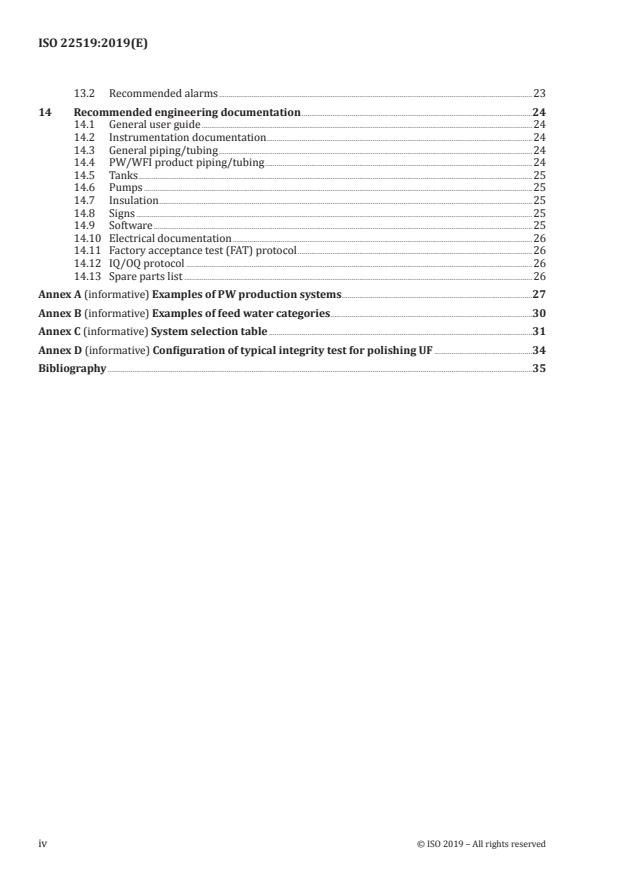
Contents Page
Foreword .v
Introduction .vi
1 Scope .1
2 Normative references .1
3 Terms, definitions and abbreviated terms .1
3.1 Terms and definitions . 1
3.2 Abbreviated terms . 3
4 Design and practices .6
4.1 Setting system boundaries. 6
4.2 General system requirements . 6
4.3 User Requirements Specifications (URS) scope . 7
4.4 Detailed system capacity calculation . 8
5 Selecting materials, methods and system components .8
5.1 Recommended system components/treatment stages . 8
5.2 Advantages and disadvantages of system components/treatment stages .10
5.3 Materials of construction — General .14
5.4 Stainless steel (SS) piping — General .15
5.5 Non-final product water piping/tubing in the PW/WFI pretreatment and production .15
5.6 Piping/tubing in contact with PW/WFI product .16
6 Sampling .16
6.1 Sampling principles .16
6.2 Minimum sampling point and locations .17
6.3 Sampling conductivity .17
7 Instruments .17
7.1 Minimum instrumentation for installation .17
7.2 Parameters for measuring, alarming, storing and graphing from online instruments .18
8 System design .19
8.1 Specification of feed water .19
8.2 System selection table based on feed water quality .19
9 Operation .19
9.1 Production .19
9.2 Recirculation when storage tank full .19
9.3 Sanitization .19
9.4 Chlorine and chlorination.20
10 Maintenance .20
10.1 Standard Operating Procedure (SOP´s) .20
10.2 Filter replacement .21
10.3 Chlorine instrumentation .21
10.4 Carbon dioxide .21
10.5 Membrane Integrity for polishing UF .21
11 Specific Good Manufacturing Practice (GMP) requirements .22
11.1 General .22
11.2 Safety considerations .22
11.3 Commissioning and qualification requirements .22
12 Control philosophy .23
12.1 Minimum control loops needed for installation.23
12.2 Automation .23
13 Alarms .23
13.1 Required alarms .23
13.2 Recommended alarms .23
14 Recommended engineering documentation .24
14.1 General user guide .24
14.2 Instrumentation documentation .24
14.3 General piping/tubing .24
14.4 PW/WFI product piping/tubing .24
14.5 Tanks .25
14.6 Pumps .25
14.7 Insulation .25
14.8 Signs .25
14.9 Software .25
14.10 Electrical documentation .26
14.11 Factory acceptance test (FAT) protocol .26
14.12 IQ/OQ protocol .26
14.13 Spare parts list .26
Annex A (informative) Examples of PW production systems .27
Annex B (informative) Examples of feed water categories .30
Annex C (informative) System selection table .31
Annex D (informative) Configuration of typical integrity test for polishing UF .34
Bibliography .35
iv © ISO 2019 – All rights reserved
Foreword
ISO (the International Organization for Standardization) is a worldwide federation of national standards
bodies (ISO member bodies). The work of preparing International Standards is normally carried out
through ISO technical committees. Each member body interested in a subject for which a technical
committee has been established has the right to be represented on that committee. International
organizations, governmental and non-governmental, in liaison with ISO, also take part in the work.
ISO collaborates closely with the International Electrotechnical Commission (IEC) on all matters of
electrotechnical standardization.
The procedures used to develop this document and those intended for its further maintenance are
described in the ISO/IEC Directives, Part 1. In particular, the different approval criteria needed for the
different types of ISO documents should be noted. This document was drafted in accordance with the
editorial rules of the ISO/IEC Directives, Part 2 (see www .iso .org/directives).
Attention is drawn to the possibility that some of the elements of this document may be the subject of
patent rights. ISO shall not be held responsible for identifying any or all such patent rights. Details of
any patent rights identified during the development of the document will be in the Introduction and/or
on the ISO list of patent declarations received (see www .iso .org/patents).
Any trade name used in this document is information given for the convenience of users and does not
constitute an endorsement.
For an explanation of the voluntary nature of standards, the meaning of ISO specific terms and
expressions related to conformity assessment, as well as information about ISO's adherence to the
World Trade Organization (WTO) principles in the Technical Barriers to Trade (TBT) see www .iso
.org/iso/foreword .html.
This document was prepared by Technical Committee ISO/TC 282, Water reuse.
Any feedback or questions on this document should be directed to the user’s national standards body. A
complete listing of these bodies can be found at www .iso .org/members .html.
Introduction
A large variety of water systems exists today in the Biopharma market; often these water systems
are of differing levels of efficiency and have different maintenance needs. Water quality for Purified
Water (PW) and Water for Injection (WFI) is specified in national and international standards, but a
standardized system for producing PW and WFI is not in place.
This document provides a standard benchmark that can be used by the industries that use PW and/or
WFI, national governments, state authorities and regulatory bodies to evaluate PW/WFI systems.
This document
— allows users to specify water systems that fit specific needs without being experts in the water
system field;
— allows users to decide whether the offered systems are safe, efficient and sustainable;
— enables national governments, state authorities and regulatory bodies to perform professional audits;
— provides auditors a standard check list to harmonize equipment and systems in the water industry;
— sets a high benchmark for suppliers of water systems all over the world, to be used as a point of
reference for their systems and;
— will improve reliability of the water generation process methods and water product while reducing
downtime needed for scheduled and non-scheduled maintenance.
This document also defines technical terms related to PW and WFI generation.
See Annex A, "examples of PW production systems".
See Annex B, "examples of feed water categories".
See Annex C, "system selection table".
See Annex D, "configuration of typical integrity test for polishing UF".
vi © ISO 2019 – All rights reserved
INTERNATIONAL STANDARD ISO 22519:2019(E)
Purified water and water for injection pretreatment and
production systems
1 Scope
This document specifies design, materials selection, construction and operation of Purified Water (PW)
and Water for Injection (WFI) pretreatment and membrane-based production systems.
As many different types of feed water are possible, different components and configurations are
presented. A decision matrix is provided to give guidance for the different types of feed water.
This document excludes
— selection of the appropriate compendial water definition per system: e.g. PW, WFI or other;
— thermal process for generation of PW/WFI;
— loops, storage and distribution;
— pure steam generation and distribution;
— laboratory water systems and
— validation.
2 Normative references
The following documents are referred to in the text in such a way that some or all of their content
constitutes requirements of this document. For dated references, only the edition cited applies. For
undated references, the latest edition of the referenced document (including any amendments) applies.
ISO 20670, Water reuse — Vocabulary
3 Terms, definitions and abbreviated terms
For the purposes of this document, the following terms and definitions given in ISO 20670 and the
following apply.
ISO and IEC maintain terminological databases for use in standardization at the following addresses:
— ISO Online browsing platform: available at https: //www .iso .org/obp
— IEC Electropedia: available at http: //www .electropedia .org/
3.1 Terms and definitions
3.1.1
pretreatment
equipment and process stages before (upstream) high pressure RO pump
3.1.2
production system
equipment and process stages after (downstream) high pressure RO pump
Note 1 to entry: If there is a tank, before the high pressure RO pump, then the tank can be included in the
production system.
3.1.3
pretreatment ultra filtration
pretreatment UF
membrane based process for removal of suspended solids, bacteria and TOC upstream of RO
Note 1 to entry: Usually operated with a reject stream and cleaned with a back wash.
3.1.4
MMF
multi media filter
layered filtration media in a pressurized container, used to reduce the level of suspended solids
(turbidity) in incoming feed water
Note 1 to entry: Media layers can consist of anthracite, sand and garnet.
3.1.5
flushed screen/disc filter
FS/DF
filter based on a static screen with a water flush of the cake that builds up on the screen
3.1.6
chlorination
dosage/generation of Hypochlorite/Chlorine to generate controlled free chlorine levels in the system
3.1.7
softener
pressurized container of softening resin for replacement of hardness ions, calcium, magnesium, barium
and strontium, with the sodium ion
3.1.8
antiscalant
AS
chemical scale inhibitor or sequestering agent that minimize the potential for scale precipitation on the
reject surface of a RO membrane
3.1.9
electric scale control
ESC
electrolytic scale inhibitor that minimizes the potential for scale precipitation on the reject surface of a
RO membrane
3.1.10
activated carbon filter
ACF
granular activated carbon (GAC) pressurized container of activated carbon media for removal of free
chlorine, chloramines and Total Organic Carbon (TOC)
3.1.11
degassing CO contact membrane
degasser
microporous hollow fiber membrane that brings into direct contact a liquid and strip gas and/or vacuum
Note 1 to entry: The dissolved gas in the liquid will pass though the membrane and into the strip gas and/or
vacuum on the other side of the membrane.
3.1.12
ultra violet (UV) lamp
irradiation of water with UV light in wavelengths ranging from 180 nm to 350 nm
2 © ISO 2019 – All rights reserved
3.1.13
microfiltration
MF
pressure driven separation process designed to remove particles and macromolecules. MF is usually
installed as part of the pre-treatment for other downstream process
Note 1 to entry: The nominal filtration sizes are 0,05 micron to 2 micron.
3.1.14
single pass reverse osmosis
SPRO
single pass membrane based process to separate dissolved ions and suspended solids
3.1.15
double pass reverse osmosis
DPRO
double pass membrane-based process to separate dissolved ions and suspended solids
3.1.16
continuous electro de-ionization
CDI/EDI/CEDI
process for ion removal from water utilizing: electricity, ion exchange membranes and resin
3.1.17
polishing ultra filtration
polishing UF
membrane based process using molecular weight cut off 6 000 or smaller for reduction of endotoxin,
TOC and bacteria post RO or post CDI/EDI/CEDI
3.1.18
anion and cation de-ionizers
separate pressurized containers of anion ion exchange resin and cation ion exchange resin, for removal
of both cations and anions
Note 1 to entry: Resins are regenerated on site or off site.
3.1.19
single use mixed bed polisher
pressurized containers of mixed anion and cation ion exchange resin for removal of both cations
and anions
Note 1 to entry: Resins are regenerated off site.
3.2 Abbreviated terms
ACF activated carbon filter
AS antiscalant
BW butt welding
CD chlorine dioxide
CFU colony forming units
CIP cleaning in place
CIT conductivity indicator and transmitter
CLIT chlorine indicator and transmitter
DPRO double pass RO
EP European Pharmacopeia
EPDM ethylene propylene diene monomer
ESC electric scale control
FAT factory acceptance test
FIT flow indicator and transmitter
FRP/PE fibre reinforced plastic (on) polyethylene
FS/DF filter screen/disk filter
GAC granular activated carbon
GMP good manufacturing practice
HOD hydro optical dechlorination
HP high pressure
HSDS Human Services Data Specification
HWS hot water sanitization
ID inside diameter
IQ Installation Qualification
ISPE International Society for Pharmaceutical Engineering
JP Japanese Pharmacopeia
L/D ratio between piping/tubing length/diameter
LT level transmitter
MF microfiltration
MMF multimedia filter
MP mechanical polish
NA non applicable
NaOH sodium hydroxide
NFPA National Fire Protection Association
NR not recommended
OSHA Occupational Safety and Health Administration
ORP oxidation reduction potential
OQ Operational Qualification
P possible
4 © ISO 2019 – All rights reserved
PEEK polyether ether ketone
PFA perfluoralkoxy alkanes
PI pressure indicator
PIT pressure indicator and transmitter
POU point of use
PPP PW/WFI pretreatment and production
PQ Performance Qualification
PS pure steam
PTFE polytetrafluoroethylene
PVC polyvinyl chloride
PW Purified Water
QIT quantity indicator and transmitter
R recommended
RO reverse osmosis
SBS sodium bi sulfite
S&D Storage and Distribution
SOP standard operating procedure
SPRO single pass reverse osmosis (RO)
SS stainless steel
TC Tri Clamp
TDS total dissolved solids
TIG/GTAW Tungsten Inert Gas/Gas Tungsten Arc Welding
TT temperature indicator
TOC total organic carbon
UF ultrafiltration
URS User Requirements Specifications
USP US Pharmacopeia
WFI Water for Injection
4 Design and practices
4.1 Setting system boundaries
4.1.1 A PW/WFI Pretreatment and Production system starts at the valve (inclusive) before the first
supplied water filter component/MMF.
4.1.2 A PW/WFI Pretreatment and Production system end boundary is at the inlet valve (inclusive) of
the PW/WFI storage tank or at the POU if a tank is not installed.
4.1.3 The PW/WFI storage tank should not be included in the PW/WFI Pretreatment and Production.
4.1.4 “Industrial” treatment systems upstream to the PW/WFI Pretreatment and Production, including
supply to other plant utilities e.g. steam boilers, potable water usage, feed to cooling towers etc. should
not be included in the PW/WFI Pretreatment and Production.
4.2 General system requirements
4.2.1 A “build clean” concept shall be employed during the installation of PW/WFI Pretreatment and
Production systems: supply of piping/tubing and equipment in clean condition and installation methods
that prevent ingress of contaminants.
4.2.2 Incoming feed water shall meet local standards or WHO standards for potable water. If this is not
the case, additional systems shall be installed to improve the water feed parameters before the PW/WFI
Pretreatment and Production.
4.2.3 The PW/WFI Pretreatment and Production water quality shall show improvement in all quality
parameters as the water advances through the system.
4.2.4 The following parameters shall be steadily reduced at each stage in the system:
— microbial total count;
— conductivity and;
— TOC.
4.2.5 PW/WFI quality shall be according to the last revision of the local/national/relevant
Pharmacopoeia. Table 1 provides recommended water quality.
Table 1 — Recommended water quality
# Parameter RO feed After RO PW WFI
1 Hardness (PPM CaCO ) ≤ feed water < 1 < 1 < 1
2 TOC (ppb) ≤ feed water < 500 < 500 (online) < 500 (online)
3 Endotoxin (EU/ml) NA NA NA < 0,25
4 Microbial total count (cfu/ml) < 500 < 200 < 100 < 10 cfu/100 ml
5 Free Chlorine (ppm) < 0,05 < 0,05 < 0,05 < 0,05
6 Pseudomonas (cfu/100 ml) < 1 < 1 < 1 < 1
Conductivity shall be measured uncompensated at 25 °C according to USP.
6 © ISO 2019 – All rights reserved
Table 1 (continued)
# Parameter RO feed After RO PW WFI
7 E. coli (cfu/100 ml) < 1 < 1 < 1 < 1
8 Total coliforms, Fungus, (cfu/100 ml) < 1 < 1 < 1 < 1
9 Conductivity (µS/cm) Like feed water < 10 < 1,3 (online) < 1,3 (online)
Conductivity shall be measured uncompensated at 25 °C according to USP.
4.2.6 A sampling programme with acceptance criteria shall be in place to gather, analyse and document
this water quality improvement.
4.2.7 During production, the PW/WFI Pretreatment and Production shall control the maximum water
temperature in the system. During production, the maximum temperature of the warmest point in the
system shall be no more than 25 °C (guidance value).
4.2.8 All parts of the PW/WFI Pretreatment and Production shall be hot water sanitized, from the feed
water inlet valve to the PW/WFI fill valve. During sanitization, the PW/WFI Pretreatment and Production
shall control the water temperature in the system. During sanitization, the all the points of the system
should be at a minimum of 80 °C (guidance value).
4.2.9 The PW/WFI Pretreatment and Production system shall be designed, controlled, regulated,
operated and maintained to ensure that the final water quality reliably meets final water quality
standard set in 4.2.5. This performance shall be stable under all conditions including common worst-
case scenarios, changing seasons or other fluctuating environmental conditions.
4.3 User Requirements Specifications (URS) scope
The scope of the User Requirements Specifications shall include the following;
— selection of water compendial standard based on products supplied;
— specification of the final water standard parameters;
— safety and Good Manufacturing Practice requirements for the system;
— list of main components;
— preliminary sizing of production flow rate;
— number of production units;
— functional requirements;
— materials of construction;
— equipment surface finish;
— biological control concept;
— high level control: interlocks, alarms and warnings;
— documentation required (see Clause 14);
— validation as required by respective authorities and;
— Performance Qualification (PQ) monitoring parameters.
The scope of the User Requirements Specifications shall include analysis of incoming water over all
yearly seasons, both chemical and microbiological.
4.4 Detailed system capacity calculation
4.4.1 Data and/or estimates of current and future PW/WFI use shall be used to size the flow rate of the
PW/WFI Pretreatment and Production System.
4.4.2 The flow rate shall be analysed in conjunction with the worst-case consumption scenario, taking
into account PW/WFI storage tank size.
4.4.3 A full tabulation of all users, present and future, shall be compiled, listing the quantity of PW/WFI
required, per day, per hour over a week period. The draw off flow shall be calculated, from the Storage
and Distribution (S&D), per hour of the day and plot the storage tank levels for a full week. In some cases
listing of required PW/WFI and take off flow calculations for a period that exceeds one week may be
necessary. In such cases the evaluation period shall be extended accordingly.
4.4.4 Once this information has been summarized, the sizing for the PW/WFI Pretreatment and
Production and PW/WFI storage tank may be determined.
5 Selecting materials, methods and system components
5.1 Recommended system components/treatment stages
5.1.1 Pretreatment, ultra filtration and microfiltration– membrane based process for removal of
suspended solids, bacteria and TOC upstream of RO.
NOTE Pretreatment UF is usually operated with a reject stream and cleaned with a back wash.
5.1.2 MMF – removal of coarse particulates pre RO in the range of 30 micron – 50 micron cleaned by
back flush of water to drain.
5.1.3 Flushed Screen/Disc Filters (FS/DF) – removal of coarse particulates upstream of RO in the range
of 30 micron – 50 micron.
5.1.4 Chlorination – dosage and/or generation of hypochlorite and/or chlorine to generate free
chlorine levels in system with a range of 0,2 ppm – 0,5 ppm (with suitable contact time) for control of
incoming and system bacteria levels.
5.1.5 Chlorine dioxide (CD) – generation and dosage of chlorine dioxide to a range of 0,1 ppm – 0,4 ppm
(with suitable contact time) for control of incoming and system bacteria levels.
5.1.6 Softeners – for replacement of magnesium-calcium, barium and strontium with sodium to reduce
scale precipitation on the RO membranes with a recommended downstream 10 micron – 20 micron
resin trap.
5.1.7 Antiscalant (AS) – addition of chemicals to RO feed water to defer hardness precipitation on the
RO membranes.
5.1.8 Electric scale control (ESC) – resin free electrolytic precipitation of scale to stop hardness
precipitation on the RO membranes. Also used for heavy metal oxidation and removal. Non sacrificial
anode and cathode.
5.1.9 Active carbon filter (ACF)/Granular Active Carbon (GAC) – removal of oxidizers, chlorine/
chloramine, TOC, upstream of RO membranes.
8 © ISO 2019 – All rights reserved
5.1.10 Sodium Bi Sulfite (SBS) – (or other sulfite based) chemical addition pre RO for reduction of
oxidizers, chlorine/chloramine.
5.1.11 Sodium Hydroxide (NaOH) - addition of chemical for pH control upstream of RO membranes to
control CO in RO permeate.
5.1.12 Degassing CO contact membrane (degasser) – water contact membrane for reduction of CO gas
2 2
in water upstream of RO and CDI/EDI/CEDI. Fabricate degasser housing from SS 316L and the membrane
will resist hot water sanitization so the degasser will be able to undergo hot water sanitization. Clean,
dry, oil free compressed air will sweep through a filter and into the membrane housing for CO removal.
Optionally if appropriate compressed air is not available, air can be drawn through the housing by a
vacuum pump. The outside air shall be filtered before being drawn through the housing.
5.1.13 Ultra Violet (UV) Lamp – irradiation of the water for dechlorination of chlorine/chloramine,
upstream of RO membranes. A UV lamp may also be used for microbial load reduction. The feed water
is de-chlorinated by exposure to ultraviolet irradiation by degrading the free chlorine into an Oxygen
molecule (O ) and a Chloride ion. The unit sizing should reduce a minimum of 0,5 ppm free chlorine to
safe levels of < 0,02 ppm. The unit can include a UV-MPL (medium pressure lamp) – with wide emission
spectrum. The unit housing may be fabricated from SS 316 and the internal parts from SS 316 or high-
grade Quartz.” Design the UV for hot water sanitization.
5.1.14 Single Pass Reverse Osmosis (SPRO) – membrane based process for reduction of: ions, TOC,
bacteria and endotoxin. Always operated with a reject stream.
5.1.15 Double Pass Reverse Osmosis (DPRO) – membrane based process for reduction of: ions, TOC,
bacteria and endotoxin. The first pass permeate is the feed to the second pass. Always operated with a
reject stream.
5.1.16 Continuous Electro De-Ionization (CDI/EDI/CEDI) – for reduction of water ion levels downstream
of RO using electrically regenerated resin.
5.1.17 Polishing Ultra filtration - Is a membrane based process using molecular weight cut off 6 000 or
smaller for reduction of endotoxin, TOC and bacteria or post CDI/EDI/CEDI.
5.2 Advantages and disadvantages of system components/treatment stages
System components/ Advantages Disadvantages
treatment stages
MMF — cost effective for a large range — filtration range limited to 10–50 micron
of flow rates; nominal;
— simple and reliable; — regular replacement of the media
needed and;
— operates with a wide range of
free chlorine levels and; — will always grow microbiological
contamination if feed is over the
— back washing enables self-
minimum temperature.
cleaning without replacement
of media.
Pretreatment ultra filtration — cost effective for a high flow — need to operate with a reject stream;
rates;
— regular back washing of membrane
— very effective removal of needed and;
organics, viruses, particulates;
— can have higher investment than MMF
— operates with a wide range of on lower flow rates.
free chlorine levels and;
— back washing enables self-
cleaning without replacement
of media.
Flushed Screen/Disc Filters — cost effective for a large range — is not always effective in high load feed
of flow rates; waters as filtration range limited to 30–
100 micron nominal.
— simple and reliable;
— no media to be replaced or to
get contaminated;
— operates with a wide range of
free chlorine levels and;
— back flushing enables self-
cleaning.
Chlorination: dosage/elec- — keeps pretreatment clear of — can be hard to control if side stream
tro-generation most bacteria; through chlorine analyser not stable and;
— maintains a residual — incomplete removal can damage RO
throughout the system and; membranes and CEDI.
— easy to control and easy to
test free chlorine levels.
Chlorine dioxide — very effective against biofilm; — hazardous to generate and handle;
— maintains a residual — short shelf life and;
throughout the system and;
— incomplete removal can damage RO
— easy to control and easy to membranes and CEDI.
test chlorine dioxide levels.
10 © ISO 2019 – All rights reserved
System components/ Advantages Disadvantages
treatment stages
Softeners — simplicity and; — salt handling and usage, need constant
makeup;
— low cost.
— waste of water for regenerations and
rinses;
— disposal of spent brine solution;
— sends high chloride effluent to drain;
— not environmentally friendly;
— in certain areas, brine discharge to sewer
systems may be restricted or banned;
— collects organic and inorganic particles
and contamination;
— will grow microbial colonies when the
feed water is above a certain minimum
temperature even if exposed to chlorine;
— multifunctional valve with low
reliability.
Anti scalant — low investment cost and; — antiscalant effectiveness fluctuates
widely as a function of incoming water
— low operational cost.
quality;
— RO permeate needs to be chemical free
and show full removal of antiscalant
chemicals;
— need for constant fresh antiscalant
makeup;
— antiscalant can be media growth
medium for bacteria and;
— high incidence of unplanned cleaning
due to scaling and fouling.
Electric scale control — media free operation without — investment costs can be more than
resins; softeners and anti scalant;
— chemical free operation; — need to circulate constantly and;
— generates free chlorine from — scale needs to be removed at regular
incoming feed water chlorides; intervals by manual or automatic means;
— actively reduces
m i c r o bi o lo g i c a l
contamination;
— stainless steel construction
allows full hot water
sanitization;
— low power usage
— no moving parts, simple
operation and;
— very low maintenance.
System components/ Advantages Disadvantages
treatment stages
Active carbon filter — effective for organics — rapid and unavoidable bacterial build up;
reduction and;
— regular sanitizations needed and;
— reliable removal of free
— shedding of carbon fines that foul
chlorine and chloramines;
downstream equipment and;
— medium to high capital cost for thermally
sanitized units and;
— water waste due to back flushing and
forward rinses.
Sodium meta bi sulfite — low cost; — low reliability, when the pump stops
then water production stops;
— unreliable Oxidation-Reduction
Potential (ORP) instrumentation for
system control;
— risk of catastrophic failure of RO
membranes and CDI/EDI/CEDI hydraulic
stack due to break though of free
chlorine or chloramines and;
— need for constant fresh solvent makeup
because of short shelf life.
Sodium Hydroxide dosage — low cost and; — hard to control accurately;
— effective for reducing large — pH instrumentation complicated and
levels of incoming CO ; high maintenance;
— needs regular makeup of solutions and;
— hazardous to handle.
Degassing CO contact — simple, no moving parts; — high investment costs;
membrane
— low maintenance and; — high operational costs (compressed
air) and;
— effective for reducing small
to medium levels of incoming — can be overwhelmed by high levels of
CO ; incoming CO .
2 2
Ultra Violet (UV) Lamp for — media free operation without — high investment costs and;
dechlorination resins;
— not highly effective in removal of
— chemical free operation; chloramine;
— removes free chlorine from
incoming feed water;
— actively reduces
m i c r o bi o lo g i c a l
contamination;
— allows full hot water
sanitization;
— no moving parts, simple
operation and;
— very low maintenance.
12 © ISO 2019 – All rights reserved
System components/ Advantages Disadvantages
treatment stages
Single Pass Reverse Osmosis — effectively removes most feed — sensitive to low levels of free chlorine;
water contamination;
— susceptible to fouling, biofilm growth
— allows full hot water and scaling;
sanitization;
— hot water sanitizable system are of
— well known and; medium to high investment and;
— relatively low maintenance. — always need a reject stream to drain.
Double Pass Reverse Osmo- — very effectively removes most — sensitive to low levels of free chlorine;
sis feed water contamination;
— susceptible to fouling, biofilm growth
— more reliable permeate and scaling;
conductivity than single pass
— are larger and more complicated than
reverse osmosis;
single pass RO;
— allows full hot water
— hot water sanitizable system need high
sanitization;
investment and;
— well known and;
— always need a reject stream to drain.
— relatively low maintenance.
Continuous Electro De-Ion- — very effectively reduces RO — very sensitive to low levels of free
ization permeate conductivity; chlorine even downstream to RO;
— allows full hot water — susceptible to fouling, biofilm and
sanitization; scaling and;
— no regeneration chemicals; — are expensive to replace;
— well known and;
— relatively low maintenance.
System components/ Advantages Disadvantages
treatment stages
Polishing Ultra filtration — very effectively reduces — medium capital cost and;
RO permeate bacteria and
— needs regular integrity testing.
endotoxin levels;
— allows full hot water
sanitization and;
— simple dead end operation
without reject stream.
Anion and Cation de-ionizers — low conductivity product. — high cost of operations on high Total
Dissolved Solid (TDS) feed water;
— regeneration on site uses large amounts
of: water, base and acid solutions;
— ion exchange resin can become the
source of organic contamination;
— changing product water quality, the
water after a regeneration will be
different than just before a regeneration;
— liable to produce high TOC product
water and;
— down time of system for regenerations.
Single use mixed bed polish- — low capital cost. — polisher replacement necessitates
er opening the piping system downstream
of RO and can introduce contaminants
into product water and;
— high operational costs.
5.3 Materials of construction — General
5.3.1 All components in the PW/WFI Pretreatment and Production system shall be manufactured
from Stainless Steel (SS) 316/316L. All PW/WFI contact parts to be fabricated from SS 316L, including:
piping/tubing, tanks, pumps, heat exchangers, valves, instruments and other accessories.
5.3.2 Additional materials that shall be used are as following:
— EPDM;
— PTFE-Polytetrafluoroethylene (PTFE);
— fluoroelastomers (FKM PEEK);
— PFA;
— high grade (low impurity) fused quartz and;
— other non-corroding, hot water sanitization (HWS) resistant, non-particle shedding and non-
leaching materials.
5.3.3 For materials of construction, exposure to hot water sanitization at 80 °C – 90 °C shall be taken
into account.
5.3.4 Elastomers and plastics shall be compatible with national regulations.
14 © ISO 2019 – All rights reserved
5.4 Stainless steel (SS) piping — General
5.4.1 SS piping/tubing in contact with free chlorine and/or low conductivity water shall be
SS 316/316L
5.4.2 SS tubing shall have dimensions as per national standards.
5.4.3 Tubing may be seamless or welded with seam.
5.4.4 Material used for piping and fittings shall meet the pressure requirements for the system and
specifically for the high pressure RO feed and concentrate.
5.4.5 Welding shall be performed with TIG/GTAW 99,97 % or better, argon shield gas shall be used.
5.4.6 The dimensions of the physical air bre
...
Questions, Comments and Discussion
Ask us and Technical Secretary will try to provide an answer. You can facilitate discussion about the standard in here.
Loading comments...