

ISO 7605:2025
(Main)Underwater acoustics — Measurement of underwater ambient sound
General Information
- Abstract
This document provides requirements and recommendations for measuring and reporting ambient sound in water, as characterized by sound pressure and selected quantities that can be derived from sound pressure. “Ambient sound” implies sound from any source except sources of self-noise. The scope includes equipment performance, calibration and deployment, digital data acquisition and data processing. Data processing is the process of converting raw data into a form and context necessary to be interpreted by people and computers. The scope includes data analysis and reporting of recordings of duration one day or longer. Five data processing stages are considered: raw digital acquisition data3), sound pressure time series, sound pressure level time series, sound pressure spectra and their statistics. The scope excludes measurement of particle motion. 3)The word data is generally used as a collective noun in this document; the plural form is reserved for cases where the constructive relationship to individual observations or measurements is to be emphasized.
- Status
- Published
- Publication Date
- 22-Jul-2025
- Technical Committee
- ISO/TC 43/SC 3 - Underwater acoustics
- Drafting Committee
- ISO/TC 43/SC 3 - Underwater acoustics
- Current Stage
- 6060 - International Standard published
- Start Date
- 23-Jul-2025
- Due Date
- 09-Apr-2025
- Completion Date
- 23-Jul-2025

Overview - ISO 7605:2025 (Underwater acoustics - Measurement of underwater ambient sound)
ISO 7605:2025 defines requirements and recommendations for measuring and reporting underwater ambient sound as characterized by sound pressure and derived quantities. The standard covers equipment performance, hydrophone calibration and deployment, digital data acquisition and data processing for recordings of duration one day or longer. It specifies five data-processing stages - raw digital acquisition data, sound pressure time series, sound pressure level time series, sound pressure spectra, and their statistics - and explicitly excludes measurement of particle motion.
Key topics and technical requirements
- Instrumentation and performance: Recommended minimum performance specifications and key characteristics for hydrophones, analogue acquisition, sampling systems and complete acquisition chains.
- Calibration: Calibration requirements, in‑situ checks and calibration regimens to ensure traceable sound pressure measurements.
- Deployment: Guidance on deployment options and mitigation of parasitic signals such as flow noise, cable strum, mechanical and electrical noise, and biofouling; includes bottom‑mounted and cabled systems and recovery considerations.
- Data acquisition & formats: Digital acquisition, file formats, scaling factors and assumptions for waveform data.
- Data processing stages: Clear workflow from raw data to derived descriptors - time series, sound pressure levels (SPL), power spectral density (PSD), decidecade/millidecade bands, narrowband spectra and statistical summaries.
- Advanced processing & statistics: Percentile levels, hybrid millidecade processing, uncertainty considerations and time‑bandwidth effects.
- Reporting & metadata: Mandatory metadata (equipment IDs, calibration, timestamps, geospatial coordinates, navigation track, meteorological/oceanographic context), averaging times, analysis windows, frequency bands and dataset stewardship.
Practical applications and who uses it
ISO 7605 is intended for professionals involved in underwater noise monitoring and acoustic environmental assessment, including:
- Marine acoustics researchers and laboratories
- Environmental consultants and regulators assessing compliance and baseline studies
- Offshore industry (oil & gas, wind farms) and shipping sectors for noise impact assessments
- Conservation organizations monitoring effects on marine mammals and fauna
- Ocean observatory and passive acoustic monitoring providers
Typical applications: long‑term ambient noise baselines, shipping noise studies, offshore construction monitoring, marine habitat assessments, and research into soundscape ecology.
Related standards
ISO 7605 complements other international standards and guidance on underwater acoustics, instrumentation calibration and environmental noise monitoring. Users should pair ISO 7605 with applicable ISO/IEC guidance for instrumentation, data formats and laboratory calibration to ensure comprehensive, traceable acoustic measurements.
Keywords: ISO 7605, underwater acoustics, ambient sound measurement, sound pressure level, hydrophone calibration, underwater noise monitoring, power spectral density, deployment guidance.
Get Certified
Connect with accredited certification bodies for this standard

BSMI (Bureau of Standards, Metrology and Inspection)
Taiwan's standards and inspection authority.
Sponsored listings
Frequently Asked Questions
ISO 7605:2025 is a standard published by the International Organization for Standardization (ISO). Its full title is "Underwater acoustics — Measurement of underwater ambient sound". This standard covers: This document provides requirements and recommendations for measuring and reporting ambient sound in water, as characterized by sound pressure and selected quantities that can be derived from sound pressure. “Ambient sound” implies sound from any source except sources of self-noise. The scope includes equipment performance, calibration and deployment, digital data acquisition and data processing. Data processing is the process of converting raw data into a form and context necessary to be interpreted by people and computers. The scope includes data analysis and reporting of recordings of duration one day or longer. Five data processing stages are considered: raw digital acquisition data3), sound pressure time series, sound pressure level time series, sound pressure spectra and their statistics. The scope excludes measurement of particle motion. 3)The word data is generally used as a collective noun in this document; the plural form is reserved for cases where the constructive relationship to individual observations or measurements is to be emphasized.
This document provides requirements and recommendations for measuring and reporting ambient sound in water, as characterized by sound pressure and selected quantities that can be derived from sound pressure. “Ambient sound” implies sound from any source except sources of self-noise. The scope includes equipment performance, calibration and deployment, digital data acquisition and data processing. Data processing is the process of converting raw data into a form and context necessary to be interpreted by people and computers. The scope includes data analysis and reporting of recordings of duration one day or longer. Five data processing stages are considered: raw digital acquisition data3), sound pressure time series, sound pressure level time series, sound pressure spectra and their statistics. The scope excludes measurement of particle motion. 3)The word data is generally used as a collective noun in this document; the plural form is reserved for cases where the constructive relationship to individual observations or measurements is to be emphasized.
ISO 7605:2025 is classified under the following ICS (International Classification for Standards) categories: 17.140.01 - Acoustic measurements and noise abatement in general. The ICS classification helps identify the subject area and facilitates finding related standards.
ISO 7605:2025 is available in PDF format for immediate download after purchase. The document can be added to your cart and obtained through the secure checkout process. Digital delivery ensures instant access to the complete standard document.
Standards Content (Sample)
International
Standard
ISO 7605
First edition
Underwater acoustics —
2025-07
Measurement of underwater
ambient sound
Acoustique sous-marine — Mesurage du son ambiant sous-marin
Reference number
© ISO 2025
All rights reserved. Unless otherwise specified, or required in the context of its implementation, no part of this publication may
be reproduced or utilized otherwise in any form or by any means, electronic or mechanical, including photocopying, or posting on
the internet or an intranet, without prior written permission. Permission can be requested from either ISO at the address below
or ISO’s member body in the country of the requester.
ISO copyright office
CP 401 • Ch. de Blandonnet 8
CH-1214 Vernier, Geneva
Phone: +41 22 749 01 11
Email: copyright@iso.org
Website: www.iso.org
Published in Switzerland
ii
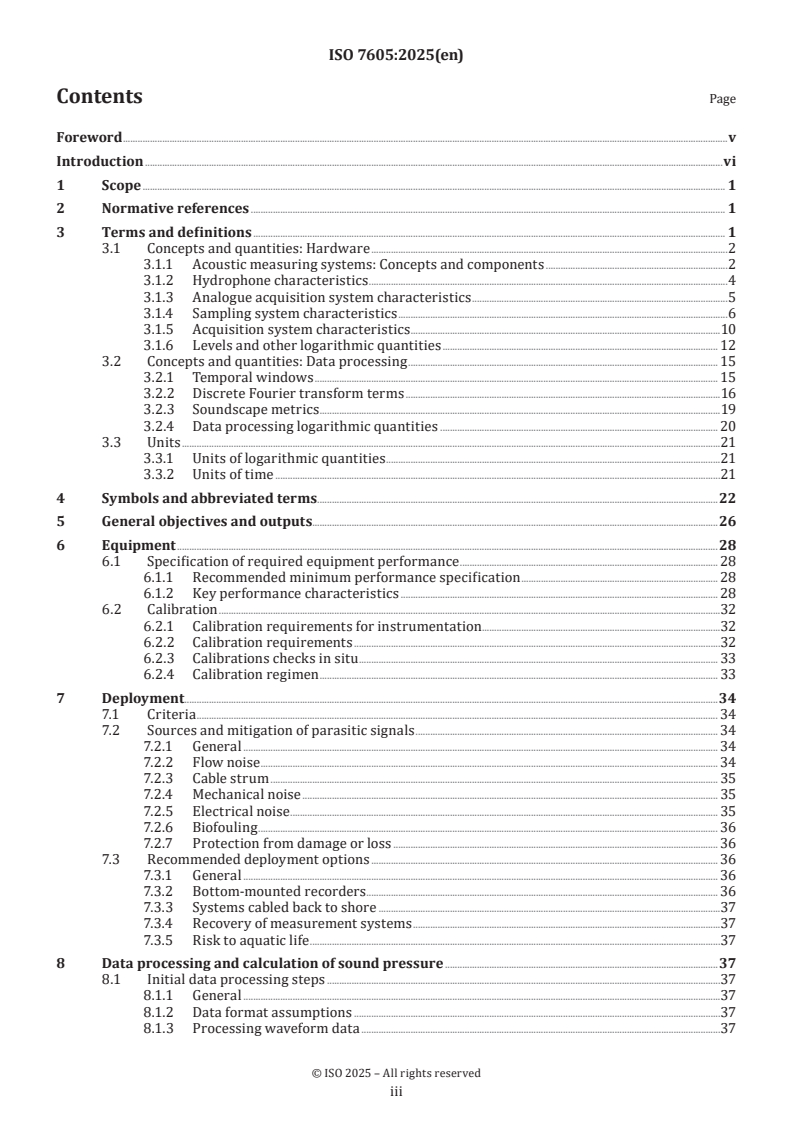
Contents Page
Foreword .v
Introduction .vi
1 Scope . 1
2 Normative references . 1
3 Terms and definitions . 1
3.1 Concepts and quantities: Hardware .2
3.1.1 Acoustic measuring systems: Concepts and components .2
3.1.2 Hydrophone characteristics .4
3.1.3 Analogue acquisition system characteristics .5
3.1.4 Sampling system characteristics .6
3.1.5 Acquisition system characteristics .10
3.1.6 Levels and other logarithmic quantities . 12
3.2 Concepts and quantities: Data processing . 15
3.2.1 Temporal windows . 15
3.2.2 Discrete Fourier transform terms .16
3.2.3 Soundscape metrics .19
3.2.4 Data processing logarithmic quantities . 20
3.3 Units .21
3.3.1 Units of logarithmic quantities .21
3.3.2 Units of time .21
4 Symbols and abbreviated terms.22
5 General objectives and outputs.26
6 Equipment .28
6.1 Specification of required equipment performance . 28
6.1.1 Recommended minimum performance specification . 28
6.1.2 Key performance characteristics . 28
6.2 Calibration .32
6.2.1 Calibration requirements for instrumentation .32
6.2.2 Calibration requirements .32
6.2.3 Calibrations checks in situ . 33
6.2.4 Calibration regimen . 33
7 Deployment . .34
7.1 Criteria . 34
7.2 Sources and mitigation of parasitic signals . 34
7.2.1 General . 34
7.2.2 Flow noise . 34
7.2.3 Cable strum . 35
7.2.4 Mechanical noise . 35
7.2.5 Electrical noise . . 35
7.2.6 Biofouling . 36
7.2.7 Protection from damage or loss . 36
7.3 Recommended deployment options . 36
7.3.1 General . 36
7.3.2 Bottom-mounted recorders . 36
7.3.3 Systems cabled back to shore .37
7.3.4 Recovery of measurement systems .37
7.3.5 Risk to aquatic life .37
8 Data processing and calculation of sound pressure .37
8.1 Initial data processing steps .37
8.1.1 General .37
8.1.2 Data format assumptions .37
8.1.3 Processing waveform data .37
iii
8.2 Calculation of sound pressure waveform . 38
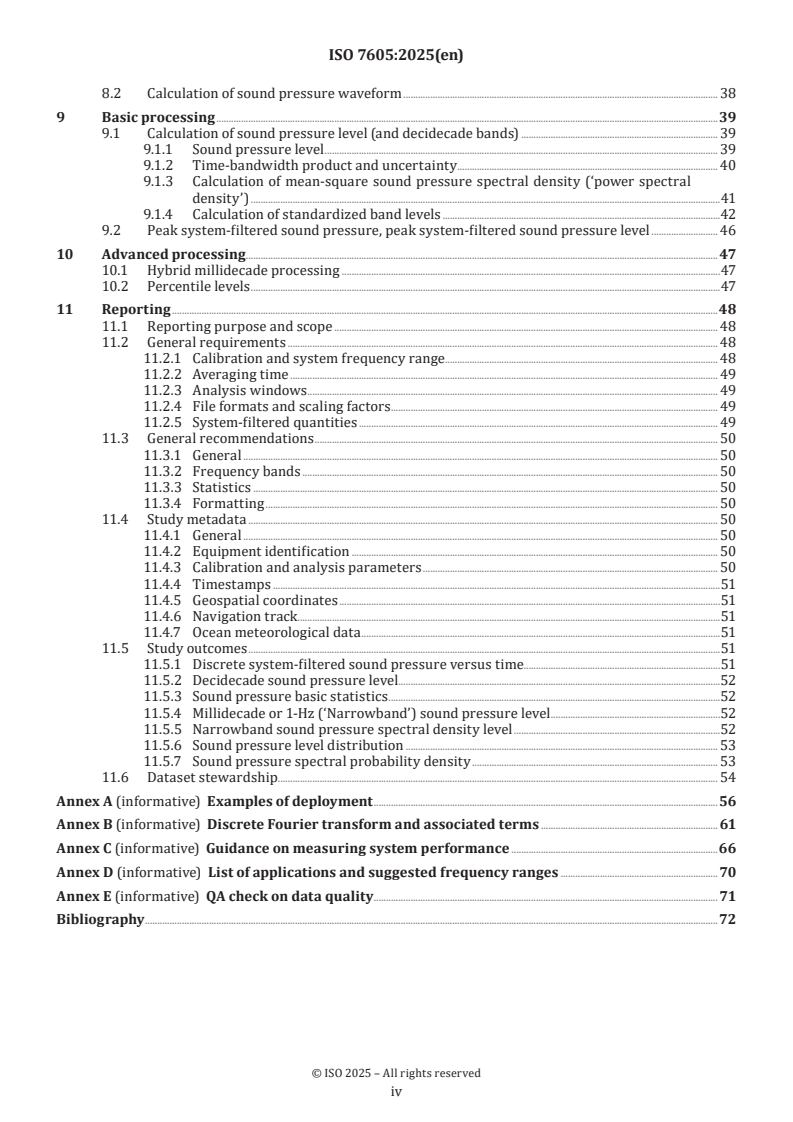
9 Basic processing .39
9.1 Calculation of sound pressure level (and decidecade bands) . 39
9.1.1 Sound pressure level . 39
9.1.2 Time-bandwidth product and uncertainty . 40
9.1.3 Calculation of mean-square sound pressure spectral density (‘power spectral
density’) .41
9.1.4 Calculation of standardized band levels .42
9.2 Peak system-filtered sound pressure, peak system-filtered sound pressure level . 46
10 Advanced processing . . 47
10.1 Hybrid millidecade processing .47
10.2 Percentile levels .47
11 Reporting .48
11.1 Reporting purpose and scope . 48
11.2 General requirements . 48
11.2.1 Calibration and system frequency range . . 48
11.2.2 Averaging time . 49
11.2.3 Analysis windows . 49
11.2.4 File formats and scaling factors . 49
11.2.5 System-filtered quantities . 49
11.3 General recommendations . 50
11.3.1 General . 50
11.3.2 Frequency bands . 50
11.3.3 Statistics . 50
11.3.4 Formatting . 50
11.4 Study metadata . 50
11.4.1 General . 50
11.4.2 Equipment identification . 50
11.4.3 Calibration and analysis parameters . 50
11.4.4 Timestamps .51
11.4.5 Geospatial coordinates .51
11.4.6 Navigation track.51
11.4.7 Ocean meteorological data .51
11.5 Study outcomes .51
11.5.1 Discrete system-filtered sound pressure versus time.51
11.5.2 Decidecade sound pressure level . .52
11.5.3 Sound pressure basic statistics .52
11.5.4 Millidecade or 1-Hz (‘Narrowband’) sound pressure level .52
11.5.5 Narrowband sound pressure spectral density level .52
11.5.6 Sound pressure level distribution . 53
11.5.7 Sound pressure spectral probability density . 53
11.6 Dataset stewardship . 54
Annex A (informative) Examples of deployment .56
Annex B (informative) Discrete Fourier transform and associated terms . 61
Annex C (informative) Guidance on measuring system performance .66
Annex D (informative) List of applications and suggested frequency ranges .70
Annex E (informative) QA check on data quality .71
Bibliography .72
iv
Foreword
ISO (the International Organization for Standardization) is a worldwide federation of national standards
bodies (ISO member bodies). The work of preparing International Standards is normally carried out through
ISO technical committees. Each member body interested in a subject for which a technical committee
has been established has the right to be represented on that committee. International organizations,
governmental and non-governmental, in liaison with ISO, also take part in the work. ISO collaborates closely
with the International Electrotechnical Commission (IEC) on all matters of electrotechnical standardization.
The procedures used to develop this document and those intended for its further maintenance are described
in the ISO/IEC Directives, Part 1. In particular, the different approval criteria needed for the different types
of ISO document should be noted. This document was drafted in accordance with the editorial rules of the
ISO/IEC Directives, Part 2 (see www.iso.org/directives).
ISO draws attention to the possibility that the implementation of this document may involve the use of (a)
patent(s). ISO takes no position concerning the evidence, validity or applicability of any claimed patent
rights in respect thereof. As of the date of publication of this document, ISO had not received notice of (a)
patent(s) which may be required to implement this document. However, implementers are cautioned that
this may not represent the latest information, which may be obtained from the patent database available at
www.iso.org/patents. ISO shall not be held responsible for identifying any or all such patent rights.
Any trade name used in this document is information given for the convenience of users and does not
constitute an endorsement.
For an explanation of the voluntary nature of standards, the meaning of ISO specific terms and expressions
related to conformity assessment, as well as information about ISO's adherence to the World Trade
Organization (WTO) principles in the Technical Barriers to Trade (TBT), see www.iso.org/iso/foreword.html.
This document was prepared by Technical Committee ISO/TC 43, Acoustics, Subcommittee SC 3, Underwater
acoustics.
Any feedback or questions on this document should be directed to the user’s national standards body. A
complete listing of these bodies can be found at www.iso.org/members.html.
v
Introduction
This document describes a procedure for the measurement and analysis of underwater ambient sound. The
development of this document made use of resources previously developed by the UK National Physical
[20] 1) 2)
Laboratory , the US-funded project ADEON and by the EU-funded Interreg programme JOMOPANS .
1) (University of New Hampshire online) Atlantic Deepwater Ecosystem Observatory Network (ADEON): An
Integrated System for Long-Term Monitoring of Ecological and Human Factors on the Outer Continental Shelf
(https://adeon.unh.edu/standards)
2) Joint Monitoring Programme for Ambient Noise North Sea (JOMOPANS) (https://northsearegion.eu/jomopans/)
vi
International Standard ISO 7605:2025(en)
Underwater acoustics — Measurement of underwater
ambient sound
1 Scope
This document provides requirements and recommendations for measuring and reporting ambient sound in
water, as characterized by sound pressure and selected quantities that can be derived from sound pressure.
“Ambient sound” implies sound from any source except sources of self-noise.
The scope includes equipment performance, calibration and deployment, digital data acquisition and data
processing. Data processing is the process of converting raw data into a form and context necessary to
be interpreted by people and computers. The scope includes data analysis and reporting of recordings of
duration one day or longer.
3)
Five data processing stages are considered: raw digital acquisition data , sound pressure time series, sound
pressure level time series, sound pressure spectra and their statistics.
The scope excludes measurement of particle motion.
2 Normative references
The following documents are referred to in the text in such a way that some or all of their content constitutes
requirements of this document. For dated references, only the edition cited applies. For undated references,
the latest edition of the referenced document (including any amendments) applies.
ISO 80000-1, Quantities and units — Part 1: General
ISO 80000-2, Quantities and units — Part 2: Mathematics
ISO 80000-3, Quantities and units — Part 3: Space and time
ISO 80000-8, Quantities and units — Part 8: Acoustics
IEC 80000-13, Quantities and units — Part 13: Information science and technology
ISO 18405, Underwater acoustics — Terminology
IEC 60565-1, Underwater acoustics — Hydrophones — Calibration of hydrophones — Part 1: Procedures for
free-field calibration of hydrophones
IEC 60565-2, Underwater acoustics — Hydrophones — Calibration of hydrophones — Part 2: Procedures for low
frequency pressure calibration
BIPM 2019, 9th (2019) edition
3 Terms and definitions
For the purposes of this document, the terms and definitions given in BIPM 2019, ISO 80000-1, ISO 80000-2,
ISO 80000-3, ISO 80000-8, IEC 80000-13, ISO 18405 and the following apply.
3) The word data is generally used as a collective noun in this document; the plural form is reserved for cases where the
constructive relationship to individual observations or measurements is to be emphasized.
ISO and IEC maintain terminology databases for use in standardization at the following addresses:
— ISO Online browsing platform: available at https:// www .iso .org/ obp
— IEC Electropedia: available at https:// www .electropedia .org/
3.1 Concepts and quantities: Hardware
3.1.1 Acoustic measuring systems: Concepts and components
3.1.1.1
hydrophone
electroacoustic transducer that produces electrical voltages in response to water borne pressure signals
Note 1 to entry: A hydrophone is designed to respond principally to underwater sound pressure.
Note 2 to entry: In general, a hydrophone can also produce a signal in response to non-acoustic pressure fluctuations
(e.g. those existing in a turbulent boundary layer during conditions of high water flow).
Note 3 to entry: Hydrophone types include reference hydrophones and measuring hydrophones. Measuring
hydrophones are used in general measurements of sound fields. Reference hydrophones are principally used for
calibration (3.1.1.11) purposes (e.g. in comparison calibrations with measuring hydrophones).
Note 4 to entry: Hydrophones are principally used as listening devices, but in reciprocity calibration, a hydrophone is
used as reciprocal transducer, not only acting as a hydrophone, but also as a projector (sound source [IEC 60565-1]).
Note 5 to entry: A compact, integrated underwater acoustic measuring system (3.1.1.6) is sometimes called a “digital
hydrophone” from its superficial resemblance to a standalone analogue hydrophone.
Note 6 to entry: If a hydrophone is connected to a charge amplifier, the sensitivity of the hydrophone is sometimes
described in terms of charge sensitivity, which is related to the voltage sensitivity of the hydrophone by its electrical
capacitance.
[SOURCE: IEC 60565-1:2020, 3.15, modified.]
3.1.1.2
pre-amplifier
amplifier located immediately after the sensing element to increase the amplitude of the voltage (or current)
Note 1 to entry: A preamplifier often takes the form of a low-noise amplifier located as near as possible to the sensing
element or another signal source. Other amplifiers can be placed later in the measurement chain.
Note 2 to entry: Adapted from IEC 60050-713, 10-45 and ISO 18406:2017.
[18]
[SOURCE: adapted from Robinson and Wang (2021), Table 9 ]
3.1.1.3
aliasing
false representation of a signal caused by mixing of spectral components above the Nyquist frequency
(3.1.4.2) with those spectral components below the Nyquist frequency
[SOURCE: ISO 18431-1:2005, 3.1]
3.1.1.4
anti-alias filter
AAF
low-pass filter designed to avoid aliasing (3.1.1.3)
Note 1 to entry: An anti-alias filter removes frequencies above the Nyquist frequency (3.1.4.2) of the digital acquisition
system (3.1.1.6).
[18]
[SOURCE: adapted from Robinson and Wang (2021), Table 9 ]
3.1.1.5
analogue-to-digital converter
ADC
electronic component that converts an analogue input signal to a digital output signal
Note 1 to entry: The input signal is typically an analogue electric voltage. The output is a digitized representation of
the input sampled at finite time intervals. Adapted from ISO 18406:2017 and IEC 60050-723, 10-04.
[18]
[SOURCE: based on Robinson and Wang (2021), Table 9 ]
3.1.1.6
digital acquisition system
measuring system
sequence of electronic components designed for data acquisition that may be considered together as whole,
with a single overall performance
Note 1 to entry: An underwater acoustic acquisition system typically comprises a hydrophone (3.1.1.1), a pre-amplifier
(3.1.1.2), an AAF (3.1.1.4), an ADC (3.1.1.5) and some form of digital interface.
[18]
[SOURCE: Robinson and Wang (2021), Table 9 ]
3.1.1.7
ADC input
analogue input signal to an ADC (3.1.1.5) such as electric voltage
[8]
Note 1 to entry: Adapted from Ainslie et al. (2020) .
[18]
[SOURCE: Robinson and Wang (2021), Table 9 ]
3.1.1.8
ADC output
digital representation of the ADC input (3.1.1.7) sampled at finite time intervals
Note 1 to entry: An ADC output is suitable for storage in a digital storage medium or processing on a digital computer.
[8]
Adapted from Ainslie et al. (2020) .
[18]
[SOURCE: Robinson and Wang (2021), Table 9 ]
3.1.1.9
full-scale signal
signal spanning the entire range of input values representable by an ADC (3.1.1.5), from minimum unsaturated
voltage (3.1.4.11) to maximum unsaturated voltage (3.1.4.10), without clipping
[4]
Note 1 to entry: Compare IEEE (STD-1241-2010) (p 13) : “A full-scale signal is one whose peak-to-peak amplitude
spans the entire range of input values recordable by the analogue-to-digital converter (3.1.1.5) under test.”
[8]
[SOURCE: Ainslie et al. (2020) ]
3.1.1.10
digital autonomous acoustic recorder
underwater acoustic measuring system (3.1.1.6) designed to operate without human intervention for
sustained periods, with storage to record acoustic signals in a digital format
Note 1 to entry: Typically, digital autonomous acoustic recorders can be programmed to operate autonomously and
sample over a range of duty cycles. Adapted from ISO 18406:2017.
[18]
[SOURCE: adapted from Robinson and Wang (2021), Table 9 ]
3.1.1.11
calibration
method of using known inputs, possibly using physical stimuli (such as a known, calibrated and traceable
acoustic source) or electrical input (charge or voltage signal injection) at the input (or other stage) of an
underwater acoustic measuring system (3.1.1.6)
[SOURCE: ISO 17208-1:2016, 3.1, modified — "field" was deleted from the term and the definition slightly
reworded.]
3.1.2 Hydrophone characteristics
3.1.2.1
free-field receive sensitivity
free-field voltage sensitivity
FFRS
FFVS
Mf()
f
quotient of the Fourier transform of the hydrophone open-circuit voltage signal and the
Fourier transform of the acoustic pressure signal, for specified frequency and specified direction of plane
wave sound incident on the position of the reference centre of the hydrophone (3.1.1.1) in the undisturbed
free-field if the hydrophone was removed
+∞
exp()−2πidft vt() t
∫
−∞
Note 1 to entry: In formula form, Mf = , where v(t) is the hydrophone open-circuit
()
f
+∞
exp()−2πidft pt() t
∫
−∞
voltage at time t and p(t) is the sound pressure of the plane wave at time t.
−1
Note 2 to entry: Free-field receive sensitivity is expressed in volt per pascal (V Pa ).
Note 3 to entry: The hydrophone free-field receive sensitivity is a complex-valued parameter. The modulus of the free-
−1
field receive sensitivity of a hydrophone (3.1.1.1) is expressed in units of volt per pascal, V·Pa . The phase angle is the
argument of the sensitivity and represents the phase difference between the hydrophone electrical voltage and the
sound pressure. The unit of phase angle is the radian.
Note 4 to entry: The term "response" is sometimes used instead of "sensitivity".
[SOURCE: IEC 60565-1:2020, 3.4]
3.1.2.2
equivalent bandwidth self-noise pressure
p
Ne, q
square root of the integral over a specified frequency range of the quotient of the noise voltage power
spectral density present at the electrical terminals of the hydrophone (3.1.1.1), in the absence of pressure
fluctuations at the hydrophone input, and the squared modulus of its free-field receive sensitivity (3.1.2.1)
V
f
2 N,f
Note 1 to entry: In formula form, p = df , where V is the noise voltage power spectral density
N,eq N,f
∫
f
Mf()
f
and Mf() is the free-field receive sensitivity (3.1.2.1) at frequency f. The frequency range is f to f .
f 1 2
Note 2 to entry: Equivalent bandwidth self-noise pressure is expressed in pascals (Pa).
Note 3 to entry: If the hydrophone (3.1.1.1) contains an integral preamplifier, the output terminals considered are
those at the output of the pre-amplifier (3.1.1.2) and the sensitivity in question includes the pre-amplifier gain.
3.1.2.3
self-noise voltage
RMS self-noise voltage
v
N,self
RMS voltage at a specified location in an acoustic receiver in the absence of sound pressure input at the
hydrophone (3.1.1.1), for a specified frequency range
Note 1 to entry: Self-noise voltage is expressed in volts (V).
[8]
[SOURCE: Ainslie et al. (2020) ]
3.1.3 Analogue acquisition system characteristics
3.1.3.1
noise current
current at a specified location in an acoustic receiver in the absence of an acoustic signal at the hydrophone
(3.1.1.1)
3.1.3.2
noise voltage
voltage at a specified location in an acoustic receiver in the absence of an acoustic signal at the hydrophone
(3.1.1.1)
3.1.3.3
signal current
current that would exist at a specified location in an acoustic receiver in the absence of noise
3.1.3.4
signal voltage
voltage that would exist at a specified location in an acoustic receiver in the absence of noise
3.1.3.5
signal-plus-noise current
current at a specified location in an acoustic receiver
3.1.3.6
signal-plus-noise voltage
voltage at a specified location in an acoustic receiver
3.1.3.7
electrical noise power
time-averaged product of noise current (3.1.3.1) and noise voltage (3.1.3.2), for a specified position in the
processing chain and a specified averaging time
Note 1 to entry: Electrical noise power is expressed in watts (W).
Note 2 to entry: In an electrical circuit of resistance, R, electrical noise power is given by mean-square noise voltage
divided by R or mean-square noise current multiplied by R.
Note 3 to entry: The electrical noise power depends on the position in the processing chain at which it is determined.
[4]
Note 4 to entry: Compare IEEE (STD-1241-2010) ('noise (total)', p15) : “Any deviation between the output signal
(converted to input units) and the input signal except deviations caused by linear time-invariant system response
(gain and phase shift), or a DC level shift. For example, noise includes the effects of random errors (random noise),
fixed pattern errors, nonlinearities (e.g. harmonic or intermodulation distortion), and aperture uncertainty. See also:
random noise.”
[8]
[SOURCE: adapted from Ainslie et al. (2020) ]
3.1.3.8
electrical signal power
W
S
time-averaged product of signal current (3.1.3.3) and signal voltage (3.1.3.4), for a specified position in the
processing chain and a specified averaging time
Note 1 to entry: Electrical signal power is expressed in watts (W).
Note 2 to entry: In an electrical circuit of resistance, R, electrical signal power is given by mean-square signal voltage
divided by R or mean-square signal current multiplied by R.
Note 3 to entry: The electrical signal power depends on the position in the processing chain at which it is determined.
[8]
[SOURCE: Ainslie et al. (2020) ]
3.1.3.9
electrical signal-plus-noise power
time-averaged product of signal-plus-noise current (3.1.3.5) and signal-plus-noise voltage (3.1.3.6), for a
specified position in the processing chain and a specified averaging time
Note 1 to entry: Electrical signal-plus-noise power is expressed in watts (W).
Note 2 to entry: In an electrical circuit of resistance, R, signal-plus-noise power is given by mean-square signal-plus-
noise voltage divided by R or mean-square signal-plus-noise current multiplied by R.
Note 3 to entry: The electrical signal-plus-noise power depends on the position in the processing chain at which it is
determined.
3.1.3.10
signal-to-noise power ratio
signal-to-noise ratio
R
SN
ratio of electrical signal power (3.1.3.8) to electrical noise power (3.1.3.7), for a specified position in the
processing chain
Note 1 to entry: The signal-to-noise power ratio depends on the position in the processing chain at which it is
determined.
[8]
[SOURCE: Ainslie et al. (2020) ]
3.1.3.11
signal-plus-noise-to-noise power ratio
signal-plus-noise-to-noise ratio
R
S+NN
ratio of electrical signal-plus-noise power (3.1.3.9) to electrical noise power (3.1.3.7), for a specified position in
the processing chain
Note 1 to entry: The signal-plus-noise-to-noise power ratio depends on the position in the processing chain at which it
is determined.
3.1.4 Sampling system characteristics
3.1.4.1
sampling rate
sampling frequency
f
s
number of samples of a signal taken per unit time
Note 1 to entry: Sampling frequency is expressed in hertz (Hz).
[SOURCE: IEC 60050-704:1993, 23-03]
3.1.4.2
Nyquist frequency
f
Nyq
maximum usable frequency available in data taken at a given sampling rate (3.1.4.1)
Note 1 to entry: In formula form, f = f / 2, where f is the sampling rate.
Nyq s s
Note 2 to entry: Nyquist frequency is expressed in hertz (Hz).
Note 3 to entry: Except for the in-phase component of continuous signals, frequencies for analysis are lower than the
Nyquist frequency.
Note 4 to entry: This document imposes additional restrictions on the maximum useful frequency due to practical
limitations in the realization of anti-aliasing filters.
Note 5 to entry: An alternative definition of Nyquist frequency is ‘1/2 times the inverse of the sampling period’ (see
ISO 19262:2015, 3.173).
[SOURCE: ISO 18431-1: 2005, 3.7, modified — Notes to entry added.]
3.1.4.3
ADC input voltage
v
ADC
voltage at input to ADC (3.1.1.5)
[8]
[SOURCE: Ainslie et al. (2020) ]
3.1.4.4
integer ADC output
N
ADC
integer representation of ADC output (3.1.1.8), defined such that a unit change in integer ADC output
corresponds to a change in the least significant bit from 0 to 1 or from 1 to 0
Note 1 to entry: The integer ADC output is equal to the product of ADC input (3.1.1.7) voltage and ADC sensitivity to
voltage (3.1.4.9).
N
bit
Note 2 to entry: The integer ADC output is one of 2 consecutive integers, where N is the bit depth (3.1.4.5).
bit
Note 3 to entry: The integer ADC output is the ADC output (3.1.1.8) when the ideal code bin width (3.1.4.13) is equal to 1.
[8]
[SOURCE: Ainslie et al. (2020) ]
3.1.4.5
bit depth
N
bit
number of bits at ADC output (3.1.1.8) used to represent one value of ADC input (3.1.1.7)
[8]
[SOURCE: Ainslie et al. (2020) ]
3.1.4.6
maximum integer ADC output
N
ADC,max
maximum possible value of the integer ADC output (3.1.4.4)
[8]
[SOURCE: Ainslie et al. (2020) ]
3.1.4.7
minimum integer ADC output
N
ADC,min
minimum possible value of the integer ADC output (3.1.4.4)
Note 1 to entry: The integer ADC output (3.1.4.4) can be positive or negative. If at least one value of the integer ADC
output (3.1.4.4) is negative, the minimum integer ADC output (3.1.4.7) is also negative.
N
bit
Note 2 to entry: The integer ADC output (3.1.4.4) is one of 2 consecutive integers, where N is the bit depth
bit
(3.1.4.5).
[8]
[SOURCE: Ainslie et al. (2020) ]
3.1.4.8
full-scale ADC output
N
ADC, FS
one more than the difference between the maximum integer ADC output (3.1.4.6) and the minimum integer
ADC output (3.1.4.7)
Note 1 to entry: The integer ADC output (3.1.4.4) can be positive or negative. If the maximum integer ADC output
(3.1.4.6) is positive and the minimum integer ADC output (3.1.4.7) is negative, then the full-scale ADC output (3.1.4.8) is
the sum of the maximum integer ADC output (3.1.4.6) and the magnitude of the minimum integer ADC output (3.1.4.7).
[8]
[SOURCE: adapted from Ainslie et al. (2020) ]
3.1.4.9
ADC sensitivity to voltage
M
ADC,v
quotient of root-mean-square integer ADC output (3.1.4.4) ( N ) and root-mean-square ADC input
ADCr, ms
voltage (3.1.4.3) ( v )
ADCr, ms
N
ADCr, ms
N
Note 1 to entry: In formula form, M = . The ADC sensitivity to voltage is equal to 2 bit divided by the
ADC,v
v
ADCr, ms
full-scale signal (3.1.1.9) peak to peak voltage.
−1
Note 2 to entry: ADC sensitivity to voltage is expressed in reciprocal volt (V ).
[8]
[SOURCE: Ainslie et al. (2020) ]
3.1.4.10
maximum unsaturated voltage
v
max
maximum ADC input voltage (3.1.4.3) for which the ADC sensitivity to voltage (3.1.4.9) is independent of ADC
input (3.1.1.7)
Note 1 to entry: Maximum unsaturated voltage is expressed in volts (V).
Note 2 to entry: The maximum unsaturated voltage is the maximum ADC input voltage (3.1.4.3) for which the ADC
sensitivity to voltage (3.1.4.9) is linear with input voltage.
[8]
[SOURCE: Ainslie et al. (2020) ]
3.1.4.11
minimum unsaturated voltage
v
min
minimum ADC input voltage (3.1.4.3) for which the ADC sensitivity to voltage (3.1.4.9) is independent of ADC
input (3.1.1.7)
Note 1 to entry: Minimum unsaturated voltage is expressed in volts (V).
Note 2 to entry: The ADC input voltage (3.1.4.3) can be positive or negative. If at least one value of the integer ADC input
voltage is negative, the minimum unsaturated voltage is also negative.
[8]
[SOURCE: Ainslie et al. (2020) ]
3.1.4.12
full-scale input range
full-scale range
full-scale voltage
FSR
difference between maximum unsaturated voltage (3.1.4.10) and minimum unsaturated voltage (3.1.4.11)
Note 1 to entry: Full-scale input range is expressed in volts (V).
Note 2 to entry: The ADC input voltage (3.1.4.3) can be positive or negative. If the maximum unsaturated voltage
(3.1.4.10) is positive and the minimum unsaturated voltage (3.1.4.11) is negative, then the full-scale input range is the
sum of the maximum unsaturated voltage and the magnitude of the minimum unsaturated voltage.
[4]
Note 3 to entry: Compare IEEE (STD-1241-2010) ('full scale range', p13) : “The difference between the most positive
N
and most negative analog inputs of a converter’s operating range. For an N-bit converter, FSR is given by: FSR = (2 )
x(ideal code width) in analog input units.”
[8]
[SOURCE: Ainslie et al. (2020) ]
3.1.4.13
ideal code bin width
ideal code width
ADC output step size
Q
full-scale input range (3.1.4.12) divided by N , where N is the full-scale ADC output (3.1.4.8)
ADCF, S ADCF, S
Note 1 to entry: The full-scale ADC output (3.1.4.8) is equal to the total number of code bins plus one.
Note 2 to entry: Compare IEEE (STD-1241-2010) (‘ideal code bin width’, p14): “The ideal full-scale input range divided
by the total number of code bins.”
[4]
Note 3 to entry: Compare IEEE (STD-1241-2010) (‘least significant bit’, p14) : “With reference to analog-to-digital
converter input signal amplitude, an LSB [least significant bit] is synonymous with one ideal code bin width.”
[8]
[SOURCE: adapted from Ainslie et al. (2020) ]
3.1.4.14
pre-amplifier voltage gain
G
PA ,V
ratio of root-mean-square pre-amplifier output voltage to root-mean-square pre-amplifier input voltage
Note 1 to entry: The pre-amplifier voltage gain can vary with frequency.
Note 2 to entry: For a tonal signal, the pre-amplifier voltag
...