


ISO/FDIS 14720-2
(Main)Testing of ceramic materials — Determination of sulfur in non-oxidic ceramic raw materials and ceramic materials — Part 2: Inductively coupled plasma optical emission spectrometry (ICP-OES) or ion chromatography (IC) after burning in the oxygen flow
Testing of ceramic materials — Determination of sulfur in non-oxidic ceramic raw materials and ceramic materials — Part 2: Inductively coupled plasma optical emission spectrometry (ICP-OES) or ion chromatography (IC) after burning in the oxygen flow
This part of ISO 14720 defines a method for the determination of sulfur in powdered and granular non-oxidic ceramic raw materials and materials, which are completely oxidized at a higher temperature in an oxygen atmosphere, e.g. carbon and graphite materials. For materials which are not completely oxidizable under these conditions, it is possible to determine sulfur that can be released under these conditions, e.g. the adherent sulfur. This part of ISO 14720 is applicable for materials with mass fractions of sulfur ≤ 10 % and mass fractions of ash For the lower detection limit of this method, a mass fraction of sulfur of 0,5 mg/kg in the case of inductively coupled plasma optical emission spectrometry (ICP/OES) and 5 mg/kg in the case of ion chromatography (IC) has to be considered as a recommended value.
Analyse des matériaux céramiques — Dosage du soufre dans les produits et les matières premières céramiques non oxydes — Partie 2: Spectrométrie d'émission optique par plasma à couplage inductif (ICP-OES) ou chromatographie ionique (IC) après combustion dans le courant d'oxygène
General Information
- Status
- Not Published
- Technical Committee
- ISO/TC 33 - Refractories
- Drafting Committee
- ISO/TC 33/WG 17 - Chemical analysis
- Current Stage
- 5020 - FDIS ballot initiated: 2 months. Proof sent to secretariat
- Start Date
- 02-Dec-2025
- Completion Date
- 02-Dec-2025
Relations
- Effective Date
- 27-Apr-2024
- Effective Date
- 13-Apr-2024
Overview
ISO/FDIS 14720-2:2025 specifies a laboratory method for the determination of sulfur in non‑oxidic ceramic raw materials and ceramic materials using inductively coupled plasma optical emission spectrometry (ICP‑OES) or ion chromatography (IC) after combustion in an oxygen flow. The method is intended for powdered and granular materials (including carbon and graphite) that are completely oxidized at elevated temperature, or for the fraction of sulfur releasable under these conditions (e.g., adherent sulfur). Typical working limits are sulfur mass fractions ≤ 10 % and ash < 20 %. Practical lower detection limits are approximately 0.5 mg/kg for ICP‑OES and 5 mg/kg for IC.
Key topics and technical requirements
- Principle: Dry sample combusted in oxygen (porcelain crucible, ≈ 1 100 °C); sulfur oxides absorbed in NaOH/H2O2 solution; residue treated and combined where necessary; sulfur determined as sulfate by ICP‑OES (ISO 11885) or IC (ISO 10304‑1).
- Applicability limits: Not suitable for samples with high barium (sulfur in BaSO4 is not detectable by this method) - the document limits barium to < 10 mg/kg.
- Detection limits: Recommended values - 0.5 mg/kg (ICP‑OES), 5 mg/kg (IC).
- Sampling and sample preparation: Procedures for representative sampling, drying and preparation prior to combustion.
- Apparatus and reagents: Combustion device, oxygen supply, ICP‑OES or ion chromatograph, absorption reagents (NaOH, H2O2) and dissolution reagents for ash.
- Interferences and compensation:
- ICP‑OES: spectral interferences (overlapping lines, molecular bands, background) and physical interferences; correction strategies and manufacturer guidance.
- IC: operating parameters and separation considerations.
- Calibration, blank determination and performance: Calibration procedures, blank measurement, precision (repeatability and reproducibility) and calculation/reporting of results.
- Annexes: Examples of combustion devices, operating parameters for IC and ICP‑OES, round‑robin results, uncertainty validation and CRM information.
Applications and users
- Quality control and acceptance testing of refractory and non‑oxidic ceramic materials, including carbon and graphite feedstocks.
- Process control for ceramic manufacturers and raw‑material suppliers to monitor sulfur content and contamination.
- Materials testing and certification laboratories performing compliance testing, R&D teams assessing formulation effects of sulfur, and environmental monitoring where sulfur in ceramic products is relevant.
Related standards
- ISO 11885 - Water quality: ICP‑OES determination of selected elements (applied here for sulfur by ICP‑OES).
- ISO 10304‑1 - Water quality: determination of dissolved anions by ion chromatography (applied here for sulfate by IC).
- Other parts of the ISO 14720 series covering related test methods for ceramic materials.
Keywords: ISO 14720-2, sulfur determination, ceramics, non‑oxidic ceramic raw materials, ICP‑OES, ion chromatography, oxygen flow combustion, sulfur content, detection limit.
ISO/FDIS 14720-2 - Testing of ceramic materials — Determination of sulfur in non-oxidic ceramic raw materials and ceramic materials — Part 2: Inductively coupled plasma optical emission spectrometry (ICP-OES) or ion chromatography (IC) after burning in the oxygen flow Released:18. 11. 2025


REDLINE ISO/FDIS 14720-2 - Testing of ceramic materials — Determination of sulfur in non-oxidic ceramic raw materials and ceramic materials — Part 2: Inductively coupled plasma optical emission spectrometry (ICP-OES) or ion chromatography (IC) after burning in the oxygen flow Released:18. 11. 2025
ISO/FDIS 14720-2 - Analyse des matériaux céramiques — Dosage du soufre dans les produits et les matières premières céramiques non oxydes — Partie 2: Spectrométrie d'émission optique par plasma à couplage inductif (ICP-OES) ou chromatographie ionique (IC) après combustion dans le courant d'oxygène Released:3. 01. 2026
Frequently Asked Questions
ISO/FDIS 14720-2 is a draft published by the International Organization for Standardization (ISO). Its full title is "Testing of ceramic materials — Determination of sulfur in non-oxidic ceramic raw materials and ceramic materials — Part 2: Inductively coupled plasma optical emission spectrometry (ICP-OES) or ion chromatography (IC) after burning in the oxygen flow". This standard covers: This part of ISO 14720 defines a method for the determination of sulfur in powdered and granular non-oxidic ceramic raw materials and materials, which are completely oxidized at a higher temperature in an oxygen atmosphere, e.g. carbon and graphite materials. For materials which are not completely oxidizable under these conditions, it is possible to determine sulfur that can be released under these conditions, e.g. the adherent sulfur. This part of ISO 14720 is applicable for materials with mass fractions of sulfur ≤ 10 % and mass fractions of ash For the lower detection limit of this method, a mass fraction of sulfur of 0,5 mg/kg in the case of inductively coupled plasma optical emission spectrometry (ICP/OES) and 5 mg/kg in the case of ion chromatography (IC) has to be considered as a recommended value.
This part of ISO 14720 defines a method for the determination of sulfur in powdered and granular non-oxidic ceramic raw materials and materials, which are completely oxidized at a higher temperature in an oxygen atmosphere, e.g. carbon and graphite materials. For materials which are not completely oxidizable under these conditions, it is possible to determine sulfur that can be released under these conditions, e.g. the adherent sulfur. This part of ISO 14720 is applicable for materials with mass fractions of sulfur ≤ 10 % and mass fractions of ash For the lower detection limit of this method, a mass fraction of sulfur of 0,5 mg/kg in the case of inductively coupled plasma optical emission spectrometry (ICP/OES) and 5 mg/kg in the case of ion chromatography (IC) has to be considered as a recommended value.
ISO/FDIS 14720-2 is classified under the following ICS (International Classification for Standards) categories: 81.060.10 - Raw materials. The ICS classification helps identify the subject area and facilitates finding related standards.
ISO/FDIS 14720-2 has the following relationships with other standards: It is inter standard links to ISO 18113-1:2022, ISO 14720-2:2013. Understanding these relationships helps ensure you are using the most current and applicable version of the standard.
ISO/FDIS 14720-2 is available in PDF format for immediate download after purchase. The document can be added to your cart and obtained through the secure checkout process. Digital delivery ensures instant access to the complete standard document.
Standards Content (Sample)
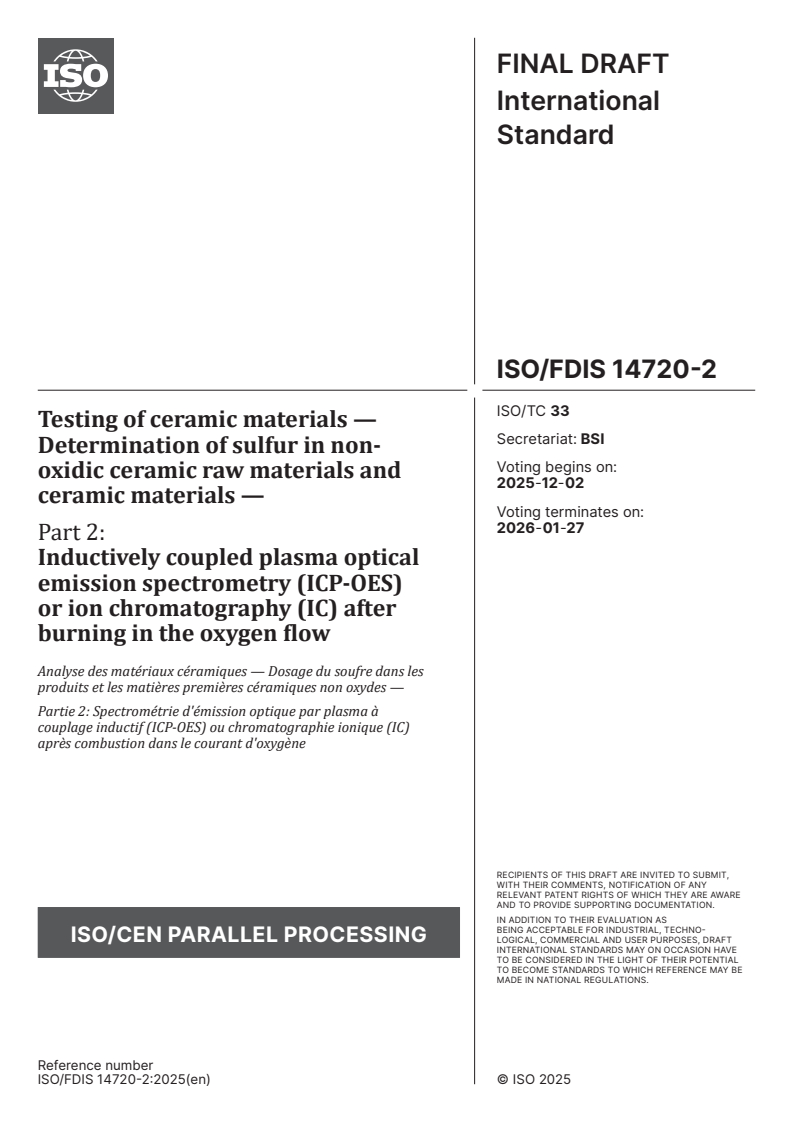
FINAL DRAFT
International
Standard
ISO/TC 33
Testing of ceramic materials —
Secretariat: BSI
Determination of sulfur in non-
Voting begins on:
oxidic ceramic raw materials and
2025-12-02
ceramic materials —
Voting terminates on:
2026-01-27
Part 2:
Inductively coupled plasma optical
emission spectrometry (ICP-OES)
or ion chromatography (IC) after
burning in the oxygen flow
Analyse des matériaux céramiques — Dosage du soufre dans les
produits et les matières premières céramiques non oxydes —
Partie 2: Spectrométrie d'émission optique par plasma à
couplage inductif (ICP-OES) ou chromatographie ionique (IC)
après combustion dans le courant d'oxygène
RECIPIENTS OF THIS DRAFT ARE INVITED TO SUBMIT,
WITH THEIR COMMENTS, NOTIFICATION OF ANY
RELEVANT PATENT RIGHTS OF WHICH THEY ARE AWARE
AND TO PROVIDE SUPPOR TING DOCUMENTATION.
IN ADDITION TO THEIR EVALUATION AS
BEING ACCEPTABLE FOR INDUSTRIAL, TECHNO-
ISO/CEN PARALLEL PROCESSING LOGICAL, COMMERCIAL AND USER PURPOSES, DRAFT
INTERNATIONAL STANDARDS MAY ON OCCASION HAVE
TO BE CONSIDERED IN THE LIGHT OF THEIR POTENTIAL
TO BECOME STAN DARDS TO WHICH REFERENCE MAY BE
MADE IN NATIONAL REGULATIONS.
Reference number
FINAL DRAFT
International
Standard
ISO/TC 33
Testing of ceramic materials —
Secretariat: BSI
Determination of sulfur in non-
Voting begins on:
oxidic ceramic raw materials and
ceramic materials —
Voting terminates on:
Part 2:
Inductively coupled plasma optical
emission spectrometry (ICP-OES)
or ion chromatography (IC) after
burning in the oxygen flow
Analyse des matériaux céramiques — Dosage du soufre dans les
produits et les matières premières céramiques non oxydes —
Partie 2: Spectrométrie d'émission optique par plasma à
couplage inductif (ICP-OES) ou chromatographie ionique (IC)
après combustion dans le courant d'oxygène
RECIPIENTS OF THIS DRAFT ARE INVITED TO SUBMIT,
WITH THEIR COMMENTS, NOTIFICATION OF ANY
RELEVANT PATENT RIGHTS OF WHICH THEY ARE AWARE
AND TO PROVIDE SUPPOR TING DOCUMENTATION.
© ISO 2025
IN ADDITION TO THEIR EVALUATION AS
All rights reserved. Unless otherwise specified, or required in the context of its implementation, no part of this publication may
BEING ACCEPTABLE FOR INDUSTRIAL, TECHNO-
ISO/CEN PARALLEL PROCESSING
LOGICAL, COMMERCIAL AND USER PURPOSES, DRAFT
be reproduced or utilized otherwise in any form or by any means, electronic or mechanical, including photocopying, or posting on
INTERNATIONAL STANDARDS MAY ON OCCASION HAVE
the internet or an intranet, without prior written permission. Permission can be requested from either ISO at the address below
TO BE CONSIDERED IN THE LIGHT OF THEIR POTENTIAL
or ISO’s member body in the country of the requester.
TO BECOME STAN DARDS TO WHICH REFERENCE MAY BE
MADE IN NATIONAL REGULATIONS.
ISO copyright office
CP 401 • Ch. de Blandonnet 8
CH-1214 Vernier, Geneva
Phone: +41 22 749 01 11
Email: copyright@iso.org
Website: www.iso.org
Published in Switzerland Reference number
ii
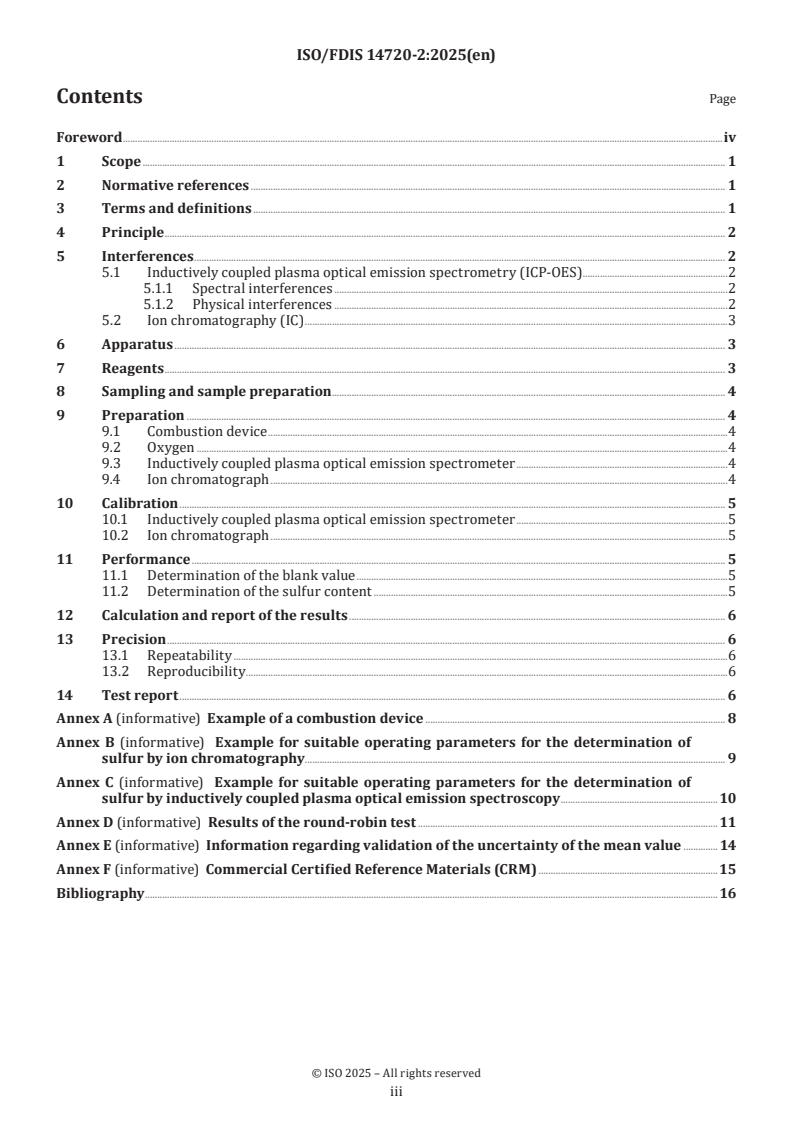
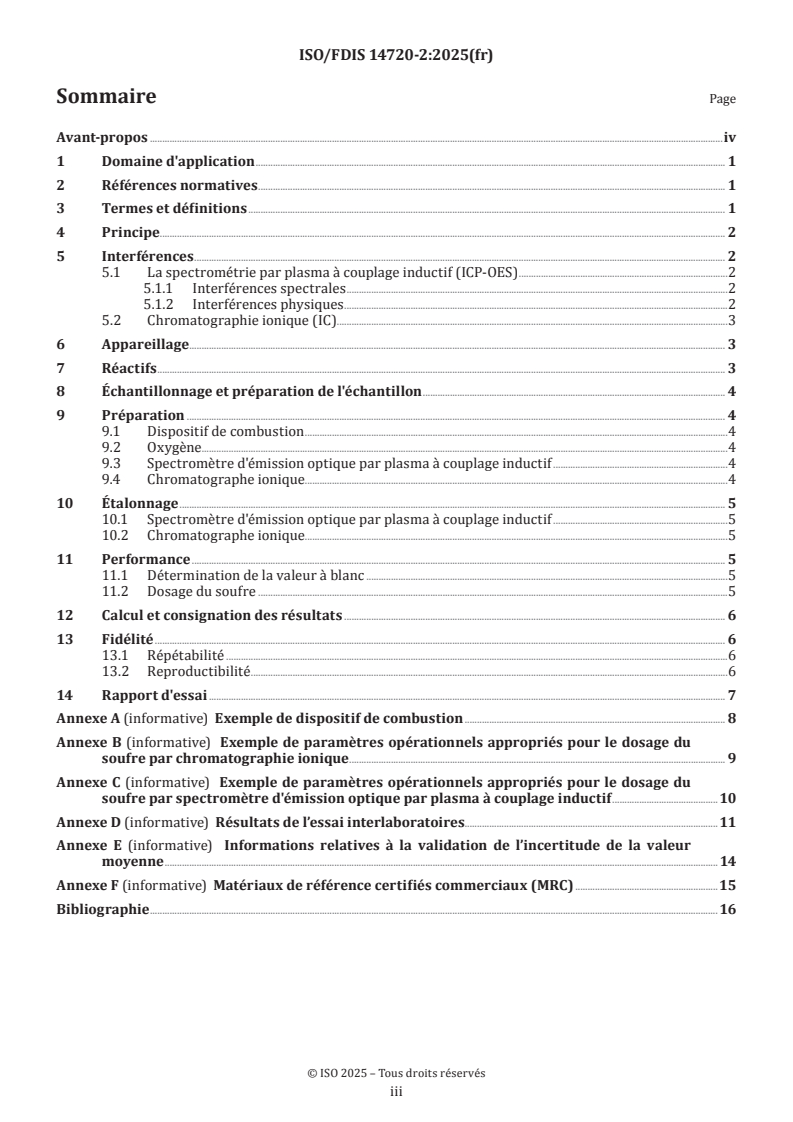
Contents Page
Foreword .iv
1 Scope . 1
2 Normative references . 1
3 Terms and definitions . 1
4 Principle . 2
5 Interferences . 2
5.1 Inductively coupled plasma optical emission spectrometry (ICP-OES) .2
5.1.1 Spectral interferences .2
5.1.2 Physical interferences .2
5.2 Ion chromatography (IC) .3
6 Apparatus . 3
7 Reagents . 3
8 Sampling and sample preparation . 4
9 Preparation . 4
9.1 Combustion device .4
9.2 Oxygen .4
9.3 Inductively coupled plasma optical emission spectrometer .4
9.4 Ion chromatograph .4
10 Calibration . 5
10.1 Inductively coupled plasma optical emission spectrometer .5
10.2 Ion chromatograph .5
11 Performance . 5
11.1 Determination of the blank value .5
11.2 Determination of the sulfur content .5
12 Calculation and report of the results . 6
13 Precision . 6
13.1 Repeatability .6
13.2 Reproducibility .6
14 Test report . 6
Annex A (informative) Example of a combustion device . 8
Annex B (informative) Example for suitable operating parameters for the determination of
sulfur by ion chromatography . . 9
Annex C (informative) Example for suitable operating parameters for the determination of
sulfur by inductively coupled plasma optical emission spectroscopy .10
Annex D (informative) Results of the round-robin test .11
Annex E (informative) Information regarding validation of the uncertainty of the mean value . 14
Annex F (informative) Commercial Certified Reference Materials (CRM) .15
Bibliography .16
iii
Foreword
ISO (the International Organization for Standardization) is a worldwide federation of national standards
bodies (ISO member bodies). The work of preparing International Standards is normally carried out through
ISO technical committees. Each member body interested in a subject for which a technical committee
has been established has the right to be represented on that committee. International organizations,
governmental and non-governmental, in liaison with ISO, also take part in the work. ISO collaborates closely
with the International Electrotechnical Commission (IEC) on all matters of electrotechnical standardization.
The procedures used to develop this document and those intended for its further maintenance are described
in the ISO/IEC Directives, Part 1. In particular, the different approval criteria needed for the different types
of ISO document should be noted. This document was drafted in accordance with the editorial rules of the
ISO/IEC Directives, Part 2 (see www.iso.org/directives).
ISO draws attention to the possibility that the implementation of this document may involve the use of (a)
patent(s). ISO takes no position concerning the evidence, validity or applicability of any claimed patent
rights in respect thereof. As of the date of publication of this document, ISO had not received notice of (a)
patent(s) which may be required to implement this document. However, implementers are cautioned that
this may not represent the latest information, which may be obtained from the patent database available at
www.iso.org/patents. ISO shall not be held responsible for identifying any or all such patent rights.
Any trade name used in this document is information given for the convenience of users and does not
constitute an endorsement.
For an explanation of the voluntary nature of standards, the meaning of ISO specific terms and expressions
related to conformity assessment, as well as information about ISO's adherence to the World Trade
Organization (WTO) principles in the Technical Barriers to Trade (TBT), see www.iso.org/iso/foreword.html.
This document was prepared by Technical Committee ISO/TC 33, Refractories, in collaboration with the
European Committee for Standardization (CEN) Technical Committee CEN/TC 187, Refractory products
and materials, in accordance with the Agreement on technical cooperation between ISO and CEN (Vienna
Agreement).
This second edition cancels and replaces the first edition (ISO 14720-2:2013), which has been technically
revised.
The main changes are as follows:
— title of this document revised to better describe its field of application;
— Clause 1 adapted to the new title;
— subclause 9.3 provides additional information on suitable sulfur emission lines;
— in 9.3, 9.4, 11.1 and 11.2, NOTES were transferred into normative paragraphs;
— subclause 11.1 provides additional information on blank measurement;
— in 11.2, the error in the analysis process regarding the extraction of the residue after combustion has
been corrected;
— in Clause 12, symbols for variables have been revised according to ISO/IEC requirements.
A list of all parts in the ISO 14720 series can be found on the ISO website.
Any feedback or questions on this document should be directed to the user’s national standards body. A
complete listing of these bodies can be found at www.iso.org/members.html.
iv
FINAL DRAFT International Standard ISO/FDIS 14720-2:2025(en)
Testing of ceramic materials — Determination of sulfur in
non-oxidic ceramic raw materials and ceramic materials —
Part 2:
Inductively coupled plasma optical emission spectrometry
(ICP-OES) or ion chromatography (IC) after burning in the
oxygen flow
1 Scope
This document specifies a method for the determination of sulfur in non-oxidic ceramic raw materials and
ceramic materials, which are completely oxidized at a higher temperature in an oxygen atmosphere, e.g.
carbon and graphite materials.
For materials which are not completely oxidizable under these conditions, it is possible to determine sulfur
that can be released under these conditions, e.g. the adherent sulfur.
This document is applicable for materials with mass fractions of sulfur ≤ 10 % and mass fractions of ash
< 20 %, The defined method is limited for materials with mass fractions of barium < 10 mg/kg, because the
sulfur bonded in barium sulfate is not detectable with this method.
For the lower detection limit of this method, a mass fraction of sulfur of 0,5 mg/kg in the case of inductively
coupled plasma optical emission spectrometry (ICP-OES) and 5 mg/kg in the case of ion chromatography
(IC) can be considered as a practical value.
2 Normative references
The following documents are referred to in the text in such a way that some or all of their content constitutes
requirements of this document. For dated references, only the edition cited applies. For undated references,
the latest edition of the referenced document (including any amendments) applies.
ISO 10304-1, Water quality — Determination of dissolved anions by liquid chromatography of ions — Part 1:
Determination of bromide, chloride, fluoride, nitrate, nitrite, phosphate and sulfate
ISO 11885, Water quality — Determination of selected elements by inductively coupled plasma optical emission
spectrometry (ICP-OES)
3 Terms and definitions
For the purposes of this document, the following terms and definitions apply.
ISO and IEC maintain terminology databases for use in standardization at the following addresses:
— ISO Online browsing platform: available at https:// www. iso. org/o bp
— IEC Electropedia: available at https:// www.e lectropedia. org/
3.1
sulfur content
Mass fraction of inorganic and organic bound sulfur.
4 Principle
The dried sample is oxidized in a flow of oxygen at a temperature of 1 100 °C using a porcelain crucible.
The resulting sulfur oxides are absorbed in a solution of sodium hydroxide and hydrogen peroxide. The
remaining material (ash) is dissolved and combined with the absorption liquid in the case of calcium-
sulfate-containing sample material. The concentration of sulfur in the sample solution shall be determined
by inductively coupled plasma optical emission spectrometry (ICP-OES) in accordance with ISO 11885 or by
ion chromatography (IC) as sulfate in accordance with ISO 10304-1.
5 Interferences
5.1 Inductively coupled plasma optical emission spectrometry (ICP-OES)
5.1.1 Spectral interferences
The compensation of spectral interferences shall be performed according to the manual of the manufacturer
of the spectrometer.
NOTE 1 Spectral interferences can be caused by:
a) overlapping with the emission line of another element;
b) overlapping with molecular bands;
c) unspecific background (for example scattering, recombinations).
Overlapping of lines can be compensated for by arithmetical correction of the raw data if applicable.
Correction factors shall be determined by measuring at least one undisturbed additional emission line of
the interfering element and considering the relation of the intensity of this emission line to the emission line
which interferes with the analyte element.
In the case of overlapping with molecular bands, an alternative emission line shall be chosen.
NOTE 2 Unspecific background is usually compensated for by measuring the background signal in the surroundings
of the analyte emission line.
5.1.2 Physical interferences
To compensate physical interferences, suitable measures shall be taken.
NOTE Physical interferences occur as plasma interferences or as transport interferences. Both are caused
by a different behaviour of the calibration solution compared to the sample solution based on a different chemical
composition. Plasma interferences are caused by changes in plasma conditions, for example temperature distribution
and electron density, leading to a changed excitation of emission lines. Transport interferences are caused by
differences in physical characteristics of the calibration solution and sample solution, mainly density, viscosity and
surface tension.
Some of the transport interferences can be reduced by using appropriate (peristaltic) pumps. Plasma
interferences as well as transport interferences can be reduced significantly by using suitable reference
lines of a reference element with the same concentration in both the calibration and analyte solution
(internal standard). Other possibilities are to equalize the chemical composition of the calibration and
sample solution as much as possible (matrix matching) or to use a standard addition procedure or a standard
addition calibration procedure instead of the standard calibration procedure.
5.2 Ion chromatography (IC)
To avoid cross-interferences by additional anions, suitable measures shall be taken.
NOTE Anions like chloride, bromide, fluoride, nitrite, nitrate, formiate and acetate in the absorption liquid can
lead to cross-interferences. By using the chromatographic parameters given in Annex B, the sulfate signal usually can
be separated completely from the signals of the other anions.
6 Apparatus
6.1 Combustion device, adjustable to (1 100 ± 20) °C, suitable for oxidizing the sample in an oxygen flow
and suitable to absorb the reaction gases completely.
NOTE For an example of a suitable device see Figure A.1.
6.2 Porcelain boat, unglazed.
6.3 Gas-washing bottles, standard type, nominal volume 100 ml, filled with 25 ml of absorption
solution (7.6 and Annex A).
6.4 Filtration adaptor, with a membrane filter with a pore width of 0,45 µm, connectable to the outlet of
the disposable syringe (6.5).
6.5 Disposable syringe, n
...
Date: 2024-12-30
ISO/DISFDIS 14720-2:2025(en)
ISO /TC 33/SC /WG
Secretariat: BSI
Date: 2025-11-17
Testing of ceramic materials — Determination of sulfur in non-
oxidic ceramic raw materials and ceramic materials —
Part 2:
Inductively coupled plasma optical emission spectrometry (ICP-
OES) or ion chromatography (IC) after burning in the oxygen flow
EssaiAnalyse des matièresmatériaux céramiques — Détermination de la teneur enDosage du soufre
desdans les produits et les matières premières céramiques non oxydes et des matériaux céramiques non
oxydes —
Partie 2: Spectrométrie d'émission optique avecpar plasma coupléà couplage inductif (ICP-OES) ou
chromatographie ionique (IC) après combustion dans le courant d'oxygène
Prüfung keramischer Werkstoffe — Bestimmung des Schwefelgehaltes in nichtoxidischen keramischen
Roh- und Werkstoffen —
Teil 2: Optische Emissionsspektrometrie mit induktiv gekoppeltem Plasma (ICP-OES) oder
Ionenchromatographie (IC) nach Verbrennung im Sauerstoffstrom
Copyright notice
ThisFDIS stage
Error! Reference source not found.
© ISO document is a Draft International Standard and is copyright-protected by ISO. Except as permitted under
All rights reserved. Unless otherwise specified, or required in the applicable lawscontext of the user's country,
neither its implementation, no part of this ISO draft nor any extract from itpublication may be reproduced, stored
in a retrieval system or transmitted or utilized otherwise in any form or by any means, electronic, or mechanical,
including photocopying, recording or otherwiseor posting on the internet or an intranet, without prior written
permission being secured.
Requests for permission to reproduce should be addressed to . Permission can be requested from either ISO at the
address below or ISO'sISO’s member body in the country of the requester.
ISO copyright office
Case postale 56 • CP 401 • Ch. de Blandonnet 8
CH-12111214 Vernier, Geneva 20
Tel.Phone: + 41 22 749 01 11
Fax + 41 22 749 09 47
E-mail: copyright@iso.org
Web www.iso.org
Reproduction may be subject to royalty payments or a licensing agreement.
Violators may be prosecuted.
Website: www.iso.org
Published in Switzerland
ii Error! Reference source not found.
ISO/DIS 14720-2:2025(en)
Contents Page
Foreword . v
1 Scope .1
2 Normative references .1
3 Terms and definitions .1
4 Principle .2
5 Interferences .2
6 Apparatus .3
7 Reagents .3
8 Sampling and sample preparation .4
9 Preparation .4
10 Calibration .5
11 Performance .5
12 Calculation and report of the results .6
13 Precision .7
14 Test report .7
Annex A (informative) Example of a combustion device .8
Annex B (informative) Example for suitable operating parameters for the determination of
sulfur by ion chromatography . 10
Annex C (informative) Example for suitable operating parameters for the determination of
sulfur by inductively coupled plasma optical emission spectroscopy . 11
Annex D (informative) Results of the round-robin test . 12
Annex E (informative) Information regarding validation of the uncertainty of the mean
value . 15
Annex F (informative) Commercial Certified Reference Materials (CRM) . 16
Bibliography . 17
Foreword .4
1 Scope .1
2 Normative references .1
3 Terms and definitions .1
4 Principle .2
5 Interferences .2
5.1 Inductively coupled plasma optical emission spectrometry (ICP-OES) .2
5.1.1 Spectral Interferences.2
5.1.2 Physical interferences .2
5.2 Ion chromatography (IC) .3
6 Apparatus .3
iii
Error! Reference source not found.
7 Reagents . 3
8 Sampling and sample preparation . 4
9 Preparation . 4
9.1 Combustion device. 4
9.2 Oxygen (7.10) . 4
9.3 Inductively coupled plasma optical emission spectrometer (6.7) . 4
9.4 Ion chromatograph (6.8) . 5
10 Calibration . 5
10.1 Inductively coupled plasma optical emission spectrometer . 5
10.2 Ion chromatograph . 5
11 Performance . 5
11.1 Determination of the blank value . 5
11.2 Determination of the sulfur content . 5
12 Calculation and report of the results . 6
13 Precision . 7
13.1 Repeatability . 7
13.2 Reproducibility . 7
14 Test report . 7
iv Error! Reference source not found.
ISO/DIS 14720-2:2025(en)
Foreword
ISO (the International Organization for Standardization) is a worldwide federation of national standards
bodies (ISO member bodies). The work of preparing International Standards is normally carried out
through ISO technical committees. Each member body interested in a subject for which a technical
committee has been established has the right to be represented on that committee. International
organizations, governmental and non-governmental, in liaison with ISO, also take part in the work. ISO
collaborates closely with the International Electrotechnical Commission (IEC) on all matters of
electrotechnical standardization.
The procedures used to develop this document and those intended for its further maintenance are
described in the ISO/IEC Directives, Part 1. In particular, the different approval criteria needed for the
different types of ISO document should be noted. This document was drafted in accordance with the
editorial rules of the ISO/IEC Directives, Part 2 (see www.iso.org/directives).
ISO draws attention to the possibility that the implementation of this document may involve the use of
(a) patent(s). ISO takes no position concerning the evidence, validity or applicability of any claimed
patent rights in respect thereof. As of the date of publication of this document, ISO had not received notice
of (a) patent(s) which may be required to implement this document. However, implementers are
cautioned that this may not represent the latest information, which may be obtained from the patent
database available at www.iso.org/patents.www.iso.org/patents. ISO shall not be held responsible for
identifying any or all such patent rights.
Any trade name used in this document is information given for the convenience of users and does not
constitute an endorsement.
For an explanation of the voluntary nature of standards, the meaning of ISO specific terms and
expressions related to conformity assessment, as well as information about ISO's adherence to the World
Trade Organization (WTO) principles in the Technical Barriers to Trade (TBT), see
www.iso.org/iso/foreword.htmlwww.iso.org/iso/foreword.html.
This document was prepared by Technical Committee ISO/TC 33, Refractories, in collaboration with the
European Committee for Standardization (CEN) Technical Committee CEN/TC 187, Refractory products
and materials, in accordance with the Agreement on technical cooperation between ISO and CEN (Vienna
Agreement).
This second edition cancels and replaces the first edition (ISO 14720-2:2013), which has been technically
revised.
The main changes are as follows:
— — The title of the standard has been changedthis document revised to better describe its field of
application;
— — Clause 1 has been1 adapted to the new title;
— In Clause 2 the introductory sentence was updated;
— In Clause 3 a reference to ISO and IEC databases was added;
— — Clause 9.39.3 provides additional information on suitable sulfur emission lines;
— In Clauses 9.3, 9.4, 11.1 and 11.2 Notes were transferred into normative paragraphs;
— — Clause 11.1in 9.3, 9.4, 11.1 and 11.2, NOTES were transferred into normative paragraphs;
v
Error! Reference source not found.
— 11.1 provides additional information on blank measurement;
— — In Clause 11.2in 11.2, the error in the analysis process regarding the extraction of the residue
after combustion has been corrected;
— — In Clause 12 the writing ofin 12, symbols for variables was adjustedhave been revised according
to theISO/IEC requirements of ISO/IEC rules.
A list of all parts in the ISO 14720 series can be found on the ISO website.
—
vi Error! Reference source not found.
ISO/DISFDIS 14720-2:2025(en)
Any feedback or questions on this document should be directed to the user’s national standards body. A
complete listing of these bodies can be found at www.iso.org/members.html.
vii
DRAFT International Standard ISO/DIS 14720-2:2025(en)
Testing of ceramic materials — Determination of sulfur in non-oxidic
ceramic raw materials and ceramic materials —
Part 2:
Inductivelyinductively coupled plasma optical emission spectrometry
(ICP-OES) or ion chromatography (IC) after burning in the oxygen flow
1 Scope
This document specifies a method for the determination of sulfur in non-oxidic ceramic raw materials and
ceramic materials, which are completely oxidized at a higher temperature in an oxygen atmosphere, e.g.
carbon and graphite materials.
For materials which are not completely oxidizable under these conditions, it is possible to determine sulfur
that can be released under these conditions, e.g. the adherent sulfur.
This document is applicable for materials with mass fractions of sulfur ≤ 10 % and mass fractions of ash
< 20 %, The defined method is limited for materials with mass fractions of barium < 10 mg/kg, because the
sulfur bonded in barium sulfate is not detectable with this method.
For the lower detection limit of this method, a mass fraction of sulfur of 0,5 mg/kg in the case of inductively
coupled plasma optical emission spectrometry (ICP-OES) and 5 mg/kg in the case of ion chromatography (IC)
can be considered as a practical value.
2 Normative references
The following documents are referred to in the text in such a way that some or all of their content constitutes
requirements of this document. For dated references, only the edition cited applies. For undated references,
the latest edition of the referenced document (including any amendments) applies.
ISO 10304--1, Water quality — Determination of dissolved anions by liquid chromatography of ions — Part 1:
Determination of bromide, chloride, fluoride, nitrate, nitrite, phosphate and sulfate
ISO 11885, Water quality — Determination of selected elements by inductively coupled plasma optical emission
spectrometry (ICP-OES)
3 Terms and definitions
For the purposes of this document, the following terms and definitions apply.
ISO and IEC maintain terminology databases for use in standardization at the following addresses:
— — ISO Online browsing platform: available at https://www.iso.org/obphttps://www.iso.org/obp
— — IEC Electropedia: available at https://www.electropedia.org/https://www.electropedia.org/
3.1
3.1 sulfur content
Mass fraction of inorganic and organic bound sulfur.
4 Principle
The dried sample is oxidized in a flow of oxygen at a temperature of 1 100 °C using a porcelain crucible. The
resulting sulfur oxides are absorbed in a solution of sodium hydroxide and hydrogen peroxide. The remaining
material (ash) is dissolved and combined with the absorption liquid in the case of calcium-sulfate-containing
sample material. The concentration of sulfur in the sample solution shall be determined by inductively coupled
plasma optical emission spectrometry (ICP-OES) in accordance with ISO 11885 or by ion chromatography (IC)
as sulfate in accordance with ISO 10304--1.
5 Interferences
5.1 Inductively coupled plasma optical emission spectrometry (ICP-OES)
5.1.1 Spectral interferences
The compensation of spectral interferences shall be performed according to the manual of the manufacturer
of the spectrometer.
NOTE 1 Spectral interferences can be caused by:
a) a) overlapping with the emission line of another element;
b) b) overlapping with molecular bands;
c) c) unspecific background (for example scattering, recombinations).
Overlapping of lines can be compensated for by arithmetical correction of the raw data if applicable.
Correction factors shall be determined by measuring at least one undisturbed additional emission line of the
interfering element and considering the relation of the intensity of this emission line to the emission line which
interferes with the analyte element.
In the case of overlapping with molecular bands, an alternative emission line shall be chosen.
NOTE 2 Unspecific background is usually compensated for by measuring the background signal in the surroundings
of the analyte emission line.
5.1.2 Physical interferences
To compensate physical interferences, suitable measures shall be taken.
NOTE Physical interferences occur as plasma interferences or as transport interferences. Both are caused by a
different behaviour of the calibration solution compared to the sample solution based on a different chemical
composition. Plasma interferences are caused by changes in plasma conditions, for example temperature distribution
and electron density, leading to a changed excitation of emission lines. Transport interferences are caused by differences
in physical characteristics of the calibration solution and sample solution, mainly density, viscosity and surface tension.
Some of the transport interferences can be reduced by using appropriate (peristaltic) pumps. Plasma
interferences as well as transport interferences can be reduced significantly by using suitable reference lines
ISO/DISFDIS 14720-2:2025(en)
of a reference element with the same concentration in both the calibration and analyte solution (internal
standard). Other possibilities are to equalize the chemical composition of the calibration and sample solution
as much as possible (matrix matching) or to use a standard addition procedure or a standard addition
calibration procedure instead of the standard calibration procedure.
5.2 Ion chromatography (IC)
To avoid cross-interferences by additional anions, suitable measures shall be taken.
NOTE Anions like chloride, bromide, fluoride, nitrite, nitrate, formiate and acetate in the absorption liquid can lead
to cross-interferences. By using the chromatographic parameters given in Annex B,Annex B, the sulfate signal usually can
be separated completely from the signals of the other anions.
6 Apparatus
6.1 6.1 Combustion device, adjustable to (1 100 ± 20) °C, suitable for oxidizing the sample in an
oxygen flow and suitable to absorb the reaction gases completely.
NOTE For an example of a suitable device see Figure A.1.0.
6.2 6.2 Porcelain boat, unglazed.
6.3 6.3 Gas-washing bottles, standard type, nominal volume 100 ml, filled with 25 ml of absorption
solution (7.6 and Annex A).(7.6 and Annex A).
6.4 6.4 Filtration adaptor, with a membrane filter with a pore width of 0,45 µm, connectable to the
outlet of the disposable syringe (6.5).(6.5).
6.5 6.5 Disposable syringe, nominal volume 5 ml.
6.6 6.6 Ultrasonic bath, preferably with a volume of ≥ 1 l and an ultrasonic power of ≥ 150 W.
6.7 6.7 Inductively coupled plasma optical emission spectrometer, sequential or
simultaneous spectrometer with a lower wavelength limit of at least 180 nm.
6.8 6.8 Ion chromatograph with a column for anions and conductivity detector, if available
with suppressor technique.
7 Reagents
7.1 7.1 General
Reagents of known analytical grade shall be used, provided it is first ascertained that the reagent is of
sufficiently high purity to permit its use without lessening the accuracy of the determination.
7.2 7.2 Hydrogen peroxide solution, H2O2, w(H2O2) = 30 %.
7.3 7.3 Sodium hydroxide solution, NaOH, c(NaOH) = 0,001 mol/l.
...
PROJET FINAL
Norme
internationale
ISO/TC 33
Analyse des matériaux
Secrétariat: BSI
céramiques — Dosage du soufre
Début de vote:
dans les produits et les matières
2025-12-02
premières céramiques non
Vote clos le:
oxydes —
2026-01-27
Partie 2:
Spectrométrie d'émission optique
par plasma à couplage inductif (ICP-
OES) ou chromatographie ionique
(IC) après combustion dans le
courant d'oxygène
Testing of ceramic materials — Determination of sulfur in non-
oxidic ceramic raw materials and ceramic materials —
Part 2: Inductively coupled plasma optical emission spectrometry
(ICP-OES) or ion chromatography (IC) after burning in the
oxygen flow
LES DESTINATAIRES DU PRÉSENT PROJET SONT
INVITÉS À PRÉSENTER, AVEC LEURS OBSERVATIONS,
NOTIFICATION DES DROITS DE PROPRIÉTÉ DONT ILS
AURAIENT ÉVENTUELLEMENT CONNAISSANCE ET À
FOURNIR UNE DOCUMENTATION EXPLICATIVE.
OUTRE LE FAIT D’ÊTRE EXAMINÉS POUR
ÉTABLIR S’ILS SONT ACCEPTABLES À DES FINS
INDUSTRIELLES, TECHNOLOGIQUES ET COM-MERCIALES,
AINSI QUE DU POINT DE VUE DES UTILISATEURS, LES
PROJETS DE NORMES
TRAITEMENT PARALLÈLE ISO/CEN
INTERNATIONALES DOIVENT PARFOIS ÊTRE CONSIDÉRÉS
DU POINT DE VUE DE LEUR POSSI BILITÉ DE DEVENIR DES
NORMES POUVANT
SERVIR DE RÉFÉRENCE DANS LA RÉGLEMENTATION
NATIONALE.
Numéro de référence
PROJET FINAL
Norme
internationale
ISO/TC 33
Analyse des matériaux
Secrétariat: BSI
céramiques — Dosage du soufre
Début de vote:
dans les produits et les matières
2025-12-02
premières céramiques non
Vote clos le:
oxydes —
2026-01-27
Partie 2:
Spectrométrie d'émission optique
par plasma à couplage inductif (ICP-
OES) ou chromatographie ionique
(IC) après combustion dans le
courant d'oxygène
Testing of ceramic materials — Determination of sulfur in non-
oxidic ceramic raw materials and ceramic materials —
Part 2: Inductively coupled plasma optical emission spectrometry
(ICP-OES) or ion chromatography (IC) after burning in the
oxygen flow
LES DESTINATAIRES DU PRÉSENT PROJET SONT
INVITÉS À PRÉSENTER, AVEC LEURS OBSERVATIONS,
NOTIFICATION DES DROITS DE PROPRIÉTÉ DONT ILS
AURAIENT ÉVENTUELLEMENT CONNAISSANCE ET À
FOURNIR UNE DOCUMENTATION EXPLICATIVE.
DOCUMENT PROTÉGÉ PAR COPYRIGHT
OUTRE LE FAIT D’ÊTRE EXAMINÉS POUR
ÉTABLIR S’ILS SONT ACCEPTABLES À DES FINS
© ISO 2025 INDUSTRIELLES, TECHNOLOGIQUES ET COM-MERCIALES,
AINSI QUE DU POINT DE VUE DES UTILISATEURS, LES
Tous droits réservés. Sauf prescription différente ou nécessité dans le contexte de sa mise en œuvre, aucune partie de cette
PROJETS DE NORMES
TRAITEMENT PARALLÈLE ISO/CEN
INTERNATIONALES DOIVENT PARFOIS ÊTRE CONSIDÉRÉS
publication ne peut être reproduite ni utilisée sous quelque forme que ce soit et par aucun procédé, électronique ou mécanique,
DU POINT DE VUE DE LEUR POSSI BILITÉ DE DEVENIR DES
y compris la photocopie, ou la diffusion sur l’internet ou sur un intranet, sans autorisation écrite préalable. Une autorisation peut
NORMES POUVANT
être demandée à l’ISO à l’adresse ci-après ou au comité membre de l’ISO dans le pays du demandeur.
SERVIR DE RÉFÉRENCE DANS LA RÉGLEMENTATION
NATIONALE.
ISO copyright office
Case postale 401 • Ch. de Blandonnet 8
CH-1214 Vernier, Genève
Tél.: +41 22 749 01 11
E-mail: copyright@iso.org
Web: www.iso.org
Publié en Suisse Numéro de référence
ii
Sommaire Page
Avant-propos .iv
1 Domaine d'application . 1
2 Références normatives . 1
3 Termes et définitions . 1
4 Principe. 2
5 Interférences . 2
5.1 La spectrométrie par plasma à couplage inductif (ICP-OES) .2
5.1.1 Interférences spectrales .2
5.1.2 Interférences physiques .2
5.2 Chromatographie ionique (IC).3
6 Appareillage . 3
7 Réactifs . 3
8 Échantillonnage et préparation de l'échantillon . 4
9 Préparation . 4
9.1 Dispositif de combustion .4
9.2 Oxygène.4
9.3 Spectromètre d'émission optique par plasma à couplage inductif .4
9.4 Chromatographe ionique . .4
10 Étalonnage . 5
10.1 Spectromètre d'émission optique par plasma à couplage inductif .5
10.2 Chromatographe ionique . .5
11 Performance . 5
11.1 Détermination de la valeur à blanc .5
11.2 Dosage du soufre .5
12 Calcul et consignation des résultats . 6
13 Fidélité . 6
13.1 Répétabilité .6
13.2 Reproductibilité . .6
14 Rapport d'essai . 7
Annexe A (informative) Exemple de dispositif de combustion . 8
Annexe B (informative) Exemple de paramètres opérationnels appropriés pour le dosage du
soufre par chromatographie ionique . . 9
Annexe C (informative) Exemple de paramètres opérationnels appropriés pour le dosage du
soufre par spectromètre d'émission optique par plasma à couplage inductif .10
Annexe D (informative) Résultats de l’essai interlaboratoires.11
Annexe E (informative) Informations relatives à la validation de l’incertitude de la valeur
moyenne . 14
Annexe F (informative) Matériaux de référence certifiés commerciaux (MRC) .15
Bibliographie .16
iii
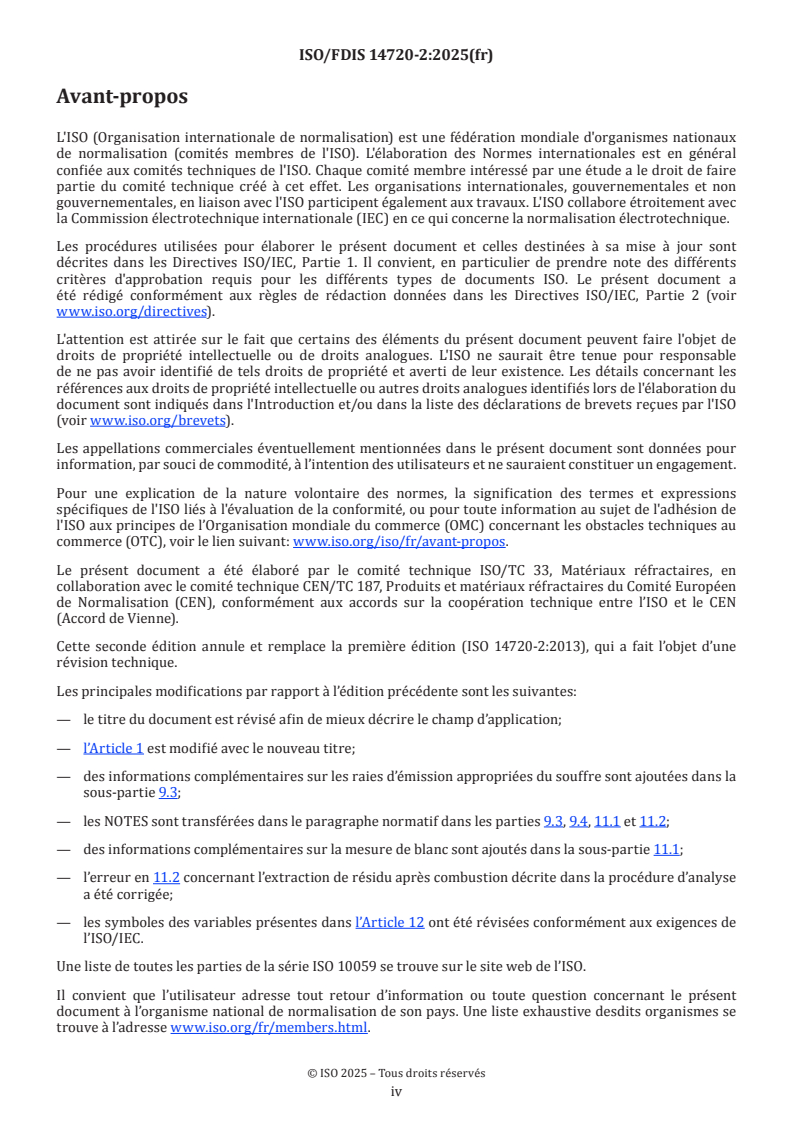
Avant-propos
L'ISO (Organisation internationale de normalisation) est une fédération mondiale d'organismes nationaux
de normalisation (comités membres de l'ISO). L'élaboration des Normes internationales est en général
confiée aux comités techniques de l'ISO. Chaque comité membre intéressé par une étude a le droit de faire
partie du comité technique créé à cet effet. Les organisations internationales, gouvernementales et non
gouvernementales, en liaison avec l'ISO participent également aux travaux. L'ISO collabore étroitement avec
la Commission électrotechnique internationale (IEC) en ce qui concerne la normalisation électrotechnique.
Les procédures utilisées pour élaborer le présent document et celles destinées à sa mise à jour sont
décrites dans les Directives ISO/IEC, Partie 1. Il convient, en particulier de prendre note des différents
critères d'approbation requis pour les différents types de documents ISO. Le présent document a
été rédigé conformément aux règles de rédaction données dans les Directives ISO/IEC, Partie 2 (voir
www.iso.org/directives).
L'attention est attirée sur le fait que certains des éléments du présent document peuvent faire l'objet de
droits de propriété intellectuelle ou de droits analogues. L'ISO ne saurait être tenue pour responsable
de ne pas avoir identifié de tels droits de propriété et averti de leur existence. Les détails concernant les
références aux droits de propriété intellectuelle ou autres droits analogues identifiés lors de l'élaboration du
document sont indiqués dans l'Introduction et/ou dans la liste des déclarations de brevets reçues par l'ISO
(voir www.iso.org/brevets).
Les appellations commerciales éventuellement mentionnées dans le présent document sont données pour
information, par souci de commodité, à l’intention des utilisateurs et ne sauraient constituer un engagement.
Pour une explication de la nature volontaire des normes, la signification des termes et expressions
spécifiques de l'ISO liés à l'évaluation de la conformité, ou pour toute information au sujet de l'adhésion de
l'ISO aux principes de l’Organisation mondiale du commerce (OMC) concernant les obstacles techniques au
commerce (OTC), voir le lien suivant: www.iso.org/iso/fr/avant-propos.
Le présent document a été élaboré par le comité technique ISO/TC 33, Matériaux réfractaires, en
collaboration avec le comité technique CEN/TC 187, Produits et matériaux réfractaires du Comité Européen
de Normalisation (CEN), conformément aux accords sur la coopération technique entre l’ISO et le CEN
(Accord de Vienne).
Cette seconde édition annule et remplace la première édition (ISO 14720-2:2013), qui a fait l’objet d’une
révision technique.
Les principales modifications par rapport à l’édition précédente sont les suivantes:
— le titre du document est révisé afin de mieux décrire le champ d’application;
— l’Article 1 est modifié avec le nouveau titre;
— des informations complémentaires sur les raies d’émission appropriées du souffre sont ajoutées dans la
sous-partie 9.3;
— les NOTES sont transférées dans le paragraphe normatif dans les parties 9.3, 9.4, 11.1 et 11.2;
— des informations complémentaires sur la mesure de blanc sont ajoutés dans la sous-partie 11.1;
— l’erreur en 11.2 concernant l’extraction de résidu après combustion décrite dans la procédure d’analyse
a été corrigée;
— les symboles des variables présentes dans l’Article 12 ont été révisées conformément aux exigences de
l’ISO/IEC.
Une liste de toutes les parties de la série ISO 10059 se trouve sur le site web de l’ISO.
Il convient que l’utilisateur adresse tout retour d’information ou toute question concernant le présent
document à l’organisme national de normalisation de son pays. Une liste exhaustive desdits organismes se
trouve à l’adresse www.iso.org/fr/members.html.
iv
PROJET FINAL Norme internationale ISO/FDIS 14720-2:2025(fr)
Analyse des matériaux céramiques — Dosage du soufre
dans les produits et les matières premières céramiques non
oxydes —
Partie 2:
Spectrométrie d'émission optique par plasma à couplage
inductif (ICP-OES) ou chromatographie ionique (IC) après
combustion dans le courant d'oxygène
1 Domaine d'application
La présente partie de l'ISO 14720 définit une méthode de dosage du soufre dans des produits et des matières
premières céramiques non oxydes, qui sont complètement oxydés à haute température dans une atmosphère
d’oxygène, par exemple des matériaux carbonés et des matériaux de graphite.
Pour les matériaux qui ne peuvent être complètement oxydés dans ces conditions, il est possible de doser le
soufre qui peut être libéré dans ces conditions, par exemple le soufre adhérent.
La présente partie de l'ISO 14720 est applicable aux matériaux dont la fraction massique de soufre est ≤ 10 %
et dont la fraction massique de cendres est < 20 %. La méthode définie est limitée aux matériaux dont la
fraction massique de baryum est < 10 mg/kg parce que le soufre lié dans le sulfate de baryum ne peut pas
être détecté par cette méthode.
Pour ce qui est de la limite de détection inférieure, une fraction massique de soufre de 0,5 mg/kg dans le cas
de la spectrométrie d'émission optique par plasma à couplage inductif (ICP-OES) et de 5 mg/kg dans le cas
de la chromatographie ionique (IC) doit être considérée comme la valeur recommandée pour cette méthode.
2 Références normatives
Les documents de référence suivants sont indispensables pour l'application du présent document. Pour
les références datées, seule l'édition citée s'applique. Pour les références non datées, la dernière édition du
document de référence s’applique (y compris les éventuels amendements).
ISO 10304-1, Qualité de l'eau — Dosage des anions dissous par chromatographie des ions en phase liquide —
Partie 1: Dosage du bromure, chlorure, fluorure, nitrate, nitrite, phosphate et sulfate
ISO 11885, Qualité de l'eau — Dosage d'éléments choisis par spectroscopie d'émission optique avec plasma induit
par haute fréquence (ICP-OES)
3 Termes et définitions
Pour les besoins du présent document, les termes et définitions suivants s'appliquent.
L'ISO et l'IEC tiennent à jour des bases de données terminologiques destinées à être utilisées en normalisation,
consultables aux adresses suivantes:
— ISO Online browsing platform: disponible à l'adresse https:// www .iso .org/ obp/
— IEC Electropedia: disponible à l'adresse https:// www .electropedia .org/
3.1
teneur en soufre
fraction massique de soufre inorganique et organique lié
4 Principe
L’échantillon sec, placé dans un creuset en porcelaine, est oxydé dans un courant d’oxygène à la température
de 1 100 °C. Les oxydes de soufre libérés sont absorbés dans une solution d’hydroxyde de sodium et de
peroxyde d’hydrogène. Si le matériau échantillon contient du sulfate de calcium, la matière résiduelle
(cendres) est dissoute et combinée au liquide d’absorption. La concentration en soufre de la solution
échantillon est déterminée par spectrométrie d'émission optique par plasma à couplage inductif (ICP-OES)
conformément à l’ISO 11885 ou par chromatographie ionique (IC), sous forme de sulfate, conformément à
l’ISO 10304-1.
5 Interférences
5.1 La spectrométrie par plasma à couplage inductif (ICP-OES)
5.1.1 Interférences spectrales
La compensation des interférences spectrales s’effectue conformément aux instructions du fabricant du
spectromètre.
NOTE 1 Les interférences spectrales peuvent être causées par:
a) chevauchement avec la raie d’émission d’un autre élément;
b) chevauchement avec des bandes moléculaires;
c) bruit de fond non spécifique (par exemple dispersion, recombinaisons).
Le chevauchement des raies peut être compensé par correction arithmétique des données brutes, le cas
échéant.
Les facteurs de correction sont déterminés en mesurant au moins une raie d’émission supplémentaire, non
perturbée, de l’élément interférent et en étudiant la relation entre l’intensité de cette raie d’émission et
l'intensité de la raie d’émission qui interfère avec l’analyte.
En cas d’interférence avec des bandes moléculaires, il faut choisir une autre raie d’émission.
NOTE 2 Un bruit de fond non spécifique se compense, normalement, en mesurant le signal de fond autour de la raie
d’émission de l’analyte.
5.1.2 Interférences physiques
Des mesures appropriées doivent être prises pour compenser les interférences physiques.
NOTE Les interférences physiques sont des interférences soit dues au plasma, soit liées au transport. Les deux
types d’interférences ont pour origine une différence de comportement entre la solution d’étalonnage et la solution
échantillon en raison de leur composition chimique différente. Les interférences dues au plasma ont pour origine des
modifications des conditions du plasma, par exemple la distribution de la température et la densité électronique, qui
modifient les conditions d’excitation des raies d’émission. Les interférences liées au transport ont pour origine des
différences de caractéristiques physiques, principalement la densité, la viscosité et la tension superficielle, entre la
solution d’étalonnage et la solution échantillon.
On peut réduire certaines des interférences liées au transport en utilisant des pompes (péristaltiques)
appropriées. Les interférences dues au plasma, comme les interférences liées au transport, peuvent être
réduites de manière significative en utilisant les raies de référence d’un élément de référence présent en
concentration identique dans la solution d’étalonnage et dans la solution échantillon (étalon interne).
D’autres solutions consistent à faire en sorte que la composition chimique de la solution d’étalonnage et
celle de la solution échantillon soient aussi similaires que possible (correspondance matricielle) ou à utiliser
un mode opératoire d’ajout dosé ou un mode opératoire d’étalonnage par ajout dosé à la place du mode
opératoire d’étalonnage normalisé.
5.2 Chromatographie ionique (IC)
Des mesures appropriées doivent être prises pour éviter les interférences croisées d’anions supplémentaires.
NOTE La présence d’anions chlorures, bromures, fluorures, nitrites, nitrates, formiates et acétates dans le
liquide d'absorption peut être à l’origine d’interférences croisées. L’utilisation des paramètres chromatographiques
donnés à l’Annexe B permet normalement de séparer complètement le signal correspondant au sulfate des signaux
correspondant aux autres anions.
6 Appareillage
6.1 Dispositif de combustion, réglable à la température de (1 100 ± 20) °C, adapté pour l’oxydation de
l’échantillon dans un courant d’oxygène et pour l’absorption complète des gaz de la réaction.
NOTE Un exemple de dispositif approprié est donné à Figure A.1.
6.2 Creuset en porcelaine, non émaillé.
6.3 Flacons de lavage de gaz, de type normalisé, ayant un volume nominal de 100 ml, remplis de 25 ml de
solution d’absorption (7.6 et Annexe A).
6.4 Adaptateur de filtration, avec une membrane filtrante de 0,45 µm de porosité, pouvant être connecté
à la sortie de la seringue jetable (6.5).
6.5 Seringue jetable, d'un volume nominal de 5 ml.
6.6 Bain à ultrasons, de préférence d’un volume ≥ 1 l et de puissance ultrasonique ≥ 150 W.
6.7 Spectromètre d'émission optique par plasma à couplage inductif, spectromètre séquentiel ou
simultané avec une
...
Questions, Comments and Discussion
Ask us and Technical Secretary will try to provide an answer. You can facilitate discussion about the standard in here.
Loading comments...