


ISO/IEC 19790:2006
(Main)Information technology — Security techniques — Security requirements for cryptographic modules
Information technology — Security techniques — Security requirements for cryptographic modules
ISO/IEC 19790:2006 specifies the security requirements for a cryptographic module utilized within a security system protecting sensitive information in computer and telecommunication systems. ISO/IEC 19790:2006 specifies the following. Four levels of increasing security for cryptographic modules. Each level offers an increase in security over the preceding level. The following functional security objectives: module specification; ports and interfaces; roles, services and authentication; finite state model; physical security; operational environment; cryptographic key management; self-tests; design assurance; mitigation of other attacks. ISO/IEC 19790:2006 will be complemented by a future International Standard defining the associated evaluation and test methods. ISO/IEC 19790:2006 is derived from NIST Federal Information Processing Standard PUB 140-2 May 25, 2001.
Technologies de l'information — Techniques de sécurité — Exigences de sécurité pour les modules cryptographiques
General Information
- Status
- Withdrawn
- Publication Date
- 08-Mar-2006
- Withdrawal Date
- 08-Mar-2006
- Current Stage
- 9599 - Withdrawal of International Standard
- Start Date
- 09-Aug-2012
- Completion Date
- 12-Feb-2026
Relations
- Effective Date
- 18-Dec-2008
Get Certified
Connect with accredited certification bodies for this standard

BSI Group
BSI (British Standards Institution) is the business standards company that helps organizations make excellence a habit.

Bureau Veritas
Bureau Veritas is a world leader in laboratory testing, inspection and certification services.

DNV
DNV is an independent assurance and risk management provider.
Sponsored listings
Frequently Asked Questions
ISO/IEC 19790:2006 is a standard published by the International Organization for Standardization (ISO). Its full title is "Information technology — Security techniques — Security requirements for cryptographic modules". This standard covers: ISO/IEC 19790:2006 specifies the security requirements for a cryptographic module utilized within a security system protecting sensitive information in computer and telecommunication systems. ISO/IEC 19790:2006 specifies the following. Four levels of increasing security for cryptographic modules. Each level offers an increase in security over the preceding level. The following functional security objectives: module specification; ports and interfaces; roles, services and authentication; finite state model; physical security; operational environment; cryptographic key management; self-tests; design assurance; mitigation of other attacks. ISO/IEC 19790:2006 will be complemented by a future International Standard defining the associated evaluation and test methods. ISO/IEC 19790:2006 is derived from NIST Federal Information Processing Standard PUB 140-2 May 25, 2001.
ISO/IEC 19790:2006 specifies the security requirements for a cryptographic module utilized within a security system protecting sensitive information in computer and telecommunication systems. ISO/IEC 19790:2006 specifies the following. Four levels of increasing security for cryptographic modules. Each level offers an increase in security over the preceding level. The following functional security objectives: module specification; ports and interfaces; roles, services and authentication; finite state model; physical security; operational environment; cryptographic key management; self-tests; design assurance; mitigation of other attacks. ISO/IEC 19790:2006 will be complemented by a future International Standard defining the associated evaluation and test methods. ISO/IEC 19790:2006 is derived from NIST Federal Information Processing Standard PUB 140-2 May 25, 2001.
ISO/IEC 19790:2006 is classified under the following ICS (International Classification for Standards) categories: 35.030 - IT Security; 35.040 - Information coding. The ICS classification helps identify the subject area and facilitates finding related standards.
ISO/IEC 19790:2006 has the following relationships with other standards: It is inter standard links to ISO/IEC 19790:2012. Understanding these relationships helps ensure you are using the most current and applicable version of the standard.
ISO/IEC 19790:2006 is available in PDF format for immediate download after purchase. The document can be added to your cart and obtained through the secure checkout process. Digital delivery ensures instant access to the complete standard document.
Standards Content (Sample)
INTERNATIONAL ISO/IEC
STANDARD 19790
FIrst edition
2006-03-01
Information technology — Security
techniques — Security requirements
for cryptographic modules
Technologies de l'information — Techniques de sécurité — Exigences
de sécurité pour les modules cryptographiques
Reference number
©
ISO/IEC 2006
ISO/IEC19790:2006(E)
PDF disclaimer
This PDF file may contain embedded typefaces. In accordance with Adobe's licensing policy, this file may be printed or viewed but
shall not be edited unless the typefaces which are embedded are licensed to and installed on the computer performing the editing. In
downloading this file, parties accept therein the responsibility of not infringing Adobe's licensing policy. The ISO Central Secretariat
accepts no liability in this area.
Adobe is a trademark of Adobe Systems Incorporated.
Details of the software products used to create this PDF file can be found in the General Info relative to the file; the PDF-creation
parameters were optimized for printing. Every care has been taken to ensure that the file is suitable for use by ISO member bodies. In
the unlikely event that a problem relating to it is found, please inform the Central Secretariat at the address given below.
© ISO/IEC 2006
All rights reserved. Unless otherwise specified, no part of this publication may be reproduced or utilized in any form or by any means,
electronic or mechanical, including photocopying and microfilm, without permission in writing from either ISO at the address below or
ISO's member body in the country of the requester.
ISO copyright office
Case postale 56 • CH-1211 Geneva 20
Tel. + 41 22 749 01 11
Fax + 41 22 749 09 47
E-mail copyright@iso.org
Web www.iso.org
Published in Switzerland
ii © ISO/IEC 2006 – All rights reserved
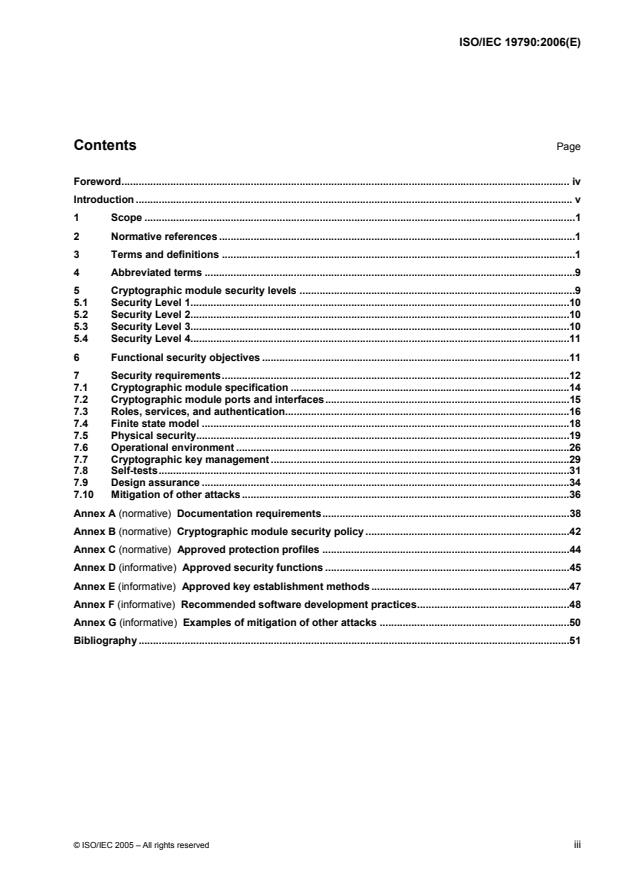
Contents Page
Foreword. iv
Introduction . v
1 Scope .1
2 Normative references .1
3 Terms and definitions .1
4 Abbreviated terms .9
5 Cryptographic module security levels .9
5.1 Security Level 1.10
5.2 Security Level 2.10
5.3 Security Level 3.10
5.4 Security Level 4.11
6 Functional security objectives .11
7 Security requirements.12
7.1 Cryptographic module specification .14
7.2 Cryptographic module ports and interfaces.15
7.3 Roles, services, and authentication.16
7.4 Finite state model .18
7.5 Physical security.19
7.6 Operational environment .26
7.7 Cryptographic key management.29
7.8 Self-tests.31
7.9 Design assurance .34
7.10 Mitigation of other attacks .36
Annex A (normative) Documentation requirements.38
Annex B (normative) Cryptographic module security policy .42
Annex C (normative) Approved protection profiles .44
Annex D (informative) Approved security functions .45
Annex E (informative) Approved key establishment methods .47
Annex F (informative) Recommended software development practices.48
Annex G (informative) Examples of mitigation of other attacks .50
Bibliography .51
© ISO/IEC 2005 – All rights reserved iii
Foreword
ISO (the International Organization for Standardization) and IEC (the International Electrotechnical
Commission) form the specialized system for worldwide standardization. National bodies that are members of
ISO or IEC participate in the development of International Standards through technical committees
established by the respective organization to deal with particular fields of technical activity. ISO and IEC
technical committees collaborate in fields of mutual interest. Other international organizations, governmental
and non-governmental, in liaison with ISO and IEC, also take part in the work. In the field of information
technology, ISO and IEC have established a joint technical committee, ISO/IEC JTC 1.
International Standards are drafted in accordance with the rules given in the ISO/IEC Directives, Part 2.
The main task of the joint technical committee is to prepare International Standards. Draft International
Standards adopted by the joint technical committee are circulated to national bodies for voting. Publication as
an International Standard requires approval by at least 75 % of the national bodies casting a vote.
Attention is drawn to the possibility that some of the elements of this document may be the subject of patent
rights. ISO and IEC shall not be held responsible for identifying any or all such patent rights.
ISO/IEC 19790 was prepared by Joint Technical Committee ISO/IEC JTC 1, Information technology,
Subcommittee SC 27, IT Security techniques.
iv © ISO/IEC 2006 – All rights reserved
Introduction
In Information Technology there is an ever-increasing need to use cryptographic mechanisms such as the
protection of data against unauthorised disclosure or manipulation, for entity authentication and for non-
repudiation. The security and reliability of such mechanisms are directly dependent on the cryptographic
modules in which they are implemented.
This International Standard provides for four increasing, qualitative levels of security requirements intended to
cover a wide range of potential applications and environments. The security requirements cover areas relative
to the design and implementation of a cryptographic module. These areas include cryptographic module
specification; cryptographic module ports and interfaces; roles, services, and authentication; finite state model;
physical security; operational environment; cryptographic key management; self-tests; design assurance; and
mitigation of other attacks.
The overall security level of a cryptographic module must be chosen to provide a level of security appropriate
for the security requirements of the application and environment in which the module is to be utilized and for
the security services that the module is to provide. The responsible authority in each organization should
ensure that their computer and telecommunication systems that utilize cryptographic modules provide an
acceptable level of security for the given application and environment. Since each authority is responsible for
selecting which approved security functions are appropriate for a given application, compliance with this
International Standard does not imply either full interoperability or mutual acceptance of compliant products.
The importance of security awareness and of making information security a management priority should be
communicated to all concerned.
Information security requirements vary for different applications; organizations should identify their information
resources and determine the sensitivity to and the potential impact of a loss by implementing appropriate
controls. Controls include, but are not limited to
• physical and environmental controls;
• software development;
• backup and contingency plans; and
• information and data controls.
These controls are only as effective as the administration of appropriate security policies and procedures
within the operational environment.
This International Standard will be revised later, if a new work item is approved, in order to improve the links
with Common Criteria scheme (ISO/IEC 15408).
This International Standard is derived from NIST Federal Information Processing Standard (FIPS) PUB 140-2
(see Bibliography [1]).
© ISO/IEC 2005 – All rights reserved v
INTERNATIONAL STANDARD ISO/IEC 19790:2006(E)
Information technology — Security techniques — Security
requirements for cryptographic modules
1 Scope
This International Standard specifies the security requirements for a cryptographic module utilized within a
security system protecting sensitive information in computer and telecommunication systems. This
International Standard defines four security levels for cryptographic modules to provide for a wide spectrum of
data sensitivity (e.g., low value administrative data, million dollar funds transfers, and life protecting data) and
a diversity of application environments (e.g., a guarded facility, an office, and a completely unprotected
location). Four security levels are specified for each of 10 requirement areas. Each security level offers an
increase in security over the preceding level.
While the security requirements specified in this International Standard are intended to maintain the security
provided by a cryptographic module, compliance to this International Standard is not sufficient to ensure that a
particular module is secure or that the security provided by the module is sufficient and acceptable to the
owner of the information that is being protected.
2 Normative references
The following referenced documents are indispensable for the application of this document. For dated
references, only the edition cited applies. For undated references, the latest edition of the referenced
document (including any amendments) applies.
ISO/IEC 15408 (all parts), Information technology — Security techniques — Evaluation criteria for IT security
ISO/IEC 18031, Information technology — Security techniques — Random bit generation
3 Terms and definitions
For the purposes of this document, the following terms and definitions apply.
3.1
approval authority
any national or international organisation/authority mandated to approve and/or evaluate security functions
3.2
approved
ISO/IEC approved or approval authority approved
3.3
approved mode of operation
mode of the cryptographic module that employs only approved security functions
NOTE Not to be confused with a specific mode of an approved security function, e.g., Cipher Block Chaining (CBC)
mode.
© ISO/IEC 2006 – All rights reserved 1
3.4
approved operating system
any operating system evaluated and approved by an approval authority
3.5
approved protection profile
any protection profile approved by an approval authority
3.6
ISO/IEC approved
security function that is either
• specified in an ISO/IEC standard or
• adopted/recommended in an ISO/IEC standard and specified either in an annex of the ISO/IEC
standard or in a document referenced by the ISO/IEC standard
3.7
asymmetric cryptographic technique
cryptographic technique that uses two related transformations — a public transformation (defined by the public
key) and a private transformation (defined by the private key) — which have the property that, given the public
transformation, it is computationally infeasible to derive the private transformation in a given limited time and
with a given limited computing power
3.8
authentication code
cryptographic checksum based on an approved security function
NOTE Also known as a Message Authentication Code (MAC).
3.9
certificate
entity's data rendered unforgettable with the private or secret key of a certification authority
3.10
compromise
unauthorised disclosure, modification, substitution, or use of CSPs or the unauthorised modification or
substitution of PSPs
3.11
confidentiality
property that information is not made available or disclosed to unauthorised entities
3.12
control information
information that is entered into a cryptographic module for the purposes of directing the operation of the
module
3.13
critical security parameter
CSP
secret or private security related information whose disclosure or modification can compromise the security of
a cryptographic module
EXAMPLE Secret and private cryptographic keys, authentication data such as passwords, PINs.
2 © ISO/IEC 2006 – All rights reserved
3.14
cryptographic boundary
explicitly defined continuous perimeter that establishes the physical and/or logical bounds of a cryptographic
module and contains all the hardware, software, and/or firmware components of a cryptographic module
3.15
cryptographic key
key
sequence of symbols that controls the operation of a cryptographic transformation
NOTE A cryptographic transformation may include but is not limited to encipherment, decipherment, cryptographic
check function computation, signature generation, or signature verification.
3.16
cryptographic key component
key component
parameter(s) used in a security function to perform a cryptographic function
3.17
cryptographic module
module
set of hardware, software, and/or firmware that implements security functions and is contained within the
cryptographic boundary
3.18
cryptographic module security policy
security policy
precise specification of the security rules under which a cryptographic module shall operate, including the
rules derived from the requirements of this International Standard and additional rules imposed by the module
NOTE See Annex B.
3.19
crypto officer
role taken by an individual or a process (i.e., subject) acting on behalf of an individual allowing cryptographic
initialisation or management functions of a cryptographic module to be performed
3.20
data path
physical or logical route over which data passes
NOTE A physical data path may be shared by multiple logical data paths.
3.21
differential power analysis
DPA
analysis of the variations of the electrical power consumption of a cryptographic module, for the purpose of
extracting information correlated to cryptographic operation
3.22
digital signature
data appended to, or a cryptographic transformation of a data unit that allows the recipient of the data unit to
prove the origin and integrity of the data unit and protect against forgery (e.g., by the recipient)
3.23
electronic key entry
entry of cryptographic keys into a cryptographic module using electronic methods such key loader or on line
means
NOTE The operator of the key may have no knowledge of the value of the key being entered.
© ISO/IEC 2006 – All rights reserved 3
3.24
electronic key transport
transfer of cryptographic keys, usually in encrypted form, using electronic means such as a computer network
3.25
encrypted key
cryptographic key that has been encrypted using an approved security function with a key encryption key
3.26
entity
person, a group, a device or a process
3.27
environmental failure protection
EFP
use of features to protect against a compromise of the security of a cryptographic module due to
environmental conditions or fluctuations outside of the module's normal operating range
3.28
environmental failure testing
EFT
use of specific methods to provide reasonable assurance that the security of a cryptographic module will not
be compromised by environmental conditions or fluctuations outside of the module's normal operating range
3.29
error detection code
EDC
value computed from data and comprised of redundant bits of information designed to detect, but not correct,
unintentional changes in the data
3.30
finite state model
FSM
mathematical model of a sequential machine that is comprised of a finite set of input events, a finite set of
output events, a finite set of states, a function that maps states and input to output, a function that maps states
and inputs to states (a state transition function), and a specification that describes the initial state
3.31
firmware
programs and data components of a cryptographic module that are stored in hardware within the
cryptographic boundary and cannot be dynamically written or modified during execution
EXAMPLE Storage hardware may include but is not limited to ROM, PROM, EEPROM, or FLASH.
3.32
hardware
physical equipment/components within the cryptographic boundary used to process programs and data
3.33
input data
information that is entered into a cryptographic module and may be used for the purposes of transformation or
computation using an approved security function
3.34
integrity
property that sensitive data has not been modified or deleted in an unauthorised and undetected manner
4 © ISO/IEC 2006 – All rights reserved
3.35
interface
logical entry or exit point of a cryptographic module that provides access to the module for logical information
flows
3.36
key encryption key
KEK
cryptographic key that is used for the encryption or decryption of other keys
3.37
key establishment
process of making available a shared secret key to one or more entities
NOTE Key establishment includes key agreement and key transport.
3.38
key loader
self-contained device that is capable of storing at least one plaintext or encrypted cryptographic key or key
component that can be transferred, upon request, into a cryptographic module
3.39
key management
administration and use of the generation, registration, certification, deregistration, distribution, installation,
storage, archiving, revocation, derivation and destruction of keying material in accordance with a security
policy
3.40
key transport
process of transferring a key from one entity to another entity
3.41
maintenance role
role assumed to perform physical maintenance and/or logical maintenance services
EXAMPLE Maintenance services may include but are not limited to hardware and/or software diagnostics.
3.42
manual key entry
entry of a cryptographic key into a cryptographic module, using a device such as a keyboard
3.43
manual key transport
out of band means of transporting cryptographic keys, such as a key loader
3.44
microcode
processor instructions that correspond to an executable program instruction
EXAMPLE Assembler code.
3.45
operator
individual or a process (subject) operating on behalf of the individual, authorised to assume one or more roles
3.46
output data
information produced by a cryptographic module
© ISO/IEC 2006 – All rights reserved 5
3.47
passivation
process in the construction of semiconductor devices in which junctions, surfaces of components and
integrated circuits are afforded a means of protection, which may modify circuit behaviour
NOTE 1 Silicon dioxide or phosphorus glass can be used for this purpose.
NOTE 2 Passivation material is technology dependent.
3.48
password
string of characters used to authenticate an identity or to verify access authorisation
EXAMPLE Letters, numbers, and other symbols.
3.49
personal identification number
PIN
numeric code used to authenticate an identity
3.50
physical protection
safeguarding of a cryptographic module, CSPs and PSPs using physical means
3.51
plaintext key
unencrypted cryptographic key
3.52
port
physical/logical input or output point of a cryptographic module that provides access to the module
3.53
private key
that key of an entity's asymmetric key pair which should only be used by that entity
NOTE In the case of an asymmetric signature system the private key defines the signature transformation. In the
case of an asymmetric encipherment system the private key defines the decipherment transformation.
3.54
production-grade
product, component or software that has been tested to meet operational specifications
3.55
protection profile
implementation-independent set of security requirements for a category of TOE that meet specific consumer
needs
3.56
public key
that key of an entity's asymmetric key pair which can be made public
NOTE In the case of an asymmetric signature system the public key defines the verification transformation. In the
case of an asymmetric encipherment system the public key defines the encipherment transformation. A key that is 'publicly
known' is not necessarily globally available. The key may only be available to all members of a pre-specified group.
3.57
public key certificate
public key information of an entity signed by an appropriate certification authority and thereby rendered
unforgeable
6 © ISO/IEC 2006 – All rights reserved
3.58
public security parameter
PSP
security related public information whose modification can compromise the security of a cryptographic module
EXAMPLE Public cryptographic keys, public key certificates, self-signed certificates, trust anchors, and one time
passwords associated with a counter.
3.59
random bit generator
RBG
device or algorithm that outputs a sequence of bits that appears to be statistically independent and unbiased
3.60
removable cover
physical means which permits access to the physical contents of a cryptographic module
3.61
role
security attribute associated with a user defining the user access rights or limitations to services of a
cryptographic module
NOTE One or more services may be associated with a role. A role may be associated with one or more users and a
user may assume one or more roles.
3.62
secret key
cryptographic key, used with a secret key cryptographic algorithm that is uniquely associated with one or more
entities and should not be made public
3.63
security function
cryptographic algorithms together with modes of operation, such as block ciphers, stream ciphers, asymmetric
key, message authentication codes, hash functions, or other security functions, random bit generators, entity
authentication and key establishment all approved either by ISO/IEC or an approval authority
NOTE See Annex D.
3.64
seed key
secret value used to initialise a cryptographic function or operation
3.65
simple power analysis
SPA
direct (primarily visual) analysis of patterns of instruction execution (or execution of individual instructions),
obtained through monitoring the variations in electrical power consumption of a cryptographic module, for the
purpose of revealing the features and implementations of cryptographic algorithms and subsequently the
values of cryptographic keys
3.66
software
programs and data components within the cryptographic boundary and usually stored on erasable media
which can be dynamically written and modified during execution
EXAMPLE Erasable media may include but are not limited to hard drives.
© ISO/IEC 2006 – All rights reserved 7
3.67
split knowledge
process by which a cryptographic key is split into multiple key components, individually sharing no knowledge
of the original key, that can be subsequently input into, or output from, a cryptographic module by separate
entities and combined to recreate the original cryptographic key
3.68
status information
information that is output from a cryptographic module for the purposes of indicating certain operational
characteristics or states of the module
3.69
symmetric cryptographic technique
cryptographic technique that uses the same secret key for both the encryption and the decryption
transformations
3.70
system software
general purpose software within the cryptographic boundary designed to facilitate the operation of the
cryptographic module
EXAMPLES Operating system, compilers and utility programs.
3.71
tamper detection
automatic determination by a cryptographic module that an attempt has been made to compromise the
security of the module
3.72
tamper evidence
external indication that an attempt has been made to compromise the security of a cryptographic module
NOTE The evidence of the tamper attempt should be observable.
3.73
tamper response
automatic action taken by a cryptographic module when tamper detection has occurred
3.74
target of evaluation
TOE
information technology product or system and associated administrator and user guidance documentation that
is the subject of a CC evaluation
3.75
TOE security functions
TSF
subset of the TOE consisting of all hardware, software, and firmware that must be relied upon for the correct
enforcement of the TOE security policy
3.76
TOE security policy
TSP
set of rules that regulate how assets are managed, protected, and distributed within a TOE
8 © ISO/IEC 2006 – All rights reserved
3.77
trust anchor
trusted information, which includes a public key algorithm, a public key value, an issuer name, and optionally,
other parameters
NOTE 1 Other parameters may include but are not limited to a validity period.
NOTE 2 A trust anchor may be provided in the form of a self-signed certificate.
3.78
trusted path
means by which a user and a TSF can communicate with necessary confidence to support the TSP
3.79
user
individual or process (subject) acting on behalf of the individual that accesses a cryptographic module in order
to obtain cryptographic services
3.80
zeroisation
method of destruction of stored data and CSPs to prevent retrieval and reuse
4 Abbreviated terms
For the purposes of this document, the following abbreviated terms apply.
API Application Program Interface
CAPP Controlled Access Protection Profile
CBC Cipher Block Chaining
EAL Evaluation Assurance Level
EDC Error Detection Code
HDL Hardware Description Language
IC Integrated Circuit
PROM Programmable Read-Only Memory
RAM Random Access Memory
ROM Read-Only Memory
5 Cryptographic module security levels
The following sub-clauses provide an overview of the four security levels. Common examples, given to
illustrate how the requirements might be met, are not intended to be restrictive or exhaustive. Within this
document, references to a module shall be interpreted as a cryptographic module.
© ISO/IEC 2006 – All rights reserved 9
5.1 Security Level 1
Security Level 1 provides the lowest level of security. Basic security requirements are specified for a
cryptographic module (e.g., at least one approved algorithm or approved security function shall be used). No
specific physical security mechanisms are required in a Security Level 1 cryptographic module beyond the
basic requirement for production-grade components. An example of a Security Level 1 cryptographic module
is a personal computer (PC) encryption board.
Security Level 1 allows the software and firmware components of a cryptographic module to be executed on a
general purpose computer system using an unevaluated operating system. Such implementations may be
appropriate for some low-level security applications when other controls, such as physical security, network
security, and administrative procedures are limited or nonexistent. The implementation of cryptographic
software may be more cost-effective than corresponding hardware-based mechanisms, enabling
organizations to select from alternative cryptographic solutions to meet lower-level security requirements.
5.2 Security Level 2
Security Level 2 enhances the physical security mechanisms of Security Level 1 by adding the requirement for
tamper-evidence, which includes the use of tamper-evident coatings or seals or pick-resistant locks on
removable covers or doors.
Tamper-evident coatings or seals are placed on a module so that the coating or seal must be broken to attain
physical access to Critical Security Parameters (CSPs) and/or Public Security Parameters (PSPs) within the
module. Tamper-evident seals or pick-resistant locks are placed on covers or doors to protect against
unauthorised physical access.
Security Level 2 requires, at a minimum, role-based authentication in which a cryptographic module
authenticates the authorisation of an operator to assume a specific role and perform a corresponding set of
services.
Security Level 2 allows the software and firmware components of a cryptographic module to be executed on a
general purpose computing system using an operating system that:
• meets the functional requirements specified in an approved protection profile (Annex C); and
• is evaluated at the ISO/IEC 15408 evaluation assurance level EAL2 (or higher).
An approved evaluated operating system may be used. It provides a level of trust so that cryptographic
modules executing on general purpose computing platforms are comparable to cryptographic modules
implemented using dedicated hardware systems.
5.3 Security Level 3
In addition to the tamper-evident physical security mechanisms required at Security Level 2, Security Level 3
attempts to prevent the intruder from gaining access to CSPs and/or PSPs held within the module. Physical
security mechanisms required at Security Level 3 are intended to have a high probability of detecting and
responding to attempts at physical access, use or modification of the cryptographic module. The physical
security mechanisms may include the use of strong enclosures and tamper detection/response circuitry that
zeroise all CSPs when the removable covers/doors of the cryptographic module are opened.
Security Level 3 requires identity-based authentication mechanisms, enhancing the security provided by the
role-based authentication mechanisms specified for Security Level 2. A cryptographic module authenticates
the identity of an operator and verifies that the identified operator is authorised to assume a specific role and
perform a corresponding set of services.
Security Level 3 requires the entry or output of CSPs (including the entry or output of CSPs using split-
knowledge techniques) to be performed using ports that are physically separated from other ports, or
interfaces that are logically separated using a trusted path from other interfaces. CSPs may be entered into or
10 © ISO/IEC 2006 – All rights reserved
output from the cryptographic module in encrypted form (in which case they may travel through enclosing or
intervening systems).
Security Level 3 allows the software and firmware components of a cryptographic module to be executed on a
general purpose computing system using an operating system that:
• meets the functional requirements specified in an approved protection profile (Annex C) with the
additional functional requirement of a Trusted Path (FTP_TRP.1); and
• is evaluated at the ISO/IEC 15408 evaluation assurance level EAL3 (or higher) with the additional
assurance requirement of an Informal Target of Evaluation (TOE) Security Policy Model
(ADV_SPM.1).
An approved evaluated trusted operating system may be used. The implementation of a trusted path protects
CSPs and the software and firmware components of the cryptographic module from other untrusted software
or firmware that may be executing on the system.
5.4 Security Level 4
Security Level 4 provides the highest level of security defined in this International Standard. At this level, the
physical security mechanisms provide a complete envelope of protection around the cryptographic module
with the intent of detecting and responding to all unauthorised attempts at physical access when CSPs and/or
PSPs are contained in the module whether external power is applied or not. Penetration of the cryptographic
module enclosure from any direction has a very high probability of being detected, resulting in the immediate
zeroisation of all CSPs. Security Level 4 cryptographic modules are useful for operation in physically
unprotected environments.
Security Level 4 also protects a cryptographic module against a security compromise due to environmental
conditions or fluctuations outside of the module's normal operating ranges for voltage and temperature.
Intentional excursions beyond the normal operating ranges may be used by an attacker to thwart a
cryptographic module's defences. A cryptographic module is required to either include special environmental
protection features designed to detect fluctuations and zeroise CSPs, or to undergo rigorous environmental
failure testing to provide a reasonable assurance that the module will not be affected by fluctuations outside of
the normal operating range in a manner that can compromise the security of the module.
Security Level 4 allows the software and firmware components of a cryptographic module to be executed on a
general purpose computing system using an operating system that:
• meets the functional requirements specified for Security Level 3; and
• is evaluated at the ISO/IEC 15408 evaluation assurance level EAL4 (or higher).
An approved evaluated trusted operating system may be used.
6 Functional security objectives
The security requirements specified in this International Standard relate to the secure design and
implementation of a cryptographic module. The requirements are derived from the following high-level
functional security objectives for a cryptographic module to:
• employ and correctly implement the approved security functions for the protection of sensitive
information;
• protect a cryptographic module from unauthorised operation or use;
• prevent the unauthorised disclosure of the contents of the cryptographic module, including CSPs;
© ISO/IEC 2006 – All rights reserved 11
• prevent the unauthorised and undetected modification of the cryptographic module and cryptographic
algorithms, including the unauthorised modification, substitution, insertion, and deletion of CSPs
and/or PSPs;
• provide indications of the operational state of the cryptographic module;
• ensure that the cryptographic module performs properly when operating in an approved mode of
operation; and
• detect errors in the operation of the module and to prevent the compromise of CSPs and/or PSPs
resulting from these errors.
7 Security requirements
This clause specifies the security requirements that shall be satisfied by cryptographic module's compliance to
this International Standard. The security requirements cover areas related to the design and implementation of
a cryptographic module. These areas include cryptographic module specification; module ports and interfaces;
roles, services, and authentication; finite state model; physical security; operational environment;
cryptographic key management; self-tests; and design assurance.
An additional area concerned with the mitigation of other attacks is currently not tested except at Security
Level 4, but it is required to document implemented controls (e.g., DPA). Table 1 summarizes the security
requirements in each of these areas.
A module shall be tested against the requirements of each area addressed in this clause. The cryptographic
module shall be independently rated in each area. Several areas provide for increasing levels of security with
cumulative security requirements for each security level. In these areas, the cryptographic module will receive
a rating that reflects the maximum-security level for which the module fulfils all of the requirements of that area.
In areas that do not provide for different levels of security (i.e., standard set of requirements), the
cryptographic module will receive a rating commensurate with the overall level of security.
In addition to receiving independent ratings for each of the security areas, a cryptographic module will also
receive an overall rating. The overall rating will indicate the minimum of the independent ratings received in
the areas.
Many of the security requirements of this International Standard include specific documentation requirements
that are summarized at Annex A. All documentation, including copies of the user and installation manuals,
shall be provided for evaluation.
12 © ISO/IEC 2006 – All rights reserved
Table 1 — Summary of security requirements
Security Level 1 Security Level 2 Security Level 3 Security Level 4
Cryptographic
Specification of cryptographic module, cryptographic boundary, approved algorithms, and approved modes of
Module operation. Description of cryptographic module, including all hardware, software, and firmware components.
Specification
Statement of module security policy.
Cryptographic
Required and optional interfaces. Specification of all Data ports for critical security parameters logically
Module Ports interfaces and of all input and output data paths. separated from other data ports.
and Interfaces
Roles, Services,
Logical separation of Role-based or identity- Identity-based operator authentication.
and required and optional based operator
Authentication
roles and services. authentication.
Finite State
Specification of finite state model. Required states and optional states. State transition diagram and specification
Model of state transitions.
Physical Production-grade Locks or tamper Tamper detection and Tamper detection and
Security
equipment. evidence. response for covers and response envelope. EFP or
doors. EFT.
Operational Single operator. Referenced PPs Referenced PPs plus Referenced PPs plus
Environment
Executable code. evaluated at EAL2 with trusted path evaluated at trusted path evaluated at
Approved integrity specified discretionary EAL3 plus security policy EAL4.
technique. access control modelling.
mechanisms and
auditing.
Cryptographic
Key management mechanisms: random bit and key generation, key establishment, key distribution key
Key entry/output, key storage and key zeroisation.
Management
Secret and private keys transported using manual Secret and private keys transported using manual
transport methods may be entered or output in transport methods shall be entered or output either
plaintext form. encrypted or using split knowledge procedures.
Self-Tests Power-up tests: cryptographic algorithm tests, software/firmware integrity tests, and critical functions tests.
Conditional tests.
Design
Configuration Secure distribution. High-level language Formal model. Detailed
Assurance management (CM). Functional specification. implementation. explanations (informal
Secure installation and proofs). Preconditions and
generation. Design and post conditions.
policy correspondence.
Guidance documents.
Specification of mitigation of attacks for which no testable requirements are
Mitigation of Specification of mitigation of
currently available.
other attacks
attacks with testable
requirements.
© ISO/IEC 2006 – All rights reserved 13
7.1 Cryptographic module specification
A cryptographic module shall be a set of hardware, software, firmware, or some combination thereof that
implements cryptographic functions or processes, and is contained within a defined cryptographic boundary. A
cryptographic module shall implement at least one approved security function used in an approved mode of
operation. Non-approved security functions may also be included for use in non-approved mode of operation
(i.e., not security relevant within the scope of the module). The operator shall be able to determine when an
approved mode of operation is selected. For Security Levels 1 and 2, the cryptographic module security policy
may specify when a cryptographic module is performing in an approved mode of operation. For Security
Levels 3 and 4, a cryptographic module shall indicate when an approved mode of operation is selected.
Approved security functions are listed at Annex D.
A cryptographic boundary shall consist of an explicitly defined perimeter that establishes the physical and/or
logical bounds of a cryptographic module. If a cryptographic module consists of software or firmware
components, the cryptographic boundary shall contain the processor(s) and other hardware components that
store and protect the software and firmware components. Hardware, software, and firmware components of a
cryptographic module can be excluded from the requirements of this International Standard if shown that
these components do not affect the security of the module.
The following documentation requirements shall apply to all security-specific hardware, software, and firmware
contained within a cryptographic module. These requirements do not apply to microcode or system software
whose source code is not available or to any hardware, software, or firmware components that can be shown
not to affect the security of the cryptographic module.
1. Documentation shall specify the hardware, software, and firmware components of a
cryptographic module, specify the cryptographic boundary surrounding these components, and
describe the physical configuration of the module (see clause 7.5).
2. Documentation shall specify any hardware, software, or firmware components of a cryptographic
module that are excluded from the security requirements of this International Standard and
explain the rationale for the exclusion.
3. Documentation shall specify the physical ports and logical interfaces and all defined input and
output data paths of a cryptographic module.
4. Documentation shall specify the manual or logical controls of a cryptographic module, physical or
lo
...
Questions, Comments and Discussion
Ask us and Technical Secretary will try to provide an answer. You can facilitate discussion about the standard in here.
Loading comments...