


ISO 26722:2009
(Main)Water treatment equipment for haemodialysis applications and related therapies
Water treatment equipment for haemodialysis applications and related therapies
ISO 26722:2009 is addressed to the manufacturer and/or provider of water treatment systems and/or devices used for the express purpose of providing water for haemodialysis or related therapies. ISO 26722:2009 covers devices used to treat water intended for use in the delivery of haemodialysis and related therapies. Included in the scope of this International Standard is water used for: (1) the preparation of concentrates from powder or other highly concentrated media at a dialysis facility; (2) the preparation of dialysis fluid that may be used for the preparation of substitution fluid; (3) the reprocessing of dialysers for multiple uses. Included within the scope of ISO 26722:2009 are all devices, piping and fittings between the point at which potable water is delivered to the water treatment system and the point of use of the dialysis water. Examples of devices included within the scope of this International Standard are water purification devices, online water quality monitors (such as conductivity monitors), and piping systems for the distribution of dialysis water.
Équipement de traitement de l'eau pour des applications en hémodialyse et aux thérapies apparentées
General Information
- Status
- Withdrawn
- Publication Date
- 14-Apr-2009
- Withdrawal Date
- 14-Apr-2009
- Technical Committee
- ISO/TC 150/SC 2 - Cardiovascular implants and extracorporeal systems
- Drafting Committee
- ISO/TC 150/SC 2 - Cardiovascular implants and extracorporeal systems
- Current Stage
- 9599 - Withdrawal of International Standard
- Start Date
- 17-Mar-2014
- Completion Date
- 12-Feb-2026
Relations
- Revised
ISO 26722:2014 - Water treatment equipment for haemodialysis applications and related therapies - Effective Date
- 14-Apr-2012
Get Certified
Connect with accredited certification bodies for this standard

BSI Group
BSI (British Standards Institution) is the business standards company that helps organizations make excellence a habit.

TÜV Rheinland
TÜV Rheinland is a leading international provider of technical services.

TÜV SÜD
TÜV SÜD is a trusted partner of choice for safety, security and sustainability solutions.
Sponsored listings
Frequently Asked Questions
ISO 26722:2009 is a standard published by the International Organization for Standardization (ISO). Its full title is "Water treatment equipment for haemodialysis applications and related therapies". This standard covers: ISO 26722:2009 is addressed to the manufacturer and/or provider of water treatment systems and/or devices used for the express purpose of providing water for haemodialysis or related therapies. ISO 26722:2009 covers devices used to treat water intended for use in the delivery of haemodialysis and related therapies. Included in the scope of this International Standard is water used for: (1) the preparation of concentrates from powder or other highly concentrated media at a dialysis facility; (2) the preparation of dialysis fluid that may be used for the preparation of substitution fluid; (3) the reprocessing of dialysers for multiple uses. Included within the scope of ISO 26722:2009 are all devices, piping and fittings between the point at which potable water is delivered to the water treatment system and the point of use of the dialysis water. Examples of devices included within the scope of this International Standard are water purification devices, online water quality monitors (such as conductivity monitors), and piping systems for the distribution of dialysis water.
ISO 26722:2009 is addressed to the manufacturer and/or provider of water treatment systems and/or devices used for the express purpose of providing water for haemodialysis or related therapies. ISO 26722:2009 covers devices used to treat water intended for use in the delivery of haemodialysis and related therapies. Included in the scope of this International Standard is water used for: (1) the preparation of concentrates from powder or other highly concentrated media at a dialysis facility; (2) the preparation of dialysis fluid that may be used for the preparation of substitution fluid; (3) the reprocessing of dialysers for multiple uses. Included within the scope of ISO 26722:2009 are all devices, piping and fittings between the point at which potable water is delivered to the water treatment system and the point of use of the dialysis water. Examples of devices included within the scope of this International Standard are water purification devices, online water quality monitors (such as conductivity monitors), and piping systems for the distribution of dialysis water.
ISO 26722:2009 is classified under the following ICS (International Classification for Standards) categories: 11.040.40 - Implants for surgery, prosthetics and orthotics. The ICS classification helps identify the subject area and facilitates finding related standards.
ISO 26722:2009 has the following relationships with other standards: It is inter standard links to ISO 26722:2014. Understanding these relationships helps ensure you are using the most current and applicable version of the standard.
ISO 26722:2009 is available in PDF format for immediate download after purchase. The document can be added to your cart and obtained through the secure checkout process. Digital delivery ensures instant access to the complete standard document.
Standards Content (Sample)
INTERNATIONAL ISO
STANDARD 26722
First edition
2009-04-15
Water treatment equipment for
haemodialysis applications and related
therapies
Équipement de traitement de l'eau pour des applications en
hémodialyse et aux thérapies apparentées
Reference number
©
ISO 2009
PDF disclaimer
This PDF file may contain embedded typefaces. In accordance with Adobe's licensing policy, this file may be printed or viewed but
shall not be edited unless the typefaces which are embedded are licensed to and installed on the computer performing the editing. In
downloading this file, parties accept therein the responsibility of not infringing Adobe's licensing policy. The ISO Central Secretariat
accepts no liability in this area.
Adobe is a trademark of Adobe Systems Incorporated.
Details of the software products used to create this PDF file can be found in the General Info relative to the file; the PDF-creation
parameters were optimized for printing. Every care has been taken to ensure that the file is suitable for use by ISO member bodies. In
the unlikely event that a problem relating to it is found, please inform the Central Secretariat at the address given below.
© ISO 2009
All rights reserved. Unless otherwise specified, no part of this publication may be reproduced or utilized in any form or by any means,
electronic or mechanical, including photocopying and microfilm, without permission in writing from either ISO at the address below or
ISO's member body in the country of the requester.
ISO copyright office
Case postale 56 • CH-1211 Geneva 20
Tel. + 41 22 749 01 11
Fax + 41 22 749 09 47
E-mail copyright@iso.org
Web www.iso.org
Published in Switzerland
ii © ISO 2009 – All rights reserved
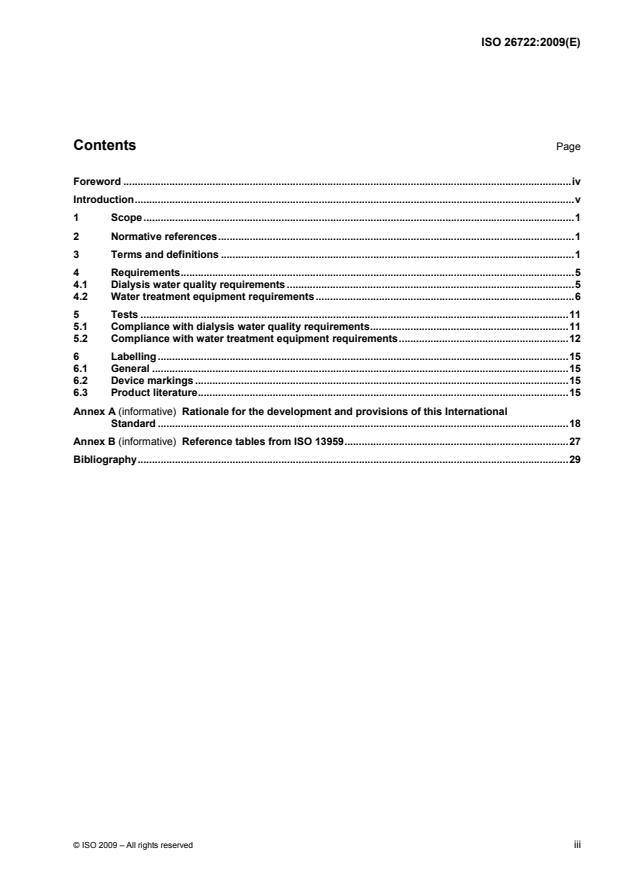
Contents Page
Foreword .iv
Introduction.v
1 Scope.1
2 Normative references.1
3 Terms and definitions .1
4 Requirements.5
4.1 Dialysis water quality requirements .5
4.2 Water treatment equipment requirements.6
5 Tests .11
5.1 Compliance with dialysis water quality requirements.11
5.2 Compliance with water treatment equipment requirements.12
6 Labelling.15
6.1 General .15
6.2 Device markings .15
6.3 Product literature.15
Annex A (informative) Rationale for the development and provisions of this International
Standard .18
Annex B (informative) Reference tables from ISO 13959.27
Bibliography.29
Foreword
ISO (the International Organization for Standardization) is a worldwide federation of national standards bodies
(ISO member bodies). The work of preparing International Standards is normally carried out through ISO
technical committees. Each member body interested in a subject for which a technical committee has been
established has the right to be represented on that committee. International organizations, governmental and
non-governmental, in liaison with ISO, also take part in the work. ISO collaborates closely with the
International Electrotechnical Commission (IEC) on all matters of electrotechnical standardization.
International Standards are drafted in accordance with the rules given in the ISO/IEC Directives, Part 2.
The main task of technical committees is to prepare International Standards. Draft International Standards
adopted by the technical committees are circulated to the member bodies for voting. Publication as an
International Standard requires approval by at least 75 % of the member bodies casting a vote.
Attention is drawn to the possibility that some of the elements of this document may be the subject of patent
rights. ISO shall not be held responsible for identifying any or all such patent rights.
ISO 26722 was prepared by Technical Committee ISO/TC 150, Implants for surgery, Subcommittee SC 2,
Cardiovascular implants and extracorporeal systems.
iv © ISO 2009 – All rights reserved
Introduction
This International Standard reflects the conscientious efforts of concerned physicians, clinical engineers,
nurses, dialysis technicians and dialysis patients, in consultation with device manufacturers and government
representatives, to develop an International Standard for performance levels that could be reasonably
achieved at the time of publication. The term “consensus,” as applied to the development of voluntary medical
device International Standards, does not imply unanimity of opinion, but rather reflects the compromise
necessary in some instances when a variety of interests must be merged.
The provisions of this International Standard apply to individual water treatment devices and to water
treatment systems assembled from one or more of these devices. In the first instance, this International
Standard is directed at the individual or company that specifies the complete water treatment system and,
second, at the supplier who assembles and installs the system. Since systems may be assembled from a
number of individual water treatment devices, the provisions of this International Standard are also directed at
the manufacturers of these devices, provided that the manufacturer indicates that the device is intended for
use in haemodialysis applications. This International Standard is written principally to address water treatment
systems for dialysis facilities treating multiple patients. However, many of its provisions equally apply to water
treatment systems used in applications where a single patient is treated, such as in a home dialysis or acute
hospital dialysis setting. Specifically, requirements for the chemical and microbiological quality of water are
considered to apply in all settings, regardless of whether a single patient or many patients are being treated.
The verbal forms used in this International Standard conform to usage described in Annex H of the ISO/IEC
Directives, Part 2. For the purposes of this International Standard, the auxiliary verb:
⎯ “shall” means that compliance with a requirement or a test is mandatory for compliance with this
International Standard;
⎯ “should” means that compliance with a requirement or a test is recommended but is not mandatory for
compliance with this International Standard;
⎯ “may” is used to describe a permissible way to achieve compliance with a requirement or test.
The requirements established by this International Standard will help protect haemodialysis patients from
adverse effects arising from known chemical and microbial contaminants found in water supplies. However,
proper dialysis and patient safety is ultimately dependent on the quality of the dialysis fluid. Since the
manufacturer or supplier of water treatment equipment does not have control over the dialysis fluid, any
reference to dialysis fluid in this International Standard is for clarification only and not a requirement of the
manufacturer. The responsibility for assuring that the dialysis fluid is not contaminated, mismatched, or
otherwise damaging to the patient rests with the clinical professionals caring for the patient under the
supervision of the medical director. Recommendations on the preparation and handling of water and dialysis
fluid in a dialysis facility are provided in ISO 23500.
INTERNATIONAL STANDARD ISO 26722:2009(E)
Water treatment equipment for haemodialysis applications and
related therapies
1 Scope
This International Standard is addressed to the manufacturer and/or supplier of water treatment systems
and/or devices used for the express purpose of providing water for haemodialysis or related therapies.
This International Standard covers devices used to treat water intended for use in the delivery of
haemodialysis and related therapies. Included in the scope of this International Standard is water used for: (1)
the preparation of concentrates from powder or other highly concentrated media at a dialysis facility; (2) the
preparation of dialysis fluid that may be used for the preparation of substitution fluid; (3) the reprocessing of
dialysers for multiple uses.
Included within the scope of this International Standard are all devices, piping and fittings between the point at
which potable water is delivered to the water treatment system and the point of use of the dialysis water.
Examples of devices included within the scope of this International Standard are water purification devices,
online water quality monitors (such as conductivity monitors), and piping systems for the distribution of dialysis
water.
Excluded from the scope of this International Standard are dialysis fluid supply systems that proportion water
and concentrates to produce dialysis fluid, sorbent dialysis fluid regeneration systems that regenerate and
recirculate small volumes of the dialysis fluid, dialysis concentrates, haemodiafiltration systems,
haemofiltration systems, systems that process dialysers for multiple uses, and peritoneal dialysis systems.
Some of these devices, such as dialysis fluid delivery systems and concentrates, are addressed in other
International Standards. Also excluded from the scope of this International Standard are requirements for the
ongoing monitoring of the purity of water used for dialysis fluid, concentrate preparation or dialyser
reprocessing.
2 Normative references
The following referenced documents are indispensable for the application of this document. For dated
references, only the edition cited applies. For undated references, the latest edition of the referenced
document (including any amendments) applies.
ISO 13959:2009, Water for haemodialysis and related therapies
3 Terms and definitions
For the purposes of this document, the following terms and definitions apply.
3.1
action level
concentration of a contaminant at which steps should be taken to interrupt the trend toward higher,
unacceptable levels
3.2
chlorine, combined
chlorine that is chemically combined, such as in chloramine compounds
NOTE No direct test exists for measuring combined chlorine, but it can be measured indirectly by measuring both
total and free chlorine and calculating the difference.
3.3
chlorine, free
dissolved molecular chlorine
3.4
chlorine, total
sum of combined chlorine (3.2) and free chlorine (3.3)
NOTE Chlorine can exist in water as dissolved molecular chlorine (free chlorine) or in chemically combined forms
(combined chlorine). Where chloramine is used to disinfect water supplies, chloramine is usually the principal component
of combined chlorine.
3.5
device
individual water purification unit, such as a softener, carbon adsorption bed, reverse osmosis unit or deionizer
NOTE This term is synonymous with the term “component” as used by the U.S. Food and Drug Administration (see
Reference [26]).
3.6
dialysis fluid
aqueous fluid containing electrolytes and usually buffer and glucose, which is intended to exchange solutes
with blood during haemodialysis
NOTE 1 The word “dialysis fluid” is used throughout this document to mean the fluid made from dialysis water and
concentrates which is delivered to the dialyser by the dialysis fluid delivery system. Such phrases as “dialysate,” “dialysis
solution,” or “dialysing fluid” may be used in place of dialysis fluid.
NOTE 2 The dialysis fluid entering the dialyser is referred to as “fresh dialysis fluid,” while the fluid leaving the dialyser
is referred to as “spent dialysis fluid.”
NOTE 3 Dialysis fluid does not include prepackaged parenteral fluids used in some renal replacement therapies, such
as haemodiafiltration and haemofiltration.
3.7
dialysis fluid delivery system
device that: (1) prepares dialysis fluid online from dialysis water and concentrates or that stores and
distributes premixed dialysis fluid; (2) circulates the dialysis fluid through the dialyser; (3) monitors the dialysis
fluid for temperature, conductivity (or equivalent), pressure, flow and blood leaks; (4) prevents dialysis during
disinfection or cleaning modes
NOTE 1 The term includes reservoirs, conduits, proportioning devices for the dialysis fluid, and monitors and
associated alarms and controls assembled as a system for the purposes listed above.
NOTE 2 The dialysis fluid supply system can be an integral part of the single patient dialysis machine or a centralized
preparation system which feeds multiple bedside monitoring systems.
NOTE 3 Dialysis fluid delivery systems are also known as proportioning systems and dialysis fluid supply systems.
3.8
dialysis water
water that has been treated to meet the requirements of ISO 13959 and which is suitable for use in
haemodialysis applications, including the preparation of dialysis fluid, reprocessing of dialysers, preparation of
concentrates and preparation of substitution fluid for online convective therapies
2 © ISO 2009 – All rights reserved
3.9
disinfection
destruction of pathogenic and other kinds of microorganisms by thermal or chemical means
NOTE 1 Disinfection is a less lethal process than sterilization, because it destroys most recognized pathogenic
microorganisms but does not necessarily destroy all microbial forms.
NOTE 2 This definition of “disinfection” is equivalent to low-level disinfection in the Spaulding classification.
3.10
empty bed contact time
EBCT
time taken by a fluid to pass through an empty volume equal to the volume of a particle bed
NOTE 1 EBCT (min) is calculated using the following equation:
EBCT = V/Q
where
V is the volume of the particle bed in cubic metres;
Q is the flowrate of water through the bed in cubic metres per minute.
NOTE 2 EBCT is used as an indirect measure of how much contact occurs between particles, such as activated
carbon, and water as the water flows through a bed of particles.
3.11
endotoxin
major component of the outer cell wall of gram-negative bacteria
NOTE Endotoxins are lipopolysaccharides, which consist of a polysaccharide chain covalently bound to lipid A.
Endotoxins can acutely activate both humoral and cellular host defences, leading to a syndrome characterized by fever,
shaking, chills, hypotension, multiple organ failure and even death if allowed to enter the circulation in a sufficient dose.
3.12
feed water
water supplied to a water treatment system or an individual component of a water treatment system
3.13
germicide
agent that kills microorganisms
3.14
haemodiafiltration
form of renal replacement therapy in which waste solutes are removed from blood by a combination of
diffusion and convection through a high-flux membrane
NOTE Diffusive solute removal is achieved using a dialysis fluid stream as in haemodialysis. Convective solute
removal is achieved by adding ultrafiltration in excess of that needed to obtain the desired weight loss; fluid balance is
maintained by infusing replacement solution into the blood either before (pre-dilution haemodiafiltration) or after the
dialyser (post-dilution haemodiafiltration).
3.15
haemodialysis
form of renal replacement therapy in which waste solutes are removed primarily by diffusion from blood
flowing on one side of a membrane into dialysis fluid flowing on the other side
NOTE Fluid removal that is sufficient to obtain desired weight loss is achieved by establishing a hydrostatic pressure
gradient across the membrane. This fluid removal provides some additional waste solute removal, particularly for higher
molecular weight solutes.
3.16
haemofiltration
form of renal replacement therapy in which waste solutes are removed from blood by convection
NOTE 1 Convective transport is achieved by ultrafiltration through a high-flux membrane. Fluid balance is maintained
by infusing a replacement solution into the blood either before the haemofilter (pre-dilution haemofiltration) or after the
haemofilter (post-dilution haemofiltration).
NOTE 2 There is no dialysis fluid stream in haemofiltration.
3.17
manufacturer
person who designs, manufactures, fabricates, assembles, formulates or processes a finished device
NOTE Manufacturers include, but are not limited to, those who perform the functions of contract sterilization,
installation, relabelling, remanufacturing, repacking or specification development, and initial distributors of foreign entities
performing these functions. The term does not cover preparation of concentrates from prepackaged dry chemicals at a
dialysis facility or the handling of bulk concentrates at a dialysis facility after responsibility for the concentrate is transferred
from the manufacturer to the user.
3.18
microbial
referring to microscopic organisms, bacteria, fungi and so forth
3.19
microfilter
filter designed to remove particles larger than 0,1 µm in size
NOTE Microfilters have an absolute size cut-off and are available in both dead-end and cross-flow configurations.
Some microfilters remove endotoxin by a process of adsorption and endotoxin aggregates greater than 0,1 µm in size may
be removed by size exclusion.
3.20
product water
water produced by a water treatment system or individual device thereof
3.21
source water
water entering a dialysis facility from an external supplier, such as a municipal water supply
NOTE Source water is assumed to be potable water.
3.22
total dissolved solids
TDS
sum of all ions in a solution, often approximated by means of electrical conductivity or resistivity
measurements
NOTE TDS measurements are commonly used to assess the performance of reverse osmosis units. TDS values are
often expressed in terms of CaCO , NaCl, KCl or 442 equivalents (mg/l). [442 is a solution of sodium sulfate (40 %),
sodium bicarbonate (40 %) and sodium chloride (20 %) that closely represents the conductivity to concentration
relationship, on average, for naturally occurring fresh water.]
3.23
user
physician or physician's representative responsible for the actual production and handling of dialysis fluid
NOTE This medical device International Standard is mainly directed to device manufacturers, and in that context the
“user” is as noted above.
4 © ISO 2009 – All rights reserved
3.24
water treatment system
collection of water purification devices and associated piping, pumps, valves, gauges, etc., that together
produce dialysis water meeting the requirements of ISO 13959 for haemodialysis applications and deliver it to
the point of use
NOTE See also device (3.5).
4 Requirements
4.1 Dialysis water quality requirements
4.1.1 General
The requirements contained in this International Standard apply to the dialysis water as it enters the
equipment used to prepare concentrates from powder or other concentrated media at a dialysis facility, to
prepare dialysis fluid, or to reprocess dialysers for multiple uses. As such, these requirements apply to the
water treatment system as a whole and not to each of the individual devices that make up the system.
However, collectively the individual devices shall produce dialysis water that, at a minimum, meets the
requirements of the clause.
4.1.2 Microbiology of dialysis water
Dialysis water used to prepare dialysis fluid or concentrates from powder at a dialysis facility, or to reprocess
dialysers for multiple uses, shall contain a total viable microbial count and endotoxin levels as specified in
ISO 13959.
The manufacturer or supplier of a complete water treatment and distribution system shall demonstrate that the
complete water treatment, storage and distribution system meets the requirements of this International
Standard, including those related to action levels, at the time of installation.
NOTE 1 If the manufacturer or supplier does not install the water storage and distribution system, then the
responsibility of the manufacturer or supplier is limited to demonstrating that the water treatment system, excluding the
water storage and distribution system, meets the requirements of this International Standard. If individual devices of the
water treatment system are provided by different manufacturers or suppliers, the person or organization specifying the
devices is responsible for demonstrating that the complete system meets the requirements of this International Standard
at the time of installation.
For disposable water treatment systems validated by the manufacturer to produce dialysis water meeting the
quality requirements of this International Standard for a specified time, monitoring of the incoming feed water
is required to assure that the input to the treatment system is in the range for which the system has been
validated. The manufacturer's recommendations for monitoring the final dialysis water may be followed when
the system is operated according to the manufacturer's instructions. Alternatively, the quality of the dialysis
water may be monitored as outlined for non-validated systems.
NOTE 2 Following installation of a water treatment, storage and distribution system, the user is responsible for
continued monitoring of the water bacteriology of the system and for complying with the requirements of this International
Standard, including those requirements related to action levels.
4.1.3 Maximum level of chemical contaminants
Dialysis water used to prepare dialysis fluid or concentrates from powder at a dialysis facility, or to reprocess
dialysers for multiple uses, shall not contain chemical contaminants at concentrations in excess of those in
Tables 1 and 2 of ISO 13959 (reproduced as Tables B.1 and B.2). The manufacturer or supplier of a complete
water treatment system shall recommend a system capable of meeting the requirements of this clause based
on the analysis of the feed water. The system design should reflect possible seasonal variations in feed water
quality. The manufacturer or supplier of a complete water treatment and distribution system shall demonstrate
that the complete water treatment, storage and distribution system is capable of meeting the requirements of
this International Standard at the time of installation.
NOTE 1 If the manufacturer or supplier does not install the water storage and distribution system, then the
responsibility of the manufacturer or supplier is limited to demonstrating that the water treatment system, excluding the
water storage and distribution system, meets the requirements of this International Standard. If individual devices of the
water treatment system are provided by different manufacturers or suppliers, the person or organization specifying the
devices is responsible for demonstrating that the complete system meets the requirements of this International Standard
at the time of installation.
For disposable water treatment and distribution systems that have been validated to produce dialysis water
meeting the quality requirements of this International Standard for a specified time, monitoring of the incoming
potable water is required to assure that the input to the treatment system is in the range for which the system
has been validated. The manufacturer's recommendation for monitoring the final dialysis water may be
followed when the system is operated according to the manufacturer's instructions. Alternatively, the quality of
the dialysis water may be monitored as outlined for non-validated systems.
NOTE 2 Following installation of a water treatment, storage and distribution system, the user is responsible for
continued monitoring of the levels of chemical contaminants in the water and for complying with the requirements of this
International Standard.
4.2 Water treatment equipment requirements
4.2.1 General
4.2.1.1 Water treatment system
The supplier of the feed water or the supplier of the water treatment system or a laboratory specified by the
user shall perform chemical analyses on feed water to determine the compatibility of the system with the feed
water and the suitability of the system for providing dialysis water meeting the requirements of 4.1.3. The
result of the chemical analyses shall be available to the user in charge of dialysis. In the case of an individual
device, the person incorporating the device into the water treatment system is responsible for ensuring that
incorporation of the device does not compromise the ability of the overall system to deliver dialysis water
capable of meeting the requirements of 4.1.2 and 4.1.3.
The water treatment and distribution system should include appropriate pressure gauges, flow meters, sample
ports, and other ancillary equipment necessary to allow monitoring of the performance of individual system
devices and the system as a whole.
Valves may be included in the water treatment system to allow individual devices to be bypassed when there
is device failure or to facilitate replacement of a device. If it is possible to bypass a device of the water
treatment system, then the manufacturer or installer of that component shall inform the user of the risks
associated with bypassing that device and the need for clearly defining the responsibility for operating the
bypass. Where such valves are installed, however, a means should be included to minimize the likelihood that
the device will be inadvertently bypassed during normal operation of the system.
Operating controls shall be positioned so as to minimize inadvertent resetting.
Electrical circuits shall be separate from hydraulic circuits and adequately protected from fluid leaks.
4.2.1.2 Materials compatibility
Materials that contact dialysis water (including materials used in piping, storage, and distribution systems)
shall not interact chemically or physically with that water so as to adversely affect its purity or quality. Water-
contacting surfaces shall be fabricated from non-reactive materials (e.g. plastics) or appropriate stainless steel.
The use of materials that are known to cause toxicity in haemodialysis, such as copper, brass, galvanized
material or aluminium, is specifically prohibited at any point beyond the water treatment device used to
remove contaminating metal ions, most commonly a reverse osmosis system or a deionizer. The materials of
any water treatment devices (including piping, storage and distribution systems) shall be compatible with the
means used to disinfect those devices. Chemicals infused into the water in the pre-treatment section, such as,
chlorine, acid, flocculants and complexing agents, shall be adequately removed from dialysis water before
they reach any point of use. Monitors or specific test procedures to verify removal of additives shall be
provided.
6 © ISO 2009 – All rights reserved
4.2.1.3 Regenerated or reconstituted devices
All devices that are regenerated or reconstituted at a site remote from the dialysis facility, such as deionizers,
shall be disinfected at the time of regeneration or reconstitution so that contaminated water is not reintroduced
into the system after regeneration or reconstitution. Separate processes shall be used to ensure no
intermixing of devices or their component parts between devices returned from medical or potable water users
and devices returned from non-potable water users.
4.2.1.4 Disinfection protection
When the manufacturer recommends chemical disinfectants [see 6.3 y)], means shall be provided to restore
the equipment and the system in which it is installed, to a safe condition relative to residual disinfectant prior
to the dialysis water being used for dialysis applications. When recommending chemical disinfectants, the
manufacturer shall also recommend methods for testing for residual levels of the disinfectants. When
disinfection is accomplished automatically by chemical disinfectant, including ozone, or by high temperature
procedures, activation of the disinfection system shall result in activation of a warning system and measures
to prevent patient exposure to an unsafe condition.
4.2.2 Backflow prevention device
All water treatment systems should be preceded by a backflow prevention device to isolate the system from
the potable water supply according to local plumbing codes.
4.2.3 Tempering valves
Tempering valves, if used, shall be sized to accommodate the anticipated range of flow rates of hot and cold
water. They shall be fitted with a mechanism to prevent backflow of water into the hot and cold water lines and
with a means to monitor the outlet water temperature.
4.2.4 Sediment filters
Sediment filters should have an opaque housing or other means to inhibit proliferation of algae. Filters should
be fitted with pressure gauges on the inlet and outlet water lines to monitor the pressure drop, ∆P, across the
filter.
NOTE Sediment filters are also known as multimedia or sand filters.
4.2.5 Cartridge filters
Cartridge filters should have an opaque housing or other means to inhibit proliferation of algae. Filters should
be fitted with pressure gauges on the inlet and outlet water lines to monitor the pressure drop, ∆P, across the
filter.
4.2.6 Softeners
Water softeners should be fitted with a mechanism to prevent water containing the high concentrations of
sodium chloride used during regeneration, from entering the product water line during regeneration. Automatic
regeneration may be performed on a volume schedule or on a time schedule. For softeners that are
regenerated automatically on a time schedule, the face of the timers used to control the regeneration cycle
should be visible to the user. Operating controls shall be positioned so as to minimize inadvertent resetting.
4.2.7 Anion exchange resin tank
Anion exchange resin, sometimes referred to as an organic scavenger, can remove organic matter and other
contaminants from the source water and protect carbon adsorption media from fouling, which can shorten its
effective life for chlorine/chloramine removal. If an organic scavenger is installed to protect the carbon media,
the scavenger should be installed upstream of the carbon beds. Anion exchange resins may also be used to
remove contaminants that might otherwise foul the reverse osmosis membrane.
4.2.8 Carbon adsorption media
Carbon adsorption is used to remove small organic compounds, chlorine and chloramine. When carbon
adsorption is used for the removal of chloramines, it shall be adapted specifically to the maximum anticipated
water flow rate of the system and the level of chloramines in the feed water.
Where chloramines are used to disinfect the potable water supply at a level of 1 mg/l or more, two carbon
adsorption beds shall be installed in series. Each of the carbon beds shall have an EBCT of at least 5 min at
the maximum product water flowrate (a total EBCT of at least 10 min). To avoid overly large beds, carbon
beds are sometimes arranged as parallel sets, each set consisting of two beds in series. The beds are equally
sized and water flows in parallel through each set. In this situation, each bed shall have a minimum EBCT of
5 min at the maximum flow rate through the bed. When parallel sets of beds are used, the piping should be
designed to minimize differences in the resistance to flow from inlet and outlet between each parallel set of
beds in order to ensure that water flows equally through all beds. A means shall be provided to sample the
product water from the first bed in each series-connected pair and a sample port should be installed following
the carbon beds for use in the event of total chlorine breaking through the first bed in a series-connected pair.
NOTE Carbon adsorption systems used to prepare water for portable dialysis systems are exempt from the
requirement for the second carbon and a 10 min EBCT, provided there is a redundant means of chloramine removal and
that a total chlorine concentration of less than 0,1 mg/l is verified in a sample collected after the primary device before
each treatment.
In situations where chloramines are not used to disinfect the water, and the ammonium level in the water is
low, one carbon adsorption bed or a carbon cartridge filter with a shorter EBCT might be sufficient.
Exhausted carbon adsorption media shall be discarded and replaced with new media according to a
replacement schedule determined by regular monitoring. For example, with two beds, when testing between
the beds shows that the first bed is exhausted, the second bed should be moved into the first position, the
second bed replaced with a new bed, and the exhausted bed discarded.
Granular activated carbon with an iodine number greater than 900 is considered optimal for
chlorine/chloramine removal. However, some source waters, such as those with a high organic content could
require alternate types of carbon that are more resistant to organic fouling. These types of carbon may have
iodine numbers less than 900. When other forms of carbon or granular activated carbon with an iodine
number of less than 900 are used, the manufacturer shall provide performance data to demonstrate that each
adsorption bed has the capacity to reduce the total chlorine concentration in the feed water to less than
0,1 mg/l when operating at the maximum anticipated flowrate for the maximum time interval between
scheduled testing of the product water for total chlorine. Regenerated carbon shall not be used.
Automatically backwashed carbon beds should be fitted with a mechanism to prevent water containing
chlorine or chloramines from entering the feed water line of downstream purification devices, such as reverse
osmosis, while the carbon beds are being backwashed. For carbon beds that are backwashed automatically
on a time schedule, the face of the timers used to control the backwash cycle should be visible to the user and
the timer should be set so that backwashing occurs when dialysis is not being performed.
4.2.9 Chemical injection systems
Sodium bisulphite injected into the source water can be an effective means of reducing chlorine and
chloramine concentrations. Ascorbic acid has also been used for this purpose. In addition, reducing the pH of
alkaline feed water by the injection of mineral acids can enhance the efficiency of granular activated carbon.
Chemical injection systems shall include a means of regulating the metering pump to control the addition of
chemical. This control system shall be designed to tightly control the addition of chemical. The control system
shall ensure that chemical is added only when water is flowing through the pre-treatment cascade and that it
is added in fixed proportion to the water flow or based on some continuously monitored parameter, such as
pH, using an automated control system. If an automated control system is used to inject the chemical, there
shall be an independent monitor of the controlling parameter. Monitors shall be designed so that the monitor
cannot be disabled while a patient is at risk, except for brief, necessary periods of manual control with the
operator in constant attention.
8 © ISO 2009 – All rights reserved
4.2.10 Reverse osmosis
When used to prepare water for haemodialysis applications, either alone or as the last stage in a purification
cascade, reverse osmosis systems shall be shown to be capable, at installation, of meeting the requirements
of 4.1, when tested with the typical feed water of the user, in accordance with the methods described in 5.1.
Reverse osmosis devices shall be equipped with online monitors that allow determination of product water
conductivity and should be equipped with monitors that determine rejection rate based on conductivity.
Monitors that display resistivity or total dissolved solids (TDS) could be used in place of conductivity monitors.
Resistivity, conductivity or TDS monitors shall be temperature-compensated, generally to 25 °C. Monitors
shall be designed so that the monitor cannot be disabled while a patient is at risk, except for brief, necessary
periods of manual control with the operator in constant attention.
When a reverse osmosis system is the last chemical purification process in the water treatment system, it
should include a means of preventing patient exposure to unsafe product water, such as diversion of the
product water to drain, in the event of a product water conductivity or rejection alarm. If the reverse osmosis
system does not have a means of preventing unsafe product water from entering the dialysis machines, the
product water conductivity monitor shall activate audible and/or visual alarms when the product water
conductivity exceeds the preset alarm limit. The alarms shall be situated so that they ensure a prompt
response by personnel in the patient care area. When an audible alarm is used, the sound emitted by the
audible alarm shall be at least 65 decibels (“A” scale) at 3 m and it shall not be possible to silence the alarm
for more than 180 s.
4.2.11 Deionization
Deionization systems, when used to prepare water for haemodialysis applications, shall be monitored
continuously with monitors generally temperature-compensated to 25 °C, to produce water of 1 MΩ⋅cm or
greater specific resistivity (or conductivity of 1 mS/cm or less). Monitors shall be designed so that the monitor
cannot be disabled while a patient is at risk, except for brief, necessary periods of manual control with the
operator in constant attention. An audible and visual alarm shall be activated when the product water
resistivity falls below 1 MΩ⋅cm and the product water stream shall be prevented from reaching any point of
use, for example by being diverted to a drain. The sound emitted by the audible alarm shall be at least
65 decibels (“A” scale) at 3 m and shall be audible in the patient care area. It shall not be possible to silence
these alarms for more than 180 s. Feed water for deionization systems shall be pretreated with activated
carbon adsorption, or a comparable alternative, to prevent nitrosamine formation. If a deionization system is
the last process in a water treatment system, it shall be followed by an endotoxin-retentive filter or other
bacteria- and endotoxin-reducing device.
NOTE The requirements given above for deionization might not apply to electrodeionization (EDI) technology, which
can be used as an alternative to deionization following reverse osmosis in haemodialysis applications.
4.2.12 Endotoxin-retentive filters
When an endotoxin-retentive filter is used in a water treatment system for haemodialysis applications, the
manufacturer of the filter shall disclose the performance of the filter and the conditions under which that
performance can be obtained. It is recommended that filters be configured in a cross-flow mode. However,
dead-end filters that have validated endotoxin and bacterial removal characteristics may also be used.
Endotoxin-retentive filters should have an opaque housing or other means to inhibit proliferation of algae.
Endotoxin-retentive filters should be fitted with a means of assessing filter integrity and fouling. One suitable
means is to monitor the pressure drop, ∆P, across the filter using pressure gauges on the inlet and outlet
water lines.
4.2.13 Storage and distribution of dialysis water
4.2.13.1 Piping systems
The dialysis water distribution system shall not contribute chemicals (such as aluminium, copper, lead and
zinc) or bacterial contamination to the product water. Dialysis water distribution systems should be designed
to minimize bacterial proliferation and biofilm formation, such as by using a continuous recirculation loop with
flow in the return line. Areas of stagnant flow (dead zones) in the loop system shall be avoided. Direct feed
systems shall include a means of verifiably preventing retrograde flow of water into the distribution loop from
the feed side of the reverse osmosis unit.
4.2.13.2 Storage tanks
When used, storage tanks should have a conical or bowl-shaped base and should drain from the lowest point
of the base. Bladder tanks and pressurized surge tanks should not be used in the dialysis water distribution
system. Storage tanks should have a tight-fitting lid and be vented through a hydrophobic 0,45 µm air filter.
Sight tubes should be avoided due to the possible growth of algae and fungi. If an overflow pipe is used it
shall be fitted with a means of preventing contamination. Means shall be provided to effectively disinfect any
storage tank installed in a dialysis water distribution system. An endotoxin-retentive filter, or some other form
of microbial control device, should be installed distal to the storage tank.
4.2.13.3 Ultraviolet irradiators
When used to control bacterial proliferation in dialysis water storage and distribution systems, UV irradiation
. 2
devices shall emit light at a wavelength of 254 nm and provide a dose of radiant energy of 30 mW sec/cm . If
the irradiator includes a calibrated ultraviolet intensity meter, the minimum dose of radiant energy should be at
. 2
least 16 mW sec/cm . The device shall be sized for the maximum anticipated flow rate according to the
manufacturer's instructions. UV irradiators should be followed by an endotoxin-retentive filter.
Ultraviolet irradiation can also be used to control bacteria in the pretreatment section of a water treatment
system, such as following carbon adsorption beds to reduce the bacterial burden presented to a reverse
osmosis unit.
To prevent the use of sublethal doses of radiation that could lead to the development of resistant strains of
bacteria, UV irradiators shall be equipped with a calib
...
МЕЖДУНАРОДНЫЙ ISO
СТАНДАРТ 26722
Первое издание
2009-04-15
Оборудование для обработки воды,
применяющейся при гемодиализе и
сопутствующей терапии
Water treatment equipment for haemodialysis applications and related
therapies
Ответственность за подготовку русской версии несёт GOST R
(Российская Федерация) в соответствии со статьёй 18.1 Устава ISO
Ссылочный номер
©
ISO 2009
Отказ от ответственности при работе в PDF
Настоящий файл PDF может содержать интегрированные шрифты. В соответствии с условиями лицензирования, принятыми
фирмой Adobe, этот файл можно распечатать или смотреть на экране, но его нельзя изменить, пока не будет получена
лицензия на интегрированные шрифты и они не будут установлены на компьютере, на котором ведется редактирование. В
случае загрузки настоящего файла заинтересованные стороны принимают на себя ответственность за соблюдение
лицензионных условий фирмы Adobe. Центральный секретариат ISO не несет никакой ответственности в этом отношении.
Adobe - торговый знак фирмы Adobe Systems Incorporated.
Подробности, относящиеся к программным продуктам, использованные для создания настоящего файла PDF, можно найти в
рубрике General Info файла; параметры создания PDF были оптимизированы для печати. Были приняты во внимание все
меры предосторожности с тем, чтобы обеспечить пригодность настоящего файла для использования комитетами-членами
ISO. В редких случаях возникновения проблемы, связанной со сказанным выше, просьба проинформировать Центральный
секретариат по адресу, приведенному ниже.
ДОКУМЕНТ ЗАЩИЩЕН АВТОРСКИМ ПРАВОМ
Все права сохраняются. Если не указано иное, никакую часть настоящей публикации нельзя копировать или использовать в
какой-либо форме или каким-либо электронным или механическим способом, включая фотокопии и микрофильмы, без
предварительного письменного согласия ISO по адресу ниже или представительства ISO в соответствующей стране.
Бюро авторского права ISO
Почтовый ящик 56 • CH-1211 Женева 20
Тел. + 41 22 749 01 11
Факс + 41 22 749 09 47
E-mail copyright@iso.org
Web www.iso.org
Опубликовано в Швейцарии
ii © ISO 2009 – Все права сохраняются
Содержание Страница
Предисловие .iv
Введение .v
1 Область применения .1
2 Нормативные ссылки .1
3 Термины и определения .1
4 Требования .6
4.1 Требования к качеству воды для диализа.6
4.2 Требования к оборудованию для обработки воды.7
5 Испытания.13
5.1 Соответствие требованиям к качеству воды для диализа.13
5.2 Соответствие требования к оборудованию для обработки воды.14
6 Этикетирование .17
6.1 Общие положения .17
6.2 Маркировка устройства.17
6.3 Литература о товаре .18
Приложение A (информативное) Обоснование разработки и пересмотра данного
международного стандарта.20
Приложение B (информативное) Справочные таблицы из ISO 13959.31
Библиография.35
Предисловие
Международная организация по стандартизации (ISO) является всемирной федерацией национальных
организаций по стандартизации (комитетов-членов ISO). Разработка международных стандартов
обычно осуществляется техническими комитетами ISO. Каждый комитет-член, заинтересованный в
деятельности, для которой был создан технический комитет, имеет право быть представленным в этом
комитете. Международные правительственные и неправительственные организации, имеющие связи с
ISO, также принимают участие в работах. Что касается стандартизации в области электротехники, то
ISO работает в тесном сотрудничестве с Международной электротехнической комиссией (IEC).
Проекты международных стандартов разрабатываются в соответствии с правилами Директив ISO/IEC,
Часть 2.
Основная задача технических комитетов заключается в подготовке международных стандартов.
Проекты международных стандартов, принятые техническими комитетами, рассылаются комитетам-
членам на голосование. Их опубликование в качестве международных стандартов требует одобрения
не менее 75 % комитетов-членов, принимающих участие в голосовании.
Следует иметь в виду, что некоторые элементы настоящего международного стандарта могут быть
объектом патентных прав. ISO не может нести ответственность за идентификацию какого-либо одного
или всех патентных прав.
ISO 26722 был подготовлен Техническим комитетом ISO/TC 150, Имплантаты для хирургии,
Подкомитетом SC 2, Сердечнососудистые имплантаты и экстракорпоральные системы.
iv © ISO 2009 – Все права сохраняются
Введение
Данный международный стандарт отражает сознательные усилия заинтересованных врачей,
клинических инженеров, медсестер, обслуживающего персонала при диализе и пациентов на диализе
при консультациях с производителями изделий и представителями правительства по разработке
стандарта на уровне рабочих характеристик, которые могут быть реально достигнуты на момент
публикации. Термин “согласие” в приложении к разработке добровольных международных стандартов
на медицинские изделия не подразумевает единства мнений, а скорее отражает компромисс,
необходимый по некоторым вопросам, когда необходимо согласовать различные интересы.
Положения данного международного стандарта применяются к отдельным устройствам для обработки
воды и к системам для обработки воды, собранным из одного или нескольких подобных устройств. В
первую очередь, данный международный стандарт адресован лицам или компаниям, которые
определяют полную систему обработки воды, и, во вторую очередь, поставщикам, которые собирают и
устанавливают систему. Т.к. системы могут собираться из набора отдельных устройств для обработки
воды, положения данного международного стандарта также адресованы производителям этих изделий
при условии, что производитель указывает, что устройство предназначено для использования при
гемодиализе. Данный международный стандарт принципиально написан так, чтобы касаться систем
для обработки воды для отделений диализа для многих пациентов. Тем не менее, многие из его
положений в равной степени применяются и к системам обработки воды, используемым, когда
процедура проводиться для одного пациента, как в случае домашнего диализа или экстренных случаях
диализа в больнице. В частности, полагается, что требования к химическому и микробиологическому
качеству воды применяются во всех случаях, независимо от того, проводится ли процедура для одного
или нескольких пациентов.
Глагольные формы, используемые в данном международном стандарте, соответствуют
использованию, описанному в Приложении Н Директив ISO/IEC, Часть 2. В рамках данного
международного стандарта вспомогательный глагол:
⎯ "должен" означает, что соответствие требованию или испытанию обязательно для соответствия
данному международному стандарту;
⎯ "следует" означает, что соответствие требованию или испытанию желательно, но не обязательно
для соответствия данному международному стандарту; и
⎯ "может" используется для описания возможных способов достижения соответствия требованиям
или испытаниям.
Требования, установленные данным международным стандартом, помогут защитить пациентов на
гемодиализе от негативного влияния известных химических и микробиологических загрязнителей,
обнаруживаемых в поставляемой воде. Тем не менее, качество диализа и безопасность пациента, в
конечном итоге, зависят от качества диализирующего раствора. Так как производитель или поставщик
оборудования для обработки воды не контролируют диализирующий раствор, любые ссылки на
диализирующий раствор в данном международном стандарте приведены только для пояснения и не
являются требованиями к производителю. Ответственность за обеспечение того, что диализирующий
раствор не загрязнен, правильно подобран и не причинит никакого другого вреда для пациента,
возлагается на медицинский персонал, обслуживающий пациента под контролем медицинского
руководства. Рекомендации по подготовке и обслуживанию воды и диализирующего раствора в
отделениях диализа приведены в ISO 23500.
МЕЖДУНАРОДНЫЙ СТАНДАРТ ISO 26722:2009(R)
Оборудование для обработки воды, применяющейся при
гемодиализе и сопутствующей терапии
1 Область применения
Данный международный стандарт адресован производителям и/или поставщикам систем и/или
устройств обработки воды, используемых в целях обеспечения водой для гемодиализа или
сопутствующей терапии.
Данный международный стандарт покрывает изделия, используемые для обработки воды,
предназначенной для обеспечения гемодиализа и сопутствующей терапии. В область применения
данного международного стандарта включена вода, используемая для: (1) подготовки концентратов из
порошка или других сильно концентрированных сред в отделении диализа; (2) подготовки
диализирующего раствора, который может использоваться для подготовки замещающей жидкости; (3)
повторной обработки диализатора для многократного использования.
В область применения данного международного стандарта включены все изделия, трубы и соединения
между точкой, в которую поставляется питьевая вода для системы обработки воды, и точкой
использования диализирующего раствора. Примерами изделий, включенных в область применения
данного международного стандарта, являются устройства очистки воды, online мониторы качества
воды (такие как контролирующие устройства электропроводности) и системы трубопроводов для
распределения диализирующего раствора.
Исключены из области применения данного международного стандарта системы поставки
диализирующего раствора, которые смешивают воду и концентраты для производства
диализирующего раствора, системы регенерации диализирующего раствора на основе сорбентов, в
которых регенерируются и рециркулируют малые объемы диализирующего раствора, концентраты для
диализа, системы гемодиафильтрации, системы гемофильтрации, системы, которые обрабатывают
диализаторы для многократного использования, и системы для перитонеального диализа. Некоторые
из этих изделий, такие как системы доставки диализирующих растворов и концентраты,
рассматриваются в других международных стандартах. Также исключены из области применения
данного международного стандарта требования к текущему контролю чистоты воды, используемой для
диализирующего раствора, подготовки концентратов или повторной обработки диализатора.
2 Нормативные ссылки
Ссылка на следующие документы обязательна при использовании данного документа. Для жестких
ссылок применяются только указанное по тексту издание. Для плавающих ссылок необходимо
использовать самое последнее издание нормативного ссылочного документа (включая любые
изменения).
ISO 13959, Вода для гемодиализа и сопутствующей терапии
3 Термины и определения
В рамках данного документа применяются следующие термины и определения.
3.1
пороговый уровень
action level
концентрация примеси, при которой следует принять меры, чтобы не допустить повышения до
неприемлемого уровня
3.2
хлор, связанный
chlorine, combined
химически связанный хлор, такой как в составе хлорамина
ПРИМЕЧАНИЕ Не существует прямых методов испытания для измерения количества связанного хлора, но оно
может быть косвенно измерено путем измерения количества общего и свободного хлора и вычисления разницы.
3.3
хлор, свободный
chlorine, free
растворенный молекулярный хлор
3.4
хлор, общий
chlorine, total
сумма связанного хлора (3.2) и свободного хлора (3.3)
ПРИМЕЧАНИЕ Хлор может присутствовать в воде в виде растворенного молекулярного хлора (свободный
хлор) или в форме химических соединений (связанный хлор). Если хлорамин используется для дезинфекции
поступающей жидкости, то он обычно является основным компонентом связанного хлора.
3.5
устройство
device
отдельный блок очистки воды, такой как смягчитель, блок адсорбции углем, блок обратного осмоса или
деионизатор
ПРИМЕЧАНИЕ Данный термин является синонимом термина “компонент”, как его использует Управление по
контролю за продуктами и лекарствами США (см. Ссылку [26]).
3.6
диализирующий раствор
dialysis fluid
жидкость на водной основе, содержащая электролиты и обычно буфер и глюкозу, предназначенная
для обмена между кровью и раствором при гемодиализе
ПРИМЕЧАНИЕ 1 Термин “диализирующий раствор” используется на протяжении данного документа в значении
жидкости, приготовленной из воды для диализа и концентратов, доставляемой в диализатор через систему
доставки диализирующего раствора. В значении диализирующего раствора могут использоваться такие фразы как
“диализат”, “раствор для диализа”, или “диализирующая жидкость”.
ПРИМЕЧАНИЕ 2 Диализирующий раствор, вводимый в диализатор, считается “свежим диализирующим
раствором”, а жидкость, выводимая из диализатора, считается “использованным диализирующим раствором”.
ПРИМЕЧАНИЕ 3 Диализирующий раствор не включает предварительно упакованные парентеральные жидкости,
используемые при некоторых видах заместительной терапии функции почек, таких как гемодиафильтрация и
гемофильтрация.
2 © ISO 2009 – Все права сохраняются
3.7
система доставки диализирующего раствора
dialysis fluid delivery system
устройство, которое: (1) подготавливает диализирующий раствор из воды для диализа и концентратов
в режиме реального времени или хранит и распределяет предварительно смешанный диализирующий
раствор; (2) обеспечивает циркуляцию диализирующего раствора по диализатору; (3) контролирует
температуру, проводимость (или эквивалент), давление и поток диализирующего раствора и утечки
крови; (4) препятствуют диализу в режимах дезинфекции или чистки
ПРИМЕЧАНИЕ 1 Термин включает резервуары, каналы, дозаторы жидкости для диализа и мониторы и
связанные аварийные сигнализации и контролирующие устройства, собранные как система для целей,
перечисленных выше.
ПРИМЕЧАНИЕ 2 Система доставки диализирующего раствора может быть встроенной частью машины для
диализа отдельного пациента или централизованной системой подготовки, которая питает множество систем
прикроватного контроля.
ПРИМЕЧАНИЕ 3 Система доставки диализирующего раствора также известна как система дозирования и
система поставки диализирующего раствора.
3.8
вода для гемодиализа
dialysis water
вода, обработанная для соответствия требованиям ISO 13959, подходящая для использования в
приложении к гемодиализу, включая подготовку диализирующего раствора, повторную обработку
диализатора, подготовку концентратов и подготовку жидкостей, подходящих для конвекционной
терапии в режиме реального времени
3.9
дезинфекция
disinfection
разрушение патогенных и других видов микроорганизмов температурными или химическими
средствами
ПРИМЕЧАНИЕ 1 Дезинфекция – это менее летальный процесс, чем стерилизация, т.к. она разрушает
большинство известных патогенных микроорганизмов, но не обязательно разрушает все формы микроорганизмов.
ПРИМЕЧАНИЕ 2 Данное определение “дезинфекции” эквивалентно дезинфекции низкого уровня по
классификации Сполдинга.
3.10
время контакта частиц с водой
empty bed contact time
EBCT
время, необходимое жидкости для прохождения через пустой объем, равный объему емкости,
заполненной частицами
ПРИМЕЧАНИЕ 1 EBCT (мин) вычисляется, используя следующее выражение:
EBCT = V/Q
где
V объему емкости, заполненной частицами, в кубических метрах;
Q скорость потока воды через емкость в кубических метрах в минуту.
ПРИМЕЧАНИЕ 2 EBCT используется как непрямое измерение того, насколько возникает контакт между
частицами, такими как активированный уголь, и водой, как водой, протекающей через емкость, заполненную
частицами.
3.11
эндотоксины
endotoxin
основной компонент внешней стенки клеток грамотрицательных бактерий
ПРИМЕЧАНИЕ Эндотоксины – это липополисахариды, которые состоят из цепочек полисахаридов, ковалентно
связанных с липидами A. Эндотоксины могут резко активировать как гуморальный, так и клеточный иммунитет,
приводящий к синдрому, характеризующемуся лихорадкой, дрожью, ознобом, гипотензией, полиорганной
недостаточностью и даже смертью, если допустить проникновение в систему кровообращения в достаточном
количестве.
3.12
подаваемая вода
feed water
вода, подаваемая в систему обработки воды или отдельный компонент системы обработки воды
3.13
гермицид
germicide
вещество, которое убивает микроорганизмы
3.14
haemodiafiltration
гемодиафильтрация
haemodiafiltration
форма заместительной терапии функции почек, при которой ненужные растворенные вещества
удаляются из крови путем комбинирования диффузии и конвекции через высокопоточную мембрану
ПРИМЕЧАНИЕ Диффузное перемещение растворенных веществ достигается, используя поток
диализирующего раствора в диализаторе. Конвективный перенос растворенных веществ достигается
добавлением ультрафильтрации с уровнем, превышающим необходимый для получения требуемой потери веса;
баланс жидкости поддерживается инфузией замещающей жидкости в кровь либо перед диализатором
(гемофильтрация с предварительным разведением) либо после диализатора (гемофильтрация с последующим
разведением).
3.15
гемодиализ
haemodialysis
форма заместительной терапии функции почек, при которой ненужные растворенные вещества
удаляются в первую очередь за счет диффузии из кровеносного потока с одной стороны мембраны в
поток диализирующего раствора с другой стороны
ПРИМЕЧАНИЕ Удаление жидкости, достаточное для получения требуемой потери веса, достигается
установкой градиента гидростатического давления через мембрану. Данное удаление жидкости обеспечивает
некоторое дополнительное удаление ненужных растворенных веществ, в частности высокомолекулярных
растворенных веществ.
3.16
гемофильтрация
haemofiltration
форма заместительной терапии функции почек, при которой ненужные растворенные вещества
удаляются из крови путем конвекции
ПРИМЕЧАНИЕ 1 Конвективный перенос достигается за счет ультрафильтрации через высокопоточную
мембрану. Баланс жидкости поддерживается инфузией замещающей жидкости в кровь либо перед гемофильтром
(гемофильтрация с предварительным разведением) либо после гемофильтра (гемофильтрация с последующим
разведением).
ПРИМЕЧАНИЕ 2 При гемофильтрации отсутствует поток диализирующего раствора.
4 © ISO 2009 – Все права сохраняются
3.17
производитель
manufacturer
организация, разрабатывающая, производящая, монтирующая, собирающая, изготовляющая или
обрабатывающая конечное изделие
ПРИМЕЧАНИЕ Производители включают, но не ограничиваются, теми, кто выполняет функции стерилизации
по контракту, установки, повторного этикетирования, повторного производства, повторной упаковки или
разработки спецификации, и начальных дистрибьюторов иностранных организаций, выполняющих эти функции.
Термин не покрывает подготовку концентратов из предварительно упакованных сухих химических элементов в
диализных отделениях или обслуживание концентратов в крупной таре в диализных отделениях после того, как
ответственность за концентраты передана от производителя пользователю.
3.18
микробиологический
microbial
относящийся к микроскопическим организмам, бактериям, грибам и т.д.
3.19
микрофильтр
microfilter
фильтр, разработанный для удаления частиц размером 0,1 мкм
ПРИМЕЧАНИЕ Микрофильтры имеют абсолютное значение отсечения и доступны как в поперечно-проточной
конфигурации, так и в тупиковой. Некоторые микрофильтры удаляют эндотоксины в процессе адсорбции и
агрегаты эндотоксинов размером более 0,1 мкм могут удаляться за счет исключения на основании размеров.
3.20
обработанная вода
product water
вода, полученная из системы обработки воды или отдельного устройства для обработки воды
3.21
исходная вода
source water
вода, поступающая в отделение диализа от внешнего поставщика, такого как система городского
водоснабжения
ПРИМЕЧАНИЕ Предполагается, что исходная вода является питьевой водой.
3.22
общее количество растворённых частиц
total dissolved solids
TDS
сумма всех ионов в растворе, часто приблизительная на основании измерений электропроводимости
или сопротивления
ПРИМЕЧАНИЕ Измерения TDS обычно используются для оценки рабочих характеристик блоков обратного
осмоса. Значения TDS часто выражаются в терминах CaCO , NaCl, KCl или 442 эквивалента (мг/л). [442 – это
раствор сульфата натрия (40 %), бикарбоната натрия (40 %) и хлорида натрия (20 %), который достаточно точно
представляет взаимосвязь проводимости от концентрации, в среднем, для природной пресной воды]
3.23
пользователь
user
врач или представитель врача, ответственный за корректное производство и обслуживание
диализирующего раствора
ПРИМЕЧАНИЕ Данный международный стандарт на медицинские изделия направлен в первую очередь на
производителей изделий и в данном контексте “пользователь” определяется, как описано выше.
3.24
система обработки воды
water treatment system
набор устройств очистки воды и сопутствующих труб, насосов, клапанов, датчиков и т.д., которые
вместе производят воду для диализа, удовлетворяющую требованиям ISO 13959, для применений при
гемодиализе и доставляют ее в точку использования
ПРИМЕЧАНИЕ См. также устройство (3.5).
4 Требования
4.1 Требования к качеству воды для диализа
4.1.1 Общие положения
Требования, содержащиеся в данном международном стандарте, применяются к воде для диализа как
к веществу, поступающему в оборудование, используемое для подготовки концентратов из порошков
или других концентрированных сред в отделении диализа, для подготовки диализирующего раствора и
для повторной обработки диализатора многократного использования. Учитывая это, эти требования
применяются к системам обработки воды в целом, а не к отдельным устройствам, составляющим
данную систему. Тем не менее, совместно отдельные устройства должны производить воду для
диализа, которая, как минимум, соответствует требованиям раздела.
4.1.2 Микробиологические характеристики воды для диализа
В воде для диализа, используемой для подготовки диализирующего раствора или концентратов из
порошка в отделении диализа или для повторной обработки диализатора многократного
использования, общее число жизнеспособных микробов и уровень эндотоксинов должны
соответствовать значениям, определенным в ISO 13959.
Производитель или поставщик полной системы обработки и распределения воды должен
продемонстрировать, что полная система обработки, хранения и распределения воды соответствует
требованиям данного международного стандарта, включая требования, касающиеся пороговых
уровней, на момент установки.
ПРИМЕЧАНИЕ 1 Если производитель или поставщик не устанавливают систему хранения и распределения воды,
ответственность производителя или поставщика ограничивается демонстрацией того, что система обработки
воды, исключая систему хранения и распределения воды, соответствует требованиям данного международного
стандарта. Если отдельные устройства системы обработки воды поставляются различными производителями или
поставщиками, ответственность за демонстрацию того, что полная система соответствует требованиям данного
международного стандарта на момент установки, несет лицо или организация, специфицировавшая устройство.
Для одноразовых систем обработки воды, валидированных производителем на производство воды для
диализа, удовлетворяющей требованиям к качеству данного международного стандарта в течение
определенного времени, требуется контроль подаваемой воды для гарантии того, что входные
параметры в систему обработки лежат в диапазоне, для которого система была валидирована.
Рекомендации производителя по контролю конечной воды для диализа можно соблюдать при работе
системы в соответствии с инструкциями производителя. Альтернативно, качество воды для диализа
можно контролировать как описанное для невалидированных систем.
ПРИМЕЧАНИЕ 2 После установки системы обработки, хранения и распределения воды, ответственность за
продолжение контроля бактериологических характеристик воды в системе и за соответствие требованиям данного
международного стандарта, включая требования, касающееся пороговых уровней, лежит на пользователе.
4.1.3 Максимальный уровень химических примесей
Вода для диализа, используемая для подготовки диализирующего раствора или концентратов из
порошка в отделении диализа или для повторной обработки диализатора многократного
6 © ISO 2009 – Все права сохраняются
использования не должна содержать химических примесей в концентрациях, превышающих описанные
в Таблицах 1 и 2 ISO 13959 (воспроизведено в Таблицах B.1 и B.2). Производитель или поставщик
полной системы обработки воды должен рекомендовать систему, способную удовлетворять
требованиям данного раздела, основываясь на анализе подаваемой воды. Конструкция системы
должна учитывать возможные сезонные изменения в подаваемой воде. Производитель или поставщик
полной системы обработки и распределения воды должен продемонстрировать, что полная система
обработки, хранения и распределения воды способна соответствовать требованиям данного
международного стандарта на момент установки.
ПРИМЕЧАНИЕ 1 Если производитель или поставщик не устанавливают систему хранения и распределения воды,
ответственность производителя или поставщика ограничивается демонстрацией того, что система обработки
воды, исключая систему хранения и распределения воды, соответствует требованиям данного международного
стандарта. Если отдельные устройства системы обработки воды поставляются различными производителями или
поставщиками, ответственность за демонстрацию того, что полная система соответствует требованиям данного
международного стандарта на момент установки, несет лицо или организация, специфицировавшая устройство.
Для одноразовых систем обработки воды, валидированных производителем на производство воды для
диализа, удовлетворяющей требованиям к качеству данного международного стандарта в течение
определенного времени, требуется контроль подаваемой воды для гарантии того, что входные
параметры в систему обработки лежат в диапазоне, для которого система была валидирована.
Рекомендации производителя по контролю конечной воды для диализа можно соблюдать при работе
системы в соответствии с инструкциями производителя. Альтернативно, качество воды для диализа
можно контролировать как описанное для невалидированных систем.
ПРИМЕЧАНИЕ 2 После установки системы обработки, хранения и распределения воды, ответственность за
продолжение контроля уровня химических примесей в воде и за соответствие требованиям данного
международного стандарта, лежит на пользователе.
4.2 Требования к оборудованию для обработки воды
4.2.1 Общие положения
4.2.1.1 Система для обработки воды
Поставщик подаваемой воды или поставщик системы обработки воды или лабораторий, определенная
пользователем, должна провести химический анализ подаваемой воды, чтобы определить
совместимость системы с подаваемой водой и насколько подходит система для обеспечения водой
для диализа, удовлетворяющей требованиям 4.1.3. Результаты химического анализа должны быть
доступны пользователю при запуске диализа. В случае индивидуального устройства, лицо,
включающее устройство в систему обработки воды ответственно за проверку того, что включение
устройства не нарушает возможности всей системы доставлять воду для диализа, способную
удовлетворить требованиям 4.1.2 и 4.1.3.
Система обработки и распределения воды должна включать соответствующие датчики давления,
флоуметры, порты забора образцов, и другое вспомогательное оборудование, необходимое для
обеспечения контроля отдельных устройств системы и всей системы вместе.
В систему обработки воды могут быть включены клапаны, чтобы позволить обходить отдельное
устройство, если в нем произошел сбой или для облегчения замены устройства. Если возможно
обойти устройство системы обработки воды, производитель или установщик данного компонента
должны информировать пользователя о рисках, связанных с обходом данного устройства, и о
необходимости четкого определения ответственности за работу системы обхода. Тем не менее, если
такие клапаны установлены, должны быть включены средства для минимизации вероятности того, что
устройство будет случайно обходиться во время нормальной работы системы.
Элементы контроля работы должны быть расположены так, чтобы минимизировать случайный сброс.
Электрические цепи должны располагаться отдельно от водных контуров и быть адекватно защищены
от утечек воды.
4.2.1.2 Совместимость материалов
Материалы, контактирующие с водой для диализа (включая материалы, используемые для труб, в
системах хранения и распределения) не должны химически или физически реагировать с водой таким
образом, чтобы негативно влиять на ее чистоту или качество. Поверхности, контактирующие с водой,
должны быть изготовлены из нереактивных материалов (например, пластика) или соответствующей
нержавеющей стали. Использование материалов, которые, как известно, являются токсичными при
гемодиализе, таких как медь, латунь, оцинкованные материалы или алюминий, особенно запрещено в
любой точке за устройством обработки воды, используемым для удаления загрязняющих ионов
метала, чаще всего в системе обратного осмоса или деионизаторе. Материалы любых систем
обработки воды (включая трубы, системы хранения и распределения) должны быть совместимы со
средствами, используемыми для дезинфекции этих устройств. Химические вещества, вводимые в воду
в секции предварительной обработки, такие как хлор, кислоты, флоккуляторы и
комплексообразователи, должны адекватно удаляться из воды для диализа до достижения любой
точки использования. Должны быть предусмотрены контролирующие процедуры или специальные
процедуры испытания для контроля удаления добавок.
4.2.1.3 Регенерируемые или восстанавливаемые устройства
Все устройства, которые регенерируют или восстанавливаются в области, удаленной от отделения
диализа, такие как деионизаторы, должны дезинфицироваться в момент регенерации или
восстановления так, чтобы загрязненная вода не вводилась в систему после регенерации или
восстановления. Для контроля того, что не происходит смешивание устройств или их компонентов,
возвращенных от пользователей медицинской или питьевой воды и возвращенных от пользователей
не питьевой воды.
4.2.1.4 Защита при дезинфекции
Если производитель рекомендует химические дезинфицирующие вещества [см. 6.3 y)], должны быть
предусмотрены средства для восстановления оборудования и систем, в которых они используются,
для поддержания безопасных условий касательно остаточных дезинфицирующих веществ до того, как
вода для диализа будет использоваться для диализа. При рекомендации химических
дезинфицирующих веществ, производитель должен также рекомендовать метод испытания уровня
остаточных дезинфицирующих веществ. Если дезинфекция выполняется автоматически с
использованием химических дезинфицирующих веществ, включая озон, или высоко температурных
процедур, активация системы дезинфекции должна приводить к активации системы и средств
сигнализации для предотвращения воздействия на пациента небезопасных условий.
4.2.2 Устройства, препятствующие обратному потоку
Перед всеми системами обработки воды должно располагаться устройство, препятствующее
обратному потоку, чтобы изолировать систему от подачи питьевой воды в соответствии с местными
нормами для водопровода.
4.2.3 Клапаны смешивания
Клапаны смешивания, если они используются, должны иметь размеры, соответствующие
предполагаемому диапазону скоростей потока горячей и холодной воды. Они должны быть снабжены
механизмом, предотвращающим обратный поток воды в линии горячей или холодной воды, и
средствами для контроля температуры воды на выходе.
4.2.4 Фильтры осадка
Фильтры осадка должны иметь непрозрачный корпус или другие средства для подавления роста
водорослей. Фильтры должны быть снабжены датчиками давления во входной или выходной линии
воды для контроля падения давления, ΔP, на фильтре.
ПРИМЕЧАНИЕ Фильтры осадка также известны как фильтры нескольких веществ или фильтры песка.
8 © ISO 2009 – Все права сохраняются
4.2.5 Фильтры со сменным фильтрующим элементом
Фильтр со сменным фильтрующим элементом должен иметь непрозрачный корпус или другие
средства для подавления роста водорослей. Фильтры должны быть снабжены датчиками давления во
входной или выходной линии воды для контроля падения давления, ΔP, на фильтре.
4.2.6 Умягчители
Умягчители воды должны быть снабжены механизмом предотвращения попадания воды, содержащей
высокие концентрации хлорида натрия, используемого во время регенерации, в линию готовой воды
во время регенерации. Автоматическая регенерация может проводиться по плану по объему или поп
плану по времени. Для увлажнителей, которые регенерируют автоматически согласно плану по
времени, лицевая сторона таймера, используемого для контроля цикла регенерации, должна быть
видна пользователю. Рабочие контролирующие блоки должны быть расположены так, чтобы
минимизировать вероятность случайного сброса.
4.2.7 Емкость для смолы для анионного обмена
Смола для анионного обмена, называемая иногда органический очиститель, может удалять
органические материалы и другие загрязнители из подаваемой воды и защищать среду угольной
адсорбции от засорения, которое может сократить его срок эффективного использования для
удаления хлора/хлораминов. Если устанавливается органический очиститель для защиты угольной
среды, очиститель должен устанавливаться выше по потоку относительно угольной подложки. Смола
для анионного обмена может также использоваться для удаления примесей, которые могут в
противном случае засорять мембрану обратного осмоса.
4.2.8 Среда угольной адсорбции
Угольная адсорбция используется для удаления небольших органических соединений, хлора и
хлорамина. Если угольная адсорбция используется для удаления хлораминов, она должна быть
специально адаптирована к максимальной предполагаемой скорости потока воды в системе и уровню
хлораминов в подаваемой воде.
Если для дезинфекции подачи питьевой воды используется уровень хлораминов 1 мг/л или более,
последовательно должны быть установлены два элемента угольной адсорбции. Каждый из угольных
элементов должен иметь EBCT, по крайней мере, 5 мин при максимальном потоке обработанной воды
(суммарное EBCT, по крайней мере, 10 мин). Для предотвращения слишком больших размеров
элементов, угольные элементы иногда располагается как параллельные блоки, каждый блок состоит
из двух последовательных элементов. Элементы одинакового размера и вода течет параллельно
через каждый блок. В данной ситуации, каждый блок должен иметь минимальное EBCT 5 мин при
максимальной скорости потока через блок. Если используются параллельные блоки элементов,
система труб должна быть расположена так, чтобы минимизировать различия в сопротивлении потоку
на входе и выходе между параллельными блоками элементов, чтобы гарантировать, что потоки равны
на всех элементах. Должны быть предусмотрены средства для отбора образцов обработанной воды
на первом элементе каждой последовательно соединенной пары, и должен быть установлен порт
отбора образцов после угольных элементов для использования в случае проникновения общего хлора
через первый элемент последовательно соединенной пары.
ПРИМЕЧАНИЕ Системы угольной адсорбции, использующиеся для приготовления воды для портативных
систем диализа, освобождены от требований второго угольного элемента и EBCT 10 мин, если предусмотрены
дополнительные средства удаления хлораминов и общая концентрация хлора менее 0,1 мг/л проверяется в
образцах, собранных после первичного устройства перед каждой обработкой.
В ситуациях, когда хлорамины не используются для дезинфекции воды, и уровень аммония воде низок,
может быть достаточно одного элемента угольной адсорбции или угольного фильтра со сменным
фильтрующим элементом с более коротки EBCT.
Отработанная угольная среда адсорбции должна утилизироваться и заменяться новой средой в
соответствии с планом замены, определенным при постоянном наблюдении. Например, с двумя
элементами, если испытание между двумя элементами показывает, что первый элемент истощен,
второй элемент должен быть передвинут на первую позицию, второй элемент заменен новым
элементом и истощенный элемент утилизирован.
Оптимальным для удаления хлора/хлораминов считается гранулированный активированный уголь с
йодным числом более 900. Тем не менее, для некоторых типов исходной воды, например с высоким
содержанием органических веществ, могут требоваться альтернативные типы угля, которые более
устойчивы к загрязнению органическими веществами. Эти типы угля могут иметь йодное число менее
900. Если используются другие формы угля или гранулированный активированный уголь с йодным
числом менее 900, производитель должен предоставить данные о рабочих характеристиках, чтобы
продемонстрировать, что каждый элемент адсорбции обладает емкостью, достаточной для снижения
общей концентрации хлора в подаваемой воде до уровня менее 0,1 мг/л при работе при максимальном
предполагаемом потоке в течение максимального временного интервала между плановыми
испытаниями обработанной воды на содержание общего хлора.
Угольные элементы с автоматической промывкой должны быть снабжены механизмом,
предотвращающим попадание воды, содержащей хлор или хлорамины, в питающую линию воды
очистительных устройств, расположенных ниже по потоку, таких как обратный осмос, во время
промывки угольных элементов. Для угольных элементов, которые промываются автоматически
согласно плану по времени, лицевая сторона таймера, используемого для контроля цикла промывки,
должна быть видна пользователю и таймер должен быть так настроен, чтобы промывка происходила в
то время, когда не проводится диализа.
4.2.9 Системы введения химических веществ
Эффективным средством для снижения концентраций хлора и хлорамина может быть введение в
исходную воду бисульфата натрия. В данных целях также используется аскорбиновая кислота. Кроме
того, снижение pH щелочной подаваемой воды введением минеральных кислот может увеличить
эффективность гранулированного активированного угля. Системы введения химических веществ
должны включать средства регулирования насоса-дозатора для контроля добавления химических
веществ. Эта контролирующая система должна быть разработана так, чтобы точно контролировать
добавление химических веществ. Контролирующая система должна обеспечивать, что химическое
вещество добавляется только, когда вода течет через каскад предварительной обработки, и что оно
добавляется в фиксированной пропорции в поток воды или основывается на некоем непрерывно
контролируемом параметре, таком как pH, используя автоматическую контролирующую систему. Если
для введения химических веществ используется автоматическая контролирующая система, то должен
осуществляться непрерывный контроль контролируемых параметров. Контролирующие блоки должны
быть разработаны таким образом, чтобы они не могли быть отключены, пока существует риск для
пациента, за исключением кратковременных необходимых периодов ручного контроля с постоянным
вниманием оператора.
4.2.10 Обратный осмос
При использовании для подготовки воды для применения при гемодиализе, либо самостоятельно,
либо как последний этап в каскаде очистки, система обратного осмоса должна демонстрировать
возможность, при установке, удовлетворять требованиям 4.1, при испытании с типичной подаваемой
водой пользователя, в соответствии с методом, описанным в 5.1.
Устройства обратного осмоса должны быть оборудованы контролирующими блоками, работающими в
режиме реального времени, позволяющими определять проводимость обработанной воды, и должно
быть оборудовано контролирующими блоками, определяющими процент брака, основываясь на
проводимости. Контролирующие блоки, показывающие сопротивление или общее содержание
растворённых твёрдых веществ (total dissolved solids, TDS) могут использоваться вместо блоков,
контролирующих проводимость. Контролирующие блоки сопротивления, проводимости или TDS
должны быть температурно скомпенсированы, обычно для 25 °C. Контролирующие блоки должны быть
разработаны так, чтобы контролирующий блок не мог быть отключен, пока существует риск для
пациента, за исключением кратковременных необходимых периодов ручного контроля с постоянным
вниманием оператора.
10 © ISO 2009 – Все права сохраняются
Если система обратного осмоса является последней в процессе химической очистки в системе
обработки воды, она должна включать средства, препятствующие воздействию на пациента
небезопасной обработанной воды, такие как спуск обработанной воды в водоотвод в случае
срабатывания сигнализации по проводимости обработанной воды или сигнализации отказа. Если
система обратно осмоса не имеет средств предотвращения попадания небезопасной обработанной
воды в машину для диализа, контролирующий блок проводимости обработанной воды должен
активировать аудио и/или визуальную сигнализацию, если проводимость обработанной воды
превышает установленный предел срабатывания сигнализации. Сигнализации должны располагаться
таким образом, чтобы гарантировать быстрый ответ персонала в области ухода за больными. Если
используется звуковая сигнализация, звук, создаваемый звуковой сигнализацией, должен быть, по
крайней мере, 65 децибел (шкала “A”) на расстоянии 3 м и должно быть невозможно отключить
сигнализацию на более чем на 180 с.
4.2.11 Деионизация
Системы деионизации, если используются для подготовки воды для применения при гемодиализе,
должны непрерывно контролироваться контролирующими блоками, обычно температурно
скомпенсированными для 25 °C, для получения воды с определенным сопротивлением 1 МОм⋅см или
более (или проводимостью 1 мС/см или менее). Контролирующие блоки должны быть разработаны так,
чтобы контролирующий блок не мог быть отключен, пока существует риск для пациента, за
исключением кратковременных необходимых периодов ручного контроля с постоянным вниманием
оператор. Звуковая или визуальная сигнализация должны активироваться, если сопротивление
обработанной воды опускается ниже 1 МОм⋅см и следует предотвратить достижение потока
обрабо
...
Questions, Comments and Discussion
Ask us and Technical Secretary will try to provide an answer. You can facilitate discussion about the standard in here.
Loading comments...