


ISO 12891-2:2014
(Main)Retrieval and analysis of surgical implants — Part 2: Analysis of retrieved surgical implants
Retrieval and analysis of surgical implants — Part 2: Analysis of retrieved surgical implants
ISO 12891-2:2014 specifies methods for the analysis of retrieved surgical implants. ISO 12891-2:2014 describes the analysis of retrieved metallic, polymeric and ceramic implants. The analysis is divided into three stages which are increasingly destructive. ISO 12891-2:2014 can also be applied to other materials, e.g. animal tissue implants. ISO 12891-2:2014 can be applied in accordance with national regulations or legal requirements regarding the handling and analysis of retrieved implants and tissues and associated biological material.
Retrait et analyse des implants chirurgicaux — Partie 2: Analyse des implants chirurgicaux métalliques retirés
General Information
- Status
- Withdrawn
- Publication Date
- 07-Sep-2014
- Withdrawal Date
- 07-Sep-2014
- Technical Committee
- ISO/TC 150 - Implants for surgery
- Drafting Committee
- ISO/TC 150/WG 10 - Use and retrieval of surgical implants
- Current Stage
- 9599 - Withdrawal of International Standard
- Start Date
- 30-Apr-2020
- Completion Date
- 12-Feb-2026
Relations
- Effective Date
- 06-Jun-2022
- Effective Date
- 23-Apr-2020
- Effective Date
- 04-Nov-2015
- Effective Date
- 04-Nov-2015
- Effective Date
- 05-Feb-2011

Get Certified
Connect with accredited certification bodies for this standard

BSI Group
BSI (British Standards Institution) is the business standards company that helps organizations make excellence a habit.

TÜV Rheinland
TÜV Rheinland is a leading international provider of technical services.

TÜV SÜD
TÜV SÜD is a trusted partner of choice for safety, security and sustainability solutions.
Sponsored listings
Frequently Asked Questions
ISO 12891-2:2014 is a standard published by the International Organization for Standardization (ISO). Its full title is "Retrieval and analysis of surgical implants — Part 2: Analysis of retrieved surgical implants". This standard covers: ISO 12891-2:2014 specifies methods for the analysis of retrieved surgical implants. ISO 12891-2:2014 describes the analysis of retrieved metallic, polymeric and ceramic implants. The analysis is divided into three stages which are increasingly destructive. ISO 12891-2:2014 can also be applied to other materials, e.g. animal tissue implants. ISO 12891-2:2014 can be applied in accordance with national regulations or legal requirements regarding the handling and analysis of retrieved implants and tissues and associated biological material.
ISO 12891-2:2014 specifies methods for the analysis of retrieved surgical implants. ISO 12891-2:2014 describes the analysis of retrieved metallic, polymeric and ceramic implants. The analysis is divided into three stages which are increasingly destructive. ISO 12891-2:2014 can also be applied to other materials, e.g. animal tissue implants. ISO 12891-2:2014 can be applied in accordance with national regulations or legal requirements regarding the handling and analysis of retrieved implants and tissues and associated biological material.
ISO 12891-2:2014 is classified under the following ICS (International Classification for Standards) categories: 11.040.40 - Implants for surgery, prosthetics and orthotics. The ICS classification helps identify the subject area and facilitates finding related standards.
ISO 12891-2:2014 has the following relationships with other standards: It is inter standard links to ISO 14816:2005/Amd 1:2019, ISO 12891-2:2020, ISO 12891-4:2000, ISO 12891-3:2000, ISO 12891-2:2000. Understanding these relationships helps ensure you are using the most current and applicable version of the standard.
ISO 12891-2:2014 is available in PDF format for immediate download after purchase. The document can be added to your cart and obtained through the secure checkout process. Digital delivery ensures instant access to the complete standard document.
Standards Content (Sample)
INTERNATIONAL ISO
STANDARD 12891-2
Second edition
2014-09-15
Retrieval and analysis of surgical
implants —
Part 2:
Analysis of retrieved surgical implants
Retrait et analyse des implants chirurgicaux —
Partie 2: Analyse des implants chirurgicaux métalliques retirés
Reference number
©
ISO 2014
© ISO 2014
All rights reserved. Unless otherwise specified, no part of this publication may be reproduced or utilized otherwise in any form
or by any means, electronic or mechanical, including photocopying, or posting on the internet or an intranet, without prior
written permission. Permission can be requested from either ISO at the address below or ISO’s member body in the country of
the requester.
ISO copyright office
Case postale 56 • CH-1211 Geneva 20
Tel. + 41 22 749 01 11
Fax + 41 22 749 09 47
E-mail copyright@iso.org
Web www.iso.org
Published in Switzerland
ii © ISO 2014 – All rights reserved
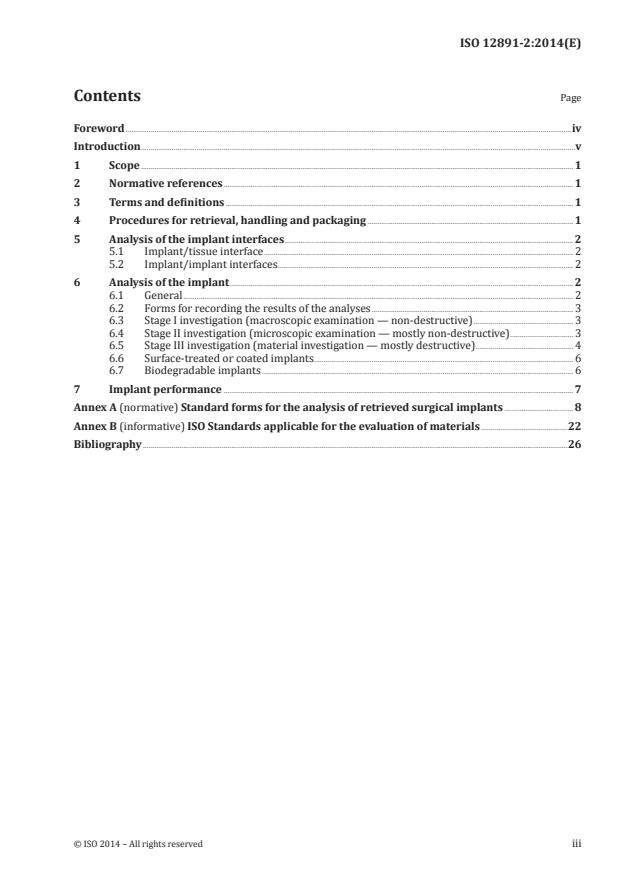
Contents Page
Foreword .iv
Introduction .v
1 Scope . 1
2 Normative references . 1
3 Terms and definitions . 1
4 Procedures for retrieval, handling and packaging . 1
5 Analysis of the implant interfaces . 2
5.1 Implant/tissue interface . 2
5.2 Implant/implant interfaces. 2
6 Analysis of the implant . 2
6.1 General . 2
6.2 Forms for recording the results of the analyses . 3
6.3 Stage I investigation (macroscopic examination — non-destructive) . 3
6.4 Stage II investigation (microscopic examination — mostly non-destructive) . 3
6.5 Stage III investigation (material investigation — mostly destructive) . 4
6.6 Surface-treated or coated implants . 6
6.7 Biodegradable implants . 6
7 Implant performance . 7
Annex A (normative) Standard forms for the analysis of retrieved surgical implants .8
Annex B (informative) ISO Standards applicable for the evaluation of materials .22
Bibliography .26
Foreword
ISO (the International Organization for Standardization) is a worldwide federation of national standards
bodies (ISO member bodies). The work of preparing International Standards is normally carried out
through ISO technical committees. Each member body interested in a subject for which a technical
committee has been established has the right to be represented on that committee. International
organizations, governmental and non-governmental, in liaison with ISO, also take part in the work.
ISO collaborates closely with the International Electrotechnical Commission (IEC) on all matters of
electrotechnical standardization.
The procedures used to develop this document and those intended for its further maintenance are
described in the ISO/IEC Directives, Part 1. In particular the different approval criteria needed for the
different types of ISO documents should be noted. This document was drafted in accordance with the
editorial rules of the ISO/IEC Directives, Part 2 (see www.iso.org/directives).
Attention is drawn to the possibility that some of the elements of this document may be the subject of
patent rights. ISO shall not be held responsible for identifying any or all such patent rights. Details of
any patent rights identified during the development of the document will be in the Introduction and/or
on the ISO list of patent declarations received (see www.iso.org/patents).
Any trade name used in this document is information given for the convenience of users and does not
constitute an endorsement.
For an explanation on the meaning of ISO specific terms and expressions related to conformity
assessment, as well as information about ISO’s adherence to the WTO principles in the Technical Barriers
to Trade (TBT) see the following URL: Foreword - Supplementary information
The committee responsible for this document is ISO/TC 150, Implants for surgery.
This second edition cancels and replaces the first editions (ISO 12891-2:2000, ISO 12891-3:2000,
ISO 12891-4:2000), which have been merged and technically revised.
ISO 12891 consists of the following parts, under the general title Retrieval and analysis of surgical
implants:
— Part 1: Retrieval and handling
— Part 2: Analysis of retrieved surgical implants
iv © ISO 2014 – All rights reserved
Introduction
The investigation of retrieved implantable medical devices and adjacent tissues can be of diagnostic
value in the event of clinical complications, can deepen our knowledge of clinical implant performance
and safety, and can improve our understanding of the interactions between implants and the body, thus,
furthering the development of implants with improved biocompatibility and functional longevity.
This part of ISO 12891 specifies methods for the retrieval, handling, and analysis of surgical implants
and associated specimens which are retrieved from patients during revision surgery or post-mortem.
The aim is to provide guidance in preventing damage to the specimens which could obscure the
investigation results, and in gathering data at the proper time and under the proper circumstances.
ISO 12891-1 deals with retrieval and handling. This part of ISO 12891 concerns the analysis of implants
of specific materials, and includes protocols for reporting the data collected. For particular investigation
programmes, additional, more specific protocols can be required. If special analytical techniques are
employed, the procedures used should be specified.
This part of ISO 12891 specifies methods for the analysis of retrieved surgical implants to ensure
they are not damaged, to indicate typical investigation techniques, and to allow comparisons between
investigation results from different sources. These methods may be useful for retrieval and analysis
studies in animals.
This part of ISO 12891 provides for a thorough examination of all aspects of an explanted prosthesis.
In many cases only a subset of these examinations will be appropriate to the investigation of a specific
explanted device.
ISO 12891-1 specifies methods for retrieval and handling and applies to this part of ISO 12891. Annexes A
and C of ISO 12891-1 include examples of protocols for reporting data concerning the retrieval process.
These protocols are not repeated in this part of ISO 12891. They may be reduced or expanded depending
on the retrieved surgical implant, the presence of any attached or accompanying biological material, and
the purpose of the retrieval and analysis.
INTERNATIONAL STANDARD ISO 12891-2:2014(E)
Retrieval and analysis of surgical implants —
Part 2:
Analysis of retrieved surgical implants
1 Scope
This part of ISO 12891 specifies methods for the analysis of retrieved surgical implants.
This part of ISO 12891 describes the analysis of retrieved metallic, polymeric and ceramic implants. The
analysis is divided into three stages which are increasingly destructive.
This part of ISO 12891 can also be applied to other materials, e.g. animal tissue implants.
This part of ISO 12891 can be applied in accordance with national regulations or legal requirements
regarding the handling and analysis of retrieved implants and tissues and associated biological material.
2 Normative references
The following documents, in whole or in part, are normatively referenced in this document and are
indispensable for its application. For dated references, only the edition cited applies. For undated
references, the latest edition of the referenced document (including any amendments) applies.
ISO 12891-1:2011, Implants for surgery — Retrieval and analysis of surgical implants — Part 1: Retrieval
and handling
3 Terms and definitions
For the purposes of this document, the following terms and definitions apply.
3.1
surgical implant
implant
medical device intended to be inserted into the body by surgical techniques
Note 1 to entry: The medical device is hereafter referred to as an “implant”.
Note 2 to entry: The implant can be a component of a modular or multicomponent implant.
4 Procedures for retrieval, handling and packaging
Procedures for retrieval, handling, packaging, and protection of the personnel involved shall be in
accordance with ISO 12891-1.
As a precautionary measure, retrieved implants shall be decontaminated by an appropriate means that
does not adversely affect the implant or the planned investigation. Appropriate methods are given in 3.8
of ISO 12891-1:2011.
Any difficulty in the implant retrieval procedure leading to unavoidable implant damage during it shall
be reported together with a description of the produced damage.
Cleaning solutions (see ISO 12891-1:2011, Table 1) can interact with the material, e.g. corrosion or
dissolution and should be chosen to minimize this risk.
Photographic records of the surgical field should be made before the implant retrieval, if appropriate.
5 Analysis of the implant interfaces
5.1 Implant/tissue interface
A significant part of the information associated with a retrieved surgical implant is often at the
implant/tissue interface. Attention shall be given to the interface and to the peri-implant tissue and its
contents. Where required, analyses of the chemistry and nature of the byproducts of degradation of the
implant and a study of the cellular response to the implant shall be considered.
In cases where implant surfaces are designed to promote tissue ingrowth or ongrowth, a study of the
implant tissue interface can be of particular interest, and the findings shall be recorded. If residues are
adherent to the surface of the implant, this shall be recorded.
Since the appearance of the tissue can vary significantly with the distance from the implant surface, it
is important that the tissue is analysed in its context with the implant. Where possible, tissue, fluid, and
particulate samples should be collected for further analysis (see ISO 12891-1, 3.4).
5.2 Implant/implant interfaces
Where implants articulate on or are in contact with other implant components, the condition of the
contacting surface areas of the implant can be of particular interest. Their study shall be considered in
the context of the opposing surfaces.
In addition to studying the condition of contacting surfaces, the surrounding area shall also be studied
to determine whether wear debris is present.
6 Analysis of the implant
6.1 General
This clause describes the different degrees of characterization to be considered when a retrieved
implant is under investigation.
The analyses of the retrieved implant are divided into three stages, with the degree of characterization
and destruction increasing from stage I to stage III. The implant characterizations can include
macroscopic and microscopic examinations, chemical analyses, and the determination of physical and
mechanical properties.
Because of the complexity of the materials that can be used for implants, and because of the large number
of potential analyses and tests suggested in this part of ISO 12891, the stage and type of analysis to be
performed shall be chosen as a function of the type of implant and the purpose of the investigation.
The examinations selected to be performed shall depend upon the reason for removal and examination
of the implant, and possible restrictions in destructive testing. Perform a minimum number of
investigations for routine removals where the implant is not suspected to have malfunctioned, more
examinations for implants suspected of having a functional impairment, and extensive investigations
for implants retrieved because of a suspected malfunction.
Each component of an implant shall be analysed separately, if possible and necessary.
NOTE 1 Annex A lists the most important characteristics to be assessed at each investigational stage.
NOTE 2 Applicable International Standards and national standards for the evaluation of implant properties
are given in Annex B and in the Bibliography.
2 © ISO 2014 – All rights reserved
6.2 Forms for recording the results of the analyses
Standard forms for metallic (see A.2), polymeric (see A.3), and ceramic (see A.4) implants, indicating
the information to be recorded at each stage of the investigation are given as a framework. Further
information regarding the use of the forms is given in A.1.
For other materials, e.g. animal tissue implants, a form based on A.2 to A.4 can be used for the preparation
of a relevant list.
NOTE A standard form for the recording of clinical and implant-related information is given in
ISO 12891-1:2011, Annex A.
6.3 Stage I investigation (macroscopic examination — non-destructive)
6.3.1 General
The primary aim of this stage of the investigation is to describe the product (type, manufacturer, etc.),
to collect the pertinent visual information and to establish the failure assessment plan.
For the assessment of the Stage I investigation, use sections 1 and 2 in A.2, A.3, or A.4.
6.3.2 Identification/photography
Markings found on the implant or its components such as the manufacturer’s name or trademark, the
batch code (lot number) or serial number, dimensions, etc., shall be recorded. Photographic records
shall be made of relevant findings, where useful.
6.3.3 Visual examination
The implant surface shall be observed to ascertain the mode of failure, destruction, or surface alteration,
if any such appears.
In no event shall any surface of a failed implant be destructively evaluated at this stage.
6.3.4 Low-power optical examination
An overall examination shall be performed under a low-power optical stereomicroscope.
6.3.5 Further evaluation
If at the conclusion of stage I further investigation is required to clarify any observations made, or to
evaluate other characteristics or the failure mode of the implant, it shall be carried out subsequently in
stage II.
6.4 Stage II investigation (microscopic examination — mostly non-destructive)
6.4.1 General
Stage II investigation shall be carried out after stage I investigation, if deemed necessary, to further
investigate or identify the characteristics and/or failure mode of the implant.
The primary aim of this stage of the investigation is to assess the mode of failure and/or the deterioration
of the implant in the most non-destructive manner possible. For the assessment of the Stage II
investigation, use sections 3 to 5 in A.2, A.3, or A.4.
6.4.2 Microscopic examination
Optical or scanning electron microscopy examination techniques suitable for the material under
investigation shall be used.
Normal incidence of transmission optical microscopy or polarizing, interference, phase-contrast or
other optical microscopy techniques can be used, when applicable to the implant.
When scanning electron microscopy is used, special preparation techniques can be required to obtain
the necessary conditions for imaging and analyses.
X-ray methods or micro-CT systems can be used, when applicable. Describe any artefact reduction
algorithm or other image processing, if applicable.
6.4.3 Fractographic examination
If the implant is fractured, analysis of the fracture surface by suitable techniques can help to ascertain
the mode of fracture or to detect defects in the material. It might be necessary to excise a portion of the
implant to conduct the examination. Destructive evaluation of the fracture surface shall be avoided.
If the implant has suffered mechanical failure, it is important to remember that it can become legal
evidence and so the necessary precautions need to be taken. If the fracture surface has been altered
before, during or after retrieval then the existence of this damage should be recorded.
When conducting the fracture analysis the investigator should take into account the possibility of
damage of the fracture surfaces due to relative movement between the implant fractured parts before
retrieval as well the loss of fractured parts during retrieval.
6.4.4 Surface topography
Where worn and unworn areas of the surfaces of retrieved implants are of interest, surface topography
tests can be carried out in addition to the morphological assessment.
6.5 Stage III investigation (material investigation — mostly destructive)
6.5.1 General
If further investigation is necessary to assess the properties of the implant, the tests listed under
Stage III in Annex A shall be carried out as deemed necessary to further characterize the implant and
its history. For the assessment of the Stage III investigation, use sections 6 to 9 in A.2 or A.4 or sections
6 to 10 in A.3.
NOTE Applicable International Standards and national standards for the evaluation of implant properties
are given in Annex B and in the Bibliography.
6.5.2 Material composition
6.5.2.1 General
Determine the physical and chemical composition and identity of the material and report the technique
employed with the results. The type of material can be characterized by means of material standards
listed in Annex B.
It can be sufficient in the study of a given retrieved implant to verify that the type of material corresponds
to the information provided by the manufacturer. If more details are required or the nature of the
material is unknown, appropriate techniques shall be used to determine the required physical and
chemical properties.
The location of the area or portion of the implant that has been analysed shall be identified in relation to
the full implant and reported with the result. The method of analysis shall be clearly identified.
4 © ISO 2014 – All rights reserved
6.5.2.2 Metals
Where necessary, analysis of the composition shall be carried out by appropriate methods (e.g. electron
diffraction X-ray analysis, X-ray fluorescence analysis, atomic absorption spectroscopy, or recognized
chemical analysis techniques).
6.5.2.3 Polymers
Differential thermal analysis, gel permeation chromatography, or other applicable molecular weight
methods, infrared analysis as well as other spectrographic techniques can be useful to further
characterize the implant material.
If applicable, the thermal properties of polymers, e.g. transition temperature, heat of fusion, and heat
of crystallization, shall be determined in accordance with applicable test methods. The fractions
extractable from the polymer shall be determined in accordance with suitable test methods.
Depending on the polymer, certain structural characteristics can be determined by optical or electron
microscopy. For the determination of inclusions and particulate constituents, similar methods should
be used.
Considering that bulk properties can differ considerably from surface properties (texture, strengths, etc.)
due to processing characteristics (flow in moulds, differences in solidification rate, etc.), representative
data shall be sampled from different portions of the implant, if possible.
6.5.2.4 Ceramics
Recognized analytical methods shall be used to determine the chemical composition of the ceramic
implant. The method of analysis shall be specified, such as X-ray fluorescence analysis and EDX
analysis, and highly quantitative and specific techniques such as atomic absorption spectroscopy and
spectrophotometric analysis.
Where of interest, the degree of crystallinity and the atomic structure can be determined by X-ray
diffraction techniques.
6.5.3 Microstructure
Standard preparation and evaluation techniques suitable for the material under investigation shall be
used.
The grain size, in accordance with the applicable material standard and method, shall be determined.
The inclusion content, in accordance with the applicable material standard, shall be determined, if
appropriate.
The process condition of the material (annealed, recrystallized, work-strengthened, hot-forged, cold-
forged, moulded, extruded, etc.), and other relevant features shall be indicated, where possible.
Evidence of corrosion or cracking shall be noted and recorded.
To check for voids and defects, scanning electron micro-analysis can be employed.
If a porous material is under investigation, the porosity shall be characterized.
6.5.4 Mechanical properties
IMPORTANT — Except for hardness measurements, which can be carried out on the implant
surface, the mechanical tests are destructive. The performance of such tests can be restricted or
inhibited by the size and/or shape of the implant or by legal conditions.
The types of measurement to be carried out at this stage of characterization depend upon the implant
and its application. Some materials (e.g. shape memory alloys, degradable metals, certain polycarbonate
urethanes, or polydimethasiloxanes) have unique mechanical considerations that shall also be addressed.
Where applicable, the density and hardness shall be determined in accordance with suitable material
standards.
Where required and possible, the mechanical properties (tensile, flexural, compressive, etc.), shall be
determined in accordance with applicable material specifications and test methods. Other tests can also
be performed as appropriate to the test specimen.
Where dimensions allow, test specimen shall be fabricated from the implant. Deviation from the test
specimen dimensions specified in standard methods may be made necessary by the shape and size of
the implant under investigation. This shall be taken into account when evaluating the test results.
In performing hardness tests, results can vary depending on the method, the area, the direction of the
measurements (surface, centre, longitudinal, transverse, etc.), deformation, etc. This shall be taken into
account when evaluating the test results.
Shape memory materials can have a different set of properties to report (e.g. plateau stresses, austenite
finish strain, elastic modulus, etc) that are not covered in Annex A.
6.6 Surface-treated or coated implants
In cases where implants have surface treatments or coatings, the following shall be considered.
a) The implant shall be examined for structural integrity. In particular, note the occurrence of any
surface regions which have become altered, such as by delamination, coating loss, or other changes.
b) The location of any fragments or debris shall be recorded and any relationship to tissues shall be
examined, when accessible.
In the case of metallic implants for joint replacement, particles released from a surface coating might
cause secondary damage to functional parts of the implant. These occurrences shall be recorded.
c) Where appropriate, specific tests to evaluate the surface treatment, coating or substrate properties
(e.g. chemical, microstructural, and mechanical characteristics) shall be carried out.
d) Where appropriate and accessible, the tissue associated with the implant and any fragments or
debris shall be analysed.
NOTE Debris can consist of substances of synthetic or biological origin.
6.7 Biodegradable implants
If the implant was intentionally manufactured from biodegradable materials, test procedures specified
in this part of ISO 12891 can still be used. However, the interpretation of the results shall allow for the
time-dependent physical and chemical changes to be expected with such materials.
a) The implant shall be examined for structural integrity. In particular, note the occurrence of any
surface regions which have become altered, such as by delamination or other changes.
b) The location of any fragments or debris shall be recorded and any relationship to tissues shall be
examined, when accessible.
6 © ISO 2014 – All rights reserved
c) Where appropriate and accessible, the tissue associated with the implant and any fragments or
debris shall be analysed.
NOTE Debris can consist of substances of synthetic or biological origin.
7 Implant performance
To evaluate the clinical performance of the implant under investigation, in particular, the implant
failure or deterioration, the implant application, the physiological conditions, the clinical history, and
the implant loading have to be considered.
Annex A
(normative)
Standard forms for the analysis of retrieved surgical implants
A.1 General
A.2, A.3, and A.4 list the steps to be followed in a typical series of analyses for metallic (see A.2), polymeric
(see A.3), and ceramic (see A.4) implants and show how the test results can be presented.
Sections which are not applicable shall be marked as such. Additional observations, findings, and
conclusions can be included at the end of the form or in the individual sections, as appropriate.
8 © ISO 2014 – All rights reserved
A.2 Form for examination of retrieved metallic surgical implant
Record no.:________
Record date:________
This report applies to component No. ______________ of a total of ________________ components.
Condition of implant: intact ; broken ; cracked ; corroded ; damaged
Stage I investigation (macroscopic examination — non-destructive)
1. Implant information
Implant type ________________________ Number of components________
Catalogue number _________ Serial, batch or lot number(s) _____________
Manufacturer __________________________________________________
Dimensions _____________________ Material _______________________
2. Macroscopic examination both visually and with low-power microscope
(state YES, NO, DOUBTFUL or N/A in the assessment column)
Location Assessment
a) wear (describe appearance) ____________________ ____________________
b) galling ____________________ ____________________
c) corrosion ____________________ ____________________
d) scratching ____________________ ____________________
e) cracking ____________________ ____________________
f) change of shape ____________________ ____________________
g) burnishing ____________________ ____________________
h) mechanical damage ____________________ ____________________
i) macroporosity ____________________ ____________________
j) other ____________________ ____________________
Stage II investigation (microscopic examination — mostly non-destructive)
Microscopic examination of surface and of defects at higher magnification
...
Questions, Comments and Discussion
Ask us and Technical Secretary will try to provide an answer. You can facilitate discussion about the standard in here.
Loading comments...