

ISO/IEC 17065
(Main)Conformity assessment — Requirements for bodies certifying products, processes and services
- Status
- Not Published
- Technical Committee
- ISO/CASCO - Committee on conformity assessment
- Drafting Committee
- ISO/CASCO - Committee on conformity assessment
- Current Stage
- 6000 - International Standard under publication - 60 Publication
- Start Date
- 28-Oct-2026
Buy Documents
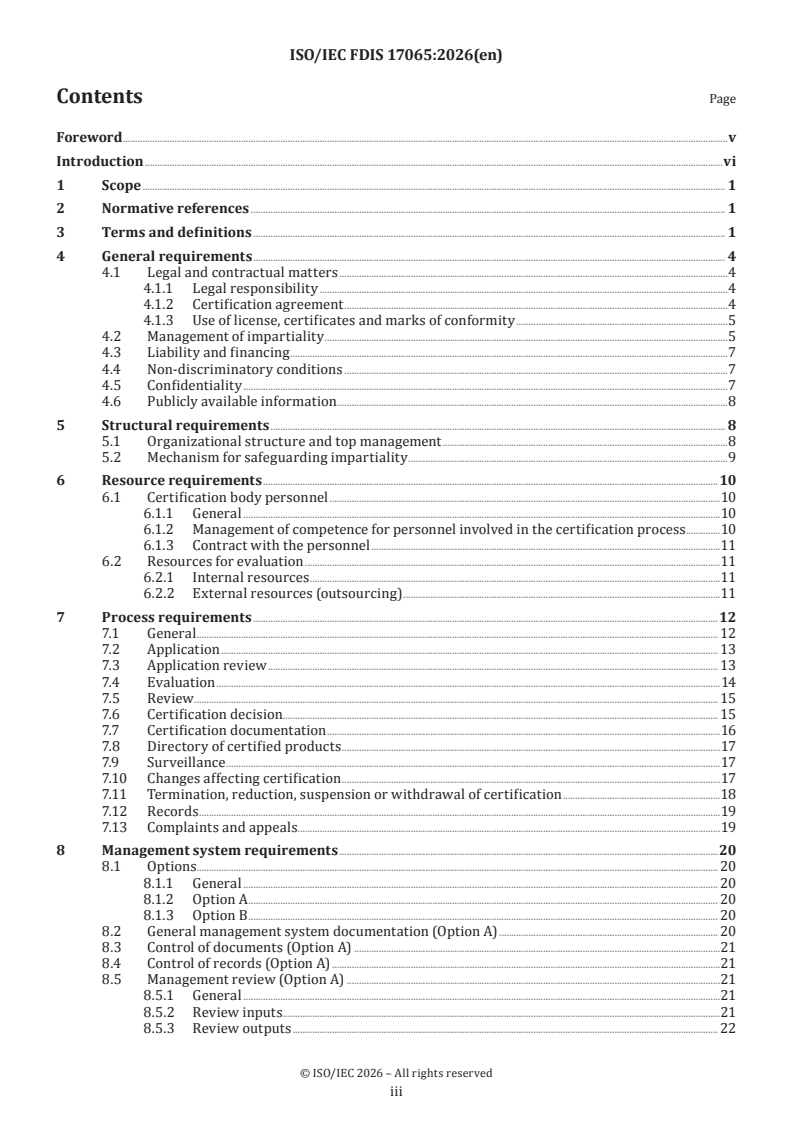
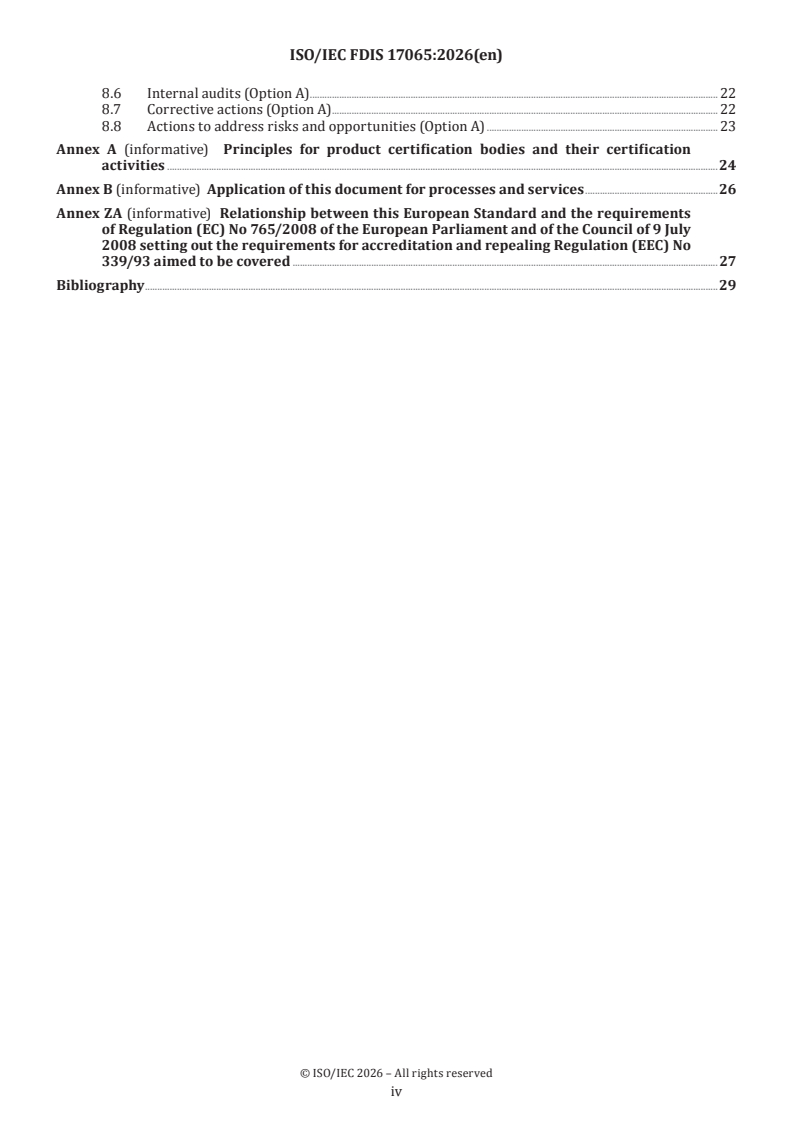
ISO/IEC FDIS 17065 - Conformity assessment — Requirements for bodies certifying products, processes and services
REDLINE ISO/IEC FDIS 17065 - Conformity assessment — Requirements for bodies certifying products, processes and services
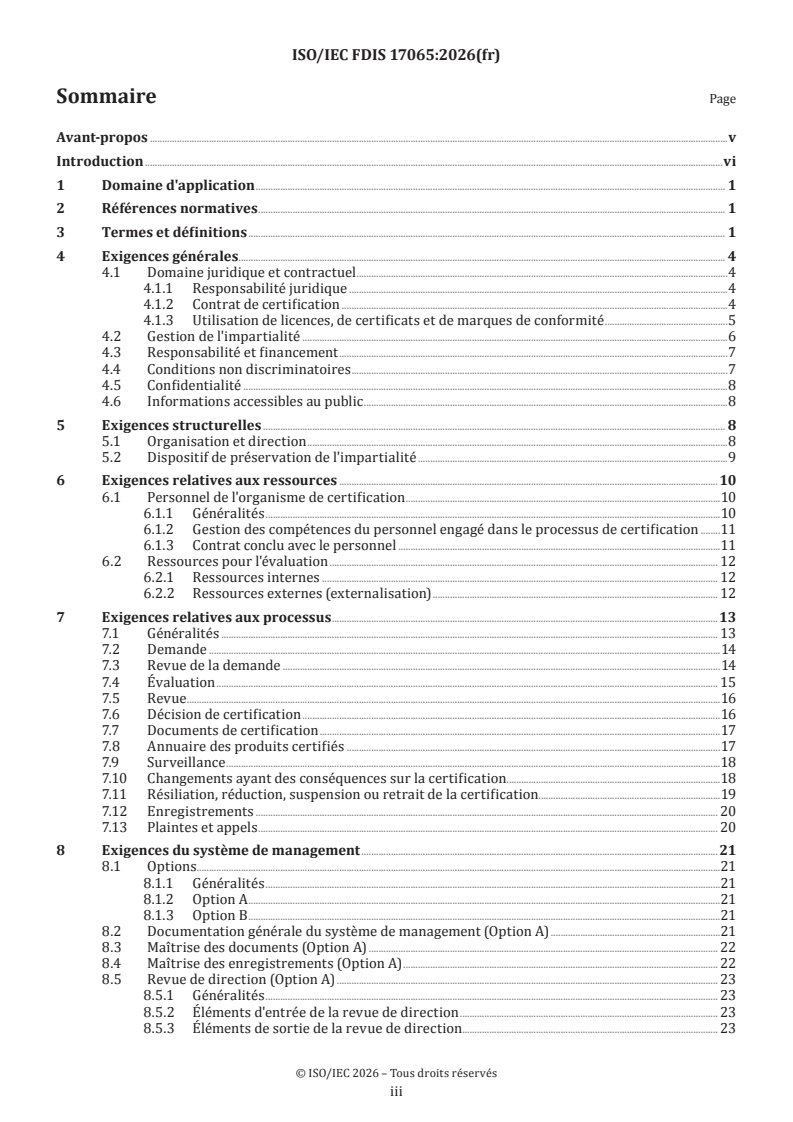
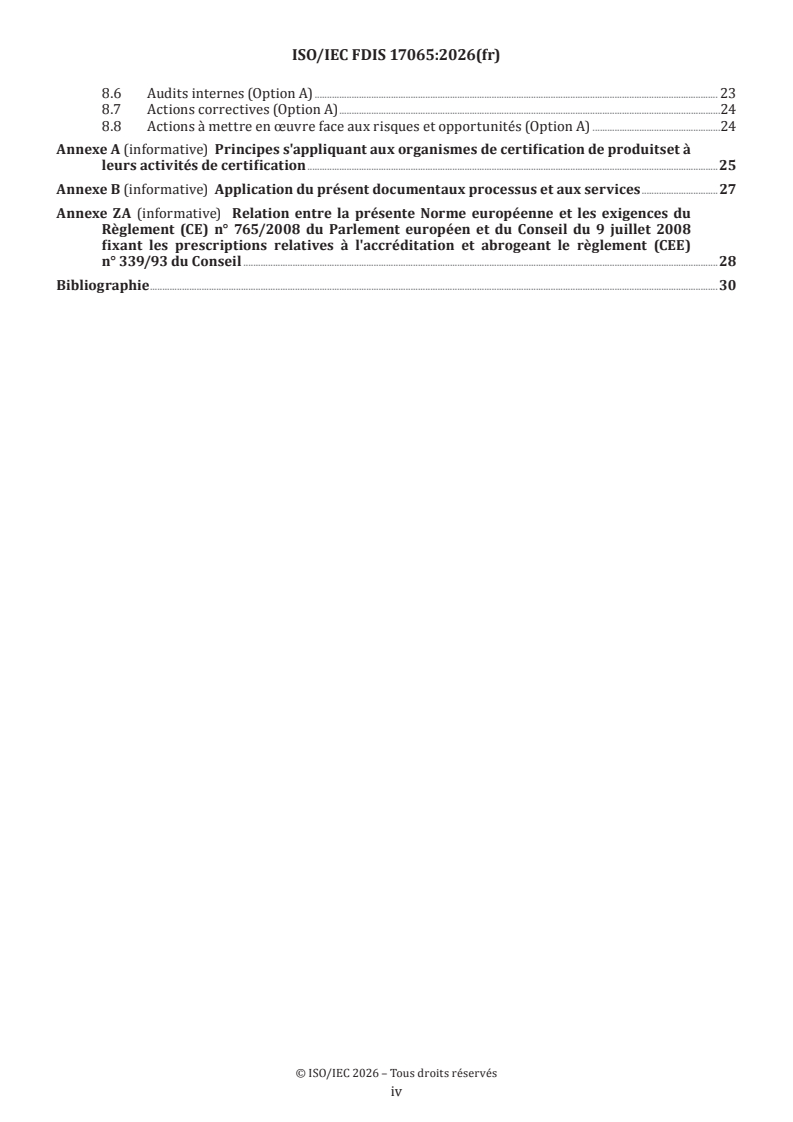
ISO/IEC FDIS 17065 - Évaluation de la conformité — Exigences pour les organismes certifiant les produits, les processus et les services
ISO/IEC 17065 is an ISO and IEC International Standard for bodies that certify products, processes and services. It specifies requirements for competence, consistent operation and impartiality, so it is the document a certification body, scheme owner, accreditor or buyer can use to judge whether a certification body is organized and controlled properly.
What does ISO/IEC 17065 specify?
ISO/IEC 17065 specifies the requirements for bodies certifying products, processes and services, with the term “product” used to include processes and services unless separate provisions are given. The standard covers the certification body itself, not how every certification scheme must be written.
The document is organized into clauses on scope, normative references, terms and definitions, general requirements, structural requirements, resource requirements, process requirements and management system requirements. It also includes informative annexes on principles, applying the document to processes and services, and the relationship to European legislation.
| Annex | What it covers |
|---|---|
| Annex A | Principles for product certification bodies and their certification activities |
| Annex B | How to apply the document to certification of processes and services |
| Annex ZA | Relationship with Regulation (EC) No 765/2008 and related European requirements |
What are the key requirements of ISO/IEC 17065?
ISO/IEC 17065 sets out a full control framework for certification bodies, from legal status and impartiality through to certification decisions, surveillance and complaints handling. In practice, it tells a body what it must have in place before it can credibly certify products, processes or services.
Legal basis, agreements and public claims
ISO/IEC 17065 requires the certification body to be a legal entity, or part of one that can be held legally responsible for certification activities. It also requires a legally enforceable certification agreement that makes the client responsible for meeting certification requirements, allowing evaluations and surveillance, handling complaints, and stopping use of certification claims after suspension or withdrawal.
This matters because the body must be able to enforce the rules it sets and protect the integrity of certificates, marks and other claims of conformity. The standard also requires control over the ownership, use and display of certificates and marks, and action against misleading references.
Impartiality and conflict of interest
ISO/IEC 17065 makes impartiality a central requirement. The certification body must identify risks to impartiality, show how it reduces or removes them, and keep top management committed to impartiality.
The body, and entities under its control, may not design, manufacture, install, maintain or provide consultancy for the certified product, process or service. It must also keep decision-making separate from any entity that offers the certified product or consultancy, and it must prevent staff who have given consultancy on a product from later reviewing or deciding on that product within a set period.
In practice, this is what keeps certification credible. A buyer or regulator can rely on the certificate only if the certifier is not also helping to create the thing being certified.
Competence and resources
ISO/IEC 17065 requires enough competent personnel and clear management of competence for everyone involved in the certification process. The body must define competence criteria, identify training needs, demonstrate competence, authorize personnel and monitor performance.
For evaluation work, the body must use internal or outsourced resources that meet the relevant standards for the task. That means ISO/IEC 17025 for testing, ISO/IEC 17020 for inspection, ISO/IEC 17021-1 for management system auditing, and ISO/IEC 17029 for validation and verification. This matters because the technical evidence behind a certification decision must come from capable and controlled evaluation activities.
Certification process from application to decision
ISO/IEC 17065 requires a managed process that starts with obtaining the information needed for certification, then reviewing the application, planning evaluation, carrying out evaluation, reviewing the results and making the certification decision. If the body lacks competence or capability, it shall decline the certification.
The standard also requires the body to inform the client of nonconformities, document all evaluation results before review, and keep the review separate from the evaluation. The certification decision must be made by a person or group not involved in the evaluation process.
This separation matters because it reduces bias and helps ensure that the decision is based on evidence rather than on the evaluator’s own work.
Certification documentation, directory and surveillance
ISO/IEC 17065 requires formal certification documentation that identifies the certification body, client, scope of certification, date granted and, where relevant, expiry date. The body must also maintain information on certified products and be able to confirm whether a certification is valid.
If the certification scheme requires surveillance, the body must run it in line with the scheme. Where marks are used on products, packaging or accompanying information, surveillance must include periodic checks to confirm that the certified status remains valid.
In practice, this is the part that keeps certification current after the initial decision, especially where production, operation or service delivery can change over time.
Changes, suspension, withdrawal, records and complaints
ISO/IEC 17065 requires the certification body to communicate scheme changes to clients, verify that clients implement them and decide what action is needed for other changes affecting certification. If a nonconformity is confirmed, the body must decide whether to continue, reduce, suspend or withdraw certification.
The body must also keep records showing that all certification requirements have been met, preserve confidentiality, and operate a documented process for complaints and appeals. Decisions on complaints and appeals must be handled by people not involved in the related certification activity.
For users, this means the standard does not stop at granting certificates - it also controls what happens when a product changes, when certification fails, or when a customer challenges a decision.
Management system options
ISO/IEC 17065 requires a management system capable of supporting consistent fulfilment of the standard. Under Option A, the body must control documents and records, carry out management review, internal audits, corrective actions, and actions to address risks and opportunities. Under Option B, a body with a management system aligned with ISO 9001 can use that system to meet these management system requirements.
This gives certification bodies a structured way to maintain consistency over time and show that their own operations are under control.
What terms does ISO/IEC 17065 define?
ISO/IEC 17065 defines several terms that are central to how certification bodies work.
- Client - the organization or person responsible to the certification body for ensuring that certification requirements are fulfilled.
- Consultancy - participation in designing, making, installing, maintaining or distributing the certified product, process or service.
- Evaluation - the combination of selection and determination activities used in conformity assessment.
- Certification requirement - a requirement, including product requirements, that the client must meet to obtain or keep certification.
- Product requirement - a specified requirement related directly to a product, as stated in standards or other normative documents named by the scheme.
- Certification scheme - the set of rules and procedures that defines the object of certification, the specified requirements and the certification method.
- Scope of certification - the product, process or service covered, the applicable scheme, and the standards or other normative documents to which conformity is judged.
- Certification body - a third-party conformity assessment body that operates certification schemes.
Who uses ISO/IEC 17065?
ISO/IEC 17065 is used by certification bodies that certify products, processes and services, including bodies that work in product certification schemes, process certification schemes and service certification schemes. It is also relevant to scheme owners, accreditation bodies, governmental authorities and peer assessment organizations that need a criteria document for assessing certification bodies.
In practice, the standard is used when setting up certification, reviewing applications, selecting evaluation methods, making certification decisions, running surveillance, handling complaints and appeals, and managing certified status over time. It is also useful to organizations seeking certification, because it shows what a certification body may ask for and how the process is controlled.
What changed in ISO/IEC 17065 from the previous edition?
ISO/IEC 17065 is the second edition and it cancels and replaces ISO/IEC 17065:2012. The stated changes are an update to reflect terminology in ISO/IEC 17000:2020, replacement of “Preventive actions” in Clause 8.8 with “Actions to address risks and opportunities”, and updated bibliographic references from ISO/IEC 17021 to ISO/IEC 17021-1.
Which standards are used with ISO/IEC 17065?
ISO/IEC 17065 names five normative references that support its application.
- ISO/IEC 17000 - provides the vocabulary and general principles for conformity assessment.
- ISO/IEC 17020 - provides requirements for bodies performing inspection, used when inspection is part of evaluation.
- ISO/IEC 17021-1 - provides requirements for bodies providing audit and certification of management systems, used when management system auditing is part of evaluation.
- ISO/IEC 17025 - provides general requirements for the competence of testing and calibration laboratories, used when testing is part of evaluation.
- ISO/IEC 17029 - provides general principles and requirements for validation and verification bodies, used when validation or verification is part of evaluation.
What does the ISO/IEC 17065 document contain?
ISO/IEC 17065 contains the full set of clauses a certification body needs to organize, operate and control product, process and service certification. The main body covers legal responsibility, impartiality, confidentiality, organizational structure, competence, outsourced evaluation, the application and review flow, evaluation, certification decision, certification documentation, directories, surveillance, changes, suspension or withdrawal, records, complaints and appeals, and management system requirements.
Annex A gives the principles behind confidence in certification, including impartiality, competence, confidentiality, openness, responsiveness to complaints and appeals, and responsibility. Annex B explains how the same requirements are applied when the object of certification is a process or a service. Annex ZA provides correspondence tables linking the standard to European regulatory requirements and related European publications.
Relations
- Effective Date
- 23-May-2026
- Effective Date
- 09-May-2026
Buy Documents
ISO/IEC FDIS 17065 - Conformity assessment — Requirements for bodies certifying products, processes and services
REDLINE ISO/IEC FDIS 17065 - Conformity assessment — Requirements for bodies certifying products, processes and services
ISO/IEC FDIS 17065 - Évaluation de la conformité — Exigences pour les organismes certifiant les produits, les processus et les services
Get Certified
Connect with accredited certification bodies for this standard

BSI Group
BSI (British Standards Institution) is the business standards company that helps organizations make excellence a habit.

Bureau Veritas
Bureau Veritas is a world leader in laboratory testing, inspection and certification services.

DNV
DNV is an independent assurance and risk management provider.
Sponsored listings
Frequently Asked Questions
ISO/IEC 17065 is a draft published by the International Organization for Standardization (ISO). Its full title is "Conformity assessment — Requirements for bodies certifying products, processes and services". This standard covers: L'ISO/IEC 17065:2012 comporte des exigences portant sur les compétences, la cohérence des activités et l'impartialité des organismes de certification de produits, processus et services. Les organismes de certification exerçant selon l'ISO/IEC 17065:2012 ne sont pas tenus de proposer tous les types de certification de produits, processus et services.
L'ISO/IEC 17065:2012 comporte des exigences portant sur les compétences, la cohérence des activités et l'impartialité des organismes de certification de produits, processus et services. Les organismes de certification exerçant selon l'ISO/IEC 17065:2012 ne sont pas tenus de proposer tous les types de certification de produits, processus et services.
ISO/IEC 17065 is classified under the following ICS (International Classification for Standards) categories: 03.120.20 - Product and company certification. Conformity assessment. The ICS classification helps identify the subject area and facilitates finding related standards.
ISO/IEC 17065 has the following relationships with other standards: It is inter standard links to prEN ISO/IEC 17065, ISO/IEC 17065:2012. Understanding these relationships helps ensure you are using the most current and applicable version of the standard.
ISO/IEC 17065 is available in PDF format for immediate download after purchase. The document can be added to your cart and obtained through the secure checkout process. Digital delivery ensures instant access to the complete standard document.
Standards Content (Sample)
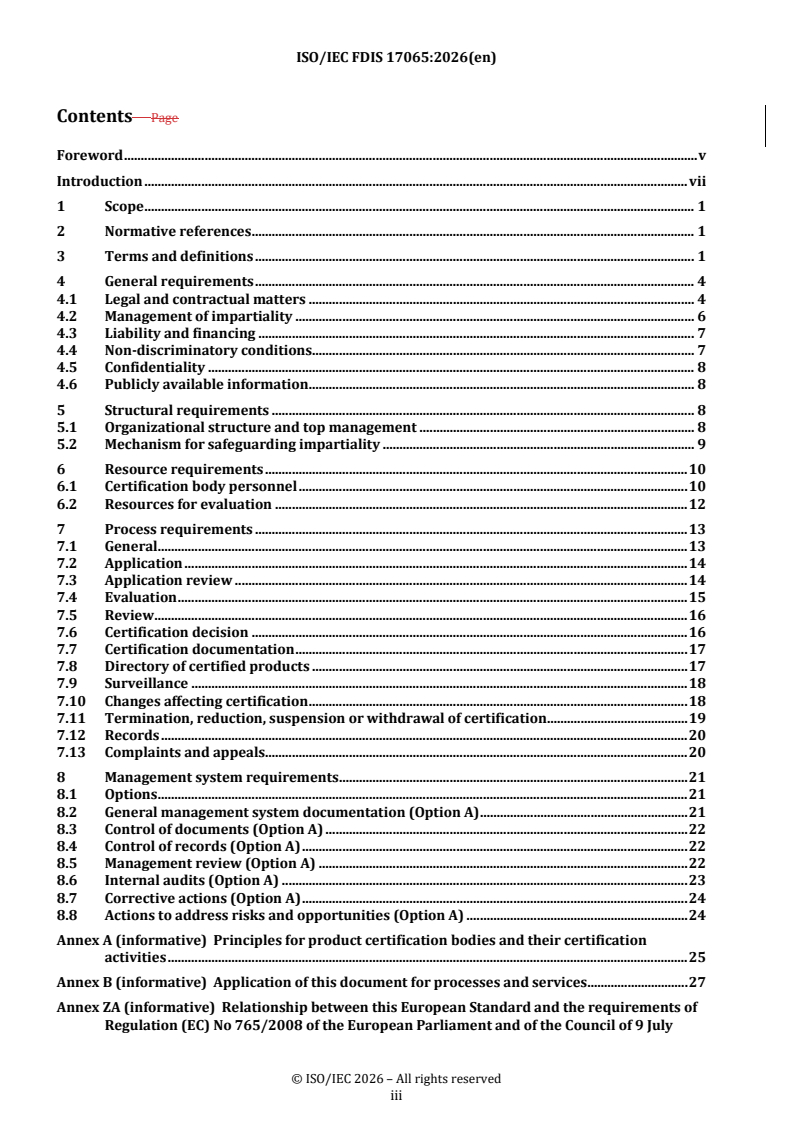
Contents
- Introduction
- 1 Scope
- 2 Normative references
- 3 Terms and definitions
- 3.1 client
- 3.2 consultancy
- 3.3 evaluation
- 3.4 product
- 3.5 process
- 3.6 service
- 3.7 certification requirement
- 3.8 product requirement
- 3.9 certification scheme
- 3.10 scope of certification
- 3.11 scheme owner
- 3.12 certification body
- 3.13 impartiality
- 4 General requirements
- 4.1 Legal and contractual matters
- 4.2 Management of impartiality
- 4.3 Liability and financing
- 4.4 Non-discriminatory conditions
- 4.5 Confidentiality
- 4.6 Publicly available information
- 5 Structural requirements
- 5.1 Organizational structure and top management
- 5.2 Mechanism for safeguarding impartiality
- 6 Resource requirements
- 6.1 Certification body personnel
- 6.2 Resources for evaluation
- 7 Process requirements
- 7.1 General
- 7.2 Application
- 7.3 Application review
- 7.4 Evaluation
- 7.5 Review
- 7.6 Certification decision
- 7.7 Certification documentation
- 7.8 Directory of certified products
- 7.9 Surveillance
- 7.10 Changes affecting certification
- 7.11 Termination, reduction, suspension or withdrawal of certification
- 7.12 Records
- 7.13 Complaints and appeals
- 8 Management system requirements
- 8.1 Options
- 8.2 General management system documentation (Option A)
- 8.3 Control of documents (Option A)
- 8.4 Control of records (Option A)
- 8.5 Management review (Option A)
- 8.6 Internal audits (Option A)
- 8.7 Corrective actions (Option A)
- 8.8 Actions to address risks and opportunities (Option A)
- Annex A
- Annex B
- Annex ZA
- Bibliography
Introduction
The overall aim of certifying products, processes or services is to give confidence to all interested parties that a product, process or service fulfils specified requirements. The value of certification is the degree of confidence and trust that is established by an impartial and competent demonstration of fulfilment of specified requirements through third-party attestation. Parties that have an interest in certification include, but are not limited to:
a) the clients of the certification bodies; b) the customers of the organizations whose products, processes or services are certified; c) governmental authorities; d) non-governmental organizations; and e) consumers and other members of the public.
Interested parties can expect or require the certification body to meet all the requirements of this document and perform certification in accordance with a certification scheme. Certification of products, processes or services is a means of providing assurance that they comply with specified requirements in standards and other normative documents. Some product, process or service certification schemes can include initial testing or inspection and assessment of its suppliers' quality management systems, followed by surveillance that takes into account the quality management system and the testing or inspection of samples from the production and the open market. Other schemes rely on initial testing and surveillance testing, while still others comprise type testing only. This document specifies requirements, the observance of which is intended to ensure that certification bodies operate certification schemes in a competent, consistent and impartial manner, thereby facilitating the recognition of such bodies and the acceptance of certified products, processes and services on a national and international basis and so furthering international trade. This document can be used as a criteria document for accreditation or peer assessment or designation by governmental authorities, scheme owners and others.
The requirements contained in this document are written, above all, to be considered as general criteria for certification bodies operating product, process or service certification schemes; they can have to be amplified when specific industrial or other sectors make use of them, or when particular requirements such as health and safety have to be taken into account. Annex A contains principles relating to certification bodies and certification activities that they provide.
This document does not set requirements for schemes and how they are developed and is not intended to restrict the role or choice of scheme owners, however scheme rules and procedures, including those identifying the certification requirements, should not contradict or exclude any of the requirements of this document.
Statements of conformity to the applicable standards or other normative documents can be in the form of certificates and/or marks of conformity. Schemes for certifying particular products or product groups, processes and services to specified standards or other normative documents can, in many cases, necessitate their own explanatory documentation.
While this document is concerned with bodies providing certification (third party attestation) for a product, process or service, many of its provisions can also be useful for bodies performing first- and second-party product, process or service conformity assessment activities.
In this document, the following verbal forms are used:
- “shall” indicates a requirement;
- “should” indicates a recommendation;
- “may” indicates a permission;
ISO/IEC FDIS 17065:2026(en) - “can” indicates a possibility or a capability.
Further details can be found in the ISO/IEC Directives, Part 2.
FINAL DRAFT International Standard ISO/IEC FDIS 17065:2026(en) Conformity assessment — Requirements for bodies certifying products, processes and services
1 Scope
This document contains requirements for the competence, consistent operation and impartiality of product, process and service certification bodies. Certification bodies operating to this document need not offer all types of products, processes and services certification. Certification of products, processes and services is a third-party conformity assessment activity (see ISO/IEC 17000:2020, 4.5). In this document, the term “product” can be read as “process” or “service”, except in those instances where separate provisions are stated for “processes” or “services” (see Annex B).
2 Normative references
The following referenced documents are indispensable for the application of this document. For dated references, only the edition cited applies. For undated references, the latest edition of the referenced document (including any amendments) applies.
ISO/IEC 17000, Conformity assessment — Vocabulary and general principles ISO/IEC 17020, Conformity assessment — Requirements for bodies performing inspection ISO/IEC 17021-1, Conformity assessment — Requirements for bodies providing audit and certification of management systems — Part 1: Requirements ISO/IEC 17025, General requirements for the competence of testing and calibration laboratories ISO/IEC 17029, Conformity assessment — General principles and requirements for validation and verification bodies
3 Terms and definitions
For the purposes of this document, the terms and definitions given in ISO/IEC 17000 and the following apply. ISO and IEC maintain terminology databases for use in standardization at the following addresses:
- ISO Online browsing platform: available at https:// www .iso .org/ obp
- IEC Electropedia: available at https:// www .electropedia .org/
3.1 client
organization or person responsible to a certification body for ensuring that certification requirements (3.7), including product requirements (3.8), are fulfilled Note 1 to entry: Whenever the term “client” is used in this document, it applies to both the “applicant” and the “client”, unless otherwise specified.
3.2 consultancy
participation in
ISO/IEC FDIS 17065:2026(en) a) the designing, manufacturing, installing, maintaining or distributing of a certified product or a product to be certified, or b) the designing, implementing, operating or maintaining of a certified process or a process to be certified, or c) the designing, implementing, providing or maintaining of a certified service or a service to be certified Note 1 to entry: In this document, the term “consultancy” is used in relation to activities of certification bodies, personnel of certification bodies and organizations related or linked to certification bodies.
3.3 evaluation
combination of the selection and determination functions of conformity assessment activities Note 1 to entry: The selection and determination functions are specified in ISO/IEC 17000:2020, Clauses A.2 and A.3.
3.4 product
result of a process 1) Note 1 to entry: Four generic product categories are noted in ISO 9000:2005 :
- services (e.g. transport) (see 3.6);
- software (e.g. computer program, dictionary);
- hardware (e.g. engine, mechanical part);
- processed materials (e.g. lubricant).
Many products comprise elements belonging to different generic product categories. Whether the product is then called service, software, hardware or processed material depends on the dominant element. Note 2 to entry: Products include results of natural processes, such as growth of plants and formation of other natural resources.
3.5 process
set of interrelated or interacting activities which transforms inputs into outputs EXAMPLE Welding engineering processes; heat treatment processes; manufacturing processes requiring confirmation of process capability (e.g. operating or producing product within specified tolerances); food production processes; plant growth processes.
Note 1 to entry: Adapted from ISO 9000:2005, 3.4.1.
3.6 service
result of at least one activity necessarily performed at the interface between the supplier and the customer, which is generally intangible Note 1 to entry: Provision of a service can involve, for example, the following:
- an activity performed on a customer-supplied tangible product (e.g. automobile to be repaired);
- an activity performed on a customer-supplied intangible product (e.g. the income statement needed to prepare a tax return);
- the delivery of an intangible product (e.g. the delivery of information in the context of knowledge transmission);
- the creation of ambience for the customer (e.g. in hotels and restaurants). Note 2 to entry: Adapted from ISO 9000:2005, 3.4.2.
1) Withdrawn.
ISO/IEC FDIS 17065:2026(en)
3.7 certification requirement
requirement, including product requirements (3.8), that is fulfilled by the client (3.1) as a condition of establishing or maintaining certification EXAMPLE The following are certification requirements that are not product requirements:
- completing the certification agreement;
- paying fees;
- providing information about changes to the certified product;
- providing access to certified products for surveillance activities. Note 1 to entry: Certification requirements include requirements imposed on the client by the certification body [usually via the certification agreement (see 4.1.2)] to meet this document, and can also include requirements imposed on the client by the certification scheme. Certification requirements, as used in this document, do not include requirements imposed on the certification body by the certification scheme.
3.8 product requirement
specified requirement that relates directly to a product, stated in standards or in other normative documents identified by the certification scheme Note 1 to entry: Product requirements can be stated in normative documents such as regulations, standards and technical specifications.
3.9 certification scheme
set of rules and procedures that describes the object of conformity assessment, identifies the specified requirements and provides the methodology for performing certification and the related conformity assessment activities Note 1 to entry: The object of conformity assessment in this document is a product, process or service. Note 2 to entry: General guidance on conformity assessment schemes which include product, process or services certification is given in ISO/IEC 17067.
[SOURCE: ISO/IEC 17000:2020, 4.9, modified — "Conformity assessment" has been replaced by "certification and the related conformity assessment activities"; the original notes to entry have been replaced by new ones.]
3.10 scope of certification
- information identifying the product(s), process(es) or service(s) for which the certification is granted,
- the applicable certification scheme, and
- the standard(s) and other normative document(s), including their date of publication, to which it is judged that the product(s), process(es) or service(s) comply
3.11 scheme owner
person or organization responsible for developing and maintaining a specific certification scheme (3.9) Note 1 to entry: The scheme owner can be the certification body itself, a governmental authority, a trade association, a group of certification bodies or others.
ISO/IEC FDIS 17065:2026(en)
3.12 certification body
third-party conformity assessment body operating certification schemes Note 1 to entry: A certification body can be non-governmental or governmental (with or without regulatory authority).
3.13 impartiality
objectivity with regard to the outcome of a conformity assessment activity Note 1 to entry: Objectivity can be understood as freedom from bias or freedom from conflicts of interest. [SOURCE: ISO/IEC 17000:2020, 5.3]
4 General requirements
4.1 Legal and contractual matters
4.1.1 Legal responsibility
The certification body shall be a legal entity, or a defined part of a legal entity, such that the legal entity can be held legally responsible for all its certification activities. NOTE A governmental certification body is deemed to be a legal entity on the basis of its governmental status.
4.1.2 Certification agreement
4.1.2.1 The certification body shall have a legally enforceable agreement for the provision of certification activities to its clients. Certification agreements shall take into account the responsibilities of the certification body and its clients.
4.1.2.2 The certification body shall ensure its certification agreement requires that the client comply at least, with the following:
a) the client always fulfils the certification requirements (see 3.7), including implementing appropriate changes when they are communicated by the certification body (see 7.10); b) if the certification applies to ongoing production, the certified product continues to fulfil the product requirements (see 3.8); c) the client makes all necessary arrangements for 1) the conduct of the evaluation (see 3.3) and surveillance (if required), including provision for examining documentation and records, and access to the relevant equipment, location(s), area(s), personnel, and client's subcontractors; 2) investigation of complaints; 3) the participation of observers, if applicable; d) the client makes claims regarding certification consistent with the scope of certification (see 3.10); e) the client does not use its product certification in such a manner as to bring the certification body into disrepute and does not make any statement regarding its product certification that the certification body can consider misleading or unauthorized; f) upon suspension, withdrawal, or termination of certification, the client discontinues its use of all advertising matter that contains any reference thereto and takes action as required by the certification scheme (e.g. the return of certification documents) and takes any other required measure;
ISO/IEC FDIS 17065:2026(en) g) if the client provides copies of the certification documents to others, the documents shall be reproduced in their entirety or as specified in the certification scheme; h) in making reference to its product certification in communication media such as documents, brochures or advertising, the client complies with the requirements of the certification body or as specified by the certification scheme; i) the client complies with any rules and procedures that may be prescribed in the certification scheme relating to the use of marks of conformity, and on information related to the product; NOTE See also ISO/IEC 17030 j) the client keeps a record of all complaints made known to it relating to compliance with certification requirements and makes these records available to the certification body when requested, and 1) takes appropriate action with respect to such complaints and any deficiencies found in products that affect compliance with the requirements for certification; 2) documents the actions taken; NOTE Verification of item j) by the certification body can be specified in the certification scheme. k) the client informs the certification body, without delay, of changes that can affect its ability to conform with the certification requirements.
NOTE Examples of changes can include the following:
- the legal, commercial, organizational status or ownership;
- organization and management (e.g. key managerial, decision-making or technical staff);
- modifications to the product or the production method;
- contact address and production sites;
- major changes to the quality management system.
4.1.3 Use of license, certificates and marks of conformity
4.1.3.1 The certification body shall exercise the control as specified by the certification scheme over ownership, use and display of licenses, certificates, marks of conformity, and any other mechanisms for indicating a product is certified.
NOTE ISO/IEC 17030 provides requirements for the use of third-party marks. 4.1.3.2 Incorrect references to the certification scheme, or misleading use of licenses, certificates, marks, or any other mechanism for indicating a product is certified, found in documentation or other publicity, shall be dealt with by suitable action.
4.2 Management of impartiality
4.2.1 Certification activities shall be undertaken impartially. 4.2.2 The certification body shall be responsible for the impartiality of its certification activities and shall not allow commercial, financial or other pressures to compromise impartiality. 4.2.3 The certification body shall identify risks to its impartiality on an ongoing basis. This shall include those risks that arise from its activities, from its relationships, or from the relationships of its personnel (see 4.2.12). However, such relationships may not necessarily present a certification body with a risk to impartiality.
ISO/IEC FDIS 17065:2026(en) NOTE 1 A relationship presenting a risk to impartiality of the certification body can be based on ownership, governance, management, personnel, shared resources, finances, contracts, marketing (including branding), and payment of a sales commission or other inducement for the referral of new clients, etc. NOTE 2 Identifying risks does not imply risk assessments as stated in ISO 31000. 4.2.4 If a risk to impartiality is identified, the certification body shall be able to demonstrate how it eliminates or minimizes such risk. This information shall be made available to the mechanism specified in 5.2.
4.2.5 The certification body shall have top management commitment to impartiality. 4.2.6 The certification body and any part of the same legal entity and entities under its organizational control (see 7.6.4) shall not:
a) be the designer, manufacturer, installer, distributer or maintainer of the certified product; b) be the designer, implementer, operator or maintainer of the certified process; c) be the designer, implementer, provider or maintainer of the certified service; d) offer or provide consultancy (see 3.2) to its clients; e) offer or provide management system consultancy or internal auditing to its clients where the certification scheme requires the evaluation of the client’s management system. NOTE 1 This does not preclude the following:
- the possibility of exchange of information (e.g. explanations of findings or clarifying requirements) between the certification body and its clients;
- the use, installing and maintaining of certified products which are necessary for the operations of the certification body.
NOTE 2 “Management system consultancy” is defined in ISO/IEC 17021-1:2015, 3.3. 4.2.7 The certification body shall ensure that activities of separate legal entities, with which the certification body or the legal entity of which it forms a part has relationships, do not compromise the impartiality of its certification activities.
NOTE See 4.2.3, NOTE 1.
4.2.8 When the separate legal entity in 4.2.7 offers or produces the certified product (including products to be certified) or offers or provides consultancy (see 3.2), the certification body's management personnel and personnel in the review and certification decision-making process shall not be involved in the activities of the separate legal entity. The personnel of the separate legal entity shall not be involved in the management of the certification body, the review, or the certification decision. NOTE For the evaluation personnel, impartiality requirements are stipulated in Clause 6 and additional requirements are given in the other relevant International Standards cited in 6.2.1 and 6.2.2.1. 4.2.9 The certification body's activities shall not be marketed or offered as linked with the activities of an organization that provides consultancy (see 3.2). A certification body shall not state or imply that certification would be simpler, easier, faster or less expensive if a specified consultancy organization were used.
...
Contents
- Introduction
- 1 Scope
- 2 Normative references
- 3 Terms and definitions
- 3.1 client
- 3.8 product requirement
- 4 General requirements
- 4.1 Legal and contractual matters
- 4.2 Management of impartiality
- 4.3 Liability and financing
- 4.4 Non-discriminatory conditions
- 4.5 Confidentiality
- 4.6 Publicly available information
- 5 Structural requirements
- 5.1 Organizational structure and top management
- 5.2 Mechanism for safeguarding impartiality
- 6 Resource requirements
- 6.1 Certification body personnel
- 6.2 Resources for evaluation
- 7 Process requirements
- 7.1 General
- 7.2 Application
- 7.3 Application review
- 7.4 Evaluation
- 7.5 Review
- 7.6 Certification decision
- 7.7 Certification documentation
- 7.8 Directory of certified products
- 7.9 Surveillance
- 7.10 Changes affecting certification
- 7.11 Termination, reduction, suspension or withdrawal of certification
- 7.12 Records
- 7.13 Complaints and appeals
- 8 Management system requirements
- 8.1 Options
- 8.2 General management system documentation (Option A)
- 8.3 Control of documents (Option A)
- 8.4 Control of records (Option A)
- 8.5 Management review (Option A)
- 8.6 Internal audits (Option A)
- 8.7 Corrective actions (Option A)
- 8.8 Actions to address risks and opportunities (Option A)
- Annex A
- Annex B
- 9 July 2008 setting out the requirements for accreditation and repealing
- Bibliography
Introduction
The overall aim of certifying products, processes or services is to give confidence to all interested parties that a product, process or service fulfils specified requirements. The value of certification is the degree of confidence and trust that is established by an impartial and competent demonstration of fulfilment of specified requirements through third-party attestation. Parties that have an interest in certification include, but are not limited to:
a) the clients of the certification bodies; b) the customers of the organizations whose products, processes or services are certified; c) governmental authorities; d) non-governmental organizations; and e) consumers and other members of the public.
Interested parties can expect or require the certification body to meet all the requirements of this International Standarddocument and perform certification in accordance with a certification scheme. Certification of products, processes or services is a means of providing assurance that they comply with specified requirements in standards and other normative documents. Some product, process or service certification schemes maycan include initial testing or inspection and assessment of its suppliers' quality management systems, followed by surveillance that takes into account the quality management system and the testing or inspection of samples from the production and the open market. Other schemes rely on initial testing and surveillance testing, while still others comprise type testing only. This International Standarddocument specifies requirements, the observance of which is intended to ensure that certification bodies operate certification schemes in a competent, consistent and impartial manner, thereby facilitating the recognition of such bodies and the acceptance of certified products, processes and services on a national and international basis and so furthering international trade. This International Standarddocument can be used as a criteria document for accreditation or peer assessment or designation by governmental authorities, scheme owners and others.
The requirements contained in this International Standarddocument are written, above all, to be considered as general criteria for certification bodies operating product, process or service certification schemes; they maycan have to be amplified when specific industrial or other sectors make use of them, or when particular requirements such as health and safety have to be taken into account. Annex AAnnex A contains principles relating to certification bodies and certification activities that they provide. This International Standarddocument does not set requirements for schemes and how they are developed and is not intended to restrict the role or choice of scheme owners, however scheme rules and procedures, including those identifying the certification requirements, should not contradict or exclude any of the requirements of this International Standarddocument.
Statements of conformity to the applicable standards or other normative documents can be in the form of certificates and/or marks of conformity. Schemes for certifying particular products or product groups, processes and services to specified standards or other normative documents willcan, in many cases, requirenecessitate their own explanatory documentation.
While this document is concerned with bodies providing certification (third party attestation) for a product, process or service, many of its provisions can also be useful for bodies performing first- and second-party product, process or service conformity assessment activities.
ISO/IEC FDIS 17065:2026(en) In this International Standarddocument, the following verbal forms are used:
- “shall” indicates a requirement;
- “should” indicates a recommendation;
- “may” indicates a permission;
- “can” indicates a possibility or a capability.
Further details can be found in the ISO/IEC Directives, Part 2.
ISO/IEC FDIS 17065:2026(en) Conformity assessment — Requirements for bodies certifying products, processes and services
1 Scope
This International Standarddocument contains requirements for the competence, consistent operation and impartiality of product, process and service certification bodies. Certification bodies operating to this International Standarddocument need not offer all types of products, processes and services certification. Certification of products, processes and services is a third-party conformity assessment activity (see ISO/IEC 17000:2020, 4.5).
In this International Standarddocument, the term “product” can be read as “process” or “service”, except in those instances where separate provisions are stated for “processes” or “services” (see Annex BAnnex B).).
2 Normative references
The following referenced documents are indispensable for the application of this document. For dated references, only the edition cited applies. For undated references, the latest edition of the referenced document (including any amendments) applies.
ISO/IEC 17000, Conformity assessment — Vocabulary and general principles ISO/IEC 17020, Conformity assessment — Requirements for bodies performing inspection ISO/IEC 17021-1, Conformity assessment — Requirements for bodies providing audit and certification of management systems — Part 1: Requirements ISO/IEC 17025, General requirements for the competence of testing and calibration laboratories ISO/IEC 17029 -, Conformity assessment — General principles and requirements for validation and verification bodies,
3 Terms and definitions
For the purposes of this document, the terms and definitions given in ISO/IEC 17000 and the following apply. ISO and IEC maintain terminology databases for use in standardization at the following addresses:
- ISO Online browsing platform: available at https://www.iso.org/obp3.1
- IEC Electropedia: available at https://www.electropedia.org/
3.1 client
organization or person responsible to a certification body for ensuring that certification requirements (3.7(3.7),), including product requirements (3.8(3.8),), are fulfilled NOTE Note 1 to entry: Whenever the term “client” is used in this International Standarddocument, it applies to both the “applicant” and the “client”, unless otherwise specified.
3.2 3.2 consultancy participation in
ISO/IEC FDIS 17065:2026(en) a) the designing, manufacturing, installing, maintaining or distributing of a certified product or a product to be certified, or b) the designing, implementing, operating or maintaining of a certified process or a process to be certified, or c) the designing, implementing, providing or maintaining of a certified service or a service to be certified NOTE Note 1 to entry: In this International Standarddocument, the term “consultancy” is used in relation to activities of certification bodies, personnel of certification bodies and organizations related or linked to certification bodies.
3.3 3.3 evaluation combination of the selection and determination functions of conformity assessment activities NOTE Note 1 to entry: The selection and determination functions are specified in ISO/IEC 17000:2020, Clauses A.2 and A.3.
3.4 3.4 product result of a process 1) NOTENote 1 to entry: Four generic product categories are noted in ISO 9000:2005: :
- services (e.g. transport) (see 3.6definition in 3.6); );
- software (e.g. computer program, dictionary);
- hardware (e.g. engine, mechanical part);
- processed materials (e.g. lubricant).
Many products comprise elements belonging to different generic product categories. Whether the product is then called service, software, hardware or processed material depends on the dominant element. NOTE 2 Note 2 to entry: Products include results of natural processes, such as growth of plants and formation of other natural resources.
3.5 3.5 process set of interrelated or interacting activities which transforms inputs into outputs EXAMPLESEXAMPLE Welding engineering processes; heat treatment processes; manufacturing processes requiring confirmation of process capability (e.g. operating or producing product within specified tolerances); food production processes; plant growth processes.
NOTE Note 1 to entry: Adapted from ISO 9000:2005, definition 3.4.1. 3.6 3.6 service result of at least one activity necessarily performed at the interface between the supplier and the customer, which is generally intangible
1) Withdrawn.
ISO/IEC FDIS 17065:2026(en) NOTE 1 Note 1 to entry: Provision of a service can involve, for example, the following:
- an activity performed on a customer-supplied tangible product (e.g. automobile to be repaired); - an activity performed on a customer-supplied intangible product (e.g. the income statement needed to prepare a tax return); - the delivery of an intangible product (e.g. the delivery of information in the context of knowledge transmission); - the creation of ambience for the customer (e.g. in hotels and restaurants). NOTE Note 2 to entry: Adapted from ISO 9000:2005, definition 3.4.2. 3.7 3.7 certification requirement requirement, including product requirements (3.8(3.8),), that is fulfilled by the client (3.1(3.1)) as a condition of establishing or maintaining certification NOTE Certification requirements include requirements imposed on the client by the certification body [usually via the certification agreement (see 4.1.2)] to meet this International Standard, and can also include requirements imposed on the client by the certification scheme. “Certification requirements”, as used in this International Standard, do not include requirements imposed on the certification body by the certification scheme. EXAMPLE The following are certification requirements that are not product requirements:
- completing the certification agreement;
- paying fees;
- providing information about changes to the certified product;
- providing access to certified products for surveillance activities. Note 1 to entry: Certification requirements include requirements imposed on the client by the certification body [usually via the certification agreement (see 4.1.23.8 )] to meet this document, and can also include requirements imposed on the client by the certification scheme. Certification requirements, as used in this document, do not include requirements imposed on the certification body by the certification scheme.
3.8 product requirement
specified requirement that relates directly to a product, stated in standards or in other normative documents identified by the certification scheme NOTE Note 1 to entry: Product requirements can be stated in normative documents such as regulations, standards and technical specifications.
3.83.9 3.9 certification scheme set of rules and procedures that describes the object of conformity assessment, identifies the specified requirements and provides the methodology for performing certification and the related conformity assessment activities Note 1 to entry: The object of conformity assessment in this document is a product, process or service. Note 2 to entry: General guidance on conformity assessment schemes which include product, process or services certification is given in ISO/IEC 17067.
ISO/IEC FDIS 17065:2026(en) [SOURCE: ISO/IEC 17000:2020, 4.9, modified — At the end of the definition, "conformity"Conformity assessment" has been replaced by "certification and the related conformity assessment activities"; the original notes to entry have been replaced by new ones.]
3.93.10 3.10 scope of certification
- information identifying the product(s), process(es) or service(s) for which the certification is granted, - the applicable certification scheme, and - the standard(s) and other normative document(s), including their date of publication, to which it is judged that the product(s), process(es) or service(s) comply 3.103.11 3.11 scheme owner person or organization responsible for developing and maintaining a specific certification scheme (3.9(3.9)) NOTE Note 1 to entry: The scheme owner can be the certification body itself, a governmental authority, a trade association, a group of certification bodies or others.
3.113.12 3.12 certification body third-party conformity assessment body operating certification schemes NOTE Note 1 to entry: A certification body can be non-governmental or governmental (with or without regulatory authority).
3.123.13 3.13 impartiality objectivity with regard to the outcome of a conformity assessment activity Note 1 to entry: Objectivity can be understood as freedom from bias or freedom from conflicts of interest. Source[SOURCE: ISO/IEC 17000:2020, 5.3]
4 General requirements
4.1 Legal and contractual matters
4.1.1 Legal responsibility
The certification body shall be a legal entity, or a defined part of a legal entity, such that the legal entity can be held legally responsible for all its certification activities. NOTE A governmental certification body is deemed to be a legal entity on the basis of its governmental status.
4.1.2 Certification agreement
4.1.2.1 4.1.2.1 The certification body shall have a legally enforceable agreement for the provision of certification activities to its clients. Certification agreements shall take into account the responsibilities of the certification body and its clients.
ISO/IEC FDIS 17065:2026(en) 4.1.2.2 4.1.2.2 The certification body shall ensure its certification agreement requires that the client comply at least, with the following:
a) the client always fulfils the certification requirements (see 3.73.7),), including implementing appropriate changes when they are communicated by the certification body (see 7.107.10);); b) if the certification applies to ongoing production, the certified product continues to fulfil the product requirements (see 3.83.8);); c) the client makes all necessary arrangements for 1) the conduct of the evaluation (see 3.33.3)) and surveillance (if required), including provision for examining documentation and records, and access to the relevant equipment, location(s), area(s), personnel, and client's subcontractors; 2) investigation of complaints; 3) the participation of observers, if applicable; d) the client makes claims regarding certification consistent with the scope of certification (see 3.103.10);); e) the client does not use its product certification in such a manner as to bring the certification body into disrepute and does not make any statement regarding its product certification that the certification body maycan consider misleading or unauthorized; f) upon suspension, withdrawal, or termination of certification, the client discontinues its use of all advertising matter that contains any reference thereto and takes action as required by the certification scheme (e.g. the return of certification documents) and takes any other required measure; g) if the client provides copies of the certification documents to others, the documents shall be reproduced in their entirety or as specified in the certification scheme; h) in making reference to its product certification in communication media such as documents, brochures or advertising, the client complies with the requirements of the certification body or as specified by the certification scheme; i) the client complies with any rules and procedures that may be prescribed in the certification scheme relating to the use of marks of conformity, and on information related to the product; NOTE See also ISO/IEC 17030 j) the client keeps a record of all complaints made known to it relating to compliance with certification requirements and makes these records available to the certification body when requested, and 1) takes appropriate action with respect to such complaints and any deficiencies found in products that affect compliance with the requirements for certification; 2) documents the actions taken; NOTE Verification of item j) by the certification body can be specified in the certification scheme. k) the client informs the certification body, without delay, of changes that maycan affect its ability to conform with the certification requirements.
NOTE Examples of changes can include the following:
ISO/IEC FDIS 17065:2026(en) - the legal, commercial, organizational status or ownership,; - organization and management (e.g. key managerial, decision-making or technical staff),); - modifications to the product or the production method,; - contact address and production sites,; - major changes to the quality management system.
4.1.3 Use of license, certificates and marks of conformity
4.1.3.1 4.1.3.1 The certification body shall exercise the control as specified by the certification scheme over ownership, use and display of licenses, certificates, marks of conformity, and any other mechanisms for indicating a product is certified.
NOTE 2 ISO/IEC 17030 provides requirements for the use of third-party marks. 4.1.3.2 4.1.3.2 Incorrect references to the certification scheme, or misleading use of licenses, certificates, marks, or any other mechanism for indicating a product is certified, found in documentation or other publicity, shall be dealt with by suitable action.
4.2 Management of impartiality
4.2.1 4.2.1 Certification activities shall be undertaken impartially. 4.2.2 4.2.2 The certification body shall be responsible for the impartiality of its certification activities and shall not allow commercial, financial or other pressures to compromise impartiality. 4.2.3 4.2.3 The certification body shall identify risks to its impartiality on an ongoing basis. This shall include those risks that arise from its activities, from its relationships, or from the relationships of its personnel (see 4.2.124.2.12).). However, such relationships may not necessarily present a certification body with a risk to impartiality.
NOTE 1 A relationship presenting a risk to impartiality of the certification body can be based on ownership, governance, management, personnel, shared resources, finances, contracts, marketing (including branding), and payment of a sales commission or other inducement for the referral of new clients, etc. NOTE 2 Identifying risks does not imply risk assessments as stated in ISO 31000. 4.2.4 4.2.4 If a risk to impartiality is identified, the certification body shall be able to demonstrate how it eliminates or minimizes such risk. This information shall be made available to the mechanism specified in 5.25.2..
4.2.5 4.2.5 The certification body shall have top management commitment to impartiality. 4.2.6 4.2.6 The certification body and any part of the same legal entity and entities under its organizational control (see 7.6.47.6.4)) shall not:
a) be the designer, manufacturer, installer, distributer or maintainer of the certified product; b) be the designer, implementer, operator or maintainer of the certified process; c) be the designer, implementer, provider or maintainer of the certified service; d) offer or provide consultancy (see 3.23.2)) to its clients; e) offer or provide management system consultancy or internal auditing to its clients where the certification scheme requires the evaluation of the client’s management system.
ISO/IEC FDIS 17065:2026(en) NOTE 1 This does not preclude the following:
- the possibility of exchange of information (e.g. explanations of findings or clarifying requirements) between the certification body and its clients;
- the use, installing and maintaining of certified products which are necessary for the operations of the certification body.
NOTE 2 “Management system consultancy” is defined in ISO/IEC 17021-1:2015, 3.3. 4.2.7 4.2.7 The certification body shall ensure that activities of separate legal entities, with which the certification body or the legal entity of which it forms a part has relationships, do not compromise the impartiality of its certification activities.
NOTE See 4.2.34.2.3, Note, NOTE 1.
...
Contents
- Introduction
- 1 Domaine d'application
- 2 Références normatives
- 3 Termes et définitions
- 3.1 client
- 3.2 conseil
- 3.3 évaluation
- 3.4 produit
- 3.5 processus
- 3.6 service
- 3.7 exigence de certification
- 3.8 exigence du produit
- 3.9 programme de certification
- 3.10 portée de la certification
- 3.11 propriétaire du programme
- 3.12 organisme de certification
- 3.13 impartialité
- 4 Exigences générales
- 4.1 Domaine juridique et contractuel
- 4.2 Gestion de l'impartialité
- 4.3 Responsabilité et financement
- 4.4 Conditions non discriminatoires
- 4.5 Confidentialité
- 4.6 Informations accessibles au public
- 5 Exigences structurelles
- 5.1 Organisation et direction
- 5.2 Dispositif de préservation de l'impartialité
- 6 Exigences relatives aux ressources
- 6.1 Personnel de l'organisme de certification
- 6.2 Ressources pour l'évaluation
- 7 Exigences relatives aux processus
- 7.1 Généralités
- 7.2 Demande
- 7.3 Revue de la demande
- 7.4 Évaluation
- 7.5 Revue
- 7.6 Décision de certification
- 7.7 Documents de certification
- 7.8 Annuaire des produits certifiés
- 7.9 Surveillance
- 7.10 Changements ayant des conséquences sur la certification
- 7.11 Résiliation, réduction, suspension ou retrait de la certification
- 7.12 Enregistrements
- 7.13 Plaintes et appels
- 8 Exigences du système de management
- 8.1 Options
- 8.2 Documentation générale du système de management (Option A)
- 8.3 Maîtrise des documents (Option A)
- 8.4 Maîtrise des enregistrements (Option A)
- 8.5 Revue de direction (Option A)
- 8.6 Audits internes (Option A)
- 8.7 Actions correctives (Option A)
- 8.8 Actions à mettre en œuvre face aux risques et opportunités (Option A)
- Annexe A
- Annexe B
- Annexe ZA
- Bibliographie
Introduction
La finalité de la certification des produits, processus ou services est d'apporter l'assurance à toutes les parties intéressées qu'un produit, un processus ou un service remplit les exigences spécifiées. La valeur d'une certification réside dans le degré de confiance établi par la démonstration impartiale et compétente, au moyen d'une attestation par tierce partie, que les exigences spécifiées sont respectées. Les parties qui ont un intérêt dans la certification sont les suivantes (liste non exhaustive):
a) les clients des organismes de certification; b) les clients des organismes dont les produits, les processus ou les services sont certifiés; c) les autorités gouvernementales; d) les organismes non gouvernementaux; e) les consommateurs et le grand public.
Les parties intéressées peuvent attendre ou exiger que l'organisme de certification réponde à toutes les exigences du présent document et qu'il réalise la certification conformément à un programme de certification.
La certification des produits, processus ou services est un moyen de garantir qu'ils répondent aux exigences spécifiées dans les normes et autres documents normatifs. Certains programmes de certification de produits, processus ou services peuvent comporter des essais initiaux ou une inspection et une évaluation des systèmes de management de la qualité des fournisseurs, suivis d'une surveillance prenant en compte le système de management de la qualité et des essais ou inspections sur des échantillons prélevés à l'usine ou sur le marché. D'autres systèmes reposent sur des essais initiaux et des essais de surveillance, alors que d'autres encore ne comprennent que des essais de type.
Le présent document spécifie des exigences, dont le respect a pour but de garantir que les organismes de certification exploitent des programmes de certification avec compétence, cohérence et impartialité, facilitant ainsi la reconnaissance de ces organismes et l'acceptation des produits, processus et services certifiés à un niveau national et international, contribuant de ce fait au développement du commerce international. Le présent document peut être utilisé comme document de référence pour une accréditation, une évaluation par des pairs ou une désignation par les autorités gouvernementales, les propriétaires de programme ou autres.
Les exigences contenues dans le présent document sont surtout rédigées dans le but de servir de critères généraux pour les organismes de certification exploitant des programmes de certification de produits, processus ou services; il se peut qu'elles doivent être développées quand des secteurs spécifiques industriels ou d'autres secteurs les utilisent ou quand il est nécessaire de prendre en compte des exigences comme la santé et la sécurité. L'Annexe A contient des principes relatifs aux organismes de certification et aux activités de certifications qu'ils fournissent.
Le présent document ne fixe pas d'exigences portant sur les programmes de certification et la façon dont ils sont élaborés, et n'a pas davantage pour objet de restreindre les rôles ou les choix des propriétaires de programmes; il convient cependant que les règles et procédures des programmes, y compris celles qui identifient les exigences de certification, ne contredisent ni n'excluent aucune des exigences du présent document.
Les déclarations de conformité aux normes applicables ou à d'autres documents normatifs peuvent se présenter sous la forme de certificats et/ou de marques de conformité. Les programmes de certification de produits particuliers ou de groupes de produits, processus et services selon des normes spécifiées ou d'autres documents normatifs peuvent, dans de nombreux cas, nécessiter leur propre documentation explicative.
Alors que le présent document traite des organismes qui fournissent une certification (attestation par tierce partie) d'un produit, d'un processus ou d'un service, nombre de ses clauses peuvent s'avérer également utiles aux organismes qui réalisent des activités d'évaluation de la conformité de produits, de processus ou de services par première ou seconde partie.
ISO/IEC FDIS 17065:2026(fr) Dans le présent document, les formes verbales suivantes sont utilisées:
- le verbe “doit” indique une exigence,
- l'expression “il convient de” indique une recommandation,
- l'expression “il est permis de” indique une permission,
- le verbe “pouvoir” indique une possibilité ou une éventualité. De plus amples détails figurent dans les Directives ISO/IEC, Partie 2.
PROJET FINAL Norme internationale ISO/IEC FDIS 17065:2026(fr) Évaluation de la conformité — Exigences pour les organismes certifiant les produits, les processus et les services
1 Domaine d'application
Le présent document comporte des exigences portant sur les compétences, la cohérence des activités et l'impartialité des organismes de certification de produits, processus et services. Les organismes de certification exerçant selon le présent document ne sont pas tenus de proposer tous les types de certification de produits, processus et services. La certification de produits, processus et services est une activité d'évaluation de la conformité par tierce partie (voir l'ISO/IEC 17000:2020, 4.5). Dans le présent document, le terme “produit” peut se comprendre comme “processus” ou “service”, à l'exception des cas où figurent des clauses distinctes pour des “processus” ou des “services” (voir Annexe B).
2 Références normatives
Les documents de référence suivants sont indispensables à l'application du présent document. Pour les références datées, seule l'édition citée s'applique. Pour les références non datées, la dernière édition du document de référence s'applique (y compris les éventuels amendements). ISO/IEC 17000, Évaluation de la conformité — Vocabulaire et principes généraux ISO/IEC 17020, Évaluation de la conformité — Exigences pour les organismes effectuant des inspections ISO/IEC 17021-1, Évaluation de la conformité — Exigences pour les organismes procédant à l'audit et à la certification des systèmes de management — Partie 1: Exigences ISO/IEC 17025, Exigences générales concernant la compétence des laboratoires d'étalonnages et d'essais ISO/IEC 17029, Évaluation de la conformité — Principes généraux et exigences pour les organismes de validation et de vérification
3 Termes et définitions
Pour les besoins du présent document, les termes et définitions donnés dans l'ISO/IEC 17000 ainsi que les suivants s'appliquent.
L'ISO et l'IEC tiennent à jour des bases de données terminologiques destinées à être utilisées en normalisation, consultables aux adresses suivantes:
- ISO Online browsing platform: disponible à l'adresse https:// www .iso .org/ obp
- IEC Electropedia: disponible à l'adresse https:// www .electropedia .org/
3.1 client
organisme ou personne ayant la responsabilité à l'égard d'un organisme de certification de garantir que les exigences de certification (3.7) incluant les exigences produit (3.8) sont remplies Note 1 à l'article: Sauf indication contraire, toutes les fois que le mot “client” est utilisé dans le présent document, il désigne à la fois le “demandeur” et le “client”.
ISO/IEC FDIS 17065:2026(fr)
3.2 conseil
participation à a) la conception, la fabrication, l'installation, la maintenance ou la distribution d'un produit certifié ou d'un produit à certifier, ou b) la conception, la mise en œuvre, l'exploitation ou la maintenance d'un processus certifié ou d'un processus à certifier, ou c) la conception, la mise en œuvre, la fourniture ou la maintenance d'un service certifié ou d'un service à certifier.
Note 1 à l'article: Dans le présent document, le terme “conseil” est utilisé en relation aux activités des organismes de certification, du personnel des organismes de certification et des organismes en relation ou liés aux organismes de certification.
3.3 évaluation
combinaison des fonctions de sélection et de détermination de l'activité d'évaluation de la conformité Note 1 à l'article: Les fonctions de sélection et de détermination sont décrites dans l'ISO/IEC 17000:2020, A.2 et A.3.
3.4 produit
résultat d'un processus 1) Note 1 à l'article: L'ISO 9000:2005 mentionne quatre catégories génériques de produits:
- les services (par exemple transport) (voir 3.6);
- les logiciels (par exemple programme informatique, application dictionnaire);
- les matériels (par exemple moteur, pièces mécaniques);
- les produits transformés (par exemple lubrifiant).
De nombreux produits sont constitués d'éléments appartenant à différentes catégories génériques de produits. Le produit est appelé service, logiciel, matériel ou produit transformé en fonction de l'élément dominant. Note 2 à l'article: La notion de produit inclut les résultats de processus naturels tels que la croissance des végétaux et la formation d'autres ressources naturelles.
3.5 processus
ensemble d'activités corrélées ou interactives qui transforment des éléments d'entrée en éléments de sortie EXEMPLE Techniques de soudage, processus de traitements thermiques, processus de fabrication exigeant la confirmation de l'aptitude du processus (par exemple utilisation ou fabrication de produits dans des tolérances spécifiées), processus de production alimentaire et processus de croissance des végétaux. Note 1 à l'article: Adapté de l'ISO 9000:2005, 3.4.1.
3.6 service
résultat, généralement immatériel, d'au moins une activité réalisée nécessairement à l'interface entre le fournisseur et le client Note 1 à l'article: La prestation d'un service peut impliquer - une activité réalisée sur un produit tangible fourni par un client (par exemple réparation d'une voiture); 1) Annulée.
ISO/IEC FDIS 17065:2026(fr) - une activité réalisée sur un produit immatériel fourni par un client (par exemple la préparation du compte de résultats nécessaire à l'établissement de la déclaration des revenus); - la fourniture d'un produit immatériel (par exemple fourniture d'informations dans le contexte de la transmission de connaissances); - la création d'une ambiance pour le client (par exemple dans les hôtels et les restaurants). Note 2 à l'article: Adapté de l'ISO 9000:2005, 3.4.2.
3.7 exigence de certification
exigence, incluant l'exigence produit (3.8) qui doit être remplie par le client (3.1) comme condition à l'obtention ou au maintien de la certification EXEMPLE Exigences de certification qui ne sont pas des exigences produit:
- conclusion du contrat de certification;
- règlement des honoraires;
- fourniture d'informations sur les changements apportés au produit certifié;
- droit d'accès aux produits certifiés pour les activités de surveillance. Note 1 à l'article: Les exigences de certification incluent les exigences imposées au client par l'organisme de certification [habituellement par l'intermédiaire du contrat de certification (voir 4.1.2)] pour répondre au présent document, et peuvent aussi inclure des exigences imposées au client par le programme spécifique de certification. Les exigences de certification telles que comprises dans le présent document n'incluent pas les exigences imposées à l'organisme de certification par le programme spécifique de certification.
3.8 exigence du produit
exigence spécifiée qui se rapporte directement à un produit, stipulée dans des normes ou dans d'autres documents normatifs identifiés par le programme de certification Note 1 à l'article: Les exigences de produits peuvent être stipulées dans des documents normatifs tels que des réglementations, des normes et des spécifications techniques.
3.9 programme de certification
ensemble de règles et procédures qui décrit l'objet de l'évaluation de la conformité, identifie les exigences spécifiées et fournit la méthodologie pour réaliser la certification et les activités d'évaluation de la conformité associées Note 1 à l'article: Dans le présent document, l'objet de l'évaluation de la conformité est un produit, un processus ou un service.
Note 2 à l'article: Des recommandations générales sur les programmes d'évaluation de la conformité qui comprennent la certification de produits, de processus ou de services figurent dans l'ISO/IEC 17067. [SOURCE: ISO/IEC 17000:2020, 4.9, modifié — “l'évaluation de la conformité” a été remplacé par “la certification et les activités d'évaluation de la conformité associées”; les notes à l'article d'origine ont été remplacées par de nouvelles notes.]
3.10 portée de la certification
- informations identifiant le ou les produits, processus ou services pour lesquels la certification est délivrée,
- le programme de certification applicable, et
ISO/IEC FDIS 17065:2026(fr) - la ou les normes et autres documents normatifs, comprenant une date de publication, auxquels le ou les produits, processus ou services sont jugés conformes
3.11 propriétaire du programme
personne ou organisme responsable du développement et de la tenue à jour d'un programme de certification (3.9) spécifique Note 1 à l'article: Le propriétaire du programme peut être l'organisme de certification lui-même, une autorité gouvernementale, une association professionnelle, un groupe d'organismes de certification ou d'autres entités.
3.12 organisme de certification
organisme tierce partie d'évaluation de la conformité mettant en œuvre des programmes de certification Note 1 à l'article: Un organisme de certification peut être gouvernemental ou non gouvernemental (avec ou sans pouvoir réglementaire).
3.13 impartialité
objectivité quant au résultat d'une activité d'évaluation de la conformité Note 1 à l'article: L'objectivité peut être comprise comme l'absence de parti pris ou de conflit d'intérêts. [SOURCE: ISO/IEC 17000:2020, 5.3]
4 Exigences générales
4.1 Domaine juridique et contractuel
4.1.1 Responsabilité juridique
L'organisme de certification doit être une entité juridique ou une partie définie d'une entité juridique, en sorte que l'entité juridique puisse être tenue légalement responsable de toutes ses activités de certification. NOTE Un organisme de certification gouvernemental est considéré comme une entité juridique en vertu de son statut gouvernemental.
4.1.2 Contrat de certification
4.1.2.1 L'organisme de certification doit disposer d'un contrat juridiquement applicable de fourniture d'activités de certification à ses clients. Les contrats de certification doivent tenir compte des responsabilités de l'organisme de certification et de celles de ses clients.
4.1.2.2 L'organisme de certification doit s'assurer que le contrat de certification engage le client à se conformer au moins aux points suivants:
a) répondre en permanence aux exigences de certification (voir 3.7), incluant la mise en œuvre les changements appropriés qui sont communiqués par l'organisme de certification (voir 7.10); b) si la certification s'applique à une production en série, s'assurer que le produit certifié continue de répondre aux exigences du produit (voir 3.8); c) prendre toutes les dispositions nécessaires pour 1) la conduite de l'évaluation (voir 3.3) et la surveillance (le cas échéant), y compris la fourniture d'éléments en vue de leur examen tels que: de la documentation et des enregistrements, l'accès au matériel, aux sites, aux zones, aux personnels et sous-traitants du client concernés; 2) l'instruction des réclamations
ISO/IEC FDIS 17065:2026(fr) 3) la participation d'observateurs, le cas échéant; d) faire des déclarations sur la certification en cohérence avec la portée de la certification (voir 3.10); e) ne pas utiliser la certification de ses produits d'une façon qui puisse nuire à l'organisme de certification ni faire de déclaration sur la certification de ses produits que l'organisme de certification puisse considérer comme trompeuse ou non autorisée; f) en cas de suspension, de retrait ou à l'échéance de la certification, cesser d'utiliser l'ensemble des moyens de communication qui y fait référence et remplir toutes les exigences prévues par le programme de certification (par exemple renvoi des documents de certification) et s'acquitter de toute autre mesure exigée; g) si le client fournit des copies de documents de certification à autrui, il doit les reproduire dans leur intégralité ou tel que spécifié par le programme de certification; h) en faisant référence à la certification de ses produits dans des supports de communication, tels que documents, brochures ou publicité, se conformer aux exigences de l'organisme de certification et/ou aux spécifications du programme de certification; i) se conformer à toutes les règles et procédures qui peuvent être prescrites dans le programme de certification du produit relatives à l'utilisation des marques de conformité et aux informations relatives au produit; NOTE Voir également l'ISO/IEC 17030.
j) conserver un enregistrement de toutes les réclamations dont il a eu connaissance concernant la conformité aux exigences de certification et mettre ces enregistrements à la disposition de l'organisme de certification sur demande, et 1) prendre toute action appropriée en rapport avec ces réclamations et les imperfections constatées dans les produits qui ont des conséquences sur leur conformité aux exigences de la certification; 2) documenter les actions entreprises.
NOTE La vérification du point j) par l'organisme de certification peut être spécifiée dans le programme de certification.
k) informer, sans délai, l'organisme de certification des changements qui peuvent avoir des conséquences sur sa capacité à se conformer aux exigences de la certification. NOTE Exemples de changements:
- la propriété ou le statut juridique, commercial, et/ou organisationnel;
- l'organisation et la gestion (par exemple le personnel clé tel que les dirigeants, les décisionnaires ou les techniciens);
- les changements apportés au produit ou à la méthode de production;
- les coordonnées de la personne à contacter et les sites de production;
- les changements importants apportés au système de management de la qualité.
4.1.3 Utilisation de licences, de certificats et de marques de conformité
4.1.3.1 L'organisme de certification doit exercer le contrôle tel que spécifié par le programme de
certification sur la propriété, l'utilisation et l'affichage des licences, des certificats, des marques de conformité, ainsi que de tout autre dispositif destiné à indiquer la certification d'un produit. NOTE L'ISO/IEC 17030 fournit les exigences relatives à l'utilisation des marques de tierces parties.
ISO/IEC FDIS 17065:2026(fr) 4.1.3.2 Des références erronées au programme de certification ou une utilisation trompeuse des licences, des certificats, des marques ou de tout autre dispositif indiquant qu'un produit est certifié, figurant dans la documentation ou d'autres outils publicitaires doivent être corrigées par une action appropriée.
4.2 Gestion de l'impartialité
4.2.1 Les activités de certification doivent être menées avec impartialité. 4.2.2 L'organisme de certification doit être responsable de l'impartialité de ses activités de certification et ne doit pas laisser des pressions commerciales, financières ou autres compromettre cette impartialité. 4.2.3 L'organisme de certification doit identifier régulièrement les risques susceptibles de nuire à son impartialité. Cela doit inclure les risques résultant de ses activités, de ses relations ou des relations de son personnel (voir 4.2.12). Cependant, ces relations ne présentent pas nécessairement un risque pour l'impartialité de l'organisme de certification.
...