

ISO/IEC 17065:2012
(Main)Conformity assessment — Requirements for bodies certifying products, processes and services
General Information
- Abstract
- Status
- Published
- Publication Date
- 09-Sep-2012
- Technical Committee
- ISO/CASCO - Committee on conformity assessment
- Drafting Committee
- ISO/CASCO - Committee on conformity assessment
- Current Stage
- 9092 - International Standard to be revised
- Start Date
- 30-Apr-2026
- Completion Date
- 29-Aug-2026
Buy Documents


ISO/IEC 17065:2012 - Conformity assessment — Requirements for bodies certifying products, processes and services Released:9/10/2012


ISO/IEC 17065:2012 - Évaluation de la conformité — Exigences pour les organismes certifiant les produits, les procédés et les services Released:6/25/2014

ISO/IEC 17065:2012 - Conformity assessment — Requirements for bodies certifying products, processes and services Released:12/10/2012


ISO/IEC 17065:2012 - Conformity assessment — Requirements for bodies certifying products, processes and services Released:5/19/2014
Overview
ISO/IEC 17065:2012, "Conformity assessment - Requirements for bodies certifying products, processes and services", specifies requirements to ensure that third‑party certification bodies operate in a competent, consistent and impartial manner. Applicable to product, process and service certification, the standard sets out organizational, resource, process and management system requirements that enable certification bodies to provide credible certificates and marks of conformity accepted nationally and internationally.
Key topics and technical requirements
ISO/IEC 17065 is organized to cover both general principles and detailed operational requirements. Major topics include:
- Scope and terms - definitions for client, certification requirements, product/process/service concepts (Clauses 1–3).
- General requirements - legal and contractual matters, management of impartiality, liability, non‑discrimination, confidentiality and publicly available information (Clause 4).
- Structural requirements - organizational structure, top management responsibilities and mechanisms for safeguarding impartiality (Clause 5).
- Resource requirements - competence and qualifications of certification body personnel, and resources required for evaluations (Clause 6).
- Process requirements - the full certification workflow: application, application review, evaluation, review, certification decision, documentation, directories of certified items, surveillance, handling of changes, suspension/withdrawal, records, complaints and appeals (Clause 7).
- Management system requirements - two options for management system implementation and controls for documents, records, internal audits, management review and corrective/preventive actions (Clause 8).
- Informative annexes - principles for product certification bodies (Annex A) and application guidance for processes and services (Annex B).
Key practical controls emphasized are impartiality mechanisms, competence assessment of personnel, surveillance of certified items, confidentiality and transparent public information.
Applications and who uses it
ISO/IEC 17065 is used by:
- Certification bodies seeking to design or improve product/process/service certification schemes.
- Accreditation bodies when assessing or accrediting third‑party certifiers.
- Scheme owners and governmental authorities using it as a criteria document for recognition or designation.
- Manufacturers, service providers and purchasers who rely on certified products, processes or services for market access, regulatory compliance or supplier assurance.
Typical uses include establishing certification procedures, demonstrating impartiality and competence for accreditation, and harmonizing certification practice across borders to facilitate international trade.
Related standards
Normative references and complementary standards commonly used with ISO/IEC 17065 include:
- ISO/IEC 17000 (conformity assessment vocabulary/principles)
- ISO/IEC 17020 (inspection bodies)
- ISO/IEC 17021 (management system certification)
- ISO/IEC 17025 (testing and calibration laboratories)
Adopting ISO/IEC 17065 helps certification bodies deliver credible, internationally recognized conformity assessment services.
Relations
- Effective Date
- 09-Feb-2026
- Effective Date
- 09-Feb-2026
- Effective Date
- 09-Feb-2026
- Referred By
CEN/CLC/TS 18072:2025 - Requirements for Conformity Assessment Bodies certifying Cloud Services - Effective Date
- 09-Feb-2026
- Effective Date
- 09-Feb-2026
- Effective Date
- 12-Feb-2026
- Consolidates
ISO/IEC 7812-1:2000 - Identification cards — Identification of issuers — Part 1: Numbering system - Effective Date
- 06-Jun-2022
- Effective Date
- 09-May-2026
- Revises
ISO/IEC Guide 65:1996 - General requirements for bodies operating product certification systems - Effective Date
- 15-Apr-2008
Buy Documents
ISO/IEC 17065:2012 - Conformity assessment — Requirements for bodies certifying products, processes and services Released:9/10/2012
ISO/IEC 17065:2012 - Évaluation de la conformité — Exigences pour les organismes certifiant les produits, les procédés et les services Released:6/25/2014
ISO/IEC 17065:2012 - Conformity assessment — Requirements for bodies certifying products, processes and services Released:12/10/2012
ISO/IEC 17065:2012 - Conformity assessment — Requirements for bodies certifying products, processes and services Released:5/19/2014
Get Certified
Connect with accredited certification bodies for this standard

BSI Group
BSI (British Standards Institution) is the business standards company that helps organizations make excellence a habit.

Bureau Veritas
Bureau Veritas is a world leader in laboratory testing, inspection and certification services.

DNV
DNV is an independent assurance and risk management provider.
Sponsored listings
Frequently Asked Questions
ISO/IEC 17065:2012 is a standard published by the International Organization for Standardization (ISO). Its full title is "Conformity assessment — Requirements for bodies certifying products, processes and services". This standard covers: L'ISO/IEC 17065:2012 comporte des exigences portant sur les compétences, la cohérence des activités et l'impartialité des organismes de certification de produits, processus et services. Les organismes de certification exerçant selon l'ISO/IEC 17065:2012 ne sont pas tenus de proposer tous les types de certification de produits, processus et services.
L'ISO/IEC 17065:2012 comporte des exigences portant sur les compétences, la cohérence des activités et l'impartialité des organismes de certification de produits, processus et services. Les organismes de certification exerçant selon l'ISO/IEC 17065:2012 ne sont pas tenus de proposer tous les types de certification de produits, processus et services.
ISO/IEC 17065:2012 is classified under the following ICS (International Classification for Standards) categories: 03.120.20 - Product and company certification. Conformity assessment. The ICS classification helps identify the subject area and facilitates finding related standards.
ISO/IEC 17065:2012 has the following relationships with other standards: It is inter standard links to EN 17927:2023, EN ISO/IEC 17067:2013, CEN ISO/TS 14907-1:2015, CEN/CLC/TS 18072:2025, EN ISO 14907-1:2020, EN ISO/IEC 17065:2012, ISO/IEC 7812-1:2000, ISO/IEC FDIS 17065, ISO/IEC Guide 65:1996. Understanding these relationships helps ensure you are using the most current and applicable version of the standard.
ISO/IEC 17065:2012 is available in PDF format for immediate download after purchase. The document can be added to your cart and obtained through the secure checkout process. Digital delivery ensures instant access to the complete standard document.
Standards Content (Sample)
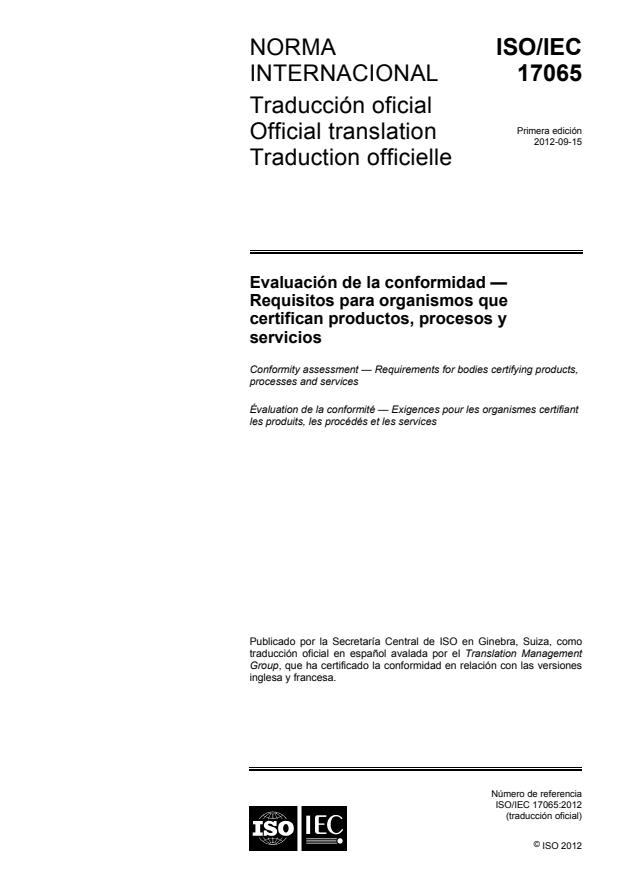
INTERNATIONAL ISO/IEC
STANDARD 17065
First edition
2012-09-15
Conformity assessment — Requirements
for bodies certifying products, processes
and services
Évaluation de la conformité — Exigences pour les organismes certifiant
les produits, les procédés et les services
Reference number
©
ISO 2012
© ISO 2012
All rights reserved. Unless otherwise specified, no part of this publication may be reproduced or utilized in any form or by any means,
electronic or mechanical, including photocopying and microfilm, without permission in writing from either ISO at the address below or
ISO's member body in the country of the requester.
ISO copyright office
Case postale 56 CH-1211 Geneva 20
Tel. + 41 22 749 01 11
Fax + 41 22 749 09 47
E-mail copyright@iso.org
Web www.iso.org
Published in Switzerland
ii © ISO 2012 — All rights reserved
Contents Page
Foreword . iv
Introduction . v
1 Scope . 1
2 Normative references . 1
3 Terms and definitions . 1
4 General requirements . 4
4.1 Legal and contractual matters . 4
4.2 Management of impartiality . 6
4.3 Liability and financing . 7
4.4 Non-discriminatory conditions . 7
4.5 Confidentiality . 7
4.6 Publicly available information . 8
5 Structural requirements . 8
5.1 Organizational structure and top management . 8
5.2 Mechanism for safeguarding impartiality . 9
6 Resource requirements . 10
6.1 Certification body personnel . 10
6.2 Resources for evaluation. 11
7 Process requirements . 12
7.1 General . 12
7.2 Application . 13
7.3 Application review . 13
7.4 Evaluation . 14
7.5 Review . 15
7.6 Certification decision . 15
7.7 Certification documentation . 16
7.8 Directory of certified products . 16
7.9 Surveillance . 17
7.10 Changes affecting certification . 17
7.11 Termination, reduction, suspension or withdrawal of certification . 18
7.12 Records . 18
7.13 Complaints and appeals . 19
8 Management system requirements . 19
8.1 Options . 19
8.2 General management system documentation (Option A) . 20
8.3 Control of documents (Option A) . 20
8.4 Control of records (Option A) . 21
8.5 Management review (Option A) . 21
8.6 Internal audits (Option A) . 22
8.7 Corrective actions (Option A) . 22
8.8 Preventive actions (Option A) . 23
Annex A (informative) Principles for product certification bodies and their certification activities . 24
Annex B (informative) Application of this International Standard for processes and services . 26
Bibliography . 27
Foreword
ISO (the International Organization for Standardization) and IEC (the International Electrotechnical
Commission) form the specialized system for worldwide standardization. National bodies that are members of
ISO or IEC participate in the development of International Standards through technical committees
established by the respective organization to deal with particular fields of technical activity. ISO and IEC
technical committees collaborate in fields of mutual interest. Other international organizations, governmental
and non-governmental, in liaison with ISO and IEC, also take part in the work. In the field of conformity
assessment, the ISO Committee on conformity assessment (CASCO) is responsible for the development of
International Standards and Guides.
International Standards are drafted in accordance with the rules given in the ISO/IEC Directives, Part 2.
Draft International Standards are circulated to the national bodies for voting. Publication as an International
Standard requires approval by at least 75 % of the national bodies casting a vote.
Attention is drawn to the possibility that some of the elements of this document may be the subject of patent
rights. ISO shall not be held responsible for identifying any or all such patent rights.
ISO/IEC 17065 was prepared by the ISO Committee on conformity assessment (CASCO).
It was circulated for voting to the national bodies of both ISO and IEC, and was approved by both
organizations.
This first edition of ISO/IEC 17065 cancels and replaces ISO/IEC Guide 65:1996, which has been technically
revised.
The following major changes have been made compared with ISO/IEC Guide 65:1996:
restructuring of this International Standard based on the common structure adopted by ISO/CASCO;
modifications based on ISO/PAS 17001, ISO/PAS 17002, ISO/PAS 17003, ISO/PAS 17004 and
ISO/PAS 17005;
introduction of the ISO/IEC 17000 functional approach in the process requirements of Clause 7;
information on the application of this International Standard for processes and services in Annex B;
revision of the terms and definitions in Clause 3;
improvement of the impartiality requirements (mechanism);
consolidation of the management system requirements in Clause 8;
inclusion of principles for product certification bodies and their activities in Annex A;
improvement by taking into account IAF GD 5;
inclusion of a reference to certification schemes, for which further information is provided in
ISO/IEC 17067.
iv © ISO 2012 – All rights reserved
Introduction
The overall aim of certifying products, processes or services is to give confidence to all interested parties that
a product, process or service fulfils specified requirements. The value of certification is the degree of
confidence and trust that is established by an impartial and competent demonstration of fulfilment of specified
requirements by a third party. Parties that have an interest in certification include, but are not limited to:
a) the clients of the certification bodies;
b) the customers of the organizations whose products, processes or services are certified;
c) governmental authorities;
d) non-governmental organizations; and
e) consumers and other members of the public.
Interested parties can expect or require the certification body to meet all the requirements of this International
Standard as well as when relevant, those of the certification scheme.
Certification of products, processes or services is a means of providing assurance that they comply with
specified requirements in standards and other normative documents. Some product, process or service
certification schemes may include initial testing or inspection and assessment of its suppliers' quality
management systems, followed by surveillance that takes into account the quality management system and
the testing or inspection of samples from the production and the open market. Other schemes rely on initial
testing and surveillance testing, while still others comprise type testing only.
This International Standard specifies requirements, the observance of which is intended to ensure that
certification bodies operate certification schemes in a competent, consistent and impartial manner, thereby
facilitating the recognition of such bodies and the acceptance of certified products, processes and services on
a national and international basis and so furthering international trade. This International Standard can be
used as a criteria document for accreditation or peer assessment or designation by governmental authorities,
scheme owners and others.
The requirements contained in this International Standard are written, above all, to be considered as general
criteria for certification bodies operating product, process or service certification schemes; they may have to
be amplified when specific industrial or other sectors make use of them, or when particular requirements such
as health and safety have to be taken into account. Annex A contains principles relating to certification bodies
and certification activities that they provide.
This International Standard does not set requirements for schemes and how they are developed and is not
intended to restrict the role or choice of scheme owners, however scheme requirements should not contradict
or exclude any of the requirements of this International Standard.
Statements of conformity to the applicable standards or other normative documents can be in the form of
certificates and/or marks of conformity. Schemes for certifying particular products or product groups,
processes and services to specified standards or other normative documents will, in many cases, require their
own explanatory documentation.
While this International Standard is concerned with third parties providing product, process or service
certification, many of its provisions may also be useful in first- and second-party product conformity
assessment procedures.
In this International Standard, the following verbal forms are used:
“shall” indicates a requirement;
“should” indicates a recommendation;
“may” indicates a permission;
“can” indicates a possibility or a capability.
Further details can be found in the ISO/IEC Directives, Part 2.
vi © ISO 2012 – All rights reserved
INTERNATIONAL STANDARD ISO/IEC 17065:2012(E)
Conformity assessment — Requirements for bodies certifying
products, processes and services
1 Scope
This International Standard contains requirements for the competence, consistent operation and impartiality of
product, process and service certification bodies. Certification bodies operating to this International Standard
need not offer all types of products, processes and services certification. Certification of products, processes
and services is a third-party conformity assessment activity (see ISO/IEC 17000:2004, definition 5.5).
In this International Standard, the term “product” can be read as “process” or “service”, except in those
instances where separate provisions are stated for “processes” or “services” (see Annex B).
2 Normative references
The following referenced documents are indispensable for the application of this document. For dated
references, only the edition cited applies. For undated references, the latest edition of the referenced
document (including any amendments) applies.
ISO/IEC 17000, Conformity assessment — Vocabulary and general principles
ISO/IEC 17020, Conformity assessment — Requirements for the operation of various types of bodies
performing inspection
ISO/IEC 17021, Conformity assessment — Requirements for bodies providing audit and certification of
management systems
ISO/IEC 17025, General requirements for the competence of testing and calibration laboratories
3 Terms and definitions
For the purposes of this document, the terms and definitions given in ISO/IEC 17000 and the following apply.
3.1
client
organization or person responsible to a certification body for ensuring that certification requirements (3.7),
including product requirements (3.8), are fulfilled
NOTE Whenever the term “client” is used in this International Standard, it applies to both the “applicant” and the
“client”, unless otherwise specified.
3.2
consultancy
participation in
a) the designing, manufacturing, installing, maintaining or distributing of a certified product or a product to be
certified, or
b) the designing, implementing, operating or maintaining of a certified process or a process to be certified, or
c) the designing, implementing, providing or maintaining of a certified service or a service to be certified
NOTE In this International Standard, the term “consultancy” is used in relation to activities of certification bodies,
personnel of certification bodies and organizations related or linked to certification bodies.
3.3
evaluation
combination of the selection and determination functions of conformity assessment activities
NOTE The selection and determination functions are specified in ISO/IEC 17000:2004, Clauses A.2 and A.3.
3.4
product
result of a process
NOTE 1 Four generic product categories are noted in ISO 9000:2005:
services (e.g. transport) (see definition in 3.6);
software (e.g. computer program, dictionary);
hardware (e.g. engine, mechanical part);
processed materials (e.g. lubricant).
Many products comprise elements belonging to different generic product categories. Whether the product is then called
service, software, hardware or processed material depends on the dominant element.
NOTE 2 Products include results of natural processes, such as growth of plants and formation of other natural
resources.
NOTE 3 Adapted from ISO/IEC 17000:2004, definition 3.3.
3.5
process
set of interrelated or interacting activities which transforms inputs into outputs
EXAMPLES Welding engineering processes; heat treatment processes; manufacturing processes requiring
confirmation of process capability (e.g. operating or producing product within specified tolerances); food production
processes; plant growth processes.
NOTE Adapted from ISO 9000:2005, definition 3.4.1.
3.6
service
result of at least one activity necessarily performed at the interface between the supplier and the customer,
which is generally intangible
NOTE 1 Provision of a service can involve, for example, the following:
an activity performed on a customer-supplied tangible product (e.g. automobile to be repaired);
an activity performed on a customer-supplied intangible product (e.g. the income statement needed to prepare a tax
return);
the delivery of an intangible product (e.g. the delivery of information in the context of knowledge transmission);
the creation of ambience for the customer (e.g. in hotels and restaurants).
NOTE 2 Adapted from ISO 9000:2005, definition 3.4.2.
2 © ISO 2012 – All rights reserved
3.7
certification requirement
specified requirement, including product requirements (3.8), that is fulfilled by the client (3.1) as a condition
of establishing or maintaining certification
NOTE Certification requirements include requirements imposed on the client by the certification body [usually via the
certification agreement (see 4.1.2)] to meet this International Standard, and can also include requirements imposed on the
client by the certification scheme. “Certification requirements”, as used in this International Standard, do not include
requirements imposed on the certification body by the certification scheme.
EXAMPLE The following are certification requirements that are not product requirements:
completing the certification agreement;
paying fees;
providing information about changes to the certified product;
providing access to certified products for surveillance activities.
3.8
product requirement
requirement that relates directly to a product, specified in standards or in other normative documents identified
by the certification scheme
NOTE Product requirements can be specified in normative documents such as regulations, standards and technical
specifications.
3.9
certification scheme
certification system related to specified products, to which the same specified requirements, specific rules and
procedures apply
NOTE 1 Adapted from ISO/IEC 17000:2004, definition 2.8.
NOTE 2 A “certification system” is a “conformity assessment system”, which is defined in ISO/IEC 17000:2004,
definition 2.7.
NOTE 3 The rules, procedures and management for implementing product, process and service certification are
stipulated by the certification scheme.
NOTE 4 General guidance for the development of schemes is given in ISO/IEC 17067, in combination with
ISO/IEC Guide 28 and ISO/IEC Guide 53.
3.10
scope of certification
identification of
the product(s), process(es) or service(s) for which the certification is granted,
the applicable certification scheme, and
the standard(s) and other normative document(s), including their date of publication, to which it is judged
that the product(s), process(es) or service(s) comply
3.11
scheme owner
person or organization responsible for developing and maintaining a specific certification scheme (3.9)
NOTE The scheme owner can be the certification body itself, a governmental authority, a trade association, a group
of certification bodies or others.
3.12
certification body
third-party conformity assessment body operating certification schemes
NOTE A certification body can be non-governmental or governmental (with or without regulatory authority).
3.13
impartiality
presence of objectivity
NOTE 1 Objectivity is understood to mean that conflicts of interest do not exist, or are resolved so as not to adversely
influence the activities of the body.
NOTE 2 Other terms that are useful in conveying the element of impartiality are independence, freedom from conflicts
of interest, freedom from bias, freedom from prejudice, neutrality, fairness, open-mindedness, even-handedness,
detachment and balance.
4 General requirements
4.1 Legal and contractual matters
4.1.1 Legal responsibility
The certification body shall be a legal entity, or a defined part of a legal entity, such that the legal entity can be
held legally responsible for all its certification activities.
NOTE A governmental certification body is deemed to be a legal entity on the basis of its governmental status.
4.1.2 Certification agreement
4.1.2.1 The certification body shall have a legally enforceable agreement for the provision of certification
activities to its clients. Certification agreements shall take into account the responsibilities of the certification
body and its clients.
4.1.2.2 The certification body shall ensure its certification agreement requires that the client comply at
least, with the following:
a) the client always fulfils the certification requirements (see 3.7), including implementing appropriate
changes when they are communicated by the certification body (see 7.10);
b) if the certification applies to ongoing production, the certified product continues to fulfil the product
requirements (see 3.8);
c) the client makes all necessary arrangements for
1) the conduct of the evaluation (see 3.3) and surveillance (if required), including provision for
examining documentation and records, and access to the relevant equipment, location(s), area(s),
personnel, and client's subcontractors;
2) investigation of complaints;
3) the participation of observers, if applicable;
d) the client makes claims regarding certification consistent with the scope of certification (see 3.10);
4 © ISO 2012 – All rights reserved
e) the client does not use its product certification in such a manner as to bring the certification body into
disrepute and does not make any statement regarding its product certification that the certification body
may consider misleading or unauthorized;
f) upon suspension, withdrawal, or termination of certification, the client discontinues its use of all
advertising matter that contains any reference thereto and takes action as required by the certification
scheme (e.g. the return of certification documents) and takes any other required measure;
g) if the client provides copies of the certification documents to others, the documents shall be reproduced in
their entirety or as specified in the certification scheme;
h) in making reference to its product certification in communication media such as documents, brochures or
advertising, the client complies with the requirements of the certification body or as specified by the
certification scheme;
i) the client complies with any requirements that may be prescribed in the certification scheme relating to
the use of marks of conformity, and on information related to the product;
NOTE See also ISO/IEC 17030, ISO/IEC Guide 23 and ISO Guide 27.
j) the client keeps a record of all complaints made known to it relating to compliance with certification
requirements and makes these records available to the certification body when requested, and
1) takes appropriate action with respect to such complaints and any deficiencies found in products that
affect compliance with the requirements for certification;
2) documents the actions taken;
NOTE Verification of item j) by the certification body can be specified in the certification scheme.
k) the client informs the certification body, without delay, of changes that may affect its ability to conform
with the certification requirements.
NOTE Examples of changes can include the following:
the legal, commercial, organizational status or ownership,
organization and management (e.g. key managerial, decision-making or technical staff),
modifications to the product or the production method,
contact address and production sites,
major changes to the quality management system.
4.1.3 Use of license, certificates and marks of conformity
4.1.3.1 The certification body shall exercise the control as specified by the certification scheme over
ownership, use and display of licenses, certificates, marks of conformity, and any other mechanisms for
indicating a product is certified.
NOTE 1 Guidance on the use of certificates and marks permitted by the certification body can be obtained from
ISO/IEC Guide 23.
NOTE 2 ISO/IEC 17030 provides requirements for the use of third-party marks.
4.1.3.2 Incorrect references to the certification scheme, or misleading use of licenses, certificates, marks,
or any other mechanism for indicating a product is certified, found in documentation or other publicity, shall be
dealt with by suitable action.
NOTE Such actions are addressed in ISO Guide 27 and can include corrective actions, withdrawal of certificate,
publication of the transgression and, if necessary, legal action.
4.2 Management of impartiality
4.2.1 Certification activities shall be undertaken impartially.
4.2.2 The certification body shall be responsible for the impartiality of its certification activities and shall not
allow commercial, financial or other pressures to compromise impartiality.
4.2.3 The certification body shall identify risks to its impartiality on an ongoing basis. This shall include
those risks that arise from its activities, from its relationships, or from the relationships of its personnel (see
4.2.12). However, such relationships may not necessarily present a certification body with a risk to impartiality.
NOTE 1 A relationship presenting a risk to impartiality of the certification body can be based on ownership, governance,
management, personnel, shared resources, finances, contracts, marketing (including branding), and payment of a sales
commission or other inducement for the referral of new clients, etc.
NOTE 2 Identifying risks does not imply risk assessments as stated in ISO 31000.
4.2.4 If a risk to impartiality is identified, the certification body shall be able to demonstrate how it eliminates
or minimizes such risk. This information shall be made available to the mechanism specified in 5.2.
4.2.5 The certification body shall have top management commitment to impartiality.
4.2.6 The certification body and any part of the same legal entity and entities under its organizational
control (see 7.6.4) shall not:
a) be the designer, manufacturer, installer, distributer or maintainer of the certified product;
b) be the designer, implementer, operator or maintainer of the certified process;
c) be the designer, implementer, provider or maintainer of the certified service;
d) offer or provide consultancy (see 3.2) to its clients;
e) offer or provide management system consultancy or internal auditing to its clients where the certification
scheme requires the evaluation of the client’s management system.
NOTE 1 This does not preclude the following:
the possibility of exchange of information (e.g. explanations of findings or clarifying requirements) between the
certification body and its clients;
the use, installing and maintaining of certified products which are necessary for the operations of the certification
body.
NOTE 2 “Management system consultancy” is defined in ISO/IEC 17021:2011, definition 3.3.
4.2.7 The certification body shall ensure that activities of separate legal entities, with which the certification
body or the legal entity of which it forms a part has relationships, do not compromise the impartiality of its
certification activities.
NOTE See 4.2.3, Note 1.
4.2.8 When the separate legal entity in 4.2.7 offers or produces the certified product (including products to
be certified) or offers or provides consultancy (see 3.2), the certification body's management personnel and
personnel in the review and certification decision-making process shall not be involved in the activities of the
separate legal entity. The personnel of the separate legal entity shall not be involved in the management of
the certification body, the review, or the certification decision.
NOTE For the evaluation personnel, impartiality requirements are stipulated in Clause 6 and additional requirements
are given in the other relevant International Standards cited in 6.2.1 and 6.2.2.1.
6 © ISO 2012 – All rights reserved
4.2.9 The certification body's activities shall not be marketed or offered as linked with the activities of an
organization that provides consultancy (see 3.2). A certification body shall not state or imply that certification
would be simpler, easier, faster or less expensive if a specified consultancy organization were used.
4.2.10 Within a period specified by the certification body, personnel shall not be used to review or make a
certification decision for a product for which they have provided consultancy (see 3.2).
NOTE 1 The period can be specified in the certification scheme or, if specified by the certification body, it reflects a
period that is long enough to ensure that the review or decision does not compromise impartiality. A specified period of
two years is often used.
NOTE 2 For the evaluation personnel, impartiality requirements are stipulated in Clause 6 and additional requirements
are given in the other relevant International Standards cited in 6.2.1 and 6.2.2.1.
4.2.11 The certification body shall take action to respond to any risks to its impartiality, arising from the
actions of other persons, bodies or organizations, of which it becomes aware.
4.2.12 All certification body personnel (either internal or external) or committees who could influence the
certification activities shall act impartially.
4.3 Liability and financing
4.3.1 The certification body shall have adequate arrangements (e.g. insurance or reserves) to cover
liabilities arising from its operations.
4.3.2 The certification body shall have the financial stability and resources required for its operations.
4.4 Non-discriminatory conditions
4.4.1 The policies and procedures under which the certification body operates, and the administration of
them, shall be non-discriminatory. Procedures shall not be used to impede or inhibit access by applicants,
other than as provided for in this International Standard.
4.4.2 The certification body shall make its services accessible to all applicants whose activities fall within
the scope of its operations.
4.4.3 Access to the certification process shall not be conditional upon the size of the client or membership
of any association or group, nor shall certification be conditional upon the number of certifications already
issued. There shall not be undue financial or other conditions.
NOTE A certification body can decline to accept an application or maintain a contract for certification from a client
when fundamental or demonstrated reasons exist, such as the client participating in illegal activities, having a history of
repeated non-compliances with certification/product requirements, or similar client-related issues.
4.4.4 The certification body shall confine its requirements, evaluation, review, decision and surveillance (if
any) to those matters specifically related to the scope of certification.
4.5 Confidentiality
4.5.1 The certification body shall be responsible, through legally enforceable commitments, for the
management of all information obtained or created during the performance of certification activities. Except for
information that the client makes publicly available, or when agreed between the certification body and the
client (e.g. for the purpose of responding to complaints), all other information is considered proprietary
information and shall be regarded as confidential. The certification body shall inform the client, in advance, of
the information it intends to place in the public domain.
4.5.2 When the certification body is required by law or authorized by contractual arrangements to release
confidential information, the client or person concerned shall, unless prohibited by law, be notified of the
information provided.
4.5.3 Information about the client obtained from sources other than the client (e.g. from the complainant or
from regulators) shall be treated as confidential.
4.6 Publicly available information
The certification body shall maintain (through publications, electronic media or other means), and make
available upon request, the following:
a) information about (or reference to) the certification scheme(s), including evaluation procedures, rules and
procedures for granting, for maintaining, for extending or reducing the scope of, for suspending, for
withdrawing or for refusing certification;
b) a description of the means by which the certification body obtains financial support and general
information on the fees charged to applicants and to clients;
c) a description of the rights and duties of applicants and clients, including requirements, restrictions or
limitations on the use of the certification body's name and certification mark and on the ways of referring
to the certification granted;
d) information about procedures for handling complaints and appeals.
5 Structural requirements
5.1 Organizational structure and top management
5.1.1 Certification activities shall be structured and managed so as to safeguard impartiality.
5.1.2 The certification body shall document its organizational structure, showing duties, responsibilities and
authorities of management and other certification personnel and any committees. When the certification body
is a defined part of a legal entity, the structure shall include the line of authority and the relationship to other
parts within the same legal entity.
5.1.3 The management of the certification body shall identify the board, group of persons, or person having
overall authority and responsibility for each of the following:
a) development of policies relating to the operation of the certification body;
b) supervision of the implementation of the policies and procedures;
c) supervision of the finances of the certification body;
d) development of certification activities;
e) development of certification requirements;
f) evaluation (see 7.4);
g) review (see 7.5);
h) decisions on certification (see 7.6);
i) delegation of authority to committees or personnel, as required, to undertake defined activities on its
behalf;
j) contractual arrangements;
k) provision of adequate resources for certification activities;
l) responsiveness to complaints and appeals;
8 © ISO 2012 – All rights reserved
m) personnel competence requirements;
n) management system of the certification body (see Clause 8).
5.1.4 The certification body shall have formal rules for the appointment, terms of reference and operation of
any committees that are involved in the certification process (see Clause 7). Such committees shall be free
from any commercial, financial and other pressures that might influence decisions. The certification body shall
retain authority to appoint and withdraw members of such committees.
5.2 Mechanism for safeguarding impartiality
5.2.1 The certification body shall have a mechanism for safeguarding its impartiality. The mechanism shall
provide input on the following:
a) the policies and principles relating to the impartiality of its certification activities;
b) any tendency on the part of a certification body to allow commercial or other considerations to prevent the
consistent impartial provision of certification activities;
c) matters affecting impartiality and confidence in certification, including openness.
NOTE 1 Other tasks or duties (e.g. taking part in the decision-making process) can be assigned to the mechanism,
provided these additional tasks or duties do not compromise its essential role of ensuring impartiality.
NOTE 2 A possible mechanism can be a committee established by one or more certification bodies, a committee
implemented by a scheme owner, a governmental authority or an equivalent party.
NOTE 3 A single mechanism for several certification schemes can satisfy this requirement.
NOTE 4 If the certification body also provides management systems certification, a committee that fulfils
ISO/IEC 17021:2011, 6.2, can also fulfil this subclause (5.2) providing that all the requirements of 5.2 have been met.
5.2.2 The mechanism shall be formally documented to ensure the following:
a) a balanced representation of significantly interested parties, such that no single interest predominates
(internal or external personnel of the certification body are considered to be a single interest, and shall not
predominate);
b) access to all the information necessary to enable it to fulfil all its functions.
5.2.3 If the top management of the certification body does not follow the input of this mechanism, the
mechanism shall have the right to take independent action (e.g. informing authorities, accreditation bodies,
stakeholders). In taking appropriate action, the confidentiality requirements of 4.5 relating to the client and
certification body shall be respected.
Input that is in conflict with the operating procedures of the certification body or other mandatory requirements
should not be followed. Management should document the reasoning behind the decision to not follow the
input and maintain the document for review by appropriate personnel.
5.2.4 Although every interest cannot be represented in the mechanism, a certification body shall identify
and invite significantly interested parties.
NOTE 1 Such interested parties can include clients of the certification body, customers of clients, manufacturers,
suppliers, users, conformity assessment experts, representatives of industry trade associations, representatives of
governmental regulatory bodies or other governmental services, and representatives of non-governmental organizations,
including consumer organizations. It can be sufficient to have one representative of each interested party in the
mechanism.
NOTE 2 These interests can be limited, depending on the nature of the certification scheme.
6 Resource requirements
6.1 Certification body personnel
6.1.1 General
6.1.1.1 The certification body shall employ, or have access to, a sufficient number of personnel to cover
its operations related to the certification schemes and to the applicable standards and other normative
documents.
NOTE The personnel include those normally working for the certification body, as well as persons working under an
individual contract or a formal agreement that places them within the management control and systems/procedures of the
certification body (see 6.1.3).
6.1.1.2 The personnel shall be competent for the functions they perform, including making required
technical judgments, defining policies and implementing them.
6.1.1.3 Personnel, including any committee members, personnel of external bodies, or personnel acting
on the certification body's behalf, shall keep confidential all information obtained or created during the
performance of the certification activities, except as required by law or by the certification scheme.
6.1.2 Management of competence for personnel involved in the certification process
6.1.2.1 The certification body shall establish, implement and maintain a procedure for management of
competencies of personnel involved in the certification process (see Clause 7). The procedure shall require
the certification body to:
a) determine the criteria for the competence of personnel for each function in the certification process, taking
into account the requirements of the schemes;
b) identify training needs and provide, as necessary, training programmes on certification processes,
requirements, methodologies, activities and other relevant certification scheme requirements;
c) demonstrate that the personnel have the required competencies for the duties and responsibilities they
undertake;
d) formally authorize personnel for functions in the certification process;
e) monitor the performance of the personnel.
6.1.2.2 The certification body shall maintain the following records on the personnel involved in the
certification process (see Clause 7):
a) name and address;
b) employer(s) and position held;
c) educational qualification and professional status;
d) experience and training;
e) the assessment of competence;
f) performance monitoring;
g) authorizations held within the certification body;
h) date of most recent updating of each record.
10 © ISO 2012 – All rights reserved
6.1.3 Contract with the personnel
The certification body shall require personnel involved in the certification process to sign a contract or other
document by which they commit themselves to the following:
a) to comply with the rules defined by the certification body, including those relating to confidentiality
(see 4.5) and independence from commercial and other interests;
b) to declare any prior and/or present association on their own part, or on the part of their employer, with:
1) a supplier or designer of products, or
2) a provider or developer of services, or
3) an operator or developer of processes
to the evaluation or certification of which they are to be assigned;
c) to reveal any situation known to them that may present them or the certification body with a conflict of
interest (see 4.2).
Certification bodies shall use this information as input into identifying risks to impartiality raised by the
activities of such personnel, or by the organizations that employ them (see 4.2.3).
6.2 Resources for evaluation
6.2.1 Internal resources
When a certification body performs evaluation activities, either with its internal resources or with other
resources under its direct control, it shall meet the applicable requirements of the relevant International
Stand
...
NORME ISO/IEC
INTERNATIONALE 17065
Première édition
2012-09-15
Version corrigée
2014-07-01
Évaluation de la conformité —
Exigences pour les organismes
certifiant les produits, les procédés et
les services
Conformity assessment — Requirements for bodies certifying
products, processes and services
Numéro de référence
©
ISO 2012
DOCUMENT PROTÉGÉ PAR COPYRIGHT
© ISO 2012
Droits de reproduction réservés. Sauf indication contraire, aucune partie de cette publication ne peut être reproduite ni utilisée
sous quelque forme que ce soit et par aucun procédé, électronique ou mécanique, y compris la photocopie, l’affichage sur
l’internet ou sur un Intranet, sans autorisation écrite préalable. Les demandes d’autorisation peuvent être adressées à l’ISO à
l’adresse ci-après ou au comité membre de l’ISO dans le pays du demandeur.
ISO copyright office
Case postale 56 • CH-1211 Geneva 20
Tel. + 41 22 749 01 11
Fax + 41 22 749 09 47
E-mail copyright@iso.org
Web www.iso.org
Version française parue en 2014
Publié en Suisse
ii © ISO 2012 – Tous droits réservés
Sommaire Page
Avant-propos .iv
Introduction .vi
1 Domaine d’application . 1
2 Références normatives . 1
3 Termes et définitions . 1
4 Exigences générales . 4
4.1 Domaine juridique et contractuel . 4
4.2 Gestion de l’impartialité . 6
4.3 Responsabilité et financement . 7
4.4 Conditions non discriminatoires . 7
4.5 Confidentialité . 8
4.6 Informations accessibles au public . 8
5 Exigences structurelles . 9
5.1 Organisation et direction . 9
5.2 Dispositif de préservation de l’impartialité . 9
6 Exigences relatives aux ressources .10
6.1 Personnel de l’organisme de certification .10
6.2 Ressources pour l’évaluation .12
7 Exigences relatives aux processus .13
7.1 Généralités .13
7.2 Demande .14
7.3 Revue de la demande .14
7.4 Évaluation .15
7.5 Revue .16
7.6 Décision de certification .16
7.7 Documents de certification .17
7.8 Annuaire des produits certifiés .18
7.9 Surveillance.18
7.10 Changements ayant des conséquences sur la certification .18
7.11 Résiliation, réduction, suspension ou retrait de la certification .19
7.12 Enregistrements .20
7.13 Plaintes et appels .20
8 Exigences du système de management .21
8.1 Options .21
8.2 Documentation générale du système de management (Option A) .22
8.3 Maîtrise des documents (Option A) .22
8.4 Maîtrise des enregistrements (Option A) .23
8.5 Revue de direction (Option A) .23
8.6 Audits internes (Option A).24
8.7 Actions correctives (Option A) .24
8.8 Actions préventives (Option A).25
Annexe A (informative) Principes s’appliquant aux organismes de certification de produitset à
leurs activités de certification .26
Annexe B (informative) Application de la présente Norme internationaleaux processus et
aux services .29
Bibliographie .30
Avant-propos
L’ISO (Organisation internationale de normalisation) et l’IEC (Commission électrotechnique
internationale) forment ensemble le système consacré à la normalisation internationale. Les organismes
nationaux membres de l’ISO ou de l’IEC participent au développement de Normes internationales par
l’intermédiaire des comités techniques créés par l’organisation concernée afin de s’occuper des différents
domaines particuliers de l’activité technique. Les comités techniques de I’ISO et de l’IEC collaborent
dans des domaines d’intérêt commun. D’autres organisations internationales, gouvernementales ou non
gouvernementales, en liaison avec I’ISO et l’IEC participent également aux travaux. Dans le domaine de
l’évaluation de la conformité, le comité ISO pour l’évaluation de la conformité (CASCO) est responsable
du développement des Normes internationales et des guides.
Les Normes internationales sont rédigées conformément aux règles données dans les Directives ISO/IEC,
Partie 2.
Les projets de Normes internationales sont soumis aux comités nationaux pour vote. Leur publication
comme Normes internationales requiert l’approbation de 75 % au moins des comités nationaux votants.
L’attention est appelée sur le fait que certains des éléments du présent document peuvent faire l’objet de
droits de propriété intellectuelle ou de droits analogues. L’ISO ne saurait être tenue pour responsable de
ne pas avoir identifié de tels droits de propriété et averti de leur existence.
L’ISO/IEC 17065 a été élaborée par le comité technique ISO pour l’évaluation de la conformité (CASCO).
Elle a été soumise pour vote aux comités nationaux de le l’ISO et de l’IEC, et a été approuvée par les deux
organisations.
Cette première édition de l’ISO/IEC 17065 annule et remplace le Guide ISO/IEC 65:1996 qui a fait l’objet
d’une révision technique.
Les changements significatifs apportés par rapport au Guide ISO/IEC 65:1996 sont les suivants:
— restructuration de la présente Norme internationale sur la base de la structure commune adoptée
par l’ISO/CASCO;
— modifications tenant compte de l’ISO/PAS 17001, l’ISO/PAS 17002, l’ISO/PAS 17003, l’ISO/PAS 17004
et l’ISO/PAS 17005;
— introduction de l’approche fonctionnelle de l’ISO/IEC 17000 dans les exigences de processus de
l’Article 7;
— informations portant sur l’application de la présente Norme internationale aux processus et aux
services (dans l’Annexe B);
— révision des termes et définitions dans l’Article 3;
— amélioration des exigences d’impartialité (dispositif);
— consolidation des exigences du système de management dans l’Article 8;
— inclusion des principes s’appliquant aux organismes de certification de produits et à leurs activités
de certification dans l’Annexe A;
— amélioration apportée par la prise en compte du GD 5 de l’IAF;
— inclusion d’une référence aux programmes de certification pour lesquels de plus amples informations
figureront l’ISO/IEC 17067.
La présente version corrigée de l’ISO/IEC 17065:2012 inclut les corrections suivantes:
— à l’Article 3, premier alinéa, la référence à l’ISO 17000 a été remplacée par une référence à
l’ISO/IEC 17000;
iv © ISO 2012 – Tous droits réservés
— en 7.9.2, «les exigences de 7.4, 7.5 et 7.6 doivent être respectées.» a été remplacé par «les exigences
de 7.4, 7.5 ou 7.6 doivent être respectées.», de manière à avoir trois exigences au choix;
— dans tout le document, le nouveau sigle unique de la Commission électrotechnique internationale,
IEC, est utilisé.
Introduction
La finalité de la certification des produits, processus ou services est d’apporter l’assurance à toutes les
parties intéressées qu’un produit, un processus ou un service remplit les exigences spécifiées. La valeur
d’une certification réside dans le degré de confiance instauré après une démonstration impartiale et
compétente par une tierce partie du respect des exigences spécifiées. Les parties qui ont un intérêt dans
la certification sont les suivantes (liste non exhaustive):
a) les clients des organismes de certification;
b) les clients des organismes dont les produits, les processus ou les services sont certifiés;
c) les autorités gouvernementales;
d) les organismes non gouvernementaux;
e) les consommateurs et le grand public.
Les parties intéressées peuvent attendre ou exiger que l’organisme de certification réponde à toutes
les exigences de la présente Norme internationale ainsi que, le cas échéant, à celles du programme
spécifique de certification.
La certification des produits, processus ou services est un moyen de garantir qu’ils répondent aux
exigences spécifiées dans les normes et autres documents normatifs. Certains programmes de
certification de produits, processus ou services peuvent comporter des essais initiaux ou une inspection
et une évaluation des systèmes de management de la qualité des fournisseurs, suivis d’une surveillance
prenant en compte le système de management de la qualité et des essais ou inspections sur des
échantillons prélevés à l’usine ou sur le marché. D’autres systèmes reposent sur des essais initiaux et
des essais de surveillance, alors que d’autres encore ne comprennent que des essais de type.
La présente Norme internationale spécifie des exigences, dont le respect a pour but de garantir que les
organismes de certification exploitent des programmes de certification avec compétence, cohérence et
impartialité, facilitant ainsi la reconnaissance de ces organismes et l’acceptation des produits, processus
et services certifiés à un niveau national et international, contribuant de ce fait au développement du
commerce international. La présente Norme internationale peut être utilisée comme document de
référence pour une accréditation, une évaluation par des pairs ou une désignation par les autorités
gouvernementales, les propriétaires de programme ou autres.
Les exigences contenues dans la présente Norme internationale sont surtout rédigées dans le but
de servir de critères généraux pour les organismes de certification exploitant des programmes de
certification de produits, processus ou services; il se peut qu’elles doivent être développées quand des
secteurs spécifiques industriels ou d’autres secteurs les utilisent ou quand il est nécessaire de prendre
en compte des exigences comme la santé et la sécurité. L’Annexe A contient des principes relatifs aux
organismes de certification et aux activités de certifications qu’ils fournissent.
La présente Norme internationale ne fixe pas d’exigences portant sur les programmes de certification
et la façon dont ils sont élaborés, et n’a pas davantage pour objet de restreindre les rôles ou les choix des
propriétaires de programmes; il convient cependant que les exigences des programmes de certification
ne contredisent ni n’excluent aucune des exigences de la présente Norme internationale.
Les déclarations de conformité aux normes applicables ou à d’autres documents normatifs peuvent se
présenter sous la forme de certificats et/ou de marques de conformité. Les programmes de certification
de produits particuliers ou de groupes de produits, processus et services selon des normes spécifiées
ou d’autres documents normatifs nécessiteront, dans de nombreux cas, une documentation explicative
qui leur sera propre.
Alors que la présente Norme internationale traite des tierces parties fournissant une certification de
produits, processus ou services, nombre de ses clauses peuvent s’avérer également utiles aux procédures
d’évaluation de la conformité de produits de première et de seconde parties.
vi © ISO 2012 – Tous droits réservés
Dans la présente Norme internationale, les formes verbales suivantes sont utilisées:
— le verbe «doit» indique une exigence,
— l’expression «il convient de» indique une recommandation,
— l’expression «il est permis de» indique une permission,
— le verbe «pouvoir» indique une possibilité ou une éventualité.
De plus amples détails figurent dans les Directives ISO/IEC, Partie 2.
NORME INTERNATIONALE ISO/IEC 17065:2012(F)
Évaluation de la conformité — Exigences pour les
organismes certifiant les produits, les procédés et les
services
1 Domaine d’application
La présente Norme internationale comporte des exigences portant sur les compétences, la cohérence
des activités et l’impartialité des organismes de certification de produits, processus et services. Les
organismes de certification exerçant selon la présente Norme internationale ne sont pas tenus de proposer
tous les types de certification de produits, processus et services. La certification de produits, processus
et services est une activité d’évaluation de la conformité par tierce partie (voir l’ISO/IEC 17000:2004,
définition 5.5).
Dans la présente Norme internationale, le terme «produit» peut se comprendre comme «processus» ou
«service», à l’exception des cas où figurent des clauses distinctes pour des «processus» ou des «services»
(voir Annexe B).
2 Références normatives
Les documents de référence suivants sont indispensables à l’application du présent document. Pour les
références datées, seule l’édition citée s’applique. Pour les références non datées, la dernière édition du
document de référence s’applique (y compris les éventuels amendements).
ISO/IEC 17000, Évaluation de la conformité — Vocabulaire et principes généraux
ISO/IEC 17020, Évaluation de la conformité — Exigences pour le fonctionnement de différents types
d’organismes procédant à l’inspection
ISO/IEC 17021, Évaluation de la conformité — Exigences pour les organismes procédant à l’audit et à la
certification des systèmes de management
ISO/IEC 17025, Exigences générales concernant la compétence des laboratoires d’étalonnages et d’essais
3 Termes et définitions
Pour les besoins du présent document, les termes et définitions donnés dans l’ISO/IEC 17000 ainsi que
les suivants s’appliquent.
3.1
client
organisme ou personne ayant la responsabilité à l’égard d’un organisme de certification de garantir que
les exigences de certification (3.7) incluant les exigences produit (3.8) sont remplies
Note 1 à l’article: Sauf indication contraire, toutes les fois que le mot «client» est utilisé dans la présente Norme
internationale, il désigne à la fois le «demandeur» et le «client».
3.2
conseil
participation à
a) la conception, la fabrication, l’installation, la maintenance ou la distribution d’un produit certifié ou
d’un produit à certifier, ou
b) la conception, la mise en œuvre, l’exploitation ou la maintenance d’un processus certifié ou d’un
processus à certifier, ou
c) la conception, la mise en œuvre, la fourniture ou la maintenance d’un service certifié ou d’un service
à certifier.
Note 1 à l’article: Dans la présente Norme internationale, le terme «conseil» est utilisé en relation aux activités
des organismes de certification, du personnel des organismes de certification et des organismes en relation ou
liés aux organismes de certification.
3.3
évaluation
combinaison des fonctions de sélection et de détermination de l’activité d’évaluation de la conformité
Note 1 à l’article: Les fonctions de sélection et de détermination sont décrites dans l’ISO/IEC 17000:2004, A.2 et
A.3.
3.4
produit
résultat d’un processus
Note 1 à l’article: L’ISO 9000:2005 mentionne quatre catégories génériques de produits:
— les services (par exemple le transport) (voir définition 3.6);
— les logiciels (par exemple programme informatique, application dictionnaire);
— les matériels (par exemple moteur, pièces mécaniques);
— les produits transformés (par exemple lubrifiant).
De nombreux produits sont constitués d’éléments appartenant à différentes catégories génériques de produits. Le
produit est appelé service, logiciel, matériel ou produit transformé en fonction de l’élément dominant.
Note 2 à l’article: La notion de produit inclut les résultats de processus naturels tels que la croissance des végétaux
et la formation d’autres ressources naturelles.
Note 3 à l’article: Adapté de l’ISO/IEC 17000:2004, définition 3.3.
3.5
processus
ensemble d’activités corrélées ou interactives qui transforment des éléments d’entrée en éléments de
sortie
EXEMPLE Techniques de soudage, processus de traitements thermiques, processus de fabrication exigeant
la confirmation de l’aptitude du processus (par exemple utilisation ou fabrication de produits dans des tolérances
spécifiées), processus de production alimentaire et processus de croissance des végétaux.
Note 1 à l’article: Adapté de l’ISO 9000:2005, définition 3.4.1.
3.6
service
résultat, généralement immatériel, d’au moins une activité réalisée nécessairement à l’interface entre le
fournisseur et le client
Note 1 à l’article: La prestation d’un service peut impliquer
— une activité réalisée sur un produit tangible fourni par un client (par exemple réparation d’une voiture);
— une activité réalisée sur un produit immatériel fourni par un client (par exemple la préparation du compte de
résultats nécessaire à l’établissement de la déclaration des revenus);
— la fourniture d’un produit immatériel (par exemple fourniture d’informations dans le contexte de la
transmission de connaissances);
2 © ISO 2012 – Tous droits réservés
— la création d’une ambiance pour le client (par exemple dans les hôtels et les restaurants).
Note 2 à l’article: Adapté de l’ISO 9000:2005, définition 3.4.2.
3.7
exigence de certification
exigence spécifiée, incluant l’exigence produit (3.8) qui doit être remplie par le client (3.1) comme
condition à l’obtention ou au maintien de la certification
Note 1 à l’article: Les exigences de certification incluent les exigences imposées au client par l’organisme de
certification [habituellement par l’intermédiaire du contrat de certification (voir 4.1.2)] pour répondre à la présente
Norme internationale, et peuvent aussi inclure des exigences imposées au client par le programme spécifique
de certification. Les «exigences de certification» telles que comprises dans la présente Norme internationale
n’incluent pas les exigences imposées à l’organisme de certification par le programme spécifique de certification.
EXEMPLE Exigences de certification qui ne sont pas des exigences produit:
— complétude du contrat de certification;
— règlement des honoraires;
— fourniture d’informations sur les changements apportés au produit certifié;
— droit d’accès aux produits certifiés pour les activités de surveillance.
3.8
exigence du produit
exigence qui se rapporte directement à un produit, spécifiée dans des normes ou dans d’autres documents
normatifs identifiés par le programme de certification
Note 1 à l’article: Les exigences de produits peuvent être spécifiées dans des documents normatifs tels que des
réglementations, des normes et des spécifications techniques.
3.9
programme de certification
système de certification spécifique pour des produits déterminés, auxquels s’appliquent les mêmes
exigences spécifiées, des règles et des procédures spécifiques
Note 1 à l’article: Adapté de l’ISO/IEC 17000:2004, définition 2.8.
Note 2 à l’article: Un «système de certification» est un «système d’évaluation de la conformité», ce dernier étant
défini dans l’ISO/IEC 17000:2004, définition 2.7.
Note 3 à l’article: Le programme de certification stipule les règles, les procédures et la gestion de la mise en œuvre
de la certification de produits, processus et services.
Note 4 à l’article: L’ISO/IEC 17067 combinée avec le Guide ISO/IEC 28 et le Guide ISO/IEC 53 donnent des lignes
directrices générales sur l’élaboration de programmes de certification.
3.10
portée de la certification
identification
— du ou des produits, processus, ou services pour lesquels la certification est délivrée,
— du programme de certification applicable, et
— de la ou des normes et autres documents normatifs, comprenant une date de publication, auxquels
le ou les produits, processus ou services sont jugés conformes.
3.11
propriétaire du programme
personne ou organisme responsable du développement et de la tenue à jour d’un programme de
certification (3.9) spécifique
Note 1 à l’article: Le propriétaire du programme peut être l’organisme de certification lui-même, une autorité
gouvernementale, une association professionnelle, un groupe d’organismes de certification ou d’autres entités.
3.12
organisme de certification
organisme tierce partie d’évaluation de la conformité mettant en œuvre des programmes de certification
Note 1 à l’article: Un organisme de certification peut être gouvernemental ou non gouvernemental (avec ou sans
pouvoir réglementaire).
3.13
impartialité
présence d’objectivité
Note 1 à l’article: La notion d’objectivité implique qu’il n’existe pas de conflit d’intérêts ou que les conflits d’intérêts
ont été résolus de sorte à ne pas porter préjudice aux activités de l’organisme de certification.
Note 2 à l’article: Ci-après, d’autres termes utiles pour véhiculer la notion d’impartialité: indépendance, absence de
conflit d’intérêts, objectivité, non-discrimination, neutralité, justice, ouverture d’esprit, équité, désintéressement,
équilibre.
4 Exigences générales
4.1 Domaine juridique et contractuel
4.1.1 Responsabilité juridique
L’organisme de certification doit être une entité juridique ou une partie définie d’une entité juridique,
en sorte que l’entité juridique puisse être tenue légalement responsable de toutes ses activités de
certification.
NOTE Un organisme de certification gouvernemental est considéré comme une entité juridique en vertu de
son statut gouvernemental.
4.1.2 Contrat de certification
4.1.2.1 L’organisme de certification doit disposer d’un contrat juridiquement applicable de fourniture
d’activités de certification à ses clients. Les contrats de certification doivent tenir compte des responsabilités
de l’organisme de certification et de celles de ses clients.
4.1.2.2 L’organisme de certification doit s’assurer que le contrat de certification engage le client à se
conformer au moins aux points suivants:
a) répondre en permanence aux exigences de certification (voir 3.7), incluant la mise en œuvre les
changements appropriés qui sont communiqués par l’organisme de certification (voir 7.10);
b) si la certification s’applique à une production en série, s’assurer que le produit certifié continue de
répondre aux exigences du produit (voir 3.8);
c) prendre toutes les dispositions nécessaires pour
1) la conduite de l’évaluation (voir 3.3) et la surveillance (le cas échéant), y compris la fourniture
d’éléments en vue de leur examen tels que: de la documentation et des enregistrements, l’accès
au matériel, aux sites, aux zones, aux personnels et sous-traitants du client concernés,
4 © ISO 2012 – Tous droits réservés
2) l’instruction des réclamations
,
3) la participation d’observateurs, le cas échéant;
d) faire des déclarations sur la certification en cohérence avec la portée de la certification (voir 3.10);
e) ne pas utiliser la certification de ses produits d’une façon qui puisse nuire à l’organisme de certification
ni faire de déclaration sur la certification de ses produits que l’organisme de certification puisse
considérer comme trompeuse ou non autorisée;
f) en cas de suspension, de retrait ou à l’échéance de la certification, cesser d’utiliser l’ensemble
des moyens de communication qui y fait référence et remplir toutes les exigences prévues par le
programme de certification (par exemple renvoi des documents de certification) et s’acquitter de
toute autre mesure exigée;
g) si le client fournit des copies de documents de certification à autrui, il doit les reproduire dans leur
intégralité ou tel que spécifié par le programme de certification;
h) en faisant référence à la certification de ses produits dans des supports de communication, tels que
documents, brochures ou publicité, se conformer aux exigences de l’organisme de certification et/ou
aux spécifications du programme de certification;
i) se conformer à toutes les exigences qui peuvent être prescrites dans le programme de certification
du produit relatives à l’utilisation des marques de conformité et aux informations relatives au
produit;
NOTE Voir également l’ISO/IEC 17030, le Guide ISO/IEC 23 et le Guide ISO 27.
j) conserver un enregistrement de toutes les réclamations dont il a eu connaissance concernant
la conformité aux exigences de certification et mettre ces enregistrements à la disposition de
l’organisme de certification sur demande, et
1) prendre toute action appropriée en rapport avec ces réclamations et les imperfections
constatées dans les produits qui ont des conséquences sur leur conformité aux exigences de la
certification;
2) documenter les actions entreprises.
NOTE La vérification du point j) par l’organisme de certification peut être spécifiée dans le programme
de certification.
k) informer, sans délai, l’organisme de certification des changements qui peuvent avoir des conséquences
sur sa capacité à se conformer aux exigences de la certification.
NOTE Exemples de changements:
— la propriété ou le statut juridique, commercial, et/ou organisationnel;
— l’organisation et la gestion (par exemple le personnel clé tel que les dirigeants, les décisionnaires ou les
techniciens);
— les changements apportés au produit ou à la méthode de production;
— les coordonnées de la personne à contacter et les sites de production;
— les changements importants apportés au système de management de la qualité.
4.1.3 Utilisation de licences, de certificats et de marques de conformité
4.1.3.1 L’organisme de certification doit exercer le contrôle tel que spécifié par le programme de
certification sur la propriété, l’utilisation et l’affichage des licences, des certificats, des marques de
conformité, ainsi que de tout autre dispositif destiné à indiquer la certification d’un produit.
NOTE 1 Le Guide ISO/IEC 23 donne des lignes directrices pour l’utilisation des certificats et des marques
autorisés par l’organisation de certification.
NOTE 2 L’ISO/IEC 17030 fournit les exigences relatives à l’utilisation des marques de tierces parties.
4.1.3.2 Des références erronées au programme de certification ou une utilisation trompeuse des
licences, des certificats, des marques ou de tout autre dispositif indiquant qu’un produit est certifié,
figurant dans la documentation ou d’autres outils publicitaires doivent être corrigées par une action
appropriée.
NOTE Ces actions sont traitées dans le Guide ISO 27 et peuvent comprendre des actions correctives, le retrait
de la certification, la publication de la faute commise et, si nécessaire, une action juridique.
4.2 Gestion de l’impartialité
4.2.1 Les activités de certification doivent être menées avec impartialité.
4.2.2 L’organisme de certification doit être responsable de l’impartialité de ses activités de certification
et ne doit pas laisser des pressions commerciales, financières ou autres compromettre cette impartialité.
4.2.3 L’organisme de certification doit identifier régulièrement les risques susceptibles de nuire à
son impartialité, notamment les risques résultant de ses activités, de ses relations ou des relations de
son personnel (voir 4.2.12). Cependant, ces relations ne présentent pas nécessairement un risque pour
l’impartialité de l’organisme de certification.
NOTE 1 Une relation présentant un risque pour l’impartialité de l’organisme de certification peut résulter de
facteurs tels que la propriété, la gouvernance, la direction, le personnel, le partage de ressources, la situation
financière, des contrats, la commercialisation (y compris la stratégie de marque), le paiement de commissions sur
les ventes ou autres incitations à l’apport de nouveaux clients, etc.
NOTE 2 L’identification des risques n’implique pas une évaluation du risque selon l’ISO 31000.
4.2.4 Si un risque pour l’impartialité est identifié, l’organisme de certification doit pouvoir apporter
la preuve de la manière dont il élimine le risque ou le limite au minimum. Ces informations doivent être
mises à la disposition du dispositif indiqué en 5.2.
4.2.5 La direction de l’organisme de certification doit s’engager en matière d’impartialité.
4.2.6 L’organisme de certification et toute autre partie de la même entité juridique, ainsi que les entités
dépendant de son contrôle organisationnel (voir 7.6.4) ne doivent pas
a) être le concepteur, le fabricant, l’installateur, le distributeur, le responsable de l’entretien du produit
certifié,
b) être le concepteur, l’utilisateur, l’exploitant, le responsable de la maintenance du processus certifié,
c) être le concepteur, l’utilisateur, le fournisseur, le responsable après-vente du service certifié,
d) proposer ou fournir à leurs clients des activités de conseil (voir 3.2), et
e) proposer ou fournir à leurs clients des conseils en matière de système de management ou d’audit
interne quand le programme de certification exige l’évaluation du système de management du client.
NOTE 1 Ceci n’empêche pas
— la possibilité d’échanger des informations (par exemple des explications sur les conclusions ou des
éclaircissements concernant des exigences) entre l’organisme de certification et ses clients, et
6 © ISO 2012 – Tous droits réservés
— l’utilisation, l’installation et la maintenance de produits certifiés qui sont nécessaires au fonctionnement de
l’organisme de certification.
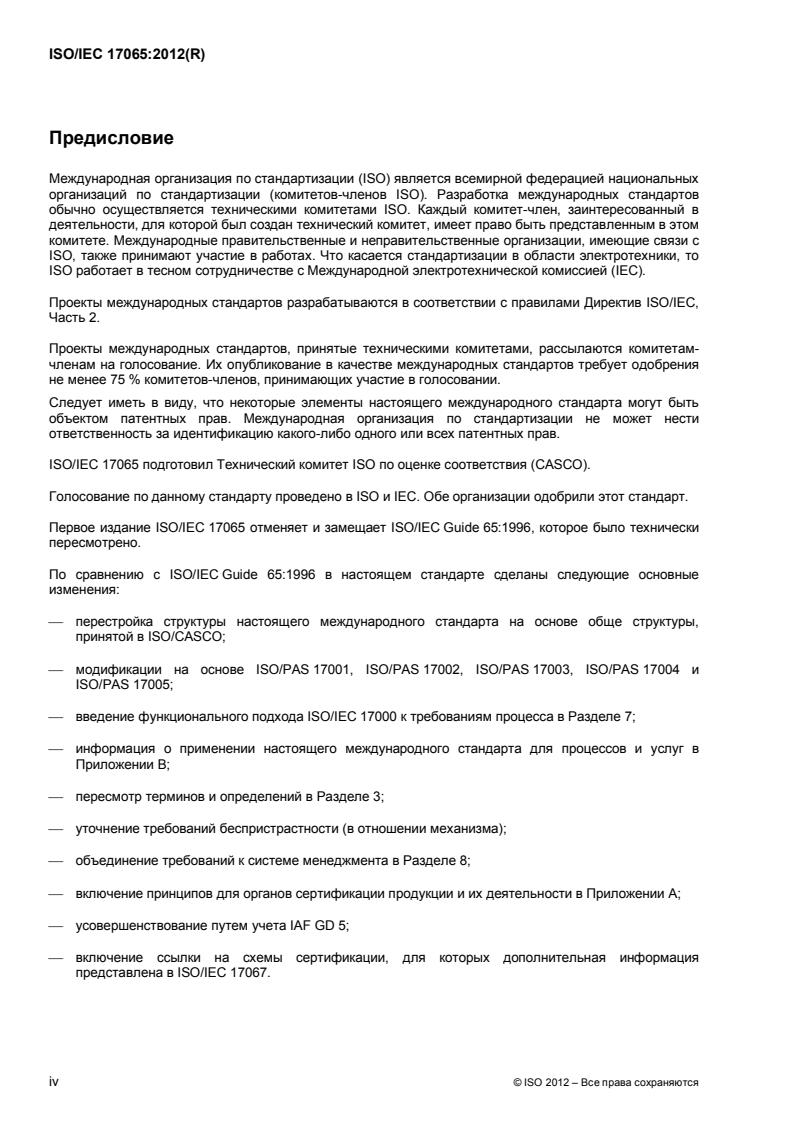
NOTE 2 «Conseils en matière de système de management» est défini dans l’ISO/IEC 17021:2011, définition 3.3.
4.2.7 L’organisme de certification doit s’assurer que les activités des entités juridiques séparées
avec lesquelles l’organisme de certification ou l’entité juridique dont il fait partie ont des relations ne
compromettent pas l’impartialité de ses activités de certification.
NOTE Voir 4.2.3, NOTE 1.
4.2.8 Lorsque l’entité juridique séparée dont il est question en 4.2.7 offre ou produit le produit certifié
(ou à certifier), ou offre ou fournit des conseils (3.2), la direction de l’organisme de certification et le
personnel chargé du processus de revue et de prise de décision de certification ne doivent pas être
impliqués dans les activités de l’entité juridique séparée. Le personnel de l’entité juridique séparée ne doit
pas être impliqué dans la gestion de l’organisme de certification, la revue ou la décision de certification.
NOTE En ce qui concerne le personnel d’évaluation, l’Article 6 de la présente Norme internationale stipule
des exigences relatives à l’impartialité. D’autres normes applicables mentionnées en 6.2.1 et 6.2.2.1 mentionnent
également des exigences supplémentaires.
4.2.9 Les activités de l’organisme de certification ne doivent pas être commercialisées ou proposées
comme étant liées aux activités d’un organisme de conseil (voir 3.2). De même, un organisme de
certification ne doit pas déclarer ou suggérer que la certification serait plus simple, plus facile, plus rapide
ou moins onéreuse s’il était fait appel à un organisme de conseil spécifié.
4.2.10 Pendant une période spécifiée par l’organisme de certification, le personnel qui a assuré des
prestations de conseil (voir 3.2) pour un produit donné ne doit pas procéder à la revue, ni prendre de
décision de certification pour ce produit.
NOTE 1 La période peut être spécifiée dans le programme de certification ou, si elle est spécifiée par l’organisme
de certification, il convient qu’elle représente une période de temps suffisamment longue pour que l’impartialité
de la revue ou de la décision ne soit pas compromise. Une période spécifiée de deux ans est souvent retenue.
NOTE 2 En ce qui concerne le personnel d’évaluation, l’Article 6 de la présente Norme internationale stipule
des exigences relatives à l’impartialité. D’autres normes applicables mentionnées en 6.2.1 et 6.2.2.1 mentionnent
également des exigences supplémentaires .
4.2.11 L’organisme de certification doit prendre les mesures nécessaires lorsqu’il prend conscience que
son impartialité est menacée par les actions d’autres personnes, entités ou organismes.
4.2.12 L’ensemble du personnel de l’organisme de certification, qu’il soit interne ou externe, ou les
comités, qui pourraient influencer les activités de certification, doit agir de manière impartiale.
4.3 Responsabilité et financement
4.3.1 L’organisme de certification doit prévoir les dispositions nécessaires (par exemple assurance ou
provisions) pour couvrir les responsabilités résultant de ses opérations.
4.3.2 L’organisme de certification doit avoir une stabilité financière et les ressources nécessaires à ses
opérations.
4.4 Conditions non discriminatoires
4.4.1 Les politiques et les procédures qui régissent le fonctionnement de l’organisme de certification,
ainsi que leur administration, doivent être non discriminatoires. Hormis les clauses prévues dans la
présente Norme internationale, les procédures ne doivent pas servir à entraver ou interdire l’accès aux
demandeurs.
4.4.2 L’organisme de certification doit rendre ses services accessibles à tous les demandeurs dont les
activités entrent dans le champ de ses activités.
4.4.3 L’accès au processus de certification ne doit pas être conditionné par la taille du client ou son
appartenance à une association ou un groupe, de même que la certification ne doit pas être conditionnée
par le nombre de certifications déjà délivrées. Il ne doit y avoir aucune condition abusive, financière ou
autre.
NOTE Un organisme de certification peut refuser d’accepter une demande de certification ou de ratifier un
contrat de certification avec un client quand il existe des raisons fondamentales ou avérées, par exemple un client
participant à des activités illégales ou ayant des antécédents de non-conformités réitérées à des exigences de
produit/de certification ou autres problèmes similaires en rapport avec le client.
4.4.4 L’organisme de certification doit limiter ses exigences, son évaluation, sa revue, sa décision et sa
surveillance (le cas échéant) aux éléments spécifiquement en rapport avec la portée de la certification.
4.5 Confidentialité
4.5.1 Dans le cadre d’engagements juridiquement exécutoires, l’organisme de certification doit être
responsable du management de toutes les informations obtenues ou créées pendant la réalisation des
activités de certification. À l’exception des informations que le client met à la disposition du public,
ou après accord entre l’organisme de certification et le client (par exemple en vue de répondre à des
réclamations), toutes les autres informations sont considérées comme des informations privées et doivent
être considérées comme confidentielles. L’organisme de certification doit informer le client, à l’avance,
des informations qu’il a l’intention de placer dans le domaine public.
4.5.2 Lorsque l’organisme de certification est tenu par la loi de communiquer des informations
confidentielles ou lorsqu’il est autorisé à le faire par des dispositions contractuelles, le client ou la
personne concernée doivent être préalablement avisés des informations qui seront fournies, à moins que
la loi ne l’interdise.
4.5.3 Les informations relatives au client obtenues par d’autres sources que le client lui-même (par
exemple plaignant, autorités de réglementation) doivent être considérées comme confidentielles.
4.6 Informations accessibles au public
L’organisme de certification doit tenir à jour (par le biais de publications, de supports électroniques ou
d’autres moyens) et fournir sur demande les informations suivantes:
a) informations sur le programme de certification des produits (ou références à ce programme) incluant
les procédures d’évaluation, les règles et les procédures de délivrance, de maintien, d’extension ou
de réduction de la portée, de suspension, de retrait ou de refus de la certification;
b) description des moyens permettant à l’organisme de certification d’obtenir des appuis financiers et
informations générales sur les tarifs facturés aux demandeurs et aux clients;
c) description des droits et des devoirs des demandeurs et des clients, comprenant les exigences, les
restrictions ou les limitations d’utilisation du nom et de la marque de certification de l’organisme de
certification, ainsi que les façons de mentionner la certification délivrée;
d) informations relatives aux procédures de traitement des plaintes et des appels.
8 © ISO 2012 – Tous droits réservés
5 Exigences structurelles
5.1 Organisation et direction
5.1.1 Les activités de certification doivent être structurées et gérées de sorte à préserver l’impartialité.
5.1.2 L’organisme de certification doit documenter son organisation, en mettant en évidence les
fonctions, les responsabilités et les pouvoirs de la direction et des membres du personnel de certification,
ainsi que de tout comité. Lorsque l’organisme de certification est une partie définie d’une entité juridique,
le lien hiérarchique et la relation avec les autres parties au sein de la même entité juridique doivent être
indiqués.
5.1.3 La direction de l’organisme de certification doit identifier le comité, le groupe de personnes ou la
personne ayant l’ensemble des pouvoirs de décision et la responsabilité de chacun des points suivants:
a) l’élaboration de politiques relatives au fonctionnement de l’organisme de certification;
b) la supervision de la mise en œuvre des politiques et des procédures;
c) la supervision de la situation financière de l’organisme;
d) le développement des prestations de certification;
e) le développement des exigences de certification;
f) l’évaluation (voir 7.4);
g) la revue (voir 7.5);
h) les décisions en matière de certification (voir 7.6);
i) la délégation des pouvoirs à des comités ou à du personnel, si nécessaire, chargés d’entreprendre en
son nom des activités définies;
j) les dispositions contractuelles;
k) la fourniture des ressources appropriées pour les activités de certification;
l) la
...
NORMA ISO/IEC
INTERNACIONAL 17065
Traducción oficial
Primera edición
Official translation
2012-09-15
Traduction officielle
Evaluación de la conformidad —
Requisitos para organismos que
certifican productos, procesos y
servicios
Conformity assessment — Requirements for bodies certifying products,
processes and services
Évaluation de la conformité — Exigences pour les organismes certifiant
les produits, les procédés et les services
Publicado por la Secretaría Central de ISO en Ginebra, Suiza, como
traducción oficial en español avalada por el Translation Management
Group, que ha certificado la conformidad en relación con las versiones
inglesa y francesa.
Número de referencia
(traducción oficial)
©
ISO 2012
DOCUMENTO PROTEGIDO POR COPYRIGHT
© ISO 2012
Reservados los derechos de reproducción. Salvo prescripción diferente, no podrá reproducirse ni utilizarse ninguna parte de esta
publicación bajo ninguna forma y por ningún medio, electrónico o mecánico, incluidos el fotocopiado y la microfilmación, sin la
autorización por escrito recibida de ISO en la siguiente dirección o del organismo miembro de ISO en el país solicitante.
ISO copyright office
Case postale 56 CH-1211 Geneva 20
Tel. + 41 22 749 01 11
Fax + 41 22 749 09 47
E-mail copyright@iso.org
Web www.iso.org
Publicado en Suiza
Traducción oficial/Official translation/Traduction officielle
ii © ISO 2012 — Todos los derechos reservados
Índice Página
Prólogo . iv
Prólogo de la version en español . v
Introducción . vi
1 Objeto y campo de aplicación . 1
2 Referencias normativas . 1
3 Términos y definiciones . 1
4 Requisitos generales . 4
4.1 Temas legales y contractuales . 4
4.2 Gestión de la imparcialidad . 6
4.3 Responsabilidad legal y financiamiento . 7
4.4 Condiciones no discriminatorias . 8
4.5 Confidencialidad . 8
4.6 Información disponible al público . 8
5 Requisitos relativos a la estructura . 9
5.1 Estructura de la organización y alta dirección . 9
5.2 Mecanismo para salvaguardar la imparcialidad . 9
6 Requisitos para los recursos . 10
6.1 Personal del organismo de certificación . 10
6.2 Recursos para la evaluación . 12
7 Requisitos del proceso . 13
7.1 Generalidades . 13
7.2 Solicitud . 14
7.3 Revisión de la solicitud. 14
7.4 Evaluación . 15
7.5 Revisión . 16
7.6 Decisión de certificación . 16
7.7 Documentación de certificación . 17
7.8 Directorio de productos certificados . 18
7.9 Vigilancia . 18
7.10 Cambios que afectan a la certificación . 18
7.11 Finalizar, reducir, suspender o retirar la certificación . 19
7.12 Registros . 20
7.13 Quejas y apelaciones . 20
8 Requisitos del sistema de gestión . 21
8.1 Opciones . 21
8.2 Documentación general del sistema de gestión (opción A) . 22
8.3 Control de documentos (opción A) . 22
8.4 Control de registros (opción A) . 22
8.5 Revisión por la dirección (opción A) . 23
8.6 Auditorías internas (opción A) . 23
8.7 Acciones correctivas (opción A) . 24
8.8 Acciones preventivas (opción A) . 24
Anexo A (informativo) Principios para los organismos de certificación de productos y sus
actividades de certificación . 26
Anexo B (informativo) Aplicación de esta norma para procesos y servicios . 28
Bibliografía . 29
Traducción oficial/Official translation/Traduction officielle
Prólogo
ISO (Organización Internacional de Normalización) e IEC (Comisión Electrotécnica Internacional) forman el
sistema especializado para la normalización mundial. Los organismos nacionales miembros de ISO e IEC
participan en el desarrollo de las Normas Internacionales por medio de comités técnicos establecidos por la
organización respectiva, para atender campos particulares de la actividad técnica. Los comités técnicos de
ISO e IEC colaboran en campos de interés mutuo. Otras organizaciones internacionales, públicas y privadas,
en coordinación con ISO e IEC, también participan en el trabajo. En el campo de la evaluación de la
conformidad, el Comité de ISO para la evaluación de la conformidad (CASCO) es responsable del desarrollo
de Normas y Guías Internacionales.
Las Normas Internacionales se redactan de acuerdo con las reglas establecidas en la Parte 2 de las
Directivas ISO/IEC.
Los Proyectos de Normas Internacionales se envían a los organismos miembros para su votación. La
publicación como Norma Internacional requiere la aprobación por al menos el 75 % de los organismos
miembros que emiten voto.
Se llama la atención sobre la posibilidad de que algunos de los elementos de este documento puedan estar
sujetos a derechos de patente. ISO e IEC no se hacen responsables de la identificación de dichos derechos
de patente.
La Norma ISO/IEC 17065 ha sido preparada por el Comité de ISO para la evaluación de la conformidad
(CASCO).
El proyecto fue sometido a votación de los organismos nacionales de ISO y de IEC y fue aprobado por las
dos organizaciones.
Esta primera edición de la Norma ISO/IEC 17065 anula y sustituye a la Guía ISO/IEC 65:1996, que ha sido
revisada técnicamente.
Se han realizado los siguientes cambios importantes en comparación con la Guía ISO/IEC 65:1996:
reestructuración de esta Norma Internacional basada en la estructura común adoptada por ISO/CASCO;
modificaciones basadas en ISO/PAS 17001, ISO/PAS 17002, ISO/PAS 17003, ISO/PAS 17004 e
ISO/PAS 17005;
introducción del enfoque funcional de ISO/IEC 17000 en los requisitos del proceso del capítulo 7;
información sobre la aplicación de esta Norma Internacional para procesos y servicios en el Anexo B;
revisión de los términos y las definiciones del capítulo 3;
mejora de los requisitos de imparcialidad (mecanismo);
consolidación de los requisitos del sistema de gestión del capítulo 8;
inclusión de los principios para los organismos de certificación de producto y sus actividades en el Anexo A;
mejora al tomar en consideración el documento IAF GD 5;
inclusión de una referencia a los esquemas de certificación, para los cuales se encuentra información
adicional en la Norma ISO/IEC 17067.
Traducción oficial/Official translation/Traduction officielle
iv © ISO 2012 – Todos los derechos reservados
Prólogo de la versión en español
Esta Norma Internacional ha sido traducida por el Grupo de Trabajo Spanish Translation Working Group
STWG del Comité ISO/CASCO, Comité para la evaluación de la conformidad, en el que participan
representantes de los organismos nacionales de normalización y representantes del sector empresarial de los
siguientes países:
Argentina, Bolivia, Chile, Colombia, Costa Rica, Cuba, Ecuador, España, Estados Unidos de América, México,
Perú y Uruguay.
Igualmente, en el citado Grupo de Trabajo participan representantes de COPANT (Comisión Panamericana
de Normas Técnicas) e INLAC (Instituto Latinoamericano de la Calidad).
Esta traducción es parte del resultado del trabajo que el Grupo ISO/CASCO STWG viene desarrollando
desde su creación en el año 2002 para lograr la unificación de la terminología en lengua española en el
ámbito de la evaluación de la conformidad.
Traducción oficial/Official translation/Traduction officielle
Introducción
El objetivo general de la certificación de productos, procesos o servicios es proporcionar confianza a todas
las partes interesadas en que un producto, proceso o servicio cumple los requisitos especificados. El valor de
la certificación es el grado de confianza que se estable mediante una demostración imparcial y competente
por una tercera parte del cumplimiento de los requisitos especificados. Las partes que tienen un interés en la
certificación incluyen, entre otras:
a) los clientes de los organismos de certificación;
b) los clientes de las organizaciones cuyos productos, procesos o servicios están certificados;
c) las autoridades gubernamentales;
d) las organizaciones no gubernamentales; y
e) los consumidores y el público en general.
Las partes interesadas pueden esperar o requerir al organismo de certificación que cumpla todos los
requisitos de esta norma internacional y también, cuando sea pertinente, aquellos del esquema de
certificación.
La certificación de productos, procesos o servicios es un medio para asegurar que estos cumplen con los
requisitos especificados en las normas u otros documentos normativos. Algunos esquemas de certificación
de productos, procesos o servicios pueden incluir el ensayo inicial o la inspección y la evaluación de los
sistemas de gestión de la calidad de sus proveedores, seguido de la vigilancia que tiene en cuenta el sistema
de gestión de la calidad y el ensayo o inspección de muestras tomadas en la producción y en el mercado.
Otros esquemas se basan en ensayos iniciales y en ensayos de vigilancia, mientras que otros incluyen
únicamente ensayos de tipo.
Esta Norma Internacional especifica requisitos, cuya observancia pretende garantizar que los organismos de
certificación operan esquemas de certificación de manera competente, coherente e imparcial, facilitando así
el reconocimiento de tales organismos y la aceptación de productos, procesos y servicios certificados en el
ámbito nacional e internacional y de este modo fomentar el comercio internacional. Esta Norma Internacional
se puede utilizar como un documento de criterios para la acreditación, la evaluación entre pares, o la
designación por las autoridades gubernamentales, dueños de esquemas y otros.
Los requisitos contenidos en esta Norma Internacional están redactados, ante todo, como criterios generales
para los organismos de certificación que operan esquemas de certificación de productos, procesos o
servicios; puede que sea necesario ampliarlos cuando los utilizan sectores industriales específicos u otros
sectores, o cuando se deben tener en cuenta requisitos particulares, tales como la salud y la seguridad. El
Anexo A contiene los principios relacionados con los organismos de certificación y con las actividades de
certificación que proporcionan.
Esta Norma Internacional no establece requisitos para los esquemas ni para la manera de desarrollarlos, y no
pretende restringir el papel ni la elección de los dueños del esquema; sin embargo los requisitos del esquema
no deberían contradecir ni excluir ninguno de los requisitos de esta Norma Internacional.
Las declaraciones de conformidad con las normas aplicables u otros documentos normativos se pueden
presentar en forma de certificados y/o marcas de conformidad. Los esquemas para la certificación de
productos particulares o grupos de productos, procesos y servicios con normas especificadas u otros
documentos normativos, en muchos casos requieren su propia documentación explicativa.
Traducción oficial/Official translation/Traduction officielle
vi © ISO 2012 – Todos los derechos reservados
Aunque esta Norma Internacional se refiere a las terceras partes que proporcionan la certificación de
productos, procesos o servicios, muchas de sus disposiciones también pueden ser útiles en los
procedimientos de evaluación de la conformidad de productos de primera y de segunda parte.
En esta Norma Internacional se utilizan las siguientes formas verbales:
“debe” indica un requisito;
“debería” indica una recomendación;
“puede” indica un permiso, una posibilidad o una capacidad.
En las Directivas ISO/IEC, Parte 2 se pueden encontrar detalles adicionales.
Traducción oficial/Official translation/Traduction officielle
NORMA INTERNACIONAL ISO/IEC 17065:2012 (traducción oficial)
Evaluación de la conformidad — Requisitos para organismos
que certifican productos, procesos y servicios
1 Objeto y campo de aplicación
Esta Norma Internacional contiene requisitos para la competencia, la consistencia de las actividades y la
imparcialidad de los organismos de certificación de productos, procesos y servicios. No es necesario que los
organismos de certificación que operan bajo esta Norma Internacional ofrezcan todos los tipos de certificación
de productos, procesos y servicios. La certificación de productos, procesos y servicios es una actividad de
evaluación de la conformidad de tercera parte (véase la Norma ISO/IEC 17000:2004, definición 5.5).
En esta Norma Internacional, el término “producto” se puede entender como “proceso” o “servicio”, excepto
en aquellos casos en que se establecen disposiciones independientes para “procesos” o “servicios” (véase
Anexo B).
2 Referencias normativas
Las normas que a continuación se indican son indispensables para la aplicación de esta norma. Para las
referencias con fecha, sólo se aplica la edición citada. Para las referencias sin fecha se aplica la última
edición de la norma (incluyendo cualquier modificación de ésta).
ISO/IEC 17000, Evaluación de la conformidad — Vocabulario y principios generales
ISO/IEC 17020, Evaluación de la conformidad — Requisitos para el funcionamiento de diferentes tipos de
organismos que realizan la inspección
ISO/IEC 17021, Evaluación de la conformidad — Requisitos para los organismos que realizan la auditoría y la
certificación de sistemas de gestión
ISO/IEC 17025, Requisitos generales para la competencia de los laboratorios de ensayo y de calibración
3 Términos y definiciones
Para los fines de este documento, se aplican los términos y definiciones incluidos en la Norma
ISO/IEC 17000 además de los siguientes.
3.1
cliente
organización o persona responsable ante un organismo de certificación para asegurar que se cumplen los
requisitos de certificación (3.7), incluyendo los requisitos de producto (3.8)
NOTA Siempre que se utilice el término “cliente” en esta norma, se aplica tanto al “solicitante” como al “cliente”, a
menos que se especifique algo diferente.
3.2
consultoría
participación en
Traducción oficial/Official translation/Traduction officielle
a) el diseño, la fabricación, la instalación, el mantenimiento o la distribución de un producto certificado o de
un producto que se va a certificar, o
b) el diseño, la implementación, la operación o el mantenimiento de un proceso certificado o de un proceso
que se va a certificar, o
c) el diseño, la implementación, la prestación o el mantenimiento de un servicio certificado o de un servicio
que se va a certificar
NOTA En esta Norma Internacional el término “consultoría” se utiliza en relación con las actividades de los
organismos de certificación, del personal de los organismos de certificación y de los organismos relacionados o
vinculados con los organismos de certificación.
3.3
evaluación
combinación de las funciones de selección y determinación en la actividad de evaluación de la conformidad
NOTA Las funciones de selección y de determinación se especifican en la Norma ISO/IEC 17000:2004,
capítulos A.2 y A.3.
3.4
producto
resultado de un proceso
NOTA 1 En la Norma ISO 9000:2005 se indican cuatro categorías genéricas de producto:
servicios (por ejemplo, el transporte) (véase la definición 3.6);
software (por ejemplo, programas de computador, diccionario);
hardware (por ejemplo, motor, parte mecánica);
materiales procesados (por ejemplo, lubricantes).
La mayoría de los productos contienen elementos que pertenecen a diferentes categorías genéricas de producto. La
denominación del producto en cada caso como servicio, software, hardware o material procesado depende del elemento
dominante.
NOTA 2 Los productos incluyen los resultados de procesos naturales, tales como el crecimiento de plantas y la
formación de otros recursos naturales.
NOTA 3 Adaptado de la Norma ISO/IEC 17000:2004, definición 3.3.
3.5
proceso
conjunto de actividades, interrelacionadas o que interactúan, que transforma elementos de entrada en
resultados
EJEMPLOS Procesos de ingeniería de soldadura; procesos de tratamiento térmico; procesos de fabricación que
requieren de la confirmación de la capacidad del proceso (por ejemplo, operar o producir un producto dentro de las
tolerancias especificadas); procesos de producción alimentaria; procesos de cultivo de plantas.
NOTA Adaptado de la Norma ISO 9000:2005, definición 3.4.1.
3.6
servicio
resultado, generalmente intangible, de al menos una actividad, realizada necesariamente en la interfaz entre
el proveedor y el cliente
NOTA 1 La prestación de un servicio puede implicar, por ejemplo, lo siguiente:
una actividad realizada sobre un producto tangible suministrado por el cliente (por ejemplo, reparación de un
automóvil);
Traducción oficial/Official translation/Traduction officielle
2 © ISO 2012 – Todos los derechos reservados
una actividad realizada en un producto intangible suministrado por el cliente (por ejemplo, la declaración de ingresos
necesaria para preparar la devolución de los impuestos);
la entrega de un producto intangible (por ejemplo, la entrega de información en el contexto de la transmisión de
conocimiento);
la creación de una ambientación para el cliente (por ejemplo, en hoteles y restaurantes).
NOTA 2 Adaptado de la Norma ISO 9000:2005, definición 3.4.2.
3.7
requisito de certificación
requisito especificado, incluyendo los requisitos de producto (3.8), que cumple el cliente (3.1) como
condición para la obtención o mantenimiento de la certificación
NOTA Los requisitos de certificación incluyen los requisitos impuestos al cliente por el organismo de certificación
[generalmente mediante el acuerdo de certificación (véase 4.1.2)] para cumplir esta Norma Internacional, y también
pueden incluir los requisitos impuestos al cliente por el esquema de certificación. Los “requisitos de certificación”, tal
como se utilizan en esta Norma Internacional, no incluyen los requisitos impuestos al organismo de certificación por el
esquema de certificación.
EJEMPLO Los siguientes son requisitos de certificación que no son requisitos de producto:
formalizar el acuerdo de certificación;
pagar las tarifas;
proporcionar información acerca de los cambios en el producto certificado;
dar acceso a los productos certificados para las actividades de vigilancia.
3.8
requisito de producto
requisito que se refiere directamente a un producto, especificado en normas o en otros documentos
normativos identificados por el esquema de certificación
NOTA Los requisitos de producto pueden estar especificados en documentos normativos tales como reglamentos,
normas y especificaciones técnicas.
3.9
esquema de certificación
sistema de certificación aplicado a productos determinados, a los que se aplican los mismos requisitos
especificados, reglas y procedimientos específicos
NOTA 1 Adaptado de la Norma ISO/IEC 17000:2004, definición 2.8.
NOTA 2 Un “sistema de certificación”, es un “sistema de evaluación de la conformidad”, que se define según la
Norma ISO/IEC 17000:2004, definición 2.7.
NOTA 3 El esquema de certificación estipula las reglas, los procedimientos y la gestión para la implementación de la
certificación de productos, procesos y servicios.
NOTA 4 La Norma ISO/IEC 17067, en combinación con las Guías ISO/IEC 28 e ISO/IEC 53, proporciona la
orientación general para el desarrollo de esquemas de certificación.
3.10
alcance de la certificación
identificación de
los productos, procesos o servicios para los cuales se otorga la certificación,
el esquema de certificación aplicable, y
Traducción oficial/Official translation/Traduction officielle
las normas y otros documentos normativos, incluida su fecha de publicación, con respecto a los cuales
se considera que el producto, proceso o servicio es conforme.
3.11
dueño del esquema
persona u organización responsable del desarrollo y el mantenimiento de un esquema de certificación (3.9)
específico
NOTA El dueño del esquema puede ser el propio organismo de certificación, una autoridad gubernamental, una
asociación comercial, un grupo de organismos de certificación u otros.
3.12
organismo de certificación
organismo de evaluación de la conformidad de tercera parte que opera esquemas de certificación
NOTA Un organismo de certificación puede ser gubernamental o no gubernamental (con o sin autoridad
reglamentaria).
3.13
imparcialidad
presencia de objetividad
NOTA 1 Se entiende que la objetividad significa que no existe conflicto de intereses, o que éstos están resueltos de
manera que no influyen de manera adversa en las actividades del organismo.
NOTA 2 Otros términos que son útiles para transmitir el elemento de imparcialidad son: independencia, ausencia de
conflicto de intereses, ausencia de sesgo, carencia de prejuicios, neutralidad, honradez, actitud abierta, ecuanimidad,
actitud desinteresada, equilibrio.
4 Requisitos generales
4.1 Temas legales y contractuales
4.1.1 Responsabilidad legal
El organismo de certificación debe ser una entidad legal, o una parte definida de una entidad legal, de
manera que pueda ser considerado legalmente responsable de todas sus actividades de certificación.
NOTA Se considera que un organismo de certificación gubernamental es una entidad legal basándose en su estatus
gubernamental.
4.1.2 Acuerdo de certificación
4.1.2.1 El organismo de certificación debe tener un acuerdo legalmente ejecutable para proporcionar
actividades de certificación a sus clientes. Los acuerdos de certificación deben tener en cuenta las
responsabilidades del organismo de certificación y de sus clientes.
4.1.2.2 El organismo de certificación debe asegurarse de que su acuerdo de certificación exige al cliente
cumplir, por lo menos, con lo siguiente:
a) el cliente siempre cumple con los requisitos de certificación (véase 3.7), incluyendo la implementación de
los cambios adecuados cuando los comunica el organismo de certificación (véase 7.10);
b) si la certificación se aplica a la producción en curso, el producto certificado continúa cumpliendo con los
requisitos del producto (véase 3.8);
c) el cliente toma todas las medidas necesarias para
Traducción oficial/Official translation/Traduction officielle
4 © ISO 2012 – Todos los derechos reservados
1) realizar la evaluación (véase 3.3) y la vigilancia (si se requiere), incluyendo las disposiciones para
examinar la documentación y los registros, y tener acceso al equipo, las ubicaciones, las áreas, el
personal y los subcontratistas del cliente que sean pertinentes;
2) investigar las quejas;
3) la participación de observadores, si es aplicable;
d) el cliente hace declaraciones sobre la certificación coherentes con el alcance de la certificación (véase
3.10);
e) el cliente no utiliza su certificación de producto de manera que ocasione mala reputación para el
organismo de certificación, y no hace ninguna declaración relacionada con su certificación de producto
que el organismo de certificación pueda considerar engañosa o no autorizada;
f) inmediatamente después de suspender, retirar o finalizar la certificación, el cliente deja de utilizarla en
todo el material publicitario que contenga alguna referencia a ella, y emprende las acciones exigidas por
el esquema de certificación (por ejemplo, la devolución de los documentos de la certificación) y cualquier
otra medida que se requiera;
g) si el cliente suministra copias de los documentos de certificación a otros, los documentos se deben
reproducir en su totalidad o según lo especifique el esquema de certificación;
h) al hacer referencia a su certificación de producto en medios de comunicación tales como documentos,
folletos o publicidad, el cliente cumple con los requisitos del organismo de certificación o los
especificados por el esquema de certificación;
i) el cliente cumple con todos los requisitos que pueda estipular el esquema de certificación con relación al
uso de las marcas de conformidad y a la información relacionada con el producto;
NOTA Véase también la Norma ISO/IEC 17030, Guía ISO/IEC 23 y Guía ISO/IEC 27.
j) el cliente conserva un registro de todos las quejas conocidas con respecto al cumplimiento de los
requisitos de la certificación y pone tales registros a disposición del organismo de certificación cuando se
le solicita, y
1) toma las acciones adecuadas con respecto a tales quejas y a las deficiencias que se encuentren en
los productos que afectan a la conformidad con los requisitos de la certificación;
2) documenta las acciones realizadas;
NOTA La verificación del punto j) por parte del organismo de certificación puede estar especificada en el esquema
de certificación.
k) el cliente informa al organismo de certificación, sin retraso, acerca de los cambios que pueden afectar a
su capacidad para cumplir con los requisitos de la certificación.
NOTA Los ejemplos de cambios pueden incluir los siguientes:
la condición legal, comercial, de organización o de propiedad,
organización y gestión (por ejemplo, directivos clave, personal que toma decisiones o personal técnico),
modificaciones en el producto o en el método de producción,
direcciones de contacto y sitios de producción,
cambios importantes en el sistema de gestión de la calidad.
Traducción oficial/Official translation/Traduction officielle
4.1.3 Uso de la licencia, los certificados y las marcas de conformidad
4.1.3.1 El organismo de certificación debe ejercer el control especificado por el esquema de certificación
sobre la propiedad, el uso y la visualización de licencias, certificados, marcas de conformidad o cualquier otro
mecanismo para indicar que el producto está certificado.
NOTA 1 Las orientaciones sobre el uso de los certificados y las marcas permitidas por el organismo de certificación se
pueden encontrar en la Guía ISO/IEC 23.
NOTA 2 La Norma ISO/IEC 17030 proporciona los requisitos para el uso de las marcas de tercera parte.
4.1.3.2 Las referencias incorrectas al esquema de certificación, o el uso engañoso de las licencias, los
certificados, las marcas de conformidad o cualquier otro mecanismo para indicar que un producto está
certificado, que se encuentren en la documentación o en otra publicidad, se deben tratar mediante una acción
adecuada.
NOTA Tales acciones se tratan en la Guía ISO/IEC 27 y pueden incluir acciones correctivas, retirada del certificado,
publicación de la transgresión y, si es necesario, acción legal.
4.2 Gestión de la imparcialidad
4.2.1 Las actividades de certificación se deben ejecutar de manera imparcial.
4.2.2 El organismo de certificación debe ser responsable de la imparcialidad de sus actividades de
certificación y no debe permitir que las presiones comerciales, financieras u otras comprometan su
imparcialidad.
4.2.3 El organismo de certificación debe identificar los riesgos para su imparcialidad de manera continua.
Se deben incluir aquellos riesgos que se derivan de sus actividades, sus relaciones o las relaciones de su
personal (véase 4.2.12). Sin embargo, dichas relaciones no necesariamente presentan riesgo para la
imparcialidad del organismo de certificación.
NOTA 1 Una relación que presenta riesgo para la imparcialidad del organismo de certificación se puede basar en
factores tales como la propiedad, la estructura directiva, la gestión, el personal, los recursos compartidos, la situación
financiera, los contratos, el marketing (incluido el posicionamiento de marca) y el pago de una comisión sobre las ventas
u otro incentivo concerniente a nuevos clientes, etc.
NOTA 2 La identificación de los riesgos no implica la valoración de ellos según se establece en la Norma ISO 31000.
4.2.4 Si se identifica un riesgo para la imparcialidad, el organismo de certificación debe poder demostrar la
manera en que elimina o minimiza tal riesgo. Esta información debe estar disponible para el mecanismo
especificado en 5.2.
4.2.5 El organismo de certificación debe contar con el compromiso de imparcialidad de la alta dirección.
4.2.6 El organismo de certificación y cualquier parte de la misma entidad legal, y las entidades bajo su
control organizacional (véase 7.6.4) no deben:
a) ser el diseñador, fabricante, instalador, distribuidor ni el responsable del mantenimiento del producto
certificado;
b) ser el diseñador, implementador, operador ni el responsable del mantenimiento del proceso certificado;
c) ser el diseñador, implementador, proveedor ni el responsable del mantenimiento del servicio certificado;
d) ofrecer ni suministrar consultoría (véase 3.2) a sus clientes;
e) ofrecer ni suministrar consultoría de sistemas de gestión ni auditoría interna a sus clientes, cuando el
esquema de certificación exige la evaluación del sistema de gestión del cliente.
Traducción oficial/Official translation/Traduction officielle
6 © ISO 2012 – Todos los derechos reservados
NOTA 1 Esto no impide:
la posibilidad de intercambio de información (por ejemplo, explicaciones de los hallazgos o aclaración sobre los
requisitos) entre el organismo de certificación y sus clientes;
el uso, la instalación y el mantenimiento de productos certificados que son necesarios para las operaciones del
organismo de certificación.
NOTA 2 “Consultoría de sistemas de gestión” se define en la Norma ISO/IEC 17021:2011, definición 3.3.
4.2.7 El organismo de certificación debe asegurarse de que las actividades de entidades legales separadas,
con las cuales este organismo o la entidad legal de la cual forma parte tiene relaciones, no comprometen la
imparcialidad de sus actividades de certificación.
NOTA Véase 4.2.3, Nota 1.
4.2.8 Cuando la entidad legal separada a la que se hace referencia en 4.2.7 ofrece o produce el producto
certificado (incluyendo los productos que se van a certificar), u ofrece o suministra consultoría (véase 3.2), el
personal de dirección del organismo de certificación y el personal del proceso de revisión y toma de decisión
sobre la certificación, no deben estar involucrados en las actividades de la entidad legal separada. El
personal de la entidad legal separada no se debe involucrar en la gestión del organismo de certificación, la
revisión ni la decisión sobre la certificación.
NOTA Para el personal de evaluación, se estipulan los requisitos de imparcialidad en el capítulo 6 y se suministran
requisitos adicionales en otras normas internacionales pertinentes citadas en los apartados 6.2.1 y 6.2.2.1.
4.2.9 Las actividades del organismo de certificación no se deben comercializar ni ofrecer de manera tal que
se consideren vinculadas a las actividades de una organización que suministra consultoría (véase 3.2). Un
organismo de certificación no debe establecer ni dejar implícito que la certificación sería más sencilla, más
fácil, más rápida o menos costosa si se utilizara una organización de consultoría determinada.
4.2.10 En un periodo especificado por el organismo de certificación, no se debe utilizar personal para revisar
o tomar la decisión sobre la certificación para un producto para el cual tal personal haya suministrado
consultoría (véase 3.2).
NOTA 1 El período puede estar especificado en el esquema de certificación o, si es especificado por el organismo de
certificación, refleja un período lo suficientemente largo para asegurarse de que la revisión o la decisión no comprometen
la imparcialidad. A menudo, se utiliza un periodo especificado de dos años.
NOTA 2 Para el personal de evaluación, se estipulan requisitos de imparcialidad en el capítulo 6 y requisitos
adicionales en otras normas internacionales pertinentes citadas en los apartados 6.2.1 y 6.2.2.1.
4.2.11 El organismo de certificación debe emprender acciones para responder ante cualquier riesgo para su
imparcialidad, que se derive de las acciones de otras personas organismos u organizaciones de los cuales
tenga conocimiento.
4.2.12 Todo el personal (interno o externo) o los comités del organismo de certificación que puedan tener
influencia en las actividades de certificación deben actuar con imparcialidad.
4.3 Responsabilidad legal y financiamiento
4.3.1 El organismo de certificación debe tener las disposiciones adecuadas (por ejemplo, seguros o
reservas) para cubrir las responsabilidades legales que se deriven de sus operaciones.
4.3.2 El organismo de certificación debe tener la estabilidad financiera y los recursos que se requieren para
sus operaciones.
Traducción oficial/Official translation/Traduction officielle
4.4 Condiciones no discriminatorias
4.4.1 Las políticas y los procedimientos bajo los cuales opera el organismo de certificación así como su
administración, deben ser no discriminatorios. No se deben utilizar procedimientos, diferentes de aquellos
suministrados en esta norma, que impidan o inhiban el acceso a los solicitantes.
4.4.2 Los servicios del organismo de certificación deben ser accesibles a todos los solicitantes cuyas
actividades estén dentro del alcance de sus operaciones.
4.4.3 El acceso al proceso de certificación no debe depender del tamaño del cliente ni de la membresía de
cualquier asociación o grupo, tampoco debe depender del número de certificaciones ya emitidas. No deben
existir condiciones indebidas, sean financieras u otras.
NOTA Un organismo de certificación puede declinar la aceptación de una solicitud o el mantenimiento de un contrato
para la certificación de un cliente cuando existen razones fundamentadas o demostradas, tales como, la participación del
cliente en actividades ilegales, un historial de no conformidades repetidas con los requisitos de producto o de certificación,
o temas similares relacionados con el cliente.
4.4.4 El organismo de certificación debe limitar sus requisitos, evaluación, revisión, decisión y vigilancia (si
existe) a aquellos asuntos relacionados específicamente con el alcance de la certificación.
4.5 Confidencialidad
4.5.1 El organismo de certificación debe ser responsable, a través de compromisos de cumplimiento legal,
de la gestión de toda la información obtenida o creada durante el desempeño de las actividades de
certificación. Con excepción de la información que el cliente pone a disposición del público, o cuando existe
acuerdo entre el organismo de certificación y el cliente (por ejemplo, con fines de responder a las quejas),
toda otra información se considera información privada y se debe considerar confidencial. El organismo de
certificación debe informar al cliente, con anticipación, acerca de la información que pretende poner a
disposición del público.
4.5.2 Cuando se exige al organismo de certificación, por ley o autorización de las disposiciones
contractuales, la divulgación de información confidencial, se debe notificar al cliente o persona implicada la
información proporcionada salvo que esté prohibido por ley.
4.5.3 La información relativa al cliente, obtenida de fuentes distintas al cliente (por ejemplo, de una queja o
de autoridades reglamentarias), debe ser tratada como información confidencial.
4.6 Información disponible al público
El organismo de certificación debe mantener (a través de publicaciones, medios electrónicos u otros medios)
y poner a disposición según solicitud, la siguiente información:
a) información sobre (o referencia a) los esquemas de certificación, incluyendo los procedimientos de
evaluación, las reglas y los procedimientos para otorgar, mantener, ampliar o reducir el alcance de la
certificación, o para suspender, retirar o denegar la certificación;
b) descripción de los medios mediante los cuales el organismo de certificación obtiene apoyo financiero e
información general sobre las tarifas cobradas a los solicitantes y clientes;
c) descripción de los derechos y deberes de solicitantes y clientes, que incluya requisitos, restricciones o
limitaciones del uso del nombre del organismo de certificación y de la marca de certificación, y sobre la
manera de hacer referencia a la certificación otorgada;
d) información sobre los procedimientos para el tratamiento de quejas y apelaciones.
Traducción oficial/Official translation/Traduction officielle
8 © ISO 2012 – Todos los derechos reservados
5 Requisitos relativos a la estructura
5.1 Estructura de la organización y alta dirección
5.1.1 Las actividades de certificación deben estar estructuradas y gestionadas de manera que
salvaguarden la imparcialidad.
5.1.2 El organismo de certificación debe documentar la estructura de su organización mostrando los
deberes, las responsabilidades y las autoridades de la dirección y demás personal de certificación, y de
cualquier comité. Cuando el organismo de certificación es una parte definida de una entidad legal, la
estructura debe incluir la línea de autoridad y la relación con otras partes dentro de la misma entidad legal.
5.1.3 La dirección del organismo de certificación debe identificar al comité, grupo de personas o persona
quien tiene la autoridad y responsabilidad general de cada una de las siguientes actividades:
a) el desarrollo de políticas relativas al funcionamiento del organismo de certificación;
b) la supervisión de la implementación de las políticas y los procedimientos;
c) la supervisión de las finanzas del organismo de certificación;
d) el desarrollo de las actividades de certificación;
e) el desarrollo de los requisitos de la certificación;;
f) la evaluación (véase 7.4);
g) la revisión (véase 7.5);
h) las decisiones relativas a la certificación (véase 7.6);
i) la delegación de autoridad en comités o personas, según el caso, para llevar a cabo en su nombre
actividades definidas;
j) los acuerdos contractuales;
k) la provisión de recursos apropiados para las actividades de certificación;
l) la respuesta a quejas y apelaciones;
m) los requisitos de competencia del personal;
n) el sistema de gestión del organismo de certificación (véase capítulo 8).
5.1.4 El organismo de certificación debe tener reglas formales para la designación, los términos de
referencia y el funcionamiento de todos los comités involucrados en el proceso de certificación (véase
capítulo 7). Tales comités no deben tener presiones de tipo comercial, financiero u otras que puedan influir en
las decisiones. El organismo de certificación debe conservar la autoridad de designar o desvincular a los
miembros de tales comités.
5.2 Mecanismo para salvaguardar la imparcialidad
5.2.1 El organismo de certificación debe tener un mecanismo para salvaguardar
...
МЕЖДУНАРОДНЫЙ ISO/IEC
СТАНДАРТ 17065
Первое издание
2012-09-15
Оценка соответствия. Требования к
органам по сертификации продуктов,
процессов и услуг
Conformity assessment — Requirements for bodies certifying products,
processes and services
Ответственность за подготовку русской версии несѐт GOST R
(Российская Федерация) в соответствии со статьѐй 18.1 Устава ISO
Ссылочный номер
©
ISO 2012
ДОКУМЕНТ ЗАЩИЩЕН АВТОРСКИМ ПРАВОМ
© ISO 2012
Все права сохраняются. Если не задано иначе, никакую часть настоящей публикации нельзя копировать или использовать в
какой-либо форме или каким-либо электронным или механическим способом, включая фотокопии и микрофильмы, без
предварительного письменного согласия офиса ISO по адресу, указанному ниже, или членов ISO в стране регистрации
пребывания.
ISO copyright office
Case postale 56 CH-1211 Geneva 20
Tel. + 41 22 749 01 11
Fax + 41 22 749 09 47
E-mail copyright@iso.org
Web www.iso.org
Опубликовано в Швейцарии
ii © ISO 2012 – Все права сохраняются
Содержание Страница
Предисловие .iv
Введение .v
1 Область применения .1
2 Нормативные ссылки .1
3 Термины и определения .1
4 Общие требования .4
4.1 Законные и договорные вопросы .4
4.2 Менеджмент беспристрастности .6
4.3 Обязательство и финансирование .8
4.4 Не дискриминационные условия .8
4.5 Конфиденциальность .8
4.6 Общедоступная информация .9
5 Структурные требования .9
5.1 Организационная структура и высшее руководство .9
5.2 Механизм для сохранения беспристрастности . 10
6 Требуемые ресурсы . 11
6.1 Персонал органа по сертификации . 11
6.2 Ресурсы для количественной и качественной оценки . 12
7 Требования к процессу . 14
7.1 Общие положения . 14
7.2 Заявление . 14
7.3 Рассмотрение заявления. 15
7.4 Количественная и качественная оценка . 16
7.5 Анализ . 17
7.6 Решение по сертификации . 17
7.7 Сертификационная документация . 17
7.8 Каталог сертифицированных продуктов . 18
7.9 Контроль . 18
7.10 Изменения, влияющие на сертификацию . 19
7.11 Окончание, сокращение, приостановка или отзыв сертификации . 20
7.12 Документальные материалы . 20
7.13 Жалобы и обращения . 21
8 Требования к системе менеджмента. 21
8.1 Варианты . 21
8.2 Общая документация системы менеджмента (Вариант A) . 22
8.3 Управление документами (Вариант A) . 23
8.4 Управление записями (Вариант A) . 23
8.5 Анализ менеджмента (Вариант A) . 23
8.6 Внутренние аудиты (Вариант A) . 24
8.7 Корректирующие меры (Вариант A) . 25
8.8 Превентивные меры (Вариант A) . 25
Приложение A (информативное) Принципы для органов по сертификации продуктов и их
сертификационной деятельности . 26
Примечание B (информативное) Применение настоящего международного стандарта для
процессов и услуг . 28
Библиография . 29
Предисловие
Международная организация по стандартизации (ISO) является всемирной федерацией национальных
организаций по стандартизации (комитетов-членов ISO). Разработка международных стандартов
обычно осуществляется техническими комитетами ISO. Каждый комитет-член, заинтересованный в
деятельности, для которой был создан технический комитет, имеет право быть представленным в этом
комитете. Международные правительственные и неправительственные организации, имеющие связи с
ISO, также принимают участие в работах. Что касается стандартизации в области электротехники, то
ISO работает в тесном сотрудничестве с Международной электротехнической комиссией (IEC).
Проекты международных стандартов разрабатываются в соответствии с правилами Директив ISO/IEC,
Часть 2.
Проекты международных стандартов, принятые техническими комитетами, рассылаются комитетам-
членам на голосование. Их опубликование в качестве международных стандартов требует одобрения
не менее 75 % комитетов-членов, принимающих участие в голосовании.
Следует иметь в виду, что некоторые элементы настоящего международного стандарта могут быть
объектом патентных прав. Международная организация по стандартизации не может нести
ответственность за идентификацию какого-либо одного или всех патентных прав.
ISO/IEC 17065 подготовил Технический комитет ISO по оценке соответствия (CASCO).
Голосование по данному стандарту проведено в ISO и IEC. Обе организации одобрили этот стандарт.
Первое издание ISO/IEC 17065 отменяет и замещает ISO/IEC Guide 65:1996, которое было технически
пересмотрено.
По сравнению с ISO/IEC Guide 65:1996 в настоящем стандарте сделаны следующие основные
изменения:
перестройка структуры настоящего международного стандарта на основе обще структуры,
принятой в ISO/CASCO;
модификации на основе ISO/PAS 17001, ISO/PAS 17002, ISO/PAS 17003, ISO/PAS 17004 и
ISO/PAS 17005;
введение функционального подхода ISO/IEC 17000 к требованиям процесса в Разделе 7;
информация о применении настоящего международного стандарта для процессов и услуг в
Приложении B;
пересмотр терминов и определений в Разделе 3;
уточнение требований беспристрастности (в отношении механизма);
объединение требований к системе менеджмента в Разделе 8;
включение принципов для органов сертификации продукции и их деятельности в Приложении A;
усовершенствование путем учета IAF GD 5;
включение ссылки на схемы сертификации, для которых дополнительная информация
представлена в ISO/IEC 17067.
iv © ISO 2012 – Все права сохраняются
Введение
Общая цель сертификации продукции, процессов или услуг — это дать уверенность всем
заинтересованным сторонам в том, что продукт, процесс или услуга выполняет заданные требования.
Значение сертификации есть степень уверенности и доверия, которая устанавливается
беспристрастной и компетентной демонстрацией выполнения заданных требований третьей стороной.
К сторонам, заинтересованным в сертификации, относятся (без ограничения) следующее:
a) клиенты органов по сертификации;
b) заказчики организаций, на продукты, процессы или услуги которых выдается квалификационное
свидетельство;
c) правительственные органы;
d) неправительственные организации; и
e) покупатели и другие члены общественности.
Заинтересованные стороны могут ожидать или нуждаться в том, чтобы орган сертификации отвечал
всем требованиям настоящего международного стандарта, а также, в уместных случаях, требованиям
схем проведения сертификации.
Сертификация продукции, процессов или услуг является средством предоставления гарантии их
соответствия требованиям, заданным в стандартах и других нормативных документах. Некоторые
схемы сертификации продукта, процесса или услуги могут включать первоначальное проведение
испытаний или инспекцию и оценку системы менеджмента качества их поставщиков с последующим
контролем, который принимает во внимание систему менеджмента качества, испытания или приемку
образцов, взятых с производства или на открытом рынке. Другие схемы полагаются на
предварительные и контрольные испытания, в то время как ряд схем все еще включают только
проведение испытаний типа.
Настоящий международный стандарт точно определяет требования, соблюдение которых гарантирует,
что органы по сертификации осуществляют схемы сертификации в компетентной, последовательной и
беспристрастной манере, тем самым способствуя признанию таких органов и одобрению
аттестованных продуктов, процессов и услуг на национальной и международной основе и, таким
образом, способствуя международной торговле. Настоящий международный стандарт может быть
использован в качестве документа, содержащего критерии для аккредитации или экспертной оценки,
или обозначения, правительственными органами, разработчиками схем сертификации и другими.
Требования, содержащиеся в настоящем международном стандарте, написаны в первую очередь для
того, чтобы их считали общими критериями для органов сертификации, которые работают по схемам
сертификации продукта, процесса или услуги. Эти требования могли быть усилены при их применении
в специальных промышленных или других секторах или в случае, когда должны быть учтены частные
требования, например, охрана труда и техника безопасности. Приложение A содержит принципы,
имеющие отношение к органам по сертификации и сертификационной деятельности, которую они
предоставляют.
Настоящий международный стандарт не устанавливает требования для схем сертификации и методов
их разработки и не предполагает ограничивать роль или выбор собственников таких схем. Однако не
следует допускать, чтобы требования к схемам сертификации противоречили или исключали любые
требования настоящего международного стандарта.
Заявления о соответствии приемлемым стандартам или другим нормативным документам могут быть
в форме сертификатов и/или меток соответствия. Схемы для сертификации конкретных продуктов или
групп изделий, процессов и услуг по заданным стандартам или другим нормативным документам могут
требовать во многих случаях свою собственную объяснительную документацию.
Пока настоящий международный стандарт представляет интерес для третьих сторон,
предоставляющих сертификацию продукта, процесса или услуги, многие его положения могут быть
также полезными в процедурах оценки соответствия продукта первой и второй стороной.
В настоящем международном стандарте используются следующие глагольные формы:
―shall‖ указывает требование;
―should‖ указывает рекомендацию;
―may‖ указывает разрешение;
‖can‖ указывает возможность или способность.
Подробности могут быть найдены в директивах ISO/IEC, Часть 2.
vi © ISO 2012 – Все права сохраняются
МЕЖДУНАРОДНЫЙ СТАНДАРТ ISO/IEC 17065:2012(R)
Оценка соответствия. Требования к органам по
сертификации продуктов, процессов и услуг
1 Область применения
Настоящий международный стандарт содержит требования для соответствия, совместной работы и
беспристрастности органов по сертификации продукта, процесса или услуги. Органам по
сертификации, действующим в рамках настоящего международного стандарта, не нужно предлагать
сертификацию всех типов продуктов, процессов и услуг. Сертификация продуктов, процессов и услуг
является сторонней (независимой) деятельностью оценки соответствия (см. ISO/IEC 17000:2004,
определение 5.5).
В настоящем международном стандарте термин ‖продукт (product)‖ может быть прочитан как ‖процесс‖
или ―услуга‖, за исключением тех примеров, где отдельные положения заявлены для ‖процессов‖ или
―услуг‖ (см. Приложение B).
2 Нормативные ссылки
Следующие ссылочные документы являются обязательными для применения настоящего документа.
Для устаревших ссылок применяется только цитируемое издание. Для недатированных ссылок
применяется самое последнее издание ссылочного документа (включая поправки).
ISO/IEC 17000, Оценка соответствия. Словарь и общие принципы
ISO/IEC 17020, Оценка соответствия. Требования для работы разных типов органов, выполняющих
инспекцию
ISO/IEC 17021, Оценка соответствия. Требования для органов, выполняющих аудит и
сертификацию систем менеджмента
ISO/IEC 17025, Общие требования для компетенции лабораторий, проводящих испытания и
поверки
3 Термины и определения
В настоящем документе применяются термины и определения, данные в ISO/IEC 17000, а также
следующие.
3.1
клиент
client
организация или личность, ответственная перед органом по сертификации, для гарантии, что
требования сертификации (3.7), включая требования к продуктам (3.8), выполняются
ПРИМЕЧАНИЕ Всякий раз, когда термин ―клиент‖ используется в настоящем международном стандарте, он
применяется и к ― заявителю‖, и к ―пользователю‖, если не задано иначе.
3.2
консультирование
consultancy
участие в
a) разработке, изготовлении, установке, содержании в исправности или распределении
аттестованного продукта или продукта, который надо сертифицировать, или
b) разработке, реализации, эксплуатации или обслуживании аттестованного процесса или процесса,
который надо сертифицировать, или
c) разработке, вводе в действие, предоставлении или поддержании аттестованной услуги или услуги,
которую надо сертифицировать
ПРИМЕЧАНИЕ В настоящем международном стандарте термин ―консультирование‖ используется в отношении
деятельности органов по сертификации, персонала и организаций, имеющих отношение к органам по
сертификации или связанными с ними.
3.3
количественное и качественное оценивание
evaluation
соединение функций отбора и определения деятельности по оценке соответствия
ПРИМЕЧАНИЕ Функции отбора и определения задаются в ISO/IEC 17000:2004, A.2 и A.3.
3.4
продукт
product
результат процесса
ПРИМЕЧАНИЕ 1 Четыре групповые категории продуктов отмечаются в ISO 9000:2005:
услуги (например, транспорт) (см. определение в 3.6);
программное обеспечение (например. компьютерная программа, словарь);
технические средства (например, двигатель, механическая часть);
обработанные материалы (например, смазка).
Многие продукты включают элементы, принадлежащие к разным групповым категориям продуктов. Тогда
название определенного продукта услугой, программным обеспечением или обработанным материалом зависит
от доминирующего элемента.
ПРИМЕЧАНИЕ 2 Продукты включают результаты естественных процессов, например, рост растений и
формирование природных ресурсов.
ПРИМЕЧАНИЕ 3 Адаптировано из ISO/IEC 17000:2004, определение 3.3.
3.5
процесс
process
набор взаимосвязанных и взаимных действий, которые преобразовывают входы в выходы
ПРИМЕРЫ Процессы сварочного производства; процессы термической обработки, производственные
процессы, требующие подтверждения возможности процесса (например, эксплуатация или производство продукта
в пределах заданных допусков); процессы производства пищевых продуктов; процессы выращивания растений.
ПРИМЕЧАНИЕ Адаптировано из ISO 9000:2005, определение 3.4.1.
2 © ISO 2012 – Все права сохраняются
3.6
услуга
service
результат, по меньшей мере, одного действия, выполненного по необходимости на границе раздела
между поставщиком и покупателем, которое, как правило, является скрытным
ПРИМЕЧАНИЕ 1 Предоставление услуги может вовлекать, например, следующее:
действие, выполненное на материальном продукте, поставляемом потребителем (например, автомобиль,
который надо отремонтировать);
действие, выполненное на скрытном продукте, поставляемом потребителем (например, отчет о прибылях и
убытках, необходимый для приготовления налоговой декларации);
доставка скрытного продукта (например, доставка информации в контексте передачи знаний);
создание обстановки (среды) для пользователя (например, в гостиницах и ресторанах).
ПРИМЕЧАНИЕ 2 Адаптировано из ISO 9000:2005, определение 3.4.2.
3.7
требование сертификации
certification requirement
заданное требование, включая требования к продуктам (3.8), которое выполняется клиентом (3.1)
как условие учреждения или поддержания сертификации
ПРИМЕЧАНИЕ Сертификационные требования включают необходимые условия, наложенные на клиента
органом по сертификации [обычно через соглашение о выдаче свидетельства (см. 4.1.2)], чтобы отвечать
настоящему международному стандарту, и может также включать требования, наложенные на клиента схемой
проведения сертификации. ―Сертификационные требования‖, как они используются в настоящем международном
стандарте, не включают необходимые условия, наложенные на орган по сертификации схемой проведения
сертификации.
ПРИМЕР Следующие сертификационные требования не являются требованиями к продуктам:
завершение соглашения о сертификации;
получение гонораров;
предоставление информации об изменениях в сертифицированном продукте;
обеспечение доступа к сертифицированному продукту для надзорных действий.
3.8
требование к продукту
product requirement
требование, которое непосредственно относится к продукту, заданное в стандартах или других
нормативных документах, указанных в схеме сертификации
ПРИМЕЧАНИЕ Требования к продуктам могут быть заданы в нормативных документах, например, правилах,
стандартах и технических условиях.
3.9
схема сертификации
certification scheme
система сертификации, относящаяся к заданным продуктам, для которых применяются одни и те же
сертификационные требования, специальные правила и методики
ПРИМЕЧАНИЕ 1 Адаптировано из ISO/IEC 17000:2004, определение 2.8.
ПРИМЕЧАНИЕ 2 ―Система сертификации‖ является ―системой оценки соответствия ‖, которая определяется в
ISO/IEC 17000:2004, определение 2.7.
ПРИМЕЧАНИЕ 3 Правила, методики и менеджмент для реализации сертификации продуктов, процессов и услуг
обуславливаются схемой проведения сертификации.
ПРИМЕЧАНИЕ 4 Общее руководство по разработке схем дается в ISO/IEC 17067, в сочетании с
ISO/IEC Guide 28 и ISO/IEC Guide 53.
3.10
область действия сертификации
scope of certification
идентификация
продукта(ов), процесса(ов) или услуги (услуг), для которых предоставляется сертификация,
соответствующей схемы проведения сертификации,
стандарта(ов) и других нормативных документов, включая их дату публикации, с которой судят о
соответствии продукта(ов), процесса(ов) или услуги (услуг)
3.11
владелец схемы
scheme owner
личность или организация, ответственная за разработку и поддержание специальной схемы
проведения сертификации (3.9)
ПРИМЕЧАНИЕ Владельцем схемы может быть сам орган по сертификации, правительственный орган,
торговая ассоциация, группа сертификационных органов или другие.
3.12
орган по сертификации
certification body
сторонний (независимый) орган оценки соответствия, управляющий схемами проведения
сертификации
ПРИМЕЧАНИЕ Орган по сертификации может быть правительственным и неправительственным (с
регулирующими полномочиями или без них).
3.13
беспристрастность
impartiality
присутствие объективности
ПРИМЕЧАНИЕ Под объективностью понимают отсутствие конфликтов интересов или их разрешение таким
образом, чтобы не оказывать вредного влияния на деятельность органа.
ПРИМЕЧАНИЕ 2 Другие термины, которые являются полезными для передачи элемента беспристрастности,
являются независимость, свобода от конфликтов интересов, свобода от пристрастности и предубеждения,
нейтральность, справедливость, непредвзятость, доктрина равного отношения, независимость суждений и
равновесие.
4 Общие требования
4.1 Законные и договорные вопросы
4.1.1 Юридическая/правовая ответственность
Орган по сертификации должен быть законным субъектом права или определенной частью субъекта
права, так что этот юридический субъект может быть привлечен к ответственности за все свои
действия по сертификации.
ПРИМЕЧАНИЕ Государственный орган по сертификации считается законным субъектом на основе своего
правительственного статуса.
4 © ISO 2012 – Все права сохраняются
4.1.2 Соглашение по сертификации
4.1.2.1 Орган по сертификации должен иметь юридически обязывающее соглашение на условие
сертификационной деятельности для своих клиентов. Соглашения по сертификации должны
учитывать обязанности органа по сертификации и его клиентов.
4.1.2.2 Орган по сертификации должен обеспечить в своем соглашении о сертификации условие, что
клиент соблюдает, по меньшей мере, следующее:
a) клиент всегда выполняет требования сертификации (см. 3.7), включая реализацию
соответствующих изменений, когда они передаются от органа по сертификации (см. 7.10);
b) если сертификация применяется к текущему производству, то аттестованный продукт продолжает
выполнять требования к продуктам (см. 3.8);
c) клиент делает все необходимые приготовления, чтобы
1) проводить оценивание (см. 3.3) и наблюдение (если требуется), включая условие для
изучения документации и записей, а также доступ к уместному оборудованию,
местоположениям, зонам, персоналу и субподрядчикам клиента;
2) расследование жалоб;
3) участие наблюдателей в зависимости от ситуации;
d) клиент предъявляет рекламации, касающиеся сертификации, которые не противоречат области
применения сертификации (см. 3.10);
e) клиент не использует сертификацию своего продукта в такой манере, которая принесет органу по
сертификации сомнительную репутацию, и не делает никакого заявления в отношении
сертификации своего продукта, которое орган по сертификации считает вводящим в заблуждение
или неразрешенным;
f) в случае приостановки, отзыва или окончания срока действия сертификации клиент прекращает ее
использование во всякой рекламе, которая содержит любую ссылку на сертификацию, выполняет
действие, требуемое по схеме проведения сертификации (например, возврат сертификационных
документов), а также принимает любые другие необходимые меры;
g) если клиент предоставляет копии сертификационных документов другим субъектам, то эти
документы должны быть воспроизведены в их целостности или как определяется по схеме
сертификации;
h) при ссылке на сертификацию своего продукта в среде передачи информации, например, в виде
документов, брошюр или рекламы, клиент подчиняется требованиям органа по сертификации или
как задано схемой сертификации;
i) клиент подчиняется любым требованиям, которые могут быть предписаны в схеме сертификации в
отношении использования меток соответствия, и к информации, имеющщей отношение к
определенному продукту;
ПРИМЕЧАНИЕ См. также ISO/IEC 17030, ISO/IEC Guide 23 и ISO Guide 27.
j) клиент ведет запись всех претензий, о которых ему становится известно в отношении
соответствия требованиям сертификации, и делает эти записи доступными для органа по
сертификации по запросу, а также
1) принимает соответствующие меры в том, что касается таких претензий и любых недостатков,
обнаруженных в продуктах, которые затрагивают соответствие требованиям сертификации;
2) подтверждает документами выполненные действия;
ПРИМЕЧАНИЕ Проверка пункта j) органом по сертификации может быть задана в схеме проведения
сертификации.
k) клиент информирует орган по сертификации без промедления об изменениях, которые могут
влиять на его способность соответствовать требованиям сертификации.
ПРИМЕЧАНИЕ Примеры изменений могут включать следующее:
правовой, коммерческий, организационный статус или владение,
организацию и менеджмент (например, изменения в управленческом или техническом штатном составе),
модификации продукта или метода производства,
контактный адрес и места расположения производства,
главные изменения в системе менеджмента качества.
4.1.3 Использование лицензии, сертификатов и меток соответствия
4.1.3.1 Орган по сертификации должен осуществлять контроль, как определено схемой
сертификации в отношении владения, использования и отображения лицензий, сертификатов, меток
соответствия и любых других механизмов для индикации, что продукт сертифицирован.
ПРИМЕЧАНИЕ 1 Руководство по использованию сертификатов и меток, разрешенных органом по сертификации,
может быть взято из ISO/IEC Guide 23.
ПРИМЕЧАНИЕ 2 ISO/IEC 17030 дает требования по использованию меток третьей стороны.
4.1.3.2 Неправильные ссылки в схеме проведения аттестации или вводящее в заблуждение
использование лицензий, сертификатов, меток или любого другого механизма для указания
сертифицированного продукта, которые были обнаружены в документации или стали известными
другим способом, должны быть устранены подходящим действием.
ПРИМЕЧАНИЕ Такие действия рассматриваются в ISO Guide 27 и могут включать корректирующие меры,
отзыв сертификата, публикацию нарушений, и, если необходимо, возбуждение судебного дела.
4.2 Менеджмент беспристрастности
4.2.1 Сертификационная деятельность должна осуществляться беспристрастно.
4.2.2 Орган по сертификации должен быть ответственным за беспристрастность своей
сертификационной деятельности и не позволять коммерческому, финансовому или другому давлению
дискредитировать беспристрастность.
4.2.3 Орган по сертификации должен выявлять риски для своей беспристрастности на текущей
основе. Сюда необходимо включить риски, которые возникают от деятельности органа, его
взаимоотношений или взаимоотношений его персонала (см. 4.2.12). Однако такие взаимоотношения не
обязательно могут представлять риск для беспристрастности органа по сертификации.
ПРИМЕЧАНИЕ 1 Взаимоотношение, представляющее риск беспристрастности органа по сертификации, может
иметь в своей основе владение, управление, менеджмент, персонал, совместные ресурсы, финансы, контракты,
маркетинг (включая торговые знаки) и выплату первого годичного комиссионного вознаграждения за
обслуживание страхователей или другой стимул для приглашения новых клиентов, и т.д.
ПРИМЕЧАНИЕ 2 Идентификация рисков не заключает в себе оценку рисков, как заявлено в ISO 31000.
4.2.4 Если риск беспристрастности идентифицируется, то орган по сертификации должен быть
способен демонстрировать, как исключить или минимизировать такой риск. Эта информация должна
быть доступной для механизма, определенного в 5.2.
6 © ISO 2012 – Все права сохраняются
4.2.5 Орган по сертификации должен иметь обязательство высшего руководства в отношении
беспристрастности.
4.2.6 Орган по сертификации и любая часть одного и того же юридического субъекта и субъектов
под его организационным контролем (см. 7.6.4) не должны
a) быть разработчиком, производителем, установщиком, распределителем или координатором
сертифицированного продукта;
b) быть разработчиком, исполнителем, оператором или координатором сертифицированного
процесса;
c) разработчиком, исполнителем, поставщиком или координатором сертифицированной услуги;
d) предлагать или предоставлять консультирование (см. 3.2) своим клиентам;
e) предлагать или предоставлять консультирование по системе менеджмента или внутреннему
аудиту своим клиентам в случае, когда схема проведения сертификации требует определения
пригодности системы менеджмента клиента.
ПРИМЕЧАНИЕ 1 Это не препятствует следующему:
возможности обмена информацией (например, разъяснение полученных данных или уточнение требований)
между органом по сертификации и его клиентами;
использованию, установке и обслуживанию сертифицированных продуктов, которые являются необходимыми
для операций органа по сертификации.
ПРИМЕЧАНИЕ 2 ―Консультирование по системе менеджмента‖ определяется в ISO/IEC 17021:2011,
определение 3.3.
4.2.7 Орган по сертификации должен гарантировать, что деятельность отдельных юридических
субъектов, с которыми он или юридический субъект, образующий его часть, имеет взаимоотношения,
не дискредитирует беспристрастность его сертификационной деятельности.
ПРИМЕЧАНИЕ См. 4.2.3, Примечание 1.
4.2.8 Когда отдельный юридический субъект в 4.2.7 предлагает или создает сертифицированный
продукт (включая продукты, которые надо аттестовать) или предлагает или предоставляет
консультирование (см 3.2), то персонал менеджмента органа по сертификации и персонал,
участвующий в процессе обзора и принятия решения о сертификации, не должен быть вовлечен в
деятельность отдельного юридического субъекта. Персонал отдельного юридического субъекта не
должен быть вовлечен в менеджмент органа по сертификации, обзор или решение о сертификации.
ПРИМЕЧАНИЕ Для персонала, делающего количественное и качественное оценивание, требования
беспристрастности оговариваются в Разделе 6 и дополнительные требования даются в других уместных
международных стандартах, цитируемых в 6.2.1 и 6.2.2.1.
4.2.9 Деятельность органа по сертификации не должна продаваться или предлагаться в связке с
деятельностью организации, которая предоставляет консультирование (см. 3.2). Орган по
сертификации не должен заявлять или влечь за собой, что сертификация могла бы быть более
простой, легкой, быстрой или менее затратной, если бы использовалась заданная консультирующая
организация.
4.2.10 В пределах периода, заданного органом по сертификации, персонал не должен привлекаться
для анализа или принятия решения о сертификации продукта, для которого они предоставили
консультирование (см. 3.2).
ПРИМЕЧАНИЕ 1 Этот период может быть определен в схеме сертификации или, если задается органом по
сертификации, он отражает период, который является достаточно продолжительным для гарантии, что экспертиза
или решение не дискредитируют беспристрастность. Часто используется заданный период два года.
ПРИМЕЧАНИЕ 2 Для персонала, делающего количественное и качественное оценивание, требования
беспристрастности оговариваются в Разделе 6 и дополнительные требования даются в других уместных
международных стандартах, цитируемых в 6.2.1 и 6.2.2.1.
4.2.11 Орган по сертификации должен реагировать на любые риски его беспристрастности,
возникающие от действий других лиц, органов или организаций, о которых ему становится известно.
4.2.12 Весь персонал органа по сертификации (либо внутренний, или внешний) или комитетов, кто мог
бы влиять на сертификационную деятельность, должен действовать беспристрастно.
4.3 Обязательство и финансирование
4.3.1 Орган по сертификации должен принимать адекватные меры (например, страхование или
резервы), чтобы покрывать денежные обязательства, возникающие из его операций.
4.3.2 Орган по сертификации должен иметь финансовую стабильность и ресурсы, необходимые для
его операций.
4.4 Не дискриминационные условия
4.4.1 Направления и методики, по которым орган по сертификации действует, а также
административное управление ими, не должны быть дискриминационными. Не должны применяться
другие методики, затрудняющие или запрещающие доступ к заявителям, кроме тех, которые
предусмотрены в настоящем международном стандарте.
4.4.2 Орган по сертификации должен делать свой сервис доступным для всех заявителей, чья
деятельность попадает в область применения его операций.
4.4.3 Доступ к процессу сертификации не должен быть обусловлен размером клиента или
количеством членов любой ассоциации или группы. Сертификация не должна зависеть от количества
уже выданных свидетельств о соответствии. Не должно быть никаких ненадлежащих финансовых или
других условий.
ПРИМЕЧАНИЕ Орган по сертификации может отклонить прием заявления клиента или поддержание контракта
на сертификацию, если существуют веские или доказанные причины, например, участие клиента в незаконной
деятельности, наличие в прошлом неоднократных несоответствий продукта требованиям сертификации или
подобных проблем, связанных с клиентом.
4.4.4 Орган по сертификации должен ограничивать свои требования, определение стоимости,
анализ, решение и контроль (если осуществляется) до тех конкретных вопросов, которые относятся к
области применения сертификации.
4.5 Конфиденциальность
4.5.1 Орган по сертификации должен быть ответственным, через юридически принудительные
обязательства, за обращение и управление всей информацией, полученной или созданной во время
исполнения сертификационных действий. За исключением информации, которую клиент делает
доступной для широкой публики, или по соглашению между органом по сертификации и клиентом
(например, в целях реагирования на претензии), вся другая информация считается собственнической
и должна рассматриваться как конфиденциальная. Орган по сертификации должен информировать
клиента заранее об информации, которую он намеревается разместить в публичной среде.
4.5.2 Когда органу по сертификации требуется по закону или разрешается контрактными
договоренностями выпустить конфиденциальную информацию, заинтересованный клиент или субъект
должен быть извещен о предоставленной информации, если это не запрещается законом.
4.5.3 Информация о клиенте, полученная от других, чем сам клиент, источников (например, из
претензии или от инспекторов) подлежит конфиденциальному обращению.
8 © ISO 2012 – Все права сохраняются
4.6 Общедоступная информация
Орган по сертификации должен поддерживать (через публикации, электронные или другие средства
передачи информации) и делать доступной по запросу следующее:
a) информацию (или ссылку) по схеме проведения сертификации, включая оценочные методики,
правила и методы для предоставления, сохранения, расширения или уменьшения объема,
временного прекращения, отзыва или отказа сертификации;
b) описание средств, с помощью которых орган по сертификации получает финансовую поддержку и
общую информацию о платах за услуги, начисляемых заявителям и клиентам;
c) описание прав и обязанностей заявителей и клиентов, включая требования, ограничения или
пределы на использование названия и сертификационного знака органа по сертификации и на
пути обращения к выданному сертификату;
d) информацию о методиках обращения с жалобами и заявлениями.
5 Структурные требования
5.1 Организационная структура и высшее руководство
5.1.1 Сертификационная деятельность должна быть структурированной и управляться с таким
расчетом, чтобы сохранять беспристрастность.
5.1.2 Орган по сертификации должен подтверждать документами свою организационную структуру,
показывая обязанности, обязательства и полномочия менеджмента, другого персонала и любых
комитетов, осуществляющего сертификацию. Когда орган по сертификации является определенной
частью юридического субъекта, то структура должна включать линию полномочий и взаимоотношения
с другими частями в рамках того же самого юридического субъекта.
5.1.3 Менеджмент органа по сертификации должен выделить совет, группу экспертов или людей,
обладающих полной властью и ответственностью по каждому из следующих пунктов:
a) разработка курсов действий, имеющих отношение к функционированию органа по сертификации;
b) надзор реализации курсов действий и методик;
c) контроль финансов органа по сертификации;
d) разработка сертификационной деятельности;
e) разработка сертификационных требований;
f) количественная и качественная оценка (см. 7.4);
g) анализ (см. 7.5);
h) решения по сертификации (см. 7.6);
i) делегирование полномочий комитетам или персоналу, когда требуется предпринимать действия
от имени менеджмента;
j) контрактные приготовления;
k) снабжение адекватных ресурсов для сертификационной деятельности;
l) реагирование на претензии, жалобы и заявления;
m) требования в отношении компетентности персонала;
n) система менеджмента органа по сертификации (см. Раздел 8).
5.1.4 Орган по сертификации должен иметь официальные правила для назначения, круга
полномочий и работы любых комитетов, которые вовлечены в процесс сертификации (см. Раздел 7).
Такие комитеты должны быть свободными от любых коммерческих, финансовых и других давлений,
которые могли бы влиять на решения. Орган по сертификации должен удерживать власть, чтобы
назначать и выводить членов таких комитетов.
5.2 Механизм для сохранения беспристрастности
5.2.1 Орган по сертификации должен иметь механизм для защиты своей беспристрастности. Этот
механизм должен давать входные данные на следующее:
a) курсы действий и принципы, относящиеся к беспристрастности сертификационной деятельности;
b) любую склонность со стороны органа по сертификации допускать коммерческие или другие
соображения, чтобы предотвращать последовательную беспристрастную возможность
сертификационной деятельности;
c) дела, вредно влияющие на беспристрастность и доверие в сертификации, включая открытость.
ПРИМЕЧАНИЕ 1 Другие задачи или обязанности (например, участие в процессе принятия решений) могут быть
назначены этому механизму при условии, что эти дополнительные задачи или обязанности не будут мешать его
основной роли в гарантии беспристрастности.
ПРИМЕЧАНИЕ 2 Возможным механизмом может быть комитет, учрежденный одним или несколькими органами
по сертификации, комитет, реализованный собственником схемы проведения сертификации, правительственный
орган или эквивалентная сторона.
ПРИМЕЧАНИЕ 3 Единичный механизм для нескольких схем проведения сертификации может удовлетворять это
требование.
ПРИМЕЧАНИЕ 4 Если орган по сертификации также обеспечивает сертификацию систем менеджмента, то
комитет, который выполняет положения ISO/IEC 17021:2011, 6.2, может также выполнять этот подпункт (5.2) при
условии, что были удовлетворены все требования 5.2.
5.2.2 Этот механизм должен быть официально подтвержден документами, чтобы гарантировать
следующее:
a) сбалансированное представление значимо заинтересованных сторон, так что не преобладает ни
один единичный интерес (внутренний или внешний персонал органа по сертификации считается
имеющим единичный интерес и не должен преобладать);
b) доступ ко всей необходимой информации, чтобы дать возможность этому механизму выполнять
все свои функции.
5.2.3 Если высшее руководство органа по сертификации не отслеживает входные данные
механизма защиты беспристрастности, то этот механизм должен быть наделен правом, выполнять
независимое действие (например, информирование властей, аккредитованных органов, акционеров).
При выполнении соответствующего действия должны быть соблюдены требования
конфиденциальности в 4.5, касающиеся клиентов и органа по сертификации.
Не следует использовать входные данные, которые противоречат рабочим методикам органа по
сертификации или другим обязательным требованиям. Следует подтверждать документами все
доводы руководства за пределами решения не использовать входные данные. Эти документы следует
сохранять для просмотра соответствующим персоналом.
10 © ISO 2012 – Все права сохраняются
5.2.4 Хотя каждый интерес не может быть представлен в упомянутом выше механизме, орган по
сертификации должен идентифицировать и приглашать значимо заинтересованные стороны.
ПРИМЕЧАНИЕ 1 Такие заинтересованные стороны могут включать клиентов органа по сертификации,
заказчиков клиентов, производителей, поставщиков, пользователей, экспертов оценки соответствия,
представителей промышленных торговых ассоциаций, представителей государственных регулирующих органов
или других государственных служб и представителей неправительственных организаций, включая общества
потребителей. Достаточно имеет одного представителя от каждой заинтересованной стороны в этом механизме.
ПРИМЕЧАНИЕ 2 Эти интересы могут быть ограничены в зависимости от характера схемы проведения
сертификации.
6 Требуемые ресурсы
6.1 Персонал органа по сертификации
6.1.1 Общие положения
6.1.1.1 Орган по сертификации должен нанимать достаточную численность персонала или иметь к
нему доступ, чтобы охватить свои операции, относящиеся к схемам сертификации и к
соответствующим стандартам и другим нормативным документам.
ПРИМЕЧАНИЕ К персоналу относятся специалисты, нормально работающие в органе по спецификации, а
также люди, работающие по индивидуальным контрактам или официальному договору, которые ставят их в
пределы управленческого контроля и системы/методики органа по сертификации (см. 6.1.3).
6.1.1.2 Персонал должен быть компетентным для функций, которые они выполняют, включая
высказывание необходимых технических суждений, определения курсов действий и их реализаций.
6.1.1.3 Персонал, включающий членов любых комитетов, персонал внешних органов или персонал,
действующий от имени органа по сертификации, должен хранить в тайне всю информацию,
полученную или созданную во время выполнения сертификационной деятельности, кроме случаев,
когда информация требуется по закону или по схеме проведения сертификации.
6.1.2 Менеджмент компетенции персонала, вовлеченного в процесс сертификации
6.1.2.1 Орган по сертификации должен учредить, реализовать и поддерживать порядок действий
для административного управления компетенцией персонала, вовлеченного в процесс сертификации
(см. Раздел 7). Этот порядок де
...