

ISO/DTS 13329
(Main)Nanomaterials — Preparation of safety data sheets (SDS)
- Abstract
This document provides guidance on the development of content for, and consistency in, the communication of information on safety, health and environmental matters in safety data sheets (SDS) for substances classified as manufactured nanomaterials. It provides supplemental guidance to ISO 11014 on the preparation of SDS.
- Status
- Not Published
- Technical Committee
- ISO/TC 229 - Nanotechnologies
- Current Stage
- 5020 - Proof sent to secretariat or FDIS ballot initiated: 8 weeks - 50 Approval
- Start Date
- 19-Oct-2026
- Due Date
- 19-Oct-2026
- Completion Date
- 19-Oct-2026
ISO/DTS 13329 is an ISO draft technical specification on nanomaterials and the preparation of safety data sheets (SDS). It gives guidance for communicating safety, health and environmental information for substances classified as manufactured nanomaterials, and it is meant to be used with ISO 11014.
What does ISO/DTS 13329 specify?
ISO/DTS 13329 provides guidance for the content, layout and consistency of SDS for manufactured nanomaterials. It is a supplement to ISO 11014, so it builds on the normal SDS structure and adds nanomaterial-specific advice where that matters in practice.
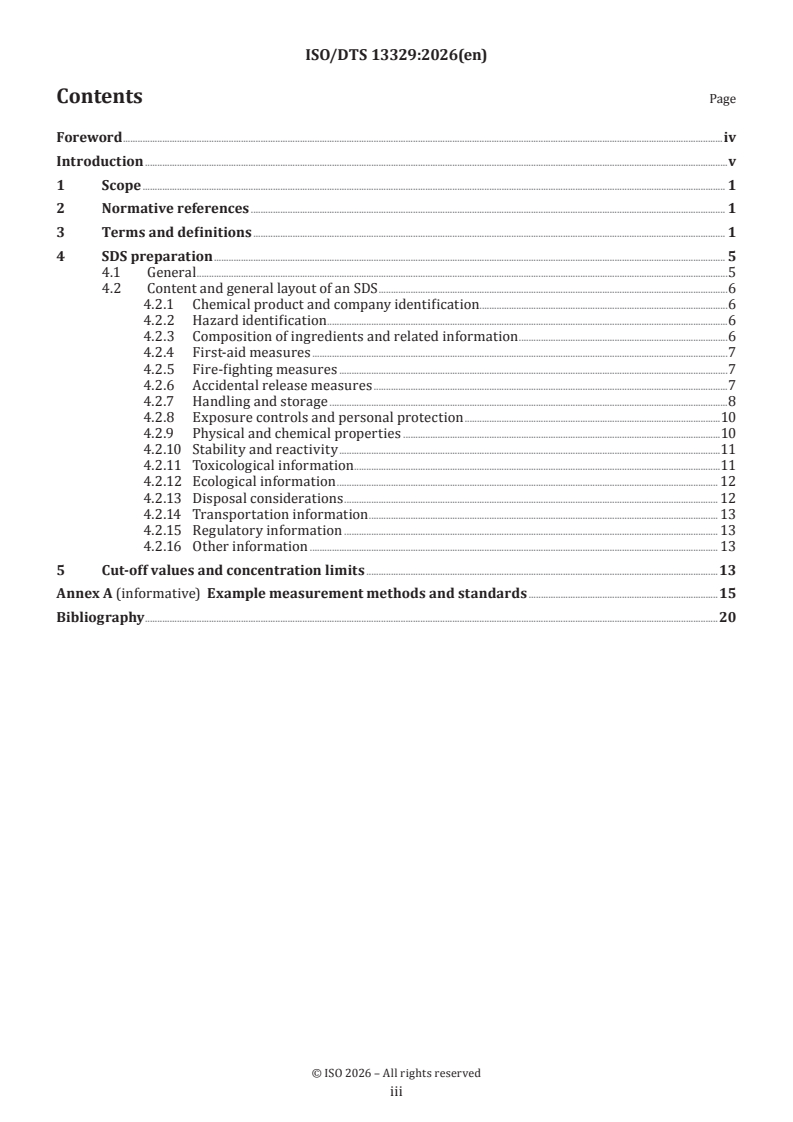
The document is organized into a short scope, normative references, terms and definitions, Clause 4 on SDS preparation, Clause 5 on cut-off values and concentration limits, and informative Annex A with example measurement methods and standards. Clause 4 follows the usual SDS sections, from identification and hazard information through disposal and transport.
What are the key requirements of ISO/DTS 13329?
Core SDS preparation
ISO/DTS 13329 says an SDS should be prepared for all manufactured nanomaterials, even when the bulk material is not classified as hazardous, unless one of the stated exceptions applies. In practice, that means the SDS is expected to support safe handling early, rather than waiting for a hazard classification alone.
The document also says the SDS should be clear and concise, prepared by competent persons, and written with the intended audience in mind. It should follow the ISO 11014 format, identify the preparation date, the organization that prepared it, and the revision information so users can see which version they are relying on.
If information for a section cannot be found, the SDS should still show that section and indicate that the information is not available. Separate SDSs should be provided for different forms of the same chemical when the forms pose different hazards.
Hazard identification and composition
Clause 4.2.2 says the SDS should describe all hazards associated with the manufactured nanomaterial or mixture and use GHS hazard statements. It should also include hazards linked to intended use, such as dust formation during milling or grinding, even when those hazards do not lead to formal GHS classification.
Clause 4.2.3 focuses on composition. The SDS should identify whether the material is pure or an additive, list hazardous ingredients and their concentrations or ranges, and state whether the material is a manufactured nanomaterial even when it shares a Chemical Abstracts Service (CAS) number with the bulk material. Where relevant, it should also identify stabilizing additives, impurities, chemical modification, coatings, solubility and any occupational exposure limits for listed substances.
For mixtures, the document distinguishes between mixtures tested as a whole and mixtures not tested as a whole. That matters because the SDS content changes depending on whether the hazards are known for the mixture itself or must be built up from the hazardous ingredients.
Handling, exposure control, and emergency measures
Clause 4.2.6 gives the spill and release response expected for manufactured nanomaterials. The SDS should recommend measures that avoid dispersion, such as preventing airborne resuspension, runoff or uncontrolled accumulation, and it gives examples such as dedicated HEPA vacuum cleaning, wet wiping, and avoiding dry sweeping and compressed air.
Clause 4.2.7 and 4.2.8 connect handling guidance with exposure control. The SDS should identify exposure scenarios, describe engineering controls, storage conditions, transfer practices, administrative controls and personal protective equipment (PPE) as the last line of defense. It should also list occupational exposure limits and state whether those limits apply to bulk material or the nanomaterial form, because bulk limits may not be protective for nanoscale forms.
In practice, this means the document is not just describing a substance. It is also telling the reader how exposure can happen and what controls should be chosen before work starts.
Physical, chemical, stability, toxicological and ecological information
Clause 4.2.9 asks for nanomaterial-relevant properties in addition to the normal SDS data. These include primary particle size, size distribution, shape and aspect ratio, crystallinity, specific surface area, dispersion stability, bulk and specific density, dustiness, functional groups and coatings, and surface hydrophobicity.
Clause 4.2.10 covers stability and reactivity, including conditions that promote exothermic reaction, decomposition, hazardous decomposition products and dust explosion risk. Clause 4.2.11 and 4.2.12 require the available toxicological and ecotoxicological information to be evaluated and summarized, including biodurability, biopersistence and relevant environmental fate information where available.
Clause 4.2.13 and 4.2.14 address disposal and transport. Waste containing nanomaterials should be handled to prevent exposure, and transport should follow national regulations or the United Nations Model Regulations.
Cut-off values and concentration limits
Clause 5 gives generic cut-off values and concentration limits from the Globally harmonized system of classification and labelling of chemicals (GHS). These values are used to decide when ingredients in mixtures must be considered in the SDS.
The clause also makes an important point for nanomaterials: weight-based cut-off values are not always the best metric for nano-objects, so other metrics such as number concentration or surface concentration should be used when available. That matters for readers because it supports SDS content that matches the way nanomaterials behave and are measured.
What terms does ISO/DTS 13329 define?
- Nanomaterial - a material with any external dimension in the nanoscale, or with internal or surface structure in the nanoscale.
- Manufactured nanomaterial - a nanomaterial intentionally produced to have selected properties or composition.
- Nano-object - a discrete piece of material with one, two or three external dimensions in the nanoscale.
- Nanoparticle - a nano-object with all three external dimensions in the nanoscale.
- Agglomerate - a collection of weakly bound particles or aggregates, or both, whose external surface area is similar to the sum of the components.
- Aggregate - a particle made of strongly bonded or fused particles, with a significantly smaller external surface area than the sum of the parts.
- Safety data sheet (SDS) - a document specifying the properties of a substance, its potential hazardous effects for humans and the environment, and the precautions needed for safe handling and disposal.
Who uses ISO/DTS 13329?
ISO/DTS 13329 is used by manufacturers, suppliers and anyone preparing SDS for manufactured nanomaterials. It is also relevant to occupational health and safety staff, laboratory personnel, quality and regulatory teams, and people responsible for storage, transport, spill response, cleaning, maintenance and waste handling.
The document is aimed at situations where nanomaterials are manufactured, stored, transported or otherwise handled at work. Its practical value is in helping those users decide what hazards to describe, what exposure controls to recommend and what supporting data to include.
What changed in ISO/DTS 13329 from the previous edition?
ISO/DTS 13329 is the third edition and it cancels and replaces ISO/TS 13329:2024. The main change stated in the document is a change to the scope, and the text says the document has been technically revised.
Which standards are used with ISO/DTS 13329?
- ISO 11014 - provides the base SDS content and order of sections; ISO/DTS 13329 adds nanomaterial-specific guidance to it.
- ISO 80004-1 - supplies the core nanotechnologies vocabulary used for key terms such as nanomaterial, nano-object and manufactured nanomaterial.
- GHS - provides the hazard classification and labelling framework, including hazard statements, hazard classes and cut-off values.
- ISO/TR 12885 - supports occupational health and safety practices for nanotechnologies.
- ISO/TS 12901-1 - supports occupational risk management principles and approaches for engineered nanomaterials.
- ISO/TS 12901-2 - supports the control banding approach.
- ISO/TR 13014 - gives guidance on physico-chemical characterization for toxicologic assessment.
- ISO 9277 - supports specific surface area measurement by gas adsorption.
- EN 15051 and EN 17199-5 - support dustiness measurement of bulk materials and materials that contain or release respirable nano-objects.
What does the ISO/DTS 13329 document contain?
Clause 4 gives the SDS content and layout, including the 16 SDS sections such as identification, hazard identification, composition, first aid, fire-fighting, accidental release, handling and storage, exposure controls, physical and chemical properties, stability, toxicology, ecology, disposal, transport, regulatory and other information. Clause 5 gives the cut-off values and concentration limits used for mixture classification.
Annex A is informative and provides example measurement methods and standards for particle size, size distribution, shape, surface area, composition, surface chemistry, surface charge, solubility and dispersibility. In practice, Annex A helps users choose methods for characterization and toxicological support data when preparing an SDS.
Relations
- Effective Date
- 07-Dec-2025
Get Certified
Connect with accredited certification bodies for this standard

BSI Group
BSI (British Standards Institution) is the business standards company that helps organizations make excellence a habit.

Bureau Veritas
Bureau Veritas is a world leader in laboratory testing, inspection and certification services.

DNV
DNV is an independent assurance and risk management provider.
Sponsored listings
Frequently Asked Questions
ISO/DTS 13329 is a draft published by the International Organization for Standardization (ISO). Its full title is "Nanomaterials — Preparation of safety data sheets (SDS)". This standard covers: This document provides guidance on the development of content for, and consistency in, the communication of information on safety, health and environmental matters in safety data sheets (SDS) for substances classified as manufactured nanomaterials. It provides supplemental guidance to ISO 11014 on the preparation of SDS.
This document provides guidance on the development of content for, and consistency in, the communication of information on safety, health and environmental matters in safety data sheets (SDS) for substances classified as manufactured nanomaterials. It provides supplemental guidance to ISO 11014 on the preparation of SDS.
ISO/DTS 13329 is classified under the following ICS (International Classification for Standards) categories: 07.120 - Nanotechnologies; 13.100 - Occupational safety. Industrial hygiene. The ICS classification helps identify the subject area and facilitates finding related standards.
ISO/DTS 13329 has the following relationships with other standards: It is inter standard links to ISO/TS 13329:2024. Understanding these relationships helps ensure you are using the most current and applicable version of the standard.
ISO/DTS 13329 is available in PDF format for immediate download after purchase. The document can be added to your cart and obtained through the secure checkout process. Digital delivery ensures instant access to the complete standard document.
Standards Content (Sample)
Contents
- Introduction
- 1 Scope
- 2 Normative references
- 3 Terms and definitions
- 3.1 agglomerate
- 3.2 aggregate
- 3.3 bioaccumulation
- 3.4 biodurability
- 3.5 biopersistence
- 3.6 biodegradability
- 3.7 chemical product
- 3.8 crystallinity
- 3.9 dustiness
- 3.10 engineered nanomaterial
- 3.11 hazard class
- 3.12 hazard statement
- 3.13 incidental nanomaterial
- 3.14 manufactured nanomaterial
- 3.15 mixture
- 3.16 nanofibre
- 3.17 nanomaterial
- 3.18 nano-object
- 3.19 nanoparticle
- 3.20 nanopowder
- 3.21 nanoscale
- 3.22 nanostructure
- 3.23 nanostructured material
- 3.24 particle
- 3.25 primary particle
- 3.26 safety data sheet
- 3.27 substance
- 3.28 surface area
- 4 SDS preparation
- 4.1 General
- 4.2 Content and general layout of an SDS
- 5 Cut-off values and concentration limits
- 5.1 General
- Annex A
- Bibliography
Introduction
Manufactured nanomaterials are defined as materials that are intentionally produced to have specific properties or a specific composition and which have any external dimension in the nanoscale or internal structure or surface structure in the nanoscale. This document is not a stand-alone document and should be [1] used in conjunction with ISO 11014 . This document takes into account the Globally harmonized system of [2] classification and labelling of chemicals (GHS) document on hazard communication, i.e. safety data sheets (SDSs). The GHS was developed by the United Nations and is being incorporated into the laws of various regions and nations, many of which already have laws that govern the preparation of SDSs. Currently, there is limited information on the possible hazards of some nanomaterials. In some cases, the degree of risk to workers or others who can be exposed to nanomaterials is partly unknown, as the possible toxicological effects of nanomaterials are not yet well known and exposure is difficult to measure. Most hazard information and communication approaches necessitate preparation of an SDS for hazardous chemicals, including those containing nanomaterials, for use in manufacture, storage, transport or other occupational handling activities. Yet, only a few SDSs contain specific information about nanomaterials or are specific to nanomaterials. Those that exist generally provide insufficient hazard information (see [3] Reference ). There is evidence that some nanomaterials can be more hazardous, e.g. more bio-reactive or active, leading to higher toxicity, than the same material in bulk (non-nanoscale) form. Characteristics predictive of potential safety issues or toxicity for manufactured nanomaterials must be determined and included in the preparation of an SDS. Within the European Union and the UK, the legislation that addresses industrial substances including nanomaterials specifies that hazardous substances and mixtures are accompanied by an SDS when placed on the market.
The most fundamental ethical responsibility faced by manufacturers is to make users aware that nanomaterials have been added to a product and to communicate, in an SDS, the hazards the product can present and the most effective ways to mitigate those hazards, relying on the hierarchy of controls. The hierarchy of controls is a method that is found in nearly every international guidance document on responsible management of nanomaterials. This document considers the precautionary approach in terms of toxicity and other risks associated with nanomaterials. It recommends providing an SDS for nanomaterials and nanomaterial-containing products, regardless of whether or not the material is classified as hazardous, unless there are existing data for the nanomaterial which demonstrates that it is non-hazardous, or if it is not envisaged that they can be released as nano-objects, or their agglomerates and aggregates greater than 100 nm (NOAA), during handling or use.
FINAL DRAFT Technical Specification ISO/DTS 13329:2026(en) Nanomaterials — Preparation of safety data sheets (SDS)
1 Scope
This document provides guidance on the development of content for, and consistency in, the communication of information on safety, health and environmental matters in safety data sheets (SDS) for substances [1] classified as manufactured nanomaterials. It provides supplemental guidance to ISO 11014 on the preparation of SDSs.
2 Normative references
The following documents are referred to in the text in such a way that some or all of their content constitutes requirements of this document. For dated references, only the edition cited applies. For undated references, the latest edition of the referenced document (including any amendments) applies. ISO 80004-1, Nanotechnologies – Vocabulary — Part 1: Core vocabulary Globally harmonized system of classification and labelling of chemicals (GHS). United Nations Economic Commission for Europe, Fourth Edition, 2011
3 Terms and definitions
For the purposes of this document, the terms and definitions given in ISO 80004-1, the GHS and the following apply.
ISO and IEC maintain terminology databases for use in standardization at the following addresses:
- ISO Online browsing platform: available at https:// www .iso .org/ obp
- IEC Electropedia: available at https:// www .electropedia .org/
3.1 agglomerate
collection of weakly bound particles or aggregates or mixtures of the two where the resulting external surface area is similar to the sum of the surface areas of the individual components Note 1 to entry: The forces holding an agglomerate together are weak forces, for example van der Waals forces or simple physical entanglement.
Note 2 to entry: Agglomerates are also termed secondary particles and the original source particles are termed primary particles.
[SOURCE: ISO 80004-1:2023, 3.2.4]
3.2 aggregate
particle comprising strongly bonded or fused particles where the resulting external surface area is significantly smaller than the sum of surface areas of the individual components Note 1 to entry: The forces holding an aggregate together are strong forces, for example covalent bonds, or those resulting from sintering or complex physical entanglement.
Note 2 to entry: Aggregates are also termed secondary particles and the original source particles are termed primary particles.
ISO/DTS 13329:2026(en) [SOURCE: ISO 80004-1:2023, 3.2.5]
3.3 bioaccumulation
process of accumulation of a substance in organisms or parts thereof [4] [SOURCE: ISO 6107:2021 , 3.64]
3.4 biodurability
physicochemical property which depends on dissolution and leaching as well as mechanical breaking and splitting of a material in a physiological solution such as a Gamble solution Note 1 to entry: The biodurability test is usually performed in vitro.
3.5 biopersistence
ability of a material to persist in a tissue in spite of the tissue’s physiological clearance mechanisms and environmental conditions [5] [SOURCE: EUR 18748:1999 , 1.2, modified — The word "fibre" has been removed and the word "lung" replaced by "tissue".]
3.6 biodegradability
susceptibility of an organic substance to biodegradation [4] [SOURCE: ISO 6107:2021 , 3.68]
3.7 chemical product
substance or mixture [6] [SOURCE: ISO 11014:2009 , 3.1]
3.8 crystallinity
presence of three-dimensional order at the level of molecular dimensions [7] [SOURCE: ISO 472:2013 , 2.240]
3.9 dustiness
propensity of materials to produce airborne dust during handling Note 1 to entry: Dustiness is not an intrinsic property as it depends on how it is measured. [8] [SOURCE: EN 1540:2021 , 3.1.2.9]
3.10 engineered nanomaterial
nanomaterial designed for a specific purpose or function [SOURCE: ISO 80004-1:2023, 3.1.8]
3.11 hazard class
nature of the physical, health or environmental hazard as used in GHS [SOURCE: GHS: 2023, Chapter 1.2, modified — Examples removed from definition and "as used in GHS" added.]
ISO/DTS 13329:2026(en)
3.12 hazard statement
statement assigned to a hazard class and category as used in GHS that describes the nature of the hazards of a hazardous substance or mixture, including, where appropriate, the degree of hazard [1] [SOURCE: ISO 11014 :2009, 3.6, modified — "Hazardous product" replaced with "hazardous substance or mixture" and "as used in GHS" added.]
3.13 incidental nanomaterial
nanomaterial generated as an unintentional by-product of a process Note 1 to entry: The process includes manufacturing, biotechnological or other processes, including natural processes. [9] Note 2 to entry: Used as a synonym for “ultrafine particle” in ISO/TR 27628:2007 . [SOURCE: ISO 80004-1:2023, 3.1.10]
3.14 manufactured nanomaterial
nanomaterial intentionally produced to have selected properties or composition [SOURCE: ISO 80004-1:2023, 3.1.9]
3.15 mixture
mixture or solution composed of two or more substances in which they do not react [SOURCE: GHS: 2023, Chapter 1.2]
3.16 nanofibre
nano-object with two similar external dimensions in the nanoscale and the third dimension significantly larger Note 1 to entry: The largest external dimension is not necessarily in the nanoscale. [SOURCE: ISO 80004-1:2023, 3.3.5]
3.17 nanomaterial
material with any external dimension in the nanoscale or having internal structure or surface structure in the nanoscale Note 1 to entry: This generic term is inclusive of nano-object and nanostructured material. Note 2 to entry: See also engineered nanomaterial, manufactured nanomaterial and incidental nanomaterial. Note 3 to entry: The nanoform of a material is a nanomaterial. [SOURCE: ISO 80004-1 :2023, 3.1.4, modified — Notes to entry have been changed.]
3.18 nano-object
discrete piece of material with one, two or three external dimensions in the nanoscale [SOURCE: ISO 80004-1:2023, 3.1.5]
3.19 nanoparticle
nano-object with all three external dimensions in the nanoscale Note 1 to entry: If the dimensions differ significantly (typically by more than three times), terms such as nanofibre or nanoplate are preferred to the term nanoparticle.
ISO/DTS 13329:2026(en) [SOURCE: ISO 80004-1:2023, 3.3.4]
3.20 nanopowder
particulate material only composed of nano-objects Note 1 to entry: Nanopowder can include agglomerates and/or aggregates in the nanoscale (largest dimension ≤ 100 nm).
[10] [SOURCE: ISO 18451-1:2019 , 3.85]
3.21 nanoscale
length range approximately from 1 nm to 100 nm [SOURCE: ISO 80004-1:2023, 3.1.1]
3.22 nanostructure
surface or internal feature with one or more dimensions in the nanoscale Note 1 to entry: A feature includes but is not limited to nano-objects, structures, morphologies or other identifiable areas of nanoscale dimensions. For example, the nanostructure can be a nanopore or a solid feature on an object. [SOURCE: ISO 80004-1:2023, 3.1.6]
3.23 nanostructured material
material having internal nanostructure or surface nanostructure Note 1 to entry: This definition does not exclude the possibility for a nano-object to have internal structure or surface structure. If external dimensions are in the nanoscale, the term nano-object is recommended. [SOURCE: ISO 80004-1:2023, 3.1.7]
3.24 particle
minute piece of matter with defined physical boundaries Note 1 to entry: A physical boundary can also be described as an interface. Note 2 to entry: This general particle definition applies to nano-objects. [11] [SOURCE: ISO 26824:2022 , 3.1.1, modified — A note to entry has been deleted.]
3.25 primary particle
original source particle of agglomerates or aggregates or mixtures of the two Note 1 to entry: Constituent particles of agglomerates or aggregates at a certain actual state can be primary particles, but often the constituents are aggregates.
Note 2 to entry: Agglomerates and aggregates are also termed secondary particles. [11] [SOURCE: ISO 26824:2022 , 3.1.4]
3.26 safety data sheet
SDS, noun document specifying the properties of a substance, its potential hazardous effects for humans and the environment, and the precautions necessary to handle and dispose of the substance safely [12] [SOURCE: ISO 11139:2018 , 3.239]
ISO/DTS 13329:2026(en)
3.27 substance
chemical elements and their compounds in the natural state or obtained by any production process, including any additive necessary to preserve the stability of the product and any impurities deriving from the process used, but excluding any solvent which can be separated without affecting the stability of the substance or changing its composition [SOURCE: GHS: 2023, Chapter 1.2]
3.28 surface area
area of the external surface of a solid plus the internal surface of its accessible macro-, meso- and micropores [13] [SOURCE: ISO 9277:2022 , 3.10]
4 SDS preparation
4.1 General
4.1.1 An SDS should be prepared for all manufactured nanomaterials, regardless of whether or not the bulk (non-nanoscale) material is classified as hazardous, except when:
- testing or assessment results that meet the requirements of competent authorities, or are based upon national or international standards, or generally accepted scientific practices, have indicated they are non-hazardous; or
- it is not envisaged that manufactured nanomaterials can be released as nano-objects or agglomerates and aggregates (NOAAs) under reasonably anticipated conditions of use to be exposed to humans, and the matrix (including the manufactured nanomaterial) does not exhibit a hazard; or
- the hazard class of manufactured nanomaterials is known and the manufactured nanomaterials are present in concentrations lower than the cut-off levels identified in 5.1. 4.1.2 The information in the SDS should be written in a clear and concise manner. The SDS should be prepared by one or more competent persons. The specific needs of the intended audience should be taken into account. The SDS should provide either comprehensive information or conclusions, or both, about the data that are evaluated, making it easy for any reader to identify all of the hazards, including those associated with the material’s nanostructure. In addition to the minimum information necessary, the SDS should contain any available information relevant to the safe use of the material. [1] 4.1.3 The format of the SDS should conform to ISO 11014 .
NOTE Refer to legal requirements that can apply regarding the format of the SDS. 4.1.4 If relevant information for any of the 16 SDS sections cannot be found, this should be indicated on the SDS in the appropriate section using phrases such as "not available". The SDS should have no blanks under any of the headings.
4.1.5 Separate SDSs should be provided for different forms of the same chemical if they pose different hazards.
NOTE Mixtures of different formulations do not necessitate separate SDSs for each formulation, they can be tested as any other mixture, as per 4.2.3.4. For instance, a graphene additive for cement can be recommended in different concentrations for specific applications or in concrete for other purposes, but one SDS is possibly sufficient.
ISO/DTS 13329:2026(en)
4.2 Content and general layout of an SDS
4.2.1 Chemical product and company identification
Due to the rapidly changing state of knowledge in the area of nanomaterial safety, the date that an SDS was prepared and the identity of the organization that prepared the SDS should be included. The SDS should include a revision number and the superseding date or other indications of what version has been replaced.
4.2.2 Hazard identification
The SDS should describe all the hazards associated with the manufactured nanomaterial or mixture for [1] which the SDS is being prepared. In line with ISO 11014 , GHS hazard statements should be used to describe hazards. Vague and potentially misleading descriptions such as "can be dangerous", "no health effects", "safe under most conditions of use" or "harmless" are not recommended. If the manufactured nanomaterial or mixture is classified according to GHS, the specific hazard and category should be identified. Also, hazards associated with the intended use of the material, but which do not result in classification or are not currently covered by GHS should be included in the "hazard identification" section of the SDS. For example, possible dust formation should be mentioned among the potential hazards if the material is milled or ground. Further guidance on evaluating exposure scenarios is provided in 4.2.8.
4.2.3 Composition of ingredients and related information
4.2.3.1 If a nanomaterial has the same chemical abstracts service (CAS) number as the bulk (non-
nanoscale) material, the CAS number should be used and a statement should be included that the material is a manufactured nanomaterial according to ISO's definition or other applicable definitions, e.g. Anatase TiO2, 1) CAS Registry Number® 1317-70-0, (manufactured nanomaterial).
4.2.3.2 The composition of manufactured nanomaterials, including stabilizing additives and impurities, should be identified to the extent necessary for classification and identification of occupational health and safety measures. If the manufactured nanomaterial is chemically modified, the hazardous properties of modified nanomaterial should also be evaluated. Manufacturers or suppliers may choose to list all ingredients, including non-hazardous ingredients. If coating ingredients are proprietary, the manufacturer should, at a minimum, identify the impact the coating can have on behaviour of the nano-object. General information on the status of the surface, such as chemical modifications of the manufactured nanomaterial, should be provided where necessary for the classification, risk assessment and development of occupational health and safety measures.
Solubility information should be included for the determination of relevant hazard profiles, if applicable. All substances having an associated occupational exposure limit must be listed. This should include substances where the exposure limit is for bulk (non-nanoscale) materials or manufactured nanomaterials. These limits are listed in 4.2.8.
NOTE Regulations can apply regarding confidential business information taking precedence over product identification. Refer to the relevant competent authority for further information. If confidential information about the composition was omitted, this should be specified.
4.2.3.3 The SDS should describe whether the manufactured nanomaterial is pure or an additive. For
mixtures, the SDS should identify the manufactured nanomaterials and concentrations, or concentration ranges, or proportion ranges of all ingredients which are hazardous as specified in GHS, and should provide the cut-off levels given in 5.1. Materials or products that contain manufactured nanomaterials should identify all manufactured nanomaterials, which are hazardous as specified in GHS. If the mixed material or product 1) CAS Registry Number® is a trademark of the American Chemical Society (ACS). This information is given for the convenience of users of this document and does not constitute an endorsement by ISO of the product named. Equivalent products may be used if they can be shown to lead to the same results.
ISO/DTS 13329:2026(en) has not been tested as a whole, the manufactured nanomaterial and common names of all ingredients which have been determined to be hazardous should be listed.
When using a proportion range, the concentration or percentage range of the manufactured nanomaterial in the mixture should be taken into account, such as mass, volume, or any other appropriate metric for nanomaterials.
4.2.3.4 If the mixture has been tested as a whole to determine its hazards, then the manufactured
nanomaterial and common names of the ingredients which contribute to these known hazards, and the common name of the mixture itself should be included. If the mixture has not been tested as a whole, the manufactured nanomaterial and common names of all ingredients which have been determined to be hazardous, and where concentrations are equal to or greater than the cut-off levels as described in 5.2, should be listed. The manufactured nanomaterial and common names of all ingredients which have been identified as posing a physical hazard when present in the mixture as described in 5.2 should also be listed.
4.2.4 First-aid measures
[1] Information provided in the "first-aid measures" section of the SDS should be based on ISO 11014 . There is no further guidance specific to manufactured nanomaterials at this time.
...