


ISO/ASTM 51649:2002
(Main)Practice for dosimetry in an electron-beam facility for radiation processing at energies between 300 keV and 25 MeV
Practice for dosimetry in an electron-beam facility for radiation processing at energies between 300 keV and 25 MeV
ISO/ASTM 51649 covers dosimetric procedures to be followed in facility characterization, process qualification and routine processing using electron beam radiation in order to ensure that the entire product has been treated with an acceptable range of absorbed doses. Other procedures related to facility characterization (including equipment documentation), process qualification and routine product processing that may influence and may be used to monitor absorbed dose in the product are also discussed. The electron energy range covered by this International Standard is between 300 keV and 25 MeV, although other energy levels are discussed. Dosimetry is only one component of a total quality assurance programme for an irradiation facility. Other controls besides dosimetry may be required for specific applications such as medical device sterilization and food preservation.
Pratique de la dosimétrie dans une installation de traitement par irradiation utilisant un faisceau d'électrons d'énergies comprises entre 300 keV et 25 MeV
General Information
- Status
- Withdrawn
- Publication Date
- 17-Apr-2002
- Withdrawal Date
- 17-Apr-2002
- Current Stage
- 9599 - Withdrawal of International Standard
- Start Date
- 20-Jul-2005
- Completion Date
- 12-Feb-2026
Relations
- Effective Date
- 15-Apr-2008
- Effective Date
- 15-Apr-2008
Get Certified
Connect with accredited certification bodies for this standard

BSMI (Bureau of Standards, Metrology and Inspection)
Taiwan's standards and inspection authority.
Sponsored listings
Frequently Asked Questions
ISO/ASTM 51649:2002 is a standard published by the International Organization for Standardization (ISO). Its full title is "Practice for dosimetry in an electron-beam facility for radiation processing at energies between 300 keV and 25 MeV". This standard covers: ISO/ASTM 51649 covers dosimetric procedures to be followed in facility characterization, process qualification and routine processing using electron beam radiation in order to ensure that the entire product has been treated with an acceptable range of absorbed doses. Other procedures related to facility characterization (including equipment documentation), process qualification and routine product processing that may influence and may be used to monitor absorbed dose in the product are also discussed. The electron energy range covered by this International Standard is between 300 keV and 25 MeV, although other energy levels are discussed. Dosimetry is only one component of a total quality assurance programme for an irradiation facility. Other controls besides dosimetry may be required for specific applications such as medical device sterilization and food preservation.
ISO/ASTM 51649 covers dosimetric procedures to be followed in facility characterization, process qualification and routine processing using electron beam radiation in order to ensure that the entire product has been treated with an acceptable range of absorbed doses. Other procedures related to facility characterization (including equipment documentation), process qualification and routine product processing that may influence and may be used to monitor absorbed dose in the product are also discussed. The electron energy range covered by this International Standard is between 300 keV and 25 MeV, although other energy levels are discussed. Dosimetry is only one component of a total quality assurance programme for an irradiation facility. Other controls besides dosimetry may be required for specific applications such as medical device sterilization and food preservation.
ISO/ASTM 51649:2002 is classified under the following ICS (International Classification for Standards) categories: 17.240 - Radiation measurements. The ICS classification helps identify the subject area and facilitates finding related standards.
ISO/ASTM 51649:2002 has the following relationships with other standards: It is inter standard links to ISO/ASTM 51649:2005, ISO 15569:1998. Understanding these relationships helps ensure you are using the most current and applicable version of the standard.
ISO/ASTM 51649:2002 is available in PDF format for immediate download after purchase. The document can be added to your cart and obtained through the secure checkout process. Digital delivery ensures instant access to the complete standard document.
Standards Content (Sample)
INTERNATIONAL ISO/ASTM
STANDARD 51649
First edition
2002-03-15
Practice for dosimetry in an electron
beam facility for radiation processing at
energies between 300 keV and 25 MeV
Pratique de la dosimétrie dans une installation de traitement par
irradiation utilisant un faisceau d’électrons d’énergies comprises
entre 300 keV et 25 MeV
Reference number
© ISO/ASTM International 2002
PDF disclaimer
This PDF file may contain embedded typefaces. In accordance with Adobe’s licensing policy, this file may be printed or viewed but shall
not be edited unless the typefaces which are embedded are licensed to and installed on the computer performing the editing. In
downloading this file, parties accept therein the responsibility of not infringing Adobe’s licensing policy. Neither the ISO Central
Secretariat nor ASTM International accepts any liability in this area.
Adobe is a trademark of Adobe Systems Incorporated.
Details of the software products used to create this PDF file can be found in the General Info relative to the file; the PDF-creation
parameters were optimized for printing. Every care has been taken to ensure that the file is suitable for use by ISO member bodies
and ASTM members. In the unlikely event that a problem relating to it is found, please inform the ISO Central Secretariat or ASTM
International at the addresses given below.
© ISO/ASTM International 2002
All rights reserved. Unless otherwise specified, no part of this publication may be reproduced or utilized in any form or by any means, electronic or mechanical,
including photocopying and microfilm, without permission in writing from either ISO at the address below or ISO’s member body in the country of the
requester. In the United States, such requests should be sent to ASTM International.
ISO copyright office ASTM International, 100 Barr Harbor Drive, PO Box C700,
Case postale 56 • CH-1211 Geneva 20 West Conshohocken, PA 19428-2959, USA
Tel. +41 22 749 01 11 Tel. +610 832 9634
Fax +41 22 749 09 47 Fax +610 832 9635
E-mail copyright@iso.ch E-mail khooper@astm.org
Web www.iso.ch Web www.astm.org
Printed in the United States
ii © ISO/ASTM International 2002 – All rights reserved
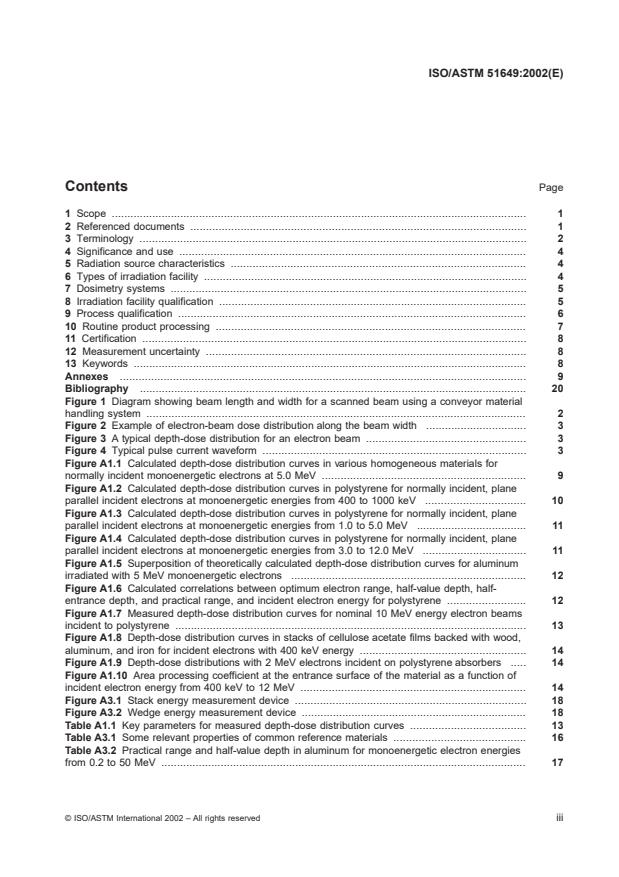
Contents Page
1 Scope . 1
2 Referenced documents . 1
3 Terminology . 2
4 Significance and use . 4
5 Radiation source characteristics . 4
6 Types of irradiation facility . 4
7 Dosimetry systems . 5
8 Irradiation facility qualification . 5
9 Process qualification . 6
10 Routine product processing . 7
11 Certification . 8
12 Measurement uncertainty . 8
13 Keywords . 8
Annexes . 9
Bibliography . 20
Figure 1 Diagram showing beam length and width for a scanned beam using a conveyor material
handling system . 2
Figure 2 Example of electron-beam dose distribution along the beam width . 3
Figure 3 A typical depth-dose distribution for an electron beam . 3
Figure 4 Typical pulse current waveform . 3
Figure A1.1 Calculated depth-dose distribution curves in various homogeneous materials for
normally incident monoenergetic electrons at 5.0 MeV . 9
Figure A1.2 Calculated depth-dose distribution curves in polystyrene for normally incident, plane
parallel incident electrons at monoenergetic energies from 400 to 1000 keV . 10
Figure A1.3 Calculated depth-dose distribution curves in polystyrene for normally incident, plane
parallel incident electrons at monoenergetic energies from 1.0 to 5.0 MeV . 11
Figure A1.4 Calculated depth-dose distribution curves in polystyrene for normally incident, plane
parallel incident electrons at monoenergetic energies from 3.0 to 12.0 MeV . 11
Figure A1.5 Superposition of theoretically calculated depth-dose distribution curves for aluminum
irradiated with 5 MeV monoenergetic electrons . 12
Figure A1.6 Calculated correlations between optimum electron range, half-value depth, half-
entrance depth, and practical range, and incident electron energy for polystyrene . 12
Figure A1.7 Measured depth-dose distribution curves for nominal 10 MeV energy electron beams
incident to polystyrene . 13
Figure A1.8 Depth-dose distribution curves in stacks of cellulose acetate films backed with wood,
aluminum, and iron for incident electrons with 400 keV energy . 14
Figure A1.9 Depth-dose distributions with 2 MeV electrons incident on polystyrene absorbers . 14
Figure A1.10 Area processing coefficient at the entrance surface of the material as a function of
incident electron energy from 400 keV to 12 MeV . 14
Figure A3.1 Stack energy measurement device . 18
Figure A3.2 Wedge energy measurement device . 18
Table A1.1 Key parameters for measured depth-dose distribution curves . 13
Table A3.1 Some relevant properties of common reference materials . 16
Table A3.2 Practical range and half-value depth in aluminum for monoenergetic electron energies
from 0.2 to 50 MeV . 17
© ISO/ASTM International 2002 – All rights reserved iii
Foreword
ISO (the International Organization for Standardization) is a worldwide federation of national standards bodies
(ISO member bodies). The work of preparing International Standards is normally carried out through ISO
technical committees. Each member body interested in a subject for which a technical committee has been
established has the right to be represented on that committee. International organizations, governmental and
non-governmental, in liaison with ISO, also take part in the work. ISO collaborates closely with the
International Electrotechnical Commission (IEC) on all matters of electrotechnical standardization.
Draft International Standards adopted by the technical committees are circulated to the member bodies for
voting. Publication as an International Standard requires approval by at least 75% of the member bodies
casting a vote.
ASTM International is one of the world’s largest voluntary standards development organizations with global
participation from affected stakeholders. ASTM technical committees follow rigorous due process balloting
procedures.
A pilot project between ISO and ASTM International has been formed to develop and maintain a group of
ISO/ASTM radiation processing dosimetry standards. Under this pilot project, ASTM Subcommittee E10.01,
Dosimetry for Radiation Processing, is responsible for the development and maintenance of these dosimetry
standards with unrestricted participation and input from appropriate ISO member bodies.
Attention is drawn to the possibility that some of the elements of this International Standard may be the subject
of patent rights. Neither ISO nor ASTM International shall be held responsible for identifying any or all such
patent rights.
International Standard ISO/ASTM 51649 was developed by ASTM Committee E10, Nuclear Technology and
Applications, through Subcommittee E10.01, and by Technical Committee ISO/TC 85, Nuclear Energy.
Annexes A1, A2, A3 and A4 of this International Standard are for information only.
iv © ISO/ASTM International 2002 – All rights reserved
Standard Practice for
Dosimetry in an Electron Beam Facility for Radiation
Processing at Energies Between 300 keV and 25 MeV
This standard is issued under the fixed designation ISO/ASTM 51649; the number immediately following the designation indicates the
year of original adoption or, in the case of revision, the year of last revision.
1. Scope 2. Referenced Documents
1.1 This practice covers dosimetric procedures to be fol- 2.1 ASTM Standards:
lowed in facility characterization, process qualification, and E 170 Terminology Relating to Radiation Measurements
routine processing using electron beam radiation to ensure that and Dosimetry
the entire product has been treated with an acceptable range of E 668 Practice for the Application of Thermoluminescence-
absorbed doses. Other procedures related to facility character- Dosimetry (TLD) Systems for Determining Absorbed Dose
ization (including equipment documentation), process qualifi- in Radiation-Hardness Testing of Electronic Devices
cation, and routine product processing that may influence and E 1026 Practice for Using the Fricke Reference Standard
may be used to monitor absorbed dose in the product are also Dosimetry System
discussed. 2.2 ISO/ASTM Standards:
51205 Practice for Use of a Ceric-Cerous Sulfate Dosimetry
NOTE 1—For guidance in the selection and calibration of dosimeters,
System
see ISO/ASTM Guide 51261. For further guidance in the selection,
51261 Guide for Selection and Calibration of Dosimetry
calibration, and use of specific dosimeters, and interpretation of absorbed
dose in the product from dosimetry, also see ASTM Practice E 668 and Systems for Radiation Processing
ISO/ASTM Practices 51275, 51276, 51431, 51607, 51631, and 51650. For
51275 Practice for Use of a Radiochromic Film Dosimetry
use with electron energies above 5 MeV, see ASTM Practice E 1026, and
System
ISO/ASTM Practices 51205, 51401, 51538, and 51540 for discussions of
51276 Practice for Use of a Polymethylmethacrylate Do-
specific large volume dosimeters. For discussion of radiation dosimetry
simetry System
for pulsed radiation, see ICRU Report 34. When considering a dosimeter
51401 Practice for Use of a Dichromate Dosimetry System
type, be cautious of influences from dose rates and accelerator pulse rates
51431 Practice for Dosimetry in Electron and Bremsstrahl-
and widths (if applicable).
ung Irradiation Facilities for Food Processing
1.2 The electron energy range covered in this practice is
51538 Practice for Use of an Ethanol-Chlorobenzene Do-
between 300 keV and 25 MeV, although there are some
simetry System
discussions for other energies.
51539 Guide for the Use of Radiation-Sensitive Indicators
1.3 Dosimetry is only one component of a total quality
51540 Practice for Use of a Radiochromic Liquid Solution
assurance program for an irradiation facility. Other controls
Dosimetry System
besides dosimetry may be required for specific applications
51607 Practice for Use of the Alanine–EPR Dosimetry
such as medical device sterilization and food preservation.
System
1.4 For the irradiation of food and the radiation sterilization
51608 Practice for Dosimetry in an X-Ray (Bremsstrahl-
of health care products, other specific ISO standards exist. For
ung) Irradiation Facility for Radiation Processing
food irradiation, see ISO/ASTM Practice 51431. For the
51631 Practice for Use of Calorimetric Dosimetry Systems
radiation sterilization of health care products, see ISO 11137.
for Electron Beam Measurements and Dosimeter Calibra-
In those areas covered by ISO 11137, that standard takes
tions
precedence.
51650 Practice for Use of a Cellulose Acetate Dosimetry
1.5 This standard does not purport to address all of the
System
safety concerns, if any, associated with its use. It is the
2.3 ISO Standard:
responsibility of the user of this standard to establish appro-
ISO 11137 Sterilization of Health Care Products–Require-
priate safety and health practices and determine the applica-
ments for Validation and Routine Control–Radiation Ster-
bility of regulatory limitations prior to use.
ilization
2.4 International Commission on Radiation Units and
Measurements (ICRU) Reports:
This practice is under the jurisdiction of ASTM Committee E10 on Nuclear
Technology and Applications and is the direct responsibility of Subcommittee
E10.01 on Dosimetry for Radiation Processing, and is also under the jurisdiction of
ISO/TC 85/WG 3.
Current edition approved Jan. 22, 2002. Published March 15, 2002. Originally Annual Book of ASTM Standards, Vol 12.02.
published as E 1649–94. Last previous ASTM edition E 1649–00. ASTM E
Available from International Organization for Standardization, 1 Rue de
e1
1649–94 was adopted by ISO in 1998 with the intermediate designation ISO
Varembé, Case Postale 56, CH-1211 Geneva 20, Switzerland.
15569:1998(E). The present International Standard ISO/ASTM 51649:2002(E) is a
revision of ISO 15569.
© ISO/ASTM International 2002 – All rights reserved
ICRU Report 34 The Dosimetry of Pulsed Radiation
ICRU Report 35 Radiation Dosimetry: Electron Beams with
Energies Between 1 and 50 MeV
ICRU Report 37 Stopping Powers for Electrons and
Positrons
ICRU Report 60 Radiation Quantities and Units
3. Terminology
3.1 Definitions—Other terms used in this practice may be
found in ASTM Terminology E 170 and ICRU Report 60.
3.2 Definitions of Terms Specific to This Standard:
3.2.1 absorbed dose, D—the quotient of de¯ by dm, where de¯
is the mean energy imparted by ionizing radiation to the matter
of mass dm (see ICRU Report 60).
de¯
D 5 (1)
dm
The special name of the unit for absorbed dose is the gray
(Gy):
FIG. 1 Diagram Showing Beam Length and Width for a Scanned
Beam Using a Conveyor Material Handling System
1 Gy 5 1 J ·kg (2)
Formerly, the special unit for absorbed dose was the rad:
22 21 22
3.2.7 depth-dose distribution—variation of absorbed dose
1 rad 5 10 J ·kg 5 10 Gy (3)
with depth from the incident surface of a material exposed to
radiation.
and:
3.2.7.1 Discussion—A typical distribution in homogeneous
1 Mrad 5 10 kGy (4)
material produced by an electron beam along the beam axis is
3.2.2 average beam current—time-averaged electron beam
shown in Fig. 3. See Annex A1.
current; for a pulsed machine, the averaging shall be done over
3.2.8 dose uniformity ratio—ratio of the maximum to the
a large number of pulses.
minimum absorbed dose within the irradiation unit; it is a
3.2.3 beam length—dimension of the irradiation zone per-
measure of the degree of uniformity of the absorbed dose; the
pendicular to the beam width and direction of the electron
concept is also referred to as the max/min dose ratio.
beam specified at a specified distance from the accelerator
3.2.9 dosimetry system—a system used for determining
window.
absorbed dose, consisting of dosimeters, measurement instru-
3.2.3.1 Discussion—See Fig. 1.
ments and their associated reference standards, and procedures
3.2.4 beam power—product of the average electron energy
for the system’s use.
and the average beam current.
3.2.10 duty cycle—for a pulsed accelerator, the fraction of
3.2.5 beam width—dimension of the irradiation zone per-
time the beam is effectively on; it is the product of the pulse
pendicular to the beam length and direction of the electron
width in seconds and the pulse rate in pulses per second.
beam specified at a specific distance from where the beam exits
3.2.11 electron beam facility—an establishment that uses
the accelerator.
energetic electrons produced by particle accelerators to irradi-
3.2.5.1 Discussion—For a radiation processing facility with
ate product.
a conveyor system, the beam width is usually perpendicular to
3.2.12 electron energy—kinetic energy of electron (unit:
the flow of motion of the conveyor (see Fig. 1). Beam width is
electron volt (eV))
the distance between the points along the dose profile which
3.2.13 electron energy spectrum—frequency or energy dis-
are at a defined level from the maximum dose region in the
tribution of electrons as a function of energy; the energy
profile (see Fig. 2). Various techniques may be employed to
spectrum of the electron beam impinging on the product
produce an electron beam width adequate to cover the process-
depends on the type of the accelerator and the conditions of the
ing zone, for example, use of electromagnetic scanning of
irradiation process.
pencil beam (in which case beam width is also referred to as
3.2.14 electron range—penetration distance along the beam
scan width), defocussing elements, and scattering foils.
axis of electrons within homogeneous material.
3.2.6 compensating dummy—simulated product used during
3.2.14.1 Discussion—Several range parameters may be de-
routine production runs with irradiation units containing less
fined to describe the characteristics of the electron beam. For
product than specified in the product loading configuration or
more information, refer to ICRU Report 35.
at the beginning and end of a production run to compensate for
3.2.15 half-entrance depth (R )—depth in homogeneous
50e
the absence of product.
material at which the absorbed dose has decreased 50 % of the
absorbed dose at the surface of the material.
Available from International Commission on Radiation Units and Measure-
3.2.15.1 Discussion—See Fig. 3.
ments, 7910 Woodmont Ave., Suite 800, Bethesda, MD 20814, U.S.A.
© ISO/ASTM International 2002 – All rights reserved
FIG. 2 Example of Electron-beam Dose Distribution Along the Beam Width with the Width Noted at Some Defined Fractional Level f of
the Average Maximum Dose D
max
point) on the almost straight descending portion of the depth-
dose distribution curve meets the depth axis.
3.2.19.1 Discussion—See Fig. 3.
3.2.20 production run—series of irradiation units contain-
ing the same product, and irradiated sequentially to the same
absorbed dose.
3.2.21 pulse beam current—for a pulsed accelerator, the
beam current averaged over the top ripples (aberrations) of the
pulse current waveform; this is equal to I /wf, where I is
avg avg
the average beam current, w is the pulse width, and f is the
pulse rate.
3.2.21.1 Discussion—See Fig. 4.
3.2.22 pulse rate—for a pulsed accelerator, the pulse current
repetition frequency in hertz, or pulses per second; this is also
referred to as the repetition (rep) rate.
3.2.23 pulse width—for a pulsed accelerator, the time inter-
val between the half peak beam current amplitude points on the
FIG. 3 A Typical Depth-Dose Distribution for an Electron Beam
3.2.16 half-value depth (R )—depth in homogeneous ma-
terial at which the absorbed dose has decreased 50 % of its
maximum value.
3.2.16.1 Discussion—See Fig. 3.
3.2.17 irradiation unit—a volume of product with a speci-
fied loading configuration processed as a single entity; this
term is not relevant to bulk-flow processing.
3.2.18 optimum thickness (R )—depth in homogeneous
opt
material at which the absorbed dose equals the absorbed dose
at the surface where the electron beam enters.
3.2.18.1 Discussion—See Fig. 3.
3.2.19 practical range (R )—distance from the surface of
p
homogeneous material where the electron beam enters to the
FIG. 4 Typical Pulse Current Waveform with Pulse Current and
point where the tangent at the steepest point (the inflection Pulse Width Noted
© ISO/ASTM International 2002 – All rights reserved
leading and falling edges of the pulse beam current waveform. tion to the absorbed dose in the material or product being
3.2.23.1 Discussion—See Fig. 4. irradiated.
3.2.24 reference material—homogeneous material of
NOTE 3—Measured dose is often characterized as absorbed dose in
known radiation absorption and scattering properties used to
water because materials commonly found in disposable medical devices
establish characteristics of the irradiation process, such as scan
and food are approximately equivalent to water in the absorption of
uniformity, depth-dose distribution, throughput rate, and repro-
ionizing radiation. Absorbed dose in materials other than water may be
determined by applying conversion factors in accordance with ISO/ASTM
ducibility.
Guide 51261.
3.2.25 reference plane—a selected plane in the radiation
zone that is perpendicular to the electron beam axis.
4.3 A beneficial irradiation process is usually specified by a
3.2.26 scanned beam—an electron beam which is swept
minimum absorbed dose to achieve the desired effect and a
back and forth with a varying magnetic field.
maximum dose limit that the product can tolerate and still be
3.2.26.1 Discussion—This is most commonly done along
functional. Since it is used to determine these limits, dosimetry
one dimension (beam width), although two dimensional scan-
is essential in the evaluation and control of the radiation
ning (beam width and length) may be used with high-current
process.
electron beams to avoid overheating the beam exit window of
4.4 The dose distribution within the product depends on
the accelerator.
irradiation unit characteristics, irradiation conditions, and op-
3.2.27 scan uniformity—the degree of uniformity of the
erating parameters. The operating parameters consist of beam
dose measured along the scan direction.
characteristics (such as energy and beam current), beam
3.2.28 simulated product—a mass of material with attenu-
dispersion parameters, and product material handling. These
ation and scattering properties similar to those of a particular
critical parameters must be controlled to obtain reproducible
material or combination of materials; this material is some-
results.
times referred to as dummy product or phantom.
4.5 Before a radiation process can be used, the facility must
be qualified to demonstrate its ability to deliver known,
4. Significance and Use
controllable doses in a reproducible manner. This involves
4.1 Various products and materials are routinely irradiated
testing the process equipment, calibrating the equipment and
at pre-determined doses at electron beam facilities to preserve
dosimetry system, and characterizing the magnitude, distribu-
or modify their characteristics. Dosimetry requirements may
tion, and reproducibility of the dose absorbed by a reference
vary depending upon the radiation process and end use of the
material.
product. For example, a partial list of processes where dosim-
4.6 To ensure that products are irradiated with reproducible
etry may be used is:
doses, routine process control requires documented product
4.1.1 Cross-linking or degradation of polymers and elas-
handling procedures before, during, and after the irradiation,
tomers,
consistent orientation of the products during irradiation, moni-
4.1.2 Polymerization of monomers and grafting of mono-
toring of critical process parameters, routine product dosim-
mers onto polymers,
etry, and documentation of the required activities and func-
4.1.3 Sterilization of medical devices,
tions.
4.1.4 Disinfection of consumer products,
5. Radiation Source Characteristics
4.1.5 Food irradiation (parasite and pathogen control, insect
disinfestation, and shelf-life extension),
5.1 Radiation sources for electrons with energies greater
4.1.6 Control of pathogens in liquid or solid waste, than 300 keV considered in this practice are either direct-action
4.1.7 Modification of characteristics of semiconductor de-
(potential-drop) or indirect-action (microwave-powered) accel-
vices, erators. These are further discussed in Annex A2.
4.1.8 Color enhancement of gemstones and other materials,
6. Types of Irradiation Facility
and
6.1 An electron beam facility includes the electron beam
4.1.9 Research on materials effects.
accelerator system; material handling systems; a radiation
NOTE 2—Dosimetry is required for regulated radiation processes such
shield with personnel safety system; product staging, loading,
5,6
as the sterilization of medical devices (1, 2, 3) and the preservation of
and storage areas; auxiliary equipment for power, cooling,
food. It may be less important for other processes, such as polymer
ventilation, etc.; equipment control room; a laboratory for
modification, which may be evaluated by changes in the physical and
chemical properties of the irradiated materials. Nevertheless, routine dosimetry and product testing; and personnel offices. The
dosimetry may be used to monitor the reproducibility of the treatment
electron beam accelerator system consists of the radiation
process.
source (see Annex A2), equipment to disperse the beam on
4.2 As a means of (quality) control of the radiation process, product, and associated equipment (4).
6.2 Process Parameters:
dosimeters are used to relate the calibrated response to radia-
6.2.1 There are various process parameters that play essen-
tial roles in determining and controlling the absorbed dose in
McKeown, J., AECL Accelerators, private communication, 1993. Example of a
radiation processing at an irradiation facility. They should,
beam width profile of an AECL Impela accelerator.
6 therefore, be considered when performing the absorbed-dose
The boldface numbers in parentheses refer to the bibliography at the end of this
practice. measurements required in Sections 8, 9, and 10.
© ISO/ASTM International 2002 – All rights reserved
6.2.2 Process parameters include irradiation unit character- 7.2 It is important that the dosimeter be evaluated for those
istics (for example, size, bulk density, and heterogeneity), parameters which may influence the dosimeter’s response; for
irradiation conditions (for example, processing geometry, example, electron energy, average and peak absorbed dose rate
multi-sided exposure, and number of passes through the beam), (particularly for pulsed accelerators), and environmental con-
and operating parameters. ditions (for example, temperature, humidity, and light). Guid-
6.2.3 Operating parameters include beam characteristics ance as to desirable characteristics and selection criteria for
(controlled by accelerator parameters: for example, energy, dosimetry systems can be found in ISO/ASTM Guide 51261,
average beam current, and pulse rate), performance character- ASTM Practice E 1026, and ISO/ASTM Practices 51205,
istics of material handling (see 6.3), and beam dispersion 51275, 51276, 51401, 51538, 51540, 51607, 51631, and
parameters (for example, beam width and frequency at which 51650.
scanned beam is swept across product). Operating parameters 7.3 The dosimetry system should be properly calibrated
are measurable, and their values depend on the facility con- using a calibration service traceable to national standards.
trolling parameters. During irradiation facility qualification Guidance for calibration can be found in ISO/ASTM Guide
(see Section 8), absorbed dose characteristics over the expected 51261.
range of the operating parameters are established for a refer-
8. Irradiation Facility Qualification
ence material.
8.1 Objective—The purpose of qualifying an electron beam
6.2.4 Process parameters for a radiation process are estab-
facility is to establish baseline data for evaluating the ability of
lished during process qualification (see Section 9) to achieve
the facility to accurately and reproducibly deliver doses over
the absorbed dose within the specified limits.
the range of conditions at which the facility will operate (4).
6.2.5 During routine product processing (see Section 10),
For example, dosimetry can be used (1) to establish relation-
the facility operating parameters are controlled and monitored
ships between measured absorbed dose distributions in refer-
to maintain all values that were set during process qualifica-
ence materials in given geometries and operating parameters of
tion.
the facility, and (2) to characterize dose variations when these
6.2.6 Different product types may require different operat-
conditions fluctuate statistically and through normal operations
ing and process parameters.
(5).
6.3 Configuration of Material Handling—The absorbed
8.2 Equipment Documentation—Document the irradiator
dose distributions within product may be affected by the
qualification program that demonstrates that the irradiator,
material handling system. Examples of systems commonly
operating within specified limits, will consistently produce an
used are:
absorbed-dose distribution in a given product to prerequisite
6.3.1 Conveyors or Carriers—Material is placed upon car-
specification. Such documentation shall be retained for the life
riers or conveyors for passage through the electron beam. The
of the irradiator, and include:
speed of the conveyor or carriers is controlled in conjunction
8.2.1 The irradiator specifications and characteristics,
with the electron beam current and beam width so that the
8.2.2 A description of the location of the irradiator within
required dose is applied.
the operator’s premises in relation to the means provided for
6.3.2 Roll-to-Roll Feed System—Roll-to-roll (also referred
the segregation of non-irradiated products from irradiated
to as reel-to-reel) feed systems are used for tubing, wire, cable,
products, if required,
and continuous web products. The speed of the system is
8.2.3 A description of the construction and the operation of
controlled in conjunction with the electron beam current and
any associated material handling equipment,
beam width so that the required dose is applied.
8.2.4 The dimensions and the description of the materials
6.3.3 Bulk-flow System—For irradiation of liquids or par-
and the construction of containers used to hold products during
ticulate materials like grain or plastic pellets, bulk-flow trans-
irradiation, if used,
port through the irradiation zone may be used. Because the
8.2.5 A description of the manner of operating the irradiator,
flow velocity of the individual pieces of the product cannot be
and
controlled, the average velocity of the product in conjunction
8.2.6 Any modifications made during and after installation.
with the beam characteristics and beam dispersion parameters
8.3 Equipment Testing and Calibration—The absorbed dose
determines the average absorbed dose.
within an irradiation unit depends in part on the operating
6.3.4 Stationary—For high dose processes, the material
parameters: beam characteristics, material handling, beam
may be placed under the beam and not moved. Cooling may be
dispersion parameters, and their inter-relationships. It also
required to dissipate the heat accumulated by the product
depends on irradiation unit characteristics and irradiation
during processing. The amount of irradiation time is controlled
conditions. These operating parameters are controlled by
in conjunction with the electron beam current, beam length,
various accelerator and other facility parameters.
and beam width to achieve the required dose.
8.3.1 Beam Characteristics:
7. Dosimetry Systems
8.3.1.1 The three principal beam characteristics that affect
7.1 Dosimetry systems are used to determine absorbed dose dosimetry are the electron energy spectrum, average beam
and consist of the dosimeter, the calibration curve or function, current, and pulse beam current. The electron energy spectrum
reference standards, appropriate instrumentation, and proce- affects the depth-dose distribution within the product (see
dures for the system’s use. Annex A1). The average and pulse beam currents, in addition
© ISO/ASTM International 2002 – All rights reserved
to several other operating parameters, affect the average and for different facilities since it depends on the energy spectrum
peak dose rates, respectively. of the electron beam and the irradiation geometry (6). The
depth of penetration depends on electron energy. Increasing the
NOTE 4—Indirect-action (microwave-powered) accelerators may de-
electron energy increases the half-value depth (R ), the
liver higher dose rates while the beam current is actually on compared to
practical range (R ), and the optimum thickness (R ).
direct-action (potential-drop) accelerators with the same average beam p opt
8.4.3 Establish the capability of the facility to deliver a
current. These higher dose rates in a pulsed mode may affect the dosimeter
response.
reproducible constant dose in a reference geometry. Measure
NOTE 5—The electron energy spectrum of the accelerated electron
the fluctuations in the values of the operating parameters that
beam may be characterized by the average electron energy (E ) and the
a
may cause variation in absorbed dose. Estimate the magnitude
most probable electron energy (E ) (see Annex A3). An energy analyzing
p
of these dose variations, for example, by passing dosimeters in
magnet may be used for more detailed analysis.
the reference geometry through the irradiation zone on the
8.3.2 Material Handling:
product conveyor at time intervals appropriate to the frequency
8.3.2.1 For facilities utilizing continuously-moving convey-
of the parameter fluctuations. The reference geometry for the
ors (including, for example, roll-to-roll feed systems for
irradiated material is selected so that the placement of the
tubing, wire, cable, and continuous web products) to transport
dosimeters on and within the material will not affect the
product through the irradiation zone, conveyor speed deter-
reproducibility of the measurements.
mines the irradiation time. Therefore, when other operating
parameters are held constant, conveyor speed governs the
9. Process Qualification
absorbed dose in the product.
9.1 Objective—Absorbed dose requirements vary depend-
NOTE 6—The conveyor speed and the beam current may be linked for ing upon the process and type of product being irradiated. A
some types of accelerators so that a variation in one causes a correspond-
radiation process is usually associated with a minimum ab-
ing change in the other to maintain a constant value of the absorbed dose
sorbed dose requirement and sometimes a maximum absorbed
(also see Note 7).
dose requirement. For a given process, one or both of these
8.3.2.2 For those facilities that irradiate products while they
limits may be prescribed by regulations. Therefore, the objec-
are stationary in the irradiation zone, irradiation time governs
tive of process qualification is to ensure that absorbed dose
the absorbed dose in the product when other operating param-
requirements are satisfied. This is accomplished by mapping
eters are held constant.
the dose distribution throughout the irradiation unit for a
8.3.3 Beam Dispersion Parameters:
specific product loading pattern. This procedure also estab-
8.3.3.1 Dispersion of the electron beam to produce a beam
lishes all the process parameters, for example, electron energy,
width adequate to cover the processing zone may be achieved
beam current, material handling parameters (conveyor speed or
by various techniques. These include electromagnetic scanning
irradiation time), beam width, irradiation unit characteristics
of a pencil beam or use of defocussing elements or scattering
and irradiation conditions necessary to achieve the absorbed
foils.
dose for the set requirements (see, for example, Refs 4, 7, and
8.3.3.2 The beam width, in addition to several other oper-
8).
ating parameters, affects the dose rate. Scanning of a pencil
NOTE 8—In conjunction with dose distribution measurements, it is
beam can produce pulsed dose at points along the beam width.
usually necessary to do testing of the product to ensure compatibility with
This can influence the dosimeters’ performance when they are
the electron beam treatment. It is recommended that this testing be done
sensitive to dose rate variations.
at doses higher than the maximum absorbed dose attained during routine
8.3.3.3 See Annex A4 for determination of beam width and processing.
dose uniformity across the beam width.
9.2 Determination of Product Loading Pattern—A loading
8.4 Irradiator Characterization:
pattern for irradiation shall be established for each product
8.4.1 The dose on the surface of the product facing the beam
type. The specification for this loading pattern shall document
is primarily related to the beam characteristics, the beam
the following:
dispersion, electron scatter conditions at the surface, and
9.2.1 Description of the product with specifications that
material handling (see 8.3). Over the expected range of these
influence the absorbed dose distribution (such as dimensions
operating parameters, establish the absorbed dose characteris-
and composition) and, if applicable, description of the orien-
tics in a reference material using appropriate dosimetry.
tation of the product within its package, and
NOTE 7—Electron beam irradiators generally utilize continuously- 9.2.2 Orientation of the product with respect to the material
moving conveyors. Dose uniformity in a reference plane is strongly
handling. This may include a further description of the orien-
influenced by the coordination of the beam spot dimensions, conveyor
tation of the product within another container used during
speed, beam width, and scan frequency (for those irradiators that employ
irradiation.
beam scanning). For a pulsed-beam accelerator, all these parameters must
9.3 Irradiation Unit Absorbed-Dose Mapping (9):
also be coordinated with the pulse width and repetition rate. Improper
coordination of these parameters can cause unacceptable dose variation in
NOTE 9—The irradiation of tubing, wire, cable, and continuous web
the reference plane.
products may not require absorbed dose mapping studies. Desired effects
from absorbed dose may be attained through control of the operating
8.4.2 Using appropriate dosimetry, establish the depth-dose
parameters and monitoring the desired effects themselves.
distribution within a reference material (see Annex A1 and
9.3.1 Establish the locations of absorbed dose extremes for
Annex A3). The exact shape of the distribution will be different
© ISO/ASTM International 2002 – All rights reserved
the selected product loading pattern. This can be accomplished 9.3.7 If the dose mapping procedure of 9.3.1 reveals that the
by placing dosimeters throughout the volume of interest for measured dose extremes are unacceptable, it may be possible
several irradiation units. Select placement patterns that can to alter these values by changing the operating parameters.
most probably identify the locations of the dose extremes; Alternatively, it may be necessary to change the product within
concentrate dosimeters in those areas, with fewer dosimeters the irradiation unit or the shape, size, or flow pattern of the
placed in areas likely to receive intermediate absorbed dose. irradiation unit itself.
Dosimeters used for dose mapping must be selected to be able 9.3.7.1 Changing the beam characteristics, for example, by
to detect doses and dose gradients likely to occur within optimizing the electron energy, can change the dose extremes.
irradiated products. For electron irradiation, dosimeter films in Other means to change the dose extremes may be employed,
sheets or strips may be most useful for obtaining this informa- such as use of attenuators, scatterers and reflectors.
tion. Because of variations in packaging geometry or product 9.3.7.2 Depending upon the density, thickness, and inhomo-
distribution, dosimeters placed in similar locations in several geneity of an irradiation unit and beam energy of the irradiator,
irradiation units may produce a range of absorbed dose many processes require double-sided irradiation to achieve an
measurements. Select a sufficient number of irradiation units acceptable dose distribution. For double-sided irradiation, the
for mapping to determine the variability of the distributions magnitudes and locations of dose extremes are usually quite
among irradiation units. different from those for single-sided irradiation. Slight fluctua-
tions in density or thickness of product within the irradiation
9.3.2 Ensure that values of the process parameters that affect
unit may cause much more pronounced changes in absorbed
the absorbed dose in the product are the same during both
dose within the product for double-sided irradiation as com-
mapping and routine production runs. This requirement is
pared to single-sided irradiation.
necessary to avoid altering the magnitudes (and perhaps
locations) of absorbed dose extremes because a change in
10. Routine Product Processing (Ref 4)
process parameters might cause the doses to lie outside the
10.1 Process Parameters:
prescribed absorbed dose requirements. Dose mapping may
10.1.1 For routine product processing, set the operating
need to be repeated whenever one or more of the process
parameters as established during process qualification.
parameters are changed.
10.1.2 Control, monitor and document the operating param-
9.3.3 If process parameters are changed that could affect the
eters to ensure that each irradiation unit that passes through the
magnitudes or locations of absorbed dose extremes, repeat the
irradiator is processed in accordance with specifications.
dose mapping to the extent necessary to establish the effects.
10.1.3 If these parameters deviate outside the processing
9.3.4 If the locations of absorbed dose extremes identified
limits prescribed from process qualification, take appropriate
during the dose mapping procedure of 9.3.1 are not readily
actions, for example, immediate interruption of the process to
accessible during production runs, alternative external or
evaluate and correct the cause of the deviations.
internal positions may be used for routine product processing
NOTE 10—Monitoring of operating parameters alone may not be
dosimetry. The relationships between the absorbed doses at
adequate for some radiation processes (for example, sterilization and food
these alternative reference positions and the absorbed dose
irradiation). For these situations, dosimetry is required during routine
extremes shall be established, shown to be reproducible, and
product processing.
documented.
10.2 Routine Production Dosimetry—Ensure that the prod-
9.3.5 Results from the dose mapping measurements will
uct receives the absorbed dose within prescribed limits by
govern the dose to be delivered to the product to ensure that
employing proper dosimetry procedures, with appropriate sta-
prescribed dose requirements within the product are achieved.
tistical controls and documentation. These procedures involve
The uncertainties of the dosimetry system, the uncertainties
the use of routine in-plant dosimetric measurements performed
from the measurement of the dose distribution, and the
as follows:
variations of the
...
Questions, Comments and Discussion
Ask us and Technical Secretary will try to provide an answer. You can facilitate discussion about the standard in here.
Loading comments...