


ISO/IEC 27011:2008
(Main)Information technology — Security techniques — Information security management guidelines for telecommunications organizations based on ISO/IEC 27002
Information technology — Security techniques — Information security management guidelines for telecommunications organizations based on ISO/IEC 27002
The scope of this Recommendation | International Standard is to define guidelines supporting the implementation of information security management in telecommunications organizations. The adoption of this Recommendation | International Standard will allow telecommunications organizations to meet baseline information security management requirements of confidentiality, integrity, availability and any other relevant security property.
Technologies de l'information — Techniques de sécurité — Lignes directrices du management de la sécurité de l'information pour les organismes de télécommunications sur la base de l'ISO/CEI 27002
General Information
- Status
- Withdrawn
- Publication Date
- 14-Dec-2008
- Withdrawal Date
- 14-Dec-2008
- Drafting Committee
- ISO/IEC JTC 1/SC 27/WG 1 - Information security management systems
- Current Stage
- 9599 - Withdrawal of International Standard
- Start Date
- 23-Nov-2016
- Completion Date
- 12-Feb-2026
Relations
- Effective Date
- 22-Jun-2013
Get Certified
Connect with accredited certification bodies for this standard

BSI Group
BSI (British Standards Institution) is the business standards company that helps organizations make excellence a habit.

Bureau Veritas
Bureau Veritas is a world leader in laboratory testing, inspection and certification services.

DNV
DNV is an independent assurance and risk management provider.
Sponsored listings
Frequently Asked Questions
ISO/IEC 27011:2008 is a standard published by the International Organization for Standardization (ISO). Its full title is "Information technology — Security techniques — Information security management guidelines for telecommunications organizations based on ISO/IEC 27002". This standard covers: The scope of this Recommendation | International Standard is to define guidelines supporting the implementation of information security management in telecommunications organizations. The adoption of this Recommendation | International Standard will allow telecommunications organizations to meet baseline information security management requirements of confidentiality, integrity, availability and any other relevant security property.
The scope of this Recommendation | International Standard is to define guidelines supporting the implementation of information security management in telecommunications organizations. The adoption of this Recommendation | International Standard will allow telecommunications organizations to meet baseline information security management requirements of confidentiality, integrity, availability and any other relevant security property.
ISO/IEC 27011:2008 is classified under the following ICS (International Classification for Standards) categories: 03.100.70 - Management systems; 35.030 - IT Security; 35.040 - Information coding. The ICS classification helps identify the subject area and facilitates finding related standards.
ISO/IEC 27011:2008 has the following relationships with other standards: It is inter standard links to ISO/IEC 27011:2016. Understanding these relationships helps ensure you are using the most current and applicable version of the standard.
ISO/IEC 27011:2008 is available in PDF format for immediate download after purchase. The document can be added to your cart and obtained through the secure checkout process. Digital delivery ensures instant access to the complete standard document.
Standards Content (Sample)
INTERNATIONAL ISO/IEC
STANDARD 27011
First edition
2008-12-15
Information technology — Security
techniques — Information security
management guidelines for
telecommunications organizations based
on ISO/IEC 27002
Technologies de l'information — Techniques de sécurité — Lignes
directrices pour le management de la sécurité de l'information pour les
organismes de télécommunications sur la base de l'ISO/CEI 27002
Reference number
©
ISO/IEC 2008
PDF disclaimer
This PDF file may contain embedded typefaces. In accordance with Adobe's licensing policy, this file may be printed or viewed but
shall not be edited unless the typefaces which are embedded are licensed to and installed on the computer performing the editing. In
downloading this file, parties accept therein the responsibility of not infringing Adobe's licensing policy. The ISO Central Secretariat
accepts no liability in this area.
Adobe is a trademark of Adobe Systems Incorporated.
Details of the software products used to create this PDF file can be found in the General Info relative to the file; the PDF-creation
parameters were optimized for printing. Every care has been taken to ensure that the file is suitable for use by ISO member bodies. In
the unlikely event that a problem relating to it is found, please inform the Central Secretariat at the address given below.
© ISO/IEC 2008
All rights reserved. Unless otherwise specified, no part of this publication may be reproduced or utilized in any form or by any means,
electronic or mechanical, including photocopying and microfilm, without permission in writing from either ISO at the address below or
ISO's member body in the country of the requester.
ISO copyright office
Case postale 56 • CH-1211 Geneva 20
Tel. + 41 22 749 01 11
Fax + 41 22 749 09 47
E-mail copyright@iso.org
Web www.iso.org
Published by ISO in 2009
Published in Switzerland
ii © ISO/IEC 2008 – All rights reserved
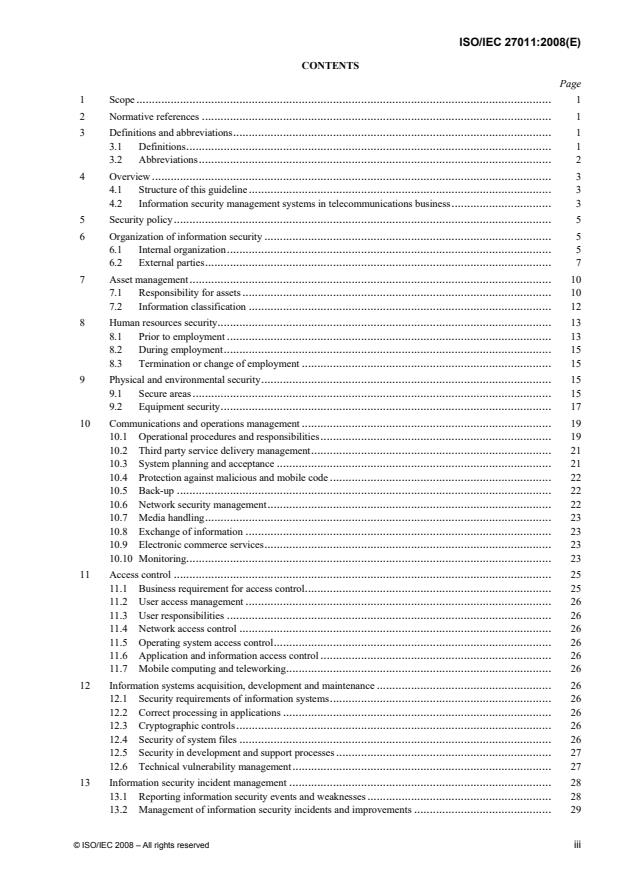
CONTENTS
Page
1 Scope. 1
2 Normative references . 1
3 Definitions and abbreviations. 1
3.1 Definitions. 1
3.2 Abbreviations. 2
4 Overview. 3
4.1 Structure of this guideline. 3
4.2 Information security management systems in telecommunications business. 3
5 Security policy. 5
6 Organization of information security . 5
6.1 Internal organization. 5
6.2 External parties. 7
7 Asset management. 10
7.1 Responsibility for assets . 10
7.2 Information classification . 12
8 Human resources security. 13
8.1 Prior to employment . 13
8.2 During employment. 15
8.3 Termination or change of employment . 15
9 Physical and environmental security. 15
9.1 Secure areas. 15
9.2 Equipment security. 17
10 Communications and operations management . 19
10.1 Operational procedures and responsibilities. 19
10.2 Third party service delivery management. 21
10.3 System planning and acceptance . 21
10.4 Protection against malicious and mobile code . 22
10.5 Back-up . 22
10.6 Network security management. 22
10.7 Media handling. 23
10.8 Exchange of information . 23
10.9 Electronic commerce services. 23
10.10 Monitoring. 23
11 Access control . 25
11.1 Business requirement for access control. 25
11.2 User access management . 26
11.3 User responsibilities . 26
11.4 Network access control . 26
11.5 Operating system access control. 26
11.6 Application and information access control . 26
11.7 Mobile computing and teleworking. 26
12 Information systems acquisition, development and maintenance . 26
12.1 Security requirements of information systems. 26
12.2 Correct processing in applications . 26
12.3 Cryptographic controls. 26
12.4 Security of system files . 26
12.5 Security in development and support processes . 27
12.6 Technical vulnerability management. 27
13 Information security incident management . 28
13.1 Reporting information security events and weaknesses . 28
13.2 Management of information security incidents and improvements . 29
© ISO/IEC 2008 – All rights reserved iii
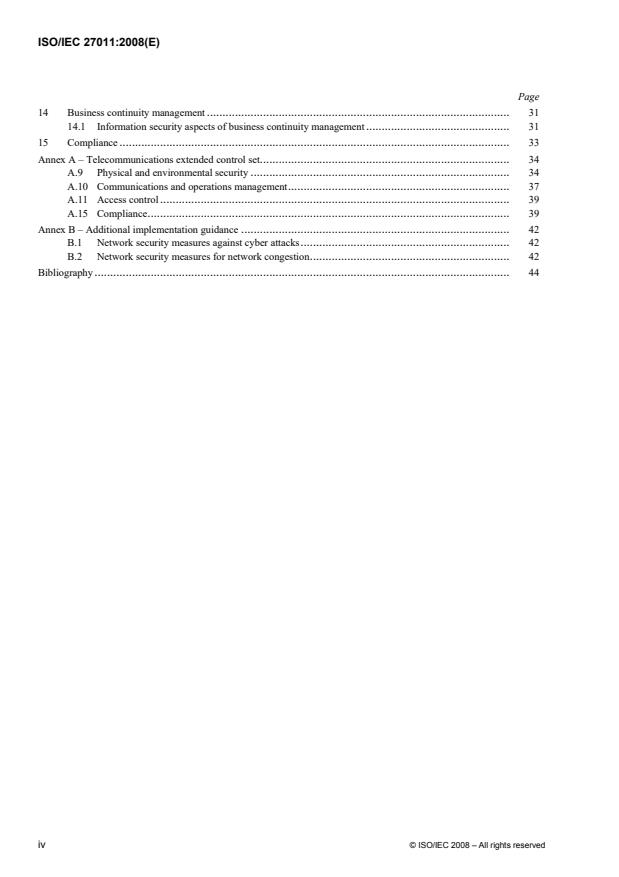
Page
14 Business continuity management . 31
14.1 Information security aspects of business continuity management. 31
15 Compliance . 33
Annex A – Telecommunications extended control set. 34
A.9 Physical and environmental security . 34
A.10 Communications and operations management. 37
A.11 Access control. 39
A.15 Compliance. 39
Annex B – Additional implementation guidance . 42
B.1 Network security measures against cyber attacks. 42
B.2 Network security measures for network congestion. 42
Bibliography. 44
iv © ISO/IEC 2008 – All rights reserved
Foreword
ISO (the International Organization for Standardization) and IEC (the International Electrotechnical
Commission) form the specialized system for worldwide standardization. National bodies that are members of
ISO or IEC participate in the development of International Standards through technical committees
established by the respective organization to deal with particular fields of technical activity. ISO and IEC
technical committees collaborate in fields of mutual interest. Other international organizations, governmental
and non-governmental, in liaison with ISO and IEC, also take part in the work. In the field of information
technology, ISO and IEC have established a joint technical committee, ISO/IEC JTC 1.
International Standards are drafted in accordance with the rules given in the ISO/IEC Directives, Part 2.
The main task of the joint technical committee is to prepare International Standards. Draft International
Standards adopted by the joint technical committee are circulated to national bodies for voting. Publication as
an International Standard requires approval by at least 75 % of the national bodies casting a vote.
Attention is drawn to the possibility that some of the elements of this document may be the subject of patent
rights. ISO and IEC shall not be held responsible for identifying any or all such patent rights.
ISO/IEC 27011 was prepared by Joint Technical Committee ISO/IEC JTC 1, Information technology,
Subcommittee SC 27, IT Security techniques in collaboration with ITU-T. The identical text is published as
ITU-T Rec. X.1051 (02/2008).
© ISO/IEC 2008 – All rights reserved v
Introduction
This Recommendation | International Standard provides interpretation guidelines for the implementation and
management of information security management in telecommunications organizations based on ISO/IEC 27002 (Code
of practice for information security management). In addition to the application of security objectives and controls
described in ISO/IEC 27002, telecommunications organizations have to take into account the following security
features:
1) Confidentiality
Information related to telecommunications organizations should be protected from unauthorized
disclosure.
This implies non-disclosure of communications in terms of the existence, the content, the source, the
destination and the date and time of communicated information.
It is critical that telecommunications organizations ensure that the non-disclosure of communications
being handled by them is not breached. Persons engaged by the telecommunications organization should
maintain the confidentiality of any information regarding others that may have come to be known during
their work duties.
NOTE – The term "secrecy of communications" is used in some countries in the context of "non-disclosure of
communications".
2) Integrity
The installation and use of telecommunications facilities should be controlled, ensuring the authenticity,
accuracy and completeness of information transmitted, relayed or received by wire, radio or any other
methods.
3) Availability
Only authorized access should be provided when necessary to telecommunications information, facilities
and the medium used for the provision of communication services whether it might be provided by wire,
radio or any other methods. As an extension of the availability, telecommunications organizations should
give priority to essential communications in case of emergency, and comply with regulatory
requirements.
Information security management in telecommunications organizations is required regardless of the method, e.g., wired,
wireless or broadband technologies. If information security management is not implemented properly, the extent of
telecommunications risks regarding confidentiality, integrity and availability may be increased.
Telecommunications organizations are designated to provide telecommunications services by intermediating
communications of others through facilities for the use of others communications. Therefore, it should be taken into
account that information processing facilities within a telecommunication organization are accessed and utilized by not
only its own employees and contractors, but also various users outside of the organization.
In order to provide telecommunications services, telecommunications organizations need to interconnect and/or share
their telecommunications services and facilities, and/or use the telecommunications services and facilities of other
telecommunications organizations. Therefore, the management of information security in telecommunications
organizations is mutually dependent and may include any and all areas of network infrastructure, services applications
and other facilities.
Regardless of operational scales, service areas or service types, telecommunications organizations should implement
appropriate controls to ensure confidentiality, integrity, availability and any other security property of
telecommunications.
Audience
This Recommendation | International Standard provides telecommunications organizations, and those responsible for
information security; together with security vendors, auditors, telecommunications terminal vendors and application
content providers, with a common set of general security control objectives based on ISO/IEC 27002,
telecommunications sector specific controls, and information security management guidelines allowing for the selection
and implementation of such controls.
vi © ISO/IEC 2008 – All rights reserved
INTERNATIONAL STANDARD
ITU-T RECOMMENDATION
Information technology – Security techniques – Information security management
guidelines for telecommunications organizations based on ISO/IEC 27002
1 Scope
The scope of this Recommendation | International Standard is to define guidelines supporting the implementation of
information security management in telecommunications organizations.
The adoption of this Recommendation | International Standard will allow telecommunications organizations to meet
baseline information security management requirements of confidentiality, integrity, availability and any other relevant
security property.
2 Normative references
The following Recommendations and International Standards contain provisions which, through reference in this text,
constitute provisions of this Recommendation | International Standard. At the time of publication, the editions indicated
were valid. All Recommendations and Standards are subject to revision, and parties to agreements based on this
Recommendation | International Standard are encouraged to investigate the possibility of applying the most recent
edition of the Recommendations and Standards listed below. Members of IEC and ISO maintain registers of currently
valid International Standards. The Telecommunication Standardization Bureau of the ITU maintains a list of currently
valid ITU-T Recommendations.
– ISO/IEC 27001:2005, Information technology – Security techniques – Information security management
systems – Requirements.
– ISO/IEC 27002:2005, Information technology – Security techniques – Code of practice for information
security management.
3 Definitions and abbreviations
3.1 Definitions
For the purposes of this Recommendation | International Standard, the definitions given in ISO/IEC 27002 apply.
Additionally, the following definitions apply:
3.1.1 collocation: Installation of telecommunications facilities on the premises of other telecommunications
carriers.
3.1.2 communication centre: Building where facilities for providing telecommunications business are sited.
3.1.3 essential communications: Communications whose contents are necessary for the prevention of or relief
from calamities, for maintaining transportation, communications or electric power supply, or for the maintenance of
public order.
3.1.4 non-disclosure of communications: Properties of communications being handled by the persons engaged in
the telecommunications organization should not be disclosed in terms of the existence, the content, the source, the
destination and the date and time of communicated information.
3.1.5 personal information: Information about an individual which can be used to identify that individual. The
specific information used for this identification will be that defined by national legislation.
3.1.6 priority call: Telecommunications made by specific terminals in the event of emergencies, which should be
handled with priority by restricting public calls. The specific terminals may span different services (VoIP, PSTN voice,
IP data traffic, etc.) for wired and wireless networks.
3.1.7 telecommunications applications: Applications such as e-mail that are accessed by end-users and are built
upon the network-based services.
ITU-T Rec. X.1051 (02/2008) 1
3.1.8 telecommunications business: Business to provide telecommunications services in order to meet the demand
of others.
3.1.9 telecommunications equipment room: A part of general building such as a room where equipment for
providing telecommunications business are sited.
3.1.10 telecommunications facilities: Machines, equipment, wire and cables, physical buildings or other electrical
facilities for the operation of telecommunications.
3.1.11 telecommunications organizations: Business entities who provide telecommunications services in order to
meet the demand of others.
3.1.12 telecommunication records: Information concerning the parties in a communication excluding the contents
of the communication, and the time, and duration of the telecommunication took place.
3.1.13 telecommunications services: Communications using telecommunications facilities, or any other means of
providing communications either between telecommunications service users or telecommunications service customers.
3.1.14 telecommunications service customer: Person or organization who enters into a contract with
telecommunications organizations to be offered telecommunications services by them.
3.1.15 telecommunications service user: Person or organization who utilizes telecommunications services.
3.1.16 terminal facilities: Telecommunications facilities which are to be connected to one end of
telecommunications circuit facilities and part of which is to be installed on the same premises (including the areas
regarded as the same premises) or in the same building where any other part thereof is also to be installed.
3.1.17 user: Person or organization who utilizes information processing facilities or systems, e.g., employee,
contractor or third party user.
3.2 Abbreviations
For the purposes of this Recommendation | International Standard, the following abbreviations apply:
ADSL Asymmetric Digital Subscriber Line
ASP Application Service Provider
CATV Community Antenna TeleVision
CERT Computer Emergency Response Team
DDoS Distributed Denial of Service
DNS Domain Name System
DoS Denial of Service
ISAC Information Sharing and Analysis Centre
ISMS Information Security Management System
NGN Next Generation Network
NMS Network Management System
OAM&P Operations, Administration, Maintenance and Provisioning
PIN Personal Identification Number
PSTN Public Switched Telephone Network
SIP Session Initiation Protocol
SLA Service Level Agreement
SOA Statement of Applicability
UPS Uninterruptible Power Supply
URL Uniform Resource Locator
VoIP Voice over Internet Protocol
2 ITU-T Rec. X.1051 (02/2008)
4 Overview
4.1 Structure of this guideline
This Recommendation | International Standard has been structured in a format similar to ISO/IEC 27002. In cases
where objectives and controls specified in ISO/IEC 27002 are applicable without a need for any additional information,
only a reference is provided to ISO/IEC 27002. Telecommunications sector specific set of control and implementation
guidance is described in Annex A (normative).
In cases where controls need additional guidance specific to telecommunications, the ISO/IEC 27002 control and
implementation guidance is repeated without modification, followed by the specific telecommunications guidance
related to this control. Telecommunications sector specific guidance and information is included in the following
clauses:
– Organization of information security (clause 6)
– Asset management (clause 7)
– Human resources security (clause 8)
– Physical and environmental security (clause 9)
– Communications and operations management (clause 10)
– Access control (clause 11)
– Information systems acquisition, development and maintenance (clause 12)
– Information security incident management (clause 13)
– Business continuity management (clause 14)
4.2 Information security management systems in telecommunications business
4.2.1 Goal
Information, like other organization assets, is an essential contributor to an organization's business. Information can be
printed or written on paper, stored electronically, transmitted by post, communicated electronically, shown on films, or
spoken in conversation. Regardless of the form or functionality of the information, or the means by which the
information is shared or stored, information should always be appropriately protected.
Organizations and their information systems and networks are faced with security threats from a wide range of sources,
including computer-assisted fraud, espionage, sabotage, vandalism, information leakage, earthquake, fire or flood.
These security threats may originate from inside or outside the telecommunications organization resulting in damage to
the organization.
Once information security is violated, for example by unauthorized access to an organization's information processing
system, the organization may suffer damage. Therefore, it is essential for an organization to ensure its information
security by continuously improving its ISMS in accordance with ISO/IEC 27001.
Effective information security is achieved by implementing a suitable set of controls based on those described in this
Recommendation | International Standard. These controls need to be established, implemented, monitored, reviewed
and improved in the telecommunications facilities, services and applications. The successful deployment of security
controls will better enable meeting the security and business objectives of the organization to be met.
Telecommunications organizations whose facilities are used by various users to process information such as personal
data, confidential data and business data should handle this information with great/due care and apply an appropriate
level of protection.
In conclusion, telecommunications organizations need to establish and continuously improve an overall ISMS which
ensures appropriate security controls are maintained.
4.2.2 Security considerations in telecommunications
The requirement for a generic security framework in telecommunications has originated from different sources:
a) Customers/subscribers needing confidence in the network and the services to be provided, including
availability of services (especially emergency services) in case of major catastrophes;
b) Public authorities demanding security by directives, regulation and legislation, in order to ensure
availability of services, fair competition and privacy protection;
ITU-T Rec. X.1051 (02/2008) 3
c) Network operators and service providers themselves needing security to safeguard their operational and
business interests, and to meet their obligations to their customers and the public.
Furthermore, telecommunications organizations should consider the following environmental and operational security
incidents:
a) Telecommunications services are heavily dependent on various interconnected facilities, such as routers,
switches, domain name servers, transmission relay systems and NMS. Therefore, telecommunications
security incidents can occur to various equipment/facilities and the incidents can propagate rapidly
through network into other equipment/facilities;
b) In addition to telecommunications facilities, vulnerabilities in network protocols and topology can result
in serious security incidents. Especially, convergence of wired and wireless networks into NGN can
impose significant challenges for developing interoperable protocols;
c) A major concern of telecommunications organizations is the possibility of compromised security that
causes network down-time. Such down-time can be extremely costly in terms of customer relations, lost
revenue, and recovery costs. Deliberate attacks on the availability of the national telecommunications
infrastructure can be viewed as a national security concern;
d) Telecommunications management networks and systems are susceptible to hacker penetrations. A
common motivation for such penetrations is theft of telecommunications services. Such theft can be
engineered in various ways, such as invoking diagnostic functions, manipulating accounting records, and
altering provisioning databases, and eavesdropping on subscriber calls;
e) In addition to external penetrations, carriers are concerned about security compromises from internal
sources, such as invalid changes to network management databases and configurations on the part of
unauthorized personnel. Such occurrences may be accidental or deliberate.
For the purpose of protecting information assets in telecommunications originating from different sources under the
various telecommunications environments, security guidelines for telecommunications are indispensable to support the
implementation of information security management in telecommunications organizations.
The security guidelines should be applicable to the following:
a) Telecommunications organizations seeking a business advantage through the implementation of an
information security management system;
b) Telecommunications organizations seeking confidence that the information security requirements of their
interested parties (e.g., suppliers, customers, regulators) will be satisfied;
c) Users and suppliers of the information security related products and services for the telecommunications
industry;
d) Those internal or external to the telecommunications organization who assess and audit the information
security management system for conformity with the requirements of ISO/IEC 27001;
e) Those internal or external to the telecommunications organizations who give advice or training on the
information security management system appropriate to that organization.
4.2.3 Information assets to be protected
In order to establish information security management, it is essential for an organization to clarify and identify all
organizational assets. The clarification of attributes and importance of the assets makes it possible to implement
appropriate controls.
Information assets which telecommunications organizations should protect can be found in 7.1.1, Inventory of assets.
4.2.4 Establishment of information security management
4.2.4.1 How to establish security requirements
It is essential for telecommunications organizations to identify their security requirements. There are three main sources
of security requirements as follows:
a) What is derived from assessing risks to a telecommunications carrier, taking into account its overall
business strategy and objectives. Through risk assessment, threats to assets are identified, vulnerability to
and likelihood of occurrence is evaluated and potential impact is estimated;
b) The legal, statutory, regulatory, and contractual requirements that telecommunications organizations
have to satisfy, and the socio-cultural environment. Examples of legislative requirements for
telecommunications organizations are non-disclosure of communications (A.15.1.7) and ensuring
essential communications (A.15.1.8). Examples of socio-cultural requirements are ensuring the integrity
4 ITU-T Rec. X.1051 (02/2008)
of telecommunications, transmitted, relayed and received by any means, the availability of wired or
wireless telecommunications facilities by authorized persons, and not harming other telecommunications
facilities;
c) The particular set of principles, objective and business requirements for information processing that a
telecommunications carrier has developed to support its operations.
4.2.4.2 Assessing security risks
Security requirements are identified by a methodical assessment of security risks. Expenditure on controls needs to be
balanced against the business harm likely to result from security failures. The results of the risk assessment will help to
guide and determine the appropriate management action and priorities for managing information security risks, and for
implementing controls selected to protect against these risks.
Risk assessment should be repeated periodically to address any changes that might influence the risk assessment results.
4.2.4.3 Selecting controls
Once security requirements and risks have been identified and decisions for the treatment of risks have been made,
appropriate controls should be selected and implemented to ensure risks are reduced to an acceptable level.
This guideline provides additional guidance and telecommunications specific controls, in addition to general
information security management, taking account of telecommunications specific requirements. Therefore,
telecommunications organizations are recommended to select controls from this guideline and implement them. In
addition, new controls can be designed to meet specific needs as appropriate.
The selection of security controls is dependent upon organizational decisions based on the criteria for risk acceptance,
risk treatment options, and the general risk management approach applied to telecommunications organizations, and
should also be subject to all relevant national and international legislation and regulations.
4.2.4.4 Critical success factors
The contents from ISO/IEC 27002 clause 0.7 apply.
5 Security policy
The control objective and the contents from ISO/IEC 27002 clause 5 apply.
6 Organization of information security
6.1 Internal organization
Objective: To manage information security within the organization.
A management framework should be established to initiate and control the implementation of information security
within the organization.
Management should approve the information security policy, assign security roles and coordinate and review the
implementation of security across the organization.
If necessary, a source of specialist information security advice should be established and made available within the
organization. Contacts with external security specialists or groups, including relevant authorities, should be developed
to keep up with industrial trends, monitor standards and assessment methods and provide suitable liaison points when
handling information security incidents. A multi-disciplinary approach to information security should be encouraged.
6.1.1 Management commitment to information security
Control 6.1.1 from ISO/IEC 27002 applies.
6.1.2 Information security coordination
Control 6.1.2 from ISO/IEC 27002 applies.
6.1.3 Allocation of information security responsibilities
Control 6.1.3 from ISO/IEC 27002 applies.
ITU-T Rec. X.1051 (02/2008) 5
6.1.4 Authorization process for information processing facilities
Control 6.1.4 from ISO/IEC 27002 applies.
6.1.5 Confidentiality agreements
Control
Requirements for confidentiality or non-disclosure agreements reflecting the organization's needs for the protection of
information should be identified and regularly reviewed.
Implementation guidance
Confidentiality or non-disclosure agreements should address the requirement to protect confidential information using
legally enforceable terms. To identify requirements for confidentiality or non-disclosure agreements, the following
elements should be considered:
a) a definition of the information to be protected (e.g., confidential information);
b) expected duration of an agreement, including cases where confidentiality might need to be maintained
indefinitely;
c) required actions when an agreement is terminated;
d) responsibilities and actions of signatories to avoid unauthorized information disclosure (such as 'need to
know');
e) ownership of information, trade secrets and intellectual property, and how this relates to the protection of
confidential information;
f) the permitted use of confidential information, and rights of the signatory to use information;
g) the right to audit and monitor activities that involve confidential information;
h) process for notification and reporting of unauthorized disclosure or confidential information breaches;
i) terms for information to be returned or destroyed at agreement cessation;
j) expected actions to be taken in case of a breach of this agreement.
Based on an organization's security requirements, other elements may be needed in a confidentiality or non-disclosure
agreement.
Confidentiality and non-disclosure agreements should comply with all applicable laws and regulations for the
jurisdiction to which it applies (see also 15.1.1 in ISO/IEC 27002).
Requirements for confidentiality and non-disclosure agreements should be reviewed periodically and when changes
occur that influence these requirements.
Telecommunications-specific implementation guidance
To identify requirements for confidentiality or non-disclosure agreements, telecommunications organizations should
consider the need to protect against non-disclosure of:
a) the existence;
b) the content;
c) the source;
d) the destination; and
e) the date and time;
in communicated information.
Other information
Confidentiality and non-disclosure agreements protect organizational information and inform signatories of their
responsibility to protect, use, and disclose information in a responsible and authorized manner.
There may be a need for an organization to use different forms of confidentiality or non-disclosure agreements in
different circumstances.
6 ITU-T Rec. X.1051 (02/2008)
6.1.6 Contact with authorities
Control
Appropriate contacts with relevant authorities should be maintained.
Implementation guidance
Organizations should have procedures in place that specify when and by whom authorities (e.g., law enforcement, fire
department, supervisory authorities) should be contacted, and how identified information security incidents should be
reported in a timely manner if it is suspected that laws may have been broken.
Organizations under attack from the Internet may need external third parties (e.g., an Internet service provider or
telecommunications operator) to take action against the attack source.
Telecommunications-specific implementation guidance
When telecommunications organizations receive inquiries from law-enforcement agencies or investigative
organizations, regarding information relating to telecommunications service users, these telecommunications
organizations need to confirm that the inquiries have gone through legitimate processes and procedures, according to
national laws and regulations.
Other information
Maintaining such contacts may be a requirement to support information security incident management (clause 13.2) or
the business continuity and contingency planning process (clause 14). Contacts with regulatory bodies are also useful to
anticipate and prepare for upcoming changes in laws or regulations, which have to be followed by the organization.
Contacts with other authorities include utilities, emergency services, and health and safety telecommunications
providers (in connection with line routing and availability).
6.1.7 Contact with special interest groups
Control 6.1.7 from ISO/IEC 27002 applies.
6.1.8 Independent review of information security
Control 6.1.8 from ISO/IEC 27002 applies.
6.2 External parties
Objective: To maintain the security of the organization's information and information processing facilities that are
accessed, processed, communicated to, or managed by external parties.
The security of the organization's information and information processing facilities should not be reduced by the
introduction of external party products or services.
Any access to the organization's information processing facilities and processing and communication of information by
external parties should be controlled.
Where there is a business need for working with external parties that may require access to the organization's
information and information processing facilities, or in obtaining or providing a product and service from or to an
external party, a risk assessment should be carried out to determine security implications and control requirements.
Controls should be agreed and defined in an agreement with the external party.
6.2.1 Identification of risks related to external parties
Control 6.2.1 from ISO/IEC 27002 applies.
6.2.2 Addressing security when dealing with customers
Control
All identified security requirements should be addressed before giving customers access to the organization's
information or assets.
ITU-T Rec. X.1051 (02/2008) 7
Implementation guidance
The following terms should be considered to address security prior to giving customers access to any of the
organization's assets (depending on the type and extent of access given, not all of them might apply):
a) asset protection, including:
1) procedures to protect the organization's assets, including information and software, and management
of known vulnerabilities;
2) procedures to determine whether any compromise of the assets, e.g., loss or modification of data,
has occurred;
3) integrity;
4) restrictions on copying and disclosing information;
b) description of the product or service to be provided;
c) the different reasons, requirements, and benefits for customer access;
d) access control policy, covering:
1) permitted access methods, and the control and use of unique identifiers such as user IDs and
passwords;
2) an authorization process for user access and privileges;
3) a statement that all access that is not explicitly authorized is forbidden;
4) a process for revoking access rights or interrupting the connection between systems;
e) arrangements for reporting, notification, and investigation of information inaccuracies (e.g., of personal
details), information security incidents and security breaches;
f) a description of each service to be made available;
g) the target level of service and unacceptable levels of service;
h) the right to monitor, and revoke, any activity related to the organization's assets;
i) the respective liabilities of the organization and the customer;
j) responsibilities with respect to legal matters and how it is ensured that the legal requirements are met,
e.g., data protection legislation, especially taking into account different national legal systems if the
agreement involves cooperation with customers in other countries (see also 15.1 in ISO/IEC 27002);
k) intellectual property rights (IPRs) and copyright assignment (see 15.1.2 in ISO/IEC 27002) and
protection of any collaborative work (see also 6.1.5).
Telecommunications-specific implementation guidance
Telecommunications organizations should consider the following terms to address security prior to giving customers
access to any of the organization's assets:
a) a clear agreement in which telecommunications service facilities or those of other connected
telecommunications users connected are not damaged or impaired;
b) a clear demarcation of responsibilities between the telecommunications service facilities of
telecommunications organizations and those of telecommunications service users;
c) a clear specification for possible suspension of telecommunications services, in case there may be a risk,
for example the threat of spam, hindering the continuous provision of telecommunications services.
Other information
The security requirements related to customers accessing organizational assets can vary considerably depending on the
information processing facilities and information being accessed. These security requirements can be addressed using
customer agreements, which contain all identified risks and security requirements (see 6.2.1).
Agreements with external parties may also involve other parties. Agreements granting external party access should
include allowance for designation of other eligible parties and conditions for their access and involvement.
6.2.3 Addressing security in third-party agreements
Control
Agreements with third parties involving accessing, processing, communicating or managing the organization's
information or information processing facilities, or adding products or services to information processing facilities
should cover all relevant security requirements.
8 ITU-T Rec. X.1051 (02/2008)
Implementation guidance
The agreement should ensure that there is no misunderstanding between the organization and the third party.
Organizations
...
Questions, Comments and Discussion
Ask us and Technical Secretary will try to provide an answer. You can facilitate discussion about the standard in here.
Loading comments...