


ISO 23131-3
(Main)Ellipsometry - Part 3: Transparent single layer model
Ellipsometry - Part 3: Transparent single layer model
This document uses ellipsometric measurements and their analysis to specify the method for the determination of the layer thickness d of a transparent layer and the optical (refractive index n) or dielectric (real part ε1) constants/functions based on the transparent single layer model within a spectral region, for which k = 0 applies.
Ellipsométrie — Partie 3: Modèle de couche unique transparente
General Information
- Status
- Not Published
- Technical Committee
- ISO/TC 107 - Metallic and other inorganic coatings
- Drafting Committee
- ISO/TC 107 - Metallic and other inorganic coatings
- Current Stage
- 6000 - International Standard under publication
- Start Date
- 17-Dec-2025
- Completion Date
- 10-Jan-2026
Overview
ISO 23131-3:2025 - "Ellipsometry - Part 3: Transparent single layer model" (ISO, FDIS stage) specifies a standardized method for obtaining the layer thickness (d) and the optical (refractive index n) or dielectric (real part ε1) functions of a transparent thin film using ellipsometric measurements within a spectral region where the extinction coefficient k = 0. The document builds on ellipsometry principles and defines a model-based fitting procedure using the ellipsometric transfer quantities Ψ (psi) and Δ (delta) to derive physical measurands. It also addresses model assumptions, validation, measurement uncertainty and reporting.
Key topics and requirements
- Transparent single layer model: Definition, optical path description and the assumptions underpinning the model (transparent layer on known substrate; k = 0 in the spectral region).
- Model deviations and limitations: Clauses covering potential deviations from model assumptions (multiple listed model and sample assumptions) and how they affect analysis.
- Fitting procedure: Parameterized fit to determine layer thickness d and wavelength-dependent refractive index n while substrate optical constants are known.
- Ellipsometric quantities: Use of phase-sensitive reflection measurements and interpretation of Ψ and Δ as primary measurands.
- Validation: Procedures and checks to validate the model fit and ensure meaningful physical results.
- Measurement uncertainty: Treatment of uncertainty for Ψ and Δ and propagated uncertainty for the fitted layer thickness (clause on measurement uncertainty and reference to GUM principles).
- Test reporting: Required content of test reports (measurement conditions, model parameters, uncertainty statements).
- Annex A (informative): Practical additions and examples (refractive indices of transparent materials, SiO/Si and SiO/BK7 examples, influence of angle of incidence and wavelength range, recommendations for measuring practice).
Applications and users
- Practical for thin-film metrology in industries and labs: optical coatings, semiconductor process control, surface engineering, and research on transparent films.
- Intended users include metrology laboratories, coating and semiconductor manufacturers, materials scientists, quality assurance/quality control teams, and ellipsometer instrument manufacturers.
- Typical applications: non‑destructive determination of film thickness, dispersion (n(λ)) characterization of transparent layers, process monitoring and acceptance testing where high precision (sub-nanometre sensitivity under ideal conditions) is required.
Related standards
- ISO 23131 series (Principles and other parts) - foundational ellipsometry principles and bulk material model.
- ISO/IEC Guide 98-3 (GUM) - uncertainty of measurement guidance referenced for uncertainty evaluation.
Keywords: ellipsometry, transparent single layer model, ISO 23131-3, thin film thickness, refractive index, Ψ Δ, spectroscopic ellipsometry, measurement uncertainty, validation.


ISO/FDIS 23131-3 - Ellipsometry — Part 3: Transparent single layer model Released:10/7/2025
REDLINE ISO/FDIS 23131-3 - Ellipsometry — Part 3: Transparent single layer model Released:10/7/2025
Frequently Asked Questions
ISO 23131-3 is a draft published by the International Organization for Standardization (ISO). Its full title is "Ellipsometry - Part 3: Transparent single layer model". This standard covers: This document uses ellipsometric measurements and their analysis to specify the method for the determination of the layer thickness d of a transparent layer and the optical (refractive index n) or dielectric (real part ε1) constants/functions based on the transparent single layer model within a spectral region, for which k = 0 applies.
This document uses ellipsometric measurements and their analysis to specify the method for the determination of the layer thickness d of a transparent layer and the optical (refractive index n) or dielectric (real part ε1) constants/functions based on the transparent single layer model within a spectral region, for which k = 0 applies.
ISO 23131-3 is classified under the following ICS (International Classification for Standards) categories: 17.020 - Metrology and measurement in general. The ICS classification helps identify the subject area and facilitates finding related standards.
ISO 23131-3 is available in PDF format for immediate download after purchase. The document can be added to your cart and obtained through the secure checkout process. Digital delivery ensures instant access to the complete standard document.
Standards Content (Sample)
FINAL DRAFT
International
Standard
ISO/FDIS 23131-3
ISO/TC 107
Ellipsometry —
Secretariat: KATS
Part 3:
Voting begins on:
2025-10-21
Transparent single layer model
Voting terminates on:
2025-12-16
Member bodies are requested to consult relevant national interests in ISO/TC
35/SC 9 before casting their ballot to the e-Balloting application.
RECIPIENTS OF THIS DRAFT ARE INVITED TO SUBMIT,
WITH THEIR COMMENTS, NOTIFICATION OF ANY
RELEVANT PATENT RIGHTS OF WHICH THEY ARE AWARE
AND TO PROVIDE SUPPOR TING DOCUMENTATION.
IN ADDITION TO THEIR EVALUATION AS
BEING ACCEPTABLE FOR INDUSTRIAL, TECHNO-
LOGICAL, COMMERCIAL AND USER PURPOSES, DRAFT
INTERNATIONAL STANDARDS MAY ON OCCASION HAVE
TO BE CONSIDERED IN THE LIGHT OF THEIR POTENTIAL
TO BECOME STAN DARDS TO WHICH REFERENCE MAY BE
MADE IN NATIONAL REGULATIONS.
Reference number
ISO/FDIS 23131-3:2025(en) © ISO 2025
FINAL DRAFT
ISO/FDIS 23131-3:2025(en)
International
Standard
ISO/FDIS 23131-3
ISO/TC 107
Ellipsometry —
Secretariat: KATS
Part 3:
Voting begins on:
Transparent single layer model
Voting terminates on:
Member bodies are requested to consult relevant national interests in ISO/TC
35/SC 9 before casting their ballot to the e-Balloting application.
RECIPIENTS OF THIS DRAFT ARE INVITED TO SUBMIT,
WITH THEIR COMMENTS, NOTIFICATION OF ANY
RELEVANT PATENT RIGHTS OF WHICH THEY ARE AWARE
AND TO PROVIDE SUPPOR TING DOCUMENTATION.
© ISO 2025
IN ADDITION TO THEIR EVALUATION AS
All rights reserved. Unless otherwise specified, or required in the context of its implementation, no part of this publication may
BEING ACCEPTABLE FOR INDUSTRIAL, TECHNO-
LOGICAL, COMMERCIAL AND USER PURPOSES, DRAFT
be reproduced or utilized otherwise in any form or by any means, electronic or mechanical, including photocopying, or posting on
INTERNATIONAL STANDARDS MAY ON OCCASION HAVE
the internet or an intranet, without prior written permission. Permission can be requested from either ISO at the address below
TO BE CONSIDERED IN THE LIGHT OF THEIR POTENTIAL
or ISO’s member body in the country of the requester.
TO BECOME STAN DARDS TO WHICH REFERENCE MAY BE
MADE IN NATIONAL REGULATIONS.
ISO copyright office
CP 401 • Ch. de Blandonnet 8
CH-1214 Vernier, Geneva
Phone: +41 22 749 01 11
Email: copyright@iso.org
Website: www.iso.org
Published in Switzerland Reference number
ISO/FDIS 23131-3:2025(en) © ISO 2025
ii
ISO/FDIS 23131-3:2025(en)
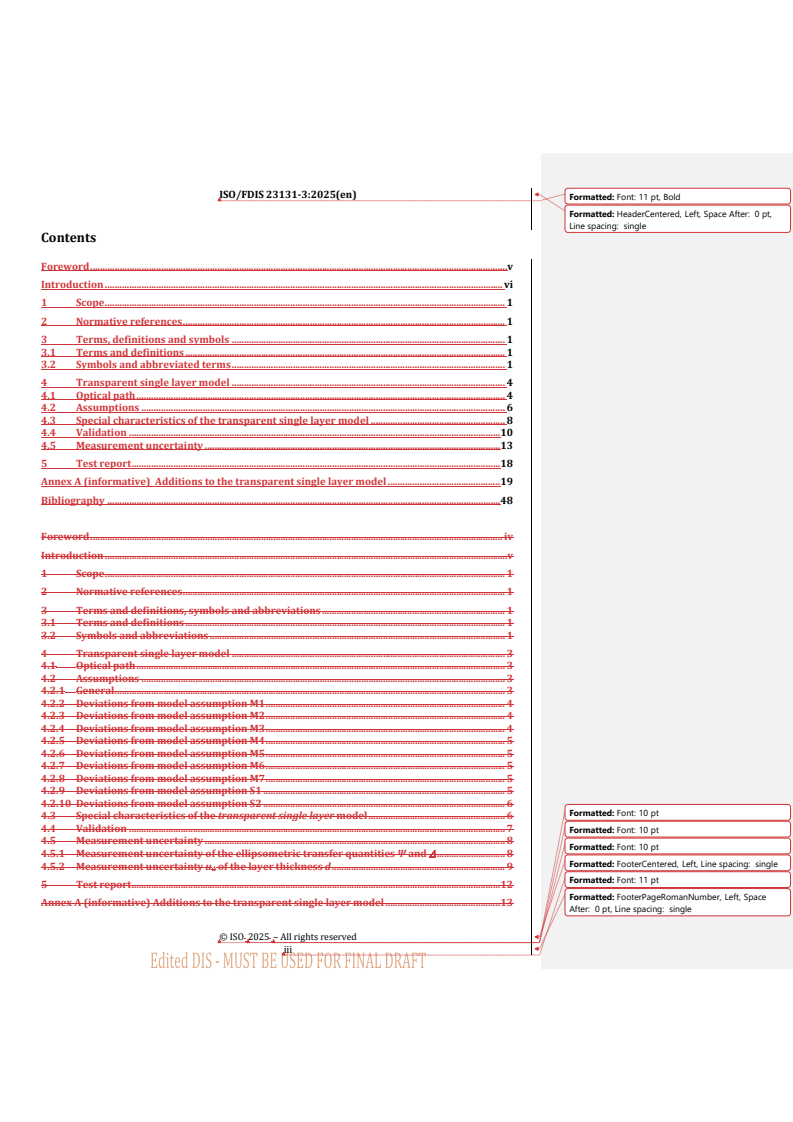
Contents Page
Foreword .iv
Introduction .v
1 Scope . 1
2 Normative references . 1
3 Terms, definitions and symbols . 1
3.1 Terms and definitions .1
3.2 Symbols and abbreviated terms .1
4 Transparent single layer model . 2
4.1 Optical path .2
4.2 Assumptions .3
4.2.1 General .3
4.2.2 Deviations from model assumption M1 .4
4.2.3 Deviations from model assumption M2 .4
4.2.4 Deviations from model assumption M3 .4
4.2.5 Deviations from model assumption M4 .5
4.2.6 Deviations from model assumption M5 .5
4.2.7 Deviations from model assumption M6 .5
4.2.8 Deviations from model assumption M7 .5
4.2.9 Deviations from model assumption S1 .5
4.2.10 Deviations from model assumption S2 .6
4.3 Special characteristics of the transparent single layer model .6
4.4 Validation .7
4.5 Measurement uncertainty .8
4.5.1 Measurement uncertainty of the ellipsometric transfer quantities Ψ and Δ .8
4.5.2 Measurement uncertainty u of the layer thickness d .9
d
5 Test report .12
Annex A (informative) Additions to the transparent single layer model .13
Bibliography .29
iii
ISO/FDIS 23131-3:2025(en)
Foreword
ISO (the International Organization for Standardization) is a worldwide federation of national standards
bodies (ISO member bodies). The work of preparing International Standards is normally carried out through
ISO technical committees. Each member body interested in a subject for which a technical committee
has been established has the right to be represented on that committee. International organizations,
governmental and non-governmental, in liaison with ISO, also take part in the work. ISO collaborates closely
with the International Electrotechnical Commission (IEC) on all matters of electrotechnical standardization.
The procedures used to develop this document and those intended for its further maintenance are described
in the ISO/IEC Directives, Part 1. In particular, the different approval criteria needed for the different types
of ISO document should be noted. This document was drafted in accordance with the editorial rules of the
ISO/IEC Directives, Part 2 (see www.iso.org/directives).
ISO draws attention to the possibility that the implementation of this document may involve the use of (a)
patent(s). ISO takes no position concerning the evidence, validity or applicability of any claimed patent
rights in respect thereof. As of the date of publication of this document, ISO had not received notice of (a)
patent(s) which may be required to implement this document. However, implementers are cautioned that
this may not represent the latest information, which may be obtained from the patent database available at
www.iso.org/patents. ISO shall not be held responsible for identifying any or all such patent rights.
Any trade name used in this document is information given for the convenience of users and does not
constitute an endorsement.
For an explanation of the voluntary nature of standards, the meaning of ISO specific terms and expressions
related to conformity assessment, as well as information about ISO's adherence to the World Trade
Organization (WTO) principles in the Technical Barriers to Trade (TBT), see www.iso.org/iso/foreword.html.
This document was prepared by Technical Committee ISO/TC 107, Metallic and other inorganic coatings, in
collaboration with ISO/TC 35, Paints and varnishes, SC 9, General test methods for paints and varnishes.
A list of all parts in the ISO 23131 series can be found on the ISO website.
Any feedback or questions on this document should be directed to the user’s national standards body. A
complete listing of these bodies can be found at www.iso.org/members.html.
iv
ISO/FDIS 23131-3:2025(en)
Introduction
The ellipsometry measuring method is a phase-sensitive reflection technique using polarized light in
the optical far-field. Ellipsometry has been established as a non-invasive measuring method in the field
of semiconductor technology, in particular the field of integrated production. The method was originally
conceived as a single-wavelength measuring method, then as a multiple-wavelength and later as a
spectroscopic measuring method.
Ellipsometry can be used to determine optical or dielectric constants of any material as well as the layer
thicknesses of at least semi-transparent layers or layer systems. Ellipsometry is an indirect measuring
method, the analysis of which is based on model optimization. The measurands, which differ according to the
procedural principle, are converted into the ellipsometric transfer quantities Ψ (psi, amplitude information)
and Δ (delta, phase information). The physical target quantities of interest (optical or dielectric constants,
layer thicknesses) are determined based on these measurands by means of a parameterized fit.
Ellipsometry shows a high precision regarding the ellipsometric transfer quantities Ψ and Δ, which can
be equivalent to a layer thickness sensitivity of 0,1 nm for ideal layer substrate systems. As a result, the
measuring method can detect even the slightest discrepancies in surface characteristics. This is closely linked
to the homogeneity and the isotropy of the material surface. In order to achieve high precision, carrying out
measurements at the exact same measuring point is a prerequisite for inhomogeneous materials. The same
applies to the orientation of the incident plane relative to the material surface for anisotropic materials.
In the transparent single layer model, a fitting procedure is used to determine the layer thickness d and the
refractive index n of the layer while the optical constants of the substrate are known. For ideal transparent
materials, it is assumed that k = 0. Therefore, fitting only refers to the layer thickness d, which is by definition
independent of the wavelength and of the angle of incidence, and the wavelength-dependent refractive
index n, which does not depend on the angle of incidence. Consequently, the transparent single layer model
allows the determination of the layer thickness and of the refractive index.
v
FINAL DRAFT International Standard ISO/FDIS 23131-3:2025(en)
Ellipsometry —
Part 3:
Transparent single layer model
1 Scope
This document uses ellipsometric measurements and their analysis to specify the method for the
determination of the layer thickness d of a transparent layer and the optical (refractive index n) or dielectric
(real part ε ) constants/functions based on the transparent single layer model within a spectral region, for
which k = 0 applies.
2 Normative references
The following documents are referred to in the text in such a way that some or all of their content constitutes
requirements of this document. For dated references, only the edition cited applies. For undated references,
the latest edition of the referenced document (including any amendments) applies.
ISO 23131, Ellipsometry — Principles
1)
ISO 23131-2:20— , Ellipsometry — Part 2: Bulk material model
ISO/IEC Guide 98-3, Uncertainty of measurement — Part 3: Guide to the expression of uncertainty in
measurement (GUM:1995)
3 Terms, definitions and symbols
3.1 Terms and definitions
For the purposes of this document, the following term and definition apply.
ISO and IEC maintain terminology databases for use in standardization at the following addresses:
— ISO Online browsing platform: available at https:// www .iso .org/ obp
— IEC Electropedia: available at https:// www .electropedia .org/
3.1.1
transparent single layer
layer of which the light extinction can be neglected within the considered spectral region
3.2 Symbols and abbreviated terms
For the purpose of this document, the symbols and abbreviated terms given in ISO 23131 and ISO 23131-2
and the following apply:
1) Under preparation. Stage at time of publication: ISO/DIS 23131-2:2025.
ISO/FDIS 23131-3:2025(en)
Table 1 — Symbols
Symbols Description
n refractive index (real part of the complex refractive index N)
k extinction coefficient (imaginary part of the complex refractive index N)
N complex refractive index
ε real part of the complex dielectric function
ε imaginary part of the complex dielectric function
ε complex dielectric function
φ angle of incidence between the incident light wave and the normal to the surface
N complex refractive index of the ambient space
a
N complex refractive index of the layer
l
N complex refractive index of the substrate
s
R maximum roughness depth
t
R arithmetic roughness average (profile roughness)
a
root-mean-square deviation (in ISO 23131 and some evaluation software, root-mean-square
D
RMS
error is still used)
D minimum of the root-mean-square deviation
RMS,min
d fitting result for the layer thickness of the transparent single layer (sample)
fit
calculated layer thickness of the transparent single layer for single-wavelength ellipsometry
d
calc
and a single angle of incidence (sample)
u uncertainty of the fit on the layer thickness model parameter (sample)
fit
a half width of the rectangular distribution
uncertainty of modelling in the transparent single layer model regarding the layer thickness
u
mod
(sample)
uncertainty of the fit on the layer thickness model parameter (layer thickness standard/ref-
u
fit,ref
erence layer)
expanded combined uncertainty (measurement uncertainty) of the reference materials
U
ref
(layer thickness standard/reference layer)
a
coverage factor that has been used to indicate the measurement uncertainty (expanded
c
ref
combined uncertainty) of the reference materials (layer thickness standard/reference layer)
u combined uncertainty of the layer thickness (layer thickness standard/reference layer)
ref
combined uncertainty of the layer thickness d considering all uncertainty components (sam-
u
d
ple)
minimum uncertainty when no other uncertainty determination is possible; defined as equal
u
min
to 0,5 nm
a
coverage factor for expression of measurement uncertainty (expanded combined uncertain-
c
samp
ty) of sample
a
The coverage factor is denoted “k” in ISO/IEC Guide 98-3.
4 Transparent single layer model
4.1 Optical path
Figure 1 shows the optical path at a certain angle of incidence φ in the transparent single layer model. The
ambient space (index “a”) is assigned with the complex refractive index N . Usually, air serves as the ambient
a
space and the refractive index is in close approximation with n = 1,000 and k = 0,000. The transparent
a a
single layer is assigned with the layer thickness d and the complex refractive index N (index “l” for layer).
l
In the transparent single layer model, it is assumed that k = 0. The substrate is assigned with the complex
l
refractive index N .
s
ISO/FDIS 23131-3:2025(en)
Incident light from the ambient space strikes the interface between the ambient space and the transparent
single layer; part of it is reflected. Another part is refracted and experiences multiple reflections in the
transparent single layer at the layer/substrate and the layer/ambient interfaces. The measured signal thus
represents the superposition of the multiple reflections (interference) in the transparent single layer.
Key
φ angle of incidence between the incident light wave and the normal to the surface
N complex refractive index of the ambient space (for air real, N = n = 1,000)
a a a
d layer thickness of the transparent single layer
N complex refractive index of the layer (for transparent layers real, N = n (λ), k (λ) = 0)
l l l l
N complex refractive index of the substrate (N = n (λ) + i · k (λ))
s s s s
Figure 1 — Optical path in the transparent single layer model
In the transparent single layer model, it is assumed that, in addition to the angle of incidence φ, only the
layer thickness d and the refractive index n or the real part of the dielectric function ε of the layer as well
l 1l
as the optical (n , k ) or dielectric (ε , ε ) constants of the substrate determine the measured ellipsometric
s s 1s 2s
transfer quantities Ψ and Δ.
Clause A.1 gives the refractive indices of specified transparent layer materials. Clause A.2 and Clause A.3
describe the reference layers for transparent single layers on opaque or transparent substrates.
4.2 Assumptions
4.2.1 General
The following model assumptions given in Table 2 are made for the transparent single layer model.
ISO/FDIS 23131-3:2025(en)
Table 2 — Assumptions for the transparent single layer model
Assumption Description
negligible extinction (i.e. neither absorption nor scattering losses) of the layer (k (λ) = 0) in the
l
M1
considered spectral region
no layers in addition to the transparent single layer, neither on the single layer (e.g. moisture or
M2
dirt films) nor between the layer and the substrate (e.g. interfacial layers)
negligible roughness of the layer (and of the substrate) relative to the measurement wavelength λ:
typically, R or S ≤ λ/250
a a
M3
negligible maximum roughness depth relative to the layer thickness d: typically,
R ≤ 1 nm + d/1 000
t
homogeneity of the substrate and the layer, especially of the layer thickness d in the field of analy-
M4 sis (FOA), i.e. no lateral (x-y) or vertical (z) local dependence (gradients) of the optical or dielectric
constants
isotropy or known anisotropy of the layer (and of the substrate), i.e. no unknown directional
M5
dependence of the optical or dielectric constants
defined chemical composition, crystallographic microstructure and atomic packing factor of the
M6
layer (and of the substrate) with sufficient stability (relative to the measuring time)
only the layer surface and the layer/substrate interface but not the backside reflections of trans-
M7 parent substrates contribute to the reflected signal, i.e. the use of substrates of sufficient thick-
ness, typically of more than 5 mm
planarity of the sample’s surface in relation to the orientation of the beam path during the meas-
S1 urement, i.e. conformity of the layer’s surface with the ellipsometer reference plane to obtain a
symmetric optical path
consistency between the angle of incidence φ applied during measurement and the one used in
S2
the model
Assumptions M1 to M7 specify the influencing parameters related to the layer and substrate material.
Assumptions S1 and S2 describe measurement-related influencing parameters which are relevant for the
validity and quality of the transparent single layer model.
The transparent reference layers described in Clause A.2 conform with model assumptions M1 to M7 in
very close approximation. When measuring actual materials and surfaces, it is possible that several
assumptions of the transparent single layer model are not met. The fundamental model-specific requirement
is assumption M1. Possible deviations from the assumptions M2 to M7 and S1 to S2 are specified for the
bulk material model in ISO 23131-2 and shall apply accordingly to the transparent single layer model in this
document.
4.2.2 Deviations from model assumption M1
Absorption or scattering losses occurring in the considered spectral region cause non-conformance with
assumption M1. It is nearly impossible to capture extinction coefficients k (λ) ≤ 0,1 by using ellipsometry as
l
a method which measures in reflection.
4.2.3 Deviations from model assumption M2
As a result of the manufacturing process of the transparent single layer, interfacial layers can develop, which
then also need to be taken into account in the model.
4.2.4 Deviations from model assumption M3
Physical substrate surfaces show some type of roughness that cause losses due to scattering as well as
depolarization effects. If model assumption M3 is not met, the roughness can be described as the interfacial
layer between the substrate and the transparent single layer (as well as between the transparent single
[1]
layer and the ambient space in case of roughness of the layer surface) using the effective medium theory .
The maximum roughness depth R , which is a multiple of the arithmetic mean roughness value R , is usually
t a
applied as the thickness of this interfacial roughness layer (see Figure 2).
ISO/FDIS 23131-3:2025(en)
Figure 2 — Arithmetic mean roughness value Ra and maximum roughness depth R of an interfacial
t
roughness layer using the example of the layer/substrate interface
4.2.5 Deviations from model assumption M4
Materials can show lateral and vertical inhomogeneities. Lateral inhomogeneities of the layer thickness
can be identified by measurements carried out on different measuring points (mapping with a sufficiently
small FOA or high-resolution imaging). These lateral inhomogeneities of the layer thickness are also called
thickness non-uniformities. Vertical gradients of the optical/dielectric constants shall be taken into account
in the model. SiO reference layers on silicon and borosilicate glass show a high degree of lateral homogeneity
(see Clause A.2 and Clause A.3).
4.2.6 Deviations from model assumption M5
The layer and the substrate can be anisotropic, e.g. as a result of the coating process or as a result of
interfacial surface tension between the layer and the substrate. As a consequence, the refractive index is
directionally dependent. Layer materials can also be birefringent and are therefore described similar to bulk
materials using two refractive indices for the ordinary and the extraordinary refraction. Anisotropies of the
layers (and of the substrate) shall be taken into account in the model. For SiO reference layers on silicon and
borosilicate glass, anisotropy and birefringence can be mostly excluded (see Clause A.2 and Clause A.3).
4.2.7 Deviations from model assumption M6
Modifications of the chemical composition, crystallographic microstructure or atomic packing factor are
deviations from the model assumptions. For SiO reference layers on silicon and borosilicate glass, these
parameters are well-defined and have long-term stability (see Clause A.2 and Clause A.3).
4.2.8 Deviations from model assumption M7
For transparent layers on ultra-thin transparent substrates, reflections occurs on the backside of the
substrate, which overlap with the light beam reflected on the layer surface and thus compromise the
ellipsometric transfer quantities Ψ and Δ. Depending on the spectral region that is considered, backside
reflections can be reduced experimentally to a value that can be neglected by roughening, taping, coating
with black paint or by using suitable device-specific fixtures.
4.2.9 Deviations from model assumption S1
The correct alignment of the surface to be measured with respect to the ellipsometer reference plane is only
given after sample adjustment of the focus in the z direction and the alignment of the x-y sample surface to
the ellipsometer reference plane. For corrugated or macroscopically curved surfaces, this can be complicated
or even impossible.
ISO/FDIS 23131-3:2025(en)
4.2.10 Deviations from model assumption S2
The angle of incidence actually used during measurement can deviate from the specified angle, especially
in conjunction with model assumption S1 regarding planarity. If necessary, an angle fit procedure shall be
carried out in order to determine the actually used angle of incidence, which shall then be applied in the
model. Even with ideally plane-parallel samples, the accuracy of the angle setting, which shall be taken into
account in the measurement uncertainty analysis according to 4.5, has to be known.
4.3 Special characteristics of the transparent single layer model
Due to the interference of the light waves reflected by the ambient/layer interface and the layer/substrate
interface, the spectra of the ellipsometric transfer quantities Ψ and Δ for transparent layers can show
oscillations whose occurrence and magnitude or number depend on the layer thickness d, the refractive
indices of the layer, the substrate and the ambient space as well as on the range of the measurement
wavelength. Corresponding spectra of SiO reference layers of different layer thicknesses d are described in
Clause A.2 (on silicon being the opaque substrate) and Clause A.3 (on borosilicate glass being the transparent
substrate). The amplitude of the oscillation (Figure A.4 and Figure A.7) depends on the refractive index
contrast of the interfaces ambient/layer and the layer/substrate, in particular for Ψ. The number of
oscillations in Ψ and Δ increases with the given contrast of the layer to the ambient space or to the substrate
with increasing layer thickness d. At a fixed wavelength, the maxima/minima are reproduced for multiples
of the so-called thickness period [see Formula (A.1) and Figure A.5 and Figure A.9].
The layer thickness d in the transparent single layer model is a parameter, which is independent of the
wavelength and the angle of incidence. This allows a multi-wavelength and a multi-angle of incidence fit
to the layer thickness, where the root-mean-square deviation (D ) between the ellipsometric transfer
RMS
quantities that have been determined by experiment and those that have been determined by model
simulation is minimised by using Formula (1).
2 2
U exp. expp.
mod. mod.
ΨΨ− ΔΔ−
1 1
i i i i 2
D = + = χ (1)
RMS
∑
21Uu−+V uU21−+V
sys,Ψ sys,Δ
i=1 i i
where
U is the number of measuring points;
V is the number of free parameters (2U ≥ V).
NOTE Formula (1) can be found in ISO 23131. In that document and in some evaluation programmes, u and
sys,Ψ
exp. exp. exp. exp.
u are still designated σ and σ . In addition, the designation of σ and σ as the experimental
sys,Δ
Ψ Δ Ψ Δ
i i i i
standard deviation can lead to confusion. They actually designate the systematic uncertainties of the ellipsometric
measuring system that are usually determined by means of statistics.
Formula (1) describes the fit quality for the determination of the fit parameters, which can be achieved
based on the specified model. In software products of different software developers, other parameters can
also be used for the description of the fit quality and for the D calculation (and thus also for the fit). For
RMS
example, N, C, S parameters (see ISO 23131) or ρ, the ratio of complex amplitude reflection coefficients of p-
to s-polarized light. Normalization of these measurands [for Ψ and Δ in Formula (1), it is the division by u
sys,Ψ
and u ] can also be achieved by other means, leading to a different weighting of several measuring points.
sys,Δ
For this reason, the D values are only comparable under identical measurement conditions.
RMS
If the optical/dielectric constants of the layer material are known, the layer thickness is the only parameter
that can be determined directly from the fit based on the transparent single layer model. In that case, either
the optical/dielectric constants that have been experimentally determined according to ISO 23131-2 or
database values are used for the substrate or layer material.
If the optical/dielectric constants of the layer are unknown or if the model-based simulated ellipsometric
transfer quantities do not sufficiently match the experimentally determined ellipsometric transfer quantities
(high value of the D minimum), an additional fit to the parameters of the specified dispersion formula for
RMS
the material constants n and ε can be made, and the layer thickness d and the material constants mentioned
can be determined simultaneously.
ISO/FDIS 23131-3:2025(en)
For thin layers (n · d < 30 nm), the simultaneous determination of the layer thickness d and the refractive
index n can be difficult due to a possible correlation of d and n.
4.4 Validation
For the determination of the layer thickness d according to 4.3, a first validation of the applied optical/
dielectric constants is carried out. This validation and, if necessary, the validation of the layer architecture,
is carried out according to the principles shown in Figure 3. In addition to the D value, plausibility of the
RMS
results shall also be analysed. Especially for measurements at a single wavelength, the initial layer thickness
for the fit shall be in the correct interference order (see Clause A.8), since the ellipsometric transfer
quantities of different interference orders are identical (Figure A.5 and Figure A.9).
A fit for measurements at a single-wavelength is only possible if measurements at different angles are
available. The absolute value of the D minima may only be compared under identical conditions (sample,
RMS
model, measurement), as demonstrated in Table A.1 to Table A.4 for standard or reference layers.
Figure 3 — Validation of the transparent single layer model
Based on the validation according to Figure 3, it is ensured that the obtained D value is the smallest
RMS
possible value under the given conditions and that the model-simulated ellipsometric transfer quantities
match the experimentally determined ellipsometric transfer quantities in the best possible way.
The initial values of the fit parameter for the layer thickness d and the initially used optical/dielectric
constants (for the substrate and the transparent single layer), either determined from measurement or by
using database values, shall be sufficiently close to the layer thickness d that is to be determined by fitting,
or sufficiently close to the actual optical/dielectric constants of the layer/substrate. Otherwise, there is a
risk that the D minimum is a locally defined minimum value and that the fitting result does not represent
RMS
reality. For non-ideal samples it can be necessary to take into account the roughness and the gradients of the
layer thickness or refractive indices. This shall be implemented in the model in order to obtain the best fit
for the layer thickness d.
If the transparent single layer model is strictly met, a pronounced minimum in the D function according
RMS
to Formula (1) is achieved for each fit at different angles of incidence for the same layer thickness.
Figure 4 illustrates the D function for the layer thickness fit of an SiO layer thickness standard with
RMS 2
d = (388,4 ± 2,1) nm as specified. Despite the different D minimum values at different angles of incidence,
RMS
the fits in the spectral region from 192 nm to 1 700 nm lead to nearly identical fitting results for the layer
thickness of 389,63 nm at the angles of incidence of 65 ° and 70 °, and for the layer thickness of 389,68 nm
at an angle of incidence of 75 °. The fitting result for the layer thickness resulting from the fitting procedure
at all three angles simultaneously is 389,65 nm. In addition, the results of spectral fits at different angles of
incidence are compared to the results from single-wavelength measurements in Table A.1 to Table A.4.
ISO/FDIS 23131-3:2025(en)
Key
D root-mean-square deviation
RMS
d layer thickness, in nm
1 layer thickness fit at the angel of incidence (AOI) of 65 °
2 layer thickness fit at AOI of 70 °
3 layer thickness fit at AOI of 75 °
4 layer thickness fit at AOI of 65 °, 70 ° and 75 °
Figure 4 — Measurement of a layer thickness standard with d = (388,4 ± 2,1) nm as specified — root-
mean-square deviation of the layer thickness fit of SiO on silicon in the wavelength range from
192 nm to 1 700 nm from fits at different angles of incidence
The root-mean-square deviation (D ) is a measure for the quality of the fit, whereas small values of the
RMS
D minimum represent a better correspondence between those ellipsometric quantities that have been
RMS
simulated based on the model (Ψ , Δ ) and those that have been determined experimentally from the
mod mod
measurement (Ψ , Δ ) under otherwise identical boundary conditions (sample, spectral region, angle of
exp exp
incidence, fit parameter, number of measurement points). The minimum in the D function corresponds
RMS
to the best fit for the layer thickness d or the refractive index n or the parameters of a dispersion function
under the given boundary conditions (see examples in Clause A.5).
4.5 Measurement uncertainty
4.5.1 Measurement uncertainty of the ellipsometric transfer quantities Ψ and Δ
The measurement uncertainties of the ellipsometric transfer quantities Ψ and Δ shall be calculated in
2)
accordance with ISO 23131-2:20— , 4.5.1.
2) Under preparation. Stage at time of publication: ISO/DIS 23131-2:2025.
ISO/FDIS 23131-3:2025(en)
For correlated quantities, the combined uncertainties of Ψ or Δ shall be obtained from the systematic and
random uncertainties of Ψ and Δ according to ISO/IEC Guide 98-3 using Formula (2) and Formula (3):
uu=+ u (2)
ΨΨsysr,,ndΨ
or
uu=+ u (3)
ΔΔsysr,,nd Δ
The systematic uncertainty component can be specific to the equipment and method used. It can also be
dependent on the wavelength and angle applied. In practice, the values of the uncertainties u are therefore
sys
provided by the measuring system, while the values of u can be calculated from repeated measurements.
rnd
Under repeatability conditions (after a single sample adjustment without sample repositioning), m
measurements are carried out at a single angle of incidence in the same wavelength range on either
reference, standard or application samples in the field of analysis (often to evaluate the long-term stability
of the measuring system). The results shall be used to calculate the standard uncertainty u according to
rnd
Formula (4) and Formula (5) where s is the experimental standard deviation of Ψ or Δ at a given wavelength
λ. These values can also be provided after the (possibly automated) measurement by the measuring system.
s
Ψ
u λ = (4)
()
rnd,Ψ
m
or
s
Δ
u ()λ = (5)
rnd,Δ
m
Clause A.6 gives the experimental standard deviations for Ψ and Δ for SiO layers on silicon of different layer
thicknesses. Figure A.10 and Figure A.11 illustrate that s and s are independent of the layer thickness and
Ψ Δ
are hence essentially dependent of the measuring system. In the visible spectral range, s is typically below
Ψ
0,1 ° and s is up to 0,5 °.
Δ
Due to the high precision of ellipsometry, the following usually applies: uu and uu
sysr,,ΨΨnd sysr,,ΔΔnd
[see Formula (2) and Formula (3)]. This is the reason why repeated measurements (m ≥ 5) are normally
omitted. It is common practice to carry out only a small number of single measurements (after repositioning
and rotating the sample) in order to check, for example, homogeneity and isotropy of the sample.
4.5.2 Measurement uncertainty u of the layer thickness d
d
4.5.2.1 General
In order to determine the layer thickness d and, if necessary, the optical/dielectric constants n or ε of the
single layer, while the optical/dielectric constants of the substrate are known, a parameterized fitting
procedure is applied and used to determine the parameter d from the condition that D approaches
fit RMS
D [see Formula (1)].
RMS,min
This procedure is applied in the example given in 4.4. Here, the optical constants of the material are either
used from a database or determined by fit from a different measurement. In the example, a certified layer
thickness standard with d = (388,4 ± 2,1) nm and c = 2 is used. After the fit procedure on the basis of the
ref
transparent single layer model, the result of the thickness determination is d = 389,65 nm. The software
fit
provides the uncertainty of the layer thickness fit with u = 0,01 nm.
fit
When using an appropriate model (layer architecture, applied optical/dielectric constants of the transparent
single layer and the substrate), the uncertainty u basically indicates the sensitivity of the algorithm for the
fit
determination of the layer thickness fit parameter and is usually negligible (see Clause A.4 and Table A.6).
However, it is also correlated with the experimental conditions. Higher values of u can also indicate a
fit
correlation between the fit parameters.
ISO/FDIS 23131-3:2025(en)
The model-correlated uncertainty u usually contributes essentially to the uncertainty (see Clause A.7).
mod
It describes, for example, deviations from the transparent single layer model with regard to the layer
architecture (e.g. interfacial roughness layers) as well as the actual optical/dielectric constants of the
transparent single layer and the substrate as a function of the specified fit parameters.
4.5.2.2 Determination of u , Option 1 using the D function and traceable layer thickness
d RMS
standards or reference layers
From the metrological perspective, the availability of the D function is bound to spectral measurements
RMS
and the capability of the applied software program to calculate D . The D function normalized to
RMS RMS
the minimum and related to the variation of the layer thickness can be used to estimate the modelling
uncertainty u (see Figure 5).
mod
Key
D /D root-mean-square deviation normalized to the minimum value
RMS RMS, min
d layer thickness, in nm
Figure 5 — Measurement of a layer thickness standard with d = (388,4 ± 2,1) nm as specified
– Normalized root-mean-square deviation of the layer thickness fit of SiO on silicon in the
wavelength range from 192 nm to 1 700 nm at an AOI of 65 °, 70 ° and 75 °
A layer thickness range from (d − a) to (d + a) is determined from the normalized D curve, for which
fit fit RMS
D
RMS
12≤≤ applies. Within this range, half width a of the rectangular distribution is assumed for the
D
RMS,min
layer thickness values. The modelling uncertainty in the transparent single layer model u results from
mod
the assumption of a rectangular distribution according to Formula (6) as in ISO/IEC Guide 98-3.
a
u = (6)
mod
In Figure 5, the half width determined from the curve of the normalized D function is a = 0,79 nm.
RMS
Consequently, the modelling uncertainty is u = 0,46 nm with uu . The uncertainty contributions
mod fitmod
u and u are correlated quantities and shall be added up. For the ideal case of the sample being a layer
fit mod
thickness standard with a nearly perfect layer architecture and very well-known optical/dielectric
constants, this results in u + u = 0,47 nm.
fit mod
Traceable layer thickness standards (based on the transparent single layer model) are often used for
instrument verification, without instrument calibration in the classic sense. The layer thickness of the used
ISO/FDIS 23131-3:2025(en)
layer thickness standard should therefore be as close as possible to the layer thickness to be measured.
The uncertainty of the layer thickness fit u for the verification measurement using the layer thickness
fit,ref
standard is also provided by the evaluation programme. Based on the expanded combined uncertainty
(measurement uncertainty) U of the layer thickness standard as specified, the combined uncertainty of
ref
the layer thickness of the standard shall first be determined according to Formula (7).
U
ref
u = (7)
ref
c
ref
c is the coverage factor as specified, which is typically 2 (95 % confidence level). Consequently, there are
ref
two contributions u and u by the layer thickness standard/reference layer, which shall be taken into
ref fit,ref
account for the expanded uncertainty of the layer thickness of the sample.
The correlated quantities u and u of the sample and the non-correlated quantities u and u of
fit mod ref fit,ref
the layer thickness standard shall be used in Formula (8) according to ISO/IEC Guide 98-3 to obtain the
combined uncertainty of the layer thickness.
uu=+()uu++u (8)
d fitmod fitr, ef ref
In the example shown in Formula (8), using a layer thickness standard as a sample, u = 0,46 nm,
mod
u = u = 0,01 nm and u = 1,05 nm. The measurement result shall be calculated with Formula (9) using
fit,ref fit ref
the coverage factor c = 2 as follows:
samp
dd=±cu⋅ (9)
fitsamp d
or numerically expressed d = (389,65 ± 2,3) nm.
The numerical value of the expanded combined uncertainty (measurement uncertainty) according to
Formula (9) has been derived assuming that the optical/dielectric material constants of the ideal sample
used (layer thickness standard) are very well-known and therefore only layer thickness fitting is required.
In addition to the layer thickness, fitting is usually also required for the parameters of the dispersion
function of the optical/dielectric constants in case of real samples, which raises the number of fit parameters
and can result in a significant broadening of the D function in comparison to Figure 5. In the result of
RMS
a multi-parameter fit, the uncertainty of modelling u and hence the uncertainty of the layer thickness
mod
u significantly increases as the parameter a significantly increases. This applies to the layer thickness
d
standard that is used as the sample in Table A.6 and Figure A.10.
4.5.2.3 Determination of u , Option 2 using an estimation correlated with the layer thickness
d
As an alternative to option 1, especially in the case where no D function or layer thickness stand
...
ISO/FDIS 23131-3:2025(en)
ISO /TC 107/N3039
Secretariat: KATS
Date: 2025-06-19
Ellipsometry —
Part 3:
Transparent single layer model
FDIS stage
ISO/DIS FDIS 23131-3:2025(en)
Formatted: Font: 11 pt, Bold
Formatted: Font: 11 pt, Bold
Formatted: Font: 11 pt, Bold
Formatted: HeaderCentered, Space After: 0 pt, Line
spacing: single
All rights reserved. Unless otherwise specified, or required in the context of its implementation, no part of this publication
may be reproduced or utilized otherwise in any form or by any means, electronic or mechanical, including photocopying,
or posting on the internet or an intranet, without prior written permission. Permission can be requested from either ISO
at the address below or ISO’s member body in the country of the requester.
ISO copyright office
CP 401 • Ch. de Blandonnet 8
CH-1214 Vernier, Geneva
Phone: + 41 22 749 01 11
E-mail: copyright@iso.org
Website: www.iso.org
Published in Switzerland
Formatted: Font: 10 pt
Formatted: Font: 10 pt
Formatted: Font: 11 pt
Formatted: FooterPageRomanNumber, Space After: 0
pt, Line spacing: single
ii © ISO 2024 2025 – All rights reserved
ii
ISO/FDIS 23131-3:2025(en)
Formatted: Font: 11 pt, Bold
Formatted: HeaderCentered, Left, Space After: 0 pt,
Line spacing: single
Contents
Foreword . v
Introduction . vi
1 Scope . 1
2 Normative references . 1
3 Terms, definitions and symbols . 1
3.1 Terms and definitions . 1
3.2 Symbols and abbreviated terms . 1
4 Transparent single layer model . 4
4.1 Optical path . 4
4.2 Assumptions . 6
4.3 Special characteristics of the transparent single layer model . 8
4.4 Validation . 10
4.5 Measurement uncertainty . 13
5 Test report . 18
Annex A (informative) Additions to the transparent single layer model . 19
Bibliography . 48
Foreword . iv
Introduction . v
1 Scope . 1
2 Normative references . 1
3 Terms and definitions, symbols and abbreviations . 1
3.1 Terms and definitions . 1
3.2 Symbols and abbreviations . 1
4 Transparent single layer model . 3
4.1 Optical path . 3
4.2 Assumptions . 3
4.2.1 General . 3
4.2.2 Deviations from model assumption M1 . 4
4.2.3 Deviations from model assumption M2 . 4
4.2.4 Deviations from model assumption M3 . 4
4.2.5 Deviations from model assumption M4 . 5
4.2.6 Deviations from model assumption M5 . 5
4.2.7 Deviations from model assumption M6 . 5
4.2.8 Deviations from model assumption M7 . 5
4.2.9 Deviations from model assumption S1 . 5
4.2.10 Deviations from model assumption S2 . 6
Formatted: Font: 10 pt
4.3 Special characteristics of the transparent single layer model . 6
4.4 Validation . 7
Formatted: Font: 10 pt
4.5 Measurement uncertainty . 8
Formatted: Font: 10 pt
4.5.1 Measurement uncertainty of the ellipsometric transfer quantities Ψ and . 8
Formatted: FooterCentered, Left, Line spacing: single
4.5.2 Measurement uncertainty u of the layer thickness d . 9
d
Formatted: Font: 11 pt
5 Test report . 12
Formatted: FooterPageRomanNumber, Left, Space
Annex A (informative) Additions to the transparent single layer model . 13
After: 0 pt, Line spacing: single
© ISO 2025 – All rights reserved
iii
ISO/DIS FDIS 23131-3:2025(en)
Formatted: Font: 11 pt, Bold
Formatted: Font: 11 pt, Bold
Formatted: Font: 11 pt, Bold
A.1 Refractive indices of transparent materials . 13
Formatted: HeaderCentered, Space After: 0 pt, Line
A.2 SiO reference layers on reflecting opaque silicon substrates . 13
spacing: single
A.3 SiO layers on transparent, weakly reflecting BK7 glass substrates . 18
A.4 Influence of the angle of incidence and of the selected wavelength range on the layer
thickness fit of a transparent single layer . 21
A.5 DRMS minima for the layer thickness fit of SiO2 layers on Si . 23
A.6 Empirical standard deviation of Ψ and Δ on SiO layers on Si . 24
A.7 Influence of the applied dispersion function on the layer thickness fit . 26
A.8 Recommendations for measuring practice . 28
Bibliography . 30
Formatted: Font: 10 pt
Formatted: Font: 10 pt
Formatted: Font: 11 pt
Formatted: FooterPageRomanNumber, Space After: 0
pt, Line spacing: single
iv © ISO 2024 2025 – All rights reserved
iv
ISO/FDIS 23131-3:2025(en)
Formatted: Font: 11 pt, Bold
Formatted: HeaderCentered, Left, Space After: 0 pt,
Line spacing: single
Foreword
ISO (the International Organization for Standardization) is a worldwide federation of national standards
bodies (ISO member bodies). The work of preparing International Standards is normally carried out through
ISO technical committees. Each member body interested in a subject for which a technical committee has been
established has the right to be represented on that committee. International organizations, governmental and
non-governmental, in liaison with ISO, also take part in the work. ISO collaborates closely with the
International Electrotechnical Commission (IEC) on all matters of electrotechnical standardization.
The procedures used to develop this document and those intended for its further maintenance are described
in the ISO/IEC Directives, Part 1. In particular, the different approval criteria needed for the different types of
ISO document should be noted. This document was drafted in accordance with the editorial rules of the
ISO/IEC Directives, Part 2 (see www.iso.org/directives).
ISO draws attention to the possibility that the implementation of this document may involve the use of (a)
patent(s). ISO takes no position concerning the evidence, validity or applicability of any claimed patent rights
in respect thereof. As of the date of publication of this document, ISO had not received notice of (a) patent(s)
which may be required to implement this document. However, implementers are cautioned that this may not
represent the latest information, which may be obtained from the patent database available at
www.iso.org/patents. ISO shall not be held responsible for identifying any or all such patent rights.
Any trade name used in this document is information given for the convenience of users and does not
constitute an endorsement.
For an explanation of the voluntary nature of standards, the meaning of ISO specific terms and expressions
related to conformity assessment, as well as information about ISO's adherence to the World Trade
Organization (WTO) principles in the Technical Barriers to Trade (TBT), see www.iso.org/iso/foreword.html.
This document was prepared by Technical Committee ISO/TC 107, Metallic and other inorganic coatings, in
collaboration with ISO/TC 35, Paints and varnishes, SC 9, General test methods for paints and varnishes.
A list of all parts in the ISO 23131 series can be found on the ISO website.
Any feedback or questions on this document should be directed to the user’s national standards body. A
complete listing of these bodies can be found at www.iso.org/members.html.
Formatted: Font: 10 pt
Formatted: Font: 10 pt
Formatted: Font: 10 pt
Formatted: FooterCentered, Left, Line spacing: single
Formatted: Font: 11 pt
Formatted: FooterPageRomanNumber, Left, Space
After: 0 pt, Line spacing: single
© ISO 2025 – All rights reserved
v
ISO/DIS FDIS 23131-3:2025(en)
Formatted: Font: 11 pt, Bold
Formatted: Font: 11 pt, Bold
Formatted: Font: 11 pt, Bold
Introduction
Formatted: HeaderCentered, Space After: 0 pt, Line
spacing: single
The ellipsometry measuring method is a phase-sensitive reflection technique using polarized light in the
optical far-field. Ellipsometry has been established as a non-invasive measuring method in the field of
semiconductor technology, in particular the field of integrated production. The method was originally
conceived as a single-wavelength measuring method, then as a multiple-wavelength and later as a
spectroscopic measuring method.
Ellipsometry can be used to determine optical or dielectric constants of any material as well as the layer
thicknesses of at least semi-transparent layers or layer systems. Ellipsometry is an indirect measuring method,
the analysis of which is based on model optimization. The measurands, which differ according to the
procedural principle, are converted into the ellipsometric transfer quantities Ψ (psi, amplitude information)
and Δ (delta, phase information). The physical target quantities of interest (optical or dielectric constants,
layer thicknesses) are determined based on these measurands by means of a parameterized fit.
Ellipsometry shows a high precision regarding the ellipsometric transfer quantities Ψ and Δ, which can be
equivalent to a layer thickness sensitivity of 0,1 nm for ideal layer substrate systems. As a result, the
measuring method can detect even the slightest discrepancies in surface characteristics. This is closely linked
to the homogeneity and the isotropy of the material surface. In order to achieve high precision, carrying out
measurements at the exact same measuring point is a prerequisite for inhomogeneous materials. The same
applies to the orientation of the incident plane relative to the material surface for anisotropic materials.
In the transparent single layer model, a fitting procedure is used to determine the layer thickness d and the
refractive index n of the layer while the optical constants of the substrate are known. For ideal transparent
materials, it is assumed that k = 0. Therefore, fitting only refers to the layer thickness d, which is by definition
independent of the wavelength and of the angle of incidence, and the wavelength-dependent refractive
index n, which does not depend on the angle of incidence. Consequently, the transparent single layer model
allows the determination of the layer thickness and of the refractive index.
Formatted: Font: 10 pt
Formatted: Font: 10 pt
Formatted: Font: 11 pt
Formatted: FooterPageRomanNumber, Space After: 0
pt, Line spacing: single
vi © ISO 2024 2025 – All rights reserved
vi
FINAL DRAFT International Standard ISO/FDIS 23131-3:2025(en)
Formatted: Main Title 2, Space After: 0 pt, Adjust
Ellipsometry —
space between Latin and Asian text, Adjust space
between Asian text and numbers
Part 3:
Formatted: Adjust space between Latin and Asian text,
Transparent single layer model
Adjust space between Asian text and numbers
Formatted: Default Paragraph Font
1 Scope
Formatted: Default Paragraph Font
This document uses ellipsometric measurements and their analysis to specify the method for the
Formatted: Default Paragraph Font, Font: Italic
determination of the layer thickness d of a transparent layer and the optical (refractive index n) or dielectric
Formatted: Adjust space between Latin and Asian text,
(real part ε ) constants/functions based on the transparent single layer model within a spectral region, for
Adjust space between Asian text and numbers, Tab
which k = 0 applies.
stops: Not at 0.7 cm + 1.4 cm + 2.1 cm + 2.8 cm +
3.5 cm + 4.2 cm + 4.9 cm + 5.6 cm + 6.3 cm + 7 cm
2 Normative references
Formatted: Default Paragraph Font
Formatted: Default Paragraph Font
The following documents are referred to in the text in such a way that some or all of their content constitutes
requirements of this document. For dated references, only the edition cited applies. For undated references,
Formatted: Default Paragraph Font
the latest edition of the referenced document (including any amendments) applies.
Formatted: Default Paragraph Font, Font: Italic
Formatted: Default Paragraph Font
ISO 23131, Ellipsometry — Principles
Formatted: Default Paragraph Font
1 1)
ISO 23131--2:20— , , Ellipsometry — Part 2: Bulk material model
Formatted: Default Paragraph Font
ISO/IEC Guide 98--3, Uncertainty of measurement — Part 3: Guide to the expression of uncertainty in
Formatted: Default Paragraph Font
measurement (GUM:1995)
Formatted: Default Paragraph Font, Font: Italic
Formatted: Adjust space between Latin and Asian text,
3 Terms, definitions, and symbols and abbreviated terms
Adjust space between Asian text and numbers
3.1 Terms and definitions
Formatted: Adjust space between Latin and Asian text,
Adjust space between Asian text and numbers, Tab
For the purposes of this document, the following term and definition apply.
stops: Not at 0.71 cm
Formatted: Adjust space between Latin and Asian text,
ISO and IEC maintain terminology databases for use in standardization at the following addresses:
Adjust space between Asian text and numbers
Formatted: Adjust space between Latin and Asian text,
— — ISO Online browsing platform: available at https://www.iso.org/obphttps://www.iso.org/obp
Adjust space between Asian text and numbers, Tab
stops: Not at 0.7 cm + 1.4 cm + 2.1 cm + 2.8 cm +
— — IEC Electropedia: available at https://www.electropedia.org/https://www.electropedia.org/
3.5 cm + 4.2 cm + 4.9 cm + 5.6 cm + 6.3 cm + 7 cm
3.1.1 3.1.1
Formatted: English (United States)
transparent single layer
Formatted: TermNum3, Adjust space between Latin
layer of which the light extinction can be neglected within the considered spectral region
and Asian text, Adjust space between Asian text and
numbers
3.2 Symbols and abbreviated terms
Formatted: Adjust space between Latin and Asian text,
Adjust space between Asian text and numbers, Tab
For the purpose of this document, the symbols and abbreviated terms given in ISO 23131 and ISO 23131-2
stops: Not at 0.71 cm
and the following apply:
Formatted: Adjust space between Latin and Asian text,
Adjust space between Asian text and numbers
Formatted: Font: 11 pt
Under preparation. Stage at time of publication: ISO/DIS 23131-2:2025.
1)
Under preparation. Stage at time of publication: ISO/DIS 23131-2:2025. Formatted
...
ISO/DIS FDIS 23131-3:2025(en)
Formatted: Font: 11 pt, Bold
Formatted: Font: 11 pt, Bold
Formatted: Font: 11 pt, Bold
Formatted: HeaderCentered, Space After: 0 pt, Line
spacing: single
Formatted: Font: Bold
Formatted: Font: 10 pt
Formatted: Font: 10 pt
Formatted: Font: 11 pt
Formatted: FooterPageNumber, Space After: 0 pt, Line
spacing: single
2 © ISO 2024 2025 – All rights reserved
Formatted
...
Formatted
...
ISO/FDIS 23131-3:2025(en)
Formatted
...
Formatted
...
Formatted Table
...
Table 1 — Symbols
Formatted
...
Symbols Description
Formatted
...
n refractive index (real part of the complex refractive index N)
Formatted
...
k extinction coefficient (imaginary part of the complex refractive index N)
Formatted
...
N complex refractive index
Formatted
...
ε real part of the complex dielectric function
Formatted
...
ε imaginary part of the complex dielectric function
Formatted
...
ε complex dielectric function
Formatted
...
φ angle of incidence between the incident light wave and the normal to the surface
Formatted
...
N complex refractive index of the ambient space
a Formatted
...
N complex refractive index of the layer Formatted
l
...
Formatted
Ns complex refractive index of the substrate .
Formatted
Rt maximum roughness depth .
Formatted
R arithmetic roughness average (profile roughness) .
a
Formatted
...
root-mean-square deviation (in ISO 23131 and some evaluation software,
DRMS
root-‑mean-‑square error is still used)
Formatted
...
D minimum of the root-mean-square deviation
RMS,min Formatted
...
d fitting result for the layer thickness of the transparent single layer (sample)
fit Formatted
...
Formatted
calculated layer thickness of the transparent single layer for single-wavelength ellipsometry
...
dcalc
and a single angle of incidence (sample)
Formatted
...
u uncertainty of the fit on the layer thickness model parameter (sample)
fit
Formatted
...
a half width of the rectangular distribution
Formatted
...
uncertainty of modelling in the transparent single layer model regarding the layer thickness
Formatted
...
u
mod
(sample)
Formatted
...
uncertainty of the fit on the layer thickness model parameter (layer thickness
ufit,ref
Formatted
...
standard/reference layer)
Formatted
...
expanded combined uncertainty (measurement uncertainty) of the reference materials
Uref
(layer thickness standard/reference layer) Formatted
...
a
coverage factor that has been used to indicate the measurement uncertainty (expanded Formatted
...
c
ref
combined uncertainty) of the reference materials (layer thickness standard/reference layer)
Formatted
...
uref combined uncertainty of the layer thickness (layer thickness standard/reference layer)
Formatted
...
combined uncertainty of the layer thickness d considering all uncertainty components
Formatted
u .
d
(sample)
Formatted
...
minimum uncertainty when no other uncertainty determination is possible; defined as equal
u
min
Formatted
...
to 0,5 nm
Formatted Table
a .
coverage factor for expression of measurement uncertainty (expanded combined
csamp
uncertainty) of sample
Formatted
...
a The coverage factor is denoted “k” in ISO/IEC Guide 98--3.
Formatted
...
Formatted
...
Formatted
...
Formatted
...
Formatted
...
Formatted
...
© ISO 2025 – All rights reserved
Formatted
...
ISO/DIS FDIS 23131-3:2025(en)
Formatted: Font: 11 pt, Bold
Formatted: Font: 11 pt, Bold
Formatted: Font: 11 pt, Bold
4 Transparent single layer model
Formatted: HeaderCentered, Space After: 0 pt, Line
spacing: single
4.1 Optical path
Formatted: Space Before: 12 pt, Adjust space between
Figure 1Figure 1 shows the optical path at a certain angle of incidence φ in the transparent single layer model.
Latin and Asian text, Adjust space between Asian text
The ambient space (index “a”) is assigned with the complex refractive index N . Usually, air serves as the
a and numbers
ambient space and the refractive index is in close approximation with na = 1,000 and ka = 0,000. The
Formatted: Adjust space between Latin and Asian text,
transparent single layer is assigned with the layer thickness d and the complex refractive index N (index “l”
l
Adjust space between Asian text and numbers, Tab
for layer). In the transparent single layer model, it is assumed that k = 0. The substrate is assigned with the
l
stops: Not at 0.71 cm
complex refractive index Ns.
Formatted: Adjust space between Latin and Asian text,
Adjust space between Asian text and numbers
Incident light from the ambient space strikes the interface between the ambient space and the transparent
single layer; part of it is reflected. Another part is refracted and experiences multiple reflections in the
transparent single layer at the layer/substrate and the layer/ambient interfaces. The measured signal thus
represents the superposition of the multiple reflections (interference) in the transparent single layer.
Formatted: Adjust space between Latin and Asian text,
Adjust space between Asian text and numbers, Tab
stops: Not at 0.7 cm + 1.4 cm + 2.1 cm + 2.8 cm +
3.5 cm + 4.2 cm + 4.9 cm + 5.6 cm + 6.3 cm + 7 cm
Formatted: Font: 10 pt
Key Formatted: Font: 10 pt
φ angle of incidence between the incident light wave and the normal to the surface
Formatted: Font: 11 pt
N complex refractive index of the ambient space (for air real, N = n = 1,000)
a a a
Formatted: FooterPageNumber, Space After: 0 pt, Line
d layer thickness of the transparent single layer
spacing: single
4 © ISO 2024 2025 – All rights reserved
ISO/FDIS 23131-3:2025(en)
Formatted: Font: 11 pt, Bold
Formatted: HeaderCentered, Left, Space After: 0 pt,
Line spacing: single
Nl complex refractive index of the layer (for transparent layers real, Nl = nl(λ), kl(λ) = 0)
Ns complex refractive index of the substrate (Ns = ns(λ) + i · ks(λ))
φ angle of incidence between the incident light wave and the normal to the surface
Na complex refractive index of the ambient space (for air real, Na = na = 1,000)
d layer thickness of the transparent single layer
N complex refractive index of the layer (for transparent layers real, N = n (λ), k (λ) = 0)
l l l l
Ns complex refractive index of the substrate (Ns = ns(λ) + i · ks(λ))
Figure 1 — Optical path in the transparent single layer model
Formatted: None, Adjust space between Latin and
Asian text, Adjust space between Asian text and
numbers
In the transparent single layer model, it is assumed that, in addition to the angle of incidence φ, only the layer
Formatted: Adjust space between Latin and Asian text,
thickness d and the refractive index n or the real part of the dielectric function ε of the layer as well as the
l 1l
Adjust space between Asian text and numbers
optical (ns, ks) or dielectric (ε1s, ε2s) constants of the substrate determine the measured ellipsometric transfer
quantities Ψ and Δ.
Clause A.1Clause A.1 gives the refractive indices of specified transparent layer materials. Clause A.2Clause A.2
and Clause A.3Clause A.3 describe the reference layers for transparent single layers on opaque or transparent
substrates.
Formatted: Font: 10 pt
Formatted: Font: 10 pt
Formatted: Font: 10 pt
Formatted: FooterCentered, Left, Line spacing: single
Formatted: Font: 11 pt
Formatted: FooterPageNumber, Left, Space After: 0 pt,
Line spacing: single
© ISO 2025 – All rights reserved
ISO/DIS FDIS 23131-3:2025(en)
Formatted: Font: 11 pt, Bold
Formatted: Font: 11 pt, Bold
Formatted: Font: 11 pt, Bold
4.2 Assumptions
Formatted: HeaderCentered, Space After: 0 pt, Line
spacing: single
4.2.1 General
Formatted: Adjust space between Latin and Asian text,
The following model assumptions given in Table 2Table 2 are made for the transparent single layer model.
Adjust space between Asian text and numbers, Tab
stops: Not at 0.71 cm
Table 2 — Assumptions for the transparent single layer model
Formatted: Adjust space between Latin and Asian text,
Adjust space between Asian text and numbers, Tab
Assumption Description
stops: Not at 0.71 cm + 0.99 cm + 1.27 cm
negligible extinction (i.e. neither absorption nor scattering losses) of the layer (k (λ) = 0) in the
l
M1 Formatted: Adjust space between Latin and Asian text,
considered spectral region
Adjust space between Asian text and numbers
no layers in addition to the transparent single layer, neither on the single layer (e.g. moisture or
M2
Formatted: None, Indent: Left: 0 cm, First line: 0 cm,
dirt films) nor between the layer and the substrate (e.g. interfacial layers)
Adjust space between Latin and Asian text, Adjust space
negligible roughness of the layer (and of the substrate) relative to the measurement
between Asian text and numbers
wavelength λ: typically, R or S ≤ λ/250
a a
Formatted: Font: 10 pt, Not Bold
M3
negligible maximum roughness depth relative to the layer thickness d: typically,
Formatted: Font: 10 pt, Not Bold
Rt ≤ 1 nm + d/1 000
Formatted: Adjust space between Latin and Asian text,
homogeneity of the substrate and the layer, especially of the layer thickness d in the field of
Adjust space between Asian text and numbers
M4 analysis (FOA), i.e. no lateral (x-y) or vertical (z) local dependence (gradients) of the optical or
dielectric constants
Formatted Table
isotropy or known anisotropy of the layer (and of the substrate), i.e. no unknown directional
Formatted: Adjust space between Latin and Asian text,
M5
dependence of the optical or dielectric constants
Adjust space between Asian text and numbers
defined chemical composition, crystallographic microstructure and atomic packing factor of the Formatted: Adjust space between Latin and Asian text,
M6
layer (and of the substrate) with sufficient stability (relative to the measuring time)
Adjust space between Asian text and numbers
Formatted: Adjust space between Latin and Asian text,
only the layer surface and the layer/substrate interface but not the backside reflections of
M7 transparent substrates contribute to the reflected signal, i.e. the use of substrates of sufficient Adjust space between Asian text and numbers
thickness, typically of more than 5 mm
Formatted
...
planarity of the sample’s surface in relation to the orientation of the beam path during the
Formatted
...
S1 measurement, i.e. conformity of the layer’s surface with the ellipsometer reference plane to
Formatted
obtain a symmetric optical path
...
Formatted
consistency between the angle of incidence φ applied during measurement and the one used in .
S2
the model
Formatted
...
Formatted
...
Assumptions M1 to M7 specify the influencing parameters related to the layer and substrate material.
Formatted
...
Assumptions S1 and S2 describe measurement-related influencing parameters which are relevant for the
validity and quality of the transparent single layer model.
The transparent reference layers described in Clause A.2Clause A.2 conform with model assumptions M1 to
Formatted
...
M7 in very close approximation. When measuring actual materials and surfaces, it is possible that several
assumptions of the transparent single layer model are not met. The fundamental model-specific requirement
Formatted: Default Paragraph Font
is assumption M1. Possible deviations from the assumptions M2 to M7 and S1 to S2 are specified for the bulk
Formatted: Default Paragraph Font
material model in ISO 23131--2 and shall apply accordingly to the transparent single layer model in this
document.
Formatted: Default Paragraph Font
Formatted
4.2.2 Deviations from model assumption M1 .
Formatted
...
Absorption or scattering losses occurring in the considered spectral region cause non-conformance with
Formatted: Font: 10 pt
assumption M1. It is nearly impossible to capture extinction coefficients kl(λ) ≤ 0,1 by using ellipsometry as a
Formatted: Font: 10 pt
method which measures in reflection.
Formatted: Font: 11 pt
Formatted
...
6 © ISO 2024 2025 – All rights reserved
ISO/FDIS 23131-3:2025(en)
Formatted: Font: 11 pt, Bold
Formatted: HeaderCentered, Left, Space After: 0 pt,
Line spacing: single
4.2.3 Deviations from model assumption M2
Formatted: Adjust space between Latin and Asian text,
Adjust space between Asian text and numbers, Tab
As a result of the manufacturing process of the transparent single layer, interfacial layers can develop, which
stops: Not at 0.71 cm + 0.99 cm + 1.27 cm
then also need to be taken into account in the model.
Formatted: Adjust space between Latin and Asian text,
Adjust space between Asian text and numbers
4.2.4 Deviations from model assumption M3
Formatted: Adjust space between Latin and Asian text,
Physical substrate surfaces show some type of roughness that cause losses due to scattering as well as
Adjust space between Asian text and numbers, Tab
depolarization effects. If model assumption M3 is not met, the roughness can be described as the interfacial
stops: Not at 0.71 cm + 0.99 cm + 1.27 cm
layer between the substrate and the transparent single layer (as well as between the transparent single layer
Formatted: Adjust space between Latin and Asian text,
[1][ ]
and the ambient space in case of roughness of the layer surface) using the effective medium theory. 0 . The
Adjust space between Asian text and numbers
maximum roughness depth Rt, which is a multiple of the arithmetic mean roughness value Ra, is usually applied
as the thickness of this interfacial roughness layer (see Figure 2).Figure 2).
Formatted: Regular Italic, Font: Bold, Not Italic
Formatted: Regular Sub, Font: Bold, Not Superscript/
Subscript
Formatted: None, Adjust space between Latin and
Asian text, Adjust space between Asian text and
Figure 2 — Arithmetic mean roughness value Ra and maximum roughness depth R of an interfacial
t numbers
roughness layer using the example of the layer/substrate interface
Formatted: Adjust space between Latin and Asian text,
Adjust space between Asian text and numbers, Tab
4.2.5 Deviations from model assumption M4 stops: Not at 0.71 cm + 0.99 cm + 1.27 cm
Formatted: Adjust space between Latin and Asian text,
Materials can show lateral and vertical inhomogeneities. Lateral inhomogeneities of the layer thickness can
Adjust space between Asian text and numbers
be identified by measurements carried out on different measuring points (mapping with a sufficiently small
Formatted: Font: 10 pt
FOA or high-resolution imaging). These lateral inhomogeneities of the layer thickness are also called thickness
non-uniformities. Vertical gradients of the optical/dielectric constants shall be taken into account in the Formatted: Font: 10 pt
model. SiO2 reference layers on silicon and borosilicate glass show a high degree of lateral homogeneity (see
Formatted: Font: 10 pt
Clause A.2 and Clause A.3).Clause A.2 and Clause A.3).
Formatted: FooterCentered, Left, Line spacing: single
Formatted: Font: 11 pt
Formatted: FooterPageNumber, Left, Space After: 0 pt,
Line spacing: single
© ISO 2025 – All rights reserved
ISO/DIS FDIS 23131-3:2025(en)
Formatted: Font: 11 pt, Bold
Formatted: Font: 11 pt, Bold
Formatted: Font: 11 pt, Bold
4.2.6 Deviations from model assumption M5
Formatted: HeaderCentered, Space After: 0 pt, Line
spacing: single
The layer and the substrate can be anisotropic, e.g. as a result of the coating process or as a result of interfacial
surface tension between the layer and the substrate. As a consequence, the refractive index is directionally
Formatted: Adjust space between Latin and Asian text,
dependent. Layer materials can also be birefringent and are therefore described similar to bulk materials
Adjust space between Asian text and numbers, Tab
using two refractive indices for the ordinary and the extraordinary refraction. Anisotropies of the layers (and
stops: Not at 0.71 cm + 0.99 cm + 1.27 cm
of the substrate) shall be taken into account in the model. For SiO reference layers on silicon and borosilicate
Formatted: Adjust space between Latin and Asian text,
glass, anisotropy and birefringence can be mostly excluded (see Clause A.2 and Clause A.3).Clause A.2 and
Adjust space between Asian text and numbers
Clause A.3).
4.2.7 Deviations from model assumption M6
Formatted: Adjust space between Latin and Asian text,
Adjust space between Asian text and numbers, Tab
Modifications of the chemical composition, crystallographic microstructure or atomic packing factor are
stops: Not at 0.71 cm + 0.99 cm + 1.27 cm
deviations from the model assumptions. For SiO reference layers on silicon and borosilicate glass, these
Formatted: Adjust space between Latin and Asian text,
parameters are well-defined and have long-term stability (see Clause A.2 and Clause A.3).Clause A.2 and
Adjust space between Asian text and numbers
Clause A.3).
4.2.8 Deviations from model assumption M7
Formatted: Adjust space between Latin and Asian text,
Adjust space between Asian text and numbers, Tab
For transparent layers on ultra-thin transparent substrates, reflections occurs on the backside of the
stops: Not at 0.71 cm + 0.99 cm + 1.27 cm
substrate, which overlap with the light beam reflected on the layer surface and thus compromise the
Formatted: Adjust space between Latin and Asian text,
ellipsometric transfer quantities Ψ and Δ. Depending on the spectral region that is considered, backside
Adjust space between Asian text and numbers
reflections can be reduced experimentally to a value that can be neglected by roughening, taping, coating with
black paint or by using suitable device-specific fixtures.
4.2.9 Deviations from model assumption S1
Formatted: Adjust space between Latin and Asian text,
Adjust space between Asian text and numbers, Tab
The correct alignment of the surface to be measured with respect to the ellipsometer reference plane is only
stops: Not at 0.71 cm + 0.99 cm + 1.27 cm
given after sample adjustment of the focus in the z direction and the alignment of the x-y sample surface to the
Formatted: Adjust space between Latin and Asian text,
ellipsometer reference plane. For corrugated or macroscopically curved surfaces, this can be complicated or
Adjust space between Asian text and numbers
even impossible.
4.2.10 Deviations from model assumption S2
Formatted: Adjust space between Latin and Asian text,
Adjust space between Asian text and numbers, Tab
The angle of incidence actually used during measurement can deviate from the specified angle, especially in
stops: Not at 0.71 cm + 0.99 cm + 1.27 cm
conjunction with model assumption S1 regarding planarity. If necessary, an angle fit procedure shall be carried
Formatted: Adjust space between Latin and Asian text,
out in order to determine the actually used angle of incidence, which shall then be applied in the model. Even
Adjust space between Asian text and numbers
with ideally plane-parallel samples, the accuracy of the angle setting, which shall be taken into account in the
measurement uncertainty analysis according to 4.5,4.5, has to be known.
4.3 Special characteristics of the transparent single layer model
Formatted: English (United States)
Formatted: Adjust space between Latin and Asian text,
Due to the interference of the light waves reflected by the ambient/layer interface and the layer/substrate
Adjust space between Asian text and numbers, Tab
interface, the spectra of the ellipsometric transfer quantities Ψ and Δ for transparent layers can show
stops: Not at 0.71 cm
oscillations whose occurrence and magnitude or number depend on the layer thickness d, the refractive
Formatted: Adjust space between Latin and Asian text,
indices of the layer, the substrate and the ambient space as well as on the range of the measurement
Adjust space between Asian text and numbers
wavelength. Corresponding spectra of SiO reference layers of different layer thicknesses d are described in
Clause A.2Error! Reference source not found. (on silicon being the opaque substrate) and Clause A.3Error!
Reference source not found. (on borosilicate glass being the transparent substrate). The amplitude of the
oscillation (Figure A.4(Error! Reference source not found. and Figure A.7)Error! Reference source not
found.) depends on the refractive index contrast of the interfaces ambient/layer and the layer/substrate, in Formatted: Font: 10 pt
particular for Ψ. The number of oscillations in Ψ and Δ increases with the given contrast of the layer to the
Formatted: Font: 10 pt
ambient space or to the substrate with increasing layer thickness d. At a fixed wavelength, the maxima/minima
Formatted: Font: 11 pt
are reproduced for multiples of the so-called thickness period [see Formula (A.1) and Figure A.5 and
Figure A.9].Error! Reference source not found. and Error! Reference source not found. and Error!
Formatted: FooterPageNumber, Space After: 0 pt, Line
Reference source not found.].
spacing: single
8 © ISO 2024 2025 – All rights reserved
ISO/FDIS 23131-3:2025(en)
Formatted: Font: 11 pt, Bold
Formatted: HeaderCentered, Left, Space After: 0 pt,
Line spacing: single
The layer thickness d in the transparent single layer model is a parameter, which is independent of the
wavelength and the angle of incidence. This allows a multi-wavelength and a multi-angle of incidence fit to the
layer thickness, where the root-mean-square deviation (D ) between the ellipsometric transfer quantities
RMS
that have been determined by experiment and those that have been determined by model simulation is
minimised by using Formula (1).Error! Reference source not found.
(1)
U 2 2
exp. exp.
mod. mod.
𝛹 − 𝛹 𝛥 − 𝛥
1 1
𝑖 𝑖 𝑖 𝑖
𝐷 = √ + = √ 𝜒
RMS ∑ [( ) ( ) ]
2𝑈 − V + 1 𝑢 𝑢 2𝑈 − 𝑉 + 1
sys,𝛹 sys,𝛥
𝑖 𝑖
𝑖=1
U
mod. exp. mod. exp.
𝛹 −𝛹 𝛥 −𝛥
1 1
𝑖 𝑖 𝑖 𝑖
2 2 2
𝐷 = [( ) + ( ) ] = 𝜒 (1)
√ ∑ √
RMS
2𝑈−V+1 𝑢 𝑢 2𝑈−𝑉+1
sys, 𝛹 sys, 𝛥
𝑖 𝑖
𝑖=1
Formatted: Equation Legend_Title, Adjust space
between Latin and Asian text, Adjust space between
where
Asian text and numbers
U is the number of measuring points;
Formatted: Default Paragraph Font
Formatted: Default Paragraph Font
V is the number of free parameters (2U ≥ V).
Formatted: Adjust space between Latin and Asian text,
U is the number of measuring points;
Adjust space between Asian text and numbers, Tab
V is the number of free parameters (2U ≥ V).
stops: Not at 0.7 cm + 1.4 cm + 2.1 cm + 2.8 cm +
NOTE Formula (1)0 can be found in ISO 23131. In that document and in some evaluation programmes, usys,Ψ and 3.5 cm + 4.2 cm + 4.9 cm + 5.6 cm + 6.3 cm + 7 cm
exp. exp. exp. exp.
u are still designated 𝜎 and 𝜎 . In addition, the designation of 𝜎 and 𝜎 as the experimental standard
sys,Δ
𝛹 𝛥 𝛹 𝛥
𝑖 𝑖 𝑖 𝑖 Formatted: Font: Cambria
deviation can lead to confusion. They actually designate the systematic uncertainties of the ellipsometric measuring
Formatted: Font: Cambria
system that are usually determined by means of statistics.
Formatted: Font: Cambria
Formula (1)0 describes the fit quality for the determination of the fit parameters, which can be achieved based
Formatted: Font: (Intl) Cambria Math
on the specified model. In software products of different software developers, other parameters can also be
Formatted: Font: (Intl) Cambria Math
used for the description of the fit quality and for the D calculation (and thus also for the fit): for). For
RMS
example, N, C, S parameters (see ISO 23131) or ρ, the ratio of complex amplitude reflection coefficients of p-
Formatted: Font: (Intl) Cambria Math
to s-polarized light. Normalization of these measurands [for Ψ and Δ in Formula (1)0, it is the division by usys,Ψ
Formatted: Font: Cambria
and u ] can also be achieved by other means, leading to a different weighting of several measuring points.
sys,Δ
Formatted: Font: (Intl) Cambria Math
For this reason, the D values are only comparable under identical measurement conditions.
RMS
Formatted: Adjust space between Latin and Asian text,
If the optical/dielectric constants of the layer material are known, the layer thickness is the only parameter
Adjust space between Asian text and numbers
that can be determined directly from the fit based on the transparent single layer model. In that, case, either
Formatted: Default Paragraph Font
the optical/dielectric constants that have been experimentally determined according to ISO 23131--2 or
Formatted: Default Paragraph Font
database values are used for the substrate or layer material.
Formatted: Default Paragraph Font
If the optical/dielectric constants of the layer are unknown or if the model-based simulated ellipsometric
Formatted: Default Paragraph Font
transfer quantities do not sufficiently match the experimentally determined ellipsometric transfer
...
Questions, Comments and Discussion
Ask us and Technical Secretary will try to provide an answer. You can facilitate discussion about the standard in here.
Loading comments...