

ISO 8080:2021
(Main)Aerospace — Anodic treatment of titanium and titanium alloys — Sulfuric acid process
General Information
- Abstract
This document specifies the requirements for producing and testing an unsealed anodic coating on titanium and titanium alloys. The anodic coating is produced by the sulfuric acid process. The coating is used with solid film lubricants for protection of titanium fasteners against galling, for limited protection of less noble metals against galvanic corrosion when in contact with titanium or for other approved uses.
- Status
- Published
- Publication Date
- 19-May-2021
- Technical Committee
- ISO/TC 20/SC 18 - Materials
- Drafting Committee
- ISO/TC 20/SC 18 - Materials
- Current Stage
- 9060 - Close of review
- Completion Date
- 02-Dec-2031
Buy Documents
ISO 8080:2021 - Aerospace -- Anodic treatment of titanium and titanium alloys -- Sulfuric acid process
ISO 8080:2021 - Aerospace — Anodic treatment of titanium and titanium alloys — Sulfuric acid process/20/2021
ISO 8080:2021 - Aéronautique et espace -- Traitement anodique du titane et de ses alliages -- Traitement à l'acide sulfurique
ISO 8080:2021 - Aéronautique et espace — Traitement anodique du titane et de ses alliages — Traitement à l'acide sulfurique/20/2021
Overview
ISO 8080:2021 - "Aerospace - Anodic treatment of titanium and titanium alloys - Sulfuric acid process" specifies requirements for producing and testing an unsealed anodic coating on titanium and its alloys using the sulfuric acid process. The standard is intended for aerospace applications where the anodic coating is used with solid film lubricants to protect titanium fasteners against galling, provide limited protection of less noble metals from galvanic corrosion when in contact with titanium, or for other approved uses.
Key topics and technical requirements
- Anodizing electrolyte: Technical grade sulfuric acid in water, nominal 200–400 g/L H2SO4, maintained within ±10% of chosen composition; chloride (as NaCl) ≤ 0.2 g/L; dissolved titanium (as Ti) ≤ 20 g/L.
- Process temperature: Solution used at (20 ± 5) °C with suitable temperature control.
- Equipment: Corrosion-resistant or lined tanks, auxiliary cathode plates (when required), and a variable direct current (v.d.c.) power source with voltage/current monitoring. All suspension fixtures must be titanium or titanium alloy.
- Surface preparation: Thorough alkaline cleaning (no chlorinated solvents or methyl alcohol), acid pickling (reference nitric/hydrofluoric mix and concentration ranges given), rinsing, and etching to ensure a clean, bright surface. Alternative mechanical activation is permitted if agreed by OEM and processor.
- Anodizing procedure: Parts are immersed as the anode; recommended voltage cycle 15–20 V for ~15 min (or until desired colour). Recommended initial current density ~0.2 A/dm² reducing to ~0.05 A/dm² over most of the cycle. Agitation and repositioning are advised for intricate parts to avoid gas entrapment.
- Post-treatment: Thorough cold and hot water rinses, drying, and handling to avoid contamination prior to subsequent surface treatments.
- Quality and inspection: Processor typically responsible for inspection. Coating should be smooth, adherent, uniform, and exhibit a uniform blue‑violet colour. Nonconforming parts may be repickled and reprocessed only after QA consultation. Sample approval and full quality documentation are required on request.
- Packaging/delivery: Parts must be packaged to protect against handling damage, weather, and transport hazards.
Applications and users
ISO 8080:2021 is primarily used by:
- Aerospace OEMs and suppliers (fasteners, structural titanium components)
- Metal finishing and anodizing processors serving aviation industry
- Procurement and quality engineers specifying surface treatments
- Maintenance and refurbishment facilities where controlled titanium anodizing is required
Typical uses include protecting titanium fasteners against galling when coated with solid film lubricants and providing limited galvanic protection for contact with less noble metals.
Related notes
ISO 8080:2021 lists no normative references. Buyers and processors should coordinate process parameters and approval criteria with the purchaser or OEM to ensure compliance with contractual and safety requirements.
Relations
- Referred By
EN 6080:2022 - Aerospace series - Rivet, 100° normal flush head, close tolerance - Inch series - Effective Date
- 25-Aug-2026
- Effective Date
- 25-Aug-2026
- Referred By
EN 6069:2022 - Aerospace series - Rivet, 100° reduced flush head, close tolerance - Inch series - Effective Date
- 25-Aug-2026
- Effective Date
- 25-Aug-2026
- Referred By
EN 6101:2022 - Aerospace series - Rivet, 100° medium flush head, close tolerance - Inch series - Effective Date
- 25-Aug-2026
- Effective Date
- 25-Aug-2026
- Revises
ISO 8080:1985 - Aerospace — Anodic treatment of titanium and titanium alloys — Sulfuric acid process - Effective Date
- 17-Feb-2018
Buy Documents
ISO 8080:2021 - Aerospace -- Anodic treatment of titanium and titanium alloys -- Sulfuric acid process
ISO 8080:2021 - Aerospace — Anodic treatment of titanium and titanium alloys — Sulfuric acid process/20/2021
ISO 8080:2021 - Aéronautique et espace -- Traitement anodique du titane et de ses alliages -- Traitement à l'acide sulfurique
ISO 8080:2021 - Aéronautique et espace — Traitement anodique du titane et de ses alliages — Traitement à l'acide sulfurique/20/2021
Get Certified
Connect with accredited certification bodies for this standard

BUREAU VERITAS Certification Germany
Bureau Veritas certification in Germany.

Element Materials Technology
Materials testing and product certification.

AQMS Ltd.
AQMS provides ISO certification to SMEs across the UK.
Sponsored listings
Frequently Asked Questions
ISO 8080:2021 is a standard published by the International Organization for Standardization (ISO). Its full title is "Aerospace — Anodic treatment of titanium and titanium alloys — Sulfuric acid process". This standard covers: This document specifies the requirements for producing and testing an unsealed anodic coating on titanium and titanium alloys. The anodic coating is produced by the sulfuric acid process. The coating is used with solid film lubricants for protection of titanium fasteners against galling, for limited protection of less noble metals against galvanic corrosion when in contact with titanium or for other approved uses.
This document specifies the requirements for producing and testing an unsealed anodic coating on titanium and titanium alloys. The anodic coating is produced by the sulfuric acid process. The coating is used with solid film lubricants for protection of titanium fasteners against galling, for limited protection of less noble metals against galvanic corrosion when in contact with titanium or for other approved uses.
ISO 8080:2021 is classified under the following ICS (International Classification for Standards) categories: 49.040 - Coatings and related processes used in aerospace industry. The ICS classification helps identify the subject area and facilitates finding related standards.
ISO 8080:2021 has the following relationships with other standards: It is inter standard links to EN 6080:2022, EN 6081:2022, EN 6069:2022, EN 2884:2024, EN 6101:2022, EN 6093:2023, ISO 8080:1985. Understanding these relationships helps ensure you are using the most current and applicable version of the standard.
ISO 8080:2021 is available in PDF format for immediate download after purchase. The document can be added to your cart and obtained through the secure checkout process. Digital delivery ensures instant access to the complete standard document.
Standards Content (Sample)
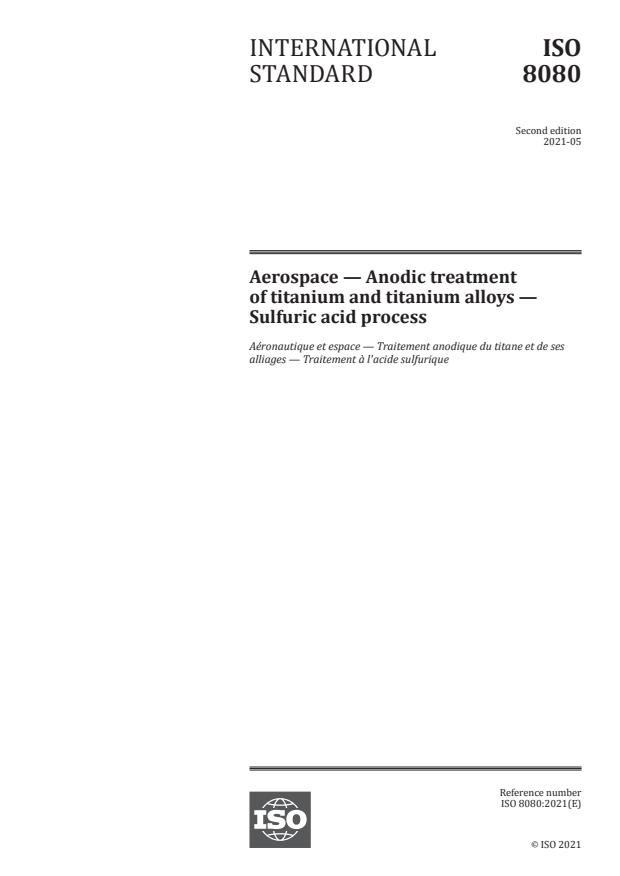
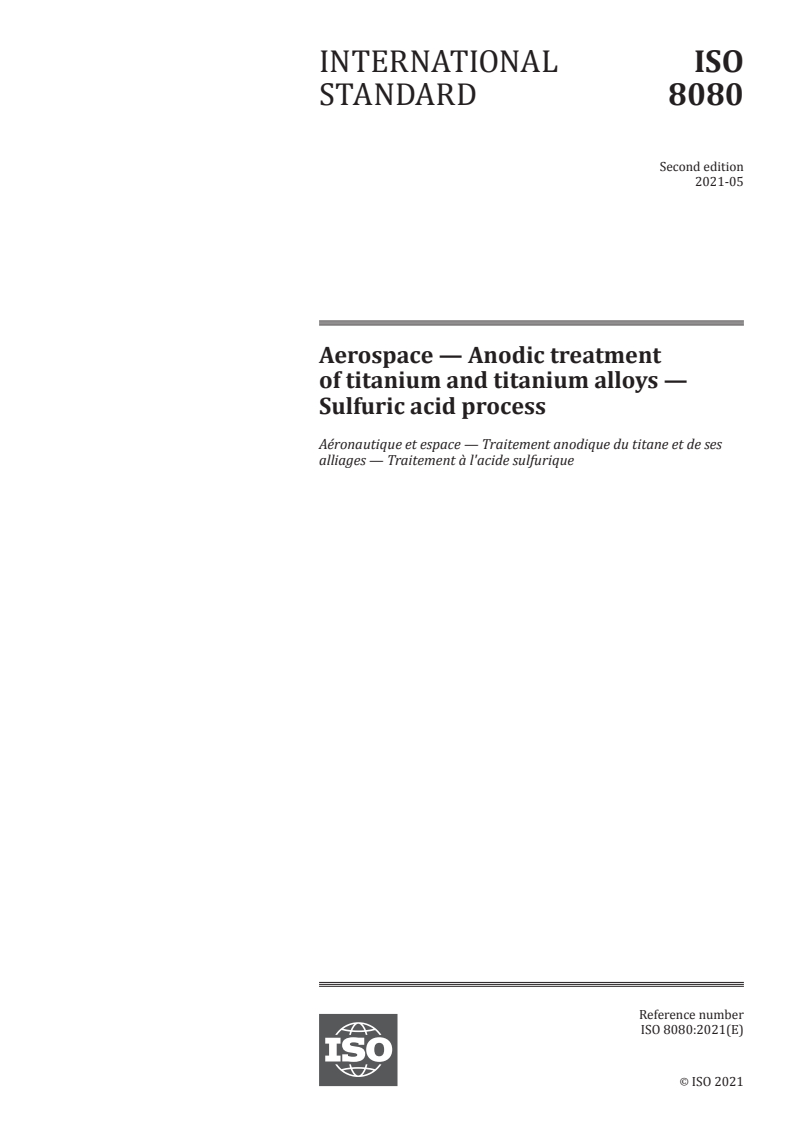
INTERNATIONAL ISO
STANDARD 8080
Second edition
2021-05
Aerospace — Anodic treatment
of titanium and titanium alloys —
Sulfuric acid process
Aéronautique et espace — Traitement anodique du titane et de ses
alliages — Traitement à l'acide sulfurique
Reference number
©
ISO 2021
© ISO 2021
All rights reserved. Unless otherwise specified, or required in the context of its implementation, no part of this publication may
be reproduced or utilized otherwise in any form or by any means, electronic or mechanical, including photocopying, or posting
on the internet or an intranet, without prior written permission. Permission can be requested from either ISO at the address
below or ISO’s member body in the country of the requester.
ISO copyright office
CP 401 • Ch. de Blandonnet 8
CH-1214 Vernier, Geneva
Phone: +41 22 749 01 11
Email: copyright@iso.org
Website: www.iso.org
Published in Switzerland
ii © ISO 2021 – All rights reserved
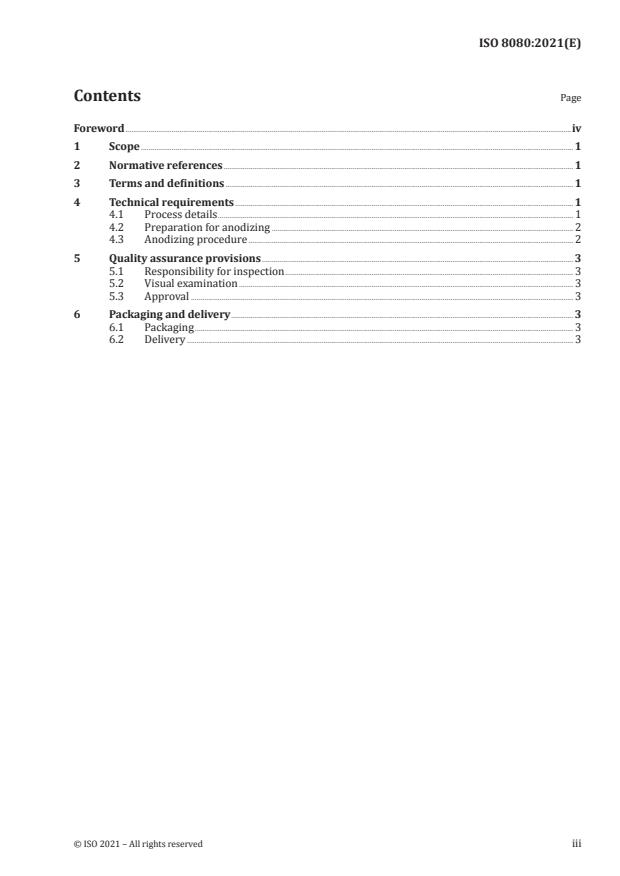
Contents Page
Foreword .iv
1 Scope . 1
2 Normative references . 1
3 Terms and definitions . 1
4 Technical requirements . 1
4.1 Process details . 1
4.2 Preparation for anodizing . 2
4.3 Anodizing procedure . 2
5 Quality assurance provisions . 3
5.1 Responsibility for inspection . 3
5.2 Visual examination . 3
5.3 Approval . 3
6 Packaging and delivery . 3
6.1 Packaging . 3
6.2 Delivery . 3
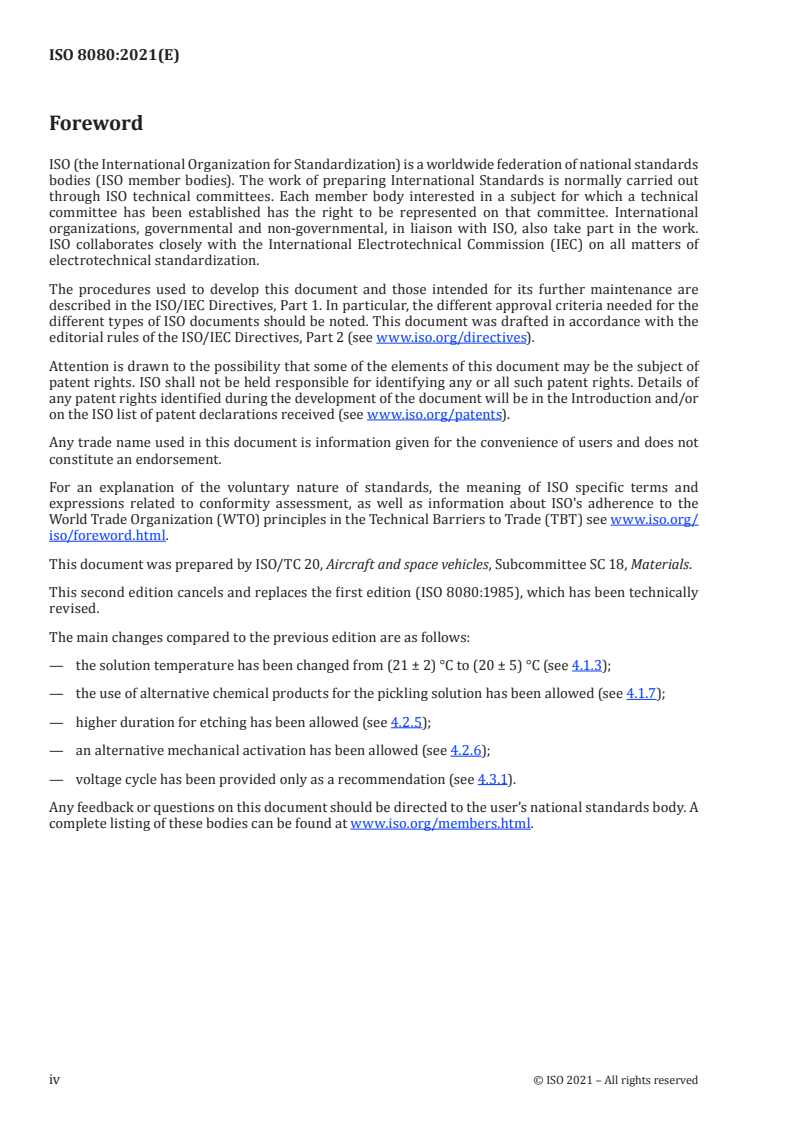
Foreword
ISO (the International Organization for Standardization) is a worldwide federation of national standards
bodies (ISO member bodies). The work of preparing International Standards is normally carried out
through ISO technical committees. Each member body interested in a subject for which a technical
committee has been established has the right to be represented on that committee. International
organizations, governmental and non-governmental, in liaison with ISO, also take part in the work.
ISO collaborates closely with the International Electrotechnical Commission (IEC) on all matters of
electrotechnical standardization.
The procedures used to develop this document and those intended for its further maintenance are
described in the ISO/IEC Directives, Part 1. In particular, the different approval criteria needed for the
different types of ISO documents should be noted. This document was drafted in accordance with the
editorial rules of the ISO/IEC Directives, Part 2 (see www .iso .org/ directives).
Attention is drawn to the possibility that some of the elements of this document may be the subject of
patent rights. ISO shall not be held responsible for identifying any or all such patent rights. Details of
any patent rights identified during the development of the document will be in the Introduction and/or
on the ISO list of patent declarations received (see www .iso .org/ patents).
Any trade name used in this document is information given for the convenience of users and does not
constitute an endorsement.
For an explanation of the voluntary nature of standards, the meaning of ISO specific terms and
expressions related to conformity assessment, as well as information about ISO's adherence to the
World Trade Organization (WTO) principles in the Technical Barriers to Trade (TBT) see www .iso .org/
iso/ foreword .html.
This document was prepared by ISO/TC 20, Aircraft and space vehicles, Subcommittee SC 18, Materials.
This second edition cancels and replaces the first edition (ISO 8080:1985), which has been technically
revised.
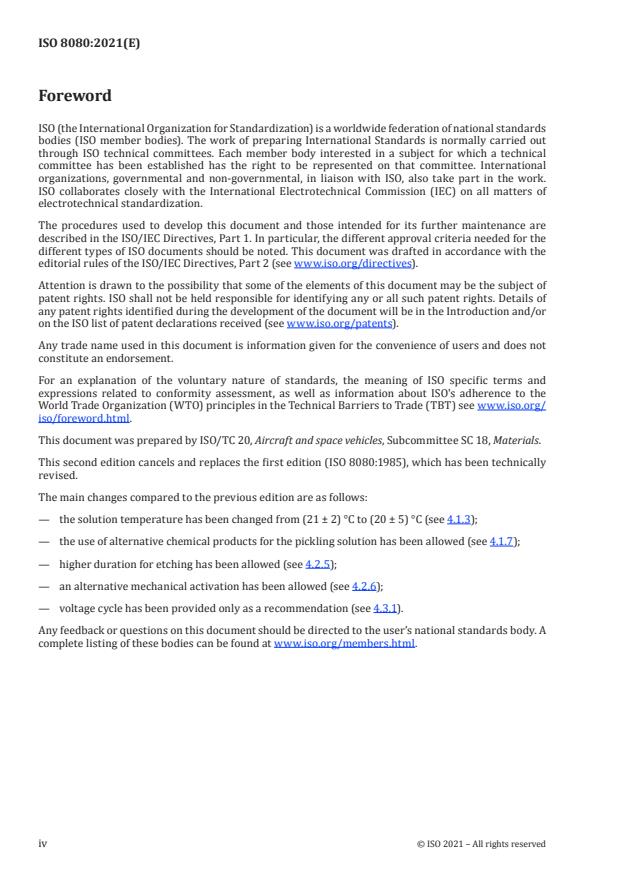
The main changes compared to the previous edition are as follows:
— the solution temperature has been changed from (21 ± 2) °C to (20 ± 5) °C (see 4.1.3);
— the use of alternative chemical products for the pickling solution has been allowed (see 4.1.7);
— higher duration for etching has been allowed (see 4.2.5);
— an alternative mechanical activation has been allowed (see 4.2.6);
— voltage cycle has been provided only as a recommendation (see 4.3.1).
Any feedback or questions on this document should be directed to the user’s national standards body. A
complete listing of these bodies can be found at www .iso .org/ members .html.
iv © ISO 2021 – All rights reserved
INTERNATIONAL STANDARD ISO 8080:2021(E)
Aerospace — Anodic treatment of titanium and titanium
alloys — Sulfuric acid process
1 Scope
This document specifies the requirements for producing and testing an unsealed anodic coating on
titanium and titanium alloys. The anodic coating is produced by the sulfuric acid process.
The coating is used with solid film lubricants for protection of titanium
...
INTERNATIONAL ISO
STANDARD 8080
Second edition
2021-05
Aerospace — Anodic treatment
of titanium and titanium alloys —
Sulfuric acid process
Aéronautique et espace — Traitement anodique du titane et de ses
alliages — Traitement à l'acide sulfurique
Reference number
©
ISO 2021
© ISO 2021
All rights reserved. Unless otherwise specified, or required in the context of its implementation, no part of this publication may
be reproduced or utilized otherwise in any form or by any means, electronic or mechanical, including photocopying, or posting
on the internet or an intranet, without prior written permission. Permission can be requested from either ISO at the address
below or ISO’s member body in the country of the requester.
ISO copyright office
CP 401 • Ch. de Blandonnet 8
CH-1214 Vernier, Geneva
Phone: +41 22 749 01 11
Email: copyright@iso.org
Website: www.iso.org
Published in Switzerland
ii © ISO 2021 – All rights reserved
Contents Page
Foreword .iv
1 Scope . 1
2 Normative references . 1
3 Terms and definitions . 1
4 Technical requirements . 1
4.1 Process details . 1
4.2 Preparation for anodizing . 2
4.3 Anodizing procedure . 2
5 Quality assurance provisions . 3
5.1 Responsibility for inspection . 3
5.2 Visual examination . 3
5.3 Approval . 3
6 Packaging and delivery . 3
6.1 Packaging . 3
6.2 Delivery . 3
Foreword
ISO (the International Organization for Standardization) is a worldwide federation of national standards
bodies (ISO member bodies). The work of preparing International Standards is normally carried out
through ISO technical committees. Each member body interested in a subject for which a technical
committee has been established has the right to be represented on that committee. International
organizations, governmental and non-governmental, in liaison with ISO, also take part in the work.
ISO collaborates closely with the International Electrotechnical Commission (IEC) on all matters of
electrotechnical standardization.
The procedures used to develop this document and those intended for its further maintenance are
described in the ISO/IEC Directives, Part 1. In particular, the different approval criteria needed for the
different types of ISO documents should be noted. This document was drafted in accordance with the
editorial rules of the ISO/IEC Directives, Part 2 (see www .iso .org/ directives).
Attention is drawn to the possibility that some of the elements of this document may be the subject of
patent rights. ISO shall not be held responsible for identifying any or all such patent rights. Details of
any patent rights identified during the development of the document will be in the Introduction and/or
on the ISO list of patent declarations received (see www .iso .org/ patents).
Any trade name used in this document is information given for the convenience of users and does not
constitute an endorsement.
For an explanation of the voluntary nature of standards, the meaning of ISO specific terms and
expressions related to conformity assessment, as well as information about ISO's adherence to the
World Trade Organization (WTO) principles in the Technical Barriers to Trade (TBT) see www .iso .org/
iso/ foreword .html.
This document was prepared by ISO/TC 20, Aircraft and space vehicles, Subcommittee SC 18, Materials.
This second edition cancels and replaces the first edition (ISO 8080:1985), which has been technically
revised.
The main changes compared to the previous edition are as follows:
— the solution temperature has been changed from (21 ± 2) °C to (20 ± 5) °C (see 4.1.3);
— the use of alternative chemical products for the pickling solution has been allowed (see 4.1.7);
— higher duration for etching has been allowed (see 4.2.5);
— an alternative mechanical activation has been allowed (see 4.2.6);
— voltage cycle has been provided only as a recommendation (see 4.3.1).
Any feedback or questions on this document should be directed to the user’s national standards body. A
complete listing of these bodies can be found at www .iso .org/ members .html.
iv © ISO 2021 – All rights reserved
INTERNATIONAL STANDARD ISO 8080:2021(E)
Aerospace — Anodic treatment of titanium and titanium
alloys — Sulfuric acid process
1 Scope
This document specifies the requirements for producing and testing an unsealed anodic coating on
titanium and titanium alloys. The anodic coating is produced by the sulfuric acid process.
The coating is used with solid film lubricants for protection of titanium
...
NORME ISO
INTERNATIONALE 8080
Deuxième édition
2021-05
Aéronautique et espace — Traitement
anodique du titane et de ses alliages
— Traitement à l'acide sulfurique
Aerospace — Anodic treatment of titanium and titanium alloys —
Sulfuric acid process
Numéro de référence
©
ISO 2021
DOCUMENT PROTÉGÉ PAR COPYRIGHT
© ISO 2021
Tous droits réservés. Sauf prescription différente ou nécessité dans le contexte de sa mise en œuvre, aucune partie de cette
publication ne peut être reproduite ni utilisée sous quelque forme que ce soit et par aucun procédé, électronique ou mécanique,
y compris la photocopie, ou la diffusion sur l’internet ou sur un intranet, sans autorisation écrite préalable. Une autorisation peut
être demandée à l’ISO à l’adresse ci-après ou au comité membre de l’ISO dans le pays du demandeur.
ISO copyright office
Case postale 401 • Ch. de Blandonnet 8
CH-1214 Vernier, Genève
Tél.: +41 22 749 01 11
E-mail: copyright@iso.org
Web: www.iso.org
Publié en Suisse
ii © ISO 2021 – Tous droits réservés
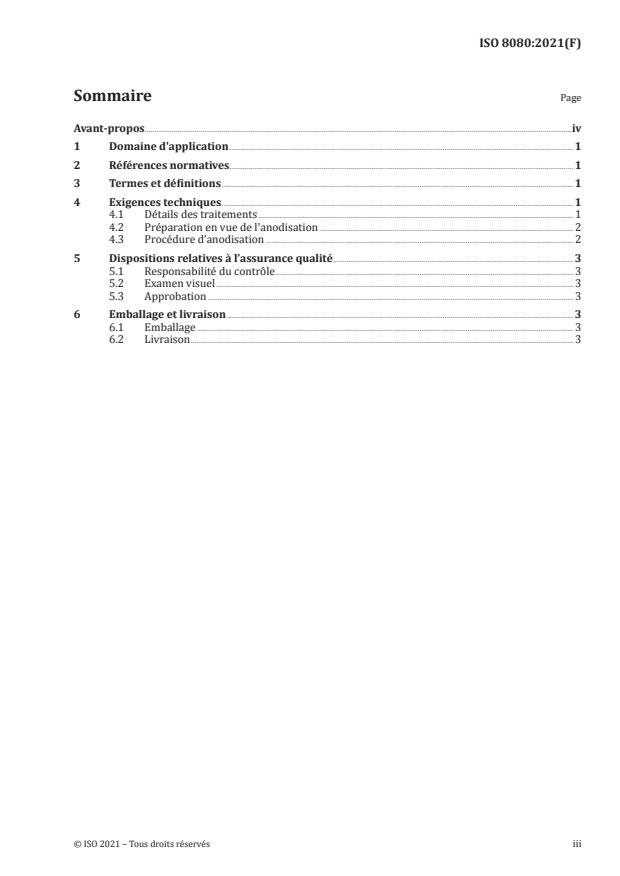
Sommaire Page
Avant-propos .iv
1 Domaine d'application . 1
2 Références normatives . 1
3 Termes et définitions . 1
4 Exigences techniques . 1
4.1 Détails des traitements . 1
4.2 Préparation en vue de l'anodisation . 2
4.3 Procédure d’anodisation . 2
5 Dispositions relatives à l’assurance qualité . 3
5.1 Responsabilité du contrôle . 3
5.2 Examen visuel . 3
5.3 Approbation . 3
6 Emballage et livraison . 3
6.1 Emballage . 3
6.2 Livraison . 3
Avant-propos
L'ISO (Organisation internationale de normalisation) est une fédération mondiale d'organismes
nationaux de normalisation (comités membres de l'ISO). L'élaboration des Normes internationales est
en général confiée aux comités techniques de l'ISO. Chaque comité membre intéressé par une étude
a le droit de faire partie du comité technique créé à cet effet. Les organisations internationales,
gouvernementales et non gouvernementales, en liaison avec l'ISO participent également aux travaux.
L'ISO collabore étroitement avec la Commission électrotechnique internationale (IEC) en ce qui
concerne la normalisation électrotechnique.
Les procédures utilisées pour élaborer le présent document et celles destinées à sa mise à jour sont
décrites dans les Directives ISO/IEC, Partie 1. Il convient, en particulier, de prendre note des différents
critères d'approbation requis pour les différents types de documents ISO. Le présent document a été
rédigé conformément aux règles de rédaction données dans les Directives ISO/IEC, Partie 2 (voir www
.iso .org/ directives).
L'attention est attirée sur le fait que certains des éléments du présent document peuvent faire l'objet de
droits de propriété intellectuelle ou de droits analogues. L'ISO ne saurait être tenue pour responsable
de ne pas avoir identifié de tels droits de propriété et averti de leur existence. Les détails concernant
les références aux droits de propriété intellectuelle ou autres droits analogues identifiés lors de
l'élaboration du document sont indiqués dans l'Introduction et/ou dans la liste des déclarations de
brevets reçues par l'ISO (voir www .iso .org/ brevets).
Les appellations commerciales éventuellement mentionnées dans le présent document sont données
pour information, par souci de commodité, à l’intention des utilisateurs et ne sauraient constituer un
engagement.
Pour une explication de la nature volontaire des normes, la signification des termes et expressions
spécifiques de l'ISO liés à l'évaluation de la conformité, ou pour toute information au sujet de l'adhésion
de l'ISO aux principes de l’Organisation mondiale du commerce (OMC) concernant les obstacles
techniques au commerce (OTC), voir www .iso .org/ avant -propos.
Le présent document a été élaboré par le comité technique ISO/TC 20, Aéronautique et espace, sous-
comité SC 18, Matériaux.
Cette deuxième édition annule et remplace la première édition (ISO 8080:1985), qui a fait l'objet d'une
révision technique.
Les principales modifications par rapport à l'édition précédente sont les suivantes :
— modification de la température de la solution de « (21 ± 2) °C » à « (20 ± 5) °C » (voir 4.1.3) ;
— autorisation d’utiliser d’autres produits chimiques pour la solution de décapage (voir 4.1.7) ;
— durée d’attaque prolongée autorisée (voir 4.2.5) ;
— activation mécanique autorisée comme alternative (voir 4.2.6) ;
— cycle de tension indiqué en tant que recommandation uniquement (voir 4.3.1).
Il convient que l’utilisateur adresse tout retour d’information ou toute question concernant le présent
document à l’organisme national de normalisation de son pays. Une liste exhaustive desdits organismes
se trouve à l’adresse www .iso .org/ fr/ members .html.
iv © ISO 2021 – Tous droits réservés
NORME INTERNATIONALE ISO 8080:2021(F)
Aéronautique et espace — Traitement anodique du titane
et de ses alliages — Traitement à l'acide sulfurique
1 Domaine d'application
Le présent document spécifie les exigences de production et d’essai d’un revêtement anodique non
colmaté du titane et de ses alliages. Le revêtement anodique est produit par le traitement à l’acide
sulfurique.
Ce revêtement est utilisé avec des lubrifiants à feuils solides pour la protection contre les éraillures des
fixations en titane, pour la protection limitée contre la corrosion galvanique des métaux moins nobles
en contact avec le titane, ou pour d’autres emplois approuvés.
2 Références normatives
Le présent document ne contient aucune référence normative.
3 Termes et déf
...
NORME ISO
INTERNATIONALE 8080
Deuxième édition
2021-05
Aéronautique et espace — Traitement
anodique du titane et de ses alliages
— Traitement à l'acide sulfurique
Aerospace — Anodic treatment of titanium and titanium alloys —
Sulfuric acid process
Numéro de référence
©
ISO 2021
DOCUMENT PROTÉGÉ PAR COPYRIGHT
© ISO 2021
Tous droits réservés. Sauf prescription différente ou nécessité dans le contexte de sa mise en œuvre, aucune partie de cette
publication ne peut être reproduite ni utilisée sous quelque forme que ce soit et par aucun procédé, électronique ou mécanique,
y compris la photocopie, ou la diffusion sur l’internet ou sur un intranet, sans autorisation écrite préalable. Une autorisation peut
être demandée à l’ISO à l’adresse ci-après ou au comité membre de l’ISO dans le pays du demandeur.
ISO copyright office
Case postale 401 • Ch. de Blandonnet 8
CH-1214 Vernier, Genève
Tél.: +41 22 749 01 11
E-mail: copyright@iso.org
Web: www.iso.org
Publié en Suisse
ii © ISO 2021 – Tous droits réservés
Sommaire Page
Avant-propos .iv
1 Domaine d'application . 1
2 Références normatives . 1
3 Termes et définitions . 1
4 Exigences techniques . 1
4.1 Détails des traitements . 1
4.2 Préparation en vue de l'anodisation . 2
4.3 Procédure d’anodisation . 2
5 Dispositions relatives à l’assurance qualité . 3
5.1 Responsabilité du contrôle . 3
5.2 Examen visuel . 3
5.3 Approbation . 3
6 Emballage et livraison . 3
6.1 Emballage . 3
6.2 Livraison . 3
Avant-propos
L'ISO (Organisation internationale de normalisation) est une fédération mondiale d'organismes
nationaux de normalisation (comités membres de l'ISO). L'élaboration des Normes internationales est
en général confiée aux comités techniques de l'ISO. Chaque comité membre intéressé par une étude
a le droit de faire partie du comité technique créé à cet effet. Les organisations internationales,
gouvernementales et non gouvernementales, en liaison avec l'ISO participent également aux travaux.
L'ISO collabore étroitement avec la Commission électrotechnique internationale (IEC) en ce qui
concerne la normalisation électrotechnique.
Les procédures utilisées pour élaborer le présent document et celles destinées à sa mise à jour sont
décrites dans les Directives ISO/IEC, Partie 1. Il convient, en particulier, de prendre note des différents
critères d'approbation requis pour les différents types de documents ISO. Le présent document a été
rédigé conformément aux règles de rédaction données dans les Directives ISO/IEC, Partie 2 (voir www
.iso .org/ directives).
L'attention est attirée sur le fait que certains des éléments du présent document peuvent faire l'objet de
droits de propriété intellectuelle ou de droits analogues. L'ISO ne saurait être tenue pour responsable
de ne pas avoir identifié de tels droits de propriété et averti de leur existence. Les détails concernant
les références aux droits de propriété intellectuelle ou autres droits analogues identifiés lors de
l'élaboration du document sont indiqués dans l'Introduction et/ou dans la liste des déclarations de
brevets reçues par l'ISO (voir www .iso .org/ brevets).
Les appellations commerciales éventuellement mentionnées dans le présent document sont données
pour information, par souci de commodité, à l’intention des utilisateurs et ne sauraient constituer un
engagement.
Pour une explication de la nature volontaire des normes, la signification des termes et expressions
spécifiques de l'ISO liés à l'évaluation de la conformité, ou pour toute information au sujet de l'adhésion
de l'ISO aux principes de l’Organisation mondiale du commerce (OMC) concernant les obstacles
techniques au commerce (OTC), voir www .iso .org/ avant -propos.
Le présent document a été élaboré par le comité technique ISO/TC 20, Aéronautique et espace, sous-
comité SC 18, Matériaux.
Cette deuxième édition annule et remplace la première édition (ISO 8080:1985), qui a fait l'objet d'une
révision technique.
Les principales modifications par rapport à l'édition précédente sont les suivantes :
— modification de la température de la solution de « (21 ± 2) °C » à « (20 ± 5) °C » (voir 4.1.3) ;
— autorisation d’utiliser d’autres produits chimiques pour la solution de décapage (voir 4.1.7) ;
— durée d’attaque prolongée autorisée (voir 4.2.5) ;
— activation mécanique autorisée comme alternative (voir 4.2.6) ;
— cycle de tension indiqué en tant que recommandation uniquement (voir 4.3.1).
Il convient que l’utilisateur adresse tout retour d’information ou toute question concernant le présent
document à l’organisme national de normalisation de son pays. Une liste exhaustive desdits organismes
se trouve à l’adresse www .iso .org/ fr/ members .html.
iv © ISO 2021 – Tous droits réservés
NORME INTERNATIONALE ISO 8080:2021(F)
Aéronautique et espace — Traitement anodique du titane
et de ses alliages — Traitement à l'acide sulfurique
1 Domaine d'application
Le présent document spécifie les exigences de production et d’essai d’un revêtement anodique non
colmaté du titane et de ses alliages. Le revêtement anodique est produit par le traitement à l’acide
sulfurique.
Ce revêtement est utilisé avec des lubrifiants à feuils solides pour la protection contre les éraillures des
fixations en titane, pour la protection limitée contre la corrosion galvanique des métaux moins nobles
en contact avec le titane, ou pour d’autres emplois approuvés.
2 Références normatives
Le présent document ne contient aucune référence normative.
3 Termes et déf
...