

ISO 16446:2013
(Main)Ships and marine technology — Marine environment protection — Adapter for joining dissimilar boom connectors
General Information
- Abstract
ISO 16446:2013 specifies a universal method for the joining of oil spill containment booms with dissimilar connectors through the use of a standard adaptor with prescribed mating specifications. ISO 16446:2013 does not intend to replace the design of existing connectors. ISO 16446:2013 does not purport to address all of the safety concerns, if any, associated with its use. It is the responsibility of the user of ISO 16446:2013 to establish appropriate safety and health practices and determine the applicability of regulatory limitations prior to use.
- Status
- Published
- Publication Date
- 20-Mar-2013
- Technical Committee
- ISO/TC 8/SC 2 - Marine environment protection
- Drafting Committee
- ISO/TC 8/SC 2/WG 3 - Environmental response
- Current Stage
- 9093 - International Standard confirmed
- Start Date
- 13-Dec-2023
- Completion Date
- 29-Aug-2026
Buy Documents
ISO 16446:2013 - Ships and marine technology — Marine environment protection — Adapter for joining dissimilar boom connectors Released:3/21/2013
ISO 16446:2013 - Ships and marine technology — Marine environment protection — Adapter for joining dissimilar boom connectors Released:7/27/2015
Overview
ISO 16446:2013 - Ships and marine technology: Adapter for joining dissimilar boom connectors - specifies a universal method for connecting oil‑spill containment booms that have different end connectors. The standard defines a standard adapter with prescribed mating specifications to enable interoperable joining of boom sections during spill response without replacing existing connector designs. It also clarifies user responsibility for safety practices and regulatory compliance.
Key topics and technical requirements
- Purpose: Enable safe, reliable joining of booms with dissimilar connectors during emergency oil‑spill operations.
- Adapter design: Encourages use of a separate flat‑plate adapter that mates to an existing connector on one side and provides a standard mating face on the other. Incorporation of mating features into existing connectors is allowed only if strength/performance are not compromised.
- Bolt and hole specifications: Adapter mating face must have a minimum of three 16 mm holes for 12 mm (1/2 in) diameter bolts (example material: AISI 316 stainless steel). Hole centre locations (relative to the boom waterline):
- 1st hole: 120 mm above waterline (accessibility/minimise leakage)
- 2nd hole: 240 mm below the 1st hole centre
- 3rd hole: 300 mm below the 1st hole centre
- Additional holes for larger adapters at 300 mm increments (distance measured from the first hole centre to avoid tolerance accumulation).
- Mating area constraints: Mating surface must be flat, clear of interference, not exceed 25 mm from hole centres to the outer edge and have minimum 26 mm inset from the hole centres.
- Assembly hardware & retention: Bolts, washers and self‑locking nuts should be supplied and retained on the adapter by chain or wire to avoid loss.
- Functional and operational considerations: Connectors must be strong enough for boom loads, avoid oil leakage, be easy to connect/disconnect in presence of oil/dirt/ice and resist distortion (e.g., when wound on reels). Tensile strength and compatibility with boom tension members and materials must be respected.
- Safety note: ISO 16446:2013 does not address all safety concerns - users must establish appropriate safety and health practices.
Applications and users
- Primary use: oil spill response operations where multiple operators, agencies or inventories of booms must be joined quickly in the field.
- Typical users: spill response teams, boom manufacturers, marine environmental protection agencies, port authorities, offshore operators, and procurement/specification engineers.
- Practical benefits: rapid interoperability of containment booms, reduced need to modify existing connectors, and improved coordination during multi‑party spill incidents.
Related standards
- ASTM F1657 - provides a similar approach for joining existing boom connectors (ISO 16446 incorporates the essence of ASTM F1657).
- ASTM F962 - earlier mating geometry standard referenced in historical discussions; ISO 16446 adopts a more field‑practical approach.
Keywords: ISO 16446:2013, marine environment protection, adapter for joining dissimilar boom connectors, oil spill containment, boom connectors, AISI 316 stainless steel, mating specifications, spill response.
Relations
- Effective Date
- 16-Jul-2011
Buy Documents
ISO 16446:2013 - Ships and marine technology — Marine environment protection — Adapter for joining dissimilar boom connectors Released:3/21/2013
ISO 16446:2013 - Ships and marine technology — Marine environment protection — Adapter for joining dissimilar boom connectors Released:7/27/2015
Get Certified
Connect with accredited certification bodies for this standard

BSI Group
BSI (British Standards Institution) is the business standards company that helps organizations make excellence a habit.

Bureau Veritas
Bureau Veritas is a world leader in laboratory testing, inspection and certification services.

DNV
DNV is an independent assurance and risk management provider.
Sponsored listings
Frequently Asked Questions
ISO 16446:2013 is a standard published by the International Organization for Standardization (ISO). Its full title is "Ships and marine technology — Marine environment protection — Adapter for joining dissimilar boom connectors". This standard covers: ISO 16446:2013 specifies a universal method for the joining of oil spill containment booms with dissimilar connectors through the use of a standard adaptor with prescribed mating specifications. ISO 16446:2013 does not intend to replace the design of existing connectors. ISO 16446:2013 does not purport to address all of the safety concerns, if any, associated with its use. It is the responsibility of the user of ISO 16446:2013 to establish appropriate safety and health practices and determine the applicability of regulatory limitations prior to use.
ISO 16446:2013 specifies a universal method for the joining of oil spill containment booms with dissimilar connectors through the use of a standard adaptor with prescribed mating specifications. ISO 16446:2013 does not intend to replace the design of existing connectors. ISO 16446:2013 does not purport to address all of the safety concerns, if any, associated with its use. It is the responsibility of the user of ISO 16446:2013 to establish appropriate safety and health practices and determine the applicability of regulatory limitations prior to use.
ISO 16446:2013 is classified under the following ICS (International Classification for Standards) categories: 13.020.40 - Pollution, pollution control and conservation. The ICS classification helps identify the subject area and facilitates finding related standards.
ISO 16446:2013 has the following relationships with other standards: It is inter standard links to ISO 16446:2002. Understanding these relationships helps ensure you are using the most current and applicable version of the standard.
ISO 16446:2013 is available in PDF format for immediate download after purchase. The document can be added to your cart and obtained through the secure checkout process. Digital delivery ensures instant access to the complete standard document.
Standards Content (Sample)
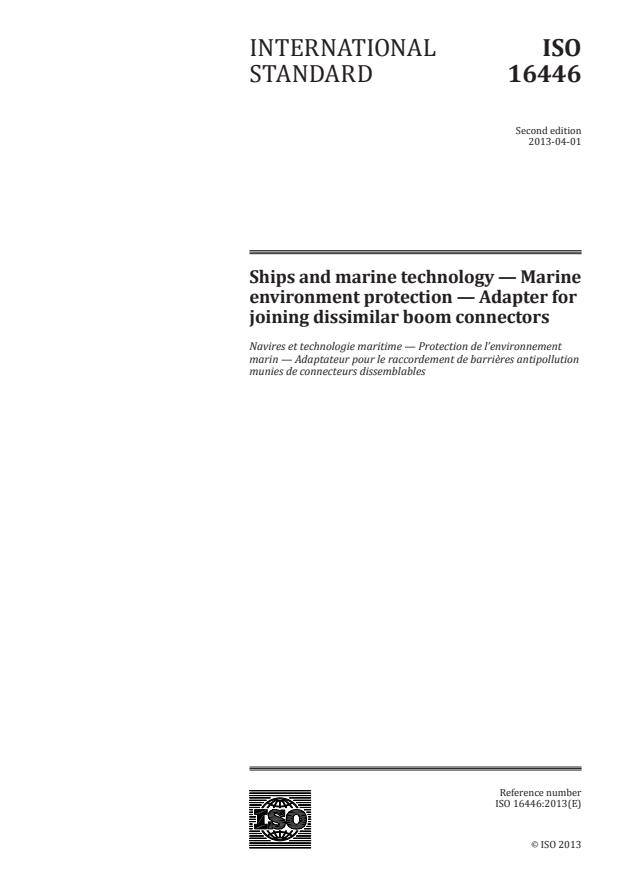
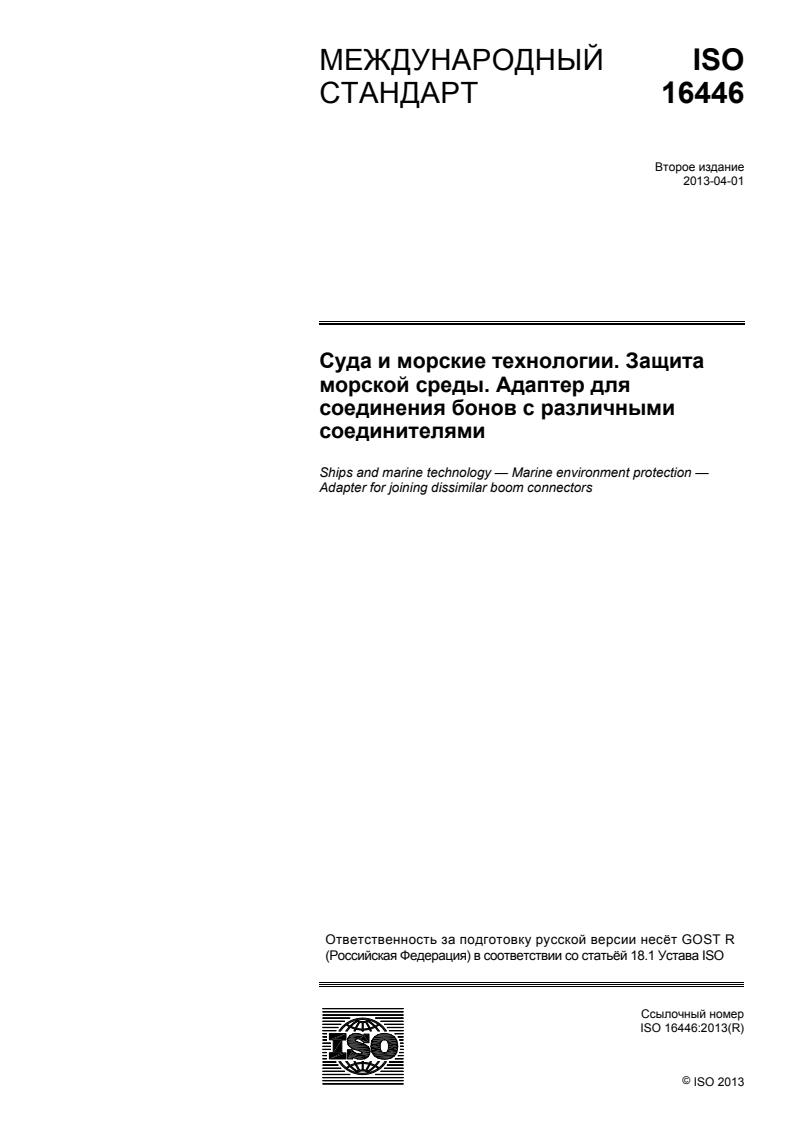
INTERNATIONAL ISO
STANDARD 16446
Second edition
2013-04-01
Ships and marine technology — Marine
environment protection — Adapter for
joining dissimilar boom connectors
Navires et technologie maritime — Protection de l’environnement
marin — Adaptateur pour le raccordement de barrières antipollution
munies de connecteurs dissemblables
Reference number
©
ISO 2013
© ISO 2013
All rights reserved. Unless otherwise specified, no part of this publication may be reproduced or utilized otherwise in any form
or by any means, electronic or mechanical, including photocopying, or posting on the internet or an intranet, without prior
written permission. Permission can be requested from either ISO at the address below or ISO’s member body in the country of
the requester.
ISO copyright office
Case postale 56 • CH-1211 Geneva 20
Tel. + 41 22 749 01 11
Fax + 41 22 749 09 47
E-mail copyright@iso.org
Web www.iso.org
Published in Switzerland
ii © ISO 2013 – All rights reserved
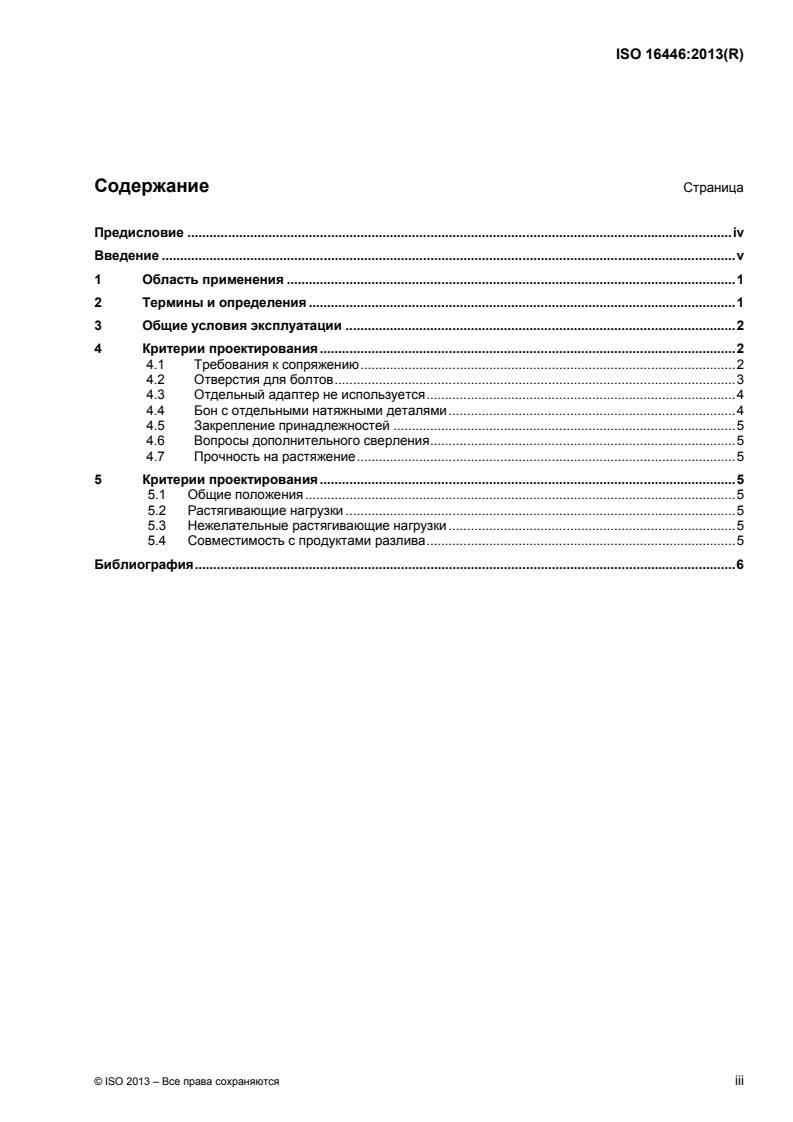
Contents Page
Foreword .iv
Introduction .v
1 Scope . 1
2 Terms and definitions . 1
3 General functional conditions . 1
4 Design criteria . 2
4.1 Mating requirements . 2
4.2 Bolt holes . 2
4.3 Separate adapter not used . 4
4.4 Boom with separate tension members . 4
4.5 Securing of material. 4
4.6 Additional drilling considerations . 5
4.7 Tensile strength . 5
5 Operational considerations . 5
5.1 General . 5
5.2 Tensile loads . 5
5.3 Unwanted tensile loads. 5
5.4 Compatibility with spill material . 5
Bibliography . 6
Foreword
ISO (the International Organization for Standardization) is a worldwide federation of national standards
bodies (ISO member bodies). The work of preparing International Standards is normally carried out
through ISO technical committees. Each member body interested in a subject for which a technical
committee has been established has the right to be represented on that committee. International
organizations, governmental and non-governmental, in liaison with ISO, also take part in the work.
ISO collaborates closely with the International Electrotechnical Commission (IEC) on all matters of
electrotechnical standardization.
The procedures used to develop this document and those intended for its further maintenance are
described in the ISO/IEC Directives, Part 1. In particular the different approval criteria needed for the
different types of ISO documents should be noted. This document was drafted in accordance with the
editorial rules of the ISO/IEC Directives, Part 2. www.iso.org/directives
Attention is drawn to the possibility that some of the elements of this document may be the subject of
patent rights. ISO shall not be held responsible for identifying any or all such patent rights. Details of any
patent rights identified during the development of the document will be in the Introduction and/or on
the ISO list of patent declarations received. www.iso.org/patents
Any trade name used in this document is information given for the convenience of users and does not
constitute an endorsement.
The committee responsible for this document is ISO/TC 8, Ships and marine technology, SC 2, Marine
environment protection.
This second edition cancels and replaces the first edition (ISO 16446:2002) which has been
technically revised.
iv © ISO 2013 – All rights reserved
Introduction
Historically, different types of boom end connectors have been produced. This International Standard
addresses the need to connect booms having dissimilar connectors during oil spill incidents where
various operators may join forces to combat an oil spill or where normally incompatible boom stock
must be used together.
The American Society for Testing and Materials (ASTM) Committee F-20 (Hazardous Substances and
Oil Spill Response) has been preparing standards on related subjects for years. This organization has
prepared two standards relating to boom connectors, namely ASTM F962-99 and ASTM F1657-96.
The first of these standards, ASTM F962, specifies standard mating requirements, or geometry, for
boom connectors or adaptors. ASTM F962 was never widely accepted in the international community
because many users believe that this mating geometry has inherent design limitations. In particular, the
required strict tolerance between mating faces of the two joining connectors can result in connection
problems. Some reported concerns or deficiencies with boom connector designs that use the ASTM F962
mating specifications are as follows:
— Slight bending along the length of the connector can easily occur during operation or, in particular,
during roll-up or storage on the boom reel, resulting in the inability to join them together again;
— The design is more susceptible to experiencing difficulties joining connector ends if the connector
face has been dented or marred through impact;
— Dirt and debris can be trapped on a mating surface, preventing proper fitting and connection, or
requiring careful cleaning of the connectors;
— During cold weather operations, ice can form at the mating faces, making connection difficult or
impossible; and
— The connection is not always secure. The use of a self-locking pin has occasionally resulted in
excessive play in the connection and eventual release.
With respect to permanently incorporating a universal requirement or standard connector in all boom
systems (instead of using an adaptor only when required), discussions with spill response operators and
oil boom producers clearly indicate that, in many cases, this will not provide an appropriate or realistic
standard practice. Booms and connectors are often designed or selected by an operator based on the
needs that are suitable for their particular operating conditions. Also, producers choose connectors
based on the needs of the particular boom design. In effect, many users think it is unlikely that any
single standard connector mating criteria (as, for example, ASTM F962) will provide the characteristics
to satisfy the specific requirements of all users.
The second of these standards, ASTM F1657, was subsequently developed to provide another approach
to oil boom connectors. Instead of providing a standard connector design, it provides a common method
for joining existing booms with different connector designs in the field during a major spill incident.
This standard does not attempt to have all manufacturers and spill responders use universal connectors
at all times. Instead, it specifies modifications on existing connectors in the way of incorporating holes
at specified locations to allow for this standard connection method during major response incidents.
Alternatively, boom manufacturers may provide an adaptor that would accomplish the same end result.
After considering these existing ASTM standards and discussions with individuals involved in the
development of these standards, i.e. spill responders and boom producers, this International Standard
was developed to use the same mating specifications as in ASTM F1657. However, this International
Standard encourages the use of separate adaptors in most cases, to avoid the possible adverse effects
of modifications to existing connector designs when incorporating these mating specifications. These
mating specifications may be incorporated into existing connectors, if preferred and possible, only when
the manufacturer or user can ensure that the modifications will not alter the strength and performance
of the connector.
...
МЕЖДУНАРОДНЫЙ ISO
СТАНДАРТ 16446
Второе издание
2013-04-01
Суда и морские технологии. Защита
морской среды. Адаптер для
соединения бонов с различными
соединителями
Ships and marine technology — Marine environment protection —
Adapter for joining dissimilar boom connectors
Ответственность за подготовку русской версии несёт GOST R
(Российская Федерация) в соответствии со статьёй 18.1 Устава ISO
Ссылочный номер
©
ISO 2013
ДОКУМЕНТ ЗАЩИЩЕН АВТОРСКИМ ПРАВОМ
© ISO 2013
Все права сохраняются. Если не указано иное, никакую часть настоящей публикации нельзя копировать или использовать в
какой-либо форме или каким-либо электронным или механическим способом, включая фотокопии и микрофильмы, без
предварительного письменного согласия ISO по соответствующему адресу, указанному ниже, или комитета-члена ISO в стране
заявителя.
ISO copyright office
Case postale 56 • CH-1211 Geneva 20
Tel. + 41 22 749 01 11
Fax + 41 22 749 09 47
E-mail copyright@iso.org
Web www.iso.org
Опубликовано в Швейцарии
ii © ISO 2013 – Все права сохраняются
Содержание Страница
Предисловие .iv
Введение .v
1 Область применения .1
2 Термины и определения .1
3 Общие условия эксплуатации .2
4 Критерии проектирования .2
4.1 Требования к сопряжению.2
4.2 Отверстия для болтов.3
4.3 Отдельный адаптер не используется.4
4.4 Бон с отдельными натяжными деталями.4
4.5 Закрепление принадлежностей .5
4.6 Вопросы дополнительного сверления.5
4.7 Прочность на растяжение.5
5 Критерии проектирования .5
5.1 Общие положения .5
5.2 Растягивающие нагрузки .5
5.3 Нежелательные растягивающие нагрузки .5
5.4 Совместимость с продуктами разлива.5
Библиография.6
Предисловие
Международная организация по стандартизации (ISO) является всемирной федерацией национальных
организаций по стандартизации (комитетов-членов ISO). Разработка международных стандартов
обычно осуществляется техническими комитетами ISO. Каждый комитет-член, заинтересованный в
деятельности, для которой был создан технический комитет, имеет право быть представленным в этом
комитете. Международные правительственные и неправительственные организации, имеющие связи с
ISO, также принимают участие в работах. Что касается стандартизации в области электротехники, ISO
работает в тесном сотрудничестве с Международной электротехнической комиссией (IEC).
Процедуры, используемые для разработки настоящего документа и предназначенные для его
дальнейшего поддержания, указаны Директивах ISO/IEC, Часть 1. В особенности следует отметить,
что для различных типов документов ISO необходимы разные критерии для утверждения. Настоящий
документ был разработан в соответствии с редакционными правилами Директив ISO/IEC,
Часть 2. www.iso.org/directives
Обращается внимание на возможность патентования некоторых элементов данного международного
стандарта. ISO не несет ответственности за идентификацию какого-либо или всех таких патентных
прав. Детали любых патентных прав, идентифицированных при разработке документа, должны
содержаться во Введении и/или в перечне полученных патентов ISO. www.iso.org/patents
Любое фирменное наименование в настоящем документе является информацией, предоставляемой
для удобства пользователей, и не носит рекомендательный характер.
За настоящий документ несет ответственность Технический комитет ISO/TC 8, Суда и морские
технологии, SC 2, Охрана морской окружающей среды.
Настоящее второе издание отменяет и заменяет первое издание (ISO 16446:2002), которое было
технически переработано.
iv © ISO 2013 – Все права сохраняются
Введение
Исторически производятся различные типы оконечных соединителей для бонов. Настоящий
международный стандарт разработан в связи с необходимостью соединять боновые заграждения,
имеющие разные соединители, в случае аварийного разлива нефти, когда несколько участников
борьбы с разливом могут объединить свои действия для его ликвидации, или когда обычно
несовместимые боны должны использоваться вместе.
Американское общество по испытанию материалов (ASTM) Комитет F-20 (Опасные вещества и
ликвидация аварийных разливов нефти) в течение нескольких лет разрабатывает стандарты по
имеющим отношение к данной теме предметам. Эта организация подготовила два стандарта по
боновым соединителям, а именно ASTM F962-99 и ASTM F1657-96.
Первый из этих стандартов, ASTM F962, устанавливает стандартные требования к геометрии
соединения для боновых соединителей или адаптеров. ASTM F962 никогда не был широко признан
международным сообществом, поскольку многие пользователи считают, что геометрия соединения
имеет собственные проектные ограничения. В частности, требуемый строгий допуск между
сопрягающимися поверхностями двух стыкуемых соединителей может привести к проблемам с
присоединением. Некоторые выявленные проблемы или недостатки, касающиеся конструкций боновых
соединителей, отвечающих техническим требованиям ASTM F962 к геометрии соединения, состоят в
следующем:
— В процессе эксплуатации бонов или, особенно, в процессе их сворачивания или хранения на
боновой катушке по длине соединителей может беспрепятственно возникнуть незначительный
изгиб, что делает невозможным их дальнейшее совместное использование;
— Конструкция обуславливает более вероятное возникновение трудностей сопряжения оконечностей
соединителя, если поверхность соединителя получила вмятины или царапины в результате удара;
— На сопрягаемой поверхности могут накапливаться грязь и мусор, что препятствует надлежащей
установке и соединению или требует тщательной очистки соединителей;
— При эксплуатации в холодную погоду на сопрягаемых поверхностях может образовываться лед,
что затрудняет соединение или делает его невозможным; и
— Соединение не всегда надежно. Использование самозажимного фиксатора иногда приводит к
избыточному люфту в соединении и возможному разъединению.
Что касается постоянного использования универсальных требований или стандартного соединителя во
всех боновых системах (вместо использования адаптера только в случае необходимости), дискуссии с
работниками, занятыми ликвидацией разливов нефти, и производителями боновых заграждений ясно
показывают, что во многих случаях это не обеспечивает надлежащую реальную стандартную практику.
Боны и соединители часто проектируются или выбираются потребителем, исходя из потребностей,
соответствующих данным конкретным условиям эксплуатации. Также производители выбирают
соединители, исходя из конкретной конструкции бона. Фактически, многие пользователи считают
маловероятным, что какой-либо единичный стандарт сопряжения соединителей (как, например,
ASTM F962) обеспечит характеристики, удовлетворяющие специфические требования всех
пользователей.
Второй из этих стандартов, ASTM F1657, был разработан позже, чтобы предоставить иной подход к
использованию соединителей боновых заграждений. Вместо стандартной конструкции соединителя он
предоставляет общий способ соединения существующих бонов с различными конструкциями
соединителей на месте серьезного разлива нефти. Этот стандарт не предусматривает обязательное
использование все время всеми производителями и пользователями универсальных соединителей.
Вместо этого он устанавливает модификации существующих соединителей в плане совпадения
отверстий на определенных позициях, чтобы сделать возможным такой стандартный метод
соединения на местах серьезных разливов нефти. Альтернативно, производители бонов могут
предоставлять адаптеры, которые обеспечат аналогичное соединения.
После рассмотрения этих существующих стандартов ASTM и обсуждений с участвующими в их
разработке, т.е. ликвидаторами разливов и производителями боновых заграждений, был разработан
настоящий международный стандарт для использования тех же технических условий соединения, что
и в стандарте ASTM F1657. Однако, настоящий международный стандарт поощряет использование в
большинстве случаев отдельных адаптеров, чтобы избежать возможных неблагоприятных
воздействий модификаций на существующие конструкции соединителей при применении этих
технических условий соединения. Эти технические условия могут быть применены для существующих
соединителей, если это возможно и предпочтительно, только когда производитель или пользователь
могут гарантировать, что модификации не изменят прочность и технические характеристики
соединителя.
Настоящий международный стандарт содержит основные положения ASTM F1657 с изменениями и
дополнениями, включенными в некоторые разделы.
vi © ISO 2013 – Все права сохраняются
МЕЖДУНАРОДНЫЙ СТАНДАРТ ISO 16446:2013(R)
Суда и морские технологии. Защита морской среды.
Адаптер для соединения бонов с различными
соединителями
1 Область применения
Настоящий международный стандарт устанавливает универсальный метод соединения локализующих
разлив нефти бонов с различными соединителями, предусматривающий использование стандартного
адаптера с установленными характеристиками сопряжения. Настоящий международный стандарт не
имеет целью замену конструкций существующих соединителей.
Настоящий международный стандарт не предназначен для рассмотрения всех вопросов безопасности,
которые могут возникнуть при его применении. Пользователь настоящего международного стандарта
...