

ISO/TR 37115-1:2026
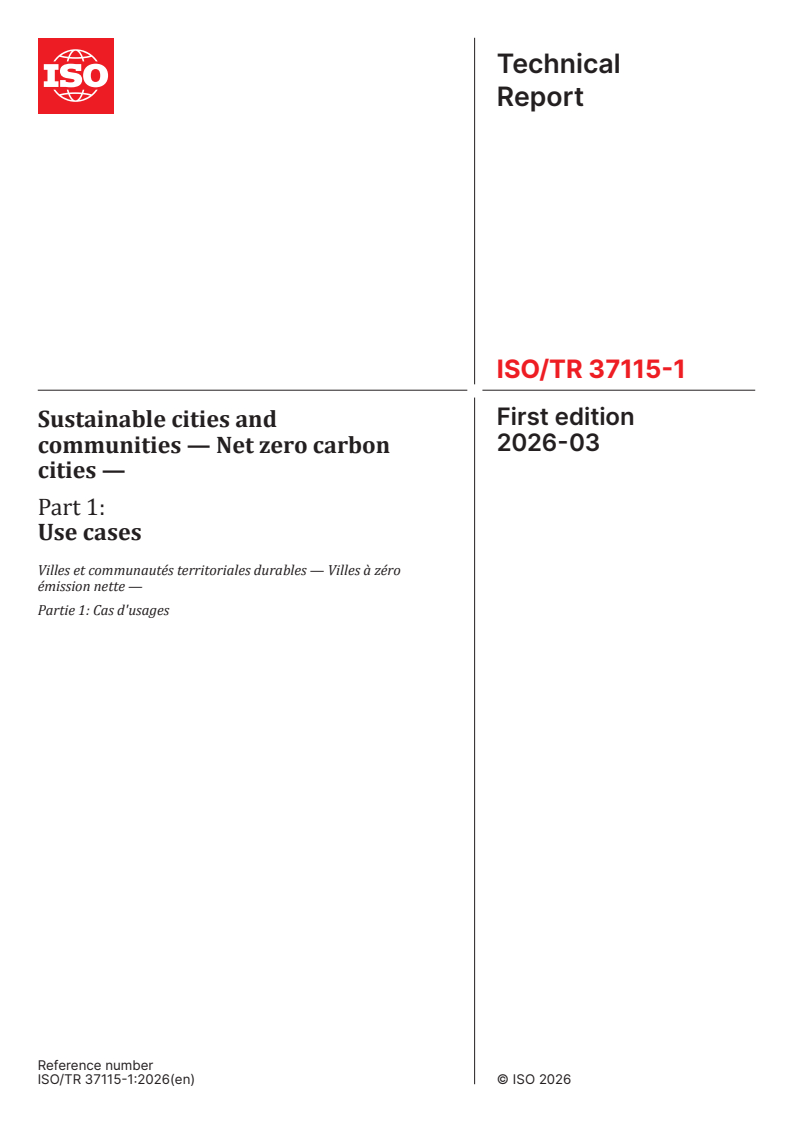
(Main)Sustainable cities and communities — Net zero carbon cities — Part 1: Use cases
General Information
- Abstract
This document provides use cases on the practices of global cities and communities, including policies, supporting techniques and tools, and management approaches that drive towards achieving lower greenhouse gas (GHG) emissions for cities and communities as a key step towards net zero carbon cities in response to climate change and global carbon neutrality. This document takes into account varying contexts including climate conditions, scale, available resources or economic structures in these practices. This document is in line with the sustainability purposes and issues provided in ISO 37101 that are relevant to GHG emissions.
- Status
- Published
- Publication Date
- 16-Mar-2026
- Technical Committee
- ISO/TC 268 - Sustainable cities and communities
- Drafting Committee
- ISO/TC 268 - Sustainable cities and communities
- Current Stage
- 6060 - International Standard published
- Start Date
- 17-Mar-2026
- Completion Date
- 17-Mar-2026


Overview
ISO/TR 37115-1:2026 is a technical report developed by the International Organization for Standardization (ISO) under the series for sustainable cities and communities. Titled Sustainable cities and communities - Net zero carbon cities - Part 1: Use cases, this document presents practical use cases of cities and communities worldwide that are implementing policies, supporting techniques, management approaches, and tools aimed at reducing greenhouse gas (GHG) emissions. Achieving low-carbon and ultimately net zero carbon cities is positioned as a pivotal response to climate change and supports global carbon neutrality objectives.
This technical report considers the diverse contexts in which these practices are applied, including varying climates, economic structures, resources, and urban scales. It aligns its approach with ISO 37101, which outlines sustainability issues relevant to GHG emissions for communities.
Key Topics
Global Framework for Net Zero Carbon Cities: The document defines key terms such as "net zero" and "carbon neutrality" and discusses their significance for city-level climate action.
Ten Themes for Net Zero Practice: Use cases are systematically grouped under ten themes that reflect the major domains of urban GHG emissions:
- Governance and regional coordination
- Local actors and citizen participation
- Industry and sustainable production
- Energy
- Construction
- Transportation
- Agriculture, forestry, and other land uses (AFOLU)
- Circularity
- Living and working environment
- Other (including innovation, education, and international cooperation)
Sectoral Focus: The standard’s framework is grounded in globally recognized GHG sources such as energy, industry, transport, construction, agriculture, and waste.
Diverse Global Case Studies: Use cases are drawn from more than eleven countries and three continents, reflecting a variety of urban scales and developmental contexts. Each case provides an overview, objectives, measures, technologies, results, and lessons learned.
Applications
The practical value of ISO/TR 37115-1:2026 lies in its role as a reference and learning tool for cities, communities, policymakers, and practitioners:
- Policy Development: Municipalities and authorities can leverage the documented practices and management frameworks to guide the formation and implementation of GHG reduction policies and action plans.
- Strategic Planning: Planners and sustainability professionals can refer to the ten theme-based use cases for tailored strategies appropriate to their specific urban context and sectoral priorities.
- Technology Adoption: The report highlights the application of renewable energy, green construction, advanced public transportation, digitalization, and low-carbon lifestyle incentives, serving as a guide for incorporating technological innovation.
- Stakeholder Engagement: By featuring successful public-private partnerships and community-driven initiatives, it demonstrates methods for fostering public participation and building broad-based support.
- Capacity Building: Education, awareness-raising, and skills development are recognized as essential in enabling a holistic transition towards net zero.
Related Standards
For a comprehensive climate action and GHG reduction strategy, ISO/TR 37115-1:2026 should be used alongside the following related standards:
- ISO 37101: Sustainable development in communities - Management system for sustainable development - Requirements with guidance for use
- ISO 37100: Sustainable cities and communities - Vocabulary
- ISO 14068-1: Climate change management - Transition to net zero - Part 1: Carbon neutrality
- IWA 42: Net zero guidelines (International Workshop Agreement providing high-level framework for net zero)
- ISO 14064-1, ISO/TS 14092: Standards for GHG quantification, reporting, and mitigation at organizational and project levels
These documents collectively provide terminology, frameworks, and methodologies essential for supporting cities in their transition to net zero carbon and in addressing the sustainable development goals related to climate action.
Conclusion:
ISO/TR 37115-1:2026 is a strategic resource for cities and communities globally striving for net zero carbon status. It delivers tested, real-world use cases and a structured thematic approach, encouraging knowledge sharing and the scalable deployment of climate solutions tailored to diverse urban realities.
Get Certified
Connect with accredited certification bodies for this standard

BSI Group
BSI (British Standards Institution) is the business standards company that helps organizations make excellence a habit.

Bureau Veritas
Bureau Veritas is a world leader in laboratory testing, inspection and certification services.

DNV
DNV is an independent assurance and risk management provider.
Sponsored listings
Frequently Asked Questions
ISO/TR 37115-1:2026 is a technical report published by the International Organization for Standardization (ISO). Its full title is "Sustainable cities and communities — Net zero carbon cities — Part 1: Use cases". This standard covers: This document provides use cases on the practices of global cities and communities, including policies, supporting techniques and tools, and management approaches that drive towards achieving lower greenhouse gas (GHG) emissions for cities and communities as a key step towards net zero carbon cities in response to climate change and global carbon neutrality. This document takes into account varying contexts including climate conditions, scale, available resources or economic structures in these practices. This document is in line with the sustainability purposes and issues provided in ISO 37101 that are relevant to GHG emissions.
This document provides use cases on the practices of global cities and communities, including policies, supporting techniques and tools, and management approaches that drive towards achieving lower greenhouse gas (GHG) emissions for cities and communities as a key step towards net zero carbon cities in response to climate change and global carbon neutrality. This document takes into account varying contexts including climate conditions, scale, available resources or economic structures in these practices. This document is in line with the sustainability purposes and issues provided in ISO 37101 that are relevant to GHG emissions.
ISO/TR 37115-1:2026 is classified under the following ICS (International Classification for Standards) categories: 13.020.20 - Environmental economics. Sustainability; 13.020.40 - Pollution, pollution control and conservation. The ICS classification helps identify the subject area and facilitates finding related standards.
ISO/TR 37115-1:2026 is available in PDF format for immediate download after purchase. The document can be added to your cart and obtained through the secure checkout process. Digital delivery ensures instant access to the complete standard document.
Standards Content (Sample)
Technical
Report
ISO/TR 37115-1
First edition
Sustainable cities and
2026-03
communities — Net zero carbon
cities —
Part 1:
Use cases
Villes et communautés territoriales durables — Villes à zéro
émission nette —
Partie 1: Cas d'usages
Reference number
© ISO 2026
All rights reserved. Unless otherwise specified, or required in the context of its implementation, no part of this publication may
be reproduced or utilized otherwise in any form or by any means, electronic or mechanical, including photocopying, or posting on
the internet or an intranet, without prior written permission. Permission can be requested from either ISO at the address below
or ISO’s member body in the country of the requester.
ISO copyright office
CP 401 • Ch. de Blandonnet 8
CH-1214 Vernier, Geneva
Phone: +41 22 749 01 11
Email: copyright@iso.org
Website: www.iso.org
Published in Switzerland
ii
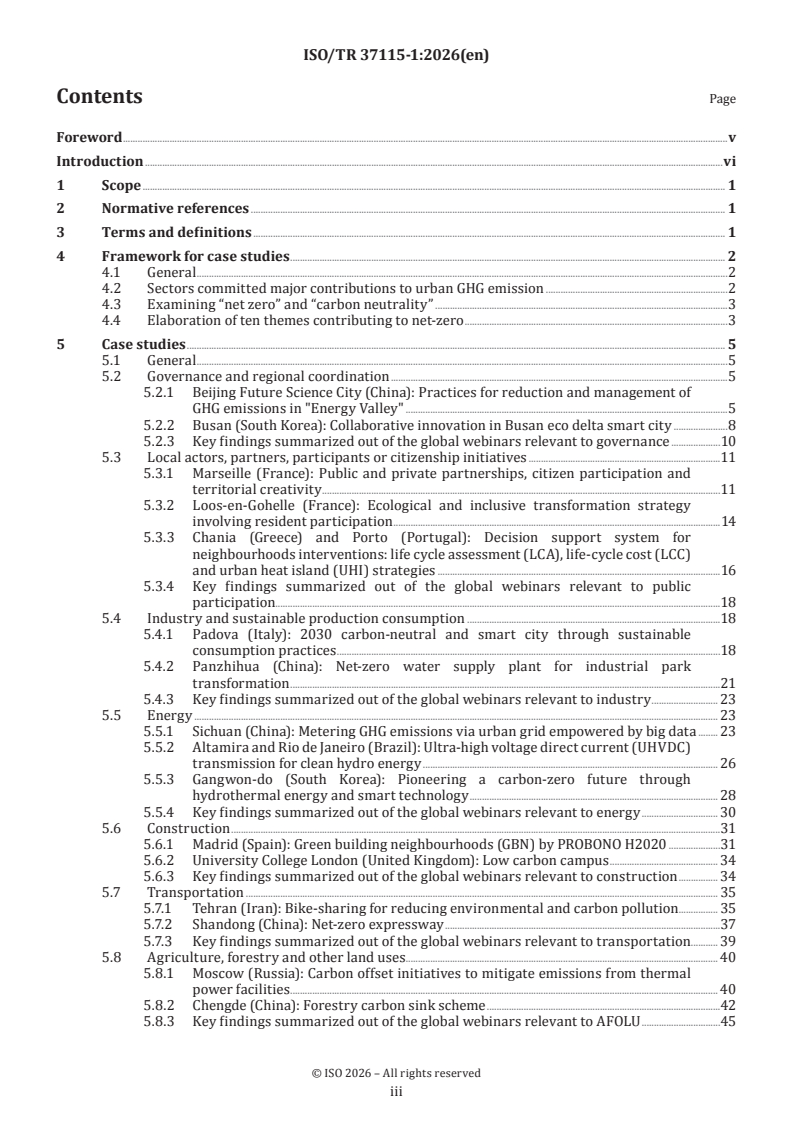
Contents Page
Foreword .v
Introduction .vi
1 Scope . 1
2 Normative references . 1
3 Terms and definitions . 1
4 Framework for case studies . 2
4.1 General .2
4.2 Sectors committed major contributions to urban GHG emission .2
4.3 Examining “net zero” and “carbon neutrality” .3
4.4 Elaboration of ten themes contributing to net-zero .3
5 Case studies . 5
5.1 General .5
5.2 Governance and regional coordination .5
5.2.1 Beijing Future Science City (China): Practices for reduction and management of
GHG emissions in "Energy Valley" .5
5.2.2 Busan (South Korea): Collaborative innovation in Busan eco delta smart city .8
5.2.3 Key findings summarized out of the global webinars relevant to governance .10
5.3 Local actors, partners, participants or citizenship initiatives .11
5.3.1 Marseille (France): Public and private partnerships, citizen participation and
territorial creativity .11
5.3.2 Loos-en-Gohelle (France): Ecological and inclusive transformation strategy
involving resident participation .14
5.3.3 Chania (Greece) and Porto (Portugal): Decision support system for
neighbourhoods interventions: life cycle assessment (LCA), life-cycle cost (LCC)
and urban heat island (UHI) strategies .16
5.3.4 Key findings summarized out of the global webinars relevant to public
participation.18
5.4 Industry and sustainable production consumption .18
5.4.1 Padova (Italy): 2030 carbon-neutral and smart city through sustainable
consumption practices .18
5.4.2 Panzhihua (China): Net-zero water supply plant for industrial park
transformation .21
5.4.3 Key findings summarized out of the global webinars relevant to industry . 23
5.5 Energy . 23
5.5.1 Sichuan (China): Metering GHG emissions via urban grid empowered by big data . 23
5.5.2 Altamira and Rio de Janeiro (Brazil): Ultra-high voltage direct current (UHVDC)
transmission for clean hydro energy . 26
5.5.3 Gangwon-do (South Korea): Pioneering a carbon-zero future through
hydrothermal energy and smart technology . 28
5.5.4 Key findings summarized out of the global webinars relevant to energy . 30
5.6 Construction .31
5.6.1 Madrid (Spain): Green building neighbourhoods (GBN) by PROBONO H2020 .31
5.6.2 University College London (United Kingdom): Low carbon campus . 34
5.6.3 Key findings summarized out of the global webinars relevant to construction . 34
5.7 Transportation . 35
5.7.1 Tehran (Iran): Bike-sharing for reducing environmental and carbon pollution . 35
5.7.2 Shandong (China): Net-zero expressway .37
5.7.3 Key findings summarized out of the global webinars relevant to transportation . 39
5.8 Agriculture, forestry and other land uses. 40
5.8.1 Moscow (Russia): Carbon offset initiatives to mitigate emissions from thermal
power facilities . 40
5.8.2 Chengde (China): Forestry carbon sink scheme .42
5.8.3 Key findings summarized out of the global webinars relevant to AFOLU .45
iii
5.9 Circularity .45
5.9.1 Volzhsky (Russia): Carbon sequestration and resource circulation in park .45
5.9.2 Shaoxing (China): Transforming textile and garment SMEs for circularity . 48
5.9.3 Key findings summarized out of the global webinars relevant to circularity. 49
5.10 Living and working environment . 50
5.10.1 Lyon (France): Sustainable urban planning for living environment . 50
5.10.2 Huzhou (China): Carbon incentive encouraging green lifestyles .52
5.10.3 Key findings summarized out of the global webinars relevant to surroundings . 54
5.11 Other . 54
6 Observations .55
Annex A (informative) Overview of global open webinars focusing on net zero carbon cities .56
Bibliography . 61
iv
Foreword
ISO (the International Organization for Standardization) is a worldwide federation of national standards
bodies (ISO member bodies). The work of preparing International Standards is normally carried out through
ISO technical committees. Each member body interested in a subject for which a technical committee
has been established has the right to be represented on that committee. International organizations,
governmental and non-governmental, in liaison with ISO, also take part in the work. ISO collaborates closely
with the International Electrotechnical Commission (IEC) on all matters of electrotechnical standardization.
The procedures used to develop this document and those intended for its further maintenance are described
in the ISO/IEC Directives, Part 1. In particular, the different approval criteria needed for the different types
of ISO document should be noted. This document was drafted in accordance with the editorial rules of the
ISO/IEC Directives, Part 2 (see www.iso.org/directives).
ISO draws attention to the possibility that the implementation of this document may involve the use of (a)
patent(s). ISO takes no position concerning the evidence, validity or applicability of any claimed patent
rights in respect thereof. As of the date of publication of this document, ISO had not received notice of (a)
patent(s) which may be required to implement this document. However, implementers are cautioned that
this may not represent the latest information, which may be obtained from the patent database available at
www.iso.org/patents. ISO shall not be held responsible for identifying any or all such patent rights.
Any trade name used in this document is information given for the convenience of users and does not
constitute an endorsement.
For an explanation of the voluntary nature of standards, the meaning of ISO specific terms and expressions
related to conformity assessment, as well as information about ISO's adherence to the World Trade
Organization (WTO) principles in the Technical Barriers to Trade (TBT), see www.iso.org/iso/foreword.html.
This document was prepared by Technical Committee ISO/TC 268, Sustainable cities and communities.
A list of all parts in the ISO 37115 series can be found on the ISO website.
Any feedback or questions on this document should be directed to the user’s national standards body. A
complete listing of these bodies can be found at www.iso.org/members.html.
v
Introduction
Climate change is one of the most significant challenges for sustainable development. It brings uncertainty
and risk for policymakers trying to help shape the future of cities. To avoid the worst effects on quality of
life, biodiversity, and critical infrastructure, ambitious and accelerating action to deal with the issues of
climate change exists – foremost among which is making rapid and significant reductions in greenhouse
gas (GHG) emissions. In this context, the United Nations (UN) and the International Organization for
Standardization (ISO) along with numerous national organizations worldwide, place great importance on
addressing this aspect of climate change. In December 2015, 196 countries and regions globally signed the
Paris Agreement, the first truly global agreement aimed at tackling climate change. The core goal is to limit
the global average temperature increase to below 2 °C above pre-industrial levels and endeavour to limit it
to 1,5 °C. The Intergovernmental Panel on Climate Change (IPCC) report, Climate Change 2021: The Physical
Science Basis, points out that to control global warming, all countries and organizations work together to
implement net zero emissions strategies.
As of October 2024, the number of countries worldwide that have put forward carbon neutrality goals
has increased to 151, covering nearly 92 % of global GDP, 89 % of the global population, and an estimated
88 % of global GHG emissions. The United Nations Sustainable Development Goals (SDGs) emphasize that
cities are key players in net zero. According to statistics from UN-Habitat, cities consume 78 % of the
world's energy, and over 60 % of GHG emissions originate from urban areas. Reports from both the United
Nations Environment Programme (UNEP) and the IPCC highlight the essential role of cities in combating
climate change. Achieving sustainable cities and communities and attaining net zero emissions presents a
formidable challenge. This urgently needs exploring while attaining net zero emissions solutions tailored
to cities and communities, which are essential for meeting the challenges posed by climate change. Many
cities have already taken actions to address their GHG emissions, such as Beijing Future Science City (BFSC),
Marseille and Moscow.
ISO is developing technical standards to support industries or organizations in their climate change
initiatives and to foster coordinated efforts in the global battle against climate change. For example,
IWA 42 and ISO 14068-1 provide tools and guidance for policymakers and organizations to achieve net zero
emissions. IWA 42 establishes a global framework to help regional, city and organizational participants in
coordinating, understanding, and planning programs to achieve net zero emissions. ISO 14068-1 guides
organizations on measuring, reporting and managing their GHG emissions to enhance environmental
performance and combat climate change.
However, cities, which often encompass multiple sectors such as energy generation and consumption,
transportation and industry, still lack International Standards for systematically reducing greenhouse gas
emissions. To tackle this challenge, accurate data collection and analysis, alongside effective management
practices and technological solutions, are essential. While the timing for establishing International
Standards is not yet optimal, compiling best practices from various countries will offer valuable references
and learning opportunities for all.
This document provides use cases that focus on policies, supportive technologies and management methods
for global cities and communities to make progress towards net zero emissions goals (corresponding to IWA
42) and address climate change and global carbon neutrality goals based on consensus (corresponding to
ISO 14068-1). This document takes into account varying climate and environmental conditions as well as the
impact of scale, available resources and economic structures in order to analyse goals, strategies, plans and
effectiveness of implementation, as well as important cross-cutting themes such as low-carbon technologies,
public participation, monitoring and verification.
This document includes cases from three continents and eleven countries, highlighting the shared need
among stakeholders for guidance and comprehensive management approaches. Clause 4 provides a
framework and ten themes that were developed through discussions with stakeholders for collecting cases.
Clause 5 systematically summarizes the carbon neutrality experiences and achievements of cities at various
development stages across different regions, drawing on an analysis of 20 cases derived from two collection
rounds and key findings summarized out of the global open webinars, which collectively cover ten themes:
— governance and regional coordination;
— local actors, partners, participants or citizenship initiatives;
vi
— industry and sustainable production and consumption;
— energy;
— construction;
— transportation;
— agriculture, forestry, and other land uses (AFOLU);
— circularity;
— living and working environment;
— other.
Clause 6 concludes with findings and recommendations to explore innovative future pathways for net
zero carbon cities development. Annex A provides a brief overview of cases from open webinars and
corresponding relationships between cases and ten themes.
Insights from global net zero carbon cities and stakeholder needs identified during open webinars contribute
to the development of this document for net zero carbon cities. This document is intended to expand into
a comprehensive series. This document presents global case studies from various regions and sets a solid
foundation for the following parts of the series. ISO 37115-2 is intended to reference these case studies and
use the ten themes from this document as its core framework to support the development of net zero carbon
cities. Future parts of the ISO 37115 series are intended to provide guidance on urban planning, industrial
zones, carbon assessment, and more, addressing the diverse concerns of stakeholders.
vii
Technical Report ISO/TR 37115-1:2026(en)
Sustainable cities and communities — Net zero carbon
cities —
Part 1:
Use cases
1 Scope
This document provides use cases on the practices of global cities and communities, including policies,
supporting techniques and tools, and management approaches that drive towards achieving lower
greenhouse gas (GHG) emissions for cities and communities as a key step towards net zero carbon cities in
response to climate change and global carbon neutrality.
This document takes into account varying contexts including climate conditions, scale, available resources
or economic structures in these practices. This document is in line with the sustainability purposes and
issues provided in ISO 37101 that are relevant to GHG emissions.
2 Normative references
The following documents are referred to in the text in such a way that some or all of their content constitutes
requirements of this document. For dated references, only the edition cited applies. For undated references,
the latest edition of the referenced document (including any amendments) applies.
ISO 37100, Sustainable cities and communities — Vocabulary
ISO 37101, Sustainable development in communities — Management system for sustainable development —
Requirements with guidance for use
ISO 14068-1, Climate change management — Transition to net zero — Part 1: Carbon neutrality
3 Terms and definitions
For the purposes of this document, the terms and definitions given in ISO 37100, ISO 37101, ISO 14068-1 and
the following apply.
ISO and IEC maintain terminology databases for use in standardization at the following addresses:
— ISO Online browsing platform: available at https:// www .iso .org/ obp
— IEC Electropedia: available at https:// www .electropedia .org/
3.1
net zero
condition in which human-caused residual GHG emissions are balanced by human-led removals over a
specified period and within specified boundaries
Note 1 to entry: Human-led removals include ecosystem restoration, direct air carbon capture and storage,
reforestation and afforestation, enhanced weathering, biochar and other effective methods.
Note 2 to entry: The words “human-caused” and “human-led” are intended to be understood as synonymous with the
word “anthropogenic” in IPCC definitions.
[SOURCE: IWA 42:2022, 3.1.1]
3.2
life cycle management
LCM
set of systematic and coordinated activities and practices through which a structure is appropriately
managed over its life cycle
[SOURCE: ISO 22040-2:2024, 3.2]
3.3
low-emissions zone
geographically defined area that seeks to restrict or deter access by specific categories of high-polluting
vehicles to improve the air quality within the geographic area
Note 1 to entry: The low-emissions zone can be dynamic, allowing the operating entity to change the location,
boundaries, or time of the low-emissions zone.
[SOURCE: ISO/TS 19091:2019, 3.27]
4 Framework for case studies
4.1 General
This clause provides a precise analysis of terminology and definitions of relevant documents from
international organizations and sources of urban greenhouse gas emissions (see 4.2), clearly distinguishing
between terms such as "net zero" and "carbon neutrality" (see 4.3). Additionally, it offers ten themes that
determine the framework of case studies to guide the efforts of urban GHG emission reductions (see 4.4).
4.2 Sectors committed major contributions to urban GHG emission
GHG refers to gaseous components in the atmosphere that can both absorb and re-emit infrared radiation,
including those that are naturally occurring and man-made. The sources of GHG refer to any process or
activity that causes GHG, aerosols, or precursors, to be released into the atmosphere. Sources can be divided
into two major categories: anthropogenic and natural. This document primarily focuses on a detailed
analysis of anthropogenic sources.
Anthropogenic sources of GHG include:
— fossil fuel combustion;
— land-use change and forestry;
— livestock and agricultural practices;
— waste management;
— industrial processes.
The IPCC, in its “Climate Change 2023 Synthesis Report” categorizes GHG sources primarily by sector, for
example, energy, industrial, agriculture, forestry, other land-use sectors, transportation and construction.
International Energy Agency (IEA) publication Net Zero by 2050 demonstrates that achieving net zero
emissions demand rapid, large-scale deployment of all available clean energy technologies, including
renewables, electric vehicles, and energy-efficient building retrofits, by 2030.
The UN Environment Programme’s Emissions Gap Report 2023 highlights that “Energy (generation) is the
dominant source of GHG emissions, currently accounting for 86 % of global CO emissions. The coal, oil and
gas extracted over the lifetime of producing and under-construction mines and fields as of 2018 would emit
more than 3,5 × the carbon budget available to limit warming to 1,5 °C, with a 50 % probability, and almost
the size of the budget available for 2 °C, with a 67 % probability. Global transformation of energy systems is
thus essential, including in low- and middle-income countries, where pressing development objectives were
met alongside a transition away from fossil fuels.”
UNEP Emissions Gap Report 2023 juxtaposes CO emissions from existing fossil fuel infrastructure against
carbon budgets for the Paris Agreement’s 1,5 °C (50 % likelihood) and 2 °C (67 % likelihood) long-term
temperature goals.
Although the GHG emissions information from different countries has unique characteristics, data
from regional organizations such as China’s Ministry of Ecology and Environment (MEE), the European
Environment Agency (EEA), and the U.S. Environmental Protection Agency (EPA) show that energy and
industrial activities are the primary sources of global GHG emissions. In China, GHG emissions mainly stem
from energy and industrial activities. According to the Second Biennial Update Report on Climate Change of
the People’s Republic of China, energy activities are the main source of China’s GHG emissions, accounting
for about 86,8 % of the total CO emissions. The EEA’s European Environment — State and Outlook 2021
categorize GHG emission sources as follows: energy supply, industrial processes, agriculture, waste
management, transportation, and other sectors. The EPA’s Inventory of U.S. GHG Emissions and Sinks 2022
classifies GHG emission sources as follows: energy-related sources, industrial sources, agriculture, land
use change and forestry, waste management, and other sectors. IWA 42 primarily focuses its attention on
the emissions of GHG within the domains of forestry, land use, agriculture, electricity generation, cement
production, steel manufacturing, service buildings and residential structures.
In summary, research reports by international organizations highlight distinct sector characteristics in
global GHG emissions. These emissions are mainly concentrated in the energy, industry, transportation,
construction and waste management sectors.
4.3 Examining “net zero” and “carbon neutrality”
There are some terms in the field of GHG emission reductions, such as "net zero" and “carbon neutrality,” that
can potentially be conflated. IWA 42 provides tools for policymakers and those committed to achieving net
zero emissions for their enterprises, groups or countries, while ISO 14068-1 offers a relatively standardized
pathway to achieving carbon neutrality, guiding organizations, products and services (including events and
buildings) to achieve carbon neutrality through quantifying, reducing and offsetting GHG emissions.
IWA 42 defines "net zero" as a condition in which human-caused residual GHG emissions are balanced by
human-led removals over a specified period and within specified boundaries. Human-led removals include
ecosystem restoration, direct air carbon capture and storage, reforestation and afforestation, enhanced
weathering, biochar and other effective methods.
ISO 14068-1 defines "carbon neutrality" as a state of being carbon neutral. The IPCC distinguishes between
carbon neutrality, a condition in which CO emissions are balanced by CO removals, and GHG neutrality, in
2 2
which all GHG emissions are balanced by GHG removals.
Although these two terms differ in their focus, both aim to promote the reduction of GHG emissions. Overall,
the "net zero" definition in IWA 42 provides a more comprehensive and integrated concept, focusing not
only on CO removal but all GHG removal and focusing on human-led removals, applying to the entire
supply chain. Meanwhile, "carbon neutrality" in ISO 14068-1 is more focused on balancing CO , although its
definition aligns with comprehensive GHG neutrality.
This document provides use cases focusing on achieving net zero emissions for cities and communities
as a key step toward net zero carbon cities in response to climate change and the need for global carbon
neutrality.
4.4 Elaboration of ten themes contributing to net-zero
This clause identifies ten themes to organize and collect use cases for pathways toward net zero carbon
cities. These themes align with the six objectives and twelve sustainability issues provided in ISO 37101.
Through these themes, this document gathers use cases to provide practical strategies and references for
cities aiming to achieve the goal of net zero emissions.
By referring to 4.2 as well as standards such as ISO/TS 14092, ISO 14064-1, ISO 14068-1 and IWA 42, primary
sources of GHG emissions are identified across all key sectors: energy, industry, agriculture, forestry, land
use, transportation and construction. These GHG emission sources are incorporated into the ten themes for
two rounds of case collection. Each theme provides use cases with targeted reduction practices, practical
experiences, and possible lessons to share with cities.
The ten themes are:
— Theme 1: Governance and regional coordination: This theme encompasses government commitments
to achieving net zero carbon cities through regional collaboration and governance improvements.
Strategies include regional and local planning, policy and regulatory development, target and indicator
setting, implementation schemes, oversight and assessment, evaluation and periodic adjustments, and
community engagement. Additionally, it involves communication and fostering cultural awareness.
— Theme 2: Local actors, partners, participants or citizenship initiatives: This theme encompasses-
strategies for local governments, community organizations, and stakeholders to achieve net zero carbon
cities. It emphasizes collaboration, community engagement, education, and environmental stewardship.
In essence, it underscores the importance of fostering robust collaborative partnerships between localities
and cooperative entities to collaboratively identify and tackle the underlying factors contributing to the
reduction of GHG emissions. This endeavour necessitates extensive engagement from the community
and the public, the establishment of cooperative governance frameworks, the enhancement of civic
environmental education, the encouragement of volunteer initiatives, the nurturing of social innovation
and the reinforcement of local environmental stewardship.
— Theme 3: Industry and sustainable production and consumption: This theme encompasses strategies in
the industrial sector to promote sustainable production and consumption for net zero carbon cities. Key
measures include technological innovation, energy efficiency and sustainable consumption patterns.
These strategies encompass technological innovation, widespread application of energy-saving
equipment, dual optimization of energy structure and production processes, as well as advocating and
practicing the optimization and upgrading of consumption patterns, with the aim of effectively reducing
dependence on high energy-consuming products.
— Theme 4: Energy: This theme encompasses GHG emission reductions in the energy sector. It involves
phasing out high-carbon energy, improving energy efficiency, and promoting renewable energy and
digitalization technologies. By developing renewable energy and improving energy efficiency, it aims to
reduce GHG emissions. This includes energy efficiency, solar energy, wind or geothermal energy, electricity,
renewable energy utilization, energy digitalization, clean electricity and energy diversification.
— Theme 5: Construction: This theme encompasses GHG emission reductions in construction through
green building practices, upgrading existing structures, and using sustainable materials. It includes
planning, design and infrastructure improvements. By using low-carbon building materials and energy-
saving designs, it directly participates in GHG emission reductions and helps reduce GHG sources in the
construction sector. This includes planning and design, operation and infrastructure.
NOTE Countries and regions define green buildings differently. This document collects several examples below to
aid in understanding the concept.
United States The U.S. Environmental Protection Agency (EPA) considers green buildings as practices that are
environmentally responsible and resource-efficient throughout a building's entire life cycle, from site selection,
design, construction, operation, maintenance, renovation to demolition. This practice expands and complements the
considerations of economy, practicality, durability, and comfort in traditional architectural design.
China China's Green Building Evaluation Standard (GB/T 50378) clearly stipulates that green buildings refer
to buildings that maximize resource conservation (energy conservation, land conservation, water conservation,
and material conservation), protect the environment, reduce pollution throughout their life cycle, provide healthy,
applicable, and efficient living spaces, and coexist harmoniously with nature.
UK The British Building Research Establishment (BRE) developed the BREEAM in 1990. Although it does not
explicitly define green buildings, it evaluates the environmental performance of buildings throughout their life cycle.
According to the comprehensive score, buildings are divided into four levels: Pass, Good, Very Good and Excellent.
Europe The European Union does not have a unified definition of green buildings, but the Energy Performance of
Buildings Directive (EPBD) stipulates that all new buildings in the EU were "nearly - zero energy buildings" from 2020.
A net zero emission building means that the building has a very high energy performance level, extremely low energy
consumption, and all energy comes from renewable energy sources, with no GHG emissions from fossil fuels.
— Theme 6: Transportation: This theme encompasses reducing urban GHG emissions in urban transportation
by promoting low-emission vehicles, optimizing logistics and enhancing public transport. It emphasizes
energy efficiency and reducing fossil fuel dependence. This includes public transportation, electric and
hybrid vehicles, infrastructure development and mobility.
— Theme 7: Agriculture, forestry and other land uses: This theme encompasses reducing urban GHG
emissions and increasing urban carbon sinks through sustainable agricultural practices such as crop
rotation and cover cropping, and through the protection and restoration of forests, wetlands and other
ecosystems. It includes precision agriculture, forest management and ecological agriculture.
— Theme 8: Circularity: This theme encompasses reducing waste and emissions while improving resource
efficiency through reducing, reusing and recycling materials. It emphasizes that practicing a circular
economy helps to reduce the demand for new resources, thereby reducing emissions from extraction and
production processes, thus affecting GHG sources. This includes resource recycling, waste reduction and
product life cycle management (LCM).
— Theme 9: Living and working environment: This theme encompasses enhancing the quality of living
and working environments through improved planning, design and operation of urban areas, including
public spaces, clean air, water resource management and urban greening. It emphasizes that a good
living and working environment can improve the quality of life for residents while reducing energy
consumption and resource waste, positively impacting GHG sources. This includes citizen lifestyle,
sustainable consumption, lifestyle transformation and sustainable communities.
— Theme 10: Other: This theme encompasses areas such as technological innovation, education and
training, public participation, and raising awareness, supporting and supplementing the other themes. It
emphasizes that technological innovation can bring new reduction technologies and methods, education
and training can help raise public awareness of climate change, and public participation and raising
awareness can promote social support and participation in reduction actions. This includes technological
innovation, financial mechanisms, market incentives, international cooperation and policy coordination.
These themes are developed based on a comprehensive understanding of GHG sources and reduction
measures, collecting global cases to recognize worldwide experiences in combating global warming,
protecting ecosystems and ensuring the long-term prosperity of human society.
5 Case studies
5.1 General
This clause presents 20 cases derived from two collection rounds, with each case including overview,
benefits and objectives, measures and methods, technology or management innovation, lessons learned.
Additionally, key findings from global open webinars (see Annex A) are also summarized in this clause.
5.2 Governance and regional coordination
5.2.1 Beijing Future Science City (China): Practices for reduction and management of GHG
emissions in "Energy Valley"
5.2.1.1 Overview
BFSC is a hub for Beijing's efforts to establish a globally influential national science and technology innovation
centre, located in northern Beijing. The 'Energy Valley' covers 10 squares kilometres in the eastern section
of BFSC, designed to accommodate around 100 000 residents. Development began in 2009.
The Energy Valley is one of the first green ecological demonstration zones in Beijing and serves as a pilot
city for ISO 37101. From the beginning, BFSC has actively implemented national climate change strategies,
focusing on "low-carbon" development principles.
BFSC serves as a model for China and an important strategic initiative for Beijing in its efforts to achieve the
China’s 'Dual Carbon Goals,' aiming for carbon peaking by 2030 and carbon neutrality by 2060. By the end of
2023, approximately 4,4 million m of green buildings had been constructed within the Energy Valley, which
also hosts the country's first 'carbon-neutral theme park.' Nearly all energy technology companies in BFSC
are adopting low-carbon technologies, such as the national power investment corporation's net zero carbon
energy park, which showcases a smart, net-zero carbon power plant. By 2020, substantial reductions in GHG
emissions were achieved.
5.2.1.2 Benefits and objectives
a) Economic benefits:
1) Facilitating the development of advanced energy industries: The Energy Valley fosters economic
growth by attracting over 300 high-tech energy enterprises, driving innovation in Beijing's energy
sector.
2) Improving energy utilization efficiency and reducing costs: Significant resource conservation and
reduced energy consumption have been achieved through initiatives like energy-saving lighting
and renewable energy generation technologies.
b) Social benefits:
1) Attracting businesses and talent to the region, enhancing residents' well-being: Hundreds of
enterprises from various sectors have been attracted to BFSC, employing tens of thousands of
talented professionals.
2) Elevating the brand influence of BFSC: As one of the first green ecological demonstration zones in
Beijing and as the pilot city for ISO 37101, BFSC enhances community well-being by attracting talent
and promoting environmental awareness.
3) Increasing public awareness of environmental protection: The establishment of a "carbon-neutral
theme park" has encouraged active participation from citizens and tourists, with over 660 000
visitors recorded to date.
c) Environmental benefits:
1) Reducing GHG emissions and promoting carbon sequestration: In 2020, through initiatives such
as distributed photovoltaics and wind power, organizations in the Energy Valley reduced GHG
emissions by over 8 000 tons.
2) Improving the quality of air, water and soil in the region: This was accomplished by creating a
314-hectare waterfront park and establishing a green ecological corridor along the Wenyu River. As
a result, green coverage reached an impressive 84 %, and the water quality in the river significantly
improved.
5.2.1.3 Measures and methods
a) Emphasizing navigation by indicators and standards:
BFSC has established a comprehensive green and low-carbon indicator framework to guide GHG emission
reduction, involving a top-level design and the establishment of a green and low-carbon indicator framework
with 42 indicators, along with a green and low-carbon implementation scheme and a series of specific plans.
This framework includes specific low-carbon indicators, such as tons of GHG emissions (CO ) per
$ 1 000 000 GDP is less than 110 tCO per million USD and renewable energy utilization rate is greater
than 20 %. According to this framework, BFSC has conducted a top-level design for green and low-carbon
implementation scheme in the Energy Valley, which includes a management system guidance covering
planning, construction and operations throughout the entire life cycle of projects.
NOTE Tons of GHG emissions (CO ) per $ 1 000 000 GDP is less than 110 tCO per million USD: This means that
2 2
the ratio of total carbon dioxide (CO2) emissions from the construction, municipal, and transportation sectors within
the entire BFSC area to its GDP (measured in millions of dollars) is less than 110 tons. Renewable energy utilization
rate is greater than 20 %: this indicates that the proportion of renewable energy consumption in the total energy
consumption within the entire BFSC area exceeds 20 %.
b) Strengthening the role of plannings:
BFSC has created low-carbon plans based on the indicator framework and its implementation scheme, aiming
for low-carbon development in both master and detailed planning. In 2014, BFSC was the first industry park
in China to develop a low-carbon development plan, which uses a model to assess sustainability capabilities.
This plan includes a GHG emissions inventory and provides strategies, measures, and actions aimed at
reducing GHG emissions.
c) Exploring management methods:
BFSC has implemented an effective management system to promote green and low-carbon practices,
throughout all stages of development. Clear responsibility agreements have been established for developers
and other participating entities, ensuring stricter oversight during both the construction and the operational
phases. For projects undertaken by developers, ten ecological indicators have been integrated into land
grant conditions. Among these, seven indicators including the certification levels of green building and
energy – saving compliance rates for public buildings – are directly aligned with the goals of achieving a net
zero carbon city.
d) Establishing strong organizational leadership:
The administration committee of BFSC is responsible for overseeing, coordinating, supervising and
managing all activities related to green and low-carbon development. To further enhance these efforts, a
sustainable development department has been established to handle the implementation of indicators,
develop technical standards, conduct assessments and evaluations and
...