

ISO 19356:2016
(Main)Ships and marine technology — Marine cranes — Test specifications and procedures
General Information
- Abstract
ISO 19356:2016 describes the required tests and the testing procedures for marine cranes of metal construction. ISO 19356:2016 is applicable to the following types of marine cranes: - deck cranes mounted on ships for handling cargo or containers in harbour or sheltered water conditions; - floating cranes or grab cranes mounted on barges or pontoons for operating in harbour conditions; - engine room cranes, provision cranes, etc. mounted on ships (including floating docks) for handling equipment and stores in harbour conditions. NOTE Marine cranes in other types can refer to this document. ISO 19356:2016 does not apply to the following: - minimum ambient operating temperatures below −20 °C; - maximum ambient operating temperatures above +45 °C; - loads from accidents or collisions; - lifting operations below sea level; - transport, assembly, dismantling and decommissioning of cranes; - lifting accessories, i.e. any item between the crane and the load; - lifting operations involving more than one crane; - hand-powered cranes; - emergency rescue operations; - shore-side cargo handling cranes; - portable cranes on board; - lifting appliances for lifeboats, liferafts accommodation ladders, and pilot ladders; - launching appliances for survival craft and rescue boats; - gangways, accommodation and pilot ladders and their handling appliances. Cranes defined in this document are intended to comply with the requirements of class societies and flag states. It is also intended that reference be made to ILO and particularly the convention No. 152. Applicable regulations are those issued by the responsible classification societies and it is intended that national authorities be complied with.
- Status
- Published
- Publication Date
- 20-Sep-2016
- Technical Committee
- ISO/TC 8/SC 4 - Outfitting and deck machinery
- Drafting Committee
- ISO/TC 8/SC 4 - Outfitting and deck machinery
- Current Stage
- 9093 - International Standard confirmed
- Start Date
- 09-Aug-2022
- Completion Date
- 29-Aug-2026
Buy Documents


ISO 19356:2016 - Ships and marine technology -- Marine cranes -- Test specifications and procedures
ISO 19356:2016 - Ships and marine technology — Marine cranes — Test specifications and procedures/21/2016
Overview
ISO 19356:2016 - Ships and marine technology - Marine cranes - Test specifications and procedures - defines required tests and test procedures for metal marine cranes intended to operate in harbour or sheltered water conditions. It covers deck cranes, floating/grab cranes on barges or pontoons, and shipboard engine‑room and provision cranes. The standard specifies how to verify technical performance, record test results and produce test reports that support compliance with classification societies, flag states and relevant ILO guidance.
Key topics and requirements
- Scope and exclusions: Applies to marine cranes used in harbour/sheltered waters; excludes extreme ambient temperatures (< −20 °C or > +45 °C), accident/collision loads, multi‑crane lifts, lifting accessories, shore‑side cargo cranes, hand‑powered or portable onboard cranes, lifeboat launching appliances and others explicitly listed.
- Test planning: Tests are to be carried out according to a designer‑prepared test program and recorded in a formal test report signed by tester, inspector and, when involved, the user/verifier.
- Functional tests (factory/internal checks): verification of limit safety functions (hoist/luff/slew/travel/slack rope), no‑load mechanism operation, electrical wiring and insulation checks, alarms and emergency brakes.
- Bench tests: Performed on a manufacturer’s test bench where possible; includes no‑load operational tests, measurements of speed/time parameters, working amplitudes and rated load (SWL) tests.
- Overload tests: Defined test loads based on SWL categories; holding test load at maximum amplitude for inspection of structural elements.
- Inclination and special tests: Inclination tests may be performed by agreement with the user; other integration or twin‑lift tests as required by the technical program.
- Measurement and traceability: Test speeds and time parameters follow ISO 13202; test loads per ISO 14518; instruments must be calibrated and within validity ranges.
- Reporting: Reports must record crane types, serial numbers, main technical parameters, test durations, loads, locations, procedures and results.
Practical applications
- Factory acceptance testing and commissioning of shipboard and floating cranes
- Verification for classification society surveys and flag state inspections
- Manufacturer bench testing during production and pre‑delivery checks
- Onboard verification after repairs, modifications or retrofits
- Developer/designer validation of crane performance and safety systems
Who should use this standard
- Crane manufacturers and test laboratories
- Shipyards and vessel operators
- Classification societies, flag state authorities and marine surveyors
- Design engineers and technical managers responsible for crane commissioning
Related standards
- ISO 14518 - Cranes - Requirements for test loads
- ISO 13202 - Cranes - Measurement of velocity and time parameters
- ISO 19354 - Ships and marine technology - Marine cranes - General requirements
- ISO 3828, ISO 4306‑1 - Vocabulary and symbols for shipboard cranes
ISO 19356:2016 is essential for anyone involved in marine crane testing, compliance and commissioning, providing clear test specifications and procedures for safe, verifiable crane operation.
Buy Documents
ISO 19356:2016 - Ships and marine technology -- Marine cranes -- Test specifications and procedures
ISO 19356:2016 - Ships and marine technology — Marine cranes — Test specifications and procedures/21/2016
Get Certified
Connect with accredited certification bodies for this standard

DNV
DNV is an independent assurance and risk management provider.

Lloyd's Register
Lloyd's Register is a global professional services organisation specialising in engineering and technology.

FSC International
Forest Stewardship Council certification.
Sponsored listings
Frequently Asked Questions
ISO 19356:2016 is a standard published by the International Organization for Standardization (ISO). Its full title is "Ships and marine technology — Marine cranes — Test specifications and procedures". This standard covers: ISO 19356:2016 describes the required tests and the testing procedures for marine cranes of metal construction. ISO 19356:2016 is applicable to the following types of marine cranes: - deck cranes mounted on ships for handling cargo or containers in harbour or sheltered water conditions; - floating cranes or grab cranes mounted on barges or pontoons for operating in harbour conditions; - engine room cranes, provision cranes, etc. mounted on ships (including floating docks) for handling equipment and stores in harbour conditions. NOTE Marine cranes in other types can refer to this document. ISO 19356:2016 does not apply to the following: - minimum ambient operating temperatures below −20 °C; - maximum ambient operating temperatures above +45 °C; - loads from accidents or collisions; - lifting operations below sea level; - transport, assembly, dismantling and decommissioning of cranes; - lifting accessories, i.e. any item between the crane and the load; - lifting operations involving more than one crane; - hand-powered cranes; - emergency rescue operations; - shore-side cargo handling cranes; - portable cranes on board; - lifting appliances for lifeboats, liferafts accommodation ladders, and pilot ladders; - launching appliances for survival craft and rescue boats; - gangways, accommodation and pilot ladders and their handling appliances. Cranes defined in this document are intended to comply with the requirements of class societies and flag states. It is also intended that reference be made to ILO and particularly the convention No. 152. Applicable regulations are those issued by the responsible classification societies and it is intended that national authorities be complied with.
ISO 19356:2016 describes the required tests and the testing procedures for marine cranes of metal construction. ISO 19356:2016 is applicable to the following types of marine cranes: - deck cranes mounted on ships for handling cargo or containers in harbour or sheltered water conditions; - floating cranes or grab cranes mounted on barges or pontoons for operating in harbour conditions; - engine room cranes, provision cranes, etc. mounted on ships (including floating docks) for handling equipment and stores in harbour conditions. NOTE Marine cranes in other types can refer to this document. ISO 19356:2016 does not apply to the following: - minimum ambient operating temperatures below −20 °C; - maximum ambient operating temperatures above +45 °C; - loads from accidents or collisions; - lifting operations below sea level; - transport, assembly, dismantling and decommissioning of cranes; - lifting accessories, i.e. any item between the crane and the load; - lifting operations involving more than one crane; - hand-powered cranes; - emergency rescue operations; - shore-side cargo handling cranes; - portable cranes on board; - lifting appliances for lifeboats, liferafts accommodation ladders, and pilot ladders; - launching appliances for survival craft and rescue boats; - gangways, accommodation and pilot ladders and their handling appliances. Cranes defined in this document are intended to comply with the requirements of class societies and flag states. It is also intended that reference be made to ILO and particularly the convention No. 152. Applicable regulations are those issued by the responsible classification societies and it is intended that national authorities be complied with.
ISO 19356:2016 is classified under the following ICS (International Classification for Standards) categories: 47.020.40 - Lifting and cargo handling equipment. The ICS classification helps identify the subject area and facilitates finding related standards.
ISO 19356:2016 is available in PDF format for immediate download after purchase. The document can be added to your cart and obtained through the secure checkout process. Digital delivery ensures instant access to the complete standard document.
Standards Content (Sample)
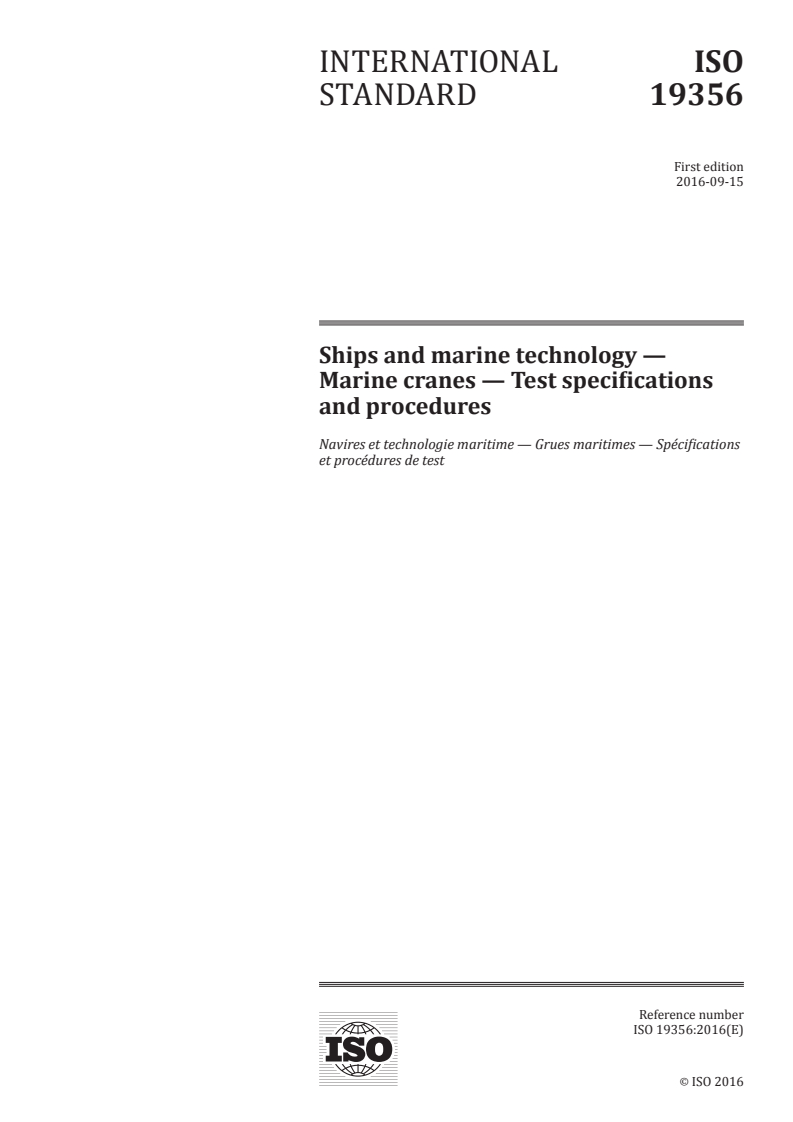
INTERNATIONAL ISO
STANDARD 19356
First edition
2016-09-15
Ships and marine technology —
Marine cranes — Test specifications
and procedures
Navires et technologie maritime — Grues maritimes — Spécifications
et procédures de test
Reference number
©
ISO 2016
© ISO 2016, Published in Switzerland
All rights reserved. Unless otherwise specified, no part of this publication may be reproduced or utilized otherwise in any form
or by any means, electronic or mechanical, including photocopying, or posting on the internet or an intranet, without prior
written permission. Permission can be requested from either ISO at the address below or ISO’s member body in the country of
the requester.
ISO copyright office
Ch. de Blandonnet 8 • CP 401
CH-1214 Vernier, Geneva, Switzerland
Tel. +41 22 749 01 11
Fax +41 22 749 09 47
copyright@iso.org
www.iso.org
ii © ISO 2016 – All rights reserved
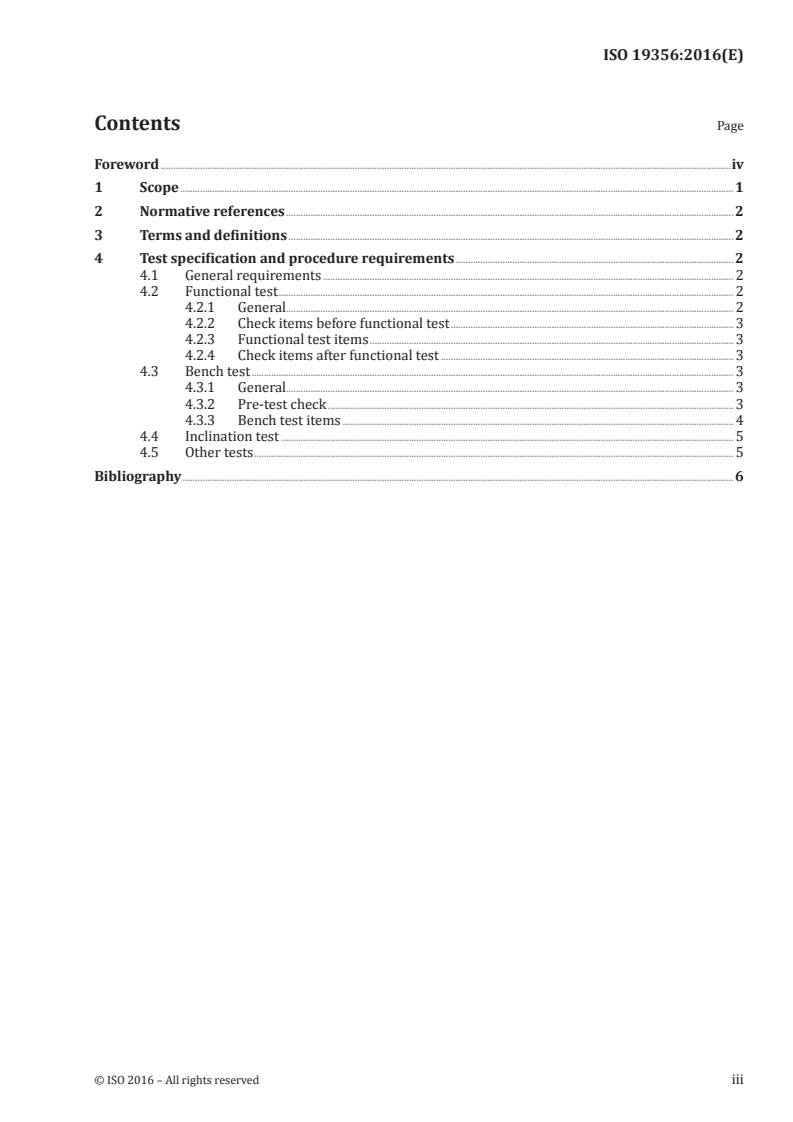
Contents Page
Foreword .iv
1 Scope . 1
2 Normative references . 2
3 Terms and definitions . 2
4 Test specification and procedure requirements . 2
4.1 General requirements . 2
4.2 Functional test . 2
4.2.1 General. 2
4.2.2 Check items before functional test . 3
4.2.3 Functional test items . 3
4.2.4 Check items after functional test . 3
4.3 Bench test . 3
4.3.1 General. 3
4.3.2 Pre-test check . 3
4.3.3 Bench test items . 4
4.4 Inclination test . 5
4.5 Other tests . 5
Bibliography . 6
Foreword
ISO (the International Organization for Standardization) is a worldwide federation of national standards
bodies (ISO member bodies). The work of preparing International Standards is normally carried out
through ISO technical committees. Each member body interested in a subject for which a technical
committee has been established has the right to be represented on that committee. International
organizations, governmental and non-governmental, in liaison with ISO, also take part in the work.
ISO collaborates closely with the International Electrotechnical Commission (IEC) on all matters of
electrotechnical standardization.
The procedures used to develop this document and those intended for its further maintenance are
described in the ISO/IEC Directives, Part 1. In particular the different approval criteria needed for the
different types of ISO documents should be noted. This document was drafted in accordance with the
editorial rules of the ISO/IEC Directives, Part 2 (see www.iso.org/directives).
Attention is drawn to the possibility that some of the elements of this document may be the subject of
patent rights. ISO shall not be held responsible for identifying any or all such patent rights. Details of
any patent rights identified during the development of the document will be in the Introduction and/or
on the ISO list of patent declarations received (see www.iso.org/patents).
Any trade name used in this document is information given for the convenience of users and does not
constitute an endorsement.
For an explanation on the meaning of ISO specific terms and expressions related to conformity assessment,
as well as information about ISO’s adherence to the World Trade Organization (WTO) principles in the
Technical Barriers to Trade (TBT) see the following URL: www.iso.org/iso/foreword.html.
The committee responsible for this document is ISO/TC 8, Ships and marine technology, Subcommittee
SC 4, Outfitting and deck machinery.
iv © ISO 2016 – All rights reserved
INTERNATIONAL STANDARD ISO 19356:2016(E)
Ships and marine technology — Marine cranes — Test
specifications and procedures
1 Scope
This document describes the required tests and the testing procedures for marine cranes of metal
construction.
This document is applicable to the following types of marine cranes:
— deck cranes mounted on ships for handling cargo or containers in harbour or sheltered water
conditions;
— floating cranes or grab cranes mounted on barges or pontoons for operating in harbour conditions;
— engine room cranes, provision cranes, etc. mounted on ships (including floating docks) for handling
equipment and stores in harbour conditions.
NOTE Marine cranes in other types can refer to this document.
This document does not apply to the following:
— minimum ambient operating temperatures below −20 °C;
— maximum ambient operating temperatures above +45 °C;
— loads from accidents or collisions;
— lifting operations below sea level;
— transport, assembly, dismantling and decommissioning of cranes;
— lifting accessories, i.e. any item between the crane and the load;
— lifting operations involving more than one crane;
— hand-powered cranes;
— emergency rescue operations;
— shore-side cargo handling cranes;
— portable cranes on board;
— lifting appliances for lifeboats, liferafts accommodation ladders, and pilot ladders;
— launching appliances for survival craft and rescue boats;
— gangways, accommodation and pilot ladders and their handling appliances.
Cranes defined in this document are intended to comply with the requirements of class societies and
flag states. It is also intended that reference be made to ILO and particularly the convention No. 152.
Ap
...
INTERNATIONAL ISO
STANDARD 19356
First edition
2016-09-15
Ships and marine technology —
Marine cranes — Test specifications
and procedures
Navires et technologie maritime — Grues maritimes — Spécifications
et procédures de test
Reference number
©
ISO 2016
© ISO 2016, Published in Switzerland
All rights reserved. Unless otherwise specified, no part of this publication may be reproduced or utilized otherwise in any form
or by any means, electronic or mechanical, including photocopying, or posting on the internet or an intranet, without prior
written permission. Permission can be requested from either ISO at the address below or ISO’s member body in the country of
the requester.
ISO copyright office
Ch. de Blandonnet 8 • CP 401
CH-1214 Vernier, Geneva, Switzerland
Tel. +41 22 749 01 11
Fax +41 22 749 09 47
copyright@iso.org
www.iso.org
ii © ISO 2016 – All rights reserved
Contents Page
Foreword .iv
1 Scope . 1
2 Normative references . 2
3 Terms and definitions . 2
4 Test specification and procedure requirements . 2
4.1 General requirements . 2
4.2 Functional test . 2
4.2.1 General. 2
4.2.2 Check items before functional test . 3
4.2.3 Functional test items . 3
4.2.4 Check items after functional test . 3
4.3 Bench test . 3
4.3.1 General. 3
4.3.2 Pre-test check . 3
4.3.3 Bench test items . 4
4.4 Inclination test . 5
4.5 Other tests . 5
Bibliography . 6
Foreword
ISO (the International Organization for Standardization) is a worldwide federation of national standards
bodies (ISO member bodies). The work of preparing International Standards is normally carried out
through ISO technical committees. Each member body interested in a subject for which a technical
committee has been established has the right to be represented on that committee. International
organizations, governmental and non-governmental, in liaison with ISO, also take part in the work.
ISO collaborates closely with the International Electrotechnical Commission (IEC) on all matters of
electrotechnical standardization.
The procedures used to develop this document and those intended for its further maintenance are
described in the ISO/IEC Directives, Part 1. In particular the different approval criteria needed for the
different types of ISO documents should be noted. This document was drafted in accordance with the
editorial rules of the ISO/IEC Directives, Part 2 (see www.iso.org/directives).
Attention is drawn to the possibility that some of the elements of this document may be the subject of
patent rights. ISO shall not be held responsible for identifying any or all such patent rights. Details of
any patent rights identified during the development of the document will be in the Introduction and/or
on the ISO list of patent declarations received (see www.iso.org/patents).
Any trade name used in this document is information given for the convenience of users and does not
constitute an endorsement.
For an explanation on the meaning of ISO specific terms and expressions related to conformity assessment,
as well as information about ISO’s adherence to the World Trade Organization (WTO) principles in the
Technical Barriers to Trade (TBT) see the following URL: www.iso.org/iso/foreword.html.
The committee responsible for this document is ISO/TC 8, Ships and marine technology, Subcommittee
SC 4, Outfitting and deck machinery.
iv © ISO 2016 – All rights reserved
INTERNATIONAL STANDARD ISO 19356:2016(E)
Ships and marine technology — Marine cranes — Test
specifications and procedures
1 Scope
This document describes the required tests and the testing procedures for marine cranes of metal
construction.
This document is applicable to the following types of marine cranes:
— deck cranes mounted on ships for handling cargo or containers in harbour or sheltered water
conditions;
— floating cranes or grab cranes mounted on barges or pontoons for operating in harbour conditions;
— engine room cranes, provision cranes, etc. mounted on ships (including floating docks) for handling
equipment and stores in harbour conditions.
NOTE Marine cranes in other types can refer to this document.
This document does not apply to the following:
— minimum ambient operating temperatures below −20 °C;
— maximum ambient operating temperatures above +45 °C;
— loads from accidents or collisions;
— lifting operations below sea level;
— transport, assembly, dismantling and decommissioning of cranes;
— lifting accessories, i.e. any item between the crane and the load;
— lifting operations involving more than one crane;
— hand-powered cranes;
— emergency rescue operations;
— shore-side cargo handling cranes;
— portable cranes on board;
— lifting appliances for lifeboats, liferafts accommodation ladders, and pilot ladders;
— launching appliances for survival craft and rescue boats;
— gangways, accommodation and pilot ladders and their handling appliances.
Cranes defined in this document are intended to comply with the requirements of class societies and
flag states. It is also intended that reference be made to ILO and particularly the convention No. 152.
Ap
...