

ISO/TR 32123:2024
(Main)Transaction assurance in E-commerce — After-sales services
General Information
- Abstract
This document provides information on the nature of after-sales services unique to E-commerce transactions. It is a review of current practices across different platforms, an analysis of factors that impact quality of after-sales services in E-commerce transactions and a description of possible means to enhance after-sales services.
- Status
- Published
- Publication Date
- 12-Dec-2024
- Technical Committee
- ISO/TC 321 - Transaction assurance in E-commerce
- Drafting Committee
- ISO/TC 321 - Transaction assurance in E-commerce
- Current Stage
- 6060 - International Standard published
- Start Date
- 13-Dec-2024
- Completion Date
- 13-Dec-2024


Overview - ISO/TR 32123:2024 (Transaction assurance in E-commerce - After-sales services)
ISO/TR 32123:2024 is a Technical Report that reviews the nature and practice of after-sales services in E‑commerce. It analyzes current practices across platforms, identifies factors that affect service quality, and describes measures to enhance after-sales service delivery - for both tangible and virtual goods. The report is informational (no normative references) and authored by ISO/TC 321 (Transaction assurance in E‑commerce).
Key topics and technical focus
The document organizes after-sales topics in pragmatic, operational sections:
- Logistics
- Dispatch, customs clearance, transportation and last‑mile delivery
- Reverse logistics for returns and return logistics design
- Delivery considerations for virtual goods
- Maintenance and technical support
- Terms and conditions, support processes and continuous customer assistance
- Return of products
- Eligibility criteria, operational processes and specific handling for virtual goods
- Refund of payment
- Refund policy elements and process flow considerations
- Resolving disputes
- Complaint handling, dispute resolution pathways and escalation
- Compensation for transaction loss
- Policy framing and procedural steps for compensation claims
- Quality factors and improvement
- Policy, information transparency, and resources (human, technical, financial)
- Use cases and referenced international standards to help implement improvements
- Terminology
- Clear definitions for tangible goods, virtual goods, E‑commerce platform, operator and seller
The report emphasizes practical process descriptions, quality factors and use-case examples rather than prescriptive requirements.
Practical applications - who should use it
ISO/TR 32123 is useful to organizations aiming to strengthen transaction assurance and buyer trust in online commerce:
- E‑commerce platform operators - design platform-level after-sales policies and seller onboarding requirements
- Online sellers and marketplaces - implement consistent return, refund and dispute processes
- Logistics and reverse‑logistics providers - align delivery and returns flows with platform expectations
- Customer support and technical teams - structure support SLAs and virtual‑goods handling
- Compliance officers and regulators - understand common practices and quality factors
- Standards implementers and consultants - map existing operations to international guidance and improvement measures
Related standards and context
- Prepared by ISO/TC 321 and cross‑linked to ISO guidance such as ISO 32110:2023 (terminology used in the report).
- The report references “applicable international standards” for quality improvement (itself informational - consult national bodies or ISO for normative standards applicable to implementation).
ISO/TR 32123:2024 is a practical resource for improving after‑sales service consistency, supporting refunds and returns policies, handling virtual goods, and strengthening overall transaction assurance in E‑commerce.
Get Certified
Connect with accredited certification bodies for this standard

BSI Group
BSI (British Standards Institution) is the business standards company that helps organizations make excellence a habit.

NYCE
Mexican standards and certification body.
Sponsored listings
Frequently Asked Questions
ISO/TR 32123:2024 is a technical report published by the International Organization for Standardization (ISO). Its full title is "Transaction assurance in E-commerce — After-sales services". This standard covers: This document provides information on the nature of after-sales services unique to E-commerce transactions. It is a review of current practices across different platforms, an analysis of factors that impact quality of after-sales services in E-commerce transactions and a description of possible means to enhance after-sales services.
This document provides information on the nature of after-sales services unique to E-commerce transactions. It is a review of current practices across different platforms, an analysis of factors that impact quality of after-sales services in E-commerce transactions and a description of possible means to enhance after-sales services.
ISO/TR 32123:2024 is classified under the following ICS (International Classification for Standards) categories: 35.240.63 - IT applications in trade. The ICS classification helps identify the subject area and facilitates finding related standards.
ISO/TR 32123:2024 is available in PDF format for immediate download after purchase. The document can be added to your cart and obtained through the secure checkout process. Digital delivery ensures instant access to the complete standard document.
Standards Content (Sample)
Technical
Report
ISO/TR 32123
First edition
Transaction assurance in
2024-12
E-commerce — After-sales services
Assurance des transactions de commerce électronique — Services
après-vente
Reference number
© ISO 2024
All rights reserved. Unless otherwise specified, or required in the context of its implementation, no part of this publication may
be reproduced or utilized otherwise in any form or by any means, electronic or mechanical, including photocopying, or posting on
the internet or an intranet, without prior written permission. Permission can be requested from either ISO at the address below
or ISO’s member body in the country of the requester.
ISO copyright office
CP 401 • Ch. de Blandonnet 8
CH-1214 Vernier, Geneva
Phone: +41 22 749 01 11
Email: copyright@iso.org
Website: www.iso.org
Published in Switzerland
ii
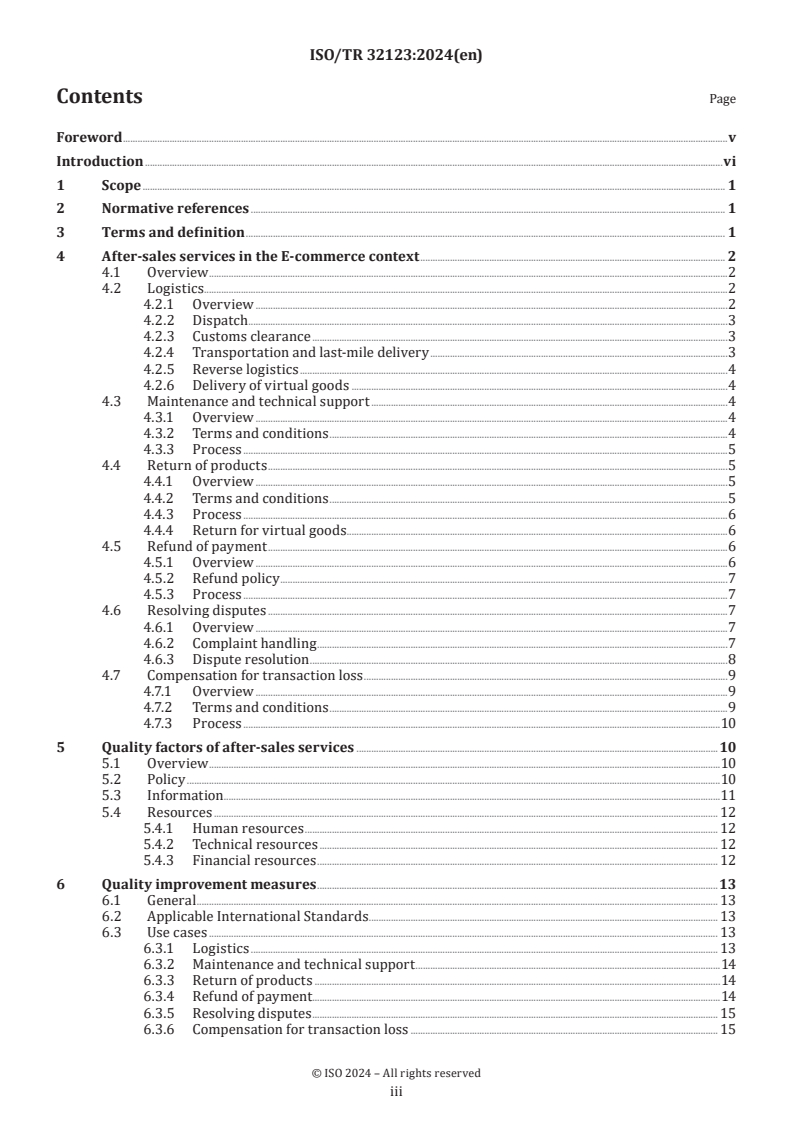
Contents Page
Foreword .v
Introduction .vi
1 Scope . 1
2 Normative references . 1
3 Terms and definition . 1
4 After-sales services in the E-commerce context . 2
4.1 Overview .2
4.2 Logistics . .2
4.2.1 Overview .2
4.2.2 Dispatch . .3
4.2.3 Customs clearance .3
4.2.4 Transportation and last-mile delivery .3
4.2.5 Reverse logistics .4
4.2.6 Delivery of virtual goods .4
4.3 Maintenance and technical support .4
4.3.1 Overview .4
4.3.2 Terms and conditions .4
4.3.3 Process .5
4.4 Return of products .5
4.4.1 Overview .5
4.4.2 Terms and conditions .5
4.4.3 Process .6
4.4.4 Return for virtual goods.6
4.5 Refund of payment .6
4.5.1 Overview .6
4.5.2 Refund policy .7
4.5.3 Process .7
4.6 Resolving disputes .7
4.6.1 Overview .7
4.6.2 Complaint handling .7
4.6.3 Dispute resolution .8
4.7 Compensation for transaction loss .9
4.7.1 Overview .9
4.7.2 Terms and conditions .9
4.7.3 Process .10
5 Quality factors of after-sales services .10
5.1 Overview .10
5.2 Policy .10
5.3 Information . .11
5.4 Resources . 12
5.4.1 Human resources . 12
5.4.2 Technical resources . 12
5.4.3 Financial resources . 12
6 Quality improvement measures .13
6.1 General . 13
6.2 Applicable International Standards . 13
6.3 Use cases . 13
6.3.1 Logistics . 13
6.3.2 Maintenance and technical support .14
6.3.3 Return of products .14
6.3.4 Refund of payment . .14
6.3.5 Resolving disputes . 15
6.3.6 Compensation for transaction loss . 15
iii
6.3.7 Seller rating .16
Bibliography . 17
iv
Foreword
ISO (the International Organization for Standardization) is a worldwide federation of national standards
bodies (ISO member bodies). The work of preparing International Standards is normally carried out through
ISO technical committees. Each member body interested in a subject for which a technical committee
has been established has the right to be represented on that committee. International organizations,
governmental and non-governmental, in liaison with ISO, also take part in the work. ISO collaborates closely
with the International Electrotechnical Commission (IEC) on all matters of electrotechnical standardization.
The procedures used to develop this document and those intended for its further maintenance are described
in the ISO/IEC Directives, Part 1. In particular, the different approval criteria needed for the different types
of ISO document should be noted. This document was drafted in accordance with the editorial rules of the
ISO/IEC Directives, Part 2 (see www.iso.org/directives).
ISO draws attention to the possibility that the implementation of this document may involve the use of (a)
patent(s). ISO takes no position concerning the evidence, validity or applicability of any claimed patent
rights in respect thereof. As of the date of publication of this document, ISO had not received notice of (a)
patent(s) which may be required to implement this document. However, implementers are cautioned that
this may not represent the latest information, which may be obtained from the patent database available at
www.iso.org/patents. ISO shall not be held responsible for identifying any or all such patent rights.
Any trade name used in this document is information given for the convenience of users and does not
constitute an endorsement.
For an explanation of the voluntary nature of standards, the meaning of ISO specific terms and expressions
related to conformity assessment, as well as information about ISO's adherence to the World Trade
Organization (WTO) principles in the Technical Barriers to Trade (TBT), see www.iso.org/iso/foreword.html.
This document was prepared by Technical Committee ISO/TC 321, Transaction assurance in E-commerce.
Any feedback or questions on this document should be directed to the user’s national standards body. A
complete listing of these bodies can be found at www.iso.org/members.html.
v
Introduction
The rapid development of E-commerce has significantly impacted buyers' shopping behaviours, and
intensified competition in the E-commerce market. Consequently, the quality of after-sales services
provided by E-commerce operators to buyers has become a critical factor in E-commerce transaction
assurance. Improving the quality of after-sales services is therefore crucial for buyers as it enhances their
satisfaction and trust in E-commerce transactions. It is also essential for E-commerce operators to maintain
a competitive edge.
In contrast to traditional after-sales services, E-commerce after-sales services are provided not only to
tangible goods but also to virtual goods. They can also compass a broader spectrum of activities, for example,
continuous customer support, automated refund processes, logistics tracking, etc. They can therefore
involve some new participants, such as E-commerce platform operators, logistic service providers, couriers
and technical support teams.
These new elements pose challenges to E-commerce after-sales services. The diversity of E-commerce after-
sales service activities can lead to inadequate policy development, causing buyers to be confused about
specific terms. The involvement of numerous participants can lead to inconsistencies in service quality,
including differences in delivery time, eligibility criteria for return and refund. The diversity of product
types can lead to disparate policies, resulting in issues such as difficulties with virtual goods refunds.
Providing sustained online support can lead to a deficit of customer service personnel, resulting in issues
such as delays in handling complaints.
This document analyses the core aspects of various E-commerce after-sales service activities, the factors
affecting service quality and the existing issues in after-sales services. This document also specifies
International Standards and use cases to help enhance service quality for after-sales services for E-commerce
operators.
vi
Technical Report ISO/TR 32123:2024(en)
Transaction assurance in E-commerce — After-sales services
1 Scope
This document provides information on the nature of after-sales services unique to E-commerce
transactions. It is a review of current practices across different platforms, an analysis of factors that impact
quality of after-sales services in E-commerce transactions and a description of possible means to enhance
after-sales services.
2 Normative references
There are no normative references in this document.
3 Terms and definition
For the purposes of this document, the following terms and definitions apply.
ISO and IEC maintain terminology databases for use in standardization at the following addresses:
— ISO Online browsing platform: available at https:// www .iso .org/ obp
— IEC Electropedia: available at https:// www .electropedia .org/
3.1
tangible goods
physical products or items that can be touched and seen
EXAMPLE Books, clothes, furniture, tools, equipment, appliances, cars, jewellery and more.
3.2
virtual goods
intangible assets that are not physically available but virtually present
EXAMPLE E-books, downloadable music, films, games and apps.
3.3
service
activity, or set of activities, provided for the benefit, or to meet the needs, of a buyer
EXAMPLE Service can include offline services and online services. Offline services include those delivered in real
life, such as travel services, hotel and event bookings. Online services include those delivered online, such as cloud
services, social media, communication, email and Skype.
[SOURCE: ISO/IEC Guide 76:2020, 3.11, modified — “consumer” has been replaced by “buyer”. Notes 1, 2, 3
and 4 to entry has been deleted, EXAMPLE has been added.]
3.4
E-commerce platform
e-marketplace
network information system that provides one or more services to interested parties to facilitate
E-commerce transactions
Note 1 to entry: Service can consist of information releasing, information delivery, data processing and transaction
information matching.
Note 2 to entry: Platform means application interface to provide E-commerce transactions in forms of websites and
mobile applications.
[SOURCE: ISO 32110:2023, 3.1.7]
3.5
E-commerce operator
individual or organization engaged in E-commerce
Note 1 to entry: E-commerce operator can be an E-commerce platform operator or a seller.
[SOURCE: ISO 32110:2023, 3.2.6]
3.6
E-commerce platform operator
organization that operates an E-commerce platform
[SOURCE: ISO 32110:2023, 3.2.7]
3.7
seller
individual or organization that sells products over open networks
Note 1 to entry: A seller can be a manufacturer or a retailer. When trading large volumes of goods for profit or business,
a seller can be a merchant.
Note 2 to entry: The definition of seller includes both for-profit and non-profit.
[SOURCE: ISO 32110:2023, 3.2.13]
4 After-sales services in the E-commerce context
4.1 Overview
After-sales services in E-commerce refer to the services and support provided by E-commerce operators
and related parties to meet the needs of buyers after purchase. Besides E-commerce operators, the involved
parties can include manufacturers, logistic service providers, third-party payment service providers, etc.
Based on current global E-commerce practices, after-sales services in E-commerce can include various
activities. For instance, when considered starting after product receipt, the main components of after-
sales services include maintenance and technical support, return of products, refund of payment, resolving
disputes and compensation for transaction loss. If they are considered to start after order placement,
additional activities in after-sales services can also encompass logistics.
After-sales service activities also differ across various products. For example, after-sales services for
tangible goods can encompass installation, maintenance, returns and exchanges, etc. This is in contrast to
virtual goods and services, which can include consultation, upgrades, training, etc.
To enhance the quality of E-commerce after-sales services, it is crucial to analyse and understand the
relevant factors that can have impacts on E-commerce activities and the quality of after-sales services.
4.2 Logistics
4.2.1 Overview
In E-commerce, timely delivery is critical for ensuring that orders are processed and fulfilled promptly and
accurately. Consequently, in some practices, logistics is viewed as a key after-sales activity that is essential
for buyer satisfaction. Key aspects related to logistics service quality can be found in the processes of
dispatch, customs clearance, transportation and last-mile delivery, and reverse logistics.
4.2.2 Dispatch
Dispatch refers to the process whereby purchased goods are picked from inventory and packaged for
shipment. The following aspects are important to the service quality:
a. Options for logistic service providers: Whether options for specifying logistic service providers are
available to buyers to select on the shopping order page or review page.
b. Packaging: Whether E-commerce operators or logistic service providers package goods with suitable
materials and label the package according to applicable rules. This can involve indicating precautions
such as fragile, hazardous items and instructions for buyers to check the condition of goods prior to
acceptance.
c. Dispatch time: Whether products are dispatched within a predefined time frame set by E-commerce
platform operators, sellers, or as agreed with the buyer.
d. Cost: Whether there is a provision for free shipping, or an estimated shipping fee is applied.
e. Notice of dispatch: Whether notification is provided by E-commerce platform operators, sellers or
logistic service providers, enabling buyers to track the status of their orders, including dispatch time,
the tracking number of the package, etc.
4.2.3 Customs clearance
Customs clearance refers to the process of complying with the requirements set by customs authorities for
importing and exporting goods across international borders. The following aspects are important to the
service quality:
a. Information availability: Whether E-commerce operators provide clear instructions on what
information is to be submitted for customs clearance (e.g. common customs clearance types, buyers ID)
and how they can be submitted (e.g. “Single Window” for international trade).
b. Customs brokerage services: Whether E-commerce operators offer the option of utilizing customs
brokers who are experts in the customs clearance process to expedite the delivery of goods to buyers.
Customs brokers assist in preparing the necessary documentation (commercial invoices, certificates
of origin, waybills, packing lists, import contracts, any necessary certifications or permits, etc.),
coordinating inspections, and facilitating communication between sellers, buyers, and customs
authorities. Additionally, whether E-commerce platform operators or related entities offer customs
brokerage services to buyers on their E-commerce platforms or similar platforms.
c. Customs clearance tracking: Whether E-commerce platform operators integrate tracking capabilities
that enable sellers and buyers to track the progress of shipments through the customs clearance process.
Furthermore, whether E-commerce platform operators provide effective communication channels to
address any customs-related inquiries or issues.
4.2.4 Transportation and last-mile delivery
Transportation and last-mile delivery involve the transportation of goods from the warehouse to the buyer.
The following aspects are important to the service quality:
a. Transportation mode selection: Whether the logistic service providers have the flexibility to select the
appropriate mode (such as ground, air, or sea) and equipment (such as cold-chain transportation) of
transportation based on factors like buyer location, package size and delivery requests.
b. Shipping options: Whether a range of shipping options is offered to buyers to suit their preferences and
needs. Options can include standard shipping, expedited shipping, same-day delivery or in-store pickup
options.
c. Logistics tracking: Whether logistic service providers offer real-time tracking updates to enable buyers
to track the status of their shipments and predict delivery times.
d. Communication channel: Whether E-commerce platform operators provide effective communication
channels for buyers to address issues such as damaged goods, loss shipping, or discrepancies in
quantities through communication with E-commerce operators.
4.2.5 Reverse logistics
Reverse logistics refers to the coordination of returned goods from buyers back to the seller, as well as
the proper handling of those goods. The aspects that affect the service quality of reverse logistics include
customs clearance (see 4.2.3), transportation (see 4.2.4), and additional elements as follows:
a. Cost: Whether buyers are offered free reverse logistics service or clearly informed of any additional
costs, such as freight or storage fees, and whether this information is provided before purchase
transaction or at another suitable time.
b. Reverse logistics tracking: Whether E-commerce platform operators or logistic service providers offer
services that allow buyers to track the movement and status of their returned items.
c. Packaging: Whether logistic service providers package goods with suitable materials to protect the
goods from damage during transportation.
4.2.6 Delivery of virtual goods
Delivery of virtual goods differs from tangible goods, as it involves electronic transfer of digital products or
services to buyers. The following aspect are important to the service quality:
a. Delivery method: Depending on the nature of the virtual goods, virtual goods can be delivered through
various methods. This can involve accessing an online platform, downloading directly through
applications, or receiving license keys, activation codes, or login details.
b. Validity: Whether the validity period of the virtual goods is clearly communicated to buyers on the
product detail page, including the start and end dates. Whether buyers are given instructions on how to
utilize the virtual goods, prompting them to download or use them accordingly.
4.3 Maintenance and technical support
4.3.1 Overview
Maintenance and technical support involve ongoing efforts to keep the product functioning properly.
Maintenance refers to preserving or restoring a product’s ability to perform its intended functions, which
can involve repairing or replacing components. Technical support refers to helping buyers correctly utilize
the product, including providing guidance in installation. E-commerce operators usually offer maintenance
and technical support for products via warranty services.
In E-commerce, warranties can be offered by various participants involved in the online retail process.
Manufacturers and sellers serve as the primary warranty providers, ensuring the quality and functionality
of products. E-commerce platform operators can also extend warranty services for products sold on their
platform. This can augment the warranty services provided by the manufacturer or seller, prolong the
warranty period, or include additional services. The key aspects in the warranty include its terms and
conditions, as well as the processes involved.
4.3.2 Terms and conditions
The terms and conditions of a warranty in E-commerce vary across the product and the warranty providers.
Typically, these terms are accessible on the product detail page of the E-commerce platform, enabling buyers
to review them before making a purchase. The following aspects are important to the service quality:
a. Warranty coverage: Whether manufacturers or sellers explicitly state what is included under the
warranty. This includes detailing which components or parts are covered, as well as any restrictions or
exclusions.
b. Warranty duration: Whether the warranty duration is clearly defined and if it is a fixed or a
predetermined period, such as from the date of purchase or installation. Whether this information is
published at a prominent place on the E-commerce platform for the ease and convenience of the buyer.
c. Warranty cost: Whether the responsibility for costs associated with the warranty claim is clearly
delineated, including shipping fees and any applicable deductions or fees for the buyer.
d. Warranty extension and renewal: Whether E-commerce operators provide details on the process,
associated costs, and additional conditions for extending or renewing the warranty.
4.3.3 Process
In E-commerce, the warranty process involves the buyer initiating a warranty claim and the E-commerce
operator promptly addressing it upon receiving the necessary details. The following aspects are important
to the service quality:
a. Claim channels: Whether E-commerce operators specify the methods for initiating the warranty claim,
including through the E-commerce platform's website or app, or direct communication via email or
online chat.
b. Documentation requirements: Whether sellers clearly communicate the documentation needed from
the buyers, such as proof of purchase, or visual evidence of defects. Upon receiving the necessary
information, sellers can evaluate and proceed with the claim.
c. Resolution methods: Whether E-commerce operators offer solutions that adhere to warranty terms
and align with the buyer’s preference, such as repairing or replacing the defective product, issuing a
refund, or providing alternative compensation. Furthermore, whether E-commerce operators explain
the process for various warranty approaches and aim to resolve warranty claims within a reasonable
time frame.
d. Process status: Whether E-commerce operators enable buyers to track the warranty progress through
tracking tools. Moreover, whether E-commerce operators promptly respond to any warranty-related
inquiries or concerns from buyers.
4.4 Return of products
4.4.1 Overview
In E-commerce, product returns refer to the process of a buyer sending back a purchased item to the
E-commerce operators for various reasons, such as receiving a damaged or defective item, dissatisfaction
with the purchase. Depending on the buyer’s preference, product returns can be categorized as direct return
and exchanges. Direct returns involve the buyer sending the purchased product back to the seller, who
then refunds all or part of the purchased price to the buyer. Exchange refers to the buyer's desire to replace
the originally purchased item with an alternative forgoing a refund. Buyers typically initiate returns or
exchanges in accordance with the applicable rules and policies of the E-commerce operators. The key aspects
involved in product returns include terms and conditions, return processes, and returns for virtual goods.
4.4.2 Terms and conditions
The terms and conditions of returns and exchanges in E-commerce vary by types of goods or service.
These policies are accessible on the E-commerce platform’s website, enabling buyers to review them before
making a purchase. By placing an order, the buyer implicitly agrees to the terms, establishing a contractual
agreement with the seller. For certain types of goods, sellers explicitly state the specific conditions for
returns and exchanges in a prominent position on the product detail page. The following aspects are
important to the service quality:
a. Eligibility criteria: Whether the acceptable condition for items being returned or exchanged are clearly
defined. This can stipulate that the goods are in their original packaging, unused, undamaged, and in
resalable condition, except in cases where specific exceptions or limitations apply, such as product
recalls due to safety, quality, regulatory, or other reasons.
b. Time frame: Whether E-commerce operators specify the deadlines for returns or exchanges.
c. Return and exchange instruction: Whether E-commerce platform operators clearly display the detailed
steps for returns and exchanges in a prominent position, enabling both sellers and buyers to follow the
process, thereby facilitating the handling of returns and exchanges.
4.4.3 Process
The return or exchange process involves the buyer initiating the procedure on the E-commerce platform,
with sellers promptly processing the request upon receiving necessary information and facilitating the
return, exchange, or refund accordingly. The following aspects are important to the service quality:
a. Claim initiation options: Whether E-commerce operators offer buyers clear options for initiating a
return or exchange, such as through a customer service hotline, email, or online chats.
b. Documentation requirements: Whether E-commerce operators clearly inform buyers of the necessary
information to provide, including the reason for the return or exchange, order number, packaging
condition and damaging condition, etc.
c. Process status updates: Whether E-commerce operators provide buyers with timely updates on each
stage of the return or exchange process, including acceptance of the claim, receipt of returned goods,
and confirmation of eligibility.
d. Logistics tracking: Whether E-commerce platform operators provide buyers with real-time logistics
tracking information to trace the movement of their items.
e. Resolution options: Whether sellers implement solutions tailored to buyer needs, such as issuing
refunds to the original payment method, offering discount coupons, or facilitating an exchange with the
requested or alternative goods.
f. Methods of communication: Whether E-commerce platform operators establish effective communication
channels between sellers and buyers, ensuring that sellers keep buyers informed about the claim’s
progress, any delays or issues, and the final resolution. Timely and transparent communication helps
maintain buyer satisfaction and trust.
g. Time frame: Whether sellers adhere to the specific timelines set by E-commerce platform policies
to ensure a smooth and efficient process. Whether buyers can remind sellers to handle returns or
exchanges promptly according to these timelines.
4.4.4 Return for virtual goods
In general, virtual goods and services are considered distinct products, with agreements between sellers
and buyers based on their specific characteristics. In case of seller error, communication and negotiation can
be pursued for return or exchange of products. The following aspects are important to the service quality:
a. Resolution options: Whether the seller offers a range of options for buyers, including return, partial
return and exchange.
b. Documentation requirements: Whether buyers supply the seller with the necessary information
for returns, partial refunds, or exchange (e.g. evidence of cancelled flights or unused virtual goods).
Additionally, whether buyers can clearly communicate their specific needs for product exchanges, such
as adjusting the hotel check-in dates or extending the validity of virtual goods.
4.5 Refund of payment
4.5.1 Overview
Refunds refer to the process of reimbursing or repaying the price paid by the buyers for a product. It involves
fully or partially return of payment due to product returns, order cancellation, or dissatisfaction with goods
or services. The key processes involved in the refund process include the refund policy and the steps for
processing refunds.
4.5.2 Refund policy
E-commerce platform operators typically establish refund policies that define the conditions under which
refunds are granted, and sellers can provide additional details on the refund conditions if the policy is met.
Refund policies are typically accessible on the E-commerce platform, allowing buyers to review the terms
before making a purchase. The following aspects are important to the service quality:
a. Eligibility criteria: Whether sellers articulate what conditions are deemed acceptable for a refund. This
can encompass the product’s condition (unused, unopened, or undamaged), the presence of original
packaging, the inclusion of accessories, and the procedures for initiating a refund.
b. Time frame: Whether sellers indicate specific timelines within which buyers can request a refund. This
time frame can vary based the product type. Whether buyers are aware of this time frame and to initiate
the refund process within the designated period.
4.5.3 Process
The refund process involves the prompt response of E-commerce operators or third-party payment service
providers upon receiving a buyer’s refund request and ensuring the settlement of such refund within a
reasonable timeframe. The following aspects are important to the service quality:
a. Options of claim initiation: Whether E-commerce platform operators provide buyers with options to
initiate a refund or describe the method by which buyers can initiate a refund. After a buyer submits
a refund claim, if the seller fails to process it within the specified timeline, the E-commerce platform
operator can assist the buyer with contacting the seller and can oversee the seller to ensure prompt
processing.
b. Documentation requirements: Whether sellers notify buyers of the relevant information they need to
provide, such as the reason for the refund request and the order number.
c. Refund method: Whether sellers agree to issue the refund to the buyer by agreement via methods such
as credit card or bank transfer. The specific timeline for refund processing can vary based on factors like
payment method and processing capacity. Whether the buyer is informed of the estimated refund time.
d. Refund process status: Whether sellers provide timely updates to buyers on the stages of processing
throughout the refund claim process. This can include the approval of the refund, any delays, and
successful refunds, etc.
4.6 Resolving disputes
4.6.1 Overview
Complaints handling and dispute resolution are distinct yet interconnected processes for addressing buyer
issues and resolving conflicts in E-commerce transactions. Complaints handling focuses on enabling sellers
to understand and address buyers’ concerns, aiming to provide immediate relief or resolution at an early
stage to prevent escalations. Disputes resolution refers to a situation where the buyer’s dissatisfaction
remains unresolved after complaints handling by the seller, necessitating a third party to find a mutually
acceptable solution.
4.6.2 Complaint handling
4.6.2.1 Overview
Complaint handling refers to the procedures and processes followed by an online seller to address and resolve
buyer complaints or concerns. It involves actively listening to buyer grievances, thoroughly investigating the
relevant issues, and providing appropriate solutions or remedies to ensure buyer satisfaction. Effectively
handling of complaints in E-commerce is crucial for maintaining buyer trust, loyalty, and satisfaction. The
key aspects involved in complaint handling include mechanisms and processes.
4.6.2.2 Mechanism
In E-commerce, the seller establishes a mechanism for handling complaints to address buyers’ dissatisfaction
or demands in E-commerce transactions. The policies for handling complaints, detailed complaint process,
and other relevant documents are prominently displayed for buyers to consult when they have a complaint.
The following aspects are important to the service quality:
a. Policies for handling complaints: Whether E-commerce platform operators establish uniform policies
for handling complaints and publicly displays them in a prominent position. Whether the sellers on the
E-commerce platform adhere to the relevant requirements during the complaint handling process.
b. Complaint channels: Whether sellers have explained how the buyer can initiate the complaint, such as
through online chat, online complaint form, email address for receiving the complaint, etc. Whether
buyers are informed of any additional information they need to provide.
4.6.2.3 Process
Complaint handling process refers to seller’s prompt response and resolution following the receipt of the
buyer’s complaint, which can be detailed in the platform’s terms and conditions, a dedicated claims policy
page or an online dispute resolution (ODR) platform. The following aspects are related to the service quality:
a. Complaint acknowledgement: Whether sellers confirm the receipt of the complaint and clarify the
buyer's expectation.
b. Complaint resolution: Whether sellers offer buyers suitable remedies, including refunds, replacement,
gift coupons, etc.
c. Process status update: Whether sellers offer a tracking mechanism for buyers to track the progress,
including details such as the complaint acknowledgement, the buyer’s submitted materials and claims,
and the projected timeline.
d. Time frame: Whether sellers address within an acceptable time frame to prevent escalation of issues
and preserve buyer satisfaction and trust.
4.6.3 Dispute resolution
4.6.3.1 Overview
Dispute resolution refers to the systematic approach to resolve conflicts or disagreements that emerge
in online transactions between buyers and sellers, such as issues with undelivered or defective products,
payment disputes, shipping problems, inaccurate item descriptions and miscommunication, or any disputes
occurring within an E-commerce transaction. ODR is a mechanism that facilitates dispute resolution online.
1)
See ISO 32122 for further details on ODR.
E-commerce platform operators address potential issues promptly and equitably using effective dispute
resolution protocols, minimize the occurrence of disputes, ensure buyer satisfaction, and promote a secure
online marketplace environment. The key aspects involved in dispute resolution include mechanisms and
processes.
1) Under preparation. Stage at the time of publication: ISO/FDIS 32122.
4.6.3.2 Mechanism
E-commerce platform operators establish a dispute resolution mechanism to address disputes between
buyers and sellers. The following aspects are important to the service quality:
a. Dispute resolution policy: Whether the policies for dispute resolution are clearly defined and
prominently displayed for dispute resolvers, including customer service personnel, to adhere to these
policy requirements and facilitate the resolution of disputes for buyers.
b. Dispute resolution channels: Whether E-commerce platform operators provide accessible and
user-friendly dispute resolution channels for reporting disputes and supporting clear and timely
communication, such as contacting customer service or utilizing the ODR platform. Whether E-commerce
platform operators prioritize mediation or nego
...