

IEC 63119-2:2022
(Main)Information exchange for electric vehicle charging roaming service - Part 2: Use cases
General Information
- Abstract
IEC 63119-2:2022 specifies roaming use cases of information exchange between EV charging service providers (CSP), charging station operators (CSOs) and clearing house platforms through roaming endpoints. The elementary use cases defined in this document are designed to support the user to have access to the EV supply equipment which does not belong to the home-CSP.
IEC 63119 (all parts) is applicable to high-level communication involved in information exchange/interaction between different CSPs, as well as between a CSP and CSO with or without clearing house platform through the roaming endpoint.
IEC 63119 (all parts) does not specify the communication either between charging station (CS) and charging station operator (CSO) or between EV and CS.
- Status
- Published
- Publication Date
- 17-Oct-2022
- Technical Committee
- TC 69 - Electrical power/energy transfer systems for electrically propelled road vehicles and industrial trucks
- Drafting Committee
- WG 9 - TC 69/WG 9
- Current Stage
- PPUB - Publication issued
- Start Date
- 18-Oct-2022
- Completion Date
- 04-Nov-2022
Overview
IEC 63119-2:2022 is an international standard developed by the International Electrotechnical Commission (IEC) that specifies use cases related to information exchange for electric vehicle (EV) charging roaming services. This part of the IEC 63119 series focuses on defining roaming use cases that enable communication between charging service providers (CSPs), charging station operators (CSOs), and clearing house platforms via roaming endpoints. The standard facilitates interoperability and user access to EV supply equipment belonging to different operators beyond the user’s home CSP.
As electric vehicle adoption grows globally, seamless roaming services become essential to provide EV drivers with convenient access to charging stations across various networks. IEC 63119-2:2022 supports this by outlining practical use cases necessary to enable effective information exchange, session management, and transactional processes during roaming.
Key Topics
Use Case Hierarchy
The standard organizes use cases in a hierarchical structure, grouped by functional areas to ensure clarity and practical application.System Architecture and Actors
Identification of key actors such as CSPs, CSOs, and clearing houses, and their roles in data exchange and service execution.General Information Exchange
Includes platform authentication, sharing site information, and exchanging real-time status of charging spots.Tariff and Pricing Information
Procedures for informing home CSPs about tariffs and requesting pricing from visited CSOs.Energy Transfer Management
Detailed use cases on starting and stopping charging sessions remotely or locally, managing charging plans, and reserving EV supply equipment.Credentials Handling
Supports online and offline user identification mechanisms for authentication at visited sites.Supporting Functions
Maintenance notifications, outage management, and emergency cable unlocking to ensure user safety and system reliability.Cybersecurity and Privacy
Requirements for secure data transmission, role identification, information privacy protection, encryption key management, and data sharing principles are outlined to safeguard communication.Unique Identifiers and Session Management
Use of global unique identifiers and management of sessions and transactions to ensure consistent and reliable interactions between actors.
Applications
IEC 63119-2:2022 directly supports the development and deployment of interoperable EV charging roaming services worldwide. Practical applications include:
- Enabling EV drivers to access charging stations outside their home network effortlessly.
- Facilitating real-time exchange of site availability and status information for reliable charging experiences.
- Supporting dynamic tariff information exchange for transparent pricing during roaming sessions.
- Allowing multiple actors such as CSPs, CSOs, and clearing houses to coordinate during charging sessions, billing, and settlements.
- Ensuring secure communication that protects user identity and transaction data in roaming scenarios.
- Providing emergency support functions such as cable unlocking to prevent user inconvenience or safety hazards.
- Integrating new identification methods such as QR codes or RFID cards for streamlined user authentication.
This standard is especially valuable for EV charging network operators, roaming platform providers, software developers, and policymakers seeking to establish interoperable charging infrastructures compliant with international practices.
Related Standards
IEC 63119-2:2022 fits within the broader IEC 63119 series, which addresses information exchange for EV charging roaming services at a high communication level. Relevant standards related to electric vehicle charging communications also include:
- IEC 63110 - Protocol for management of electric vehicle charging and discharging infrastructures.
- ISO 15118 - Vehicle-to-grid communication interface enabling advanced charging functionalities.
- IEC 61850 - Communication networks and systems in substations, relevant for electrical interfaces supporting EV charging.
- OCPP (Open Charge Point Protocol) - Widely adopted protocol for communication between charging stations and management systems.
Combining IEC 63119-2:2022 with related standards ensures comprehensive interoperability and user-centric roaming experiences in the evolving EV charging ecosystem.
Adopting IEC 63119-2:2022 enables stakeholders to establish robust, secure, and user-friendly roaming services across multiple EV charging networks, significantly enhancing the usability and accessibility of electric vehicle infrastructure worldwide.
Get Certified
Connect with accredited certification bodies for this standard

TÜV Rheinland
TÜV Rheinland is a leading international provider of technical services.

TÜV SÜD
TÜV SÜD is a trusted partner of choice for safety, security and sustainability solutions.

DEKRA Certification Inc.
DEKRA US certification services.
Sponsored listings
Frequently Asked Questions
IEC 63119-2:2022 is a standard published by the International Electrotechnical Commission (IEC). Its full title is "Information exchange for electric vehicle charging roaming service - Part 2: Use cases". This standard covers: IEC 63119-2:2022 specifies roaming use cases of information exchange between EV charging service providers (CSP), charging station operators (CSOs) and clearing house platforms through roaming endpoints. The elementary use cases defined in this document are designed to support the user to have access to the EV supply equipment which does not belong to the home-CSP. IEC 63119 (all parts) is applicable to high-level communication involved in information exchange/interaction between different CSPs, as well as between a CSP and CSO with or without clearing house platform through the roaming endpoint. IEC 63119 (all parts) does not specify the communication either between charging station (CS) and charging station operator (CSO) or between EV and CS.
IEC 63119-2:2022 specifies roaming use cases of information exchange between EV charging service providers (CSP), charging station operators (CSOs) and clearing house platforms through roaming endpoints. The elementary use cases defined in this document are designed to support the user to have access to the EV supply equipment which does not belong to the home-CSP. IEC 63119 (all parts) is applicable to high-level communication involved in information exchange/interaction between different CSPs, as well as between a CSP and CSO with or without clearing house platform through the roaming endpoint. IEC 63119 (all parts) does not specify the communication either between charging station (CS) and charging station operator (CSO) or between EV and CS.
IEC 63119-2:2022 is classified under the following ICS (International Classification for Standards) categories: 43.120 - Electric road vehicles. The ICS classification helps identify the subject area and facilitates finding related standards.
IEC 63119-2:2022 is available in PDF format for immediate download after purchase. The document can be added to your cart and obtained through the secure checkout process. Digital delivery ensures instant access to the complete standard document.
Standards Content (Sample)
IEC 63119-2 ®
Edition 1.0 2022-10
INTERNATIONAL
STANDARD
NORME
INTERNATIONALE
colour
inside
Information exchange for electric vehicle charging roaming service –
Part 2: Use cases
Échange d'informations pour le service d'itinérance de la recharge des véhicules
électriques –
Partie 2: Cas d'utilisation
All rights reserved. Unless otherwise specified, no part of this publication may be reproduced or utilized in any form
or by any means, electronic or mechanical, including photocopying and microfilm, without permission in writing from
either IEC or IEC's member National Committee in the country of the requester. If you have any questions about IEC
copyright or have an enquiry about obtaining additional rights to this publication, please contact the address below or
your local IEC member National Committee for further information.
Droits de reproduction réservés. Sauf indication contraire, aucune partie de cette publication ne peut être reproduite
ni utilisée sous quelque forme que ce soit et par aucun procédé, électronique ou mécanique, y compris la photocopie
et les microfilms, sans l'accord écrit de l'IEC ou du Comité national de l'IEC du pays du demandeur. Si vous avez des
questions sur le copyright de l'IEC ou si vous désirez obtenir des droits supplémentaires sur cette publication, utilisez
les coordonnées ci-après ou contactez le Comité national de l'IEC de votre pays de résidence.
IEC Secretariat Tel.: +41 22 919 02 11
3, rue de Varembé info@iec.ch
CH-1211 Geneva 20 www.iec.ch
Switzerland
About the IEC
The International Electrotechnical Commission (IEC) is the leading global organization that prepares and publishes
International Standards for all electrical, electronic and related technologies.
About IEC publications
The technical content of IEC publications is kept under constant review by the IEC. Please make sure that you have the
latest edition, a corrigendum or an amendment might have been published.
IEC publications search - webstore.iec.ch/advsearchform IEC Products & Services Portal - products.iec.ch
The advanced search enables to find IEC publications by a Discover our powerful search engine and read freely all the
variety of criteria (reference number, text, technical publications previews. With a subscription you will always
committee, …). It also gives information on projects, replaced have access to up to date content tailored to your needs.
and withdrawn publications.
Electropedia - www.electropedia.org
IEC Just Published - webstore.iec.ch/justpublished
The world's leading online dictionary on electrotechnology,
Stay up to date on all new IEC publications. Just Published
containing more than 22 300 terminological entries in English
details all new publications released. Available online and
and French, with equivalent terms in 19 additional languages.
once a month by email.
Also known as the International Electrotechnical Vocabulary
(IEV) online.
IEC Customer Service Centre - webstore.iec.ch/csc
If you wish to give us your feedback on this publication or
need further assistance, please contact the Customer Service
Centre: sales@iec.ch.
A propos de l'IEC
La Commission Electrotechnique Internationale (IEC) est la première organisation mondiale qui élabore et publie des
Normes internationales pour tout ce qui a trait à l'électricité, à l'électronique et aux technologies apparentées.
A propos des publications IEC
Le contenu technique des publications IEC est constamment revu. Veuillez vous assurer que vous possédez l’édition la
plus récente, un corrigendum ou amendement peut avoir été publié.
Recherche de publications IEC - IEC Products & Services Portal - products.iec.ch
webstore.iec.ch/advsearchform Découvrez notre puissant moteur de recherche et consultez
La recherche avancée permet de trouver des publications IEC gratuitement tous les aperçus des publications. Avec un
en utilisant différents critères (numéro de référence, texte, abonnement, vous aurez toujours accès à un contenu à jour
comité d’études, …). Elle donne aussi des informations sur adapté à vos besoins.
les projets et les publications remplacées ou retirées.
Electropedia - www.electropedia.org
IEC Just Published - webstore.iec.ch/justpublished
Le premier dictionnaire d'électrotechnologie en ligne au
Restez informé sur les nouvelles publications IEC. Just
monde, avec plus de 22 300 articles terminologiques en
Published détaille les nouvelles publications parues.
anglais et en français, ainsi que les termes équivalents dans
Disponible en ligne et une fois par mois par email.
19 langues additionnelles. Egalement appelé Vocabulaire
Electrotechnique International (IEV) en ligne.
Service Clients - webstore.iec.ch/csc
Si vous désirez nous donner des commentaires sur cette
publication ou si vous avez des questions contactez-nous:
sales@iec.ch.
IEC 63119-2 ®
Edition 1.0 2022-10
INTERNATIONAL
STANDARD
NORME
INTERNATIONALE
colour
inside
Information exchange for electric vehicle charging roaming service –
Part 2: Use cases
Échange d'informations pour le service d'itinérance de la recharge des véhicules
électriques –
Partie 2: Cas d'utilisation
INTERNATIONAL
ELECTROTECHNICAL
COMMISSION
COMMISSION
ELECTROTECHNIQUE
INTERNATIONALE
ICS 43.120 ISBN 978-2-8322-5829-3
– 2 – IEC 63119-2:2022 © IEC 2022
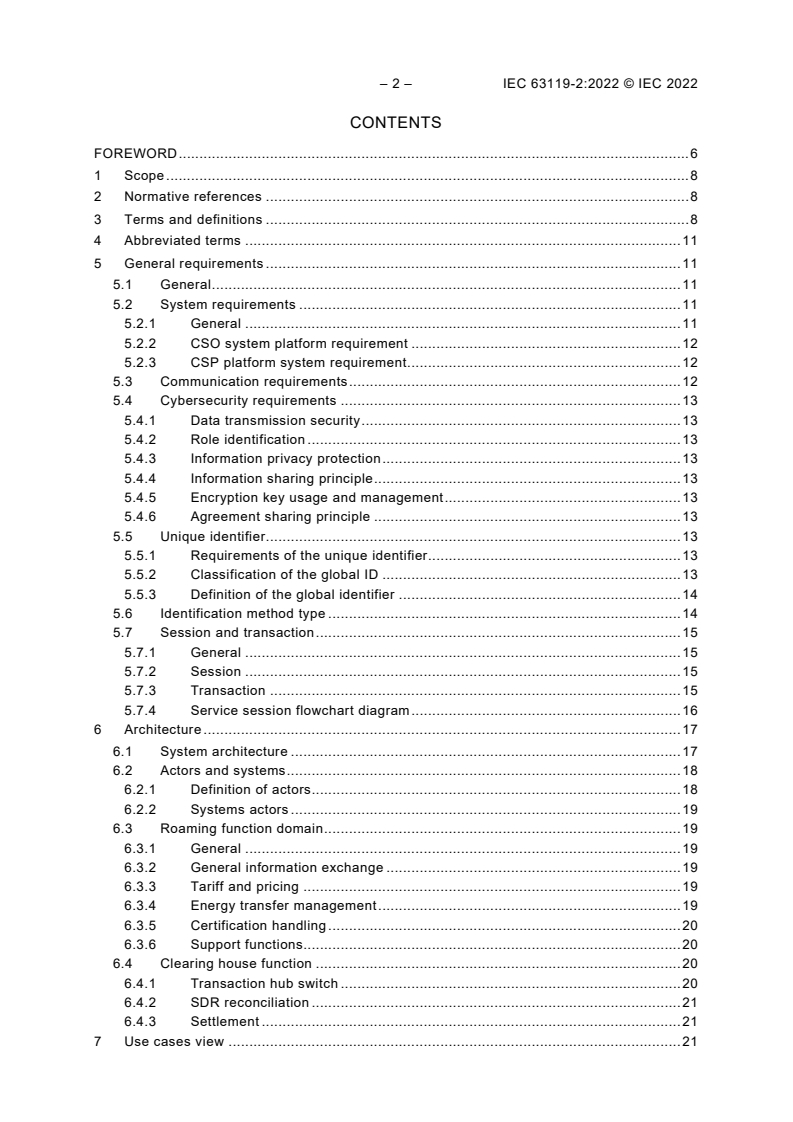
CONTENTS
FOREWORD . 6
1 Scope . 8
2 Normative references . 8
3 Terms and definitions . 8
4 Abbreviated terms . 11
5 General requirements . 11
5.1 General . 11
5.2 System requirements . 11
5.2.1 General . 11
5.2.2 CSO system platform requirement . 12
5.2.3 CSP platform system requirement . 12
5.3 Communication requirements . 12
5.4 Cybersecurity requirements . 13
5.4.1 Data transmission security . 13
5.4.2 Role identification . 13
5.4.3 Information privacy protection . 13
5.4.4 Information sharing principle . 13
5.4.5 Encryption key usage and management . 13
5.4.6 Agreement sharing principle . 13
5.5 Unique identifier . 13
5.5.1 Requirements of the unique identifier. 13
5.5.2 Classification of the global ID . 13
5.5.3 Definition of the global identifier . 14
5.6 Identification method type . 14
5.7 Session and transaction . 15
5.7.1 General . 15
5.7.2 Session . 15
5.7.3 Transaction . 15
5.7.4 Service session flowchart diagram . 16
6 Architecture . 17
6.1 System architecture . 17
6.2 Actors and systems . 18
6.2.1 Definition of actors. 18
6.2.2 Systems actors . 19
6.3 Roaming function domain . 19
6.3.1 General . 19
6.3.2 General information exchange . 19
6.3.3 Tariff and pricing . 19
6.3.4 Energy transfer management . 19
6.3.5 Certification handling . 20
6.3.6 Support functions. 20
6.4 Clearing house function . 20
6.4.1 Transaction hub switch . 20
6.4.2 SDR reconciliation . 21
6.4.3 Settlement . 21
7 Use cases view . 21
7.1 Use case hierarchy diagram . 21
7.2 Use case hierarchy layer . 22
7.2.1 Use case groups . 23
7.2.2 Use case list . 24
8 Use cases . 26
8.1 General information exchange . 26
8.1.1 UC1-1 Platform authentication . 26
8.1.2 UC1-2 Sites information exchange . 28
8.1.3 UC1-3 Sharing dynamic status of EV supply equipment . 29
8.2 Tariff and pricing . 30
8.2.1 UC2-1 Inform home-CSP on tariff information . 30
8.2.2 UC2-2 home-CSP request tariffs from visited-CSO . 31
8.3 Energy transfer management . 31
8.3.1 UC3-1 Start charging roaming locally at the EV supply equipment . 31
8.3.2 UC3-2 Start charging roaming remotely from home-CSP. 33
8.3.3 UC3-3 Start charging roaming by PnC . 35
8.3.4 UC3-4 Stop energy transfer session via home-CSP . 37
8.3.5 UC3-5 Complete a charging service transaction in a roaming scenario . 38
8.3.6 UC3-6 Collect dynamic charging information. 38
8.3.7 UC3-7 Charge plan exchange . 39
8.3.8 UC3-8 Reservation of an EV supply equipment . 40
8.3.9 UC3-9 SDR information exchange . 42
8.3.10 UC3-10 Update charge plan by visited-CSO . 43
8.4 Credentials handling . 43
8.4.1 UC4-1 Support online identification of the user at a visited-CSO . 43
8.4.2 UC4-2 Pre-distribution of information for offline identification of the user
at a visited-CSO . 45
8.5 Supporting functions . 45
8.5.1 UC5-1 Maintenance/outage information . 45
8.5.2 UC5-2 Emergency cable unlocking after charging service activated . 47
8.5.3 UC5-3 Emergency cable unlocking for charging service activation failed . 48
Annex A (informative) Roaming scenarios . 50
A.1 Roaming scenario 1 – Roaming by using QR code scanning . 50
A.1.1 Roaming scenario description . 50
A.1.2 Roaming scenario business sequence diagram . 51
A.1.3 List of elementary use cases . 52
A.2 Roaming scenario 2 – Charging site navigation service . 53
A.2.1 Roaming scenario description . 53
A.2.2 Roaming scenario business sequence diagram . 53
A.3 Roaming scenario 3 – Roaming by using RFID card . 53
A.3.1 Roaming scenario description . 53
A.3.2 List of elementary use cases . 54
Annex B (informative) Service session data . 55
B.1 Service session data diagram . 55
B.2 SDR general structure. 56
Bibliography . 57
Figure 5-1 – Service session structure . 15
– 4 – IEC 63119-2:2022 © IEC 2022
Figure 5-2 – Relationship between session and transaction . 16
Figure 5-3 – Diagram of service session . 17
Figure 6-1 – System architecture . 18
Figure 6-2 – Clearing house function . 20
Figure 6-3 – Clearing house . 21
Figure 7-1 – Use case hierarchy diagram . 22
Figure 7-2 – Use case hierarchy diagram of charging roaming . 23
Figure 7-3 – Use domain overview of the 1-Layer in the hierarchy diagram . 24
Figure 7-4 – Use case groups overview . 24
Figure 8-1 – Use case sequence diagram for platform authentication . 28
Figure 8-2 – Use case sequence diagram for Start charging roaming locally at the EV
supply equipment . 33
Figure 8-3 – Use case sequence diagram for Start charging roaming remotely from
home-CSP . 35
Figure 8-4 – Use case sequence diagram for Start charging roaming by PnC . 37
Figure A.1.1 – Roaming by using QR code scanning . 50
Figure A.1.2 – Sequence diagram . 52
Figure A.2.1 – Charging site navigation service . 53
Figure B.1 – Data diagram of service session . 55
Table 1 – System actor categories . 12
Table 2 – Structure of the global identifier . 14
Table 3 – Definition of the global identifier syntax . 14
Table 4 – Session categories . 15
Table 5 – Definition of actors . 18
Table 6 – Use case group index and description . 23
Table 7 – Use case list . 25
Table 8 – Use case description for platform authentication . 26
Table 9 – Use case description for Sites information exchange . 28
Table 10 – Use case description for sharing dynamic status of EV supply equipment . 29
Table 11 – Use case description for Inform home-CSP on tariff information . 30
Table 12 – Use case description for home-CSP request tariffs from visited-CSO . 31
Table 13 – Use case description for Start charging roaming locally at the EV supply
equipment . 31
Table 14 – Use case description for Start charging roaming remotely from home-CSP . 34
Table 15 – Use case description for Start charging roaming by PnC . 36
Table 16 – Use case description for Stop energy transfer session via home-CSP . 37
Table 17 – Use case description for Complete a charging service transaction in a
roaming scenario . 38
Table 18 – Use case description for Collect dynamic charging information . 39
Table 19 – Use case description for Charge plan exchange . 40
Table 20 – Use case description for Reservation of an EV supply equipment . 40
Table 21 – Use case description for SDR information exchange . 42
Table 22 – Use case description for Update charge plan by visited-CSO . 43
Table 23 – Use case description for Support online identification of the user at a
visited-CSO . 44
Table 24 – Use case description for Pre-distribution of information for offline
identification of the user at a visited-CSO . 45
Table 25 – Use case description for Maintenance/outage information . 46
Table 26 – Use case description for Emergency cable unlocking after charging service
activated . 47
Table 27 – Use case description for Emergency cable unlocking for charging service
activation failed . 48
Table A.1 – Roaming scenario: peer-to-peer roaming by scanning EV supply
equipment QR code . 51
Table A.2 – Elementary use cases . 52
Table A.3 – Peer-to-peer roaming for charging service using RFID card . 53
Table A.4 – Elementary use cases . 54
Table B.1 – SDR general structure . 56
– 6 – IEC 63119-2:2022 © IEC 2022
INTERNATIONAL ELECTROTECHNICAL COMMISSION
____________
INFORMATION EXCHANGE FOR ELECTRIC
VEHICLE CHARGING ROAMING SERVICE –
Part 2: Use cases
FOREWORD
1) The International Electrotechnical Commission (IEC) is a worldwide organization for standardization comprising
all national electrotechnical committees (IEC National Committees). The object of IEC is to promote international
co-operation on all questions concerning standardization in the electrical and electronic fields. To this end and
in addition to other activities, IEC publishes International Standards, Technical Specifications, Technical Reports,
Publicly Available Specifications (PAS) and Guides (hereafter referred to as "IEC Publication(s)"). Their
preparation is entrusted to technical committees; any IEC National Committee interested in the subject dealt with
may participate in this preparatory work. International, governmental and non-governmental organizations liaising
with the IEC also participate in this preparation. IEC collaborates closely with the International Organization for
Standardization (ISO) in accordance with conditions determined by agreement between the two organizations.
2) The formal decisions or agreements of IEC on technical matters express, as nearly as possible, an international
consensus of opinion on the relevant subjects since each technical committee has representation from all
interested IEC National Committees.
3) IEC Publications have the form of recommendations for international use and are accepted by IEC National
Committees in that sense. While all reasonable efforts are made to ensure that the technical content of IEC
Publications is accurate, IEC cannot be held responsible for the way in which they are used or for any
misinterpretation by any end user.
4) In order to promote international uniformity, IEC National Committees undertake to apply IEC Publications
transparently to the maximum extent possible in their national and regional publications. Any divergence between
any IEC Publication and the corresponding national or regional publication shall be clearly indicated in the latter.
5) IEC itself does not provide any attestation of conformity. Independent certification bodies provide conformity
assessment services and, in some areas, access to IEC marks of conformity. IEC is not responsible for any
services carried out by independent certification bodies.
6) All users should ensure that they have the latest edition of this publication.
7) No liability shall attach to IEC or its directors, employees, servants or agents including individual experts and
members of its technical committees and IEC National Committees for any personal injury, property damage or
other damage of any nature whatsoever, whether direct or indirect, or for costs (including legal fees) and
expenses arising out of the publication, use of, or reliance upon, this IEC Publication or any other IEC
Publications.
8) Attention is drawn to the Normative references cited in this publication. Use of the referenced publications is
indispensable for the correct application of this publication.
9) Attention is drawn to the possibility that some of the elements of this IEC Publication may be the subject of patent
rights. IEC shall not be held responsible for identifying any or all such patent rights.
IEC 63119-2 has been prepared by IEC technical committee 69: Electrical power/energy
transfer systems for electrically propelled road vehicles and industrial trucks. It is an
International Standard.
The text of this International Standard is based on the following documents:
Draft Report on voting
69/847/FDIS 69/862/RVD
Full information on the voting for its approval can be found in the report on voting indicated in
the above table.
The language used for the development of this International Standard is English.
This document was drafted in accordance with ISO/IEC Directives, Part 2, and developed in
accordance with ISO/IEC Directives, Part 1 and ISO/IEC Directives, IEC Supplement, available
at www.iec.ch/members_experts/refdocs. The main document types developed by IEC are
described in greater detail at www.iec.ch/standardsdev/publications.
A list of all parts in the IEC 63119 series, published under the general title Information exchange
for electric vehicle charging roaming service, can be found on the IEC website.
The committee has decided that the contents of this document will remain unchanged until the
stability date indicated on the IEC website under webstore.iec.ch in the data related to the
specific document. At this date, the document will be
• reconfirmed,
• withdrawn,
• replaced by a revised edition, or
• amended.
IMPORTANT – The "colour inside" logo on the cover page of this document indicates
that it contains colours which are considered to be useful for the correct understanding
of its contents. Users should therefore print this document using a colour printer.
– 8 – IEC 63119-2:2022 © IEC 2022
INFORMATION EXCHANGE FOR ELECTRIC
VEHICLE CHARGING ROAMING SERVICE –
Part 2: Use cases
1 Scope
This part of IEC 63119 specifies roaming use cases of information exchange between EV
charging service providers (CSP), charging station operators (CSOs) and clearing house
platforms through roaming endpoints. The elementary use cases defined in this document are
designed to support the user to have access to the EV supply equipment which does not belong
to the home-CSP.
IEC 63119 (all parts) is applicable to high-level communication involved in information
exchange/interaction between different CSPs, as well as between a CSP and CSO with or
without clearing house platform through the roaming endpoint.
IEC 63119 (all parts) does not specify the communication either between charging station (CS)
and charging station operator (CSO) or between EV and CS.
2 Normative references
The following documents are referred to in the text in such a way that some or all of their content
constitutes requirements of this document. For dated references, only the edition cited applies.
For undated references, the latest edition of the referenced document (including any
amendments) applies.
IEC 63119-1, Information exchange for electric vehicle charging roaming service – Part 1:
General
3 Terms and definitions
For the purposes of this document, the terms and definitions given in IEC 63119-1 and the
following apply.
ISO and IEC maintain terminological databases for use in standardization at the following
addresses:
• IEC Electropedia: available at http://www.electropedia.org/
• ISO Online browsing platform: available at http://www.iso.org/obp
3.1
service
series of processes that the service provider provides to the EV user, including energy transfer
service, reservation service, parking service, etc.
3.2
energy transfer service
charging service
complete energy transfer process that the service provider provides to the EV user, including
authentication, charging, billing, and settlement, for the time being
3.3
EV user ID
unique electronic identifier used to distinguish different EV users,which probably can be a
contract information NO/RFID id/UID
3.4
roaming endpoint ID
REP ID
unique electronic identifier used to distinguish different CSP, CSO or clearing house
3.5
EV supply equipment ID
unique electronic identifier used to distinguish different EV supply equipment
3.6
transaction ID
unique electronic identifier used to label each service transaction
3.7
energy transfer session ID
unique electronic identifier used to label each energy transfer session
3.8
business actor
stakeholder related to EV roaming energy transfer services, including operators, automobile
manufacturers, charging facilities, EV and charging users
3.9
service provider
entity which provides EV service to users, such as charging service provider (CSP) and
charging station operators (CSO)
3.10
EV charging system platform provider
dedicated service party that provides the energy transfer service platform for the CSP/CSO
3.11
home charging service provider
home-CSP
home e-mobility service provider
home-EMSP
entity which has a contract with the EV user and can authorize an energy transfer session to
another CSP/CSO
3.12
visited charging station operator
visited-CSO
CSO that the EV user visits for getting energy transfer service, which is not the EV user’s home-
CSP
3.13
system actor
actor who uses and interacts with the system
3.14
system platform
combination of hardware, software, and data that provides software services
– 10 – IEC 63119-2:2022 © IEC 2022
3.15
function unit
hardware and software unit that provides information process and exchange function between
different system platforms
3.16
information exchange channel
secured and authenticated communication data high-level link used for exchanging information
between the different platforms
3.17
information exchange session
period that started from the platform authentication and the closing of the platform exchange
channel
3.18
service contract
regulations and provisions of settlement between different CSPs, CSOs and clearing house
3.19
EV energy exchange infrastructure
EV charging service infrastructure
set of associated equipment/systems used to support energy transfer service, which include
EV supply equipment, and may also include supply network, and parking service system
(ground lock system, barrier gate system, etc.)
3.20
EV service infrastructure
EV supply equipment and set of value added service systems
Note 1 to entry: A value added service system may include
– supply network related information which, for example, might be necessary for smart charging services, and
– parking service system (ground lock system, barrier gate system, etc.).
3.21
authentication
process of verifying the identity of the subject as what it claims to be
3.22
authorization
process of granting subject access to particular resources or services
3.23
primary actor
entity involved directly in IEC 63119 domain
3.24
secondary actor
entity involved indirectly in IEC 63119 domain
3.25
identification
procedure of identifying the credential (e.g., contract certificate, credit card number, etc.) to
obtain the information for authentication
3.26
tariff
tariff scheme
formula with parameters to calculate the cost of an energy transfer session
3.27
price
unit price
value applied to each parameter of the tariff scheme
Note 1 to entry: The price can be dependent on contextual factors, such as the time of the day or the nominal power
of the EV supply equipment.
3.28
cost
total cost
series of process that manage to provide energy transfer service to the EV user
Note 1 to entry: The cost includes authentication and authorization from home-CSP, charging operation from
visited-CSO and transaction between these two platforms.
3.29
switch table
complicated information structure, which stores REP ID and relevant service URI, provides the
path selection from incoming REP entries to initiate outgoing REP URI entries based on the
destination REP ID
3.30
charge plan
combined set of user’s preferences which could include the energy transfer plan, monetary
goals, mobility needs
EXAMPLE expected start time, expected departure time, expected amount of energy/power, etc.)
4 Abbreviated terms
PnC plug and charge
SOC state of charging
PKI public key infrastructure
SDR service detail record
SP system platform
OID operator identification
URI universal resource identification
5 General requirements
5.1 General
Clause 5 presents the general requirements that an implementer of the roaming protocol shall
follows.
5.2 System requirements
5.2.1 General
In the charging roaming service system, the charging roaming service achieves the service
collaboration of different CSP/CSOs. Coherent system roles fall into two categories: primary
actors and secondary actors. The system functions provided directly by the primary actors are
to complete the information exchange process of the charging roaming service, and the system
functions provided by the secondary system actors are used to support users to obtain the
complete service transaction process. See Table 1.
– 12 – IEC 63119-2:2022 © IEC 2022
Table 1 – System actor categories
System actor Actor type
EV charging service provider system platform (SP system platform) Primary actor
EV charging station operator system platform (CSO system platform) Primary actor
Clearing house system platform (CH system platform) Primary actor
EV services provider system platform Secondary actor
EV parking services provider system platform Secondary actor
Third-party charging services provider system platform Secondary actor
EV charging service infrastructure Secondary actor
EV user Secondary actor
EV Secondary actor
5.2.2 CSO system platform requirement
The CSO system platform is responsible for collecting, processing, and managing the
information of the EV energy exchange infrastructure. It may exchange the information with the
superior CSP platform.
The main functions of the CSO system platform include charging equipment registration,
management, monitoring, remote control; user identification may be included under some
scenarios.
The CSO system platform complies with the cybersecurity and data privacy requirements
according to 5.3.
5.2.3 CSP platform system requirement
The CSP system platform is responsible for the EV or EV user registration and management,
providing the charging transaction records, managing the payment, settlement information, and
completing information interaction with the CSO system platform and other third party platforms.
The main functions of the CSP system platform include user identification, charging service
authentication and authorization, billing, and settlement.
The CSP system platform complies with the cybersecurity and data privacy requirements
according to 5.4 and IEC 63119-3 .
5.3 Communication requirements
The platform which implemented roaming endpoint shall
• be based on IPV4/IPV6, and support bidirectional information exchange,
• support synchronous and asynchronous message mechanism,
• support request/response and publish/subscribe model,
• be capable of transmitting encrypted and/or signed message payload sub-elements, and
• be able to control the message transmitting priority by the application layer.
Under preparation. Stage at the time of publication: IEC/ACD 63119-3:2022.
5.4 Cybersecurity requirements
5.4.1 Data transmission security
The information exchange between the REPs may adopt state of the art secure communication
technology.
5.4.2 Role identification
The information exchange between the REPs shall adopt a trusted platform access
authorization mechanism to ensure the authenticity of the identity of the information-sharing
platform.
5.4.3 Information privacy protection
Privacy-preserving technology should be adopted in order to protect EV user privacy
information in all cases where regulation is demanding it. For example, by applying
pseudonymization, anonymization and de-identification.
5.4.4 Information sharing principle
Information should be shared securely exclusively with the corresponding recipient. When
necessary, for example, end-to-end encryption or role-based access control may be applied.
5.4.5 Encryption key usage and management
The security and integrity of transmitted and received data should be guaranteed during the
message transmission between the operators' platforms. PKI should be considered.
5.4.6 Agreement sharing principle
All roaming service parties, including CSP, CSO and clearing house, shall have an agreement
on information sharing. Furthermore, the clearing house shall have an agreement with each
CSP and CSO on information sharing.
5.5 Unique identifier
5.5.1 Requirements of the unique identifier
To achieve the roaming between the different platforms, the following requirements may be
fulfilled.
• All the identification such as REP ID, equipment ID, connector ID, energy transfer
transaction ID, etc., which are used by roaming endpoint may be universally unified and
unique.
• The identification field should consist of two parts: global and local.
• The global part of the identification shall be public and unique.
• The local part of the identification may be defined and managed respectively by CSP/CSO.
• The information routing and destination addressing may be realized by distinguishing the
global part of the ID during the information exchange for roaming.
5.5.2 Classification of the global ID
According to ISO 15118-2:2014, Annex H, the global identifiers used by the roaming endpoint
are classified as follows:
– REP ID: the unique ID of the CSP/CSO/clearing house which implements the roaming
endpoint;
– 14 – IEC 63119-2:2022 © IEC 2022
– equipment ID: the unique ID of the dedicated equipment or charging station owned by the
roaming CSP/CSO;
– EV connecting point ID: the unique ID of an EV supply equipment connector or outlet socket
owned by the roaming CSP/CSO;
– energy transfer transaction ID: the unique number of the roaming energy transfer
transaction;
– e-mobility account identifier (eMA ID:the unique ID of the account of an EV user (with
contract ID, service levels, etc.) and thus to any kind of an e-mobility service that the service
provider can offer to EV user (charging, search and find EVSE, etc.).
5.5.3 Definition of the global identifier
The global identifier encapsulates the original protocol issuer ID, original format ID and original
ID. See Table 2.
Table 2 – Structure of the global identifier
Format issuer ID Format ID Original ID (local ID)
4 Bytes (ALPHA / DIGIT/ “*”) 4 Bytes (ALPHA / DIGIT/“*”) (ALPHA / DIGIT)
NOTE 1 ALPHA is the element of [%x41-5A / %x61-7A]; according to RFC 5234 (7-Bit ASCII));a-z/A-Z.
NOTE 2 DIGIT is the element of [%x30-39]; according to RFC 5234 (7-Bit ASCII);0-9.
NOTE 3 Alpha characters are interpreted case-insensitively.
NOTE 4 If the length of the actual format issuer ID or format ID is shorter than 4 Bytes, add the padding symbol
"*" in front.
Each section is defined in Table 3.
Table 3 – Definition of the global identifier syntax
Section Definition
Format issuer ID Indicates which protocol issuer formats the encapsulated protocol:
– "*GBT" indicates CN protocol;
– "EMI3" indicates EMI3 format.
Format ID Refers to the version number of the current protocol, defined by the
protocol issuer
Original identifier (local identifier) Alphanumeric characters, which refer to the original ID (local ID) such as
GBT ID, EMI3 ID
NOTE 1 The definition of EMAID/EVSEID in Europe are defined in
IDACS-ID format and syntax (https://www.benelux-
idro.eu/sites/default/files/2021-06/IDACS%20-
%20ID%20Format%20and%20syntax.pdf)
NOTE 2 ConnectorID for CN system is defined in T/CEC 102-2
5.6 Identification method type
All the identification methods, such as Apps, RFID, PnC, etc., which are used by the roaming
endpoint may be generally defined as below.
• Apps
Identification mode where the EV user provides the EV connecting point ID and contract
information by the mobile device through the internet before plugging the vehicle.
• RFID
Identification mode where the EV user provides the contract information by swiping the RFID
card before plugging the vehicle.
• PnC
Identification mode where all aspects of charging are automatically taken care of with no
further intervention from the EV user. There are two types of PnC identification mode that
may be defined. For example,
– Type1 PnC=ISO 15118 PnC, and
– Type2 PnC=GBT PnC.
5.7 Session and transaction
5.7.1 General
Session and transaction should be used to describe service billable constituent parts.
5.7.2 Session
Collection of all billable items of one user at a specific service time.
A service session is the container of other sessions, and it contains at least one session
mentioned in Table 4.
Table 4 – Session categories
Session type Description Detailed record
Reservation session Collection of all reservation Data is collected in the reservation detailed
transactions. record (RDR)
Energy transfer session Collection of all energy transfer Data is collected in th
...