

IEC 61950:2019
(Main)Cable management systems - Specifications for extra-heavy-duty electrical steel conduit fittings and accessories
General Information
- Abstract
IEC 61950:2019(E) specifies requirements for conduit fittings, including conduit bodies used with extra-heavy-duty electrical rigid steel (EHDERS) conduit conforming to IEC 60981.
This document does not include requirements for fittings intended for installation in potentially explosive atmospheres.
This third edition cancels and replaces the second edition published in 2007. This edition constitutes a technical revision.
This edition includes the following significant technical changes with respect to the previous edition:
– change in title and scope to cover only fittings and accessories for use with extraheavyduty electrical rigid steel (EHDERS) conduits;
– new and updated definitions of terms;
– addition of requirements for expansion, expansion-deflection and deflection fittings;
– deletion of requirements for cast metal boxes.
A bilingual version of this publication may be issued at a later date.
- Status
- Published
- Publication Date
- 15-Sep-2019
- Technical Committee
- SC 23A - Cable management systems
- Drafting Committee
- MT 1 - TC 23/SC 23A/MT 1
- Current Stage
- PPUB - Publication issued
- Start Date
- 16-Sep-2019
- Completion Date
- 04-Oct-2019
Overview
IEC 61950:2019 - Cable management systems - Specifications for extra‑heavy‑duty electrical steel conduit fittings and accessories - is the third edition (2019) international standard that defines requirements for fittings and accessories used with extra‑heavy‑duty electrical rigid steel (EHDERS) conduit conforming to IEC 60981. This technical revision narrows the scope to fittings and accessories for EHDERS conduit, introduces new/updated definitions, adds requirements for expansion, expansion‑deflection and deflection fittings, and removes requirements for cast metal boxes. The standard excludes fittings intended for potentially explosive atmospheres.
Key Topics and Technical Requirements
IEC 61950 covers functional, constructional and testing requirements for EHDERS conduit fittings and conduit bodies. Key technical areas include:
- Materials and corrosion protection
- Metallic materials and coatings, plus non‑metallic materials (bushings, insulating liners, elastomers, gaskets).
- Mechanical construction
- Threads, offset and angle fittings, screws, locknuts and dimensional requirements for hubs and bushings.
- Classifications
- Concrete‑tight and wet‑location types, plus classes for expansion, expansion‑deflection and deflection fittings.
- Electrical performance
- Requirements for electrical continuity and earth‑fault current capability for both threaded and unthreaded fittings.
- Conduit bodies and covers
- Cross‑sectional area, openings, straight/angle/short conduit bodies, and marking requirements.
- Marking and documentation
- Manufacturer identification, installation instructions, temperature and material coding.
- Type tests and quality assurance
- Concrete‑tightness, wet‑locations spray test, flammability, electrical continuity, earth fault current, conductor pull, metallic‑coating thickness, thermal ageing and gasket tests, plus specific tests for expansion fittings and locknuts.
Practical Applications
IEC 61950 is intended for specification, design, manufacture, testing and selection of fittings used where extra mechanical protection and robust electrical continuity are required. Typical practical uses include:
- Heavy industrial and utility installations requiring EHDERS conduit systems
- Service‑entrance heads, nipples, hubs and conduit bodies exposed to wet locations or concrete encasement
- Installations requiring thermal or seismic movement accommodation using expansion or deflection fittings
- Product design and type‑testing of conduit fittings and accessories for procurement and compliance
Who should use IEC 61950
- Manufacturers and designers of conduit fittings and accessories
- Test laboratories and quality assurance teams performing type tests
- Specifiers, electrical engineers and procurement professionals writing technical requirements
- Contractors and installers selecting fittings for heavy‑duty EHDERS systems
Related Standards
- IEC 60981 - specifications for extra‑heavy‑duty electrical rigid steel conduit (EHDERS) (referenced by IEC 61950)
- National electrical codes and procurement specifications (for installation and compliance)
Relations
- Effective Date
- 05-Sep-2023
Get Certified
Connect with accredited certification bodies for this standard

IMQ S.p.A. (Certification)
Italian electrical product certification.

SLG Prüf- und Zertifizierungs GmbH
German testing and certification body.

UL Solutions
Global safety science company with testing, inspection and certification.
Sponsored listings
Frequently Asked Questions
IEC 61950:2019 is a standard published by the International Electrotechnical Commission (IEC). Its full title is "Cable management systems - Specifications for extra-heavy-duty electrical steel conduit fittings and accessories". This standard covers: IEC 61950:2019(E) specifies requirements for conduit fittings, including conduit bodies used with extra-heavy-duty electrical rigid steel (EHDERS) conduit conforming to IEC 60981. This document does not include requirements for fittings intended for installation in potentially explosive atmospheres. This third edition cancels and replaces the second edition published in 2007. This edition constitutes a technical revision. This edition includes the following significant technical changes with respect to the previous edition: – change in title and scope to cover only fittings and accessories for use with extraheavyduty electrical rigid steel (EHDERS) conduits; – new and updated definitions of terms; – addition of requirements for expansion, expansion-deflection and deflection fittings; – deletion of requirements for cast metal boxes. A bilingual version of this publication may be issued at a later date.
IEC 61950:2019(E) specifies requirements for conduit fittings, including conduit bodies used with extra-heavy-duty electrical rigid steel (EHDERS) conduit conforming to IEC 60981. This document does not include requirements for fittings intended for installation in potentially explosive atmospheres. This third edition cancels and replaces the second edition published in 2007. This edition constitutes a technical revision. This edition includes the following significant technical changes with respect to the previous edition: – change in title and scope to cover only fittings and accessories for use with extraheavyduty electrical rigid steel (EHDERS) conduits; – new and updated definitions of terms; – addition of requirements for expansion, expansion-deflection and deflection fittings; – deletion of requirements for cast metal boxes. A bilingual version of this publication may be issued at a later date.
IEC 61950:2019 is classified under the following ICS (International Classification for Standards) categories: 29.120.10 - Conduits for electrical purposes. The ICS classification helps identify the subject area and facilitates finding related standards.
IEC 61950:2019 has the following relationships with other standards: It is inter standard links to IEC 61950:2007. Understanding these relationships helps ensure you are using the most current and applicable version of the standard.
IEC 61950:2019 is available in PDF format for immediate download after purchase. The document can be added to your cart and obtained through the secure checkout process. Digital delivery ensures instant access to the complete standard document.
Standards Content (Sample)
IEC 61950 ®
Edition 3.0 2019-09
INTERNATIONAL
STANDARD
Cable management systems –
Specifications for extra-heavy-duty electrical steel conduit fittings and
accessories
All rights reserved. Unless otherwise specified, no part of this publication may be reproduced or utilized in any form
or by any means, electronic or mechanical, including photocopying and microfilm, without permission in writing from
either IEC or IEC's member National Committee in the country of the requester. If you have any questions about IEC
copyright or have an enquiry about obtaining additional rights to this publication, please contact the address below or
your local IEC member National Committee for further information.
IEC Central Office Tel.: +41 22 919 02 11
3, rue de Varembé info@iec.ch
CH-1211 Geneva 20 www.iec.ch
Switzerland
About the IEC
The International Electrotechnical Commission (IEC) is the leading global organization that prepares and publishes
International Standards for all electrical, electronic and related technologies.
About IEC publications
The technical content of IEC publications is kept under constant review by the IEC. Please make sure that you have the
latest edition, a corrigendum or an amendment might have been published.
IEC publications search - webstore.iec.ch/advsearchform Electropedia - www.electropedia.org
The advanced search enables to find IEC publications by a The world's leading online dictionary on electrotechnology,
variety of criteria (reference number, text, technical containing more than 22 000 terminological entries in English
committee,…). It also gives information on projects, replaced and French, with equivalent terms in 16 additional languages.
and withdrawn publications. Also known as the International Electrotechnical Vocabulary
(IEV) online.
IEC Just Published - webstore.iec.ch/justpublished
Stay up to date on all new IEC publications. Just Published IEC Glossary - std.iec.ch/glossary
details all new publications released. Available online and 67 000 electrotechnical terminology entries in English and
once a month by email. French extracted from the Terms and Definitions clause of
IEC publications issued since 2002. Some entries have been
IEC Customer Service Centre - webstore.iec.ch/csc collected from earlier publications of IEC TC 37, 77, 86 and
If you wish to give us your feedback on this publication or CISPR.
need further assistance, please contact the Customer Service
Centre: sales@iec.ch.
IEC 61950 ®
Edition 3.0 2019-09
INTERNATIONAL
STANDARD
Cable management systems –
Specifications for extra-heavy-duty electrical steel conduit fittings and
accessories
INTERNATIONAL
ELECTROTECHNICAL
COMMISSION
ICS 29.120.10 ISBN 978-2-8322-7373-9
– 2 – IEC 61950:2019 © IEC 2019
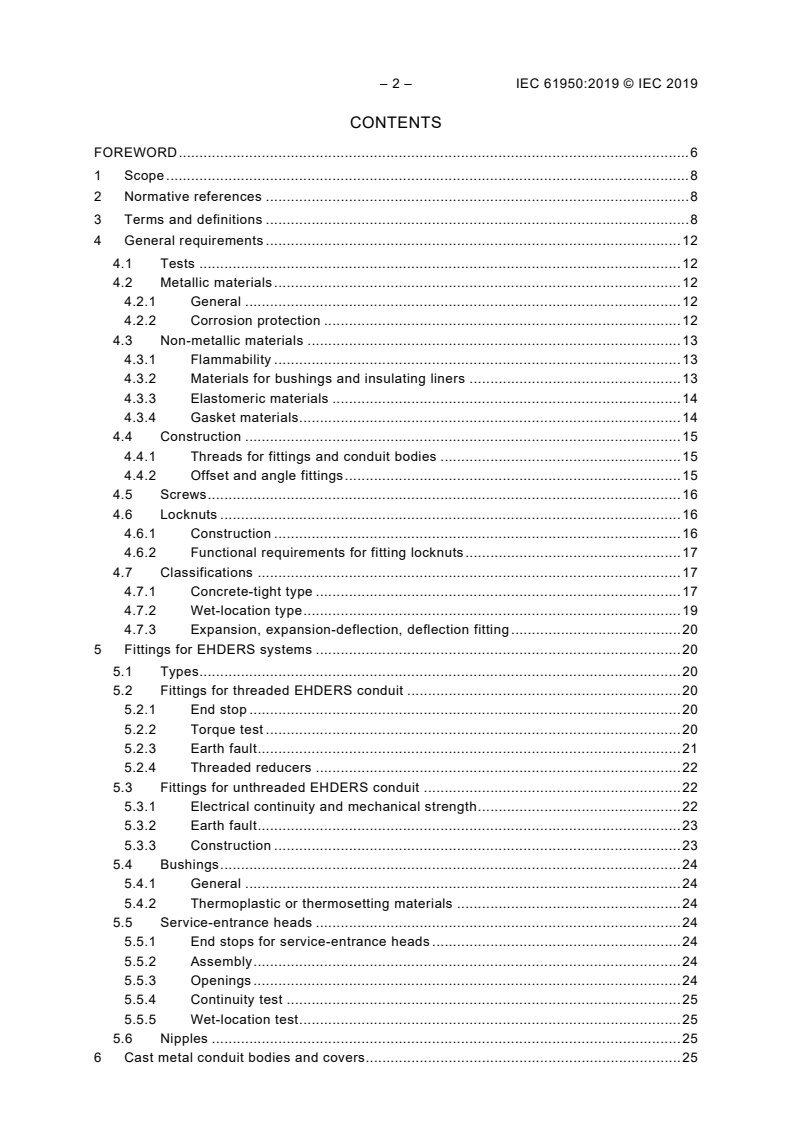
CONTENTS
FOREWORD . 6
1 Scope . 8
2 Normative references . 8
3 Terms and definitions . 8
4 General requirements . 12
4.1 Tests . 12
4.2 Metallic materials . 12
4.2.1 General . 12
4.2.2 Corrosion protection . 12
4.3 Non-metallic materials . 13
4.3.1 Flammability . 13
4.3.2 Materials for bushings and insulating liners . 13
4.3.3 Elastomeric materials . 14
4.3.4 Gasket materials. 14
4.4 Construction . 15
4.4.1 Threads for fittings and conduit bodies . 15
4.4.2 Offset and angle fittings . 15
4.5 Screws . 16
4.6 Locknuts . 16
4.6.1 Construction . 16
4.6.2 Functional requirements for fitting locknuts . 17
4.7 Classifications . 17
4.7.1 Concrete-tight type . 17
4.7.2 Wet-location type . 19
4.7.3 Expansion, expansion-deflection, deflection fitting . 20
5 Fittings for EHDERS systems . 20
5.1 Types. 20
5.2 Fittings for threaded EHDERS conduit . 20
5.2.1 End stop . 20
5.2.2 Torque test . 20
5.2.3 Earth fault . 21
5.2.4 Threaded reducers . 22
5.3 Fittings for unthreaded EHDERS conduit . 22
5.3.1 Electrical continuity and mechanical strength . 22
5.3.2 Earth fault . 23
5.3.3 Construction . 23
5.4 Bushings . 24
5.4.1 General . 24
5.4.2 Thermoplastic or thermosetting materials . 24
5.5 Service-entrance heads . 24
5.5.1 End stops for service-entrance heads . 24
5.5.2 Assembly . 24
5.5.3 Openings . 24
5.5.4 Continuity test . 25
5.5.5 Wet-location test . 25
5.6 Nipples . 25
6 Cast metal conduit bodies and covers. 25
6.1 General . 25
6.1.1 Applicability . 25
6.1.2 Openings . 25
6.2 Materials . 25
6.2.1 Wall thickness . 25
6.2.2 Coatings on metallic surfaces . 25
6.3 Integral bushings . 25
6.4 Threads . 26
6.5 Threadless connections . 26
6.6 External thread construction . 26
6.7 Wet-location type . 26
7 Conduit bodies and covers . 30
7.1 Cross-sectional area . 30
7.2 Connection to conduit . 30
7.3 Straight conduit bodies . 32
7.4 Angle conduit bodies . 32
7.5 Short conduit bodies . 33
8 Marking . 35
8.1 All fittings . 35
8.1.1 Permanence and legibility . 35
8.1.2 Manufacturer identification . 35
8.1.3 Location of marking . 35
8.1.4 Specific conditions of installation . 35
8.1.5 Specific instructions . 35
8.2 Insulating bushings or parts . 36
8.2.1 Colour coding . 36
8.2.2 Temperature rating . 36
8.2.3 Unthreaded bushings . 36
8.3 Conduit bodies . 36
8.3.1 Manufacturer identification . 36
8.3.2 Specific conditions of installation . 37
8.3.3 Short conduit bodies . 37
8.3.4 Angle conduit bodies . 37
8.3.5 Conduit bodies requiring pulling compound . 37
8.4 Fittings for threaded hubs . 37
8.5 Expansion, expansion-deflection and deflection fittings . 37
9 Type tests . 38
9.1 General . 38
9.1.1 Samples under test . 38
9.1.2 Mechanical connection . 38
9.1.3 Number of samples . 38
9.1.4 Locknuts . 38
9.1.5 Temperature . 38
9.1.6 Assembly . 38
9.2 Concrete-tightness test . 38
9.3 Wet locations test . 39
9.4 Flammability test . 42
9.5 Electrical continuity test . 44
9.6 Earth fault current test . 45
– 4 – IEC 61950:2019 © IEC 2019
9.7 Tests for temperature ratings of insulating material used for bushings or
insulating liners . 47
9.7.1 Flammability test . 47
9.7.2 Accelerated aging test . 47
9.7.3 Heat distortion test . 48
9.7.4 Drop test . 48
9.8 Elastomeric materials deterioration test . 48
9.9 Conductor pull test . 49
9.10 Metallic-coating thickness test . 49
9.11 Threaded fittings for EHDERS – Tests for conduit locknuts . 51
9.11.1 Assembly . 51
9.11.2 Integrity of assembly . 52
9.12 Threaded fittings for EHDERS – Tests for hubs. 52
9.13 Expansion, expansion-deflection and deflection fittings . 52
9.13.1 General . 52
9.13.2 Assembly test . 53
9.13.3 Electrical continuity test . 54
9.13.4 Reciprocation test . 54
9.13.5 Deflection test . 55
9.13.6 Wet locations test . 56
9.13.7 Corrosion resistance test . 56
9.13.8 Earth fault current test . 56
9.13.9 Galvanic compatibility test . 56
9.14 Gaskets – Expanded closed cell materials . 57
9.14.1 Insulation electrical continuity test . 57
9.14.2 Compression set test . 57
9.15 Permanence of markings test . 57
Bibliography . 58
Figure 1 – Basic dimensions for locknuts for EHDERS conduit . 18
Figure 2 – Basic dimensions for electrical fitting locknuts . 19
Figure 3 – Bending test for threadless fittings . 23
Figure 4 – Basic dimensions of internal straight pipe threads for conduit fittings having
short threads on bushings or hubs for use with EHDERS conduit or electrical
equipment having tapered or straight threads . 27
Figure 5 – Pitch diameter dimensions of tapered thread conduit entries . 28
Figure 6 – Basic dimensions of external straight pipe threads for conduit fittings for use
with EHDERS coupling or electrical equipment having tapered or straight internal
threads . 29
Figure 7 – Conduit body openings . 33
Figure 8 – Short conduit bodies . 34
Figure 9 – Wet locations test spray head . 41
Figure 10 – Wet locations test spray head piping . 42
Figure 11 – Flammability test apparatus. 44
Figure 12 – Measurement of voltage drop for fittings . 45
Figure 13 – Fault current test using an enclosure . 46
Figure 14 – Fault current test using a steel plate . 46
Figure 15 – Temperature rating test for insulating material of bushings and insulating
liners . 48
Figure 16 – Expansion, expansion-deflection, and deflection fitting test programme . 53
Figure 17 – Parallel misalignment of an expansion-deflection, or deflection fitting . 55
Table 1 – Wall thickness of fittings . 12
Table 2 – Thickness of zinc coating . 13
Table 3 – Thickness and diameters of bushings . 14
Table 4 – Radius of bend of angle fittings . 15
Table 5 – Inside throat diameters of fittings and bushings . 16
Table 6 – Tightening torque, bending load, and pull-out force for threaded and
threadless fittings . 21
Table 7 – Test currents and times . 21
Table 8 – Minimum cross-sectional area of conduit bodies . 30
Table 9 – Space inside a conduit body . 30
Table 10 – Minimum distance between conduit body hubs for three-conductor
installation with no investigation . 31
Table 11 – Temperature for conditioning polymeric materials . 36
Table 12 – Tightening torque value . 47
Table 13 – Thickness factor reference test of zinc coatings . 51
Table 14 – Metal thickness simulating thickness of test material for verifying
mechanical mounting . 51
Table 15 – Dimensions of zinc-coated ferrous-metal conduit for assembly test for
expansion fittings . 54
Table 16 – Test currents and times for expansion fittings . 57
– 6 – IEC 61950:2019 © IEC 2019
INTERNATIONAL ELECTROTECHNICAL COMMISSION
____________
CABLE MANAGEMENT SYSTEMS –
SPECIFICATIONS FOR EXTRA-HEAVY-DUTY
ELECTRICAL STEEL CONDUIT FITTINGS AND ACCESSORIES
FOREWORD
1) The International Electrotechnical Commission (IEC) is a worldwide organization for standardization comprising
all national electrotechnical committees (IEC National Committees). The object of IEC is to promote
international co-operation on all questions concerning standardization in the electrical and electronic fields. To
this end and in addition to other activities, IEC publishes International Standards, Technical Specifications,
Technical Reports, Publicly Available Specifications (PAS) and Guides (hereafter referred to as "IEC
Publication(s)"). Their preparation is entrusted to technical committees; any IEC National Committee interested
in the subject dealt with may participate in this preparatory work. International, governmental and non-
governmental organizations liaising with the IEC also participate in this preparation. IEC collaborates closely
with the International Organization for Standardization (ISO) in accordance with conditions determined by
agreement between the two organizations.
2) The formal decisions or agreements of IEC on technical matters express, as nearly as possible, an international
consensus of opinion on the relevant subjects since each technical committee has representation from all
interested IEC National Committees.
3) IEC Publications have the form of recommendations for international use and are accepted by IEC National
Committees in that sense. While all reasonable efforts are made to ensure that the technical content of IEC
Publications is accurate, IEC cannot be held responsible for the way in which they are used or for any
misinterpretation by any end user.
4) In order to promote international uniformity, IEC National Committees undertake to apply IEC Publications
transparently to the maximum extent possible in their national and regional publications. Any divergence
between any IEC Publication and the corresponding national or regional publication shall be clearly indicated in
the latter.
5) IEC itself does not provide any attestation of conformity. Independent certification bodies provide conformity
assessment services and, in some areas, access to IEC marks of conformity. IEC is not responsible for any
services carried out by independent certification bodies.
6) All users should ensure that they have the latest edition of this publication.
7) No liability shall attach to IEC or its directors, employees, servants or agents including individual experts and
members of its technical committees and IEC National Committees for any personal injury, property damage or
other damage of any nature whatsoever, whether direct or indirect, or for costs (including legal fees) and
expenses arising out of the publication, use of, or reliance upon, this IEC Publication or any other IEC
Publications.
8) Attention is drawn to the Normative references cited in this publication. Use of the referenced publications is
indispensable for the correct application of this publication.
9) Attention is drawn to the possibility that some of the elements of this IEC Publication may be the subject of
patent rights. IEC shall not be held responsible for identifying any or all such patent rights.
International Standard IEC 61950 has been prepared by subcommittee 23A: Cable
management systems, of IEC technical committee 23: Electrical accessories.
This third edition cancels and replaces the second edition published in 2007. This edition
constitutes a technical revision.
This edition includes the following significant technical changes with respect to the previous
edition:
– change in title and scope to cover only fittings and accessories for use with
extra-heavy-duty electrical rigid steel (EHDERS) conduits;
– new and updated definitions of terms;
– addition of requirements for expansion, expansion-deflection and deflection fittings;
– deletion of requirements for cast metal boxes.
The text of this International Standard is based on the following documents:
FDIS Report on voting
23A/887/FDIS 23A/890/RVD
Full information on the voting for the approval of this International Standard can be found in
the report on voting indicated in the above table.
This document has been drafted in accordance with the ISO/IEC Directives, Part 2.
In this standard, the following print types are used:
• requirements proper: in roman type;
• test specifications: in italic type;
• explanatory matter: in smaller roman type.
The committee has decided that the contents of this document will remain unchanged until the
stability date indicated on the IEC website under "http://webstore.iec.ch" in the data related to
the specific document. At this date, the document will be
• reconfirmed,
• withdrawn,
• replaced by a revised edition, or
• amended.
A bilingual version of this publication may be issued at a later date.
– 8 – IEC 61950:2019 © IEC 2019
CABLE MANAGEMENT SYSTEMS –
SPECIFICATIONS FOR EXTRA-HEAVY-DUTY
ELECTRICAL STEEL CONDUIT FITTINGS AND ACCESSORIES
1 Scope
This document specifies requirements for conduit fittings, including conduit bodies used with
extra-heavy-duty electrical rigid steel (EHDERS) conduit conforming to IEC 60981.
This document does not include requirements for fittings intended for installation in potentially
explosive atmospheres.
2 Normative references
The following documents are referred to in the text in such a way that some or all of their
content constitutes requirements of this document. For dated references, only the edition
cited applies. For undated references, the latest edition of the referenced document (including
any amendments) applies.
IEC 60981:2019, Extra heavy-duty electrical rigid steel conduits
ISO 68-2, ISO general purpose screw threads – Basic profile – Part 2: Inch screw threads
ISO 263, ISO inch screw threads – General plan and selection for screws, bolts and nuts –
Diameter range 0,06 to 6 in
ISO 301, Zinc alloy ingots intended for castings
ISO 5864, ISO inch screw threads – Allowances and tolerances
3 Terms and definitions
For the purposes of this document, the following terms and definitions apply.
ISO and IEC maintain terminological databases for use in standardization at the following
addresses:
• IEC Electropedia: available at http://www.electropedia.org/
• ISO Online browsing platform: available at http://www.iso.org/obp
3.1
angle fitting
fitting with or without a cover (or cap) intended to change the direction of the conduit entering
a box or an enclosure
3.2
box
enclosure without a cover but with means for mounting a cover, and provision for the entrance
of conduit and cable fittings
3.3
box fitting
connector whose primary function is to join threadless or threaded metal conduit to knockout
openings or threaded openings in a box or enclosure
3.4
bushing
discrete or integral fitting provided to protect conductors from abrasion and intended for use
where they enter or leave the conduit system
3.4.1
insulating bushing
fitting consisting of a polymeric insulator provided to protect wires from abrasion and intended
for use where conductors enter or leave the conduit
3.4.2
insulated bushing
bushing having a metallic collar with an insulated shoulder
3.4.3
insulating liner bushing
bushing used in the portion of a fitting where the conductors exit the conduit
3.4.4
bushing outlet
metallic or non-metallic collar with an insulating material cover having holes for the individual
conductors
3.4.5
non-insulating bushing
bushing made of metallic material
3.5
capped elbow
elbow with a removable cover that provides access to interior of the conduit system during
conductor pulling
3.6
compression-type fitting
style of fitting that is provided with a gland nut that, when wrench tightened, uniformly
compresses a split ring that secures the fitting to the conduit
3.7
concrete-tight
so constructed that when embedded in freshly mixed concrete there is no ingress of concrete
aggregate (Portland-type cement and sand) under specified test conditions
3.8
conduit body
means that provides access through (a) removable cover(s) to the interior of the system at a
junction of two or more conduit sections or at a termination point
Note 1 to entry: Cast, sheet metal, non-metallic, and other boxes such as FS and FD or larger boxes and fittings
such as capped elbows and service entrance elbows are not classified as conduit bodies.
3.9
connector
fitting intended to terminate conduit to a box or enclosure and capable of providing other
functions such as sealing and earthing
– 10 – IEC 61950:2019 © IEC 2019
3.10
coupling
fitting intended to join two lengths of EHDERS conduit
3.11
deflection fitting
fitting intended to compensate only for lateral or angular deflection in a span of conduit
3.12
elastomer
rubber or any thermosetting polymer having properties similar to those of rubber
3.13
elbow
conduit bend that changes the direction of the axis of a conduit system
3.14
enclosure
box with a cover, so constructed to provide a defined degree of protection for personnel
against accidental contact with live parts, and also for the enclosed equipment against
specified environmental conditions
3.15
expansion fitting
fitting that compensates only for linear expansion and contraction of a span of conduit
3.16
expansion-deflection fitting
fitting that compensates for linear expansion and contraction, and compensates for lateral or
angular deflection in a span of conduit
3.17
EHDERS conduit
extra-heavy-duty rigid steel conduit
part of a closed wiring system of circular cross-section, made of steel of welded construction,
capable of providing extra-heavy mechanical protection to conductors or cables and for use
as an equipment earthing conductor when installed utilizing appropriate fittings
3.18
fitting
means for securing conduit to a box or enclosure, or conduit system
3.19
hub
fitting intended for use with threaded conduit for connection to an enclosure
3.20
junction box
box with a cover joining different runs of conduit and cable and providing space for the
connection and branching of the conductors enclosed
Note 1 to entry: There are no openings in the cover.
3.21
knockout
portion of the wall of a box or enclosure that may be removed readily at the time of installation
in order to provide an unthreaded opening for the attachment of conduit, or conduit and cable
fittings
3.22
liquid-tight
intended for use in wet industrial environments which contain machine oils and coolants
3.23
fitting locknut
component provided with a fitting that attaches an externally threaded connector to an
unthreaded opening in a box or enclosure and is capable of providing electrical continuity
3.24
conduit locknut
internally threaded fitting for use on threaded conduit intended to inhibit turning and to provide
a secure joint, and is capable of providing electrical continuity
3.25
nipple
externally threaded fitting that serves as a short conduit between closely spaced enclosures
3.26
offset fitting
connector or coupling that offsets the axis of a conduit
3.27
outlet box
box that provides access to a wiring system and has provision for the entrance of conduit, or
conduit and cable fittings and means for the mounting of a cover
3.28
pull box
box with a cover that is installed in one or more runs of conduit to facilitate pulling the
conductors through the conduit system
3.29
pull fitting
fitting that permits conductors to be pulled at locations other than a box
3.30
wet location type fitting
fitting so constructed or protected as to exclude beating rain under specified test conditions
3.31
reducing coupling
fitting intended to join lengths of two different sizes of conduit
3.32
service-entrance head
enclosed fitting intended for use at service entrances where a service drop is connected to a
service-entrance conduit
3.33
threadless fitting
fitting intended for use with unthreaded rigid conduit
3.34
type test
test made on a specimen for the conformity of the design of a given product to the
requirements of the relevant standard
– 12 – IEC 61950:2019 © IEC 2019
4 General requirements
4.1 Tests
Tests according to this document shall be type tests.
4.2 Metallic materials
4.2.1 General
4.2.1.1 The wall thickness of fittings shall conform to the values given in Table 1 when
measured at least 3,2 mm from the edge of the fitting. If a taper is provided to permit easy
withdrawal of the part from the die, the thickness shall be not less than that required at the
base of threads when measured 0,8 mm from the edge of the fitting.
Compliance is checked by measurement.
Table 1 – Wall thickness of fittings
Material of fitting Wall thickness Minimum thickness
at base of thread
Unthreaded parts
mm mm
a
Sheet steel or machine steel 0,63 0,63
b
0,50
Sheet aluminium 0,78 0,78
Die-cast aluminium, die-cast zinc, or malleable 1,57 0,78
iron
c
Sand-cast aluminium, sand-cast steel, sand- 3,17 2,36
cast bronze or cast iron
d
1,57
c d
NOTE The letter "H" in footnotes and denotes designations for EHDERS conduit.
a
At the base of cut threads.
b
At the base of rolled threads.
c
At the base of threads in fittings of the 27H conduit designation and larger sizes.
d
At the base of threads in fittings of the 21H conduit designation and smaller sizes.
4.2.1.2 The minimum thickness is specified in 4.2.1.1 and does not apply to gland rings of
compression-type fittings.
4.2.1.3 Zinc die-casting material shall conform to the requirements of ISO 301 for alloy
ZnAl Cu .
4 2
4.2.2 Corrosion protection
Ferrous metal fittings shall have zinc plating of adequate thickness or have an alternate
corrosion protection coating according to IEC 60981:2019.
Compliance of the zinc plating is checked by measurement according to 9.10 and Table 2.
This requirement does not apply to the following:
a) a fitting of stainless steel need not be so protected;
b) cut edges, including punched or threaded holes, need not be so protected.
NOTE 1 Most non-ferrous materials such as copper, zinc, aluminium, and their alloys are generally suitable for
indoor and outdoor applications without the need for a protective coating.
NOTE 2 For applications involving severe or unusual corrosive environments, additional corrosion protection or
materials having special characteristics can be required as determined by investigation.
Table 2 – Thickness of zinc coating
Thickness of coating
Type of fitting and material
a
Average Minimum
mm mm
A fitting part, locknut or clamp intended for assembly inside 0,003 8 0,002 5
a box
Outside of a sheet-steel or a machined-steel coupling, 0,012 7 0,010 2
connector, bushing, or conduit locknut
b
Inside of a sheet-steel or machined-steel fitting -
b
Malleable iron or cast-iron fittings -
b
Screws -
a
The average thickness shall be determined by averaging at least three measurements. Each measurement
shall be taken on a different surface, when possible. When it is required to take multiple measurements on a
single surface, they shall be spaced equally over that surface.
b
The minimum thickness of the coating on these fittings and components is not specified. Evidence of
corrosion protection provided shall be verified by visual inspection.
4.3 Non-metallic materials
4.3.1 Flammability
Non-metallic material of a fitting shall resist the propagation of flame, where:
a) material plaques shall not flame for more than 30 s after any of the first four applications,
or for more than 1 min after the fifth application of the test flame;
b) the finished product material shall not:
1) openly flame for more than 1 min after the final application of the test flame, or
2) be consumed;
c) there shall not be an opening in the material such that a 6,4 mm diameter rod passes
freely through without force after the material has returned to ambient temperature;
d) there shall not be a visible flame on the surface of the plaque or the sample opposite the
surface to which the test flame has been applied;
e) there shall not be glowing or burning particles during the test.
With reference to 4.3.1 b) 2), a polymeric throat or throat liner located in a metal fitting of the
16H or 21H designation that is consumed during the test complies with the requirement.
Compliance is checked by the test in 9.4.
4.3.2 Materials for bushings and insulating liners
Materials for bushings and insulating liners shall be resistant to flame and heat. Bushings
shall comply with 4.3.1 b), d), and e).
Compliance is checked by the tests in 9.7.1.
The inside diameter of the throat of a bushing or an insulating bushing shall not be reduced to
a dimension less than 90 % of the minimum value specified in Table 3.
– 14 – IEC 61950:2019 © IEC 2019
Compliance is checked by the test in 9.7.2.
Table 3 – Thickness and diameters of bushings
Metric designator Maximum diameter Throat diameter of bushing
of bushing
Minimum Maximum
mm mm mm
12H 24,64 11,28 12,52
16H 28,96 14,22 15,80
21H 36,07 18,85 20,93
27H 44,96 23,98 26,64
35H 57,94 31,55 35,05
41H 65,99 36,80 40,89
53H 80,65 47,24 52,50
63H 90,47 56,44 62,71
78H 107,95 70,13 77,92
91H 122,00 81,10 90,12
103H 137,21 92,02 102,26
129H 169,52 115,37 128,19
155H 201,52 138,63 154,05
The bushing shall not show evidence of cracking or softening so as to expose metal or form
an incomplete insulating throat.
Compliance is checked by the test in 9.7.3.
A throat or throat liner shall not be dislodged by impact.
Compliance is checked by the test in 9.7.4.
4.3.3 Elastomeric materials
Rubber or other elastomeric materials shall not crack or show a change in hardness of more
than ten numbers.
Compliance is checked by the test in 9.8.
4.3.4 Gasket materials
4.3.4.1 Elastomeric materials for gaskets shall comply with 4.3.3.
4.3.4.2 Expanded closed cell material for gaskets, intended for installation between a fitting
and its cover, or between a fitting and an enclosure shall maintain its thickness and provide
adequate electrical resistance.
Compliance is checked by the tests in 9.14.
4.4 Construction
4.4.1 Threads for fittings and conduit bodies
Cut threads on conduit fittings and conduit bodies shall conform to 6.4 as applicable, except
for products that are manufactured and furnished as a complete assembly or that do not
require thread interchangeability with conduit or conduit fittings.
4.4.2 Offset and angle fittings
4.4.2.1 Offset fittings
An offset fitting shall have a removable cap or cover to facilitate the installation of wire if the
offset is greater than 25 mm or if the axis of the offsetting section is at any angle greater than
35° from the axis of the conduit.
Determination of the applicability of this requirement to a given offset fitting is checked by
measurement.
Compliance is checked by inspection.
4.4.2.2 Angle fittings
An angle fitting having a radius of bend less than that specified in Table 4 shall have a
removable cap or cover to facilitate the installation of wires.
Determination of the applicability of this requirement to a given angle fitting is checked by
measurement.
Compliance is checked by inspection.
Angle fittings without removable covers other than connectors secured to the EHDERS
conduit by means other than turning shall adequately facilitate the pulling of conductors. After
pulling of the conductors, the conductor insulation:
a) shall not show visible damage; and
b) shall withstand for 5 min without breakdown the application of a 50 Hz to 60 Hz sinusoidal
potential of 2 500 V RMS, when applying the potential between the conductor and:
1) aluminium foil that is wrapped around, and in contact with, the insulation; or
2) a volume of water containing the conductor, fitting, and conduit section.
Compliance with 4.4.2.2 a) is checked by the test in 9.9.
Table 4 – Radius of bend of angle fittings
Conduit designation Minimum radius in centre
of fitting
mm
12H Not used
16H 100
21H 115
27H 150
35H 180
41H 215
53H 240
– 16 – IEC 61950:2019 © IEC 2019
Conduit designation Minimum radius in centre
of fitting
mm
63H 270
78H 330
91H 380
103H 400
129H 600
155H 760
4.4.2.3 Cross-sectional area
Fittings (for example, angle fittings, offset fittings) that change the direction of a conduit shall
have an internal cros
...