

IEC TR 62517:2009
(Main)Magnetizing behaviour of permanent magnets
General Information
- Abstract
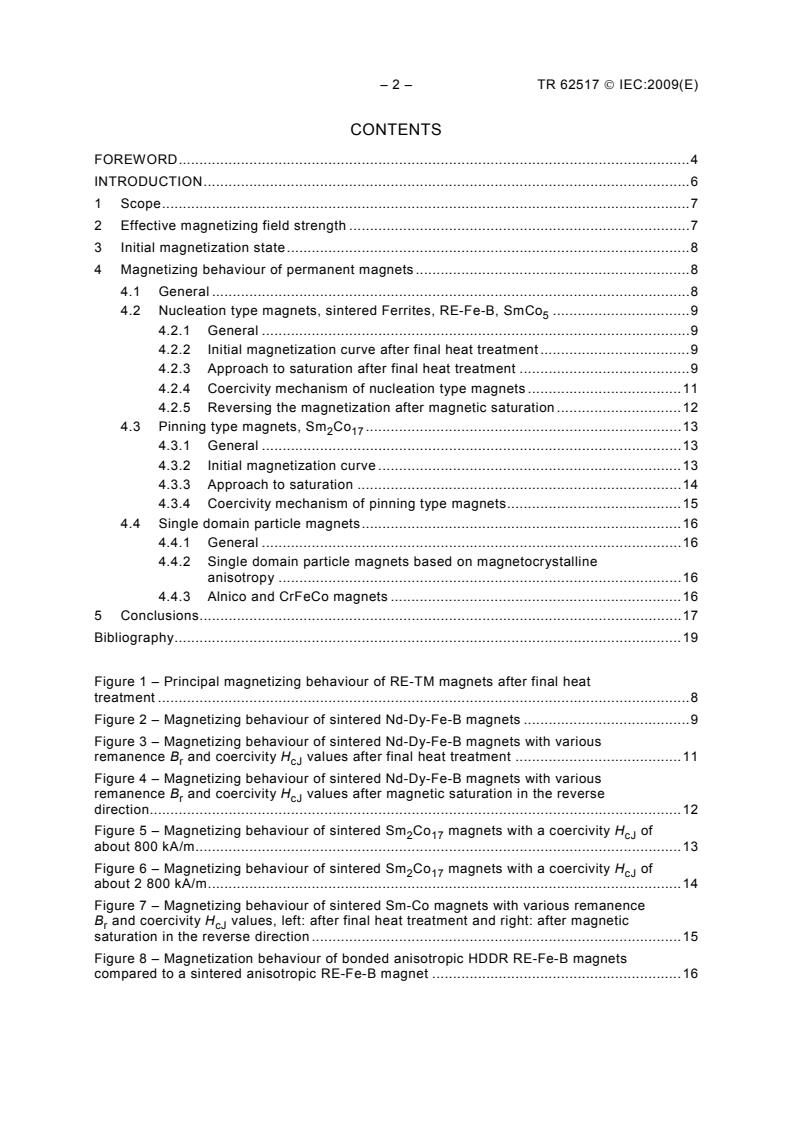
IEC/TR 62517:2009(E) describes the magnetizing behaviour of permanent magnets in detail covering:
- the relationship between the applied magnetic field strength and the effectively acting internal field strength;
- the initial state prior to magnetization;
- the magnetizing behaviour of all common types of permanent magnets subdivided according to the dominant coercivity mechanisms, namely the nucleation type for sintered Ferrites, RE-Fe-B and SmCo5 magnets, the pinning type for carbon steel and Sm2Co17 magnets and the single domain type for nano-crystalline RE-Fe-B, Alnico and Cr-Fe-Co magnets;
- the recommended magnetizing field strengths for modern permanent magnets compiled in a comprehensive table.
- Status
- Published
- Publication Date
- 06-Apr-2009
- Technical Committee
- TC 68 - Magnetic alloys and steels
- Drafting Committee
- WG 5 - TC 68/WG 5
- Current Stage
- PPUB - Publication issued
- Start Date
- 07-Apr-2009
- Completion Date
- 15-Jun-2009
Overview
IEC TR 62517:2009 - "Magnetizing behaviour of permanent magnets" is a technical report from the International Electrotechnical Commission (IEC) that documents how modern permanent magnets respond to applied magnetizing fields. The report explains the relationship between the externally applied field and the internal field acting in the magnet, describes the typical initial (virgin) magnetization states, classifies magnet types by coercivity mechanism, and compiles recommended internal magnetizing field strengths for complete saturation.
Key topics
- Internal vs. applied field: treatment of the effective internal magnetic field Hint = Happl − Hdemag (including the role of the demagnetization coefficient N and polarization J) and implications for magnet assembly magnetization.
- Initial magnetization state: description of the thermally demagnetized (virgin) state after final heat treatment and methods to reset magnets (e.g., heating above the Curie temperature for ferrite and RE‑Fe‑B; full heat treatment for SmCo).
- Coercivity mechanisms and magnetizing behaviour:
- Nucleation-type (sintered ferrite, RE‑Fe‑B, SmCo5) - typical magnetization curves and approach to saturation.
- Pinning-type (carbon steel, Sm2Co17) - distinct magnetizing response and reversal behaviour.
- Single-domain particle type (nano-crystalline RE‑Fe‑B, Alnico, Cr‑Fe‑Co) - behaviour of single-domain particles and implications for magnetizing process.
- Practical magnetizing recommendations: a comprehensive table of recommended internal magnetizing field strengths to reach complete saturation from the post‑heat‑treatment state (report includes guidance rather than a single simple multiplier rule).
- Magnetization pulse considerations: guidance about pulse magnetization (commonly used via capacitor discharge), including pulse-duration effects and typical penetration guidance (pulse durations of about 5–10 ms are generally sufficient for complete penetration of many blocks).
Applications
IEC TR 62517:2009 is practical for:
- Design and optimization of magnetizing coils and pulse generators for production magnetization.
- Assembly-level magnetization planning (magnetize-after-assembly best practice to reduce handling risks).
- Quality control and test-lab procedures for verifying saturation and acceptable magnetizing fields.
- Failure analysis (understanding demagnetization, reversal and remanence behaviour).
- Material selection and process specification for manufacturers of motors, sensors, actuators, and magnetic assemblies.
Who should use it
- Magnet engineers and designers
- Manufacturing and assembly engineers
- Test laboratories and R&D teams working with RE‑Fe‑B, SmCo, ferrite, Alnico and related magnet materials
- Standards developers and technical procurement specialists
Related standards
- IEC 60404-5 (definitions related to magnet saturation)
- IEC 60404-8-1 (Sm‑Co composition and related guidance)
Keywords: IEC TR 62517:2009, magnetizing behaviour, permanent magnets, coercivity mechanisms, nucleation, pinning, single domain, internal magnetizing field, saturation, RE‑Fe‑B, SmCo, ferrite, Alnico, pulse magnetization.
Get Certified
Connect with accredited certification bodies for this standard

IMQ S.p.A. (Certification)
Italian electrical product certification.

SLG Prüf- und Zertifizierungs GmbH
German testing and certification body.

UL Solutions
Global safety science company with testing, inspection and certification.
Sponsored listings
Frequently Asked Questions
IEC TR 62517:2009 is a technical report published by the International Electrotechnical Commission (IEC). Its full title is "Magnetizing behaviour of permanent magnets". This standard covers: IEC/TR 62517:2009(E) describes the magnetizing behaviour of permanent magnets in detail covering: - the relationship between the applied magnetic field strength and the effectively acting internal field strength; - the initial state prior to magnetization; - the magnetizing behaviour of all common types of permanent magnets subdivided according to the dominant coercivity mechanisms, namely the nucleation type for sintered Ferrites, RE-Fe-B and SmCo5 magnets, the pinning type for carbon steel and Sm2Co17 magnets and the single domain type for nano-crystalline RE-Fe-B, Alnico and Cr-Fe-Co magnets; - the recommended magnetizing field strengths for modern permanent magnets compiled in a comprehensive table.
IEC/TR 62517:2009(E) describes the magnetizing behaviour of permanent magnets in detail covering: - the relationship between the applied magnetic field strength and the effectively acting internal field strength; - the initial state prior to magnetization; - the magnetizing behaviour of all common types of permanent magnets subdivided according to the dominant coercivity mechanisms, namely the nucleation type for sintered Ferrites, RE-Fe-B and SmCo5 magnets, the pinning type for carbon steel and Sm2Co17 magnets and the single domain type for nano-crystalline RE-Fe-B, Alnico and Cr-Fe-Co magnets; - the recommended magnetizing field strengths for modern permanent magnets compiled in a comprehensive table.
IEC TR 62517:2009 is classified under the following ICS (International Classification for Standards) categories: 01 - GENERALITIES. TERMINOLOGY. STANDARDIZATION. DOCUMENTATION; 29.030 - Magnetic materials. The ICS classification helps identify the subject area and facilitates finding related standards.
IEC TR 62517:2009 is available in PDF format for immediate download after purchase. The document can be added to your cart and obtained through the secure checkout process. Digital delivery ensures instant access to the complete standard document.
Standards Content (Sample)
IEC/TR 62517 ®
Edition 1.0 2009-04
TECHNICAL
REPORT
Magnetizing behaviour of permanent magnets
IEC/TR 62517:2009(E)
All rights reserved. Unless otherwise specified, no part of this publication may be reproduced or utilized in any form or by
any means, electronic or mechanical, including photocopying and microfilm, without permission in writing from either IEC or
IEC's member National Committee in the country of the requester.
If you have any questions about IEC copyright or have an enquiry about obtaining additional rights to this publication,
please contact the address below or your local IEC member National Committee for further information.
Droits de reproduction réservés. Sauf indication contraire, aucune partie de cette publication ne peut être reproduite
ni utilisée sous quelque forme que ce soit et par aucun procédé, électronique ou mécanique, y compris la photocopie
et les microfilms, sans l'accord écrit de la CEI ou du Comité national de la CEI du pays du demandeur.
Si vous avez des questions sur le copyright de la CEI ou si vous désirez obtenir des droits supplémentaires sur cette
publication, utilisez les coordonnées ci-après ou contactez le Comité national de la CEI de votre pays de résidence.
IEC Central Office
3, rue de Varembé
CH-1211 Geneva 20
Switzerland
Email: inmail@iec.ch
Web: www.iec.ch
About IEC publications
The technical content of IEC publications is kept under constant review by the IEC. Please make sure that you have the
latest edition, a corrigenda or an amendment might have been published.
ƒ Catalogue of IEC publications: www.iec.ch/searchpub
The IEC on-line Catalogue enables you to search by a variety of criteria (reference number, text, technical committee,…).
It also gives information on projects, withdrawn and replaced publications.
ƒ IEC Just Published: www.iec.ch/online_news/justpub
Stay up to date on all new IEC publications. Just Published details twice a month all new publications released. Available
on-line and also by email.
ƒ Electropedia: www.electropedia.org
The world's leading online dictionary of electronic and electrical terms containing more than 20 000 terms and definitions
in English and French, with equivalent terms in additional languages. Also known as the International Electrotechnical
Vocabulary online.
ƒ Customer Service Centre: www.iec.ch/webstore/custserv
If you wish to give us your feedback on this publication or need further assistance, please visit the Customer Service
Centre FAQ or contact us:
Email: csc@iec.ch
Tel.: +41 22 919 02 11
Fax: +41 22 919 03 00
IEC/TR 62517 ®
Edition 1.0 2009-04
TECHNICAL
REPORT
Magnetizing behaviour of permanent magnets
INTERNATIONAL
ELECTROTECHNICAL
COMMISSION
PRICE CODE
R
ICS 29.030 ISBN 978-2-88910-752-0
– 2 – TR 62517 © IEC:2009(E)
CONTENTS
FOREWORD.4
INTRODUCTION.6
1 Scope.7
2 Effective magnetizing field strength .7
3 Initial magnetization state.8
4 Magnetizing behaviour of permanent magnets .8
4.1 General .8
4.2 Nucleation type magnets, sintered Ferrites, RE-Fe-B, SmCo .9
4.2.1 General .9
4.2.2 Initial magnetization curve after final heat treatment .9
4.2.3 Approach to saturation after final heat treatment .9
4.2.4 Coercivity mechanism of nucleation type magnets .11
4.2.5 Reversing the magnetization after magnetic saturation .12
4.3 Pinning type magnets, Sm Co .13
2 17
4.3.1 General .13
4.3.2 Initial magnetization curve .13
4.3.3 Approach to saturation .14
4.3.4 Coercivity mechanism of pinning type magnets.15
4.4 Single domain particle magnets.16
4.4.1 General .16
4.4.2 Single domain particle magnets based on magnetocrystalline
anisotropy .16
4.4.3 Alnico and CrFeCo magnets .16
5 Conclusions.17
Bibliography.19
Figure 1 – Principal magnetizing behaviour of RE-TM magnets after final heat
treatment .8
Figure 2 – Magnetizing behaviour of sintered Nd-Dy-Fe-B magnets .9
Figure 3 – Magnetizing behaviour of sintered Nd-Dy-Fe-B magnets with various
remanence B and coercivity H values after final heat treatment .11
r cJ
Figure 4 – Magnetizing behaviour of sintered Nd-Dy-Fe-B magnets with various
remanence B and coercivity H values after magnetic saturation in the reverse
r cJ
direction.12
Figure 5 – Magnetizing behaviour of sintered Sm Co magnets with a coercivity H of
2 17 cJ
about 800 kA/m.13
Figure 6 – Magnetizing behaviour of sintered Sm Co magnets with a coercivity H of
2 17 cJ
about 2 800 kA/m.14
Figure 7 – Magnetizing behaviour of sintered Sm-Co magnets with various remanence
B and coercivity H values, left: after final heat treatment and right: after magnetic
r cJ
saturation in the reverse direction .15
Figure 8 – Magnetization behaviour of bonded anisotropic HDDR RE-Fe-B magnets
compared to a sintered anisotropic RE-Fe-B magnet .16
TR 62517 © IEC:2009(E) – 3 –
Table 1 – The recommended internal magnetizing field strengths, H , to achieve
mag
complete saturation for modern permanent magnets, starting from the initial state after
the final heat treatment .18
– 4 – TR 62517 © IEC:2009(E)
INTERNATIONAL ELECTROTECHNICAL COMMISSION
____________
MAGNETIZING BEHAVIOUR OF PERMANENT MAGNETS
FOREWORD
1) The International Electrotechnical Commission (IEC) is a worldwide organization for standardization comprising
all national electrotechnical committees (IEC National Committees). The object of IEC is to promote
international co-operation on all questions concerning standardization in the electrical and electronic fields. To
this end and in addition to other activities, IEC publishes International Standards, Technical Specifications,
Technical Reports, Publicly Available Specifications (PAS) and Guides (hereafter referred to as “IEC
Publication(s)”). Their preparation is entrusted to technical committees; any IEC National Committee interested
in the subject dealt with may participate in this preparatory work. International, governmental and non-
governmental organizations liaising with the IEC also participate in this preparation. IEC collaborates closely
with the International Organization for Standardization (ISO) in accordance with conditions determined by
agreement between the two organizations.
2) The formal decisions or agreements of IEC on technical matters express, as nearly as possible, an international
consensus of opinion on the relevant subjects since each technical committee has representation from all
interested IEC National Committees.
3) IEC Publications have the form of recommendations for international use and are accepted by IEC National
Committees in that sense. While all reasonable efforts are made to ensure that the technical content of IEC
Publications is accurate, IEC cannot be held responsible for the way in which they are used or for any
misinterpretation by any end user.
4) In order to promote international uniformity, IEC National Committees undertake to apply IEC Publications
transparently to the maximum extent possible in their national and regional publications. Any divergence
between any IEC Publication and the corresponding national or regional publication shall be clearly indicated in
the latter.
5) IEC provides no marking procedure to indicate its approval and cannot be rendered responsible for any
equipment declared to be in conformity with an IEC Publication.
6) All users should ensure that they have the latest edition of this publication.
7) No liability shall attach to IEC or its directors, employees, servants or agents including individual experts and
members of its technical committees and IEC National Committees for any personal injury, property damage or
other damage of any nature whatsoever, whether direct or indirect, or for costs (including legal fees) and
expenses arising out of the publication, use of, or reliance upon, this IEC Publication or any other IEC
Publications.
8) Attention is drawn to the Normative references cited in this publication. Use of the referenced publications is
indispensable for the correct application of this publication.
9) Attention is drawn to the possibility that some of the elements of this IEC Publication may be the subject of
patent rights. IEC shall not be held responsible for identifying any or all such patent rights.
The main task of IEC technical committees is to prepare International Standards. However, a
technical committee may propose the publication of a technical report when it has collected
data of a different kind from that which is normally published as an International Standard, for
example "state of the art".
IEC 62517, which is a technical report, has been prepared by IEC technical committee 68:
Magnetic alloys and steels.
The text of this technical report is based on the following documents:
Enquiry draft Report on voting
68/377/DTR 68/384/RVC
Full information on the voting for the approval of this technical report can be found in the
report on voting indicated in the above table.
This publication has been drafted in accordance with the ISO/IEC Directives, Part 2.
TR 62517 © IEC:2009(E) – 5 –
The committee has decided that the contents of this publication will remain unchanged until
the maintenance result date indicated on the IEC web site under "http://webstore.iec.ch" in
the data related to the specific publication. At this date, the publication will be
• reconfirmed,
• withdrawn,
• replaced by a revised edition, or
• amended.
A bilingual version of this publication may be issued at a later date.
– 6 – TR 62517 © IEC:2009(E)
INTRODUCTION
The full performance of a permanent magnet can only be obtained if it is magnetized properly
to saturation. In IEC 60404-5 a definition of the saturation of a permanent magnet is given.
Accordingly, a magnet is defined as saturated at a magnetizing field strength H if a 50 %
higher field strength leads to an increase of (BH) or H of less than 1 %. However, such a
max cB
definition cannot explain the substantial differences in the magnetizing behaviour of modern
permanent magnets which is mainly determined by their coercivity mechanisms. Unfortunately
the variety of magnetizing behaviours cannot be accommodated by a simple recommendation
such as “magnetize with magnetizing field strengths of three to five times the coercivity H ”.
cJ
In particular for RE permanent magnets with high coercivity H this simplification would lead
cJ
to unacceptable overestimations of the required magnetizing field strengths.
TR 62517 © IEC:2009(E) – 7 –
MAGNETIZING BEHAVIOUR OF PERMANENT MAGNETS
1 Scope
It is within the scope of this technical report to describe the magnetizing behaviour of
permanent magnets in detail. Firstly, in Clause 3 the relationship between the applied
magnetic field strength and the effectively acting internal field strength is reviewed. In Clause
4 the initial state prior to magnetization is discussed. Then, in the main Clause 5, the
magnetizing behaviour of all common types of permanent magnets is outlined. The clause is
subdivided according to the dominant coercivity mechanisms, namely the nucleation type for
sintered Ferrites, RE-Fe-B and SmCo magnets, the pinning type for carbon steel and
Sm Co magnets and the single domain type for nano-crystalline RE-Fe-B, Alnico and Cr-
2 17
Fe-Co magnets. Finally, the recommended magnetizing field strengths for modern permanent
magnets are compiled in a comprehensive table.
2 Effective magnetizing field strength
For magnetization of permanent magnets, the internal magnetic field strength H in the
int
magnet is the critical parameter. The internal field strength is determined by the applied field
strength H and the self-demagnetizing field strength H of the magnet or the magnet
appl demag
assembly. The self-demagnetizing field strength depends on the dimensions of the magnet or
the load line of a magnet assembly and the polarization of the magnet material, see equation
(1):
H = H – H = H – N·J/μ (1)
int appl demag appl 0
N denotes the demagnetization coefficient and J the polarization of the magnet material.
Most advanced magnets are magnetized by a short pulse field, achieved by discharging a
capacitor bank through a copper coil. The duration of the field pulse must last sufficiently
long, in order to overcome the eddy currents at the surface of the magnets, in particular for
large blocks. In general, a pulse duration of 5 ms to 10 ms is sufficient for complete
penetration. The penetration depth λ , see equation (2), depends on the electrical resistance
ρ, the permeability μ of the magnet material and the frequency f of the field pulse [1] :
ρ
λ = K ⋅ (2)
μ ⋅ f
K denotes a constant.
Preferably, magnets will be magnetized after assembly, since handling of unmagnetized
magnets is easier and prevents contamination by ferromagnetic particles. In addition chipping
of magnet-edges due to the mutual attraction of magnet parts is avoided.
___________
The composition Sm Co is used as the generic name for a series of binary and multiphase alloys with
2 17
nd
transition elements such as Fe, Cu and Zr replacing Co, see also IEC 60404-8-1; 2 edition 2001.
The figures in brackets refer to the Bibliography.
– 8 – TR 62517 © IEC:2009(E)
3 Initial magnetization state
For nucleation type ferrite, SmCo5 and REFeB magnets, the initial state prior to magnetizing
is usually the state after the final heat treatment, i.e. after sintering. This state shows no net
remanent magnetization and is often called the thermally demagnetized, or virgin, state.
Ferrite and REFeB magnets, once magnetized, may be reset to the initial state by heating
them to above the Curie temperature. This will return them to the thermally demagnetized
state without permanent loss of properties. SmCo magnets can be reset to the initial state
only by repeating the full final heat treatment. To prevent chemical changes which can lead to
surface damage and permanent loss of properties, rare earth magnets shall be protected in
an inert atmosphere during this procedure.
For anisotropic Alnico and CrFeCo magnets, where heat treatment in a magnetic field and
tempering are involved, some residual magnetization may remain in the magnets. These
magnets may be completely demagnetized from any degree of magnetization by applying a
slowly reducing alternating magnetic field. The same holds for any pinning or single domain
type magnet such as Sm Co and rapidly quenched or HDDR-treated REFeB magnets.
2 17
4 Magnetizing behaviour of permanent magnets
4.1 General
The magnetizing behaviour of permanent magnets is closely related to their coercivity
mechanisms, therefore they need to be discussed. Modern permanent magnets may be
divided into three groups with respect to their coercivity mechanism. The principal
magnetization behaviour for these groups, the nucleation type, the pinning type and the single
domain particle type is illustrated in Figure 1.
Sm Co magnet,
Sm Co magnet,
22 1717
H = 800 kA/m
H = 800 kA/m
cJcJ
Sintered
sintered
anisotropic
Nd-Fanisotropice-B
1,0 1,0
1,0 magnet 1,0
Nd-Fe-B
magnet
rapidly
solidified
0,5 0,5
0,5
0,5
Nd-Fe-B
Rapidly
soribbonlidified
Nd-Fe-B
ribbon
Sm Co magnet,
2 17
Sm Co magnet,
2 17
H = 2070 kA/m
cJ
H = 2 070 kA/m
cJ
0,0,0 0 0,0
0,0
0 500 1 000 0 1 000 2 000 3 000
0 500 1000
0 1000 2000 3000
Field strength H in kA/m Field strength H in kA/m
field strength H in kA/m
IEC 523/09 IEC 524/09
field strength H in kA/m
(a) (b)
a) Nucleation-type anisotropic RE-TM magnets, for instance sintered Nd-Fe-B or SmCo
magnets, or single domain particle type isotropic nanocrystalline RE-TM magnets, for
instance rapidly solidified Nd-Fe-B ribbons
b) Pinning-type RE-TM magnets, for instance Sm Co magnets with coercivities H of
2 17 cJ
800kA/m or 2 070 kA/m, respectively.
Figure 1 – Principal magnetizing behaviour of RE-TM magnets after final heat treatment
Polarization in T
polarization in T
Polarization in T
polarization in T
TR 62517 © IEC:2009(E) – 9 –
4.2 Nucleation type magnets, sintered Ferrites, RE-Fe-B, SmCo
4.2.1 General
The commercially very important sintered Ferrites, RE-Fe-B and SmCo magnets are
nucleation type materials. In the following discussion, the magnetization behaviour of
nucleation type magnets will be discussed using anisotropic sintered RE-Fe-B magnets as an
example.
4.2.2 Initial magnetization curve after final heat treatment
For nucleation type magnets such as sintered Ferrites and Rare Earth Transition Metal (RE-
TM) magnets based on Nd-Fe-B or SmCo , the grains contain multiple magnetic domains
after final heat treatment. The magnetic domains are separated by domain walls which can
move easily within the grains, so that the polarization increases steeply, even in small
magnetizing fields, see Figure 1 a) [2]. For sintered RE-Fe-B magnets, a polarization of about
95 % of the saturation polarization results even after magnetizing with a small magnetizing
field strength of about 200 kA/m.
4.2.3 Approach to saturation after final heat treatment
The polarization decreases, once a low magnetizing field is removed, since no significant
coercivity H has been developed. In the multidomain grains, the domain walls are free to
cJ
move back toward their original positions, to minimize the magnetic stray field energy, see
Figure 2.
-1
Magnetizing field strength H in kA/m
mag
magnetizing field strength H in kA m :
1,5
mag
1,5
1 600
1,1,00
0,5
0,5
375375 300 300
0,0,0 0
–1 500 –1 000 –500 0 500
-1500 -1000 -500 0 500
-1
magnetic field strength in kA m
Magnetic field strength in kA/m
IEC 525/09
Figure 2 – Magnetizing behaviour of sintered Nd-Dy-Fe-B magnets
Polarization J in T
polarization J in T
– 10 – TR 62517 © IEC:2009(E)
The demagnetization curves J(H) were measured on different samples, each in the state after
the final heat treatment, after magnetization by the indicated field strengths H . For
mag
complete magnetization an applied field of 2 000 kA/m is recommended.
Magnetization by a field strength of about 500 kA/m saturates some grains, resulting in some
coercivity. Such grains do not contain domain walls anymore. Since most of the grains are still
multidomain, the J(H) demagnetization curves of such partially magnetized magnets show a
very poor squareness, see Figure 2.
To saturate a nucleation type magnet after final heat treatment, all domain walls within every
single grain must be removed. To achieve this, the internal field strength must become
positive at every point in the material, since strong local demagnetizing stray fields can occur
at the grain edges [3,4]. The magnitude of the local stray fields can be estimated from the
following equation:
H = – N ·J/μ (3)
local eff 0
J denotes the polarization of the magnet material and N presents an effective
eff
demagnetization coefficient, which depends on the local microstructure. In practice, N can
eff
be of the order of two [4]. As a result, perfect saturation requires a magnetizing field strength
of at least twice the saturation polarization J (divided by μ ) of the magnet material [4,5]. For
s 0
the RE-Fe-B magnet shown in Figure 2, complete magnetization requires a strong internal
field strength of more than 1 600 kA/m. In that case, nearly every grain is saturated: hardly
any grains contain small reversed domains.
In conclusion, the internal magnetizing field strength for complete saturation of anisotropic
nucleation type permanent magnets after final heat treatment can be written as
H ≈ 2·J /μ (4)
mag s 0
where J denotes the saturation polarization of the magnet material. The factor 2 describes
s
the effect of the local stray fields as discussed above. It is worth mentioning that the
magnetizing field strength required to saturate such magnets does not depend on the
coercivity H at all, but instead it increases with increasing remanent polarization, see Figure
cJ
3 and Reference [6].
TR 62517 © IEC:2009(E) – 11 –
B/μ H = –1,17
Br = 1,40 T
H = 1 180 kA/m
cJ
Br = 1,35 T
H = 1 500 kA/m
cJ
Br = 1,27 T
H = 1 790 kA/m
cJ
Br = 1,21 T
H = 2 440 kA/m
cJ
0 500 1 000 1 500 2 000 2 500
External magnetizing field strength (kA/m)
IEC 526/09
Figure 3 – Magnetizing behaviour of sintered Nd-Dy-Fe-B magnets with various
remanence B and coercivity H values after final heat treatment
r cJ
The open circuit flux was measured with a Helmholtz coil after each magnetizing pulse and
related to the remanent flux density after saturation with 4 780 kA/m.
However, the magnetizing
...