

IEC 61511-2:2016
(Main)Functional safety - Safety instrumented systems for the process industry sector - Part 2: Guidelines for the application of IEC 61511-1:2016
General Information
- Abstract
IEC 61511-2:2016 provides guidance on the specification, design, installation, operation and maintenance of SIFs and related SIS as defined in IEC 61511-1:2016. This second edition cancels and replaces the first edition published in 2003. This edition constitutes a technical revision. This edition includes the following significant technical changes with respect to the previous edition:
- guidance examples based on all phases of the safety life cycle provided based on usage experience with IEC 61511 1st edition;
- annexes replaced to address transition from software to application programming.
- Status
- Published
- Publication Date
- 27-Jul-2016
- Technical Committee
- SC 65A - System aspects
- Drafting Committee
- MT 61511 - TC 65/SC 65A/MT 61511
- Current Stage
- PPUB - Publication issued
- Start Date
- 28-Jul-2016
- Completion Date
- 15-Apr-2016
Buy Documents
IEC 61511-2:2016 RLV - Functional safety - Safety instrumented systems for the process industry sector - Part 2: Guidelines for the application of IEC 61511-1:2016 Released:7/28/2016
IEC 61511-2:2016 - Functional safety - Safety instrumented systems for the process industry sector - Part 2: Guidelines for the application of IEC 61511-1:2016 Released:7/28/2016
Overview
IEC 61511-2:2016 - Functional safety - Safety instrumented systems for the process industry sector - Part 2: Guidelines for the application of IEC 61511-1:2016 - provides practical guidance for applying the requirements of Part 1 to Safety Instrumented Functions (SIFs) and Safety Instrumented Systems (SIS) in the process industry. This 2nd edition (2016) replaces the 2003 edition and is a technical revision that adds real-world guidance across the safety life cycle and updated annexes that address the transition from traditional software to modern application programming.
Key topics and technical requirements
The standard complements IEC 61511-1 by expanding on how to implement its requirements. Major subjects covered include:
- Management of functional safety: roles, responsibilities and lifecycle governance for SIS projects.
- Safety life-cycle guidance: practical steps from concept and design to decommissioning for SIFs and SIS.
- Verification and validation: planning and evidence needed to demonstrate compliance with safety requirements.
- Process hazard and risk assessment (H&RA): inputs for defining SIFs and determining required Safety Integrity Levels (SILs).
- Allocation of safety functions to protection layers: methods to assign risk reduction between SIS and other layers (BPCS, alarms).
- SIS safety requirements specification (SRS): how to write and manage SRS documents for application programming and hardware.
- SIS design, engineering and hardware selection: architecture, diagnostics, hardware fault tolerance and field device considerations.
- Application program development: lifecycle, tools, methodology and verification for SIS logic solvers and safety PLCs.
- Factory Acceptance Testing (FAT), installation, commissioning, validation, operation, maintenance and proof testing.
- Documentation, modification, decommissioning: recordkeeping and change-control practices.
- Annexes and examples: techniques for probability-of-failure calculations, typical architectures, application program examples and transition guidance from non-programmable to programmable equipment.
Practical applications and users
IEC 61511-2 is intended for organizations and professionals involved in the design, implementation and lifecycle management of safety instrumented systems in process industries:
- Functional safety engineers and SIS designers
- Process safety managers and plant operators
- Control system integrators and automation engineers
- Software developers of SIS application programs and safety PLC code
- Maintenance teams, inspectors and auditors
- Regulatory and compliance personnel
Use cases include establishing SRS documents, performing SIL allocation and LOPA, designing SIS architectures, conducting FAT and commissioning, and developing/verifying safety application software.
Related standards
- IEC 61511-1:2016 - Requirements for SIS (primary normative reference)
- IEC 61508 series - generic functional safety for electrical/electronic/programmable systems
- Industry-specific guidance and local regulatory process-safety standards
Keywords: IEC 61511-2, IEC 61511-1, functional safety, safety instrumented systems, SIS, SIF, process industry, SIL, safety lifecycle, safety PLC, application programming, proof testing, FAT, LOPA.
Relations
- Effective Date
- 16-Sep-2026
- Effective Date
- 25-Aug-2026
- Effective Date
- 25-Aug-2026
- Effective Date
- 25-Aug-2026
- Effective Date
- 25-Aug-2026
- Effective Date
- 22-Apr-2026
- Effective Date
- 25-Feb-2026
- Effective Date
- 10-Feb-2026
- Effective Date
- 10-Feb-2026
- Effective Date
- 10-Feb-2026
- Effective Date
- 10-Feb-2026
- Effective Date
- 10-Feb-2026
- Effective Date
- 10-Feb-2026
- Effective Date
- 10-Feb-2026
- Effective Date
- 05-Sep-2023
Buy Documents
IEC 61511-2:2016 RLV - Functional safety - Safety instrumented systems for the process industry sector - Part 2: Guidelines for the application of IEC 61511-1:2016 Released:7/28/2016
IEC 61511-2:2016 - Functional safety - Safety instrumented systems for the process industry sector - Part 2: Guidelines for the application of IEC 61511-1:2016 Released:7/28/2016
Get Certified
Connect with accredited certification bodies for this standard

DVS-ZERT GmbH
German welding certification society.
CARES (UK Certification Authority for Reinforcing Steels)
UK certification for reinforcing steels and construction.
CIS Institut d.o.o.
Personal Protective Equipment (PPE) certification body. Notified Body NB-2890 for EU Regulation 2016/425 PPE.
Sponsored listings
Frequently Asked Questions
IEC 61511-2:2016 is a standard published by the International Electrotechnical Commission (IEC). Its full title is "Functional safety - Safety instrumented systems for the process industry sector - Part 2: Guidelines for the application of IEC 61511-1:2016". This standard covers: IEC 61511-2:2016 provides guidance on the specification, design, installation, operation and maintenance of SIFs and related SIS as defined in IEC 61511-1:2016. This second edition cancels and replaces the first edition published in 2003. This edition constitutes a technical revision. This edition includes the following significant technical changes with respect to the previous edition: - guidance examples based on all phases of the safety life cycle provided based on usage experience with IEC 61511 1st edition; - annexes replaced to address transition from software to application programming.
IEC 61511-2:2016 provides guidance on the specification, design, installation, operation and maintenance of SIFs and related SIS as defined in IEC 61511-1:2016. This second edition cancels and replaces the first edition published in 2003. This edition constitutes a technical revision. This edition includes the following significant technical changes with respect to the previous edition: - guidance examples based on all phases of the safety life cycle provided based on usage experience with IEC 61511 1st edition; - annexes replaced to address transition from software to application programming.
IEC 61511-2:2016 is classified under the following ICS (International Classification for Standards) categories: 13.110 - Safety of machinery; 25.040.01 - Industrial automation systems in general. The ICS classification helps identify the subject area and facilitates finding related standards.
IEC 61511-2:2016 has the following relationships with other standards: It is inter standard links to EN ISO 16924:2026, EN ISO 10418:2019, EN ISO 16924:2018, EN ISO 20257-2:2021, EN ISO 20257-1:2020, EN ISO 13577-4:2022, EN 1473:2021, EN 61784-3-6:2010, EN 61784-3-1:2010, EN 61784-3-8:2010, EN 61784-3-14:2010, CLC/TR 60079-33:2015, EN 61784-3-3:2010, EN 60947-4-1:2010, IEC 61511-2:2003. Understanding these relationships helps ensure you are using the most current and applicable version of the standard.
IEC 61511-2:2016 is available in PDF format for immediate download after purchase. The document can be added to your cart and obtained through the secure checkout process. Digital delivery ensures instant access to the complete standard document.
Standards Content (Sample)
IEC 61511-2 ®
Edition 2.0 2016-07
REDLINE VERSION
INTERNATIONAL
STANDARD
colour
inside
Functional safety – Safety instrumented systems for the process industry
sector –
Part 2: Guidelines for the application of IEC 61511-1:2016
All rights reserved. Unless otherwise specified, no part of this publication may be reproduced or utilized in any form
or by any means, electronic or mechanical, including photocopying and microfilm, without permission in writing from
either IEC or IEC's member National Committee in the country of the requester. If you have any questions about IEC
copyright or have an enquiry about obtaining additional rights to this publication, please contact the address below or
your local IEC member National Committee for further information.
IEC Central Office Tel.: +41 22 919 02 11
3, rue de Varembé Fax: +41 22 919 03 00
CH-1211 Geneva 20 info@iec.ch
Switzerland www.iec.ch
About the IEC
The International Electrotechnical Commission (IEC) is the leading global organization that prepares and publishes
International Standards for all electrical, electronic and related technologies.
About IEC publications
The technical content of IEC publications is kept under constant review by the IEC. Please make sure that you have the
latest edition, a corrigenda or an amendment might have been published.
IEC Catalogue - webstore.iec.ch/catalogue Electropedia - www.electropedia.org
The stand-alone application for consulting the entire The world's leading online dictionary of electronic and
bibliographical information on IEC International Standards, electrical terms containing 20 000 terms and definitions in
Technical Specifications, Technical Reports and other English and French, with equivalent terms in 15 additional
documents. Available for PC, Mac OS, Android Tablets and languages. Also known as the International Electrotechnical
iPad. Vocabulary (IEV) online.
IEC publications search - www.iec.ch/searchpub IEC Glossary - std.iec.ch/glossary
The advanced search enables to find IEC publications by a 65 000 electrotechnical terminology entries in English and
variety of criteria (reference number, text, technical French extracted from the Terms and Definitions clause of
committee,…). It also gives information on projects, replaced IEC publications issued since 2002. Some entries have been
and withdrawn publications. collected from earlier publications of IEC TC 37, 77, 86 and
CISPR.
IEC Just Published - webstore.iec.ch/justpublished
Stay up to date on all new IEC publications. Just Published IEC Customer Service Centre - webstore.iec.ch/csc
details all new publications released. Available online and If you wish to give us your feedback on this publication or
also once a month by email. need further assistance, please contact the Customer Service
Centre: csc@iec.ch.
IEC 61511-2 ®
Edition 2.0 2016-07
REDLINE VERSION
INTERNATIONAL
STANDARD
colour
inside
Functional safety – Safety instrumented systems for the process industry
sector –
Part 2: Guidelines for the application of IEC 61511-1:2016
INTERNATIONAL
ELECTROTECHNICAL
COMMISSION
ICS 13.110; 25.040.01 ISBN 978-2-8322-3549-2
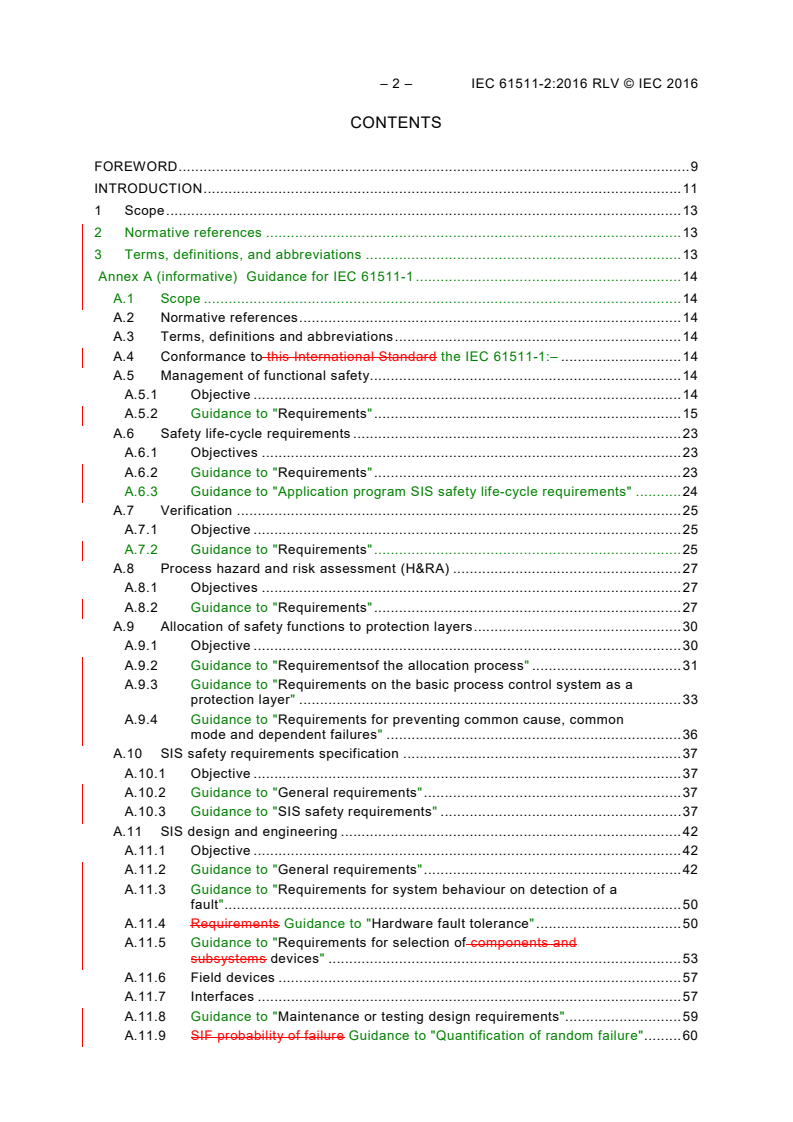
– 2 – IEC 61511-2:2016 RLV © IEC 2016
CONTENTS
FOREWORD . 9
INTRODUCTION . 11
1 Scope . 13
2 Normative references . 13
3 Terms, definitions, and abbreviations . 13
Annex A (informative) Guidance for IEC 61511-1 . 14
A.1 Scope . 14
A.2 Normative references . 14
A.3 Terms, definitions and abbreviations . 14
A.4 Conformance to this International Standard the IEC 61511-1:– . 14
A.5 Management of functional safety . 14
A.5.1 Objective . 14
A.5.2 Guidance to "Requirements" . 15
A.6 Safety life-cycle requirements . 23
A.6.1 Objectives . 23
A.6.2 Guidance to "Requirements" . 23
A.6.3 Guidance to "Application program SIS safety life-cycle requirements" . 24
A.7 Verification . 25
A.7.1 Objective . 25
A.7.2 Guidance to "Requirements" . 25
A.8 Process hazard and risk assessment (H&RA) . 27
A.8.1 Objectives . 27
A.8.2 Guidance to "Requirements" . 27
A.9 Allocation of safety functions to protection layers . 30
A.9.1 Objective . 30
A.9.2 Guidance to "Requirementsof the allocation process" . 31
A.9.3 Guidance to "Requirements on the basic process control system as a
protection layer" . 33
A.9.4 Guidance to "Requirements for preventing common cause, common
mode and dependent failures" . 36
A.10 SIS safety requirements specification . 37
A.10.1 Objective . 37
A.10.2 Guidance to "General requirements" . 37
A.10.3 Guidance to "SIS safety requirements" . 37
A.11 SIS design and engineering . 42
A.11.1 Objective . 42
A.11.2 Guidance to "General requirements" . 42
A.11.3 Guidance to "Requirements for system behaviour on detection of a
fault" . 50
A.11.4 Requirements Guidance to "Hardware fault tolerance" . 50
A.11.5 Guidance to "Requirements for selection of components and
subsystems devices" . 53
A.11.6 Field devices . 57
A.11.7 Interfaces . 57
A.11.8 Guidance to "Maintenance or testing design requirements" . 59
A.11.9 SIF probability of failure Guidance to "Quantification of random failure" . 60
12 Requirements for application software, including selection criteria for utility .
software .
12.1 Application software safety lifecycle requirements .
12.2 Application software safety requirements specification .
12.3 Application software safety validation planning .
12.4 Application software design and development .
12.5 Integration of the application software with the SIS subsystem .
12.6 FPL and LVL software modification procedures .
12.7 Application software verification .
A.12 SIS application program development . 81
A.12.1 Objective . 81
A.12.2 Guidance to "General requirements" . 81
A.12.4 Guidance to "Application program implementation" . 84
A.12.3 Guidance to "Application program design" . 82
A.12.5 Guidance to "Requirements for application program verification (review
and testing)" . 85
A.12.6 Guidance to "Requirements for application program methodology and
tools" . 89
A.13 Factory acceptance testing (FAT) . 91
A.13.1 Objectives . 91
A.13.2 Guidance to "Recommendations" . 91
A.14 SIS installation and commissioning . 91
A.14.1 Objectives . 91
A.14.2 Guidance to "Requirements" . 92
A.15 SIS safety validation . 92
A.15.1 Objective . 92
A.15.2 Guidance to "Requirements" . 92
A.16 SIS operation and maintenance . 93
A.16.1 Objectives . 93
A.16.2 Guidance to "Requirements" . 93
A.16.3 Proof testing and inspection . 94
A.17 SIS modification . 97
A.17.1 Objective . 97
A.17.2 Guidance to "Requirements" . 97
A.18 SIS decommissioning . 98
A.18.1 Objectives . 98
A.18.2 Guidance to "Requirements" . 98
A.19 Information and documentation requirements . 98
A.19.1 Objectives . 98
A.19.2 Guidance to "Requirements" . 98
Annex A (informative) Example of techniques for calculating the probability of failure
on demand for a safety instrumented function .
Annex B (informative) Typical SIS architecture development .
Annex B (informative) Example of SIS logic solver application program development
using function block diagram . 106
B.1 General . 106
B.2 Application program development and validation philosophy . 106
B.3 Application description . 107
B.3.1 General . 107
– 4 – IEC 61511-2:2016 RLV © IEC 2016
B.3.2 Process description . 107
B.3.3 Safety instrumented functions . 108
B.3.4 Risk reduction and domino effects . 109
B.4 Application program safety life-cycle execution . 109
B.4.1 General . 109
B.4.2 Inputs to application program SRS development . 109
B.4.3 Application program design and development . 112
B.4.4 Application program production . 126
B.4.5 Application program verification and testing . 126
B.4.6 Validation . 126
Annex C (informative) Application features of a safety PLC .
Annex C (informative) Considerations when converting from NP technologies to PE
technologies . 129
Annex D (informative) Example of SIS logic solver application software development
methodology .
Annex D (informative) Example of how to get from a piping and instrumentation
diagram (P&ID) to application program . 135
Annex E (informative) Example of development of externally configured diagnostics
for a safety-configured PE logic solver .
Annex E (informative) Methods and tools for application programming . 141
E.1 Typical toolset for application programming . 141
E.2 Rules and constraints for application program design . 142
E.3 Rules and constraints for application programming . 142
Annex F (informative) Example SIS project illustrating each phase of the safety life
cycle with application program development using relay ladder language . 144
F.1 Overview . 144
F.2 Project definition . 144
F.2.1 General . 144
F.2.2 Conceptual planning . 145
F.2.3 Process hazards analysis . 145
F.3 Simplified process description . 145
F.4 Preliminary design . 147
F.5 IEC 61511 application . 147
F.5.1 General . 147
F.5.2 Step F.1: Hazard & risk assessment . 151
F.5.3 Hazard identification . 151
F.5.4 Preliminary hazard evaluation . 151
F.5.5 Accident history . 151
F.6 Preliminary process design safety considerations . 154
F.7 Recognized process hazards . 154
F.8 Process design definitions strategy . 155
F.9 Preliminary hazard assessment . 158
F.9.1 General . 158
F.9.2 Step F.2: Allocation of safety functions . 162
F.10 SIF safety integrity level determination . 163
F.11 Layer of protection analysis (LOPA) applied to example . 163
F.12 Tolerable risk criteria . 164
F.13 Step F.3: SIS safety requirements specifications . 167
F.13.1 Overview . 167
F.13.2 Input requirements . 167
F.13.3 Safety functional requirements . 168
F.13.4 Safety integrity requirements . 169
F.14 Functional description and conceptual design . 170
F.14.1 Narrative for example reactor system logic . 170
F.15 SIL verification calculations . 171
F.16 Application program requirements . 178
F.17 Step F.4: SIS safety life-cycle . 185
F.18 Technology and device selection . 185
F.18.1 General . 185
F.18.2 Logic solver . 185
F.18.3 Sensors . 186
F.18.4 Final elements . 186
F.18.5 Solenoid valves . 186
F.18.6 Emergency vent valves . 187
F.18.7 Modulating valves . 187
F.18.8 Bypass valves . 187
F.18.9 Human-machine interfaces (HMIs) . 187
F.18.10 Separation . 188
F.19 Common cause and systematic failures . 189
F.19.1 General . 189
F.19.2 Diversity . 189
F.19.3 Specification errors . 189
F.19.4 Hardware design errors . 189
F.19.5 Software design errors . 190
F.19.6 Environmental overstress . 190
F.19.7 Temperature . 190
F.19.8 Humidity . 190
F.19.9 Contaminants . 191
F.19.10 Vibration . 191
F.19.11 Grounding . 191
F.19.12 Power line conditioning . 191
F.19.13 Electro-magnetic compatibility (EMC) . 191
F.19.14 Utility sources . 192
F.19.15 Sensors . 193
F.19.16 Process corrosion or fouling . 193
F.19.17 Maintenance . 193
F.19.18 Susceptibility to mis-operation . 193
F.19.19 SIS architecture . 193
F.20 SIS application program design features . 194
F.21 Wiring practices . 195
F.22 Security . 195
F.23 Step F.5: SIS installation, commissioning, validation . 196
F.24 Installation . 196
F.25 Commissioning . 197
F.26 Documentation . 198
F.27 Validation . 198
F.28 Testing . 199
F.29 Step F.6: SIS operation and maintenance . 212
– 6 – IEC 61511-2:2016 RLV © IEC 2016
F.30 Step F.7: SIS Modification . 215
F.31 Step F.8: SIS decommissioning . 215
F.32 Step F.9: SIS verification . 215
F.33 Step F.10: Management of functional safety and SIS FSA . 217
F.34 Management of functional safety . 217
F.34.1 General . 217
F.34.2 Competence of personnel . 217
F.35 Functional safety assessment . 217
Annex G (informative) Guidance on developing application programming practices . 218
G.1 Purpose of this guidance . 218
G.2 Generic safe application programming attributes . 218
G.3 Reliability . 218
G.3.1 General . 218
G.3.2 Predictability of memory utilisation . 219
G.3.3 Predictability of control flow . 220
G.3.4 Accounting for precision and accuracy . 222
G.3.5 Predictability of timing . 224
G.4 Predictability of mathematical or logical result . 224
G.5 Robustness . 225
G.5.1 General . 225
G.5.2 Controlling use of diversity . 225
G.5.3 Controlling use of exception handling . 226
G.5.4 Checking input and output . 227
G.6 Traceability . 228
G.6.1 General . 228
G.6.2 Controlling use of built-in functions . 228
G.6.3 Controlling use of compiled libraries . 228
G.7 Maintainability . 228
G.7.1 General . 228
G.7.2 Readability . 229
G.7.3 Data abstraction . 232
G.7.4 Functional cohesiveness . 233
G.7.5 Malleability . 233
G.7.6 Portability . 233
Bibliography . 235
Figure 1 – Overall framework of IEC 61511 series . 12
Figure 2 – BPCS function and initiating cause independence illustration .
Figure 3 – Software development lifecycle (the V-model) .
Figure A.1 – Application program V-Model . 25
Figure A.2 – Independence of a BPCS protection layer and an initiating source in the
BPCS . 35
Figure A.3 – Independence of two protection layers allocated to the BPCS . 36
Figure A.4 – Relationship of system, SIS hardware, and SIS application program . 41
Figure A.5 – Illustration of uncertainties on a reliability parameter . 64
Figure A.6 – Illustration of the 70 % confidence upper bound . 65
Figure A.7 – Typical probabilistic distribution of target results from Monte Carlo
simulation . 66
Figure B.1 – Process flow diagram for SIF 02.01 . 108
Figure B.2 – Process flow diagram for SIF 06.02 . 109
Figure B.3 – Functional specification of SIF02.01 and SIF 06.02 . 110
Figure B.4 – SIF 02.01 hardware functional architecture . 110
Figure B.5 – SIF 06.02 hardware functional architecture . 111
Figure B.6 – Hardware specification for SOV extracted from piping and
instrumentation diagram . 111
Figure B.7 – SIF 02.01 hardware physical architecture . 112
Figure B.8 – SIF 06.02 hardware physical architecture . 112
Figure B.9 – Hierarchical structure of model integration . 116
Figure B.10 – Hierarchical structure of model integration including models of safety
properties and of BPCS logic . 118
Figure B.11 – State transition diagram . 119
Figure B.12 – SOV typical block diagram . 120
Figure B.14 – Typical model block diagram implementation – BPCS part . 123
Figure B.13 – SOV typical model block diagram . 121
Figure B.15 – SOV application program typical model implementation – SIS part . 124
Figure B.16 – Complete model for final implementation model checking . 126
Figure C.1 – Logic solver .
Figure D.1 – Example of P&ID for an oil and gas separator . 135
Figure D.2 – Example of (part of) an ESD cause & effect diagram (C&E) . 136
Figure D.3 – Example of (part of) an application program in a safety PLC function
block programming . 137
Figure E.1 – EWDT timing diagram .
Figure F.1 – Simplified flow diagram: the PVC process . 146
Figure F.2 – SIS safety life-cycle phases and FSA stages . 148
Figure F.3 – Example of the preliminary P&ID for PVC reactor unit . 157
Figure F.4 – SIF S-1 Bubble diagram showing the PFD of each SIS device . 173
avg
Figure F.5 – S-1 Fault tree . 174
Figure F.6 – SIF S-2 Bubble diagram showing the PFD of each SIS device . 175
avg
Figure F.7 – SIF S-2 fault tree . 176
Figure F.8 – SIF S-3 Bubble diagram showing the PFD of each SIS device . 177
avg
Figure F.9 – SIF S-3 fault tree . 178
Figure F.10 – P&ID for PVC reactor unit SIF . 179
Figure F.11 – Legend (1 of 5) . 180
Figure F.12 – SIS for the VCM reactor . 194
Table 1 – Typical Safety Manual organisation and contents .
Table B.1 – Modes of operation specification . 113
Table B.2 – State transition table . 119
Table F.1 – SIS safety life-cycle overview . 149
Table F.2 – SIS safety life-cycle – Box 1 . 151
Table F.3 – Some physical properties of vinyl chloride . 153
Table F.4 – What-If/Checklist . 159
– 8 – IEC 61511-2:2016 RLV © IEC 2016
Table F.5 – HAZOP . 160
Table F.6 – Partial summary of hazard assessment for SIF strategy development . 161
Table F.7 – SIS safety life-cycle – Box 2 . 163
Table F.8 – Tolerable risk ranking . 165
Table F.9 – VCM reactor example: LOPA based integrity level . 166
Table F.10 – SIS safety life-cycle – Box 3 . 167
Table F.11 – Safety instrumented functions and SILs . 167
Table F.12 – Functional relationship of I/O for the SIF(s) . 168
Table F.13 – SIS sensors, normal operating range & trip points . 168
Table F.14 – Cause and effect diagram . 171
Table F.15 – MTTFd figures of SIS F.1 devices . 172
Table F.16 – SIS safety life-cycle – Box 4 . 185
Table F.17 – SIS safety life-cycle – Box 5 . 196
Table F.18 – List of instrument types and testing procedures used . 200
Table F.19 – Interlock check procedure bypass/simulation check sheet . 212
Table F.20 – SIS safety life-cycle – Box 6 . 212
Table F.21 – SIS trip log . 213
Table F.22 – SIS device failure log . 213
Table F.23 – SIS safety life-cycle – Box 7 . 215
Table F.24 – SIS safety life-cycle – Box 8 . 215
Table F.25 – SIS safety life-cycle – Box 9 . 216
INTERNATIONAL ELECTROTECHNICAL COMMISSION
____________
FUNCTIONAL SAFETY –
SAFETY INSTRUMENTED SYSTEMS
FOR THE PROCESS INDUSTRY SECTOR –
Part 2: Guidelines for the application of IEC 61511-1:2016
FOREWORD
1) The International Electrotechnical Commission (IEC) is a worldwide organization for standardization comprising
all national electrotechnical committees (IEC National Committees). The object of IEC is to promote
international co-operation on all questions concerning standardization in the electrical and electronic fields. To
this end and in addition to other activities, IEC publishes International Standards, Technical Specifications,
Technical Reports, Publicly Available Specifications (PAS) and Guides (hereafter referred to as “IEC
Publication(s)”). Their preparation is entrusted to technical committees; any IEC National Committee interested
in the subject dealt with may participate in this preparatory work. International, governmental and non-
governmental organizations liaising with the IEC also participate in this preparation. IEC collaborates closely
with the International Organization for Standardization (ISO) in accordance with conditions determined by
agreement between the two organizations.
2) The formal decisions or agreements of IEC on technical matters express, as nearly as possible, an international
consensus of opinion on the relevant subjects since each technical committee has representation from all
interested IEC National Committees.
3) IEC Publications have the form of recommendations for international use and are accepted by IEC National
Committees in that sense. While all reasonable efforts are made to ensure that the technical content of IEC
Publications is accurate, IEC cannot be held responsible for the way in which they are used or for any
misinterpretation by any end user.
4) In order to promote international uniformity, IEC National Committees undertake to apply IEC Publications
transparently to the maximum extent possible in their national and regional publications. Any divergence
between any IEC Publication and the corresponding national or regional publication shall be clearly indicated in
the latter.
5) IEC itself does not provide any attestation of conformity. Independent certification bodies provide conformity
assessment services and, in some areas, access to IEC marks of conformity. IEC is not responsible for any
services carried out by independent certification bodies.
6) All users should ensure that they have the latest edition of this publication.
7) No liability shall attach to IEC or its directors, employees, servants or agents including individual experts and
members of its technical committees and IEC National Committees for any personal injury, property damage or
other damage of any nature whatsoever, whether direct or indirect, or for costs (including legal fees) and
expenses arising out of the publication, use of, or reliance upon, this IEC Publication or any other IEC
Publications.
8) Attention is drawn to the Normative references cited in this publication. Use of the referenced publications is
indispensable for the correct application of this publication.
9) Attention is drawn to the possibility that some of the elements of this IEC Publication may be the subject of
patent rights. IEC shall not be held responsible for identifying any or all such patent rights.
This redline version of the official IEC Standard allows the user to identify the changes
made to the previous edition. A vertical bar appears in the margin wherever a change
has been made. Additions are in green text, deletions are in strikethrough red text.
– 10 – IEC 61511-2:2016 RLV © IEC 2016
International Standard IEC 61511-2 has been prepared by subcommittee 65A: System
aspects, of IEC technical committee 65: Industrial-process measurement, control and
automation.
This second edition cancels and replaces the first edition published in 2003. This edition
constitutes a technical revision. This edition includes the following significant technical
changes with respect to the previous edition:
• guidance examples based on all phases of the safety life cycle provided based on usage
st
experience with IEC61511 1 edition;
• annexes replaced to address transition from software to application programming.
The text of this standard is based on the following documents:
FDIS Report on voting
65A/783/FDIS 65A/787/RVD
Full information on the voting for the approval of this standard can be found in the report on
voting indicated in the above table.
This publication has been drafted in accordance with the ISO/IEC Directives, Part 2.
This International Standard is to be read in conjunction with IEC 61511-1. It is based on the
second edition of that standard.
A list of all parts in the IEC 61511 series, published under the general title Functional safety –
Safety instrumented systems for the process industry sector, can be found on the IEC
website.
The committee has decided that the contents of this publication will remain unchanged until
the stability date indicated on the IEC website under "http://webstore.iec.ch" in the data
related to the specific publication. At this date, the publication will be
• reconfirmed,
• withdrawn,
• replaced by a revised edition, or
• amended.
IMPORTANT – The 'colour inside' logo on the cover page of this publication indicates
that it contains colours which are considered to be useful for the correct
understanding of its contents. Users should therefore print this document using a
colour printer.
IEC 61
...
IEC 61511-2 ®
Edition 2.0 2016-07
INTERNATIONAL
STANDARD
NORME
INTERNATIONALE
colour
inside
Functional safety – Safety instrumented systems for the process industry
sector –
Part 2: Guidelines for the application of IEC 61511-1: 2016
Sécurité fonctionnelle – Systèmes instrumentés de sécurité pour le secteur
des industries de transformation –
Partie 2: Lignes directrices pour l'application de l'IEC 61511-1:2016
All rights reserved. Unless otherwise specified, no part of this publication may be reproduced or utilized in any form
or by any means, electronic or mechanical, including photocopying and microfilm, without permission in writing from
either IEC or IEC's member National Committee in the country of the requester. If you have any questions about IEC
copyright or have an enquiry about obtaining additional rights to this publication, please contact the address below or
your local IEC member National Committee for further information.
Droits de reproduction réservés. Sauf indication contraire, aucune partie de cette publication ne peut être reproduite
ni utilisée sous quelque forme que ce soit et par aucun procédé, électronique ou mécanique, y compris la photocopie
et les microfilms, sans l'accord écrit de l'IEC ou du Comité national de l'IEC du pays du demandeur. Si vous avez des
questions sur le copyright de l'IEC ou si vous désirez obtenir des droits supplémentaires sur cette publication, utilisez
les coordonnées ci-après ou contactez le Comité national de l'IEC de votre pays de résidence.
IEC Central Office Tel.: +41 22 919 02 11
3, rue de Varembé Fax: +41 22 919 03 00
CH-1211 Geneva 20 info@iec.ch
Switzerland www.iec.ch
About the IEC
The International Electrotechnical Commission (IEC) is the leading global organization that prepares and publishes
International Standards for all electrical, electronic and related technologies.
About IEC publications
The technical content of IEC publications is kept under constant review by the IEC. Please make sure that you have the
latest edition, a corrigenda or an amendment might have been published.
IEC Catalogue - webstore.iec.ch/catalogue Electropedia - www.electropedia.org
The stand-alone application for consulting the entire The world's leading online dictionary of electronic and
bibliographical information on IEC International Standards, electrical terms containing 20 000 terms and definitions in
Technical Specifications, Technical Reports and other English and French, with equivalent terms in 15 additional
documents. Available for PC, Mac OS, Android Tablets and languages. Also known as the International Electrotechnical
iPad. Vocabulary (IEV) online.
IEC publications search - www.iec.ch/searchpub IEC Glossary - std.iec.ch/glossary
The advanced search enables to find IEC publications by a 65 000 electrotechnical terminology entries in English and
variety of criteria (reference number, text, technical French extracted from the Terms and Definitions clause of
committee,…). It also gives information on projects, replaced IEC publications issued since 2002. Some entries have been
and withdrawn publications. collected from earlier publications of IEC TC 37, 77, 86 and
CISPR.
IEC Just Published - webstore.iec.ch/justpublished
Stay up to date on all new IEC publications. Just Published IEC Customer Service Centre - webstore.iec.ch/csc
details all new publications released. Available online and If you wish to give us your feedback on this publication or
also once a month by email. need further assistance, please contact the Customer Service
Centre: csc@iec.ch.
A propos de l'IEC
La Commission Electrotechnique Internationale (IEC) est la première organisation mondiale qui élabore et publie des
Normes internationales pour tout ce qui a trait à l'électricité, à l'électronique et aux technologies apparentées.
A propos des publications IEC
Le contenu technique des publications IEC est constamment revu. Veuillez vous assurer que vous possédez l’édition la
plus récente, un corrigendum ou amendement peut avoir été publié.
Catalogue IEC - webstore.iec.ch/catalogue Electropedia - www.electropedia.org
Application autonome pour consulter tous les renseignements
Le premier dictionnaire en ligne de termes électroniques et
bibliographiques sur les Normes internationales,
électriques. Il contient 20 000 termes et définitions en anglais
Spécifications techniques, Rapports techniques et autres
et en français, ainsi que les termes équivalents dans 15
documents de l'IEC. Disponible pour PC, Mac OS, tablettes
langues additionnelles. Egalement appelé Vocabulaire
Android et iPad.
Electrotechnique International (IEV) en ligne.
Recherche de publications IEC - www.iec.ch/searchpub
Glossaire IEC - std.iec.ch/glossary
La recherche avancée permet de trouver des publications IEC 65 000 entrées terminologiques électrotechniques, en anglais
en utilisant différents critères (numéro de référence, texte, et en français, extraites des articles Termes et Définitions des
comité d’études,…). Elle donne aussi des informations sur les publications IEC parues depuis 2002. Plus certaines entrées
projets et les publications remplacées ou retirées. antérieures extraites des publications des CE 37, 77, 86 et
CISPR de l'IEC.
IEC Just Published - webstore.iec.ch/justpublished
Service Clients - webstore.iec.ch/csc
Restez informé sur les nouvelles publications IEC. Just
Published détaille les nouvelles publications parues. Si vous désirez nous donner des commentaires sur cette
Disponible en ligne et aussi une fois par mois par email. publication ou si vous avez des questions contactez-nous:
csc@iec.ch.
IEC 61511-2 ®
Edition 2.0 2016-07
INTERNATIONAL
STANDARD
NORME
INTERNATIONALE
colour
inside
Functional safety – Safety instrumented systems for the process industry
sector –
Part 2: Guidelines for the application of IEC 61511-1: 2016
Sécurité fonctionnelle – Systèmes instrumentés de sécurité pour le secteur
des industries de transformation –
Partie 2: Lignes directrices pour l'application de l'IEC 61511-1:2016
INTERNATIONAL
ELECTROTECHNICAL
COMMISSION
COMMISSION
ELECTROTECHNIQUE
INTERNATIONALE
ICS 13.110; 25.040.01 ISBN 978-2-8322-3227-9
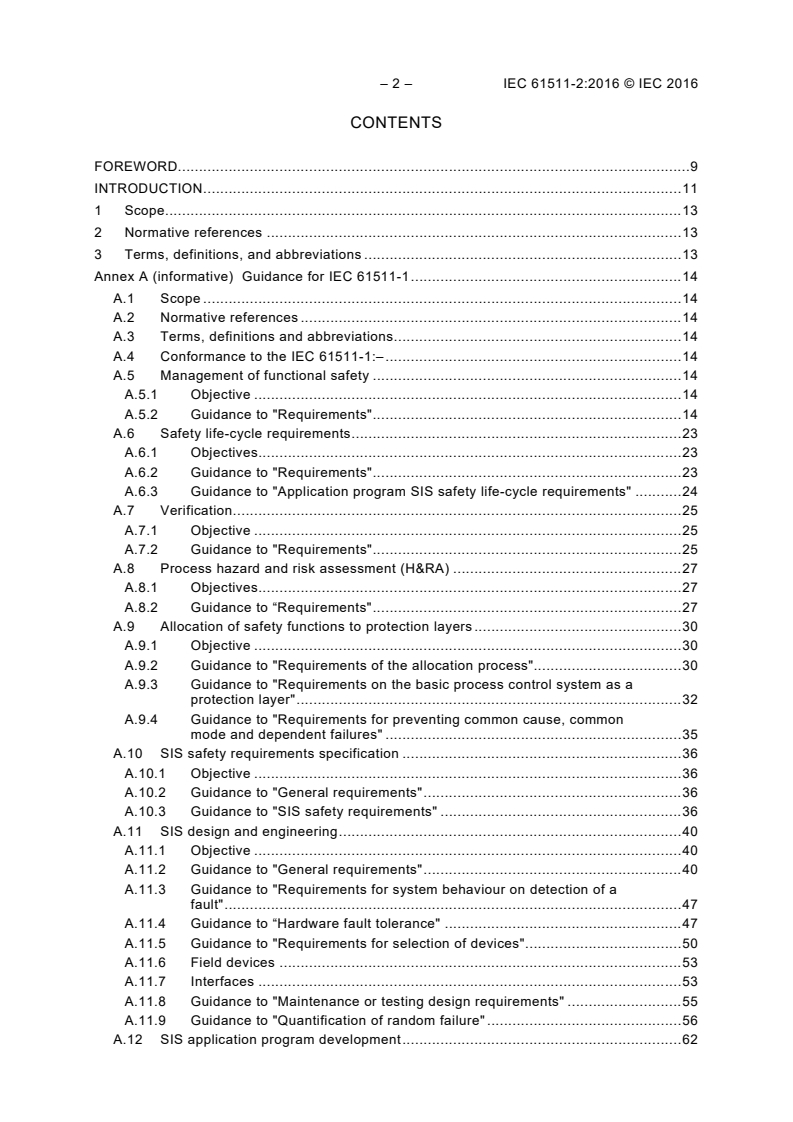
– 2 – IEC 61511-2:2016 © IEC 2016
CONTENTS
FOREWORD. 9
INTRODUCTION . 11
1 Scope . 13
2 Normative references . 13
3 Terms, definitions, and abbreviations . 13
Annex A (informative) Guidance for IEC 61511-1 . 14
A.1 Scope . 14
A.2 Normative references . 14
A.3 Terms, definitions and abbreviations . 14
A.4 Conformance to the IEC 61511-1:– . 14
A.5 Management of functional safety . 14
A.5.1 Objective . 14
A.5.2 Guidance to "Requirements" . 14
A.6 Safety life-cycle requirements . 23
A.6.1 Objectives . 23
A.6.2 Guidance to "Requirements" . 23
A.6.3 Guidance to "Application program SIS safety life-cycle requirements" . 24
A.7 Verification . 25
A.7.1 Objective . 25
A.7.2 Guidance to "Requirements" . 25
A.8 Process hazard and risk assessment (H&RA) . 27
A.8.1 Objectives . 27
A.8.2 Guidance to “Requirements" . 27
A.9 Allocation of safety functions to protection layers . 30
A.9.1 Objective . 30
A.9.2 Guidance to "Requirements of the allocation process". 30
A.9.3 Guidance to "Requirements on the basic process control system as a
protection layer" . 32
A.9.4 Guidance to "Requirements for preventing common cause, common
mode and dependent failures" . 35
A.10 SIS safety requirements specification . 36
A.10.1 Objective . 36
A.10.2 Guidance to "General requirements" . 36
A.10.3 Guidance to "SIS safety requirements" . 36
A.11 SIS design and engineering . 40
A.11.1 Objective . 40
A.11.2 Guidance to "General requirements" . 40
A.11.3 Guidance to "Requirements for system behaviour on detection of a
fault" . 47
A.11.4 Guidance to “Hardware fault tolerance" . 47
A.11.5 Guidance to "Requirements for selection of devices" . 50
A.11.6 Field devices . 53
A.11.7 Interfaces . 53
A.11.8 Guidance to "Maintenance or testing design requirements" . 55
A.11.9 Guidance to "Quantification of random failure" . 56
A.12 SIS application program development . 62
A.12.1 Objective . 62
A.12.2 Guidance to "General requirements" . 62
A.12.3 Guidance to "Application program design" . 64
A.12.4 Guidance to "Application program implementation" . 66
A.12.5 Guidance to "Requirements for application program verification (review
and testing)" . 67
A.12.6 Guidance to "Requirements for application program methodology and
tools" . 70
A.13 Factory acceptance testing (FAT) . 73
A.13.1 Objectives . 73
A.13.2 Guidance to "Recommendations" . 73
A.14 SIS installation and commissioning . 73
A.14.1 Objectives . 73
A.14.2 Guidance to "Requirements" . 73
A.15 SIS safety validation . 74
A.15.1 Objective . 74
A.15.2 Guidance to "Requirements" . 74
A.16 SIS operation and maintenance . 74
A.16.1 Objectives . 74
A.16.2 Guidance to "Requirements" . 75
A.16.3 Proof testing and inspection . 76
A.17 SIS modification . 78
A.17.1 Objective . 78
A.17.2 Guidance to "Requirements" . 79
A.18 SIS decommissioning . 79
A.18.1 Objectives . 79
A.18.2 Guidance to "Requirements" . 79
A.19 Information and documentation requirements . 80
A.19.1 Objectives . 80
A.19.2 Guidance to "Requirements" . 80
Annex B (informative) Example of SIS logic solver application program development
using function block diagram . 81
B.1 General . 81
B.2 Application program development and validation philosophy . 81
B.3 Application description . 82
B.3.1 General . 82
B.3.2 Process description . 82
B.3.3 Safety instrumented functions . 83
B.3.4 Risk reduction and domino effects . 84
B.4 Application program safety life-cycle execution . 84
B.4.1 General . 84
B.4.2 Inputs to application program SRS development . 84
B.4.3 Application program design and development . 87
B.4.4 Application program production . 101
B.4.5 Application program verification and testing . 101
B.4.6 Validation . 101
Annex C (informative) Considerations when converting from NP technologies to PE
technologies . 102
– 4 – IEC 61511-2:2016 © IEC 2016
Annex D (informative) Example of how to get from a piping and instrumentation
diagram (P&ID) to application program . 104
Annex E (informative) Methods and tools for application programming . 107
E.1 Typical toolset for application programming . 107
E.2 Rules and constraints for application program design . 108
E.3 Rules and constraints for application programming . 108
Annex F (informative) Example SIS project illustrating each phase of the safety life
cycle with application program development using relay ladder language . 110
F.1 Overview . 110
F.2 Project definition . 110
F.2.1 General . 110
F.2.2 Conceptual planning . 111
F.2.3 Process hazards analysis . 111
F.3 Simplified process description . 111
F.4 Preliminary design . 113
F.5 IEC 61511 application . 113
F.5.1 General . 113
F.5.2 Step F.1: Hazard & risk assessment . 117
F.5.3 Hazard identification . 117
F.5.4 Preliminary hazard evaluation . 117
F.5.5 Accident history . 117
F.6 Preliminary process design safety considerations . 120
F.7 Recognized process hazards . 120
F.8 Process design definitions strategy . 121
F.9 Preliminary hazard assessment . 124
F.9.1 General . 124
F.9.2 Step F.2: Allocation of safety functions . 128
F.10 SIF safety integrity level determination . 129
F.11 Layer of protection analysis (LOPA) applied to example . 129
F.12 Tolerable risk criteria . 130
F.13 Step F.3: SIS safety requirements specifications . 133
F.13.1 Overview . 133
F.13.2 Input requirements . 133
F.13.3 Safety functional requirements . 134
F.13.4 Safety integrity requirements . 135
F.14 Functional description and conceptual design . 136
F.14.1 Narrative for example reactor system logic . 136
F.15 SIL verification calculations . 137
F.16 Application program requirements . 144
F.17 Step F.4: SIS safety life-cycle . 151
F.18 Technology and device selection . 151
F.18.1 General . 151
F.18.2 Logic solver . 151
F.18.3 Sensors . 152
F.18.4 Final elements . 152
F.18.5 Solenoid valves . 152
F.18.6 Emergency vent valves . 153
F.18.7 Modulating valves . 153
F.18.8 Bypass valves . 153
F.18.9 Human-machine interfaces (HMIs) . 153
F.18.10 Separation . 154
F.19 Common cause and systematic failures . 155
F.19.1 General . 155
F.19.2 Diversity . 155
F.19.3 Specification errors . 155
F.19.4 Hardware design errors . 155
F.19.5 Software design errors . 156
F.19.6 Environmental overstress . 156
F.19.7 Temperature . 156
F.19.8 Humidity . 156
F.19.9 Contaminants . 157
F.19.10 Vibration . 157
F.19.11 Grounding . 157
F.19.12 Power line conditioning . 157
F.19.13 Electro-magnetic compatibility (EMC) . 157
F.19.14 Utility sources . 158
F.19.15 Sensors . 159
F.19.16 Process corrosion or fouling . 159
F.19.17 Maintenance . 159
F.19.18 Susceptibility to mis-operation . 159
F.19.19 SIS architecture . 159
F.20 SIS application program design features . 160
F.21 Wiring practices . 161
F.22 Security . 161
F.23 Step F.5: SIS installation, commissioning, validation . 162
F.24 Installation . 162
F.25 Commissioning . 163
F.26 Documentation . 164
F.27 Validation . 164
F.28 Testing . 165
F.29 Step F.6: SIS operation and maintenance . 178
F.30 Step F.7: SIS Modification . 181
F.31 Step F.8: SIS decommissioning . 181
F.32 Step F.9: SIS verification . 181
F.33 Step F.10: Management of functional safety and SIS FSA . 182
F.34 Management of functional safety . 183
F.34.1 General . 183
F.34.2 Competence of personnel . 183
F.35 Functional safety assessment . 183
Annex G (informative) Guidance on developing application programming practices . 184
G.1 Purpose of this guidance . 184
G.2 Generic safe application programming attributes . 184
G.3 Reliability . 184
G.3.1 General . 184
G.3.2 Predictability of memory utilisation . 185
G.3.3 Predictability of control flow . 186
G.3.4 Accounting for precision and accuracy . 188
G.3.5 Predictability of timing . 190
– 6 – IEC 61511-2:2016 © IEC 2016
G.4 Predictability of mathematical or logical result . 190
G.5 Robustness . 191
G.5.1 General . 191
G.5.2 Controlling use of diversity . 191
G.5.3 Controlling use of exception handling . 192
G.5.4 Checking input and output . 193
G.6 Traceability . 194
G.6.1 General . 194
G.6.2 Controlling use of built-in functions . 194
G.6.3 Controlling use of compiled libraries . 194
G.7 Maintainability . 194
G.7.1 General . 194
G.7.2 Readability . 195
G.7.3 Data abstraction . 198
G.7.4 Functional cohesiveness . 199
G.7.5 Malleability . 199
G.7.6 Portability . 199
Bibliography . 201
Figure 1 – Overall framework of IEC 61511 series . 12
Figure A.1 – Application program V-Model . 25
Figure A.2 – Independence of a BPCS protection layer and an initiating source in the
BPCS . 34
Figure A.3 – Independence of two protection layers allocated to the BPCS . 35
Figure A.4 – Relationship of system, SIS hardware, and SIS application program . 39
Figure A.5 – Illustration of uncertainties on a reliability parameter . 60
Figure A.6 – Illustration of the 70 % confidence upper bound . 61
Figure A.7 – Typical probabilistic distribution of target results from Monte Carlo
simulation . 62
Figure B.1 – Process flow diagram for SIF 02.01 . 83
Figure B.2 – Process flow diagram for SIF 06.02 . 84
Figure B.3 – Functional specification of SIF02.01 and SIF 06.02 . 85
Figure B.4 – SIF 02.01 hardware functional architecture . 85
Figure B.5 – SIF 06.02 hardware functional architecture . 86
Figure B.6 – Hardware specification for SOV extracted from piping and
instrumentation diagram . 86
Figure B.7 – SIF 02.01 hardware physical architecture . 87
Figure B.8 – SIF 06.02 hardware physical architecture . 87
Figure B.9 – Hierarchical structure of model integration . 91
Figure B.10 – Hierarchical structure of model integration including models of safety
properties and of BPCS logic . 93
Figure B.11 – State transition diagram . 94
Figure B.12 – SOV typical block diagram . 95
Figure B.13 – SOV typical model block diagram . 96
Figure B.14 – Typical model block diagram implementation – BPCS part . 98
Figure B.15 – SOV application program typical model implementation – SIS part . 99
Figure B.16 – Complete model for final implementation model checking . 101
Figure D.1 – Example of P&ID for an oil and gas separator . 104
Figure D.2 – Example of (part of) an ESD cause & effect diagram (C&E) . 105
Figure D.3 – Example of (part of) an application program in a safety PLC function
block programming . 106
Figure F.1 – Simplified flow diagram: the PVC process . 112
Figure F.2 – SIS safety life-cycle phases and FSA stages . 114
Figure F.3 – Example of the preliminary P&ID for PVC reactor unit . 123
Figure F.4 – SIF S-1 Bubble diagram showing the PFD of each SIS device . 139
avg
Figure F.5 – S-1 Fault tree . 140
Figure F.6 – SIF S-2 Bubble diagram showing the PFD of each SIS device . 141
avg
Figure F.7 – SIF S-2 fault tree . 142
Figure F.8 – SIF S-3 Bubble diagram showing the PFD of each SIS device . 143
avg
Figure F.9 – SIF S-3 fault tree . 144
Figure F.10 – P&ID for PVC reactor unit SIF . 145
Figure F.11 – Legend (1 of 5) . 146
Figure F.12 – SIS for the VCM reactor . 160
Table B.1 – Modes of operation specification . 88
Table B.2 – State transition table . 93
Table F.1 – SIS safety life-cycle overview . 115
Table F.2 – SIS safety life-cycle – Box 1 . 117
Table F.3 – Some physical properties of vinyl chloride . 119
Table F.4 – What-If/Checklist . 125
Table F.5 – HAZOP . 126
Table F.6 – Partial summary of hazard assessment for SIF strategy development . 127
Table F.7 – SIS safety life-cycle – Box 2 . 129
Table F.8 – Tolerable risk ranking . 131
Table F.9 – VCM reactor example: LOPA based integrity level . 132
Table F.10 – SIS safety life-cycle – Box 3 . 133
Table F.11 – Safety instrumented functions and SILs . 133
Table F.12 – Functional relationship of I/O for the SIF(s) . 134
Table F.13 – SIS sensors, normal operating range & trip points . 134
Table F.14 – Cause and effect diagram . 137
Table F.15 – MTTFd figures of SIS F.1 devices . 138
Table F.16 – SIS safety life-cycle – Box 4 . 151
Table F.17 – SIS safety life-cycle – Box 5 . 162
Table F.18 – List of instrument types and testing procedures used . 166
Table F.19 – Interlock check procedure bypass/simulation check sheet . 178
Table F.20 – SIS safety life-cycle – Box 6 . 178
Table F.21 – SIS trip log . 179
Table F.22 – SIS device failure log . 179
Table F.23 – SIS safety life-cycle – Box 7 . 181
– 8 – IEC 61511-2:2016 © IEC 2016
Table F.24 – SIS safety life-cycle – Box 8 . 181
Table F.25 – SIS safety life-cycle – Box 9 . 182
Table F.26 – SIS safety life-cycle – Box 10 . 182
INTERNATIONAL ELECTROTECHNICAL COMMISSION
____________
FUNCTIONAL SAFETY –
SAFETY INSTRUMENTED SYSTEMS
FOR THE PROCESS INDUSTRY SECTOR –
Part 2: Guidelines for the application of IEC 61511-1:2016
FOREWORD
1) The International Electrotechnical Commission (IEC) is a worldwide organization for standardization comprising
all national electrotechnical committees (IEC National Committees). The object of IEC is to promote
international co-operation on all questions concerning standardization in the electrical and electronic fields. To
this end and in addition to other activities, IEC publishes International Standards, Technical Specifications,
Technical Reports, Publicly Available Specifications (PAS) and Guides (hereafter referred to as “IEC
Publication(s)”). Their preparation is entrusted to technical committees; any IEC National Committee interested
in the subject dealt with may participate in this preparatory work. International, governmental and non-
governmental organizations liaising with the IEC also participate in this preparation. IEC collaborates closely
with the International Organization for Standardization (ISO) in accordance with conditions determined by
agreement between the two organizations.
2) The formal decisions or agreements of IEC on technical matters express, as nearly as possible, an international
consensus of opinion on the relevant subjects since each technical committee has representation from all
interested IEC National Committees.
3) IEC Publications have the form of recommendations for international use and are accepted by IEC National
Committees in that sense. While all reasonable efforts are made to ensure that the technical content of IEC
Publications is accurate, IEC cannot be held responsible for the way in which they are used or for any
misinterpretation by any end user.
4) In order to promote international uniformity, IEC National Committees undertake to apply IEC Publications
transparently to the maximum extent possible in their national and regional publications. Any divergence
between any IEC Publication and the corresponding national or regional publication shall be clearly indicated in
the latter.
5) IEC itself does not provide any attestation of conformity. Independent certification bodies provide conformity
assessment services and, in some areas, access to IEC marks of conformity. IEC is not responsible for any
services carried out by independent certification bodies.
6) All users should ensure that they have the latest edition of this publication.
7) No liability shall attach to IEC or its directors, employees, servants or agents including individual experts and
members of its technical committees and IEC National Committees for any personal injury, property damage or
other damage of any nature whatsoever, whether direct or indirect, or for costs (including legal fees) and
expenses arising out of the publication, use of, or reliance upon, this IEC Publication or any other IEC
Publications.
8) Attention is drawn to the Normative references cited in this publication. Use of the referenced publications is
indispensable for the correct application of this publication.
9) Attention is drawn to the possibility that some of the elements of this IEC Publication may be the subject of
patent rights. IEC shall not be held responsible for identifying any or all such patent rights.
International Standard IEC 61511-2 has been prepared by subcommittee 65A: System
aspects, of IEC technical committee 65: Industrial-process measurement, control and
automation.
This second edition cancels and replaces the first edition published in 2003. This edition
constitutes a technical revision. This edition includes the following significant technical
changes with respect to the previous edition:
• guidance examples based on all phases of the safety life cycle provided based on usage
st
experience with IEC61511 1 edition;
• annexes replaced to address transition from software to application programming.
– 10 – IEC 61511-2:2016 © IEC 2016
The text of this standard is based on the following documents:
FDIS Report on voting
65A/783/FDIS 65A/787/RVD
Full information on the voting for the approval of this standard can be found in the report on
voting indicated in the above table.
This publication has been drafted in accordance with the ISO/IEC Directives, Part 2.
This International Standard is to be read in conjunction with IEC 61511-1. It is based on the
second edition of that standard.
A list of all parts in the IEC 61511 series, published under the general title Functional safety –
Safety instrumented systems for the process industry sector, can be found on the IEC
website.
The committee has decided that the contents of this publication will remain unchanged until
the stability date indicated on the IEC websit
...