

IEC 62923-2:2018
(Main)Maritime navigation and radiocommunication equipment and systems - Bridge alert management - Part 2: Alert and cluster identifiers and other additional features
General Information
- Abstract
IEC 62923-2:2018 specifies standard alert identifiers and reserved cluster identifiers to be used when applying bridge alert management. The intent is to reduce the number of different identifiers used for similar alerts as much as possible.
- Status
- Published
- Publication Date
- 28-Aug-2018
- Technical Committee
- TC 80 - Maritime navigation and radiocommunication equipment and systems
- Drafting Committee
- WG 16 - TC 80/WG 16
- Current Stage
- PPUB - Publication issued
- Start Date
- 29-Aug-2018
- Completion Date
- 21-Sep-2018
Buy Documents
IEC 62923-2:2018 - Maritime navigation and radiocommunication equipment and systems - Bridge alert management - Part 2: Alert and cluster identifiers and other additional features Released:8/29/2018
Overview
IEC 62923-2:2018 is an international standard published by the International Electrotechnical Commission (IEC). This standard focuses on maritime navigation and radiocommunication equipment and systems, specifically addressing bridge alert management by defining standard alert identifiers and reserved cluster identifiers. The main goal of IEC 62923-2:2018 is to harmonize and reduce the variety of identifiers used for similar alerts, thereby streamlining alert communication and improving safety and efficiency on maritime vessel bridges.
By specifying machine-readable alert identifiers and reserved cluster identifiers, IEC 62923-2:2018 supports standardized processing, display, and transfer of alerts between systems. The standard complements IEC 62923-1 and is widely referenced in other maritime and navigation standards to ensure consistency in bridge alert management.
Key Topics
Standard Alert Identifiers:
The standard defines a comprehensive list of alert identifiers, ensuring that similar alerts across different equipment are represented consistently. This harmonization improves operator awareness and reduces confusion during critical situations.Reserved Cluster Identifiers:
IEC 62923-2:2018 introduces reserved cluster identifiers for grouping related alerts, such as navigation, communication, automation, cargo, safety/security, and more. This grouping helps operators and systems manage and prioritize alerts efficiently.Machine-Readable Coding:
Alert and cluster identifiers are designed for machine readability, facilitating efficient electronic communication, processing, and integration with other bridge systems.Requirement for Manufacturers:
Equipment manufacturers must assign the correct identifiers for predefined alerts and document all alerts and clusters present in their equipment. If an alert is not listed in the standard, manufacturers must assign identifiers in the designated generic range.Testing and Compliance:
The standard sets out clear methods for verifying that equipment uses the correct identifiers and that alerts are displayed and transmitted as specified, supporting effective compliance and system interoperability.
Applications
The practical applications of IEC 62923-2:2018 span a wide range of maritime environments and equipment, including:
Vessel Bridges:
Ensures that all bridge systems (navigation, communication, safety, automation) use standardized alert identifiers, improving clarity for watchkeepers and operators.Integrated Navigation Systems (INS):
Facilitates consistent alert sharing across integrated systems, enhancing situational awareness and response coordination.System Interoperability:
Simplifies integration between devices from different manufacturers by using standardized alert codes, facilitating smoother equipment upgrades and replacement.Regulatory Compliance:
Helps shipowners, operators, and equipment suppliers meet IMO and SOLAS requirements related to bridge alert management and maritime safety.Safety and Emergency Response:
By reducing ambiguity in alert identification and clustering, the standard directly supports faster and more reliable emergency responses, crucial for preventing incidents at sea.
Related Standards
For full effectiveness, IEC 62923-2:2018 should be implemented alongside related standards, including:
- IEC 62923-1: Maritime navigation and radiocommunication equipment and systems – Bridge alert management – Part 1: Operational and performance requirements, methods of testing and required test results
- IEC 61924-2: Integrated navigation systems – Operational and performance requirements
- IMO SOLAS: International Convention for Safety of Life at Sea
- IMO A.1021(26): Code on Alerts and Indicators
- IMO MSC.252(83): Performance standards for integrated navigation systems (INS)
By harmonizing alert and cluster identifiers as defined in IEC 62923-2:2018, the maritime industry benefits from enhanced safety, reliability, and interoperability in bridge alert management. The adoption of this standard is essential for modern vessels seeking to comply with international maritime regulations and best practices.
Buy Documents
IEC 62923-2:2018 - Maritime navigation and radiocommunication equipment and systems - Bridge alert management - Part 2: Alert and cluster identifiers and other additional features Released:8/29/2018
Get Certified
Connect with accredited certification bodies for this standard

DNV
DNV is an independent assurance and risk management provider.

Lloyd's Register
Lloyd's Register is a global professional services organisation specialising in engineering and technology.

FSC International
Forest Stewardship Council certification.
Sponsored listings
Frequently Asked Questions
IEC 62923-2:2018 is a standard published by the International Electrotechnical Commission (IEC). Its full title is "Maritime navigation and radiocommunication equipment and systems - Bridge alert management - Part 2: Alert and cluster identifiers and other additional features". This standard covers: IEC 62923-2:2018 specifies standard alert identifiers and reserved cluster identifiers to be used when applying bridge alert management. The intent is to reduce the number of different identifiers used for similar alerts as much as possible.
IEC 62923-2:2018 specifies standard alert identifiers and reserved cluster identifiers to be used when applying bridge alert management. The intent is to reduce the number of different identifiers used for similar alerts as much as possible.
IEC 62923-2:2018 is classified under the following ICS (International Classification for Standards) categories: 47.020.70 - Navigation and control equipment. The ICS classification helps identify the subject area and facilitates finding related standards.
IEC 62923-2:2018 is available in PDF format for immediate download after purchase. The document can be added to your cart and obtained through the secure checkout process. Digital delivery ensures instant access to the complete standard document.
Standards Content (Sample)
IEC 62923-2 ®
Edition 1.0 2018-08
INTERNATIONAL
STANDARD
NORME
INTERNATIONALE
Maritime navigation and radiocommunication equipment and systems – Bridge
alert management –
Part 2: Alert and cluster identifiers and other additional features
Matériels et systèmes de navigation et de radiocommunication maritimes –
Gestion des alertes à la passerelle –
Partie 2: Identifiants d'alerte et de groupe et autres caractéristiques
supplémentaires
All rights reserved. Unless otherwise specified, no part of this publication may be reproduced or utilized in any form
or by any means, electronic or mechanical, including photocopying and microfilm, without permission in writing from
either IEC or IEC's member National Committee in the country of the requester. If you have any questions about IEC
copyright or have an enquiry about obtaining additional rights to this publication, please contact the address below or
your local IEC member National Committee for further information.
Droits de reproduction réservés. Sauf indication contraire, aucune partie de cette publication ne peut être reproduite
ni utilisée sous quelque forme que ce soit et par aucun procédé, électronique ou mécanique, y compris la photocopie
et les microfilms, sans l'accord écrit de l'IEC ou du Comité national de l'IEC du pays du demandeur. Si vous avez des
questions sur le copyright de l'IEC ou si vous désirez obtenir des droits supplémentaires sur cette publication, utilisez
les coordonnées ci-après ou contactez le Comité national de l'IEC de votre pays de résidence.
IEC Central Office Tel.: +41 22 919 02 11
3, rue de Varembé info@iec.ch
CH-1211 Geneva 20 www.iec.ch
Switzerland
About the IEC
The International Electrotechnical Commission (IEC) is the leading global organization that prepares and publishes
International Standards for all electrical, electronic and related technologies.
About IEC publications
The technical content of IEC publications is kept under constant review by the IEC. Please make sure that you have the
latest edition, a corrigenda or an amendment might have been published.
IEC Catalogue - webstore.iec.ch/catalogue Electropedia - www.electropedia.org
The stand-alone application for consulting the entire The world's leading online dictionary of electronic and
bibliographical information on IEC International Standards, electrical terms containing 21 000 terms and definitions in
Technical Specifications, Technical Reports and other English and French, with equivalent terms in 16 additional
documents. Available for PC, Mac OS, Android Tablets and languages. Also known as the International Electrotechnical
iPad. Vocabulary (IEV) online.
IEC publications search - webstore.iec.ch/advsearchform IEC Glossary - std.iec.ch/glossary
The advanced search enables to find IEC publications by a 67 000 electrotechnical terminology entries in English and
variety of criteria (reference number, text, technical French extracted from the Terms and Definitions clause of
committee,…). It also gives information on projects, replaced IEC publications issued since 2002. Some entries have been
and withdrawn publications. collected from earlier publications of IEC TC 37, 77, 86 and
CISPR.
IEC Just Published - webstore.iec.ch/justpublished
Stay up to date on all new IEC publications. Just Published IEC Customer Service Centre - webstore.iec.ch/csc
details all new publications released. Available online and If you wish to give us your feedback on this publication or
also once a month by email. need further assistance, please contact the Customer Service
Centre: sales@iec.ch.
A propos de l'IEC
La Commission Electrotechnique Internationale (IEC) est la première organisation mondiale qui élabore et publie des
Normes internationales pour tout ce qui a trait à l'électricité, à l'électronique et aux technologies apparentées.
A propos des publications IEC
Le contenu technique des publications IEC est constamment revu. Veuillez vous assurer que vous possédez l’édition la
plus récente, un corrigendum ou amendement peut avoir été publié.
Catalogue IEC - webstore.iec.ch/catalogue Electropedia - www.electropedia.org
Application autonome pour consulter tous les renseignements
Le premier dictionnaire en ligne de termes électroniques et
bibliographiques sur les Normes internationales,
électriques. Il contient 21 000 termes et définitions en anglais
Spécifications techniques, Rapports techniques et autres
et en français, ainsi que les termes équivalents dans 16
documents de l'IEC. Disponible pour PC, Mac OS, tablettes
langues additionnelles. Egalement appelé Vocabulaire
Android et iPad.
Electrotechnique International (IEV) en ligne.
Recherche de publications IEC -
Glossaire IEC - std.iec.ch/glossary
webstore.iec.ch/advsearchform
67 000 entrées terminologiques électrotechniques, en anglais
La recherche avancée permet de trouver des publications IEC et en français, extraites des articles Termes et Définitions des
en utilisant différents critères (numéro de référence, texte, publications IEC parues depuis 2002. Plus certaines entrées
comité d’études,…). Elle donne aussi des informations sur les antérieures extraites des publications des CE 37, 77, 86 et
projets et les publications remplacées ou retirées. CISPR de l'IEC.
IEC Just Published - webstore.iec.ch/justpublished Service Clients - webstore.iec.ch/csc
Restez informé sur les nouvelles publications IEC. Just Si vous désirez nous donner des commentaires sur cette
Published détaille les nouvelles publications parues. publication ou si vous avez des questions contactez-nous:
Disponible en ligne et aussi une fois par mois par email. sales@iec.ch.
IEC 62923-2 ®
Edition 1.0 2018-08
INTERNATIONAL
STANDARD
NORME
INTERNATIONALE
Maritime navigation and radiocommunication equipment and systems – Bridge
alert management –
Part 2: Alert and cluster identifiers and other additional features
Matériels et systèmes de navigation et de radiocommunication maritimes –
Gestion des alertes à la passerelle –
Partie 2: Identifiants d'alerte et de groupe et autres caractéristiques
supplémentaires
INTERNATIONAL
ELECTROTECHNICAL
COMMISSION
COMMISSION
ELECTROTECHNIQUE
INTERNATIONALE
ICS 47.020.70 ISBN 978-2-8322-5994-8
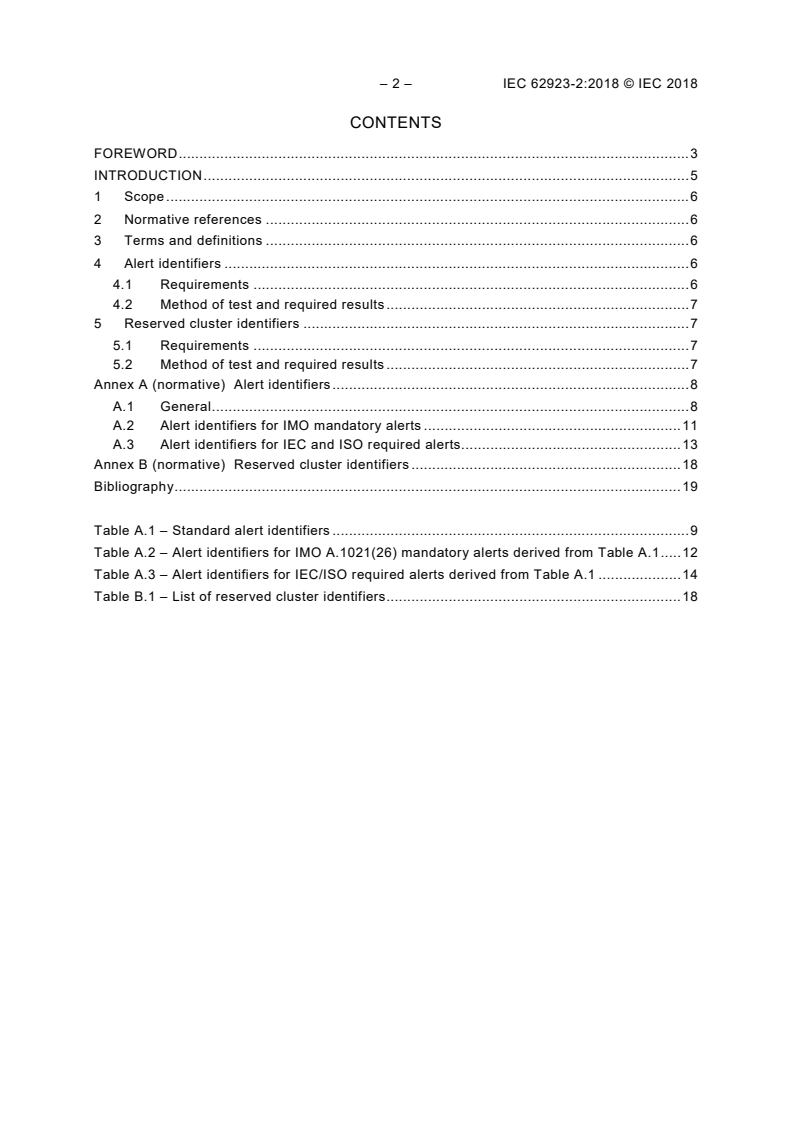
– 2 – IEC 62923-2:2018 © IEC 2018
CONTENTS
FOREWORD . 3
INTRODUCTION . 5
1 Scope . 6
2 Normative references . 6
3 Terms and definitions . 6
4 Alert identifiers . 6
4.1 Requirements . 6
4.2 Method of test and required results . 7
5 Reserved cluster identifiers . 7
5.1 Requirements . 7
5.2 Method of test and required results . 7
Annex A (normative) Alert identifiers . 8
A.1 General . 8
A.2 Alert identifiers for IMO mandatory alerts . 11
A.3 Alert identifiers for IEC and ISO required alerts. 13
Annex B (normative) Reserved cluster identifiers . 18
Bibliography . 19
Table A.1 – Standard alert identifiers . 9
Table A.2 – Alert identifiers for IMO A.1021(26) mandatory alerts derived from Table A.1 . 12
Table A.3 – Alert identifiers for IEC/ISO required alerts derived from Table A.1 . 14
Table B.1 – List of reserved cluster identifiers . 18
INTERNATIONAL ELECTROTECHNICAL COMMISSION
____________
MARITIME NAVIGATION AND RADIOCOMMUNICATION
EQUIPMENT AND SYSTEMS – BRIDGE ALERT MANAGEMENT –
Part 2: Alert and cluster identifiers and other additional features
FOREWORD
1) The International Electrotechnical Commission (IEC) is a worldwide organization for standardization comprising
all national electrotechnical committees (IEC National Committees). The object of IEC is to promote
international co-operation on all questions concerning standardization in the electrical and electronic fields. To
this end and in addition to other activities, IEC publishes International Standards, Technical Specifications,
Technical Reports, Publicly Available Specifications (PAS) and Guides (hereafter referred to as “IEC
Publication(s)”). Their preparation is entrusted to technical committees; any IEC National Committee interested
in the subject dealt with may participate in this preparatory work. International, governmental and
non-governmental organizations liaising with the IEC also participate in this preparation. IEC collaborates
closely with the International Organization for Standardization (ISO) in accordance with conditions determined
by agreement between the two organizations.
2) The formal decisions or agreements of IEC on technical matters express, as nearly as possible, an international
consensus of opinion on the relevant subjects since each technical committee has representation from all
interested IEC National Committees.
3) IEC Publications have the form of recommendations for international use and are accepted by IEC National
Committees in that sense. While all reasonable efforts are made to ensure that the technical content of IEC
Publications is accurate, IEC cannot be held responsible for the way in which they are used or for any
misinterpretation by any end user.
4) In order to promote international uniformity, IEC National Committees undertake to apply IEC Publications
transparently to the maximum extent possible in their national and regional publications. Any divergence
between any IEC Publication and the corresponding national or regional publication shall be clearly indicated in
the latter.
5) IEC itself does not provide any attestation of conformity. Independent certification bodies provide conformity
assessment services and, in some areas, access to IEC marks of conformity. IEC is not responsible for any
services carried out by independent certification bodies.
6) All users should ensure that they have the latest edition of this publication.
7) No liability shall attach to IEC or its directors, employees, servants or agents including individual experts and
members of its technical committees and IEC National Committees for any personal injury, property damage or
other damage of any nature whatsoever, whether direct or indirect, or for costs (including legal fees) and
expenses arising out of the publication, use of, or reliance upon, this IEC Publication or any other IEC
Publications.
8) Attention is drawn to the Normative references cited in this publication. Use of the referenced publications is
indispensable for the correct application of this publication.
9) Attention is drawn to the possibility that some of the elements of this IEC Publication may be the subject of
patent rights. IEC shall not be held responsible for identifying any or all such patent rights.
International Standard IEC 62923-2 has been prepared by IEC technical committee 80:
Maritime navigation and radiocommunication equipment and systems.
The text of this International Standard is based on the following documents:
FDIS Report on voting
80/893/FDIS 80/896/RVD
Full information on the voting for the approval of this International Standard can be found in
the report on voting indicated in the above table.
This document has been drafted in accordance with the ISO/IEC Directives, Part 2.
– 4 – IEC 62923-2:2018 © IEC 2018
A list of all parts in the IEC 62923 series, published under the general title Maritime
navigation and radiocommunication equipment and systems – Bridge alert management, can
be found on the IEC website.
The committee has decided that the contents of this document will remain unchanged until the
stability date indicated on the IEC website under "http://webstore.iec.ch" in the data related to
the specific document. At this date, the document will be
• reconfirmed,
• withdrawn,
• replaced by a revised edition, or
• amended.
INTRODUCTION
This document is written to support the implementation of IEC 62923-1, through the definition
of harmonized machine readable alert identifiers that can be used to facilitate the
implementation of responsibility transfer.
References are made to IEC 62923-2 in other standards. Many IEC standards involve alert
communications to which bridge alert management principles apply. This includes
interconnections between equipment to transfer alerts. Many standards define alerts for which
alert identifiers could be applied to enable machine-reading of these alerts.
It is important to coordinate the alert identifiers, to maintain machine-readability and to
prevent double use of an identifier. Due to the development of standards, it is important to
maintain this list.
This edition of the document contains the alert identifiers which have defined at the time of
publication. As bridge alert management is introduced into maritime navigation and
radiocommunication equipment, alert identifiers will be added into equipment standards. It is
intended that later editions of this document will include the alert identifiers subsequently
defined in the equipment standards.
– 6 – IEC 62923-2:2018 © IEC 2018
MARITIME NAVIGATION AND RADIOCOMMUNICATION
EQUIPMENT AND SYSTEMS – BRIDGE ALERT MANAGEMENT –
Part 2: Alert and cluster identifiers and other additional features
1 Scope
This part of IEC 62923 specifies standard alert identifiers and reserved cluster identifiers to
be used when applying bridge alert management. The intent is to reduce the number of
different identifiers used for similar alerts as much as possible.
2 Normative references
The following documents are referred to in the text in such a way that some or all of their
content constitutes requirements of this document. For dated references, only the edition
cited applies. For undated references, the latest edition of the referenced document (including
any amendments) applies.
IEC 62923-1, Maritime navigation and radiocommunication equipment and systems – Bridge
alert management – Part 1: Operational and performance requirements, methods of testing
and required test results
IMO, International Convention for the safety of life at sea (SOLAS),1974 as amended
IMO A.481(XII), Principles of safe manning
IMO MSC.128(75), Performance standards for a bridge navigational watch alarm system
(BNWAS)
IMO FSS Code, International Code of Fire Safety Systems
3 Terms and definitions
For the purposes of this document, the terms and definitions given in IEC 62923-1 apply.
ISO and IEC maintain terminological databases for use in standardization at the following
addresses:
• IEC Electropedia: available at http://www.electropedia.org/
• ISO Online browsing platform: available at http://www.iso.org/obp
4 Alert identifiers
4.1 Requirements
When defining alerts listed in Annex A, the corresponding alert identifiers defined in Annex A
shall be used.
Alerts not listed in Annex A shall be assigned an alert identifier in the range 10000 to
9999999.
The manufacturer shall provide a list of all alerts in the EUT, together with their assigned alert
identifiers.
4.2 Method of test and required results
Confirm by inspection of manufacturer’s documentation that:
• if the manufacturer has defined alerts listed in Annex A, the corresponding alert identifiers
are assigned as specified in Annex A; and
• if the manufacturer has defined alerts not listed in Annex A, the corresponding alert
identifiers are assigned within the range 10000 to 9999999.
If applicable, cause up to 5 alerts listed in Annex A and confirm by observation that the
reported ALF messages are indicating the appropriate identifier.
If applicable, cause up to 10 alerts not listed in Annex A and confirm by observation that the
reported ALF messages are indicating an identifier in the range 10000 to 9999999.
5 Reserved cluster identifiers
5.1 Requirements
When defining clusters (see IEC 62923-1), the cluster identifiers defined in Annex B shall be
used for their intended purpose. Only when the cluster identifiers defined in Annex B are not
applicable, the free range of cluster identifiers as defined in IEC 62923-1 shall be used.
The manufacturer shall provide a list of all alerts in the EUT, together with their assigned
cluster identifiers.
5.2 Method of test and required results
Confirm by inspection of manufacturer’s documentation that cluster identifiers are used as
specified in Annex B. If the clusters defined in Annex B are not applicable, confirm by
inspection that the cluster identifiers are used in the free range of cluster identifiers as
defined in IEC 62923-1.
– 8 – IEC 62923-2:2018 © IEC 2018
Annex A
(normative)
Alert identifiers
A.1 General
Table A.1 defines the standard alert identifiers. This table gives the definition of each alert,
which is to be considered as guidance for assigning an appropriate alert title. Also, the reason
for each alert is described.
In the definition, the text between angle brackets shall be replaced with the
appropriate information for the specific situation.
EXAMPLE
Definition: empty
Reason for alert: no cookies in the jar
Suggested alert title: cookie jar empty
NOTE 1 Guidance for the formulation of an appropriate alert title and alert description text is given in
IEC 62923-1.
The range of alert identifiers below number 0100 is reserved for emergency alerts only.
Starting from 0300, alert identifiers are issued in blocks per alert, as alerts could occur in
different priorities, due to the situation in which they occur.
Of the alert identifiers above 0300:
• numbers ending with 1, 4 and 7 will be used for the priority alarm;
• numbers ending with 2, 5 and 8 will be used for the priority warning;
• numbers ending with 3, 6 and 9 will be used for the priority caution.
NOTE 2 Where Table A.1, Table A.2 and Table A.3 in the column "Purpose" use the word "alarm" due to
formulations used in a related IMO document the requirements of IEC 62923-1, IMO or the individual equipment
standard could result in an actual alert priority other than "alarm".
Table A.2 and Table A.3 further indicate how those alert identifiers map to the alerts specified
by IMO or by the individual equipment standards.
NOTE 3 All alerts of individual equipment standards that have published alert identifiers will be included in future
editions of this document.
Where the tables also indicate numbers between brackets, for example (110), these represent
legacy alert identifiers, which could be encountered by equipment already in the market
before publishing of this document. These legacy alert identifiers should not be transmitted by
equipment compliant with this document for alerts raised by that equipment, except if this is a
configurable option for backwards compatibility.
Table A.1 – Standard alert identifiers
Standard alert Priority Alert Purpose
identifier definition
(title has
≤16
characters)
0001 Emergency
alarm emergency> general emergency procedures immediately.
0004 Emergency Fire Fire alarm activated. Operator has to initiate fire emergency
alarm procedures immediately.
Emergency
0007 Fire-extinguishing discharge imminent.
alarm
E.g. CO2 EngineRoom – Discharge imminent: evacuate space.
0011 Emergency Water level main alarm. Operator has to initiate water-ingress
alarm flooding procedures immediately.
0014 Emergency A watertight door or hatch is power-operated to close.
alarm closing
The system has lost communication with a connected system.
3002 Warning Lost
E.g. a wiring cut.
3003 Caution The system has lost communication with a connected system.
Improper information received.
3005 Warning Invalid
E.g. ECDIS "different geodetic datum".
Improper information received.
3006 Caution
E.g. IEC 61162-1 sentence has invalid fields.
One of the main functions of the system had to be stopped. The
3007 Alarm Lost
operator has to select an alternative immediately.
E.g. INS has lost collision avoidance function.
One of the main functions of the system had to be stopped. The
3008 Warning
operator has to select an alternative.
E.g. GNSS ‘no calculation of position’.
One of the main functions of the system had to be stopped. The
3009 Caution
operator has to select an alternative.
E.g. AIS ‘MKD lost’.
3012 Warning Doubtful The integrity check has failed.
E.g. the position monitor detects an integrity failure.
3013 Caution The integrity check has failed.
E.g. the position monitor detects an integrity failure.
A main function has lost essential sensor input.
3014 Alarm Lost
E.g. the last position sensor is lost.
3015 Warning A main function has lost essential sensor input.
A main function has lost essential sensor input.
3016 Caution
E.g. a standby TCS has lost input such that it cannot be
activated.
An operator setting is inconsistent when compared to other
3019 Caution Wrong
information.
E.g. INS "different thresholds entered".
3021 Alarm fail Power failure (generic).
E.g. power failure of steering gear pump 1.
3022 Warning Power failure (generic).
E.g. TCS "failure or reduction in power supply".
3023 Caution Power failure (generic)
E.g. charging voltage or current out of limits.
– 10 – IEC 62923-2:2018 © IEC 2018
Standard alert Priority Alert Purpose
identifier definition
(title has
≤16
characters)
3024 Alarm
limit>
E.g. the cross-track distance is too large.
3025 Warning A system detects that a control limit has been exceeded.
E.g. off heading.
3026 Caution A system detects that a control limit has been exceeded.
3027 Alarm
change>
3028 Warning
3031 Alarm A system detects that an operator threshold has been
exceeded.
3032 Warning
E.g. TCS "course difference".
3035 Warning
ahead> violate the safety of the ship.
3036 Caution
E.g. Crossing navigational hazard.
3038 Warning
point>
3042 Warning
store>
3043 Caution Target processing/display/capacity is about to be exceeded.
3044 Alarm CPA/TCPA Collision danger detected.
3048 Warning New Target A new target detected.
3052 Warning Lost target An acquired target has been lost.
3055 Warning
quality>
E.g. GNSS "loss of differential signal".
3056 Caution
3061 Alarm The system’s self-check has detected a fault (generic).
fault
3062 Warning
3065 Warning A system detects that it is outside its operating range.
E.g. TCS "low speed".
3067 Alarm
control> fail
E.g. propulsion machinery has a remote control failure.
3071 Alarm
imminent>
E.g. imminent slowdown or shutdown of propulsion system.
3074 Alarm Shutdown Automatic shutdown of system.
E.g. automatic shutdown of propulsion machinery.
3077 Alarm
attention> (generic).
3078 Warning Fault requiring action or attention of the officer on watch
(generic).
3079 Caution Fault requiring action or attention of the officer on watch
(generic).
E.g. paper low in printer.
3081 Alarm A closed watertight door or hatch is opening.
opening
Standard alert Priority Alert Purpose
identifier definition
(title has
≤16
characters)
3084 Alarm
detected>
E.g. hydrocarbon gas detection in a tanker’s cargo pump
rooms.
3087 Alarm
detected> controlled machinery space.
3091 Alarm Lost A system that monitors the presence of another critical system
detects the loss of that other system.
E.g. loss of required ventilation.
3094 Alarm
active> activated.
3097 Alarm
alert>
3101 Alarm
detected> activated.
3104 Alarm
detected>
3108 Warning
device>
3113 Caution in Lost primary function, fallback is in use.
fallback
E.g. AIS ‘Sync in fallback’.
3115 Warning Impaired Lost functionality of a radio link, causing loss of information.
radio
E.g. antenna tuning error.
3116 Caution Lost functionality of a radio link, causing loss of information.
E.g. AIS channel 1 inoperative.
3119 Caution Missing A data output signal is missing due to loss of external data
source.
E.g. AIS: Input missing for transmitting ROT.
3122 Warning
received>
E.g. a distress or urgency call from GMDSS equipment.
3123 Caution A message is received from a communication system.
E.g. maritime safety information from GMDSS equipment.
A.2 Alert identifiers for IMO mandatory alerts
IMO resolution A.1021(26), Table 10.1.1, lists the required alerts to be located on the
navigation bridge. An excerpt of this table, including added unique alert identifiers at alert
source, is reproduced as Table A.2.
Where an equipment applies alerts listed in Table A.2, the standard alert identifiers in Table
A.2 shall be used by the equipment for these alerts.
– 12 – IEC 62923-2:2018 © IEC 2018
Table A.2 – Alert identifiers for IMO A.1021(26) mandatory
alerts derived from Table A.1
IMO instrument Priority Purpose (as formulated by IMO) Standard
alert
identifier
SOLAS II-1
29.5.2 Alarm Steering gear power unit power failure 3021
29.8.4 Alarm Steering control system power failure 3021
29.12.2 Alarm Low steering gear hydraulic fluid level
30.3 Alarm Steering system electric phase failure/overload 3021
31.2.7, 49.5 Alarm Propulsion machinery remote control failure 3067
31.2.9, 49.7 Alarm Low propulsion starting air pressure 3031
31.2.10 Alarm Imminent slowdown or shutdown of propulsion system 3071
52 Alarm Automatic shutdown of propulsion machinery
51.1.3 Alarm Fault requiring action by or attention of the officer on watch 3077
(machinery alarm including automatic change-over alarm and
alarm for all important pressures, temperatures, fluid levels
and other essential parameters)
13.7.1.6, 13.8.2 Em. alarm
Power-operated sliding watertight door closing alarm 0014
13.7.3.1 Alarm Watertight door low hydraulic fluid level 3031
13.7.3.1 Alarm Watertight door low gas pressure 3031
13.7.3.2 Alarm Loss of stored energy 3021
13.7.8 Alarm Watertight door electrical power loss 3021
35-1.2.6.2 Alarm
High water level alarm 3031
17-1.1.2, 17-1.1.3 Alarm Opening indicator 3081
25.4 Alarm Water level pre-alarm 3031
25.4 Em. alarm Water level main-alarm 0011
51.2.2 Alarm Alarm system normal power supply failure 3021
SOLAS II-2
4.5.10.1.3 Alarm Hydrocarbon gas detection in tanker cargo pump rooms 3084
7.4.1, 7.4.2 Alarm Fire detection in periodically unattended, automated or 3087
remotely controlled machinery space
7.9.4 Em. alarm General emergency alarm 0001
7.9.4 Em. alarm Fire alarm 0004
20.3.1.3 Alarm Loss of required ventilation 3091
10.5.6.4 Alarm Fixed local application fire-extinguishing system activation 3094
SOLAS III
6.4 Em. alarm General emergency alarm 0001
SOLAS XII
12.1 Alarm Water level pre-alarm 3031
12.2 Em. alarm Water level main-alarm 0011
Resolution
A.481(XII)
Annex 2
7.3
Alarm Personnel alarm 3097
IMO instrument Priority Purpose (as formulated by IMO) Standard
alert
identifier
Resolution
MSC.128(75)
Annex
4.1.2.3, 5.2.3 Alarm BNWAS first stage audible alarm 3031
FSS Code
5.2.1.3 Em. alarm Fire-extinguishing pre-discharge alarm 0007
9.2.5.1 Em. alarm Fire alarm
8.2.5.2.1, Alarm Fire detection or automatic sprinkler operation 3101
9.2.5.1.2,
9.2.5.1.3
8.2.5.2.1, Alarm Fire detection system fault 3061
9.2.5.1.5,
9.2.5.1.2
10.2.4.1.4 Alarm Smoke detection system power loss 3021
10.2.4.1.3, Alarm Smoke detection 3104
10.2.2.3
A.3 Alert identifiers for IEC and ISO required alerts
Where an equipment applies alerts listed in Table A.3, the standard alert identifiers in Table
A.3 shall be used by the equipment for these alerts. Where the table also indicates numbers
between brackets, for example (110), these represent legacy alert identifiers, which could be
encountered by equipment already in the market before publishing of this document.
NOTE Table A.3 includes alerts from IEC 61924-2:2012, Table J.3 together with additional alerts called up in
IEC/ISO standards. IEC 61924-2:2012, Table J.3 is based on MSC.252(83) Appendix 5 in which IMO listed the
alerts appropriate to existing IMO individual performance standards.
– 14 – IEC 62923-2:2018 © IEC 2018
Table A.3 – Alert identifiers for IEC/ISO required alerts
derived from Table A.1
Source Priority Purpose (as formulated by individual equipment Standard alert
standard) identifier
CAM Caution Loss of alert communication with a connected system. 3003
Caution Improper alert information received. 3006
INS Alarm System function (e.g. collision avoidance) lost due to loss 3007
of essential sensor input.
(110)
Warning Integrity verification not possible. 3012
(111)
Warning Invalid information for functions in use. 3015
(112)
Caution Invalid information for functions not in use. 3016
(113)
Caution Different thresholds entered. 3019
(114)
Warning Loss of system communication. 3002
(115)
HCS Alarm Failure or reduction in power supply. 3021
(140)
Alarm System failure 3061
Warning Off heading alarm. 3025
(141)
Warning Heading monitor (deviation from second heading source). 3012
(142)
TCS Warning Early course change indication (track control via 3038
waypoints).
(150)
Warning Actual course change indication. 3028
(151)
Alarm Wheel over line alarm 3027
(152)
Warning Failure or reduction in power supply. 3022
(153)
Warning Position monitor. 3012
(154)
Warning Heading monitor. 3012
(155)
Alarm Sensor failure (heading, position, speed). 3014
(156)
Alarm Cross-track alarm. 3024
(157)
Warning Course difference (heading deviates from track course). 3032
(158)
Warning Low speed alarm. 3065
(159)
Warning End of track 3025
Source Priority Purpose (as formulated by individual equipment Standard alert
standard) identifier
Warning Track control stopped 3008
ECDIS Warning Positioning system failure. 3015
(170)
Alarm Crossing safety contour. 3031
(171)
Alarm Deviation from planned route – off-track alarm. 3024
(172)
Warning Area with special conditions – cross the boundary. 3035
(173)
Caution Area with special conditions – cross the boundary. 3036
(173)
Warning Approach to critical point. 3038
(174)
Warning Different geodetic datum. 3005
(175)
Warning System malfunction. 3062
(176)
Warning System malfunction of backup device. 3002
(177)
Alarm Anchor watch. 3031
Warning 3032
Warning Crossing navigational hazard. 3035
Caution 3036
RADAR Warning Target capacity exceeded. 3042
(190)
Caution Target capacity about to be exceeded. 3043
Alarm CPA/TCPA. 3044
(191)
Warning Acquisition/activation (New target). 3048
(192)
Warning Lost target alarm. 3052
(193)
Warning Failure of any signal or sensor in use. 3015
(194)
GNSS Caution HDOP exceeded. 3056
(210)
Warning No calculation of position. 3008
(211)
Warning Loss of position. 3015
(212)
Warning Loss of differential signal. 3055
(213)
Warning Differential corrections not applied. 3055
(214)
– 16 – IEC 62923-2:2018 © IEC 2018
Source Priority Purpose (as formulated by individual equipment Standard alert
standard) identifier
Warning Differential integrity status. 3012
(215)
Warning Alert limit exceeded 3062
Echo sounder Alarm Depth below keel alarm. 3031
(230)
Warning Failure or reduction in power supply. 3022
(231)
Gyro compass Warning System fault. 3062
(240)
BNWAS Warning Malfunction. 3062
(250)
Warning Power supply failure. 3022
(251)
Communication Warning Receipt of distress or urgency call 3122
(310)
Caution Receipt of other call 3123
(311)
Caution No position data received 3016
(312)
Caution Position older than 4 h 3013
Warning Antenna error or failure 3115
(313)
Caution No contact with satellites 3116
Warning Transmission power error 3008
(314)
Caution Battery charger out of limits 3023
(313)
Caution ICS subsystem failure 3009
(314)
Caution ICS network failure 3009
(315)
Caution Paper low 3079
AIS Warning Locating device 3108
(14)
Warning General fault 3062
(6)
Warning Transceiver failure 3008
(1.3.4)
Warning Lost position 3015
(26)
Caution Impaired radio 3116
(2,3,4,5)
Caution Sync in fallback 3113
(7)
Source Priority Purpose (as formulated by individual equipment Standard alert
standard) identifier
Caution Lost ext EPFS 3003
(25)
Caution Missing COG, SOG, Heading. ROT 3119
(29,30,32,35)
Caution Doubtful GNSS, Heading 3013
(9,11)
Caution Wrong NavStatus 3019
(10)
Caution Lost MKD 3009
(8)
– 18 – IEC 62923-2:2018 © IEC 2018
Annex B
(normative)
Reserved cluster identifiers
The reserved cluster identifiers are specified in Table B.1.
Table B.1 – List of reserved cluster identifiers
Identifier Cluster name Description Operator (example)
Nav Navigation Navigation bridge Navigator
Com Communication Ship’s communication Radio officer
Aut Automation Engine room domain Engineer
Cgo Cargo Regarding the payload of Chief officer/Supercargo
the ship
Passenger related Hotel manager (passenger
Htl Hotel
services vessels)
ICT ICT Office network ICT manager
SSe Safety/Security Access monitoring Ship security officer
Pos Position control Dynamic position or DP/mooring operator
mooring control
ROV Remote operated vehicle ROV control centre ROV operator
Bibliography
IEC 61924-2, Maritime navigation and radiocommunication equipment and systems –
Integrated navigation systems – Part 2: Modular structure for INS – Operational and
performance requirements, methods of testing and required test results
IMO A.1021(26), Code on Alerts and Indicators, 2009
IMO MSC.252(83), Performance standards for integrated navigation systems (INS)
___________
– 20 – IEC 62923-2:2018 © IEC 2018
SOMMAIRE
AVANT-PROPOS . 21
INTRODUCTION . 23
1 Domaine d'application . 24
2 Références normatives . 24
3 Termes et définitions . 24
4 Identifiants d'alerte . 25
4.1 Exigences . 25
4.2 Méthode d'essai et résultats exigés . 25
5 Identifiants de groupe réservés . 25
5.1 Exigences . 25
5.2 Méthode d'essai et résultats exigés . 25
Annexe A (normative) Identifiants d'alerte . 26
A.1 Généralités . 26
A.2 Identifiants d'alerte pour les alertes obligatoires OMI . 30
A.3 Identifiants d'alerte pour les alertes exigées par l'IEC et l'ISO . 32
Annexe B (normative) Identifiants de groupe réservés . 36
Bibliographie . 37
Tableau A.1 – Identifiants d'alerte normalisés . 27
Tableau A.2 – Identifiants d'alerte pour les alertes obligatoires OMI A.1021(26)
déduites du Tableau A.1 . 30
Tableau A.3 – Identifiants d'alerte pour les alertes exigées par l'IEC/ISO déduites
du Tableau A.1 . 32
Tableau B.1 – Liste des identifiants de groupe réservés . 36
COMMISSION ÉLECTROTECHNIQUE INTERNATIONALE
____________
MATÉRIELS ET SYSTÈMES DE NAVIGATION
ET DE RADIOCOMMUNICATION MARITIMES –
GESTION DES ALERTES À LA PASSERELLE –
Partie 2: Identifiants d'alerte et de groupe et autres
caractéristiques supplémentaires
AVANT-PROPOS
1) La Commission Electrotechnique Internationale (IEC) est une organisation mondiale de normalisation
composée de l'ensemble des comités électrotechniques nationaux (Comités nationaux de l’IEC). L’IEC a pour
objet de favoriser la coopération internationale pour toutes les questions de normalisation dans les domaines
de l'électricité et de l'électronique. A cet effet, l’IEC – entre autres activités – publie des Normes
internationales, des Spécifications techniques, des Rapports techniques, des Spécifications accessibles au
public (PAS) et des Guides (ci-après dénommés "Publication(s) de l’IEC"). Leur élaboration est confiée à des
comités d'études, aux travaux desquels tout Comité national intéressé par le sujet traité peut participer. Les
organisations internationales, gouvernementales et non gouvernementales, en liaison avec l’IEC, participent
également aux travaux. L’IEC collabore étroitement avec l'Organisation Internationale de Normalisation (ISO),
selon des conditions fixées par accord entre les deux organisations.
2) Les décisions ou accords officiels de l’IEC concernant les questions techniques représentent, dans la mesure
du possible, un accord international sur les sujets étudiés, étant donné que les Comités nationaux de l’IEC
intéressés sont représentés dans chaque comité d’études.
3) Les Publications de l’IEC se présentent sous la forme de recommandations internationales et sont agréées
comme telles par les Comités nationaux de l’IEC. Tous les efforts raisonnables sont entrepris afin que l’IEC
s'assure de l'exactitude du contenu technique de ses publications; l’IEC ne peut pas être tenue responsable de
l'éventuelle mauvaise utilisation ou interprétation qui en est faite par un quelconque utilisateur final.
4) Dans le but d'encourager l'uniformité internationale, les Comités nationaux de l’IEC s'engagent, dans toute la
mesure possible, à appliquer de façon transparente les Publications de l’IEC dans leurs publications nationales
et régionales. Toutes divergences entre toutes Publications de l’IEC et toutes publications nationales ou
régionales correspondantes doivent être indiquées en termes clairs dans ces dernières.
5) L’IEC elle-même ne fournit aucune attestation de conformité. Des organismes de certification indépendants
fournissent des services d'évaluation de conformité et, dans certains secteurs, accèdent aux marques de
conformité de l’IEC. L’IEC n'est responsable d'aucun des services effectués par les organismes de certification
indépendants.
6) Tous les utilisateurs doivent s'assurer qu'ils sont en possession de la dernière édition de cette publication.
7) Aucune responsabilité ne doit être imputée à l’IEC, à ses administrateurs, employés, auxiliaires ou
mandataires, y compris ses experts particuliers et les membres de ses comités d'études et des Comités
nationaux de l’IEC, pour tout préjudice causé en cas de dommages corporels et matériels, ou de tout autre
dommage de quelque nature que ce soit, directe ou indirecte, ou pour supporter les coûts (y compris les frais
de justice) et les dépenses découlant de la publication ou de l'utilisation de cette Publication de l’IEC ou de
toute autre Publication de l’IEC, ou au crédit qui lui est accordé.
8) L'attention est attirée sur les références normatives citées dans cette publication. L'utilisation de publications
...