


IEC 61162-410:2001
(Main)Maritime navigation and radiocommunication equipment and systems - Digital interfaces - Part 410: Multiple talkers and multiple listeners - Ship systems interconnection - Transport profile requirements and basic transport profile
General Information
- Abstract
Defines the general requirements of the T-profile and three implementations of the T-profile over the Internet V4 (IPV4) protocol suite.
- Status
- Replaced
- Publication Date
- 27-Nov-2001
- Technical Committee
- TC 80 - Maritime navigation and radiocommunication equipment and systems
- Drafting Committee
- WG 6 - TC 80/WG 6
- Current Stage
- WPUB - Publication withdrawn
- Start Date
- 24-Jun-2011
- Completion Date
- 28-Aug-2026
Buy Documents
IEC 61162-410:2001 - Maritime navigation and radiocommunication equipment and systems - Digital interfaces - Part 410: Multiple talkers and multiple listeners - Ship systems interconnection - Transport profile requirements and basic transport profile Released:11/28/2001
Relations
- Effective Date
- 05-Sep-2023
- Referred By
EN ISO 9875:2001 - Ships and marine technology - Marine echo-sounding equipment (ISO 9875:2000) - Effective Date
- 25-Aug-2026
Buy Documents
IEC 61162-410:2001 - Maritime navigation and radiocommunication equipment and systems - Digital interfaces - Part 410: Multiple talkers and multiple listeners - Ship systems interconnection - Transport profile requirements and basic transport profile Released:11/28/2001
Get Certified
Connect with accredited certification bodies for this standard

DNV
DNV is an independent assurance and risk management provider.

Lloyd's Register
Lloyd's Register is a global professional services organisation specialising in engineering and technology.

FSC International
Forest Stewardship Council certification.
Sponsored listings
Frequently Asked Questions
IEC 61162-410:2001 is a standard published by the International Electrotechnical Commission (IEC). Its full title is "Maritime navigation and radiocommunication equipment and systems - Digital interfaces - Part 410: Multiple talkers and multiple listeners - Ship systems interconnection - Transport profile requirements and basic transport profile". This standard covers: Defines the general requirements of the T-profile and three implementations of the T-profile over the Internet V4 (IPV4) protocol suite.
Defines the general requirements of the T-profile and three implementations of the T-profile over the Internet V4 (IPV4) protocol suite.
IEC 61162-410:2001 is classified under the following ICS (International Classification for Standards) categories: 47.020.70 - Navigation and control equipment. The ICS classification helps identify the subject area and facilitates finding related standards.
IEC 61162-410:2001 has the following relationships with other standards: It is inter standard links to IEC 61162-450:2011, EN ISO 9875:2001. Understanding these relationships helps ensure you are using the most current and applicable version of the standard.
IEC 61162-410:2001 is available in PDF format for immediate download after purchase. The document can be added to your cart and obtained through the secure checkout process. Digital delivery ensures instant access to the complete standard document.
Standards Content (Sample)
INTERNATIONAL IEC
STANDARD
61162-410
First edition
2001-11
Maritime navigation and radiocommunication
equipment and systems –
Digital interfaces –
Part 410:
Multiple talkers and multiple listeners –
Ship systems interconnection –
Transport profile requirements
and basic transport profile
Reference number
Publication numbering
As from 1 January 1997 all IEC publications are issued with a designation in the
60000 series. For example, IEC 34-1 is now referred to as IEC 60034-1.
Consolidated editions
The IEC is now publishing consolidated versions of its publications. For example,
edition numbers 1.0, 1.1 and 1.2 refer, respectively, to the base publication, the
base publication incorporating amendment 1 and the base publication incorporating
amendments 1 and 2.
Further information on IEC publications
The technical content of IEC publications is kept under constant review by the IEC,
thus ensuring that the content reflects current technology. Information relating to
this publication, including its validity, is available in the IEC Catalogue of
publications (see below) in addition to new editions, amendments and corrigenda.
Information on the subjects under consideration and work in progress undertaken
by the technical committee which has prepared this publication, as well as the list
of publications issued, is also available from the following:
• IEC Web Site (www.iec.ch)
• Catalogue of IEC publications
The on-line catalogue on the IEC web site (www.iec.ch/catlg-e.htm) enables
you to search by a variety of criteria including text searches, technical
committees and date of publication. On-line information is also available on
recently issued publications, withdrawn and replaced publications, as well as
corrigenda.
• IEC Just Published
This summary of recently issued publications (www.iec.ch/JP.htm) is also
available by email. Please contact the Customer Service Centre (see below) for
further information.
• Customer Service Centre
If you have any questions regarding this publication or need further assistance,
please contact the Customer Service Centre:
Email: custserv@iec.ch
Tel: +41 22 919 02 11
Fax: +41 22 919 03 00
INTERNATIONAL IEC
STANDARD
61162-410
First edition
2001-11
Maritime navigation and radiocommunication
equipment and systems –
Digital interfaces –
Part 410:
Multiple talkers and multiple listeners –
Ship systems interconnection –
Transport profile requirements
and basic transport profile
IEC 2001 Copyright - all rights reserved
No part of this publication may be reproduced or utilized in any form or by any means, electronic or
mechanical, including photocopying and microfilm, without permission in writing from the publisher.
International Electrotechnical Commission 3, rue de Varembé Geneva, Switzerland
Telefax: +41 22 919 0300 e-mail: inmail@iec.ch IEC web site http://www.iec.ch
Commission Electrotechnique Internationale
PRICE CODE
XB
International Electrotechnical Commission
For price, see current catalogue
– 2 – 61162-410 IEC:2001(E)
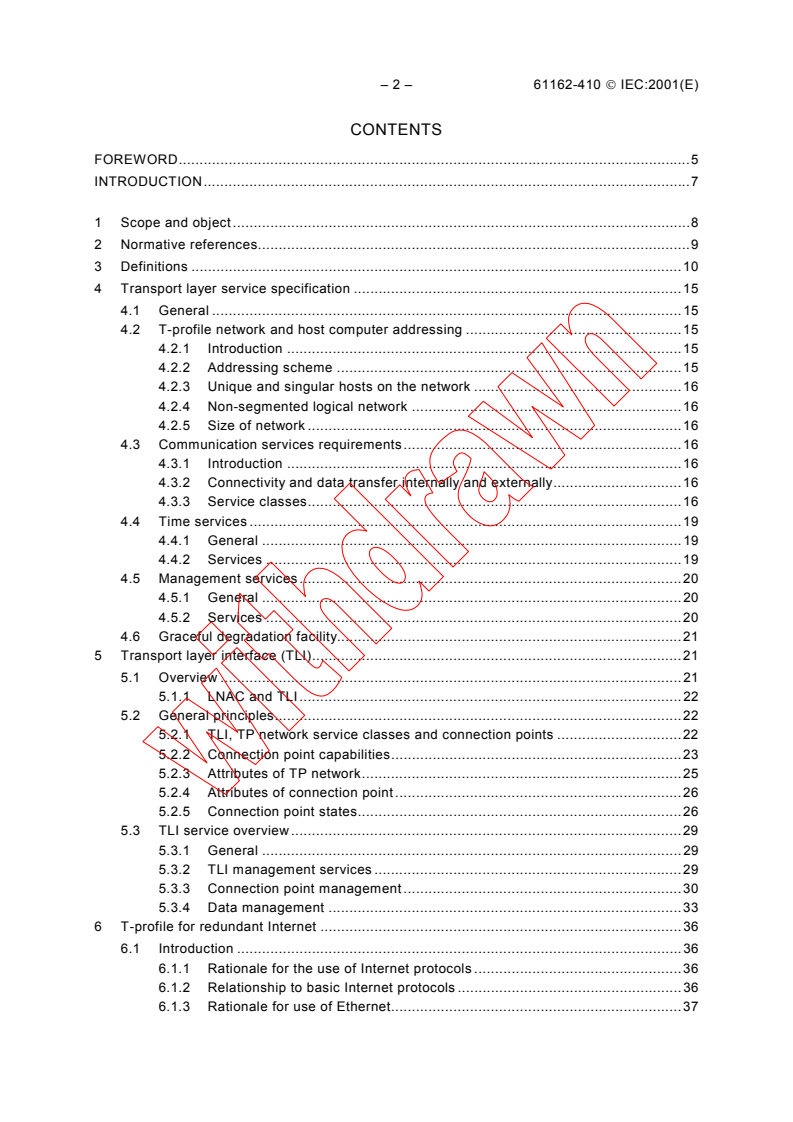
CONTENTS
FOREWORD.5
INTRODUCTION.7
1 Scope and object .8
2 Normative references.9
3 Definitions .10
4 Transport layer service specification .15
4.1 General .15
4.2 T-profile network and host computer addressing .15
4.2.1 Introduction .15
4.2.2 Addressing scheme .15
4.2.3 Unique and singular hosts on the network .16
4.2.4 Non-segmented logical network .16
4.2.5 Size of network .16
4.3 Communication services requirements.16
4.3.1 Introduction .16
4.3.2 Connectivity and data transfer internally and externally.16
4.3.3 Service classes.16
4.4 Time services .19
4.4.1 General .19
4.4.2 Services .19
4.5 Management services.20
4.5.1 General .20
4.5.2 Services .20
4.6 Graceful degradation facility.21
5 Transport layer interface (TLI).21
5.1 Overview .21
5.1.1 LNAC and TLI.22
5.2 General principles.22
5.2.1 TLI, TP network service classes and connection points .22
5.2.2 Connection point capabilities.23
5.2.3 Attributes of TP network.25
5.2.4 Attributes of connection point .26
5.2.5 Connection point states.26
5.3 TLI service overview .29
5.3.1 General .29
5.3.2 TLI management services .29
5.3.3 Connection point management.30
5.3.4 Data management .33
6 T-profile for redundant Internet .36
6.1 Introduction .36
6.1.1 Rationale for the use of Internet protocols .36
6.1.2 Relationship to basic Internet protocols .36
6.1.3 Rationale for use of Ethernet.37
61162-410 IEC:2001(E) – 3 –
6.2 Transport profile architecture .37
6.2.1 General .37
6.2.2 Redundancy.38
6.2.3 Communication services .39
6.3 Message formats .39
6.3.1 General format.39
6.3.2 Special reliable link messages .40
6.3.3 Broadcast messages.40
6.4 Reliable stream protocol .41
6.4.1 Introduction .41
6.4.2 Connection management .41
6.4.3 Data transmission .45
6.4.4 Data reception .46
6.4.5 Link close .47
6.5 Reliable message service .47
6.5.1 Introduction .47
6.5.2 Data reception .47
6.5.3 Data transmission on the urgent link .47
6.6 Unreliable message service .47
6.6.1 Introduction .47
6.6.2 Connection management .47
6.6.3 Message length limitation.49
6.6.4 Data transmission .49
6.6.5 Data reception .49
6.7 Time services .50
6.7.1 Introduction .50
6.7.2 Time management architecture.50
6.7.3 Client interfaces.50
6.7.4 System integration requirements .51
6.8 Network management services .51
6.8.1 Introduction .51
6.8.2 Physical architecture.51
6.8.3 Required safety precautions.51
6.8.4 NMA requirements .51
6.8.5 Network element requirements.51
7 T-profile for non-redundant Internet.52
7.1 Introduction .52
7.2 Relationship to redundant Internet protocol .52
7.3 Redundancy .52
7.4 Reliable stream protocol .53
7.5 Reliable message service .53
7.6 Unreliable message service .53
7.7 Time services .53
7.8 Network management services .53
8 T-profile for wide area networks (MAU-LNA communication link) .53
8.1 Introduction .53
8.1.1 General architecture .53
8.1.2 TP network and NNN code definitions .54
– 4 – 61162-410 IEC:2001(E)
8.2 Relationship to non-redundant Internet T-profile.54
8.3 Reliable stream service .55
8.4 Reliable message service .55
8.5 Other services .55
Annex A (informative) Typical software library structure.56
Annex B (informative) Channel synchronization example .57
Annex C (informative) NTP and SNTP overview.58
Annex D (informative) Overview of Internet network management services .59
61162-410 IEC:2001(E) – 5 –
INTERNATIONAL ELECTROTECHNICAL COMMISSION
____________
MARITIME NAVIGATION AND RADIOCOMMUNICATION
EQUIPMENT AND SYSTEMS –
DIGITAL INTERFACES –
Part 410: Multiple talkers and multiple listeners –
Ship systems interconnection –
Transport profile requirements and basic transport profile
FOREWORD
1) The IEC (International Electrotechnical Commission) is a worldwide organization for standardization comprising
all national electrotechnical committees (IEC National Committees). The object of the IEC is to promote
international co-operation on all questions concerning standardization in the electrical and electronic fields. To
this end and in addition to other activities, the IEC publishes International Standards. Their preparation is
entrusted to technical committees; any IEC National Committee interested in the subject dealt with may
participate in this preparatory work. International, governmental and non-governmental organizations liaising
with the IEC also participate in this preparation. The IEC collaborates closely with the International Organization
for Standardization (ISO) in accordance with conditions determined by agreement between the two
organizations.
2) The formal decisions or agreements of the IEC on technical matters express, as nearly as possible, an
international consensus of opinion on the relevant subjects since each technical committee has representation
from all interested National Committees.
3) The documents produced have the form of recommendations for international use and are published in the form
of standards, technical specifications, technical reports or guides and they are accepted by the National
Committees in that sense.
4) In order to promote international unification, IEC National Committees undertake to apply IEC International
Standards transparently to the maximum extent possible in their national and regional standards. Any
divergence between the IEC Standard and the corresponding national or regional standard shall be clearly
indicated in the latter.
5) The IEC provides no marking procedure to indicate its approval and cannot be rendered responsible for any
equipment declared to be in conformity with one of its standards.
6) Attention is drawn to the possibility that some of the elements of this International Standard may be the subject
of patent rights. The IEC shall not be held responsible for identifying any or all such patent rights.
International Standard IEC 61162-410 has been prepared by IEC technical committee 80:
Maritime navigation and radiocommunication equipment and systems
The text of this standard is based on the following documents:
FDIS Report on voting
80/311/FDIS 80/326/RVD
Full information on the voting for the approval of this standard can be found in the report on
voting indicated in the above table.
This publication has been drafted in accordance with the ISO/IEC Directives, Part 3.
The special typographical conventions and nomenclature used in this standard are defined in
IEC 61162-400 annex A.
– 6 – 61162-410 IEC:2001(E)
Annexes A, B, C and D are for information only.
The committee has decided that the contents of this publication will remain unchanged until
June 2005. At this date, the publication will be
• reconfirmed;
• withdrawn;
• replaced by a revised edition, or
• amended.
61162-410 IEC:2001(E) – 7 –
INTRODUCTION
International Standard IEC 61162 is a four-part standard which specifies four digital interfaces
for applications in marine navigation, radiocommunication and system integration.
The four parts are:
IEC 61162-1 Single talker and multiple listeners
IEC 61162-2 Single talker and multiple listeners, high speed transmission
IEC 61162-3 Multiple talkers and multiple listeners – Serial data instrument network
IEC 61162-4 Multiple talkers and multiple listeners – Ship systems interconnection.
Part 4 of the standard is subdivided into a number of individual standards with part numbers in
the 400 series.
This part of the standard contains the specification of the requirements to an IEC 61162-4
transport profile (T-profile) and also the specification of one implementation, based on
redundant Ethernet and Internet protocol functionality. The T-profile is the protocol transport
mechanisms that offer simple message or byte stream transport services to the higher protocol
layers (defined in other parts of the standard). In addition, the T-profile also offers services for
time distribution and physical network management.
The use of Internet and Ethernet protocols offer low cost and high efficiency data transport in
any kind of system. However, for safety related applications, certain measures have to be
taken to avoid that particulars of office-quality and off-the-shelf technology create safety risks.
This part of the standard specifies mechanisms by which a certain degree of quality of service
can be guaranteed from these networks, including the provision of redundancy.
Other T-profile documents will be prepared with specifications of the same T-profile require-
ments over other transport protocols. This will be issued in the same number series as this
standard (IEC 61162-41x).
Relationship with the other parts of the IEC 61162 series of standards is defined in annex B to
IEC 61162-400.
– 8 – 61162-410 IEC:2001(E)
MARITIME NAVIGATION AND RADIOCOMMUNICATION
EQUIPMENT AND SYSTEMS –
DIGITAL INTERFACES –
Part 410: Multiple talkers and multiple listeners –
Ship systems interconnection –
Transport profile requirements and basic transport profile
1 Scope and object
This part of IEC 61162-4 defines the general requirements of the T-profile and three
implementations of the T-profile over the Internet V4 (IPV4) protocol suite. Part 400 of this
standard defines the relationship between the different protocol levels (T-profile, A-profile and
companion standards) and part 401 defines the A-profile, the immediate user of the protocol
level defined in this part.
The different components of the IEC 61162-4 standard are defined in IEC 61162-400. The
T-profile is the specification of the communication services and the communication protocols
used by the LNA to implement the A-profile functionality. Basically, the T-profile consists of the
following components:
a) a transport layer interface (TLI) definition that specifies the services and the semantics that
will be available to the application level of the LNA (and in some cases the MAU). This
includes data transport as well as time and network management services. The TLI will be
general to all T-profiles and is defined in this part 410 of the standard,
b) A T-profile protocol definition that specifies how the services provided by the TLI and
additional time distribution and physical network management services are implemented on
the protocol level. This part 410 contains a number of alternative T-profile protocol
specifications using the Internet V4 series of standards. Additional parts of this standard
will address other T-profiles based on other protocol families.
Note that the time distribution and network management functionality may or may not include
specific TLI services. For some systems this functionality may be interfaced to directly by the
underlying operating system. Note also that time distribution and network management are not
strictly speaking transport related protocol functionality. However, the implementation of these
services is normally dependent on the transport protocols in use and is, thus, placed in the
T-profile part of the standard.
The purpose of this standard is to define and describe the services that will be provided at the
transport level interface in a way which is completely independent of the underlying network
environment as well as defining one possible implementation of these services over the
Internet V4 protocols. The separation of service and protocol definitions allows the
specification of several different transport profiles, each one dedicated to a specific network
environment, and to use the same transport service interface in all cases.
Clause 4 defines the transport level services and clause 5 describes the transport layer
interface through which the services are offered. These clauses define the general, network
independent services.
Clause 6 defines the transport profile architecture for redundant Ethernet and Internet
protocols version 4 (IPV4). Clause 7 defines the architecture for a local area non-redundant
Internet network. These clauses define two specific implementations of the T-profile services.
61162-410 IEC:2001(E) – 9 –
Clause 8 defines a simple MAU-LNA protocol for use over wide area network (WAN) TCP/IP
links. This can be used to implement a WAN architecture for the overall system. The WAN
architecture is not intended for integrated ship control systems, but can be used for remote test
integration and remote maintenance and diagnostics. The WAN protocol can also be used to
support MAUs that are located in other host computers than the LNA, but on one local network
(conformance class 4).
2 Normative references
The following normative documents contain provisions which, through reference in this text,
constitute provisions of this part of IEC 61162. For dated references, subsequent amendments
to, or revisions of, any of these publications do not apply. However, parties to agreements
based on this part of IEC 61162 are encouraged to investigate the possibility of applying the
most recent editions of the normative documents indicated below. For undated references, the
latest edition of the normative document referred to applies. Members of IEC and ISO maintain
registers of currently valid International Standards.
IEC 61162-400, Maritime navigation and radiocommunication equipment and systems – Digital
interfaces – Part 400: Multiple talkers and multiple listeners – Ship systems interconnection –
Introduction and general principles
ISO 8802-3, Information technology – Telecommunications and information exchange between
systems – Local and metropolitan area networks – Specific requirements – Part 3: Carrier
sense multiple access with collision detection (CSMA/CD) access method and physical layer
specifications
ISO/IEC 9595: Information technology – Open Systems Interconnection – Common manage-
ment information service
ISO/IEC 9596-1: Information technology – Open Systems Interconnection – Common manage-
ment information protocol – Part 1: Specification
RFC 768:1980, User Datagram Protocol (UDP), Internet Activities Board recommended
standard
RFC 793:1981, Transmission Control Protocol (TCP), Internet Activities Board recommended
standard
RFC 826:1982, Address Resolution Protocol (ARP), Internet Activities Board elective standard
RFC 894:1984, Internet Protocol on Ethernet Networks, Internet Activities Board elective
standard
RFC 1157:1990, Simple Network Management Protocol (SNMP)
RFC 1189:1990, Common Management Information Services and Protocols for the Internet
(CMOT and CMIP)
RFC 1213:1991, Management Information Base for Network Management of TCP/IP-based
Internets: MIB-II
RFC 1305:1992, Network Time Protocol, Version 3 – Specification and Implementation
RFC 2030:1996, Simple Network Time Protocol (SNTP), Version 4 for IPv4, IPv6 and OSI
RFC 2500:1999, Internet Official Protocol Standards – Internet Activities Board standard
– 10 – 61162-410 IEC:2001(E)
NOTE RFC (request for comments) is a document, issued by the Internet engineering task force (IETF) the
International standardization body for the Internet, that describes a part of the Internet protocol. Some RFCs are
accepted as official Internet standards and listed in the “Internet Official Protocol Standards” itself an RFC.
3 Definitions
For the purpose of this part of IEC 61162, the definitions in IEC 61162-400 and the following
definitions apply:
3.1
broadcast
see multicast
3.2
CL – connectionless
a connectionless communication means that sender and receiver do not have to know each
other. There is no association established between sender(s) and receiver(s) before messages
are sent (see also peer-to-peer and client-server)
3.3
client-server
a client-server communication link is established by the client after a server has allowed the
connection attempt by the establishment of a listening connection point. The client is the active
part while the server allows the connection (see also connectionless and peer-to-peer)
3.4
CMIP – common management information protocol
see ISO/IEC 9595 and ISO/IEC 9596-1
3.5
CMIS – common management information services
see ISO/IEC 9595 and ISO/IEC 9596-1
3.6
CMOT – CMIS/CMIP over TCP/IP
an Internet proposed standard protocol. Its status is elective (see RFC 1189)
3.7
CO – connection-oriented
the opposite of CL (connectionless). A data exchange where an association between sender
and receiver exists
3.8
connection point
an entity that can represent a communication link end point (for established connections) or a
connection attempt between two host computers in some state. It is also used for
connectionless communication, but in this case it represents just the local host computer’s port
to the network
3.9
Ethernet
refers to a carrier sense multiple access collision detect (CSMA/CD) local area network
protocol standard as defined in ISO/IEC 8802-3. The medium access control (MAC) frame
format shall use the Internet protocol type (0800) in the length/protocol field (see RFC 894).
Any type of Ethernet can be used in systems compliant with this standard as long as they fulfil
relevant technical requirements and the system integrator ensures compatibility between the
integrated components. The most relevant technologies are:
61162-410 IEC:2001(E) – 11 –
• 10Base-5 – thick coaxial, shared media bus – can be used in environments that require
noise immunity;
• 10Base-2 – thin (RG58) coaxial, shared media bus – can be used in environments with low
noise immunity requirements;
• 10Base-T – shielded or unshielded twisted pair – used in conjunction with a repeating or
switching hub;
• 10Base-F – fibre optic media, as above, but for very high noise immunity applications;
• 100Base-TX – shielded or unshielded twisted pair, as above. Note that this medium
requires special precautions to extend network lengths beyond 200 m;
• 100Base-FX – fibre optic, as previous, but for very high noise immunity.
The recommended solution is the use of non-duplex switching hubs with 10 and/or 100 megabit
links to the host computers.
The system integrator must make sure that the relevant physical characteristics of the selected
network solution satisfies the requirements defined in ISO/IEC 8802-3 and other applicable
standards
3.10
ICMP – Internet control message protocol
an integral part of the Internet protocols (see 3.12)
3.11
IGMP – Internet group management protocol
a protocol used between hosts and multicast routers on a single physical network to establish
hosts' membership in particular multicast groups. Multicast routers use this information, in
conjunction with a multicast routing protocol, to support IP multicast forwarding across the
Internet. The IGMP standard is part of the Internet RFC system, but is currently not used in this
standard
3.12
IP – Internet protocol.
refers to RFC 2500. All required parts as defined by that document shall be implemented in an
Internet compliant protocol stack. It is also required that the system in question implements the
ARP (see RFC 826) address resolution protocol. Optionally, other address resolution schemes
can be used at the discretion of the system integrator.
RFC 2500 will give additional information as to which additional standards apply to conforming
implementations of the Internet protocol.
RFC 1918 lists a set of reserved private address spaces that can be used for a ship-board
control network that must not be connected to off-ship or other ship-board Internets. For the
purpose of this standard, it is recommended that the following network addresses are used:
172.16.0.1 to 172.16.255.254 (network mask 255.255.0.0 – class B)
3.13
IPV4 – Internet protocol version 4
the version used in this issue of the standard (see previous subclause)
3.14
IPV6 – Internet protocol version 6
the proposed next generation Internet protocol. It is currently not sufficiently accepted to be
viable as the basis of this standard, but future generations of this standard are expected to
migrate to IPV6
3.15
LAN – local area network
a network within a delimited physical area. Typical for control system networks (see also WAN,
MAN)
– 12 – 61162-410 IEC:2001(E)
3.16
LNAC – LNA communication module interface
a variant of TLI that is dedicated to MAU-LNA communication
3.17
loop-back interface
refers to the loop-back function in the Internet protocol whereby an Internet message can be
sent between two entities on the same network host. The complete class A network number
127 is assigned the “loop-back” function (see RFC1060). The address 127.0.0.1 will be used
for the loop-back
3.18
MA – management agent
an SNMP agent located in a network element (NE)
3.19
MAN – metropolitan area network
a network between LAN and WAN. The area the network covers is more than local, but not
worldwide
3.20
MIB – management information base
basis for physical network management protocol
[RFC 1213]
3.21
MTU – maximum transmission unit
the largest message that can be transmitted over a given T-profile without fragmentation. For
Ethernet, the MTU is 1 500 octets
3.22
multicast
a transport mechanism by which any number of computer hosts can be reached with one
transmitted message. This transport mechanism is referred to as multicast or broadcast. The
T-profile specification defines the actual physical mechanism that is used to implement this
service
3.23
NE – network element
term used within SNMP to identify a managed entity in a network. This is typically a host
computer with its protocol entities, a router, a gateway or a switch
3.24
NMA – network management applications
applications within a NMS
3.25
NMS – network management station
a host computer, with software implementing one or more NMA, that is responsible for physical
network monitoring (see MIB and SNMP)
3.26
NNN – network node number
an identification of one node on a TP network. This is typically the Internet host number
(excluding the network part of the address) for IPV4 networks. The NNN shall be unique and
unambiguous for one node, even if this node is on a redundant network with two different
network addresses. The NNN is a 32-bit unsigned integer
61162-410 IEC:2001(E) – 13 –
3.27
NTP – network time protocol
all references in this standard address the Internet time distribution and synchronization
protocol described in RFC 1305
3.28
OSI – open systems interconnect
this term is defined in IEC 61162-400
3.29
peer-to-peer
a two-way communication link that can be established by both sides concurrently. The T-profile
shall make sure that only one link is established and that the link has the same identification on
both sides (see client-server and connectionless)
3.30
primary network
a redundant network has two independent transport paths between any two nodes (primary and
secondary network). The primary network is the transport path defined as the one that is
normally used when connections are established between the nodes, and that normally is to be
used if non-redundant nodes are attached to the network. However, the T profile will be able to
use the secondary network in the same manner as the primary (i.e. accept incoming connects
that arrive on the secondary network alone). The T-profile may process request on the
secondary network after requests on the primary
3.31
priority
assigns importance to messages or message streams transported through the communication
network. Three levels are defined: urgent, normal and low.
It must (as a minimum) act as a rudimentary bandwidth allocation scheme where high priority
(importance) data is serviced before lower priority data
3.32
QoS – quality of service
degree to which a certain protocol (typically T-profile) supplies certain services to the higher
levels
[IEC 61162-400]
3.33
redundant IPV4
reference to a redundant Internet means a T-profile as defined in clause 6 of this standard.
Where the standard redundant IPV4 network is used (LNADR_IPV4R), the following addresses
are used:
172.16.0.1 to 172.16.255.254 (network mask 255.255.0.0 – “primary”).
172.17.0.1 to 172.17.255.254 (network mask 255.255.0.0 – “secondary”).
Other addresses can be used when the system integrator defines new T-profile networks for
use in a specific implementation (LNADR_IPV4RE).
Both networks will be of the same class (class B for the standard network) and each network
node will have the same node address on the primary and secondary networks.
For all IP networks the following port numbers will be used:
– 14 – 61162-410 IEC:2001(E)
Table 1 – Internet IPV4 protocol port numbers
Port type Protocol Port
LNA-LNA listening port (normal) TCP 23305
LNA-LNA listening port (urgent) TCP 23306
LNA-MAU listening port (normal) TCP 23303
LNA-MAU listening port (urgent) TCP 23304
MAU-MAU stream listening ports TCP 22307-
ABC0 (standard broadcast) UDP 23307 (23308)
ABC1 UDP 23309 (23310)
ABC2 UDP 23311 (23312)
ABC3 UDP 23313 (23314)
ABC4 UDP 23315 (23316)
ABC5 UDP 23317 (23318)
NOTE 1 The port numbers are different from the ones used in MiTS. This is done to support the co-existence of
MiTS and IEC 61162-4 networks.
NOTE 2 The stream ports will be selected by trying different port numbers in sequence, starting with the one
specified.
Two port numbers are listed for each UDP broadcast port. The first number (odd number) is
the mandatory listening (destination) port. The even number in parenthesis is the recom-
mended sending port (source) port. Other sending port numbers can be used if desired in an
implementation.
NOTE Some implementations of UDP can cause problems when the same port number is used for sending and
receiving. A typical problem is that sent broadcast messages are not received by the sending computer itself.
Likewise, two port numbers are used for the message ports to support differentiation between
normal and urgent messages. Implementations that do not support differentiation will use the
normal port (valid for MAU-LNA link only).
The same ports will be used for all IP type networks and on both the primary and secondary
side of a redundant network.
3.34
secondary network
represents the second transport path
See primary network (3.30)
3.35
SMI
structure and identification of management information is a model for description of the
structure of needed information
3.36
SNMP – simple network management protocol
Internet protocol used for physical network management
[RFC 1157]
3.37
TCP/IP – transmission control protocol/Internet protocol
refers to the reliable and stream oriented protocol defined by RFC 793. A system implementing
TCP/IP will also implement the Internet protocol as described above
61162-410 IEC:2001(E) – 15 –
3.38
TPN – TP network
definition of a physical network architecture with all relevant address and network parameters.
IEC 61162-410 defines a number of different TP networks based on the IPV4 family of
protocols
3.39
UDP – user datagram protocol
the unreliable message based protocol defined by RFC 768. A system implementing UDP shall
also implement the Internet protocol as described above
3.40
WAN – wide area network
a network that, in principle, can span the entire world. A typical example is the Internet
4 Transport layer service specification
4.1 General
The transport layer will provide the upper layers (the MAUs and the A-profile) with functions for
the following services:
− communication services;
− time services;
− network management services;
− graceful degradation facility.
Communication and graceful degradation services are provided by the transport layer while
time and management services typically involve the transport layer and/or other entities (upper
layers, resources depending on actual implementation).
4.2 T-profile network and host computer addressing
4.2.1 Introduction
This subclause defines requirements for the T-profile network and host computer addressing.
The described addressing scheme shall ensure easy portability for higher level entities
between different T-profiles.
4.2.2 Addressing scheme
Host computers that communicate via a specific T-profile use a two-level addressing scheme:
− each T-profile shall as a minimum, define one T-profile network (TP network) that specifies
the physical architecture of the network. This network is logically a linear network without
any further subdivisions or segmentation. Some T-profiles may define more than one TP
network to subdivide the different functions supplied by the T-profile into separate modules.
NOTE A typical example is a redundant Internet profile that subdivides the TP network into one for MAUs
(supporting only stream communication) and one for the LNA (supporting message-based communication).
− each host computer has a unique and singular network node number (NNN). This number
when referenced to a specific TP network shall be sufficient to address the host computer
by the T-profile implementation.
– 16 – 61162-410 IEC:2001(E)
4.2.3 Unique and singular hosts on the network
The T-profile shall provide an addressing mechanism that makes each host computer on a
T-profile network uniquely and singularly identifiable by a network node number (NNN). This
applies for all types of T-profile networks, for those that are non-redundant as well as
redundant. One NNN shall map to one and only one possible host computer.
NOTE For redundant networks the single NNN must normally be convertible to two physical network addresses,
one for each of the active links.
4.2.4 Non-segmented logical network
The addressing scheme defined here creates a non-segmented logical network on which the
host computers reside. However, a T-profile network may optionally provide physical
segmentation between groups of host computers in the NNN address space. This standard
does not specify how this can or should be done. This standard requires that all nodes on
the T-profile network, independent of physical segmentation, shall be able to establish
communication links between themselves and exchange data over these links.
NOTE A T-profile for the wide area Internet may need to handle broadcasts specially (e.g. by using a multicast
protocol, for example IGMP) to enable general MAU name look-up over several networks.
4.2.5 Size of network
The NNN is an unsigned integer of at most 32 bits in length. Physical addressing schemes that
require more bit-space must define attributes in the T-profile network description that supply
the extra information so that a shorter NNN can be mapped to the correct address.
NOTE IPV6 uses a 128 bit long network address. To make host computers addressable by 32 bits, the remaining
96 bits must be determined from the T-profile network attributes. The same applies to redundant networks, for
example for IPV4, where each host computer typically has two network addresses.
4.3 Communication services requirements
4.3.1 Introduction
This subclause defines the general attributes of the communication services that shall be made
available through the T-profile.
4.3.2 Connectivity and data transfer internally and externally
The T-profile shall provide the following general services:
− the transfer of data between any nodes attached to the embedded system level network;
− allow connection to one or more other networks than the embedded system level network.
NOTE The concept of defining different logical T-profile networks allows several T-profiles to coexist on the
same physical network. In this case, the other network may be another T-profile. More commonly, the other
network is some form of administrative network accessed via a separate network interface card (NIC).
Different service classes are defined in this standard for data transfer on the embedded system
network. Data transfer out of the embedded system network is not covered by this standard.
4.3.3 Service classes
4.3.3.1 Overview
This subclause defines the service classes that shall be supported. Table 2 summarizes the
service classes and their main characteristics.
61162-410 IEC:2001(E) – 17 –
Table 2 – Service classes
Communication Connection Data Priority Relation Instances
LNA-LNA data CO Msg U and N Peer-to-peer One
LNA-LNA MC in CL Short msg U and / N Multicast listen Six MC ports
LNA-LNA MC out CL Short msg U and / N Multicast send Six MC ports
MAU-MAU stream N CO Stream N Client/server Any
MAU-MAU stream L CO Stream L Client/server Any
MAU-LNA data CO Msg U and N Client/server One
NOTE The first column specifies the service class and by that, its normal area of use.
The second column specifies whether the communication uses a connection-oriented (CO) or connectionless
service.
The third column specifies whether data is sent as messages (with message boundaries) or as streams.
The fourth column specifies the priority classes that shall be supported for this service class.
The fifth column specifies the relationship between host computers using the service.
The final column specifies the various instances that are supported for each communication class. For LNA-LNA
and MAU-LNA links, it is just one: The one standard path to the one listening LNA. For multicast services, the
A-profile requires six predefined addresse
...